
Inside Baidu's ERNIE 5.5 Flash Base: A 280B MoE Open Foundation Model
🚀 Key Takeaways
- Next-Generation Open Base Model: Baidu has officially launched ERNIE-5.5-Flash-Base, a massive 280-billion-parameter mixture-of-experts foundation model built explicitly as an unaligned starting point for specialized post-training.
- Extreme Sparse Activation: By activating just 14 billion parameters per token through fine-grained expert routing, the architecture delivers ultra-low latency while sustaining context lengths up to 128K tokens.
- Novel Hybrid Attention Topology: The network combines Heavily Compressed Attention with dynamic sparse latent attention to drastically reduce memory footprint without degrading retrieval fidelity.
- Massive Pre-Training Scale: Pre-trained from scratch on 33.5 trillion diverse tokens using the distributed Muon optimizer, the checkpoint achieves exceptional mathematical, code synthesis, and analytical capabilities.
- Frontier Benchmark Results: The model consistently outpaces competitive open-weight base checkpoints—including DeepSeek-V4-Flash-Base—across core evaluations like HumanEval+ and MMLU-Pro.
- Optimized Serving Ecosystem: Deployments are immediately compatible with vLLM and SGLang, featuring production recipes calibrated for modern acceleration platforms including NVIDIA Blackwell systems.
- Tiered Open Licensing: Distributed under a custom agreement that provides royalty-free commercial utility for ventures generating under $50 million annually, subject to regional and distillation terms.
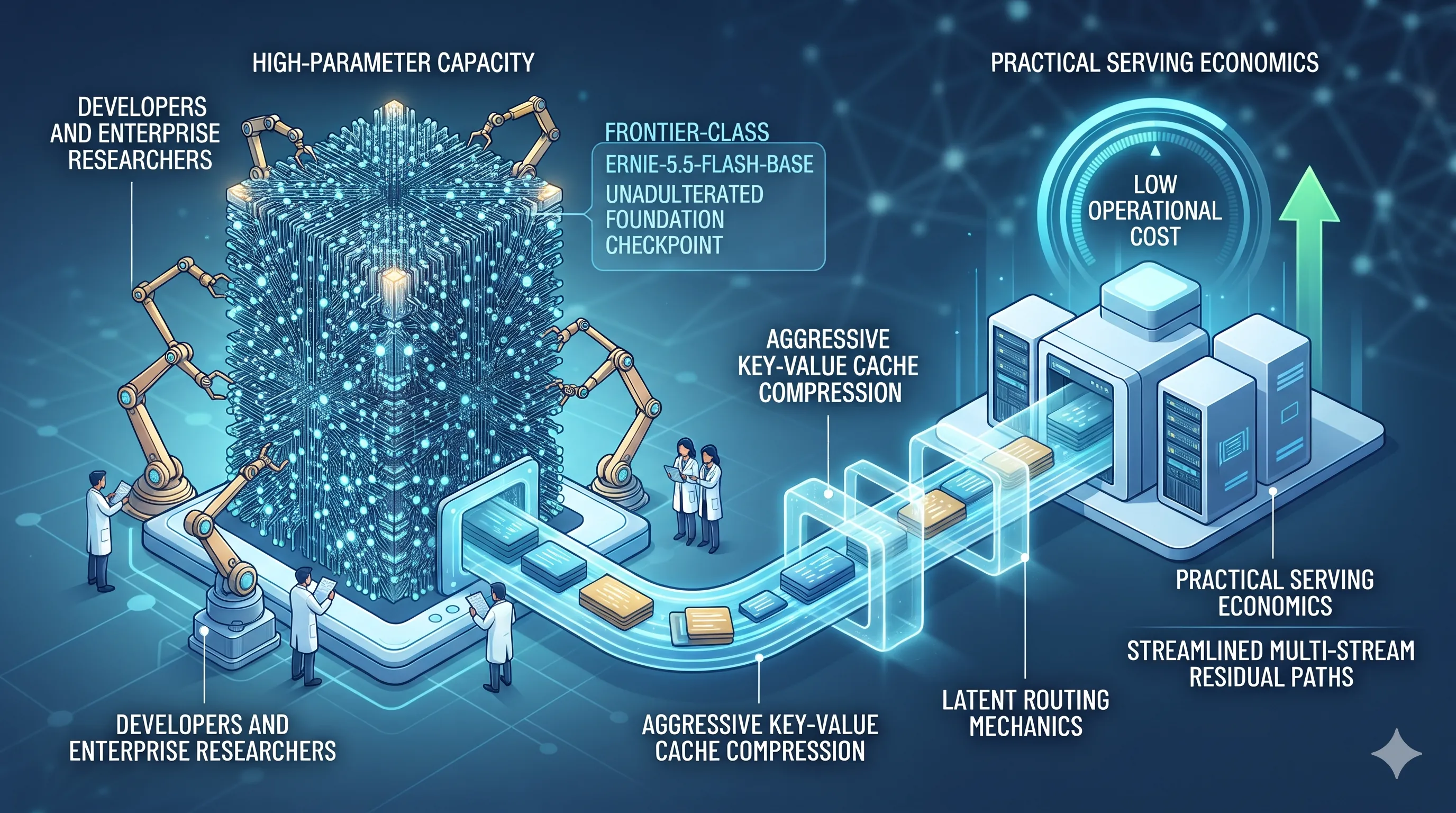
The open foundation model ecosystem has reached a pivotal juncture where high-parameter capacity must converge with operational cost efficiency. Today, Baidu introduced ERNIE-5.5-Flash-Base, offering developers and enterprise researchers direct access to a frontier-class base checkpoint engineered from the ground up to power next-generation adaptation workflows.
Rather than shipping a locked, chat-aligned system, this release delivers a pure continuation checkpoint captured immediately at the conclusion of extensive pre-training. By providing an unadulterated foundation, the release addresses an urgent industry demand for transparent, high-capacity models that organizations can tailor through domain-specific fine-tuning, reinforcement learning, and custom reasoning alignment.
Underpinned by sophisticated architectural refinements—including aggressive key-value cache compression, latent routing mechanics, and streamlined multi-stream residual paths—ERNIE-5.5-Flash-Base demonstrates that frontier-grade performance can coexist with practical serving economics, setting a potent new standard for open AI research.
1. ERNIE 5.5 Flash Base: Architecture Scale, Pre-Training Footprint, and Foundation Scope
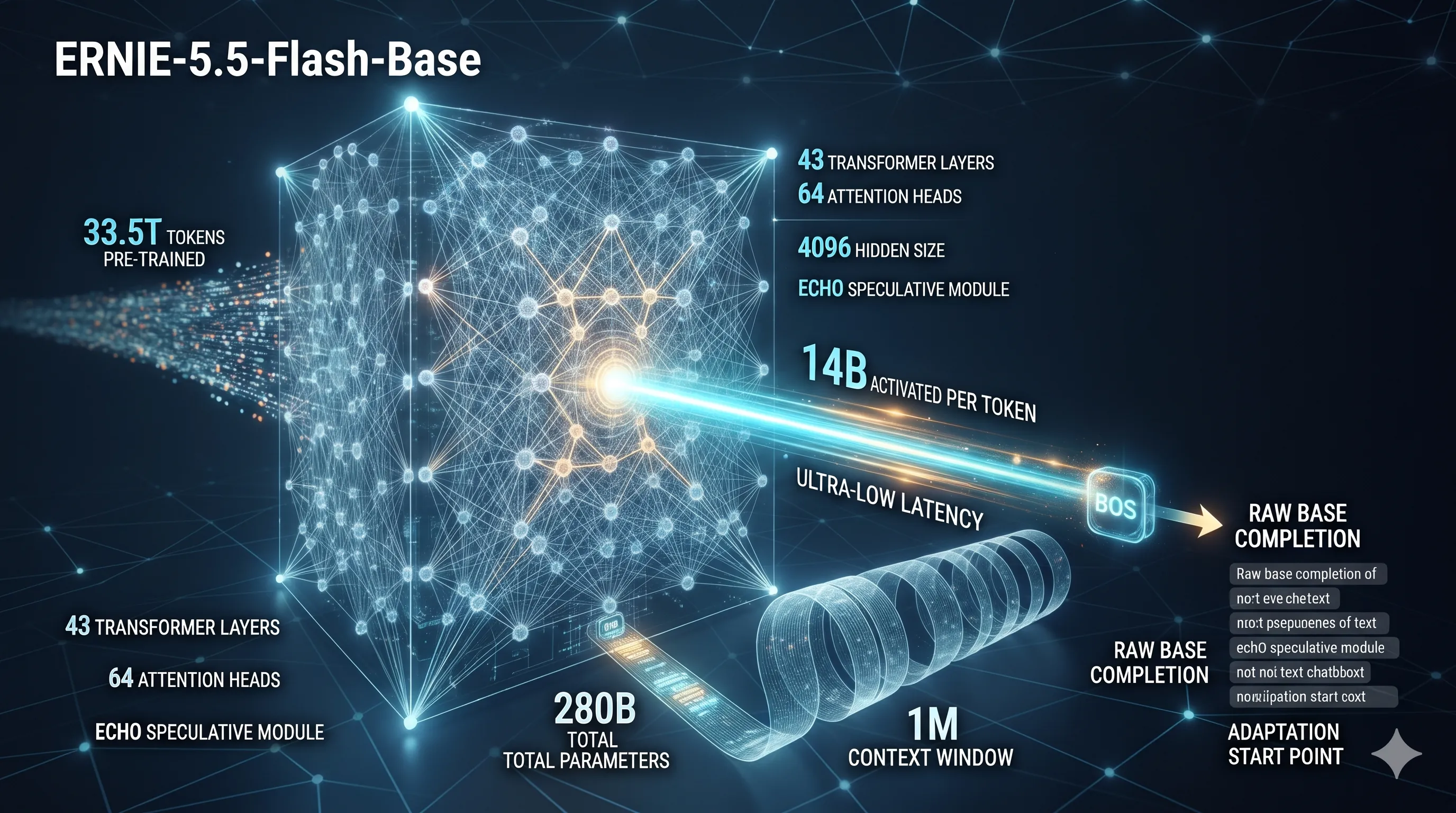
Baidu announced and released ERNIE-5.5-Flash-Base on November 5, 2026, marking a significant entry into large-scale foundational releases.This section evaluates the raw architectural footprint, compute scale, and functional scope defining the base model checkpoint within the ERNIE 5.5 Flash framework.
Parameter Allocation and Memory Packaging
ERNIE-5.5-Flash-Base features 280B total parameters, while the Hugging Face widget reads 286B total parameters.Despite this massive structural scale, runtime compute remains sparse, as only 14B parameters are activated per token.
The backbone network is engineered across 43 Transformer layers, operating with a hidden size of 4096 and 64 attention heads.
The release includes 0.36B ECHO parameters, which are excluded from the headline 280B total parameter count.
To accommodate diverse hardware configurations and production memory requirements, the model weights are distributed in both FP8 mixed-precision and BF16 safetensors formats.
| Specification Metric | Configuration Value |
|---|---|
| Total Parameters | 280B (Hugging Face widget reads 286B) |
| Activated Parameters per Token | 14B |
| ECHO Parameters | 0.36B (excluded from headline 280B count) |
| Transformer Architecture | 43 layers, 4096 hidden size, 64 attention heads |
| Pre-Training Token Budget | 33.5T tokens (pre-trained from scratch) |
| Native Pre-Training Context | Extended up to 128K tokens |
| Inference and Fine-Tuning Context Window | 1M tokens (1,048,576 tokens) |
| Distribution Formats | FP8 mixed-precision and BF16 safetensors |
Base Completion Boundaries and Context Scaling
ERNIE-5.5-Flash-Base was pre-trained from scratch on 33.5T tokens, reflecting an intensive data ingestion pipeline.During its initial training phases, the training context was extended up to 128K tokens.
For downstream deployment, the architecture supports a context window of up to 1M tokens (1,048,576 tokens) for fine-tuning and inference workflows.
The released checkpoint represents the exact end of pre-training, delivered completely without mid-training or post-training alignment passes.
As a consequence, the model functions strictly as a base continuation model rather than a conversational chatbot, and it does not follow instructions out-of-the-box.
Operational runtime configurations dictate that inputs require a BOS token at the start (configured via
add_special_tokens=True).The model serves primarily as an open starting point for domain adaptation, instruction tuning, and reinforcement learning research.
Clarifying the utility of this foundational checkpoint, the Baidu ERNIE Team stated: "A base model is valuable both for the capabilities that pre-training builds and for the starting point it offers for further training."
While this release establishes the initial unaligned foundation, a post-trained ERNIE 5.5 Flash model is planned to follow.
2. Dual-Attention Architecture: Heavily Compressed Attention and Dynamic Sparse Latents
With the release of ERNIE 5.5 Flash Base, Baidu introduces a hybrid attention framework that fundamentally restructures sequence processing across a 43-layer transformer backbone.This design splits processing between long-range compressed memory and dense latent interactions, striking an engineered balance between token representation fidelity and resource consumption.
HCA and MLA Layer Partitioning
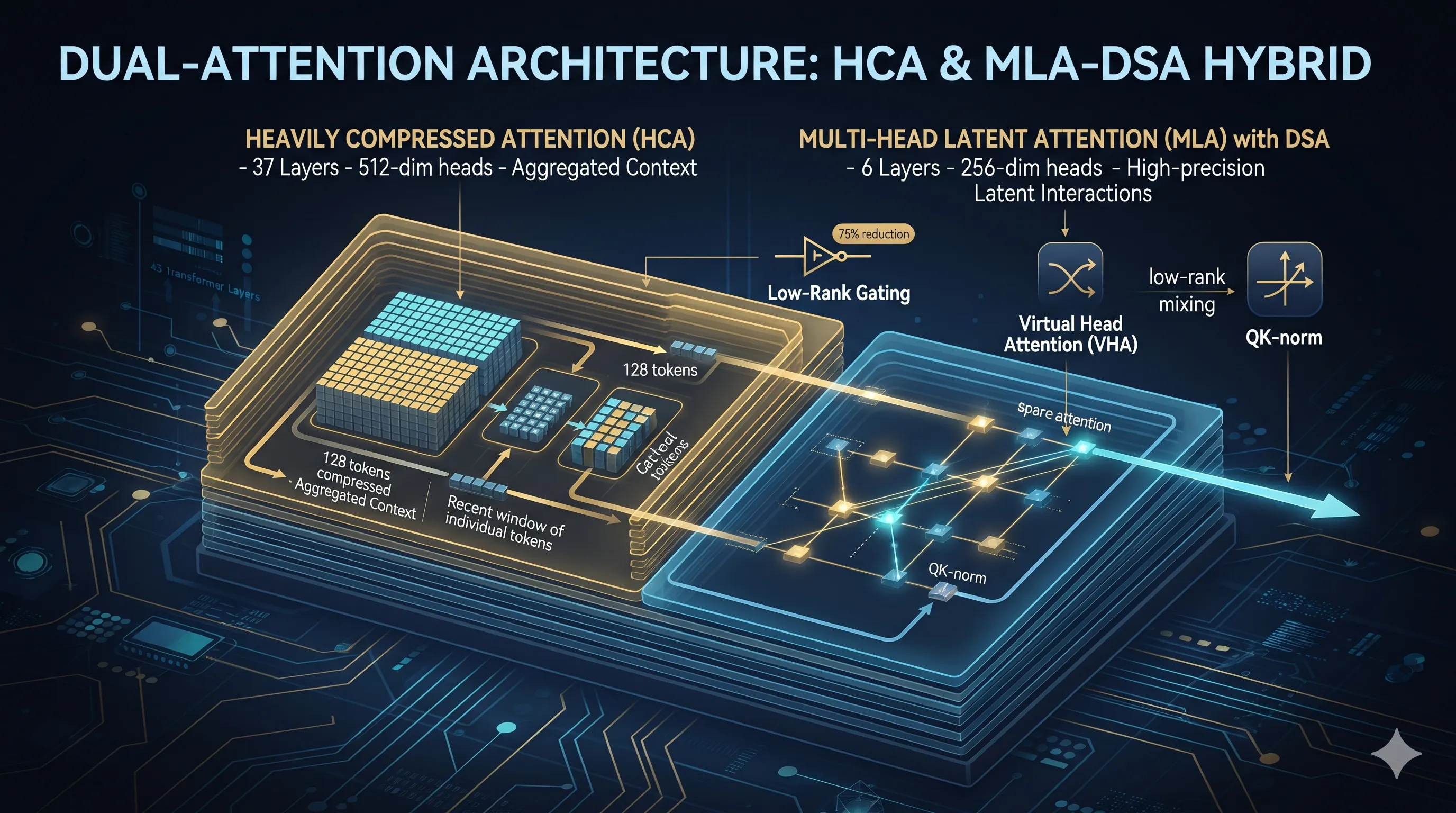
The structural execution of ERNIE 5.5 Flash Base is divided across 43 transformer layers using two distinct operational mechanisms: Heavily Compressed Attention (HCA) and Multi-head Latent Attention (MLA).A dominant allocation of 37 of the 43 layers runs HCA, while the remaining 6 layers operate MLA enhanced with Dynamic Sparse Attention (DSA).
Under this hybrid attention topology, wide heads are allocated to cheap compressed layers, while narrower heads are assigned to token-level MLA layers.
In terms of dimensional sizing, HCA layers utilize 512-dimensional heads to process aggregated contexts.
Conversely, MLA layers utilize 256-dimensional heads for query/key and value projections.
To minimize the memory footprint of long context traces, HCA compresses every 128 tokens into a single cached entry, pairing this aggregated representation alongside a short recent window.
| Architectural Parameter | Heavily Compressed Attention (HCA) | Multi-head Latent Attention (MLA) with DSA |
|---|---|---|
| Layer Count Allocation | 37 of the 43 layers | 6 of the 43 layers |
| Head Dimension | 512-dimensional heads | 256-dimensional heads (query/key and value) |
| Context & Compression Mechanism | Compresses every 128 tokens into a single cached entry plus a short recent window | Dynamic Sparse Attention (DSA) scoring past positions for top-k selection |
| Topology Role | Wide heads dedicated to computationally inexpensive compressed layers | Narrower heads dedicated to high-precision token-level latent layers |
DSA Indexing and Low-Rank Gating Dynamics
The 6 MLA layers leverage Dynamic Sparse Attention (DSA) to bypass exhaustive attention passes over long contexts.DSA implements a lightweight indexer that scores past positions to compute attention selectively over top-k positions, keeping per-query core attention cost constant regardless of sequence expansion.
Parameter efficiency across the attention projections is further enhanced through Low-Rank Gated Attention.
This mechanism reduces gate-projection parameters by 75% by computing gates directly from the low-rank query latent rather than full-dimensional representations.
In addition, ERNIE 5.5 Flash Base integrates Virtual Head Attention (VHA).
VHA adds a lightweight low-rank mixing step across heads with an identity skip connection, which is fully fused at inference time to avoid computational latency.
To maintain mathematical stability across both compressed and sparse operations, QK-norm is applied across every attention layer throughout the network.
3. MoE Structural Design: Multi-Router Latents, Manifold Connections, and Token Output Systems
The release of ERNIE 5.5 Flash Base by Baidu introduces a dense-sparse hybrid framework engineered for low-latency generation and high-capacity knowledge representation.Connecting directly to the core architectural foundation of ERNIE 5.5 Flash Base, this section analyzes the configuration of its sparse Mixture-of-Experts (MoE) layers, manifold residual connections, output distribution sharpening, and vocabulary tokenization.
Multi-Router Latent MoE and Load Balancing
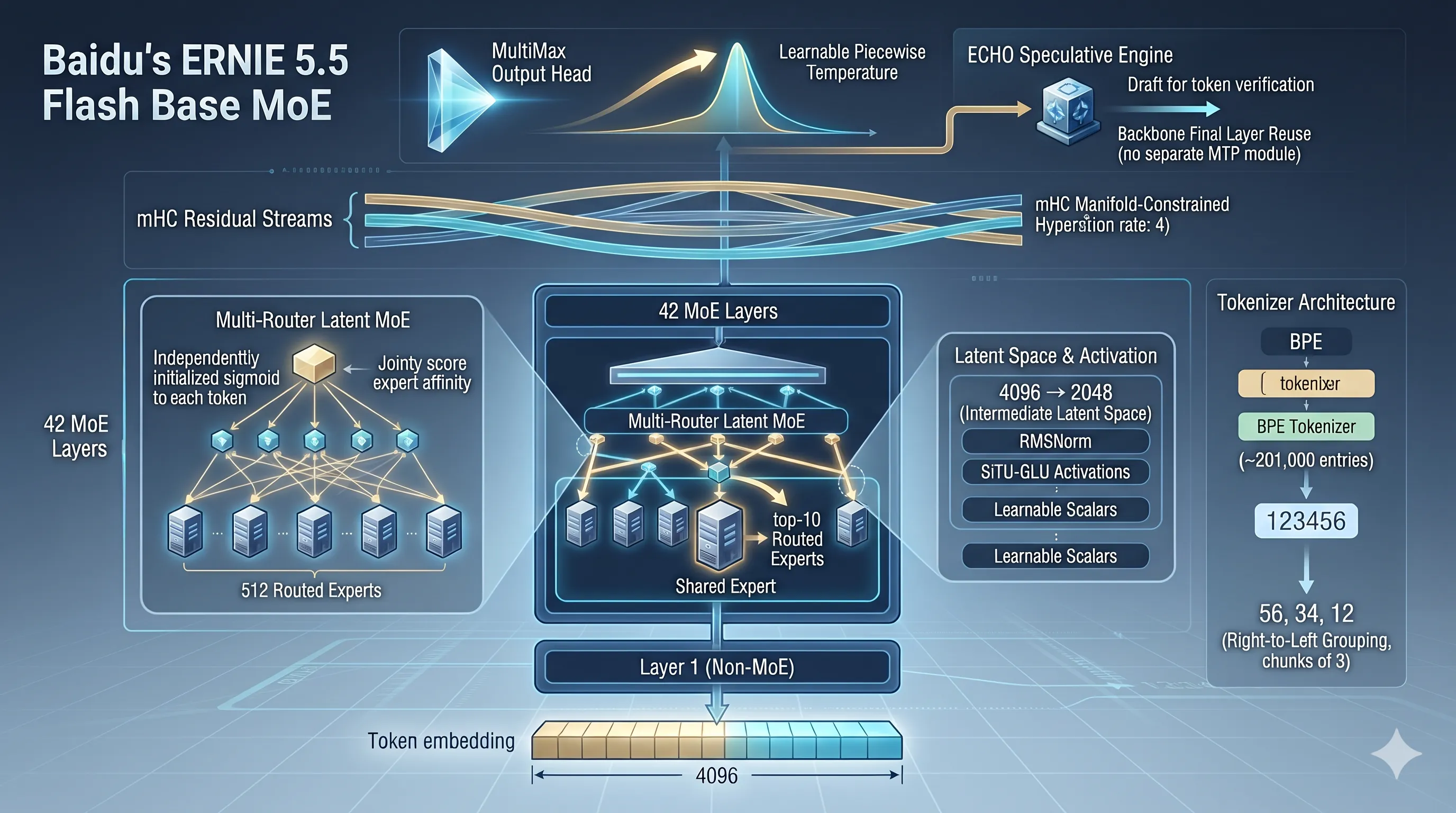
Within ERNIE 5.5 Flash Base, all layers except the first layer implement MoE feed-forward blocks, establishing a total of 42 MoE layers throughout the network.Each individual MoE layer contains 512 routed experts alongside 1 shared expert dedicated to modeling persistent background features.
During inference and training, the dispatch system applies a top-10 activation rule, selecting 10 routed experts per token while simultaneously executing the shared expert.
To restrict parameter footprint and memory movement, the model uses latent experts that project representations from 4096 dimensions down to a 2048-dimensional intermediate latent space.
Routing assignment deviates from standard softmax approaches through a Multi-Router design.
This system replaces the single gating router with several independently initialized sigmoid routers that score expert affinity jointly.
To prevent routing collapse and maintain balanced expert utilization, ERNIE 5.5 Flash Base deploys an auxiliary-loss-free, bias-corrected load balancing mechanism.
The expert computations adhere to the Stable LatentMoE design, inserting an RMSNorm layer immediately prior to up-projection.
Furthermore, the expert pathways rely on SiTU-GLU activations and integrate expert-specific learnable scalars to stabilize training across deeply scaled expert clusters.
mHC Residual Streams, ECHO Prediction, and Tokenization
Inter-layer information movement is structured through Manifold-Constrained Hyper-Connections (mHC).The mHC framework operates with an expansion rate of 4 parallel residual streams, expanding the connectivity manifold beyond conventional single-stream residual additions.
At the final transformation step, token probability calculation is driven by the MultiMax Output Head.
The MultiMax Output Head applies a learnable piecewise temperature within a Triton-fused cross-entropy kernel to sharpen the final output distribution during loss computation and sampling.
Speculative decoding capabilities are integrated directly via ECHO.
Rather than requiring separate Multi-Token Prediction (MTP) modules, ECHO reuses the backbone's final layer to predict future tokens and serve natively as the speculative decoding draft model.
Text and data ingestion are handled by a Byte-Pair Encoding (BPE) tokenizer with a vocabulary size of approximately 200,000 entries (around 201,000 entries).
For numeric representations, the tokenizer processes numbers right-to-left (R2L) in groups of up to three digits to maintain consistency across arithmetic sequences.
| Architecture Component | Dimensions & Configuration | Operational Mechanism |
|---|---|---|
| MoE Routing & Experts | 42 MoE layers (all layers except layer 1); 512 routed experts + 1 shared expert; top-10 active | Multi-Router configuration with independently initialized sigmoid routers; auxiliary-loss-free, bias-corrected load balancing |
| Latent Space & Activation | 4096 input dimensions projected to 2048-dimensional intermediate latent space | Stable LatentMoE framework; RMSNorm prior to up-projection; SiTU-GLU activations with expert-specific learnable scalars |
| Hyper-Connections (mHC) | Expansion rate of 4 parallel residual streams | Manifold-Constrained Hyper-Connections preserving multi-stream state continuity across the backbone |
| MultiMax Output Head | Final projection layer | Triton-fused cross-entropy kernel executing a learnable piecewise temperature to sharpen logit distributions |
| ECHO Speculative Engine | Backbone final layer reuse (no separate MTP module) | Draft model prediction recycling the terminal backbone layer for speculative decoding token verification |
| Tokenizer Architecture | BPE tokenizer with ~200,000 (around 201,000) vocabulary entries | Right-to-left (R2L) numerical grouping in chunks of up to three digits |
4. Pre-Training Data Pipeline and Distributed Muon Infrastructure
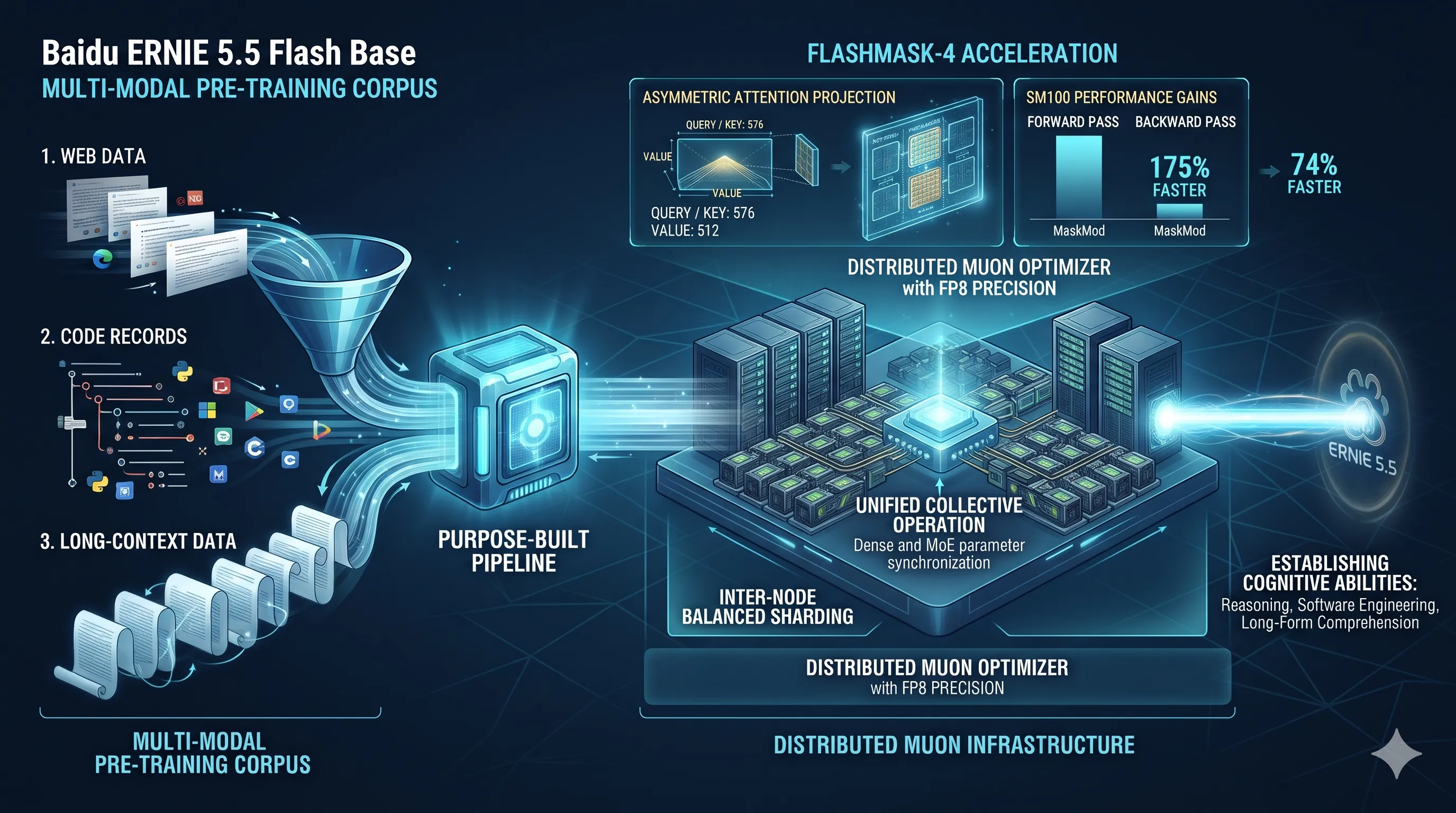
Connecting directly to the release of Baidu ERNIE 5.5 Flash Base, the model relies on a purpose-built pre-training data pipeline and a high-throughput distributed training architecture.To establish core reasoning, software engineering, and long-form comprehension abilities, the training workflow coordinates specialized data curation with distributed optimization and attention acceleration.
Multi-Modal Pre-Training Corpus Composition
The pre-training corpus for ERNIE 5.5 Flash Base is structured around three core data categories.First, the workflow incorporates filtered web data to build broad generalized knowledge and cross-domain linguistic competence.
Second, the corpus integrates code evolution records, including commit histories, pull requests (PRs), and continuous integration (CI) fixes, capturing step-by-step programming workflows and automated issue remediation.
Third, the pipeline embeds curated long-context data to ensure consistency and retrieval precision across expanded context sequences.
Distributed Muon Optimization and FlashMask-4 Acceleration
ERNIE 5.5 Flash Base was pre-trained using the Muon optimizer combined with FP8 mixed precision.To prevent memory bottlenecks during training, inter-node balanced sharding distributes Muon optimizer states evenly across GPUs, eliminating out-of-memory hotspots.
Additionally, distributed Muon streamlines communication by optimizing dense and mixture-of-experts (MoE) parameter synchronization into a single collective operation across identical inter-node GPU ranks.
Attention layer execution is accelerated via FlashMask-4, a specialized kernel engineered using CuTe-DSL.
FlashMask-4 provides hardware support for NVIDIA Hopper (SM90) and Blackwell (SM100) GPUs.
Architecturally, the kernel accommodates asymmetric attention projection sizes, supporting head dimensions up to 576 for query and key representations and up to 512 for value representations.
On NVIDIA SM100 hardware, FlashMask-4 delivers marked execution improvements over FlashAttention-4 MaskMod, achieving up to 175% faster execution in the forward pass and up to 74% faster execution in the backward pass.
| Specification / Metric | System Detail |
|---|---|
| Hardware Architecture Support | NVIDIA Hopper (SM90) and Blackwell (SM100) |
| Query / Key Maximum Head Dimension | 576 |
| Value Maximum Head Dimension | 512 |
| SM100 Forward Pass Speedup | Up to 175% faster compared to FlashAttention-4 MaskMod |
| SM100 Backward Pass Speedup | Up to 74% faster compared to FlashAttention-4 MaskMod |
| Optimizer & Precision Format | Distributed Muon optimizer with FP8 mixed precision |
| Distributed State Sharding | Inter-node balanced sharding to prevent out-of-memory hotspots |
| Collective Parameter Synchronization | Unified dense and MoE synchronization across identical inter-node GPU ranks |
5. Empirical Verification Profile: Code, Math, and Knowledge Benchmarks
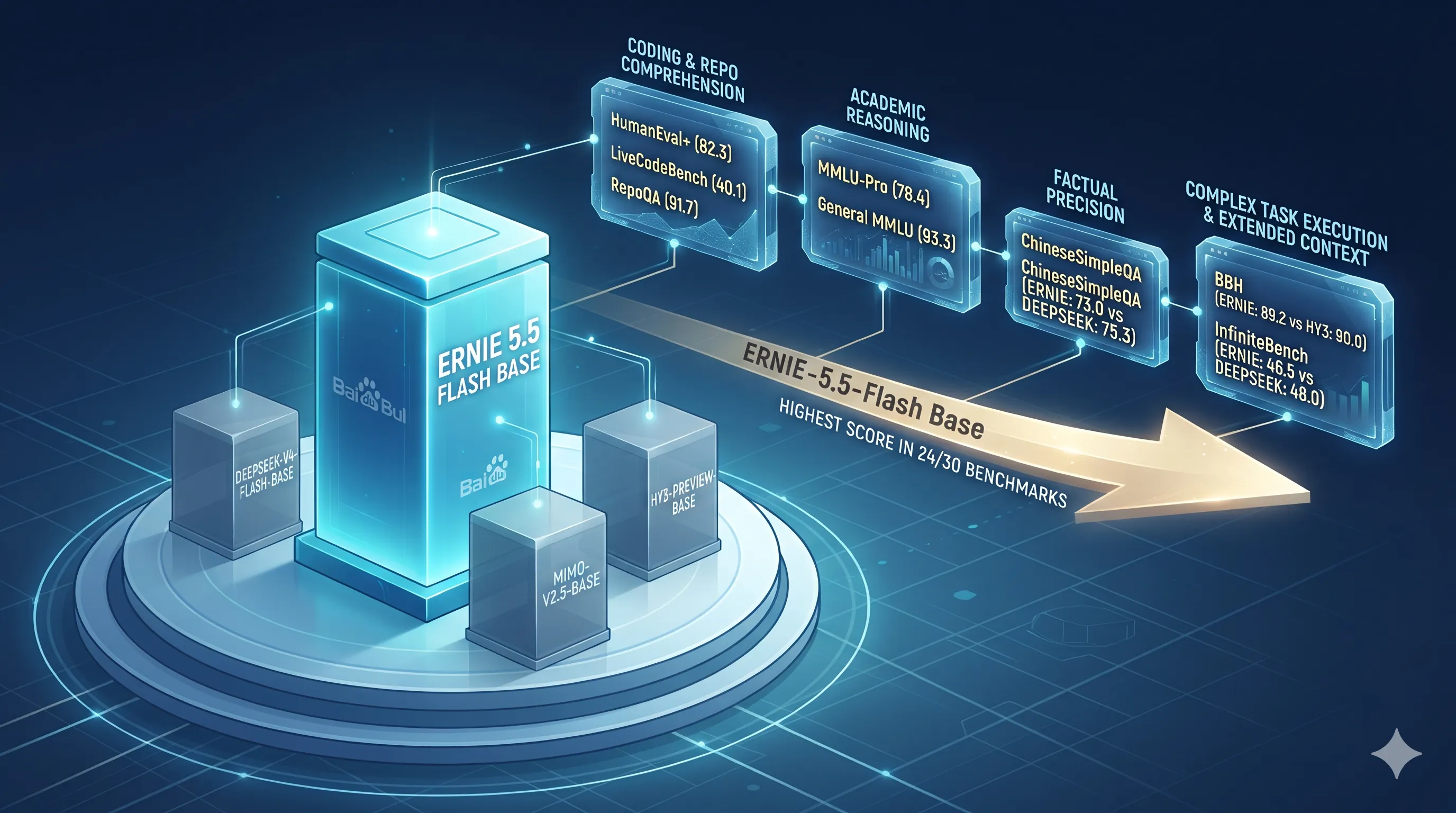
To substantiate the release of ERNIE 5.5 Flash Base, Baidu published comprehensive comparative evaluations measuring the foundational checkpoint against equivalent peer base models.This empirical verification connects directly to the core release by establishing where ERNIE-5.5-Flash-Base sits relative to competitive architectures, specifically DeepSeek-V4-Flash-Base (284B-A13B), Hy3-preview-Base (295B-A21B), and MiMo-V2.5-Base (310B-A15B).
According to Baidu's published evaluation documentation, all comparisons were conducted across identical prompts, few-shot examples, and standardized harnesses.
Core Reasoning and Coding Performance
Across the broader evaluation suite, ERNIE-5.5-Flash-Base achieved the highest score in 24 out of the 30 published benchmark rows.Its performance advantages are concentrated across code generation, complex software repository comprehension, and advanced multi-discipline reasoning.
On the HumanEval+ benchmark under a 1-shot Pass@1 setting, ERNIE-5.5-Flash-Base posted an 82.3 score, outpacing Hy3-preview-Base at 78.0, MiMo-V2.5-Base at 74.4, and DeepSeek-V4-Flash-Base at 69.5.
In dynamic code generation evaluated on LiveCodeBench (1-shot, Pass@1), ERNIE-5.5-Flash-Base recorded 40.1, leading Hy3-preview-Base (33.5), MiMo-V2.5-Base (32.4), and DeepSeek-V4-Flash-Base (31.9).
Repository-level code understanding evaluated via RepoQA (0-shot, Pass@1) demonstrated a 91.7 score for ERNIE-5.5-Flash-Base, narrowly leading Hy3-preview-Base at 91.3 while significantly surpassing DeepSeek-V4-Flash-Base (81.0) and MiMo-V2.5-Base (56.5).
In high-difficulty academic reasoning, ERNIE-5.5-Flash-Base scored 78.4 on MMLU-Pro (5-shot, Exact Match), contrasting against DeepSeek-V4-Flash-Base at 69.2, Hy3-preview-Base at 66.9, and MiMo-V2.5-Base at 65.7.
Additionally, the general MMLU score for ERNIE-5.5-Flash-Base was reported at 93.3.
| Benchmark (Setting) | ERNIE-5.5-Flash-Base | DeepSeek-V4-Flash-Base (284B-A13B) | Hy3-preview-Base (295B-A21B) | MiMo-V2.5-Base (310B-A15B) |
|---|---|---|---|---|
| HumanEval+ (1-shot, Pass@1) | 82.3 | 69.5 | 78.0 | 74.4 |
| LiveCodeBench (1-shot, Pass@1) | 40.1 | 31.9 | 33.5 | 32.4 |
| RepoQA (0-shot, Pass@1) | 91.7 | 81.0 | 91.3 | 56.5 |
| MMLU-Pro (5-shot, EM) | 78.4 | 69.2 | 66.9 | 65.7 |
| General MMLU | 93.3 | — | — | — |
Comparative Gaps and Self-Reported Evaluation Boundaries
While ERNIE-5.5-Flash-Base led across the majority of testing conditions, the disclosure reveals specific operational domains where competitor checkpoints retained an edge.In question answering and factual precision, ERNIE-5.5-Flash-Base scored 73.0 on ChineseSimpleQA, trailing behind DeepSeek-V4-Flash-Base's score of 75.3.
In complex chain-of-thought task execution evaluated on BBH with CoT, ERNIE-5.5-Flash-Base posted 89.2, falling short of Hy3-preview-Base at 90.0.
On end-to-end multi-tier software tasks evaluated under FullStackBench, ERNIE-5.5-Flash-Base recorded 54.6, trailing Hy3-preview-Base at 56.7.
Extended context testing similarly identified boundary limitations; on InfiniteBench, ERNIE-5.5-Flash-Base reached 46.5, trailing DeepSeek-V4-Flash-Base at 48.0.
Additional deficits appeared on INCLUDE-lite, where ERNIE-5.5-Flash-Base marked 79.5 against DeepSeek's 79.8, and on HELMET-Rerank, where ERNIE scored 56.2 while a competitor reached 60.0.
Technical evaluation of these metrics requires contextual prudence: all comparative benchmark numbers were generated and self-reported by Baidu without independent third-party reproduction at the time of release.
6. Open Weights Licensing: Commercial Thresholds, Geographic Exclusions, and IP Boundaries
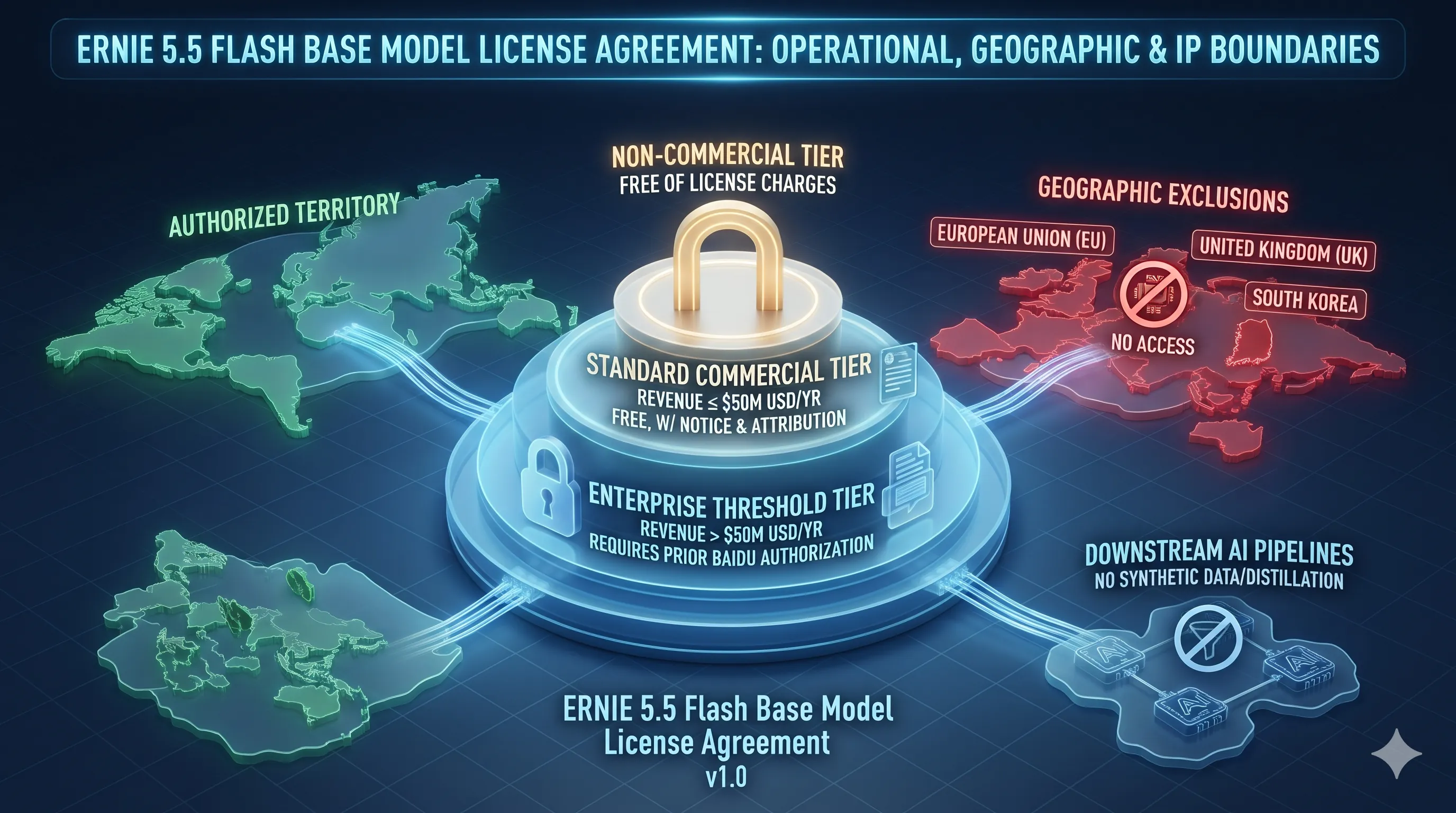
In assessing the release of ERNIE 5.5 Flash Base by Baidu, understanding the governing legal framework is essential for enterprise compliance and infrastructure planning.Baidu has released ERNIE 5.5 Flash Base under the custom ERNIE 5.5 Flash Base Model License Agreement v1.0, which outlines precise operational thresholds, notification requirements, geographic exclusions, and synthetic data boundaries.
Revenue Thresholds and Commercial Attribution Tiers
The ERNIE 5.5 Flash Base Model License Agreement v1.0 establishes distinct tracks for non-commercial and commercial deployments.Non-commercial use of the model is completely free of license charges.
For commercial deployments, use remains free provided that annual revenues from related products remain at or below $50 million USD.
To determine eligibility under this ceiling, the commercial revenue calculation aggregates all entities under common control, defined as maintaining greater than 50% equity or voting rights.
Deploying commercial products within or below this $50 million USD threshold is conditioned upon submitting a one-time notice and maintaining prominent Powered by ERNIE attribution across the product implementation.
If annual revenue from related products exceeds $50 million USD across the aggregated entities, commercial rights do not apply automatically, and prior written authorization from Baidu is mandatory.
| Licensing Tier | Revenue Threshold and Entity Scope | Terms, Notice, and Attribution Conditions |
|---|---|---|
| Non-Commercial | Not applicable | Free of license charges. |
| Standard Commercial Tier | Annual revenues at or below $50 million USD from related products (aggregating entities under >50% common control equity/voting rights) | Free of license charges; requires a one-time notice and prominent "Powered by ERNIE" attribution. |
| Enterprise Threshold Tier | Annual revenues exceeding $50 million USD from related products | Requires prior written authorization from Baidu. |
Territorial Exclusions and Distillation Restrictions
In addition to monetary thresholds, the ERNIE 5.5 Flash Base Model License Agreement v1.0 enforces strict geographic boundaries.The license strictly excludes the European Union, the United Kingdom, and South Korea from the authorized territory, precluding deployment and utilization within those jurisdictions.
Furthermore, the agreement imposes clear intellectual property and operational boundaries on downstream artificial intelligence pipelines.
It explicitly prohibits using licensed materials, derivative models, or generated outputs to train or improve unrelated AI/ML systems.
This legal limitation directly restricts developers and organizations from leveraging ERNIE 5.5 Flash Base outputs for synthetic data generation or model distillation aimed at secondary models.
7. Deployment Framework: Hardware Footprint, Serving Engines, and Fine-Tuning Execution
Baidu's release of ERNIE 5.5 Flash Base introduces concrete operational parameters for enterprise infrastructure planning, supervised fine-tuning (SFT), and production inference.Deploying the open-weights foundation model requires an accurate assessment of its raw memory footprint across precision formats, alongside specific distributed cluster orchestration for downstream adaptation.
Memory Footprint and Distributed SFT Infrastructure
Hosting the unquantized and quantized variants of ERNIE 5.5 Flash Base demands substantial high-bandwidth memory allocations across physical accelerators.When deployed in 16-bit brain floating-point precision (BF16), the model weights require approximately 560 GB of memory.
Utilizing 8-bit floating-point (FP8) precision compresses the memory requirement to approximately 280 GB, permitting denser deployment configurations across high-end accelerator clusters.
For supervised fine-tuning workflows, NVIDIA Megatron Bridge provides validated training recipes optimized for next-generation hardware topologies.
The official SFT recipe provisions a distributed cluster consisting of 16 nodes equipped with 4 NVIDIA GB300 GPUs per node (yielding a 64-accelerator pool).
These training recipes have been officially validated on NVIDIA Blackwell architectures, specifically GB200 and GB300 systems.
While NVIDIA Megatron Bridge components inherently support the older Hopper architecture, Hopper deployment remains not officially validated for ERNIE 5.5 Flash Base training workloads.
| Deployment Parameter | Specification / Topology | Validation Status |
|---|---|---|
| BF16 Weight Footprint | Approximately 560 GB memory | Production Standard |
| FP8 Weight Footprint | Approximately 280 GB memory | Production Standard |
| SFT Cluster Recipe (Megatron Bridge) | 16 nodes × 4 GB300 GPUs per node | Validated on Blackwell (GB200, GB300) |
| Hopper Architecture Support | Supported via Megatron Bridge components | Not officially validated |
Inference Serving Workflows via SGLang and vLLM
Production inference serving for ERNIE 5.5 Flash Base is supported natively through two primary runtime environments: SGLang and vLLM.When serving via vLLM, deployments require version 0.32.0 combined with Baidu's custom integration plugin.
Both serving engines necessitate dedicated launch flags to govern distributed execution, including tensor parallelism, attention data parallelism, or proprietary Mixture-of-Experts (MoE) backends.
Furthermore, network endpoints must expose and target the completions API endpoint (
/v1/completions) rather than chat completion endpoints for standard generation execution.To load ERNIE-5.5-Flash-Base directly using the Hugging Face Transformers pipeline for rapid baseline evaluation, instantiate the pipeline with the text-generation task:
from transformers import pipeline

pipe = pipeline("text-generation", model="baidu/ERNIE-5.5-Flash-Base")To establish high-throughput model serving in production using the SGLang CLI, initiate the server process with the target model path and network endpoints:
python3 -m sglang.launch_server \
    --model-path "baidu/ERNIE-5.5-Flash-Base" \
    --host 0.0.0.0 \
--port 30000Once an inference server such as vLLM is active, applications query the model via an OpenAI-compatible completions API using standard HTTP POST requests:
curl -X POST "http://localhost:8000/v1/completions" \
	-H "Content-Type: application/json" \
	--data '{
		"model": "baidu/ERNIE-5.5-Flash-Base",
		"prompt": "Once upon a time,",
		"max_tokens": 512,
		"temperature": 0.5
}'/v1/completions endpoint, specifying generation parameters including maximum token generation and sampling temperature.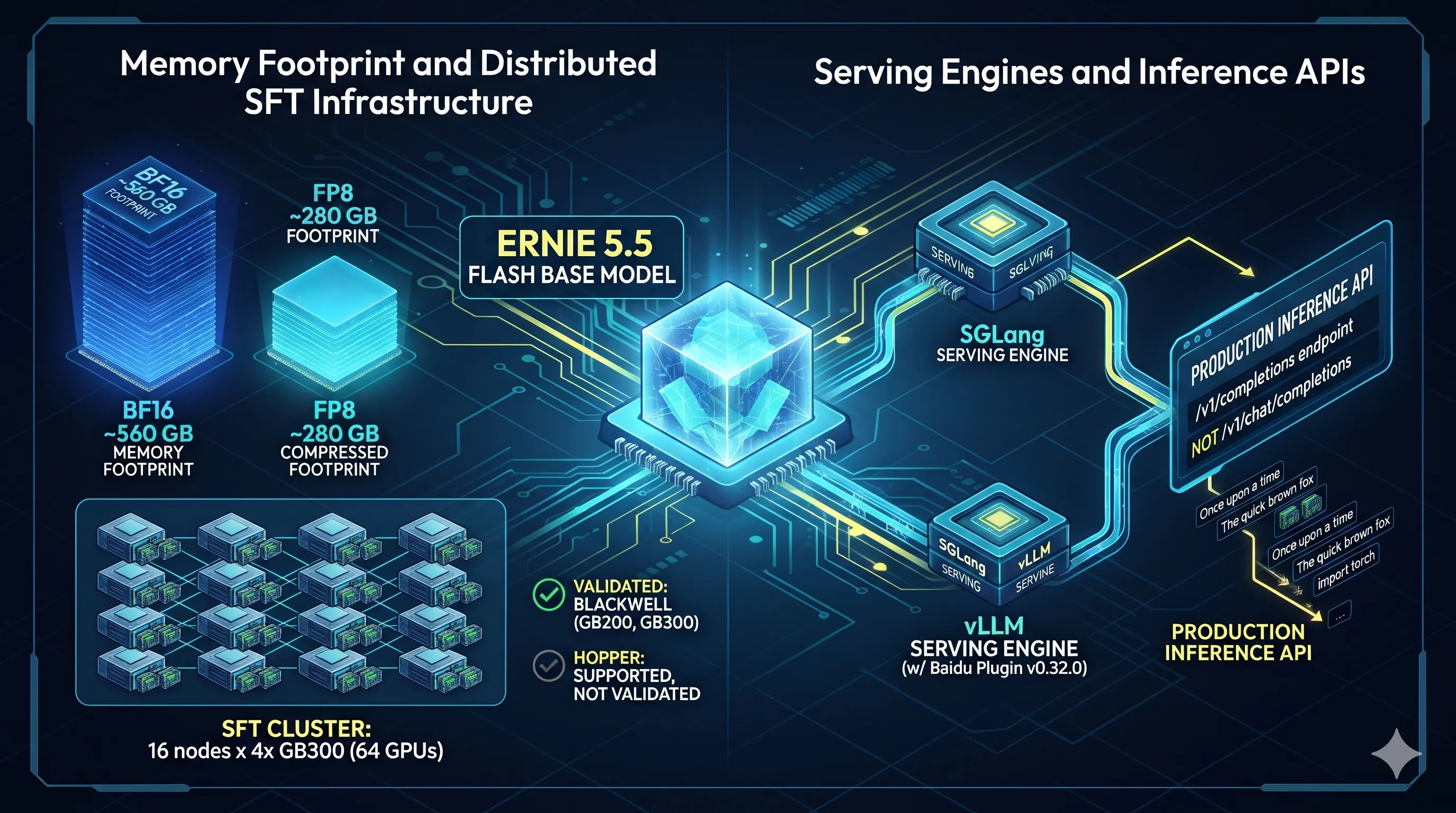
Related Posts
How Unsloth Desktop and Inkling 2 Mini Redefine Local AIDiscover how Unsloth Desktop, Qwen, and Inkling 2 Mini's looped transformer architecture make...

Serving 30B LLMs with 128k Context on 16GB GPUs: vLLM and llama.cpp Optimization GuideLearn how to deploy 30B parameter language models with 128k context windows on 16GB GPUs using...

A Guide to Building Sovereign AI Infrastructure with Mistral Self-Hosted StacksLearn how to build sovereign, air-gapped AI infrastructure using Mistral's self-hosted enterprise...
Generative AI may have assisted with research or drafting for this article. Topic selection, fact-checking, final wording, and publication remain the responsibility of DragonStone74. AI use disclosure