
How Nemotron 3.5 Parse Accelerates Vision-Language Document Extraction
🚀 Key Takeaways
- Streamlined Visual-Prefix Architecture: Merges a dynamic-resolution vision encoder with a compact causal decoder and grouped-query attention, eliminating encoder-decoder cross-attention overhead to accelerate autoregressive token generation.
- Speculative Decoding Acceleration: Pairs the primary model with a lightweight speculative draft engine to verify multi-token proposal blocks simultaneously, delivering substantial speedups in low-concurrency pipelines.
- Configurable Multi-Tier Parsing: Provides single-, double-, and triple-pass execution modes that establish an adaptable Pareto-optimal trade-off between maximum page throughput and fine-grained tabular precision.
- Deterministic Control-Token Steering: Replaces conversational instruction bloat with concise control-token sequences to toggle structural bounding boxes, classes, and markdown styling on demand without model re-runs.
- Verifiable Reward Reinforcement: Utilizes policy optimization trained against verifiable structural criteria to drastically curtail degenerative token looping and generation-limit truncation on dense visual pages.
- Broad Serving Ecosystem Compatibility: Integrates natively with leading serving stacks including vLLM, SGLang, and enterprise microservices to ensure flexible deployment across modern compute infrastructure.
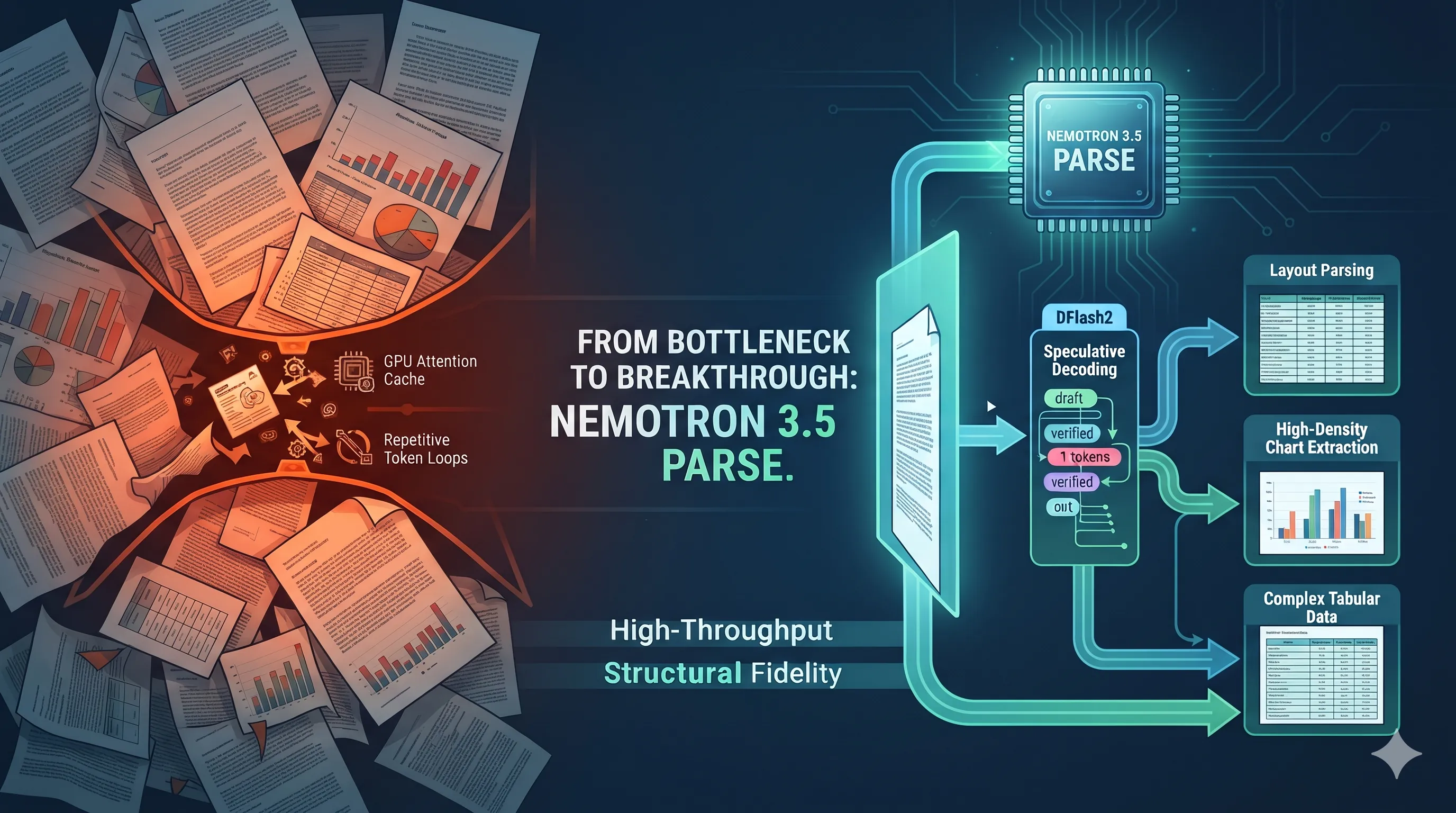
Automated visual document extraction has long represented one of the most demanding computational bottlenecks in enterprise retrieval-augmented generation and unstructured knowledge pipelines. Conventional vision-language architectures frequently trade responsiveness for comprehension, struggling to decipher high-density charts, rotated layouts, and complex tabular data without exhausting GPU attention cache memory or succumbing to endless repetitive token loops.
NVIDIA’s Nemotron 3.5 Parse directly addresses these architectural constraints by uniting parameter-efficient visual-prefix processing with cutting-edge speculative decoding. Rather than treating document parsing as a slow, monolithic task, the framework enables highly targeted extraction workflows that dynamically scale computational effort based on visual density, operational latency constraints, and downstream formatting requirements.
Examining these design breakthroughs reveals how Nemotron 3.5 Parse shifts the paradigm from brittle optical character recognition toward rapid, verifiable layout parsing. By mastering its controllable prompt sequences, multi-pass configurations, and specialized serving integrations, engineering teams can achieve exceptional throughput and structural fidelity across modern production workloads.
1. Architectural Optimizations Powering Low-Latency Vision-Language Decoding
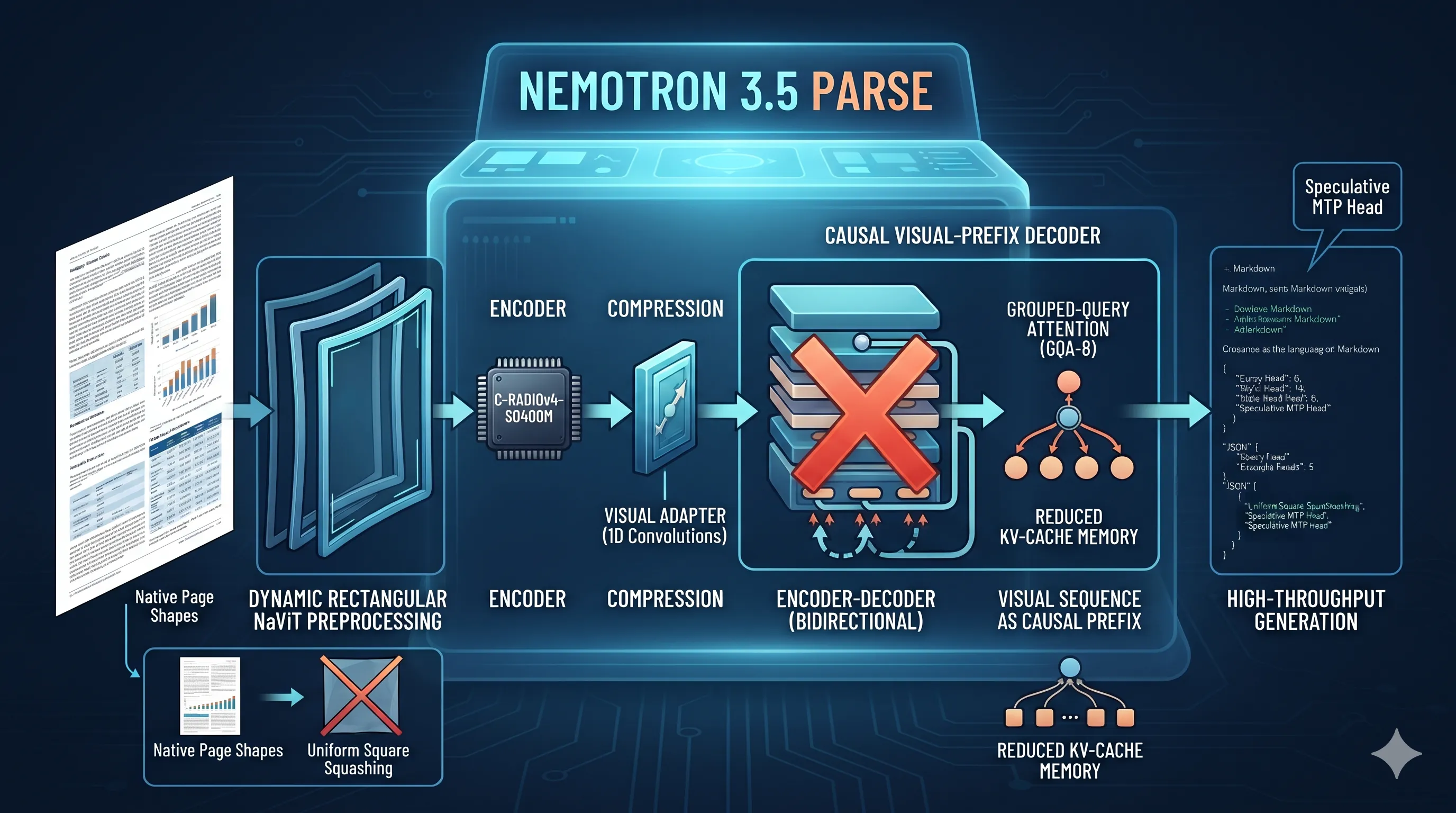
Understanding how Nemotron 3.5 Parse improves inference speed and flexibility begins with its streamlined architectural design.The model operates on a compact footprint of 630,800,496 unique trainable parameters (approximately 0.631B), carefully allocating capacity between high-resolution visual extraction and high-throughput text generation.
By purposefully departing from traditional heavy multimodal pipelines, this lightweight architecture minimizes computational overhead while maintaining structural fidelity.
C-RADIOv4-SO400M Encoder and NaViT Dynamic Rectangular Preprocessing
The visual perception foundation is built on the NVIDIA C-RADIOv4-SO400M (vit_so400m_patch16_224) vision encoder.To maximize document ingestion flexibility, the architecture integrates dynamic rectangular NaViT preprocessing.
Rather than forcing variable-aspect-ratio documents into standard square formats, dynamic rectangular NaViT preprocessing adapts directly to native page shapes without uniform canvas squashing.
Preserving uncompromised aspect ratios prevents the visual distortion of dense text lines, tabular boundaries, and micro-typography.
Following visual feature extraction, a dedicated visual adapter compresses vision latent sequences using 1D convolutions and normalization layers.
This 1D convolutional compression downsamples the latent token length, substantially diminishing the sequence burden delivered to downstream autoregressive stages.
Causal Visual-Prefix Decoder and GQA-8 Memory Reduction
For generation, Nemotron 3.5 Parse relies on a 10-layer mBART causal visual-prefix decoder.Unlike conventional multimodal frameworks that separate image and text representations across complex cross-attention layers, this decoder consumes the visual sequence directly as a causal prefix, eliminating encoder-decoder cross-attention.
Removing cross-attention eliminates the latency bottlenecks and operational overhead associated with bidirectional cross-layer interactions.
To streamline memory bandwidth during autoregressive decoding, grouped-query attention is configured with 16 query heads and 8 key/value heads (GQA-8).
This GQA-8 design reduces decoder key/value attention-cache memory requirements, directly increasing KV-cache throughput during long-context document generation.
The vocabulary infrastructure employs a tokenizer containing 72,505 vocabulary entries, with decoder embeddings padded to 72,512 rows for computational alignment.
Furthermore, the architecture includes a trained auxiliary one-step multi-token prediction (MTP) head bundled directly in the model weights to facilitate speculative execution and decoding efficiency.
| Architectural Component | Specification / Implementation Detail | Functional Latency and Memory Benefit |
|---|---|---|
| Total Trainable Parameters | 630,800,496 parameters (~0.631B) | Provides a compact, lightweight runtime footprint for low-latency serving. |
| Vision Encoder | NVIDIA C-RADIOv4-SO400M (vit_so400m_patch16_224) | Delivers specialized visual feature representations for document elements. |
| Visual Preprocessing | Dynamic rectangular NaViT preprocessing | Adapts to native document dimensions without uniform canvas squashing. |
| Visual Adapter | 1D convolutions and normalization layers | Compresses vision latent sequences to reduce input length for the decoder. |
| Text Decoder | 10-layer mBART causal visual-prefix decoder | Eliminates encoder-decoder cross-attention by treating visual tokens as a causal prefix. |
| Attention Mechanism | Grouped-Query Attention (16 query heads, 8 key/value heads / GQA-8) | Reduces decoder key/value attention-cache memory requirements during inference. |
| Tokenizer and Embeddings | 72,505 vocabulary entries (decoder embeddings padded to 72,512 rows) | Ensures broad vocabulary coverage aligned to GPU-friendly dimensional padding. |
| Auxiliary Head | Trained one-step multi-token prediction (MTP) head bundled in model weights | Enables multi-token forecasting routines directly from native weights. |
2. DFlash2 Speculative Decoding and High-Concurrency Throughput Scaling
This section directly examines how Nemotron 3.5 Parse achieves substantial inference speed acceleration and operational flexibility by pairing with the DFlash2 draft model for speculative decoding.Speculative Verification Mechanics with the 89.3M Draft Model
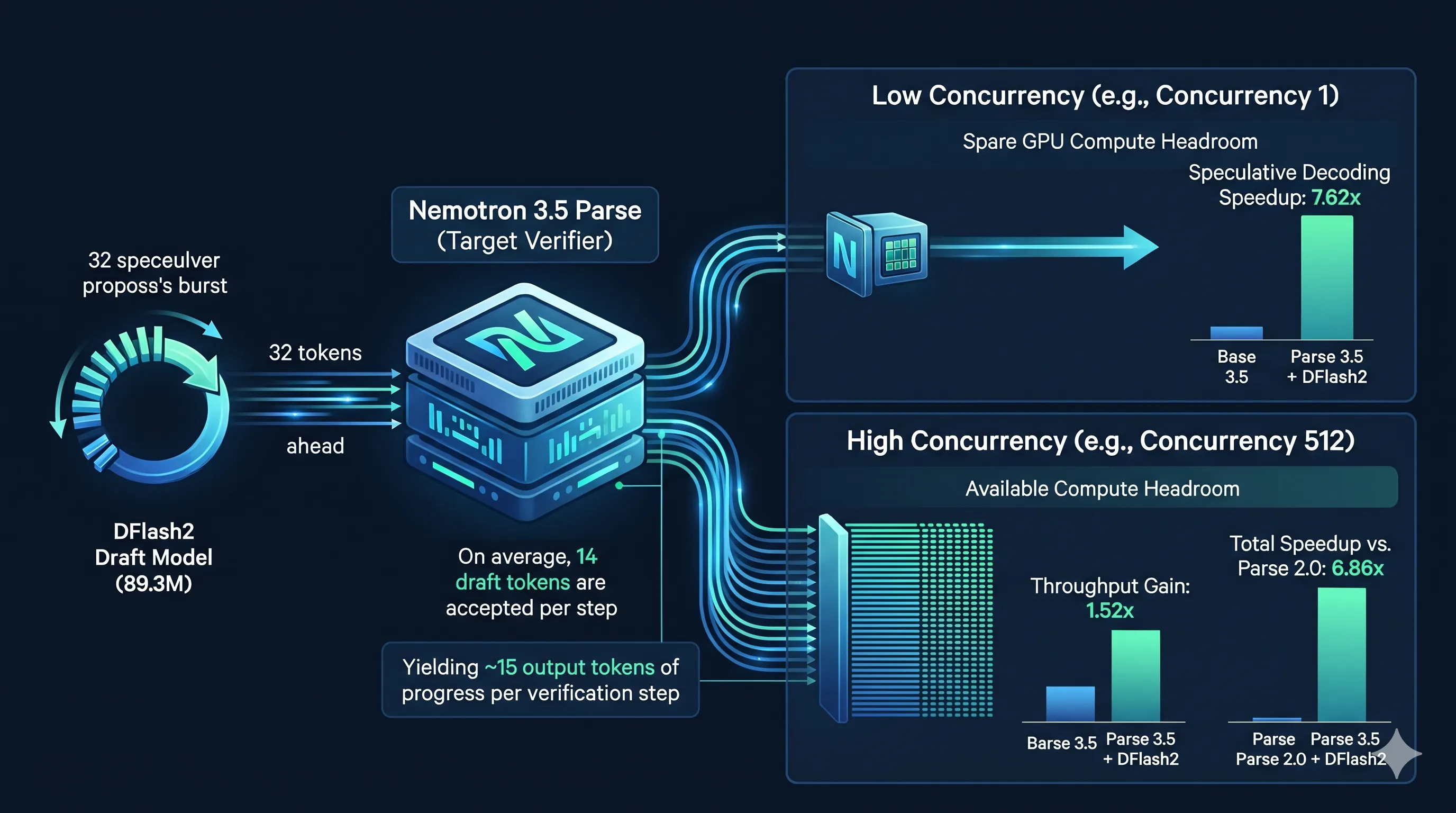
The speculative decoding architecture pairs a compact 89.3M parameter DFlash2 draft model directly alongside Nemotron 3.5 Parse.In this dual-model pipeline, Nemotron 3.5 Parse acts as the target verifier, evaluating speculative proposals generated by the DFlash2 draft model in parallel verification passes.
During each forward cycle, DFlash2 proposes up to 32 tokens ahead per verification step.
Nemotron 3.5 Parse evaluates these proposed token sequences simultaneously rather than generating tokens sequentially one by one.
On average, the target verifier accepts approximately 14 draft tokens per step, yielding roughly 15 output tokens of progress per verification step when accounting for the verifier's own token emission.
This mechanism delivers its highest relative throughput speedup when GPU utilization is low between incoming requests, allowing the architecture to convert spare compute headroom into lower latency per page.
Throughput Scaling Benchmarks Across Concurrency Tiers
Empirical benchmarks demonstrate how speculative decoding transforms document processing efficiency across various hardware setups and workload profiles.On a single NVIDIA H100 GPU, Nemotron 3.5 Parse delivers 10.5 pages per second while achieving a 75.20 ParseBench score.
When evaluated on a single NVIDIA H200 in BF16 precision, throughput gains depend heavily on concurrency levels.
At concurrency 1, speculative decoding via DFlash2 delivers a 7.62x throughput increase compared to Nemotron 3.5 Parse running without speculation.
As concurrency expands to 512 parallel streams on the single NVIDIA H200 in BF16, throughput reaches 20.44 pages/s with DFlash2, compared to 13.48 pages/s for base Nemotron 3.5 Parse without speculation and 2.98 pages/s for Parse 2.0.
This represents a 1.52x throughput increase at concurrency 512 for DFlash2 over unassisted Parse 3.5.
Compared against the previous-generation Parse 2.0 baseline at concurrency 512, Nemotron 3.5 Parse achieves 4.53x throughput in its base configuration and 6.86x throughput when accelerated with DFlash2.
These throughput gains taper at very high concurrencies because the GPU compute pipeline becomes saturated with dense verification batches, leaving less underutilized compute for speculative acceleration.
| Model Configuration | Hardware & Precision | Concurrency Level | Throughput (Pages/s) | Relative Speedup / Baseline Metric |
|---|---|---|---|---|
| Parse 2.0 | NVIDIA H200 (BF16) | Concurrency 512 | 2.98 pages/s | 1.00x (Baseline) |
| Nemotron 3.5 Parse (Base, No Speculation) | NVIDIA H200 (BF16) | Concurrency 1 | - | 1.00x (Base Concurrency 1) |
| Nemotron 3.5 Parse + DFlash2 (89.3M) | NVIDIA H200 (BF16) | Concurrency 1 | - | 7.62x vs. Parse 3.5 Base |
| Nemotron 3.5 Parse (Base, No Speculation) | NVIDIA H200 (BF16) | Concurrency 512 | 13.48 pages/s | 4.53x vs. Parse 2.0 |
| Nemotron 3.5 Parse + DFlash2 (89.3M) | NVIDIA H200 (BF16) | Concurrency 512 | 20.44 pages/s | 1.52x vs. Parse 3.5 Base (6.86x vs. Parse 2.0) |
| Nemotron 3.5 Parse | Single NVIDIA H100 | Standard | 10.5 pages/s | 75.20 ParseBench score |
3. Configuring Single, Double, and Triple-Pass Parsing for Latency-Accuracy Tradeoffs
Document extraction workloads rarely present a uniform requirement across ingestion pipelines, making runtime architectural flexibility essential to maximizing inference speed and efficiency.In Nemotron 3.5 Parse, document processing is structured around a configurable multi-pass execution architecture that allows operators to balance parsing precision against processing throughput.
By structuring the pipeline into single, double, and triple-pass runs, the model establishes a Pareto-optimal frontier between inference latency and extraction accuracy across varied operational demands.
The Pareto-Optimal Parsing Frontier: Single vs. Multi-Pass Execution
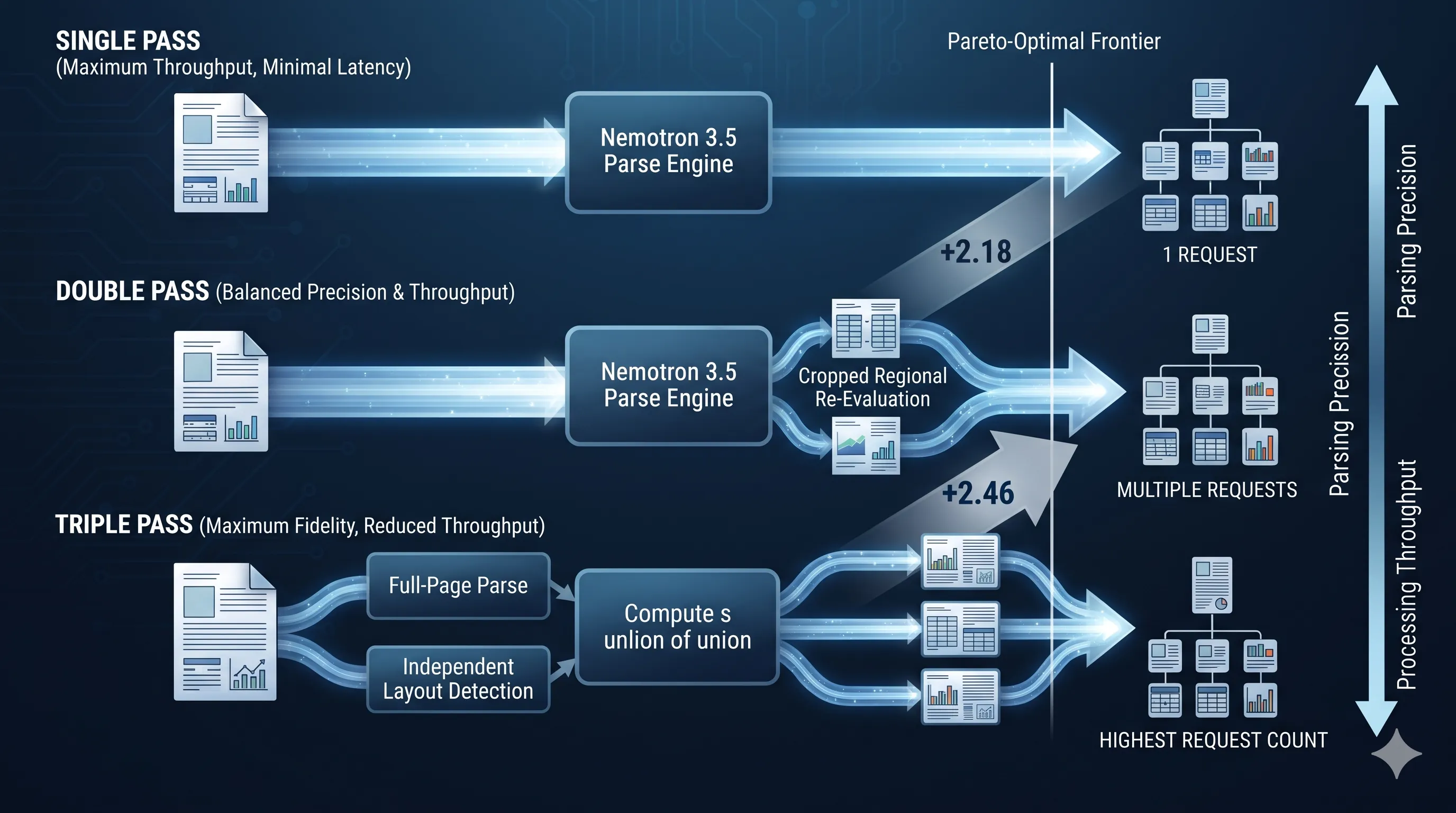
The operational baseline of the pipeline is Single Pass execution.In a single pass, Nemotron 3.5 Parse processes the entire document page in one forward request, extracting layout, text, tables, and charts simultaneously to deliver maximum processing throughput.
This configuration is ideal for high-volume ingest pipelines where low latency and computational speed take precedence over granular visual re-evaluations.
When complex visual structures demand deeper extraction fidelity, multi-pass configurations push accuracy further along the Pareto frontier.
Double-pass parsing builds upon the single-pass baseline by identifying tables and charts directly on the full-page output, cropping those specific sub-regions, processing them at high detail in targeted secondary requests, and merging the refined outputs back into the page-level representation.
Evaluated across 2,078 ParseBench pages, this targeted re-parsing adds 2.18 ParseBench points over the single-pass configuration.
For scenarios where missing edge-case structural boundaries cannot be tolerated, Triple-pass parsing introduces parallel regional validation.
Triple pass runs full-page parsing and independent layout detection concurrently.
It then computes the union of table and chart regions detected across both paths and dispatches detailed refinement passes over this union.
Across the identical benchmark of 2,078 ParseBench pages, triple-pass parsing adds 2.46 ParseBench points over single pass, reaching a 75.20 headline score.
However, moving through these tiers involves a distinct operational tradeoff.
Because additional parsing passes require cropping and isolated secondary evaluations, they trigger multiple requests per page.
This directly trades system throughput for extraction precision, necessitating deliberate configuration based on document difficulty and latency budgets.
| Parsing Configuration | Execution Workflow | Throughput & Latency Tradeoff | ParseBench Accuracy Gain | Benchmark Headline Score |
|---|---|---|---|---|
| Single Pass | Parses entire page once for layout, text, tables, and charts in a single request. | Maximum processing throughput; minimal inference latency. | Baseline | Baseline |
| Double Pass | Full-page parse locates tables and charts, crops identified regions, re-parses them at high detail, and merges refinements. | Triggers multiple requests per page; trades throughput for enhanced visual structural precision. | +2.18 ParseBench points over single pass | Baseline + 2.18 |
| Triple Pass | Concurrently runs full-page parsing and independent layout detection, then refines the union of detected table and chart regions. | Highest request count per page; lowest throughput in exchange for maximum extraction fidelity. | +2.46 ParseBench points over single pass | 75.20 headline score (across 2,078 pages) |
Cropping, Refinement Merging, and Guarded Replacement Policies
The practical effectiveness of double and triple-pass execution rests on how regional crops are parsed and reintegrated into the overarching document tree.When high-detail crops of tables and charts complete inference, the refinement merging layer reconciles the focused crop predictions with the initial full-page extraction canvas.
By default, refinement merging is configured to preserve alternate table and chart hypotheses.
Retaining alternate structural hypotheses ensures downstream consumers have access to candidate bounding boxes and structural alternatives when structural ambiguities exist across overlapping regions.
For extraction systems requiring strict deterministic reconciliation, the pipeline provides an optional guarded merge policy.
When enabled, this guarded merge policy enforces conservative replacement criteria.
Rather than automatically writing over page elements, the guarded merge engine arbitrates between the base full-page extraction and the cropped refinement, applying selective replacement only when the secondary pass satisfies defined spatial and structural conditions.
This mechanism prevents isolated crops from corrupting broader document layouts while capturing the visual accuracy necessary to attain peak ParseBench scores.
4. Controllable Task Control-Tokens and Zero-Inference Postprocessing Pipelines
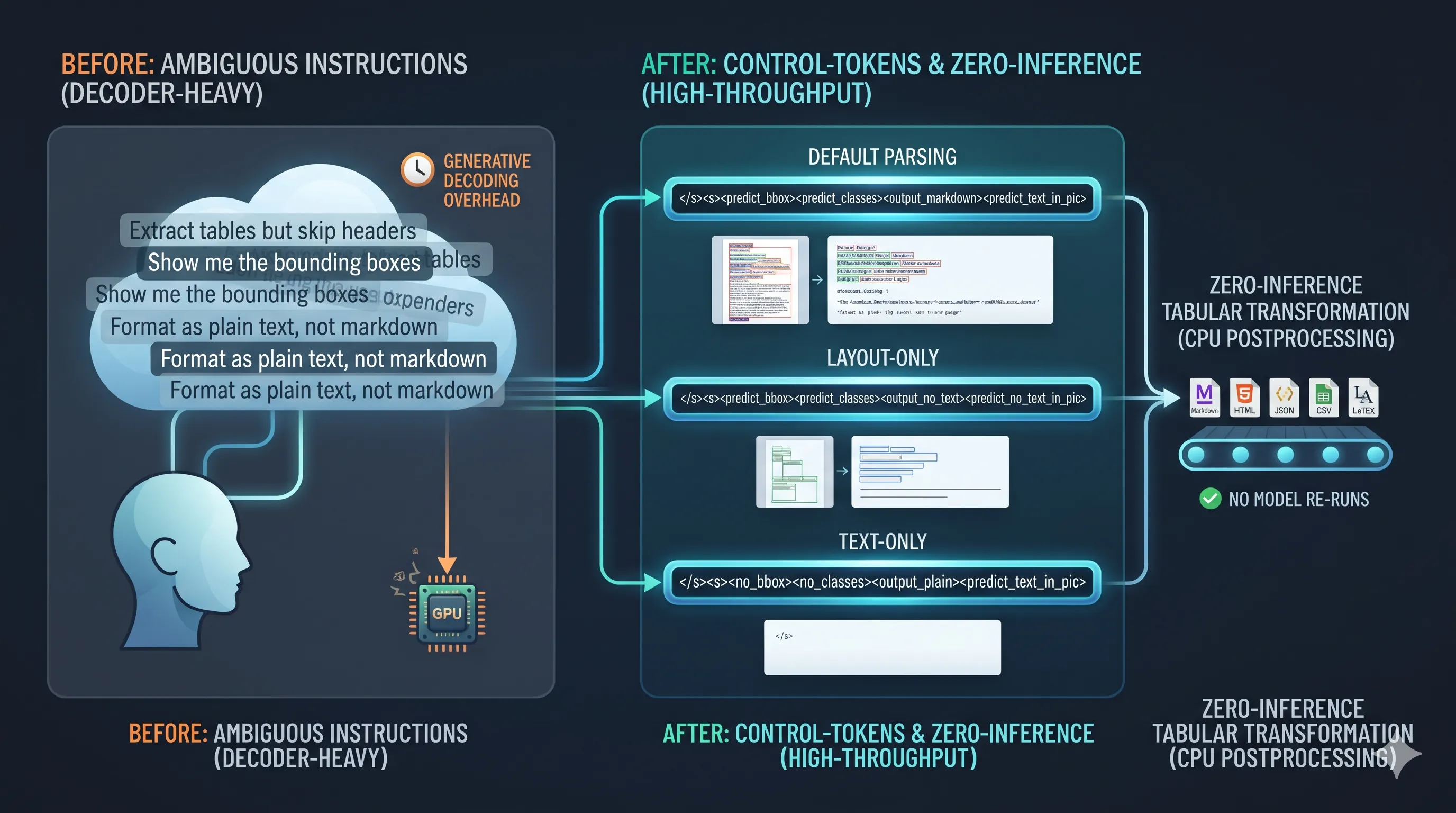
Nemotron 3.5 Parse improves inference speed and operational flexibility by shifting execution away from slow, ambiguous natural language chat instructions and toward deterministic prefix tokens and decoupled zero-inference transformations.Rather than relying on conversational system prompts that require generative decoding overhead, the model governs extraction modes entirely through explicit control-token prefix sequences.
Prefix Control-Token Sequences for Targeted Extraction
Nemotron 3.5 Parse replaces free-form natural language instructions with fixed control-token prefix prompts.These prefix tokens instruct the architecture directly on which modalities to extract, bypass, or format before generation begins.
Engineers can selectively toggle structural bounding box extraction, class categorization, and the target markup representation.
For instance, structural classes can be toggled via
<predict_classes> or suppressed using <no_classes>.Similarly, the output formatting representation can be switched between structured Markdown via
<output_markdown> and plain text using <output_plain>.When tokenizing input prefixes, automatic special-token insertion must be explicitly disabled in the tokenizer to prevent breaking the strict sequence order of the control tokens.
It is also critical to recognize that altering the task prompt sequence from the standard default configuration invalidates full-structure benchmark evaluations.
| Extraction Mode | Control-Token Prefix Sequence | Functional Behavior |
|---|---|---|
| Default Parsing | </s><s><predict_bbox><predict_classes><output_markdown><predict_text_in_pic> |
Extracts bounding boxes, structural classes, Markdown formatting, and embedded image text. |
| Layout-Only | </s><s><predict_bbox><predict_classes><output_no_text><predict_no_text_in_pic> |
Extracts bounding boxes and layout classes while suppressing all document text and image text decoding. |
| Text-Only | </s><s><no_bbox><no_classes><output_plain><predict_text_in_pic> |
Suppresses bounding boxes and class hierarchies, returning plain text with embedded image text. |
Post-Inference Tabular Format Transformation Without Model Re-Runs
Flexibility is further amplified after the initial forward pass through zero-inference postprocessing routines.Once Nemotron 3.5 Parse generates an initial tabular representation, downstream workflows often require varying schema formats depending on the consumer system.
Rather than re-invoking GPU inference or running separate model passes, table outputs can be dynamically transformed during CPU postprocessing into Markdown, HTML, JSON, CSV, or LaTeX.
This zero-inference postprocessing pipeline is built to retain structural fidelity without degrading parsed content.
The cleanup routines preserve complex cell spans, maintain native model reading order, and retain blank cells without collapsing table geometries.
Furthermore, the transformation pipeline provides configuration flags to disable automatic header inference or prevent arbitrary numeric splitting during export.
This architecture cleanly separates neural visual extraction from downstream syntactic conversion, ensuring high pipeline throughput.
5. RLVR Post-Training with GRPO: Mitigating Generation Loops and Improving Decoding
In visual document parsing, inference speed and operational flexibility suffer drastically when a model enters repetitive decoding loops or truncates structural data.Within the context of how Nemotron 3.5 Parse improves inference speed and flexibility, Reinforcement Learning with Verifiable Rewards (RLVR) acts as a pivotal post-training mechanism to stabilize token generation without sacrificing formatting variability.
By replacing rigid sequence matching with objective verification criteria, the model learns to complete complex parsing passes efficiently without stalling inference pipelines.
Group Relative Policy Optimization and Verifiable Reward Functions
Reinforcement learning with verifiable rewards (RLVR) utilizes Group Relative Policy Optimization (GRPO) to enforce valid sequence completions across visual extraction workloads.Rather than restricting the policy to replicate an identical reference string, GRPO evaluates sampled completions against targeted, verifiable reward components.
These reward functions systematically evaluate critical structural and semantic elements:
- Text Fidelity: Assessing the precise transcription of extracted characters and text segments.
- Bounding Box Accuracy: Validating exact coordinate alignment against target visual regions.
- Table Structure: Checking the preservation of structural grid layouts and cell delimiters.
- Chart Values: Verifying numeric data points and categorical labels contained within visual figures.
- Sequence Termination: Ensuring proper emission of end-of-sequence markers to close parsing payloads cleanly.
This balance ensures that Nemotron 3.5 Parse preserves the flexibility to represent varied document layouts while preventing runaway generation behavior.
Eliminating Repetition Loops and 9,000-Token Generation Cutoffs
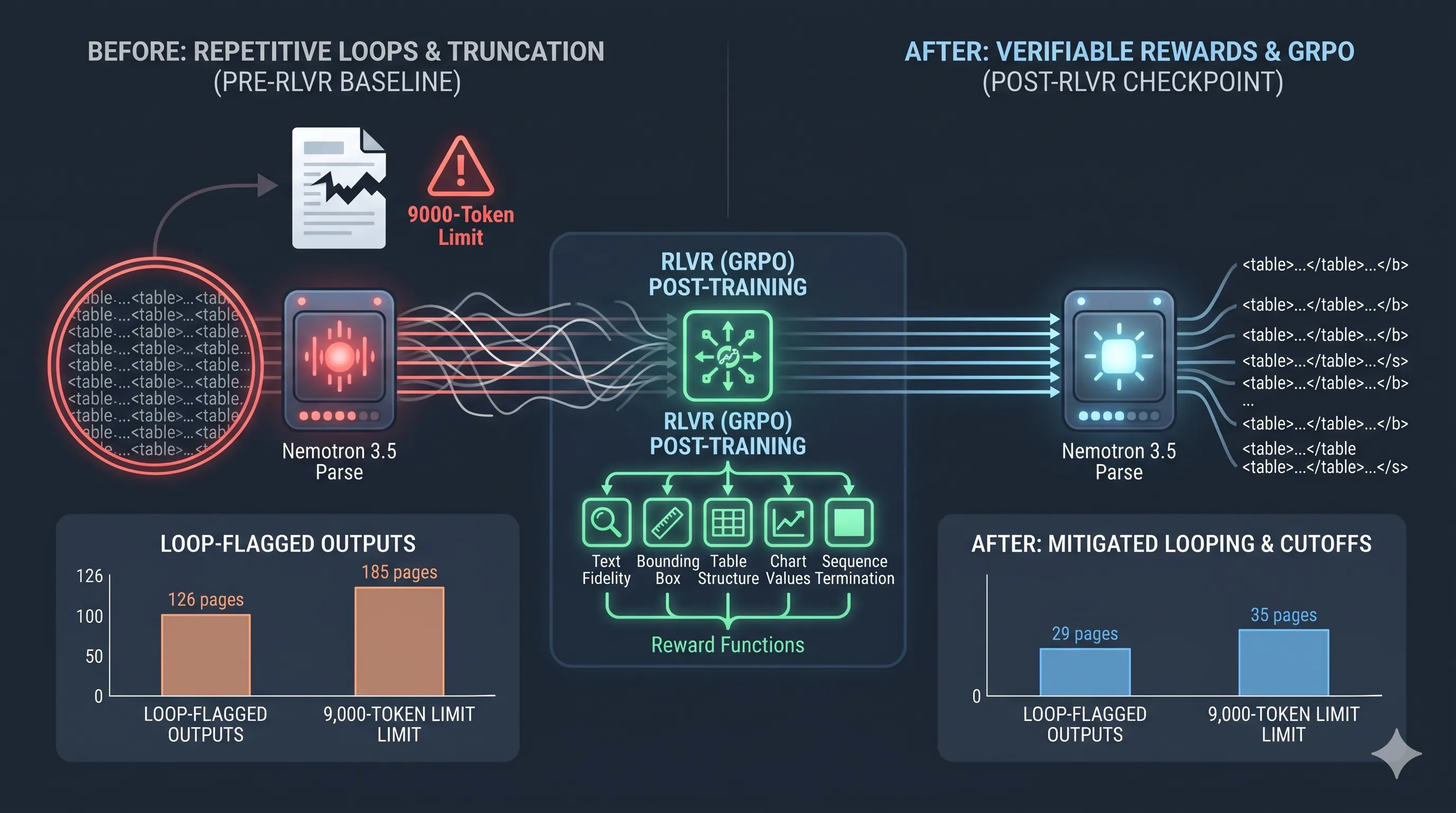
Unchecked generation loops severely throttle document processing pipelines by wasting compute and causing truncation cutoffs.Post-training with RLVR directly resolves these failure modes by training the model to terminate parses cleanly once all verified visual components are transcribed.
In comparative development checkpoint evaluations, applying RLVR with GRPO reduced loop-flagged outputs from 126 down to 29 pages, achieving an approximate 77% reduction in looping behavior.
Concurrently, document pages that stalled and hit the 9,000-token generation limit dropped precipitously from 185 to 35 pages.
| Evaluation Metric | Pre-RLVR Baseline Checkpoint | Post-RLVR (GRPO) Checkpoint | Observed Change / Impact |
|---|---|---|---|
| Loop-Flagged Outputs | 126 pages | 29 pages | ~77% reduction in repetitive looping |
| 9,000-Token Limit Cutoffs | 185 pages | 35 pages | 150 fewer page truncations |
| Overall Benchmark Score | 66.24 | 71.38 | +5.14 overall gain (+5.18 tables, +4.15 charts) |
This overall increase reflects substantial accuracy improvements across structured elements, gaining +5.18 points in tables and +4.15 points in charts.
Engineering teams evaluating these metrics should note that reported RLVR comparison figures represent development checkpoints separate from the final release weights.
Nevertheless, the GRPO alignment trajectory proves that verifiable reward post-training safeguards decoding efficiency and eliminates generation bottlenecks across complex document parsing tasks.
6. Serving Runtimes, OpenAI-Compatible APIs, and Deployment Workflows
Operational flexibility and high-throughput execution for Nemotron 3.5 Parse depend directly on selecting the proper deployment framework.To maximize inference speed and architectural flexibility across production pipelines, Nemotron 3.5 Parse is engineered for deployment across multiple serving runtimes, including vLLM, SGLang, Hugging Face Transformers, and NVIDIA NIM.
Reference hardware validation is officially supported on Linux operating systems provisioned with NVIDIA Hopper H100 and H200 GPUs.
From a legal and architectural compliance standpoint, the primary model weights are released under the OpenMDW License Agreement version 1.1, whereas the tokenizer component is distributed under the MIT license.
Input document and image handling is calibrated around a recommended maximum image resolution of 1664 by 2048 pixels across 3 RGB channels.
| Runtime Framework | Primary Serving Characteristics | Speculative Decoding Capability |
|---|---|---|
| vLLM | OpenAI-compatible HTTP chat completions endpoint | Optimized; native DFlash2 speculative decoding integration housed in the dflash2/ subfolder |
| SGLang | OpenAI-compatible HTTP chat completions server | Supported high-throughput execution |
| Hugging Face Transformers | Standard Python inference pipelines | Defaults to standard decoder generation (speculative decoding options are optimized for vLLM) |
| NVIDIA NIM | Enterprise containerized microservice runtime | Supported for Linux environments on NVIDIA Hopper H100 and H200 hardware |
Engine Setup: vLLM and SGLang Server Deployments
Deploying Nemotron 3.5 Parse inside high-performance environments leverages standalone inference engines that minimize generation latency.Speculative decoding options are specifically optimized for vLLM, utilizing model assets located inside the
dflash2/ subfolder for direct vLLM loading, whereas Hugging Face Transformers defaults to standard decoder generation.To establish a high-performance vLLM serving instance with Nemotron 3.5 Parse, execute the standard package installation and server startup commands:
pip install vllm
vllm serve "nvidia/Nemotron-3.5-Parse"The engine automatically maps weights, initializes KV cache structures, and prepares the model for immediate generation requests.
For teams standardizing infrastructure around SGLang, deployment can be achieved through its dedicated server launcher.
To launch an SGLang server for Nemotron 3.5 Parse inference, run the following commands:
pip install sglang
python3 -m sglang.launch_server \
    --model-path "nvidia/Nemotron-3.5-Parse" \
    --host 0.0.0.0 \
--port 30000The explicit
--model-path flag tells the backend to ingest the official repository weights, while --host 0.0.0.0 exposes the listening daemon across internal network fabrics for distributed cluster access.OpenAI-Compatible Chat Completions Integration and Image Payload Handling
Standardized integration into downstream services is simplified because both vLLM and SGLang provide an OpenAI-compatible HTTP chat completions API interface.This design allows existing vision-language clients to route visual document payloads directly into Nemotron 3.5 Parse without developing proprietary network wrappers.
When preparing inputs, maintain fidelity by ensuring that the input document or image conforms to the recommended maximum image resolution of 1664 by 2048 pixels across 3 RGB channels.
To query Nemotron 3.5 Parse via an OpenAI-compatible curl endpoint, structure the visual input request as follows:
curl -X POST "http://localhost:8000/v1/chat/completions" \
	-H "Content-Type: application/json" \
	--data '{
		"model": "nvidia/Nemotron-3.5-Parse",
		"messages": [
			{
				"role": "user",
				"content": [
					{
						"type": "text",
						"text": "Describe this image in one sentence."
					},
					{
						"type": "image_url",
						"image_url": {
							"url": "https://cdn.britannica.com/61/93061-050-99147DCE/Statue-of-Liberty-Island-New-York-Bay.jpg"
						}
					}
				]
			}
		]
}'The
messages array contains structured elements distinguishing text prompts from the target image_url, allowing the server runtime to decode the visual tensors and generate parsing outputs directly over standard HTTP transport.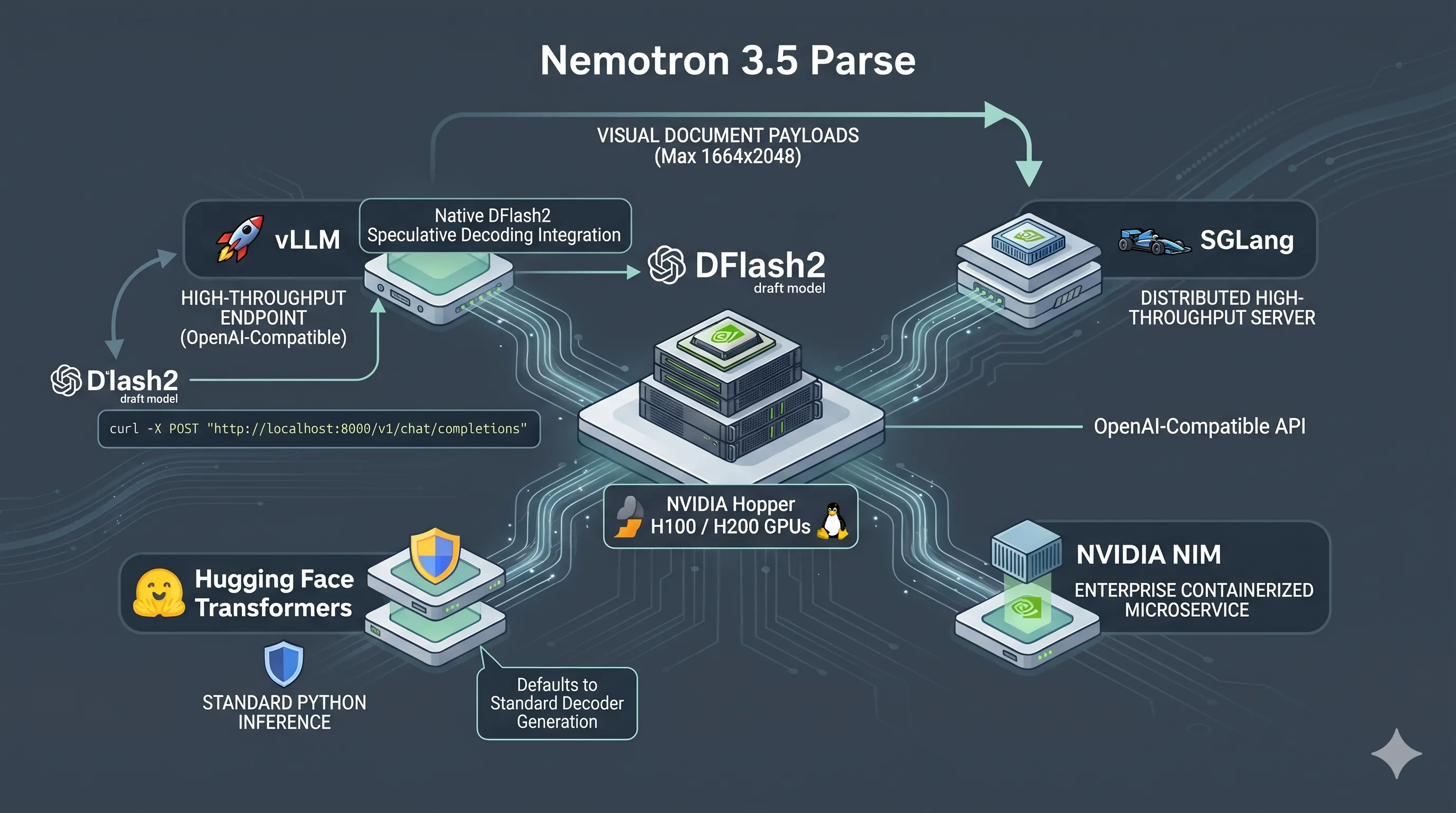
Related Posts

Generative AI may have assisted with research or drafting for this article. Topic selection, fact-checking, final wording, and publication remain the responsibility of DragonStone74. AI use disclosure