
Mistral Large 4 API Integration Guide: 1M Token Context, MoE Architecture, and Token Economics
🚀 Key Takeaways
- Trillion-Parameter MoE Architecture: Mistral Large 4 delivers massive model capacity with efficient per-token compute across an expansive 1-million-token context window.
- Immediate API Preview Access: Engineers can integrate the model directly through Mistral Studio endpoints prior to the open-weight release scheduled for late October 2026.
- Cost-Effective Token Economics: Public preview pricing offers an immediate 50% discount alongside dramatic cost reductions for cached input tokens.
- Native Multimodal Comprehension: An integrated vision encoder enables seamless parsing of document images, complex diagrams, and mixed-format payloads.
- Controllable Reasoning Depth: Configurable reasoning parameters allow applications to dynamically toggle between rapid generation and step-by-step chain-of-thought traces.
- Breaking Payload Response Structure: Enabling high reasoning returns structured content chunk arrays rather than standard strings, requiring updated client-side parser logic.
- Enterprise Hardware Demands: Self-hosting requires high-density multi-GPU infrastructure, making managed API integration the fastest path to production.
The debut of Mistral Large 4 introduces enterprise-grade reasoning and multimodal document intelligence at an unprecedented scale.
Powered by a Mixture-of-Experts architecture featuring over one trillion total parameters and a 1-million-token context window, the model effortlessly processes extensive legal dossiers, multi-page financial reports, and high-resolution scanned documents within a single API call.
While local self-hosting requires high-density multi-GPU clusters, Mistral has made the model instantly accessible via public preview on its unified API platform.
Engineering teams can plug into existing SDKs using discounted preview token pricing and state-of-the-art prompt caching, dramatically reducing operating costs for high-throughput enterprise pipelines.
However, transitioning to Mistral Large 4 demands immediate architectural awareness—specifically regarding response structure shifts caused by deep reasoning modes and updated multimodal payloads.
This guide delivers a direct, production-focused walkthrough covering authentication, token economics, parser safeguards, and real-world Document AI integration strategies.

1. Mistral Large 4 Architecture: 1.05T Parameters, Active MoE Compute, and 1M Context Window
Underpinning enterprise integration workflows—from processing high-volume long-form documents to pipeline deployment—is the structural foundation of Mistral Large 4.Referred to across technical circles by the moniker 'Le Chonk', this model establishes a new computational scale for open-weight engineering.
Understanding its architectural mechanics is essential before implementing end-to-end SDK workflows and large-scale document pipelines.
Trillion-Parameter MoE Design and Active Parameter Routing
Mistral Large 4 incorporates a massive footprint totaling 1.05 trillion total parameters.To execute inference across a model of this magnitude without prohibitive compute costs per forward pass, the model utilizes a sparse Mixture-of-Experts (MoE) architecture.
Under this MoE routing mechanism, only a fraction of the network engages for any given inference step, maintaining an operational footprint of approximately 50 billion active parameters per token.
Technical reports highlight slight variations in exact active sizing depending on the technical source, specifically noted as 49B in announcement materials versus 52B in documentation.
This sparse gating enables the system to direct token pathways exclusively through specialized expert subsets, drastically bounding FLOP requirements during generation cycles.
Vision Encoder Specifications and 1M-Token Context Envelope
Beyond sheer scale, Mistral Large 4 is natively multimodal, providing out-of-the-box support for both text and image inputs within identical inference sequences.Visual comprehension is driven by an integrated 1.6B-parameter vision encoder designed to translate visual structures directly into the shared latent space.
Coupled with this visual ingestion layer is an expansive 1M-token context window.
This context envelope allows organizations to stage hundreds of dense pages, mixed visual diagrams, and exhaustive textual corpora simultaneously without requiring multi-pass segment chunking.
| Architectural Dimension | Specification / Detail |
|---|---|
| Total Model Parameters | 1.05 trillion parameters |
| Active Compute per Token | ~50 billion active parameters (49B in announcement, 52B in documentation) |
| Routing Architecture | Sparse Mixture-of-Experts (MoE) |
| Vision Encoder | 1.6B parameters |
| Input Modalities | Natively multimodal (text and image inputs) |
| Context Window Capacity | 1,000,000 tokens (1M context window) |
| Model Moniker | 'Le Chonk' |
VRAM Residency vs Sparse Compute Trade-offs
Deploying and hosting Mistral Large 4 introduces a strict architectural trade-off that engineering teams must account for.While routing only ~50B active parameters saves compute per token and accelerates execution speed during token generation, it does not reduce GPU memory needs.
Because routing decisions occur dynamically per token across the entire architecture, all experts must reside in VRAM concurrently.
The full 1.05 trillion parameter weight footprint remains permanently in GPU memory, meaning physical hardware requirements are dictated by total parameter capacity rather than the active parameter runtime figure.

2. Release Timeline, Public Preview Status, and Deployment Licensing
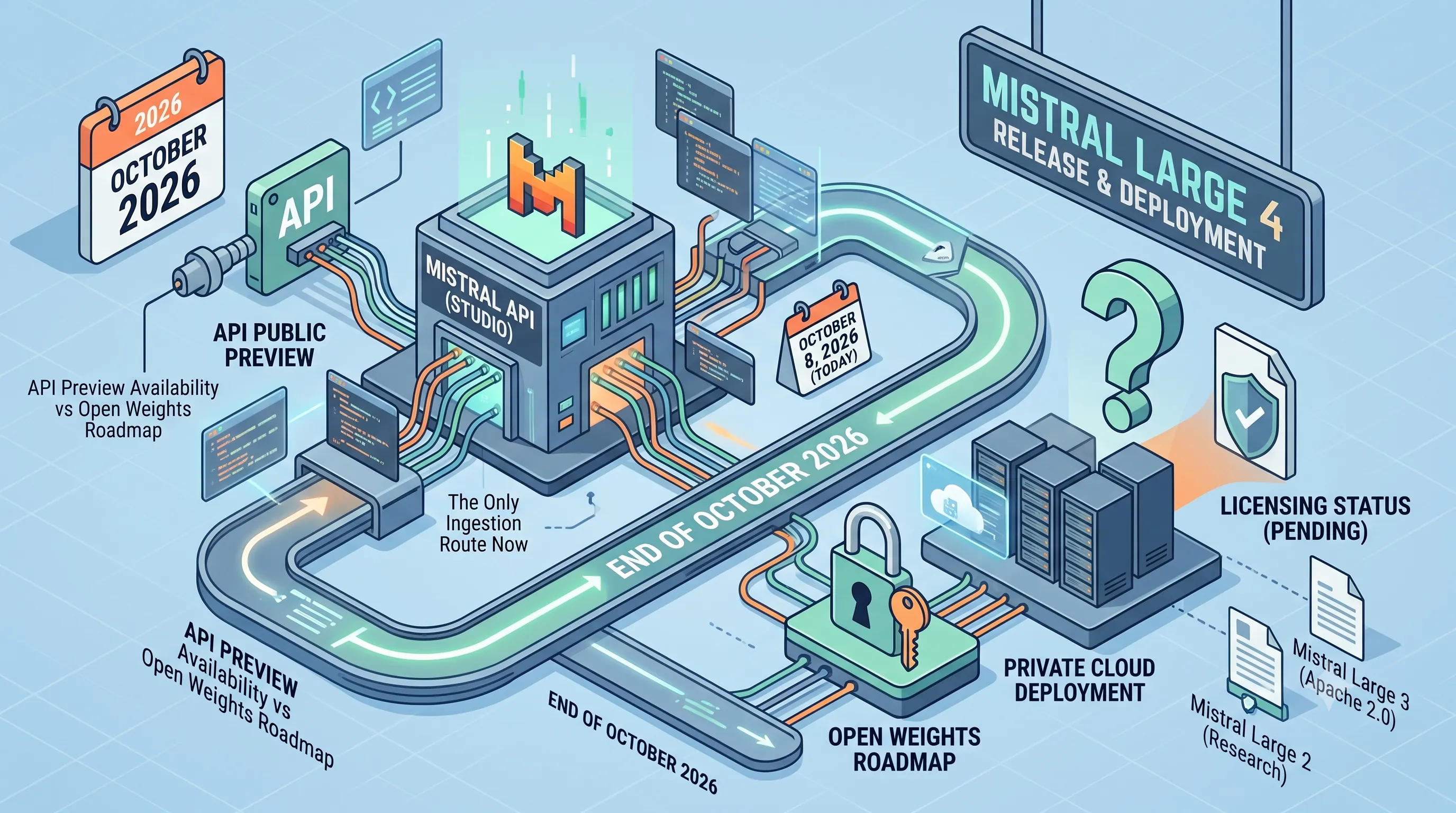
To successfully execute large-scale workloads—such as ingesting enterprise archives up to the 1-million-token boundary—engineering teams must align their pipeline architecture with the current deployment footprint of Mistral Large 4.As of October 8, 2026, the model's operational scope is defined by its initial managed preview, setting specific constraints on how systems can interface with the model today versus self-hosted targets planned for later in the month.
API Preview Availability vs Open Weights Roadmap
Mistral Large 4 officially went live on the Mistral API on October 6, 2026.It is currently offered as a public preview via the managed Mistral API endpoint, serving as the immediate integration path for developers testing high-capacity reasoning and document parsing.
Because the release is explicitly labeled as a public preview, system behaviors, endpoints, and performance characteristics may change before final weights release.
As documented by Apidog, "If you want to try the 1-trillion-parameter “Le Chonk” now, the API is the only way in...", confirming that direct managed API access stands as the sole ingestion route for teams integrating the model today.
For organizations architecting self-hosted environments, open weights are scheduled to ship by the end of October 2026.
Private Cloud Deployment Readiness and License Status
Mistral Large 4 is structurally described as an open-weight model designed for private cloud and on-premise self-deployment once the weights become accessible.However, enterprise architectural planning must account for pending licensing confirmations.
The exact model license for Mistral Large 4 has not been published yet.
Historical precedent across the model family reveals varying licensing frameworks: Mistral Large 3 used Apache 2.0, whereas Mistral Large 2 operated under a research license.
Until the official license terms are detailed alongside the late October weight release, self-hosted deployment models cannot formalize compliance pathways.
Managed API consumption remains the only validated mechanism to prototype 1-million-token context processing and SDK integration.
| Model Iteration / Channel | Availability Date | Deployment Target | Licensing Status |
|---|---|---|---|
| Mistral Large 4 (API Preview) | October 6, 2026 | Mistral API (Public Preview) | Managed API access terms (Only ingestion route available now) |
| Mistral Large 4 (Open Weights) | End of October 2026 | Private Cloud and On-Premise Self-Deployment | Exact model license has not been published yet |
| Mistral Large 3 | Prior Release | Open Deployment | Apache 2.0 |
| Mistral Large 2 | Prior Release | Open Deployment | Research License |
3. Token Economics: API Pricing Tiers, Prompt Caching, and Inference Costs
Executing enterprise workloads—from parsing large documents to managing high-frequency SDK pipelines—demands an exact understanding of Mistral Large 4 API expenditure.Evaluating token economics is critical to projecting infrastructure budgets and maintaining cost efficiency across scaled production environments.
Preview vs Standard List Token Pricing
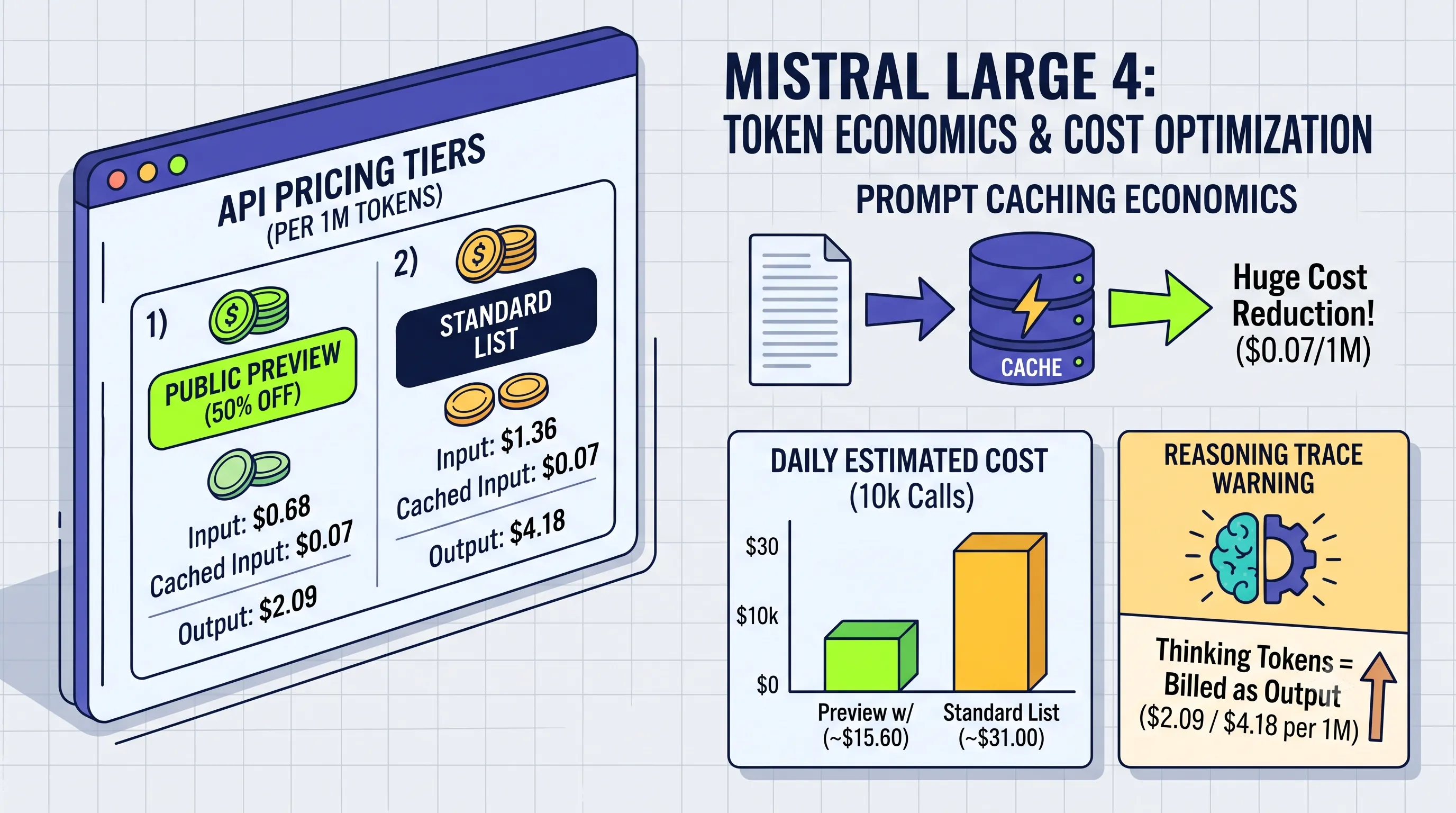
Mistral Large 4 is currently accessible under public preview API pricing, which provides a 50% discount compared to standard list rates.Under this public preview tier, input tokens are billed at $0.68 per million tokens, while output tokens are priced at $2.09 per million tokens.
Once standard rates apply, the list price transitions to $1.36 per million input tokens and $4.18 per million output tokens.
It is important for infrastructure architects to account for this transition, as Mistral has not specified when preview pricing will end.
| Pricing Tier | Input Tokens (per 1M) | Cached Input Tokens (per 1M) | Output Tokens (per 1M) |
|---|---|---|---|
| Public Preview | $0.68 | $0.07 | $2.09 |
| Standard List | $1.36 | $0.07 | $4.18 |
Prompt Caching Economics and Daily Operational Cost Modeling
Prompt caching dramatically lowers retrieval and execution costs for repetitive context architectures.Cached input tokens are billed at $0.07 per million tokens, representing a substantial discount over standard and preview input ingestion.
To understand the financial implications in active production, consider a concrete daily operational workload processing 10,000 calls.
In this model, each request utilizes 3,000 total input tokens, of which 2,500 tokens are cached and 500 tokens are uncached, alongside an average generation of 500 output tokens.
At public preview pricing, this workload results in an estimated cost of approximately $15.60 per day.
When calculated against standard list pricing, the same daily volume totals approximately $31 per day.
Leveraging cached prompts is therefore essential to preserving capital as request density scales.
Billing Impact of Reasoning Trace Tokens
When invoking advanced analytical capabilities, reasoning traces introduce additional computational consumption.Thinking tokens generated during reasoning are billed as standard output tokens.
Because output tokens represent the higher-priced tier—billed at $2.09 per million during preview and $4.18 per million at list price—extended reasoning chains directly drive generation costs.
Monitoring the volume of generated thinking tokens is vital to prevent unexpected operational spikes during automated reasoning tasks.
4. API Authentication, SDK Setup, and Chat Completion Endpoint Integration
Establishing a reliable programmatic pipeline is the foundational prerequisite for handling large-scale document parsing and inference within the broader guide, 100만 토큰 문서 파싱부터 SDK 연동까지: Mistral Large 4 API 실무 통합 가이드.Before processing massive document contexts, developers must properly initialize authentication credentials and connect to the core service endpoints.
Mistral Studio Key Management and Header Authentication
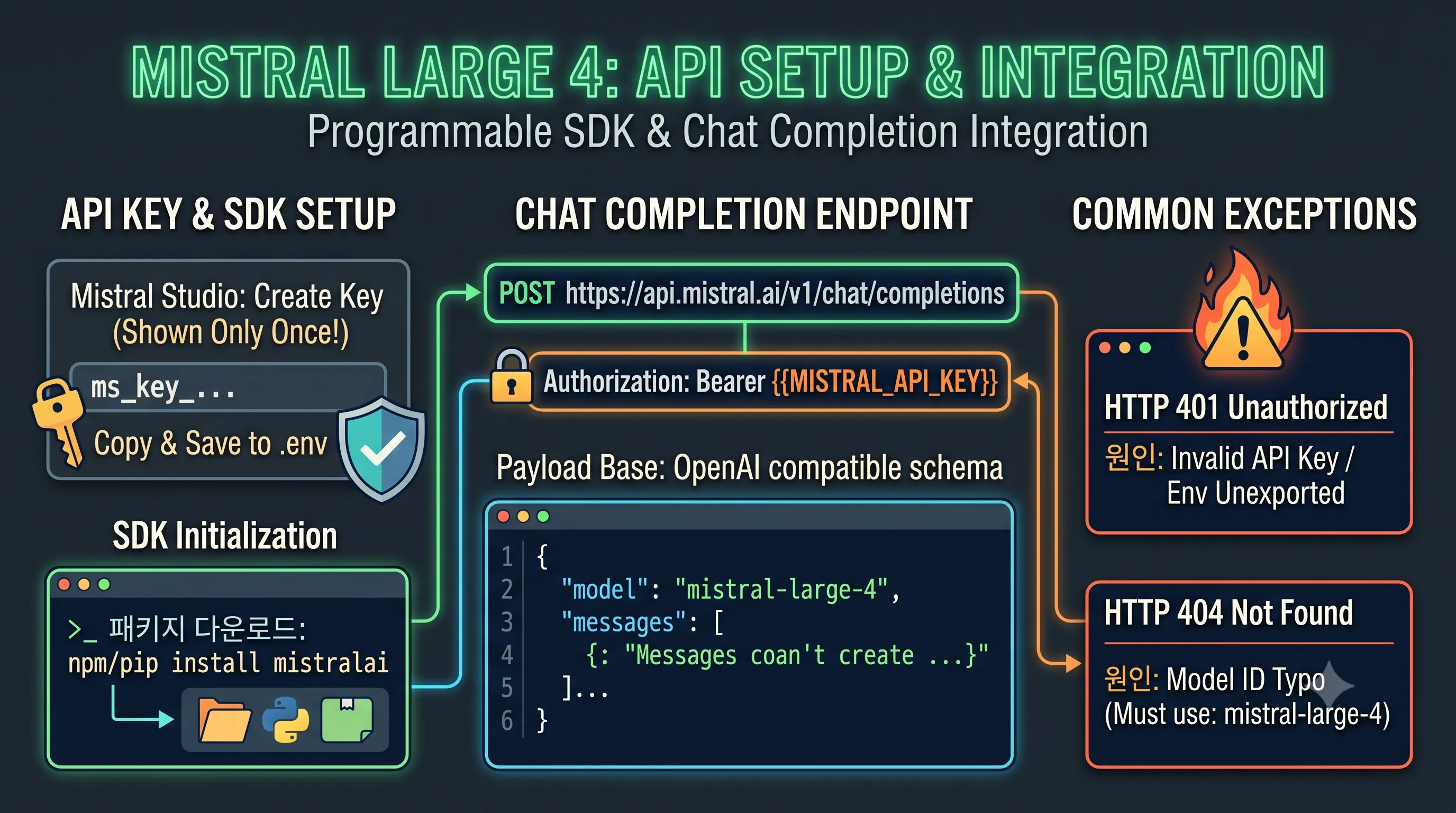
API keys are generated directly within Mistral Studio, formerly known as La Plateforme, under the dedicated API Keys management section.During key creation, security policies dictate that Mistral Studio only shows the generated API key once upon creation.
Because the secret cannot be retrieved again from the console after the initial view, engineers must securely capture and store the value in local environment configurations immediately.
Authentication across all incoming requests uses the Bearer token format structured inside the standard HTTP Authorization header.
Large 4 utilizes the identical base URL, authentication mechanisms, and official SDKs as existing Mistral models, requiring only the designation of the specific model ID mistral-large-4.
Chat Completions and Embeddings Schema Alignment
The primary chat endpoint URL for dispatching inference payloads is POST https://api.mistral.ai/v1/chat/completions.In addition to text generation and conversation parsing, a dedicated embeddings endpoint is available via the Mistral API to support retrieval and vector indexing workflows.
Integration friction remains minimal because the request schema aligns closely with the OpenAI format.
Specifically, payloads accept standardized top-level keys including model, messages, tools, tool_choice, and response_format.
To make an HTTP chat completion request via Apidog / REST, developers configure the base call using a defined variable for security:
POST https://api.mistral.ai/v1/chat/completions
Authorization: Bearer {{MISTRAL_API_KEY}}Handling HTTP 401 and 404 Integration Exceptions
When executing REST calls or configuring client SDKs, integration exceptions generally trace back to credential ingestion or route naming.A 401 error indicates an incorrect or unexported key within the runtime environment.
Engineers encountering this status code should verify whether the environment variable containing the Bearer token was exported correctly in the shell or deployment container.
Conversely, a 404 error typically signifies a model ID typo in the JSON request body.
Verifying that the payload specifies the exact mistral-large-4 identifier ensures the routing logic maps directly to the active model backend.
5. Controlling Reasoning Effort and Handling Multi-Chunk Parser Breaking Changes
Connecting robust SDK integration to reliable document processing requires mastering how Mistral Large 4 dynamically structures its response payloads.While direct execution yields familiar payload schemas, enabling reasoning controls fundamentally alters response formatting and downstream token accounting.
The reasoning_effort Parameter and Step-by-Step Traces
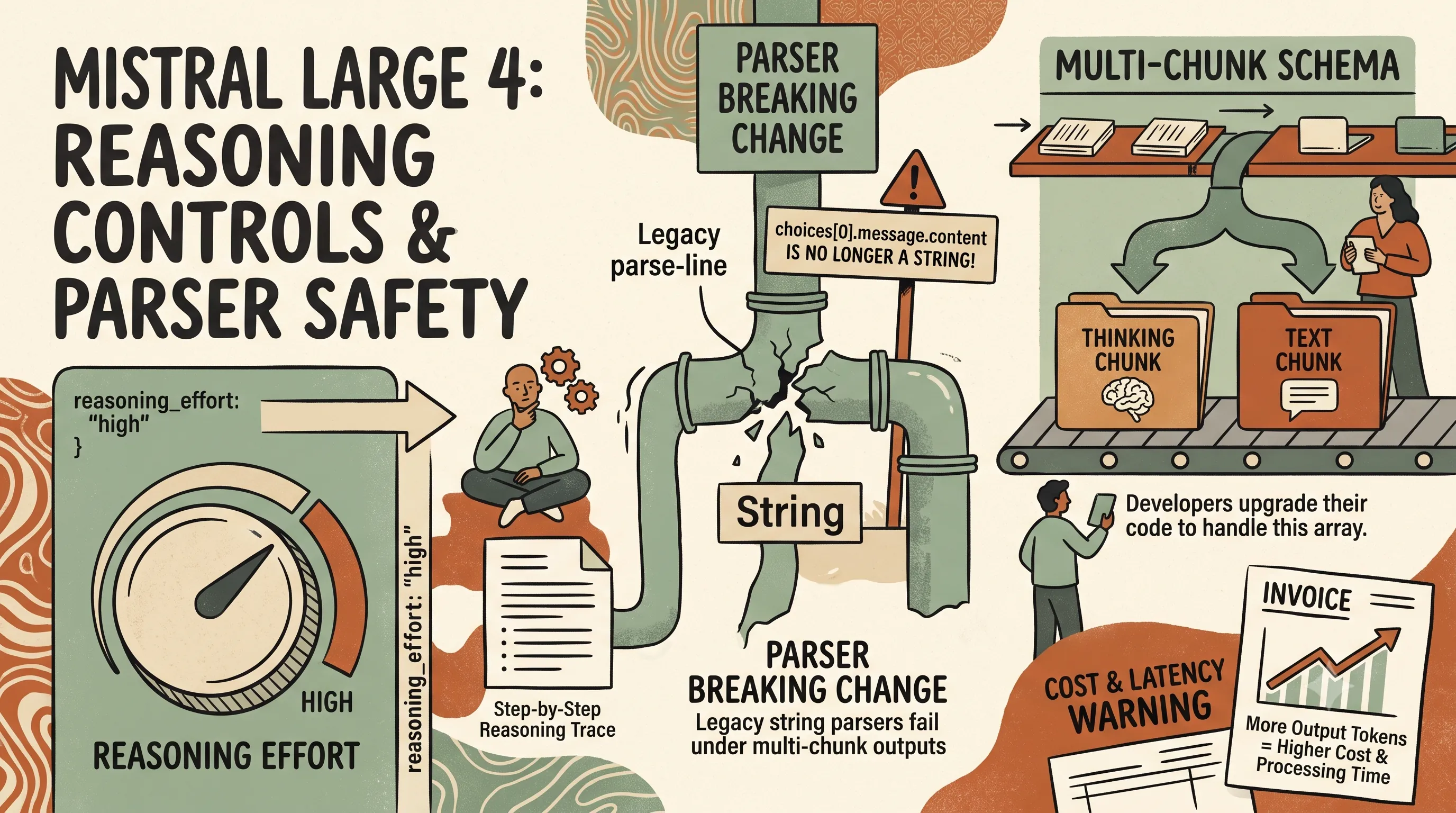
Mistral Large 4 operates as a hybrid model supporting both direct execution and reasoning via the dedicated reasoning_effort parameter.To configure reasoning effort in the API request payload, developers pass the parameter explicitly to activate analytical evaluation:
reasoning_effort: "high"By toggling this parameter, client pipelines determine whether the engine produces an immediate direct execution response or executes extended intermediate reasoning steps.
Multi-Chunk Response Schema Migration from String Outputs
Switching to high reasoning effort introduces an immediate structural breaking change for legacy integrations.Setting reasoning_effort to "high" splits
choices[0].message.content into multiple chunks instead of returning a single string.As Apidog notes: "This is the part that breaks parsers. With reasoning_effort: \"high\", message.content is no longer a string."
Parsers expecting
choices[0].message.content to arrive as a traditional string will break when reasoning_effort is enabled.Under this multi-chunk schema, output chunks contain a "thinking" chunk representing the underlying reasoning trace and a separate "text" chunk housing the final response answer.
Production applications must update parser logic to migrate away from simple string access and explicitly extract the text chunk from the content array.
Cost and Latency Considerations of Thinking Tokens
Enabling reasoning traces carries direct financial and performance implications for application architectures.Thinking tokens generated within the reasoning trace add directly to total output token billing.
This expansion in generated tokens makes configuring reasoning_effort to "high" noticeably more expensive than operating the model under standard direct execution.
Applications must account for both the increased token charges and the associated latency required to generate extensive thinking traces prior to emitting the final text chunk.
6. Multimodal Parsing, Base64 Payloads, and Strict JSON Function Calling
Within an enterprise integration pipeline centered on large-scale document parsing and SDK automation, ingesting visual layouts alongside text prompts bridges the gap between raw document ingestion and structured downstream execution.Mistral Large 4 addresses this interface by combining multimodal understanding with strict schema-governed API outputs.
Base64 Image Injection and Visual Grounding Processing
Mistral Large 4 natively supports images as content parts placed directly alongside text prompts inside the payload array.For document ingestion workflows handling local files, the API accepts local image data encoded directly as base64 data URLs.
This eliminates external hosting dependencies when piping extracted document scans directly from local storage into the model.
The visual comprehension layer is benchmarked for complex visual reasoning and execution.
Mistral Large 4 scores 42% on the Dense 200 visual-grounding benchmark.
Additionally, the model achieves 59.9% on the AutomationBench benchmark, validating its capability to visually parse interface elements and document segments accurately.
To format local image inputs for multimodal processing, engineers inject the encoded image directly into the message content object.
"image_url": "data:image/png;base64,<encoded>"Tool Execution Workflows with tool_call_id Tracking
Executing operational tasks during document parsing requires programmatic interaction through external tools.Mistral Large 4 supports function calling configured through standard JSON Schema definitions for tool parameters.
When an execution trigger occurs, the model returns a response containing specific arguments along with an assigned identifier.
Maintaining thread continuity is critical during multi-turn automation.
Function execution requires passing the returned tool_call_id back to the conversation thread when supplying tool execution results.
Failing to preserve this identifier breaks thread state correlation, preventing the model from validating that the requested tool call has completed successfully.
Enforcing Strict Structured Output via json_schema
Extracting deterministic entities from documents requires strict schema conformance.Structured JSON outputs can be enforced by configuring the response_format parameter or by applying strict JSON Schema validation.
A critical requirement exists when enforcing structured output modes: prompt instructions must explicitly request JSON format alongside setting the response_format configuration.
Omitting the textual instruction while declaring schema enforcement can cause validation failures or unexpected generation patterns.
To enforce strict schema validation on output generation, configure the payload using the designated schema format wrapper.
{"type": "json_schema", "json_schema": {...}}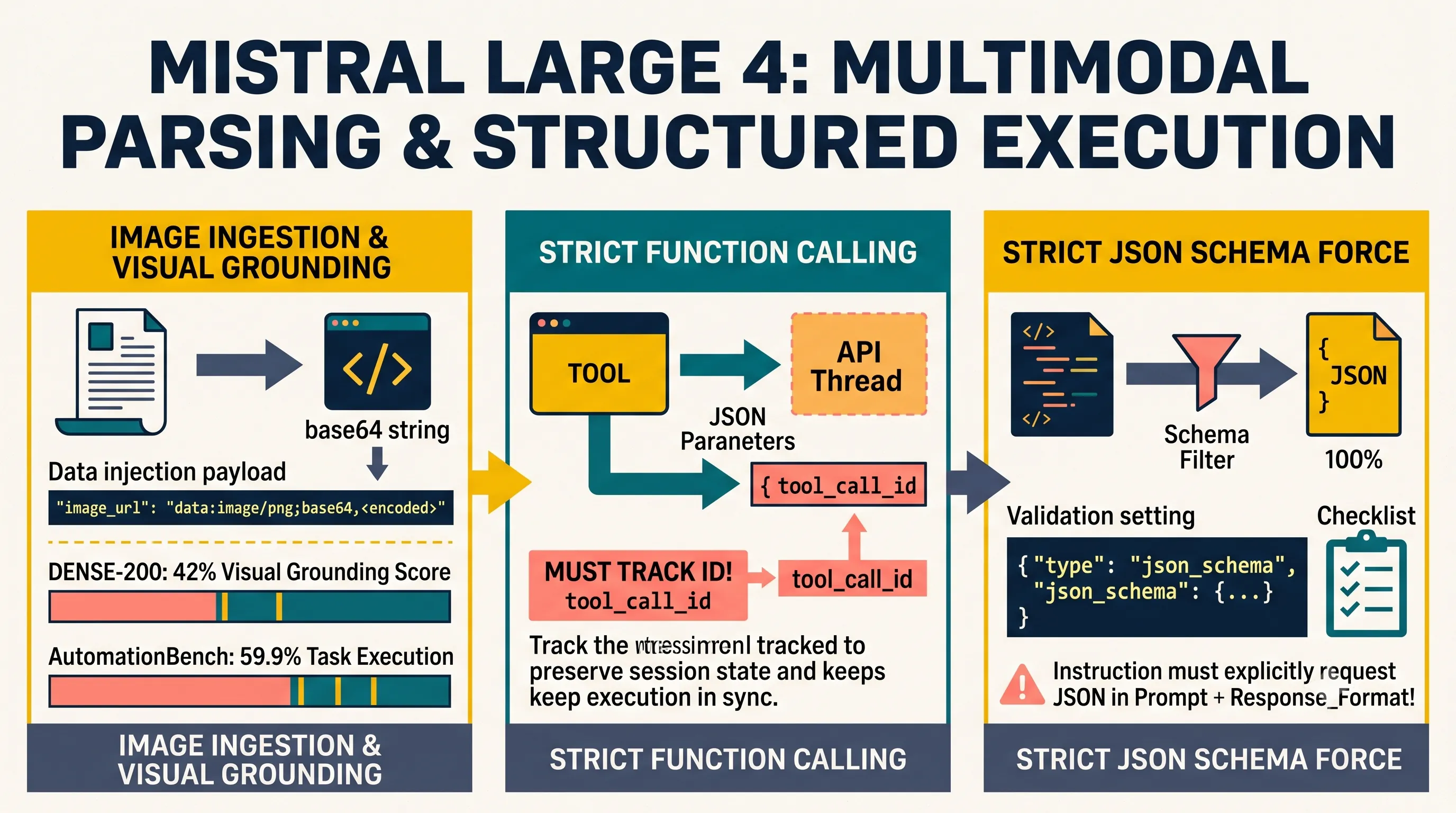
7. Self-Hosting Hardware Sizing: VRAM Footprints and Multi-GPU Cluster Planning
To bridge the gap between cloud API consumption and sovereign enterprise infrastructure for the overarching guide, "100만 토큰 문서 파싱부터 SDK 연동까지: Mistral Large 4 API 실무 통합 가이드", engineering teams must calculate baseline multi-GPU resource requirements.Mistral Large 4 achieves a score of 61.7% on the DeepSWE v1.1 benchmark, confirming its status as a frontier coding and reasoning engine that demands substantial computing infrastructure for private, self-hosted deployments.
Quantization Sizing Formula: 4-Bit, FP8, and BF16 Memory Overhead
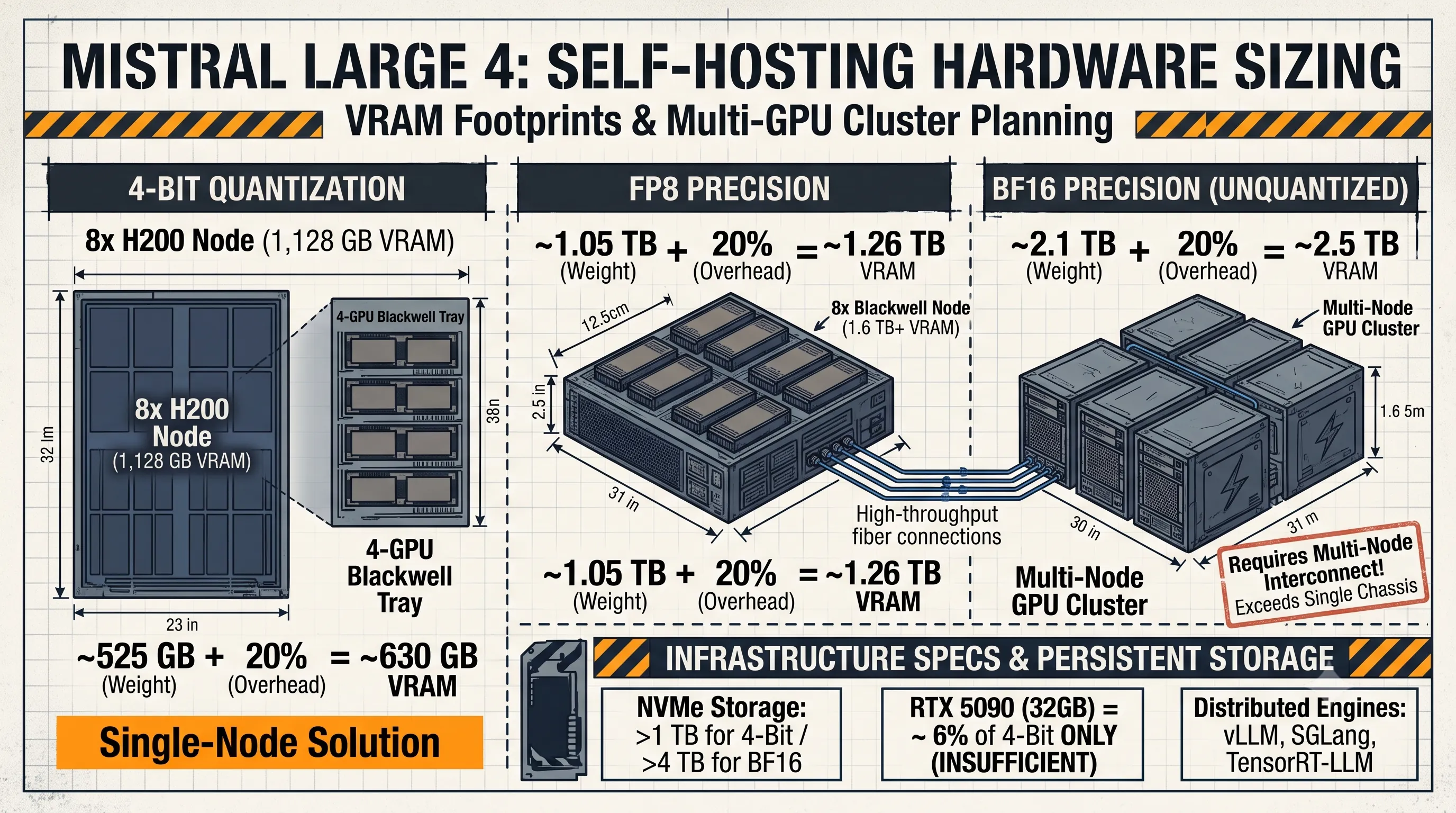
Calculating production memory for Mistral Large 4 requires a standard planning formula that adds approximately 20% on top of raw parameter weights.This 20% margin accounts for execution runtime overhead, intermediate activations, and dynamic KV cache expansion during sequence generation.
At 4-bit precision, the estimated weight footprint sits at ~525 GB, driving the functional planning requirement to ~630 GB VRAM.
Stepping up to FP8 precision doubles the weight footprint to ~1.05 TB, necessitating ~1.26 TB of allocated VRAM.
At full BF16 precision, the model weights span ~2.1 TB, requiring a cluster capacity of ~2.5 TB VRAM.
Hardware architects must note that single-workstation GPUs cannot host this model under any circumstance; a 32 GB RTX 5090 accommodates merely ~6% of the lowest 4-bit estimate.
Furthermore, actual production hardware thresholds remain working estimates until Mistral officially confirms the production release checkpoint precision.
| Precision | Estimated Weight Size | Planning VRAM Requirement (+20% Overhead) | Target Cluster Hardware |
|---|---|---|---|
| 4-Bit | ~525 GB | ~630 GB | Single 8x H200 node (1,128 GB VRAM) or 4-GPU Blackwell tray |
| FP8 | ~1.05 TB | ~1.26 TB | 8-GPU Blackwell node |
| BF16 | ~2.1 TB | ~2.5 TB | Multi-node GPU cluster |
Node Architecture Mapping: Blackwell, H200, and Multi-Node Deployments
Mapping these sizing tiers onto production hardware determines exact multi-GPU topology requirements.For 4-bit quantized deployments, an 8x H200 node provides 1,128 GB VRAM, offering comfortable headroom above the ~630 GB operational threshold.
Alternatively, a 4-GPU Blackwell tray provides a compact footprint capable of handling the 4-bit checkpoint.
While an 8x H100 node satisfies the 4-bit raw calculation on paper, it fails to clear operating requirements comfortably in practice due to tighter memory constraints under continuous generation loads.
Scaling to FP8 precision shifts deployment boundaries, requiring an 8-GPU Blackwell node to securely handle the ~1.26 TB footprint.
Running Mistral Large 4 at unquantized BF16 precision cannot fit inside a single system chassis and mandates an interconnected multi-node GPU cluster architecture.
Local NVMe Storage Footprints and Serving Runtime Engines
Cluster readiness extends beyond active GPU memory to persistent host storage and orchestration frameworks.Local disk storage requirements start at over 1 TB of high-speed NVMe space to store and unpack 4-bit checkpoints.
Hosting BF16 checkpoints locally increases disk capacity demands to over 4 TB to stage raw weights during node initialization and model distribution.
For serving execution, inference engines such as vLLM, SGLang, and TensorRT-LLM are expected to provide baseline runtime support near release, allowing teams to integrate these quantized footprints into production distributed serving stacks.
8. Enterprise Document AI: OCR Extraction, Multilingual Workflows, and Batch Pipelines
In high-volume enterprise ingestion architectures, feeding unstructured assets directly into large-context models like Mistral Large 4 requires a robust upstream extraction layer.Mistral Document AI bridges this requirement by coupling advanced optical character recognition with downstream LLM ingestion pipelines.
Mistral OCR Integration for Document Text and Image Parsing
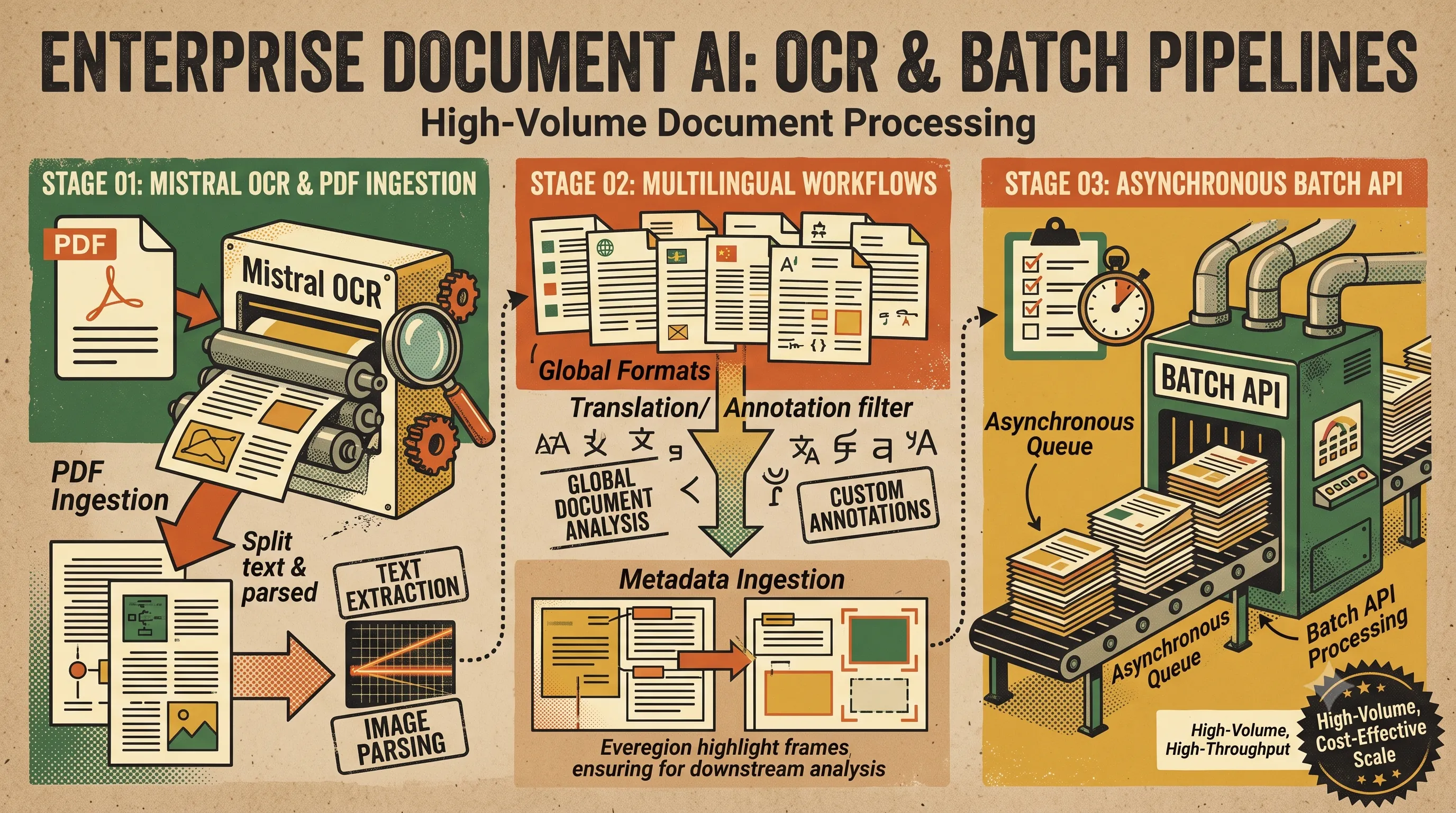
Mistral Document AI natively combines OCR technology with structured data extraction.Within downstream enterprise pipelines, this integration powers the extraction of text and images from complex PDF documents.
Rather than handling text extraction and visual parsing as disjointed operational tasks, the system isolates textual characters and embedded visual figures from PDF layouts simultaneously.
This unified parsing guarantees that downstream Mistral Large 4 pipelines receive structured, unified representations of documents containing mixed multimodal content.
Multilingual Document Comprehension Workflows
Global enterprise repositories inevitably span diverse languages, layout paradigms, and metadata requirements.Mistral Document AI supports multilingual document processing across an array of global formats.
The platform provides adaptable workflows designed to handle varying document structures while preserving structural context.
Furthermore, enterprise implementations can apply custom annotations directly within these extraction workflows.
These annotation capabilities ensure that domain-specific regions and layout identifiers remain aligned with downstream structured extraction targets.
Batch API Pipelines for Large-Scale Asynchronous Ingestion
Synchronous inference can become inefficient when processing thousands of complex PDF files.To address high-volume workloads, the platform provides a dedicated Batch API for running OCR and document comprehension at scale.
The Batch API allows engineering teams to queue massive document ingestion tasks asynchronously.
This asynchronous execution model minimizes resource contention and ensures cost-effective document processing across high-throughput enterprise pipelines.
Related Posts
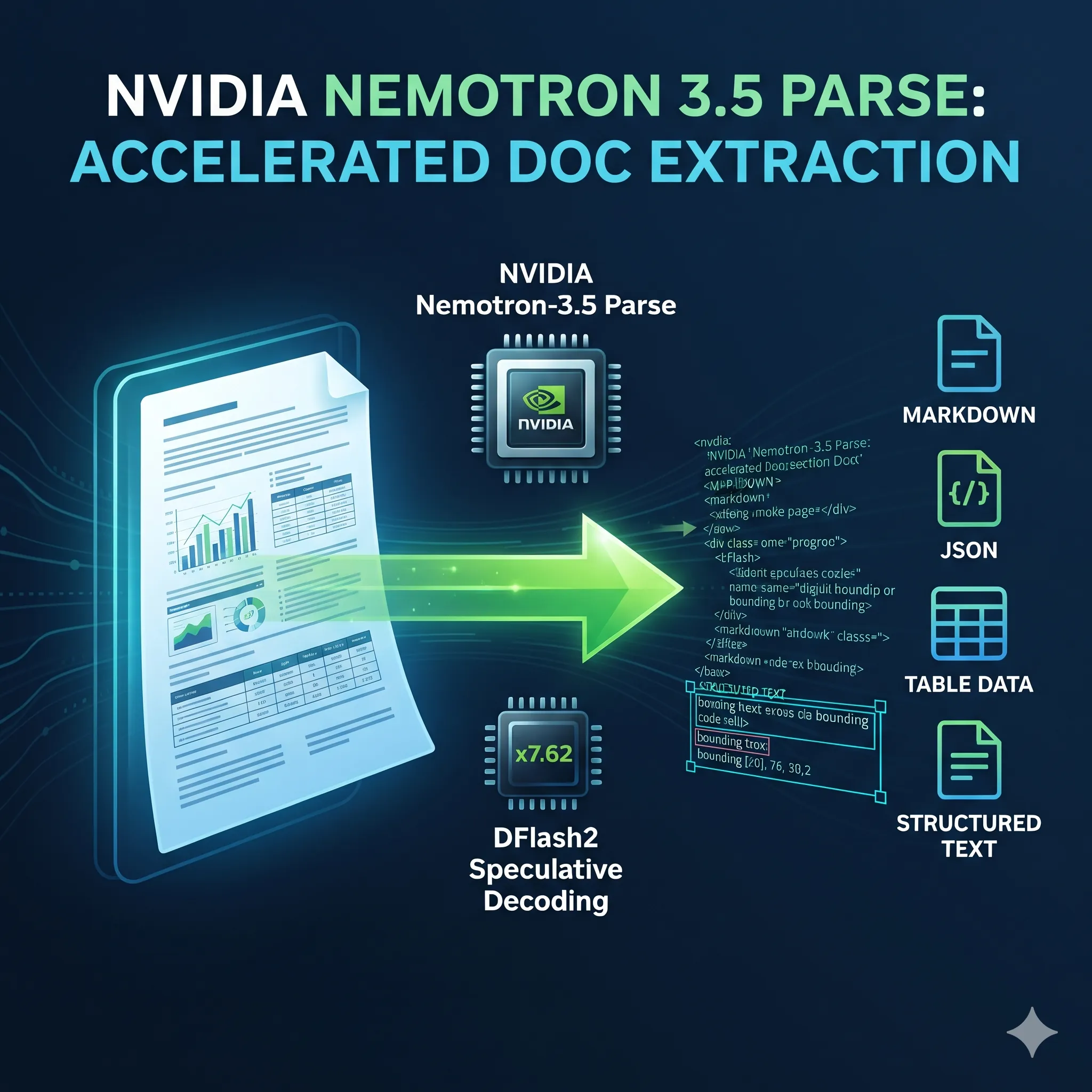
How Nemotron 3.5 Parse Accelerates Vision-Language Document ExtractionDiscover how NVIDIA's Nemotron 3.5 Parse boosts inference speed and document extraction efficiency...

Claude Fable 5.1: Architectural Economics and Autonomous Development PipelinesExplore the architecture of Claude Fable 5.1, focusing on prompt caching, autonomous debugging, and...
DeepSeek-V4-Flash: Revolutionizing AI with 284B MoE, 1M Context & Unprecedented Efficiency on DeepInfraDeepSeek-V4-Flash: The 284B MoE LLM revolutionizing AI with 1M context, extreme efficiency, speed,...
Generative AI may have assisted with research or drafting for this article. Topic selection, fact-checking, final wording, and publication remain the responsibility of DragonStone74. AI use disclosure