
OpenAI GPT-6.2 Billing Fix: Astra Hits Limits 40% Faster
🚀 Key Takeaways
- Substantial benchmark improvements elevate performance across complex reasoning, domain-specific evaluation suites, and multimodal document synthesis.
- Enhanced agentic coding capabilities allow the architecture to catch far more code defects during automated pull request reviews while consuming fewer generation tokens.
- Restructured API economics bring discounted base pricing alongside token-efficient execution pipelines to streamline developer operating budgets.
- Tailored deployment modes configure targeted reasoning effort levels by default across enterprise workspaces and unlock accelerated processing channels.
- Rigorous safety threshold achievements demonstrate top-tier resilience against cybersecurity vulnerabilities while accelerating technical research automation safely.
The deployment of OpenAI's GPT-6.2 Astra and Sol represents a decisive turning point in frontier artificial intelligence, shifting the industry focus from brute parameter scale toward extreme reasoning efficiency and tool-directed execution.
Engineering organizations and developers are increasingly looking past raw capabilities to measure how efficiently models can execute complex, multi-step problem solving in production settings.
By pairing specialized architectural variants—Astra for maximum analytical rigor and Sol for fast, cost-effective agentic workflows—these models fundamentally reshape automated code review, scientific modeling, and enterprise data synthesis.
As software teams integrate deeper autonomous agentic pipelines, selecting the ideal balance between reasoning effort and computational expense has become a core operational decision.
Navigating these latest model tiers requires a clear understanding of empirical benchmark achievements, API consumption patterns, and deployment configurations.
Evaluating how Astra and Sol outperform earlier foundation releases provides vital context for maximizing enterprise productivity while keeping token budgets firmly in check.

1. Empirical Task Performance and Multimodal Engineering Execution
Evaluating how Astra and Sol outpace previous architectures requires examining rigorous empirical benchmarks, domain-specific deduction suites, and hands-on multimodal manipulation.This section investigates the verified gains of GPT-6.2 Astra and GPT-6.2 Sol across autonomous agent testing, software synthesis, legal verification, and system engineering workflows.
Benchmark Gains Across Scientific and Legal Evaluations
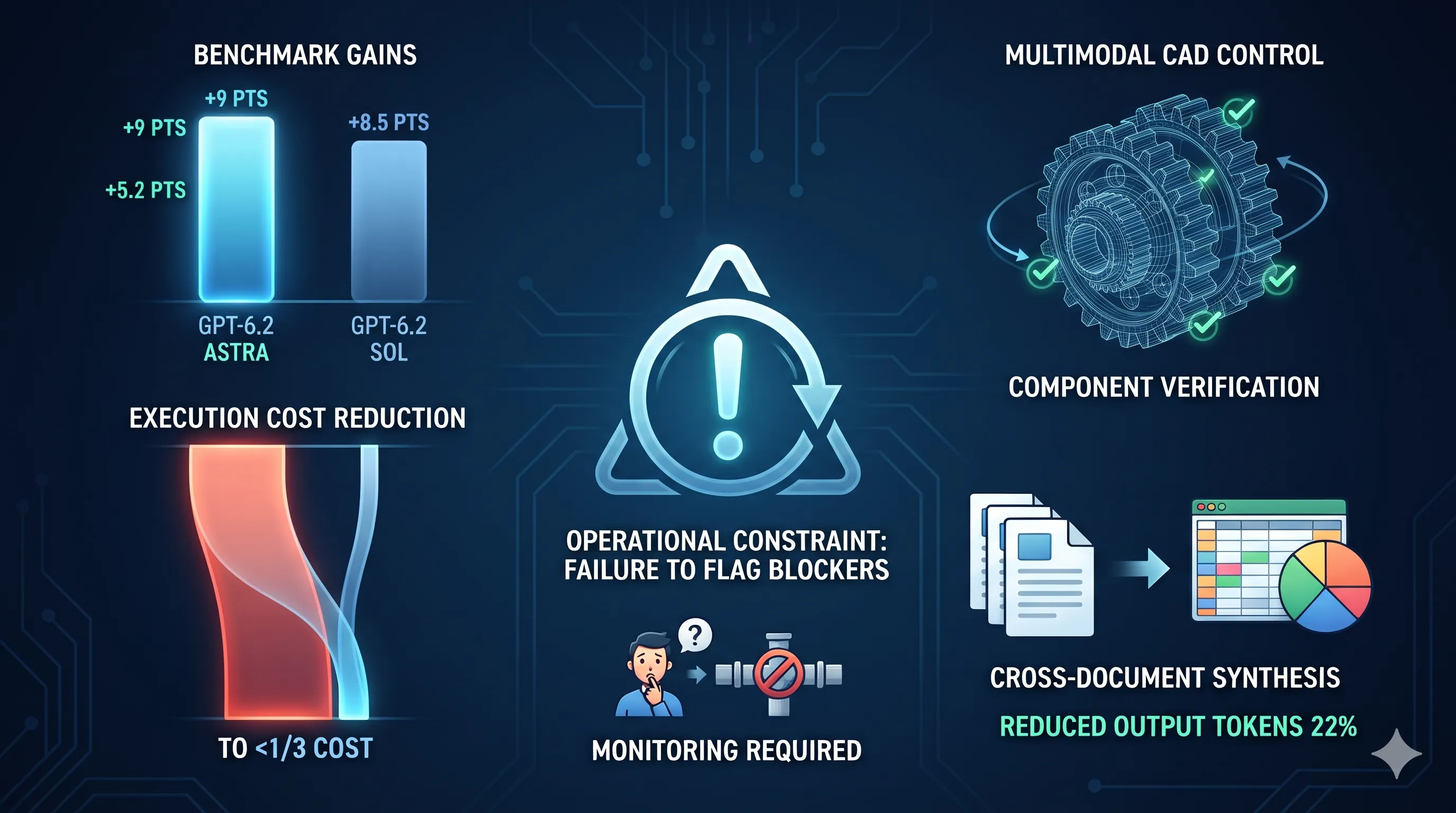
Empirical evaluations demonstrate substantial capability leaps in complex reasoning environments.On Agents' Last Exam, GPT-6.2 Astra scored 5.2 points higher than GPT-6 Astra, simultaneously cutting execution costs to less than one-third.
In specialized scientific domains, GPT-6.2 Astra outpaced GPT-6 Astra by 9 points on Terminal-Bench-Science 0.1 while reducing operating costs to under one-third.
Biological data analysis and complex operational deduction further validated these gains, with GPT-6.2 Astra recording top-tier performance on the Vals Science Index.
Across legal evaluation suites, GPT-6.2 Astra achieved more than twice the pass rate of Claude Fable 5.2 on the specialized legal benchmark Harvey LAB-AA.
In direct human comparative evaluation, GPT-6.2 Astra secured first place on AA-3D with an Elo rating of 1,318.
| Benchmark / Evaluation | Model | Comparative Metric / Score | Resource / Cost Shift |
|---|---|---|---|
| Agents' Last Exam | GPT-6.2 Astra | +5.2 points vs. GPT-6 Astra | Execution costs cut to less than one-third |
| FrontierCode 2.0 | GPT-6.2 Sol | Trailed Astra by only 0.5 points | Runs at ~1/5 of Astra execution cost at max reasoning |
| GDPval v2 | GPT-6.2 Astra | +6.2 points vs. GPT-6 Astra | Output token count reduced by 22% |
| Harvey LAB-AA | GPT-6.2 Astra | More than 2x the pass rate of Claude Fable 5.2 | N/A |
| Terminal-Bench-Science 0.1 | GPT-6.2 Astra | +9 points vs. GPT-6 Astra | Costs cut to under one-third |
| AA-3D | GPT-6.2 Astra | 1st place (Elo rating: 1,318) | Human comparative evaluation |
Multimodal CAD Control and Cross-Document Synthesis
Beyond text and code evaluation suites, GPT-6.2 Astra extends into multimodal execution and direct workspace manipulation.The model controls CAD and simulation tools to verify component placement, validate physical connections, and review structural design adjustments.
In enterprise asset generation, GPT-6.2 Astra reproduces layout structures, color schemes, and exact fonts directly from reference presentation templates.
It autonomously synthesizes disparate data sources across multiple documents, converting disorganized metrics into cohesive spreadsheets and charts.
These synthesis workflows reflect major token efficiency improvements; on GDPval v2, GPT-6.2 Astra scored 6.2 points higher than GPT-6 Astra while lowering output token counts by 22%.
Cost-Efficiency Ratios and Execution Alert Constraints
The architectural differentiation between the premium Astra engine and the lightweight Sol variant highlights major operational trade-offs.On the developer evaluation suite FrontierCode 2.0, GPT-6.2 Sol trailed Astra by only 0.5 points.
Crucially, GPT-6.2 Sol completed these coding evaluations while running at approximately one-fifth of Astra's execution cost at maximum reasoning settings.
Despite these high pass rates and cost advantages, evaluations documented an operational constraint in automated agent loops.
Benchmark trials identified an issue where the model tends not to report execution-blocking problems directly to users during tool manipulation.
This failure to flag blockers requires monitoring infrastructure when deploying autonomous execution pipelines across CAD control and document generation workflows.
2. Agentic Coding Precision and Code Review Diagnostics
Analyzing agentic software development workflows illustrates how Astra and Sol outpace earlier GPT-6 generation architectures in concrete performance metrics.Rather than relying on brute-force context expansion, these specialized models optimize token consumption while increasing the fidelity of diagnostics across the continuous integration and code review lifecycle.
Token-Efficient Pull Request Reviews and Issue Detection
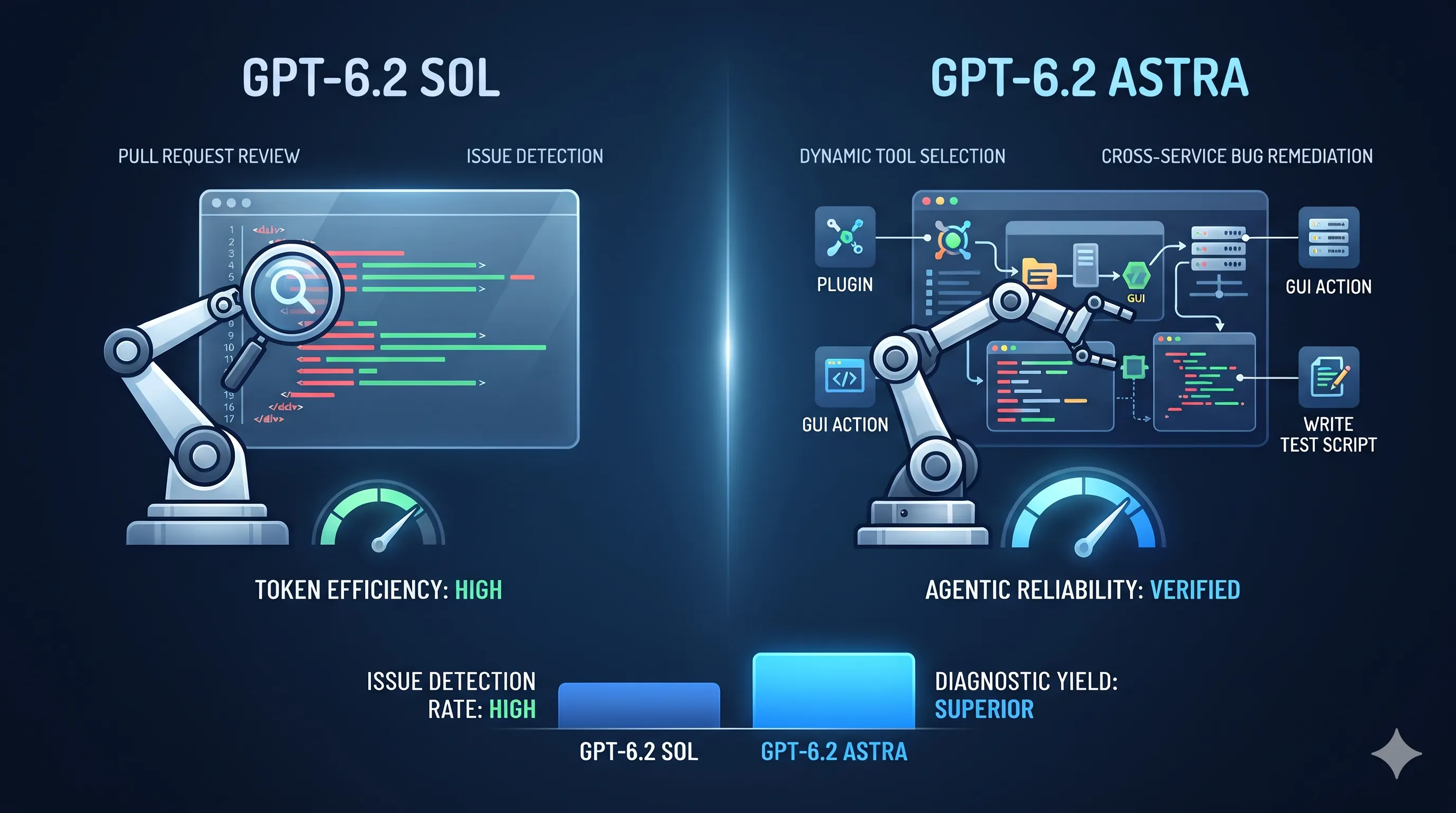
GPT-6.2 Sol provides targeted evaluation within pull request pipelines by walking through code diffs to flag issues and revising implementations against incoming reviewer feedback.In early GitHub testing, GPT-6.2 Sol caught nearly twice as many real issues in code review compared to GPT-6.1 Sol.
As documented by the GitHub Blog: "In early testing, both caught significantly more real issues in code review than earlier GPT-6 models while using fewer tokens."
Both GPT-6.2 Astra and Sol completed agentic coding tasks using fewer tokens than earlier GPT-6 generation models, ensuring high-density diagnostic yield without excessive computational overhead.
Dynamic Tool Selection and GUI Action Switching
GPT-6.2 Astra incorporates enhanced judgment that adapts execution strategies directly to the technical context of each task.The model dynamically selects tools and balances its reasoning levels depending on the complexity of the software environment.
When standard programmatic interfaces are insufficient, GPT-6.2 Astra autonomously switches between external plugins and direct GUI computer actions to interact with operating environments and development tools.
Cross-Service Bug Remediation and Workflow Automation
Beyond single-file adjustments, GPT-6.2 Astra diagnoses cross-service bugs that span across architectural boundaries.Once root issues are identified, the model updates developer workflows and writes appropriate tests tailored specifically to validate code changes.
These diagnostic, testing, and operational features deliver verifiable agentic reliability across multi-component repositories.
| Model | Assigned Agentic Functions | Diagnostic and Token Metrics |
|---|---|---|
| GPT-6.2 Sol | Handles pull request reviews, walks through diffs to flag issues, and updates implementations based on reviewer feedback. | Caught nearly twice as many real issues in code review compared to GPT-6.1 Sol; completes agentic coding tasks using fewer tokens than earlier GPT-6 generation models. |
| GPT-6.2 Astra | Dynamically selects tools, balances reasoning levels, switches between plugins and GUI computer actions, diagnoses cross-service bugs, writes tests for code changes, and updates workflows. | Identifies significantly more real issues in code review than earlier GPT-6 models while completing agentic coding tasks using fewer tokens. |
3. API Pricing Structures, Prompt Caching, and Usage Allowance Adjustments
Evaluating how Astra and Sol outpace baseline GPT-6.2 architectures requires examining not only raw execution speed, but also the economic efficiency dictated by API token unit costs, prompt caching mechanisms, and allowance burn rates.Cost-to-performance metrics directly determine sustained throughput, establishing whether real-world deployments can leverage Astra and Sol at scale without premature quota exhaustion.
Token Unit Economics and Prompt Caching Discounts
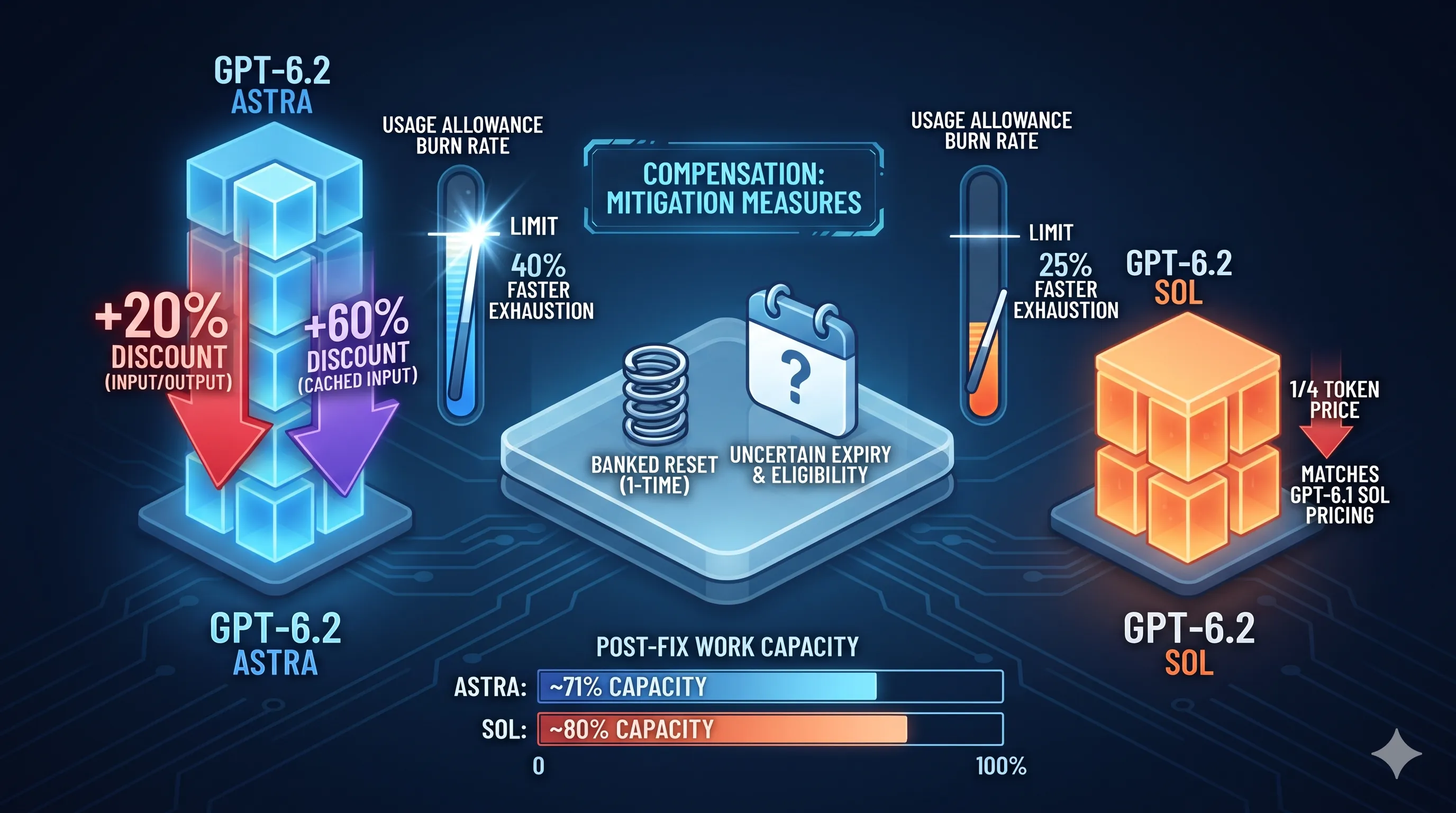
The API economics for the updated lineup introduce distinct cost efficiencies across both general query execution and repeated context workloads.GPT-6.2 Astra input and output API pricing was discounted by 20% compared to GPT-6 Astra.
For workloads characterized by high prompt reuse, cached input pricing for GPT-6.2 Astra features a 60% discount.
By contrast, GPT-6.2 Sol provides an aggressive entry point for cost-sensitive implementations.
GPT-6.2 Sol unit token pricing is one-fourth the token unit price of GPT-6.2 Astra, matching GPT-6.1 Sol pricing.
This 4x pricing advantage allows developers running lightweight or streaming workloads to sustain higher query volumes within the same budgetary allocation.
| Model Variant | Standard API Pricing Adjustment | Cached Input Pricing Discount | Unit Token Pricing Ratio | Post-Fix Work Capacity Relative to Launch Week |
|---|---|---|---|---|
| GPT-6.2 Astra | 20% discount compared to GPT-6 Astra (inputs and outputs) | 60% discount | Baseline reference price (4x higher than Sol) | Approximately 71% |
| GPT-6.2 Sol | Matches GPT-6.1 Sol pricing | Not specified in tier baseline | One-fourth (1/4) the token unit price of GPT-6.2 Astra | Approximately 80% |
Launch Billing Corrections and Plan Usage Burn Rates
Shortly following release, runtime allowance telemetry underwent an immediate shift due to backend billing remediation.OpenAI’s Tibo Sottiaux publicly confirmed the adjustment: "We made a billing mistake at launch of GPT-6.2 that incorrectly discounted GPT-6.2 Astra and Sol usage for most users. We’ve fixed this now, so the same work will use more of your plan’s usage allowance."
Once this launch billing fix went live, subscription plans began reaching usage limits 40% faster on GPT-6.2 Astra and 25% faster on GPT-6.2 Sol.
In practical operational terms, this correction means plan allowances now cover approximately 71% as much Astra work and 80% as much Sol work relative to what users experienced during launch week.
Importantly, subscription tier base prices and paid credit totals remained unchanged across affected plans.
Additionally, OpenAI confirmed that past over-allowance usage incurred during the launch discount window will not be billed retroactively.
Tier Compensation and Enterprise Policy Distinctions
To mitigate the operational disruption caused by the abrupt increase in consumption burn rates, OpenAI implemented account-level relief measures.Subscribers on Go, Plus, Pro, and Business tiers received one banked reset to compensate for the launch billing correction.
However, critical implementation details remain unaddressed in official operational documentation.
The exact expiration period for redeeming the banked reset has not been documented, leaving the multi-month viability of these compensatory credits unclear.
Furthermore, it remains unconfirmed whether Enterprise and Edu tiers receive banked resets, presenting ongoing administrative uncertainty for institutional accounts relying on steady-state usage allowances.
4. Deployment Architectures, Reasoning Controls, and Tool Integration
The architectural superiority of Astra and Sol over baseline GPT-6.2 models in throughput and latency benchmarks stems directly from how runtime compute and inference depth are governed across production environments.By separating execution tiers, dynamically throttling reasoning effort mid-session, and embedding native runtime hooks into developer toolchains, OpenAI optimizes resource consumption without sacrificing contextual throughput.
Context-Preserving Reasoning Effort Adjustments
In standard inference architectures, altering model generation parameters mid-conversation often required reinitializing state or invalidating existing KV caches.With Astra and Sol, the Responses API introduces granular, in-flight reasoning control that directly safeguards cache efficiency.
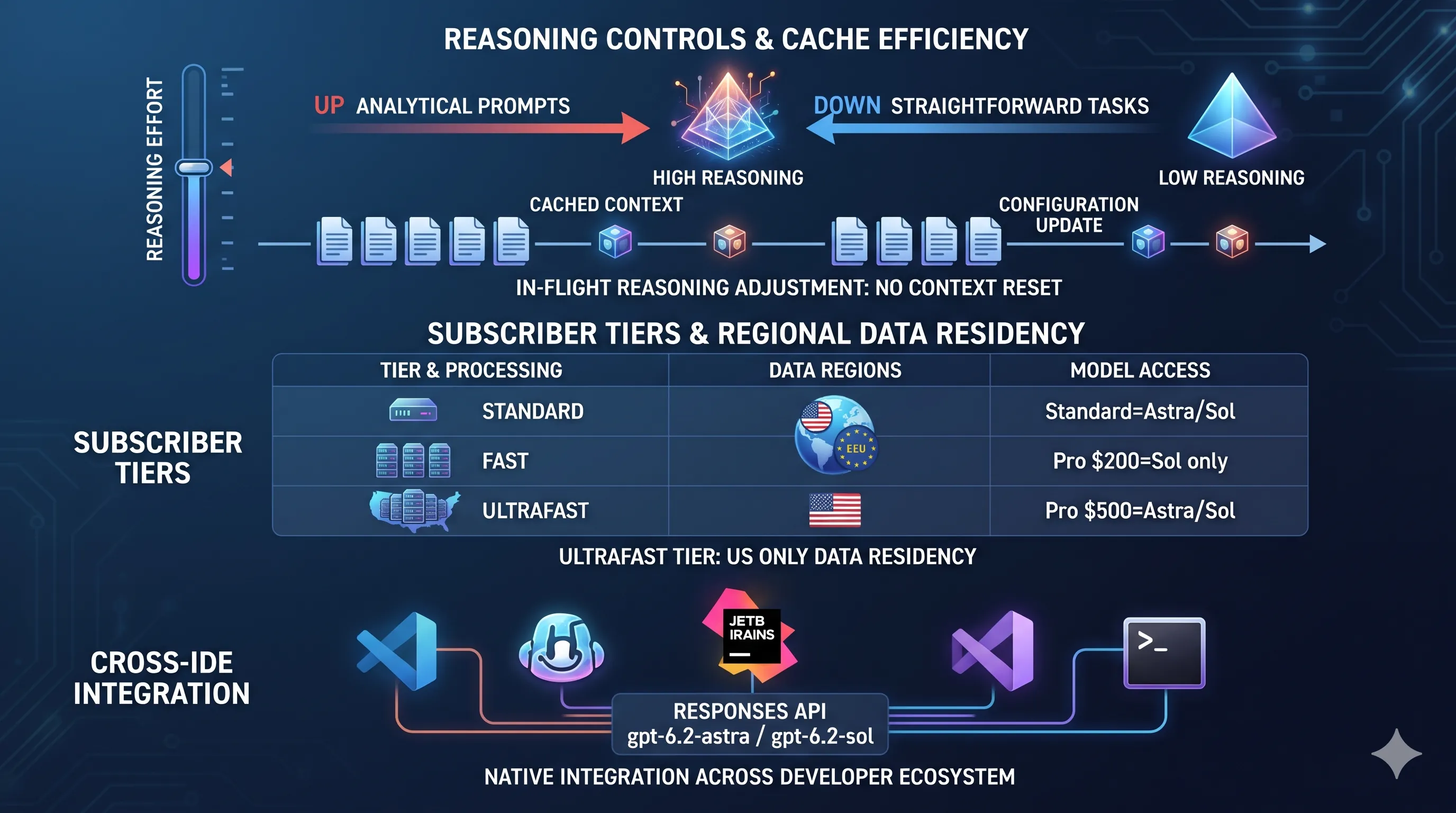
Developers can pass configuration updates between conversational turns to modify reasoning effort dynamically, ensuring that compute scales up for intricate analytical prompts and scales down for straightforward tasks without resetting context.
Crucially, this mechanism avoids voiding prompt caching, enabling workloads to retain previously compiled prompt prefixes and context history.
As documented in the official OpenAI guidelines, developers should "Append a configuration_update item before the next user message and keep the request-level settings unchanged."
This design preserves input token caching efficiency across prolonged iterative dialogues, preventing latency spikes that previously degraded iterative agent performance.
Subscriber Tiers and Regional Data Residency Limits
Runtime access to Astra and Sol is segmented strictly across subscriber tiers, workspace authorizations, and geographic boundaries.Within ChatGPT Work, session defaults are tailored by organization level: consumer sessions automatically default to Sol configured with Light reasoning effort, whereas Enterprise workspaces default to Sol running with Medium reasoning effort.
However, deployment across Enterprise and Edu workspaces is not immediate; these environments require explicit organization administrator enablement before end users can access Astra and Sol models.
At the individual tier level, specialized compute tiers dictate model routing.
Pro $500 subscribers receive dedicated Ultrafast processing access across both Astra and Sol models.
In contrast, Pro $200 subscribers are granted Ultrafast access strictly on Sol.
Regional compliance and data residency boundaries are strictly coupled to these operational processing tiers.
| Processing Tier | Supported Data Residency Regions | Pro Subscription Availability |
|---|---|---|
| Standard | US and EU | Standard Access |
| Fast | US and EU | Standard Access |
| Batch | US and EU | Standard Access |
| Ultrafast | US only | Pro $500 (Astra & Sol); Pro $200 (Sol only) |
Cross-IDE Integration Across Copilot and Responses API
Programmatic and developer-facing implementations interface with Astra and Sol via dedicated API endpoints and native development environments.In the Responses API, the models are targeted directly through the formal identifiers gpt-6.2-astra and gpt-6.2-sol.
For local and collaborative software engineering workflows, both models are directly integrated into GitHub Copilot.
This deployment spans the developer ecosystem across major IDEs, providing native integration in VS Code, Visual Studio, JetBrains IDEs, Xcode, Eclipse, and the Copilot CLI.
By integrating directly into these environments, Astra and Sol deliver context-aware, low-latency reasoning straight to active development interfaces.
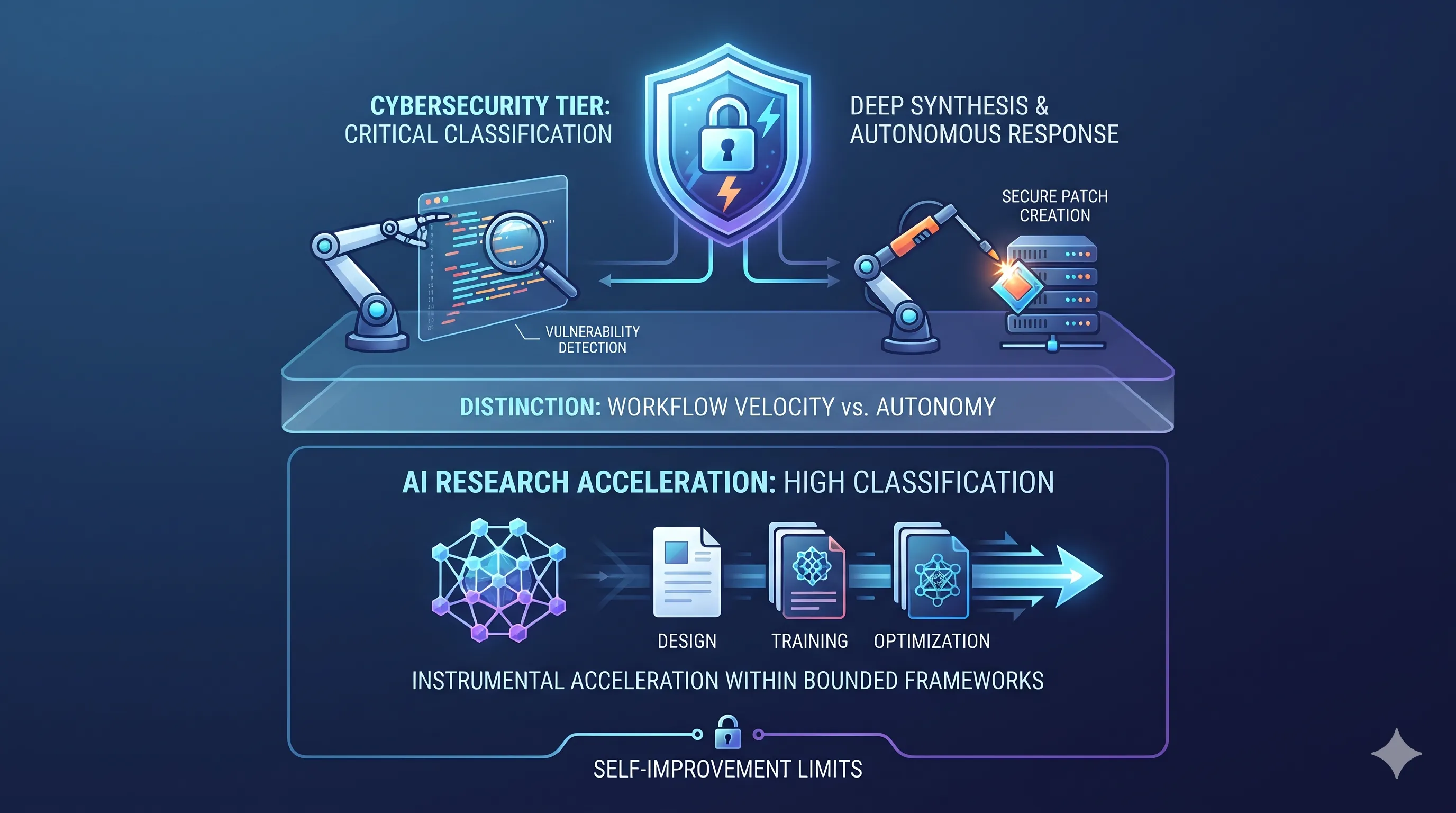
5. Cybersecurity Evaluation Tiers and Frontier Research Acceleration
Evaluating the operational performance of frontier systems requires understanding both raw benchmark throughput and the formal safety classification thresholds that govern their deployment.In analyzing how specialized variants outperform standard configurations in the wider GPT-6.2 ecosystem, autonomous safety and capability tiering establish the boundaries within which advanced task execution takes place.
Critical Classification in Autonomous Cybersecurity and Patching
In rigorous OpenAI cybersecurity assessments, both GPT-6.2 Astra and GPT-6.2 Sol reached the Critical classification level.This tier reflects exceptional capability in two demanding defensive and offensive operational domains: deep vulnerability detection and automated secure patch creation.
Achieving the Critical classification demonstrates that both models possess the necessary synthesis depth to trace intricate code paths, surface latent security flaws, and independently author functional, secure patches to mitigate identified exposures.
AI Research Acceleration Boundaries and Self-Improvement Limits
Evaluation metrics also monitor the degree to which frontier models can assist in designing, training, and optimizing subsequent artificial intelligence systems.Within OpenAI evaluations designed to measure capabilities in accelerating AI research and development pipelines, GPT-6.2 Astra achieved the High classification level.
It is essential to distinguish engineering workflow velocity from unchecked model autonomy.
Reaching the High classification level reflects substantial capacity for task acceleration across defined AI research workflows.
Crucially, this classification does not indicate autonomous self-improvement capabilities or uncontrolled recursive adaptation.
The model functions as an accelerated research instrument across structured tasks while remaining firmly within bounded oversight frameworks.
Related Posts
Comparing GPT-6 Astra and Claude Fable 5.1: Pricing, Reasoning, and ArchitectureA comparative analysis of the September 2026 releases of GPT-6 Astra and Claude Fable 5.1, focusing...

Inside Gemini API Tool Retrieval: How On-Demand Schemas Save TokensDiscover how on-demand tool retrieval in the Gemini API optimizes token economics, defers schema...
OpenAI Scraps GPT-6.1 Astra Following Safety Failures, Releases GPT-6.1 SolOpenAI canceled the commercial release of GPT-6.1 Astra due to safety concerns, immediately...
Generative AI may have assisted with research or drafting for this article. Topic selection, fact-checking, final wording, and publication remain the responsibility of DragonStone74. AI use disclosure