Comparing GPT-6 Astra and Claude Fable 5.1: Pricing, Reasoning, and Architecture
🚀 Key Takeaways
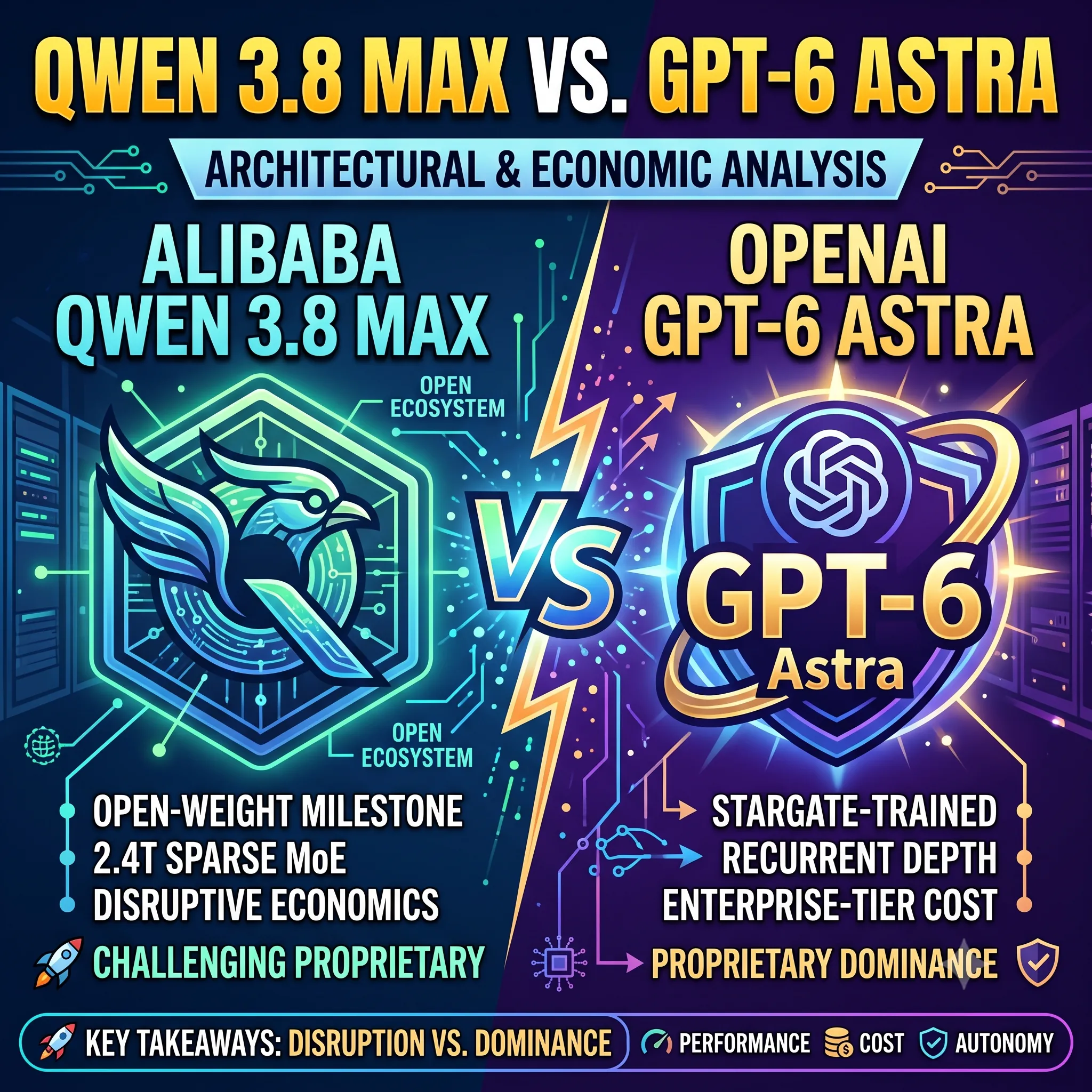
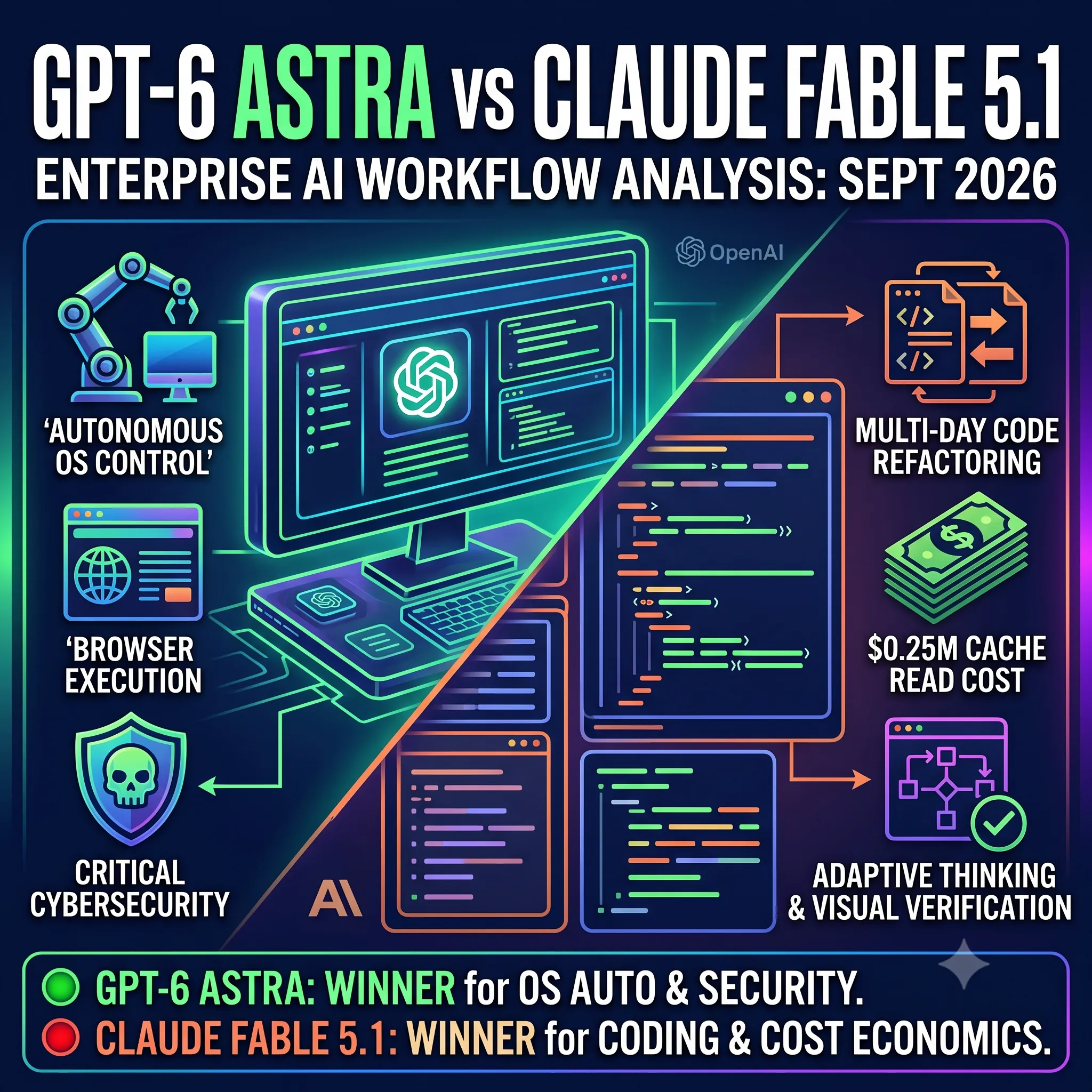
- Frontier AI Convergence: Anthropic's Claude Fable 5.1 and OpenAI's GPT-6 Astra have officially established the competitive benchmark for late 2026 autonomous agents, complex reasoning, and knowledge work.
- Base API Pricing Parity: Both flagship frontier models share an identical standard base API rate of $10.00 per million input tokens and $50.00 per million output tokens.
- Aggressive Caching Disruption: Claude Fable 5.1 significantly lowers state-heavy operational costs with $0.25 per million tokens for prompt cache reads, undercutting GPT-6 Astra's $1.00 per million tokens cached prefix pricing.
- Massive Context & Reasoning Control: GPT-6 Astra introduces a unified 1.1M token context capacity and configurable reasoning tiers from low to maximum effort.
- Agentic Infrastructure & Safety Routing: Anthropic couples multi-day autonomous task capabilities with automated Opus-tier safety rerouting and dedicated container runtime economics for tool-assisted agents.
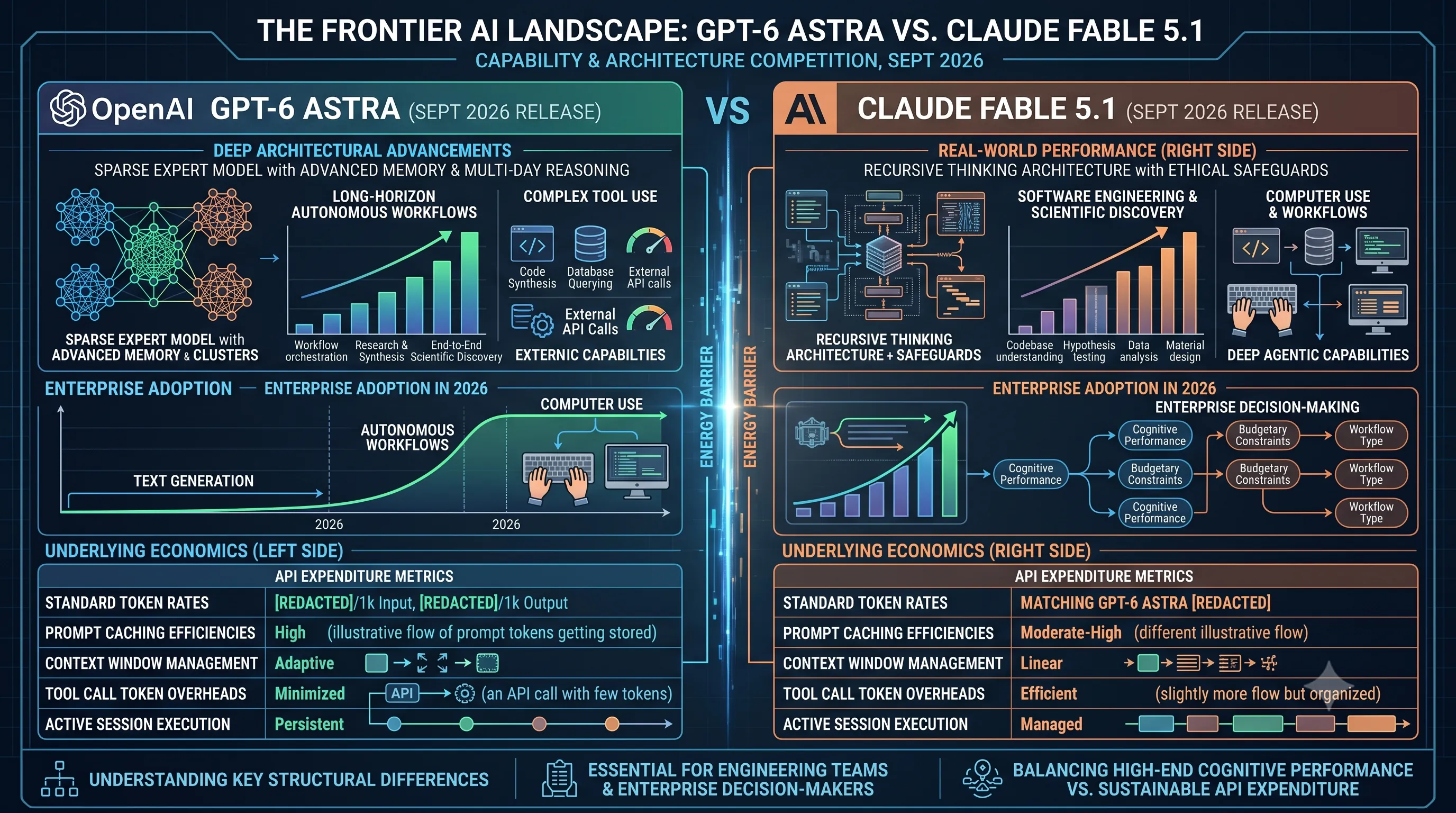
As enterprise adoption transitions from basic text generation toward long-horizon autonomous workflows, multi-day research tasks, and computer use, these flagship systems showcase how deep architectural advancements are reshaping real-world software engineering and scientific discovery.
While both AI developers have arrived at matching standard token rates, the underlying economics diverge dramatically across prompt caching efficiencies, context window management, tool call token overheads, and active session execution.
Understanding these subtle structural differences is essential for engineering teams and enterprise decision-makers balancing high-end cognitive performance against sustainable API expenditure in the second half of 2026.
1. Claude Fable 5.1 Architecture: Long-Running Autonomy and Scientific Workloads
In the context of the 2026 H2 frontier AI evaluation comparing GPT-6 Astra and Claude Fable 5.1 across benchmark performance and enterprise API deployments, understanding the architectural scope and release timeline of Anthropic's flagship lineup is essential.Mythos-Level Design for Multi-Day Autonomous Execution
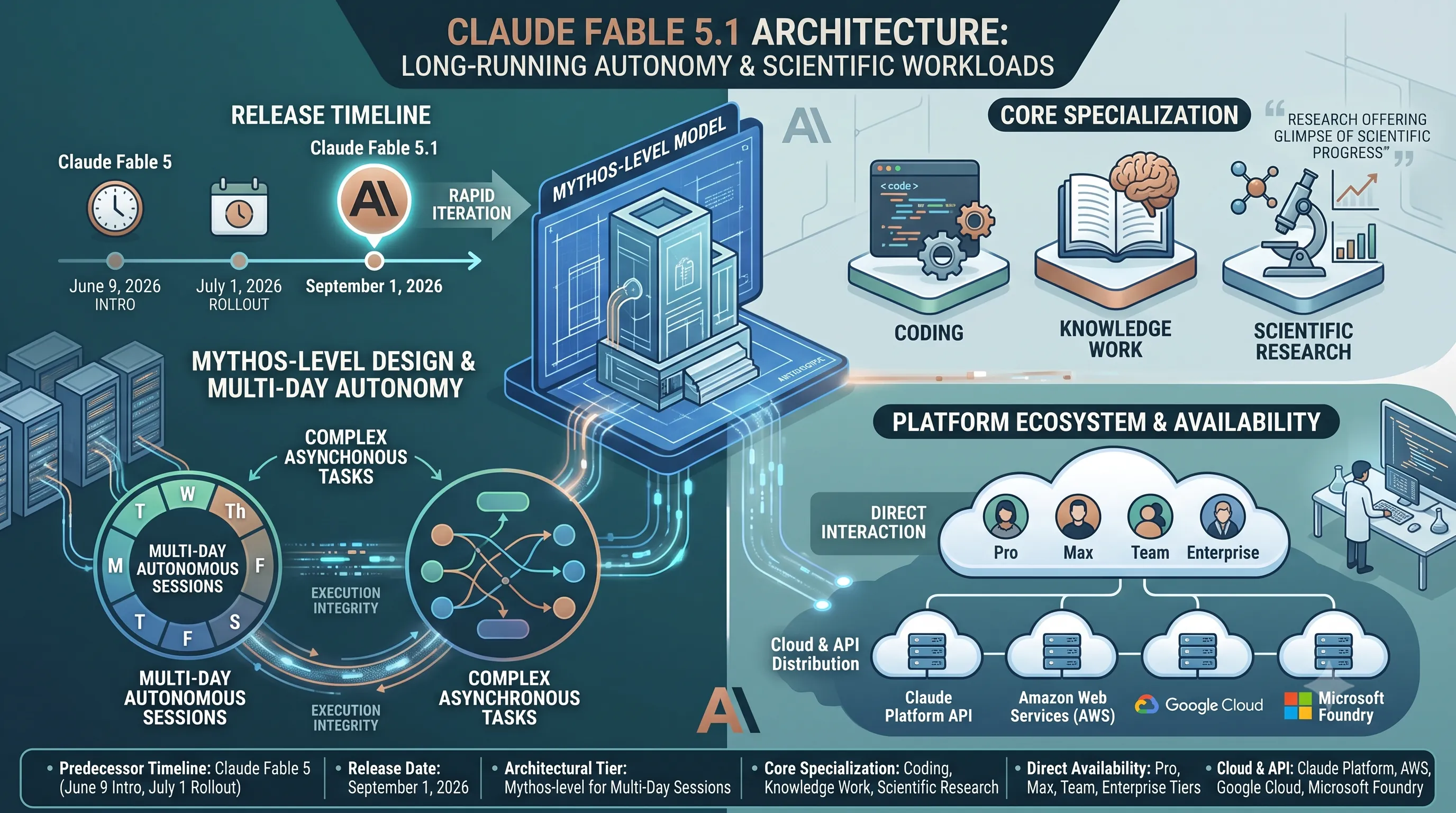
Claude Fable 5.1 was officially introduced on September 1, 2026, marking a rapid architectural iteration over Claude Fable 5, which was originally introduced on June 9, 2026, and rolled out on July 1, 2026.Anthropic has positioned Claude Fable 5.1 as its most capable model to date for coding and intensive knowledge work.
The system is architected as a Mythos-level model specifically engineered to manage long-running, multi-day autonomous sessions and complex asynchronous tasks without losing execution integrity.
This framework is targeted at sophisticated scientific workloads and advanced automated development, with Anthropic noting that its research capabilities "offer an early glimpse of how AI will soon contribute to scientific progress."
Platform Ecosystem and Cloud Provider Availability
To accommodate both individual power users and large-scale enterprise deployments, Anthropic has enabled broad distribution across dedicated interfaces and hyperscale cloud infrastructure.For direct interaction, the model is available to Pro, Max, Team, and Enterprise users.
For enterprise-grade integration, asynchronous workload orchestration, and API-driven development, Claude Fable 5.1 is accessible via the Claude Platform API, Amazon Web Services (AWS), Google Cloud, and Microsoft Foundry.
| Dimension | Claude Fable 5.1 Specification & Details |
|---|---|
| Predecessor Timeline | Claude Fable 5 introduced on June 9, 2026; rolled out on July 1, 2026 |
| Release Date | September 1, 2026 |
| Architectural Tier | Mythos-level model designed for multi-day autonomous sessions and complex asynchronous tasks |
| Core Specialization | Anthropic's most capable model for coding, knowledge work, and scientific research |
| Direct User Availability | Pro, Max, Team, and Enterprise subscription tiers |
| Cloud & API Distribution | Claude Platform API, AWS, Google Cloud, and Microsoft Foundry |
2. Claude Fable 5.1 API Cost Breakdown: Prompt Caching and Geo Multipliers
As frontier model architectures advance in the second half of 2026, evaluating operational token economics is essential for balancing compute throughput and deployment budgets.Claude Fable 5.1 introduces refined enterprise pricing structures, expanded context capabilities, and specialized caching mechanisms that redefine API expenditure across complex agentic pipelines.
Base Token Pricing and Prompt Caching Efficiency
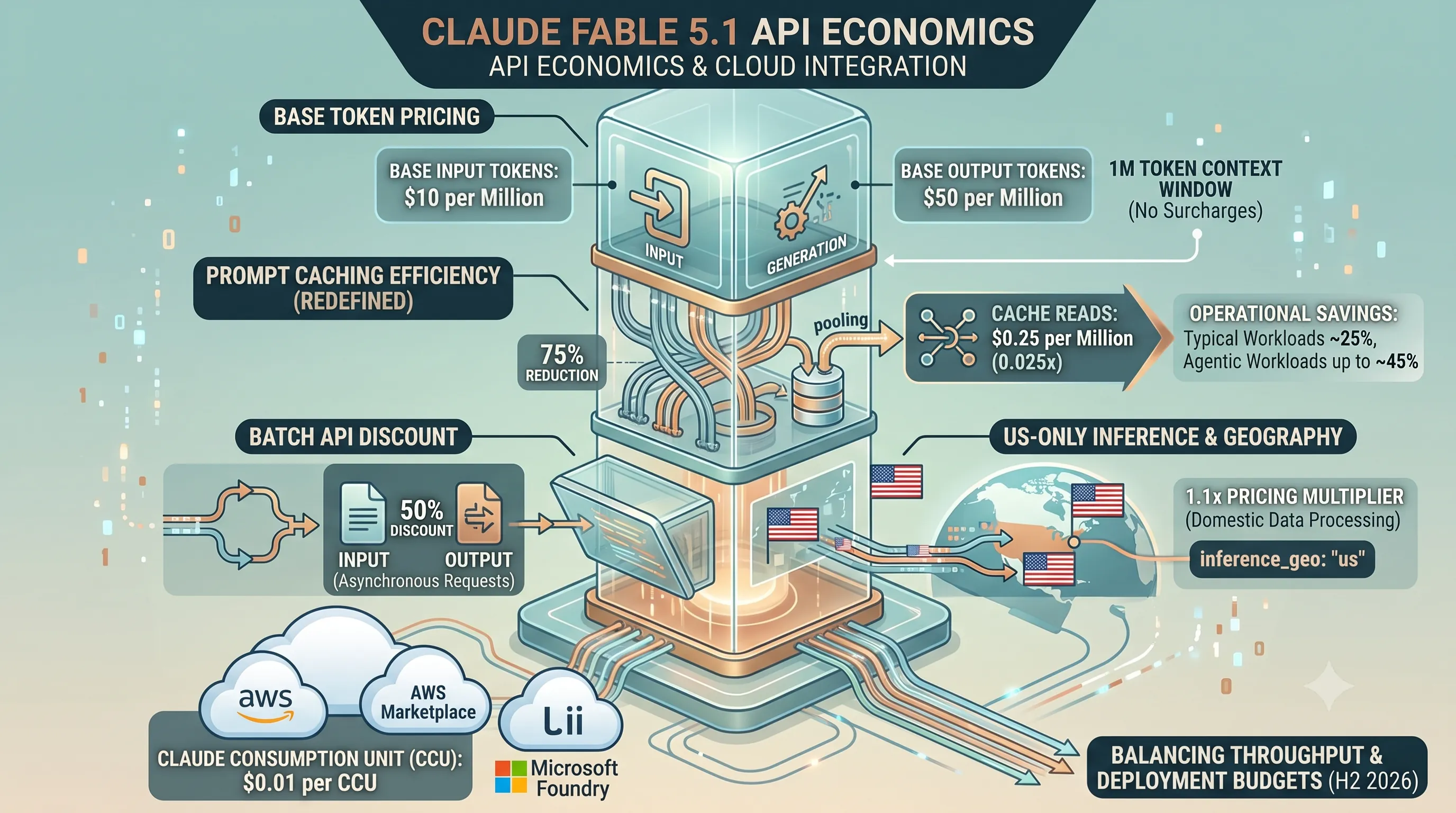
Under standard operational tiers, Claude Fable 5.1 is priced at a base rate of $10 per million input tokens and $50 per million output tokens.These standard rates apply across the model's full 1M token context window, providing extended context processing without penalty surcharges on raw input capacity.
To optimize long-context and iterative prompt chains, prompt caching allows developers to store recurring context blocks efficiently.
Automatic caching and explicit cache breakpoints are managed directly via the
cache_control parameter.Cache read tokens are billed at $0.25 per million tokens, which is a 0.025x multiplier of the base input price.
This cache read pricing represents a 75% reduction compared to Fable 5.
In production, these caching mechanics translate into measurable operational savings.
Prompt caching reduces total API costs for typical workloads by an estimated 25%, while highly agentic workloads that rely on repeated context queries achieve cost reductions of up to approximately 45%.
| Billing Tier / Feature | Pricing / Multiplier | Operational Scope & Efficiency |
|---|---|---|
| Base Input Tokens | $10 per million tokens | Standard rate across the entire 1M token context window |
| Base Output Tokens | $50 per million tokens | Standard inference generation rate |
| Cache Reads | $0.25 per million tokens (0.025x) | 75% reduction vs. Fable 5; saves ~25% (typical) to ~45% (agentic) |
| Batch API | 50% discount | Applies to both input and output tokens for asynchronous requests |
| US-Only Inference | 1.1x multiplier | Configured via inference_geo: 'us' parameter |
| Claude Consumption Unit (CCU) | $0.01 per CCU | Available on AWS Marketplace and Microsoft Foundry |
Batch API Discounts, US Inference Multipliers, and CCU Rates
For workloads that do not require immediate synchronous execution, the Batch API offers a flat 50% discount across both input and output tokens for asynchronous requests.This halved unit cost enables high-volume document extraction, retrospective data analysis, and offline evaluations at scale.
Geographic data routing parameters introduce specific enterprise billing modifiers.
When requests mandate domestic data processing using US-only inference (specified via
inference_geo: 'us'), a 1.1x pricing multiplier is applied to all consumed tokens.For enterprise procurement across major cloud ecosystems, Claude Fable 5.1 is accessible on AWS Marketplace and Microsoft Foundry.
Consumption in these environments is billed through Claude Consumption Units (CCU), set at a standardized rate of $0.01 per CCU to streamline cloud infrastructure budgeting and commitments.
3. OpenAI GPT-6 Astra: Specifications, Configurable Reasoning, and Pricing
As part of the 2026 frontier AI benchmark and API unit economics evaluation, analyzing OpenAI's flagship architecture provides essential clarity on system throughput and inference expenses.Released by OpenAI in September 2026, GPT-6 Astra serves as the company's frontier foundation model engineered specifically for end-to-end reasoning, coding, computer use, research, and document creation.
Operated under OpenAI proprietary API and product terms with associated usage restrictions, the model establishes a high-performance baseline for enterprise and developer workloads across the late 2026 landscape.
1.1M Token Context Capacity and Reasoning Effort Controls
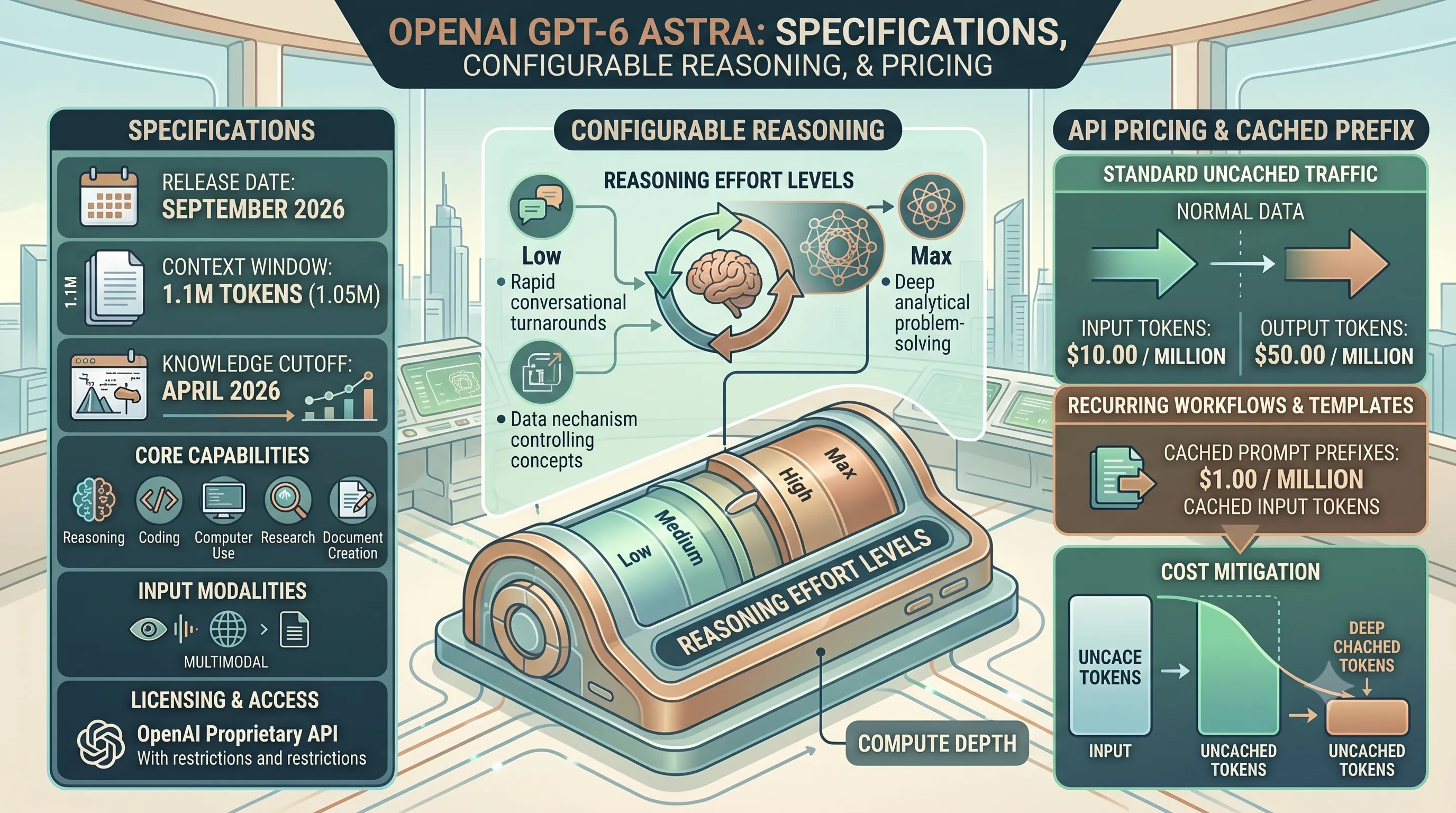
Architecturally, GPT-6 Astra incorporates an expansive context window capacity of 1.1M tokens (also referenced as 1.05M tokens), enabling comprehensive ingest of massive codebases and technical corpora in a single inference call.The model's knowledge cutoff date is April 2026, anchoring its internal parametric knowledge to verified events and developments up to that point.
To address complex operational workflows, GPT-6 Astra natively supports multimodal input capabilities alongside advanced cognitive steering mechanisms.
Specifically, it provides developers with granular control through configurable reasoning effort levels ranging from 'low' to 'max', allowing systems to dynamically allocate compute depth depending on whether a task requires rapid conversational turnaround or deep analytical problem solving.
GPT-6 Astra API Pricing and Cached Prefix Structure
Understanding the unit economics of GPT-6 Astra is critical when comparing frontier deployments in the second half of 2026.OpenAI sets the base API pricing for standard uncached traffic at $10.00 per million input tokens and $50.00 per million output tokens.
For recurring workflows and continuous prompt templates, cached prompt prefixes cost $1.00 per million cached input tokens, providing substantial cost mitigation for large context pipelines.
| Specification / Metric | GPT-6 Astra Detail |
|---|---|
| Release Date | September 2026 |
| Context Window | 1.1M tokens (1.05M tokens) |
| Knowledge Cutoff | April 2026 |
| Core Capabilities | End-to-end reasoning, coding, computer use, research, document creation |
| Input Modalities | Multimodal input support |
| Reasoning Controls | Configurable reasoning effort levels ('low' to 'max') |
| Standard Input API Rate | $10.00 / million tokens |
| Standard Output API Rate | $50.00 / million tokens |
| Cached Prefix API Rate | $1.00 / million tokens |
| Licensing & Access | Proprietary API with usage restrictions |
4. Safeguards, Fallback Routing, and Data Retention Policies
Deploying Claude Fable 5.1 within frontier API architectures requires a clear understanding of runtime compliance, automated safety enforcement, and underlying billing mechanisms.Anthropic integrates specialized safety controls to manage critical risk domains while preventing unexpected cost penalties during query rerouting.
Automated High-Risk Routing to Opus Models via Fallback API
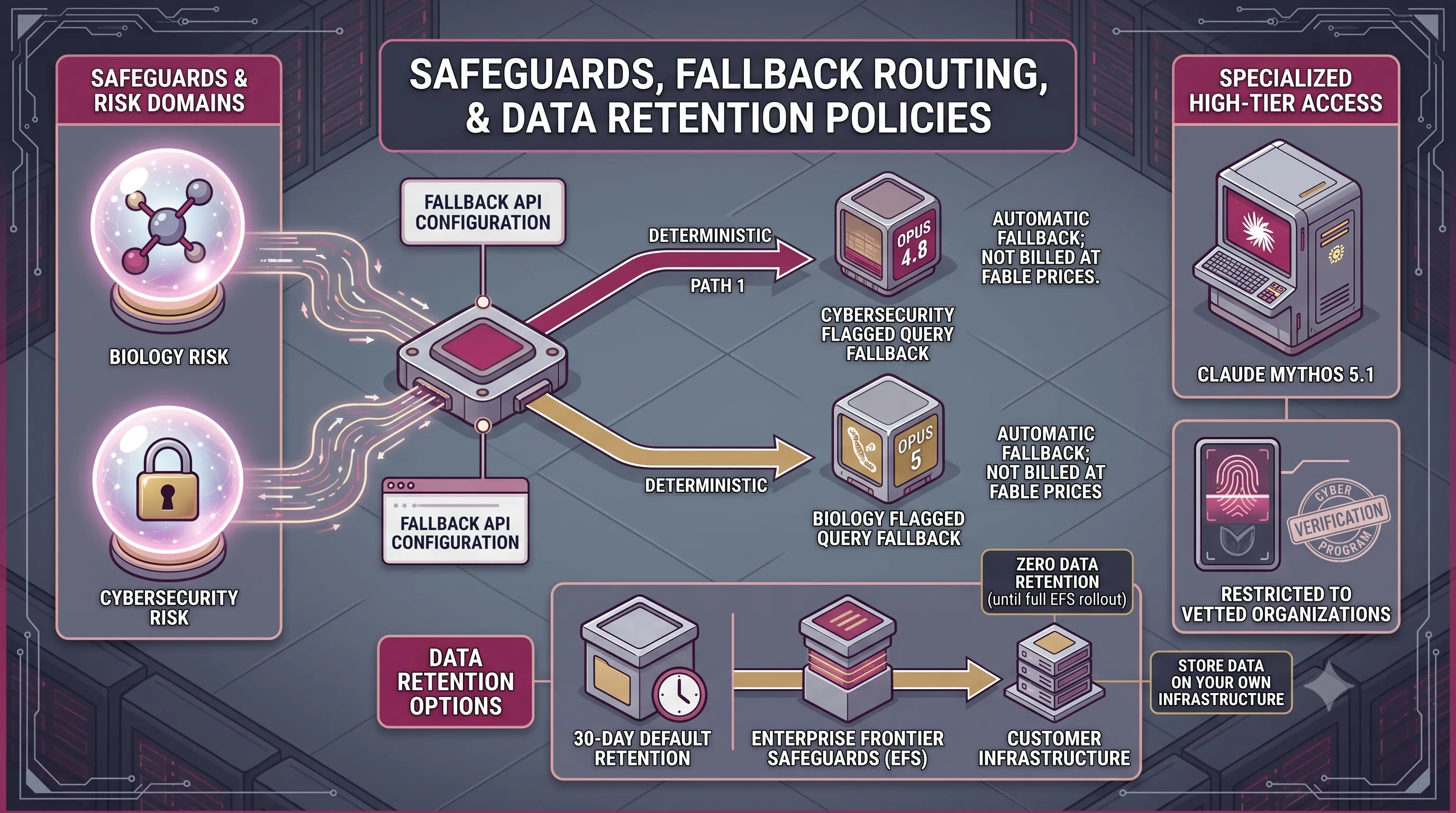
Robust safeguards actively monitor and restrict high-risk biology and cybersecurity capabilities during prompt processing.When high-risk vectors are identified, the platform employs deterministic fallback routing rather than standard execution halts.
Cybersecurity flagged queries automatically fallback and route to Opus 4.8 for controlled resolution.
Biology flagged queries automatically fallback and route to Opus 5.
To maintain cost integrity, rerouted queries are not billed at Fable prices.
API customers must configure fallback behavior via the Fallback API to handle these transitions systematically across production pipelines.
For specialized security research requiring unrestricted access, Claude Mythos 5.1 access is restricted to vetted organizations via the Cyber Verification Program.
| Domain / Trigger | Routing Target | Billing and Access Policy |
|---|---|---|
| Cybersecurity Flagged Query | Opus 4.8 | Automatic fallback; not billed at Fable prices |
| Biology Flagged Query | Opus 5 | Automatic fallback; not billed at Fable prices |
| Unrestricted High-Tier Capabilities | Claude Mythos 5.1 | Restricted to vetted organizations via Cyber Verification Program |
Enterprise Frontier Safeguards and Data Retention Options
Standard safety monitoring operates under a 30-day default data retention period across default endpoints.Enterprise customers can store data on their own infrastructure via Enterprise Frontier Safeguards (EFS).
Zero data retention remains available for qualifying enterprise deployments until the full EFS rollout is finalized.
5. Agentic Tool Token Overhead and Platform Execution Costs
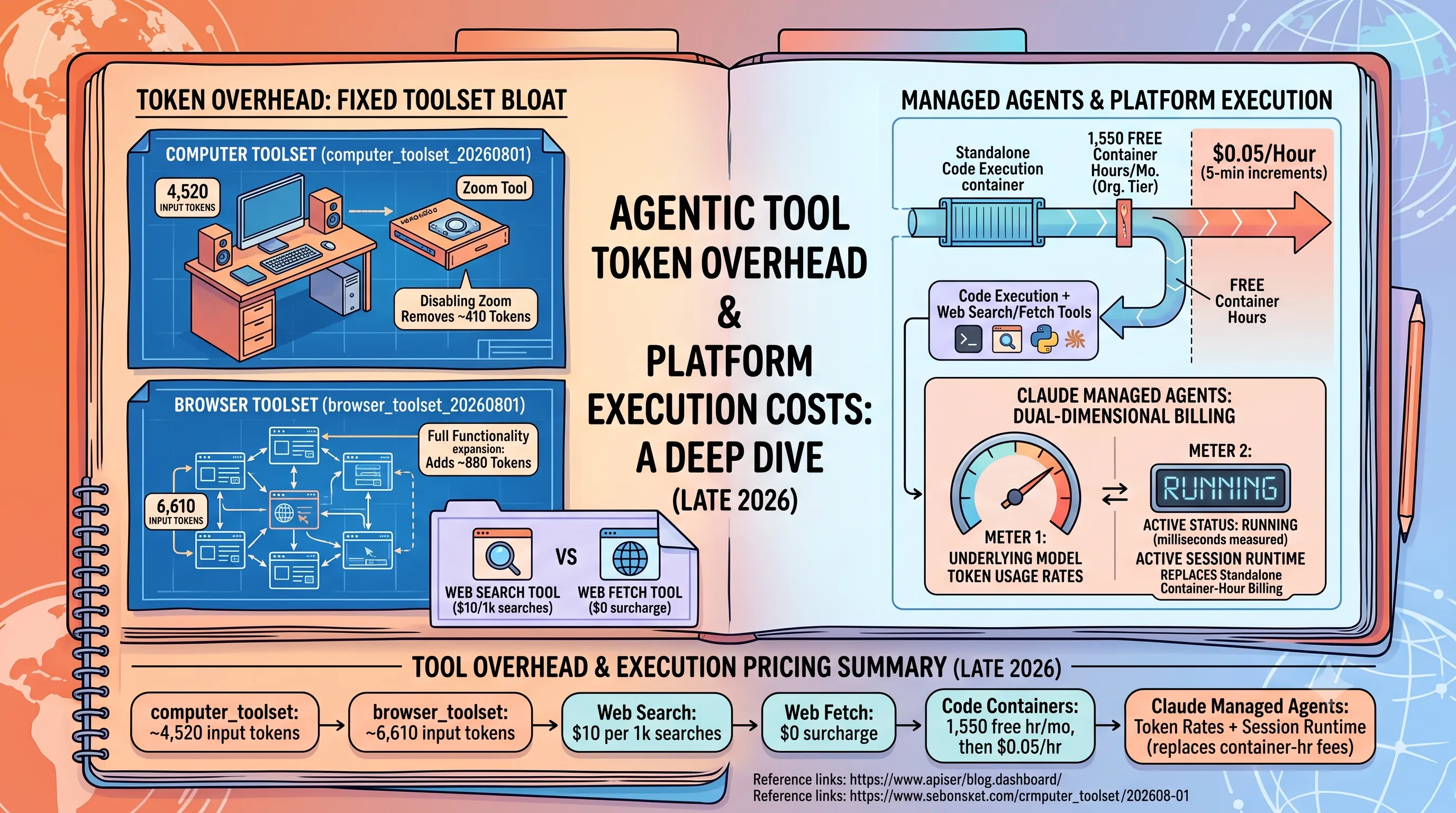
Evaluating real-world operational expenditures in frontier model deployments—such as comparative workloads between GPT-6 Astra and Claude Fable 5.1 in late 2026—demands a granular look at agentic framework overhead.
Base token pricing alone does not capture the true cost of complex agentic workflows, as native toolsets inject fixed prompt bloat on every execution step and invoke platform runtime meters.
Token Overhead Across Computer and Browser Toolsets
When orchestrating deep autonomous actions on Claude Fable 5 and Opus 5 architectures, tool definitions introduce substantial baseline token overhead before user prompts or dynamic context are processed.
Specifically, integrating computer_toolset_20260801 adds approximately 4,520 input tokens to the context window on Claude Fable 5 and Opus 5.
Developers seeking to reduce context bloat can selectively adjust configuration parameters, as disabling the zoom tool removes approximately 410 tokens from the schema payload.
Complex web navigation tasks require even higher structural context investments.
Activating browser_toolset_20260801 introduces approximately 6,610 input tokens on Claude Fable 5 and Opus 5.
Furthermore, configuring full functionality where all optional schema members are enabled adds approximately 880 tokens to this base payload.
For external information retrieval, tool billing mechanics diverge based on the interface type.
The web search tool is billed at a fixed rate of $10 per 1,000 searches, supplemented by standard input token costs for processing the retrieved result payload.
In contrast, the web fetch tool incurs zero specialized execution surcharge, requiring payment only for the standard input token charges consumed by the fetched text content.
Managed Agents Session Runtime and Container Execution Pricing
Beyond context-level token overhead, backend environment management introduces direct compute billing.
Standalone code execution infrastructure provides an allowance of 1,550 free container hours per organization per month.
Once this organizational tier is exhausted, usage is billed at $0.05 per container hour, calculated in minimum 5-minute increments.
However, code execution is completely exempt from container charges when combined directly within workflows utilizing web_search_20260209 or web_fetch_20260209.
For end-to-end autonomous deployments, Claude Managed Agents transitions billing into a dual-dimensional structure.
Managed agents bill simultaneously across two dimensions: underlying model token usage rates and active session runtime.
Active session runtime is tracked and measured in milliseconds strictly while the session status is in a running state.
Within this managed agent architecture, active session runtime billing completely replaces standalone container-hour billing for code execution tasks.
| Tool / Environment Component | Token Overhead / Direct Surcharge | Execution & Billing Conditions |
|---|---|---|
| computer_toolset_20260801 | ~4,520 input tokens (Claude Fable 5 / Opus 5) | Disabling zoom removes ~410 input tokens from overhead schema. |
| browser_toolset_20260801 | ~6,610 input tokens (Claude Fable 5 / Opus 5) | Enabling all optional members adds ~880 input tokens to overhead schema. |
| Web Search Tool | $10 per 1,000 searches | Fetched result content billed at standard input token rates. |
| Web Fetch Tool | $0 tool surcharge | Content billed exclusively at standard input token rates. |
| Code Execution Containers | 1,550 free container hours/month, then $0.05/hour | Billed in 5-minute increments; free when combined with web search/fetch tools. |
| Claude Managed Agents | Token usage rates + Active session runtime | Runtime measured in milliseconds while status is running; replaces container-hour fees. |
Related Posts