A Guide to Building Sovereign AI Infrastructure with Mistral Self-Hosted Stacks
🚀 Key Takeaways
- Sovereign AI Autonomy: Migrating to Mistral's self-hosted enterprise stack enables organizations to break reliance on US hyperscalers and maintain total data sovereignty under strict regulatory frameworks.
- Optimized Frontier Portfolio: Architectures such as Mistral Small 4, Devstral Small 2, and Mistral Medium 3.5 deliver high-efficiency local inference across extensive context windows and agentic coding workflows.
- Zero-Telemetry Air-Gapped Serving: Standardized local inference engines paired with telemetry-disabled tooling guarantee completely isolated operations without external network leakage.
- Enterprise Control via Mistral Studio: Self-hosted and dedicated tiers integrate stateful orchestration, automated judges, and proprietary data connectors entirely inside the corporate perimeter.
- Validated Large-Scale Deployments: Global enterprises across regulated sectors have proven that private, self-hosted LLM stacks can scale securely across hundreds of thousands of users.
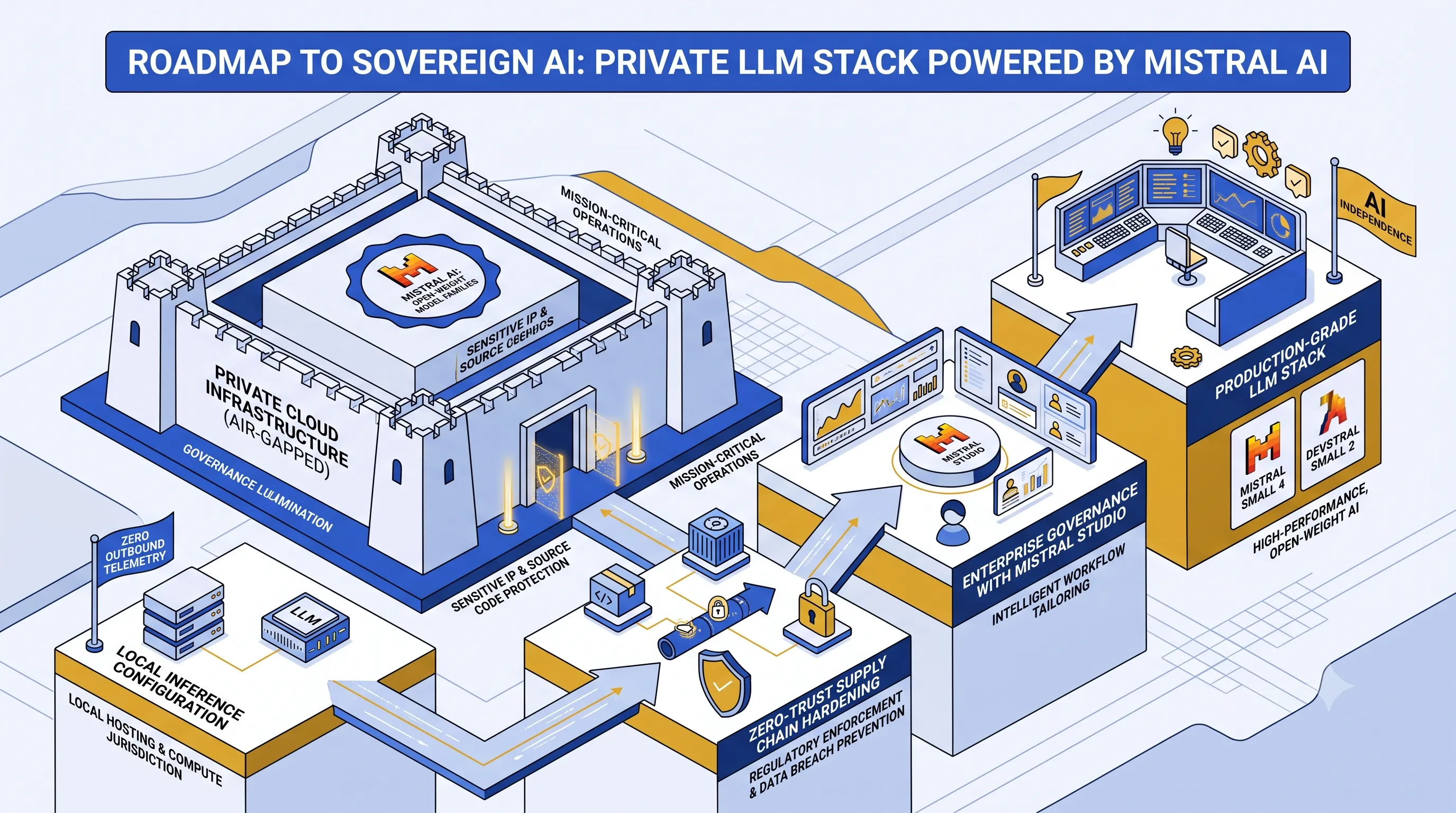
Mistral AI has emerged as the cornerstone of the sovereign AI movement, offering high-performance, open-weight model families paired with an enterprise-ready orchestration layer. By deploying models such as Mistral Small 4 and Devstral Small 2 on dedicated private infrastructure, IT leaders can retain full physical compute jurisdiction, enforce zero outbound telemetry, and tailor intelligent workflows directly to internal operational requirements.
This architectural guide provides a comprehensive roadmap for engineering a production-grade, air-gapped private cloud LLM stack. From local inference configuration and zero-trust supply chain hardening to enterprise governance with Mistral Studio, organizations now possess the tools necessary to achieve complete AI independence without sacrificing frontier capabilities.
1. Self-Hosted Model Selection: Hardware Sizing and Mistral Portfolio Specifications
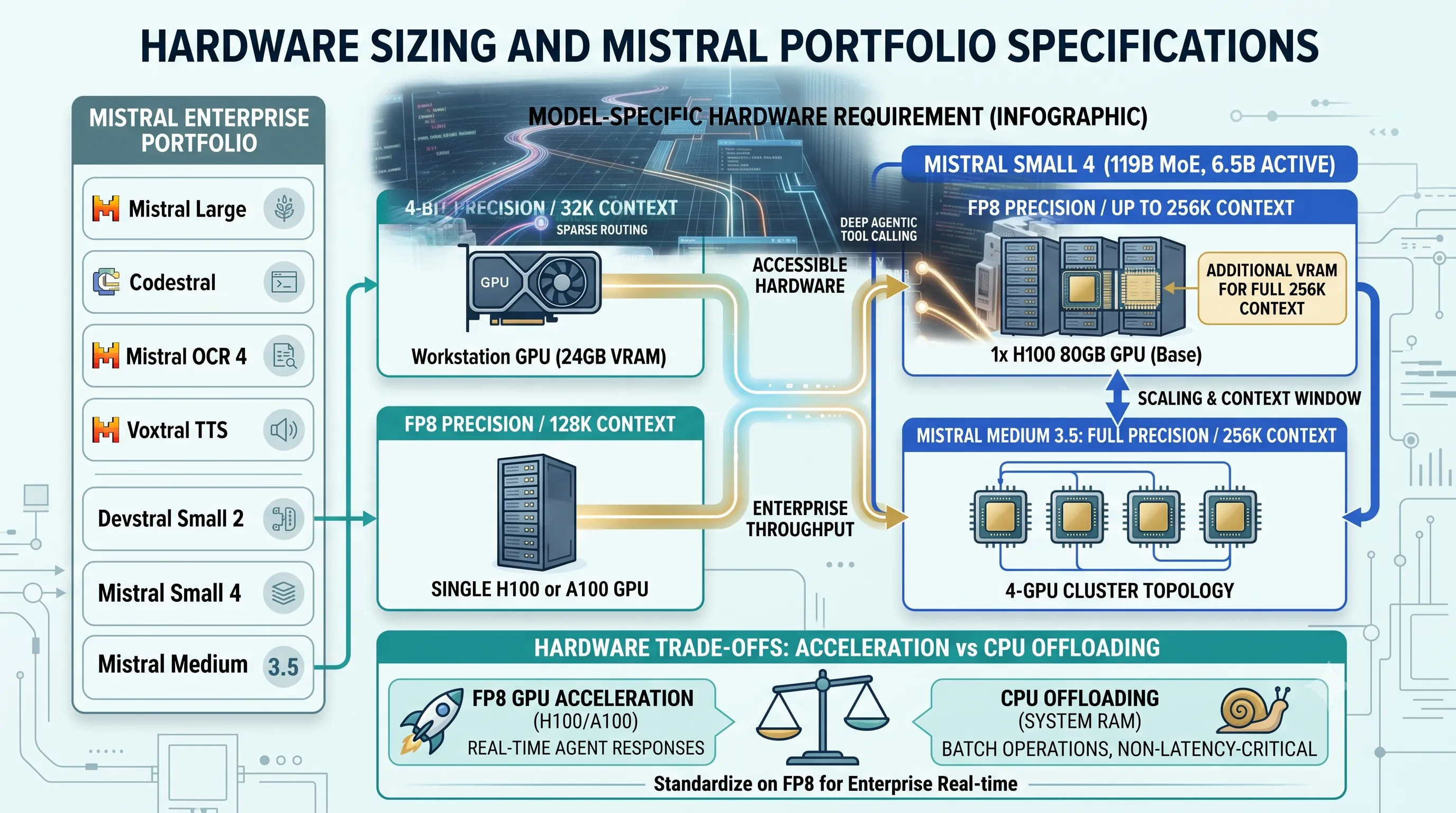
Establishing an independent, sovereign private cloud infrastructure requires precise hardware sizing across the Mistral enterprise model portfolio.Organizations transitioning away from proprietary US cloud dependencies can tailor on-premise deployments using Mistral's specialized architectures, which span from lightweight developer tooling to massive Mixture-of-Experts (MoE) engines.
The broader self-hosted lineup comprises targeted foundational engines including Mistral Large, Codestral, Mistral OCR 4 for document understanding, and Voxtral TTS for localized speech synthesis alongside the core reasoning models.
Devstral Small 2 and Mistral Small 4 VRAM Footprints
Devstral Small 2 is engineered as a 24B dense model optimized specifically for coding agents and developer workflows.Its compact architecture provides an accessible on-premise hardware footprint for secure developer environments.
At 4-bit precision, Devstral Small 2 operates within a 32k context length on consumer-grade hardware such as an RTX 4090 or any workstation GPU equipped with 24 GB VRAM.
For enterprise-tier throughput and expanded context, Devstral Small 2 runs at FP8 precision with an extended 128k context length on a dedicated H100 or A100 GPU.
For complex multimodal logic, Mistral Small 4 implements a 119B parameter Mixture-of-Experts (MoE) architecture activating 6.5B parameters per token.
This design couples hybrid reasoning with robust code generation while maintaining computational efficiency.
Mistral Small 4 supports an extensive 256,000-token (256k) context window.
Deploying Mistral Small 4 at FP8 precision requires at least a single H100 80GB GPU for standard execution.
Multi-GPU Topologies for Mistral Medium 3.5 and Extended Context
Enterprise workloads demanding higher parameter scale leverage Mistral Medium 3.5 across multi-GPU clusters.Mistral Medium 3.5 self-hosts across a baseline configuration of 4 GPUs to sustain its native 256,000-token context window.
Distributing tensor parallelism across a 4-GPU topology provides the memory bandwidth necessary to prevent context truncation during long-form enterprise analysis.
Similarly, while Mistral Small 4 runs basic inference on a single 80GB accelerator, scaling its full 256k context window in high-throughput production environments demands additional VRAM beyond a single H100 80GB GPU.
Allocating multi-GPU infrastructure guarantees that key-value caching over massive document contexts does not trigger out-of-memory bottlenecks.
| Model | Architecture & Parameter Scale | Precision & Context Window | Target Hardware Requirement |
|---|---|---|---|
| Devstral Small 2 | 24B Dense (Coding agents & developer tasks) | 4-bit Precision / 32k Context | RTX 4090 or any 24 GB VRAM GPU |
| Devstral Small 2 | 24B Dense (Coding agents & developer tasks) | FP8 Precision / 128k Context | Single H100 or A100 GPU |
| Mistral Small 4 | 119B MoE (6.5B active parameters) | FP8 Precision / Up to 256k Context | 1x H100 80GB GPU (Base); Additional VRAM for longer context |
| Mistral Medium 3.5 | Enterprise Multi-GPU Model | Full Precision / 256k Context | 4-GPU Cluster Topology |
Hardware Trade-offs: FP8 Acceleration vs CPU Offloading
Operating private LLM stacks requires balancing accelerator availability against processing latency.Running inference with CPU offloading remains a viable deployment path if system RAM is sufficient to hold the model weights.
However, CPU offloading operates significantly slower than dedicated GPU inference due to system memory bandwidth constraints.
Enterprise environments requiring real-time agent responses benefit from standardizing on native FP8 GPU acceleration across H100 and A100 infrastructure, reserving CPU offload configurations strictly for asynchronous batch operations or non-latency-critical workloads.
2. Air-Gapped Deployment Architecture: vLLM Serving and Zero-Telemetry Hardening
Establishing enterprise data sovereignty and eliminating dependency on centralized US cloud providers requires hosting models entirely within on-premises or private cloud infrastructure.Deploying Mistral models in fully air-gapped environments ensures that sensitive corporate intellectual property never crosses external network perimeters.
Hardening vLLM for Local OpenAI-Compatible Serving
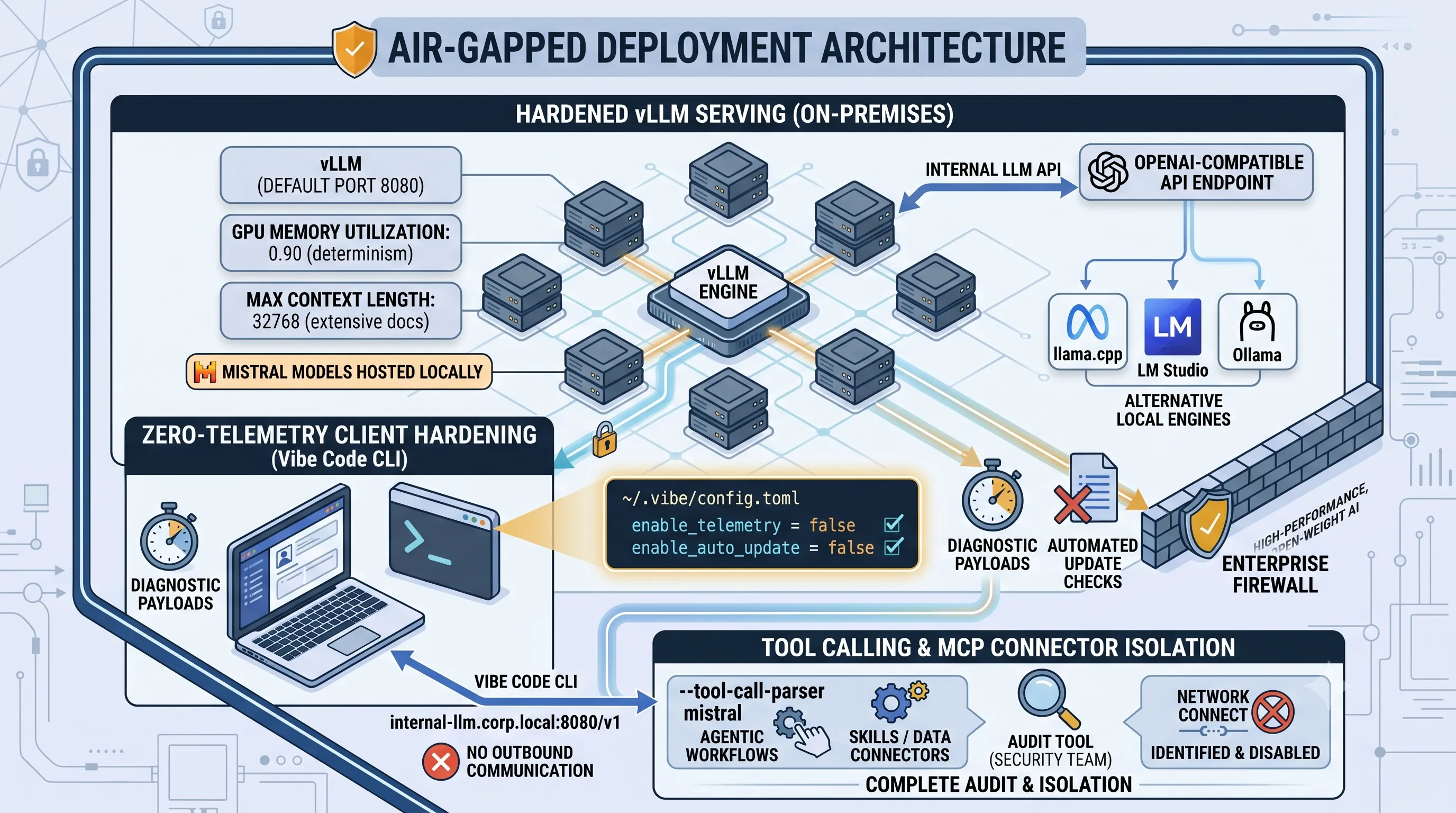
Mistral models can be served internally using vLLM to expose a standard OpenAI-compatible API endpoint across corporate networks.In a hardened air-gapped setup, the runtime container is typically bound to the default local serving port 8080.
To ensure deterministic performance and prevent out-of-memory crashes during concurrent execution, the GPU memory utilization flag is set to 0.90.
Furthermore, the maximum model context length in the serving container configuration is allocated to 32768 tokens, accommodating extensive documents and complex multi-turn developer prompts.
Enterprises evaluating alternative local OpenAI-compatible inference runtimes can also utilize llama.cpp, LM Studio, or Ollama depending on their hardware environments and virtualization constraints.
| Component / Engine | Configuration Parameter | Operational Role |
|---|---|---|
| vLLM (Default Port) | Port 8080 | Exposes the primary OpenAI-compatible API endpoint for internal traffic. |
| vLLM (Memory Flag) | GPU Memory Utilization: 0.90 | Allocates 90% of dedicated VRAM for stable, air-gapped batch processing. |
| vLLM (Context Limit) | Max Context Length: 32768 | Defines the 32k token window for large-scale enterprise context processing. |
| Alternative Local Engines | llama.cpp, LM Studio, Ollama | Provides alternative local OpenAI-compatible inference serving backends. |
Zero-Telemetry Client Configuration in Vibe Code CLI
Client tooling connecting to private Mistral instances must be hardened to prevent telemetry leakage.When utilizing the Vibe Code CLI, the client must be pointed directly to internal inference endpoints, such as http://internal-llm.corp.local:8080/v1, using custom provider definitions.
To enforce strict air-gapped compliance, automated network pings and telemetry transmissions to mistral.ai must be explicitly disabled.
This hardening is managed inside the client configuration file located at ~/.vibe/config.toml by applying the following properties:
enable_telemetry = false
enable_auto_update = false
Tool Calling Isolation and MCP Connector Auditing
For agentic workflows requiring native function calling, vLLM must be initialized with Mistral-specific parsing flags.Operators must supply the --tool-call-parser mistral and --enable-auto-tool-choice runtime flags to enable structured schema outputs and automated tool invocation within local boundaries.
While the core inference engine and CLI client operate in strict isolation, enterprise security teams must perform separate audits on external tools, Model Context Protocol (MCP) servers, skills, and data connectors.
Any supplementary connector or skill that attempts external network communication must be identified and disabled to maintain complete air-gapped integrity.
3. Enterprise Orchestration and Control: Mistral Studio Governance Framework
To break free from reliance on centralized US Big Tech proprietary architectures, enterprises require sovereign operational control over both their model execution and lifecycle management.Mistral Studio establishes this foundation, backed by Mistral AI's €3B capital raised to build sovereign open-weight frontier AI systems.
By integrating enterprise orchestration and granular governance, organizations can operate private cloud LLM ecosystems without compromising data privacy or administrative authority.
Deployment Tier Comparison: Self-Hosted vs Dedicated vs Hybrid
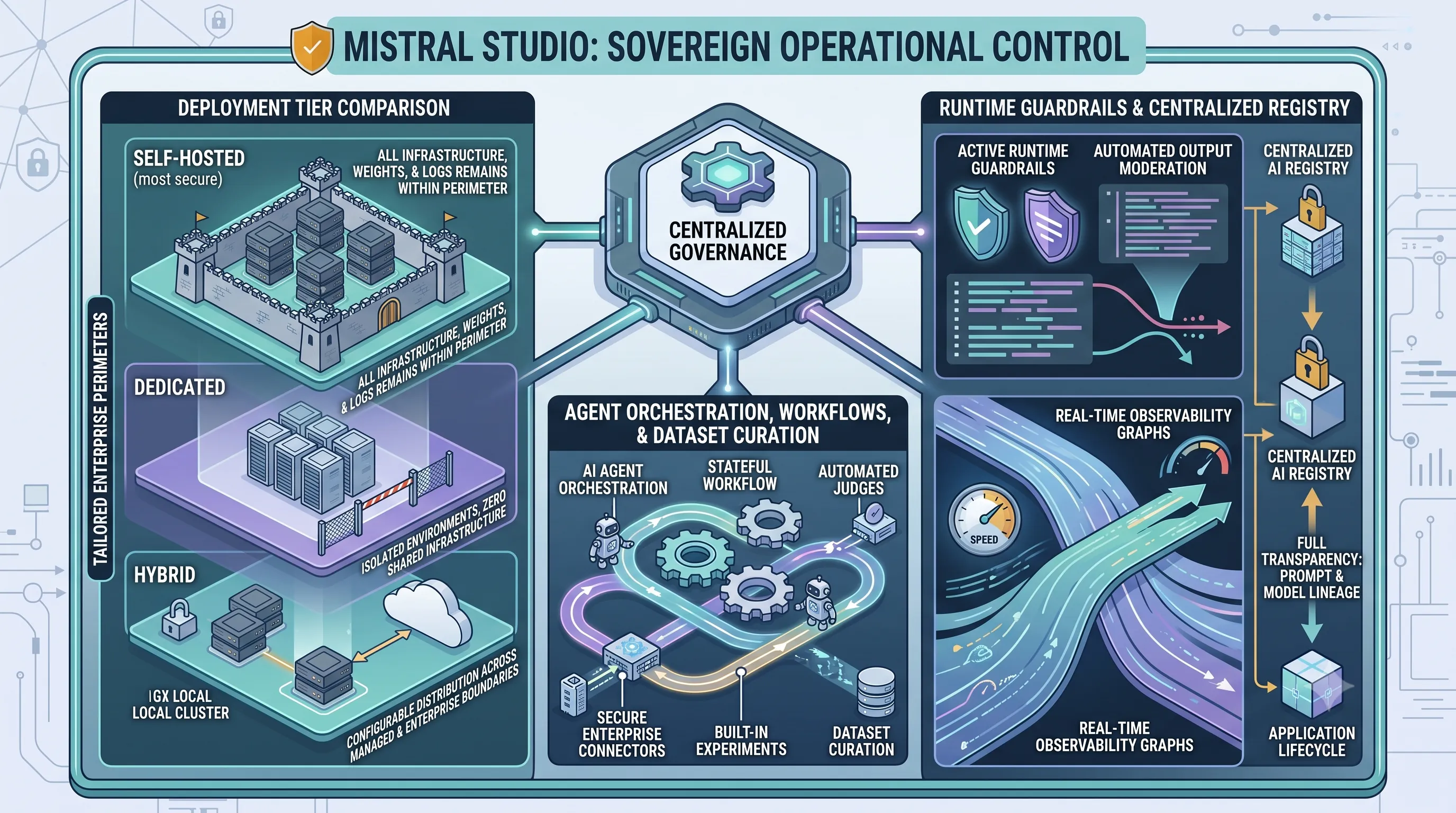
Mistral Studio addresses sovereign infrastructure needs by offering flexible architectural tiers tailored to specific enterprise perimeter requirements.Organizations can choose between three distinct deployment models: Hybrid, Dedicated, and Self-hosted tiers.
| Deployment Tier | Infrastructure Isolation | Perimeter and Data Control |
|---|---|---|
| Self-Hosted | Full on-premises or private cloud deployment. | Keeps all infrastructure, models, and data strictly within the enterprise perimeter. |
| Dedicated | Isolated environments with no shared infrastructure resources. | Dedicated enterprise-grade runtime separation without multi-tenant hardware overlap. |
| Hybrid | Flexible tiered allocation across connected environments. | Configurable architectural distribution across managed and enterprise boundaries. |
The Dedicated tier offers fully isolated environments where zero infrastructure resources are shared with external tenants.
Agent Orchestration, Workflows, and Dataset Curation
Operating an autonomous private cloud stack requires robust workflow engines that extend beyond basic prompt interfaces.Mistral Studio integrates complete AI agent orchestration to manage complex, multi-step tasks across enterprise environments.
These capabilities are supported by stateful workflows that preserve execution context across dynamic enterprise tasks.
Direct integration is facilitated through secure enterprise connectors, linking models to internal data sources.
To maintain continuous output quality and validate modifications, the platform includes automated judges alongside built-in tooling for running structured experiments.
Comprehensive dataset curation tools enable teams to refine domain-specific datasets directly within their managed environment.
Runtime Guardrails and Centralized Model Registry Lineage
Enterprise-level sovereignty demands comprehensive operational oversight and strict real-time control.Mistral Studio provides robust governance through active runtime guardrails that intercept queries and enforce operational policies.
These safeguards work in tandem with automated output moderation to inspect and filter model responses before delivery.
Administrators monitor fleet behavior through real-time observability graphs, providing visibility into execution paths and latency profiles.
All system artifacts are governed through a centralized AI registry, ensuring full transparency across prompt and model lineage throughout the entire application lifecycle.
4. Sovereign AI Economics and Compliance: Mitigating Data Exposure and Regulatory Risk
Transitioning away from public US Big Tech APIs toward sovereign AI infrastructure addresses immediate regulatory liabilities and significant financial exposure.
Operating private cloud LLMs ensures that enterprise workloads adhere strictly to regional data sovereignty mandates while preventing proprietary intelligence from leaking into external model training pipelines.
Regulatory Pressure: GDPR and EU AI Act Penalty Mitigation
Regulatory frameworks have substantially raised the stakes for enterprise data governance.
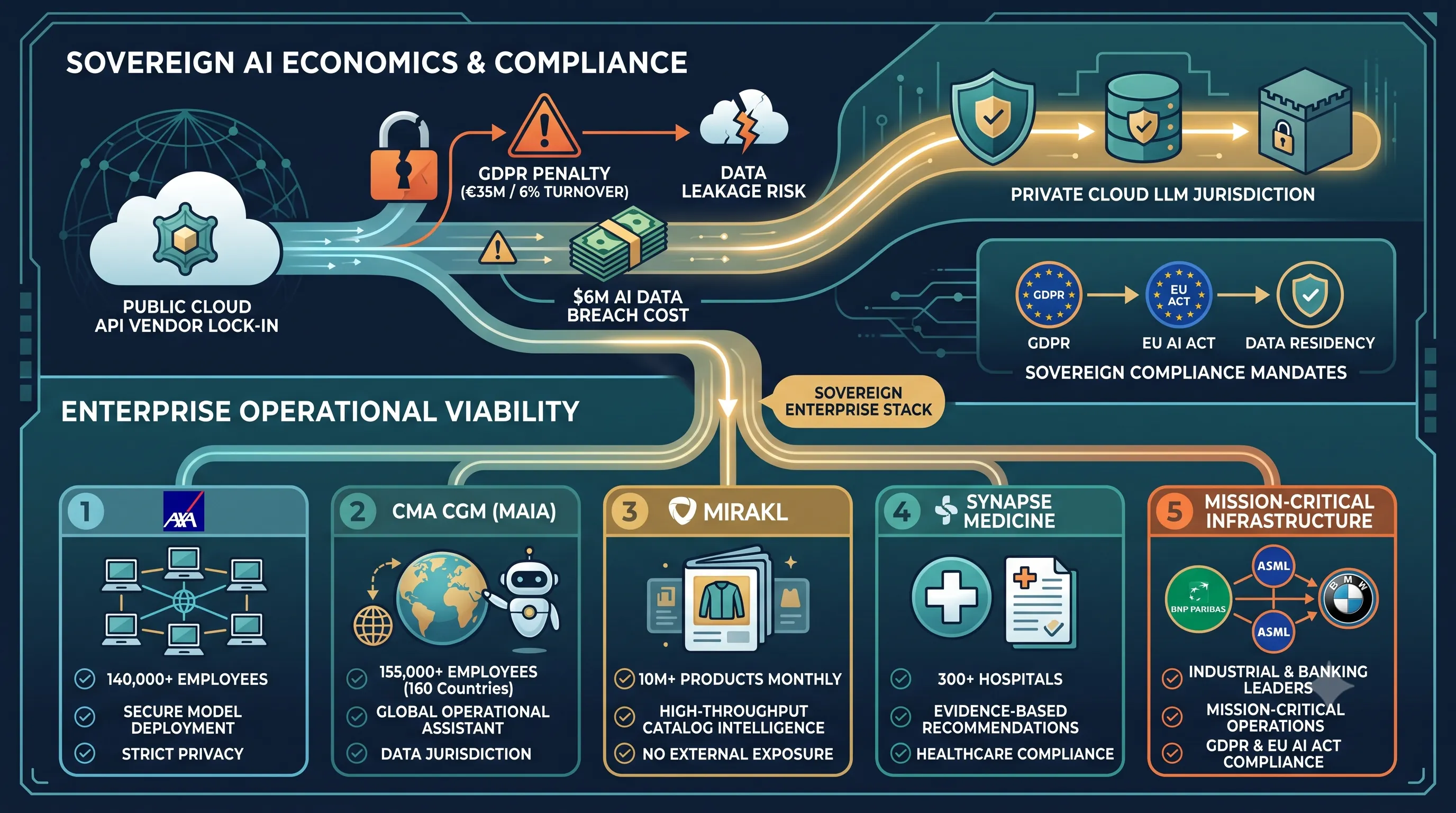
Under the EU AI Act, non-compliance violations carry statutory penalties reaching up to €35 million or 6% of global annual turnover.
Concurrently, the average cost of a malicious AI-enabled data breach reached $6 million in 2026.
Deploying sovereign models mitigates data leakage risks associated with unmanaged public chatbot usage, such as the accidental exposure of proprietary source code or confidential internal records.
Meeting strict sovereign AI standards requires enterprises to maintain complete control over data jurisdiction, physical compute access, and model execution in full alignment with GDPR and EU AI Act mandates.
Enterprise Case Studies: AXA, CMA CGM, and Mission-Critical Workloads
Major organizations across heavily regulated sectors have validated the operational viability of private Mistral deployments at massive scale.
Financial services leader AXA deployed secure Mistral AI models to over 140,000 employees to maintain strict operational privacy.
Global logistics group CMA CGM rolled out the Mistral-powered MAIA personal assistant across 160 countries for more than 155,000 employees.
E-commerce platform Mirakl processes over 10 million products monthly using Mistral technology.
In healthcare, Synapse Medicine delivers evidence-based medical recommendations to over 300 hospitals while keeping patient records fully protected within compliant boundaries.
Additional European enterprises leveraging Mistral models for sovereign operations include BNP Paribas, ASML, HSBC, BMW, TotalEnergies, Veolia, and France Travail.
| Enterprise / Organization | Operational Scale / Workload Scope | Sovereignty and Compliance Focus |
|---|---|---|
| AXA | 140,000+ employees | Secure enterprise-wide model deployment |
| CMA CGM (MAIA Assistant) | 155,000+ employees across 160 countries | Global operational assistant with data jurisdiction control |
| Mirakl | 10M+ products processed monthly | High-throughput catalog intelligence without external data exposure |
| Synapse Medicine | 300+ hospitals | Evidence-based medical recommendations under healthcare compliance |
| Industrial & Banking Leaders (BNP Paribas, ASML, HSBC, BMW, TotalEnergies, Veolia, France Travail) |
Mission-critical enterprise infrastructure | Full compute access, GDPR, and EU AI Act regulatory compliance |
Data Residency Control vs Public Cloud API Vendor Lock-In
Relying on public cloud AI APIs without explicit data residency guarantees exposes organizations to severe vendor lock-in and unauthorized data exposure risks.
When proprietary data traverses third-party public endpoints, organizations lose granular control over physical infrastructure, runtime parameters, and lifecycle governance.
Building private cloud environments using the Mistral enterprise stack establishes complete authority over model execution, ensuring enterprise data never leaves sovereign boundaries.
5. Private Cloud AI Infrastructure: Supply Chain Hardening and TCO Realities
Eliminating dependency on external Big Tech APIs requires building a fully autonomous, sovereign private cloud infrastructure capable of hosting enterprise LLM workloads.Operating artificial intelligence systems within an air-gapped boundary demands rigorous software supply chain controls, internal platform dependencies, and a clear understanding of infrastructure economics.
Core Stack Topology: Mirrored Registries and Internal RAG Infrastructure
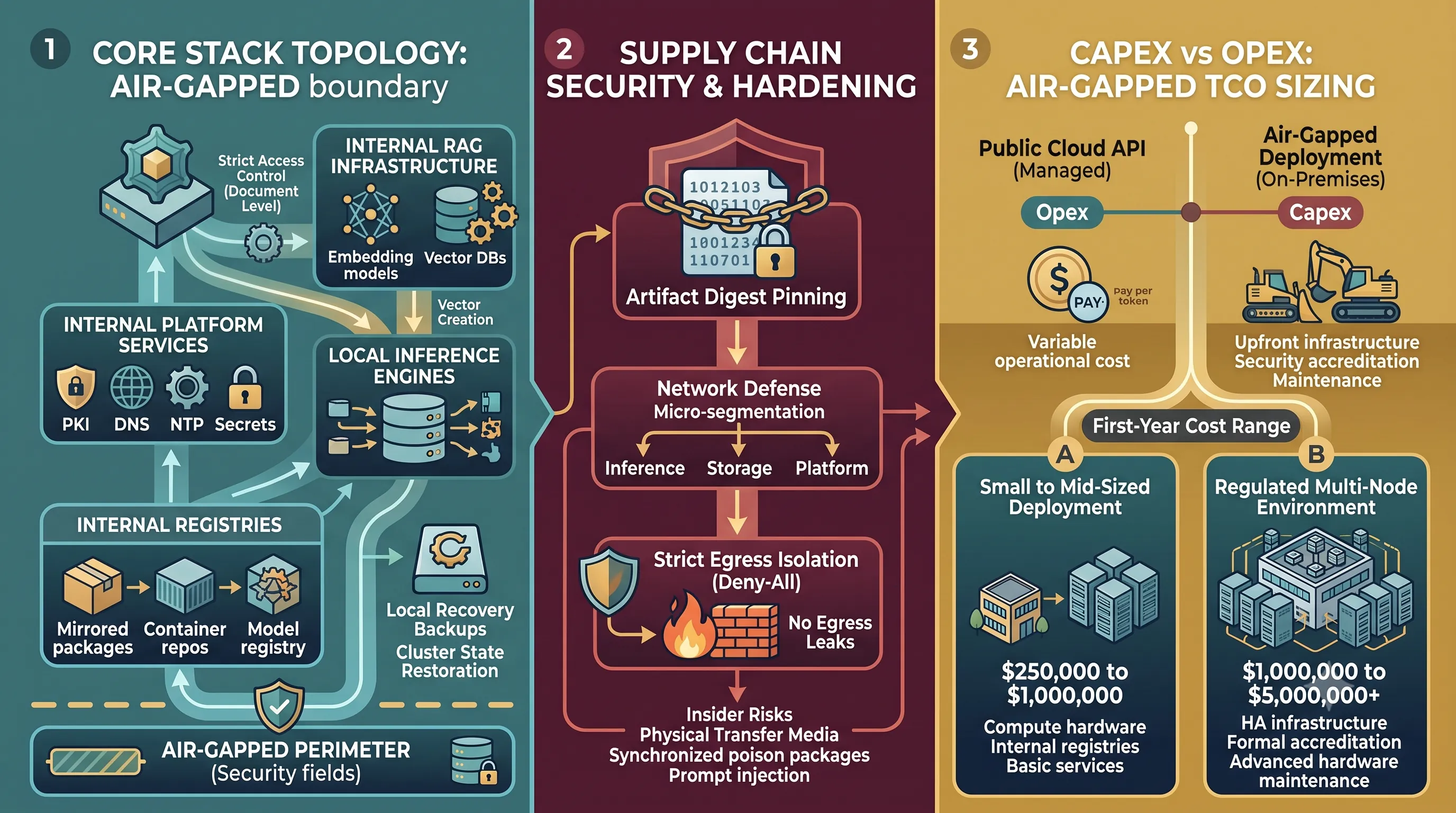
A complete air-gapped artificial intelligence stack must operate without external network access by replacing public package registries and endpoints with internal alternatives.The baseline infrastructure requires internally hosted model registries alongside mirrored package and container repositories.
Workloads are processed directly through local inference engines, supported by dedicated platform services including internal Public Key Infrastructure (PKI), local Domain Name System (DNS), Network Time Protocol (NTP), and enterprise secrets management.
System resilience is preserved through local recovery backup mechanisms engineered to restore cluster state without external data feeds.
Air-gapped Retrieval-Augmented Generation (RAG) pipelines introduce specialized infrastructure requirements within the private perimeter.
Organizations must deploy and maintain on-premises hosting for embedding models and dedicated vector databases.
To prevent unauthorized data exposure across internal silos, the system must enforce strict document-level access control prior to context injection into the inference engine.
Supply Chain Security: Artifact Digest Pinning and Egress Isolation
Software supply chain integrity within disconnected environments depends heavily on strict provenance and verification standards.Engineering teams must pin exact artifact digests or immutable version numbers rather than relying on mutable tags such as 'latest'.
Network defense requires configuring strict deny-all egress policies at the firewall layer, supported by fine-grained network micro-segmentation across inference, storage, and platform tiers.
Teams must conduct recurring tests for egress leaks to validate that no anomalous outbound traffic or unauthorized telemetry can traverse the perimeter.
Despite strict isolation, network segregation alone does not eliminate all critical risk factors.
Enterprises must actively mitigate insider risks, physical transfer media vectors, poisoned packages entering via synchronization mirrors, and application-level prompt injection vulnerabilities.
Capex vs Opex: Air-Gapped TCO Sizing and Operational Maintenance
Transitioning from managed public cloud APIs to an on-premises air-gapped deployment fundamentally shifts enterprise financial structures.The cost profile pivots from operational, variable pay-per-token API fees to upfront infrastructure investments, local security accreditation, and ongoing local hardware maintenance.
| Deployment Scope | First-Year Cost Range | Primary Cost Drivers |
|---|---|---|
| Small to Mid-Sized Deployment | $250,000 to $1,000,000 | Upfront compute hardware, internal registry setup, platform services (PKI, DNS, NTP, secrets), and basic local recovery backups. |
| Regulated Multi-Node Environment | $1,000,000 to $5,000,000+ | High availability multi-node infrastructure, formal security accreditation, local RAG pipeline clusters, and advanced hardware maintenance. |
For organizations operating highly available, regulated, multi-node air-gapped AI environments, first-year capital and operational expenditures reach $1,000,000 to $5,000,000 or more.
Related Posts