
Seamless CI/CD for AI Prompts: Promptfoo for Quality, Security, and Evaluation
🚀 Key Takeaways
- Promptfoo seamlessly integrates into CI/CD pipelines, automating prompt evaluation and security scanning to ensure quality before deployment.
- It empowers developers to proactively catch regressions and identify vulnerabilities early by testing prompt changes in pre-production environments.
- Comprehensive assertions and metrics allow for precise validation of LLM outputs against expected conditions and performance thresholds.
- Advanced features like custom scoring functions and derived metrics enable highly customizable and complex evaluation logic, alongside cost tracking and compliance reporting.
The landscape of artificial intelligence continues its rapid transformation, with large language models now central to an expanding array of applications. As of August 2026, the challenge isn't just in crafting effective prompts, but in ensuring their quality, reliability, and security throughout the development lifecycle and into production. Without robust mechanisms to validate prompt behavior, organizations risk deploying models that are unpredictable, insecure, or costly.
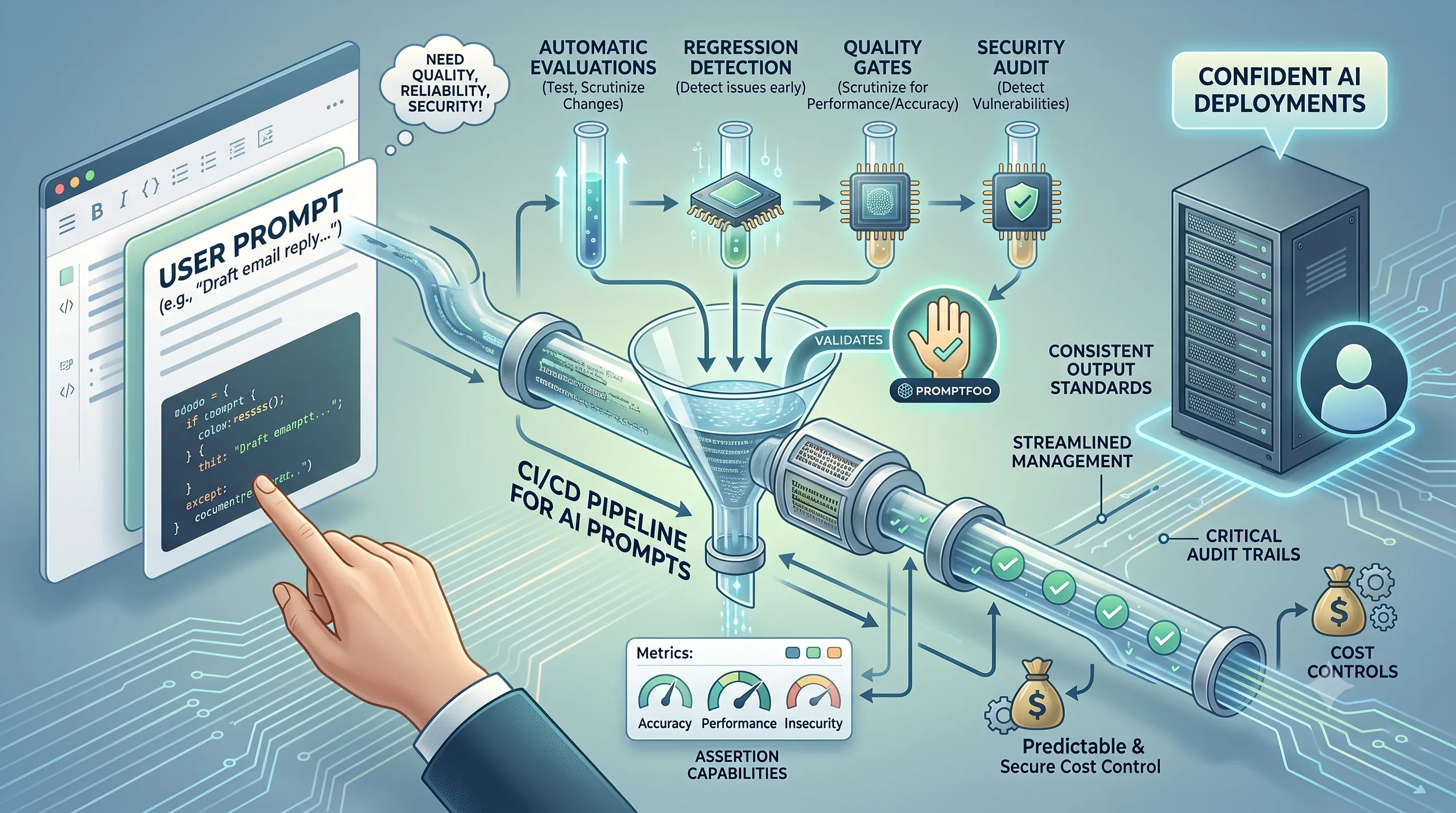
This is precisely why adopting a structured CI/CD pipeline for AI prompts has become indispensable. Mimicking the best practices of traditional software development, Promptfoo offers a comprehensive framework to test, evaluate, and deploy prompts with confidence. It allows teams to integrate automatic evaluations directly into their workflows, ensuring every prompt change is scrutinized for performance, accuracy, and potential vulnerabilities before it reaches end-users.
By leveraging Promptfoo's powerful assertion capabilities and sophisticated metric configurations, developers can establish quality gates, detect regressions early, and maintain consistent output standards. This approach not only streamlines prompt management but also provides critical audit trails and cost controls, making AI deployments more predictable and secure in today's dynamic AI environment.
This is precisely why adopting a structured CI/CD pipeline for AI prompts has become indispensable. Mimicking the best practices of traditional software development, Promptfoo offers a comprehensive framework to test, evaluate, and deploy prompts with confidence. It allows teams to integrate automatic evaluations directly into their workflows, ensuring every prompt change is scrutinized for performance, accuracy, and potential vulnerabilities before it reaches end-users.
By leveraging Promptfoo's powerful assertion capabilities and sophisticated metric configurations, developers can establish quality gates, detect regressions early, and maintain consistent output standards. This approach not only streamlines prompt management but also provides critical audit trails and cost controls, making AI deployments more predictable and secure in today's dynamic AI environment.
1. The Broader Landscape: Why Robust AI Prompt Testing Matters
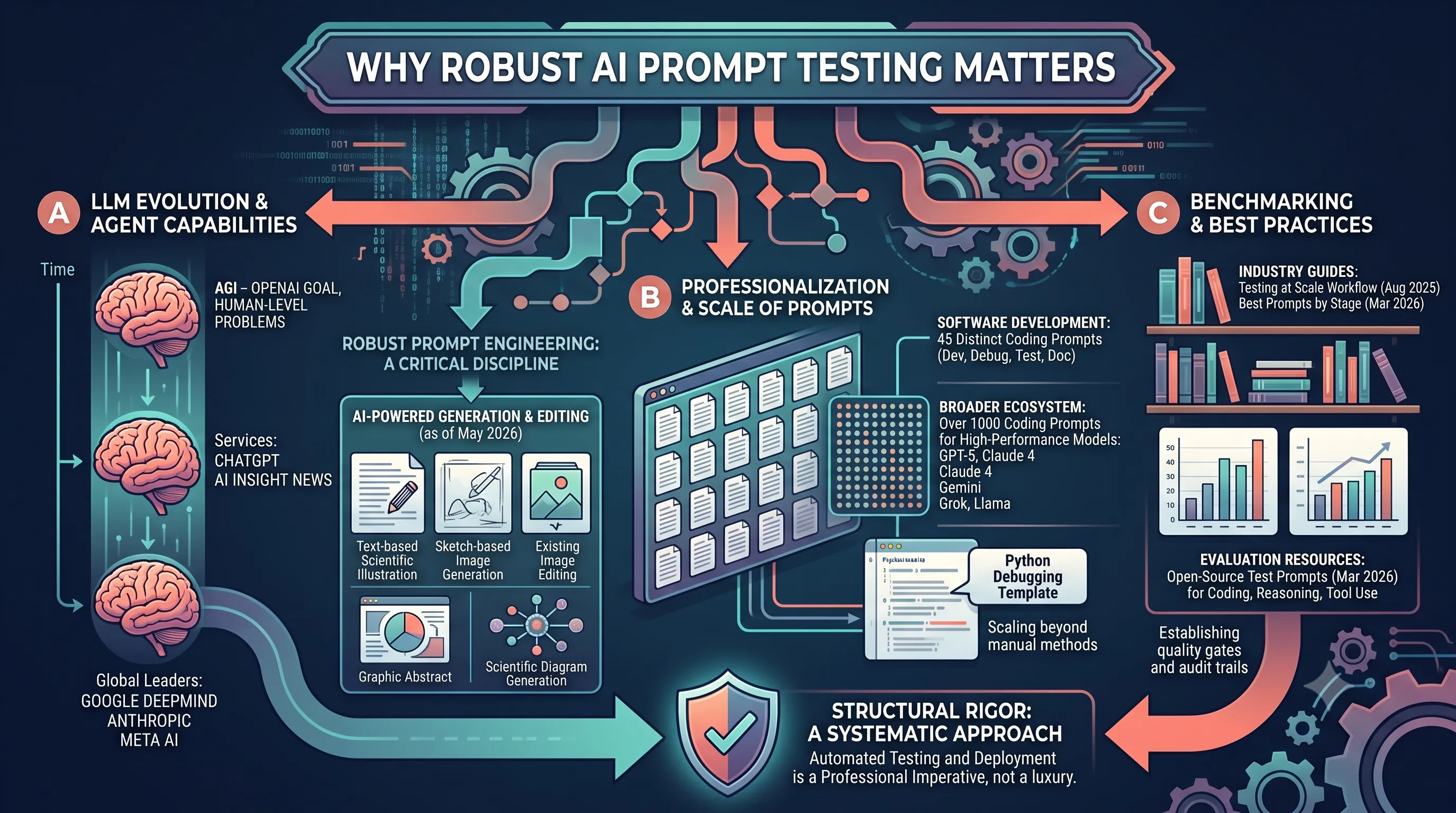
To fully appreciate the necessity of a CI/CD pipeline for AI prompts—the core topic of this article—we must first understand the vast and rapidly evolving landscape in which these prompts operate.The ad-hoc, manual methods of prompt modification and deployment are no longer sufficient in a world where AI's complexity and integration are accelerating.
This section provides that essential context, outlining the technological backdrop and the professional discipline of prompt engineering that makes systematic, automated testing an imperative, not a luxury.
The Evolution and Impact of AI and LLMs
At its core, Artificial intelligence (AI) is a technology where machines are designed to think, learn, and solve problems in a manner that mimics human cognitive abilities.This field is driven by ambitious long-term goals, with organizations like OpenAI openly stating their research objective is to achieve artificial general intelligence (AGI), a system capable of solving human-level problems.
This technological pursuit is no longer confined to research labs; it has become a ubiquitous part of the digital experience through services like ChatGPT.
The broader ecosystem is covered by dedicated news platforms such as AI Insight, which tracks the developments of global AI leaders including OpenAI, Google DeepMind, Anthropic, and Meta AI, keeping the industry and public informed of the constant progress.
The Imperative of Effective Prompt Engineering
As the capabilities of Large Language Models (LLMs) have expanded, a specialized skill has emerged as critical: prompt engineering.The quality of a prompt directly determines the quality of the AI's output, which now extends to highly sophisticated tasks.
For example, an article from May 2026 highlighted a range of advanced AI capabilities that are unlocked through precise inputs.
| AI-Powered Generation & Editing Capabilities (as of May 2026) |
|---|
| Text-based scientific illustration generation |
| Sketch-based image generation |
| Existing image editing |
| Graphic abstract generation |
| Scientific diagram generation |
For software development alone, there are resources identifying 45 distinct professional coding prompts for tasks spanning development, debugging, testing, and documentation.
The scale is even larger when considering the broader ecosystem, with well over 1000 coding prompts optimized for high-performance models like GPT-5, Claude 4, Gemini, Grok, and Llama.
Among these are practical tools like templates specifically for Python debugging, demonstrating a clear demand for reliable, reusable AI instructions.
Benchmarking and Best Practices in LLM Evaluation
The rapid proliferation of models and prompts has naturally led to a focus on quality, consistency, and evaluation.The industry recognized early on that without rigorous testing, deploying AI solutions at scale would be fraught with risk.
This need has been addressed by various guides and benchmarks over the last couple of years.
For instance, a guide published back on August 21, 2025, specifically discussed establishing a workflow to confidently test different combinations of models and prompts at scale.
Similarly, a comprehensive guide from March 8, 2026, curated the best AI prompts for developers that year, organizing them by workflow stage and validating them across real-world situations.
Alongside these best-practice guides, benchmarking resources have also become available, such as the open-source test prompts released around March 10, 2026, designed to evaluate LLMs on critical tasks like coding, reasoning, and tool use.
These past efforts underscore a fundamental truth: as prompts become as critical as code, they require an equally rigorous and structured approach to testing and deployment.
2. Seamless AI Prompt CI/CD: Ensuring Quality and Security with Promptfoo
This section directly addresses the core theme of the article—treating prompts like code—by detailing the primary tool and methodology for implementation: Promptfoo integrated into a Continuous Integration/Continuous Deployment (CI/CD) pipeline.By embedding prompt evaluation, quality assurance, and security scanning into the automated workflows developers already use for code, Promptfoo transforms prompt engineering from a manual, unpredictable art into a systematic, repeatable engineering discipline.
It provides the practical framework for the "test-driven development" for prompts that the main article advocates for, ensuring that every change is automatically validated against objective criteria before it impacts users.
Core CI/CD Workflows for Prompt Testing
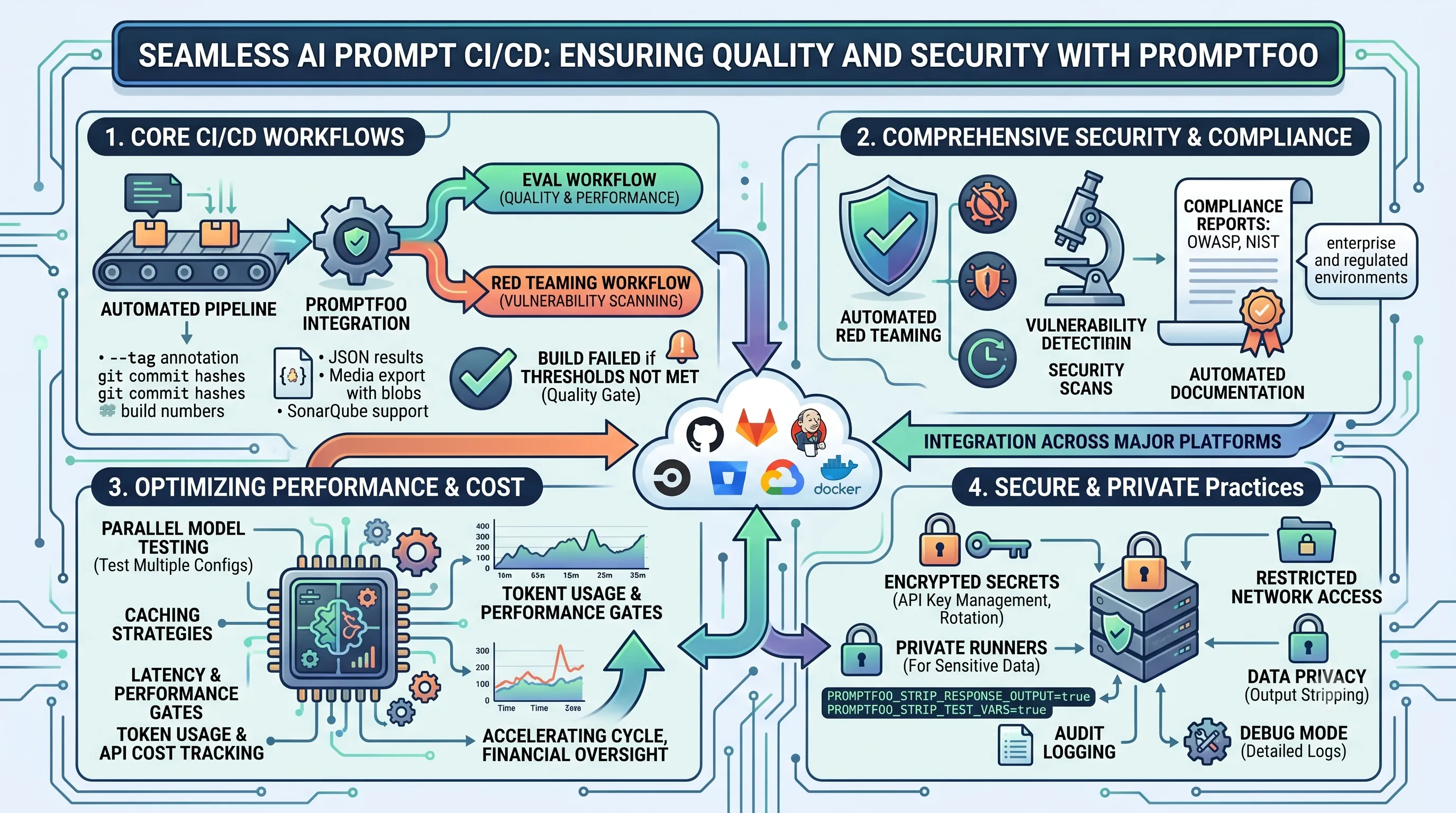
Promptfoo integrates directly into existing CI/CD pipelines to enable the automatic evaluation of prompts, ensuring both quality and security before any changes are deployed.This proactive approach helps teams catch regressions early by systematically testing prompt modifications before they reach production environments.
The platform supports two primary CI/CD workflows: the 'Eval' workflow, which focuses on prompt quality and performance, and the 'Red Teaming' workflow, designed for comprehensive security vulnerability scanning.
To provide essential context within automated runs, evaluations can be annotated using the `--tag key=value` flag.
These tags, which can represent information like a git commit hash or a build number, are saved with the evaluation results and included when those results are shared, making it easier to trace outcomes back to specific pipeline events.
The `promptfoo redteam eval` command also accepts the `--tag` option when executing its generated security probes.
For maximum flexibility, Promptfoo supports multiple output formats to meet diverse CI/CD needs.
The standard JSON output, generated via commands like `promptfoo eval -o results.json`, follows a specific schema, which is the same structure used by `promptfoo export eval
For evaluations that include images or other media, a portable export can be created with `--include-media`, which may add embedded `blobAssets` to the output file.
Crucially, this system allows a CI/CD build to be failed if quality thresholds, defined through a comprehensive set of assertions and metrics, are not met, effectively creating an automated quality gate for prompts.
Evaluation results can then be automatically posted to pull request comments, Slack channels, or other notification systems to maintain team visibility.
Comprehensive Security and Compliance Scans
Beyond quality testing, Promptfoo provides robust features for automated security analysis within the CI/CD pipeline.It offers automated red teaming and vulnerability detection, systematically probing prompts for weaknesses before they can be exploited in a live environment.
This allows teams to run comprehensive security scans on a recurring schedule, ensuring continuous protection against emerging threats.
A key benefit for enterprise and regulated environments is Promptfoo's ability to generate compliance reports for security frameworks like OWASP and NIST.
This automates a significant part of the documentation and verification process, helping organizations maintain and prove their adherence to industry-standard security postures.
Optimizing CI/CD Performance and Cost Management
Promptfoo is also designed to help manage the operational aspects of running LLM applications at scale.Within the CI/CD process, it can enforce minimum performance thresholds, acting as a quality gate not just for accuracy but also for latency and other performance metrics.
To provide financial oversight, the platform includes features to track token usage and API costs over time, giving teams the data needed for effective cost control and budget forecasting.
CI/CD performance itself can be enhanced through the use of caching strategies, and the system is built to test multiple models or provider configurations in parallel, accelerating the evaluation cycle.
Integrating Promptfoo Across Major CI/CD Platforms
Promptfoo offers broad compatibility with the modern DevOps toolchain, ensuring it can be adopted in nearly any environment.Dedicated guides are available for seamless integration with popular platforms such as GitHub Actions, GitLab CI, and Jenkins.
Its versatility extends to many other systems, enabling robust CI/CD workflows for prompt management across the development landscape.
| Platform/Method | Integration Support |
|---|---|
| GitHub Actions | Supported (Dedicated Guide) |
| GitLab CI | Supported (Dedicated Guide) |
| Jenkins | Supported (Dedicated Guide) |
| Azure Pipelines | Supported |
| AWS CodeCommit | Supported |
| CircleCI | Supported |
| Bitbucket Pipelines | Supported |
| Travis CI | Supported |
| n8n Workflows | Supported |
| Looper | Supported |
| Docker | Supported via custom image with Promptfoo pre-installed |
Users of the open-source version can achieve the same outcome by processing the standard JSON output and creating a custom import for SonarQube.
Secure and Private CI/CD Practices
To ensure the security and confidentiality of data during automated testing, Promptfoo supports and recommends several best practices.For API key management, keys should always be stored as encrypted secrets within the CI/CD system, configured with least-privilege access controls, and rotated on a regular basis.
In terms of network security, using private runners is advised for processing sensitive data, and outbound network access from these runners should be restricted to only necessary endpoints.
For enterprise environments with stringent security requirements, on-premise deployments of Promptfoo are an option.
To protect data privacy, output stripping can be enabled via the `PROMPTFOO_STRIP_RESPONSE_OUTPUT=true` and `PROMPTFOO_STRIP_TEST_VARS=true` environment variables, which prevents sensitive information from being logged.
For audit logging, it is critical to maintain a history of evaluations, track which user or process triggered security scans, and monitor for anomalous patterns.
Finally, for troubleshooting pipeline issues, a debug mode can be enabled for detailed logging.
It is important to note that the CI environment must have Node.js version 22.22.0 or greater installed, with Node.js 24 LTS being the recommended version.
3. Precision Prompt Validation: Mastering Assertions and Metrics in Promptfoo
This section connects directly to the core theme of our main article—testing AI prompts like code within a CI/CD pipeline.While the overall pipeline provides the framework for automation, the concepts discussed here represent the engine of validation itself.
By defining precise assertions and metrics, we codify our expectations for LLM outputs, turning subjective quality checks into objective, repeatable tests that can automatically pass or fail a prompt change.
Automating LLM Output Verification with Assertions
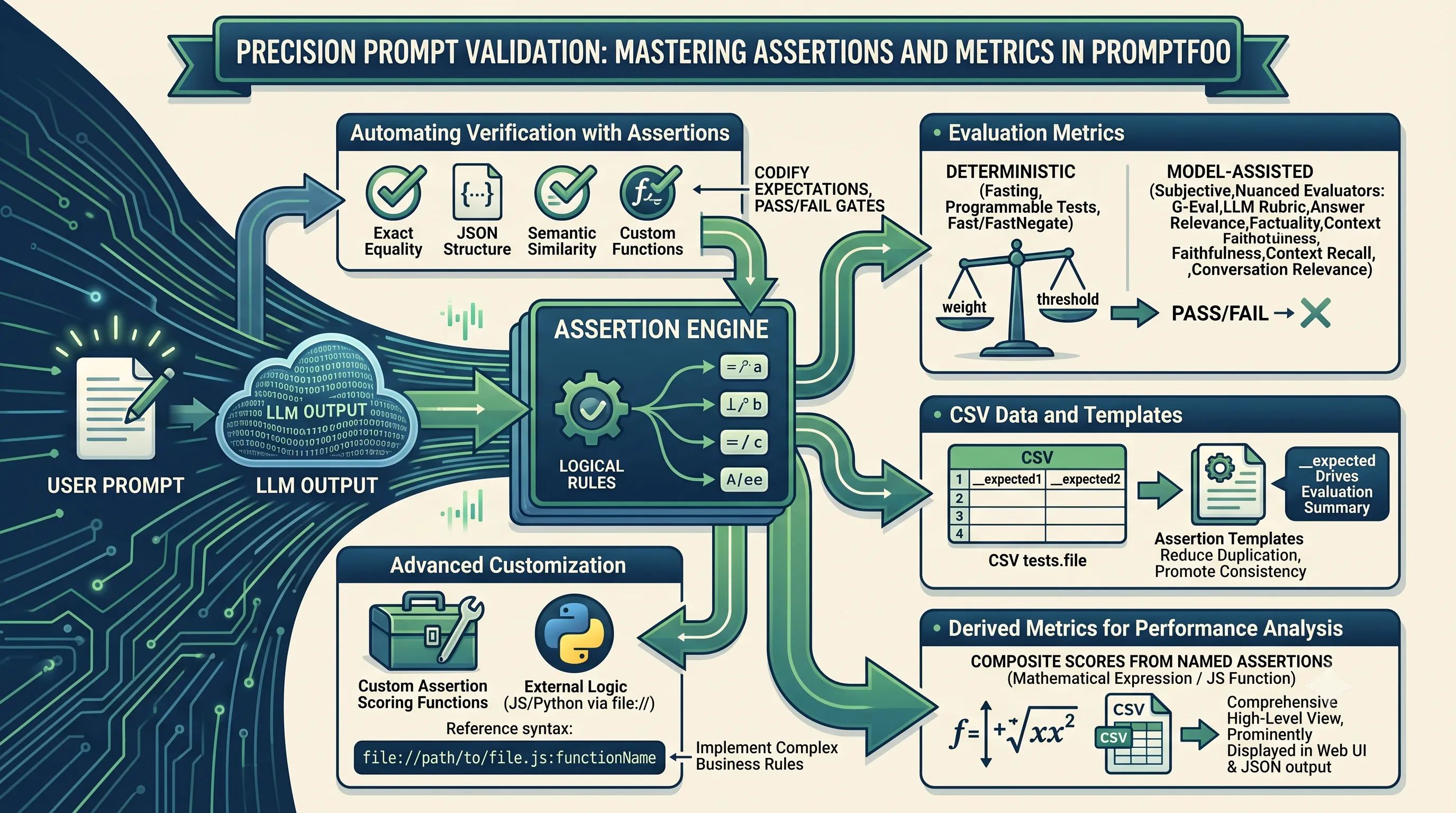
At the heart of Promptfoo's evaluation capabilities lies the concept of assertions, an optional but powerful method for automating the analysis of LLM outputs.Assertions systematically compare the generated output against a set of predefined expected values or conditions.
This allows for the validation of various output characteristics, such as exact equality, the presence of a valid JSON structure, semantic similarity to a reference text, or adherence to complex rules defined by custom functions.
In the context of Promptfoo, accuracy is defined as the proportion of prompts that generate the desired output as validated by these assertions.
Configuration is handled by adding an `assert` property to a test case within your `promptfoo.yaml` file.
This property contains an array of assertion objects, each of which must have a `type` property specifying the kind of check to perform.
For more complex scenarios, assertions can be grouped into an `assert-set`.
An `assert-set` is considered successful if all of its constituent assertions pass; alternatively, you can define a `threshold` to allow the set to pass even if a certain number of its assertions fail, providing flexible validation logic.
Leveraging Deterministic and Model-Assisted Evaluation
Promptfoo supports two primary categories of evaluation metrics: deterministic and model-assisted.Deterministic metrics are programmatic tests that execute directly on the LLM's output without external model calls.
These are fast, cheap, and reliable for checking objective criteria.
Notably, any deterministic test type can be negated to check for the absence of a condition, such as `not-equals` or `not-regex`.
Model-assisted metrics, on the other hand, leverage other LLMs or machine learning models to grade an output based on more nuanced, subjective criteria.
This category includes a wide range of sophisticated evaluators like G-Eval, Pi Scorer, LLM Rubric, Answer Relevance, Factuality, Context Faithfulness, Context Recall, and Conversation Relevance.
To control the evaluation outcome, Promptfoo uses `weight` and `threshold` properties.
The `weight` property, which defaults to 1, assigns a relative importance to each assertion, influencing the final weighted average score.
An assertion with a `weight` of 0 is effectively ignored and automatically passes.
The `threshold` property, when set on a test case, determines its overall pass/fail status.
The test case passes only if the combined weighted score of all its assertions meets or exceeds this threshold.
Setting a test case's `threshold` to 0 ensures it will always pass, regardless of individual assertion failures, which can be useful during initial test development.
Advanced Customization: Scoring Functions and External Logic
For validation logic that goes beyond built-in assertion types, Promptfoo allows you to define custom assertion scoring functions.These functions are necessary for implementing complex business rules or nuanced quality checks.
To use a custom scoring function, you must first tag the relevant assertions with a named metric using the `metric` field.
The scoring functions themselves can be written in JavaScript or Python and are referenced in the configuration using the `file://` prefix.
For JavaScript, you can even reference named exports from a module using the syntax `file://path/to/file.js:functionName`.
When the evaluation runs, the named scores from the tagged assertions are passed to your custom function as normalized weighted averages, and the final output includes a `namedScoreWeights` object for transparency.
This `file://` syntax is not limited to scoring functions; it can also be used to load the *value* of an assertion from an external file.
The behavior depends on the file type:
- If the file ends in .js, the JavaScript code is executed to dynamically return the assertion value, which should be a `GradingResult` object.
- If the file ends in .py, the Python script is executed, and its standard output is expected to be a `bool`, a `float` (0.0-1.0), or a JSON-formatted `GradingResult`.
Streamlining Assertions with Templates and CSV Data
To keep configuration files clean and manage large sets of test cases, Promptfoo supports defining tests outside the main `promptfoo.yaml` file, such as in a CSV.When using a CSV as a "Tests file," you can define assertions directly within the data.
A column named `__expected` will automatically add a single assertion to each test case in that row.
To add multiple assertions, you can use additional columns named `__expected1`, `__expected2`, `__expected3`, and so on.
The value in these columns uses a simple string syntax: `type:value` (e.g., `contains:success`) or `type(threshold):value` for assertions that support a threshold.
If the type is omitted, it defaults to `equals`.
Ultimately, the `__expected` field is the mechanism that drives the success/failure statistics you see in the evaluation summary.
For common checks that apply across many test cases or even different projects, you can create reusable assertion templates.
This feature promotes consistency and reduces configuration duplication by allowing you to define a standard assertion once and reference it wherever needed.
Derived Metrics for Comprehensive Performance Analysis
After an evaluation completes, Promptfoo can calculate derived metrics to create composite scores from the results of your named assertions.This feature is configured in a top-level `derivedMetrics` array, where each object has a `name` for the new metric and a `value` defining its calculation.
The `value` can be either a mathematical expression using `mathjs` syntax or a more complex JavaScript function.
These calculations have access to a special `__count` variable, which represents the total number of test cases for a given prompt-provider combination, making it easy to calculate averages.
Derived metrics are calculated sequentially in the order they are defined, allowing a later metric to reference the result of an earlier one.
If a named metric used in a calculation is missing for a particular test case, its value defaults to 0.
A critical limitation to be aware of is that there is no circular dependency protection for derived metrics, so their order must be managed carefully to avoid errors.
Once calculated, these composite scores are prominently displayed in the web UI's metrics column, included in the JSON output's `namedScores` object, and added as columns in the CSV export, providing a comprehensive, high-level view of prompt performance.
4. Promptfoo in Action: A GitHub Actions CI/CD Blueprint
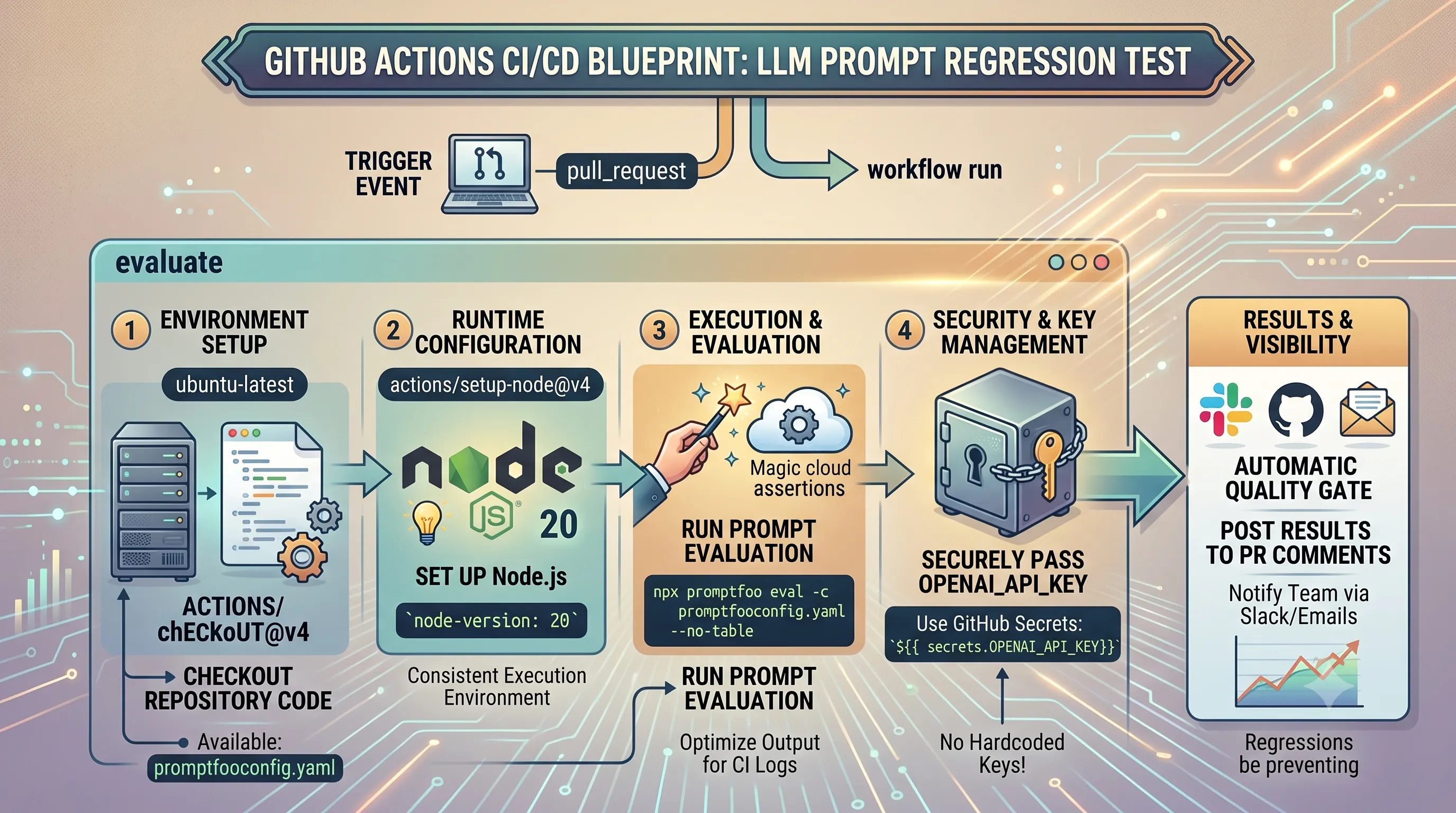
This section provides a concrete blueprint for implementing the prompt testing CI/CD pipeline discussed in this article. We will walk through a practical example of integrating Promptfoo directly into a GitHub Actions workflow, automating prompt evaluation to ensure quality and consistency with every code change.Setting Up the GitHub Actions Workflow
The foundation of our automated testing process is a GitHub Actions workflow file.This workflow can be named something descriptive, such as 'LLM Prompt Regression Test', to clearly communicate its purpose.
To integrate prompt evaluation directly into the development lifecycle, the workflow is configured to trigger on `pull_request` events.
This ensures that any proposed changes to prompts are automatically tested before they are merged into the main branch.
The core logic is contained within a job, which we can name 'evaluate', that runs on a standard GitHub-hosted runner, specifically `ubuntu-latest`.
Configuring Environment and Dependencies
Before running Promptfoo, the CI environment must be prepared.The first essential step in the job is to check out the repository's code using the `actions/checkout@v4` action.
This makes the `promptfooconfig.yaml` and any other necessary files available to the runner.
Next, since Promptfoo is a Node.js-based tool, we need to set up the correct runtime environment.
This is accomplished using the `actions/setup-node@v4` action, configured to install a specific version of Node.js.
For this workflow, we specify `node-version: 20`, ensuring a consistent and compatible execution environment.
Executing Promptfoo Evaluations in CI
With the environment configured, the final step is to execute the prompt evaluation.The workflow runs the command `npx promptfoo eval -c promptfooconfig.yaml --no-table`.
This command instructs Promptfoo to run the evaluation defined in the configuration file, and the `--no-table` flag optimizes the output for a non-interactive log stream within the CI environment.
Handling sensitive information like API keys is critical for security.
The `OPENAI_API_KEY` is not hardcoded in the workflow file but is instead passed as an environment variable.
This is done securely by referencing a GitHub secret using the syntax `${{ secrets.OPENAI_API_KEY }}`, which injects the value stored in the repository's or organization's secrets settings at runtime.
References
- https://www.promptfoo.dev/docs/integrations/ci-cd/
- https://www.promptfoo.dev/docs/configuration/expected-outputs/
- 35+ Best Coding Prompts for AI (ChatGPT, Claude, Gemini)
- How to test AI models and prompts: A complete guide
- Best AI Prompts for Developers in 2026: The Complete Guide to AI …
- AUTOMATED | English meaning - Cambridge Dictionary
- AI Model Test Prompts — Reproducible Benchmark Tasks
Related Posts

A Guide to Building Sovereign AI Infrastructure with Mistral Self-Hosted StacksLearn how to build sovereign, air-gapped AI infrastructure using Mistral's self-hosted enterprise...

AI Video Generation for Commercial Production: Prompt Engineering, Luma Ray, and Runway Gen-3 AlphaLearn how to use structured prompt engineering, Luma Ray, and Runway Gen-3 Alpha to create...
Architecting Resilient AI Agents with Pydantic AI: Type Safety, Execution Control, and Error RecoveryLearn how Pydantic AI enables production-grade AI agents through type-safe schema validation,...