
Microsoft Ignite 2026: Copilot Work OS and Agent 365 Governance
🚀 Key Takeaways
- Copilot evolves into the Work OS: Unified chat, coworking, coding, and autonomous agents merge native Office applications and enterprise data federation into a single daily workflow.
- Centralized control via Agent 365: A dedicated enterprise control plane introduces comprehensive FinOps visibility, cost attribution, and tools registries to govern fleet-wide agent ecosystems.
- Zero-trust security and agent identity: Microsoft Entra establishes automated Agent IDs, an MCP Firewall, and open transparency standards to eliminate unverified, nested autonomous operations.
- Production-grade model evaluation in Foundry: Azure Foundry achieves general availability for multi-turn execution trace evaluations alongside optimized reasoning models and reflection-driven optimizers.
- Copilot SDK 2.0 redefines developer tooling: A native Rust runtime powers multi-language agent development, paired with automated end-to-end repository pipelines and isolated code-review sandboxes.
- Arm-based silicon and runtime isolation: Azure Cobalt 200 custom virtual machines reach general availability alongside AKS Agent Sandbox extensions engineered for secure, hardware-isolated code execution.
- Intelligent hybrid data and sovereign operations: Azure HorizonDB launches with integrated vector indexing, complemented by disconnected rehoming capabilities across full-stack Azure Local environments.
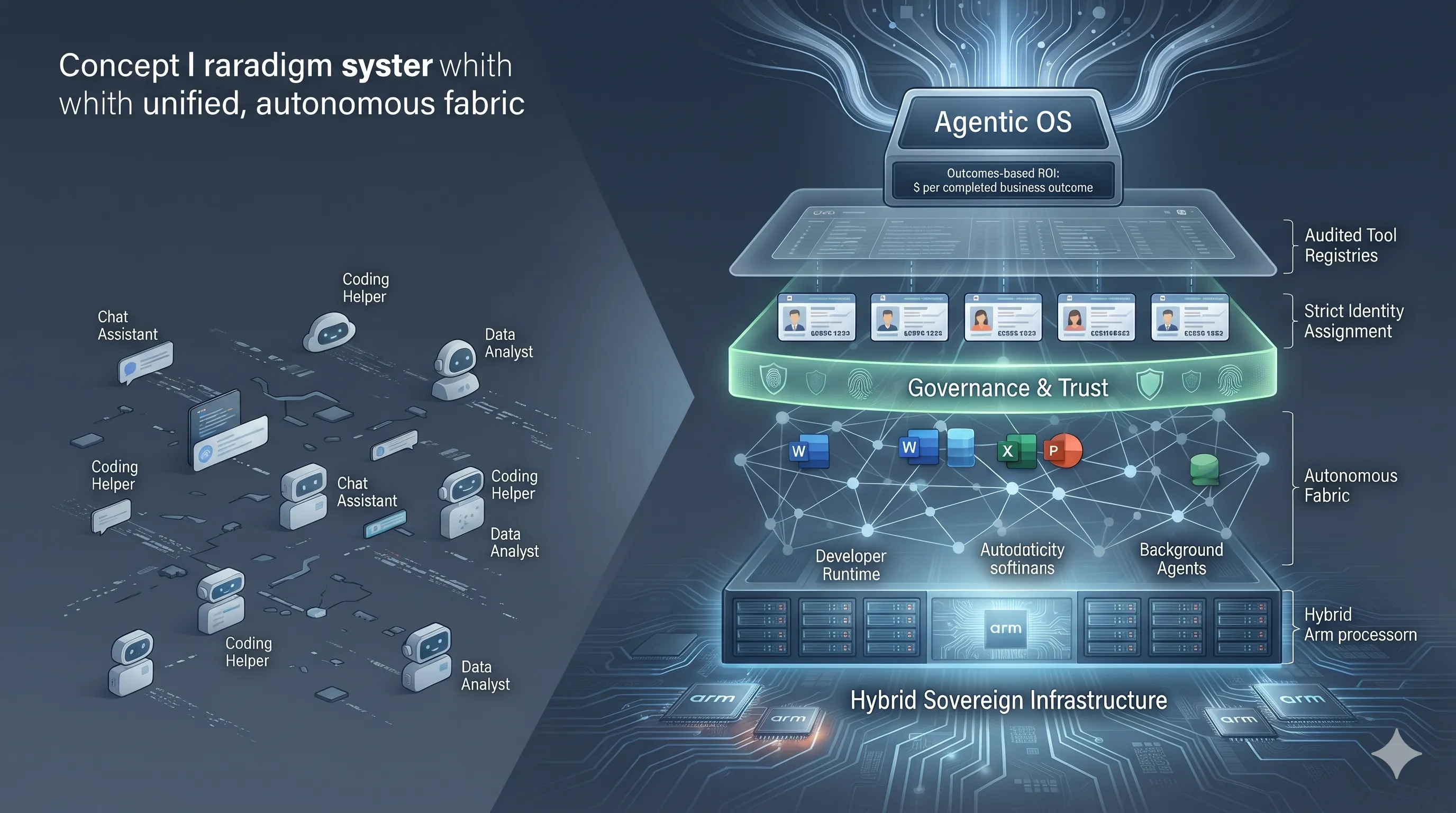
Microsoft Ignite 2026 marked a structural paradigm shift across enterprise computing, pivoting the industry conversation from conversational AI interfaces to comprehensive agentic operating systems. Rather than treating artificial intelligence as a fragmented layer of disparate assistants, the platform now binds productivity software, developer runtimes, and background agents into a unified, autonomous fabric.
This evolution arrives at a critical inflection point where enterprise adoption is no longer constrained by model speed, but by governance, verifiable trust, and financial predictability. Organizations deploying millions of autonomous processes require hardened operational boundaries—transitioning their focus toward strict identity assignment, audited tool registries, and clear metrics measuring return on investment per completed business outcome.
From custom Arm silicon and containerized execution sandboxes to hybrid sovereign infrastructure, Microsoft has outlined a full-stack blueprint for the agent-driven enterprise. Understanding these architectural changes is essential for technology leaders preparing their cloud, security, and data platforms for the operational realities of autonomous work.
1. Copilot Evolves into the Enterprise Work OS: Chat, Cowork, Code, and Autopilot
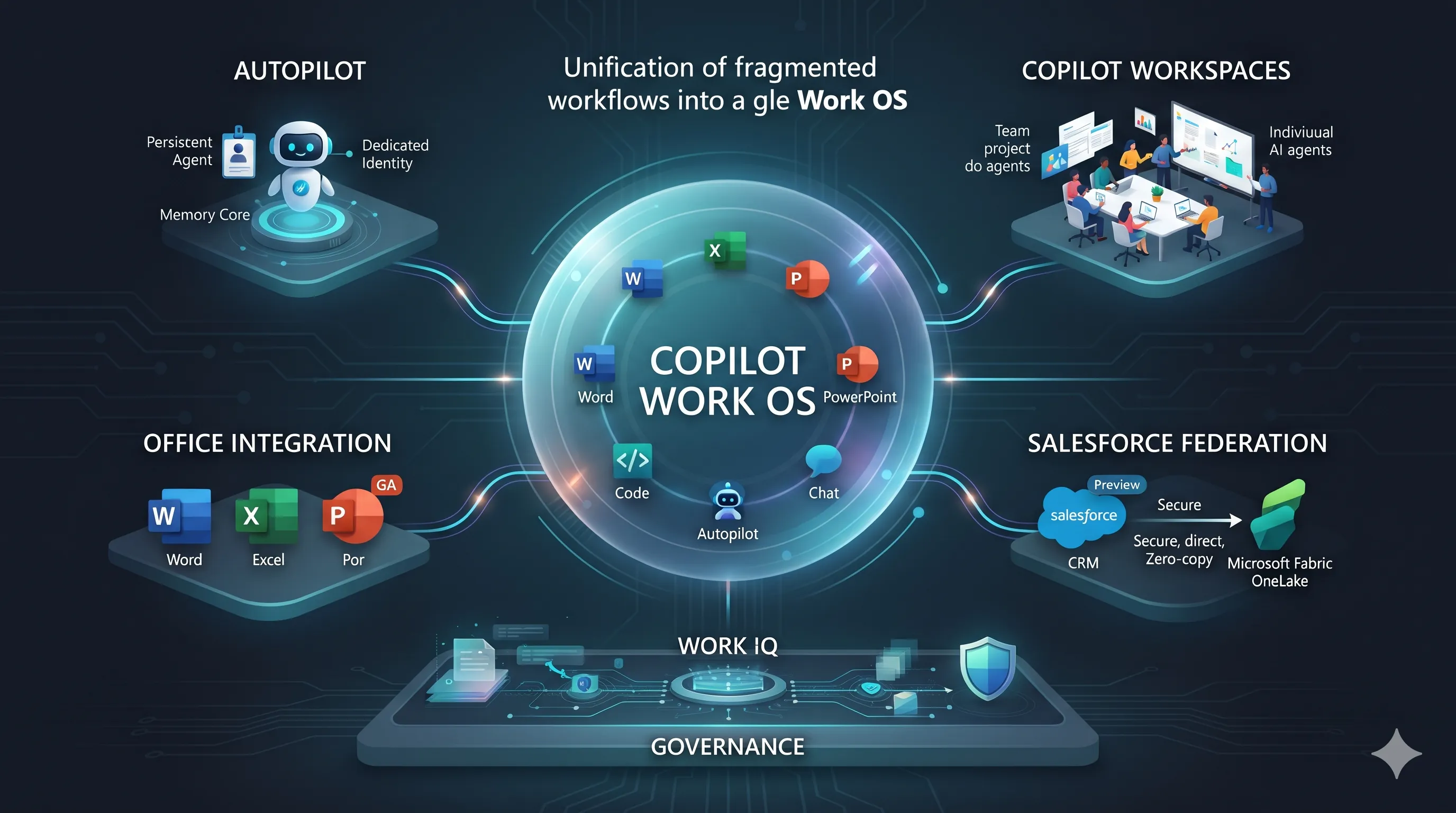
At Microsoft Ignite 2026, the overarching paradigm shift centers on redefining enterprise workflows from isolated AI interactions into a centralized execution platform.This section directly underpins the core theme of Ignite 2026—Copilot as the Work OS and Agent Governance—by detailing how Microsoft has unified fragmented productivity touchpoints into a persistent operating environment.
During the conference, Satya Nadella positioned Copilot as the operating system for work, combining chat, coding, and autonomous agents in one experience.
Rather than functioning merely as a task-specific helper, Copilot combines Chat, Cowork, Code, and Autopilot into a unified operating system experience for work that bridges individual productivity and autonomous organizational execution.
Autopilot and Copilot Workspaces: Grounding Autonomous Agents via Work IQ
To move beyond basic prompt-and-response interfaces, Microsoft introduced Autopilot to handle persistent execution.Autopilot is rolling out to Frontier customers as a long-running personal agent with dedicated identity, memory, and tool access.
However, access is currently constrained by architectural guardrails, as the Autopilot rollout is initially restricted to Frontier customers while infrastructure matures.
Because agentic workflows require coordination across human teams and disparate AI entities, Microsoft launched Copilot Workspaces.
Copilot Workspaces enables multiple individuals and their agents to collaborate around shared context and shared goals.
This shared collaboration layer relies on institutional understanding to prevent operational drift.
To achieve this, Work IQ anchors Copilot by interpreting enterprise context across people, relations, documents, emails, meetings, chats, and projects.
By synthesizing cross-channel organizational behavior, Work IQ provides the underlying semantic telemetry required for autonomous agents to execute complex objectives without manual human re-grounding.
Direct Office Integration and Zero-Copy Salesforce Federation with Fabric OneLake
The evolution of the Work OS is further demonstrated by embedding core desktop productivity engines and enterprise data stores directly within the Copilot interface.Office in Copilot integrates Word, Excel, and PowerPoint directly into Copilot as a generally available feature, turning the conversational layer into a full-featured authoring and analytical environment.
At the enterprise data layer, Microsoft expanded multi-vendor interoperability across critical CRM systems.
Salesforce in Copilot entered preview with more than 38 prebuilt sales skills, allowing teams to execute specialized revenue operations directly through conversational interaction.
A current limitation to note is that Salesforce integration remains in preview.
Underpinning this external connectivity without introducing data duplication risks, zero-copy data federation between Salesforce Data 360 and Fabric OneLake is generally available.
This zero-copy architecture allows organizations to maintain governance and real-time synchronization between core data platforms while driving intelligent agentic execution.
| Feature / Component | Release Status | Core Capabilities and Scope |
|---|---|---|
| Office in Copilot | Generally Available | Integrates Word, Excel, and PowerPoint directly into Copilot. |
| Autopilot | Rollout (Frontier Customers) | Functions as a long-running personal agent with dedicated identity, memory, and tool access; rollout is initially restricted to Frontier customers. |
| Copilot Workspaces | Available (Ignite 2026) | Enables multiple individuals and their agents to collaborate around shared context and shared goals. |
| Salesforce in Copilot | Preview | Includes more than 38 prebuilt sales skills; integration remains in preview. |
| Salesforce Data 360 to Fabric OneLake | Generally Available | Zero-copy data federation linking Salesforce Data 360 directly with Microsoft Fabric OneLake. |
2. Governing at Scale: Agent 365 Control Plane, FinOps, and Dynamic Risk Controls
As Microsoft Ignite 2026 establishes Copilot as the multi-agent Work OS, the operational focus for IT leadership shifts decisively from individual agent discovery to macro-level management.Enterprise inquiries around autonomous workflows have matured rapidly beyond theoretical exploration.
As Muhammad Atif observed, customer priorities have reoriented toward hard architectural fundamentals: "How do we actually put this into production? How do we scale AI and agents across the organisation? How do we govern and secure them? How do we control the cost as adoption grows?"
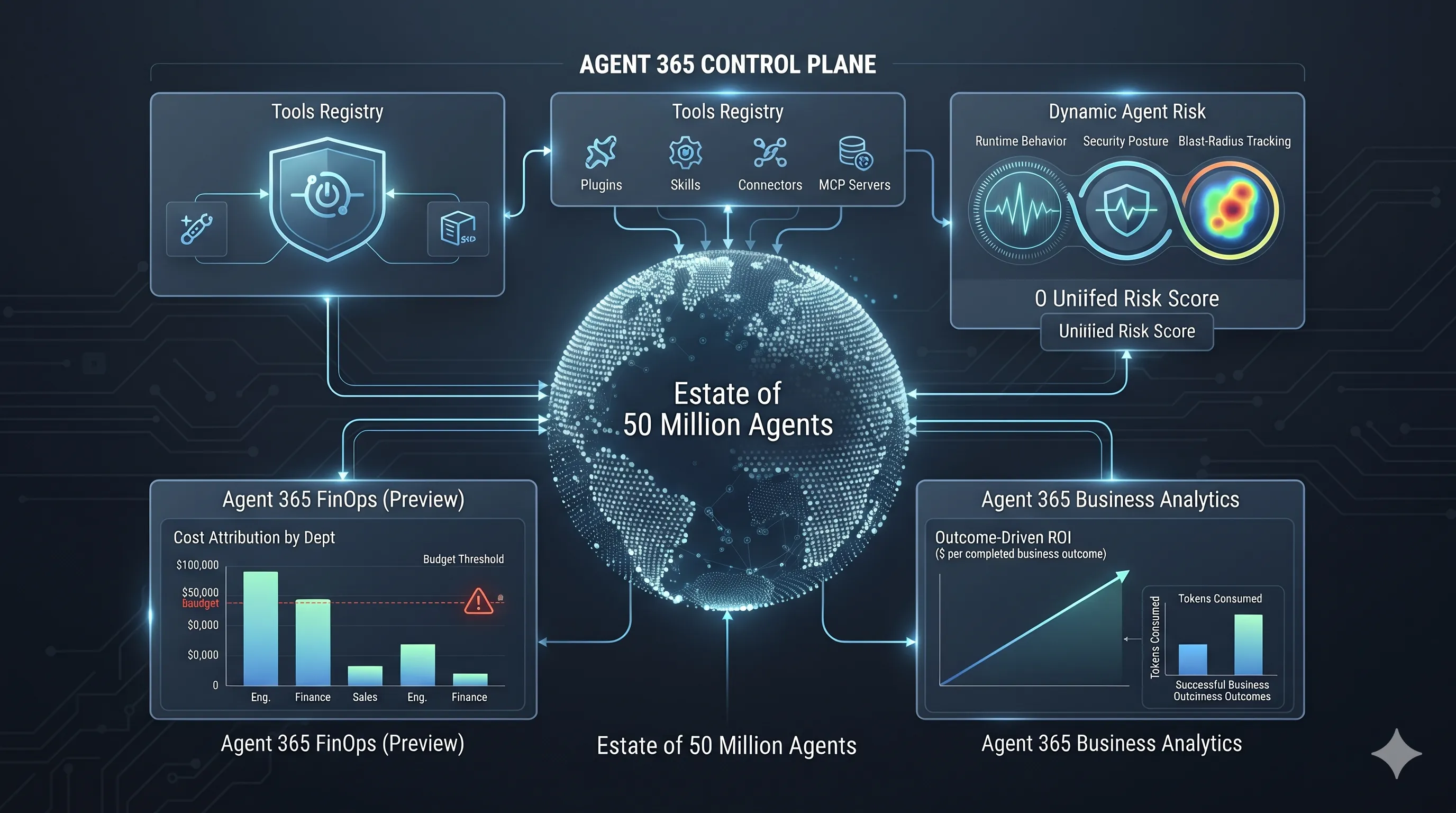
To address this operational reality, Microsoft introduced Agent 365 as a centralized enterprise control plane engineered to extend governance, identity, security, and administrative management across an estate of more than 50 million agents.
Centralized Inventory and Dynamic Blast-Radius Risk Scoring
Operating an estate spanning millions of autonomous units demands comprehensive visibility across all active integrations and components.Agent 365 addresses this through a generally available tools registry that centrally catalogs every plugin, skill, connector, and Model Context Protocol (MCP) server leveraged by agents across the organization.
By centralizing these building blocks, IT administrators prevent unmanaged shadow integrations and establish a verifiable software inventory across all agentic execution paths.
Alongside centralized inventory, securing autonomous systems requires continuous, real-time risk assessment rather than static, point-in-time perimeter checks.
Agent 365 introduces Dynamic Agent Risk scoring to compute real-time risk levels for every registered entity.
This system continuously aggregates signals across three key operational vectors: runtime behavior, overall security posture, and blast-radius tracking.
By continuously correlating real-time behavioral drift with the potential blast-radius of an agent's permissions, administrators can isolate or remediate threats before credential abuse or system-level damage cascades through dependent services.
| Governance Component | Release Status | Enterprise Governance Functionality |
|---|---|---|
| Tools Registry | General Availability | Catalogs all plugins, skills, MCP servers, and connectors accessed by enterprise agents. |
| Dynamic Agent Risk | Active Capability | Aggregates runtime behavior, security posture, and blast-radius signals into calculated risk levels per agent. |
| Agent 365 FinOps | Preview | Delivers centralized cost visibility, policy enforcement, budgetary alerts, and Fabric-based chargeback models. |
| Agent 365 Business Analytics | Active Capability | Monitors enterprise cost drivers and maps AI expenditures directly to quantifiable business outcomes and ROI optimization. |
Agent 365 FinOps and Outcome-Driven AI Cost Management
As agent deployment scales horizontally across business units, unmonitored compute utilization and unpredictable token volumes present substantial financial risk.To establish fiscal guardrails, Agent 365 FinOps introduces preview capabilities designed to enforce strict financial oversight across the entire agent lifecycle.
The preview functionality equips engineering and finance teams with granular cost visibility, automated cost policies, budget threshold alerts, and Microsoft Fabric-based chargeback mechanisms to accurately attribute expenditures back to individual departments.
However, effective governance extends beyond raw expense containment to aligning compute spend directly with organizational value.
Agent 365 Business Analytics directly complements these FinOps cost controls by systematically tracking underlying cost drivers and linking AI operational spend to measurable business results.
This shift addresses a critical gap in conventional AI measurement models.
As Anurag Karuparti highlighted regarding enterprise ROI: "The metric that matters isn't just tokens consumed. It's cost per successful business outcome. That's how I think enterprises should start measuring agent ROI."
By coupling Fabric-based chargeback accounting with Business Analytics outcome mapping, Agent 365 transforms agent governance from a reactive risk mitigation exercise into an optimized, value-driven discipline.
3. Zero-Trust Agent Security: Entra Agent IDs, MCP Firewalls, and Microsoft Perception
As Microsoft frames Copilot as an end-to-end Work OS at Ignite 2026, the governance boundary has shifted fundamentally from human user identities to autonomous execution loops.Unchecked autonomous agents operating across corporate directories introduce attack vectors that legacy perimeter tools cannot see.
As Aaron Reich observed regarding this operational pivot: "Speed isn't the bottleneck anymore, trust is. As AI drives the cost of knowledge toward zero with apps being easier to build, agents doing more work, and abundant intelligence, the scarce things are hard and need more attention: institutional knowledge, judgment, accountability and trust."
To establish this baseline of trust, Microsoft launched the AI Transparency Initiative in alignment with NIST's Agent Standards Initiative, gathering 40 participating organizations to establish open industry standards for verification, safety, and accountability.
This initiative directly operationalizes Satya Nadella's insistence on deterministic validation, rejecting architectures where opaque agents evaluate each other: "These nested black boxes are simply unacceptable."
Shannon Kuehn captured the operational reality facing infrastructure engineers: "Treat agents like apps and you'll spend 2027 cleaning up after them."
Identity-Driven Guardrails: Entra Agent IDs and the Enterprise MCP Firewall
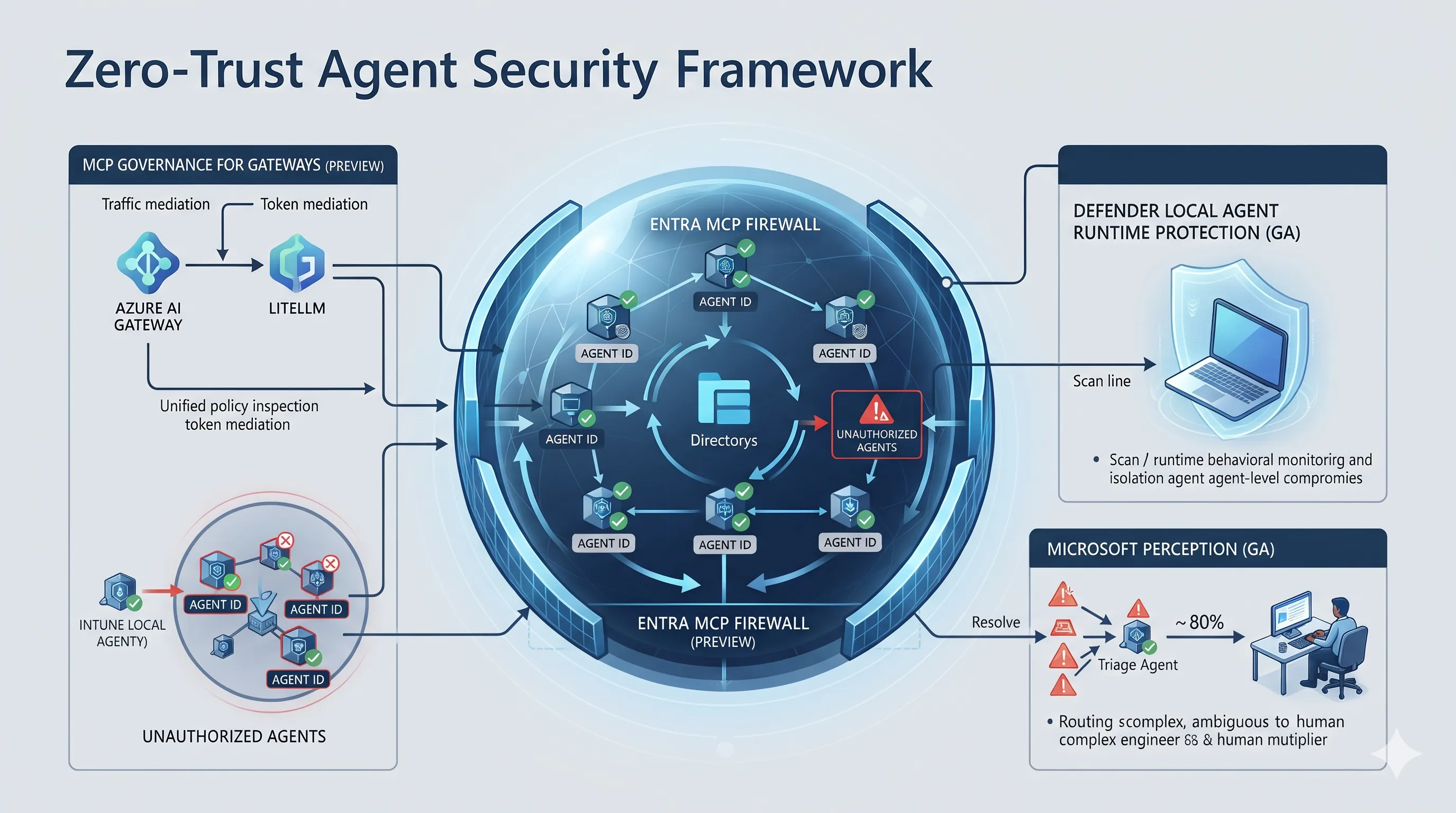
Treating agents as distinct non-human security principals is the core architectural prerequisite for safe agentic deployment.Microsoft Entra now automatically assigns Agent IDs to discovered local agents, establishing immediate provenance and telemetry, beginning with GitHub Copilot CLI and Claude Code.
To govern these entities across enterprise boundaries, the Microsoft MCP Server for Enterprise is generally available, giving agents permission-controlled access to Entra directory data without exposing raw directory secrets or uncontrolled graph endpoints.
Policy enforcement for tool execution is handled by the new preview of the Entra MCP Firewall.
The MCP Firewall regulates traffic across MCP servers, tools, prompts, and transport protocols, preventing unsanctioned tool calls and blocking injection attempts within dynamic agent payloads.
Simultaneously, MCP governance has entered preview across Azure AI Gateway and LiteLLM, extending unified policy inspection and token mediation to multi-model agent deployments.
IT teams should note that while directory data access via the Enterprise MCP Server is production-ready, the Entra MCP Firewall remains in preview.
| Security Component | Release Status | Core Capability | Prerequisites & Limitations |
|---|---|---|---|
| Entra Agent IDs | Active | Automatic identity assignment for discovered local agents | Initial rollout begins with GitHub Copilot CLI and Claude Code |
| Microsoft MCP Server for Enterprise | General Availability | Permission-controlled agent access to Entra directory data | Requires standard Entra directory configuration |
| Entra MCP Firewall | Preview | Regulates access across MCP servers, tools, prompts, and transport protocols | Currently in preview; policy evaluation controls are expanding |
| MCP Governance for Gateways | Preview | Extends MCP traffic governance across Azure AI Gateway and LiteLLM | Preview status across both gateway platforms |
| Defender Local Agent Runtime Protection | General Availability | Runtime protection for local AI agents running on Windows | Requires Defender for Endpoint P2 licensing |
| Intune Local Agent Compliance | Preview | Identifies and flags endpoints hosting unauthorized agents as noncompliant | Currently in preview |
| Microsoft Perception | General Availability | Agentic security defense, simulation, and remediation using Playbooks and Cyber 2 | Triage Agent covers approximately 80% of alerts in a typical queue |
Autonomous Defense: Microsoft Perception GA and Endpoint Runtime Isolation
Securing local agent execution requires active endpoint supervision alongside central directory policies.Windows Defender runtime protection for local AI agents is now generally available for endpoints running Windows, providing real-time behavioral monitoring and isolation against agent-level compromise.
However, enterprise deployment requires Defender for Endpoint P2 licensing to activate these local agent runtime monitors.
Complementing Defender's runtime defense, Microsoft Intune previews local agent governance, enabling administrators to discover unapproved autonomous engines and automatically flag those devices as noncompliant within conditional access workflows.
At the security operations level, Microsoft Perception (formerly Project Perception) has entered general availability.
Perception operates as an autonomous, agentic defense system powered by the integrated Cyber 2 security model.
Using autonomous Playbooks, Perception conducts proactive attack simulation, autonomous threat defense, and dynamic remediation across enterprise workloads.
Within daily Security Operations Center (SOC) workflows, the Microsoft Perception Triage Agent covers approximately 80% of alerts in a typical Defender queue, resolving baseline event volumes autonomously while routing complex, ambiguous anomalies to human security engineers.
4. Model Foundations and Traffic Control: Microsoft Foundry, GPT-6.2, and Azure AI Gateway
The realization of Copilot as the Work OS depends on robust underlying model infrastructure, deterministic traffic control, and disciplined agent governance.As enterprise teams deploy autonomous agents across operational workflows, traffic management and inference economics dictate whether autonomous copilots remain financially sustainable and architecturally stable.
Microsoft Ignite 2026 addressed this operational layer directly by decoupling traffic routing from legacy API management, expanding the Microsoft Foundry platform, and deploying next-generation frontier and specialized reasoning weights.
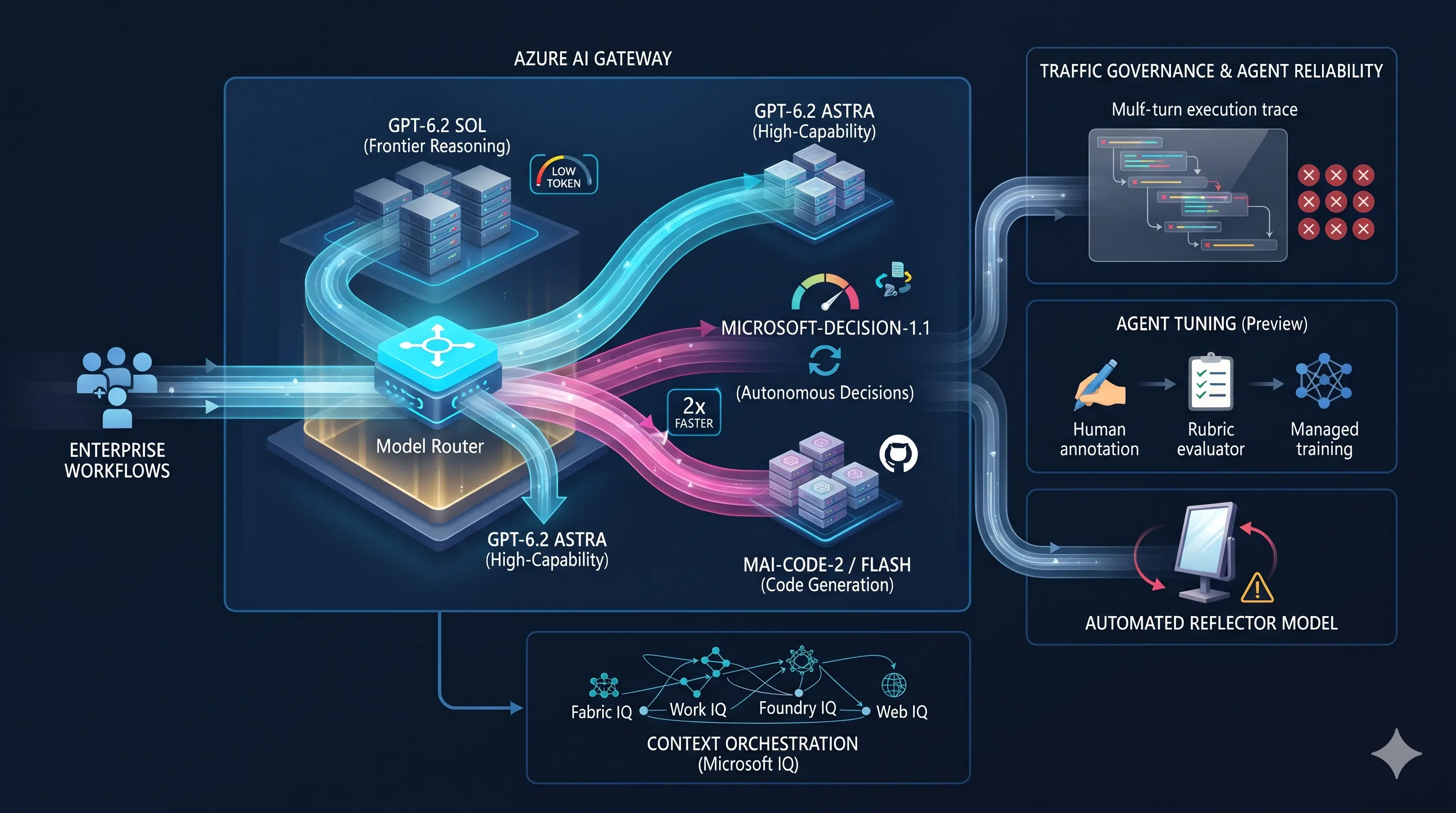
Azure AI Gateway and Cost-Optimized Dynamic Model Routing
Azure AI Gateway is now generally available as a standalone product, having officially split from the Azure API Management AI tier to monitor and route production AI traffic.To simplify enterprise adoption, the standalone gateway provides 10,000 free requests per gateway per month across 17 supported regions, with paid billing scheduled to commence on January 1, 2027.
A core capability of this standalone gateway is dynamic model routing across the top 50 models within an overall catalog of more than 11,000 models.
By dynamically dispatching prompts based on workload complexity, latency requirements, and fallback thresholds, the model router yields cost savings of up to 65% compared to routing all calls indiscriminately to frontier models.
Beyond routing, traffic governance inside Microsoft Foundry has expanded to tackle enterprise agent reliability.
Foundry multi-turn evaluation and production insights—which automatically group recurring execution failures across multi-step agent workflows—are now generally available.
For agent tuning, Microsoft introduced previews of human annotation, rubric evaluators, Managed Training, and Programmed Training for supervised fine-tuning (SFT) and reinforcement learning (RL).
Crucially, the preview of the agent optimizer incorporates an automated reflector model that directly analyzes failing execution traces to diagnose agent scoring deficiencies.
However, introducing automated reflection mechanisms into production cycles demands strict oversight.
Addressing this operational risk, Hector Flores cautioned: "Self-modifying agents with no review gate are an incident waiting to happen."
Context orchestration across organizational data layers has also advanced through Microsoft IQ, which externalizes Copilot context across Work IQ, Fabric IQ, Foundry IQ, and Web IQ without creating a new SKU.
Within Foundry IQ, preview features include knowledge graphs and the Microsoft-Retriever-1 iterative retrieval model.
Teams must note ongoing preview boundaries: MAI-Image-2.7, Foundry IQ knowledge graphs, and the agent optimizer remain in preview, and paid billing for Azure AI Gateway does not begin until January 1, 2027.
Frontier Model Portfolio: GPT-6.2 Deployments and Microsoft-Decision-1.1
Enterprise model selection in Microsoft Foundry now spans specialized decision models, code-optimized engines, and OpenAI frontier models.For general frontier reasoning, OpenAI GPT-6.2 Global Standard deployments now span 28 regions.
GPT-6.2 Sol provides cost-efficient frontier intelligence at $2 per million input tokens and $10 per million output tokens on Standard deployments with short context.
For complex, high-capability workloads, GPT-6.2 Astra is positioned at $8 per million input tokens and $40 per million output tokens.
Alongside frontier checkpoints, Microsoft released Microsoft-Decision-1.1, a specialized model built on the Gemma 4 26B A4B architecture with added image input support.
Designed specifically for high-velocity routing, tool call orchestration, and autonomous decisions, Microsoft-Decision-1.1 scores 68 on the Artificial Analysis Decision Index v2.1 while running over 2x faster than its predecessor.
The model has already been utilized by over 4,000 customers in production environments requiring low-latency evaluation loops.
In software engineering and developer tooling, MAI-Code-2 and MAI-Code-2-Flash are generally available on GitHub and within Foundry.
For enterprises requiring dedicated infrastructure and private weight hosting, the MAI Licensed Weights program allows qualified customers to access proprietary Microsoft AI model weights through Frontier Co.
| Component / Model | Type / Tier | Pricing / Free Allocation | Key Architecture, Specs, and Scale |
|---|---|---|---|
| Azure AI Gateway | Standalone AI Traffic Governance | 10,000 free requests/gateway/month; billing begins Jan 1, 2027 | Deployed across 17 regions; routes top 50 models in 11,000+ catalog; up to 65% cost savings |
| OpenAI GPT-6.2 Sol | Frontier Model (Standard short context) | $2 / 1M input tokens; $10 / 1M output tokens | Global Standard deployments across 28 regions |
| OpenAI GPT-6.2 Astra | Frontier Reasoning Model | $8 / 1M input tokens; $40 / 1M output tokens | Global Standard deployments across 28 regions |
| Microsoft-Decision-1.1 | Specialized Decision / Agent Engine | Foundry standard model access tier | Gemma 4 26B A4B architecture; image input; scores 68 on Decision Index v2.1; 2x faster; 4,000+ customers |
| MAI-Code-2 / Flash | Code Generation and Agent Execution | Generally Available (GitHub & Foundry) | Optimized for coding workflows; weights accessible via MAI Licensed Weights through Frontier Co. |
5. Engineering Autonomous Pipelines: Copilot SDK 2.0, Sandboxes, and MCP Developer Tooling
To establish Copilot as the enterprise Work OS under robust agent governance, developer infrastructure must shift from passive code generation to autonomous, verifiable execution pipelines.The announcements at Microsoft Ignite 2026 ground this shift in production-grade runtimes, isolated execution environments, and standardized protocol surfaces.
Copilot SDK 2.0: Rust Runtime and End-to-End Repository Automation
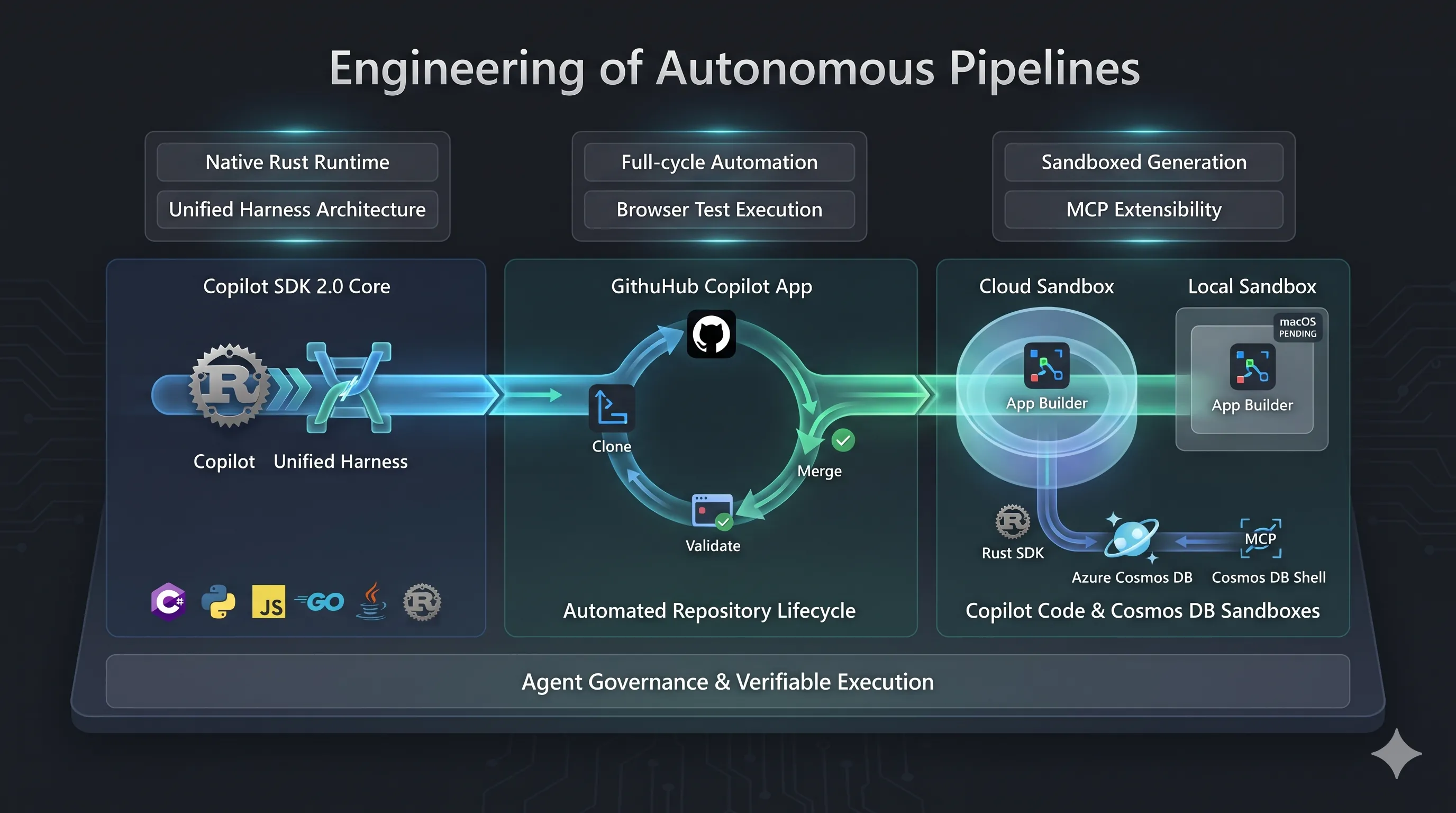
At the core of the autonomous engineering stack is the general availability of Microsoft Copilot SDK 2.0.To satisfy the performance and determinism requirements of mission-critical agents, Copilot SDK 2.0 is engineered with a native Rust runtime paired with a standardized internal harness architecture.
This underlying harness provides the foundation across 6 programming languages, ensuring cross-stack parity for engineering teams integrating autonomous agent behaviors directly into their existing codebases.
Beyond foundational SDKs, repository lifecycle management receives full-cycle automation through the GitHub Copilot app.
The application automates end-to-end repository pipelines from clone to merge, incorporating automated browser test execution to validate web-facing application surfaces prior to human review.
Complementing the app pipeline, Copilot code review introduces comprehensive governance checkpoints for distributed source trees.
Developers can execute reviews locally inside the command-line interface (CLI), enforce real-time secret scanning, apply adaptive review depth based on change velocity or risk profiles, and maintain contextual awareness across complex multi-repo architectures.
| Toolchain Component | Key Features & Architecture | Availability & Support Details |
|---|---|---|
| Microsoft Copilot SDK 2.0 | Native Rust runtime; unified internal harness architecture | Generally Available; supported across 6 programming languages |
| GitHub Copilot App | Autonomous repository pipeline execution from clone to merge; integrated browser test execution | Available |
| Copilot Code Review | Local CLI reviews; secret scanning; adaptive review depth; multi-repo contextual analysis | Available in CLI |
| Copilot Code | Natural-language application builder; isolated cloud and local sandboxing | Frontier program preview; GA targeted for December; macOS local sandbox pending |
| Azure Cosmos DB Tooling | Model Context Protocol (MCP) support via Cosmos DB Shell; native semantic reranker | Generally Available (including native Rust SDK) |
Sandboxed Generation and MCP Extensibility in Cosmos DB
Governing autonomous code synthesis requires strict boundary containment during code execution.The Copilot Code application builder integrates natural-language generation directly with secure cloud and local sandboxes through Microsoft's Frontier program.
This sandbox containment isolates agent-driven app construction from core system processes.
While cloud sandboxes and standard local runtimes are functional within the Frontier program, the Copilot Code macOS local sandbox remains unreleased and pending ahead of the targeted December general availability milestone.
Data persistence and context retrieval layers have likewise aligned with autonomous agent standards.
Cosmos DB developers gain access to a generally available Rust SDK, providing high-concurrency, low-latency database connectivity aligned with the Copilot SDK runtime.
For agent-driven retrieval workflows, Cosmos DB integrates a native semantic reranker to refine vector and hybrid query relevance.
Furthermore, database operations can now participate directly in standardized agent tooling via the Cosmos DB Shell, which delivers native support for the Model Context Protocol (MCP).
This MCP implementation allows autonomous development agents to inspect, manage, and query Cosmos DB state securely through uniform interface boundaries.
6. Silicon and Infrastructure: Azure Cobalt 200 GA, Maia 300, and AKS Agent Sandbox Isolation
As enterprise architectures pivot toward Copilot as the central Work OS, the underlying systems demand a fundamental restructuring to sustain high-density autonomous agent execution.Establishing deterministic runtimes and robust agent governance requires custom silicon co-design and hardware-enforced isolation boundaries at every tier of the cloud stack.
Azure Cobalt 200 Architecture and Token Efficiency Benchmarks
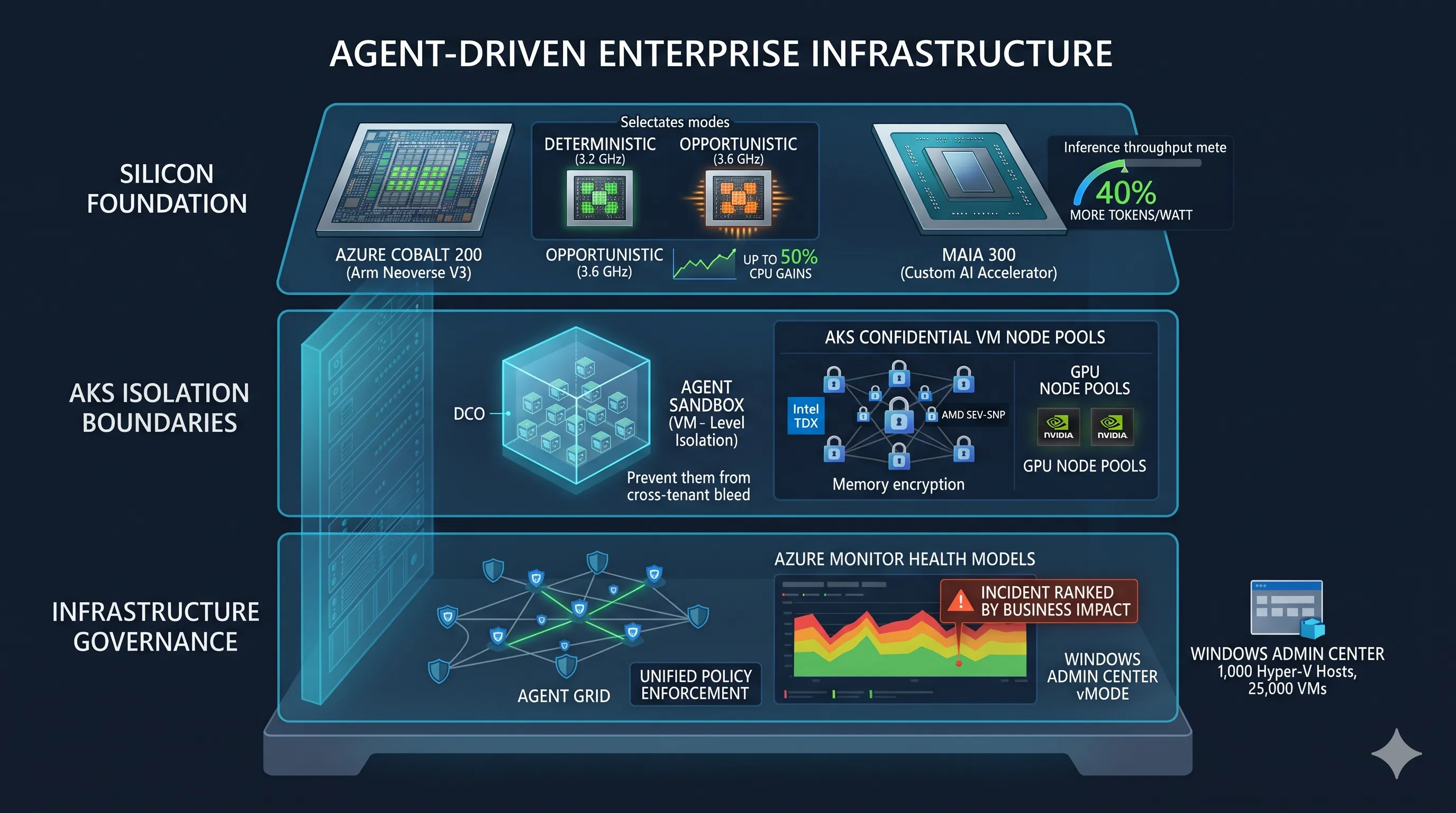
Microsoft announced the general availability (GA) of the Azure Cobalt 200 virtual machine families, representing a direct generational leap in custom Arm silicon.The Cobalt 200 processor features 132 Arm Neoverse V3 cores fabricated on TSMC's 3nm process node.
Compute allocation can be tailored across two operational clock profiles: cores run at a fixed 3.2 GHz in Deterministic Mode for predictable, jitter-free execution, and can scale up to 3.6 GHz in Opportunistic Mode for burstable compute demands.
The rollout introduces generally available VM options tailored for compute, memory, and I/O-intensive workloads, specifically including high-memory Mpsv4 and storage-optimized Lpsv5 VM series.
Powered by underlying Azure Boost enhancements, Cobalt 200 unlocks up to 15% higher network bandwidth and 20% higher remote storage IOPS.
Overall, Cobalt 200 delivers up to 50% better CPU performance than its predecessor, Cobalt 100.
In production workloads, Amadeus documented over 30% higher flight-search throughput on Cobalt 200 versus Cobalt 100.
Validating the silicon for generative AI pipelines, OpenAI's Vadim Filanovsky noted: "We saw higher throughput and lower latency on Cobalt 200."
Complementing the Arm CPU developments, the custom Maia 300 chip delivers substantial gains for inference serving, processing 40% more tokens per watt compared to leading GPU systems.
In terms of deployment availability, Cobalt 200 VMs operate in 14 regions today, with an expansion roadmap targeting 23 regions by the end of 2026.
| Infrastructure Component | Silicon Architecture / Manufacturing | Key Performance & Operational Metrics | Release Status & Availability |
|---|---|---|---|
| Azure Cobalt 200 VMs | 132 Arm Neoverse V3 cores (TSMC 3nm process) | Up to 50% CPU gains over Cobalt 100; 3.2 GHz Deterministic / 3.6 GHz Opportunistic modes; +15% network bandwidth, +20% remote storage IOPS via Azure Boost | General Availability (Mpsv4 and Lpsv5 series); deployed in 14 regions, targeting 23 by end of 2026 |
| Azure Maia 300 | Custom AI accelerator silicon | Processes 40% more tokens per watt compared to leading GPU systems | Announced / Production deployment |
| AKS Managed GPU Node Pools | NVIDIA accelerated infrastructure | Native acceleration for distributed agent execution and training runtimes | General Availability; NVIDIA GB200 and GB300 support in preview |
| AKS Confidential VM Node Pools | Intel TDX and AMD SEV-SNP hardware architectures | Azure Container Linux-based memory encryption and VM isolation | General Availability; multi-GPU on VR72 and Kata CoCo in preview |
| Windows Admin Center vMode | Host virtualization management layer | Scales to manage up to 1,000 Hyper-V hosts and 25,000 VMs at zero extra software cost | Available for infrastructure operations |
AKS Isolation: Agent Sandbox Extension and Confidential Node Pools
Deploying autonomous agents requires container platforms that can safely execute dynamic, model-generated code without risking cross-tenant bleed or host compromise.To address this operational risk, the Agent Sandbox AKS extension delivers VM-level isolation directly inside Kubernetes clusters, containing agent-generated code execution within strict virtualization perimeters.
At the cluster layer, Managed GPU node pools on AKS are now generally available, with previews launched for NVIDIA GB200 and GB300 hardware configurations.
For workloads requiring end-to-end memory encryption, AKS Confidential VM node pools on Azure Container Linux reached general availability across both Intel TDX and AMD SEV-SNP hardware environments.
Microsoft also introduced three confidential computing previews: multi-GPU support on VR72, Azure Confidential Enclaves with AKS Kata CoCo, and the Azure Confidential Clean Room.
Enterprise architects should note that multi-instance GPU mixing and multi-GPU confidential computing remain in preview status.
Beyond infrastructure sandboxing, operational control is formalized via Agent Grid, which provides unified policy enforcement across agents, models, tools, and external services.
Observability pipelines are augmented by Azure Monitor health models, now generally available to construct real-time health graphs that rank operational incidents strictly by business impact.
For operations management, the Azure SRE Agent preview brings AI assistance into systems engineering, supporting customer-managed keys, Entra Agent ID integration, cross-agent communications, and multicloud investigations.
Concurrently, on-premises and hybrid hosts gain improved capacity under Windows Admin Center vMode, which manages up to 1,000 Hyper-V hosts and 25,000 VMs at zero extra software cost.
7. Hybrid Continuity and Sovereign Cloud: Azure HorizonDB and Disconnected Azure Local
Establishing Copilot as an enterprise-wide Work OS requires rigorous agent governance that extends beyond public cloud hyperscale environments into sovereign, air-gapped, and local operational footprints.As organizations deploy autonomous agents against mission-critical data, the underlying data tier and infrastructure substrate must enforce rigorous identity perimeters, support vector search natively, and maintain uninterrupted continuity even during full disconnection from public Azure backplanes.
At Microsoft Ignite 2026, Microsoft solidified this hybrid foundation by announcing the general availability of Azure HorizonDB alongside sweeping advancements across the Sovereign Private Cloud stack, zero-downtime Azure Local rehoming, and next-generation systems infrastructure.
Azure HorizonDB: Managed PostgreSQL with Native Vector Indexing
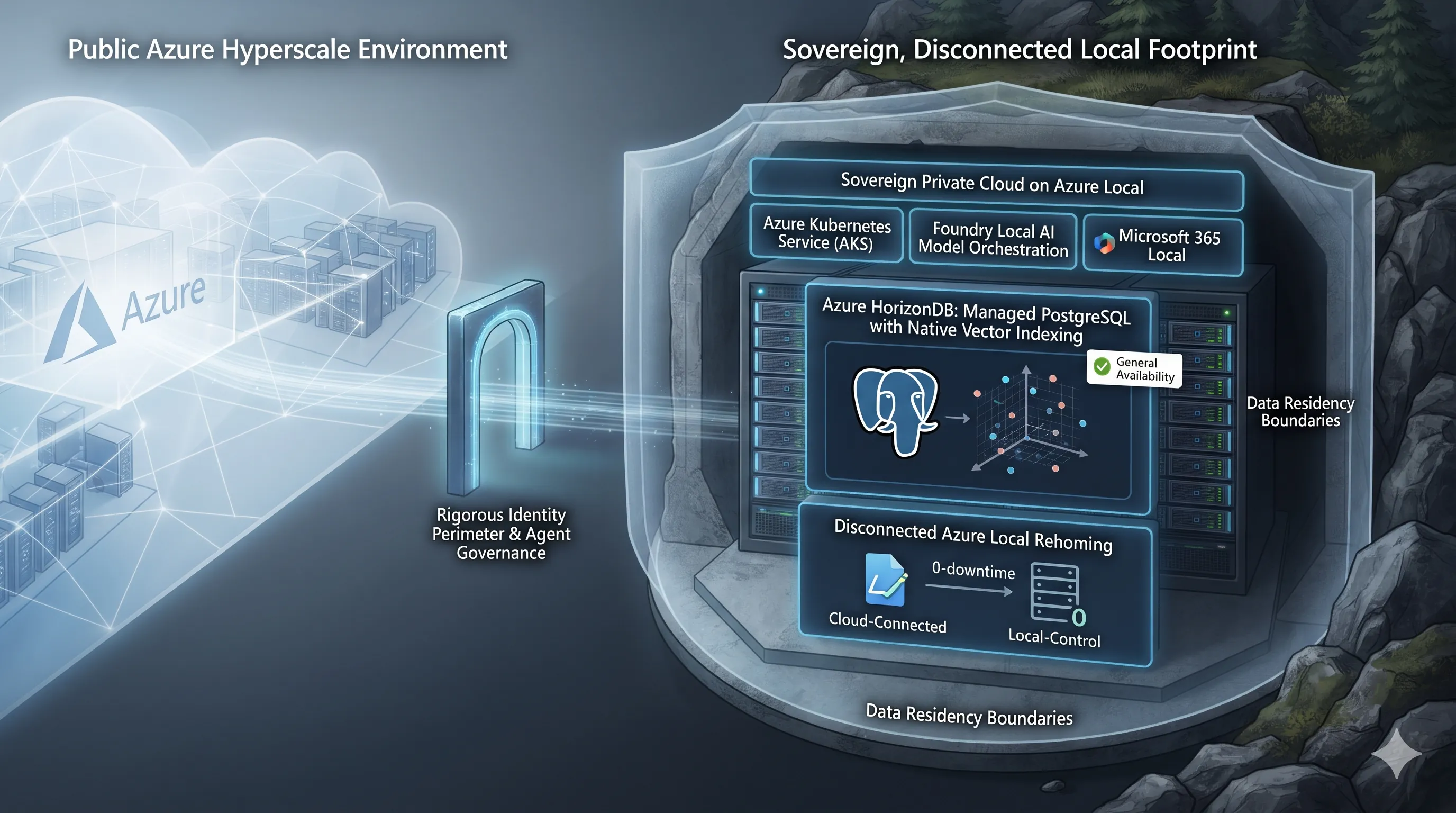
Azure HorizonDB is now generally available as a fully managed, PostgreSQL-compatible operational database engineered specifically to underpin intelligent agent workloads without introducing third-party vector database sprawl.To ensure unified identity and governance across enterprise agent ecosystems, HorizonDB embeds native Microsoft Entra ID controls directly into the database engine, enforcing policy-driven access controls at the data layer.
HorizonDB integrates built-in vector indexing out of the box, allowing enterprise teams to store, index, and query embeddings alongside traditional relational schemas without provisioning auxiliary vector platforms.
While the core database engine and vector capabilities have achieved general availability, advanced developer capabilities—specifically HorizonDB AI Functions and AI Pipelines—remain in preview.
To streamline adoption from legacy and existing database footprints, Azure Database Migration Service (Azure DMS) introduces preview migration pathways supporting both Oracle-to-PostgreSQL transitions and automated upgrades from existing Azure Database for PostgreSQL deployments into HorizonDB.
Sovereign Private Cloud and Zero-Downtime Rehoming on Azure Local
For organizations operating under stringent regulatory mandates and data residency boundaries, Microsoft launched the Sovereign Private Cloud as an integrated, full-stack architecture running on Azure Local.The sovereign stack encompasses core infrastructure virtual machines (VMs), Azure Kubernetes Service (AKS), managed data services, Foundry Local for localized AI model orchestration, and Microsoft 365 Local for on-premises collaborative workloads.
During its initial preview phase, the sovereign control panel operates exclusively in European regions, hosted out of Sweden, and functions without active policy enforcement enabled.
A critical operational challenge for hybrid infrastructure has been the friction of shifting nodes between cloud-connected control planes and fully disconnected, air-gapped states.
Microsoft addressed this operational barrier by introducing a native rehoming capability on Azure Local that transitions an instance from Azure cloud management to disconnected local control in a single script while fully retaining active running VMs and underlying storage volumes.
Highlighting the operational impact of this shift, Darryl van der Peijl remarked: "Until now, going from connected to disconnected meant a migration project. Microsoft showed a script that does the rehoming in one run."
Expanding edge silicon support, Azure Local entered public preview on arm64 architectures, validated on the NVIDIA Jetson AGX Thor Development Kit running bare-metal container workloads.
Concurrently, infrastructure foundations advanced with the Windows Server 2028 Insider preview, which incorporates post-quantum cryptography, default native NVMe storage handling, NVMe-oF (NVMe over Fabrics), ReFS boot capabilities, and user-mode network drivers designed for high-throughput, low-latency enterprise environments.
| Component / Platform | Key Features and Functional Scope | Release Status |
|---|---|---|
| Azure HorizonDB | Managed PostgreSQL-compatible database, built-in vector indexing, native Microsoft Entra ID controls | General Availability |
| HorizonDB AI Tooling | Native AI Functions and extensible AI Pipelines | Preview |
| Azure DMS Migration Paths | Workload migrations for Oracle-to-PostgreSQL and Azure Database for PostgreSQL to HorizonDB | Preview |
| Sovereign Private Cloud Stack | Full-stack Azure Local deployment: VMs, AKS, data services, Foundry Local, and Microsoft 365 Local (Sweden-hosted control panel, no active policy enforcement) | European Preview |
| Azure Local Rehoming | Single-script transition from cloud management to disconnected local control while preserving active VMs and storage | Announced / Demonstrated |
| Azure Local on arm64 | Bare-metal container execution supported on NVIDIA Jetson AGX Thor Development Kit | Public Preview |
| Windows Server 2028 | Post-quantum cryptography, default native NVMe, NVMe-oF, ReFS boot, and user-mode network drivers | Insider Preview |
Related Posts
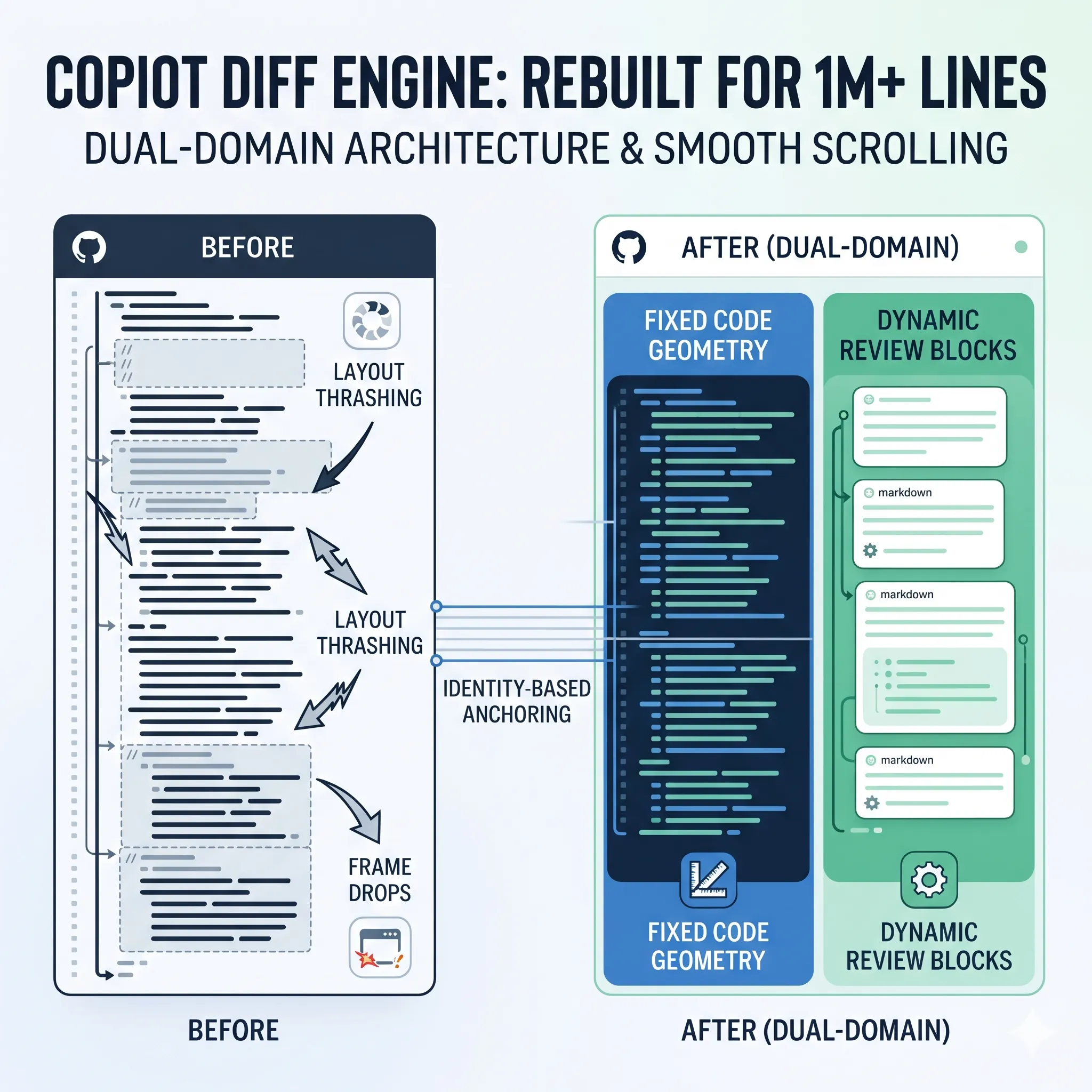
How GitHub Rebuilt Copilot's Diff Engine for Million-Line Pull RequestsDiscover how GitHub re-engineered the Copilot diff interface with dual-domain virtualization and...

Microsoft's Secret Second Brain: The Definitive Guide to the Claude AI Takeoveron Microsoft's Claude Integration Dual-AI Strategy: Microsoft is integrating Anthropic's Claude...
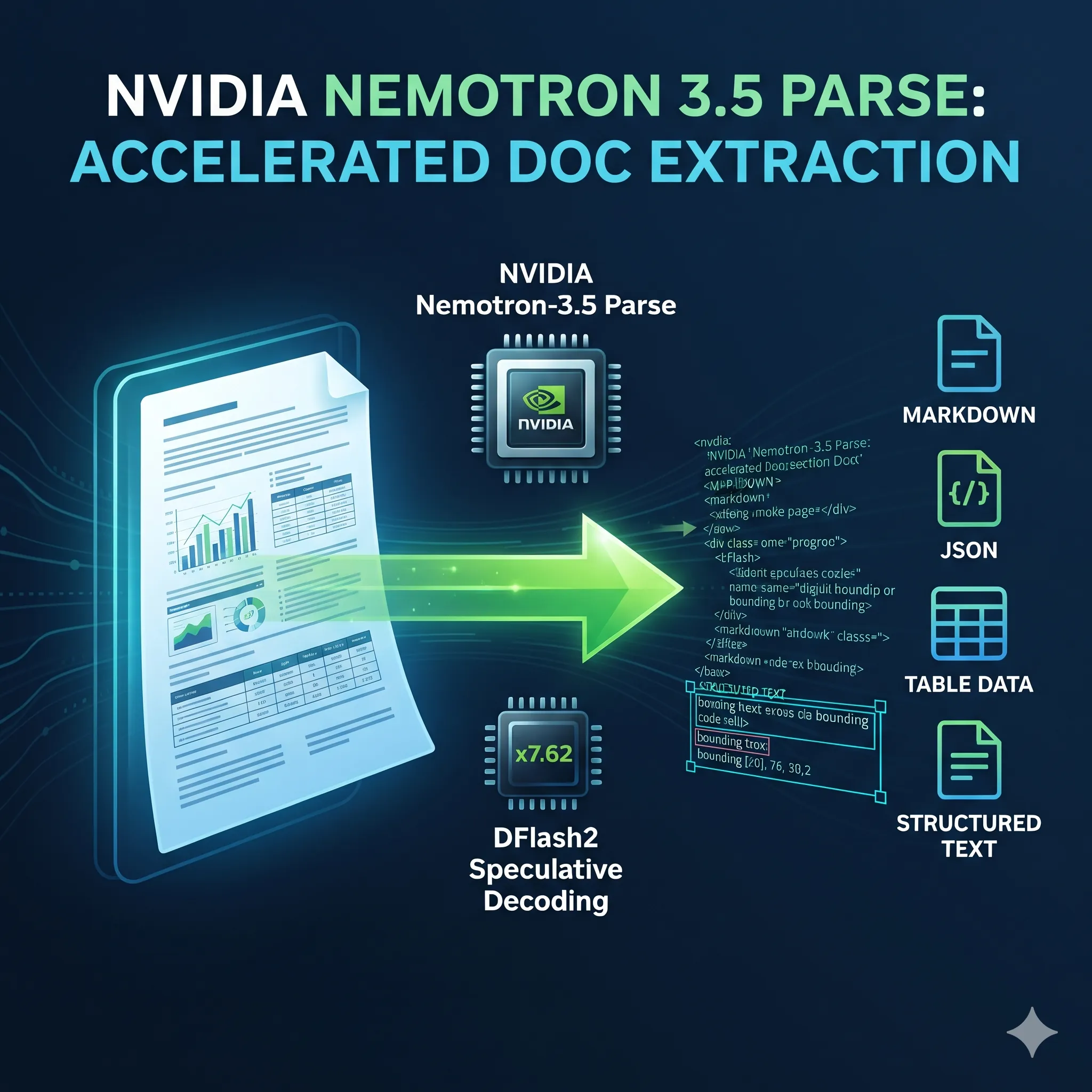
How Nemotron 3.5 Parse Accelerates Vision-Language Document ExtractionDiscover how NVIDIA's Nemotron 3.5 Parse boosts inference speed and document extraction efficiency...
Generative AI may have assisted with research or drafting for this article. Topic selection, fact-checking, final wording, and publication remain the responsibility of DragonStone74. AI use disclosure