
How GitHub Rebuilt Copilot's Diff Engine for Million-Line Pull Requests
🚀 Key Takeaways
- Dual-Domain Layout Architecture: Decoupling predictable, fixed-height code lines from dynamic review elements enables virtualization engines to render only active viewport rows without layout bottlenecks.
- Identity-Based Scroll Anchoring: Tracking blocks via semantic file, line, and side coordinates prevents jarring layout shifts and scroll jumps when inline discussions or reply fields expand.
- Controlled Observer Pipelines: Replacing continuous layout measurements with dirty-flagged ResizeObservers and deferred syntax highlighting prevents cascading browser reflow loops during fast scrolling.
- Continuous Agentic Benchmarking: Embedding automated synthetic mega-PRs and layout probes inside continuous integration workflows guarantees UI stability as agent-generated code volume surges.
As AI coding agents rapidly accelerate the velocity of software development, code review has swiftly replaced code creation as the primary engineering bottleneck.
When automated agents produce sprawling changesets spanning hundreds of files and thousands of lines in seconds, conventional diff viewers struggle to maintain interactive frame rates under intense browser layout calculations.
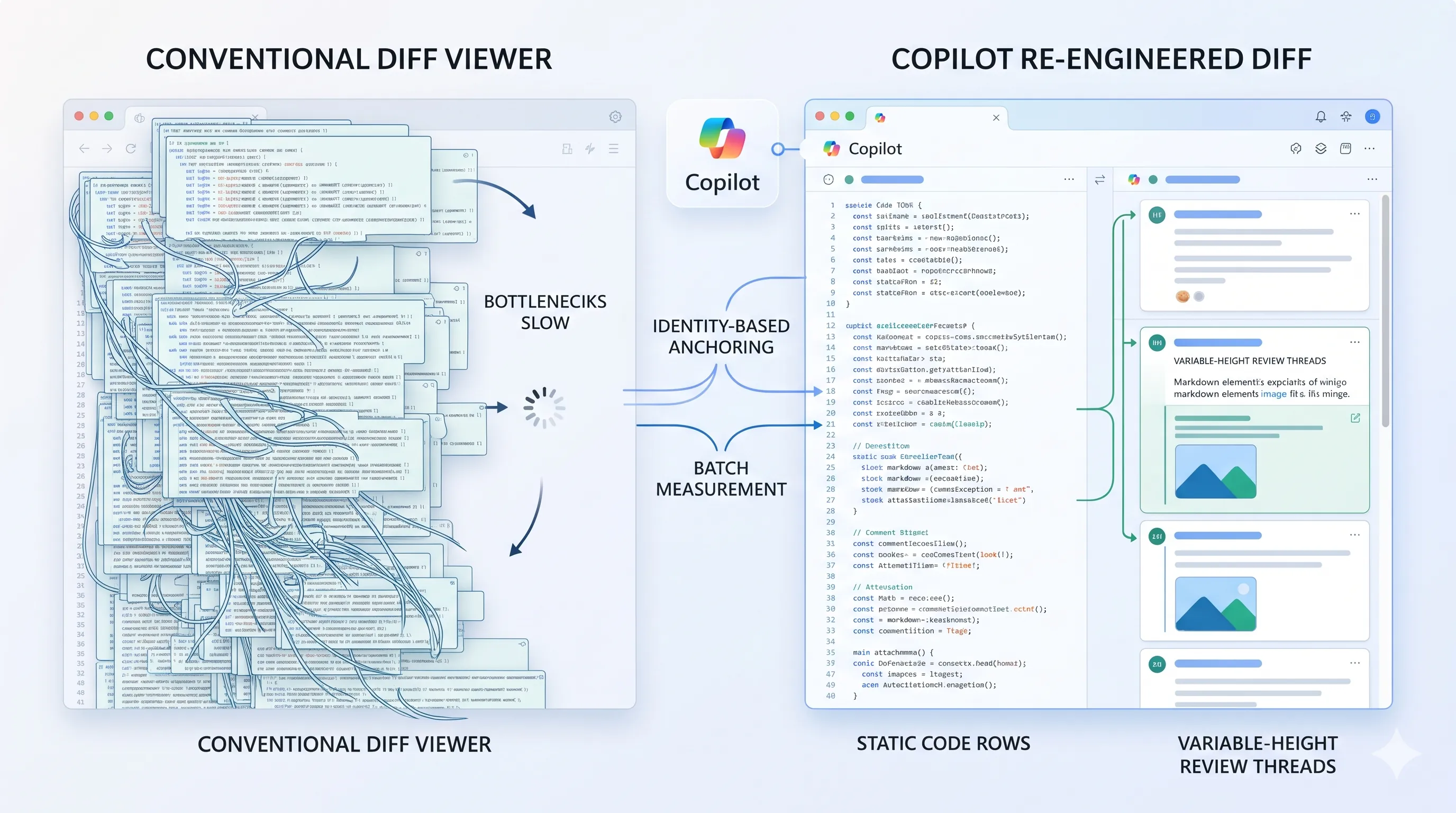
To resolve these scalability challenges, GitHub re-engineered the Copilot diff interface from the ground up, eliminating the longstanding assumption that a code review page is simply a uniform, single-column document.
By establishing a dual-domain rendering model that separates static code rows from variable-height review threads, the new architecture delivers responsive performance even against extreme, million-line pull requests.
Supported by batch measurement intervals, identity-anchored scrolling mechanisms, and automated performance test harnesses, this architectural overhaul modernizes how developers interact with dense, agent-authored code in real time.
1. Dual-Domain Virtualization: Decoupling Fixed Code Geometry from Dynamic Review Blocks
To optimize Copilot's diff surface for performance, GitHub fundamentally restructured how massive code changes and contextual data are rendered in the browser.Rather than handling a pull request as an undifferentiated, continuous document, the engineering team re-engineered the rendering pipeline around a dual-domain layout architecture.
Technical details published by Principal Design Engineer Alberto Gimeno on the Copilot engineering rebuild reveal how decoupling predictable code syntax from unpredictable user-generated metadata resolved long-standing browser performance bottlenecks.
Stress-Testing at Extreme Scale: The 1,000,000-Line Pull Request
Rendering large diffs inside web browsers historically led to severe interface degradation, frame drops, and browser tab crashes under enterprise-grade workloads.To establish a high-performance baseline for Copilot's diff surface, the rebuilt architecture was stress-tested against an extreme pull request containing 2,200 files, over 1,000,000 changed lines, and more than 400 inline review comments.
Attempting to mount a document of this magnitude directly into the DOM tree would immediately exhaust browser memory and overwhelm layout engines.
To solve this, GitHub implemented strict DOM virtualization that restricts actively rendered lines so that only roughly 100 rows exist in the browser DOM simultaneously, rather than rendering the full million lines.
This viewport-bound windowing ensures that DOM node counts remain constant regardless of whether an engineer reviews a minor patch or a repository-scale code modification.
Dual-Domain Partitioning: Fixed Code Geometry vs. Dynamic Review Blocks
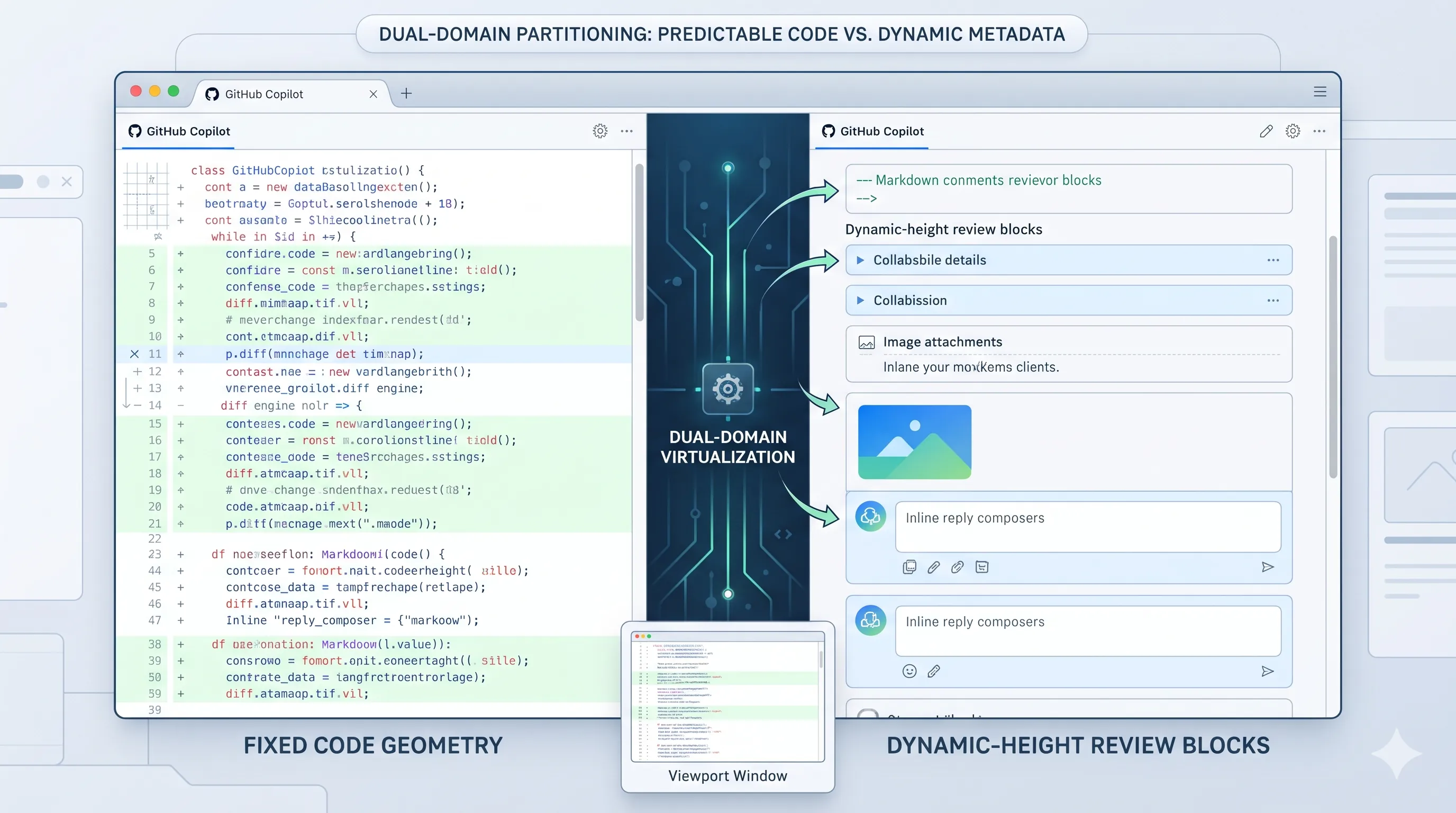
The foundational breakthrough in the rebuilt diff surface was eliminating the architectural assumption that a pull request is a single uniform list.Standard virtualization engines fail when forced to treat uniform code lines and arbitrary metadata as identical entities within a single layout queue.
GitHub divided the document layout into two distinct domains: fixed-geometry code rows and dynamic-height review blocks.
| Layout Domain | Structural Elements | Rendering & Geometry Characteristics |
|---|---|---|
| Fixed-Geometry Code Rows | Source code lines, diff modifications, line numbers. | Pre-calculated from known font size and line height; never requires recalculation or rebuilding. |
| Dynamic-Height Review Blocks | Markdown review comments, collapsible details elements, image attachments, and inline reply composers. | Variable dimensions rendered independently without forcing layout recalculations onto static code rows. |
As a result, pure code rows never require runtime DOM recalculation or layout rebuilding during scrolling.
Conversely, dynamic blocks—which encompass markdown review comments, collapsible details elements, image attachments, and inline reply composers—are isolated so their fluctuating heights do not disrupt the pre-computed grid of surrounding code.
Overcoming Static Height Reservation Bottlenecks
Prior to this architectural separation, diff viewers struggled with conflicting virtualization strategies.Forcing a single variable-height virtualizer to compute both static code and variable comments simultaneously caused severe layout recalculation bottlenecks.
Under that legacy pattern, the browser repeatedly measured dynamic heights during scroll events, invalidating layout trees across the entire diff surface.
Engineers previously attempted to mitigate these recalculations by applying static height reservations for incoming comments.
However, static height reservations introduced structural defects: they either left excessive, empty whitespace when comments were short, or clipped longer content into awkward nested scrollbars.
By partitioning the diff surface into fixed-geometry code and isolated dynamic review containers, the rebuilt architecture avoids static height clipping while protecting the primary diff stream from expensive layout thrashing.
2. Identity-Based Block Keying and Anchored Scroll Stabilization
As part of the architecture powering GitHub's diff surface optimizations, resolving layout instability during real-time code reviews required rethinking how dynamic elements coexist with static line structures.Dynamic injections such as inline comment threads, rich markdown reviews, and AI-generated suggestions disrupt standard DOM virtualization when tracked purely by vertical screen positions.
Stabilizing this diff interface demands decoupling render positions from absolute spatial coordinates and anchoring the viewport around structural identity.
Coordinate-Based Keying vs. Pixel-Position Tracking
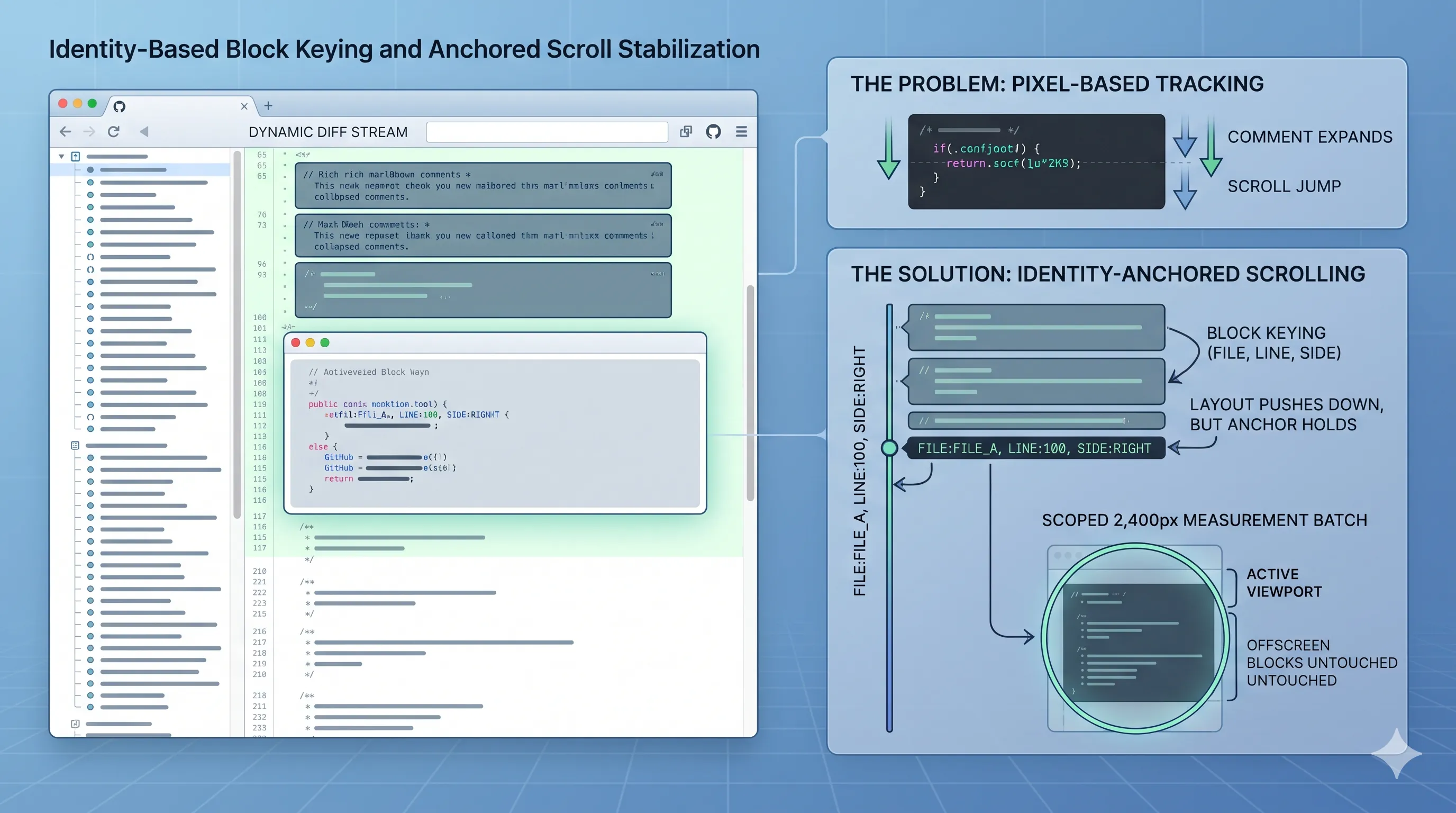
Traditional diff rendering models bind content lines directly to sequential vertical coordinates or absolute pixel offsets.Under this naive approach, overwriting code row pixel coordinates when comments resize shifts following content, causing visual jank during reading or scrolling.
To neutralize these jarring shifts, dynamic blocks are keyed by identity coordinates (file, line, side) instead of pixel positions.
By keying elements to semantic coordinates within the diff tree, the layout engine separates line-level code identity from the rendered dimensions of adjacent metadata.
When newly added or expanded content initializes, dynamic blocks rely on temporary height estimates until rendered and batched measurements replace them.
This preliminary sizing ensures that layout boundaries are reserved instantaneously without triggering disruptive full-document recalculations.
Window-Width Fingerprinting and Scoped 2,400px Measurement Batches
Responsive text behavior adds complexity to dynamic diff sizing, as inline comment text wraps differently depending on browser dimensions.To resolve this, a block fingerprint tracks content changes, toggle expansion states, and viewport measurement widths.
Height measurements are tracked across distinct window-width intervals to account for varying text wrapping.
When a container transitions across these distinct responsive thresholds, the layout cache invalidates only the affected fingerprint state rather than resetting all cached metrics.
To prevent expensive DOM layout thrashing during DOM reads, the dynamic block measurement pass is restricted to a batch scope of roughly 2,400 pixels around the active viewport.
Confining layout reads strictly within this 2,400-pixel perimeter keeps calculations performant, measuring elements just before they enter view while leaving offscreen blocks untouched.
Identity-Anchored Viewport Scrolling Under Dynamic Content Resizing
The most persistent challenge in dynamic diff streams is the upward layout push caused when comments above the reader's view expand or hydrate.If a virtualized list tracks position strictly by raw scroll offsets, any expansion occurring above the viewport immediately displaces the lines currently being examined.
GitHub bypasses this behavior by locking the viewport scroll position to visible item identity rather than absolute pixel offsets, preventing scroll jumps when upper blocks expand.
When a block measurement above the active screen replaces its temporary height estimate with accurate measured dimensions, the engine recalculates the scroll delta relative to the anchored identity coordinate.
The visible code rows remain locked in place before the engineer's eyes, providing uninterrupted reading continuity across large, collaborative diffs.
3. Batching Layout Cycles: Taming ResizeObserver and Deferring Heavy Rendering
In optimizing GitHub Copilot's diff surface for performance, rendering hundreds of modified code lines alongside complex UI components introduces severe strain on the browser's main thread.Handling high-frequency layout changes and dynamic blocks within diff views requires restructuring how the DOM reports and updates element dimensions.
Breaking the ResizeObserver Feedback Loop with Dirty-Flag Batching
Earlier optimizations on github.com's unified view cut line rendering overhead from roughly 8 React components and 10 DOM elements each by roughly half.While this substantial reduction minimized the static footprint of diff lines, handling dynamic content within Copilot's diff interfaces created new runtime challenges.
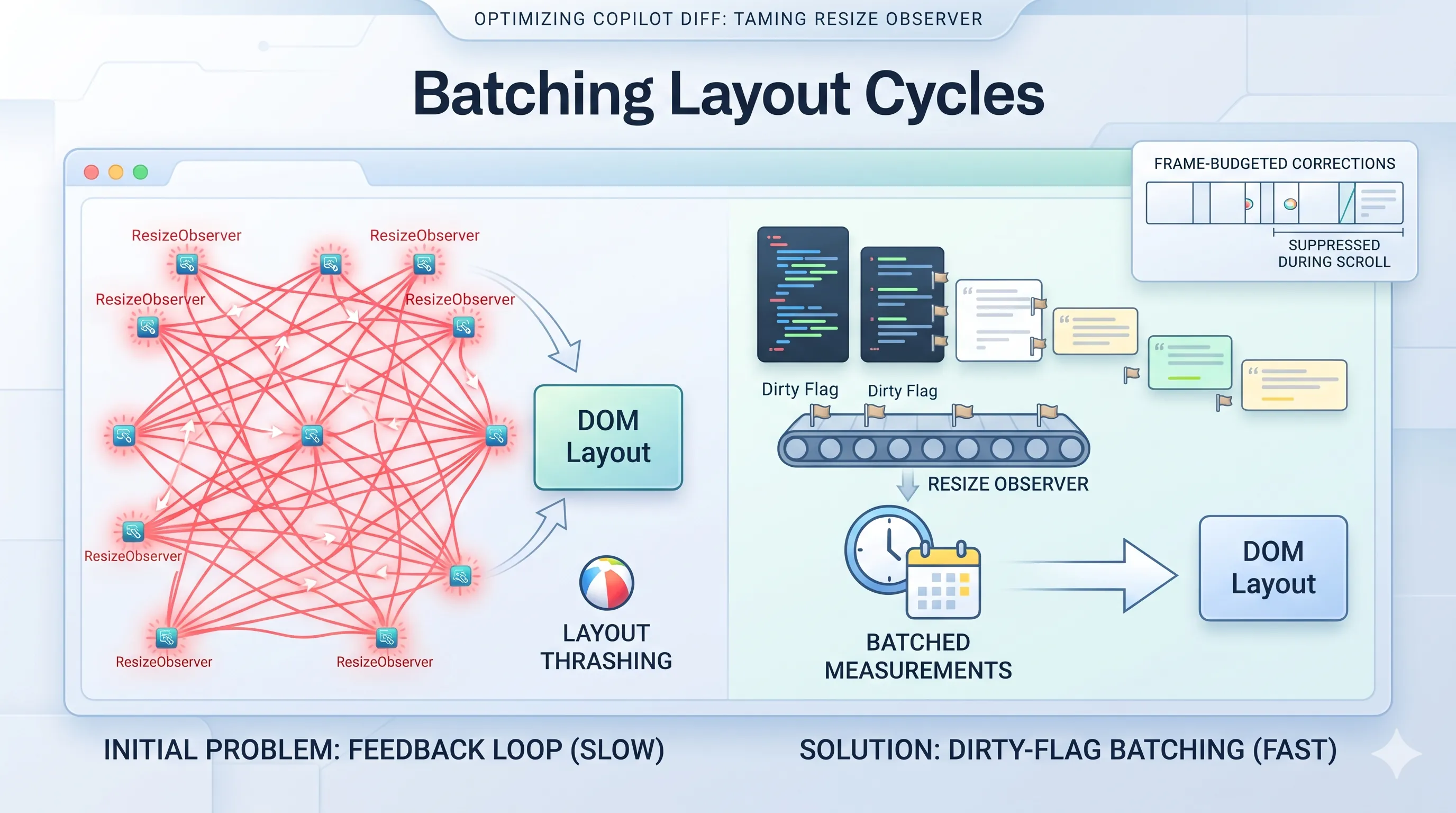
The engineering team's initial approach relied on one ResizeObserver per block writing directly to the layout upon detecting size mutations.
As Alberto Gimeno noted, this initial one-ResizeObserver-per-block approach was a classic feedback loop whose cost grew with every mounted block.
Directly writing layout heights back to the DOM inside observer callbacks forced synchronous reflows, which in turn triggered subsequent resize observations across neighboring blocks.
To dismantle this layout feedback cycle, the ResizeObserver implementation was redesigned to set dirty flags rather than immediately write layout heights back on every observation.
By marking blocks as dirty instead of executing direct layout writes, the diff surface isolates observation from mutation and aggregates dimension recalculations.
Frame-Budgeted Layout Corrections and Scroll Suppression
Flushing dimension changes requires careful scheduling to prevent visual stutter and layout thrashing during user navigation.Synchronous layout corrections are limited to one per frame when users explicitly expand details elements or composers, ensuring adjacent code moves in the same frame.
This frame-budgeted execution guarantees visual stability by preventing cascading repositioning events across code lines while keeping expansions visually synchronized.
To maintain responsiveness when navigating through extensive diffs, synchronous layout corrections are suppressed while active scrolling is underway.
By deferring non-critical geometry updates until scrolling ceases, the engine prevents layout calculation spikes from dropping animation frames.
| Optimization Area | Initial Problem or Baseline | Implemented Performance Strategy |
|---|---|---|
| DOM Line Footprint | Overhead of roughly 8 React components and 10 DOM elements per line in unified views. | Overhead cut roughly in half in earlier unified-view optimizations. |
| Observer Feedback Loop | One ResizeObserver per block writing directly to layout, degrading as mounted blocks increased. | Redesigned to set dirty flags rather than immediately writing layout heights on observation. |
| Synchronous Layout Execution | Unthrottled layout recalculations competing with user interactions and scrolling. | Limited to one correction per frame during explicit expansions; suppressed during active scrolling. |
| Rendering Pipeline | Simultaneous parsing and layout of structural content, code styling, and formatted text. | Deferred rendering: presents file trees and metadata immediately; postpones syntax highlighting and markdown. |
Deferred Rendering: Prioritizing Structural Metadata Over Syntax Highlighting
Balancing DOM operations also required decoupling high-priority interface scaffolding from computationally expensive text formatting.Deferred rendering presents file trees and metadata immediately, while syntax highlighting and heavy markdown rendering are postponed until elements approach the viewport.
Displaying file structures and metadata without delay allows users to inspect diff hierarchies instantly without waiting on tokenization.
Postponing heavy markdown parsing and syntax highlighting until blocks approach the visible viewport bounds ensures browser resources remain dedicated to structural stability and smooth scrolling.
4. Automated Performance Probes and the Multi-Panel Copilot Review Workflow
Optimizing GitHub Copilot's diff surface for performance requires continuous runtime enforcement and specialized review environments capable of handling high-throughput agentic code volume.As AI coding agents accelerate delivery, validation frameworks must safeguard rendering speeds while giving reviewers direct operational controls.
CI Layout Probes and Autopilot Telemetry Benchmarking
To prevent rendering regressions within the diff interface, structured probes are embedded permanently inside the diff surface to validate layout invariants against performance budgets in CI.These probes measure interface behavior continuously across the lifecycle of diff rendering.
Complementing embedded probes, a synthetic mega-PR fixture is run automatically by an autopilot driving cold and warm desktop application flows.
During these automated test runs, automated agents inspect desktop on-disk telemetry logs to detect layout regressions without manual interaction.
Demonstrating confidence in these layout optimizations and stress testing mechanisms, Alberto Gimeno concluded the post by urging reviewers to "open the worst pull request you have got."
| Benchmarking & Verification Mechanism | Execution Scope | Target Objective |
|---|---|---|
| Structured In-Diff Probes | Continuous Integration (CI) test suites | Validate diff surface layout invariants against strict performance budgets. |
| Synthetic Mega-PR Fixture | Desktop autopilot driving cold and warm flows | Stress test application diff rendering under extreme payload sizes. |
| Automated Telemetry Agents | Desktop on-disk telemetry inspection | Detect layout and rendering regressions without requiring manual interaction. |
| Integrated Review Environment | Copilot desktop application workspace | Pair side-by-side diff review with terminal execution and browser previews. |
Addressing the AI Code Review Bottleneck: Beyond 200-Line Degradation
AI coding agents generate pull requests faster than human reviewers can digest, making code review rather than code generation the primary software bottleneck.Codegen CEO Jay Hack noted winners in the AI era will redesign workflows around review being the bottleneck.
Review efficiency is fundamentally constrained by cognitive load limits.
Microsoft research cited in context showed code review quality degrades sharply once a pull request exceeds roughly 200 lines.
To mitigate oversized diffs and support modular inspection of agent-produced output, stacked pull requests entered public preview on 30 July 2026.
Multi-Panel Verification: Testing Agent Changes with the Embedded Terminal
To accelerate the human inspection cycle, the Copilot app integrates side-by-side diff review, terminal execution, and browser previews to let reviewers verify agent-generated code before merging.Instead of switching external contexts to confirm that an agent's changes run as intended, reviewers validate behavior directly within the application.
Reviewers utilize this integrated environment for testing agent-generated application changes from the Copilot app terminal panel:
npm run dev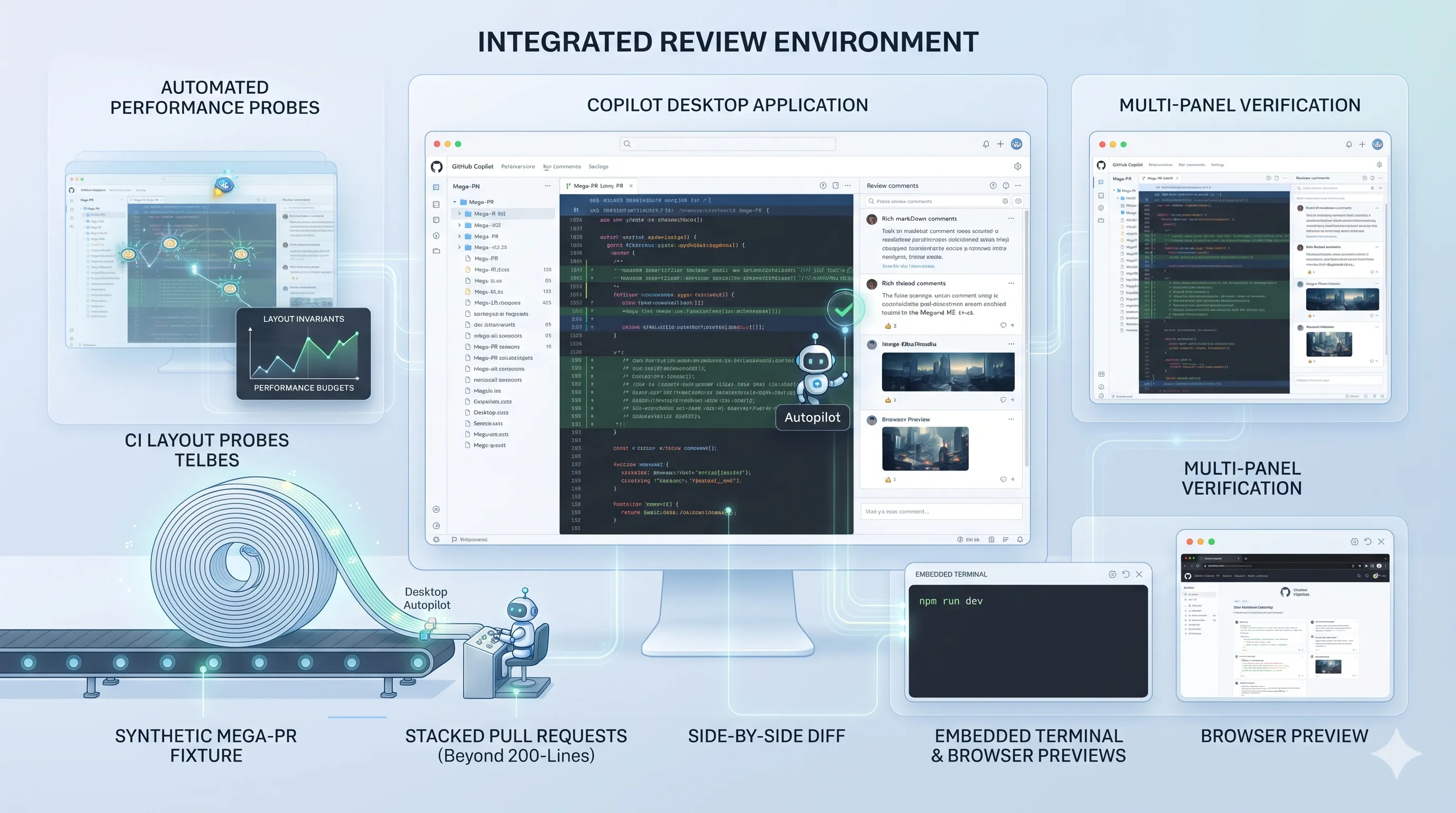
Related Posts
Microsoft Ignite 2026: Copilot Work OS and Agent 365 GovernanceDiscover how Microsoft Ignite 2026 redefines enterprise AI with Copilot as the Work OS, centralized...

DeepSeek V4 Pro & Flash: Unveiling the 1 Million Token Era – Architecture, Efficiency, and Real-World Performance NuancesDeepSeek-V4 revolutionizes the AI landscape by officially launching its open-source V4-Pro and...

Gemma 4: Google's Open AI Redefines Performance & Efficiency, Closing Proprietary Gaps for Developers & Edge DevicesGemma 4 redefines open AI, offering frontier-level performance and unparalleled efficiency across...
Generative AI may have assisted with research or drafting for this article. Topic selection, fact-checking, final wording, and publication remain the responsibility of DragonStone74. AI use disclosure