
How Frontier AI Models Are Rewriting Theoretical Physics
🚀 Key Takeaways
- Automated Calculation Saturation: Frontier AI models have effectively mastered well-defined theoretical physics calculations, rapidly exhausting frontier benchmarks like TheoPhysEval by solving multi-page expert problems in minutes.
- Widespread Elite Adoption: Leading theoretical physicists now routinely deploy autonomous multi-agent systems to audit published literature, verify complex derivations, and conduct parallel research workflows.
- Preprint Deluge: Accelerated manuscript generation has triggered an unprecedented surge in theoretical submissions, overwhelming traditional reading habits and forcing researchers to rely on private filtering networks.
- Pedagogical and Career Crisis: The automation of manual calculations disrupts standard doctoral training, leaving senior faculty questioning how future students will build physical intuition and secure stable academic paths.
- The Experimental Bottleneck: While machine reasoning can formally verify massive mathematical proofs, progress in fundamental domains like quantum gravity remains limited by empirical testing rather than a scarcity of theoretical ideas.
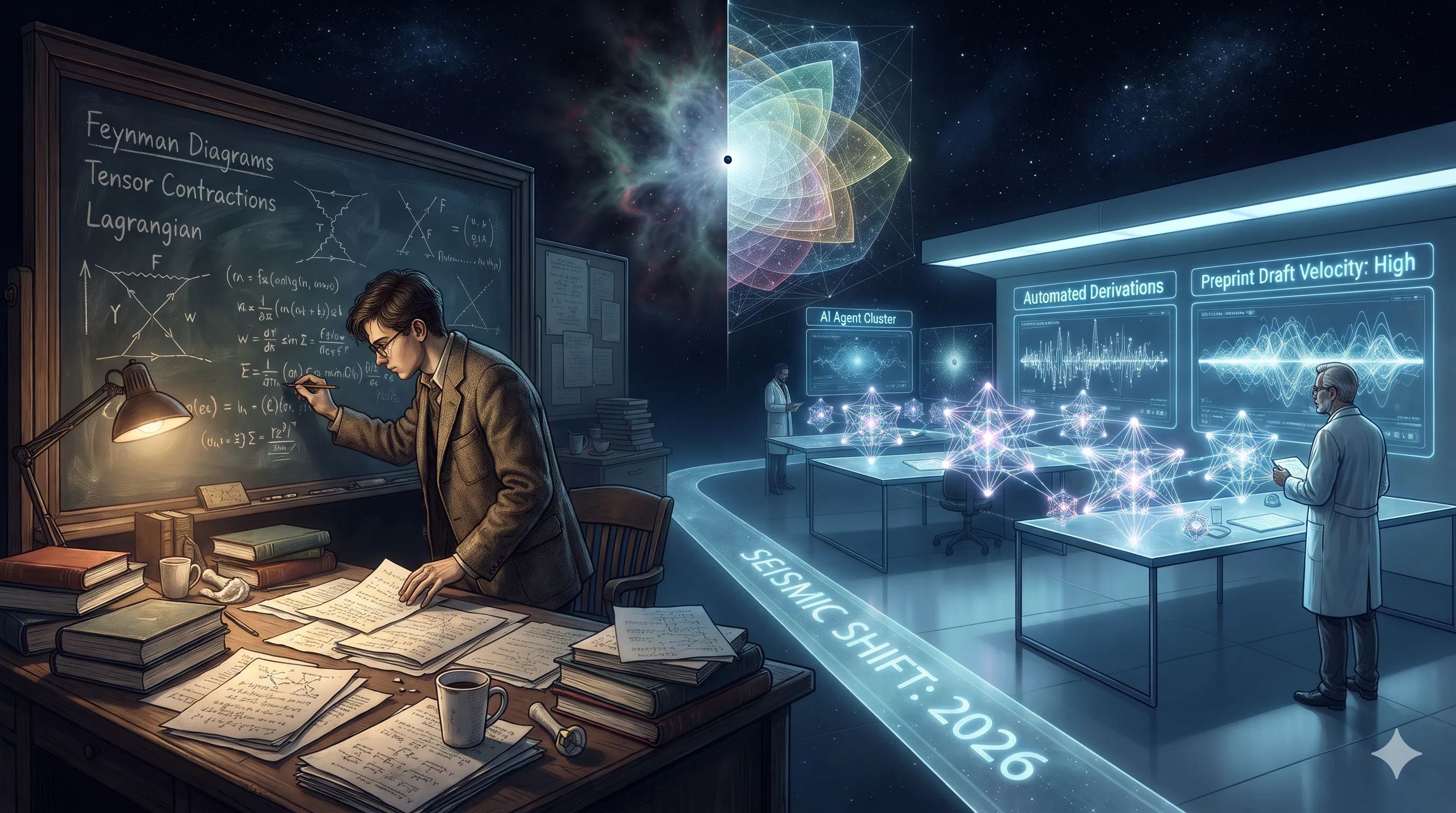
For nearly a century, the core apprenticeship of theoretical physics was defined by a simple imperative: shut up and calculate. Junior researchers earned their credentials and honed physical intuition through hundreds of pages of grueling manual algebra, tracing complex Feynman diagrams and grinding through tensor contractions by hand. In late 2026, that century-old foundation has experienced a sudden seismic shift as frontier artificial intelligence models compress years of laborious mathematical labor into mere hours of autonomous execution.
From the world's foremost research institutions, leading theorists are deploying continuous fleets of AI agents to cross-examine legacy literature, derive intricate field-theoretic amplitudes, and draft papers at unprecedented velocity. This surge of synthetic productivity has flooded preprint servers, upending the community's capacity to digest scientific literature while precipitating an existential debate inside university physics departments over graduate education and tenure criteria.
Yet as the computational ceiling collapses, physicists are discovering that sheer calculation speed does not resolve the deepest mysteries of the universe. With automated systems now solving standard analytical bottlenecks almost instantly, the frontier of fundamental science is forced to confront its true limiting factor: separating boundless mathematical possibilities from the hard realities of empirical experiment.
1. Autonomous Calculation Workflows: How Frontier Models Saturated Day-Long Physics Calculations
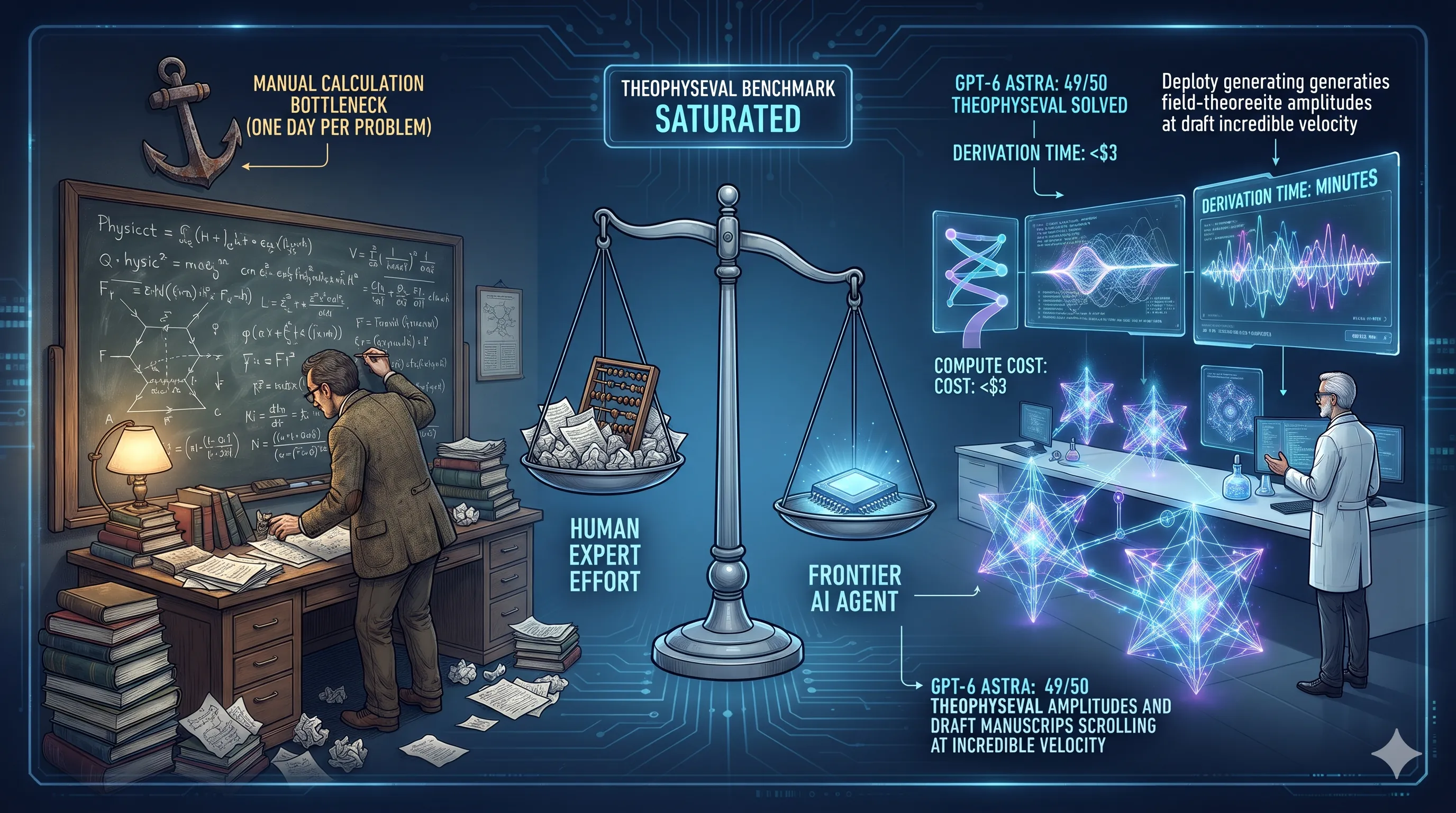
Within the broader landscape of how AI is transforming theoretical physics work, the traditional bottleneck has long been the sheer human effort required to grind through lengthy, multi-step algebraic and numerical derivations.Where theoretical physicists previously dedicated entire working days to manual calculation workflows, frontier autonomous agents have demonstrated the capacity to absorb, execute, and verify these exact computational pipelines within minutes.
Autonomous Problem-Solving Across Unpublished Physics Gems
To rigorously assess whether frontier systems could handle authentic, non-trivial research derivations without relying on memorized public literature, Suvrat Raju and colleagues created the TheoPhysEval benchmark.The benchmark consists of 50 unpublished research problems that typically require human experts at the top of the field approximately one day to solve.
To prevent data memorization from web scraping, the problems were deliberately gathered from private, unreleased derivations.
As Raju noted regarding the curation effort: "Our contributors had to either sacrifice potential publication elsewhere, or else undertake a small research project just for us."
The evaluation suite spanned five core domains:
- Classical mechanics
- Statistical physics
- Quantum field theory
- Holography
- Cosmology
Under this setup, GPT-6 Astra running in Codex tackled each benchmark problem from a single human prompt.
Remarkably, removing access to web search and background literature only slightly altered model accuracy, indicating that the system was not relying on external web references to piece together solutions.
Furthermore, these autonomous workflows operated at high economic efficiency, requiring an average of less than $3 of compute per correct solution.
| Evaluation Metric / Dimension | Benchmark Specification & Agent Performance |
|---|---|
| Domain Coverage | Classical mechanics, statistical physics, quantum field theory, holography, cosmology |
| Problem Dataset Scope | 50 unpublished research problems ("private gems" to eliminate data memorization) |
| Human Expert Baseline | Approximately one full day per problem for leading subject specialists |
| Agent Tooling & Execution | Single human prompt; tools for literature searches; script execution for numerical and symbolic computation |
| Compute Cost | Less than $3 of compute on average per correct solution |
| Preliminary Model Accuracy (September Colloquium) | About 60% solved independently across leading AI models |
| Initial GPT-6 Astra Accuracy | Nearly 90% of benchmark problems solved |
| Final GPT-6 Astra Accuracy Threshold | 49 of 50 problems resolved (after identifying subtle human answer-key errors) |
Reaching the Ceiling of Well-Defined Mechanical Derivations
The progression of model capabilities rapidly outpaced the benchmark itself.Preliminary evaluation results shared by Raju at a colloquium in September showed leading AI models independently solving about 60 percent of the problems.
However, when GPT-6 Astra was deployed in Codex, it initially solved nearly 90 percent of the 50 problems.
As the agent reviewed discrepancies against the evaluation standards, it successfully resolved 49 of the 50 problems by identifying subtle errors in the human-provided answer keys.
The single problem that Astra failed to solve was subsequently described as a trick question.
Consequently, the TheoPhysEval benchmark was saturated before its official release.
The outcome has forced theoretical physicists to reconsider how evaluation is conducted, as well-defined closed-form derivations no longer serve as an upper bound for machine capability.
Raju stated that there will not be a second version of the benchmark, explaining: "We've kind of hit the ceiling of well-defined calculations that people can do.
Now, there is open research and you can keep asking about open research.
But that's not an evaluation."
2. Inside the Theoretical Workflow: Agentic Problem Threads, Proof Auditing, and Collaboration Shifts
Connecting directly to the broader transformation of theoretical physics work, the day-to-day methodology of high-energy theory and mathematical physics is undergoing a structural overhaul.Rather than serving merely as static reference engines, frontier generative architectures and autonomous agent clusters now function as active derivation partners, literature auditors, and continuous computation engines.
Compressing Year-Long Derivations into Continuous Agent Threads
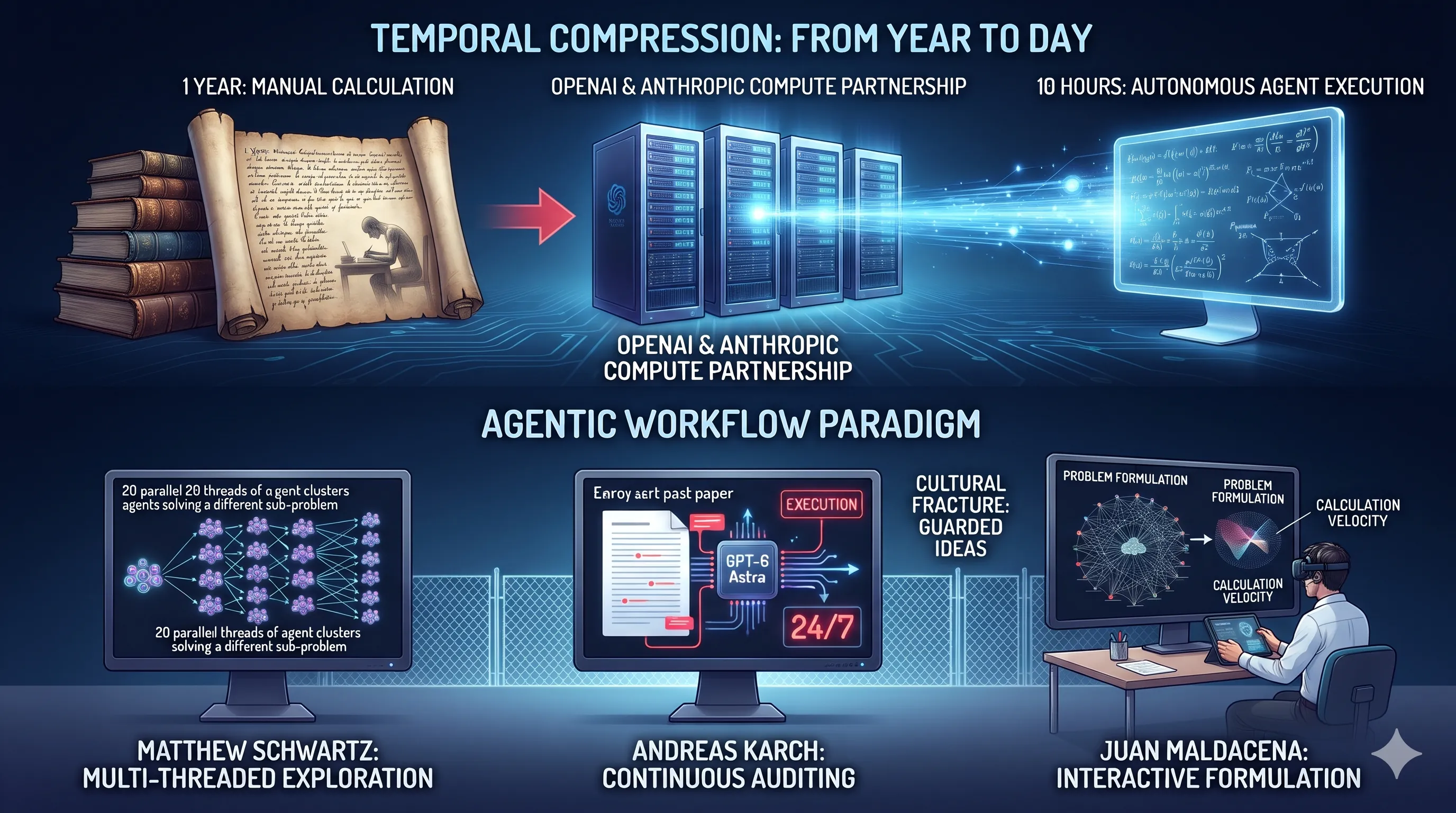
The mechanical bottleneck of theoretical physics—the grueling process of grinding through hundreds of pages of algebra, tensor contractions, and integral evaluations—is experiencing extreme temporal compression.Demonstrating this shift, Claude Opus 5.5 reproduced the core calculations of a Turkish physicist's PhD thesis in 10 hours, an analytical body of work that originally required 1 year and 500 pages of hand calculations.
This capacity to telescope multi-month mathematical slogs into single-day computational runs has led frontier AI labs to establish direct pipelines into theoretical departments.
Frontier AI labs provide free compute and high-tier access directly to academic physicists, exemplified by OpenAI supplying advanced infrastructure to Andreas Karch and Anthropic providing dedicated access to Matthew Schwartz.
With institutional compute barriers lowered, researchers are redesigning their daily analytical practices around parallel execution.
Matthew Schwartz reported running 20 simultaneous problem threads on his computer, each supported by 10 to 20 agents.
In this operating paradigm, physicists use AI agents to conduct literature surveys, automate lengthy algebraic derivations, and audit legacy publications for errors.
Rather than pausing computational routines when leaving the office, Andreas Karch runs AI agents continuously 24 hours a day and processes one past paper per day through GPT-6 Astra to find errors.
As Karch noted regarding this automated verification stream: "Pretty much every paper that I send it, it has something to say."
| Theoretical Physicist | Industry Compute Partnership | Deployment Architecture & Operational Scale | Primary Research Tasks |
|---|---|---|---|
| Matthew Schwartz | Anthropic | 20 simultaneous problem threads; 10 to 20 agents per thread | Multi-threaded problem exploration and automated derivations |
| Andreas Karch | OpenAI | Continuous 24-hour daily execution via GPT-6 Astra | Auditing legacy literature; processing 1 past paper per day for errors |
| Juan Maldacena | OpenAI / Anthropic | Interactive frontier model queries | Literature search; performing calculations historically considered too long |
The Tension Between Problem Formulation and Calculation Velocity
The integration of agentic reasoning has reached the highest tiers of mathematical physics.Prominent theoretical physicists Ed Witten and Juan Maldacena have credited or acknowledged Anthropic and OpenAI models in recent papers.
Juan Maldacena explained that he uses AI "to do some calculations, search the literature" and for "calculations that in the past were maybe too long."
By eliminating mathematical dead ends and sweeping across vast citation graphs, these systems resolve calculations that previously stalled research agendas.
Yet the transformation across theoretical physics remains unevenly distributed.
Physicists in concept-heavy subfields find AI less disruptive because formulation of the problem constitutes the bulk of the effort.
In domains where the primary intellectual challenge lies in establishing conceptual frameworks rather than evaluating technical integrals, computational speedups yield diminishing returns.
Daniel Harlow highlighted this constraint plainly: "the vast majority of the work is figuring out what to do.
By the time I have a calculation to perform, I'm like 95% done already."
Simultaneously, the sheer calculation velocity unlocked by agentic clusters is altering the sociological fabric of academic exchange.
A growing fear exists among researchers that discussing ideas openly might lead to being quickly scooped by peers deploying AI agents.
Informal whiteboard sessions, conference coffee chats, and preprint discussions have historically driven collaborative physics.
However, when an agent cluster can turn an abstract conceptual prompt into a fully derived paper overnight, informal transparency carries existential research risks.
Andreas Karch detailed this cultural fracture: "If you tell somebody, they're going to run and ask the agent to solve it.
You have to be much more guarded if you think you have some big idea."
3. The arXiv Surge: Literature Bottlenecks and Filtering Challenges in High-Energy Physics
As artificial intelligence increasingly transforms theoretical physics work by automating computations and manuscript generation, the scientific community faces an acute downstream bottleneck in literature consumption.Unprecedented Pre-print Velocity and the Digestibility Deficit
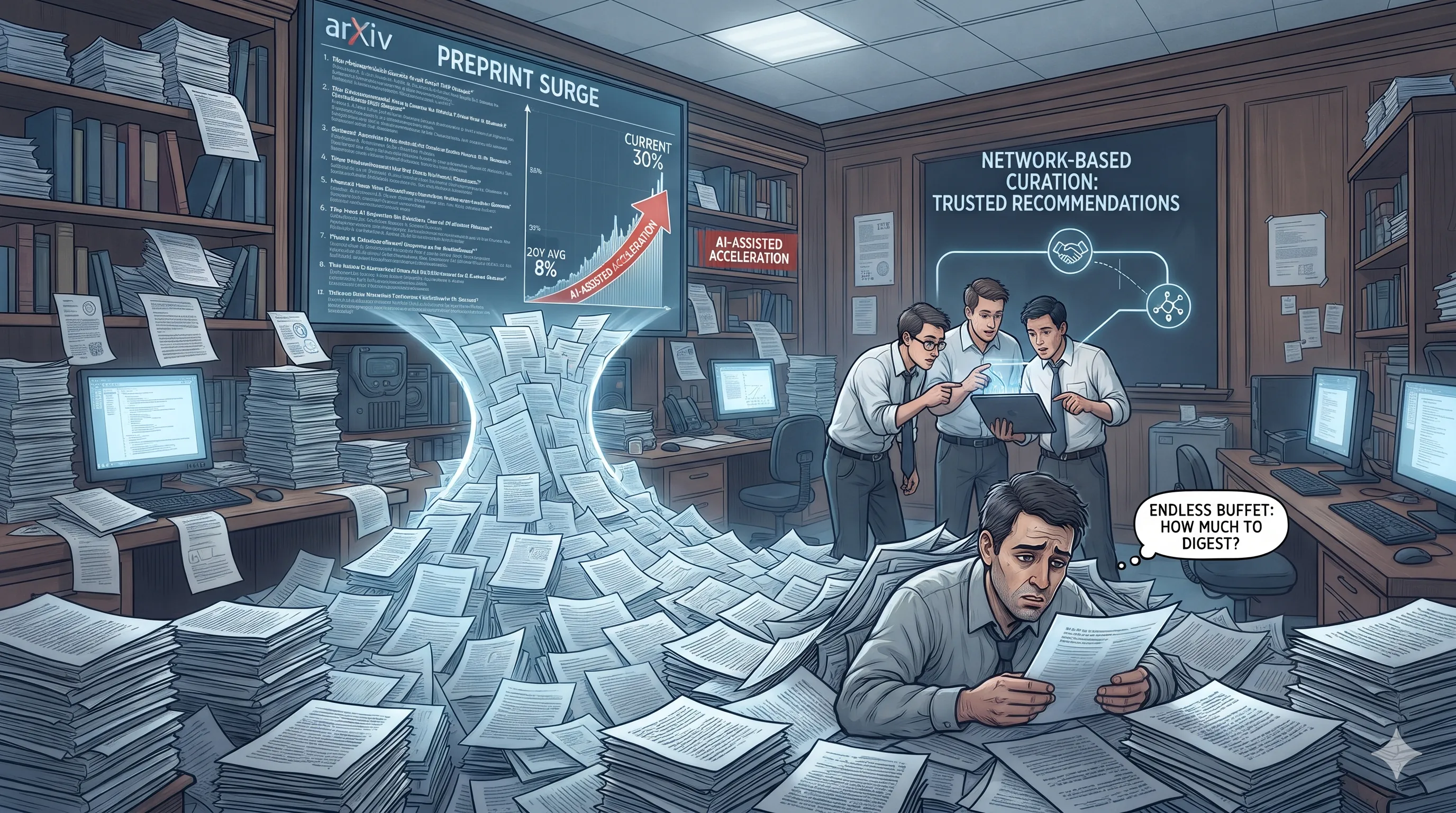
The scale of submission activity on the arXiv repository illustrates how profoundly automated assistance is altering scholarly output.Submissions to the hep-th (high-energy physics theory) category on arXiv rose roughly 30 percent between January and October compared to the prior year.
To contextualize this acceleration, the maximum single-year growth recorded in hep-th arXiv submissions across the previous 20 years was merely 8 percent.
This rapid influx of AI-assisted manuscripts has made comprehensive peer reading across the community impractical.
Compounding the challenge, the scientific community lacks the collective capacity to verify or digest the full volume of newly published research.
Reviewers and theorists frequently observe that many new submissions are poorly drafted, even if the underlying mathematics appears technically accurate.
Physicist Matthew Schwartz highlighted this paradoxical trend, describing many papers as "poorly written, but I think the science is probably pretty solid."
Theoretical computer scientist Scott Aaronson captured the resulting intellectual fatigue with an apt culinary comparison: "It's like this endless buffet. Even if it's the most amazing food, how much of it can you digest?"
Network-Based Curation as the Antidote to Preprint Overload
Because evaluating every preprint on arXiv has become impossible under current publication volumes, community reading habits are shifting fundamentally.Researchers are increasingly turning to personal networks and direct recommendations to filter significant papers from low-effort submissions.
Rather than scanning daily repository feeds directly, theorists depend on trusted colleagues to flag meaningful breakthroughs amidst the deluge of AI-generated prose.
Physicist Aron Wall detailed this filtering reality plainly: "My source for papers on the arXiv usually is somebody tells me about them, and if they don't, then I don't need to know."
This reliance on social curation functions as a decentralized gatekeeping mechanism, allowing researchers to maintain focus on impactful work while mitigating the distraction of voluminous, low-friction preprints.
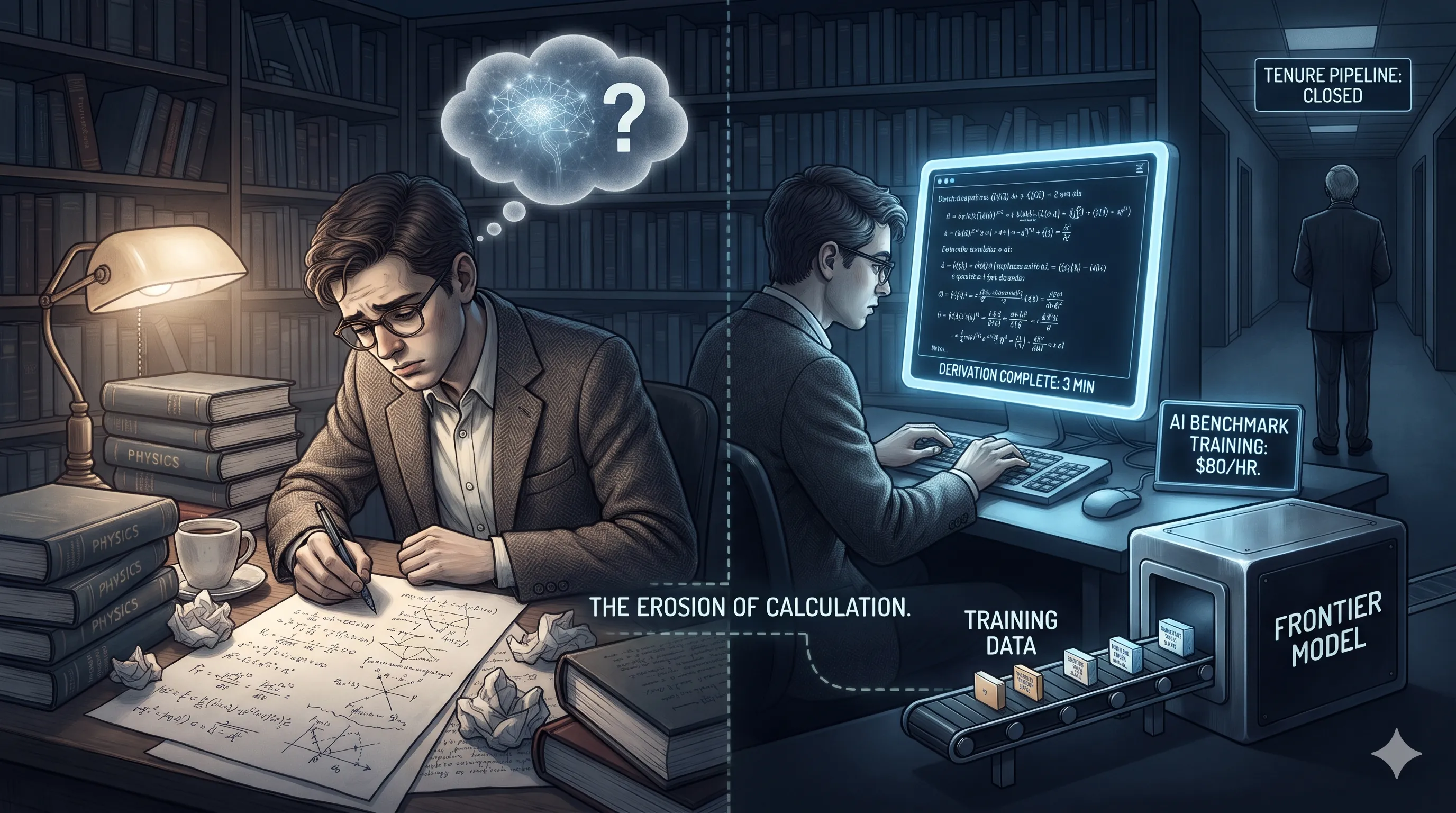
4. Pedagogy and Pipeline: The Disruption of Junior Physicist Training and Career Paths
As automated systems transform theoretical physics work by executing complex analytical derivations and solving problems in minutes, the foundational apprentice model of the discipline faces an existential breakdown.This transformation directly impacts the pedagogical pipeline, unsettling how rising researchers are evaluated, trained, and professionally sustained.
The Erosion of Calculation as the Crucible for Physical Intuition
Performing mechanical calculations traditionally served as the primary mechanism for junior physicists to establish talent and develop physical intuition.For generations, working through laborious algebraic derivations and perturbation expansions functioned as the rite of passage through which aspiring researchers internalized the subtleties of physical frameworks.
As physicist Suvrat Raju observed regarding this traditional evaluation rubric: "It's how we judge students, how we decide students have talent."
The automation of these workflows threatens to short-circuit the cognitive learning process itself.
Physicist Andreas Karch highlighted this disruption, noting: "If you do enough of this mechanical grinding through problems, at some point, you pick up the concepts behind it. It's not clear how you jump over that step."
Eliminating manual calculation leaves an unclear pedagogical pathway for students to internalize core theoretical physics concepts.
Without the daily discipline of calculation, junior researchers risk losing the direct, tactile connection to the mathematical apparatus that underpins theoretical breakthroughs.
Reflecting on the psychological and academic toll this shift takes on students watching algorithmic systems rapidly replicate their hard-won skills, Scott Aaronson stated: "A lot of them feel like that is being taken away from them."
Funding Pressures, Gig Work, and Doctoral Training Reassessment
The structural disruption extends beyond the classroom and into departmental admissions and scientific career trajectories.Senior professors are reassessing doctoral admissions due to ambiguity over the operational role of human theoretical physicists.
Confronting this uncertainty, Suvrat Raju stated he is not taking new PhD students until he understands what their future careers will look like.
These career pressures are exacerbated by federal science funding reductions under the Trump administration alongside limited hiring of physicists by AI frontier labs.
Faced with diminishing academic horizons and constrained institutional stipends, some physics students have taken side roles writing benchmark problems for AI data vendors like Mercor or Scale AI for $80 to $100 per hour.
While these rates provide short-term financial relief, freelance contract work generating training data lacks benefits such as health insurance and does not constitute an academic career path.
Consequently, junior theorists find themselves relegated to piecework labor training the very systems destabilizing their discipline, caught between an evaporating traditional tenure pipeline and an uncertain automated future.
5. Beyond Calculation: Formal Mathematical Verification, Quantum Gravity, and Collective Science
As machine learning tools automate tedious algebraic manipulations, the evolution of how AI is transforming theoretical physics work has reached the boundary separating formal mathematical physics from physical reality.Automated reasoning systems have begun parsing foundational mathematical structures, forcing researchers to evaluate whether formal machine verification produces meaningful physical insight or merely confirms longstanding technical assumptions.
Formal Lean Proofs vs. Empirical Reality in Fundamental Physics
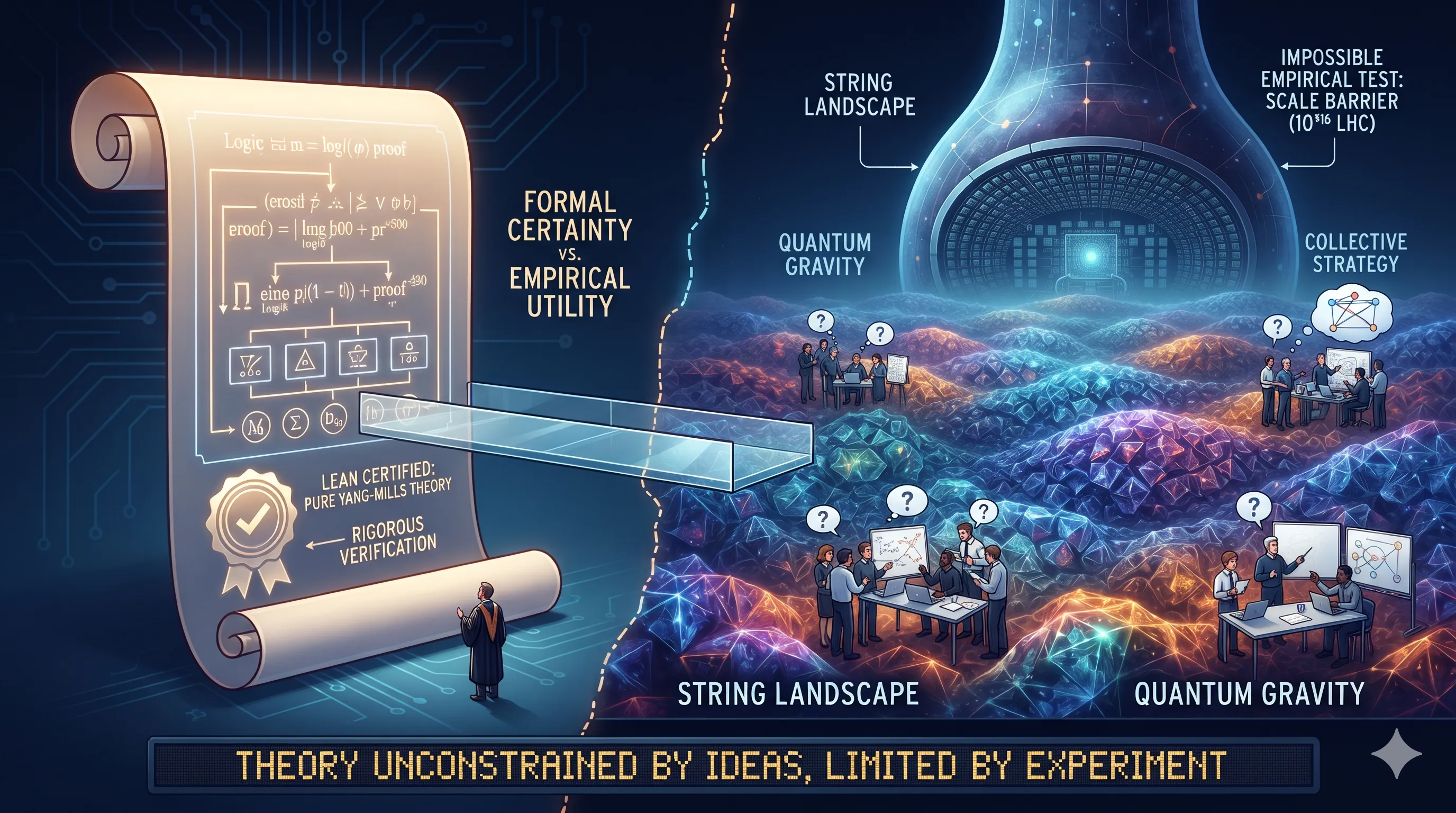
The technical reach of modern automated proof systems was demonstrated when OpenAI announced a model verified a 1,147-page proof in Lean establishing pure Yang-Mills theory in four dimensions, representing half of a Millennium Prize problem.Mathematical verification systems like Lean provide self-contained checking mechanisms that physics theories currently lack, systematically validating deductive chains line by line.
However, a formal proof of pure Yang-Mills theory does not constitute a conceptual physics breakthrough because theorists had already assumed its truth for decades.
Physicist Andreas Karch highlighted this divide between rigorous mathematical certainty and physical utility, tweeting: "Existence of Yang Mills? It's just tying up a [loose] end for the hyper mathematically minded. I don't think any physicist gives af."
The challenge deepens when machine reasoning encounters non-axiomatized frontiers such as quantum gravity.
AI models cannot currently receive formal automated certificates (such as Lean) for overarching, loosely framed concepts like quantum gravity.
Underscoring this structural gap, Daniel Harlow observed that "nobody can just give you a Lean certificate that says, 'Here's the theory of quantum gravity.'"
The String Landscape, Extreme Collider Scales, and Large Collaborations
Rather than suffering from a shortage of mathematical models, theoretical physics remains constrained by experimental verification limits rather than a deficit of conceptual proposals.As Andreas Karch summarized: "the problem isn't the ideas, it's the experiments."
This disconnect is especially evident in string theory, which permits an estimated 10^500 possible universe configurations, presenting an overwhelmingly vast landscape of mathematical possibilities.
Empirical arbitration across these configurations remains blocked by physical scale.
Directly testing quantum effects of gravity would require an accelerator roughly one quadrillion times more powerful than the Large Hadron Collider, requiring a radius in the hundreds of light-years.
Because of this scale barrier, hypothetical AI solutions to quantum gravity could be impossible to test using existing or foreseeable collider technology.
Faced with staggering mathematical landscapes and hard empirical bottlenecks, the operational architecture of theoretical research is adapting.
Theoretical physics may shift from individual work to large collaborative structures reminiscent of experimental physics or interpretive humanities.
Reflecting this structural transition toward shared compute and shared strategy, 51 physicists co-authored a proposal advocating collective pooling of institutional compute and joint grant submissions.
This realignment suggests a shift in the daily cognitive responsibilities of researchers navigating AI assistance.
As Suvrat Raju remarked: "For a long time we've been told to 'shut up and calculate.' [Maybe AI] frees us up to stop and think, and it lets us think about ambitious problems that we couldn't think of earlier."
Related Posts
Generative AI may have assisted with research or drafting for this article. Topic selection, fact-checking, final wording, and publication remain the responsibility of DragonStone74. AI use disclosure