
Inside Gemini API Tool Retrieval: How On-Demand Schemas Save Tokens
🚀 Key Takeaways
- On-Demand Schema Loading: Tool Retrieval enables the Gemini API to compress inactive tool declarations into minimal identifiers, retrieving detailed parameter schemas only when the model needs to invoke them.
- Flexible Execution Modes: Developers can choose between zero-setup server-side search handled entirely by Gemini or client-side retrieval to query custom external indices and permission-governed catalogs.
- Prompt Prefix Cache Preservation: Deferring parameter definitions keeps the prompt start stable from turn to turn, allowing full compatibility with prompt caching and bulk deferral for Model Context Protocol servers.
- Substantial Context Optimization: By drastically minimizing the footprint of idle declarations, the mechanism yields significant token economies for agent architectures managing dozens or hundreds of tools.
- Permanent In-Session Schema Retention: Retrieved schemas remain active in the model's context for the duration of the conversation, making strategic separation between permanent core tools and deferred utilities essential.
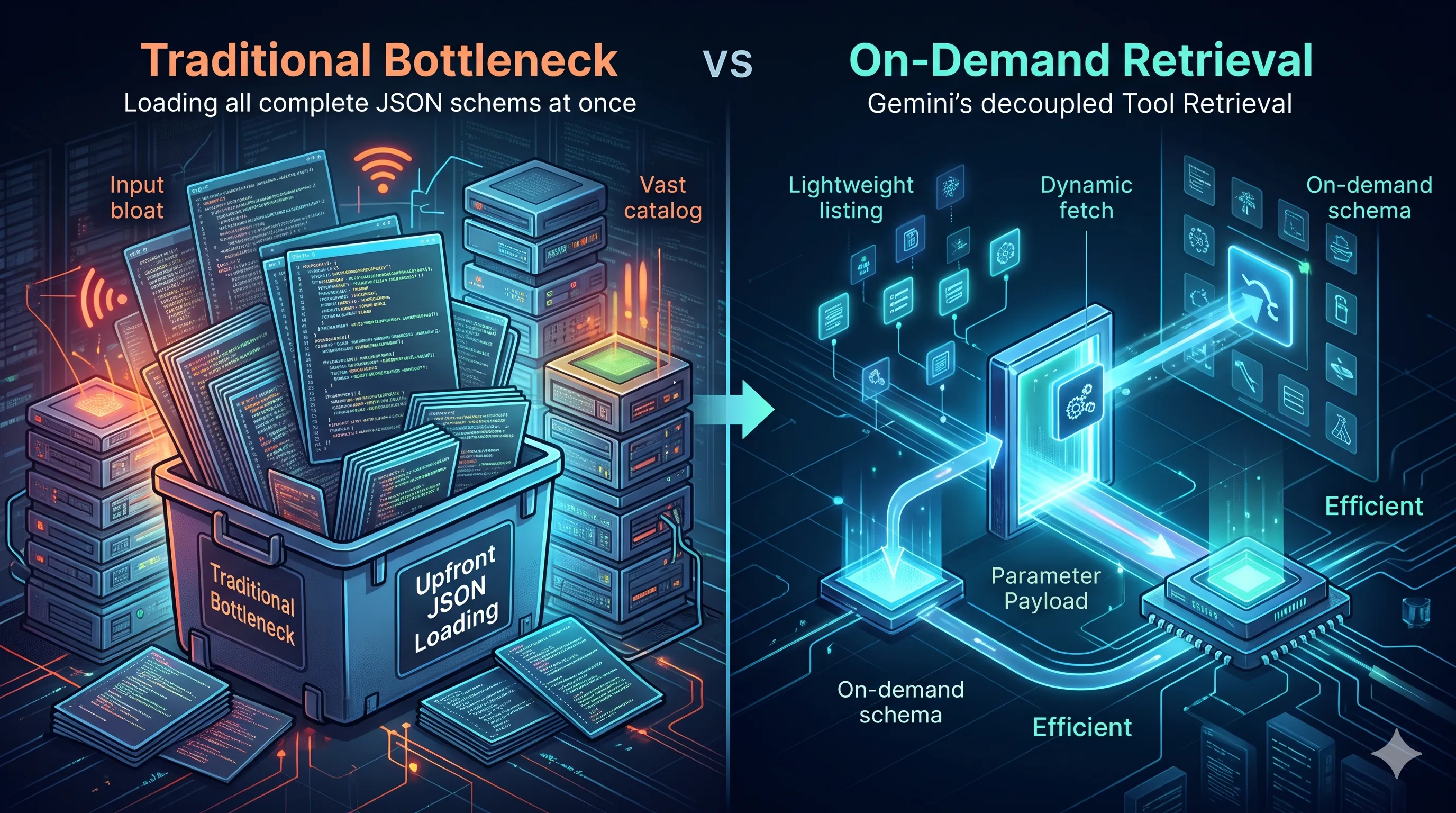
Building capable autonomous agents increasingly requires equipping models with vast libraries of external APIs, calculators, and enterprise connectors. Traditionally, providing broad tool access came with a crippling operational penalty: developers had to load every complete JSON parameter schema into the system prompt upfront, consuming precious context space and inflating recurring input costs even if most tools were never touched.
Google has addressed this structural bottleneck by previewing Tool Retrieval in the Gemini Interactions API. The architecture decouples high-level tool visibility from parameter payload definitions, maintaining lightweight listings in the initial prompt and fetching comprehensive specifications on the fly as conversational intent demands.
Whether routing calls through automated server-side searches or orchestrating distributed catalogs across remote Model Context Protocol instances, adopting dynamic tool retrieval fundamentally alters how agent developers balance latency, token economics, and functional capability. Mastering these operational mechanics is critical for deploying scalable, cost-efficient Gemini agents in production.
1. Core Architecture and the Interactions API: How On-Demand Tool Retrieval Operates
To understand how Tool Retrieval functions in the Gemini API, developers must examine the underlying architectural change in how tool metadata is supplied to the model.Announced on November 19, 2026, by Lucia Loher, Product Manager for the Gemini API, and Nora Kassner, Research Scientist at Google DeepMind, Tool Retrieval introduces an on-demand retrieval mechanism for function schemas.
Instead of consuming context budget by passing extensive JSON schemas up front, the architecture splits declarations into a compact prompt listing while holding full parameter schemas out of context until they are explicitly needed.
Interactions API Integration and the tool_search Declaration
Tool Retrieval is currently available as a preview feature and requires the v1beta version of the API.The functionality is built specifically for the Gemini Interactions API, meaning that the older, legacy generateContent method does not support Tool Retrieval.
Because the feature is in preview, the API surface remains subject to change before reaching general availability.
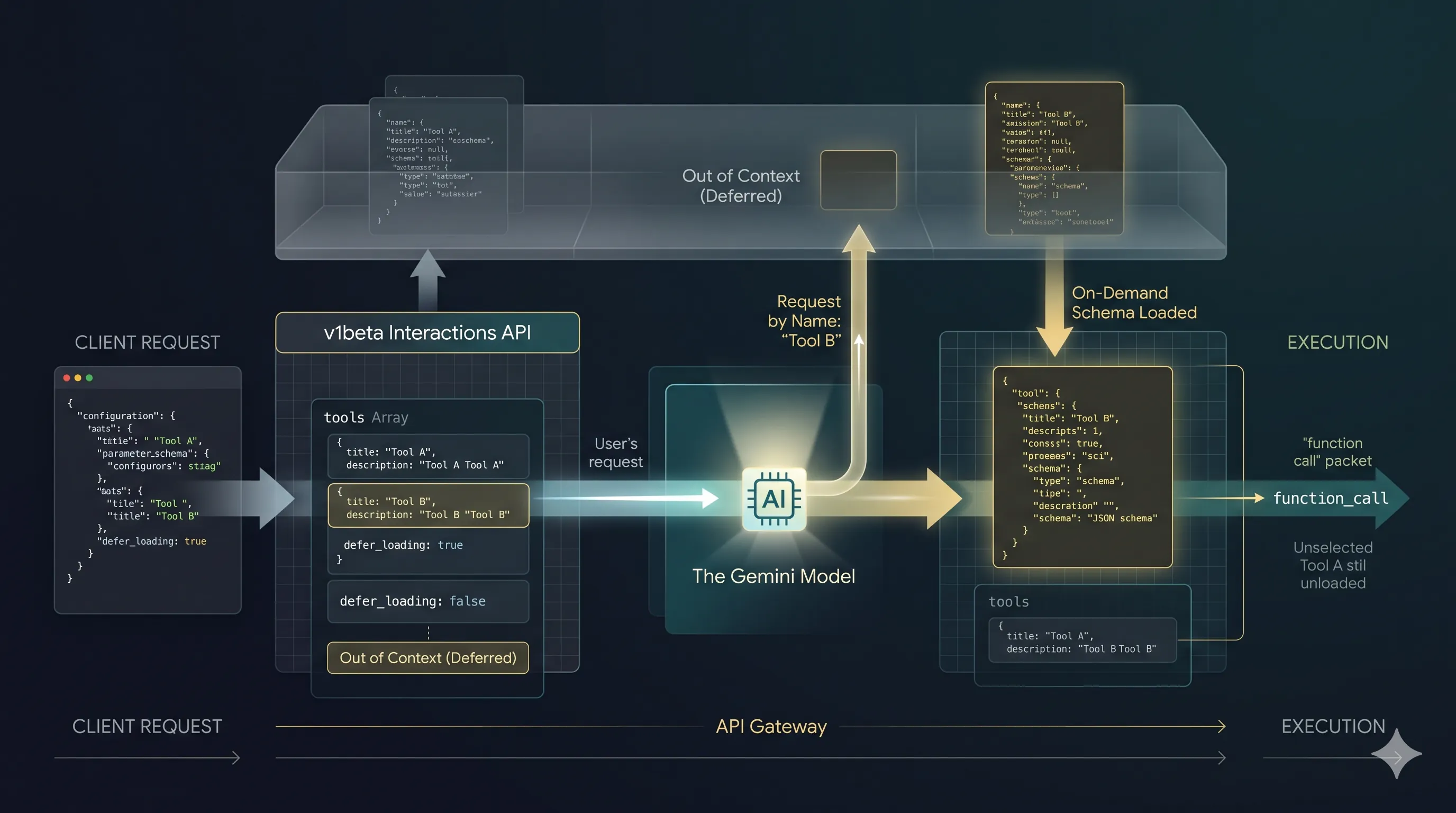
Integration is configured directly within the API call by adding a tool_search definition into the tools array and setting defer_loading: true on individual tool declarations.
Under this design, exactly one tool_search definition is permitted per request.
| Configuration Component | Specification / Requirement | Architectural Role |
|---|---|---|
| API Endpoint | Gemini Interactions API (v1beta) | Replaces legacy generateContent calls to support on-demand schema fetching. |
| tool_search | Exactly one definition permitted per request | Activates the retrieval mechanism inside the request payload. |
| defer_loading: true | Configured on target tool definitions | Excludes parameter schemas from prompt context until explicitly retrieved. |
On-Demand Schema Loading Within a Single Request Pass
Even though full schemas are kept out of context, the model does not operate blindly.The Gemini model continues to see the name and description of deferred tools, ensuring it retains visibility over the entire catalog of available capabilities.
When the model determines that a deferred tool must be invoked, it requests the tool by name.
The API then loads the full parameter schema into context on demand.
This entire sequence—requesting the tool by name, dynamically loading the schema, and emitting the final function_call—takes place inside a single request pass.
2. Server-Side vs. Client-Side Execution Modes: Architecture and Flow Controls
Within the broader scope of how tool retrieval works in the Gemini API, execution architecture dictates whether tool discovery logic runs internally on Google's infrastructure or delegates query routing back to the developer's application layer.Understanding this distinction is essential for balancing operational simplicity against fine-grained governance over proprietary tools.
Default Server-Side Retrieval vs. Custom Client Registries
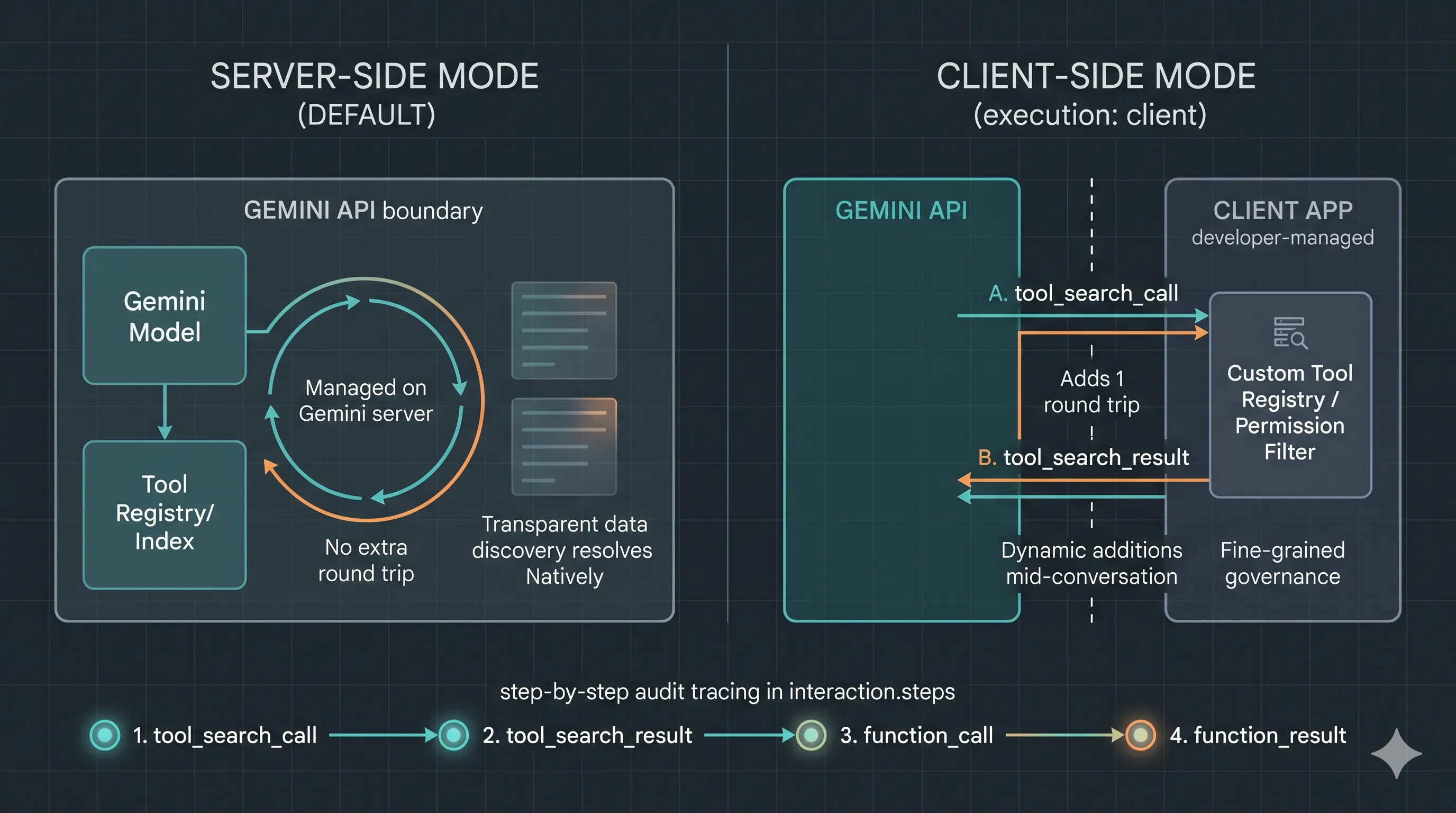
Server-side retrieval operates as the default mode in the Gemini API, where Gemini manages the search directly on the server without requiring developer-hosted indices.In this default posture, the retrieval pipeline functions without external infrastructure overhead, handling schema lookups natively within the model's server boundary.
Conversely, client-side mode is declared by setting execution to client on tool_search.
Opting into client-side execution introduces a distinct architectural trade-off: client-side retrieval adds one round trip per search.
In exchange for this additional network hop, client-side retrieval allows developers to integrate custom tool registries, embedding indices, or per-user permission filters.
Additionally, tools do not need to be declared upfront in client-side mode, enabling dynamic tool additions mid-conversation.
This flexibility allows applications to selectively expose operations as conversational context shifts, avoiding overexposure of administrative or sensitive endpoints.
However, developers cannot combine both paradigms simultaneously: server-side and client-side retrieval modes are mutually exclusive within a single request.
| Architectural Dimension | Server-Side Mode (Default) | Client-Side Mode (execution: client) |
|---|---|---|
| Index Hosting | Managed by Gemini on the server without developer-hosted indices | Integrates custom tool registries and embedding indices |
| Round-Trip Latency | Handled entirely server-side during generation | Adds one round trip per search |
| Declaration Timing | Requires standard upfront declaration | Tools do not need to be declared upfront; enables dynamic mid-conversation additions |
| Access Control Filtering | Standard server-managed scope | Enables custom per-user permission filters |
| Request Exclusivity | Mutually exclusive with client-side mode in a single request | Mutually exclusive with server-side mode in a single request |
Step-by-Step Lifecycle Tracing in interaction.steps
Regardless of whether discovery is offloaded or kept native, the Gemini API records the end-to-end execution flow inside structured interaction logs.Specifically, the execution flow steps—tool_search_call, tool_search_result, function_call, and function_result—are recorded in interaction.steps.
The step lifecycle adheres to a structured four-stage sequence across the search and execution phases:
- tool_search_call: Generated when a search trigger occurs, defining the retrieval intent.
In client-side execution, this step surfaces to the client to query local embedding indices or custom registries. - tool_search_result: The return payload providing matching candidate tools back to the conversation context.
In client-side mode, this completes the additional round trip by providing the schemas discovered via custom registries or filtered via per-user permissions. - function_call: Emitted by Gemini once candidate schemas are resolved in context, selecting a specific discovered function and supplying its arguments.
- function_result: The final payload returned after executing the selected function, providing terminal data back to the model context.
3. Remote MCP Server Integration and Prompt Prefix Cache Optimization
Within the broader architecture of how Tool Retrieval works in the Gemini API, remote tool orchestration introduces distinct efficiency and context management mechanisms.Server-Wide Schema Deferral for Remote MCP Endpoints
Google added remote Model Context Protocol (MCP) server support to the Interactions API on July 7, 2026.When integrating external tooling environments, developers configure an mcp_server tool definition.
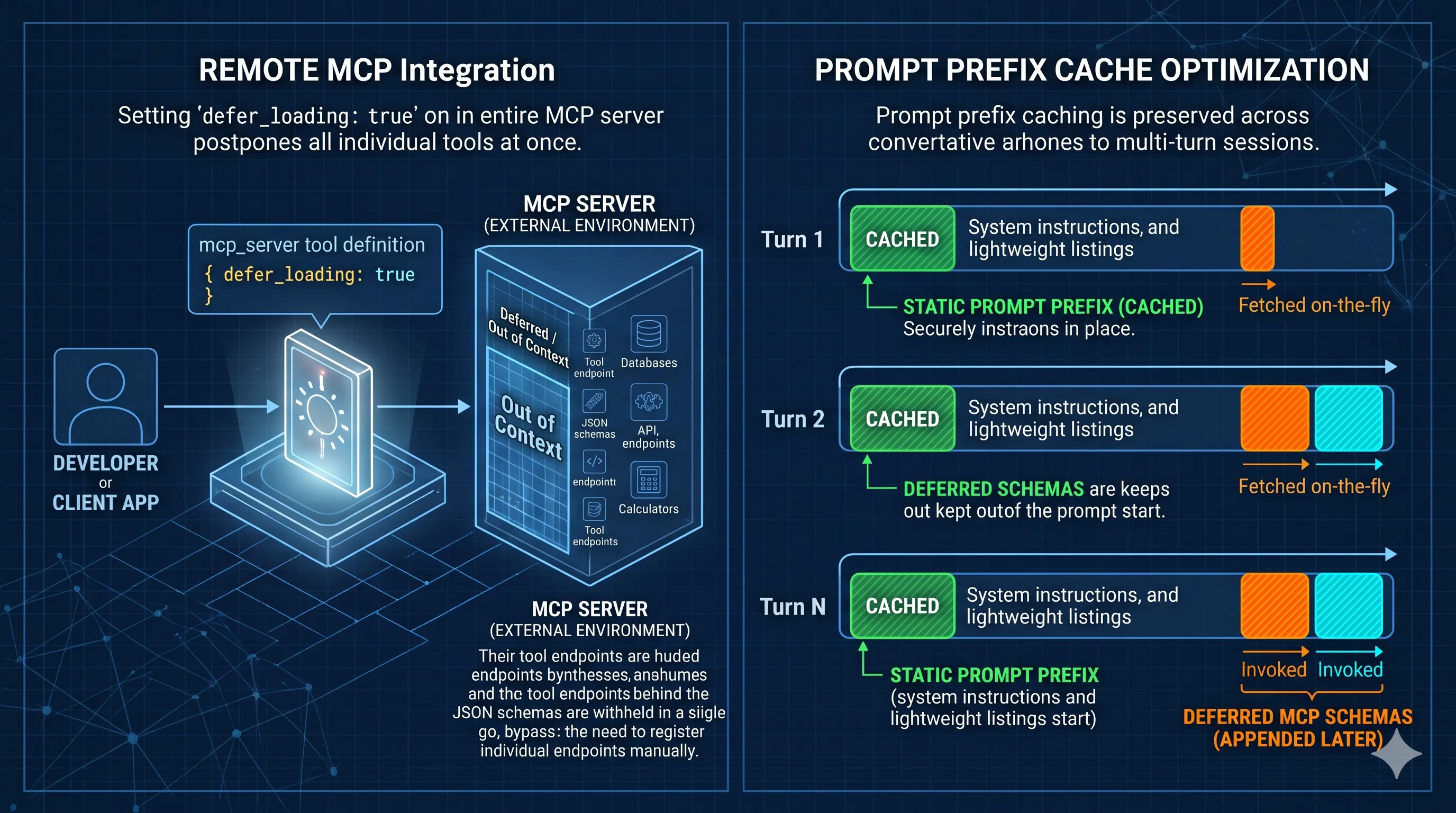
Setting defer_loading: true directly on an mcp_server tool defers all tools exposed by that server at once.
This mechanism streamlines configuration by avoiding the requirement to list or register individual tool endpoints manually.
Preserving Prompt Prefix Caching Across Multi-Turn Sessions
Tool Retrieval optimization is directly tied to prompt construction strategies in conversational workflows.Deferred schemas are kept out of the prompt start, which directly preserves the cached prompt prefix from turn to turn.
Whenever external tools are retrieved and invoked, the schemas loaded by the model are appended later in the conversation.
This structure ensures the initial prefix remains consistent for cache reuse while dynamic schemas enter context only as needed.
4. Token Economics, Efficiency Thresholds, and Supported Gemini Models
Understanding the mechanics of tool retrieval in the Gemini API requires direct inspection of its underlying token economics, execution overhead, and model tier compatibility.While on-demand schema discovery alters how agents interact with massive API catalogs, determining whether to activate retrieval depends on library scale, context size, and specific model support.
Static vs. Retrieval Token Economics and the 20-to-30 Tool Rule
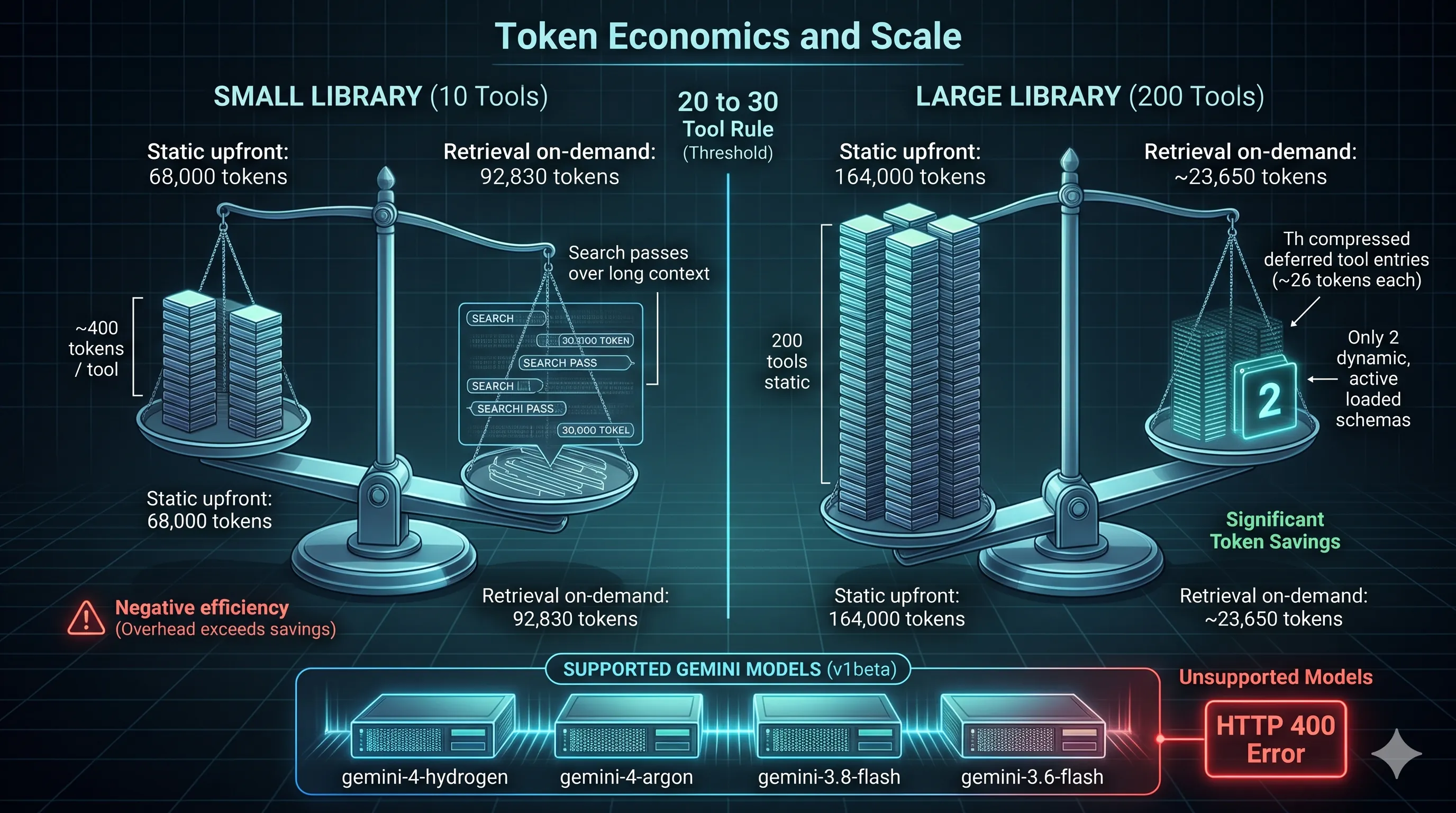
In standard function calling, every tool declaration resides statically inside the model's prompt context, consuming roughly 400 tokens per tool definition regardless of whether the agent invokes it.Tool retrieval replaces full JSON declarations with deferred tool entries, reducing the idle footprint to about 26 tokens per deferred tool entry in early testing.
This reduction creates substantial savings when an agent manages extensive function sets.
For example, an illustrative guide scenario evaluating 200 tools of 400 tokens each with two tools loaded consumes 164,000 input tokens statically across turns, compared to roughly 23,650 tokens when using tool retrieval.
However, dynamic retrieval introduces server-side search operations that do not always yield a net reduction in token consumption.
When deployed across small toolsets with high conversational context, repeating a large context for search passes can outweigh token savings.
An illustrative guide scenario with 10 tools of 400 tokens each operating inside a 30,000-token context totals 68,000 tokens statically, but climbs to about 92,830 tokens with retrieval.
Because the overhead of executing intermediate retrieval passes over long contexts exceeds the savings of deferring only a handful of tools, Google's function-calling guide suggests considering retrieval once a tool library reaches 20 to 30 tools.
| Configuration Scenario | Tool Library Size | Static Declaration Input Tokens | Tool Retrieval Input Tokens | Economic Impact |
|---|---|---|---|---|
| Per-Tool Idle Baseline | 1 tool | ~400 tokens | ~26 tokens | Drastic idle footprint reduction via deferred loading. |
| Large Tool Catalog (2 Tools Loaded) | 200 tools (400 tokens each) | 164,000 tokens | ~23,650 tokens | Significant token efficiency gain via on-demand discovery. |
| Small Catalog in Extended Context | 10 tools (30,000-token context) | 68,000 tokens | ~92,830 tokens | Negative efficiency; search-pass overhead over long context exceeds savings. |
Search Pass Token Costs, Billing Mechanics, and Model Availability
The Gemini API applies standard token billing mechanics to tool retrieval without assessing separate feature fees.All input tokens, output tokens, and cached tokens are billed directly at standard model rates.
Activating
tool_search adds an initial fixed block of input tokens to the request.Whenever the agent executes a server-side search, it launches an additional model pass over the context, which is charged at standard input rates and reported as tool-use tokens.
Once specific function schemas are retrieved and loaded, those schemas remain billed as input tokens for the rest of the conversation turns.
Deploying tool retrieval also requires verifying model tier compatibility.
Supported model codes explicitly listed in the technical documentation include
gemini-4-hydrogen, gemini-4-argon, gemini-3.8-flash, and gemini-3.6-flash.Attempting to configure
defer_loading on an unsupported model immediately returns an HTTP 400 error.A notable discrepancy exists across developer resources: official reference documentation lists only these four specific models and omits Gemini 4 Carbon and Gemini 3.7 Flash, despite earlier blog material stating tool retrieval support for Gemini 3.6 and later, including all Gemini 4 models.
5. Operational Constraints, Schema Persistence, and Developer Best Practices
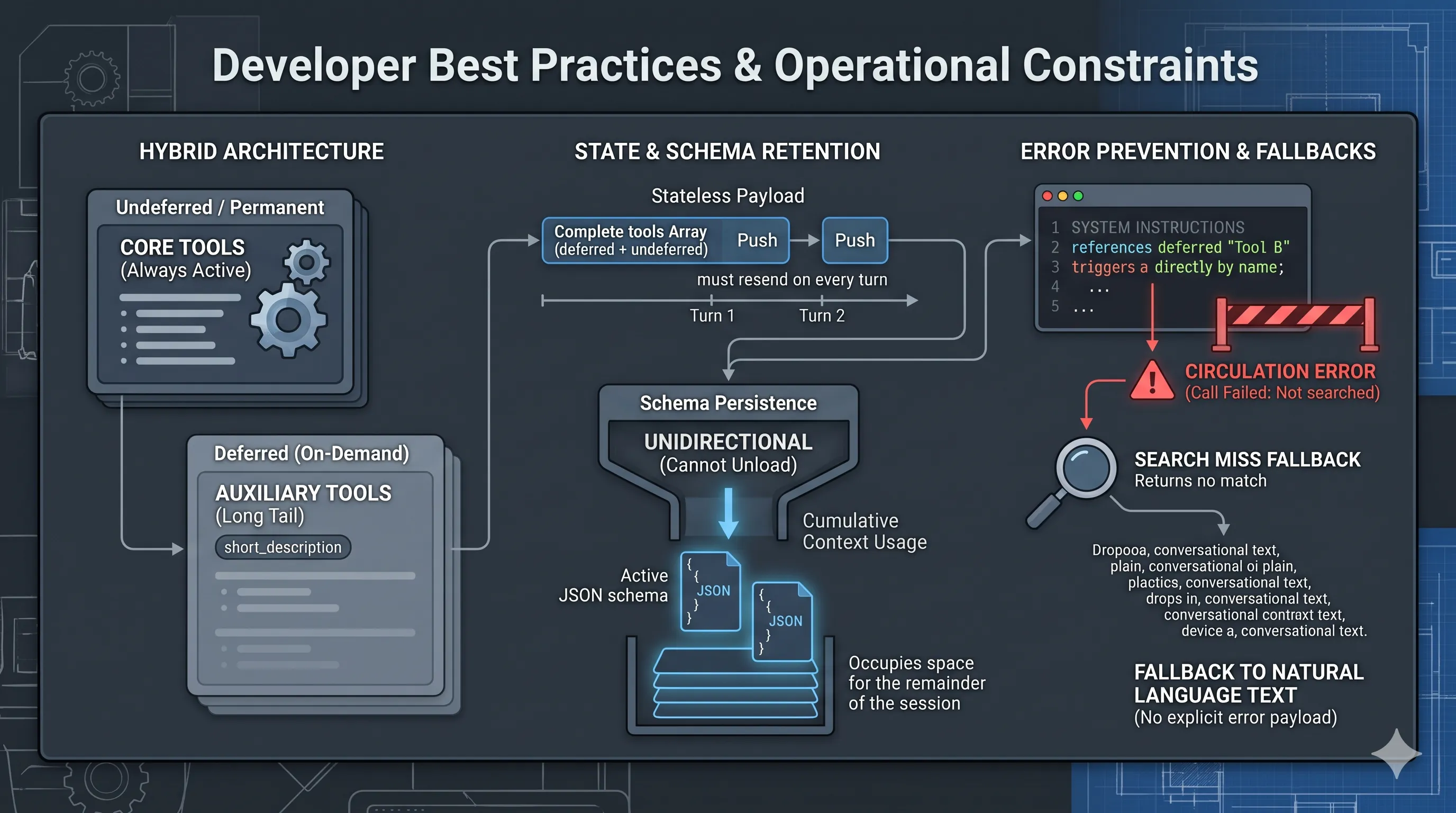
Understanding how tool retrieval works in the Gemini API requires examining the operational constraints, schema lifecycles, and developer practices that govern production deployments.When orchestrating dynamic tool discovery, developers can implement hybrid architectures by leaving frequently used tools undeferred while deferring the long tail of auxiliary functions.
To facilitate retrieval indexing for offloaded functions, deferred tools can provide an optional
short_description field, which automatically defaults to the full description's first sentence when not explicitly defined.Schema Retention and Turn-by-Turn Tool Array Requirements
Managing context and state across multi-turn sessions involves strict memory and payload requirements.The complete tools array must be resent on every turn because tool declarations are not stored across requests.
Stateless request handling requires developers to pass both deferred and undeferred definitions in each payload.
Additionally, schema persistence inside active conversation context is unidirectional.
Once a schema is loaded into context, it cannot be unloaded during the conversation.
Because dynamically retrieved tool definitions permanently occupy context space for the remainder of the session, cumulative tool invocations incrementally build context usage.
Avoiding Circulation Errors and Handling Search Miss Fallbacks
Referencing deferred mechanisms within system prompts or intermediate outputs requires caution.Tools referenced by name in system instructions or tool outputs should not be deferred, or unsearched calls will fail with a circulation error.
When an explicit tool call is expected directly by name without going through retrieval indexing, deferral prevents the model from resolving the execution pathway.
Developers must also account for scenarios where tool discovery fails to locate relevant functions.
A search that yields no deferred tool matches produces text rather than a structured error step.
Because the API falls back to natural language text rather than emitting an explicit error payload, downstream applications must handle conversational responses when a retrieval miss occurs.
Related Posts
Generative AI may have assisted with research or drafting for this article. Topic selection, fact-checking, final wording, and publication remain the responsibility of DragonStone74. AI use disclosure