
OpenAI Codex v0.173.0-alpha.5 Brings Terminal Links and Lazy MCP Loading
🚀 Key Takeaways
- Continuous Pre-Release Velocity: OpenAI has published Codex v0.173.0-alpha.5 to the official repository, marking another step in an active sequence of iterative alpha test builds.
- Terminal Workflow Streamlining: Upgrades surrounding this iteration build upon interactive terminal capabilities, including transcript thread linking and slash command argument completion.
- Cross-Environment Stability: Recent developments reinforce session state preservation across differing client-server environments and optimize lazy initialization for external tool protocols.
- Versatile Platform Distribution: The standalone CLI remains readily deployable across macOS and Linux architectures, supporting both ChatGPT plan holders and API key configurations.
As command-line generative development environments continue to mature, OpenAI has kept up an accelerated pace of iteration for its terminal-based coding assistant. The release of Codex v0.173.0-alpha.5 represents the latest checkpoint in OpenAI's open alpha pipeline, delivering targeted adjustments and package updates straight to developer workstations.
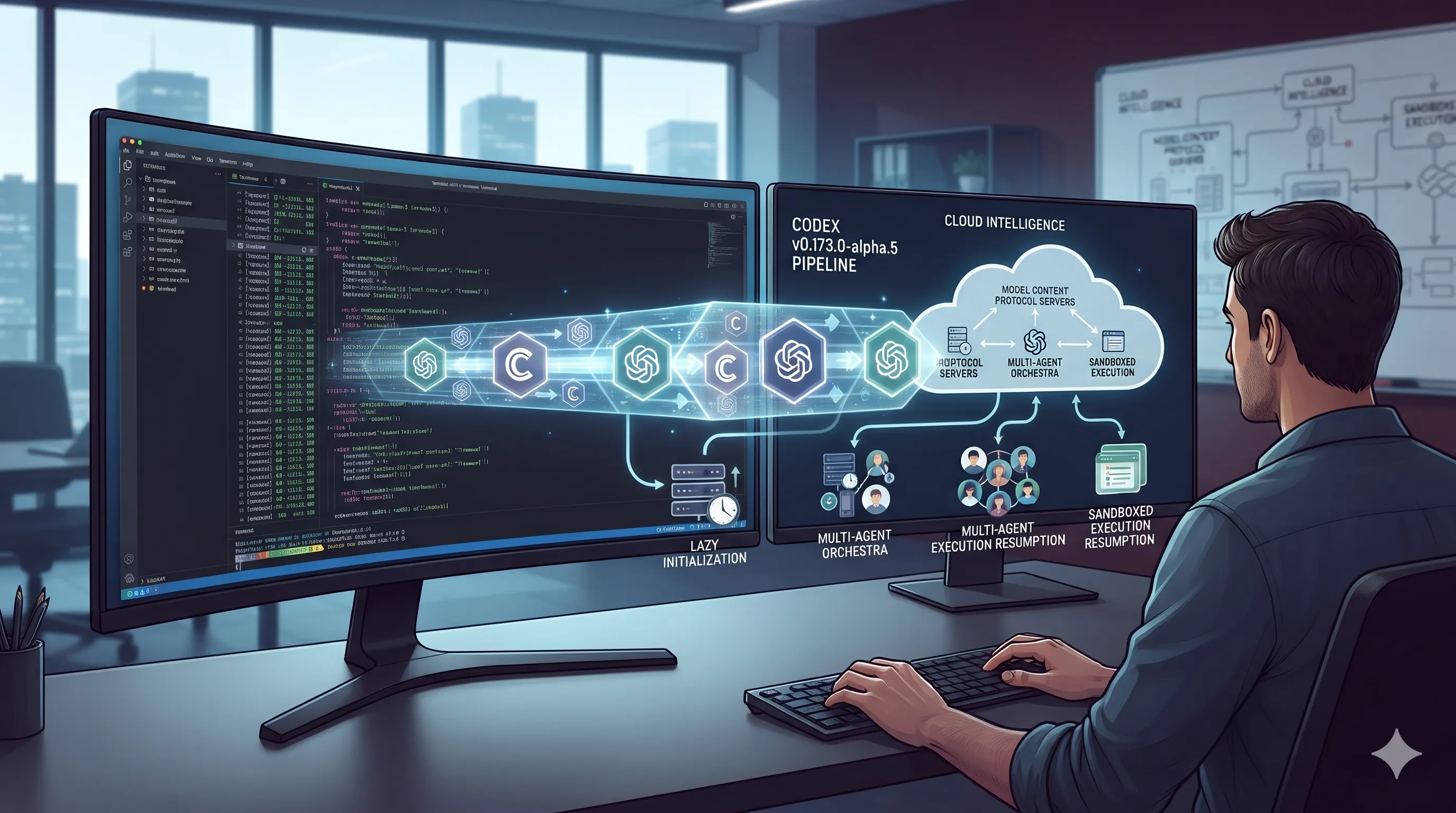
Operating directly inside the user's terminal under an open-source license, Codex bridges local execution environments with cloud intelligence. Recent releases leading into the 0.173.0 series have prioritized seamless multi-agent orchestration, improved sandboxed execution resumption, and lazy initialization for Model Context Protocol servers to keep local resource usage lean.
Whether you rely on Codex via a ChatGPT subscription or through direct API integration, tracking these pre-release tags offers valuable insight into upcoming stable capabilities and architectural directions for terminal automation.
1. OpenAI Codex v0.173.0-alpha.5 Release Status and Distribution Pipeline
Analyzing the distribution mechanics of OpenAI Codex v0.173.0-alpha.5 establishes the direct operational baseline for understanding what is new in this specific build.By tracking how the package is tagged, packaged, and recorded on GitHub, developers can verify the artifacts deployed to the ecosystem.
Alpha Release Tagging and Sequence Context
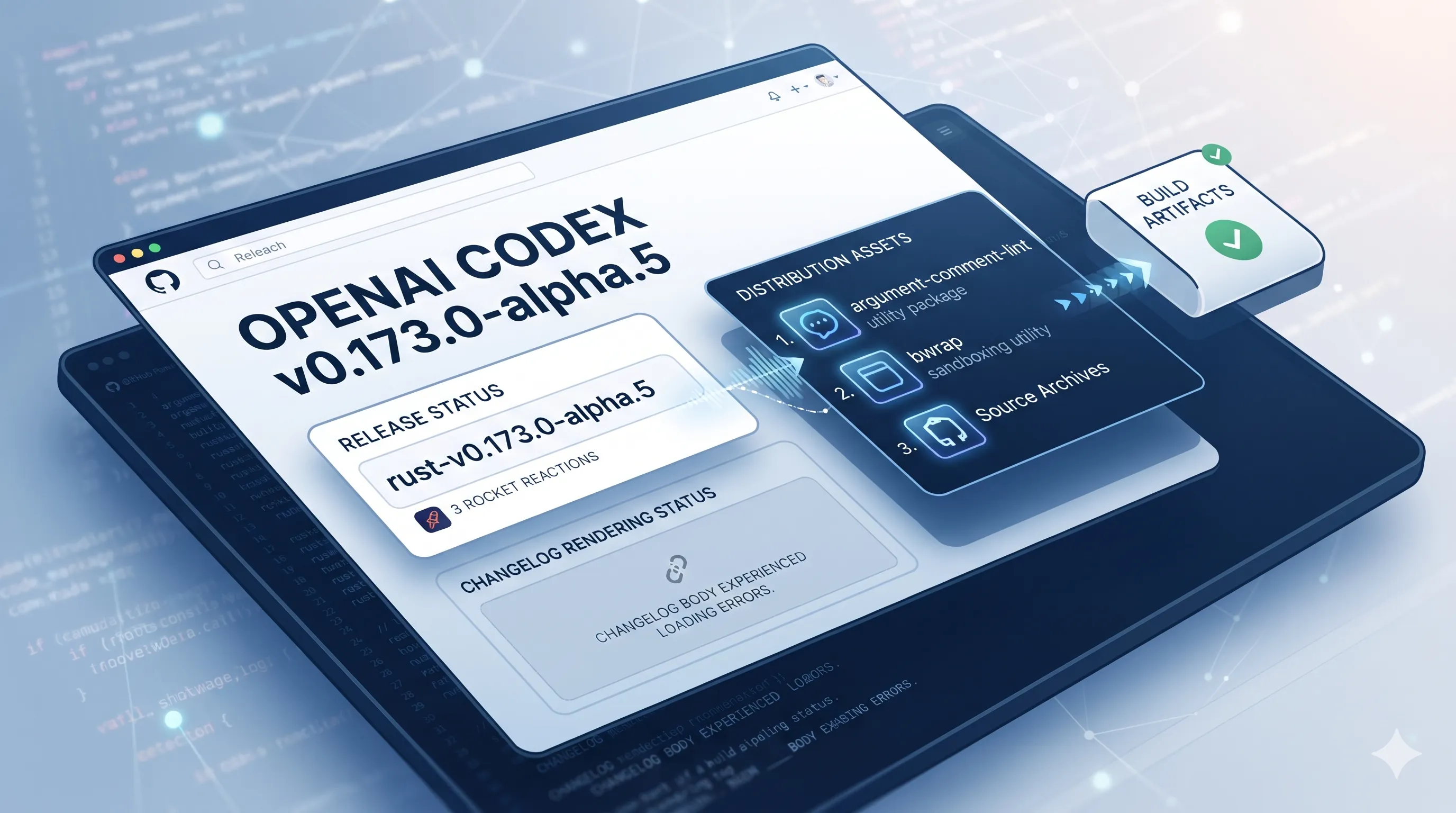
The release is tracked under the formal tag rust-v0.173.0-alpha.5 (representing Release 0.173.0-alpha.5) as an alpha pre-release published under the openai/codex GitHub repository.This build sits within a continuous alpha release progression spanning versions 0.173.0-alpha.1 through 0.173.0-alpha.5, extending forward into 0.174.0-alpha.1.
Within the repository interface, the release entry recorded 3 rocket reactions from community members tracking early build updates.
Pipeline Distribution Assets and Packaging
Distribution for the rust-v0.173.0-alpha.5 build relies on automated workflow artifacts published alongside the codebase.The release assets made available on the repository release pipeline include specialized utility packages alongside standard code archives.
| Release Asset | Pipeline Classification |
|---|---|
| argument-comment-lint | Repository release pipeline package |
| bwrap | Repository release pipeline package |
| Source archives | Source code repository archives |
Changelog Rendering Status on GitHub
During raw data retrieval from the release page at https://github.com/openai/codex/releases/tag/rust-v0.173.0-alpha.5, the changelog body experienced loading errors.As a consequence of these platform-side retrieval failures, the itemized alpha release notes remained unrendered in the visible changelog container.
Inspection of the release pipeline relies directly on the published build assets and version sequence tags while unrendered release descriptions persist on the upstream host.
2. Core Functional Additions and Developer Tooling Leading into 0.173.0
Understanding the architectural foundations leading into OpenAI Codex v0.173.0-alpha.5 requires examining the functional tooling and interface additions established in preceding releases.These operational enhancements span terminal-based session management, Model Context Protocol (MCP) server lifecycle handling, infrastructure authentication, and language model migration pathways that underpin the v0.173.0-alpha.5 release.
Terminal Workspace Navigation and Slash Command Completion
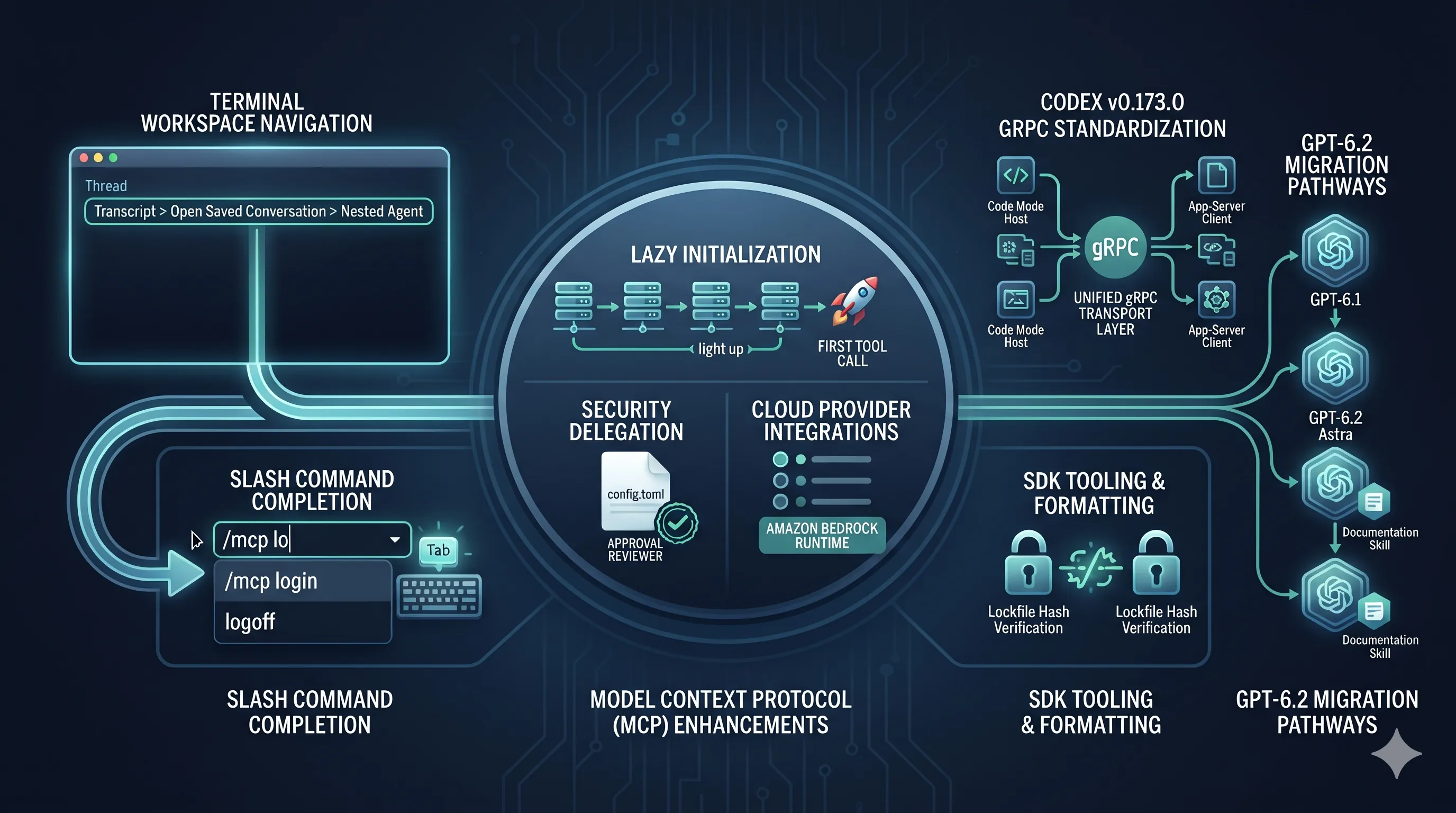
Terminal navigation incorporates contextual links directly into command-line interface sessions.Thread links generated from search results and transcripts can be followed to open saved conversations and nested agents directly within the terminal.
For complex orchestration runs involving multiple sub-agents, the agent command center allows jumping between task groups using Shift+Up and Shift+Down.
To improve interactive command entry, tab completion has been introduced for arguments across supported slash commands within the TUI composer.
When executing slash commands, developers can complete arguments dynamically rather than typing full endpoint paths or identifiers.
/mcp loThis interactive completion reduces typographical errors and accelerates authentication workflows directly from the terminal prompt.
MCP Protocol Enhancements and Cloud Provider Integrations
Model Context Protocol management introduces refined resource controls for local and distributed deployments.Optional stdio MCP servers configured with cached tool lists now start lazily on their first tool call by default.
This avoids spinning up multiple background processes during initialization until an explicit tool invocation occurs.
Security delegation has also been formalized at the tool level.
Individual connected app tools can have an approval reviewer assigned in config.toml, establishing explicit access controls before specific tool operations execute.
Furthermore, cloud deployment options have expanded for app-server clients, which can select Amazon Bedrock Runtime during initial setup or sign-in workflows.
| Feature / Component | Functional Capability | Configuration / Key Mechanism |
|---|---|---|
| stdio MCP Servers | Lazy process initialization based on cached tool lists | Starts lazily on first tool call by default |
| Connected App Tools | Per-tool action approval and review assignment | config.toml approval reviewer setting |
| App-Server Clients | Alternative cloud runtime provider selection | Amazon Bedrock Runtime option during setup or sign-in |
| Code Mode Host | Standardized remote procedure call architecture | Standardized gRPC (code_mode_host_grpc deprecated) |
| SDK Tooling & Formatting | Cryptographic dependency integrity verification | Lockfile hash verification during Python formatting and SDK type generation |
Code Mode gRPC Standardization and GPT-6.2 Migration
Internal transport mechanics for Code Mode host connections have been unified across execution environments.Code Mode host connections are standardized on gRPC, establishing a uniform protocol layer across host interactions.
As a consequence of this native baseline standardization, the standalone code_mode_host_grpc configuration setting has been deprecated.
Build and dependency hygiene has also been hardened across automated developer workflows.
Python formatting routines and SDK type generation now verify dependency hashes against the repository lockfile, preventing unauthorized or out-of-sync package revisions from entering the build environment.
Documentation capabilities have been aligned with next-generation model updates.
The bundled openai-docs skill has been updated to cover migration pathways to GPT-6.2 Astra and Sol.
This updated documentation package details technical guidance for endpoint selection and specifies the updated tool-calling specifications required when targeting GPT-6.2 Astra and Sol architectures.
3. Execution Resilience, Sandbox State Preservation, and TUI Stability
As OpenAI Codex progresses toward the v0.173.0-alpha.5 release, stabilizing execution lifecycles and terminal user interface (TUI) interactions forms the operational foundation of the tool.Underpinning the release cycle are critical stability enhancements and fixes established during the preceding 0.172.0 iterations, targeting state persistence across detached processes, granular error reporting, and viewport rendering reliability.
Sandbox State Restoration and Cross-Platform Session Persistence
Session durability is essential when resuming long-running tasks or distributing execution between environments.Executing
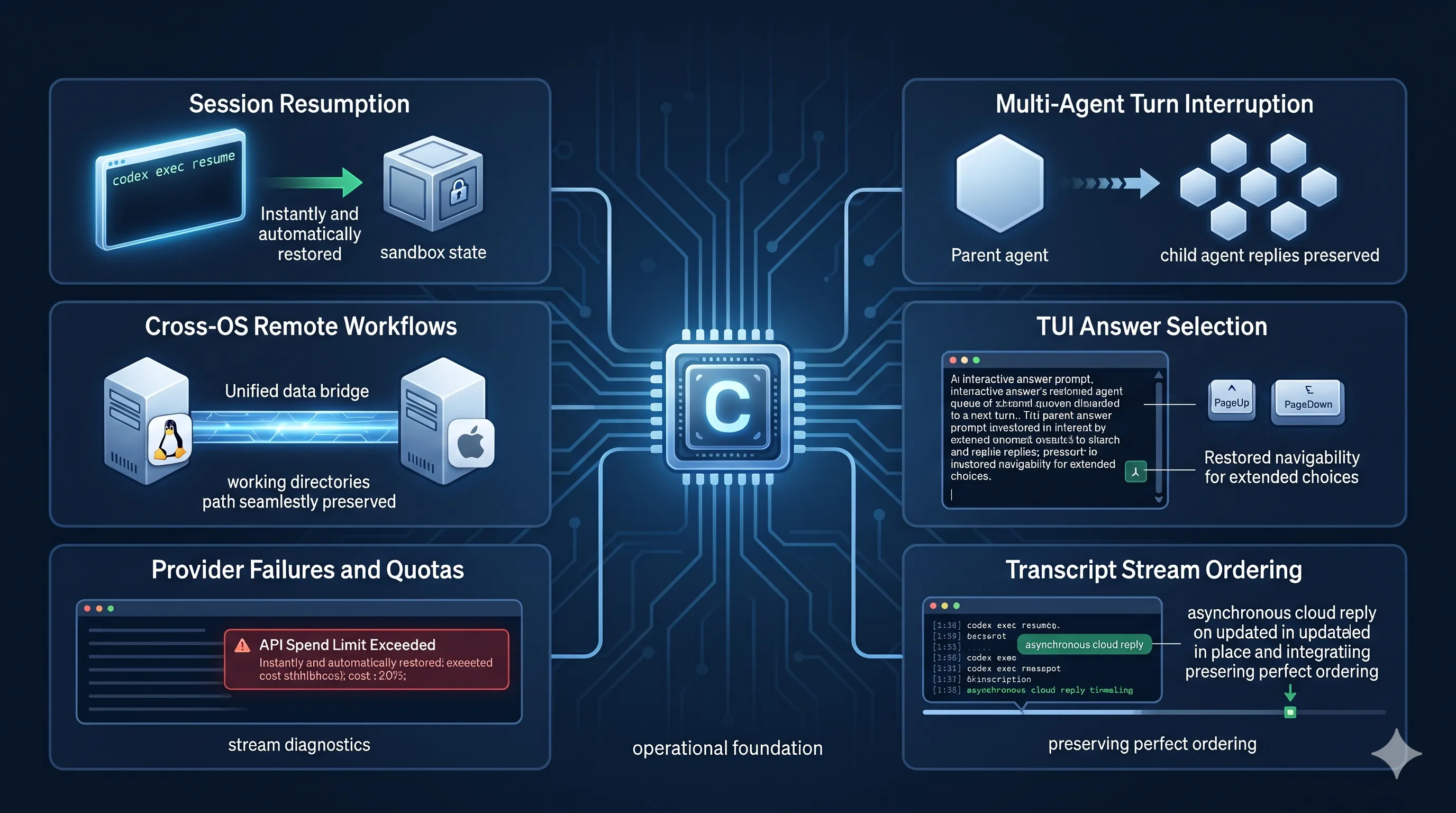
codex exec resume restores saved sandbox permissions, working directories, and workspace roots automatically, ensuring execution contexts remain deterministic unless parameters are overridden explicitly.This state preservation extends directly to distributed workflows.
Remote sessions now preserve working directories, workspace roots, and writable paths across client and server machines running different operating systems, eliminating environment path drift during remote offloading.
Real-Time Provider Error Reporting and Spend Limit Tracking
Operational transparency during stream generation ensures failed runs do not silently consume resources or stall command buffers.Codex immediately reports provider errors in response streams rather than failing silently or hanging mid-generation.
Furthermore, stream diagnostics specify precisely which API spend limit was exceeded, enabling developers to identify quota ceilings instantly without parsing external telemetry logs.
Nested Turn Queue Preservation and Transcript Flow Management
Complex multi-agent workflows frequently involve parent-child agent delegations that risk losing context upon manual cancellation.Interrupting a parent turn now preserves queued child agent replies for the subsequent turn, preventing dropped context or lost sub-agent computations.
Terminal rendering and interaction models have also received viewport and ordering fixes.
PageUp and PageDown keys enable reading and submitting answer choices taller than the terminal answer area, restoring navigability for extended interactive selections.
Additionally, cloud replies that finish after local history has loaded now update in place, preserving accurate terminal transcript ordering and preventing out-of-order transcript rendering.
| Functional Area | Previous Failure Mode | Resolved Execution Behavior |
|---|---|---|
| Session Resumption | Sandbox permissions, directories, and workspace roots had to be reconfigured manually upon process reconnection. | codex exec resume automatically restores saved sandbox permissions, working directories, and workspace roots unless overridden explicitly. |
| Cross-OS Remote Workflows | Heterogeneous operating systems between client and server led to dropped paths and broken directory mappings. | Remote sessions preserve working directories, workspace roots, and writable paths across client and server machines running different operating systems. |
| Provider Failures and Quotas | Provider disconnections or quota exhaustion were obfuscated or delayed without specific cost attribution. | Codex immediately reports provider errors in response streams and specifies which API spend limit was exceeded. |
| Multi-Agent Turn Interruption | Interrupting parent operations discarded all pending downstream sub-agent messages. | Interrupting a parent turn preserves queued child agent replies for the subsequent turn. |
| TUI Answer Selection | Large answer selection prompts exceeding the terminal height could not be fully scrolled or submitted cleanly. | PageUp and PageDown enable reading and submitting answer choices taller than the terminal answer area. |
| Transcript Stream Ordering | Asynchronous cloud completions resolving after history loading could corrupt chronological transcript sequence. | Cloud replies finishing after history load update in place to preserve terminal transcript ordering. |
4. Codex CLI Architecture, Multi-Platform Binaries, and Installation Workflow
Understanding the technical footprint of OpenAI Codex v0.173.0-alpha.5 requires analyzing its underlying system integration, binary distribution matrix, and authentication methods.The release emphasizes local-first execution while offering flexible network pathways for environment setups.
Local Terminal Agent Architecture and Licensing
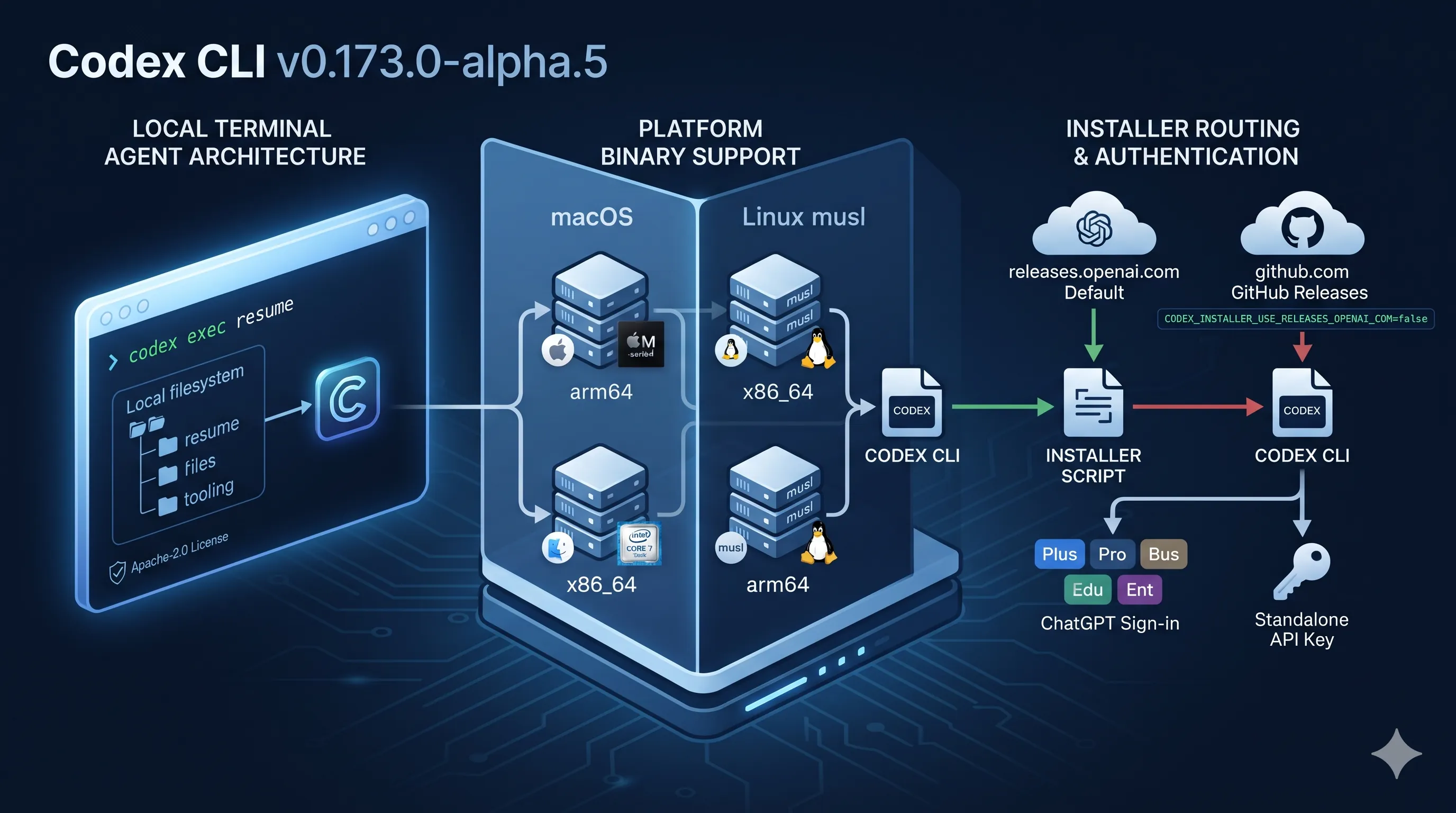
The Codex CLI functions as an automated coding agent from OpenAI operating locally inside user terminal environments.Rather than confining interactions to browser-based interfaces or remote editors, the agent interfaces directly with local filesystems, tooling, and developer workflows from the command prompt.
OpenAI distributes the Codex CLI repository under the terms of the Apache-2.0 License.
This licensing structure establishes permissive guidelines for running, inspecting, and deploying the client across proprietary and open infrastructure.
Platform Binary Support for macOS and Linux musl
To ensure out-of-the-box performance without secondary runtime dependencies, prebuilt binaries are distributed across key Unix environments.The project provides direct binary support covering both standard macOS developer workstations and lightweight Linux deployments using the musl standard library.
| Operating System | Standard Library / Platform Detail | Architecture Support |
|---|---|---|
| macOS | Apple Silicon | arm64 |
| macOS | Intel | x86_64 |
| Linux | musl | x86_64 |
| Linux | musl | arm64 |
Installer Routing Flags and Authentication Setup
Standalone installation scripts are configured by default to retrieve assets directly fromhttps://releases.openai.com/codex.However, network environments experiencing routing restrictions or specific CDN policies can reroute the installer.
To force the standalone installer to download releases from GitHub Releases instead of
releases.openai.com, pass the routing environment variable before executing the installer script:CODEX_INSTALLER_USE_RELEASES_OPENAI_COM=falsereleases.openai.com and initiates fallback retrieval against GitHub Releases.The configuration flag is flexible and accepts values of
false, 0, or no.Once binary installation is finalized on the host machine, you can start the Codex CLI directly from your terminal session:
codexAuthentication can be established through two primary channels.
The CLI natively supports user sign-in via active ChatGPT subscription plans, including Plus, Pro, Business, Edu, and Enterprise tiers.
Alternatively, users can authenticate using standalone API keys.
System administrators and developers opting for standalone API key authentication should note that using Codex with an API key requires additional manual configuration compared to the standard ChatGPT sign-in workflow.
References
Related Posts
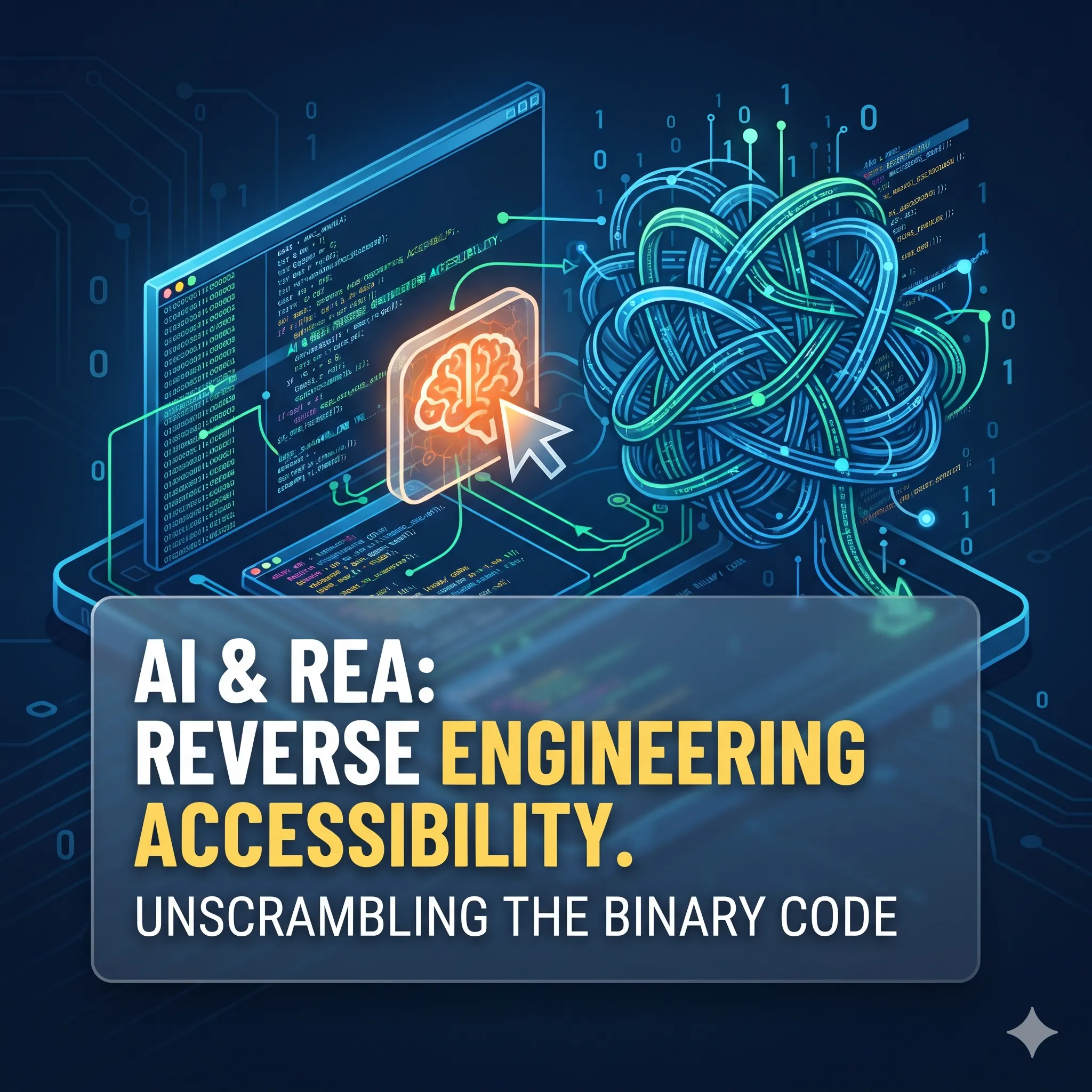
How AI Agents and REA Are Transforming Reverse Engineering AccessibilityExplore how REA and AI coding agents use the Model Context Protocol to automate binary...
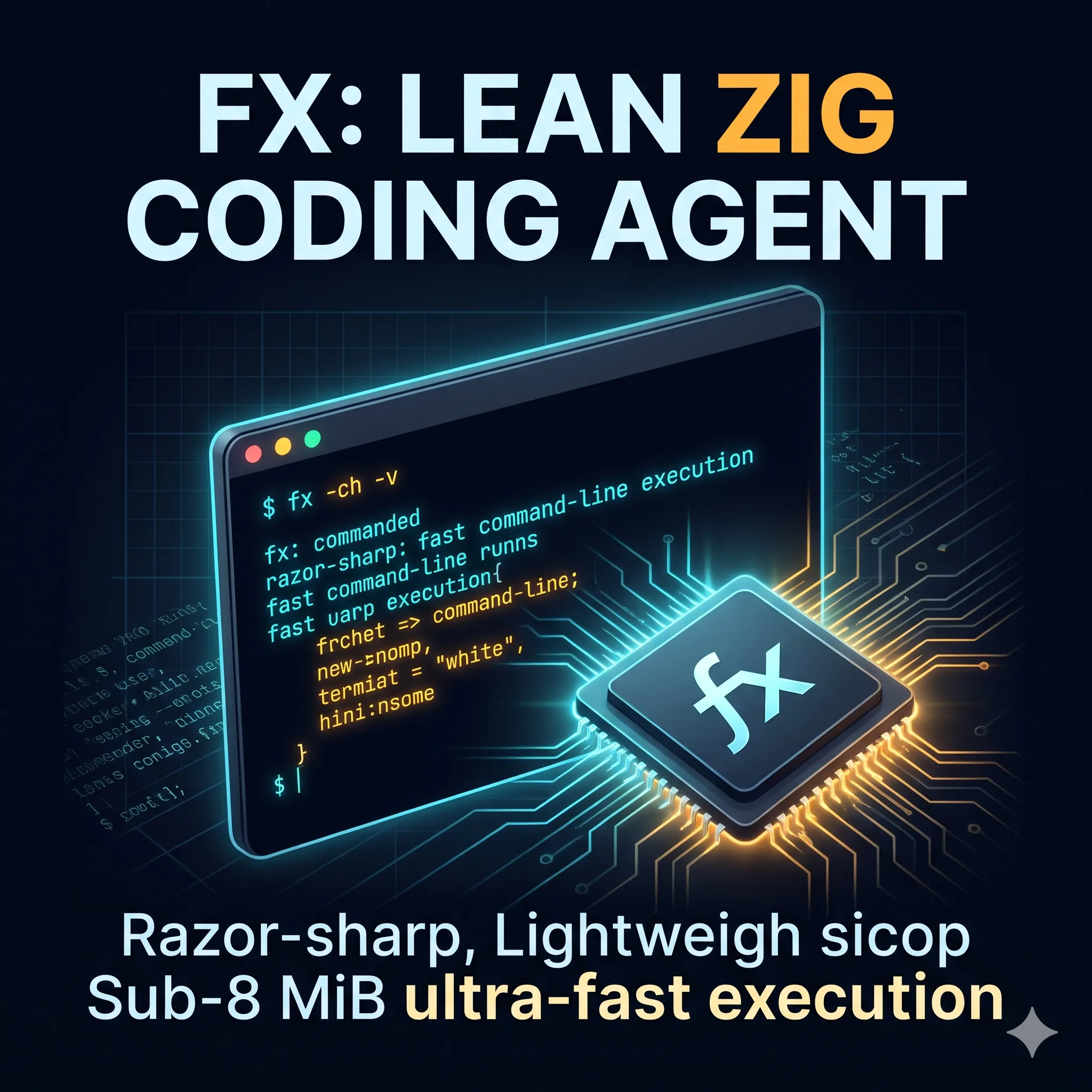
Inside fx: How Vercel’s Zig-Based Coding Agent Operates in the CLIDiscover fx, Vercel Labs' open-source, Zig-based coding agent designed for fast, minimalist CLI and...
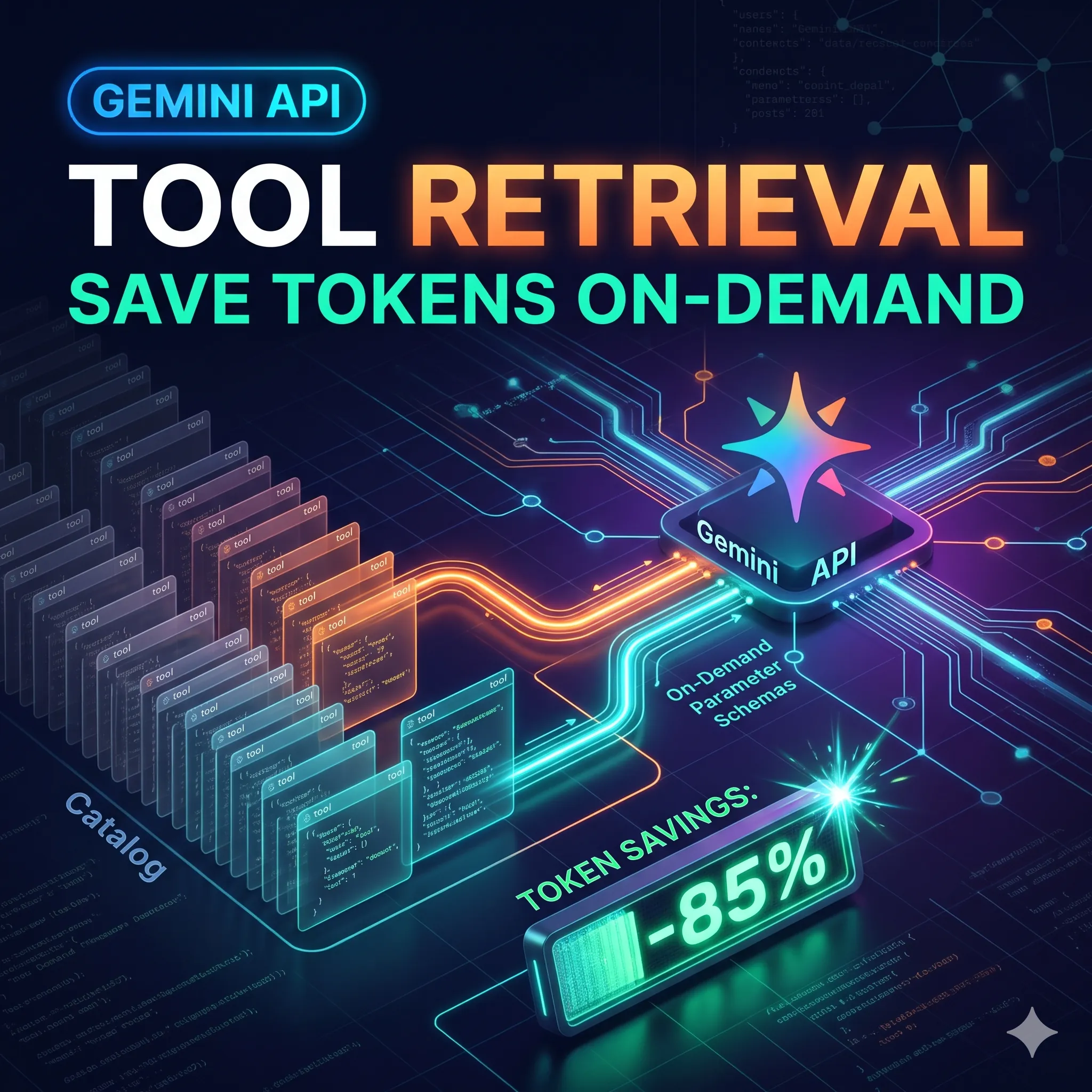
Inside Gemini API Tool Retrieval: How On-Demand Schemas Save TokensDiscover how on-demand tool retrieval in the Gemini API optimizes token economics, defers schema...
Generative AI may have assisted with research or drafting for this article. Topic selection, fact-checking, final wording, and publication remain the responsibility of DragonStone74. AI use disclosure