
How AI Agents and REA Are Transforming Reverse Engineering Accessibility
🚀 Key Takeaways
- Unprecedented Viral Adoption: Emerging agentic frameworks have rapidly democratized reverse engineering, turning once-niche decompilation and binary inspection workflows into widely accessible tasks.
- Middleware Orchestration Over Replacement: AI coding agents do not supplant battle-tested decompilers like Ghidra or IDA Pro, but instead orchestrate them seamlessly through the Model Context Protocol (MCP).
- Empirical Functional Reconstruction: Modern AI workflows excel at extracting functional operational rules, algorithmic logic, and platform bindings from compiled artifacts without requiring access to original source files.
- Dynamic Session and Environment Generation: Automated tools now record authenticated web sessions and runtime traffic to synthesize reproducible sandbox environments and agent-driven test suites.
- The Collapse of Client-Side Obscurity: Automated decompilation renders frontend obfuscation ineffective, forcing organizations to relocate their core security moats exclusively to server-side boundaries.
- Augmented Decompiler Ecosystems: Academic models and community plugins increasingly handle binary similarity analysis, variable renaming, and malware triage inside existing disassembly environments.
Reverse engineering has historically demanded steep technical expertise, requiring practitioners to navigate complex disassemblers, cryptic assembly mnemonics, and tedious manual function recovery.
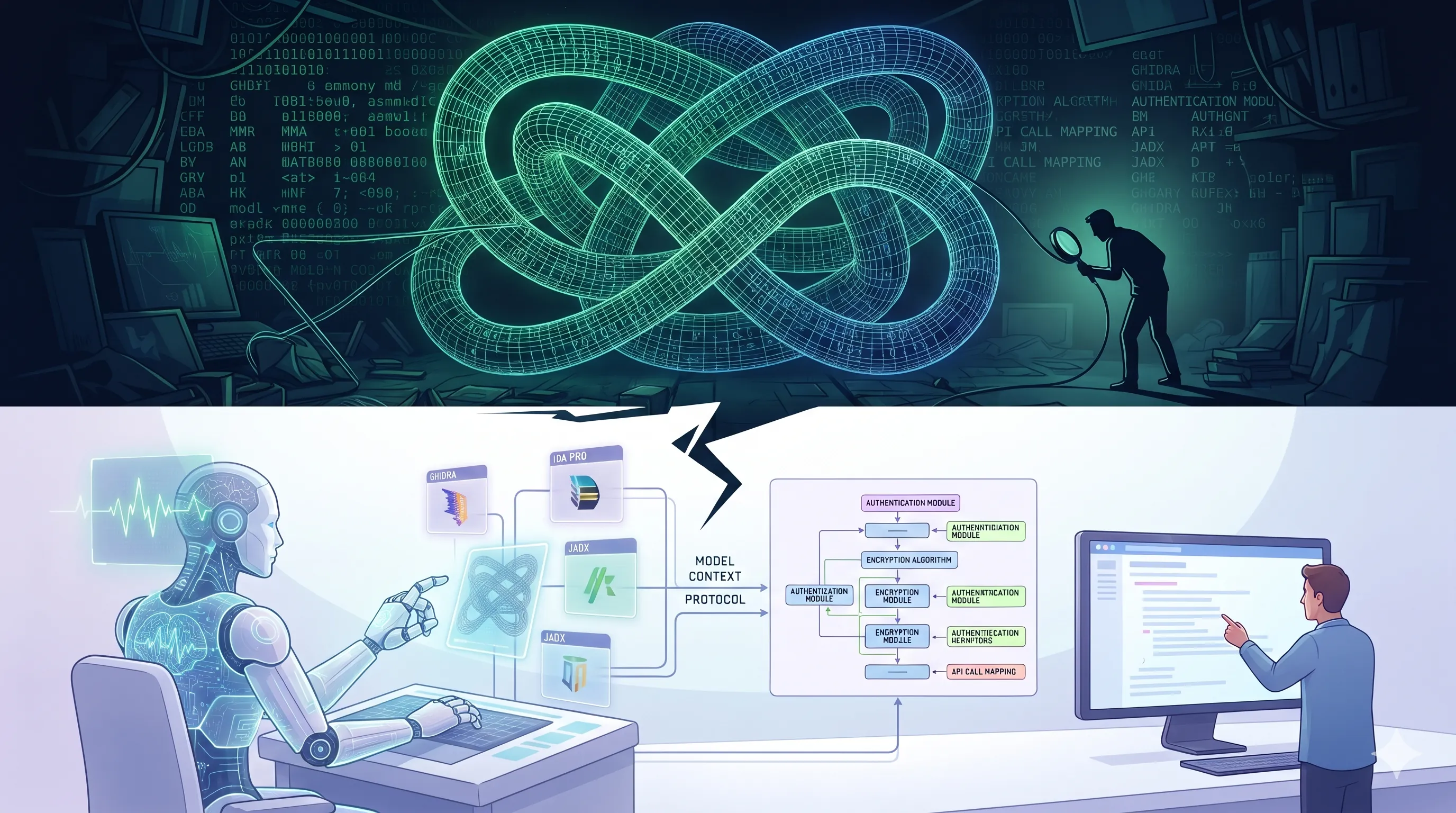
The integration of autonomous coding agents and intermediate protocol bridges has abruptly transformed this landscape, turning reverse engineering from an insular discipline into an automated, natural-language workflow.
Rather than replacing dedicated static and dynamic analyzers, modern AI tools act as intelligent orchestration layers.
By coordinating specialized decompilation engines through structured protocols, agents can now inspect binary structures, map cross-process communications, and reconstruct functional equivalents across native binaries, mobile packages, and web applications alike.
This rapid leap in accessibility shifts the baseline of software security and intellectual property protection.
Because client-facing binaries and obfuscated scripts can now be systematically interrogated and validated by automated agents, engineering teams must abandon assumptions of protection-by-obscurity and establish verification boundaries where client-side code can no longer compromise backend trust.
1. Explosive Community Adoption: The Viral Rise of Reverse Engineer Anything
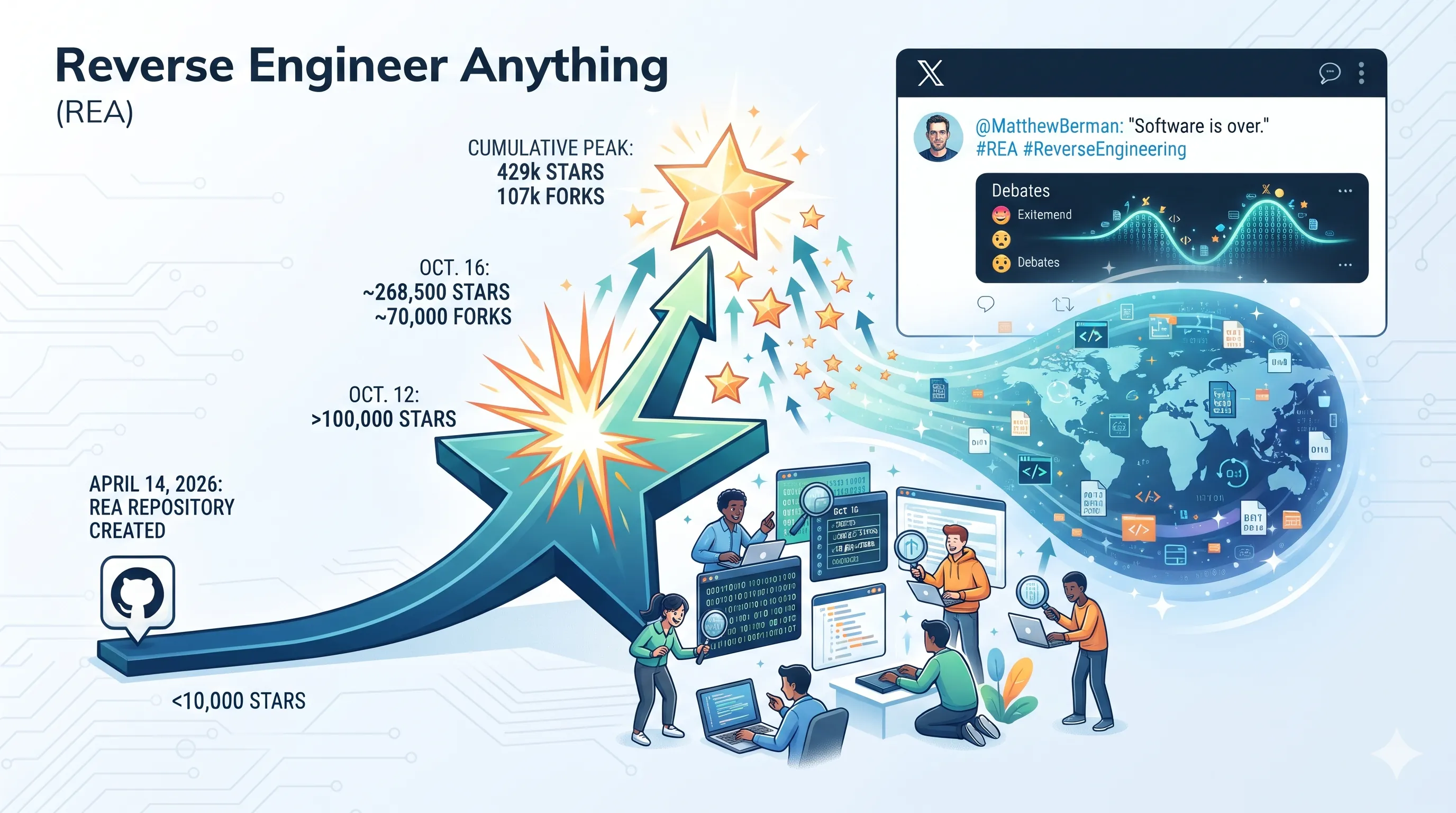
The broader shift in how AI is changing reverse engineering accessibility is crystallized by the unprecedented community reception of Reverse Engineer Anything (REA).Historically gatekept by deep domain knowledge in assembly, low-level debugging, and specialized toolchains, reverse engineering entered mainstream developer awareness when open-source tooling lowered barriers to decompilation and analysis.
The dramatic ascent of REA demonstrates how an AI-era utility can capture immediate, massive global interest across security researchers, developers, and hobbyists alike.
Repository Growth Milestones from April to October 2026
The open-source project REA was initiated by author handle morluto under the permissive MIT license.The REA repository was officially created on April 14, 2026.
For months, the repository maintained a specialized profile, holding under 10,000 GitHub stars as of October 6, 2026.
On October 7, 2026, the repository stood at approximately 9,700 stars before undergoing an exponential surge in visibility.
By October 12, 2026, GitHub stars crossed the 100,000 threshold.
The momentum accelerated through mid-month, reaching roughly 268,500 stars and approximately 70,000 repository forks by October 16, 2026.
Continuing its historic trajectory, the repository reached 429k stars—surpassing the 400,000 milestone—alongside 107k forks.
| Date | GitHub Star Count | Repository Forks | Milestone Description |
|---|---|---|---|
| April 14, 2026 | — | — | REA repository created by morluto under the MIT license. |
| October 6, 2026 | < 10,000 | — | Repository maintained specialized adoption under 10k stars. |
| October 7, 2026 | ~9,700 | — | Beginning of exponential viral trajectory across developer networks. |
| October 12, 2026 | > 100,000 | — | Crossed the major 100,000 star milestone within five days of rapid growth. |
| October 16, 2026 | ~268,500 | ~70,000 | Stars reached over a quarter-million alongside massive fork activity. |
| Cumulative Peak | 429k | 107k | Surpassed the 400,000 star milestone with over 107,000 forks recorded. |
Ecosystem Reception and the Viral 'Software is Over' Debate
Beyond REA itself, the broader knowledge footprint around modern reverse engineering expanded through companion resources.Creator morluto also published Awesome Reverse Engineering, a curated compendium covering binaries, apps, firmware, file formats, and protocols.
This collection organized reference pathways across traditionally fragmented technical disciplines, giving engineers a single reference map for binary parsing, protocol reversing, and firmware introspection.
The sudden accessibility of tools capable of deconstructing complex software sparked intense debate across online developer channels.
Highlighting the disruptive impact of the tooling on modern development paradigms, tech YouTuber Matthew Berman posted on X: 'Software is over.'
The viral discourse reflected both excitement and concern over how automated deconstruction tools reshape intellectual property, proprietary software analysis, and the historical craft of binary exploration.
2. Architectural Role of REA: Connecting AI Coding Agents via Model Context Protocol
In the broader context of How AI is Changing Reverse Engineering Accessibility, the primary bottleneck has historically been the friction between conversational AI interfaces and the rigid, isolated desktop environments of classical decompilers.REA transforms this paradigm by functioning as an intermediate orchestration middleware, bringing high-end binary disassembly and inspection capabilities directly into developer workflows via the Model Context Protocol (MCP).
Model Context Protocol (MCP) Integration and Schema Controls
REA positions itself as a middleware layer that connects automated AI coding agents directly to specialized reverse-engineering tools through standard MCP server implementations.The platform provides direct connectivity for leading coding assistants, including Claude Code, Cursor, Codex, Gemini CLI, and Grok Build.
Rather than transmitting raw binaries to external proprietary endpoints, all analysis runs locally on the user machine.
The REA MCP server evaluates target artifacts locally and streams structured evidence, identified limitations, and explicitly unverified items back to the agent session.
To optimize context window usage and prevent token exhaustion during complex disassemblies, REA incorporates strict schema control configurations.
By default, the server operates with compact input schemas to conserve model context.
Operators can switch to full interactive parameter guidance by specifying
REA_MCP_INPUT_SCHEMA_PROFILE=full in the execution environment.For outgoing data, REA utilizes full schema advertising as its standard behavior.
This can be restricted using
REA_MCP_OUTPUT_SCHEMA_PROFILE=compact to enforce tighter bounding limits, or set to REA_MCP_OUTPUT_SCHEMA_PROFILE=off to omit output schema definitions entirely.To establish this protocol interface and configure host agents, operators execute the agent provisioning utility.
npx rea-agents setupnpx rea-agents setup registers the REA MCP server with the chosen coding agents, provisions specialized reverse-engineering workflow skills, and creates automatic backups of all existing agent configuration files prior to modification.Runtime Requirements, Disassembler Orchestration, and CLI Tooling
REA is architectured to orchestrate existing decompilation platforms rather than replace them, and it does not claim to recover original source code.For native binary inspection, REA binds directly to installed instances of Ghidra, Hopper, IDA Pro, the Kuna decompiler, GNU objdump, or Rizin.
REA grants no licenses for commercial utilities such as IDA Pro, Hex-Rays, Hopper, or JEB; users are required to supply their own legitimate commercial software licenses.
However, REA's interactive setup can optionally download and install Hopper if explicit user approval is granted.
Conversely, native analysis engines are not required when auditing static JavaScript packages, Electron applications, or .NET binaries, as REA provides native parsing logic for these targets.
| Component / Runtime | Specification / Requirement | Operational Role |
|---|---|---|
| Node.js Engine | 22.x (>=22.23.4), 24.x (>=24.22.1), or 26.12.1+ (with npm) | Base host runtime for CLI and MCP server operations |
| Bun Alternative | Bun 1.2.17 or later | Execution runtime required for Bun-based global updates |
| Linux Process Tracking | procps-compatible ps on PATH |
Enforces process ownership checks during Ghidra, JADX, firmware, and JS/Electron operations |
| Updater Logging Cap | Maximum 4 MiB combined | Buffers and retains bounded stdout and stderr streams during CLI updates |
rea inspect "D:/apps/example"rea inspect "D:/apps/example" targets an extracted JavaScript application directory or unpacked Electron ASAR archive to analyze internal modules, imported third-party libraries, and Electron IPC boundary configurations while outputting accompanying structural evidence.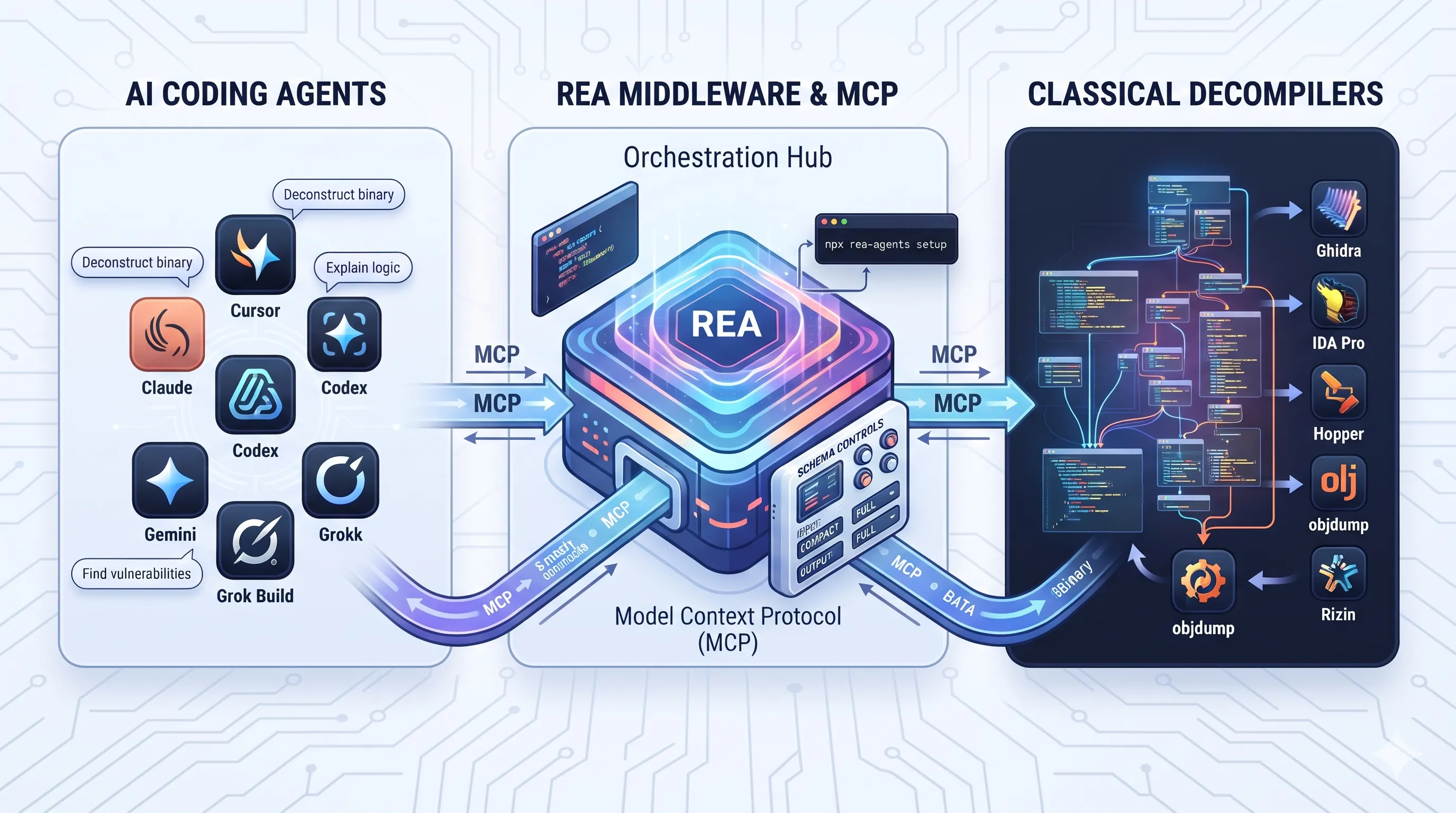
3. Empirical Verification: Case Studies in Automated Logic Extraction and Reconstruction
Understanding how AI is changing reverse engineering accessibility requires examining empirical implementations where automated tools extract verifiable logic from compiled binaries and packaged runtimes.Rather than relying on manual assembly tracing, automated reverse engineering environments such as REA (Reverse Engineer Anything) translate machine routines directly into auditable, high-level code representations.
Critically, these automated reconstructions recover deterministic operational rules and procedural behavior rather than private cryptographic keys or remote backend logic.
Cryptographic Logic and Binary Reconstruction in Aegis and DX-Ball
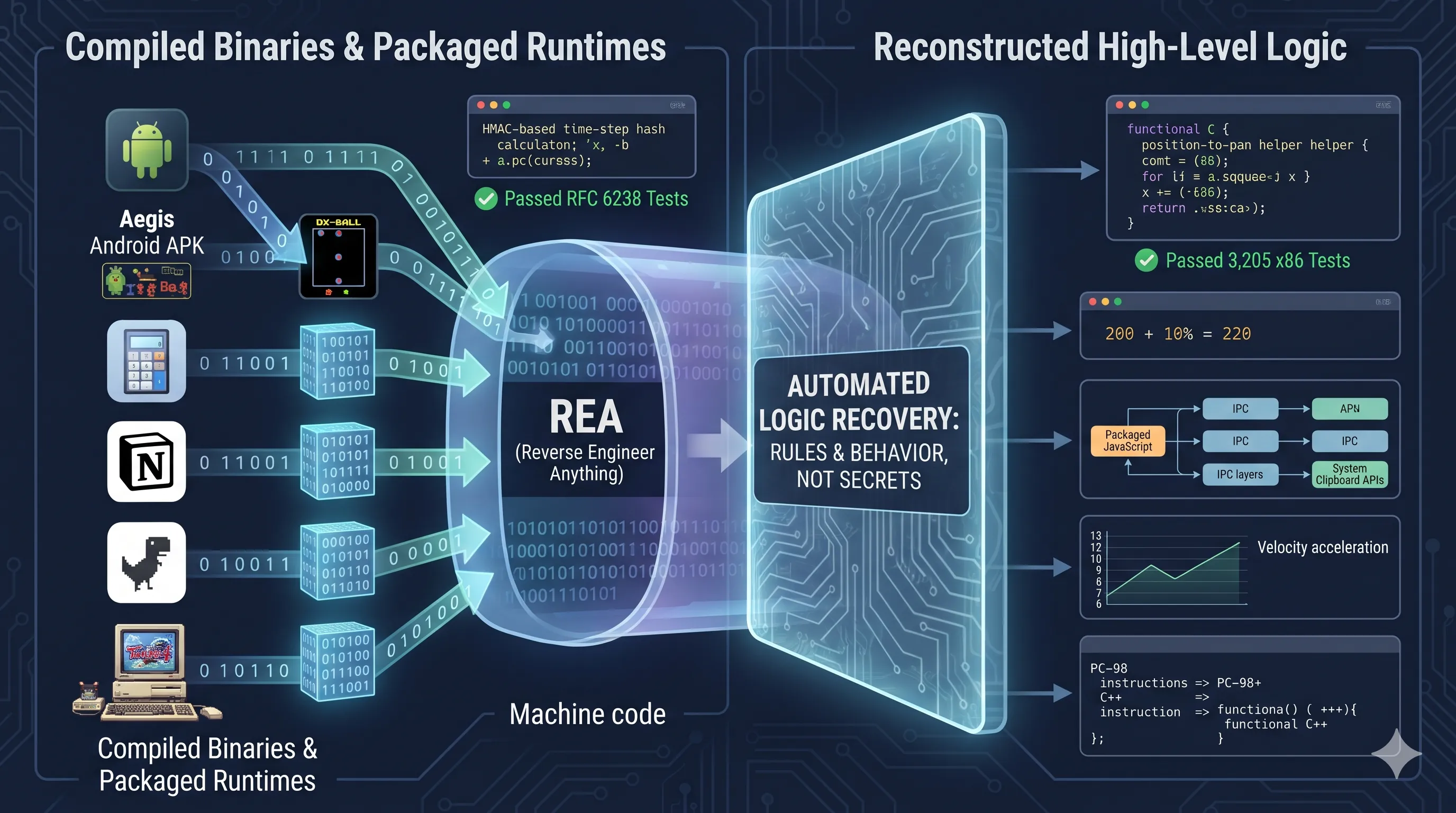
Automated logic extraction demonstrates significant utility in security-sensitive and legacy binary contexts by systematically recovering program workflows without compromising operational boundaries.During the analysis of the Aegis Android APK on October 9, 2026, REA 6.1.0 parsed 3,077 code bundles to inspect the application's multi-factor authentication implementation.
The automated engine traced the application's 30-second rotating 6-digit login token logic back to standard HMAC-based time-step hash calculations.
The extracted algorithmic implementation passed 133 test runs matching RFC 6238 standard values.
Crucially, this reconstruction verified the mathematical and temporal rules of the authenticator without recovering private account secrets or runtime cryptographic keys.
This highlights the core boundary of AI-assisted disassembly: it extracts deterministic program specifications while leaving server-bound components and cryptographic secrets untouched.
In legacy binary modernization, automated extraction preserves low-level precision when porting machine code to modern programming languages.
In an x86 binary reconstruction of the classic game DX-Ball, automated extraction targeted the sound-pan helper routines.
The system recovered the original position-to-pan helper assembly and pseudocode, reconstructing the routine into functional C code.
The resulting logic passed all 3,205 original x86 test cases and matched all 63 compiled function bytes identically.
This proves that automated logic recovery can produce byte-for-byte fidelity without manual decompilation intervention.
Rule Extraction Across Windows Calculator, Electron Bridges, and Classic Games
Automated rule extraction extends beyond standalone binaries into modern operating system utilities, complex web runtime bridges, and real-time state engines.In an audit of Windows Calculator 11.2508.4.0 (x64) inspected with REA 4.1.0, automated analysis extracted the underlying arithmetic sequence for complex modifiers.
The system successfully isolated and verified the percentage calculation rule, confirming the deterministic flow where the input sequence 200 + 10% reliably yields 220.
Beyond native math runtimes, tracing execution paths across multi-process application architectures represents another major expansion of reverse engineering accessibility.
When evaluating the Notion desktop application, tracing mapped packaged JavaScript across renderer Inter-Process Communication (IPC) and preload layers down to native system clipboard APIs.
This mapping exposed how rich block data transfers across architectural boundaries without requiring manual instrumentation of the Electron runtime.
Automated reverse engineering tools have also demonstrated cross-architecture agility when analyzing real-time procedural rules in legacy and browser environments.
In an inspection of the Chromium Dinosaur game's speed mechanics, the extracted rule confirmed that running speed starts at 6 and increments by 0.001 per update up to a maximum threshold of 13.
The reconstructed model confirmed that the avatar's speed reaches 10.0 after exactly 4,000 updates and caps at 13.0 after 10,000 updates.
Similarly, a technical showcase on Touhou 4 (TH04) demonstrated the recovery of 16-bit DOS bullet-ring angle calculations from vintage PC-98 instructions directly into matching C++ code.
Across all environments, reconstruction successfully extracts program logic and operational rules, but cannot reconstruct private cryptographic secrets or server-bound components.
| Target System | REA Inspection Version / Architecture | Recovered Program Behavior | Verification Results |
|---|---|---|---|
| Aegis Android APK | REA 6.1.0 (Android APK) | 30-second rotating 6-digit login token logic traced to HMAC-based time-step hash calculation | Parsed 3,077 bundles; passed 133 tests matching RFC 6238 standard values without recovering private keys |
| DX-Ball | x86 Assembly | Position-to-pan helper assembly and pseudocode reconstructed into functional C code | Passed all 3,205 original x86 test cases; matched all 63 compiled function bytes |
| Windows Calculator 11.2508.4.0 | REA 4.1.0 (x64) | Percentage calculation rule evaluation logic | Verified execution behavior where 200 + 10% yields 220 |
| Dinosaur Game | Browser Runtime / JavaScript | Velocity acceleration formula and bounding logic | Verified initial speed of 6, increment of 0.001 per update, 10.0 at 4,000 updates, and max 13.0 cap at 10,000 updates |
| Notion Desktop | Electron Framework (IPC / Preload) | Packaged JavaScript mapped across renderer IPC and preload layers to system clipboard APIs | Verified rich block data transfer paths across execution contexts |
| Touhou 4 (TH04) | PC-98 (16-bit DOS) | Bullet-ring angle calculation routines | Extracted PC-98 instructions into matching functional C++ code |
4. Autonomous Browser Interaction: Synthesizing Reinforcement Learning Environments
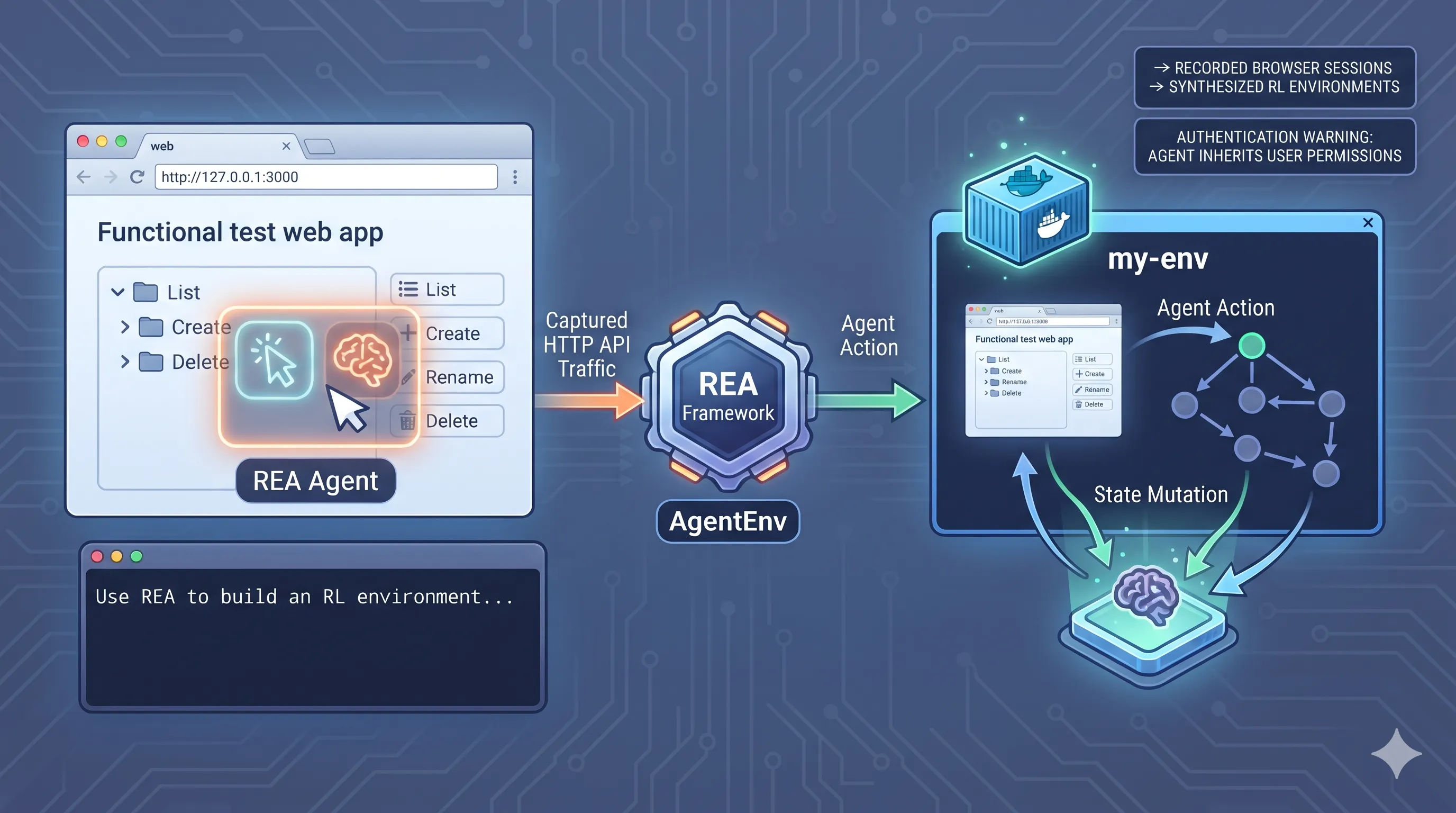
Automated web session recording fundamentally alters the accessibility of reverse engineering by converting observed network traffic into interactive mock environments without manual API reconstruction.Rather than writing synthetic stubs, reverse engineers and security researchers can observe user flows and immediately compile captured HTTP API traffic into functional Reinforcement Learning (RL) sandboxes.
From Recorded Browser Sessions to Containerized RL Environments
The REA framework enables recording web application sessions to turn captured HTTP API requests and responses into agent tools for RL environment generation via AgentEnv and Docker.This automated pipeline captures client-server exchanges and packages the underlying protocol logic into containerized mock environments where autonomous agents can execute actions.
A critical technical constraint in this process governs mutations: RL environment exports support state modifications only when recorded browser sessions confirm their exact effects.
If a write or delete operation does not have an observed counterpart demonstrating how the server state mutated in response, the generated environment restricts those operations to prevent hallucinated API side-effects.
To generate an interactive Reinforcement Learning (RL) environment from recorded web interactions, practitioners invoke natural language directives within REA:
›Use REA to build an RL environment from my test web app at http://127.0.0.1:3000. Cover listing, creating, renaming, and deleting folders. You may create and remove test folders. Leave existing data unchanged. Save it in a folder named my-env. Check which operations work and tell me how to run it.The agent exercises endpoints on the local web application at http://127.0.0.1:3000, verifies CRUD folder state transitions against observed HTTP payloads, packages the operational tooling into my-env, and generates the necessary AgentEnv and Docker runtime configs.
Browser Automation Architectures, Authentication Risks, and Tooling
Autonomous browser agents interact with web pages primarily through two architectural mechanisms: direct image capture recognition or textual accessibility tree parsing assigning element IDs.While visual recognition interprets rendered UI layouts directly, accessibility tree parsing decomposes the Document Object Model into actionable node identifiers, allowing agents to manipulate controls deterministically.
The tooling ecosystem for browser automation developed rapidly across 2025 and 2026.
The Claude for Chrome preview was released on August 26, 2025, demonstrating browser-integrated assistance.
ChatGPT Atlas was launched on October 21, 2025, and shut down on August 9, 2026, shifting features to ChatGPT apps and Chrome extensions.
Within open-source tooling, Tencent BrowserSkill accumulated approximately 9,000 GitHub stars as of October 16, 2026.
| Tool / Platform | Key Milestone Date | Operational Model / Status |
|---|---|---|
| Claude for Chrome | August 26, 2025 | Preview released for browser integration. |
| ChatGPT Atlas | October 21, 2025 – August 9, 2026 | Launched in October 2025; retired in August 2026 with capabilities shifted to ChatGPT apps and Chrome extensions. |
| Tencent BrowserSkill | October 16, 2026 | Accumulated approximately 9,000 GitHub stars; integrates with active desktop browser sessions. |
For reverse engineers and protocol analysts, BrowserSkill includes a website debugging feature capturing outgoing HTTP requests, incoming server responses, and console error logs.
However, delegating tasks through authenticated browser sessions introduces severe security risks.
BrowserSkill agent sessions do not operate inside a security sandbox and inherit all user authentication permissions and internal system access.
Because the automated CLI hooks directly into the user's active session, any unvetted agent action carries the full authority of the logged-in operator across all internal and authenticated endpoints.
5. The Collapse of Client-Side Obscurity and Evolving Security Moats
As artificial intelligence fundamentally reshapes the accessibility of reverse engineering, the traditional defensive paradigms that protected proprietary software have begun to deteriorate.AI integration dramatically reduces the human labor barrier of reverse engineering by unifying code observation, rule extraction, reimplementation, and automated testing into a single continuous feedback loop.
This automated cycle alters how vulnerability researchers, competitors, and security teams analyze software, exposing the systemic fragility of client-side defenses and forcing organizations to reconsider where their intellectual property and security boundaries genuinely reside.
Erosion of Client-Side Obfuscation and Relocation of Defensible Moats
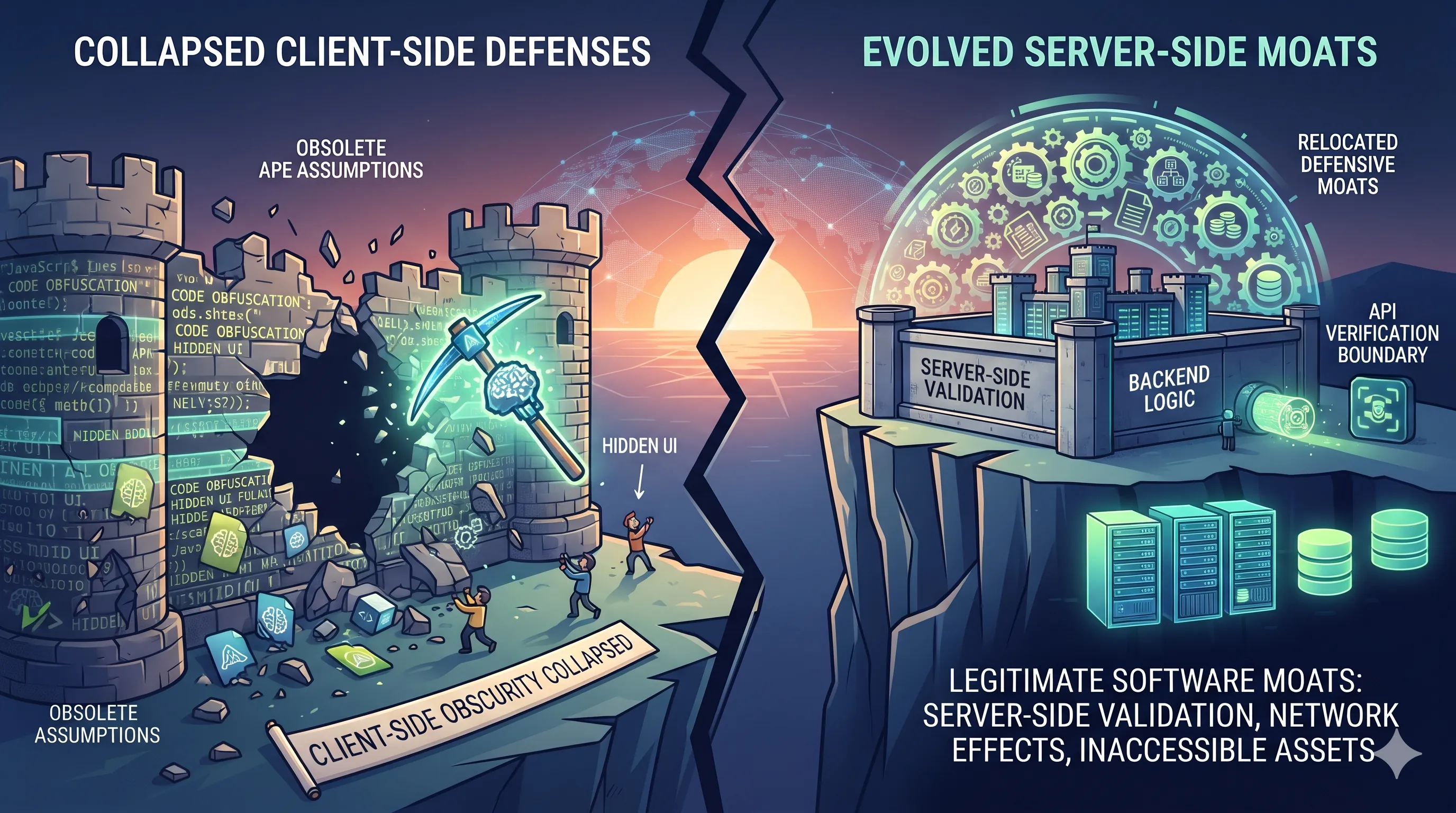
The automation of iterative analysis means that client-side binaries, web bundles, and mobile APKs delivered directly to end-user devices can no longer rely on code obfuscation or hidden UI elements for protection.Techniques designed to deter human analysts through deliberate syntactic confusion are readily untangled when code observation, behavioral rule extraction, and automated test synthesis operate in an unbroken algorithmic loop.
While AI-driven reverse engineering cannot directly extract inaccessible server-side logic or backend databases, it significantly facilitates empirical inference based on API request and response behavior.
Consequently, security architectures that depend on client-side secrecy collapse under systematic, AI-assisted external probing.
| Security Dimension | Obsolete Client-Side Assumptions | Defensible Architectural Moats |
|---|---|---|
| Core Protection Mechanism | Reliance on code obfuscation, client-side binaries, mobile APKs, and hidden UI elements. | Server-side validation, backend logic enforcement, and infrastructure operational workflows. |
| Competitive Defense | Attempting to conceal proprietary client-side algorithms within distributed web bundles or executables. | Accumulated proprietary datasets, active network effects, and inaccessible backend database assets. |
| Security Team Verification | Relying solely on pre-release source code static analysis before deployment. | Proactive inspection of deployed artifacts under low-privilege accounts to verify server-side enforcement. |
Organizations must recognize that sustainable defense exists solely in server-side validation, accumulated proprietary datasets, network effects, and tightly controlled infrastructure operational workflows.
To counter empirical inference attacks, security teams must adopt proactive inspection of deployed artifacts under low-privilege accounts to verify server-side enforcement directly, rather than relying solely on pre-release source code static analysis.
Legal Boundaries under Copyright Law and Industry Perspectives
The technological acceleration of automated reverse engineering operates against rigorous legal constraints.Article 101-4 of the Korean Copyright Act establishes definitive boundaries for program analysis, permitting reverse analysis exclusively for acquiring interoperability information when indispensable, while strictly prohibiting the use of extracted information for competing product distribution.
As automated feedback loops make code extraction frictionless, legal and engineering leaders are wrestling with the operational reality of exposed client software.
Industry leaders highlight the strategic repositioning forced by these accessible analysis capabilities.
Lee Hyuk-joong, CISO, underscored the tactical question facing modern defenders: "The question REA poses to security organizations is sharper: Where are your products readable from the outside?"
From a hardware and platform perspective, Sreekanth Pannala, director at AMD, framed the shift within broader historical industry cycles: "What a difference a decade makes! We’ve gone from an era when software was king and hardware was a commodity to one where hardware is king and proprietary software is becoming increasingly replaceable."
Ethical concerns regarding the deployment of these automated capabilities remain acute.
Cleverson Santos, creator of the Persistent Intelligence Project, commented on LinkedIn: "That is a murky boundary! I don't view crossing those lines favorably—and this is just the beginning; everything created to help human beings ends up being used against them in some way!"
Furthermore, the vulnerability of local binaries points toward a rapid migration in software distribution models.
Hacker News user revelationnow observed: "I feel this is going to accelerate big tech moving apps to the cloud, at least one channel of reverse engineering will be cut off if there are no binaries."
As automated code extraction removes the veil of obfuscation, architectural survival depends entirely on moving validation behind backend perimeter walls where algorithmic observation cannot reach.
6. Academic and Open-Source LLM Decompilation Tooling
Understanding how AI is changing reverse engineering accessibility requires examining the open-source and academic tooling that integrates directly into practitioner workflows.By lowering the technical barrier to interpreting complex machine code, community-driven plugins and neural frameworks are transforming decompilation from an elite manual discipline into an automated, semantically guided analysis process.
LLM Disassembly Augmentation and Binary Similarity Plugins
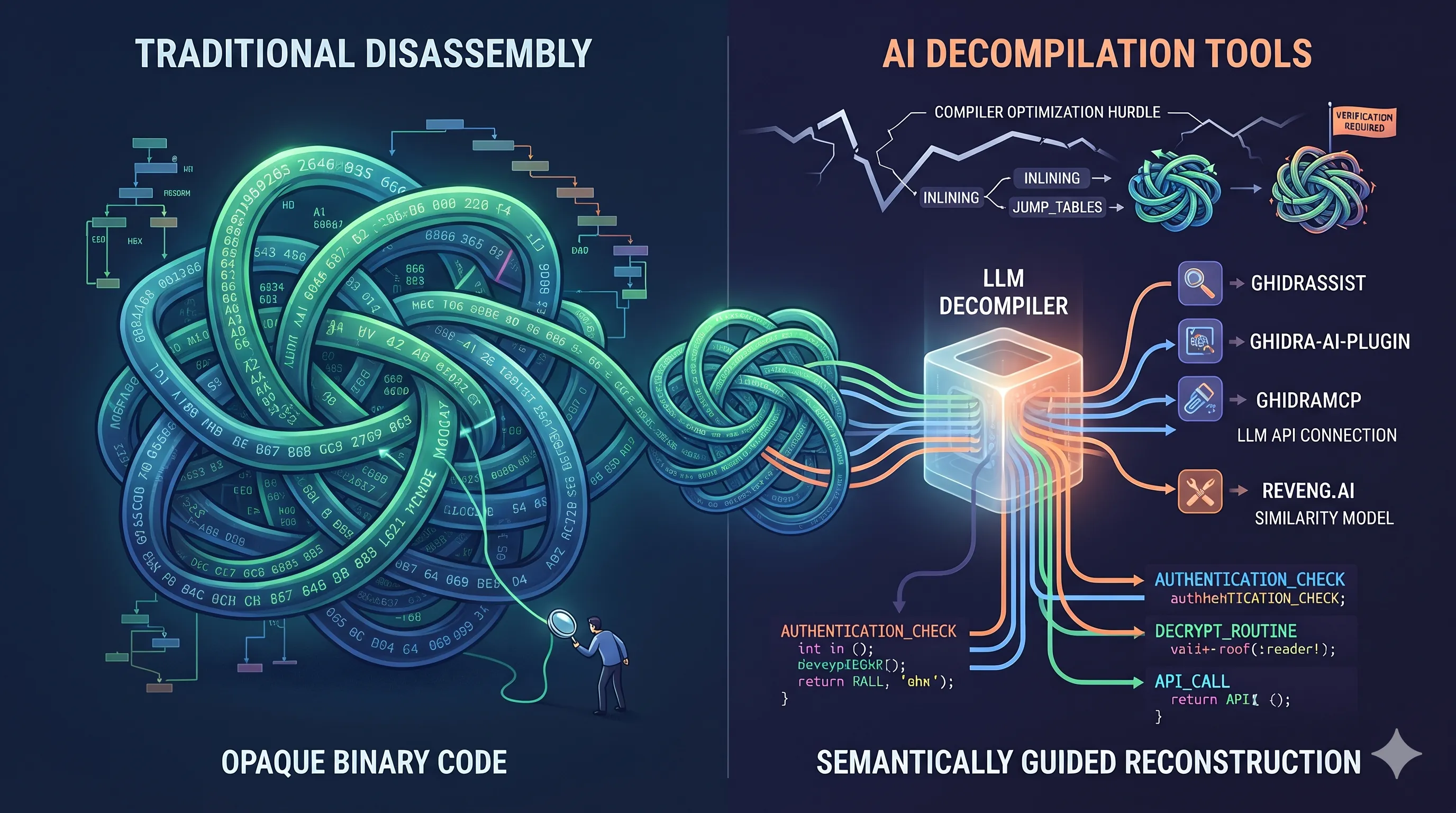
The open-source ecosystem has expanded through direct integrations that bridge standard disassembly platforms with modern artificial intelligence.Community plugins such as GhidrAssist, Ghidra-Ai-Plugin, and GhidraMCP directly connect Ghidra disassemblers to LLM APIs.
These tools automate function explanation and drive iterative pseudocode refinement, enabling analysts to quickly decipher opaque disassembly without manually annotating every assembly sequence.
Complementing direct language model prompts, RevEng.AI provides a specialized Ghidra plugin that leverages binary code similarity models.
This binary similarity modeling assists reverse engineers in identifying stripped binary functions by matching structural representations and semantic profiles against known function repositories.
| Tool / Plugin | Underlying Mechanism | Primary Capability |
|---|---|---|
| GhidrAssist | LLM API Connection | Automated function explanation and pseudocode refinement |
| Ghidra-Ai-Plugin | LLM API Connection | Automated function explanation and pseudocode refinement |
| GhidraMCP | LLM API Connection | Automated function explanation and pseudocode refinement |
| RevEng.AI Ghidra Plugin | Binary Code Similarity Models | Identification of stripped binary functions |
Semantic Recovery Capabilities and Compiler Optimization Hurdles
Decompilation frameworks increasingly harness LLM-driven semantic understanding to evaluate target software when original source code is entirely missing.These capabilities prove essential for malware classification and the identification of latent software vulnerabilities within stripped executables.
By inferring programmer intent rather than relying solely on deterministic control-flow recovery, AI models reconstruct high-level context that traditional disassemblers strip away.
Significant technical limitations remain evident when navigating non-trivial build configurations.
LLM decompilers often struggle with precise structural reconstruction under aggressive compiler optimizations and complex obfuscation schemes without iterative dynamic validation.
When aggressive compiler transformations alter control paths, static semantic models risk generating plausible but architecturally inaccurate representations unless paired with runtime verification.
References
Related Posts


Generative AI may have assisted with research or drafting for this article. Topic selection, fact-checking, final wording, and publication remain the responsibility of DragonStone74. AI use disclosure