
How Unsloth Desktop and Inkling 2 Mini Redefine Local AI
🚀 Key Takeaways
- Streamlined Local Serving: Unsloth Desktop eliminates terminal-based environment management, allowing developers to deploy and share local models across a home network via an intuitive graphical interface.
- Algorithmic Parameter Efficiency: Inkling 2 Mini introduces an innovative looped transformer architecture that reuses physical layers dynamically to achieve high-capacity reasoning within compact memory footprints.
- Consumer Hardware Accessibility: Advanced quantization formats enable high-performing open models to run smoothly on standard consumer GPUs without sacrificing baseline output quality.
- Tiered Scalability with Qwen: Modern model families offer balanced configurations that map cleanly across entry-level to enthusiast GPU tiers, maximizing throughput via mixture-of-experts designs.
- Extensive Ecosystem Compatibility: Immediate day-0 integration with mainstream inference runtimes ensures flexible local development across both CUDA-powered systems and unified memory platforms.
The recent release of Thinking Machines Lab's open-weights Inkling 2 Mini, alongside the continued evolution of the Qwen model family, demonstrates how structural innovations and sparse execution allow consumer workstations to rival cloud-hosted alternatives. When paired with streamlined orchestration tools like Unsloth Desktop, deploying high-capacity reasoning models no longer demands complex Python dependency trees or enterprise server budgets.
Understanding how these complementary technologies interact provides engineers and independent developers with a clear blueprint for building autonomous, cost-effective, and fully private local development stacks.
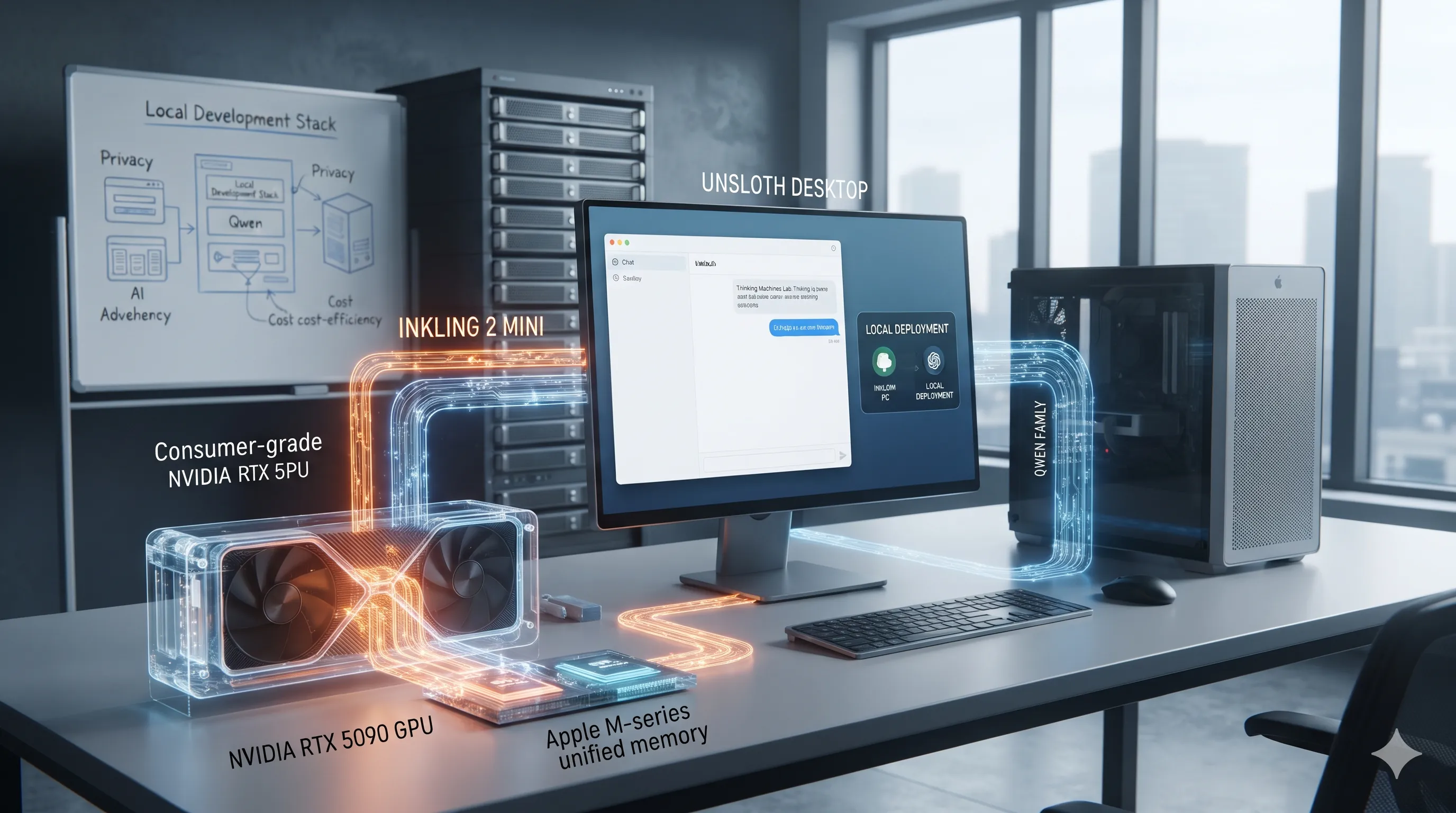
1. Streamlining Local AI Deployment and LAN Serving with Unsloth Desktop
Within the integrated local intelligence pipeline alongside Inkling and Qwen, Unsloth Desktop serves as the foundational inference and execution layer that operationalizes models on consumer hardware.By eliminating the friction traditionally associated with local AI development, the platform enables direct model serving through an accessible graphical interface.
Three-Step Setup and Zero-Terminal Execution
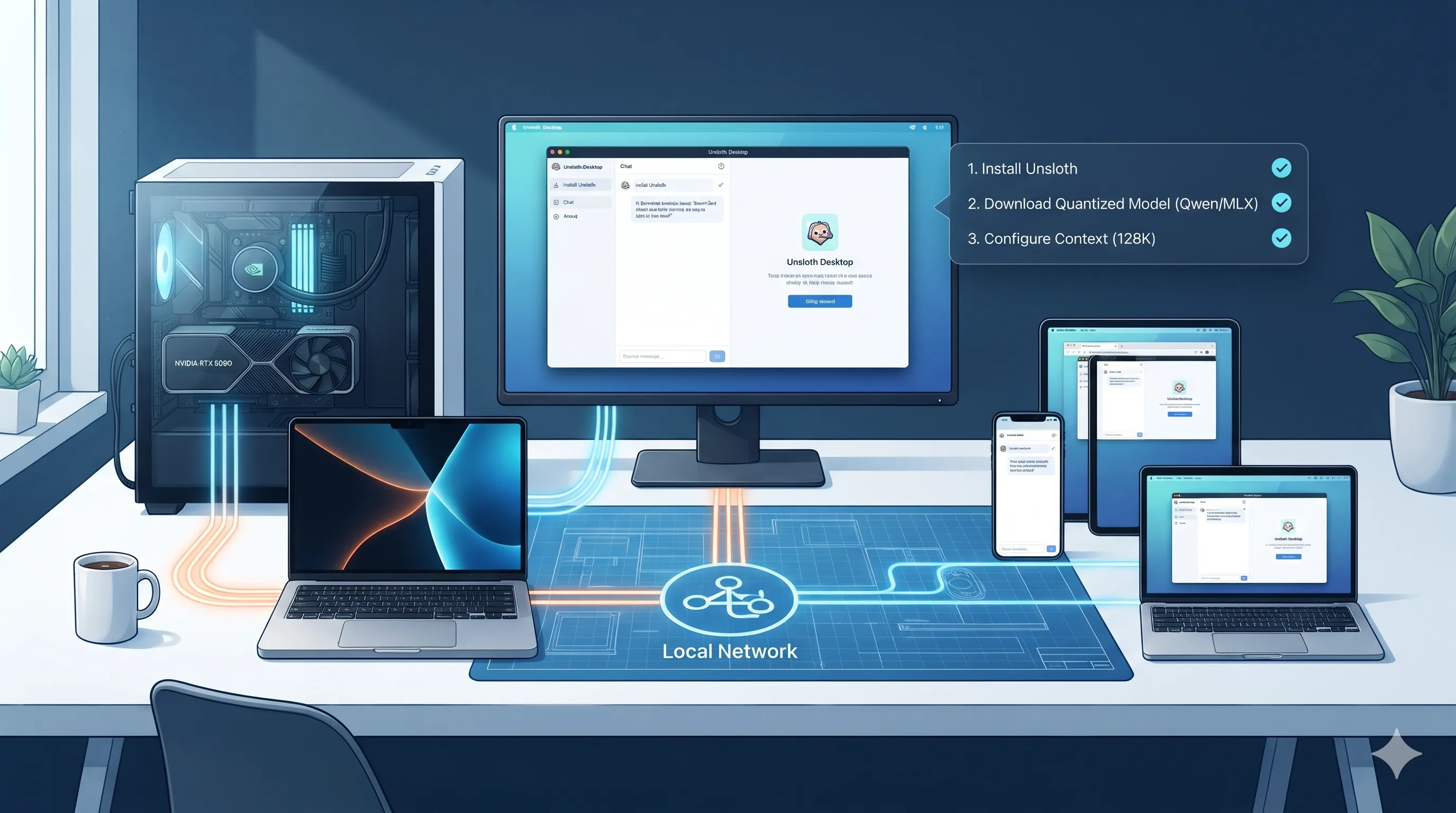
Setting up Unsloth Desktop on local hardware takes approximately 10 to 15 minutes, excluding model download times.The runtime serves local AI models through a graphical chat interface without requiring terminal commands or manual Python environment configuration.
Industry analyst Jerry James noted that Unsloth Desktop abstracts away terminal commands, Python environments, and dependencies behind a simple UI without pushing subscriptions.
The operational setup consists of three primary steps: installing Unsloth Desktop, selecting and downloading a quantized model, and configuring the context size.
Hardware execution scales directly with system memory architecture.
For instance, deploying Unsloth Desktop on an NVIDIA RTX 5090 with 32GB of VRAM running Qwen3.8-27B at 4-bit quantization allows for a 128K context window.
For unified memory systems such as Apple Silicon Macs, the environment runs custom-built MLX model variants optimized specifically for the architecture.
| Setup Stage | Primary Action | Hardware & Execution Specifications |
|---|---|---|
| Step 1: Installation | Install Unsloth Desktop client | Zero terminal commands or Python environments required; 10 to 15 minute local deployment. |
| Step 2: Model Selection | Download quantized weights | Supports 4-bit quantized models such as Qwen3.8-27B or custom-built MLX variants on Apple Silicon. |
| Step 3: Configuration | Define context window limit | Accommodates up to a 128K context window when operating on an RTX 5090 with 32GB VRAM. |
Local Area Network Access and Browser Authentication
Beyond standalone host execution, Unsloth Desktop provides built-in Local Area Network (LAN) access.This network serving capability allows client devices connected to the same home network to interact with the served model directly through a web browser.
To maintain local security across connected endpoints, incoming LAN sessions require credential validation.
Users connecting over the local network authenticate under the username unsloth using a user-configured Remote password established during runtime management.
Host Machine Constraints and Remote Tunneling Requirements
While Unsloth Desktop minimizes local hosting overhead, network access remains tightly coupled to host hardware availability.The physical host machine must remain powered on with Unsloth actively running for network clients to access the model without disruption.
Furthermore, native LAN sharing is restricted to the local subnet.
Accessing the local deployment remotely from outside the local home network requires additional tunneling configurations.
2. Inside Inkling 2 Mini: Looped Transformer Mechanics and Weight Reuse
Understanding the inner architecture of Thinking Machines Lab's Inkling 2 Mini is essential to grasping how modern open architectures redefine local AI development.Released under an Apache 2.0 open-weights license on November 17, 2026, the model demonstrates how local consumer and workstation hardware can achieve deep compute graphs without demanding the memory footprint of massive static models.
As Hugging Face described, Inkling 2 Mini operates as a looped transformer model utilizing a layer-reuse mechanism to increase functional capacity while keeping physical memory bounds remarkably compact.
Recurrent Decoder Passes and Identical Weight Reuse
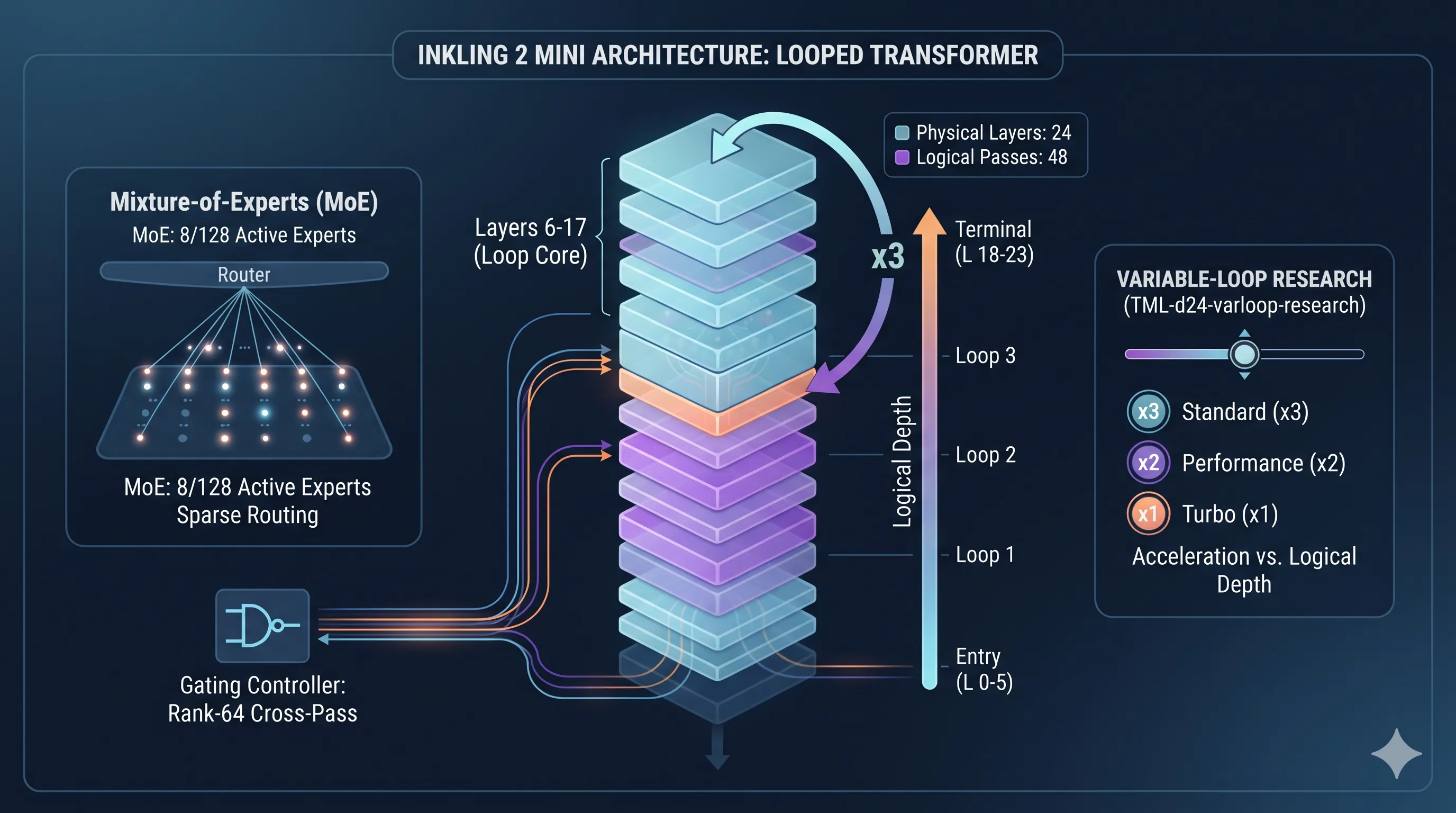
At the core of Inkling 2 Mini is a 24-physical-layer decoder layout engineered to simulate the depth of a much larger network.Rather than passing through 24 distinct parameter banks in sequence, the execution pipeline splits into three distinct execution stages.
Layers 0 through 5 execute once as an entry stage.
The core processing block, spanning physical layers 6 through 17, repeats three full times in a sequential loop.
Finally, layers 18 through 23 execute once to finalize the token representations.
Because the 12 intermediate physical layers execute three times (12 × 3 = 36 logical passes), combined with the 6 initial and 6 terminal layers (6 + 36 + 6), the engine produces 48 logical layer visits per token from just 24 physical layers.
Crucially, all three passes through layers 6 through 17 reuse identical stored model weights.
Memory storage does not duplicate the parameters for passes two and three; instead, the runtime streams activations back through the identical weight matrices.
Despite reusing static weights, each logical layer visit retains its own distinct key-value and short-convolution state, ensuring that temporal representations evolve over recurrent iterations.
| Architectural Dimension | Specification / Implementation | Operational Role |
|---|---|---|
| Total vs. Active Parameters | 26B physical total / 3B to 5.4B active per token | Maintains low active memory compute while preserving a large physical capacity. |
| Physical vs. Logical Layers | 24 physical layers / 48 logical layer visits | Layers 6–17 repeat across 3 loops to deepen representation depth without added weight footprint. |
| Decoder Dimensions | Hidden size: 2,304 / Expert intermediate width: 1,152 | Defines dense projection dimensionality and per-expert transformation capacity. |
| Attention Configuration | 24 query heads / 8 key-value heads | Grouped-query setup serving up to a 1M native context window. |
| Layer Attention Structure | 5 sliding-window layers (1,024 tokens) to 1 full-attention layer | Structured across six-layer blocks to optimize long-context memory and throughput. |
| MoE Architecture | 8 active out of 128 SwiGLU experts | High-granularity routing per token per layer pass. |
Sparse MoE Routing and Rank-64 Cross-Pass Gating
The feedforward blocks within Inkling 2 Mini rely on a fine-grained Mixture-of-Experts (MoE) configuration.Each layer exposes 128 SwiGLU experts, each possessing an intermediate width of 1,152.
For every token pass, the MoE router dynamically selects 8 active experts, which caps token execution between 3B and 5.4B active parameters despite the model housing approximately 26B total physical parameters.
A central technical challenge of weight reuse is preventing recurrent passes from collapsing into redundant representations.
Inkling 2 Mini resolves this through cross-pass communication powered by learned queries and a dedicated gating controller.
Specifically, four rank-64 gates mix separate cross-pass messages into the query, key, value, and MoE inputs across loop passes 2 and 3.
This gating controller dynamically balances current layer inputs against messages preserved from previous passes, modulating feature trajectories across the 48 logical steps.
Attention compute is further structured into six-layer blocks: each block integrates five sliding-window layers (bounded by a local window of up to 1,024 tokens) followed by one full-attention layer.
With 24 query heads and 8 key-value heads, this hybrid sliding-window design enables native support for context windows up to 1M tokens.
Multimodal Ingestion and Variable-Loop Execution Trade-Offs
Inkling 2 Mini extends this looped architecture beyond pure language tasks, supporting native multimodal text and image input processing within the same unified backbone.The text decoder's hidden size of 2,304 coordinates with the multimodal projection pipeline to process mixed token sequences through the looped physical layers.
Alongside the standard release, Thinking Machines Lab published an experimental variable-loop research artifact designated as TML-d24-varloop-research.
This research artifact permits developers to configure execution dynamically, bypassing the standard three iterations to run with either 1 or 2 loop passes through layers 6 to 17.
This introduces an explicit engineering trade-off: reducing the loop passes to 1 or 2 accelerates inference latency and reduces computational load on local hardware, but it may decrease overall output generation quality by truncating the logical depth of the model.
3. Inkling Quantization Profiles and Hardware Memory Footprints
Local AI development using Inkling, Qwen, and Unsloth relies directly on matching model weight precision against the physical memory of local hardware.
Quantization compresses model weights to lower precision profiles, such as 4-bit or 2-bit representations, allowing high-capacity models to fit inside consumer GPU memory.
Official Inkling weights ship in advanced mixed-precision formats, including NVFP4 and MXFP8, giving practitioners distinct operational choices based on available VRAM.
Precision Levels and Consumer VRAM Thresholds
Deploying Inkling 2 Mini locally requires evaluating trade-offs between precision, runtime stability, and headroom for context caching.
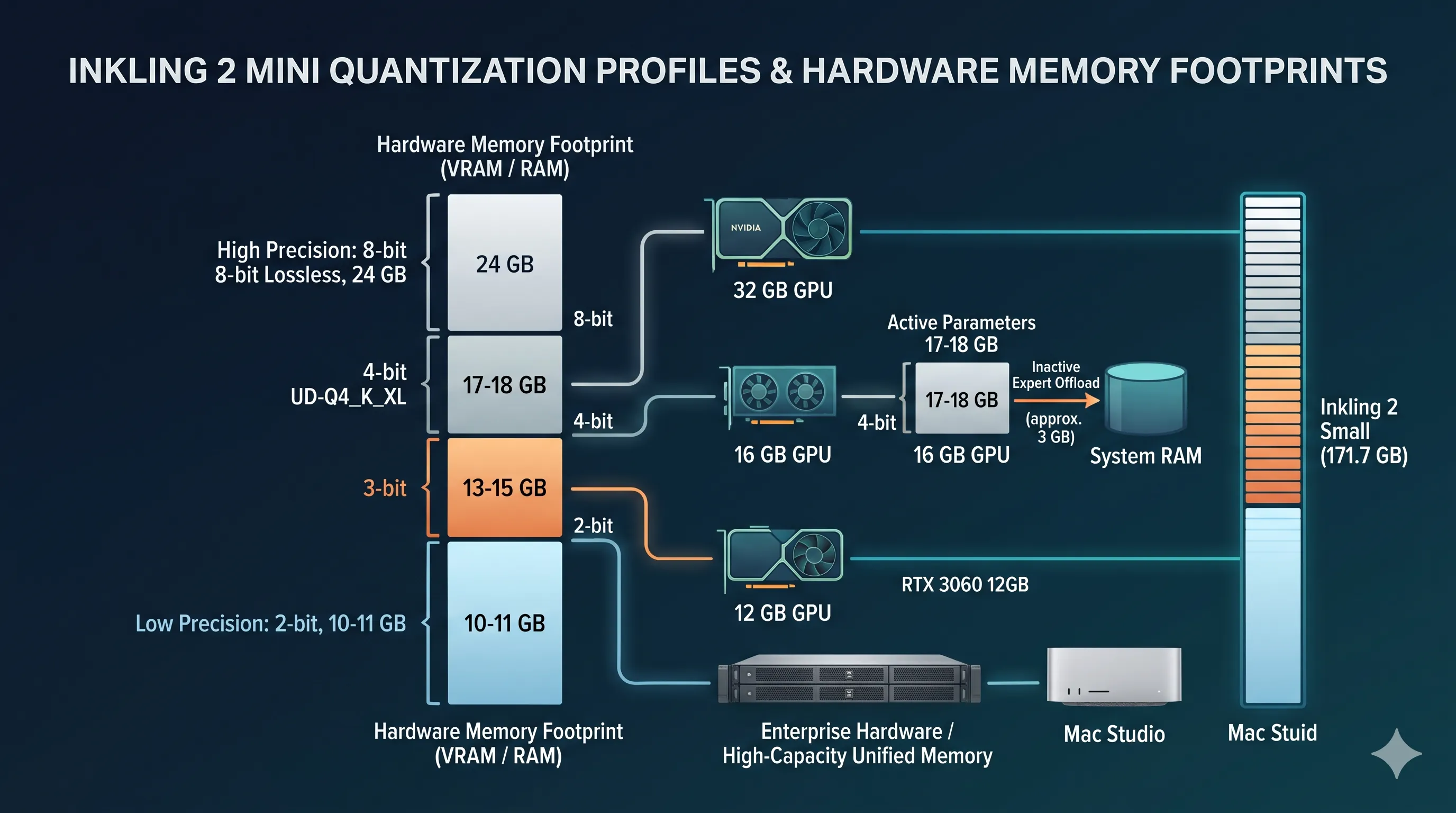
At the extreme lower bound, 2-bit quantization requires 10–11 GB of combined memory, enabling the model to fit and execute on standard 12 GB GPUs.
Stepping up to 3-bit quantization increases memory demands to 13–15 GB of combined memory, which comfortably targets 16 GB GPU configurations.
For general deployment, 4-bit quantization using the recommended UD-Q4_K_XL profile serves as the primary standard.
The UD-Q4_K_XL format features a file size measuring 17.6 GB and demands 17–18 GB of active memory.
Moving to uncompromised weights, the 8-bit lossless quantization profile requires 24 GB of memory and fits entirely on a 32 GB card.
When running 4-bit Inkling 2 Mini on a 32 GB GPU like the RTX 5090, the architecture occupies roughly 18 GB, leaving approximately 14 GB of VRAM entirely free for context allocation.
| Model Variant & Quantization | File Size | Memory Requirement | Target Hardware Profile |
|---|---|---|---|
| Inkling 2 Mini (2-bit) | — | 10–11 GB | 12 GB GPUs |
| Inkling 2 Mini (3-bit) | — | 13–15 GB | 16 GB GPUs |
| Inkling 2 Mini (4-bit UD-Q4_K_XL) | 17.6 GB | 17–18 GB | 16 GB GPUs (with offload) / 32 GB GPUs |
| Inkling 2 Mini (8-bit Lossless) | — | 24 GB | 32 GB GPUs |
| Inkling 2 Small (Smallest Quant) | 171.7 GB | 171.7+ GB | Enterprise Hardware / High-Capacity Unified Memory |
Sparse MoE System RAM Offloading Strategies
Although the recommended 4-bit UD-Q4_K_XL profile of Inkling 2 Mini demands 17–18 GB—exceeding the raw VRAM capacity of mainstream 16 GB graphics cards—local execution remains viable.
Inkling 2 Mini utilizes a mixture-of-experts (MoE) architecture characterized by sparse active parameters.
Because the full parameter set is not concurrently engaged for every computation, system operators can offload inactive expert weights into host system RAM.
This sparse MoE routing allows 4-bit quantizations to run on 16 GB GPUs without crashing due to out-of-memory errors, bridging local memory limitations while retaining 4-bit weight quality.
Enterprise Boundaries: Inkling 2 Small Hardware Demands
While Inkling 2 Mini offers flexible deployment across standard consumer graphics hardware, the higher-tier Inkling 2 Small establishes a distinct enterprise boundary.
Inkling 2 Small is a 594B parameter model designed for extensive reasoning tasks.
The model's smallest quantization package measures 171.7 GB in footprint.
Consequently, Inkling 2 Small cannot fit on standalone consumer graphics cards.
Local execution of Inkling 2 Small strictly necessitates enterprise hardware or high-capacity unified memory platforms, such as a 256GB Mac Studio or a DGX Station.
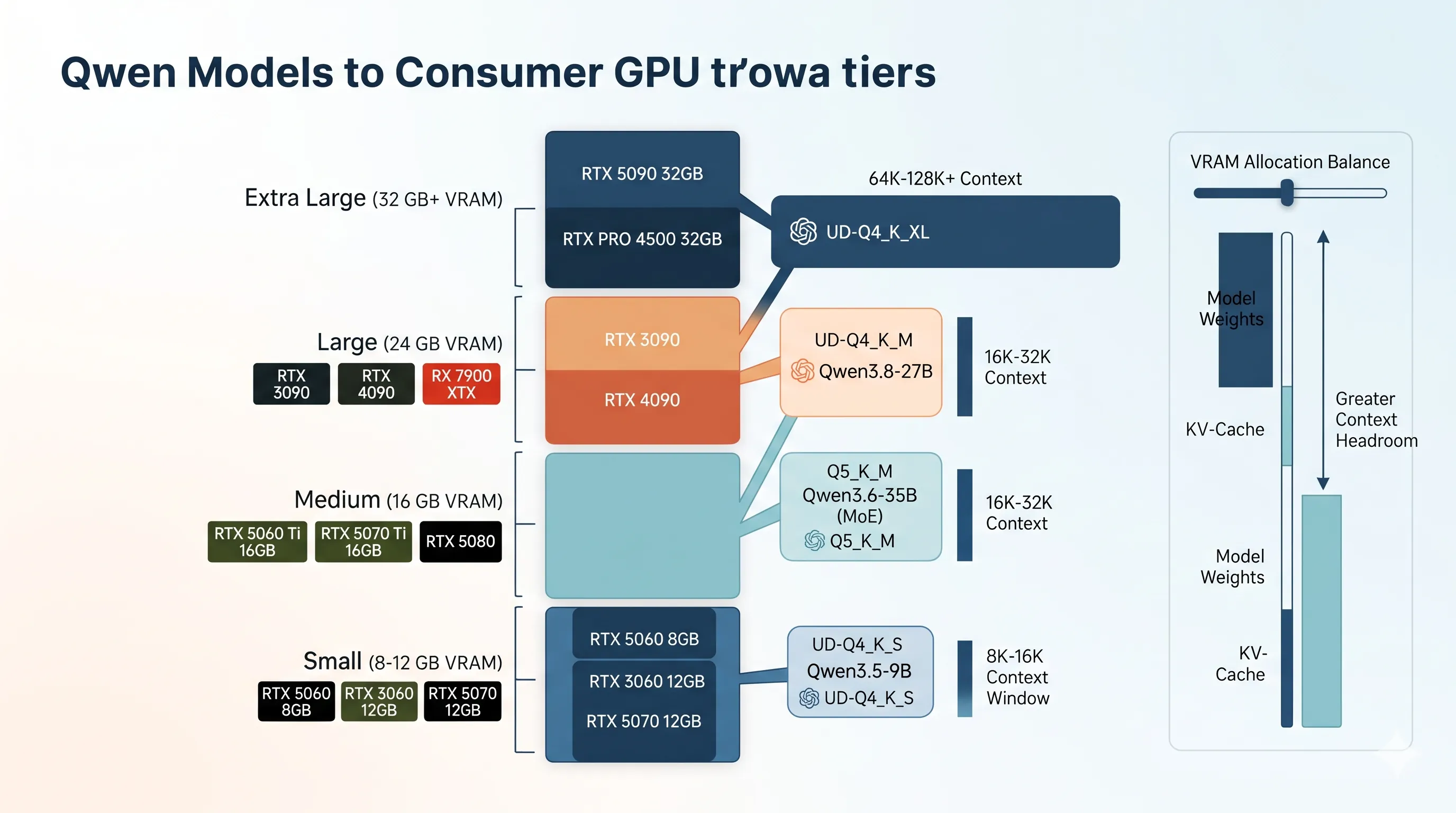
4. Mapping Qwen Models to Consumer GPU Hardware Tiers and Context Windows
Understanding physical VRAM constraints is essential to how Inkling, Qwen, and Unsloth enable local AI development.Uncompressed, full-size 16-bit Qwen weights require approximately 56 GB of storage and memory, placing them far beyond the physical ceiling of standard desktop graphics cards without compression or tier-specific hardware mapping.
Local deployment hinges on selecting target quantization profiles and offloading strategies that fit available VRAM while preserving sufficient headroom for active context execution.
Small and Medium GPU Tiers: Running Efficient MoE Weights
The Small hardware tier covers consumer setups equipped with 8–12 GB VRAM, including the RTX 5060 8GB, RTX 3060 12GB, and RTX 5070 12GB.On these entry-level cards, local execution centers on lightweight architectures such as Qwen3.5-9B and Gemma 4 12B.
These setups run reliably under UD-Q4_K_S or Q4_K_M quantizations, providing workable allocations for 8K–16K context windows.
Stepping up to the Medium tier brings 16 GB VRAM into scope through hardware such as the RTX 5060 Ti 16GB, RTX 5070 Ti, and RTX 5080.
This 16 GB threshold unlocks denser models and sparse architectures, supporting Qwen3-14B, Qwen3-Coder-30B (MoE), and Qwen3.6-35B (MoE) formatted at Q4_K_M or Q5_K_M quantizations with 16K–32K context windows.
Mixture-of-experts architectures maintain interactive generation speeds on mid-range hardware by evaluating only a subset of parameters per token.
For instance, an RTX 5060 Ti 16GB running Qwen3.6-35B MoE achieves an estimated 47 tokens per second when inactive parameters are held in system RAM.
Large and Extra Large Tiers: Scaling to 128K Context Windows
The Large tier encompasses 24 GB VRAM cards, represented by workstation and flagship consumer hardware such as the RTX 3090, RTX 4090, and RX 7900 XTX.These 24 GB configurations comfortably accommodate dense, high-capability models like Qwen3.8-27B and Gemma 4 31B using UD-Q4_K_M or Q4_K_S quantizations with 16K–32K context.
For prolonged workflows that demand high token capacity, Extra Large tier hardware with 32 GB+ VRAM—such as the RTX 5090 32GB and RTX PRO 4500 32GB—removes context limits entirely.
These 32 GB+ platforms support Qwen3.8-27B packaged in UD-Q4_K_XL or Q6_K quantizations, scaling smoothly to 64K–128K+ context windows.
Unsloth's UD-Q4_K_XL quantization profile provides quality closer to unquantized models compared to smaller Q4_K_M or Q4_K_S options, enabling high reasoning precision without exceeding the VRAM budget.
| Hardware Tier | VRAM Capacity | Representative GPUs | Supported Models | Quantization Profile | Context Window |
|---|---|---|---|---|---|
| Small | 8–12 GB | RTX 5060 8GB, RTX 3060 12GB, RTX 5070 12GB | Qwen3.5-9B, Gemma 4 12B | UD-Q4_K_S, Q4_K_M | 8K–16K |
| Medium | 16 GB | RTX 5060 Ti 16GB, RTX 5070 Ti, RTX 5080 | Qwen3-14B, Qwen3-Coder-30B (MoE), Qwen3.6-35B (MoE) | Q4_K_M, Q5_K_M | 16K–32K |
| Large | 24 GB | RTX 3090, RTX 4090, RX 7900 XTX | Qwen3.8-27B, Gemma 4 31B | UD-Q4_K_M, Q4_K_S | 16K–32K |
| Extra Large | 32 GB+ | RTX 5090 32GB, RTX PRO 4500 32GB | Qwen3.8-27B | UD-Q4_K_XL, Q6_K | 64K–128K+ |
Balancing Model Quantization Against KV-Cache Allocations
Local engine configuration requires managing a strict zero-sum memory trade-off on consumer cards.Allocating maximum GPU memory to larger model weights restricts the available context window size.
Because full 16-bit Qwen weights demand 56 GB, fitting models into consumer GPUs requires selecting lower-bit quantization formats like UD-Q4_K_S, Q4_K_M, or Q5_K_M to leave room for the expanding KV cache.
Choosing a compact quantization profile lowers the static baseline footprint, which preserves the VRAM buffer needed to expand prompt buffers toward 32K or 128K context during inference.
Conversely, choosing higher-fidelity quantization profiles like Q6_K or Unsloth's UD-Q4_K_XL increases parameter precision, but necessitates 32 GB+ memory tiers if extended sequence lengths are to be maintained without out-of-memory errors.
5. Inference Runtimes and Ecosystem Integration for Inkling 2 Mini
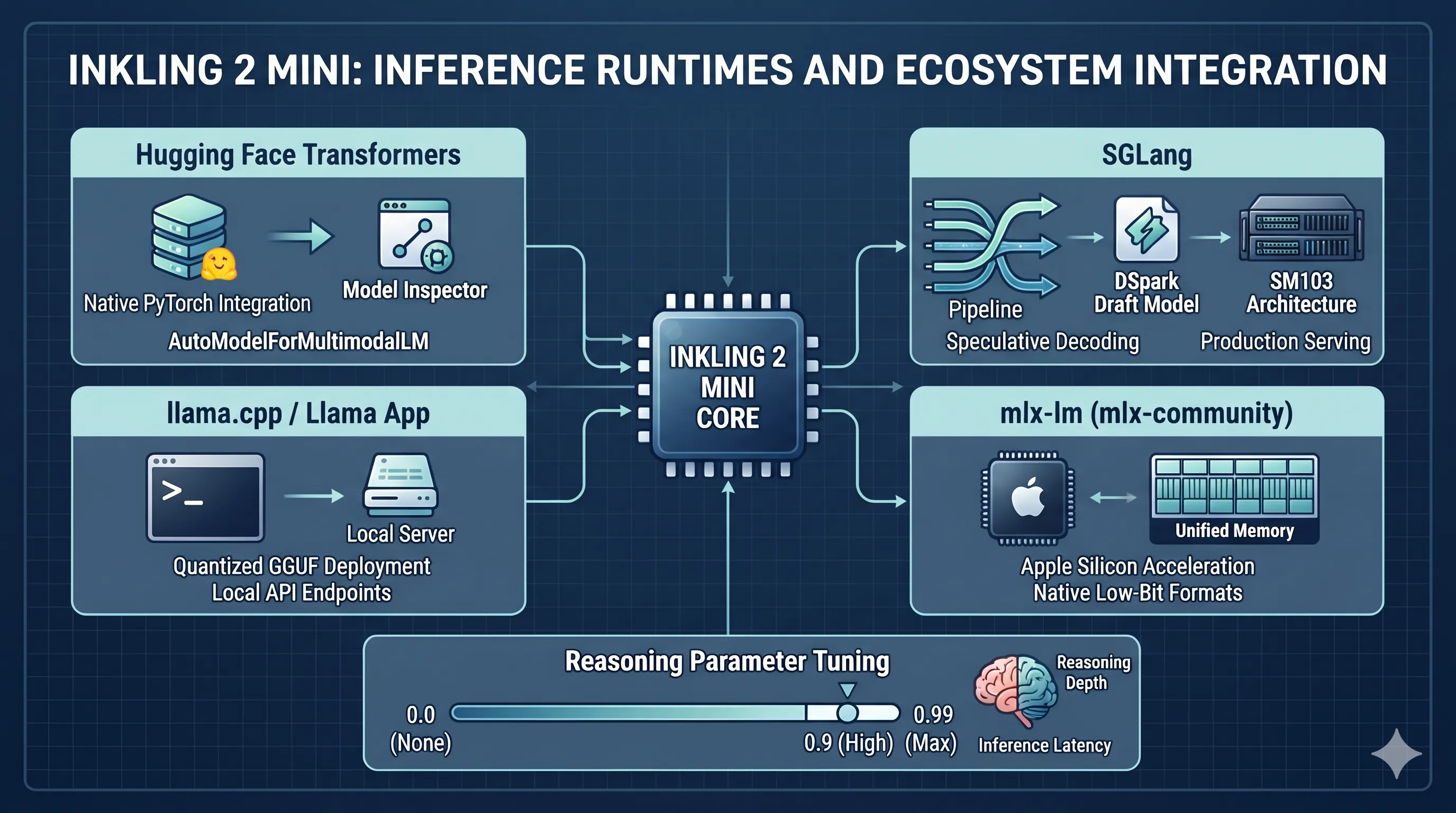
Within the broader scope of how Inkling, Qwen, and Unsloth enable local AI development, effective deployment hinges entirely on runtime compatibility and framework integration.For engineers moving models from local fine-tuning into real-world agentic workflows, Inkling 2 Mini delivers multi-runtime ecosystem support spanning workstation inference, high-throughput enterprise engines, and unified-memory hardware architectures.
Validating these execution pipelines reflects the model's competitive profile: Inkling 2 Mini leads in 32 out of 48 benchmark evaluations when compared directly against Gemma 4 31B, Muse Glimmer, Qwen3.8-27B, and Nemotron 3.5 Super VL.
According to Hugging Face, Inkling 2 Mini achieved state-of-the-art results in its class on the Artificial Analysis Intelligence Index v5 (AAv5).
| Framework / Runtime | Supported Quantization & Execution Formats | Architectural Target & Deployment Capabilities |
|---|---|---|
| Hugging Face Transformers | Native PyTorch precision weights | AutoModelForMultimodalLM interface supporting base model and variable-loop research variant |
| llama.cpp / Llama App | 4-bit (IQ4_NL) and 8-bit (Q8_0) GGUF | Local self-hosted OpenAI-compatible API endpoint serving |
| SGLang | High-throughput serving formats | Day-0 speculative decoding via 3-layer DSpark draft model on SM103 architecture |
| mlx-lm (mlx-community) | Native NVFP4 and MXFP8 execution | Apple Silicon unified memory acceleration |
Local Serving with llama.cpp and Transformers
Deploying Inkling 2 Mini for development workflows begins with native Hugging Face Transformers integration.Developers access the architecture via the standard AutoModelForMultimodalLM interface, which provides out-of-the-box support for both the standard Inkling 2 Mini weights and its variable-loop research variant.
This ensures direct drop-in integration with established model inspection, evaluation, and pipeline tooling.
For resource-constrained environments and local service backends, Llama App and llama.cpp deliver quantized deployment targets.
Runtimes expose pre-packaged 4-bit (IQ4_NL) and 8-bit (Q8_0) GGUF quantizations.
These quantized builds power self-hosted, OpenAI-compatible API serving endpoints that run directly on consumer-grade hardware.
In hands-on terminal tool-use tasks, the model matches Qwen3.8-27B on Terminal-Bench 4.0, allowing local endpoints to handle system command generation reliably.
However, teams designing multi-step workflow automation should note that Inkling 2 Mini trails Qwen3.8-27B on AutomationBench-AA v1.0.6, necessitating validation before relying entirely on lightweight local GGUF instances for complex autonomy.
Production Inference and Speculative Decoding in SGLang
For large-scale backend infrastructure, SGLang provides Day-0 production serving for Inkling 2 Mini.To accelerate token generation throughput, the runtime implements speculative decoding driven by a dedicated 3-layer DSpark draft model.
This draft model speculates token candidates ahead of verification by the primary Inkling 2 Mini network, decreasing per-token latency during intensive generation.
A core hardware constraint governs this setup: SGLang deployment for Inkling 2 Mini requires SM103 architecture hardware.
When deployed across verified SM103 clusters, this high-throughput pipeline excels in technical code generation workflows.
In rigorous coding benchmarks, Inkling 2 Mini leads on FrontierCode v2.0, making the SGLang speculative decoding stack an optimal engine for production-tier developer copilots and automated programming endpoints.
Apple Silicon MLX Execution and Reasoning Parameter Tuning
Local edge deployment extends directly to Apple Silicon hardware through mlx-lm and releases maintained under the mlx-community organization.This integration allows native execution using low-bit formats, specifically supporting NVFP4 and MXFP8 runtimes to maximize throughput on unified memory architectures.
Across all runtimes, downstream output quality relies on prompt template configuration.
Inkling 2 Mini incorporates an explicit reasoning effort parameter within its prompt template formatting.
By default, the runtime reasoning effort is configured to high (0.9).
Engineers can tune this parameter along a continuous scale ranging from none (0.0) for low-latency direct completions up to max (0.99) for deep algorithmic problem solving.
Adjusting this value allows developers running mlx-lm or local server endpoints to trade reasoning depth against interactive response times based on task complexity.
Related Posts
Generative AI may have assisted with research or drafting for this article. Topic selection, fact-checking, final wording, and publication remain the responsibility of DragonStone74. AI use disclosure