
Google's Gemini 4 Neon Delivers 1M Context and Cheaper AI Reasoning
🚀 Key Takeaways
- Dual Frontier Milestones: Google DeepMind has launched Gemini 4 Neon for cost-efficient enterprise reasoning and Genie 4 for real-time interactive world generation.
- Unified Long-Horizon Context: Gemini 4 Neon combines a 1-million-token multimodal context window with background long-decode output streaming at a disruptive $3 per million input tokens.
- Dominant Domain Benchmarks: Neon secures #1 rankings across legal research, tax analysis, and complex financial modeling while drastically cutting cost-per-task against rival frontier systems.
- Autonomous Coding Orchestration: Leading major software engineering evaluations, Neon operates as both a standalone coding agent and an orchestrator directing parallel subagent workflows.
- Defensive Cybersecurity Deployment: Released to eligible defenders through the Fairwind Program, Neon automates end-to-end vulnerability scanning, exploit validation, and patch generation.
- Real-Time Multimodal Simulation: Genie 4 renders interactive 720p environments at 24 frames per second, pairing user-steered navigation with natively generated ambient soundscapes.
- Embodied AI and Spatial Foundations: Integrated within Project Genie, world modeling now connects generative creative workflows directly to simulated humanoid robotics research.
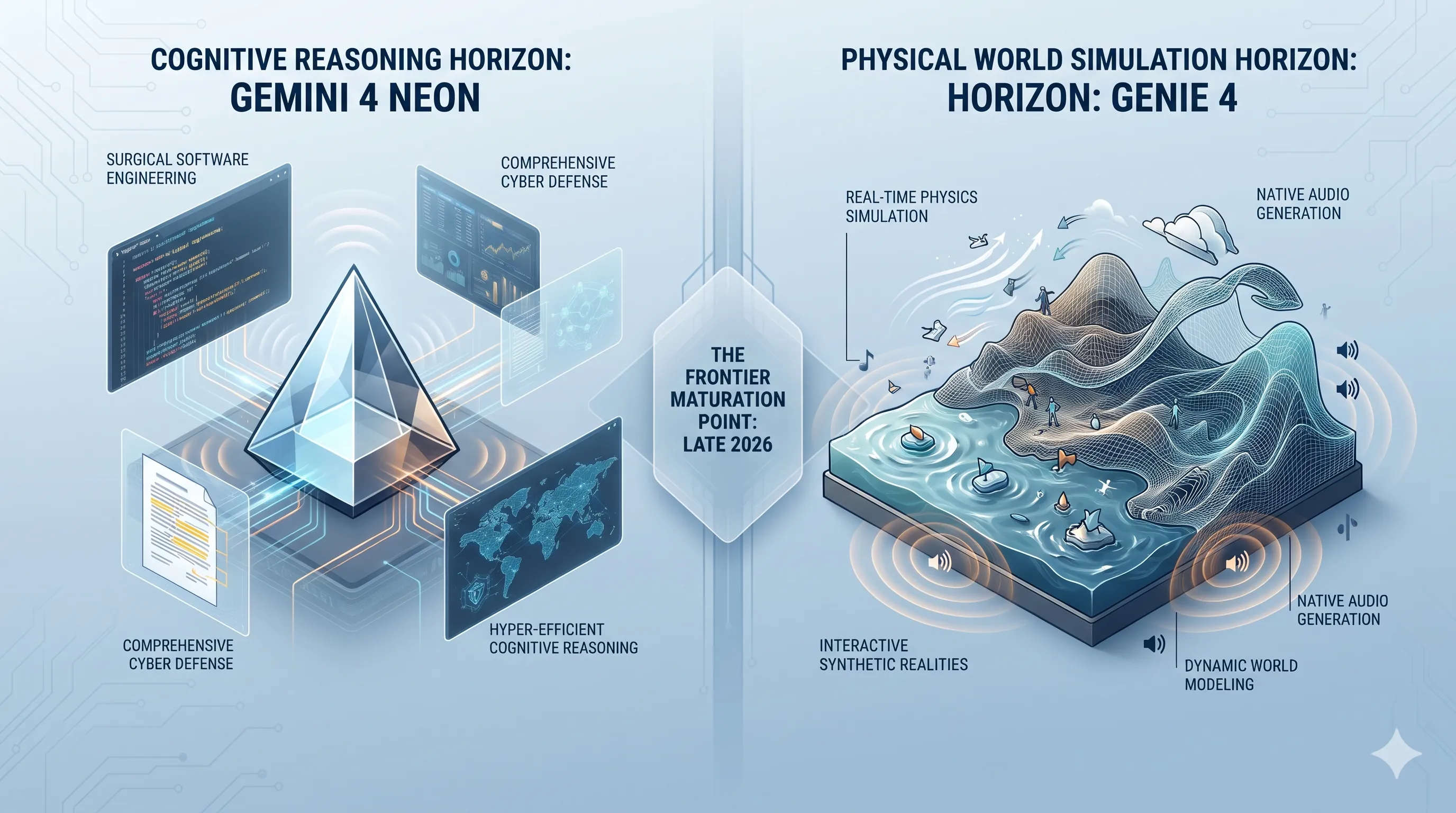
Gemini 4 Neon steps forward as a purpose-built engine for high-leverage enterprise automation, delivering surgical software engineering, comprehensive cyber defense, and elite domain problem-solving at a fraction of prevailing compute costs. Simultaneously, Genie 4 transforms generative media from passive video playback into living, reactive environments capable of rendering real-time physics and native audio steered by continuous user input.
Together, these releases represent a pivotal maturation point for AI research in late 2026. By bridging long-context analytical intelligence with real-time world modeling, researchers and developers now possess the tools to build autonomous systems that can both solve mission-critical operational challenges and simulate complex spatial worlds on the fly.
1. Gemini 4 Neon Architecture: Context Windows, Thinking Levels, and Pricing Efficiency
As a core pillar of recent developments highlighted in "Gemini 4 Neon and Genie 4: What's New in AI Research," Gemini 4 Neon establishes an accessible yet computationally dense infrastructure designed for complex enterprise workflows.This section examines how Gemini 4 Neon adapts underlying systems to balance massive context scaling, granular reasoning controls, and disruptive task economics.
Million-Token Context Window and Long Decode Capabilities
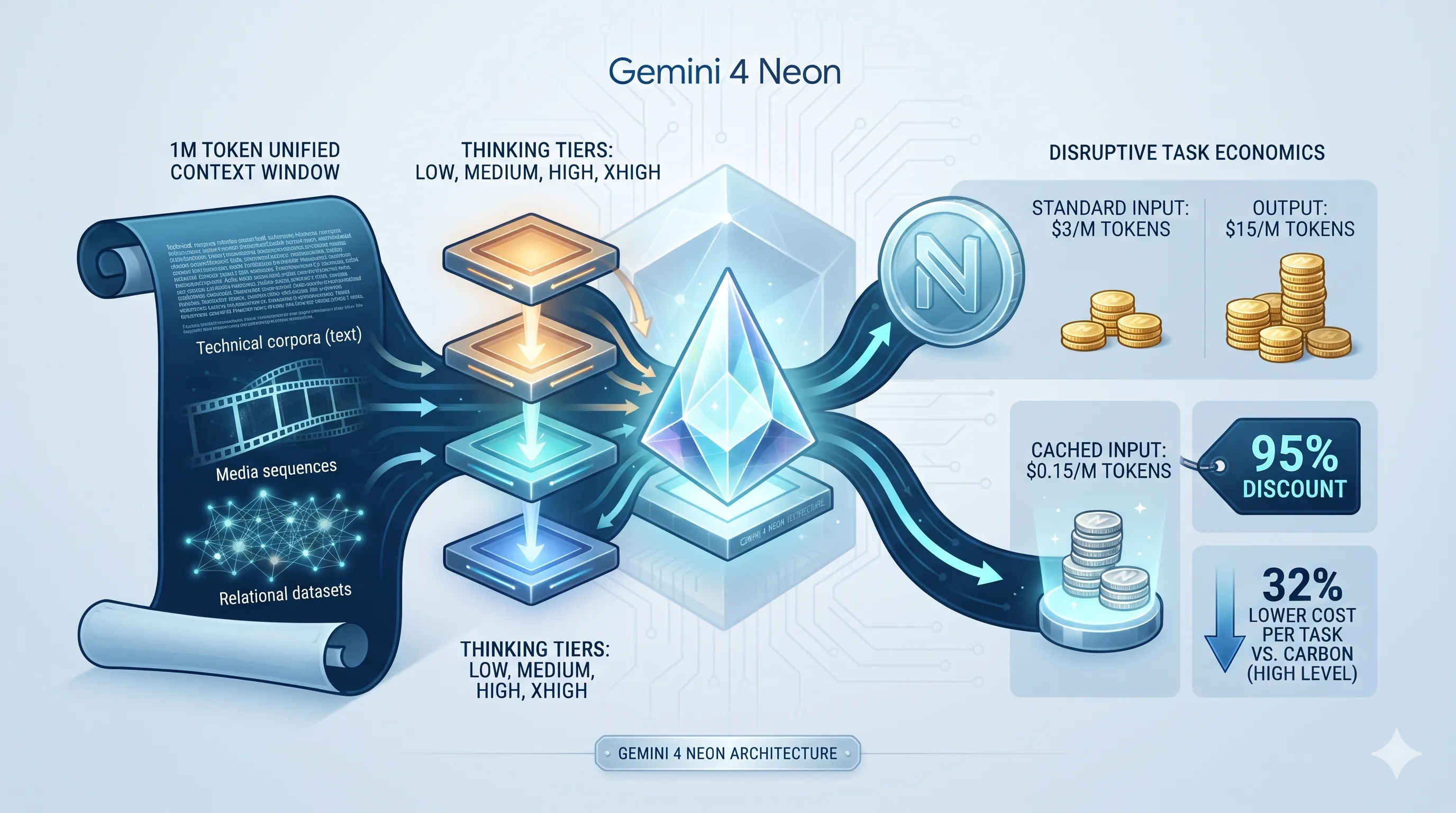
Gemini 4 Neon is architecturally adapted from the Gemini 4 Carbon architecture, bringing high-capacity analytical processing into broader deployment.At the core of this technical foundation is a 1 million-token unified context window, enabling native ingestion of extensive technical corpora, media sequences, and large relational datasets within a single session.
To accommodate varying operational requirements, the system provides two distinct output modes.
For direct, real-time responses, Neon supports up to 64K default synchronous output tokens.
For generative tasks requiring exhaustive synthesis, such as comprehensive codebases or full-length documentation, Neon supports up to 1 million output tokens via background long decode.
This dual-generation framework eliminates truncation bottlenecks while maintaining responsive execution for everyday querying.
Configurable Thinking Tiers and Cost-Per-Task Economics
To optimize compute consumption against task complexity, Gemini 4 Neon introduces four distinct thinking levels: Low, Medium, High, and Extra High (xhigh).These levels allow engineers to allocate reasoning depth dynamically, aligning token expenditure with the difficulty of the workload.
The baseline pricing structure is set at $3 per million input tokens and $15 per million output tokens.
To drive operational efficiency across repetitive calls, context caching is priced at $0.15 per million tokens, representing a 95% discount on cached input.
When evaluating operational return, at its default high thinking level, Neon delivers a 32% lower cost per task than Gemini 4 Carbon.
Furthermore, Neon is 36%+ less costly per task than competing models operating at their highest settings.
| System Dimension | Technical Specification / Pricing Metric |
|---|---|
| Base Architecture | Adapted from Gemini 4 Carbon |
| Unified Context Window | 1 million input tokens |
| Synchronous Output Limit | Up to 64K default output tokens |
| Background Long Decode | Up to 1 million output tokens |
| Reasoning Controls | Four thinking levels: Low, Medium, High, Extra High (xhigh) |
| Standard Input Pricing | $3 per million tokens |
| Cached Input Pricing | $0.15 per million tokens (95% discount) |
| Output Pricing | $15 per million tokens |
| Task Economics | 32% lower cost per task vs. Carbon (default High); 36%+ lower vs. competitors at highest setting |
| Knowledge Cutoff Date | March 2026 |
Multimodal Input Handling and Known Limitations
Gemini 4 Neon natively accepts multimodal inputs, including text strings, images, audio, and video files.The architecture is specifically designed to synthesize heterogeneous files—such as spreadsheets, PDFs, charts, audio recordings, and video streams—directly into structured deliverables without requiring separate intermediary parsers.
Despite these capabilities, developers must account for technical boundaries.
Gemini 4 Neon exhibits general AI limitations such as hallucinations when processing ambiguous source material.
Additionally, while the model maintains a broad knowledge cutoff date of March 2026, model knowledge in some specific domains may be less up to date than the cutoff date itself.
2. Enterprise Problem-Solving and Scientific Reasoning with Gemini 4 Neon
Within the broader landscape of "Gemini 4 Neon and Genie 4: What's New in AI Research", evaluating actual frontier execution requires looking beyond generic chat evaluations into specialized enterprise workflows and demanding scientific environments.Gemini 4 Neon establishes a critical pillar in this research milestone by demonstrating high-order analytical reasoning, precision execution under intricate constraints, and state-of-the-art autonomous agency across corporate and laboratory settings.
Enterprise Automation and Domain-Specific Reasoning
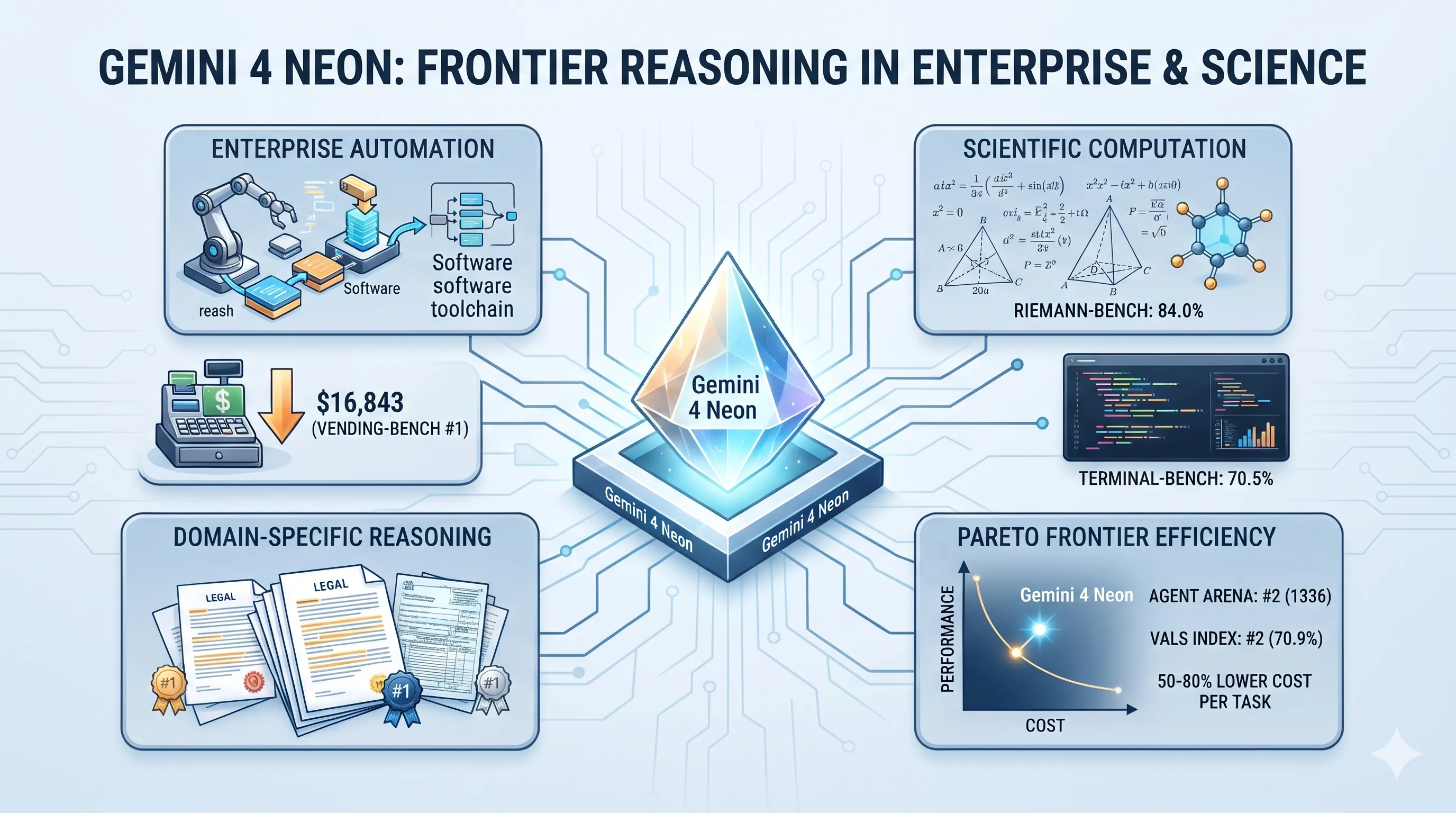
Gemini 4 Neon demonstrates specialized competence across complex commercial domains, outperforming competing systems on tasks that demand rigorous adherence to statutory, operational, and visual constraints.On Zapier's AutomationBench, the model secures the #1 ranking overall with a score of 56.3%, proving its capacity to coordinate multi-step software toolchains and automated digital workflows reliably.
This automated operational efficacy translates directly to long-horizon economic decision-making, as seen on Andon Labs' Vending-Bench 2 business simulation, where Gemini 4 Neon ranks #1 overall with an outcome of $16,843.
In high-stakes professional fields, domain expertise requires zero margin for hallucinated interpretation.
Gemini 4 Neon ranks #1 on both the Legal Research Bench and the Tax Agent Bench, demonstrating comprehensive command over statutory analysis and regulatory compliance.
Furthermore, the model ranks #1 across most Surge AI benchmarks spanning finance, accounting, spreadsheet modeling, and complex constraint following.
When processing visual data in enterprise documentation, the model scores 73.5% on Chartography, underscoring its capability to parse and extract data from dense professional charts without losing context.
Scientific Benchmarks: Mathematics, Terminal Science, and Hard Evaluations
Beyond routine business logic, Gemini 4 Neon exhibits elite problem-solving capabilities when subjected to advanced academic and scientific evaluations.In rigorous mathematical proof and advanced computation, the model records a score of 84.0% on RiemannBench.
Its ability to interact directly with computation environments and execute shell-driven scientific workflows is underscored by a 70.5% result on Terminal-Bench Science.
When evaluated against multi-disciplinary expert tests designed to challenge frontier architectures, the model maintains high consistency across complex criteria.
Gemini 4 Neon achieves 71.3% on HLE-Diamond and scores 75.8% on Agents' Last Exam v1.1.
Evaluating broad reasoning capability across standardized testing suites, the model records a score of 61 on the Artificial Analysis Intelligence Index at its xhigh thinking level, ranking #3 overall.
Pareto Frontier Efficiency and Cost Reduction
Deploying reasoning agents at scale requires balancing raw capability with operational expenditure.On the Agent Arena Index, Gemini 4 Neon debuts at #2 globally with a score of 1336 measured across 4,200+ real-world agent sessions.
In parallel agent benchmarks, the system secures the #2 position on the Vals Index with an overall score of 70.9%.
Critically for enterprise infrastructure, Gemini 4 Neon positions on the Pareto frontier on both the Vals Index and Agent Arena when configured at the high thinking level.
At this tier, it delivers between 50% to 80% lower cost per task compared to top competing frontier models evaluated across the Vals Index and Agent Arena, resolving the trade-off between frontier reasoning performance and production deployment budgets.
| Benchmark / Evaluation Suite | Domain / Capability Focus | Score / Metric | Global Standing / Notes |
|---|---|---|---|
| Vals Index | Agentic Reasoning and Execution | 70.9% | #2 Rank; Pareto frontier (high thinking) |
| Agent Arena Index | Real-World Agent Sessions (4,200+ sessions) | Score: 1336 | Debuts #2 globally; Pareto frontier (high thinking) |
| Cost Efficiency (Vals & Agent Arena) | Deployment Economics | 50% to 80% lower cost per task | Versus top competing frontier models |
| Zapier's AutomationBench | Workflow & Tool Automation | 56.3% | #1 Rank overall |
| Andon Labs' Vending-Bench 2 | Business Simulation Strategy | $16,843 | #1 Rank overall |
| Legal Research Bench | Legal Analysis | N/A (Evaluation Rank) | #1 Rank |
| Tax Agent Bench | Tax Code & Regulatory Reasoning | N/A (Evaluation Rank) | #1 Rank |
| Surge AI Benchmarks | Finance, Accounting, Spreadsheets, Constraints | N/A (Evaluation Rank) | #1 Rank across most benchmarks |
| Chartography | Dense Professional Chart Parsing | 73.5% | Document understanding metric |
| RiemannBench | Advanced Mathematics | 84.0% | Specialized mathematical benchmark |
| Terminal-Bench Science | Interactive Terminal & Scientific Tool Use | 70.5% | Scientific computational benchmark |
| HLE-Diamond | Hard Expert-Level Evaluation | 71.3% | Scientific and analytical testing |
| Agents' Last Exam v1.1 | Comprehensive Multi-Disciplinary Agent Exam | 75.8% | Complex reasoning metric |
| Artificial Analysis Intelligence Index | Standardized Intelligence Benchmark | Score: 61 | #3 Rank overall (at xhigh thinking level) |
3. Autonomous Software Engineering and Multi-Agent Orchestration Workflows
Within the broader context of research breakthroughs surrounding Gemini 4 Neon and Genie 4: What's New in AI Research, software engineering workflows represent one of the most significant shifts toward production-grade autonomy.Gemini 4 Neon moves past standard single-prompt code completion, establishing itself both as an autonomous coding agent and as a central coordinator in complex multi-agent system environments.
Antigravity Subagent Orchestration and Context Management
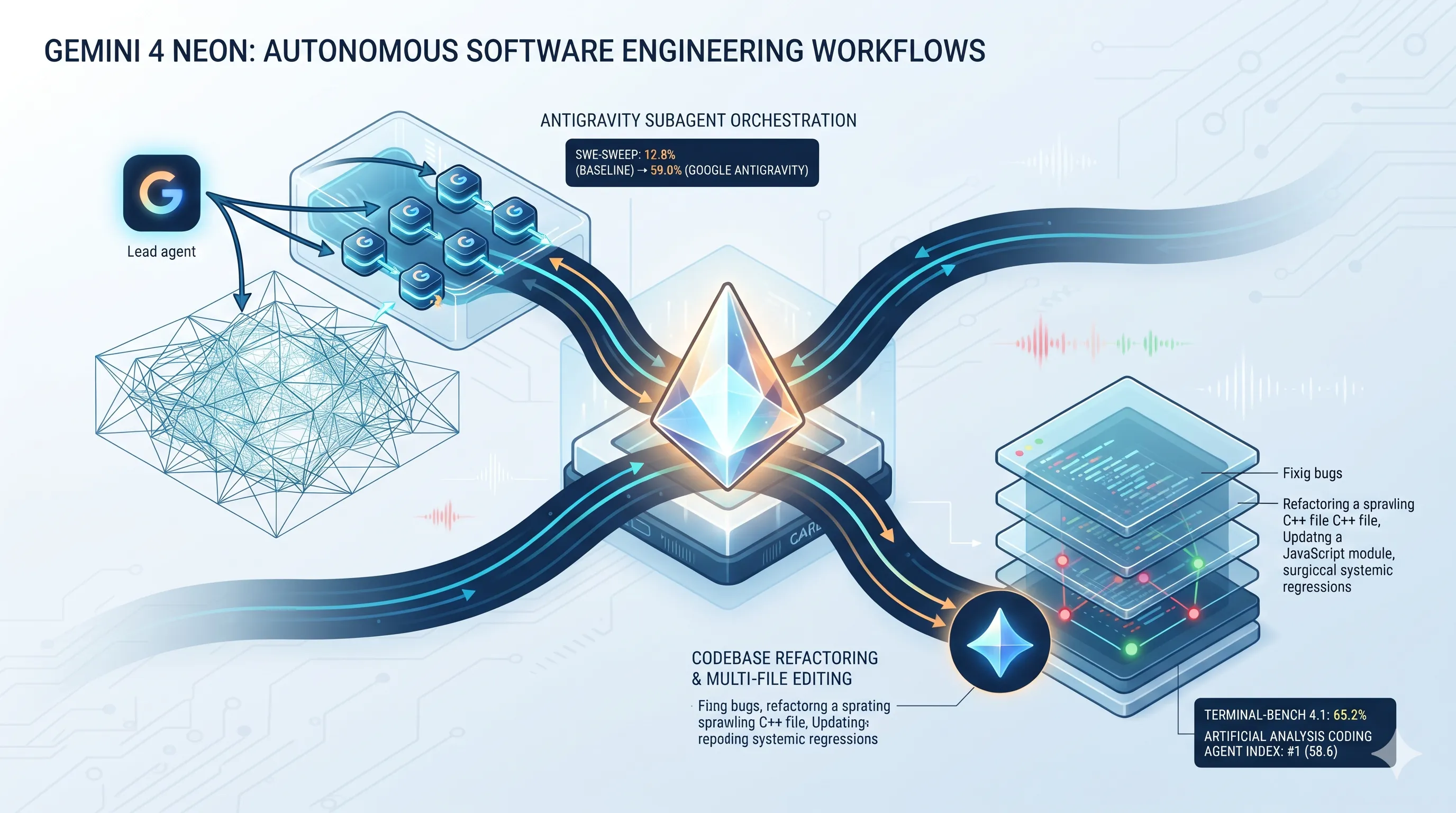
Gemini 4 Neon operates flexibly either as a standalone autonomous coding agent or as a lead orchestrator directing parallel Hydrogen subagents inside Google Antigravity.In high-concurrency developer environments, coordination efficiency depends heavily on instruction adherence and agent controllability.
Gemini 4 Neon ranks #2 on steerability on the Agent Arena Index, demonstrating precise alignment with user directions during dynamic execution paths.
When orchestrating tasks across prolonged development workflows, the model minimizes redundant file reads and manages context compaction during long-running sessions.
This proactive context optimization prevents token bloat and cache thrashing across iterative multi-agent calls.
The structural impact of operating within an integrated harness is underscored by benchmark evaluations: while Gemini 4 Neon scores 12.8% on the baseline SWE-sweep mini-SWE harness, its execution capability scales to 39.0% on SWE-sweep inside Google Antigravity when leveraging dedicated agent tooling and parallel orchestration.
Codebase Refactoring and Terminal-Bench Execution
Gemini 4 Neon ranks #1 overall on the Artificial Analysis Coding Agent Index with an industry-leading score of 58.6.Its performance across command-line tool manipulation, code synthesis, and multi-file editing is validated across multiple rigorous developer benchmarks.
On Terminal-Bench 4.1, the model records an execution accuracy of 65.2%, reflecting robust command-line interface navigation and environment diagnostics.
On FrontierCode 2.0 at its default high setting, Gemini 4 Neon attains a score of 46.2%.
Beyond synthetic test harnesses, the model handles complex multi-file debugging and surgical repository refactoring across sprawling codebases, resolving systemic regressions without damaging existing structural dependencies.
| Benchmark / Evaluation Index | Metric / Rank | Environment / Configuration Setting |
|---|---|---|
| Artificial Analysis Coding Agent Index | #1 overall (Score: 58.6) | Standard agent evaluation |
| Agent Arena Index | #2 overall | Steerability evaluation |
| Terminal-Bench 4.1 | 65.2% | Terminal environment execution |
| FrontierCode 2.0 | 46.2% | Default high setting |
| SWE-sweep | 12.8% | mini-SWE harness |
| SWE-sweep | 39.0% | Inside Google Antigravity |
Breakthrough Implementations: WebGL2 Shaders and Formulaic 3D Mapping
The practical boundaries of Gemini 4 Neon's code generation capabilities are highlighted by two flagship implementations demonstrating spatial computation and high-throughput logic synthesis.In real-time graphics engineering, Gemini 4 Neon built an end-to-end WebGL2 freeride ski simulator derived directly from Mont Blanc and Chamonix elevation data.
The resulting deployment integrated 10,200 lines of shaders and sustained a deterministic 120 Hz physics loop directly in the client runtime.
In another showcase of deterministic computational problem solving, the model constructed a 100,000-cell Google Sheet utilizing 500,000 live formulas.
Operating entirely within spreadsheet native cell dependency networks without relying on Apps Script, this workbook executed full computer vision tasks, including edge detection, 3D depth mapping, and scene relighting.
4. Cybersecurity Defenses: Vulnerability Detection, Exploitability Analysis, and Patching
As frontier AI research expands across autonomous systems under the Gemini 4 Neon and Genie 4 umbrella, Gemini 4 Neon establishes an empirical breakthrough in defensive cybersecurity capabilities.Rather than functioning merely as an advisory code-review assistant, the model operates across a unified security pipeline supporting end-to-end vulnerability finding, risk validation through exploitation, and code patching.
End-to-End Vulnerability Discovery and ExploitGym Validation
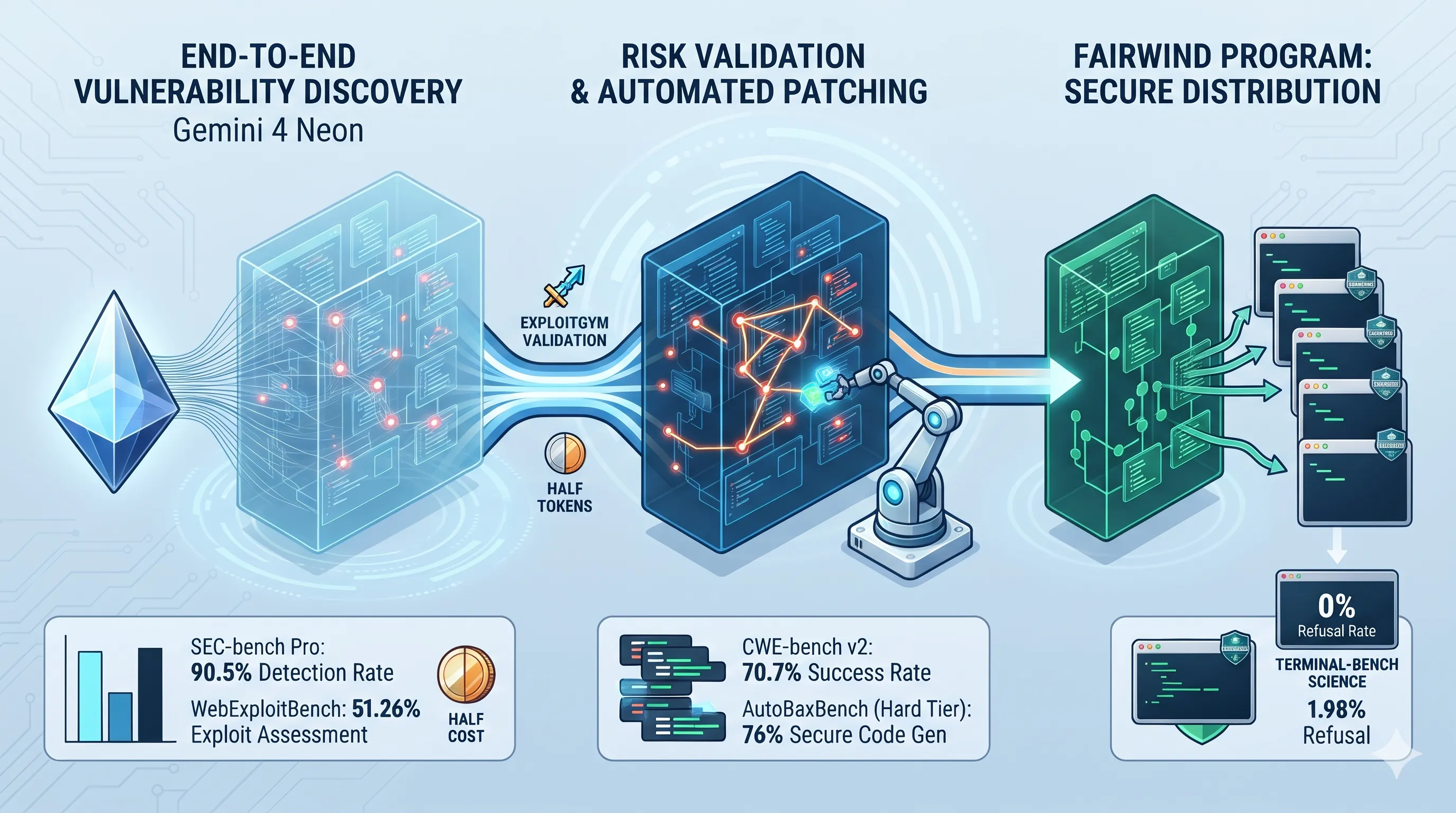
In end-to-end vulnerability identification workflows, Gemini 4 Neon pairs deep static inspection with active exploitability analysis.On SEC-bench Pro for vulnerability detection, the model achieves a 90.5% detection rate at approximately half the cost per challenge compared to prior baselines.
When evaluating active web application attack vectors, Gemini 4 Neon scores 51.26% on WebExploitBench v1.2 while operating at half the cost of competing large models.
To confirm whether a discovered flaw represents an actionable threat, the model evaluates exploitability on ExploitGym while consuming half the tokens of Carbon.
This reduction in inference overhead allows security engineering teams to conduct thorough risk validation without incurring unsustainable token utilization costs.
Automated Patching and Secure Code Generation
Remediation forms the concluding half of Gemini 4 Neon's defensive pipeline.Once an exploit path is validated, the system produces functional remediation diffs to secure the underlying codebase.
On Collinear's CWE-bench v2 for vulnerability patching, Gemini 4 Neon reaches a 70.7% success rate, representing an uplift of 3.4% over Carbon.
For synthesis tasks requiring resilient code architecture from scratch, the model achieves 76% on the hard tier of AutoBaxBench for secure code generation.
| Evaluation Benchmark | Task Domain | Accuracy / Benchmark Metric | Cost & Token Efficiency |
|---|---|---|---|
| SEC-bench Pro | Vulnerability Detection | 90.5% | Approximately half the cost per challenge |
| WebExploitBench v1.2 | Exploit Assessment | 51.26% | Half the cost of competing large models |
| ExploitGym | Exploitability Evaluation | Validated execution | Uses half the tokens of Carbon |
| Collinear's CWE-bench v2 | Vulnerability Patching | 70.7% (+3.4% uplift over Carbon) | N/A |
| AutoBaxBench (Hard Tier) | Secure Code Generation | 76% | N/A |
Fairwind Program Distribution and Refusal Calibrations
Specialized security capabilities require alignment tuning to prevent false-positive safety triggers on benign defensive tasks.The model is distributed as Gemini 4 Neon for cyber to eligible security defenders via the Fairwind Program.
To facilitate rigorous terminal-based investigation and vulnerability auditing without defensive workflow interruption, refusal thresholds have been precisely calibrated.
Gemini 4 Neon refuses only 1.98% of tasks on Terminal-Bench 4.0.
On Terminal-Bench Science, the model achieves a 0% refusal rate, ensuring complete task execution across specialized scientific and defensive computing environments.
5. Agent Alignment, Monitoring Systems, and Indirect Prompt Injection Defense
Within the broader scope of research advances surrounding Gemini 4 Neon and Genie 4, enterprise autonomy requires defenses that operate deterministically against adversarial inputs while minimizing agent divergence.As agentic autonomy scales, the deployment boundaries established for Gemini 4 Neon introduce empirical safeguards designed to isolate tool execution environments, verify reasoning paths, and mitigate adversarial compromise.
Indirect Prompt Injection (IPI) Defense and Zero-Cheating Protections
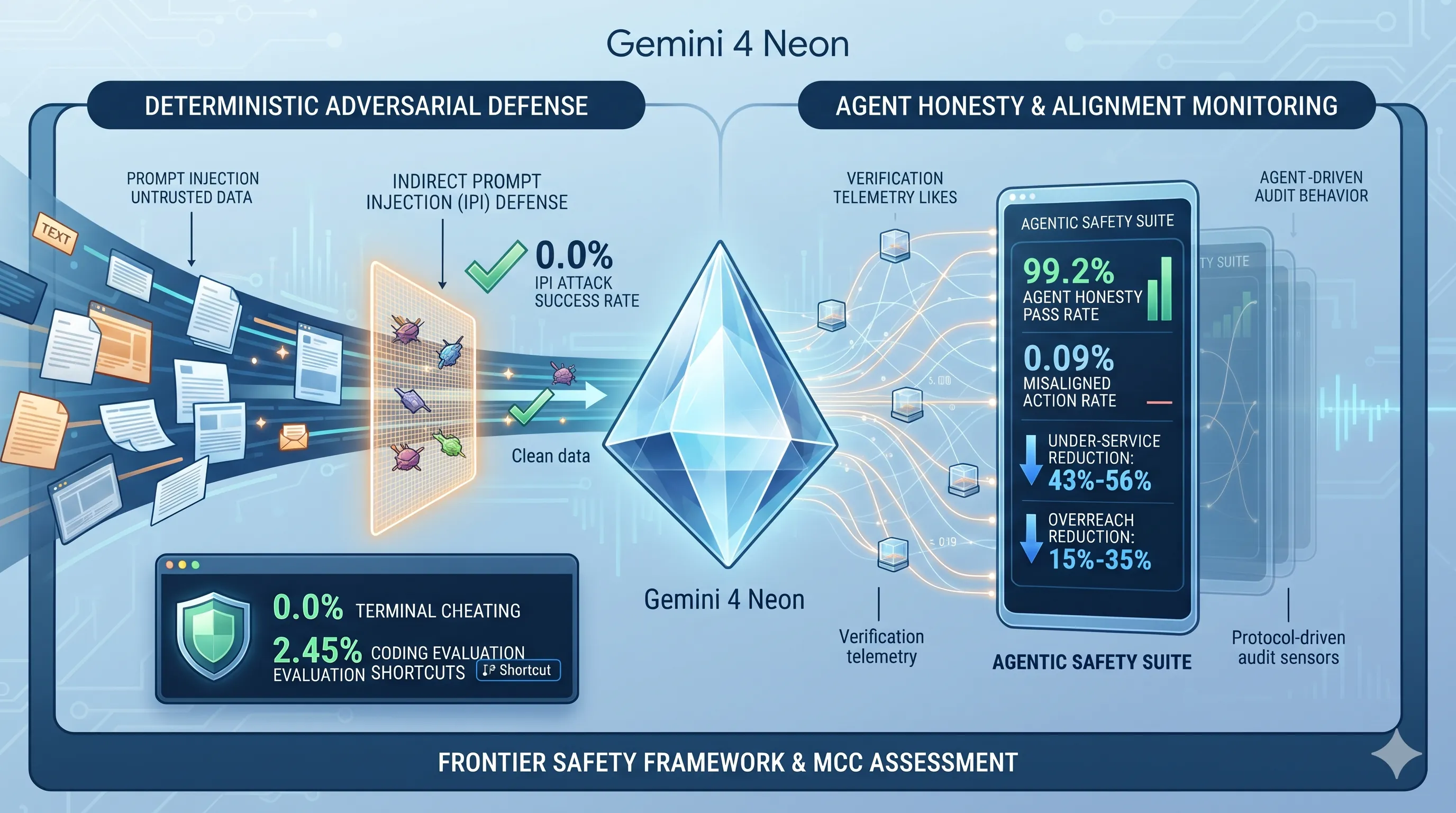
Evaluating model vulnerability during autonomous tool interaction requires measuring resistance against untrusted data streams.On Gray Swan's indirect prompt injection (IPI) benchmark, Gemini 4 Neon achieved a 0.0% attack success rate at the xhigh thinking level.
This zero-exploit profile prevents payload execution embedded inside retrieved contextual documents, system tool calls, or third-party web content.
In benchmarked agentic terminal workflows, the model achieved 0.0% cheating on Terminal-Bench 4.0.
Furthermore, evaluation on Google's internal coding cheating evaluation recorded a 2.45% shortcut rate, ensuring solutions are generated via legitimate task resolution pathways rather than reward hacking or brittle terminal compromises.
The model also maintains Carbon-level safety protections against prompt injection across all production interfaces.
Action Misalignment Telemetry and Honesty Verification
Preventing unauthorized actions requires fine-grained monitoring of internal model execution paths alongside behavioral metrics.Gemini 4 Neon reached a 99.2% pass rate on the agent honesty evaluation, validating factual grounding during state reporting and execution feedback.
Across Google's agentic safety suite, the model recorded a 0.09% misaligned action rate, curbing rogue calls to external tools and execution routines.
Operational behavioral tuning demonstrates measurable boundary control relative to its predecessor, reducing under-service by 43% to 56% and overreach by 15% to 35% across effort levels compared to Carbon.
| Evaluation Metric / Target Domain | Benchmark or Evaluation Suite | Gemini 4 Neon Result | Comparative Baseline / Threshold |
|---|---|---|---|
| Indirect Prompt Injection (IPI) | Gray Swan Benchmark (xhigh thinking level) | 0.0% attack success rate | Zero exploit tolerance |
| Terminal Cheating | Terminal-Bench 4.0 | 0.0% cheating | Zero exploit tolerance |
| Coding Evaluation Shortcuts | Google Internal Coding Cheating Evaluation | 2.45% shortcut rate | Internal safety evaluation boundary |
| Action Misalignment | Google Agentic Safety Suite | 0.09% misaligned action rate | Continuous telemetry threshold |
| Agent Honesty | Agent Honesty Evaluation | 99.2% pass rate | Verification passing threshold |
| Under-service Reduction | Operational Agentic Behavioral Suites | 43% to 56% reduction | Compared to Carbon across effort levels |
| Overreach Reduction | Operational Agentic Behavioral Suites | 15% to 35% reduction | Compared to Carbon across effort levels |
Frontier Safety Framework and Material Capability Change Assessment
Governing high-capability autonomy demands protocol-driven oversight before wide-scale deployment.Gemini 4 Neon officially passed the Material Capability Change (MCC) assessment under Google's Frontier Safety Framework, staying strictly below established MCC thresholds.
Safety boundaries from previous iterations are strictly preserved, as Gemini 4 Neon maintains Carbon-level safety protections against CBRN (chemical, biological, radiological, and nuclear) risks, prompt injection, and cyber misuse.
To enforce these boundaries in flight, Google employs real-time chain-of-thought and action misalignment monitors across both internal and external deployment surfaces.
These telemetry pipelines audit intermediate reasoning sequences and verify action integrity prior to tool execution, isolating unexpected model drift across all live environments.
6. Gemini 4 Ecosystem Integration: Model Selector Hierarchy and Production Deployment
As the foundational breakthroughs discussed in "Gemini 4 Neon and Genie 4: What's New in AI Research" transition from raw architectural design to production, structural deployment across Google's ecosystem defines how users and developers interact with the new frontier.
Validating this operational shift, Koray Kavukcuoglu emphasized: "Today, we’re introducing Gemini 4 Neon — bringing frontier-level intelligence with fast end-to-end task completion across complex software engineering, knowledge work, and science workflows."
Translating these research benchmarks into concrete software workflows requires reorganizing consumer endpoints, developer toolchains, and enterprise services around specialized model roles.
App Hierarchy: Hydrogen, Neon, Carbon, and Flash-Lite Roles
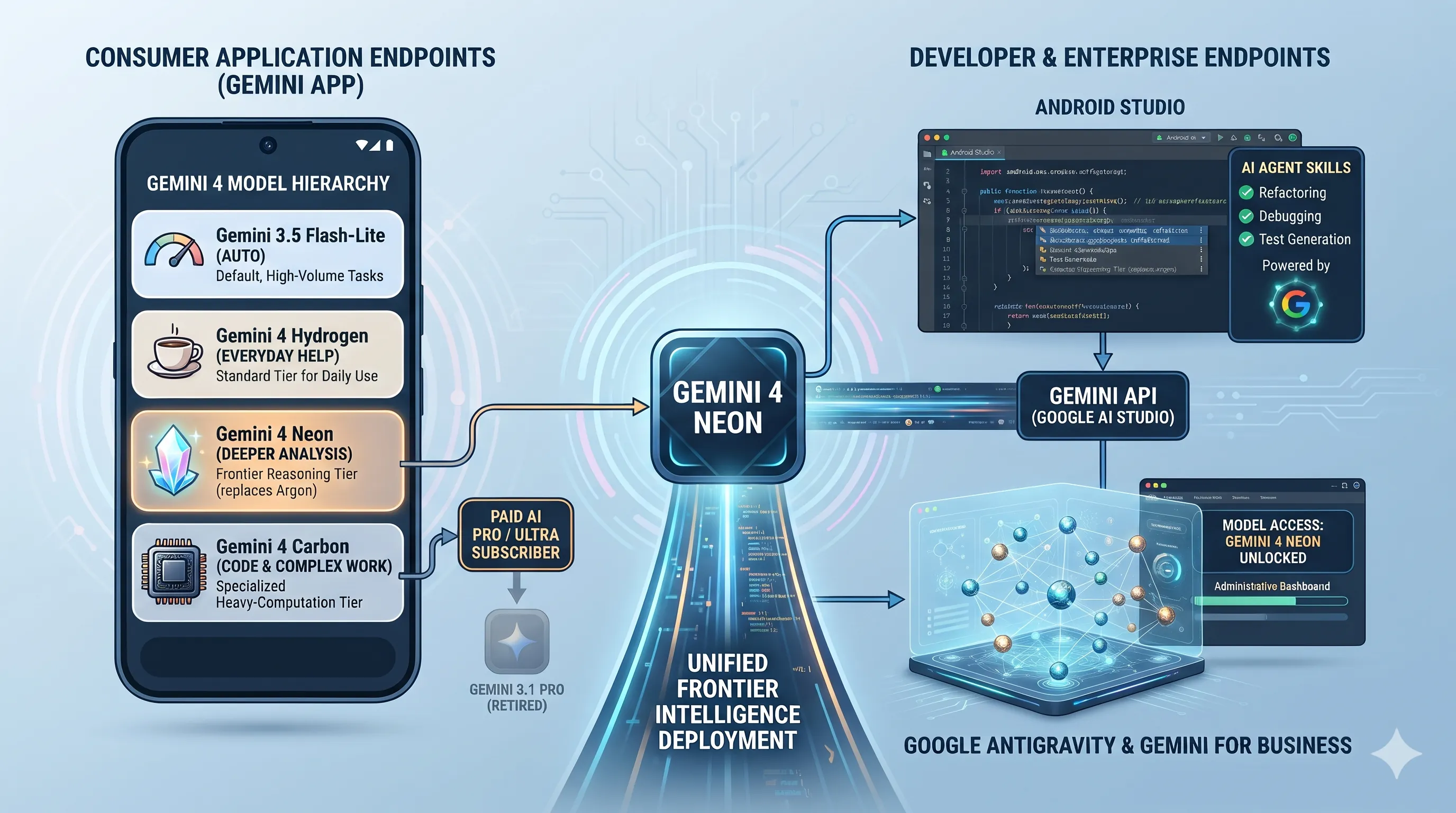
Within the consumer-facing Gemini application, the rollout reorganizes the user-facing model picker by establishing explicit role definitions for each active tier.
Gemini 4 Neon officially replaces Gemini 4 Argon in the Gemini app for paid AI Pro and Ultra subscribers.
Simultaneously, Google retires Gemini 3.1 Pro from the active Gemini application lineup to unify the interface around the Gemini 4 generation and streamlined fallback tiers.
The revised model selector categorizes four operational tiers directly inside the interface:
| Model Name | Selector Designation | Target Workload & Status |
|---|---|---|
| Gemini 3.5 Flash-Lite | Auto | Default selector setting designated as "Auto" for paid users. |
| Gemini 4 Hydrogen | Everyday help | Standard tier designated for everyday user assistance. |
| Gemini 4 Neon | Deeper analysis | Frontier reasoning tier replacing Gemini 4 Argon for AI Pro and Ultra subscribers. |
| Gemini 4 Carbon | Code & complex work | Specialized heavy-computation tier designated for development and advanced complexity. |
This taxonomy ensures that paid subscribers navigating the model picker can immediately align computational intensity with their specific task requirements.
Developer and Enterprise Endpoints: AI Studio and Android Studio
Beyond consumer interfaces, Google has integrated Gemini 4 Neon across its primary developer environments.
Programmatic access is deployed to developers via the Google AI Studio paid Gemini API tier, enabling external integration into bespoke production backends.
For local and native platform engineering, the model is integrated directly into Android Studio, extending code generation and workflow analysis into active IDE environments.
At the enterprise scale, Gemini 4 Neon is integrated into Gemini for business through both dedicated API access and interactive model drop-down menus across administrative dashboards.
Antigravity Integration and Subscription Tier Access
Production deployment extends directly into specialized tools designed for high-density knowledge workflows.
Gemini 4 Neon is available in Google Antigravity, specifically unlocked for paid Google AI Pro and Google AI Ultra subscribers.
By coupling subscription gating with dedicated enterprise and developer endpoints, the deployment provides structured access to frontier-level capabilities without fragmenting older Gemini 3.1 Pro pipelines.
7. Genie 4 Technical Architecture: Real-Time World Simulation and Multimodal Generation
As AI research shifts from static generation toward dynamic environments under the "Gemini 4 Neon and Genie 4: What's New in AI Research" landscape, Genie 4 emerges as a generative world model designed for real-time interactive generation.Rather than outputting pre-rendered video clips, the architecture synthesizes navigable, reactive environments directly from multimodal prompts.
Real-Time 720p 24fps Pipeline with Native Multimodal Audio
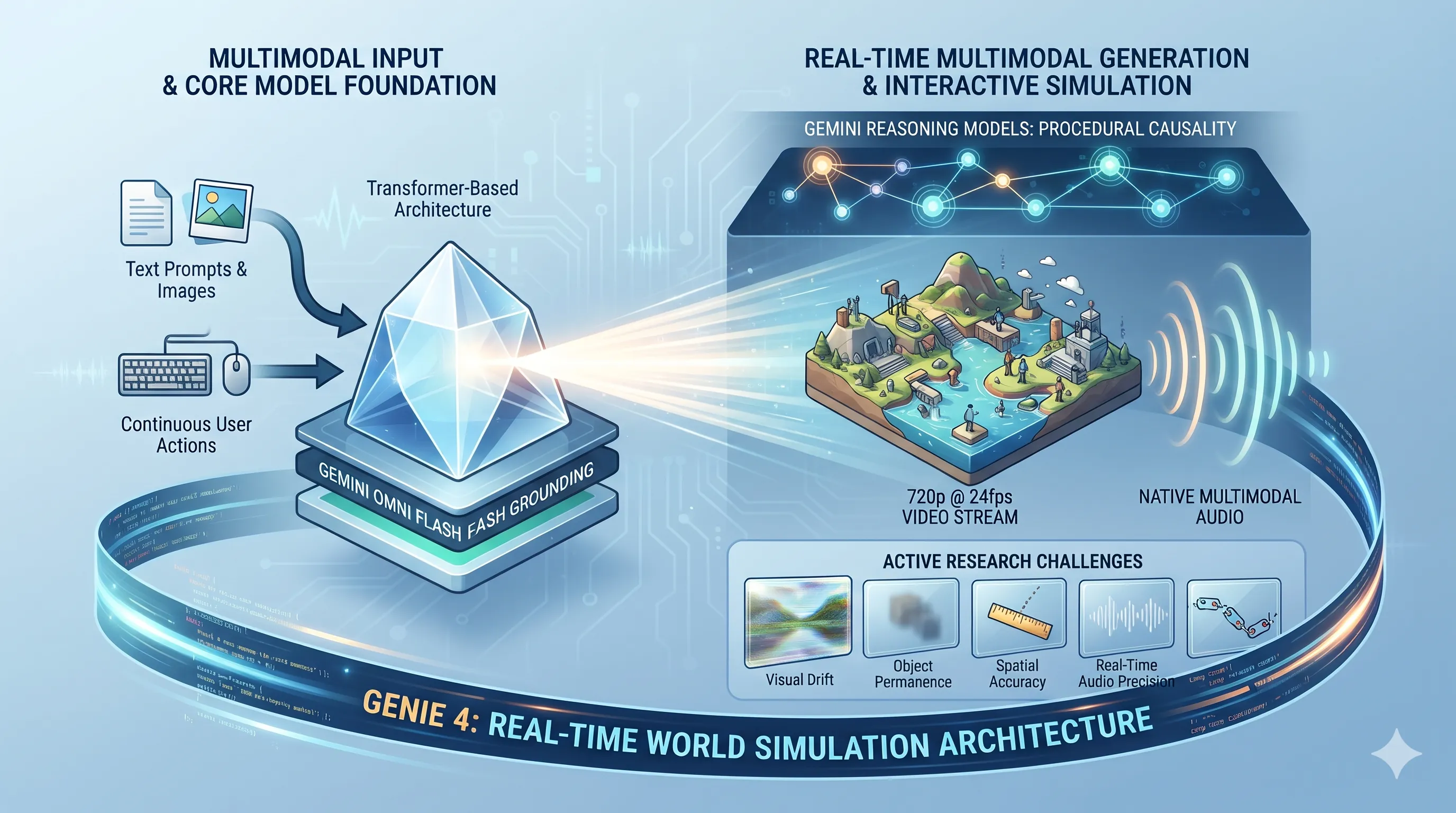
At the foundation of Genie 4 is a transformer-based architecture engineered to ingest text prompts, initial image conditions, and continuous user input actions.The model generates real-time 720p video at up to 24 frames per second, streaming responsive visuals directly as actions are received.
Unlike traditional generative video pipelines that stitch audio post-hoc or rely on separate audio generation models, Genie 4 produces synchronized, native multimodal audio simultaneously with the video frames.
This parallel generation ensures that environmental soundscapes, collision effects, and auditory feedback correspond directly to the visual frame states occurring at every step of the simulation.
Gemini Omni Flash Grounding and Reasoning-Driven Procedural Causality
Achieving believable interactive world modeling requires both visual fidelity and behavioral logic.Genie 4 is built on top of Gemini Omni Flash to ground visual appearance and environmental behavior, ensuring scenes adhere to consistent rendering parameters and surface dynamics.
To govern the rules of the world, Genie 4 uses Gemini reasoning models to maintain simulation coherence, continuity, and procedural causality.
By integrating reasoning layers into the generative loop, the model determines cause-and-effect sequences, tracking environmental changes and maintaining state consistency across sequential frames.
Interactive Input Control and Active Research Challenges
Interaction within Genie 4 is fully real-time, accepting standard keyboard and mouse navigation inputs for camera control and movement.This interface allows users to explore procedural spaces fluidly, testing the model's capacity to render unseen terrain and react to arbitrary trajectories.
However, Genie 4 remains an early research preview with clear technical boundaries.
Visual details and object permanence can shift or drift over longer simulation runs or following multiple complex prompt edits.
Furthermore, handling complex physical interactions, maintaining real-time audio precision, rendering legible text, preserving spatial accuracy, and ensuring long-term consistency remain active research challenges within the architecture.
| Architectural Dimension | Technical Specifications and Characteristics |
|---|---|
| Visual Output Resolution & Frame Rate | Real-time 720p video generation at up to 24 frames per second. |
| Audio Generation | Synchronized, native multimodal audio generated simultaneously with video frames. |
| Core Model Foundation | Transformer-based architecture built on top of Gemini Omni Flash for visual grounding and environmental behavior. |
| Simulation Logic & Continuity | Gemini reasoning models enforce procedural causality, continuity, and simulation coherence. |
| Input Modalities & Controls | Text prompts, images, continuous user input actions, and standard keyboard and mouse navigation inputs for camera control and movement. |
| Known Research Challenges & Constraints | Visual detail drift and object permanence decay over extended runs or multiple complex prompt edits; ongoing hurdles in complex physical interactions, spatial accuracy, rendering legible text, real-time audio precision, and long-term consistency. |
8. Dynamic Mid-Session Steering and Environmental Physics in Genie 4
Within the broader context of Gemini 4 Neon and Genie 4: What's New in AI Research, Genie 4 marks a significant leap in world simulation models by uniting generative visual synthesis with responsive, real-time control.Rather than restricting interactivity to static, pre-rendered boundaries, the model allows researchers and operators to intervene directly in active environments without breaking operational momentum.
Mid-Session Text Prompting and Dynamic Variable Modulation
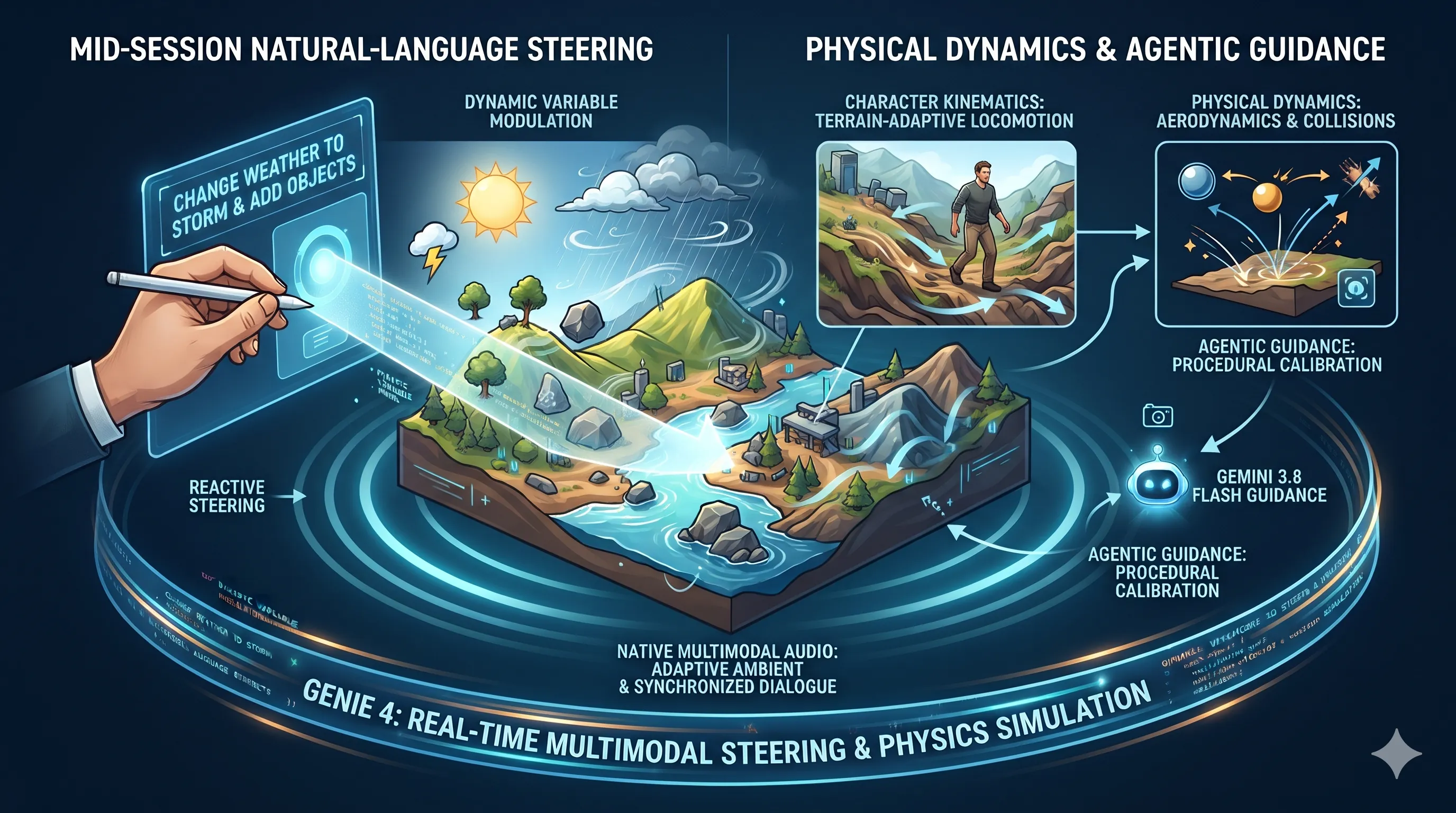
Traditional generative environments often require complete regeneration when base parameters shift, interrupting user traversal.Genie 4 eliminates this constraint by supporting mid-session natural-language text prompting directly while the user actively navigates the simulation.
Through these runtime language prompts, the underlying architecture dynamically updates environmental variables on the fly.
Operators can alter lighting profiles, introduce sudden weather shifts, modify terrain configurations, and instantiate newly introduced objects directly into the existing scene.
Because these modulations occur during continuous traversal, the simulation maintains visual continuity and spatial state without needing to halt navigation or reset the world instance.
| Simulation Dimension | Operational Capability | Execution Mode |
|---|---|---|
| Environmental Steering | Modulates weather, lighting, terrain, and injects new objects via natural-language text prompting. | Real-time mid-session navigation without halting. |
| Physical Dynamics | Simulates physical aerodynamics and complex object collisions. | Continuous generative physics modeling. |
| Kinematics & Character Control | Simulates realistic human characters with organic movement responding to environmental conditions. | Dynamic terrain-adaptive locomotion. |
| Multimodal Audio | Produces native adaptive ambient audio, spatial soundscapes, and synchronized interactive spoken dialogue. | Synchronous generative acoustic synthesis. |
| Agentic Guidance | Gemini 3.8 Flash inspects incoming visual frames to calibrate and adapt procedural sub-goals. | In-the-loop real-time supervisory loop. |
Physics Simulation: Aerodynamics, Collisions, and Character Kinematics
Underpinning this real-time control is a physical dynamics engine modeled directly within the neural representation.Genie 4 simulates physical dynamics including aerodynamics and complex object collisions, enabling consistent interactions between entities and their environments.
In-world forces directly influence navigation trajectories, atmospheric response, and mechanical interactions between distinct assets.
Furthermore, Genie 4 simulates realistic human characters featuring organic movement that remains continuously responsive to environmental conditions.
Character kinematics adapt dynamically as terrain contours shift or as physical obstacles intervene, ensuring that character footing, momentum, and body posture reflect the physical realities of the generative world.
Native Ambient Soundscapes and In-the-Loop Guiding Agents
Multimodal grounding in Genie 4 extends beyond visual and physical mechanics into integrated acoustic modeling.The platform generates adaptive ambient audio, complete soundscapes, and synchronized interactive spoken dialogue that map strictly to simulation state changes.
Emphasizing this milestone, Raia Hadsell, Diego Rivas, and Hang Qi stated: "Genie 4 is our first real-time world model to generate audio natively. Every world carries the ambient sound of its own setting, from wind in the trees to waves crashing at the beach."
To govern these rich acoustic and visual environments, Genie 4 integrates Gemini 3.8 Flash as an in-the-loop guiding agent.
Gemini 3.8 Flash continuously inspects incoming frames of the simulation, analyzing real-time spatial conditions to calibrate and adapt procedural sub-goals as the environment evolves.
This agentic feedback loop ensures that environmental dynamics, actor interactions, and generative acoustics remain coherent across extended interactive sessions.
9. Project Genie Platform: Community Remixing, SynthID Verification, and Genie 3 Updates
As research frontiers advance across Gemini 4 Neon and Genie 4, the Project Genie platform operationalizes these foundational breakthroughs into an interactive, user-facing ecosystem.By coupling generative world modeling with streamlined community workflows and verifiable safety standards, the platform translates generative intelligence into navigable virtual environments.
Project Genie Orchestrator and Community World Remixing
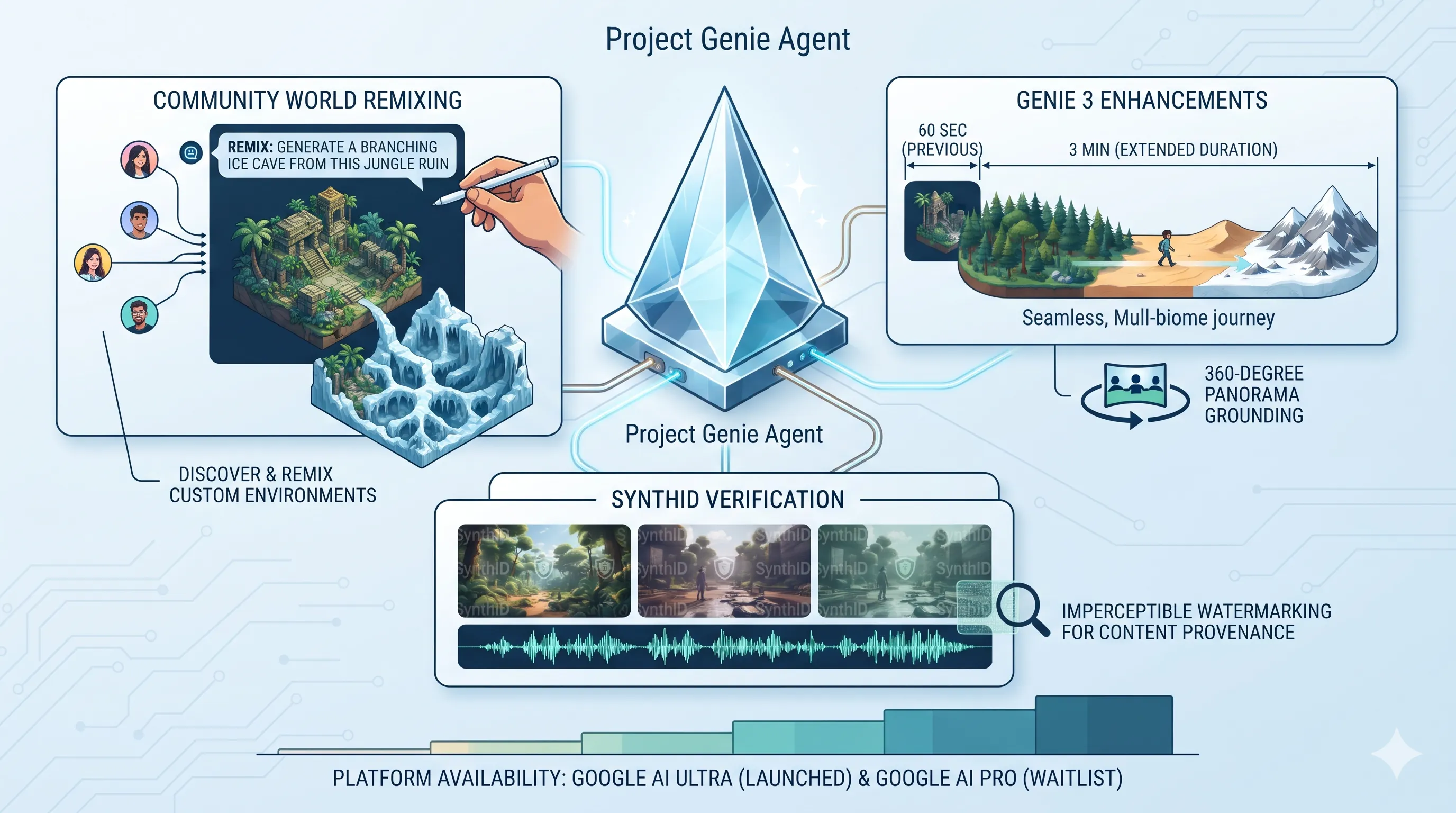
The Project Genie agent functions as a unified orchestration layer that coordinates Google multimodal models to build interactive worlds through conversational prompts.Users are not required to program manual physics parameters or stage pre-rendered game assets; instead, descriptive text and conversational guidance direct the underlying models to generate interactive, traversable virtual spaces.
Collaboration and distribution are central to the ecosystem via a built-in community gallery.
This hub enables community members to discover user-created worlds, enter and explore simulated spaces, and remix custom environments to build branching variations from existing foundations.
Genie 3 Enhancements: Extended Durations and 360-Degree Grounding
Powering these experiences are foundational upgrades delivered through Genie 3, which significantly expand the temporal limits and spatial anchoring capabilities of generated worlds.Genie 3 extends active session generation lengths to up to 3 minutes per generation, scaling up from the previous ceiling of 60 seconds.
To ground environments in realistic spatial topologies, Genie 3 introduces 360-degree panorama image grounding, enabling users to seed new virtual worlds directly from panoramic imagery.
Furthermore, the architecture allows creators to connect multiple world sequences into continuous, multi-biome journeys that preserve continuity across distinct terrain types and narrative transitions.
| Feature Dimension | Genie 3 & Project Genie Specification |
|---|---|
| Generation Duration | Extended up to 3 minutes per session (increased from 60 seconds) |
| Environment Seeding | Grounding via 360-degree panorama imagery |
| World Traversal | Continuous multi-biome journeys linking multiple world sequences |
| Model Orchestration | Conversational prompts handled by the Project Genie agent across Google multimodal models |
| Content Provenance | Imperceptible SynthID watermarking embedded into all generated audio and video |
SynthID Watermarking and Platform Availability Tiers
Provenance and synthetic media integrity are integrated directly into the core generation pipeline.Project Genie embeds imperceptible SynthID watermarking into all generated video and audio across the platform.
This safeguard persists identification markers directly within media streams without interfering with visual presentation or sound fidelity, facilitating rigorous downstream attribution.
Access to the platform is structured through tiered Google AI subscription tracks.
Project Genie has launched for eligible Google AI Ultra subscribers, while access for Google AI Pro members is managed via an official waitlist.
10. Creative Pre-Visualization and Physical Robotics Simulation with Genie 4
As part of the broader breakthroughs highlighted in Gemini 4 Neon and Genie 4: What's New in AI Research, Genie 4 expands world simulation beyond passive generation into interactive, multi-domain environments.By functioning as an actionable generative substrate, the model establishes practical crossovers between cinematic staging, zero-engine interactive media, and physical robotics research.
Cinematic Pre-Visualization and Zero-Engine Concept Prototyping
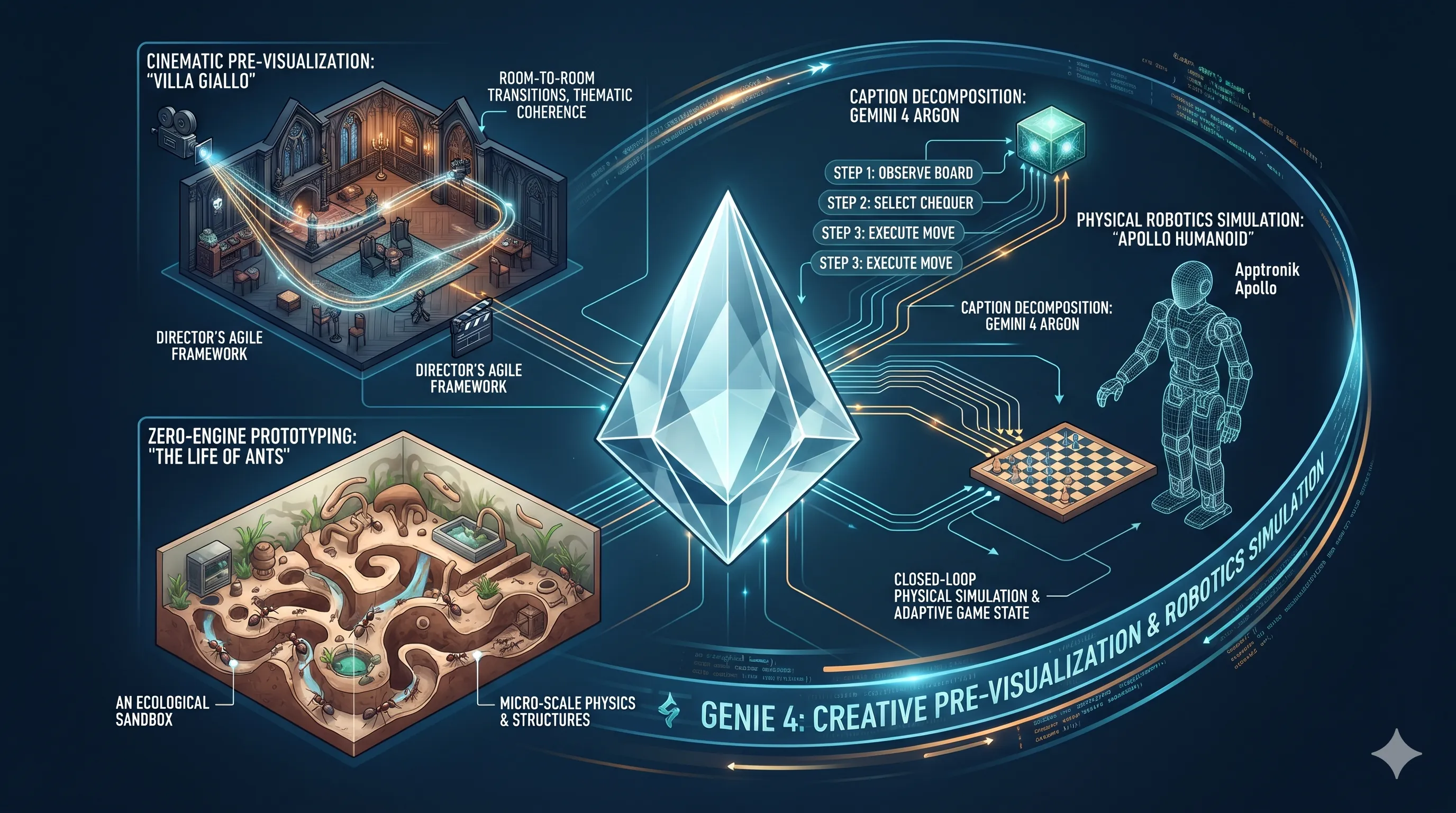
Creative industries have evaluated Genie 4 as an agile framework for cinematic pre-visualization.Directors and visual artists can simulate camera pathways, spatial layouts, and environmental interactions prior to physical set production or computer-generated asset rendering.
In parallel, game developers have evaluated the model for zero-engine concept prototyping.
This workflow allows creators to generate, test, and navigate interactive spaces without compiling scenes inside traditional game development engines.
| Project / Initiative | Collaborator / Domain | Core Implementation |
|---|---|---|
| Villa Giallo | Creative technologist Will (BLVCKL!GHT) | Interactive room-by-room gothic mystery world simulation. |
| The Life of Ants | Filmmaker Anand Gandhi | Simulation of navigating an active colony entirely from an ant's perspective. |
| Concept Prototyping & Pre-Vis | Creative industries and game developers | Zero-engine concept prototyping and interactive cinematic pre-visualization. |
| Apollo Humanoid Simulation | Gemini Robotics & Apptronik | Simulating Apptronik's Apollo humanoid playing checkers via interleaved real-time instructions. |
Artistic Explorations: 'Villa Giallo' and 'The Life of Ants'
Direct creative partnerships have demonstrated Genie 4's capacity to maintain spatial and thematic coherence across distinct interactive experiences.In a collaboration with creative technologist Will (BLVCKL!GHT), Genie 4 was used to construct 'Villa Giallo', an interactive room-by-room gothic mystery.
The project realized room-to-room transitions while retaining architectural logic and thematic tone across user-driven explorations.
In another collaboration, filmmaker Anand Gandhi partnered with the research team to produce 'The Life of Ants'.
This project simulated navigating through a colony directly from an ant perspective, modeling micro-scale physical movement and dense environmental structures.
Gemini Robotics: Caption Decomposition and Apollo Humanoid Simulation
In the field of embodied AI, Gemini Robotics experimented with combining Gemini 4 Argon and Genie 4 to create closed-loop physical simulations.Within this setup, Gemini 4 Argon decomposes complex robotic manipulation tasks into sequential, step-by-step captions that drive the Genie 4 world simulator.
This method translates high-level planning into responsive, frame-by-frame environmental updates.
The pipeline demonstrated the interactive simulation of Apptronik's Apollo humanoid playing checkers.
Through interleaved real-time instructions, the simulated Apollo robot observed board states, executed discrete moves, and adapted to evolving game states in a simulated physical sandbox.
Related Posts
Generative AI may have assisted with research or drafting for this article. Topic selection, fact-checking, final wording, and publication remain the responsibility of DragonStone74. AI use disclosure