
How Google's SynthID Detector Expands AI Watermark Checks to OpenAI and NVIDIA
🚀 Key Takeaways
- Cross-Ecosystem Expansion: SynthID Detector now verifies watermarked content across a growing coalition of external industry partners, including OpenAI and NVIDIA.
- Centralized Public Scanning: The public tool at synthid.com provides browser-based verification for supported image, audio, and video files under a single workflow.
- Multi-Modal Protection: The underlying architecture embeds imperceptible statistical patterns directly into pixels, audio frequencies, and text generation sequences.
- Defined Scope: SynthID is not a universal synthetic media detector and only identifies content from generative platforms that actively implement the standard.
- Complementary Provenance: Watermarking functions alongside cryptographic standards like C2PA, remaining resilient against casual edits while facing ongoing adversarial challenges.
As synthetic media, hyper-realistic voice synthesis, and generative video flood online spaces, authenticating digital content has become one of the modern internet's most pressing challenges. What began as a proprietary safeguard within Google DeepMind has rapidly expanded into a multi-provider ecosystem, addressing the long-standing fragmentation that forced analysts and platforms to juggle disjointed verification tools.
The worldwide rollout of the SynthID Detector portal marks a pivotal shift toward unified provenance tracking. By extending watermark recognition to major third-party developers, the system offers an accessible, cross-platform mechanism to verify whether incoming media originated from participating generative models.
Navigating this evolving defense requires a clear view of how direct imperceptible watermarking operates across different modalities, how third parties interface with the technology, and where its technical limits remain in an adversarial landscape.

1. Global Expansion: Unifying Detection Across OpenAI, NVIDIA, and Kakao
Understanding how Google's SynthID Detector operates with new AI providers requires examining its transformation from an internal research tool into an integrated verification standard.By consolidating watermark identification across disparate ecosystems, SynthID Detector addresses the fragmentation that previously challenged content authenticity workflows.
From DeepMind Internal Research to Global Public Release
Google DeepMind launched SynthID in 2023 to embed imperceptible digital watermarks directly into AI-generated outputs.To assess real-world verification challenges, an early version of SynthID Detector was released on May 20, 2025, specifically for journalists and media professionals.
Following extensive field testing, worldwide public access to SynthID Detector in English was officially announced on October 7, 2026.
This rapid deployment trajectory and technical influence earned the platform a place on TIME's Best Inventions of 2026 list.
The underlying infrastructure currently operates at unprecedented operational throughput.
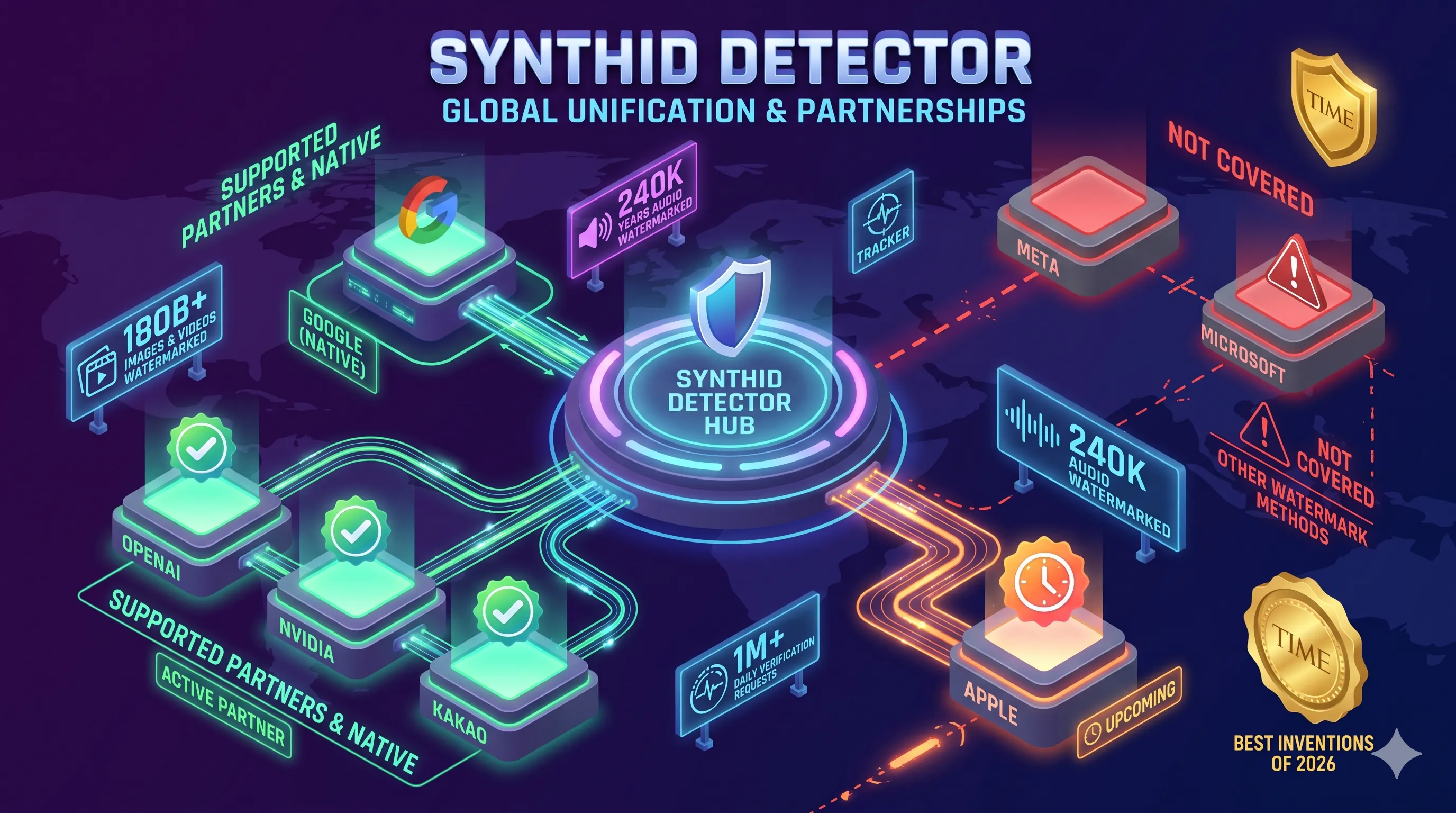
Over 180 billion images and videos have been watermarked using SynthID.
In addition, approximately 240,000 years of audio content have been watermarked using SynthID to date.
Direct public and platform integrations have scaled alongside these ingestion numbers, with verification features across Search, Gemini, and Chrome now processing more than 1 million requests daily.
Supported Partner Ecosystem and Multi-Model Coverage Limits
The defining architectural shift of the October 2026 expansion is multi-provider interoperability.SynthID Detector replaces previous workflows where external provider detection required separate, individual tools for each platform.
Instead of isolating provenance within Google's proprietary ecosystem, SynthID Detector expands detection beyond Google-native models to partner platforms including OpenAI, NVIDIA, and Kakao.
Furthermore, Apple support is identified as upcoming within this expanding network.
However, DeepMind explicitly outlines the operational boundaries of this unified framework.
As stated by Google DeepMind: "This is not a general AI detector. We can only detect media from the above companies, who have adopted SynthID technology."
Consequently, SynthID Detector does not cover models from Meta or Microsoft, which utilize different watermarking methods.
Even among confirmed partners, verification is not absolute; coverage varies depending on the specific model, product version, export workflow, and creation date.
| Provider / Platform | Coverage Status | Technical & Integration Notes |
|---|---|---|
| Supported Native | Native platform integration across Search, Gemini, and Chrome processing over 1 million daily requests. | |
| OpenAI | Supported Partner | Integrated into unified detection; replaces separate, individual tool workflows. |
| NVIDIA | Supported Partner | Adopted SynthID technology; covered under multi-provider expansion. |
| Kakao | Supported Partner | Integrated partner platform for SynthID watermark verification. |
| Apple | Upcoming | Identified as an upcoming integration within the SynthID partner ecosystem. |
| Meta | Not Covered | Excluded from detection due to utilization of different watermarking methods. |
| Microsoft | Not Covered | Excluded from detection due to utilization of different watermarking methods. |
As the partner coalition evolves, unified detection remains dependent on direct technology adoption rather than universal post-hoc analysis.
2. Web-Based Verification: Inspecting Media Signals via synthid.com
Within the broader scope of How Google's SynthID Detector Works with New AI Providers, the public inspection layer bridges model-level watermarking with direct user verification.This verification interface provides the operational environment where multi-provider provenance signals embedded in raw assets are evaluated directly via the web.
Direct Media Upload and Localized Region Scanning
The verification architecture is hosted publicly at synthid.com to facilitate direct, browser-based media analysis.Users can submit direct uploads of image, video, and audio files to scan for provenance watermarks deployed across supported partner generators.
Rather than focusing on arbitrary text generation, the public web portal explicitly emphasizes image, video, and audio verification workflows.
During the analysis pass, the underlying engine does not simply assign a single file-level metric.
Instead, the scanner can identify localized regions within an image that contain the embedded watermark signal.
For temporal formats, the detector isolates specific segments within an audio or video track to pinpoint exactly where watermarking is present.
| Supported Media Format | Detection Granularity | Verification Scope and Constraints |
|---|---|---|
| Image Files | Identifies localized regions containing watermark signals. | Restricted to supported partner integrations; cannot detect non-participating generators like Midjourney. |
| Video Streams | Identifies specific time-based segments within the video track. | Evaluates provenance marks from supported partners; negative returns do not verify human authorship. |
| Audio Tracks | Identifies specific localized segments within the audio track. | Scans across participating partner tools; portal prioritizes media assets over arbitrary text. |
Interpreting Positive and Negative Provenance Determinations
The scanning engine evaluates whether a supported provenance watermark signal is present, returning a positive or negative determination.Interpreting these outcomes requires understanding the technical boundaries of the detection pipeline.
A negative result indicates strictly that no confident watermark signal was identified by the system.
Consequently, a negative determination does not serve as confirmation that the media was authored by a human.
Furthermore, the engine cannot detect arbitrary synthetic media generated by non-participating tools, such as Midjourney.
The scanner is strictly bound to the detection of recognized provenance watermarks embedded by supported partner ecosystems.

3. Watermarking Architecture Across Visual, Audio, and Text Modalities
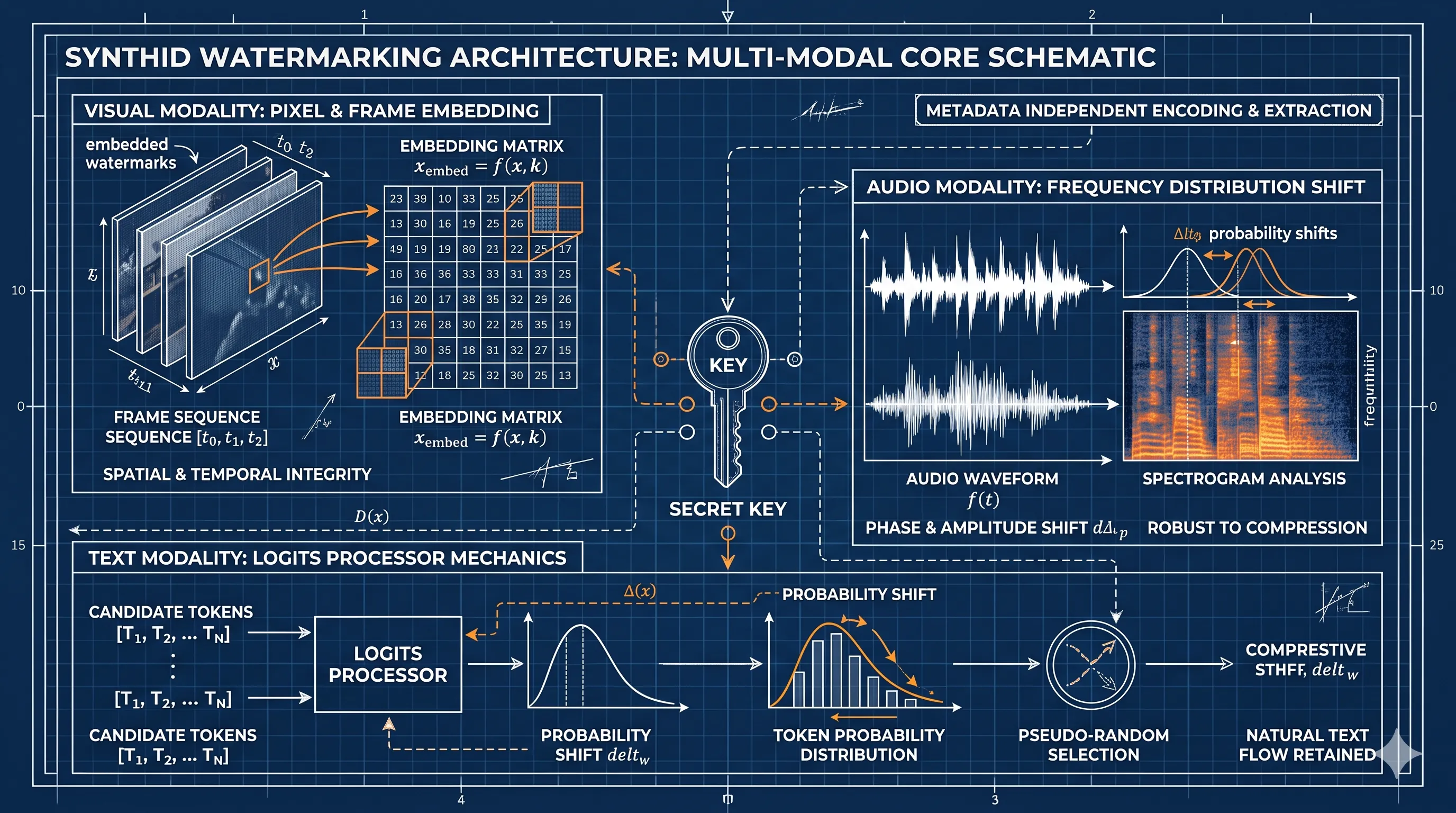
To evaluate how Google's SynthID detector operates across multi-provider ecosystems, technical teams must examine the foundational watermarking architecture embedded directly into generated assets.The core framework embeds imperceptible signals directly into media content at generation time using a secret key, baking provenance into the content itself without degrading fidelity.
Pixel, Frequency, and Logits Processor Mechanics
Because different content types process information through distinct mathematical representations, the embedding mechanism applies custom transformations suited to each modality.Image and video watermarking embeds patterns across pixels and video frames without altering visual quality, ensuring that visual artifacts remain imperceptible to human observers.
In auditory pipelines, audio watermarking modifies frequency probability distributions during synthesis.
This frequency-shifting approach is implemented in models like Lyria and NotebookLM podcasts, injecting verifiable markers throughout the audio track.
For language models, text watermarking operates as a logits processor after Top-K and Top-P sampling by adjusting token probability scores.
By subtly skewing the sampling distribution toward specific pseudo-random token selections governed by the secret key, the model leaves a statistical footprint while preserving natural phrasing.
Metadata Independence and Signal Degradation Under Heavy Editing
A critical architectural strength of this approach is its structural resilience against conventional file sanitization routines.SynthID operates independently of file metadata, allowing the signal to survive workflows that strip EXIF or C2PA data.
Because the verification signal is fused directly into pixel values, audio spectrums, or token probability shifts, standard metadata stripping does not erase detection capability.
Despite this architectural separation from metadata, the embedded signals are subject to specific operational limitations under aggressive post-generation transformations.
Signals degrade under extensive editing, repeated re-encoding, heavy filtering, or deep compression.
Furthermore, text watermarking is less effective on strictly factual responses and loses detection confidence after translation or extensive rewriting.
Constrained factual contexts limit the logits processor's capacity to alter token probability scores without distorting accurate data, while substantive structural rewrites disperse the underlying statistical signature.
4. Third-Party Developer Integrations and API Implementations
To understand how Google's SynthID detector operates across new AI providers, engineering teams must evaluate how external platforms and open-source ecosystems adopt and verify these watermarking algorithms.While SynthID originated within Google DeepMind, cross-industry provenance initiatives have driven adoption into third-party stacks, expanding the footprint of imperceptible watermarking across multi-modal pipelines.
OpenAI Content Provenance API Endpoint and Upload Constraints
Third-party adoption gained major momentum when OpenAI integrated SynthID watermarking directly into its media generation infrastructure.OpenAI added SynthID support for generated images in May 2026.
This coverage was extended when OpenAI expanded SynthID watermarking to audio in July 2026.
For verification, OpenAI provides watermark checking through the web-based interface at openai.com/verify as well as via a dedicated REST API endpoint designed for programmatic pipelines.
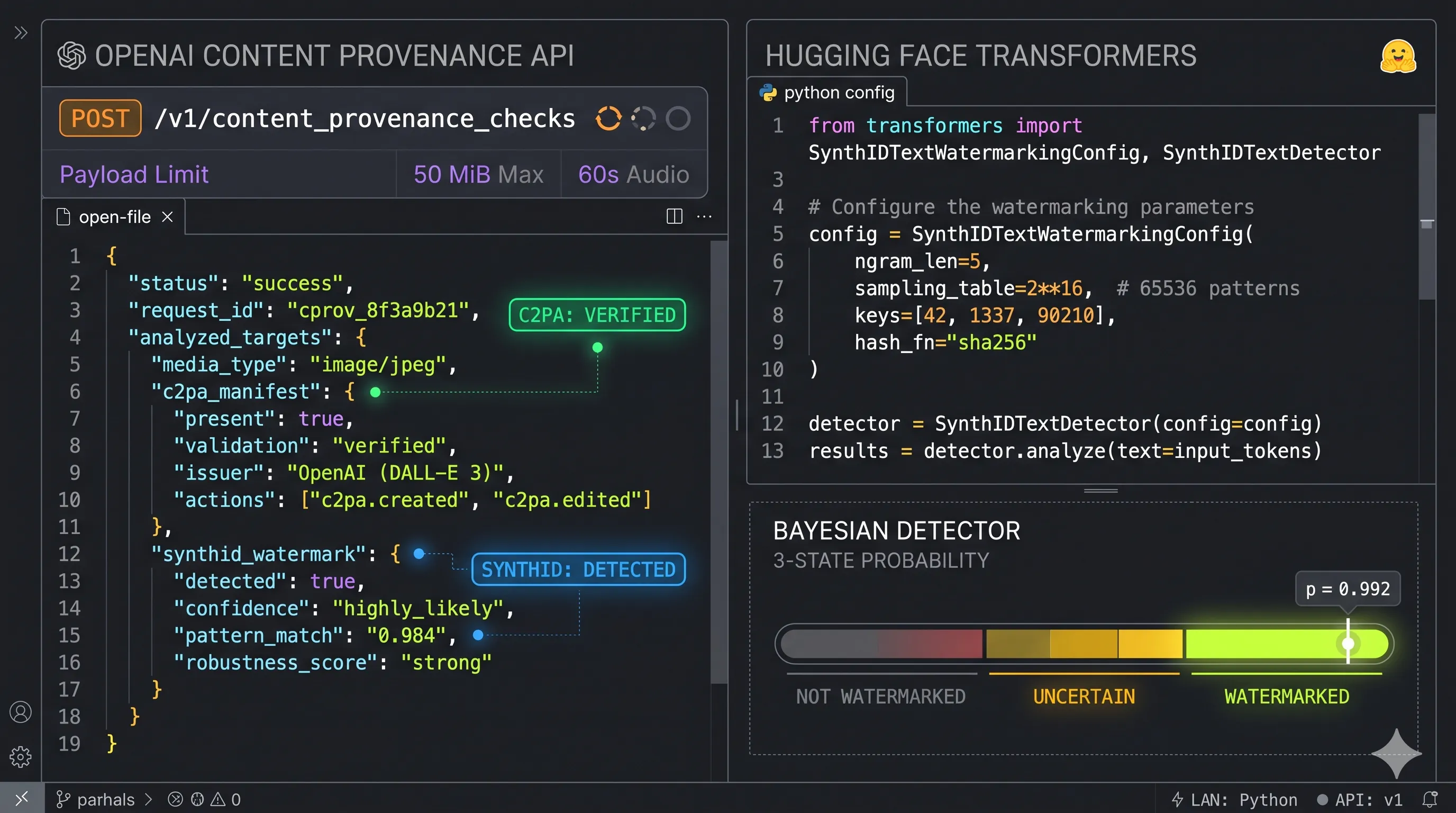
Developers query the OpenAI Content Provenance API to detect supported SynthID and C2PA provenance signals in generated files.
POST /v1/content_provenance_checksWithin the API response, independent status fields are output for C2PA and SynthID signals, allowing consuming systems to parse cryptographic metadata and imperceptible watermarks separately.
Production implementations must accommodate strict ingestion constraints when dispatching payloads to this interface.
The OpenAI Content Provenance API enforces a default maximum upload size of 50 MiB.
For audio verification tasks, the API supports decoded audio durations up to 60 seconds.
Engineers must also recognize verification boundaries: the OpenAI Content Provenance API verifies OpenAI ecosystem assets and cannot be used as a universal Google watermark checker.
Furthermore, Google has not made a general-purpose, unrestricted public SynthID decoding API available to third-party developers.
Hugging Face Transformers Configuration and Open-Source Parameters
Beyond proprietary API surfaces, the open-source community has introduced standard implementations for text-based watermarking.SynthID Text production implementation is available in Hugging Face Transformers v4.46.0+.
This integration allows developers to embed SynthID watermarking directly into token generation loops using open weights.
When configuring SynthID Text generation, the implementation recommends a sampling table size of at least 2^16 and a default ngram_len of 5.
For downstream evaluation, the SynthID Text open-source implementation provides a Bayesian detector.
This Bayesian verification mechanism categorizes evaluated text outputs into three distinct states: watermarked, not watermarked, and uncertain.
| Provider / Platform | Supported Modality & Timeline | Verification Interface | Operational Parameters & Constraints |
|---|---|---|---|
| OpenAI | Images (added May 2026); Audio (expanded July 2026) | POST /v1/content_provenance_checks and openai.com/verify | 50 MiB maximum upload cap; 60-second limit on decoded audio; outputs independent C2PA and SynthID status fields; limited to OpenAI ecosystem assets |
| Hugging Face | Text (Transformers v4.46.0+) | Built-in open-source Bayesian detector | Recommended sampling table size >= 2^16; default ngram_len of 5; detector outputs classified as watermarked, not watermarked, or uncertain |
| Multi-modal SynthID core standard | Restricted ecosystem availability | Has not made a general-purpose, unrestricted public SynthID decoding API available to third-party developers |
5. Robustness Challenges, Circumvention Risks, and C2PA Complementarity
Evaluating how Google's SynthID detector works with new AI providers requires examining its real-world durability against deliberate circumvention and everyday media workflows.While the technology provides an embedded detection layer directly within generated assets, operational testing highlights distinct edge cases and trade-offs when deployed across multi-vendor ecosystems.
Denoising Attacks and False Detection Boundaries
SynthID demonstrates resilience against everyday, routine media transformations.The detector successfully identifies watermarks despite mild cropping, color adjustments, lossy compression routines, and certain screenshots.
However, the system encounters clear operational boundaries when media undergoes heavier modifications or targeted circumvention techniques.
False negatives can occur when content is heavily modified, preventing the detector from surfacing an authentic detection signal.
Conversely, false positives have been cited on video outputs, indicating detection friction in dynamic visual media.
Beyond passive image degradation, active bypass methods present an ongoing risk.
Researchers and users report that low denoising passes applied to generated image outputs can systematically strip the embedded SynthID watermarks.
Highlighting this circumvention vulnerability, Reddit user Bulky-Employer observed: "A removal node is easily created. You just run a low denoising pass on the image... SynthID is just a speed bump..."
Embedded Watermarks Versus C2PA Cryptographic Metadata
Given the boundaries of post-hoc detection, SynthID operates as a complementary signal alongside C2PA Content Credentials rather than a standalone verification standard.C2PA frameworks approach provenance through cryptographically signed metadata manifests attached to the asset lifecycle.
Contrasting these architectures, Harry G on LinkedIn argued that C2PA is "the only approach that actually scales" because detecting synthetic content post hoc becomes an arms race.
Despite its architectural advantages, C2PA manifest provenance suffers from its own structural vulnerabilities.
Cryptographic C2PA records are prone to being discarded by social platforms during re-upload processing or whenever users capture screenshots of the media.
In these environments, embedded pixel-level watermarking like SynthID persists even when platform pipelines strip external headers.
Critically, neither technical approach provides a complete guarantee of narrative integrity.
Neither SynthID detection nor valid C2PA credentials verify factual accuracy or truthfulness of media context, leaving broader factual verification beyond the scope of both technical systems.

Related Posts

Google, OpenAI, and Anthropic Form Standards Authority for Frontier AI (SAFA) to Establish Industry Self-RegulationGoogle, OpenAI, and Anthropic are launching the Standards Authority for Frontier AI (SAFA) to...

OpenAI GPT-6.2 Billing Fix: Astra Hits Limits 40% FasterOpenAI fixes a GPT-6.2 launch billing bug, causing Astra limits to hit 40% faster and Sol 25%...

OpenAI and Cisco Launch Shirudo: A Daemonless eBPF Runtime for AIDiscover Shirudo, a new open-source runtime by OpenAI and Cisco featuring daemonless eBPF...
Generative AI may have assisted with research or drafting for this article. Topic selection, fact-checking, final wording, and publication remain the responsibility of DragonStone74. AI use disclosure