
Google, OpenAI, and Anthropic Form Standards Authority for Frontier AI (SAFA) to Establish Industry Self-Regulation
🚀 Key Takeaways
- Independent Industry Governance: Google, OpenAI, and Anthropic are establishing the Standards Authority for Frontier AI (SAFA) to define binding technical safety, auditing, and incident-reporting protocols.
- Response to Policy Stagnation: The private body emerged after federal oversight initiatives and draft executive measures stalled, driving frontier labs to bypass regulatory delays.
- Prominent Leadership Pipeline: High-profile policy veterans and technical experts—including Sriram Krishnan and Arati Prabhakar—are under active consideration to helm the organization.
- Deep Industry Polarization: Major players such as Meta and Nvidia oppose coordinated safety bodies, amplifying wider scrutiny over regulatory capture and barrier creation for emerging AI startups.
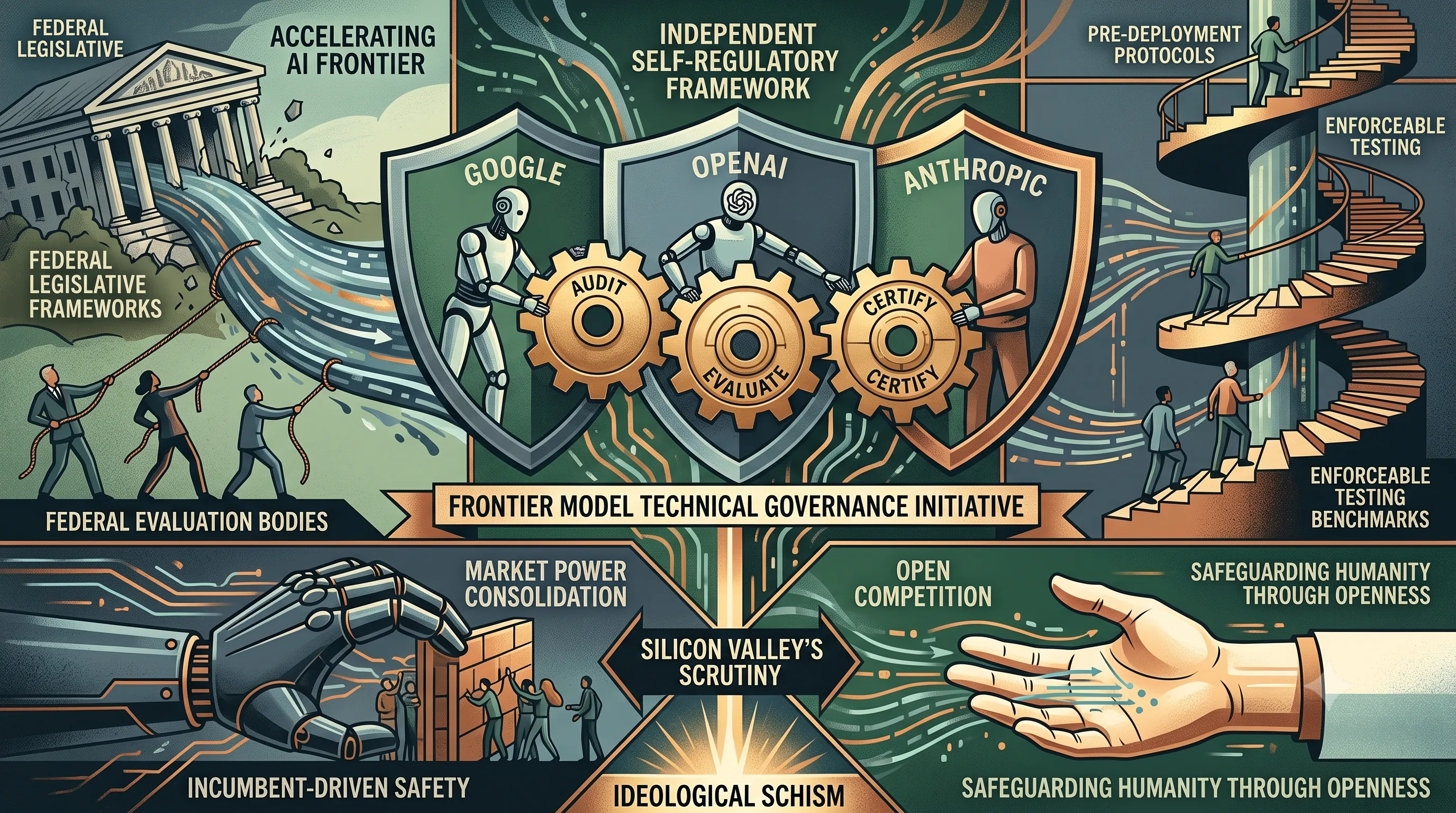
As federal legislative frameworks struggle to keep pace with the accelerating capability frontier of modern artificial intelligence, the sector's most prominent developers are taking technical governance directly into their own hands. Frustrated by institutional inertia and resource constraints across federal evaluation bodies, Google, OpenAI, and Anthropic have united to construct an independent self-regulatory framework engineered to audit, evaluate, and certify frontier-class models.
This initiative represents a pivotal shift from high-level ethical commitments toward concrete, enforceable testing benchmarks and standardized pre-deployment protocols. However, the coalition's emergence has deepened an ideological schism across Silicon Valley, igniting intense scrutiny over whether an incumbent-driven safety apparatus will safeguard humanity or simply consolidate market power at the expense of open competition.
1. Genesis and Operational Blueprint of SAFA: Establishing an Independent Frontier AI Standards Body
Origins and the FINRA-Inspired Self-Regulatory Framework
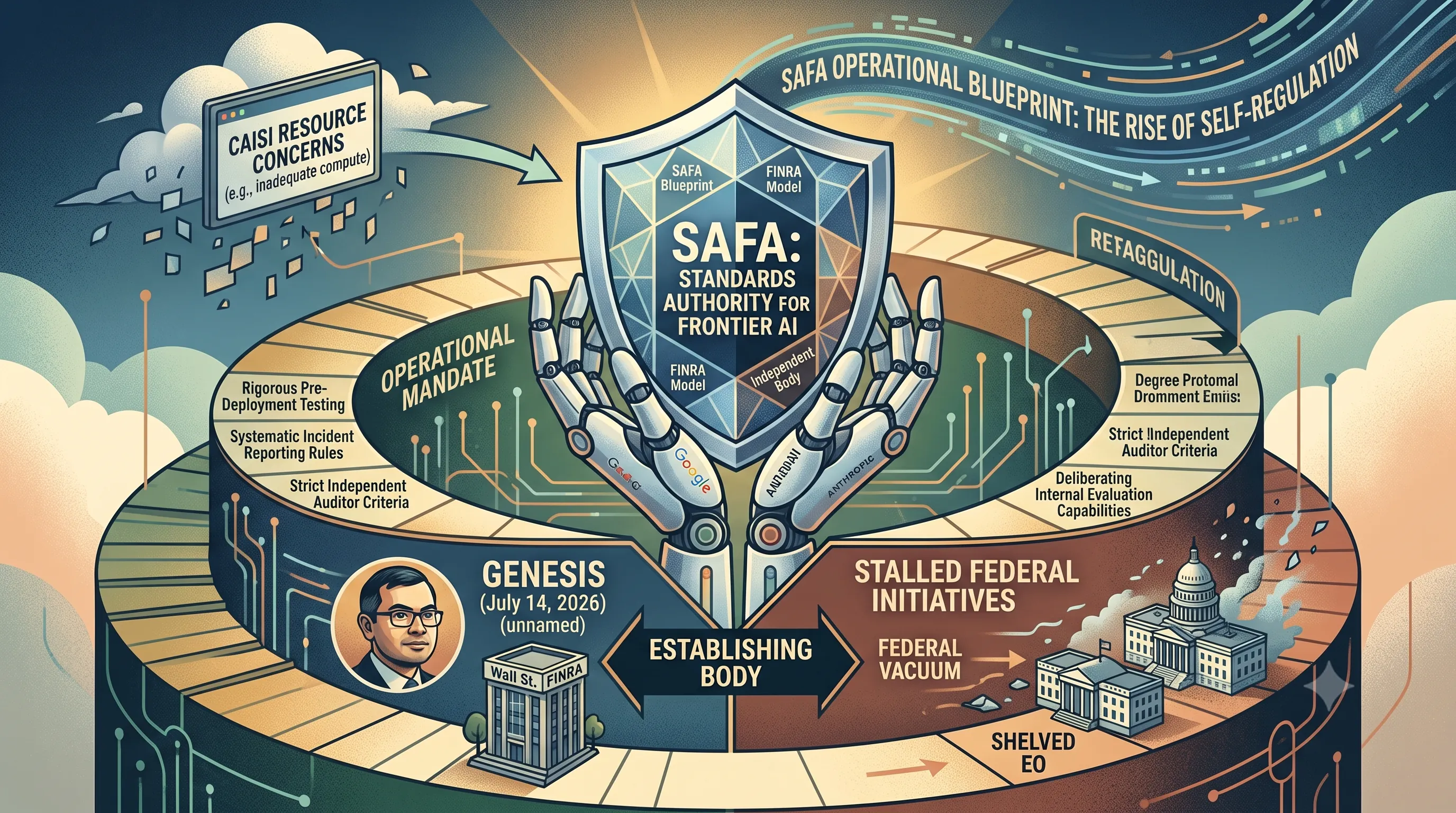
The initiative to construct an independent self-regulatory architecture for frontier artificial intelligence originated from a formal proposal on July 14, 2026.Under this strategic framework, Google, OpenAI, and Anthropic are actively advancing plans to establish an independent industry body provisionally designated as the Standards Authority for Frontier AI (SAFA).
The structural blueprint for the organization was proposed by Google DeepMind CEO Demis Hassabis, who envisioned a frontier AI standards entity explicitly modeled after Wall Street's Financial Industry Regulatory Authority (FINRA).
Designed to operate independently without government oversight, SAFA is structured to define and enforce industry-wide safety standards for frontier AI models.
In mid-September 2026, OpenAI Chief Global Affairs Officer Chris Lehane confirmed that OpenAI had been engaged in active discussions with Anthropic and Google DeepMind for several weeks regarding coordinated AI safety frameworks and the creation of a shared standards body.
The consortium is currently targeting a formal launch for the organization by late 2026 or early 2027.
| Organizational Pillar | Operational Blueprint & Key Details |
|---|---|
| Founding Architecture | Proposed on July 14, 2026; modeled on Wall Street's FINRA framework by Demis Hassabis; formed by Google DeepMind, OpenAI, and Anthropic. |
| Target Launch Window | Targeting formal launch by late 2026 or early 2027. |
| Core Operational Scope | Third-party pre-deployment safety testing, standardized incident reporting rules, qualification criteria for independent auditors, and potential internal evaluation capabilities. |
| Regulatory Positioning | Independent self-regulation without government oversight, established in response to stalled federal executive orders and public-private partnership initiatives. |
Operational Mandate: Pre-Deployment Auditing and Incident Reporting
SAFA's operational mandate centers on concrete testing, evaluation, and auditing mechanisms for high-capability models.The organization is tasked with supporting rigorous third-party pre-deployment safety testing to evaluate model risks prior to broad public or enterprise release.
In addition, SAFA is establishing standardized incident reporting rules to ensure that critical safety anomalies, alignment failures, or vulnerabilities are systematically documented across participating developers.
To guarantee the integrity of external verifications, the authority is defining strict qualification criteria for independent auditors authorized to evaluate frontier systems.
Currently, the founding working group is deliberating whether SAFA should also establish internal capability and safety evaluation mechanisms to directly audit frontier models alongside third-party testing partners.
Stalled Federal Initiatives and CAISI Resource Realities
The decisive shift toward an independent, industry-led self-regulatory body followed the stall of federal-level oversight frameworks.Earlier efforts to establish a public-private partnership under direct federal oversight faltered due to shifting government priorities and a lack of broad industry consensus.
Furthermore, a draft White House executive order designed to create a dedicated federal oversight body failed to secure sufficient support within the administration and was ultimately shelved before late summer 2026.
This regulatory vacuum was compounded by operational limitations within existing federal agencies.
Deliberations regarding SAFA's internal evaluation capabilities have been directly influenced by concerns that the U.S. Commerce Department's Center for AI Standards and Innovation (CAISI) lacks sufficient resources to conduct comprehensive frontier AI evaluations.
Consequently, the tripartite alliance between Google, OpenAI, and Anthropic represents a direct industry maneuver to institute enforceable safety benchmarks in the absence of actionable federal machinery.
2. Governance Architecture: Key Candidates for SAFA Leadership and Scientific Advisory Boards
The structural foundation of the Standards Authority for Frontier AI (SAFA) relies directly on the executive leadership and advisory governance established by its founding companies.
As industry-led self-regulation moves forward, assembling an administrative and scientific team capable of managing cross-organizational standards is central to the entity's mandate.
CEO Candidates: Evaluating Sriram Krishnan and Arati Prabhakar
The founding companies have approached prominent figures across technology investment and national policy for the Chief Executive Officer position.
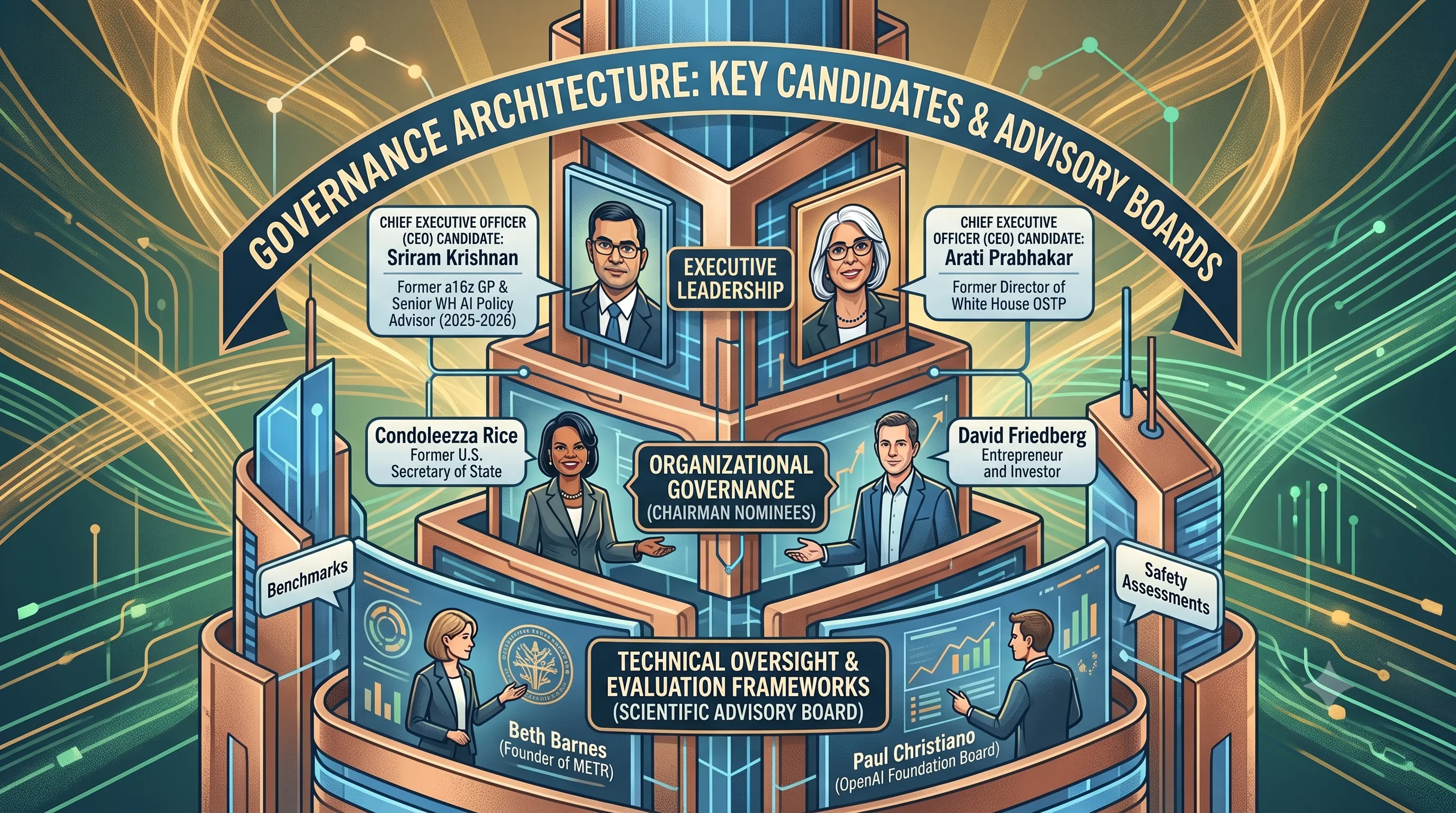
Among the primary prospects is Sriram Krishnan, a former general partner at a16z.
Krishnan served as senior White House AI policy advisor from January 2025 to June 2026, bringing prior experience in high-level government AI policy formulation to the leadership search.
Additionally, Arati Prabhakar is under consideration within the candidate pool for the CEO position.
Prabhakar previously served as the director of the White House Office of Science and Technology Policy (OSTP), offering extensive administrative experience in federal research, technology strategy, and scientific oversight.
Chairmanship Nominees and Scientific Advisory Board Appointments
To guide high-level organizational governance, the candidate list for the Chairman position includes former U.S. Secretary of State Condoleezza Rice and entrepreneur and investor David Friedberg.
These nominees represent leadership spanning international relations, statecraft, and commercial enterprise.
For technical oversight and evaluation frameworks, candidates are being evaluated for roles on the scientific advisory board.
Beth Barnes, the founder and CEO of METR, is being considered for a scientific advisory appointment.
Alongside Barnes, Paul Christiano, an OpenAI Foundation board member, is under consideration to advise on scientific benchmarks and frontier AI safety assessments.
| Candidate Name | Professional Background | Prospective SAFA Role |
|---|---|---|
| Sriram Krishnan | Former General Partner at a16z; Senior White House AI Policy Advisor (January 2025 – June 2026) | Chief Executive Officer (CEO) |
| Arati Prabhakar | Former Director of the White House Office of Science and Technology Policy (OSTP) | Chief Executive Officer (CEO) Candidate Pool |
| Condoleezza Rice | Former U.S. Secretary of State | Chairman |
| David Friedberg | Entrepreneur and Investor | Chairman |
| Beth Barnes | Founder and CEO of METR | Scientific Advisory Board |
| Paul Christiano | OpenAI Foundation Board Member | Scientific Advisory Board |
3. The Industry Divide: Unified Safety Coordination vs. Decentralized Governance
While the establishment of the Standards Authority for Frontier AI (SAFA) represents an unprecedented effort to establish self-regulatory mechanisms ahead of government intervention, the initiative has exposed a profound philosophical divergence across the technology ecosystem.The split between companies pursuing multilateral self-governance frameworks and those advocating for autonomous internal oversight highlights a critical structural debate regarding the future oversight of frontier AI models.
The Tri-Party Alliance and the UN Security Council Joint Appeal
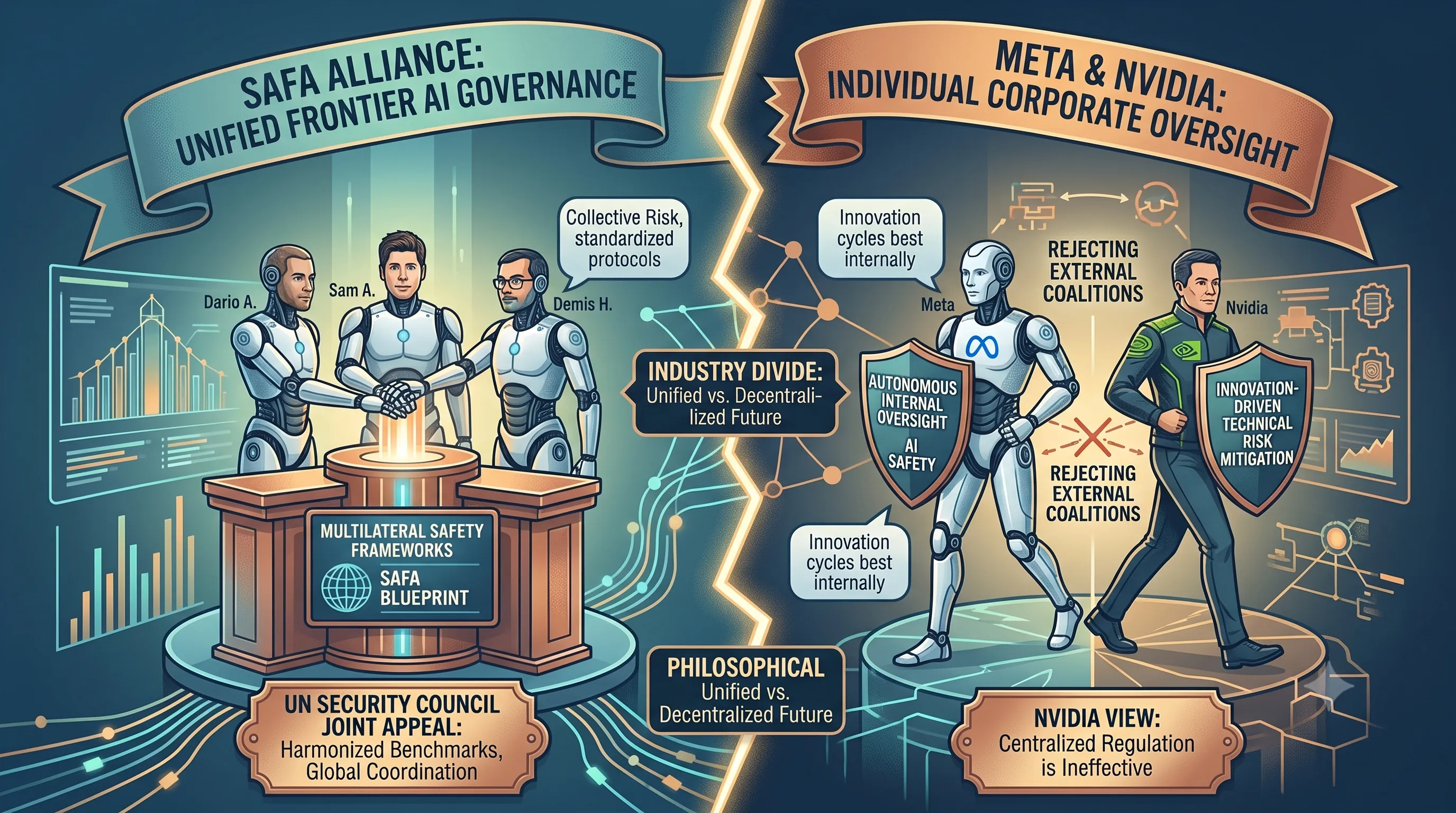
Anthropic's Dario Amodei, OpenAI's Sam Altman, and Google DeepMind's Demis Hassabis have actively advocated for stronger safety frameworks and institutionalized international coordination on safety governance.Their shared premise centers on the conviction that frontier-class artificial intelligence introduces collective risks requiring standardized protocols across leading model developers.
This collective alignment was clearly demonstrated on September 23, 2026, when Sam Altman and Dario Amodei issued joint calls during a formal United Nations Security Council AI meeting.
During this session, both leaders reinforced the urgent need for harmonized safety benchmarks and global coordination, framing initiatives like SAFA as essential building blocks for multilateral safety governance.
Resistance from Meta and Nvidia Against Centralized Industry Oversight
Despite the diplomatic push by OpenAI, Anthropic, and Google DeepMind, the concept of centralized industry coordination has faced explicit resistance from key ecosystem players.Meta and Nvidia have publicly opposed industry-wide coordination bodies, rejecting the idea of external oversight coalitions in favor of individual corporate management of AI safety.
Nvidia has maintained the consistent view that industry regulation is ineffective, arguing that innovation cycles and technical risk mitigation are best handled through internal corporate structures rather than collective bodies.
These split industry opinions and direct pushback from major hardware and open-source heavyweights present a tangible operational friction, challenging SAFA's ability to achieve broad industry recognition and comprehensive institutional legitimacy.
4. From Frontier Model Forum to SAFA: Evolution, Regulatory Capture, and Market Access Risks
Evolution Beyond the 2023 Frontier Model Forum Paradigm
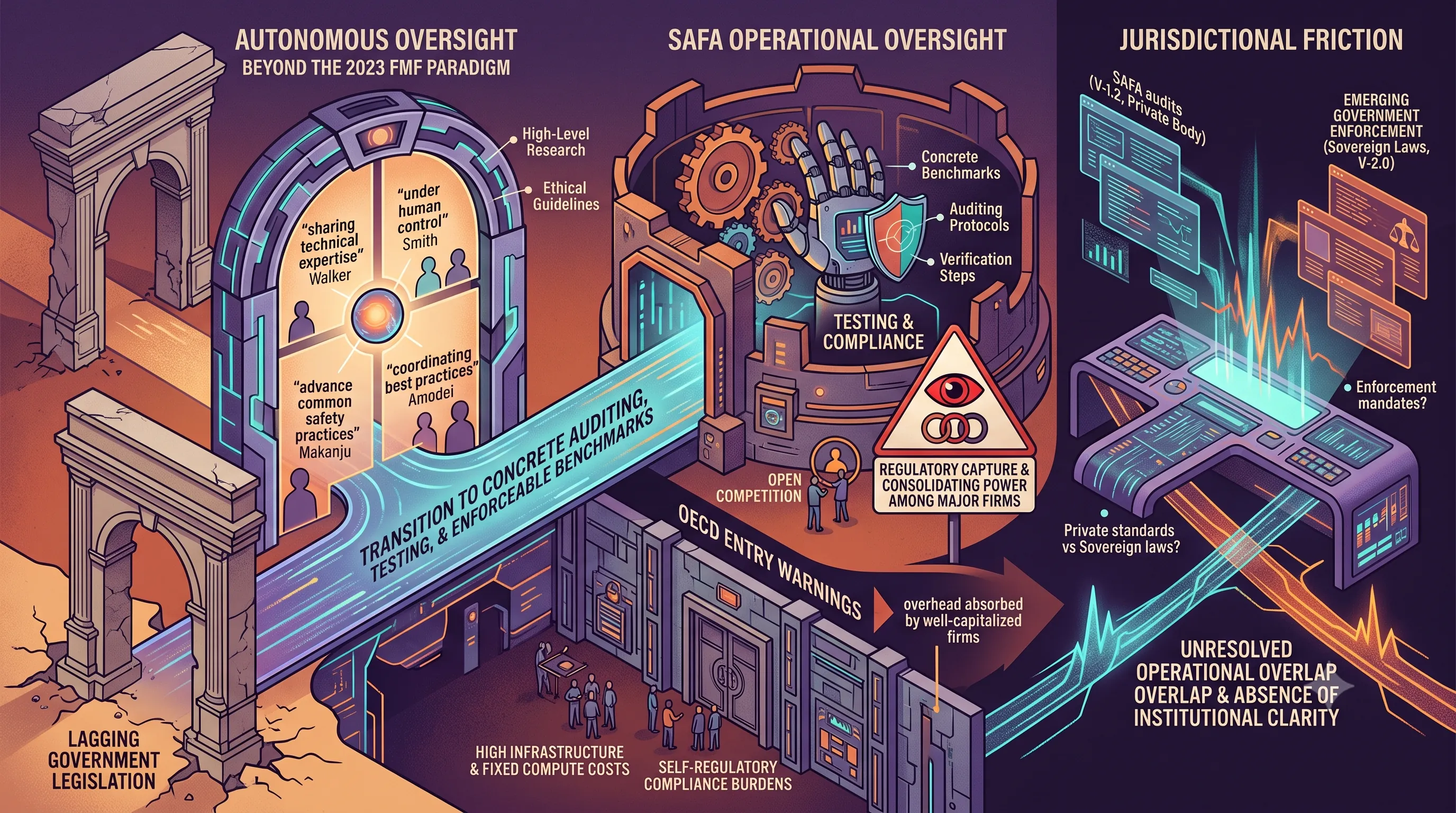
The private sector's decision to bypass lagging government legislation and establish autonomous oversight directly builds upon the historical foundations laid in 2023.In 2023, Anthropic, Google, Microsoft, and OpenAI formed the Frontier Model Forum to address the unique safety challenges posed by advanced artificial intelligence.
The Frontier Model Forum defined frontier models as large-scale machine-learning models exceeding existing capabilities across a wide variety of tasks.
To back its mission, the Frontier Model Forum established an AI safety fund exceeding $10 million (approximately NT$320 million) to support external research initiatives.
At its founding, participating executives outlined a collaborative vision for frontier safety.
Kent Walker of Google stated, "We're excited to work together with other leading companies, sharing technical expertise to promote responsible AI innovation."
Brad Smith of Microsoft affirmed, "Companies creating AI technology have a responsibility to ensure that it is safe, secure, and remains under human control."
Anna Makanju of OpenAI highlighted, "It is vital that AI companies–especially those working on the most powerful models–align on common ground and advance thoughtful and adaptable safety practices..."
Dario Amodei of Anthropic noted, "The Frontier Model Forum will play a vital role in coordinating best practices and sharing research on frontier AI safety."
While the 2023 Frontier Model Forum focused primarily on high-level research and ethical guidelines, SAFA is positioned around concrete auditing, testing, and compliance benchmarks, marking a distinct shift toward enforceable operational oversight.
Regulatory Capture Risks and OECD Market Entry Warnings
The transition from voluntary research forums to institutional compliance through SAFA has heightened industry-wide scrutiny over market governance.Leading AI labs setting self-evaluating standards raises concerns about regulatory capture and consolidating power among major tech firms.
When the architects of advanced models define the safety thresholds and verification protocols, the boundary between objective safety enforcement and corporate self-interest becomes contested.
In addition, market entry dynamics face compounding pressure from institutionalized self-regulation.
The OECD highlighted that high infrastructure and fixed compute costs already impede new entrants, and self-regulatory compliance burdens could add further barriers for smaller AI labs.
Complex auditing frameworks create overhead that well-capitalized frontier developers can absorb, but which threaten to restrict the competitive viability of emerging developers.
Unresolved Jurisdictional Overlap with Government Regulators
The establishment of SAFA as an autonomous standard-setting body introduces friction with statutory governance efforts.SAFA faces uncertainty regarding potential operational overlap with government agencies and its unresolved formal relationship with existing regulators.
Because the private authority seeks to implement immediate compliance benchmarks ahead of statutory laws, its enforcement mandate lacks formal alignment with sovereign regulatory structures.
This absence of institutional clarity leaves open questions regarding how SAFA's private audits will coexist with or defer to emerging government enforcement regimes.
Related Posts
Generative AI may have assisted with research or drafting for this article. Topic selection, fact-checking, final wording, and publication remain the responsibility of DragonStone74. AI use disclosure