
How Local Elections and Policy Shifts Threaten US AI Infrastructure
🚀 Key Takeaways
- Grassroots voter pushback has swept municipal ballots nationwide, yielding widespread rejections of local data center zoning and direct recalls of pro-development officials.
- State-level permitting freezes and moratoriums now directly jeopardize nearly half of all planned domestic computing capacity across premier infrastructure hubs.
- Federal oversight and grid-protection bills are intensifying intergovernmental friction as lawmakers challenge the allocation of utility costs to residential ratepayers.
- Escalating regulatory compliance costs are forcing unprecedented concessions from balance-sheet tech giants while disproportionately straining smaller compute providers.
The relentless expansion of artificial intelligence infrastructure has collided head-on with American electoral politics.
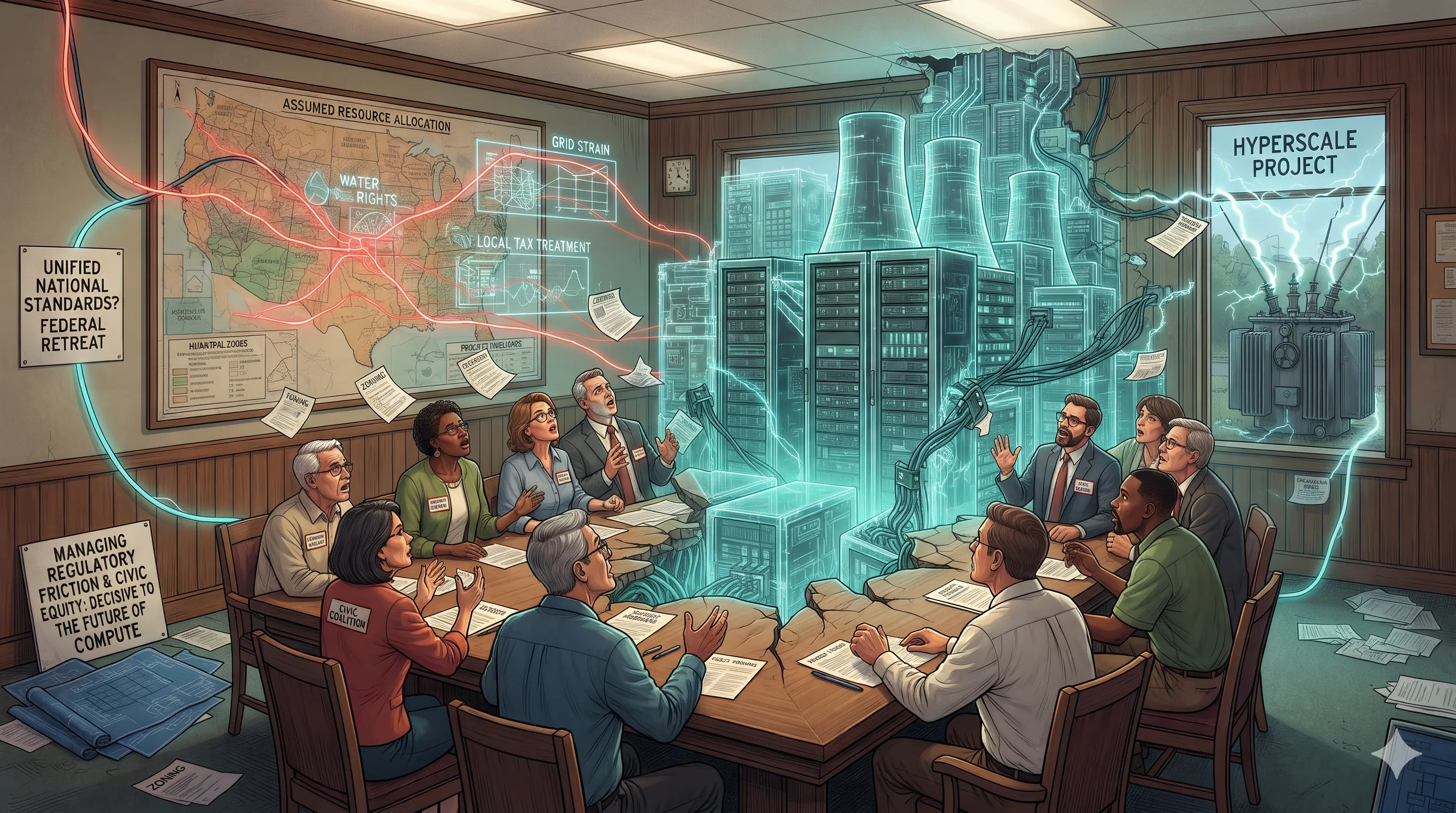
The longstanding assumption that municipalities and regional power grids would seamlessly accommodate multi-gigawatt hyperscale projects has unraveled under an unprecedented wave of community resistance and ballot-box pushback.
Across key technology corridors, incoming political leaders and localized civic coalitions are demanding a complete reappraisal of resource allocation, from grid strain and water rights to local tax treatment.
As federal agencies step back from unified national standards and leave regulatory enforcement to fragmented state and municipal authorities, infrastructure developers face an increasingly volatile political landscape.
While the world's largest technology conglomerates are deploying capital concessions and direct infrastructure funding to salvage their buildouts, the emerging policy shifts threaten to alter project timelines across the nation.
Managing regulatory friction and civic equity has quickly become just as decisive to the future of compute as securing silicon and electrical power.
1. Ballot Box Revolt: How Local Elections and Ballot Measures Blocked AI Expansion
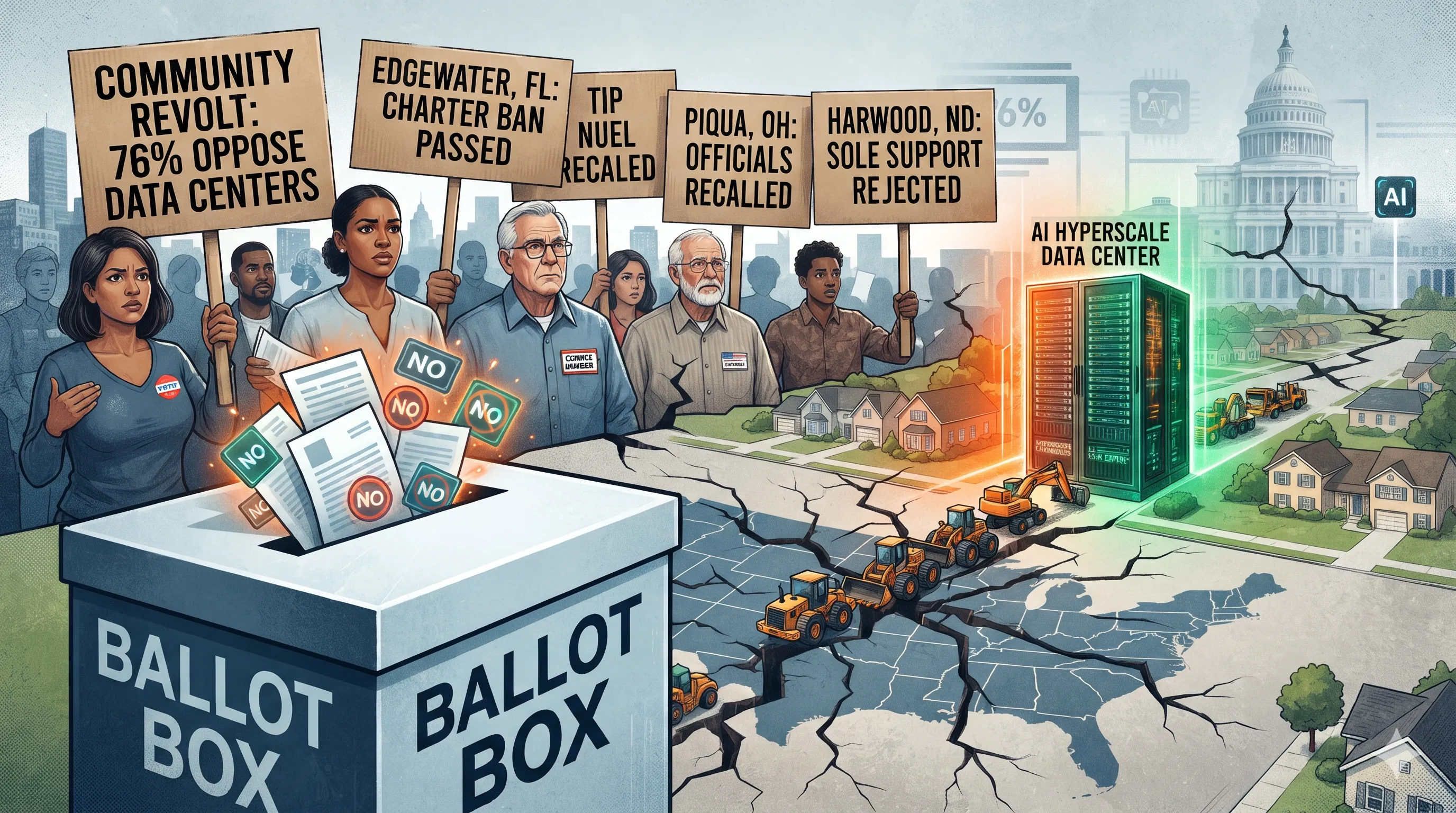
Policy shifts and grass-roots political resistance have emerged as immediate disruptions to AI infrastructure growth, fundamentally challenging the physical expansion of computing facilities.The November 2026 election cycle demonstrated that local communities are no longer passively accommodating hyperscale builds, converting growing skepticism into decisive political and legislative barriers.
Overwhelming Ballot Rejections Across Key States
Voters delivered an unprecedented rebuke to digital infrastructure developers by rejecting AI data centers in 40 of 41 local ballot measures across 10 states.State-level battlegrounds saw concentrated pushback, with Ohio alone holding 21 of the local ballot votes focused on data centers.
Amid this nationwide wave of resistance, Harwood, North Dakota was the only jurisdiction to reject additional review on industrial data center projects, highlighting how isolated institutional support has become at the municipal level.
| Jurisdiction | State | Electoral Outcome / Municipal Action |
|---|---|---|
| Edgewater | Florida | Approved a measure writing a data center ban directly into its municipal charter. |
| Piqua | Ohio | Recalled the mayor and two city commissioners who supported a proposed data center. |
| Harwood | North Dakota | Voted as the sole jurisdiction to reject additional review on industrial data center projects. |
Municipal Charter Bans and Local Official Recalls
Municipal resistance has escalated beyond temporary zoning moratoriums into permanent governing constraints.In Edgewater, Florida, voters approved a measure to write a data center ban directly into its municipal charter, establishing an enduring legal blockade against future facilities.
Widespread community opposition has created direct electoral friction for municipal officials supporting AI facilities, making local development approvals politically perilous.
This friction culminated in Piqua, Ohio, where voters successfully recalled the mayor and two city commissioners who supported a proposed data center.
Exit Polling and Growing Electoral Backlash
The widespread disruption to AI infrastructure expansion is supported by broad demographic consensus, transforming local utility concerns into federal platform debates.An exit poll showed 76% of voters oppose hosting a new data center in their community.
Furthermore, the exit poll indicated 56% of voters viewed AI and data centers as a major or crucial factor in their vote for Congress.
Reflecting on this nationwide sentiment, Representative Greg Casar stated: "The revolt against data centers was one of the top issues of the 2026 election. And in a few years we will look back on it as just the early tremor of a much bigger AI earthquake upending American politics."
2. State-Level Moratoriums Threaten Nearly Half of Planned US Compute Capacity
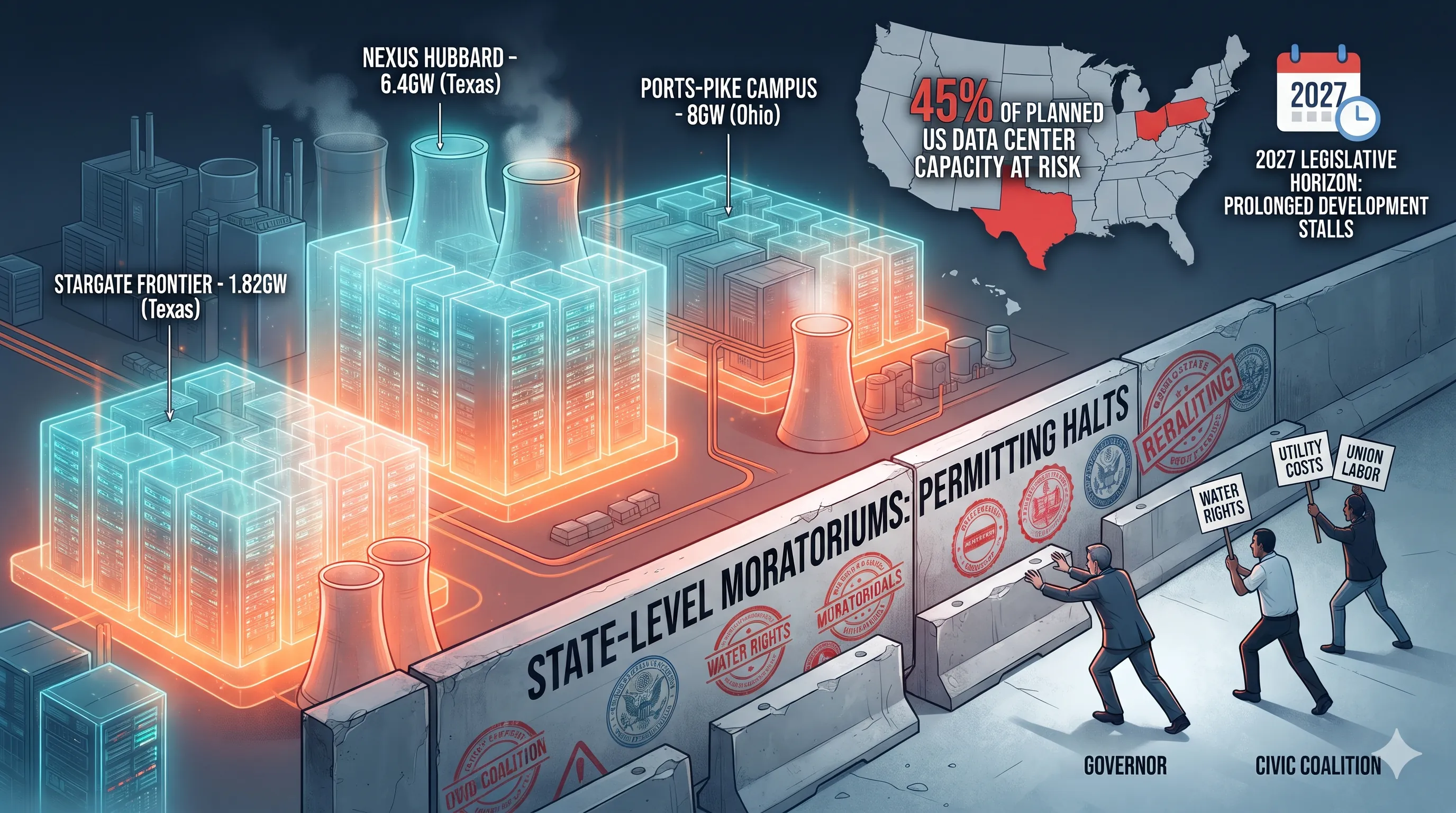
The broader trajectory of artificial intelligence infrastructure growth is directly colliding with state-level regulatory pushback and political realignments.While federal oversight often commands national attention, regional policy shifts have introduced acute structural barriers, placing approximately 45% of planned US data center capacity at risk across key markets.
Gubernatorial Mandates and Permitting Halts in Texas and Ohio
Recent gubernatorial election outcomes have established clear regulatory headwinds across critical deployment corridors.Democratic candidates who campaigned explicitly against rapid data center expansion won gubernatorial races in Texas, Ohio, and Georgia.
Jan Hatzius, Goldman Sachs chief economist, outlined the quantitative reach of these political shifts, observing: "The states where Democrats are likely to further restrict data centers account for roughly 45% of planned US data center capacity, with Texas alone accounting for roughly 25%."
In Texas, Governor-elect Gina Hinojosa campaigned on enacting a statewide data center moratorium pending comprehensive legislation governing water, air, electricity, and property rights.
This platform builds directly upon immediate regulatory interventions enacted prior to the election, as former Texas Governor Greg Abbott ordered environmental regulators to halt data center permits on September 21.
Concurrently, Ohio Governor-elect Amy Acton supports a conditional moratorium that sets rigorous operational and development hurdles, requiring data centers to fully cover their associated utility costs and utilize union labor for facility buildouts.
Multi-Gigawatt Hubs at Risk: Stargate Frontier, Nexus Hubbard, and PORTS-Pike
Permitting freezes and pending state-level moratoriums threaten multi-gigawatt AI computing hubs currently under construction.Developers targeting massive cluster deployments face direct disruptions across active sites in Texas and Ohio.
In Shackelford County, Texas, the Stargate Frontier project involves 1,820MW of capacity currently under construction that is vulnerable to the shifting regulatory climate.
Also in Texas, the massive Nexus Hubbard project represents 6,400MW intended primarily to serve Anthropic.
Meanwhile, in Ohio, OpenAI has secured 8GW of computing capacity at the PORTS-Pike campus, a scale of energy allocation that falls under the purview of newly mandated conditional requirements and utility cost-coverage demands.
| Project / Campus | State Location | Capacity Specification | Project Status / Primary Stakeholder |
|---|---|---|---|
| Stargate Frontier | Shackelford County, Texas | 1,820MW | Under construction |
| Nexus Hubbard | Texas | 6,400MW | Intended primarily to serve Anthropic |
| PORTS-Pike Campus | Ohio | 8GW | OpenAI secured capacity |
The 2027 Legislative Horizon and Prolonged Development Stalls
The timeline required to resolve these regulatory freezes compounds the operational disruption for AI infrastructure providers.Texas accounts for approximately 25% of planned US data center capacity, making the state's legislative trajectory central to nationwide buildout roadmaps.
However, the Texas legislative session capable of passing utility and zoning laws ends in mid-2027.
Because statutory clarity regarding electricity consumption, water allocation, emissions, and property rights cannot be finalized until that mid-2027 milestone, multi-gigawatt projects caught in permitting freezes face prolonged operational suspension.
This prolonged window of legislative uncertainty threatens to stall near-term compute scaling across nearly half of the entire planned domestic pipeline.
3. Federal Scrutiny and Intergovernmental Friction Compound Regulatory Uncertainty
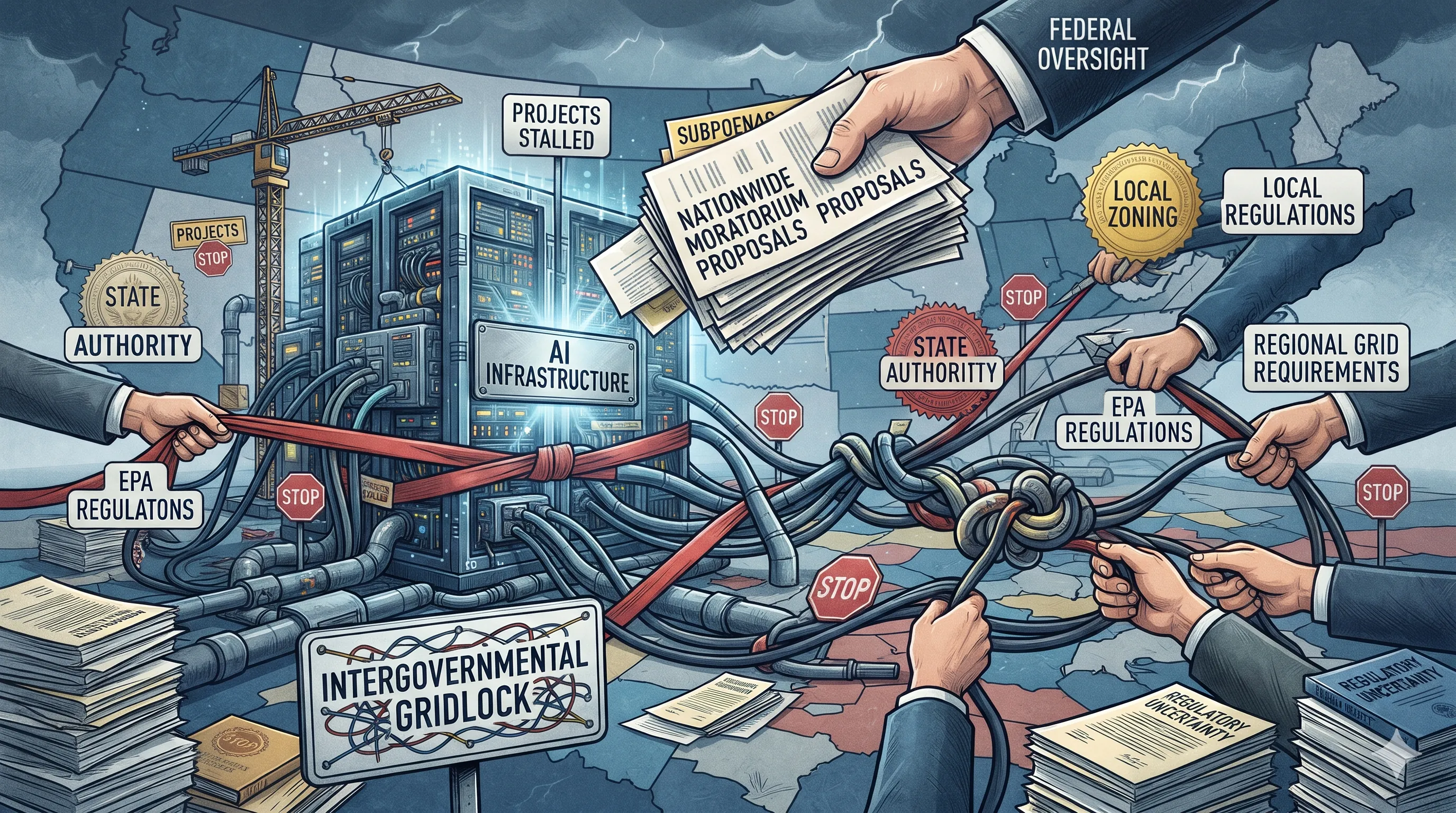
Mounting federal policy shifts directly disrupt AI infrastructure growth by introducing legislative standstills and intergovernmental friction.As artificial intelligence compute facilities expand nationwide, developers face an increasingly volatile political environment where federal actions conflict with regional priorities.
National Moratorium Proposals and the GRID Savings Act
Federal lawmakers have introduced aggressive statutory measures targeting hyperscale compute expansion.Federal legislation sponsored by Senator Bernie Sanders and Representative Alexandria Ocasio-Cortez proposes a nationwide moratorium on new data centers.
This proposed freeze targets facility development, injecting substantial uncertainty into long-term infrastructure planning and site acquisition.
Simultaneously, cost-allocation frameworks are undergoing intense legislative scrutiny.
The proposed GRID Savings Act, sponsored by Senator Martin Heinrich, aims to prevent local communities from paying for data center-related grid upgrades.
By insulating residential ratepayers from infrastructure reinforcement costs, this measure places the fiscal responsibility for transmission and utility buildouts directly onto data center developers.
Despite these sweeping legislative threats, immediate statutory implementation faces structural barriers.
Incoming Congressional majorities lack the two-thirds threshold required to override potential presidential vetoes, leaving federal energy and technology policy in a state of high-stakes political contestation.
| Policy Action / Proposal | Key Sponsors / Entity | Core Mechanism and Regulatory Scope |
|---|---|---|
| Nationwide Data Center Moratorium | Senator Bernie Sanders, Representative Alexandria Ocasio-Cortez | Proposes a nationwide moratorium on the construction of new data centers. |
| GRID Savings Act | Senator Martin Heinrich | Aims to prevent local communities from paying for data center-related grid upgrades. |
| Environmental Standard Devolution | Environmental Protection Agency (EPA) | Declined to establish nationwide environmental standards, shifting regulatory burdens to state and local authorities. |
Congressional Oversight Threats and Subpoena Risks
In addition to statutory proposals, technology executives confront aggressive oversight mechanisms from Capitol Hill.Congressional leaders have signaled intent to issue subpoenas and call technology executives for oversight hearings regarding infrastructure impacts.
Lawmakers are intensifying their scrutiny surrounding the land use, electrical demand, and resource consumption associated with advanced AI clusters.
Underscoring the scale of this impending oversight campaign, Senator Ed Markey stated on X: "They are going to need to plant new forests for all of the subpoenas we’ll be printing."
These investigatory proceedings threaten to entangle AI developers in protracted public inquiries, creating ongoing operational distractions and reputational friction.
EPA Regulatory Devolution and Intergovernmental Gridlock
Federal environmental policy has introduced further fragmentation instead of establishing a unified national framework.The EPA declined to establish nationwide environmental standards for AI data centers, shifting regulatory burdens to state and local authorities.
This decision leaves regulatory oversight decentralized, requiring operators to navigate an inconsistent patchwork of local and municipal rules.
Consequently, overlapping federal, state, and local jurisdictions create conflicting regulatory mandates for infrastructure builders.
Federal initiatives aiming to accelerate environmental permitting face regulatory friction from state and municipal restrictions.
While certain federal directives push to expedite project reviews, local ordinances and state-level administrative hurdles continually impede execution, leaving infrastructure growth stalled in intergovernmental gridlock.
4. Hyperscaler Concessions and the Widening Divide Between Tech Giants and Pure-Play Providers
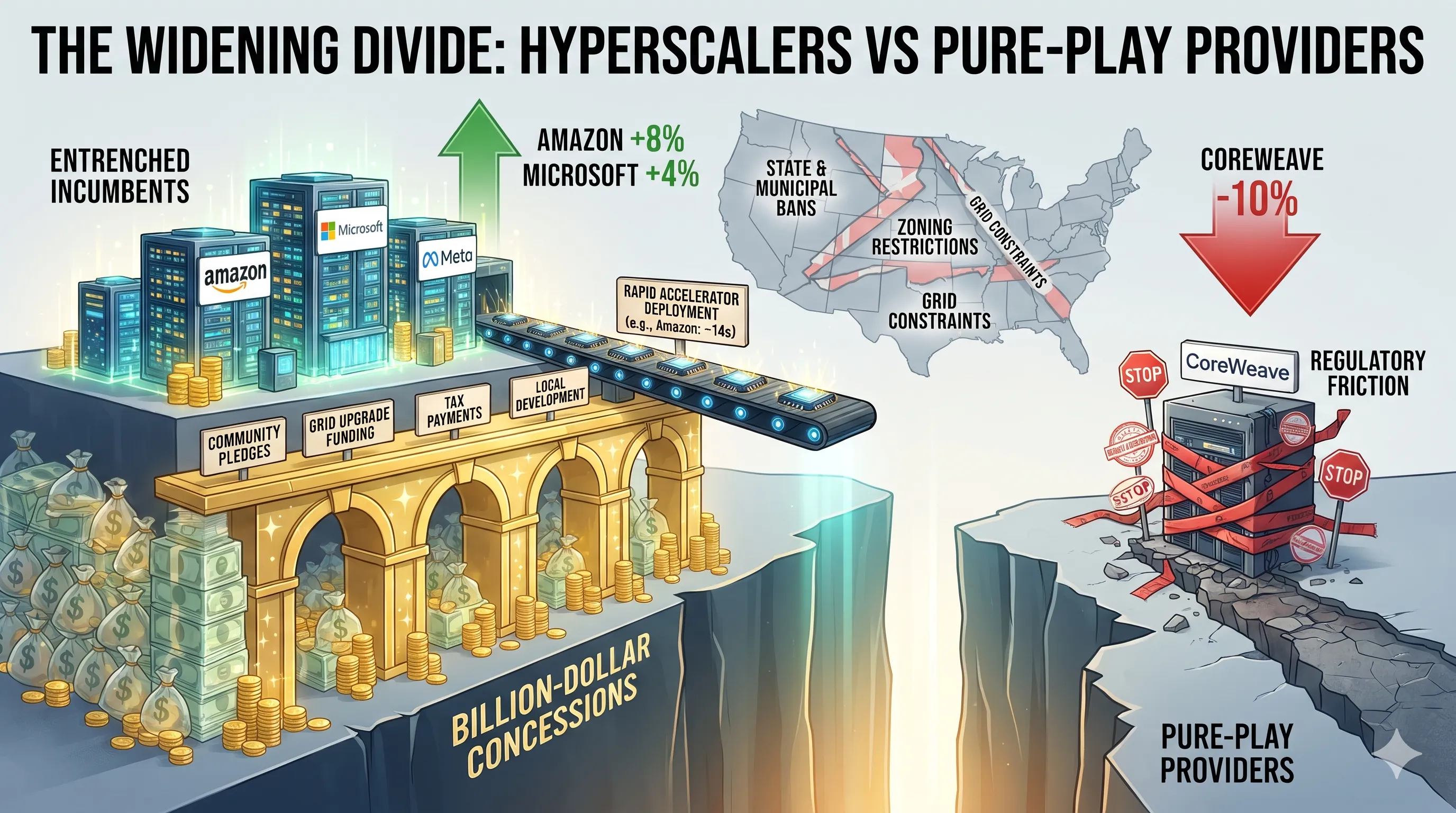
As shifts in regulatory and municipal policies threaten to disrupt the pace of AI infrastructure growth, the burden of adaptation is altering the competitive landscape of artificial intelligence.While major tech companies have committed more than $3 trillion to infrastructure expansion, growing local opposition and grid constraints are forcing operators to offer unprecedented defensive concessions.
This operational friction directly connects to the broader reality of policy shifts disrupting infrastructure rollouts, creating an uneven environment where well-funded tech giants can leverage capital to bypass barriers while pure-play compute providers absorb the financial shocks.
Billion-Dollar Concessions and Community Grid Pledges
To insulate their projects against escalating municipal resistance, hyperscalers are deploying multi-billion-dollar concession strategies to placate regional authorities.Amazon pledged more than $1bn over five years to communities hosting its data centers, directly subsidizing local public works and services to secure operational continuity.
Similarly, Microsoft committed to paying its sites' grid infrastructure costs and pledged to discontinue seeking local tax exemptions, voluntarily assuming heavy civic and utility expenses to bypass civic hurdles.
Industrial footprints are simultaneously scaling up, as demonstrated by Meta, which planned a $1bn data center facility of up to 1.4GW in Piqua, Ohio.
Recognizing that community pushback could calcify into outright development bans, OpenAI leadership circulated a memo warning policymakers against implementing data center bans, cautioning that statutory halts would severely disrupt compute readiness and strategic expansion.
Continuous Accelerator Deployment Versus Regulatory Friction
Despite mounting bureaucratic and municipal challenges, hyperscalers continue expanding capacity at an industrial scale.Amazon reported installing an AI accelerator approximately every 14 seconds to satisfy the massive processing requirements of modern workloads.
Addressing this breakneck cadence, Amazon CEO Andy Jassy highlighted the operational reality behind the buildout: "We’re installing an AI accelerator about every 14 seconds, and almost as fast as we install capacity, customers are gobbling it up."
This rapid deployment rate emphasizes the gulf between well-funded hyperscalers—who can maintain constant hardware rollout while funding civic mitigations—and smaller providers who must navigate identical site friction without equivalent capital buffers.
Market Divergence: Entrenched Incumbents Versus Pure-Play Compute
The resulting regulatory divergence is driving a sharp split in public equity markets between established tech conglomerates and independent compute operators.Smaller infrastructure and specialized compute providers experience steeper equity declines when regulatory compliance costs rise, as they lack diversified revenue streams to absorb community payouts, power grid upgrades, and lost tax incentives.
Following post-election trading, CoreWeave shares fell 10%, while Amazon rose 8% and Microsoft rose 4%.
This capital divergence directly validates the assessment of Needham analyst Laura Martin, who noted that higher regulatory barriers "entrench incumbents."
Heightened local and state barriers reinforce the market advantage of well-capitalized incumbents relative to pure-play compute providers, ensuring that shifting policies consolidate power among the tech sector's wealthiest balance sheets.
| Company | Infrastructure Action / Defensive Concession | Post-Election Market Reaction |
|---|---|---|
| Amazon | Pledged more than $1bn over five years to host communities; installs an AI accelerator approximately every 14 seconds | Shares rose 8% |
| Microsoft | Committed to pay sites' grid infrastructure costs and pledged to discontinue seeking local tax exemptions | Shares rose 4% |
| CoreWeave | Pure-play compute provider subject to rising regulatory compliance and infrastructure friction | Shares fell 10% |
| Meta | Planned a $1bn data center facility of up to 1.4GW in Piqua, Ohio | Not specified |
References
Related Posts
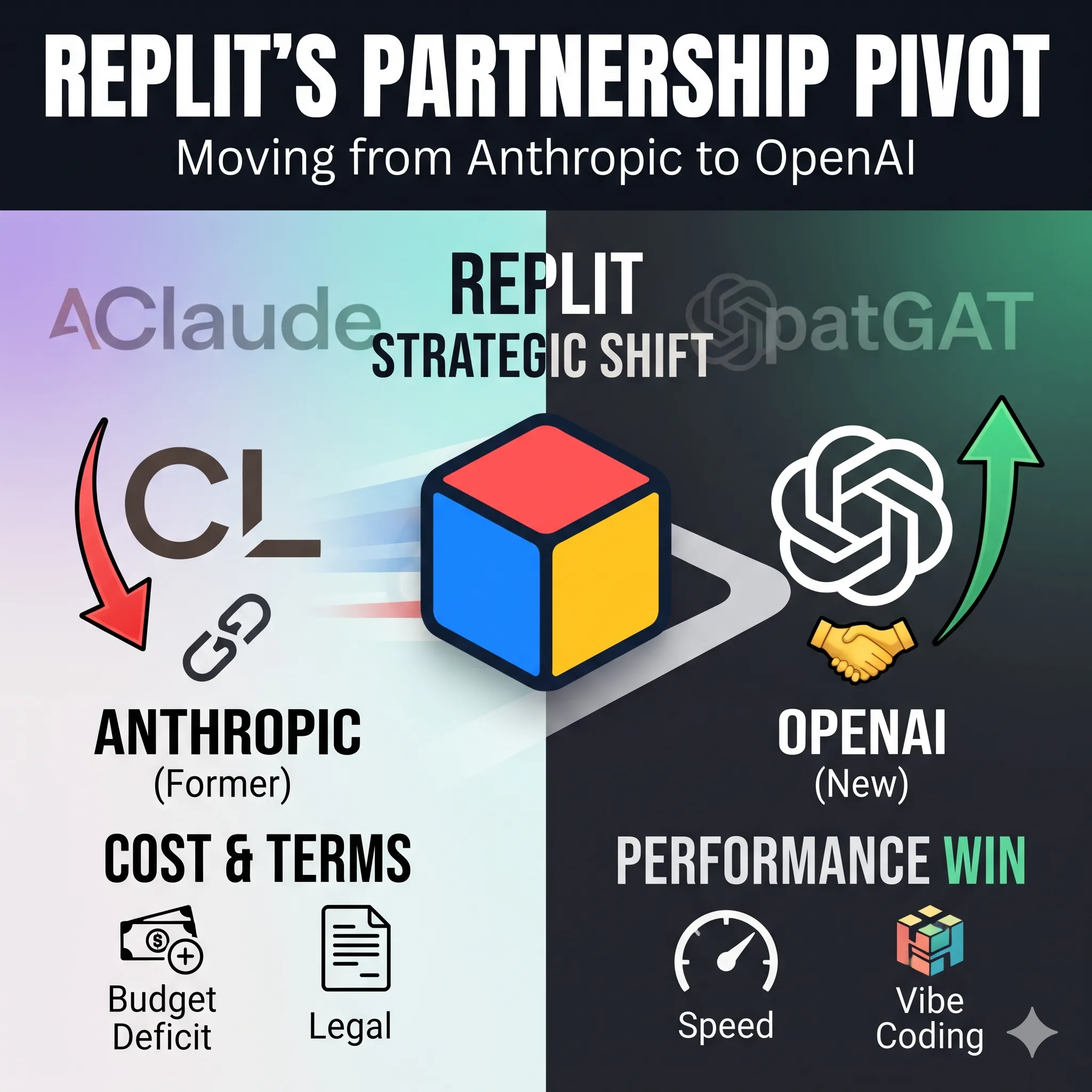
Why Replit Left Anthropic for OpenAI: Inside the Strategic PivotReplit ends its partnership with Anthropic, citing cost and performance, and announces a major...
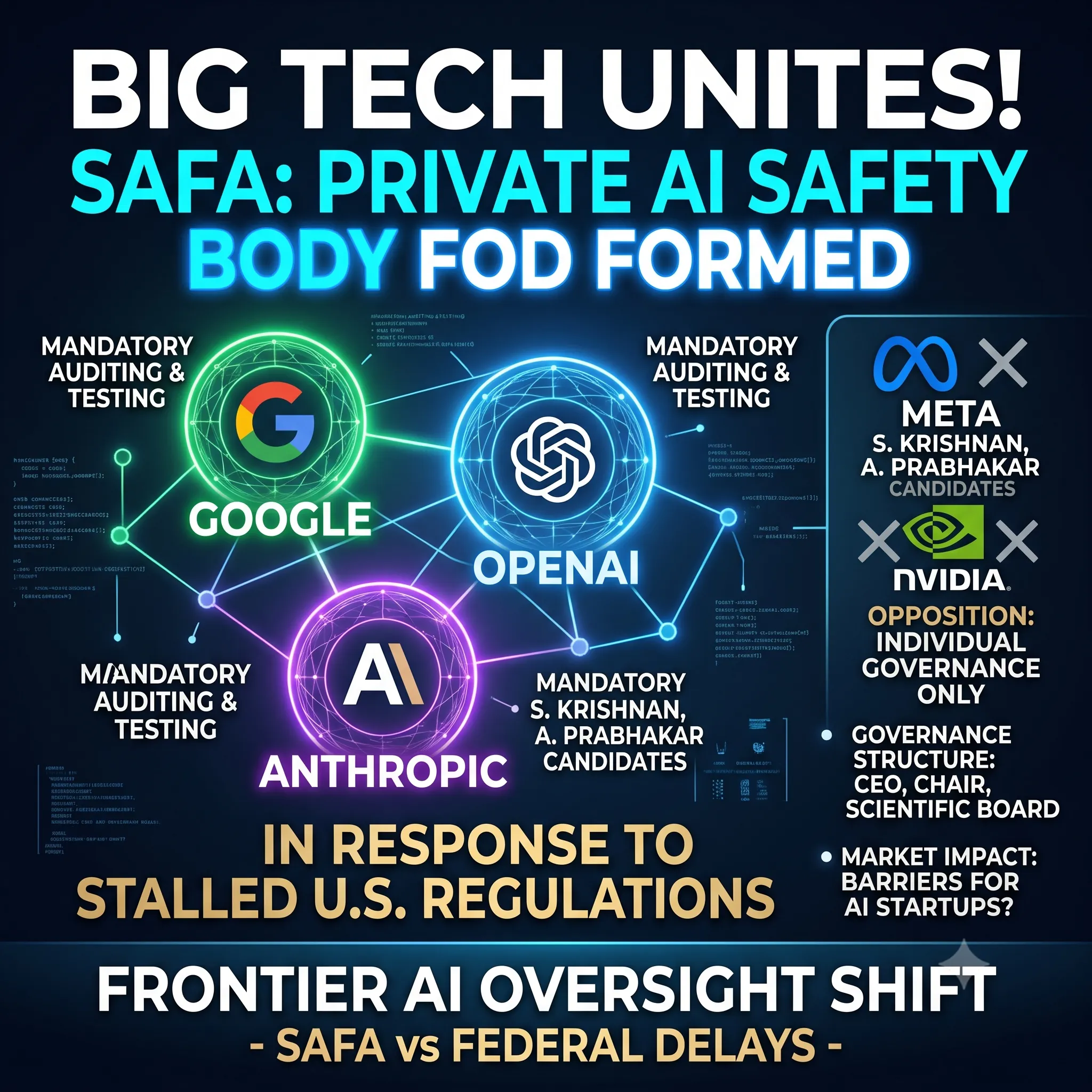
Google, OpenAI, and Anthropic Form Standards Authority for Frontier AI (SAFA) to Establish Industry Self-RegulationGoogle, OpenAI, and Anthropic are launching the Standards Authority for Frontier AI (SAFA) to...

Comparing GPT-6 Astra and Claude Fable 5.1: Pricing, Reasoning, and ArchitectureA comparative analysis of the September 2026 releases of GPT-6 Astra and Claude Fable 5.1, focusing...
Generative AI may have assisted with research or drafting for this article. Topic selection, fact-checking, final wording, and publication remain the responsibility of DragonStone74. AI use disclosure