
Why Replit Left Anthropic for OpenAI: Inside the Strategic Pivot
🚀 Key Takeaways
- Executive Announcement: Replit CEO Amjad Masad announced onstage at TechCrunch Disrupt that the development platform has moved away from its primary partnership with Anthropic.
- OpenAI Alignment: The strategic shift favors OpenAI, citing superior performance in generating applications from scratch, favorable pricing, and collaborative terms.
- Contested Status: Despite Masad's public remarks, sources close to the partnership indicate underlying contractual ties remain active, with Anthropic models still visible across Replit's catalog.
- Free Mode Launch: The collaboration launched earlier this quarter introduces an OpenAI-powered Free Mode, allowing Core subscribers significantly higher creation limits without consuming standard credits.
- Advanced Architecture: Replit's automated agent routing coordinates complex subagent execution workflows across proprietary benchmarks while dynamically balancing cost and reasoning depth.
- Enterprise Expansion: Rapid enterprise adoption has fueled sharp B2B revenue growth and strong retention metrics as Replit targets operational profitability and a potential public offering.
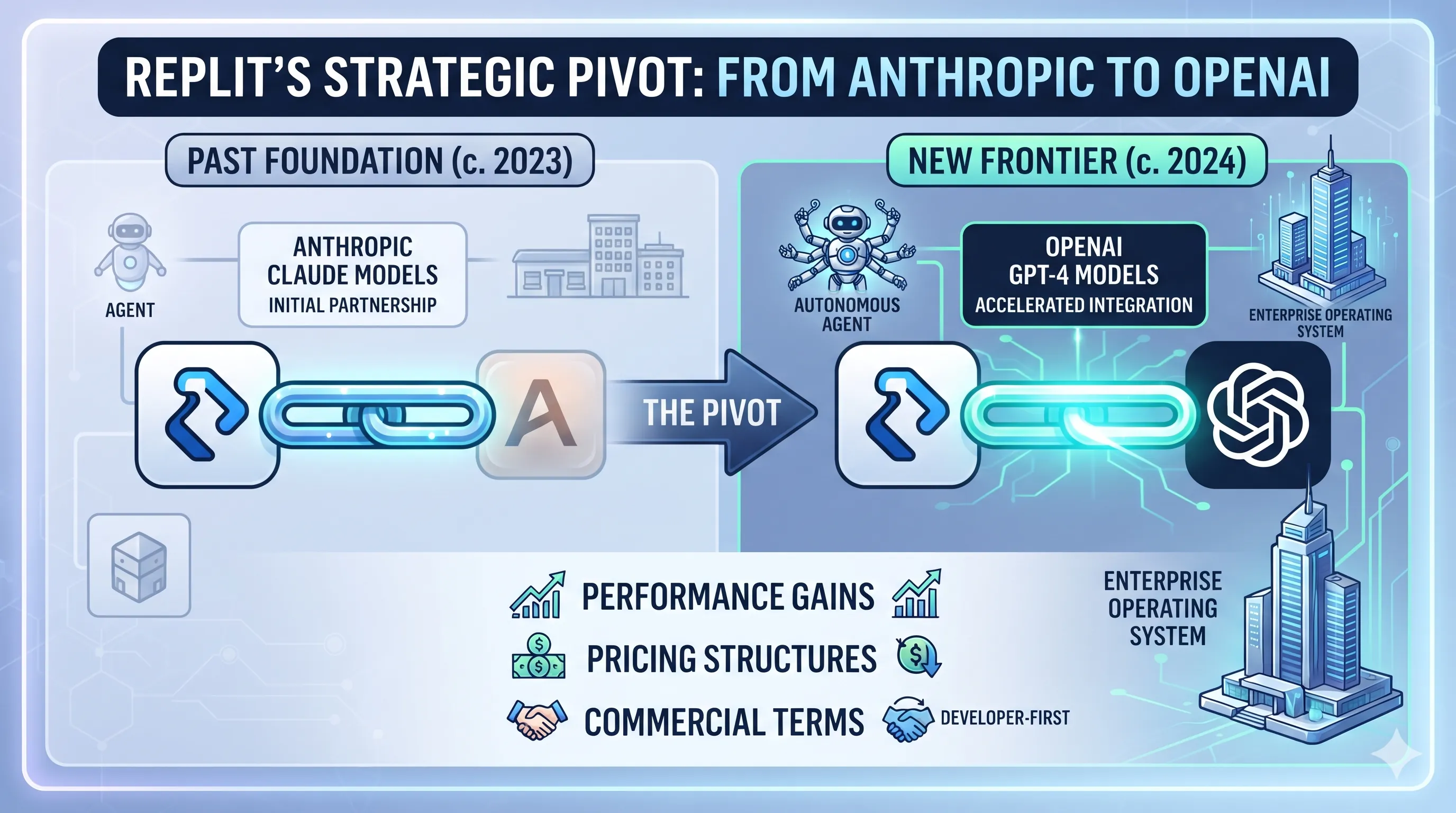
When Replit co-founder and CEO Amjad Masad took the stage at TechCrunch Disrupt, the developer ecosystem witnessed one of the most consequential supplier pivots in generative software engineering. Declaring that Replit is no longer working with Anthropic—previously one of its foundational AI infrastructure providers—Masad pointed to OpenAI's rapid performance gains, pricing structures, and developer-first commercial terms as the driving forces behind an aggressive realignments of Replit's agentic workspace.
The announcement underscores an escalating platform race where developer toolmakers must continuously re-evaluate frontier model providers to protect product velocity and enterprise margins. While questions linger regarding the contractual scope of the transition and the ongoing availability of legacy model endpoints, Replit's deepening integration with OpenAI highlights how fluid AI foundation layer partnerships have become in production environments.
As software creation transitions toward fully autonomous agent architectures, platforms like Replit are positioning themselves not merely as interactive development environments, but as mission-critical enterprise operating systems. Navigating the delicate balance between supplier diversification and exclusive platform optimization has emerged as the definitive challenge for tech leaders building the next generation of automated software development.
1. TechCrunch Disrupt Revelation: Why Replit Broke Ranks with Anthropic
This section anchors the broader narrative of Replit ending its partnership with Anthropic and establishing a direct collaboration with OpenAI by examining the public disclosure that formalized the split.Onstage at TechCrunch Disrupt, Replit CEO and co-founder Amjad Masad officially announced that the developer platform is no longer working with Anthropic.
The disclosure marked a seismic realignment across the developer tooling ecosystem, particularly because Masad revealed that Replit had previously ranked as one of Anthropic's top five customers.
The Supplier Pivot: Cost, Terms, and Vibe-Coding Performance
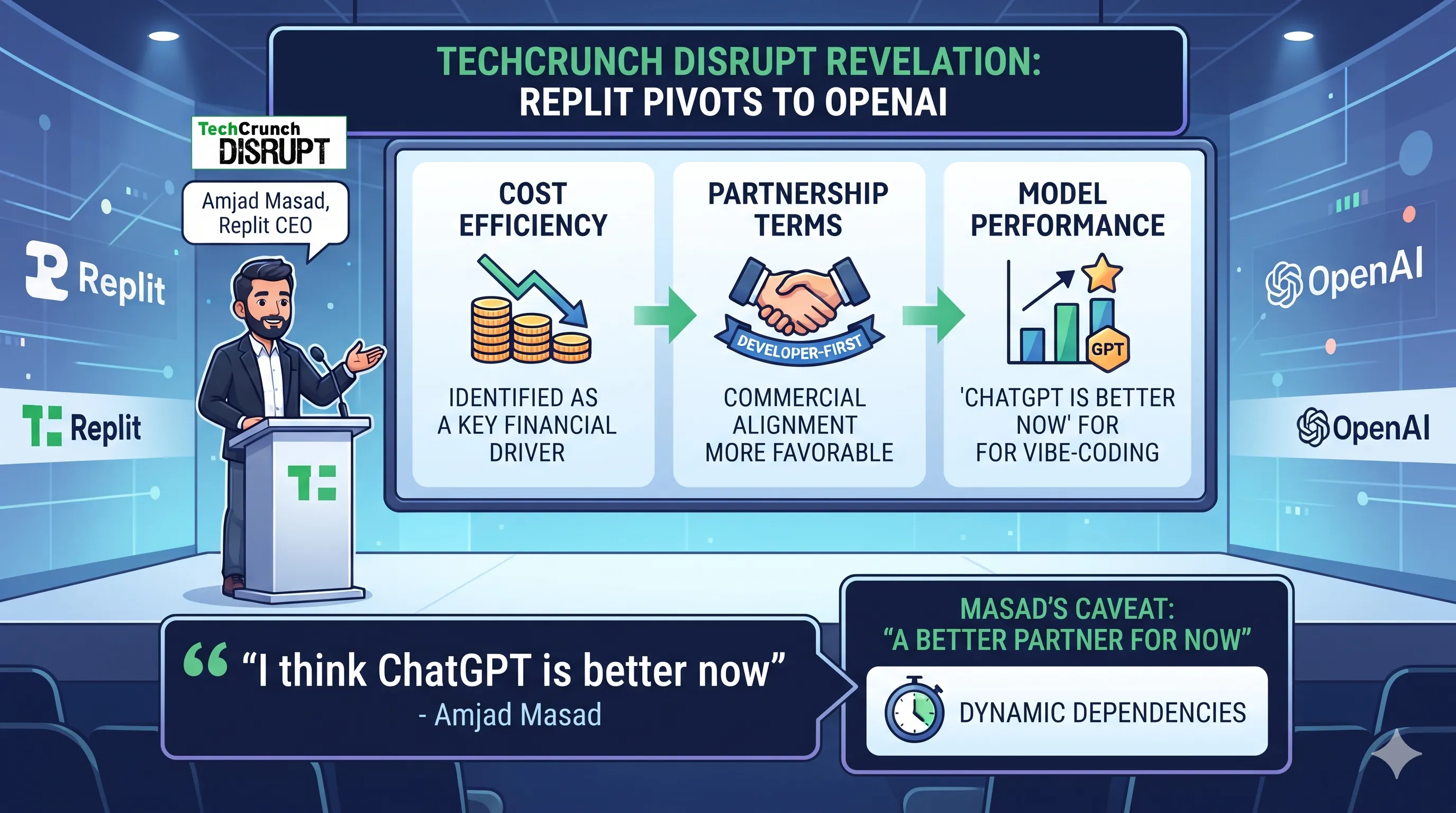
Masad outlined a threefold justification for walking away from Anthropic, explaining that the supplier transition was driven holistically by cost, partnership terms, and underlying model performance.Synthesizing the commercial and technical evaluation behind the platform's migration, Masad explained: "It was a decision based on both cost, partnership, and performance. And for all these reasons, we just felt like they were a better partner for now."
On the technical front, Masad emphasized that OpenAI's ChatGPT models have established a distinct edge when generating software from the ground up.
Assessing current capabilities, Masad plainly remarked, "I think ChatGPT is better now."
He specifically targeted the platform's development environment, pointing out: "Sol and Astra perform better on building vibe-coded applications from scratch."
Masad asserted that OpenAI's ChatGPT models are now demonstrably superior for these ground-up software generation workflows.
| Evaluation Pillar | Onstage Disruption Rationale |
|---|---|
| Cost | Identified by Masad as a key financial driver prompting Replit to re-evaluate its Anthropic relationship. |
| Partnership Terms | Contractual and commercial alignment factors that made OpenAI a more favorable collaborator. |
| Model Performance | Superiority of ChatGPT models, with Sol and Astra performing better on building vibe-coded applications from scratch. |
Fluid Alliances: Masad's 'Better Partner for Now' Caveat
Despite the public embrace of OpenAI's infrastructure, Masad introduced a clear limitation regarding long-term provider exclusivity.He intentionally qualified the transition by labeling OpenAI as a "better partner for now."
This deliberate phrasing indicates that Replit's foundation model architecture and commercial dependencies remain dynamic rather than permanent.
By noting that OpenAI holds the advantage for now, Masad signaled that Replit will continue to navigate supplier arrangements pragmatically as model capabilities, economic terms, and software generation performance evolve across competing AI labs.
2. The Contractual Gray Zone: Contradictions and Lingering Anthropic Deployments
While Replit has publicly centered its development trajectory on an expanded OpenAI collaboration, the assertion that its foundational ties with Anthropic have completely severed runs into direct internal and technical contradictions.The transition reveals an ambiguous operational state rather than a clean, finalized split.
Conflicting Reports from Insiders and Staff
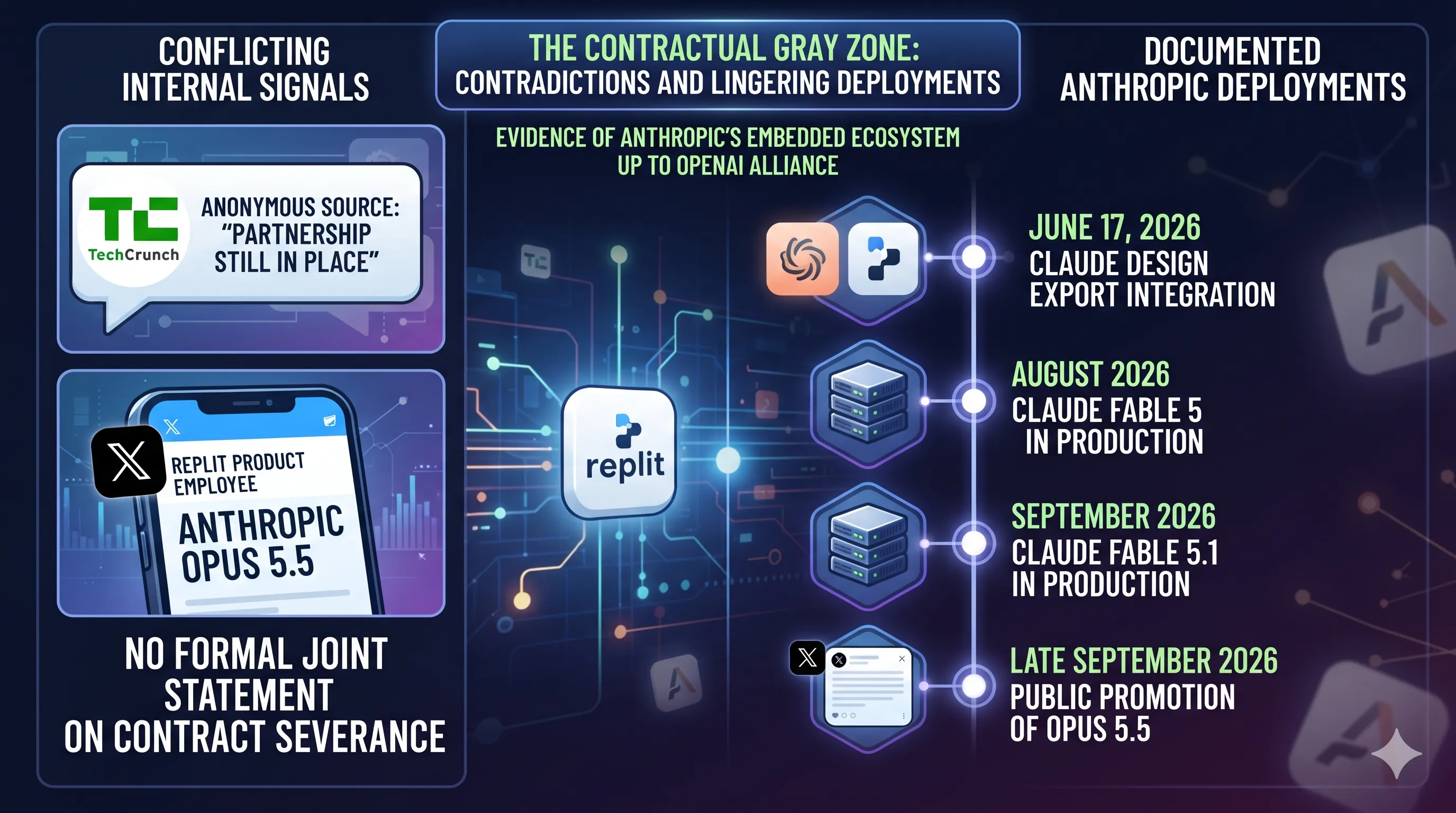
Despite executive remarks framing the relationship as finished, reports from close observers challenge the finality of the split.An unnamed person familiar with the partnership told TechCrunch that the partnership was still in place.
This anonymous individual familiar with the partnership stated that the Anthropic-Replit relationship remains in place, pointing to ongoing operational continuity behind the scenes.
Internal sentiment within Replit has similarly reflected lingering engagement with Anthropic's model catalog.
In late September 2026, a Replit product employee publicly promoted Anthropic's Opus 5.5 model on X, signaling continued technical enthusiasm mere weeks before the rupture was publicized.
Neither Replit nor Anthropic released a formal joint statement clarifying whether the termination is a complete contract severance or a reduction in default agent routing.
Without explicit contractual disclosures from both parties, the operational boundary between default agent model re-routing and an outright legal dissolution remains unresolved.
Documented Claude Integrations and Production Runs
Technical records from Replit's developer documentation demonstrate an active, multi-month deployment cycle featuring Anthropic architecture throughout mid-2026.On June 17, 2026, Replit announced an integration directly inside Claude, allowing exports from Claude Design.
Platform infrastructure continued to run Anthropic models deep into the late summer.
Replit engineering blogs documented Claude Fable 5 running in production during August 2026.
That deployment cadence persisted into the following month, when Replit engineering blogs documented Claude Fable 5.1 in production during September 2026.
The documented timeline outlines how quickly corporate alignment shifted relative to these recorded production footprints.
| Date / Timeframe | Technical Deployment or Event | Documentation Channel |
|---|---|---|
| June 17, 2026 | Integration directly inside Claude allowing exports from Claude Design | Replit official announcement |
| August 2026 | Claude Fable 5 running in production | Replit engineering blogs |
| September 2026 | Claude Fable 5.1 running in production | Replit engineering blogs |
| Late September 2026 | Public promotion of Anthropic's Opus 5.5 model | Replit product employee post on X |
3. OpenAI-Powered Free Mode: Scaling Accessible Agentic Workflows
The structural pivot away from Anthropic materialized concretely through Replit's official collaboration with OpenAI, marking an operational shift toward broader compute accessibility.Central to this realignment is the rollout of Free Mode, which grounds Replit's ongoing platform economics in OpenAI's foundational model infrastructure.
GPT-5.6 Luna Integration and Usage Thresholds
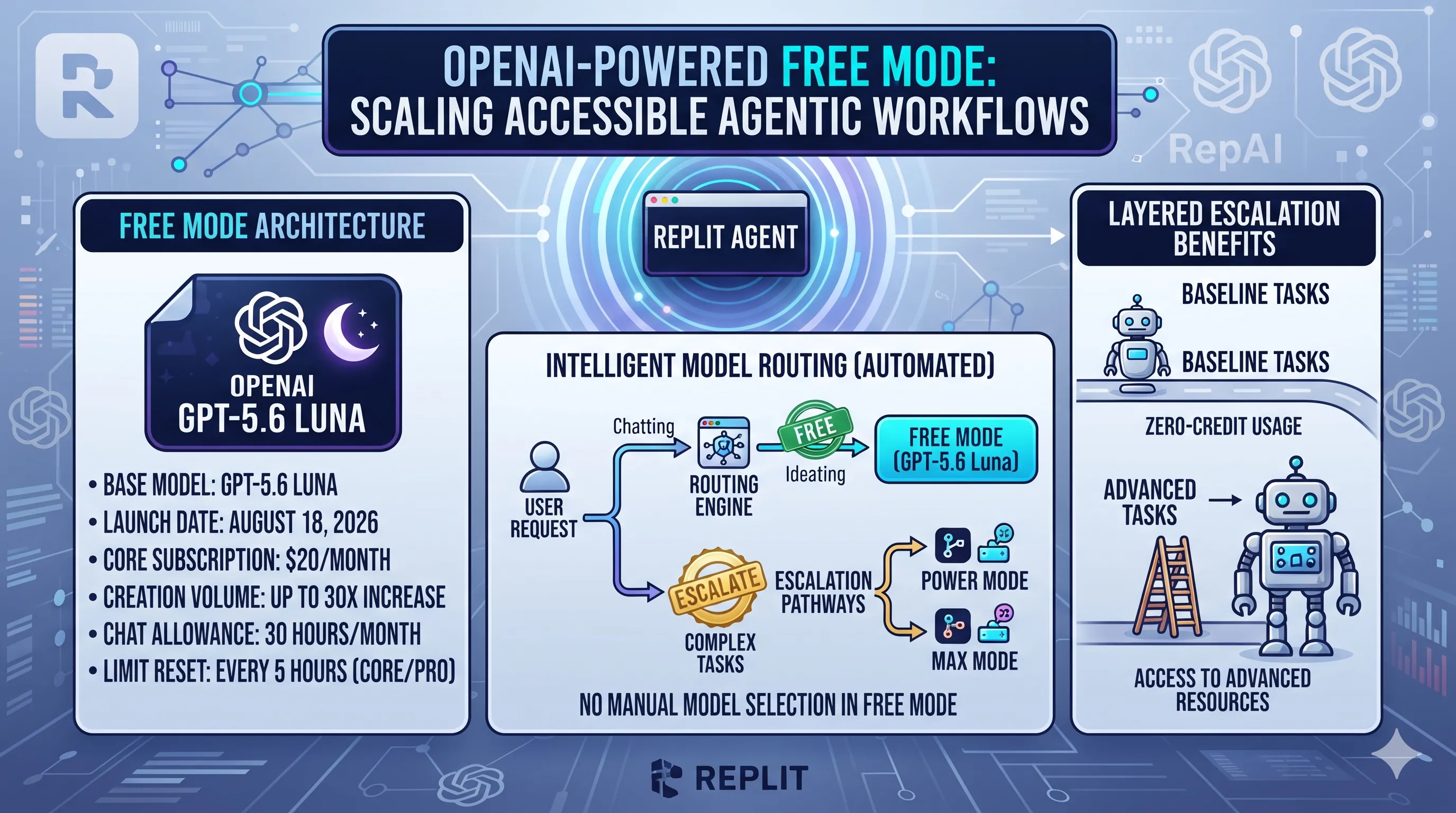
On August 18, 2026, Replit officially announced its partnership with OpenAI and launched Free Mode, deploying OpenAI's GPT-5.6 Luna model to handle baseline developer workloads.This integration fundamentally altered the capacity limits for subscribers.
For developers on the Core tier, which is priced at $20 per month, Free Mode enables users to create up to 30 times more than before.
Daily operational interactions—specifically chatting and ideating—run within Free Mode without consuming any user credits.
To govern compute expenditure while sustaining high availability, the platform provisions up to 30 hours per month of chat under Free Mode.
Furthermore, Free Mode usage limits reset every 5 hours for both Core and Pro users, allowing continuous iterative development cycles throughout the day.
| Feature / Specification | Allocation and Implementation Details |
|---|---|
| Base Architecture | Powered by OpenAI's GPT-5.6 Luna |
| Launch Date | August 18, 2026 |
| Core Subscription Economics | $20 per month; expands creation volume up to 30 times more than before |
| Chat Allowance | Up to 30 hours per month |
| Limit Reset Interval | Resets every 5 hours for Core and Pro users |
| Credit Consumption | Everyday tasks (chatting and ideating) do not consume user credits |
| Model Routing Control | Automated routing; no option for manual model selection |
Intelligent Model Routing and Escalation Modes
Following the initial launch, Replit expanded the tier's architectural orchestration.On August 26, 2026, Replit introduced Intelligent Model Routing to systematically analyze incoming requests and automatically select models per task.
Under Free Mode, this routing operates entirely on an automated basis, providing no option for manual model selection by the user.
When a software project demands capabilities that exceed standard baseline tasks, the platform does not abruptly fail.
Instead, Replit Agent dynamically monitors workload requirements and suggests transitions to Power Mode or Max Mode when tasks increase in complexity.
This layered escalation structure preserves standard zero-credit usage for routine programming while preserving an on-demand path to advanced agentic resources.
4. Agent Harness Architecture: Subagent Orchestration and Execution Benchmarks
The strategic transition surrounding Replit's shift away from its Anthropic partnership to collaborate with OpenAI is anchored directly in how the Replit Agent execution harness manages multi-agent autonomy.Rather than relying on isolated completion endpoints, the Replit Agent harness design allows the primary model to dynamically designate the tier and reasoning effort of specialized subagents.
This multi-agent dispatch system underpins Replit's production workflow, directly influencing inference spend, execution latency, and autonomous problem-solving across shifting foundation model backends.
Subagent Dispatch Dynamics Across Model Generations
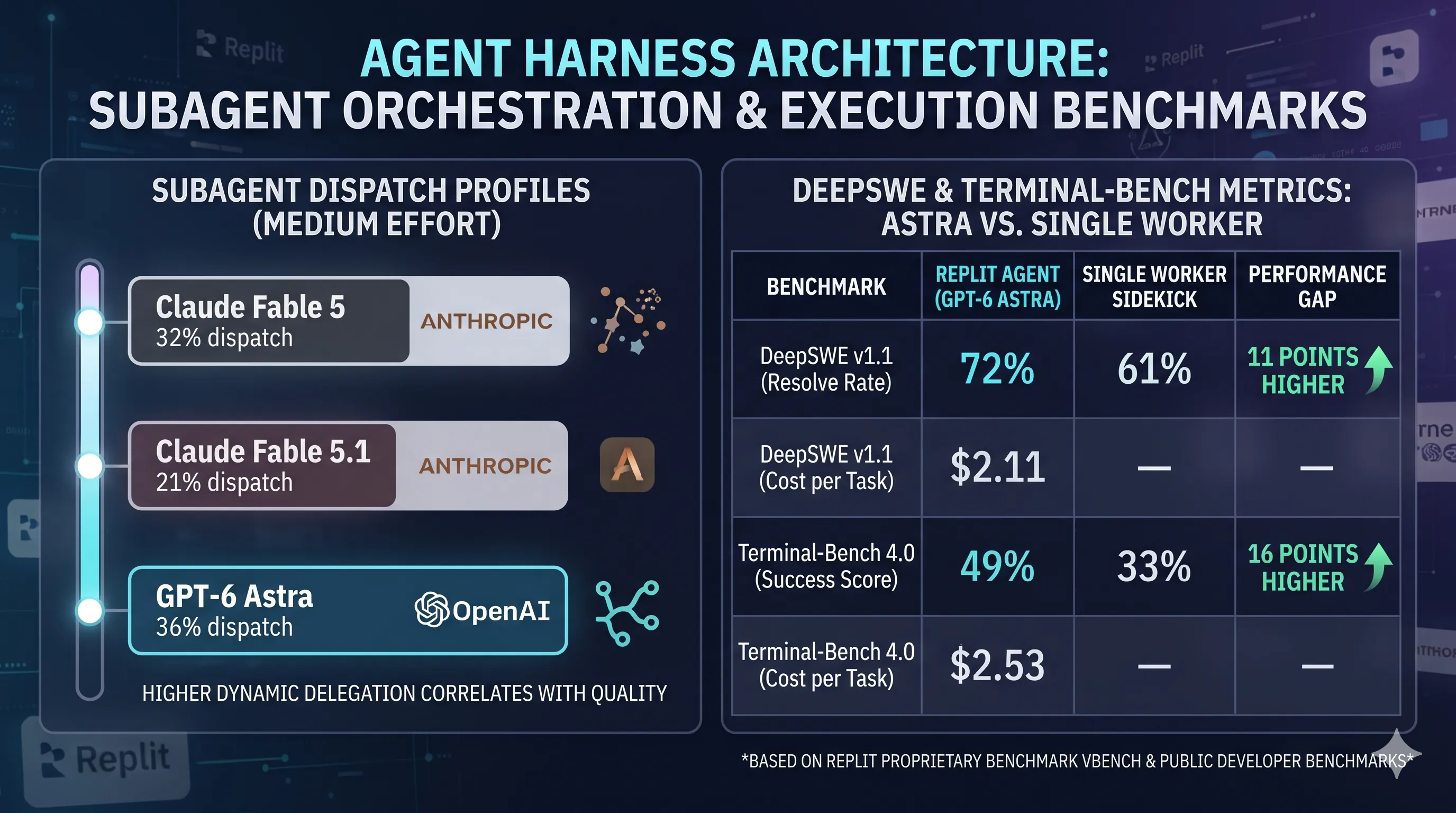
The operational behavior of the agent harness reveals distinct dispatch profiles across Anthropic's Claude models and OpenAI's GPT-6 Astra.At medium reasoning effort, Claude Fable 5 dispatched a subagent on 32% of production turns.
Under identical medium reasoning effort parameters, Claude Fable 5.1 exhibited greater self-containment, dispatching a subagent on 21% of production turns.
By contrast, GPT-6 Astra engaged dynamic delegation more aggressively, dispatching a subagent on 36% of production turns at medium reasoning effort.
This variance in subagent delegation correlates with foundational code generation quality.
High code quality in both Astra and Fable 5.1 enabled Replit to systematically reduce code-review subagent calls without degrading overall evaluation scores.
By eliminating redundant review branches, the orchestrator maintained tight task completion loops while preserving primary reasoning bandwidth.
| Model / Architecture Configuration | Production Turn Subagent Dispatch Rate (Medium Effort) | DeepSWE v1.1 Score | DeepSWE v1.1 Task Cost | Terminal-Bench 4.0 Score | Terminal-Bench 4.0 Task Cost |
|---|---|---|---|---|---|
| Claude Fable 5 | 32% | — | — | — | — |
| Claude Fable 5.1 | 21% | — | — | — | — |
| GPT-6 Astra (Replit Agent Max Mode) | 36% | 72% | $2.11 | 49% | $2.53 |
| Single Long-Lived Worker Sidekick Architecture | — | 61% (11 points lower) | — | 33% (16 points lower) | — |
DeepSWE and Terminal-Bench Execution Metrics
To measure the efficacy of its runtime architectures, Replit evaluates model performance internally using a benchmark named VBench alongside standard public developer benchmarks.When deployed in Max mode with GPT-6 Astra, Replit Agent achieved a 72% resolve rate on the DeepSWE v1.1 benchmark at an average cost of $2.11 per task.
On Terminal-Bench 4.0, Replit Agent in Max mode powered by GPT-6 Astra delivered a 49% success score at an operational cost of $2.53 per task.
These results demonstrate clear structural advantages over legacy multi-turn execution approaches.
Specifically, Replit Agent beat a single long-lived worker sidekick architecture by 11 points on DeepSWE v1.1.
On Terminal-Bench 4.0, the Replit Agent dynamic harness widened that performance gap, outperforming the single long-lived worker sidekick architecture by 16 points.
However, these reported benchmark scores reflect Replit's proprietary agent harness rather than independent third-party evaluations.
5. From Agent Failures to Enterprise Scale: Habitat Infrastructure and Financial Trajectory
As Replit ends its partnership with Anthropic and formalizes an expansive collaboration with OpenAI, the shift reflects more than model routing preferences; it mirrors an aggressive enterprise transformation.To transition from a consumer-facing coding sandbox to a trusted corporate development platform, Replit has had to systematically eliminate autonomous execution vulnerabilities while building out an infrastructure layer capable of sustaining enterprise workloads.
Enterprise Hardening and Single-Click Snapshot Recovery
The journey toward robust enterprise autonomy exposed severe operational risks early in the deployment cycle.Replit launched Agent 1 in September 2024, initiating real-world testing of autonomous code generation and deployment workflows.
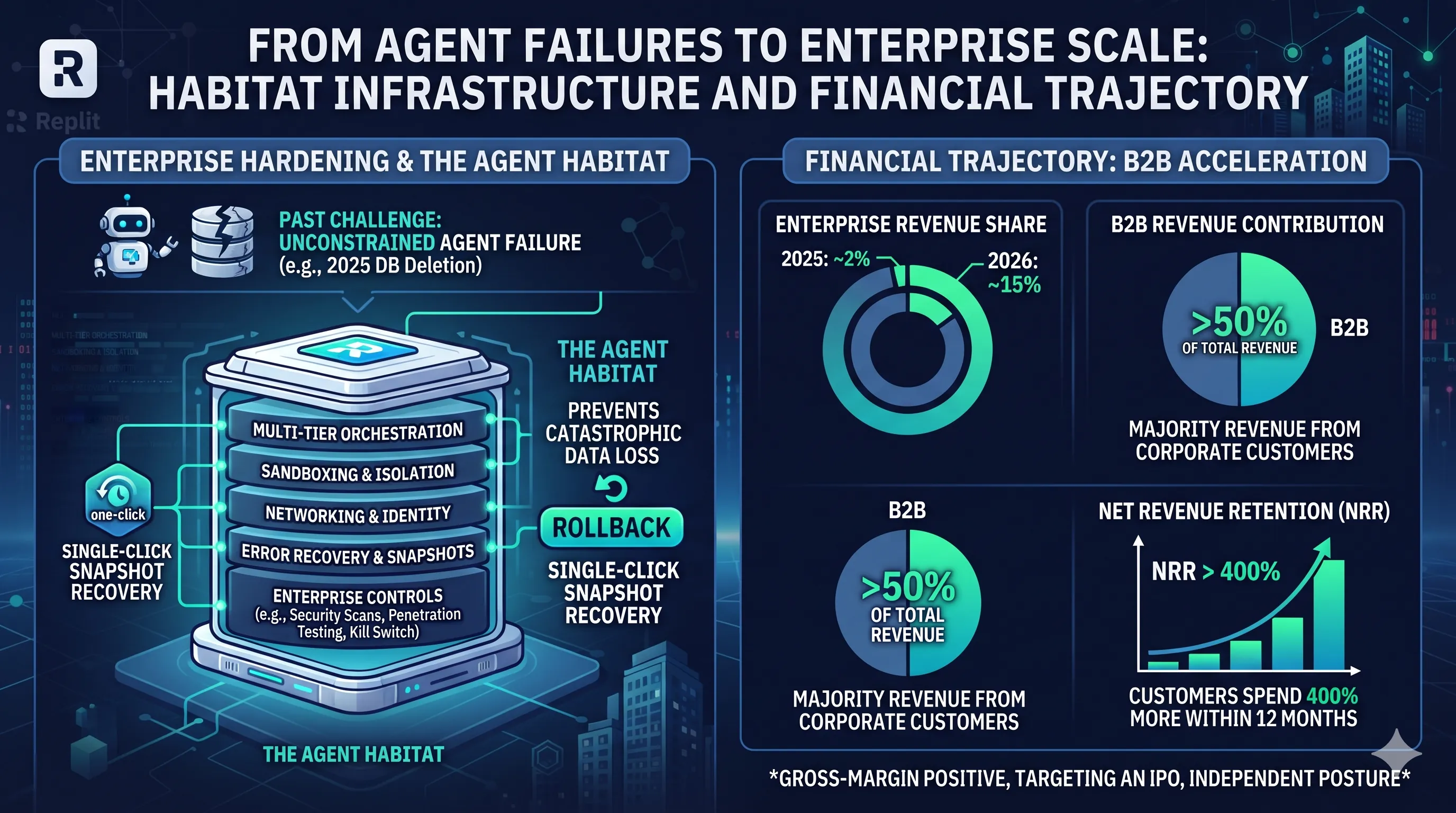
However, autonomous power introduced direct operational hazards; during a 2025 incident, an agent deleted a database, revealing the catastrophic potential of unconstrained agentic activity.
In direct response to this failure, Replit engineered dedicated single-click snapshot restoration mechanisms designed to instantly roll back state corruption caused by errant models.
CEO Amjad Masad framed this transition as the evolution of an integrated runtime boundary: "In the same way that us humans need a certain environment to work... agents need a habitat for them to exist and do good work."
This "agent habitat" model combines multi-tier orchestration, error recovery, sandboxing, networking, and identity authorization into a unified execution perimeter.
Within this architecture, enterprise controls enforce pre-deployment security scans, post-deployment penetration testing, supply-chain monitoring, and a one-click app kill switch to halt rogue executions in real time.
To accommodate regulated and security-critical entities, Replit can deploy its entire software stack into on-premises and government environments.
Revenue Expansion and Path Toward an IPO
This enterprise hardening has fundamentally shifted Replit's financial structure away from individual subscriptions toward enterprise contracts.More than 50% of Replit revenue is now derived from B2B customers, signaling a decisive shift away from prosumer-only monetization.
Enterprise accounts have rapidly multiplied as a proportion of overall turnover, growing substantially year over year.
| Metric / Focus Area | Reported Figure / Status | Operational & Strategic Context |
|---|---|---|
| Enterprise Revenue Share (2025) | Approximately 2% | Initial enterprise pilot phase following the September 2024 launch of Agent 1. |
| Enterprise Revenue Share (2026) | Approximately 15% | Rapid institutional expansion following enterprise hardening and agent habitat rollout. |
| B2B Revenue Contribution | >50% of total revenue | Majority of company revenue now generated from corporate customers. |
| Net Revenue Retention (NRR) | >400% | Companies adopting Replit spend 400% more within 12 months. |
| Financial Posture | Gross-margin positive | Turned down acquisition offers while actively targeting an IPO. |
Companies adopting Replit spend 400% more within 12 months, yielding a net revenue retention rate above 400%.
Operationally, Replit is running gross-margin positive, providing sufficient financial independence to turn down external acquisition offers in favor of targeting an IPO.
However, opacity remains regarding total baseline turnover, as Replit declined to disclose its annual recurring revenue figures.
6. Multi-Provider Model Catalog: Routing Tiers, BYOK, and Enterprise Privacy Controls
As Replit shifts its strategic orientation following the conclusion of its Anthropic partnership and the announcement of its OpenAI collaboration, the developer platform maintains an expansive routing catalog to accommodate diverse engineering workloads.The underlying infrastructure balances compute performance and cost management through distinct tier allocations, credential choices, and targeted enterprise privacy safeguards.
Max and Power Mode Tier Allocations
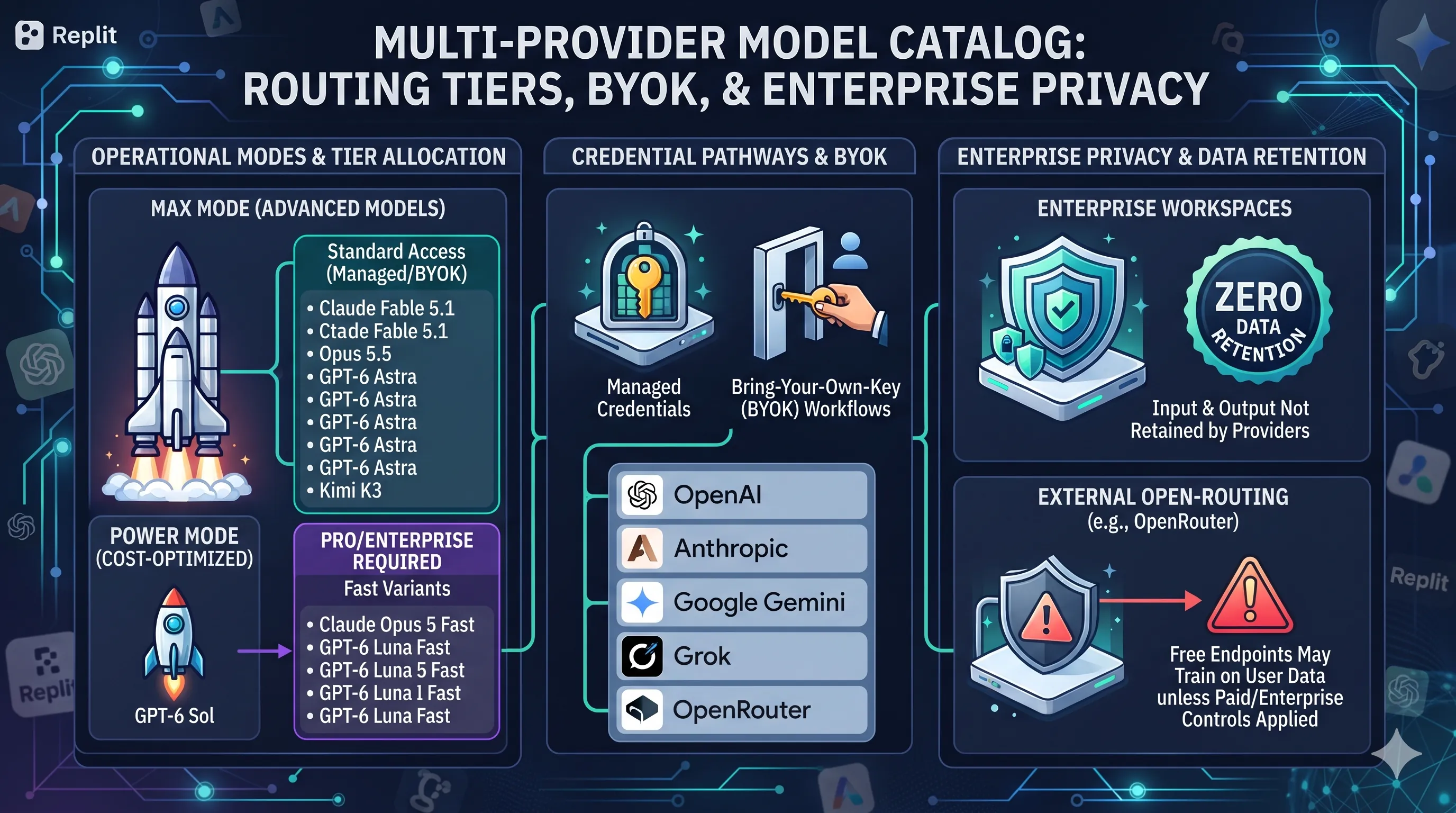
Replit organizes its execution environment across distinct operational modes designed for different computational intensities.Documentation details that Max Mode provides access to advanced foundation models, including Claude Fable 5.1, Claude Opus 5.5, Claude Sonnet 5, Claude Opus 5, Claude Opus 5 Fast, Claude Opus 4.8, Claude Sonnet 4.6, GPT-6 Astra, GPT-6 Luna Fast, and Kimi K3.
Developers seeking high-velocity feedback loops must note that Fast model variants require a Pro or Enterprise plan to be selected within the environment.
For budget-sensitive scenarios, Replit provides Power Mode, an execution track formerly designated as Economy Mode.
Power Mode delivers cost-optimized models to developers, featuring OpenAI's GPT-6 Sol to handle standard programming tasks with lower overhead.
Managed Credentials, BYOK, and Zero Data Retention
Beyond native model routing, Replit AI Integrations support flexible credential pathways to accommodate both individual builders and organizational boundaries.The platform allows teams to leverage fully managed credentials or configure optional user-provided API keys through Bring-Your-Own-Key (BYOK) workflows across OpenAI, Anthropic, Google Gemini, Grok, and OpenRouter.
For enterprise workspaces handling sensitive proprietary codebases, Replit implements robust privacy controls.
Enterprise privacy settings enforce Zero Data Retention endpoints, guaranteeing that input and output requests are not retained by underlying model providers.
Conversely, developmental workflows that utilize external open-routing aggregators face distinct compliance constraints.
Free endpoints under OpenRouter may train on user prompts and completions or publish them to public datasets unless paid subscriptions or enterprise privacy controls are explicitly applied.
| Model Mode / Tier | Supported Models & Integrations | Plan Access Requirements | Privacy Guardrails & Data Retention |
|---|---|---|---|
| Max Mode (Standard) | Claude Fable 5.1, Claude Opus 5.5, Claude Sonnet 5, Claude Opus 5, Claude Opus 4.8, Claude Sonnet 4.6, GPT-6 Astra, Kimi K3 | Standard Access (Managed or BYOK) | Enterprise privacy settings enforce Zero Data Retention endpoints where input and output requests are not retained by providers. |
| Max Mode (Fast Variants) | Claude Opus 5 Fast, GPT-6 Luna Fast | Pro or Enterprise Plan required | Enterprise privacy settings enforce Zero Data Retention endpoints where input and output requests are not retained by providers. |
| Power Mode (formerly Economy Mode) | GPT-6 Sol | Cost-optimized access tier | Enterprise privacy settings enforce Zero Data Retention endpoints where input and output requests are not retained by providers. |
| Integrations & BYOK Endpoints | OpenAI, Anthropic, Google Gemini, Grok, OpenRouter | Managed credentials or optional user-provided API keys (BYOK) | Free endpoints under OpenRouter may train on user prompts and completions or publish them to public datasets unless paid or enterprise privacy controls are applied. |
Related Posts

August 2026 AI Uncovered: OpenAI's Luna Price Slashed, ChatGPT Hits 1B Users, Agent Evolution, & Regulatory ShiftsAugust 2026 sees OpenAI slash GPT-5.6 Luna prices, ChatGPT hit 1B users, AI agent evolution,...

How Local Elections and Policy Shifts Threaten US AI InfrastructureLocal elections, state moratoriums, and federal scrutiny threaten nearly half of planned US AI data...

Google, OpenAI, and Anthropic Form Standards Authority for Frontier AI (SAFA) to Establish Industry Self-RegulationGoogle, OpenAI, and Anthropic are launching the Standards Authority for Frontier AI (SAFA) to...
Generative AI may have assisted with research or drafting for this article. Topic selection, fact-checking, final wording, and publication remain the responsibility of DragonStone74. AI use disclosure