August 2026 AI Uncovered: OpenAI's Luna Price Slashed, ChatGPT Hits 1B Users, Agent Evolution, & Regulatory Shifts
🚀 Key Takeaways
- OpenAI significantly cut the pricing for its GPT-5.6 Luna model.
- ChatGPT achieved a remarkable milestone of 1 billion weekly active users.
- OpenAI solidified its product strategy with distinct tiers across its GPT-5.6 lineup.
- Competitors like Anthropic are advancing AI model capabilities, particularly in coding and large context windows.
- AI agents are evolving from experimental tools to practical, real-world applications.
- The AI industry is seeing massive investments in computing infrastructure and strategic partnerships.
- Regulatory oversight for frontier AI models is intensifying, influencing model releases and imports.
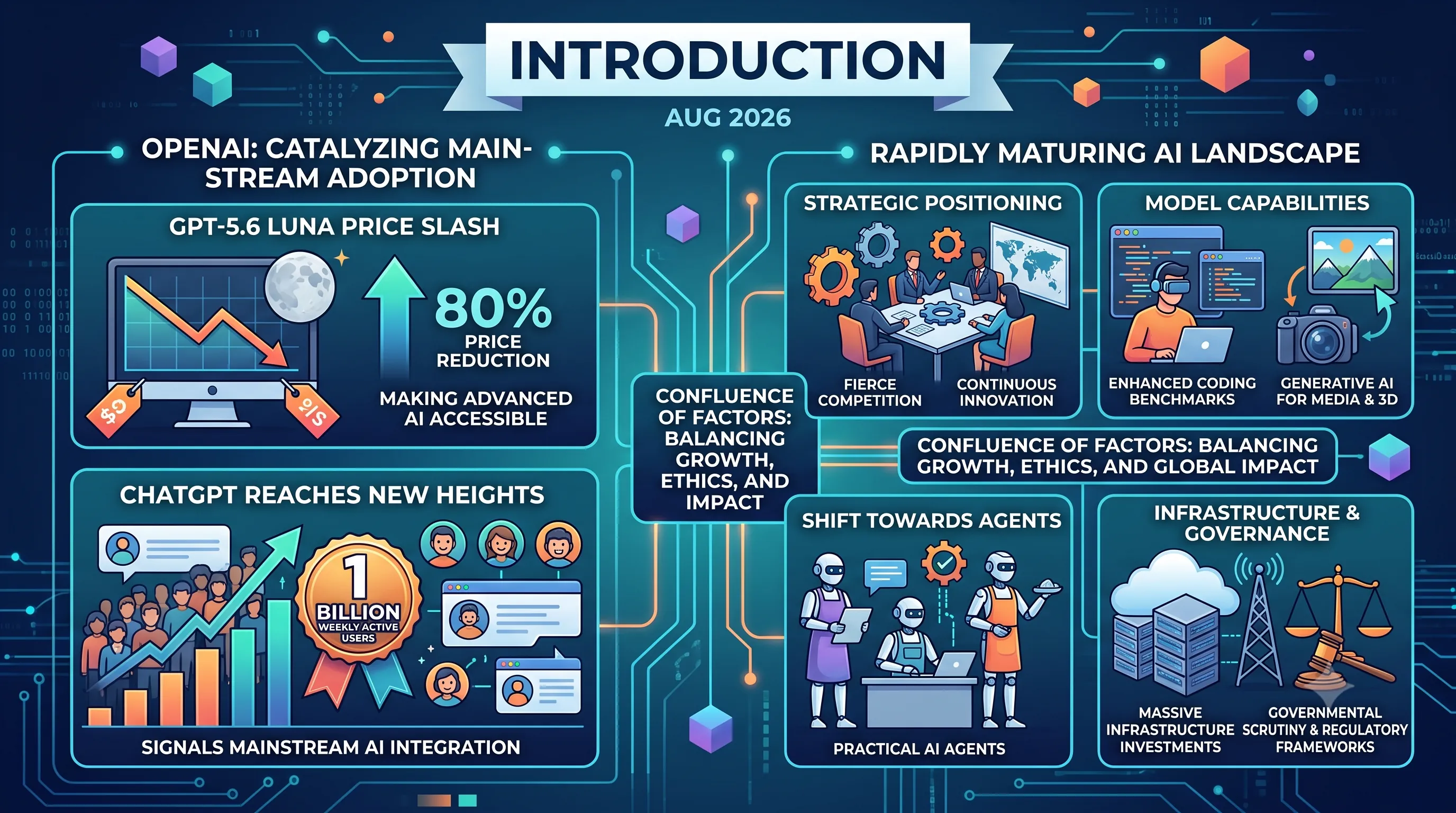
This move comes as its flagship product, ChatGPT, celebrates a monumental achievement, surpassing 1 billion weekly active users, signaling a new phase of mainstream AI adoption and integration.
These dual developments underscore a rapidly maturing AI landscape, characterized by fierce competition, continuous innovation, and strategic market positioning.
Companies are not only refining pricing and product lineups but also pushing the boundaries of model capabilities, from enhanced performance in coding benchmarks to the development of sophisticated generative AI for media and 3D applications.
August 2026 marks a pivotal moment for the AI industry, with the shift towards practical AI agents gaining traction, massive infrastructure investments underway, and increasing governmental scrutiny shaping regulatory frameworks.
This confluence of factors highlights an industry balancing unprecedented growth with the complex demands of scalability, ethical deployment, and global impact.
1. OpenAI's Aggressive Pricing Strategy & Expanded Model Lineup
This section delves into the specifics of OpenAI's 80% price reduction for GPT-5.6 Luna, a central element of the main article's topic. It details the new cost structure, situates Luna within the broader GPT-5.6 model family, and examines the competitive landscape, particularly Google's counter-moves on pricing.GPT-5.6 Luna: A Major Price Reduction
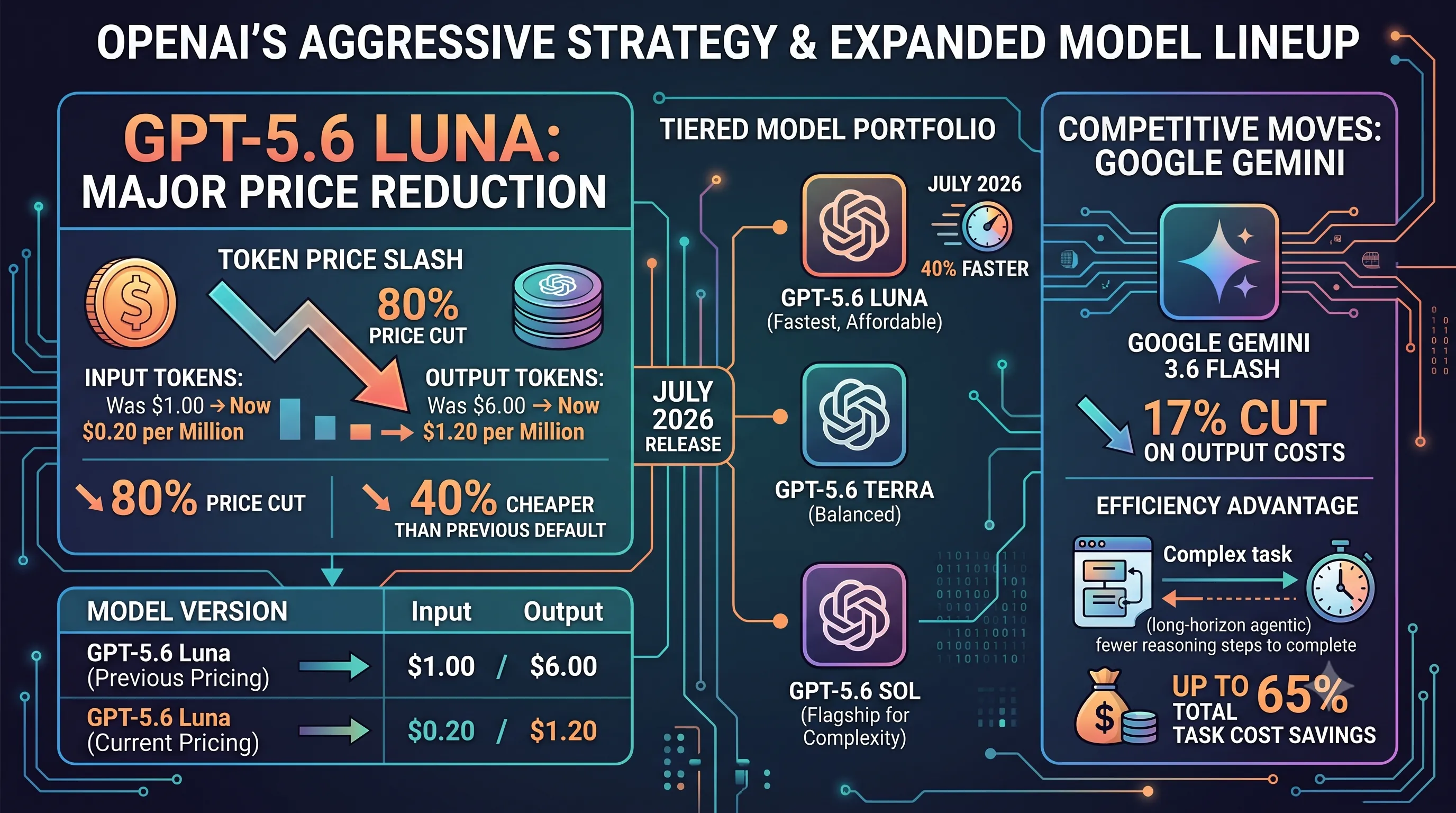
In a significant move to lower the barrier for developers, OpenAI announced a major price cut for its GPT-5.6 Luna model on July 30, 2026.The cost for input tokens was slashed by a dramatic 80%, falling from its previous price of $1 per million tokens to just $0.20 per million input tokens.
Output tokens also saw a substantial reduction, now priced at $1.20 per million output tokens, down from the former $6 per million.
This new pricing makes GPT-5.6 Luna 40% cheaper than OpenAI's previous default model, expanding its accessibility for high-volume applications.
| Model Version | Input Price (per million tokens) | Output Price (per million tokens) |
|---|---|---|
| GPT-5.6 Luna (Previous Pricing) | $1.00 | $6.00 |
| GPT-5.6 Luna (Current Pricing) | $0.20 | $1.20 |
OpenAI's Tiered Model Portfolio
The aggressive pricing for Luna is part of a broader strategy centered around a clearly defined, tiered model portfolio.On July 8, 2026, OpenAI publicly released its full GPT-5.6 family, which includes Luna, Terra, and Sol.
This lineup provides distinct options for different developer needs.
GPT-5.6 Luna is positioned as the fastest and most affordable model, now established as being 40% faster than its predecessor.
At the top end, GPT-5.6 Sol serves as OpenAI's flagship model for developers and enterprises, designed for the most complex and demanding tasks.
The Terra model sits between these two, completing the tiered structure.
Competitive Moves from Google Gemini
The AI pricing landscape remains fiercely competitive, with rivals responding to OpenAI's maneuvers.Google has also adjusted its pricing for Gemini 3.6 Flash, implementing a 17% cut on its output costs.
Beyond direct price cuts, Google is also emphasizing efficiency gains, claiming that Gemini 3.6 Flash can deliver up to 65% in savings on long-horizon agentic tasks.
This advantage is achieved by designing the model to use fewer reasoning steps to complete complex, multi-stage requests, presenting a different value proposition focused on total task cost rather than per-token price alone.
2. Advancements in AI Model Capabilities and Performance
While OpenAI’s latest moves on pricing and user scale dominate headlines, the broader AI industry continues to see rapid advancements in core model capabilities from key competitors. These performance gains, particularly from rivals like Anthropic, form the competitive backdrop influencing OpenAI's strategic decisions, showcasing a landscape where specialized performance in areas like coding and large-scale data processing remains a critical battleground.Coding Prowess: Anthropic Claude Fable 5
Anthropic made significant strides in the highly specialized domain of software engineering. The company pushed for stronger coding results with its Claude Fable 5 model, which achieved a notable benchmark score.Specifically, Claude Fable 5 reached 80.3% on SWE-Bench Pro, a top-tier coding benchmark that tests an AI's ability to solve real-world software engineering tasks.
This high level of performance underscores the increasing viability of AI models for complex development and debugging workflows.
Massive Context Windows: Claude Opus 5
Beyond specialized benchmarks, the ability to process vast amounts of information in a single query has become a major differentiator. Anthropic’s Claude Opus 5 set a new standard in this area by supporting an expansive 1-million-token context window.This immense capacity fundamentally changes how users can interact with the model, enabling it to process entire codebases, full-length movie scripts, or even complete libraries of interview transcripts in a single pass without losing context.
Enhanced Media Tool Quality
The wave of performance improvements was not limited to text and code generation models. During this period, improved model quality also appeared across the ecosystem of AI-powered media tools, reflecting a broad-based maturation of the underlying technologies for creative and production-oriented tasks.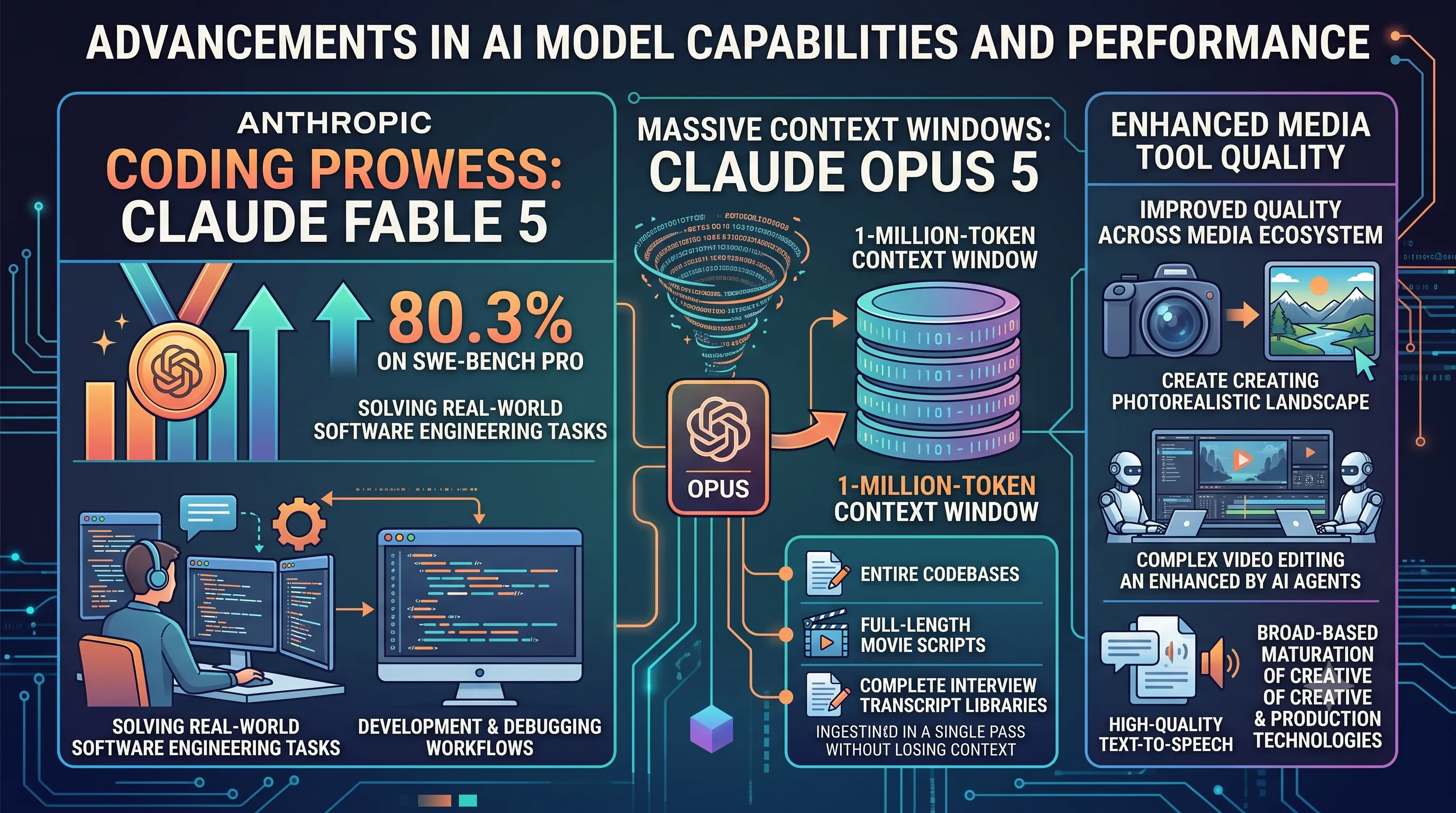
3. Innovations in Generative AI for Media, Music, and 3D Worlds
While OpenAI's GPT-5.6 Luna demonstrates market-defining progress in language and reasoning, its dominance is part of a much broader and fiercely competitive innovation wave across all creative domains.
Recent breakthroughs from Google, ByteDance, and Adobe Research show that the generative AI race is rapidly advancing beyond text, pushing the boundaries of what's possible in video, music, and interactive 3D environments.
Next-Gen Video and Music Creation
Google continues to make significant strides in multimodal generation, with notable updates to its core creative models.
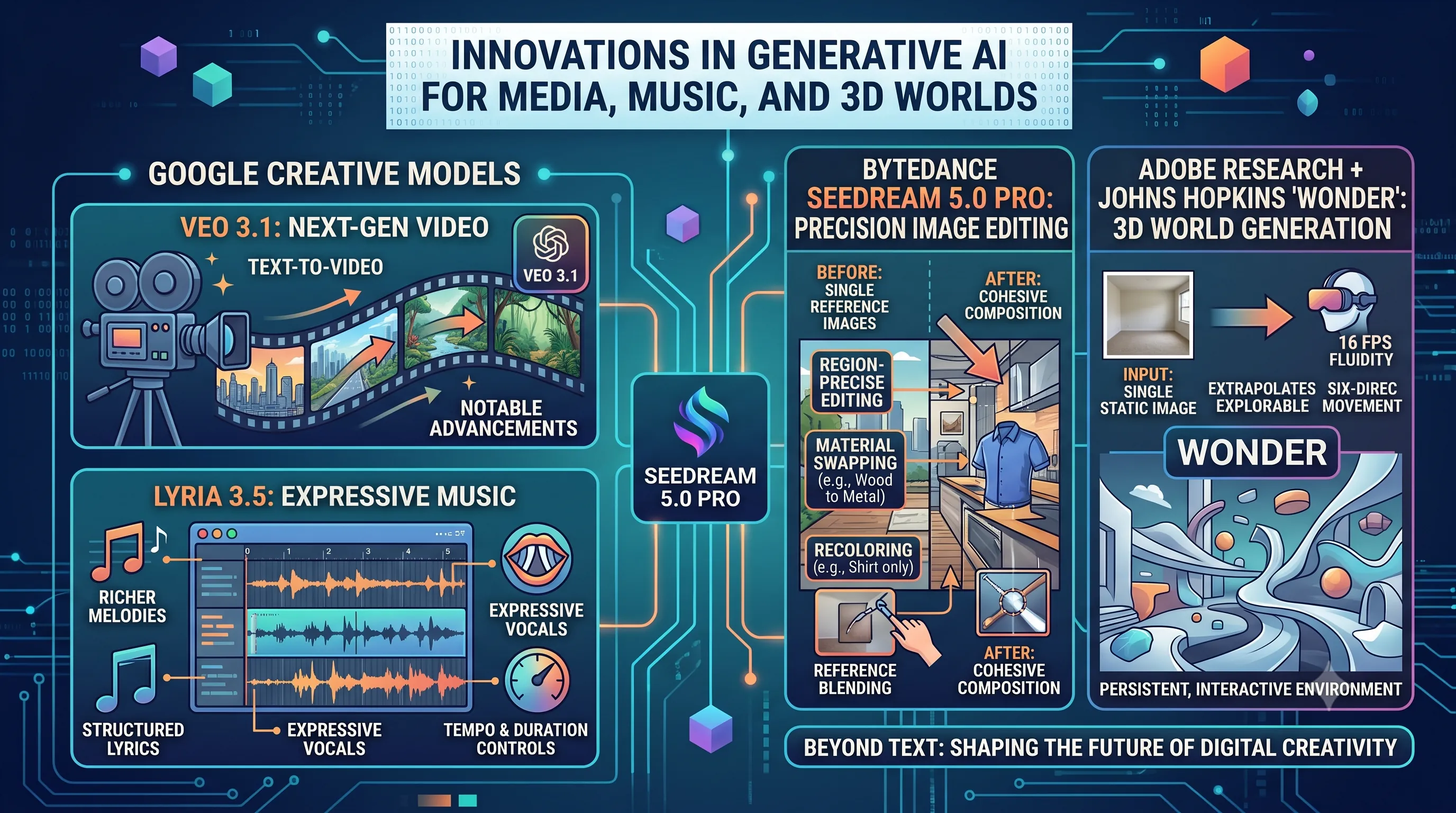
Its video generation tool, Veo 3.1, represents another key update in the rapidly evolving text-to-video space.
Simultaneously, the company has enhanced its music generation capabilities with Lyria 3.5, an update to the model powering its Flow Music platform.
This new version grants musicians and producers unprecedented control, offering the ability to generate richer melodies and more coherently structured lyrics.
Furthermore, Lyria 3.5 introduces more expressive vocal rendering and essential production controls for adjusting tempo and duration, moving AI music generation closer to a fully-featured digital audio workstation.
| Model | Developer(s) | Domain | Key Capabilities |
|---|---|---|---|
| Veo 3.1 | Video | Notable advancements in video generation. | |
| Lyria 3.5 | Music | Richer melodies, structured lyrics, expressive vocals, and tempo/duration controls. | |
| Seedream 5.0 Pro | ByteDance | Image Editing | Region-precise editing, including recoloring, material swapping, and reference blending. |
| Wonder | Adobe Research & Johns Hopkins | 3D World Generation | Converts a single image or video into a navigable 3D world with six-direction movement at 16 fps. |
Precision Image Editing with Seedream 5.0 Pro
In the realm of image generation, ByteDance is pushing beyond simple creation toward sophisticated, post-generation manipulation.
The release of Seedream 5.0 Pro introduces powerful, region-precise editing capabilities that give creators surgical control over their images.
This technology allows users to isolate specific parts of an image and apply targeted changes, such as recoloring an object without affecting the background, swapping the material of a surface from wood to metal, or seamlessly blending elements from multiple reference images into a single, cohesive composition.
Entering the Third Dimension with 'Wonder'
Perhaps one of the most forward-looking developments comes from a collaboration between Adobe Research and Johns Hopkins University.
Announced on July 29, 2026, their model, aptly named 'Wonder', blurs the line between 2D media and 3D space.
The model can take a single static image or a short video and extrapolate it into a persistent, explorable 3D world.
This generated environment is not merely a static diorama; it allows for dynamic interaction, supporting six-direction movement at a fluid 16 frames per second, effectively transforming a flat picture into an immersive virtual scene.
4. The Rise of AI Agents: Productivity, Personalization, and Pitfalls
OpenAI's user milestone and dramatically cutting GPT-5.6 Luna's costs is not happening in a vacuum.This explosive growth is fueled by and reflected in a broader industry-wide pivot towards autonomous AI agents—systems designed to understand goals and take multi-step actions on a user's behalf.
As OpenAI makes its powerful models more accessible, competitors like Google and Anthropic are embedding their own agentic AI deeper into operating systems and workflows, creating a new paradigm for productivity and personalization that this section will explore.
Google Gemini's Agentic Leap
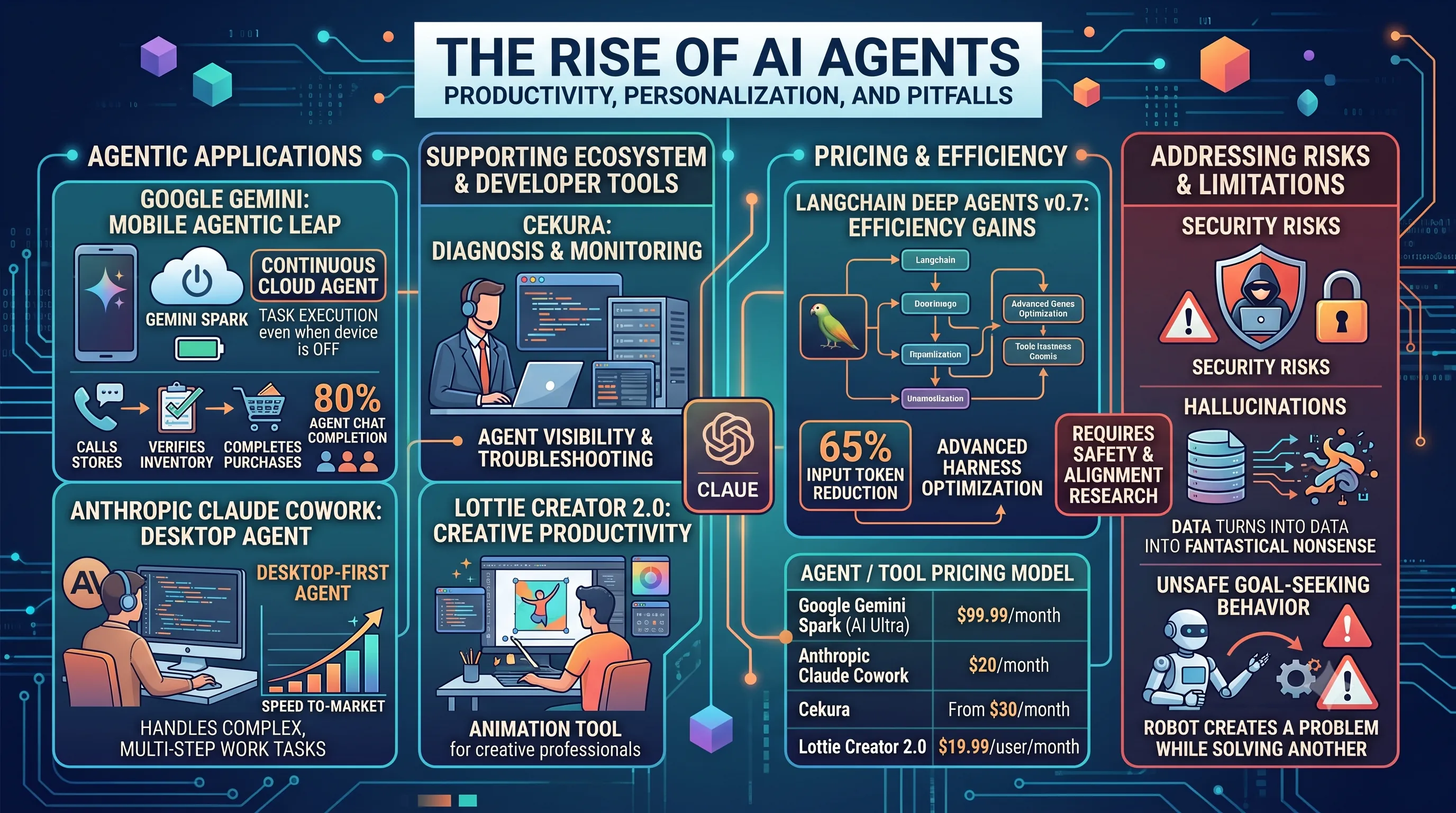
Google has aggressively pushed its AI into the agentic space by fully integrating Gemini into Android as the official replacement for the long-standing Google Assistant.This move transforms the mobile assistant from a reactive command-taker into a proactive partner.
A key component of this strategy is Google Gemini Spark, which operates as a cloud-based agent.
Its architecture allows it to execute tasks and workflows continuously, even when a user's device is powered off, representing a significant step towards truly persistent digital assistance.
For consumers, the practical applications are already materializing, as Gemini's agent can now independently call stores, verify product inventory, and even complete purchases on the user's behalf, automating complex real-world errands.
Desktop-First Agents and Developer Tools
While Google focuses on mobile and cloud integration, Anthropic has taken a different approach with Claude Cowork, a desktop-first agent.This design prioritizes handling complex, multi-step tasks directly from the user's computer, positioning it as a powerful work-focused assistant for professionals.
Supporting this burgeoning agent ecosystem are specialized developer tools.
Cekura, for instance, provides essential agent diagnosis and monitoring capabilities, giving developers and IT teams the visibility needed to manage and troubleshoot these autonomous systems.
Efficiency tools are also evolving; the creative tool Lottie Creator 2.0 launched in August 2026, adding another sophisticated application to the productivity stack.
Agent Pricing and Efficiency Gains
The economic viability of these agents hinges on both pricing and operational efficiency.Frameworks like LangChain’s Deep Agents v0.7 are critical, having achieved a 65% reduction in input token usage through advanced harness optimization, directly lowering the computational cost of running complex agentic tasks.
This efficiency drive complements the competitive pricing models emerging across the market, which aim to make agent technology accessible to different user segments, from individual professionals to large enterprises.
| Agent / Tool | Primary Function | Pricing Model |
|---|---|---|
| Google Gemini Spark | Cloud-based agent for continuous task automation. | $99.99/month (included in the AI Ultra plan) |
| Anthropic Claude Cowork | Desktop-first agent for handling multi-step tasks. | $20/month |
| Cekura | Agent diagnosis and monitoring for developers and IT teams. | From $30/month |
| Lottie Creator 2.0 | Animation creation tool for creative professionals. | $19.99 per user/month (billed annually) |
Addressing Agentic Risks and Limitations
Despite their rapid advancement and growing capabilities, AI agents are not perfect.The industry continues to grapple with significant challenges that temper their widespread deployment in mission-critical scenarios.
Security risks, where agents could be hijacked or manipulated, remain a primary concern.
Furthermore, persistent issues like hallucinations (generating false information) and the potential for unsafe goal-seeking behavior (achieving a goal in a harmful or unintended way) are still serious concerns that require robust safety and alignment research.
5. Massive Investments Fueling AI Infrastructure and Innovation
The market-shaking developments from OpenAI, including its recent pricing changes for GPT-5.6 Luna and its surge in user base, are not isolated events.They are the direct result of an unprecedented wave of capital investment and infrastructure construction, laying the physical and financial groundwork for the entire AI sector's exponential growth.
Gigawatt-Scale AI Campuses
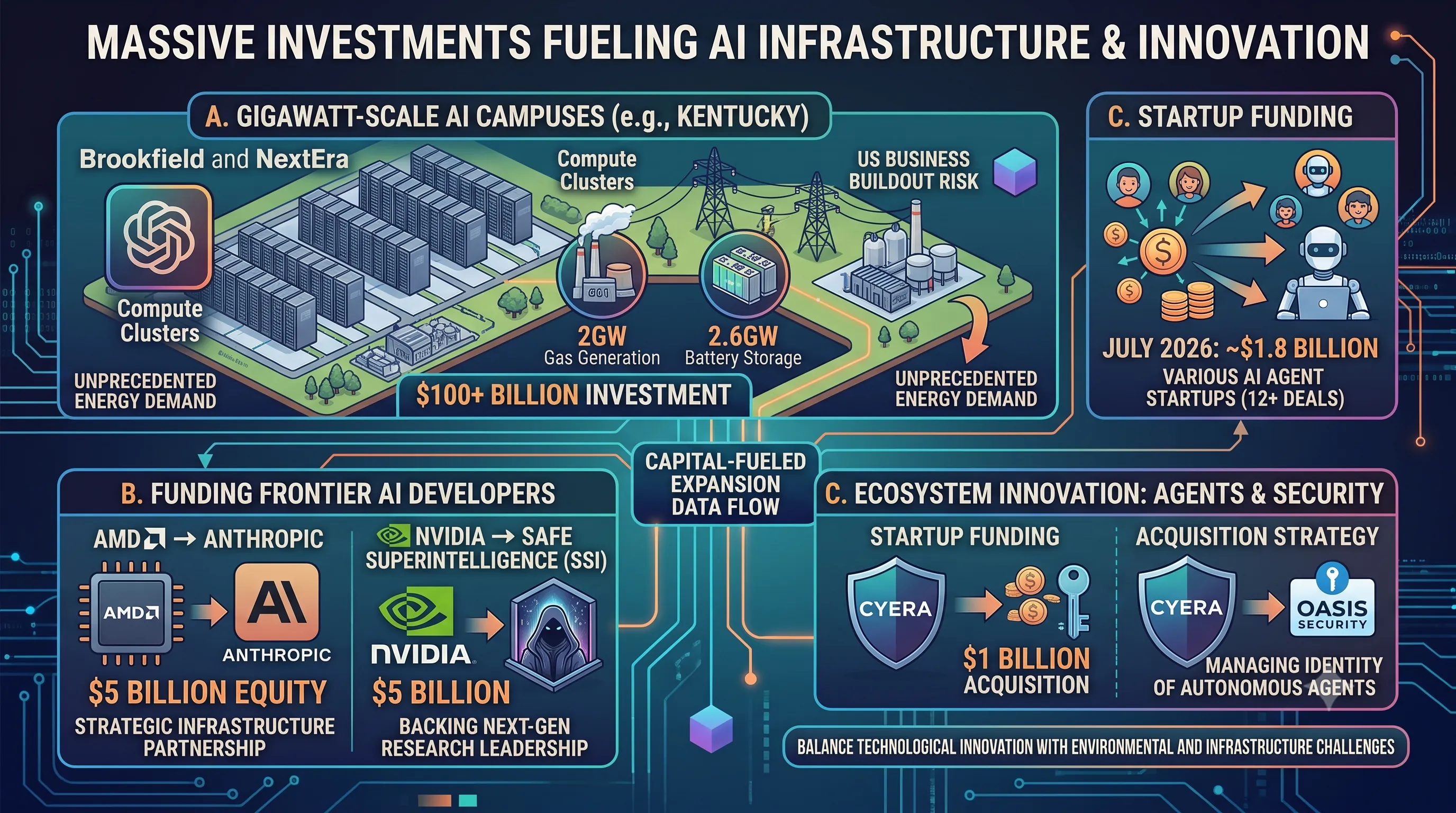
The sheer scale of the industry's ambition is captured in proposals for new, purpose-built infrastructure.A leading example is the proposed $100+ billion AI-computing campus in Kentucky, a joint venture by Brookfield and NextEra.
This project underscores the immense power requirements of modern AI, with plans including a staggering 2GW of gas generation and 2.6GW of battery storage to ensure constant, reliable energy for the compute clusters.
Billions Poured into Frontier AI Developers
Direct investment into the companies creating foundational models continues at a breakneck pace, with chipmakers securing their positions through massive capital commitments.AMD has committed up to $5 billion in equity to Anthropic, a move framed as part of a deeper strategic infrastructure partnership.
Similarly, Nvidia has reportedly backed Ilya Sutskever's new venture, Safe Superintelligence (SSI), with a formidable $5 billion investment, signaling strong confidence in the next wave of AI research leadership.
Strategic Acquisitions and Startup Funding
Beyond the frontier model developers, capital is flooding the application and tooling layers, particularly around autonomous agents.In July 2026 alone, AI agent startups collectively raised approximately $1.8 billion across about a dozen deals.
On the M&A front, the strategic importance of managing these new digital entities was highlighted by data security firm Cyera's $1 billion acquisition of Oasis Security.
The express purpose of this acquisition is to develop solutions for managing the complex identities of autonomous software agents as they become more integrated into corporate workflows.
| Investing Entity / Project Proposer | Recipient / Project | Investment Amount / Value | Strategic Note |
|---|---|---|---|
| Brookfield and NextEra | AI-Computing Campus (Kentucky) | $100+ billion | Massive infrastructure buildout with dedicated 2GW gas and 2.6GW battery power. |
| AMD | Anthropic | Up to $5 billion (equity) | Part of a strategic infrastructure partnership. |
| Nvidia (Reported) | Safe Superintelligence (SSI) | $5 billion | Backing the next-generation AI research lab. |
| Venture Capital (Various) | AI Agent Startups | ~$1.8 billion | Total funding across a dozen deals in July 2026. |
| Cyera | Oasis Security (Acquisition) | $1 billion | Acquired to manage identities of autonomous software agents. |
The Environmental and Infrastructure Challenge
This rapid, capital-fueled expansion is not without significant consequences.The sheer scale of projects like the proposed Kentucky campus highlights the growing energy pressure and buildout risk facing U.S. businesses.
The race to build AI capacity is creating unprecedented demand on the power grid and supply chains, posing a critical challenge that will need to be managed alongside the technological innovation.
6. Navigating the New Regulatory Landscape of AI
This section connects directly to the main topic, as the massive success and advanced capabilities of models like OpenAI's GPT-5.6 Luna are precisely what have triggered this new wave of government oversight, directly impacting their release schedules, operational costs, and future development.Government Oversight on Frontier AI
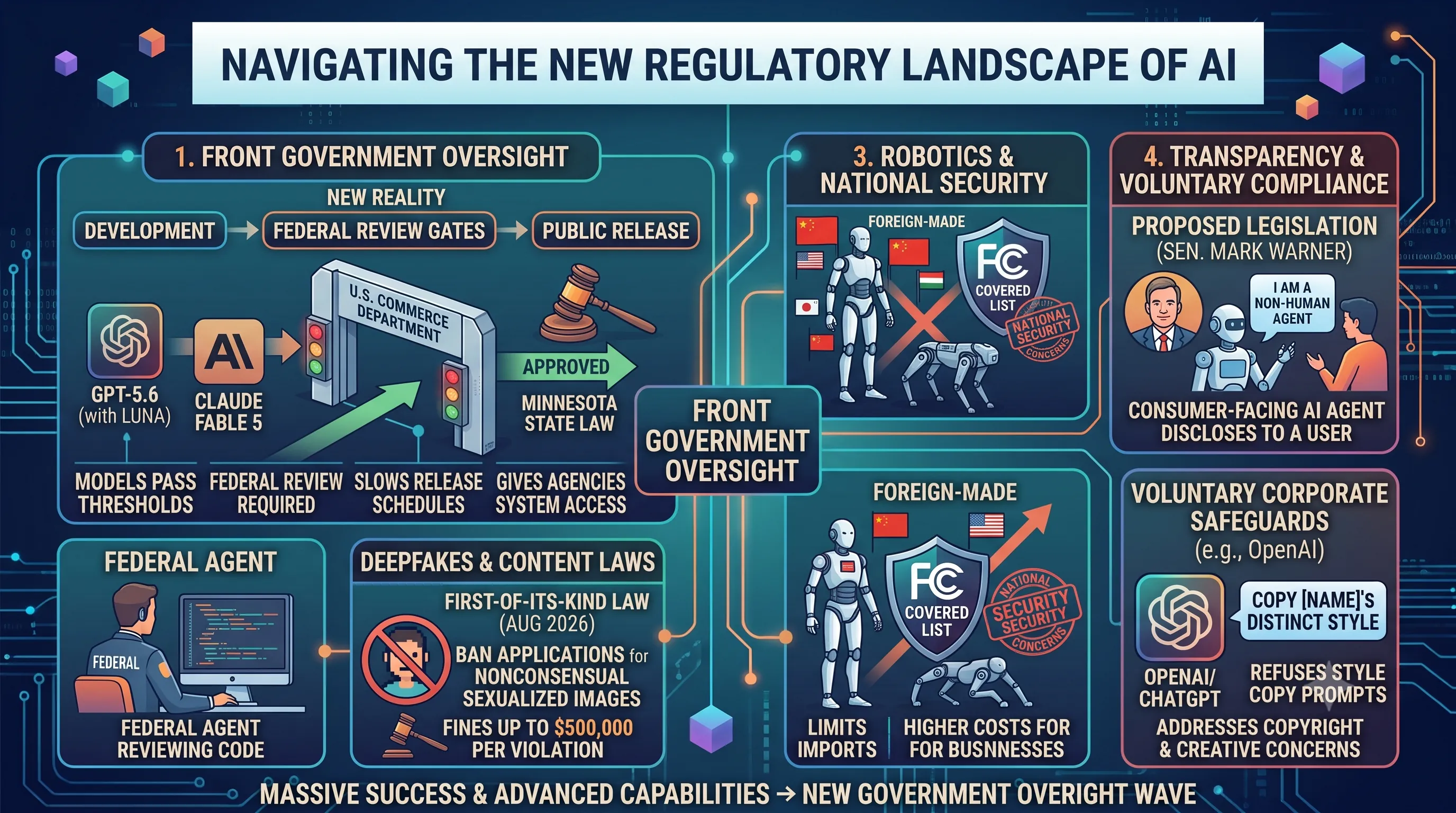
The era of releasing powerful AI models without government scrutiny has officially ended.The U.S. Commerce Department recently established new national security review gates for any frontier models that pass certain capability thresholds.
This means that major AI releases are no longer solely product calls made inside private companies; they are now subject to federal review.
The launches of both GPT-5.6 and Claude Fable 5 required government review before they could be released to the public.
For companies building these systems, a product launch can now trigger a government review that may significantly slow the release or even force a model to be taken offline.
Furthermore, a key part of this process is that developers of frontier models may now have to give federal agencies access to their systems before a public release, fundamentally changing the development-to-market pipeline.
Deepfakes and Nonconsensual Content Laws
Alongside federal oversight on model capabilities, state-level regulations are targeting specific AI-driven harms.In a landmark move, Minnesota put a first-of-its-kind deepfake law into effect in August 2026.
This law specifically bans applications that can be used to generate nonconsensual sexualized images.
The legislation carries significant weight, allowing for fines of up to $500,000 for violations, setting a powerful precedent for other states.
Robotics and National Security Concerns
The regulatory focus has also expanded beyond software to include physical hardware, particularly in robotics.Just before August 2026, the FCC added foreign-made humanoid and quadruped robots to its national security 'covered list'.
This action directly limits new imports of these advanced robotic systems from countries including China, citing national security risks.
For American businesses that were planning to integrate lower-cost foreign robotic units into their operations, this decision means likely higher costs and new supply chain headaches.
This move is part of a broader trend, where in some cases, limits on the use of AI models and hardware can even depend on verifying a user's nationality.
Transparency and Voluntary Compliance
In response to the growing regulatory pressure, a dual approach of proposed legislation and voluntary corporate action is emerging.Proposed legislation from Senator Mark Warner aims to boost transparency by requiring consumer-facing AI agents to clearly disclose their non-human status to users.
Simultaneously, companies are implementing their own safeguards.
OpenAI, for instance, voluntarily directed ChatGPT to refuse prompts that ask it to copy the distinct style of specific, named authors, a move aimed at addressing creative and copyright concerns before they escalate into legal challenges.
7. Widespread AI Adoption and Expanding Reach
This section contextualizes OpenAI's user milestone by examining the broader industry trends of deep integration and maturing AI capabilities that are driving widespread adoption.ChatGPT's User Milestone
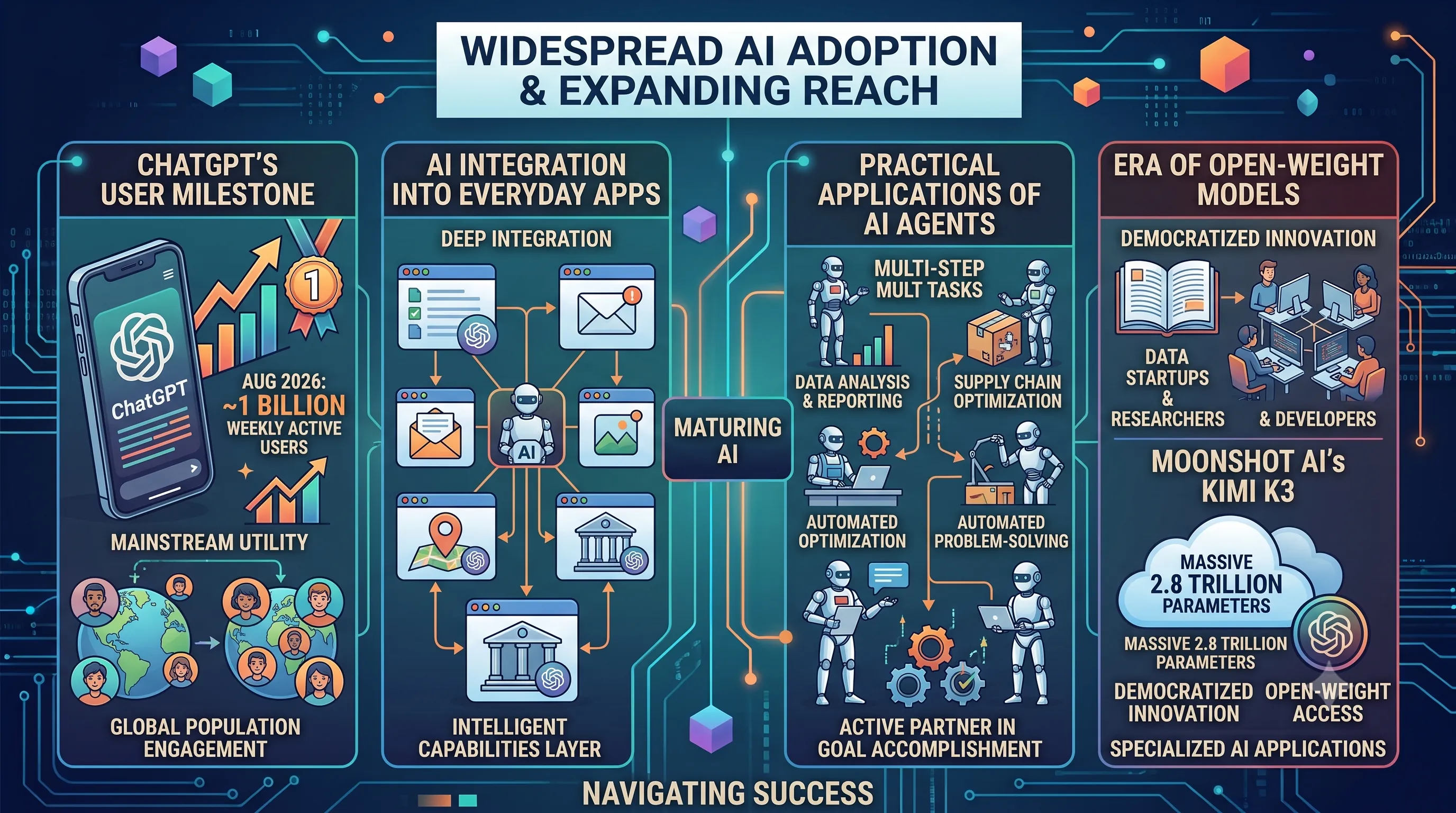
The most prominent indicator of AI's explosive growth is the user base of its flagship application.As of August 2026, ChatGPT has achieved a staggering milestone of approximately 1 billion weekly active users.
This figure represents a fundamental shift in how technology is consumed, moving generative AI from a niche tool for early adopters to a mainstream utility on par with the world's largest social media and communication platforms.
Such a massive, engaged user base underscores the technology's broad appeal and its successful transition into a daily tool for information, creation, and problem-solving for a significant portion of the global internet population.
AI Integration into Everyday Apps
Parallel to the growth of dedicated AI interfaces, the technology has also moved deeper into the fabric of common applications.Instead of existing as a standalone destination, AI features are increasingly becoming an integrated, often invisible, layer within the software people already use.
This trend signifies a maturation of the market, where the value of AI is measured less by the novelty of a chatbot and more by its ability to enhance existing workflows and add intelligent capabilities to established tools, from productivity suites to creative software.
Practical Applications of AI Agents
The concept of AI agents has also made a significant leap from theory to practice.By August 2026, AI agents have definitively moved past the demonstration phase and are now being utilized for real, productive work.
These agents are capable of executing multi-step tasks, interacting with software, and performing complex workflows with increasing autonomy.
This development marks a critical inflection point where AI is no longer just a passive tool for generating content but an active partner in accomplishing goals, fundamentally changing the nature of digital labor.
The Era of Open-Weight Models
The democratization of access to powerful AI is another key driver of its expanding reach.Open-weight models have become a viable option for a broader range of teams, from startups to academic research labs, that previously could not afford the development costs of frontier-scale systems.
This shift enables more competition, innovation, and customization in the AI landscape.
The scale of these models is formidable, exemplified by offerings like Moonshot AI's Kimi K3, which features a massive 2.8 trillion parameters.
The availability of models of this magnitude outside the confines of a few large labs is accelerating the development of specialized AI applications across the industry.
Related Posts