
OpenAI and Cisco Launch Shirudo: A Daemonless eBPF Runtime for AI
🚀 Key Takeaways
- Collaborative open-source defense: OpenAI and Cisco jointly unveiled Shirudo under the Secure Infrastructure Project to protect Linux infrastructure against emerging vulnerabilities without requiring system reboots.
- Daemonless eBPF architecture: Re-engineered from Tetragon, the runtime operates via a one-shot CLI and injects early boot-stage kernel protections without running persistent background agents.
- Autonomous AI-driven shielding: Built for autonomous workflows, the platform enables AI models like Codex to rapidly generate executable mitigation code directly on kernel and runtime hooks.
- Cryptographic hardware attestation: Every runtime patch and shield modification is verified and cryptographically recorded within TPM 2.0 registers to ensure verifiable operational integrity.
- Live zero-downtime mitigation: Practical evaluations demonstrated immediate protection for running production systems, neutralizing severe vulnerabilities in Elasticsearch and PHP without service interruption.
- Custom kernel dependencies: Currently in pre-release, production deployments require specialized Linux kernels supporting signed-loader ABIs alongside physical hardware security modules.
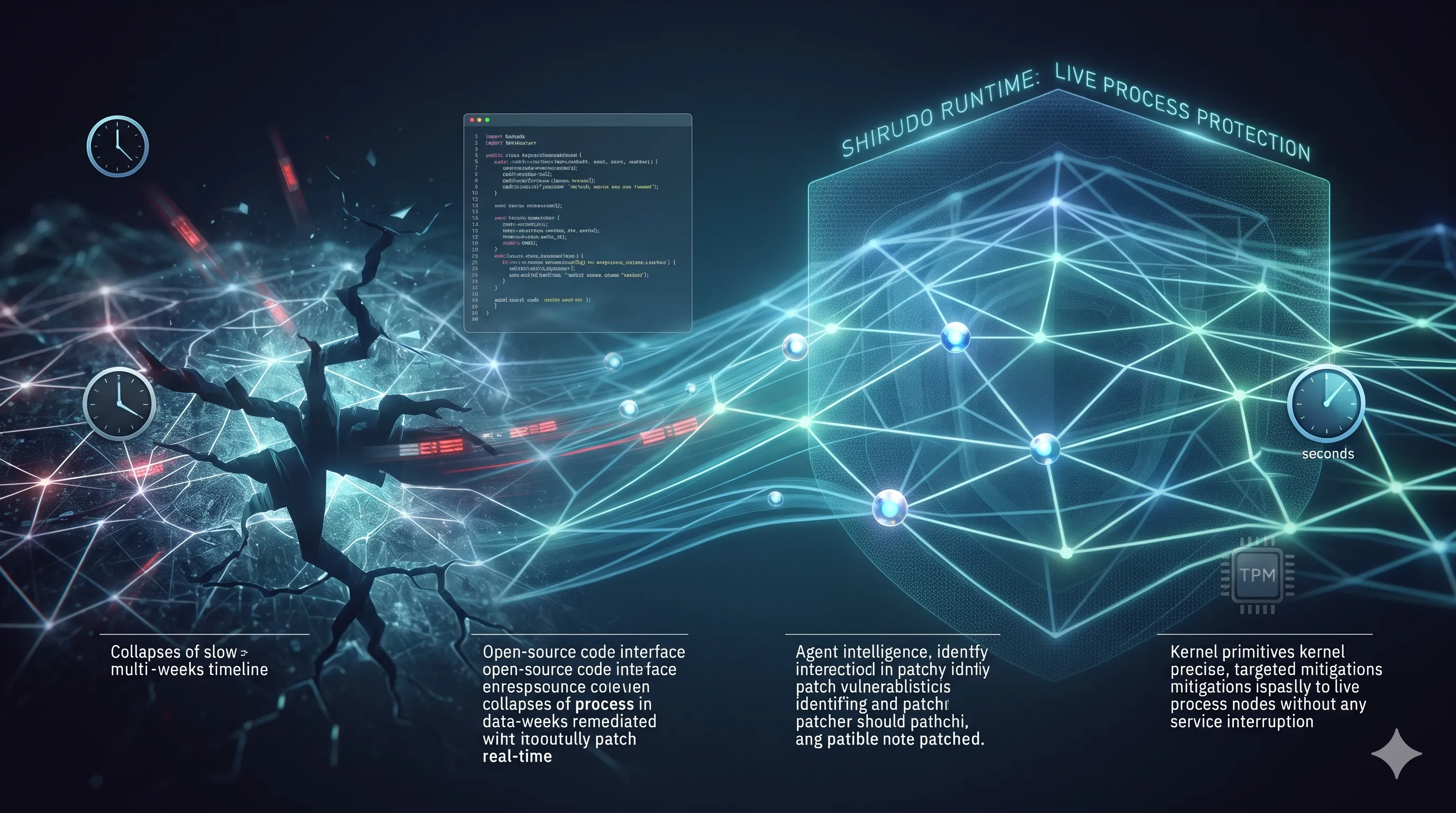
The acceleration of automated offensive capabilities has fundamentally altered the cybersecurity equation: when synthetic models can discover zero-day vulnerabilities and construct functional exploits in seconds, conventional remediation timelines collapse.
Traditional patch management—routinely stalled by weeks of regression testing, staging cycles, and service-disrupting reboots—leaves high-throughput AI infrastructure acutely vulnerable during critical exposure windows.
Enter Shirudo, a newly launched open-source security runtime developed jointly by OpenAI and Cisco under the Secure Infrastructure Project to invert this defender's dilemma.
Deriving its name from the Japanese word for "shield," the platform establishes a daemonless, kernel-integrated layer capable of applying immediate, targeted mitigations to live processes without demanding service restarts.
By bridging autonomous agent intelligence with low-level kernel primitives and hardware attestation, Shirudo transforms infrastructure defense from manual maintenance to an automated, real-time feedback loop.
As high-performance AI environments place unprecedented availability and integrity demands on enterprise clusters, this emerging runtime paradigm marks a pivotal step toward self-defending systems.
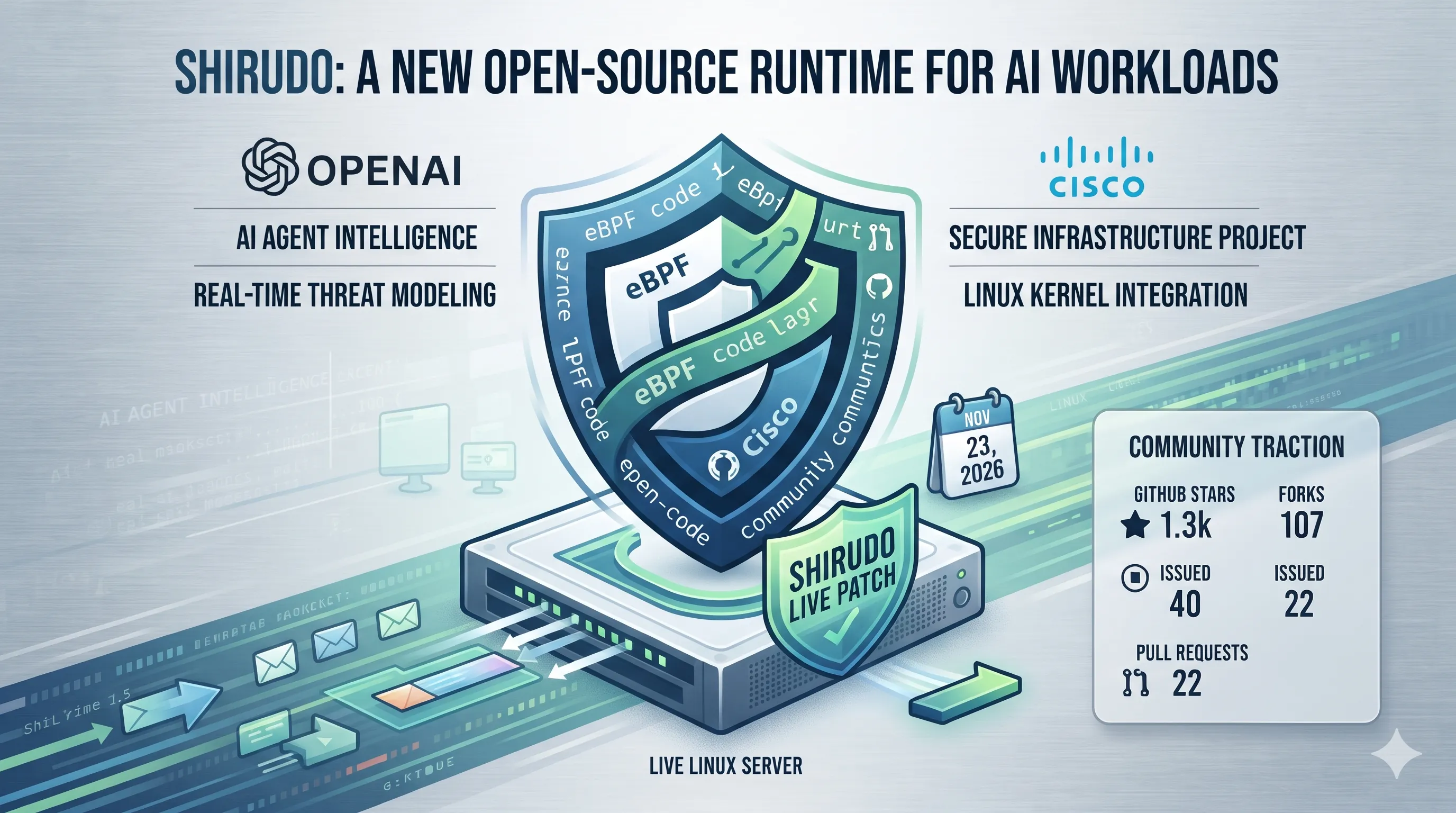
1. OpenAI and Cisco's Shirudo: Genesis, Licensing, and Live-Patching Philosophy
This foundational section establishes the origin, design intentions, and ecosystem status of Shirudo within the broader architecture of "Shirudo: A New Open-Source Runtime for AI Workloads."Secure Infrastructure Project and the Patching Gap
Shirudo represents an open-source security runtime jointly launched by OpenAI and Cisco under the Secure Infrastructure Project, officially announced on November 23, 2026.Etymologically, Shirudo translates to "shield" in Japanese and is pronounced "shee-roo-doh".
The runtime is engineered specifically to protect running Linux systems while infrastructure operators test, validate, and roll out permanent software patches, eliminating the operational penalty of forced reboots or service downtime.
Addressing the pervasive friction between critical vulnerability discovery and actual production deployment, Greg Brockman stated: "Finding a bug today doesn't mean you can patch every system tomorrow."
By providing active shielding at the system level, Shirudo bridges this high-risk patching window without requiring system restarts or interrupted workloads.
Open-Source Licensing and Early Repository Traction
To foster community collaboration across cloud environments and operating systems, the Shirudo project adopts an open governance and licensing model.The core Shirudo code is licensed under the permissive BSD 2-Clause license, whereas its specialized BPF programs are dual-licensed under both BSD and GPL frameworks.
Following its launch, the open-source repository immediately garnered notable developer interest across its initial public metrics.
| Repository Metric | Count / Value |
|---|---|
| GitHub Stars | 1.3k |
| Forks | 107 |
| Tracked Issues | 40 |
| Pull Requests | 22 |
2. Architecture and Delivery: Boot-Time eBPF, One-Shot CLI, and OCI Packaging
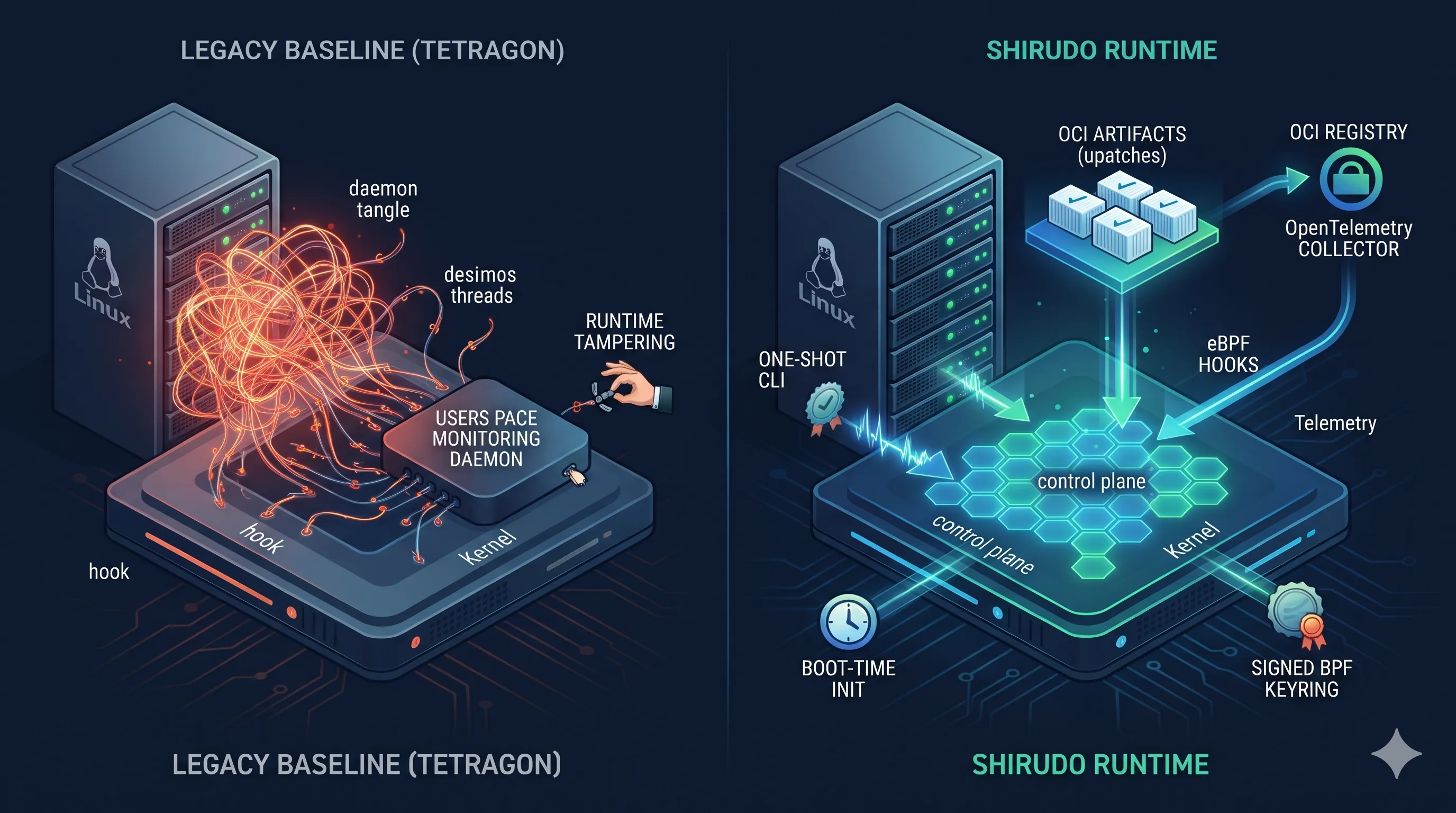
As an open-source runtime engineered for AI workloads, Shirudo establishes host security by completely rethinking how kernel-level instrumentation is deployed and maintained.Rewritten from Tetragon, an eBPF security platform released in 2022, Shirudo replaces continuous userspace agent management with an early-boot, immutable control plane designed to eliminate runtime tampering.
Daemonless One-Shot Control Plane and Boot-Time Initialization
Shirudo departs fundamentally from legacy monitoring systems by eliminating the need for a permanently running background daemon on target hosts or operator machines.Instead of relying on active userspace processes to maintain kernel hooks, the target control plane is an eBPF program loaded directly into the Linux operating system during boot.
Enforcement begins at the earliest possible stage of host startup when the shirudo init command attaches guards directly from the initial ramdisk (initrd).
To secure the integrity of the kernel against unauthorized alterations, Shirudo restricts BPF program loads from userspace exclusively to signed loaders verified against a sealed .bpf keyring.
This design ensures that security controls are active before userspace AI pipelines execute, removing exposure windows typical of late-stage daemon initialization.
| Architectural Dimension | Tetragon (Legacy Baseline) | Shirudo Runtime |
|---|---|---|
| Execution Model | Requires a permanently running background daemon on the host. | Operates via a one-shot CLI without background daemons on target hosts or operator machines. |
| Enforcement Lifecycle | Initializes hooks post-boot after userspace daemon startup. | Enforcement begins at boot time via shirudo init attaching guards from the initrd. |
| Control Plane Layer | Userspace monitoring daemon driving dynamic hook insertion. | Control plane is an eBPF program loaded into the Linux OS during system boot. |
| BPF Loading Security | Standard userspace daemon loading interfaces. | Restricts BPF loads from userspace exclusively to signed loaders verified against a sealed .bpf keyring. |
OCI-Packaged upatches, Sealed Keyrings, and Kernel Observability
Software distribution and mitigation delivery in Shirudo rely entirely on standardized container infrastructure rather than bespoke daemon update protocols.Mitigations ship as signed packages called upatches or .bee packages distributed directly through OCI registries.
Operators pull and apply these packages via one-shot commands, bypassing persistent update agents.
Telemetry captured by Shirudo does not terminate in a proprietary agent process; instead, packages pull via one-shot commands and export telemetry directly to OpenTelemetry collectors.
For comprehensive workload visibility, Shirudo includes the kernel-obs package.
This package provides kernel-level instrumentation targeting process execution, network activity, and privilege monitoring across running AI environments.
By combining OCI artifact delivery, sealed .bpf keyring verification, and native OpenTelemetry exports, Shirudo maintains a zero-daemon runtime profile without sacrificing deep kernel auditability.
3. Hardware-Rooted Integrity: TPM 2.0 Measurement and Offline Attestation
Shirudo establishes trust for AI workloads by anchoring runtime security directly into physical hardware verification mechanisms.Within the architecture of Shirudo: A New Open-Source Runtime for AI Workloads, hardware-rooted integrity ensures that every operational modification to the environment is measured, authenticated, and verifiable against tamper-evident hardware state.
TPM 2.0 Register Extension and State Tracking
Shirudo enforces a strict requirement of a TPM 2.0 module on all production targets.To guarantee complete system visibility, the runtime uses Trusted Platform Module (TPM) hardware to measure and record every addition or removal of upatches.
Whenever upatch modifications take place, loaded upatch state changes extend a per-boot TPM register.
This per-boot register extension creates an immutable, hardware-level ledger reflecting the exact sequence and current composition of applied patches.
| Component / Capability | Specification & Operational Behavior |
|---|---|
| Hardware Target Requirement | Requires a TPM 2.0 module on production targets. |
| Upatch Measurement Mechanism | Uses TPM hardware to measure and record every addition or removal of upatches. |
| Register Management | Loaded upatch state changes extend a per-boot TPM register. |
| Signature Verification | Verifies cryptographic signatures on incoming packages prior to runtime execution. |
| Integrity Inspection | Offers offline attestation verification through the shirudo attest command. |
Offline Cryptographic Attestation with 'shirudo attest'
Prior to runtime execution, Shirudo validates the provenance of deployable units by verifying cryptographic signatures on incoming packages.This pre-execution signature check prevents unsigned, altered, or unauthorized artifacts from reaching execution stages.
To validate the resulting host integrity state without requiring continuous external connectivity, Shirudo offers offline attestation verification through the
shirudo attest command.Operators use the
shirudo attest utility to inspect and cryptographically confirm the host measurement baseline against recorded TPM values.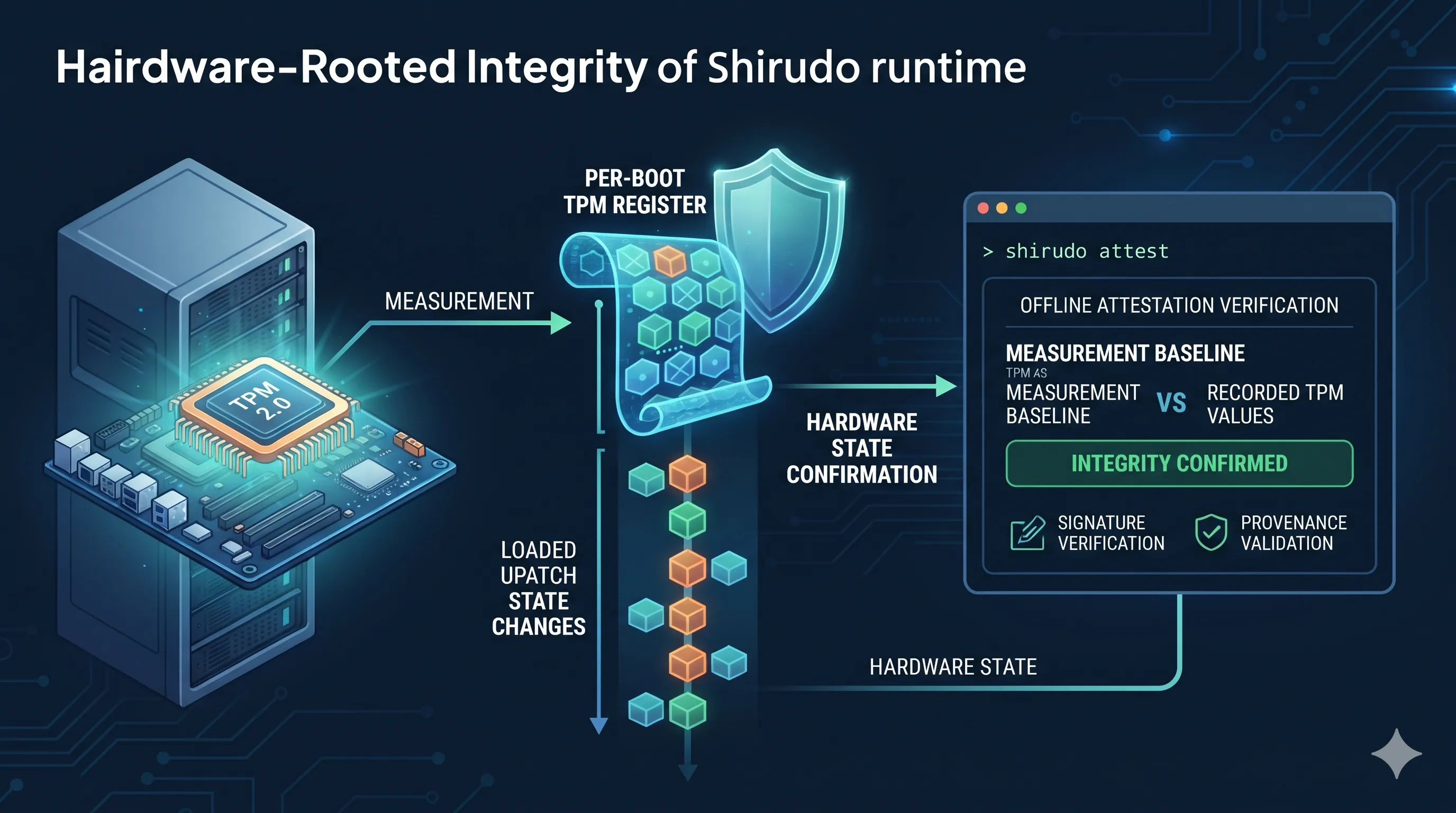
4. Agent-Native Mitigation: The Codex-Driven Kernel Shield Pipeline
Within the broader architecture of Shirudo: A New Open-Source Runtime for AI Workloads, operational resilience depends on moving defense mechanisms from manual workflows into automated, software-driven execution paths.Shirudo establishes an agent-native paradigm that bridges dynamic infrastructure governance with programmatic safety primitives.
Executable Code Interfaces for Autonomous Agents
Traditional infrastructure security relies heavily on human-oriented configuration files and static policy declaration languages.Shirudo diverges fundamentally from this model by enabling AI agents to interact directly via executable code rather than parsing or generating configuration syntax.
By treating safeguards as executable logic rather than passive policy sheets, defensive agents can adapt their countermeasures programmatically to fast-evolving threats.
This shift reflects the compressed response times required in contemporary computing environments.
Thomas Graf addressed this structural imperative, stating: "The industry has so far added security after the fact, and this approach no longer works in a situation where AI models can find vulnerabilities and figure out attack methods within seconds."
Through executable code interfaces, Shirudo equips infrastructure to respond at machine speed rather than awaiting human policy synthesis.
The Codex Loop: Exploit Reproducers to Live Traffic Shielding
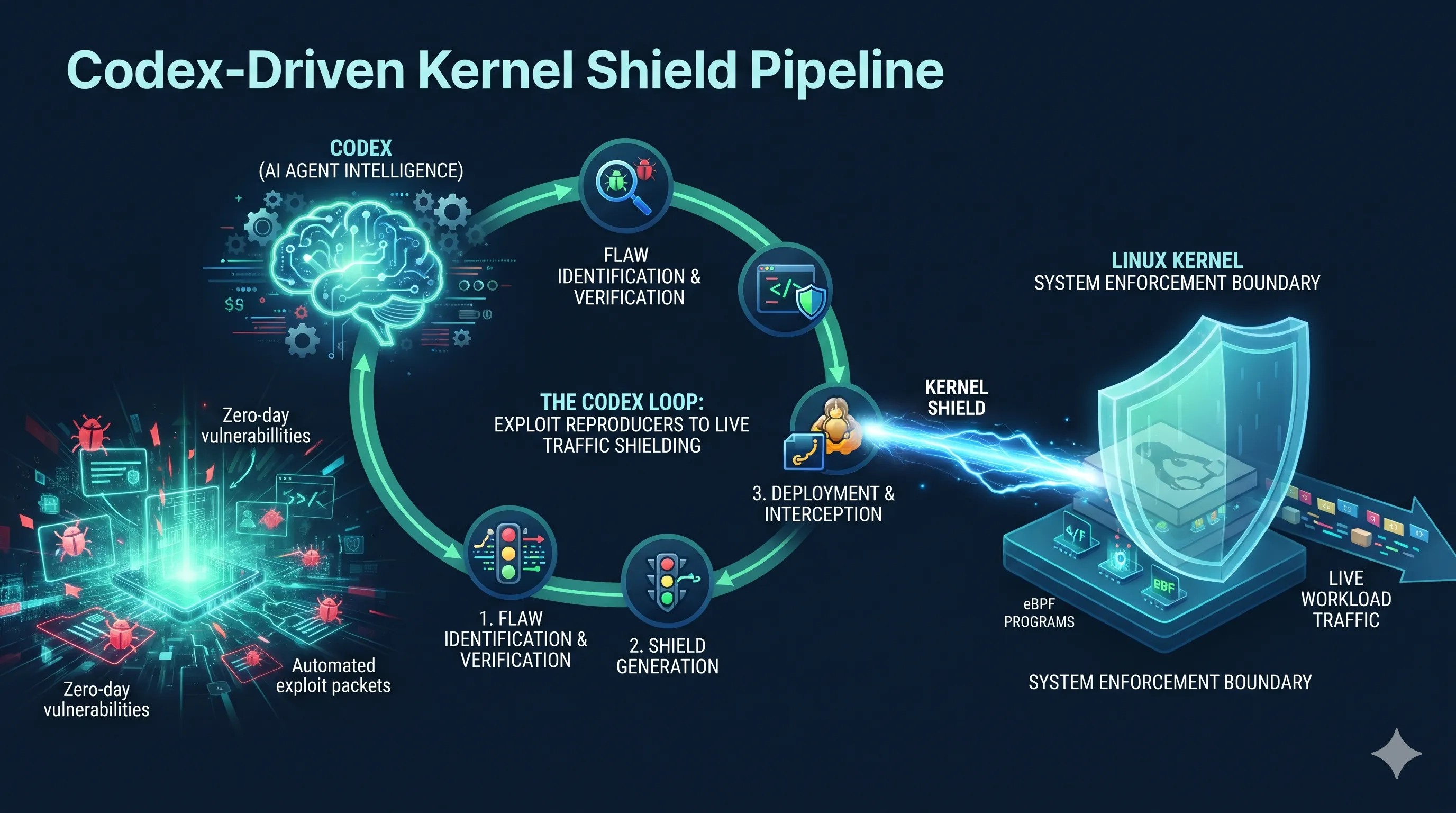
Shirudo operationalizes self-defending workflows by integrating an automated control plane loop driven by Codex.This autonomous loop is structured to continuously identify system risks, construct exploit reproducers, generate mitigation code, and validate the resulting solutions.
Once synthesized and verified, these targeted safeguards—designated as shields—are dispatched directly to system enforcement boundaries.
Shirudo applies these shields straight to kernel hooks using eBPF or embeds them into application runtimes, intercepting anomalous behavior at the lowest feasible abstraction layers.
To maintain workload availability without unintended disruptions, Shirudo enables security teams to test and trial shields against live traffic prior to enforcing active blocking.
| Pipeline Phase | Mechanism and Operational Action | Enforcement or Validation Target |
|---|---|---|
| Flaw Identification & Verification | Scans for infrastructure flaws and builds exploit reproducers | Automated control plane loop driven by Codex |
| Shield Generation | Generates mitigation code and validates software solutions | Executable code interfaces for AI agent interaction |
| Deployment & Interception | Applies targeted safeguards directly as runtime shields | Kernel hooks via eBPF or application runtimes |
| Safe Staging | Trials and tests generated shields before applying active blocking | Live workload traffic |
By uniting automated flaw discovery, kernel-level eBPF attachment, and live-traffic staging, Shirudo maintains runtime integrity against automated exploits.
5. Empirical Validation: Neutralizing Java4Shell and Web Vulnerabilities
Empirical validation highlights how Shirudo: A New Open-Source Runtime for AI Workloads moves from defensive theory to real-time execution shielding.By actively deploying synthesized defenses at runtime, Shirudo protects enterprise data systems and runtime components underpinning AI infrastructure without requiring down-time or manual recompilation.
Hot-Patching Elasticsearch 9.5.5 Against Java4Shell
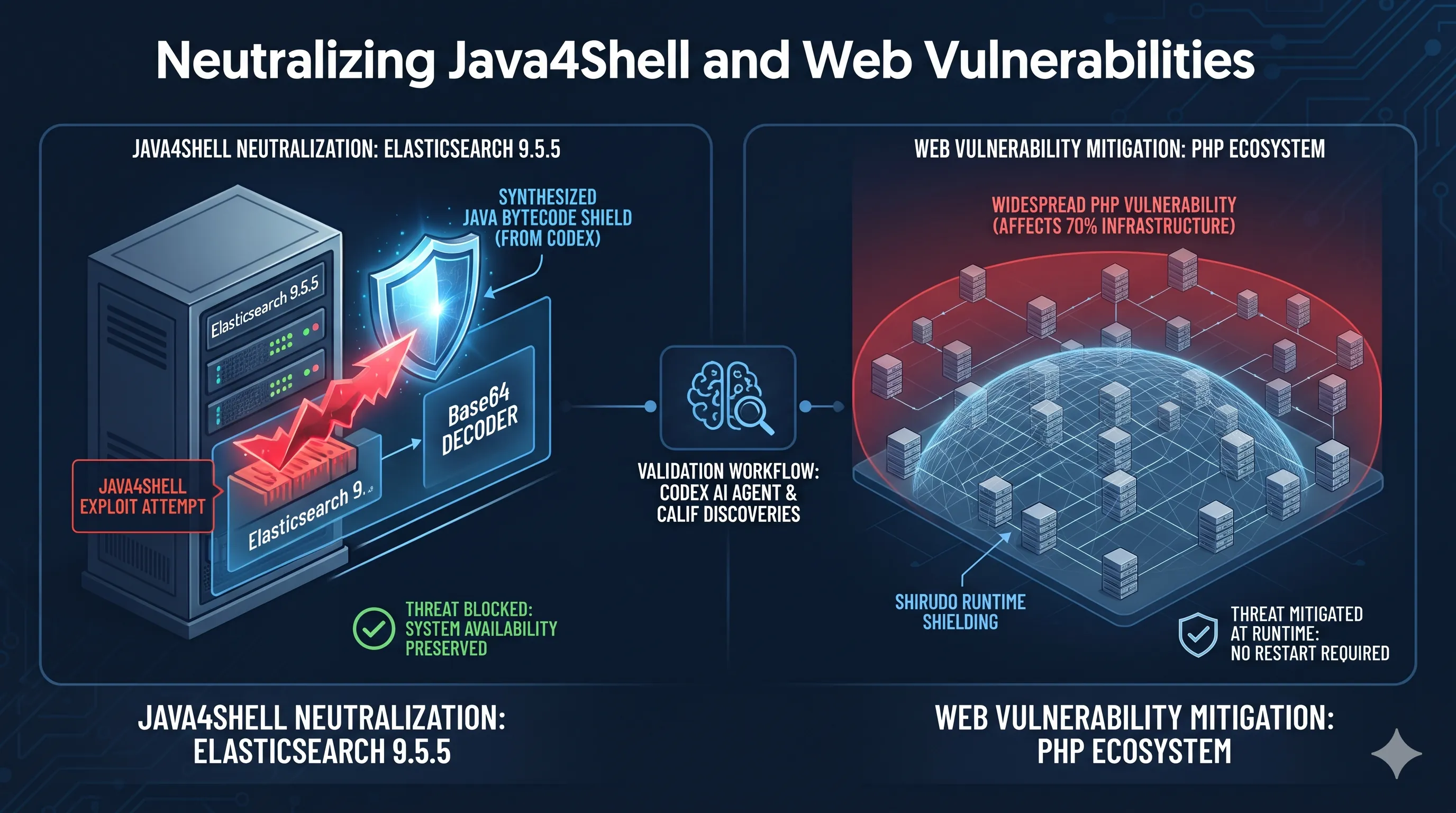
During testing scenarios against Elasticsearch version 9.5.5, Shirudo demonstrated its capacity to intercept high-severity execution paths.To address the Java4Shell vulnerability within OpenJDK, Codex generated a specialized Java bytecode shield.
This synthesized Java4Shell shield injected targeted input validation directly into the Base64 decoder of the running Elasticsearch process.
As the attack payload was triggered, the injected bytecode successfully blocked the exploit attempt.
The dynamic intervention preserved full system availability, ensuring that Elasticsearch remained running without service restart or operational disruption.
Calif Discoveries and Controlled Validation Constraints
The threat models driving Shirudo's validation originated from advanced threat identification workflows.Both the Java4Shell flaw and a widespread PHP vulnerability were identified by cybersecurity startup Calif using the OpenAI Cyber model.
The runtime demonstrated its mitigation capabilities against this PHP vulnerability, a flaw that reportedly affected an estimated 70% of global web infrastructure.
However, current empirical findings present certain evaluation constraints.
The Java4Shell test was conducted as a controlled internal test by the project creators rather than an independent evaluation.
6. System Constraints and Hardware Portability: Kernel Hooks and Target Requirements
Understanding the underlying system constraints is essential to evaluating Shirudo: A New Open-Source Runtime for AI Workloads, as its execution boundaries rely directly on specific low-level environment prerequisites.Kernel ABI Customization and Architecture Compatibility
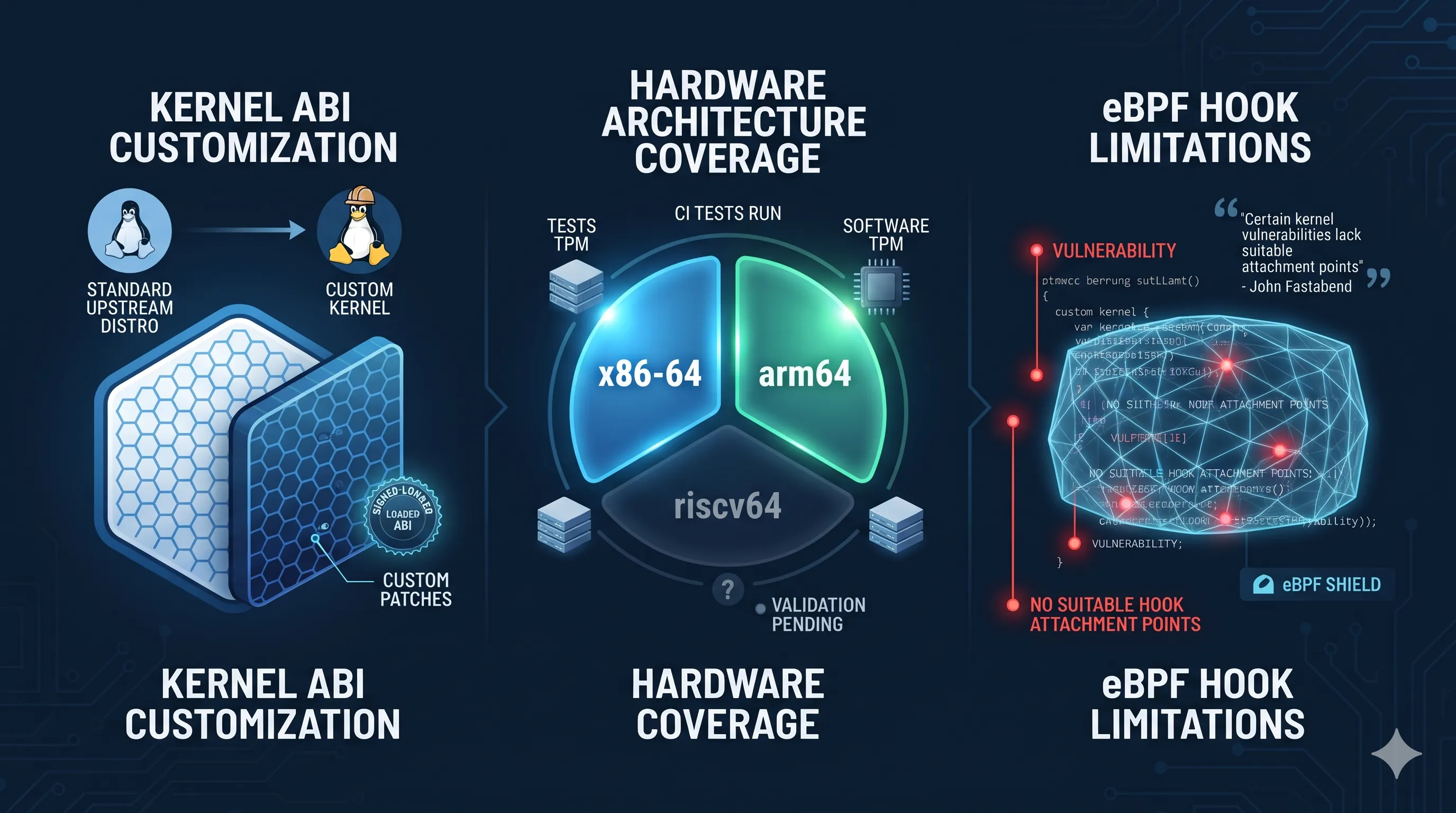
Deploying Shirudo onto production targets mandates a custom Linux kernel compiled with the signed-loader ABI and Shirudo's kernel patches.Because the runtime relies on specialized kernel-level mechanisms to enforce containment, standard upstream distributions cannot host production deployments out of the box.
Hardware architecture coverage currently divides between validated hardware profiles and targets undergoing continuous integration.
Continuous integration tests actively run on x86-64 and arm64 architectures.
For local development and verification workflows, the test VM supports local boot using a software TPM on both x86-64 and arm64 targets.
Conversely, architecture validation for riscv64 remains pending.
| Architecture | Continuous Integration (CI) Status | Software TPM Test VM Support |
|---|---|---|
| x86-64 | CI tests run | Supported for local boot |
| arm64 | CI tests run | Supported for local boot |
| riscv64 | Validation pending | Pending validation |
eBPF Hook Limitations and Pre-Release Deployment Caveats
Shirudo is currently classified as pre-release software, reflecting ongoing engineering across its core subsystems.Operating within the Linux kernel introduces structural challenges when applying eBPF-based isolation mechanisms.
Specifically, certain kernel vulnerabilities lack suitable attachment points where an eBPF shield can be hooked.
This constraint is an acknowledged boundary across the broader eBPF security domain.
Isovalent engineer John Fastabend noted at a Linux kernel summit that his team often encounters vulnerabilities lacking suitable kernel attachment points.
These hook limitations define the operational perimeter of Shirudo as its kernel patches and shield mechanisms continue development.
Related Posts
OpenAI GPT-6.2 Billing Fix: Astra Hits Limits 40% FasterOpenAI fixes a GPT-6.2 launch billing bug, causing Astra limits to hit 40% faster and Sol 25%...

How Local Elections and Policy Shifts Threaten US AI InfrastructureLocal elections, state moratoriums, and federal scrutiny threaten nearly half of planned US AI data...
How OpenAI Dots Brings Autonomous Background Coding to DevelopersDiscover OpenAI Dots, an always-on AI coding assistant featuring autonomous background execution,...
Generative AI may have assisted with research or drafting for this article. Topic selection, fact-checking, final wording, and publication remain the responsibility of DragonStone74. AI use disclosure