
Serving 30B LLMs with 128k Context on 16GB GPUs: vLLM and llama.cpp Optimization Guide
🚀 Key Takeaways
- VRAM Bottleneck Resolution: Serving 30B-class models with 128k context windows on 16GB GPUs requires combining low-bit weight quantization with aggressive Key-Value (KV) cache compression.
- vLLM Production Architecture: vLLM leverages PagedAttention, continuous batching, and native low-precision KV cache formats to maximize multi-user serving throughput.
- llama.cpp Local Efficiency: llama.cpp offers a lightweight, dependency-free runtime optimized for single-user latency and sub-byte integer weight formats on consumer hardware.
- Attention Kernel Scaling: FlashAttention and paged memory structures mitigate quadratic memory expansion, keeping activation footprints linear across long sequences.
- KV Cache Quantization Gains: Compressing attention states into FP8 or INT4 formats reduces per-token memory overhead by up to 75%, unlocking extreme context lengths in memory-constrained environments.
- Engine Selection Trade-offs: The choice between vLLM and llama.cpp balances operational throughput and framework overhead based on concurrency and deployment requirements.
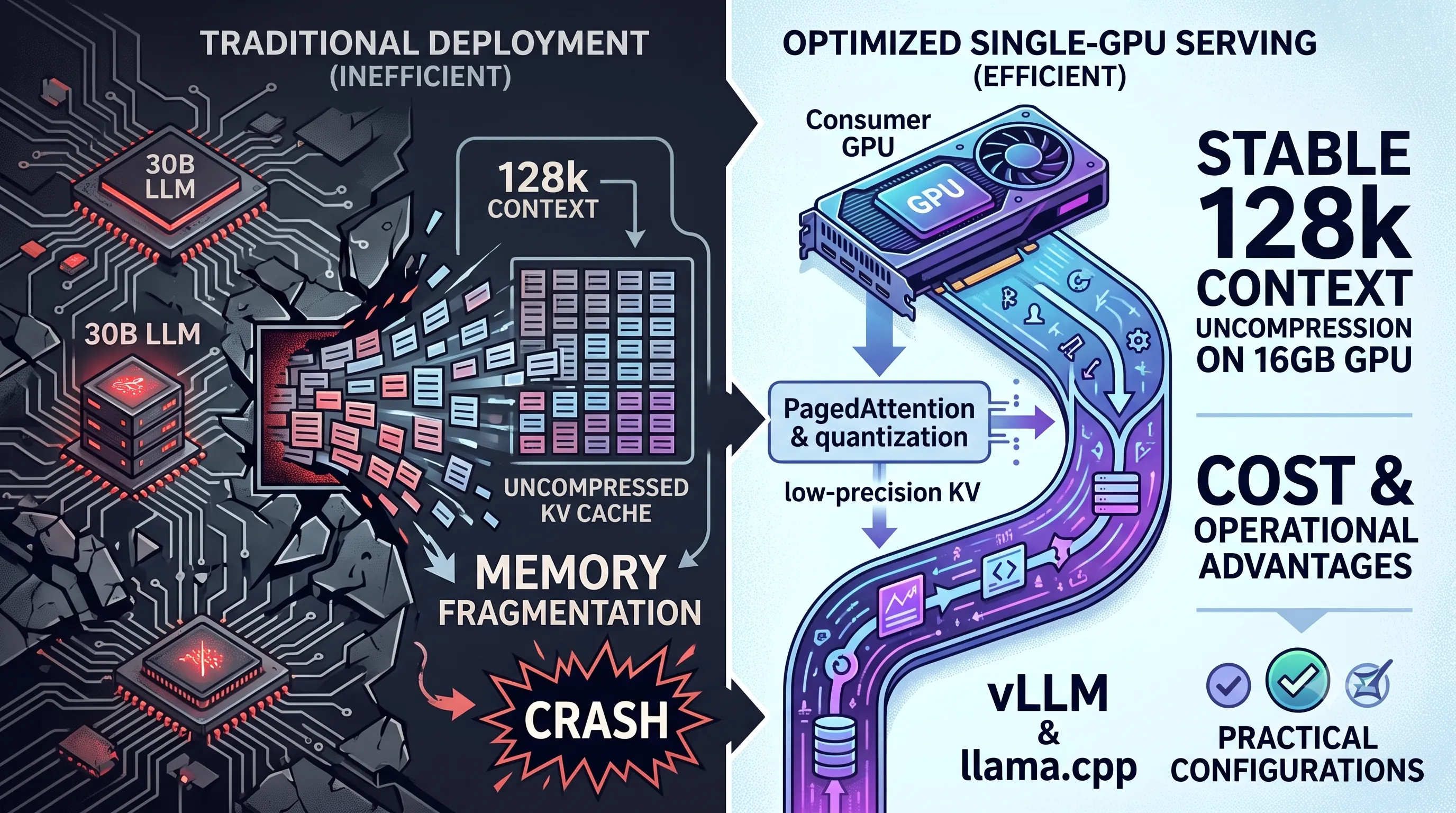
Deploying 30B-parameter language models across expansive 128k context windows has traditionally required multi-GPU server infrastructure with massive memory capacity. As long-context retrieval, document analysis, and autonomous agent workflows become integral to production systems, running these expansive workloads on accessible 16GB consumer or edge GPUs offers significant cost and operational advantages.
The primary barrier at extreme sequence lengths is no longer merely model parameter storage, but the rapid memory expansion of the Key-Value (KV) cache during autoregressive generation. Without targeted optimization, uncompressed attention states quickly exceed available VRAM, causing memory fragmentation and out-of-memory crashes.
This guide explores the memory management architectures and practical configurations of vLLM and llama.cpp. By applying modern quantization techniques, PagedAttention mechanisms, and low-precision KV cache strategies, developers can achieve stable 128k context serving on a single 16GB GPU without compromising inference reliability.
1. Architectural Foundation of vLLM: PagedAttention and High-Throughput Inference Engine
Serving massive 30B parameter models with extensive 128k context windows on constrained hardware, such as a single 16GB GPU, demands aggressive memory efficiency and optimized KV cache handling.vLLM provides the foundational infrastructure required to maximize hardware utilization and eliminate memory fragmentation under extreme memory pressure.
PagedAttention Mechanics and Non-Contiguous Memory Allocation
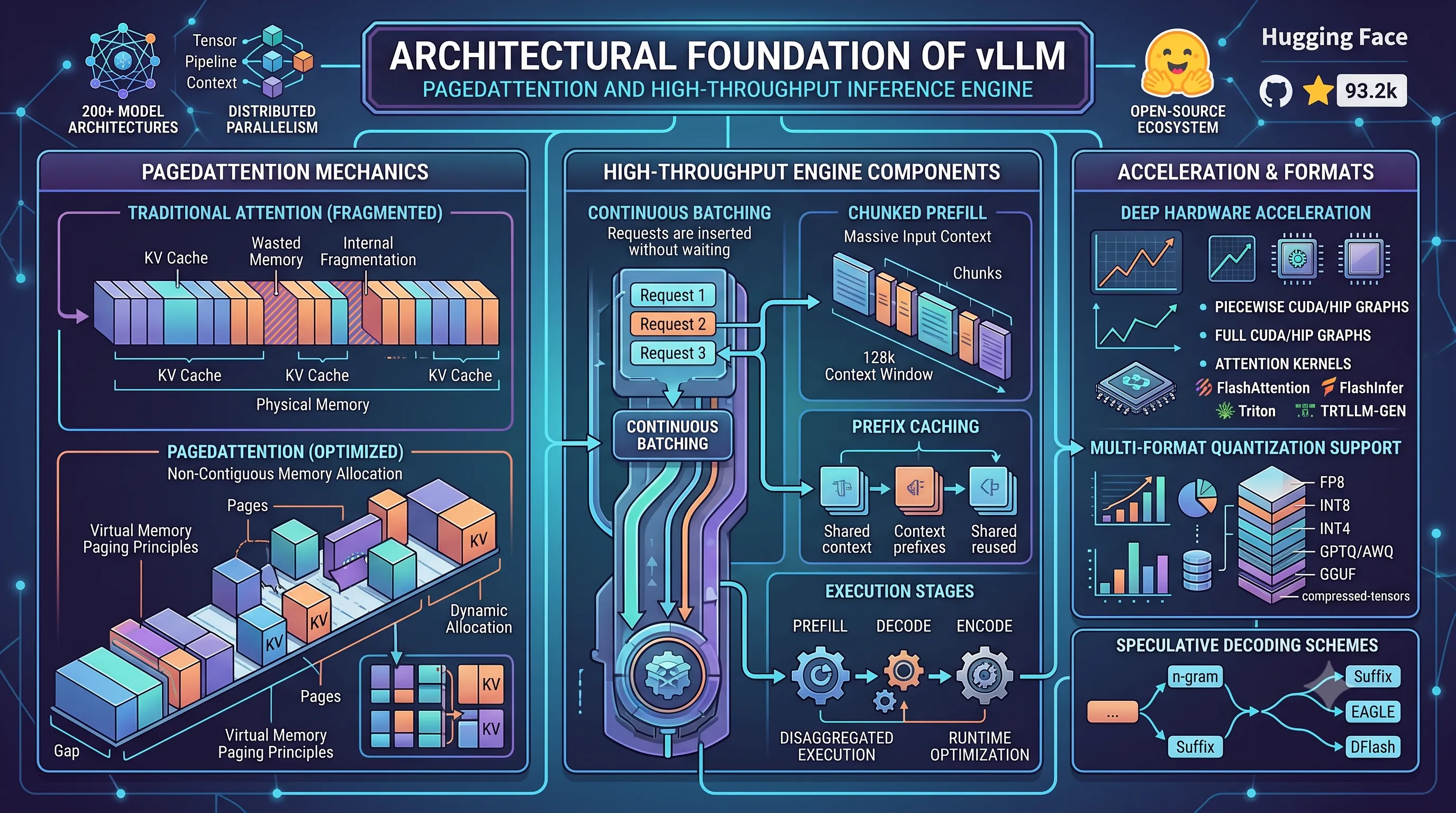
Originally developed in the Sky Computing Lab at UC Berkeley, vLLM has grown into a collaborative open-source ecosystem supported by over 2000 contributors, with over 93.2k stars and 23k forks on GitHub.The engine provides native compatibility for more than 200 model architectures on Hugging Face, serving as a unified backbone for modern high-throughput LLM workloads.
At the core of vLLM's memory management is PagedAttention, an algorithm designed to manage key and value memory with virtual memory paging principles.
Traditional attention implementations allocate continuous physical memory blocks for KV tensors, which leads to substantial internal and external memory fragmentation during extended sequence generation.
PagedAttention resolves this bottleneck by allowing KV cache storage across non-contiguous physical memory blocks.
This structure dynamically allocates memory on demand, enabling fine-grained memory utilization during 128k long-context execution.
Beyond memory paging, vLLM incorporates continuous batching, allowing the engine to insert newly arrived requests into running iterations without waiting for prior generation requests to complete.
To handle heavy prompt ingestion efficiently, vLLM implements chunked prefill, breaking massive input contexts into manageable chunks that execute alongside decoding steps.
Furthermore, prefix caching retains computed KV states for repeated system prompts or shared context prefixes, preventing redundant matrix multiplications.
The engine also supports disaggregated prefill, decode, and encode execution, allowing dedicated runtime optimization across heterogeneous compute stages.
Execution Graphs, Speculative Decoding, and Multi-Format Quantization Support
To achieve minimal latency and maximum compute density, vLLM provides deep hardware acceleration through both piecewise and full CUDA/HIP graphs.Graph execution captures sequences of GPU operations to eliminate host-to-device launch overheads during decode phases.
The execution layer integrates multiple high-performance attention kernels, including FlashAttention, FlashInfer, TRTLLM-GEN, FlashMLA, and Triton.
For throughput acceleration, vLLM embeds advanced speculative decoding schemes, including n-gram, suffix, EAGLE, and DFlash methods.
Quantization represents an essential requirement for fitting large model weights and KV states into limited VRAM capacities.
vLLM offers native support for diverse precision and compression formats, including FP8, MXFP8/MXFP4, NVFP4, INT8, INT4, GPTQ/AWQ, GGUF, compressed-tensors, ModelOpt, and TorchAO.
For scaling across infrastructure setups, vLLM provides distributed inference with tensor, pipeline, data, expert, and context parallelism.
External deployment is streamlined via an OpenAI-compatible API server, Anthropic Messages API, and high-performance gRPC support.
| Engine Dimension | Supported Features & Implementations |
|---|---|
| Quantization Formats | FP8, MXFP8, MXFP4, NVFP4, INT8, INT4, GPTQ, AWQ, GGUF, compressed-tensors, ModelOpt, TorchAO |
| Attention Kernels | FlashAttention, FlashInfer, TRTLLM-GEN, FlashMLA, Triton |
| Graph Execution Backends | Piecewise CUDA/HIP graphs, Full CUDA/HIP graphs |
| Speculative Decoding | n-gram, Suffix, EAGLE, DFlash |
| Distributed Parallelism | Tensor, Pipeline, Data, Expert, Context parallelism |
| Serving Protocols & APIs | OpenAI-compatible API server, Anthropic Messages API, gRPC |
2. llama.cpp Lightweight Runtime: Multi-Backend Execution and Extreme Integer Quantization
To serve large parameter architectures such as 30B models across constrained hardware environments like a single 16GB GPU with extended 128k context windows, runtime efficiency and aggressive memory reduction are mandatory.The open-source llama.cpp framework directly addresses these memory bottlenecks through a highly optimized, low-overhead execution model.
Plain C/C++ ggml Engine and Low-Bit Integer Quantization Spectrum
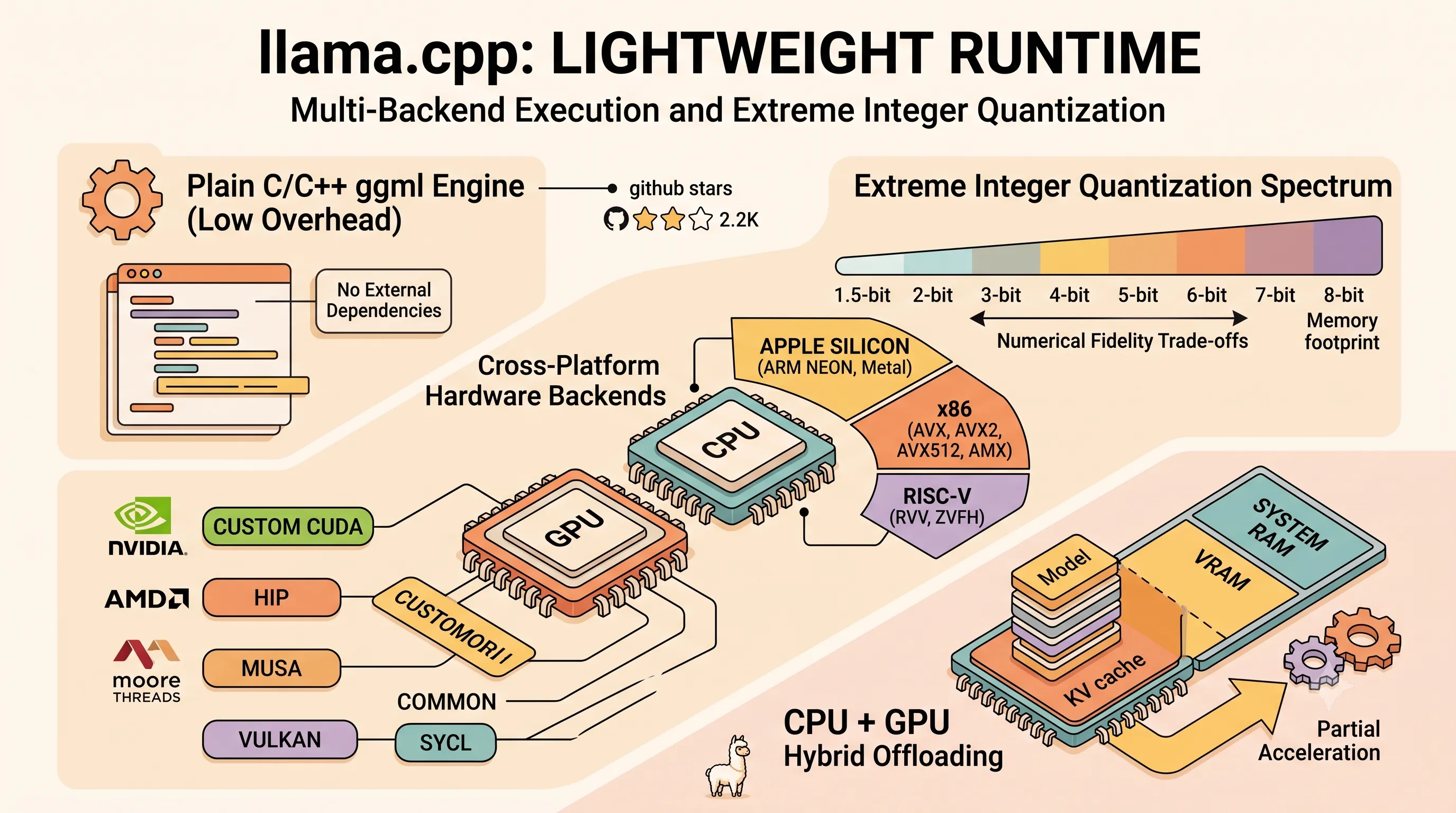
The architecture of llama.cpp is implemented in plain C/C++ without external dependencies, eliminating runtime overheads and complex environment requirements.Built directly on top of the ggml tensor library, the project has garnered substantial industry adoption, evidenced by its 130k stars and 24.1k forks on GitHub.
A foundational mechanism enabling large model execution in restricted VRAM is its extensive integer quantization spectrum.
The runtime supports extreme compression configurations across 1.5-bit, 2-bit, 3-bit, 4-bit, 5-bit, 6-bit, and 8-bit integer quantization levels.
This broad quantization spectrum allows operators to precisely trade off compute throughput, numerical fidelity, and memory footprints according to available hardware limits.
Cross-Platform Hardware Backends and CPU-GPU Hybrid Offloading
Beyond quantization, llama.cpp delivers broad hardware portability through dedicated hardware backends and compute kernels.For acceleration on discrete GPUs, the engine provides custom CUDA kernels for NVIDIA GPUs, HIP support for AMD GPUs, and MUSA support for Moore Threads GPUs.
In addition, cross-vendor compute acceleration is enabled via SYCL and Vulkan backends.
On host processors, the engine integrates native instruction optimizations: Apple silicon utilizes ARM NEON, Accelerate, and Metal frameworks; x86 architectures leverage AVX, AVX2, AVX512, and AMX instruction sets; and RISC-V architectures benefit from RVV, ZVFH, ZFH, ZICBOP, and ZIHINTPAUSE extensions.
When model parameter sizes and large context KV caches exceed dedicated VRAM capacity, llama.cpp enables CPU+GPU hybrid inference to split compute layers and partially accelerate workloads across system memory and GPU memory.
| Category | Supported Technologies & Capabilities |
|---|---|
| Core Architecture | Plain C/C++ without external dependencies, built on top of the ggml library |
| Integer Quantization Spectrum | 1.5-bit, 2-bit, 3-bit, 4-bit, 5-bit, 6-bit, and 8-bit integer quantization |
| Discrete GPU Backends | Custom CUDA kernels (NVIDIA), HIP (AMD), MUSA (Moore Threads), Vulkan, and SYCL |
| CPU & Architecture Extensions |
Apple Silicon (ARM NEON, Accelerate, Metal) x86 (AVX, AVX2, AVX512, AMX) RISC-V (RVV, ZVFH, ZFH, ZICBOP, ZIHINTPAUSE) |
| Offloading Capabilities | CPU+GPU hybrid inference to partially accelerate models larger than total VRAM capacity |
3. FlashAttention Kernel Integration: Exact Linear Memory Scaling and Paged KV Caches
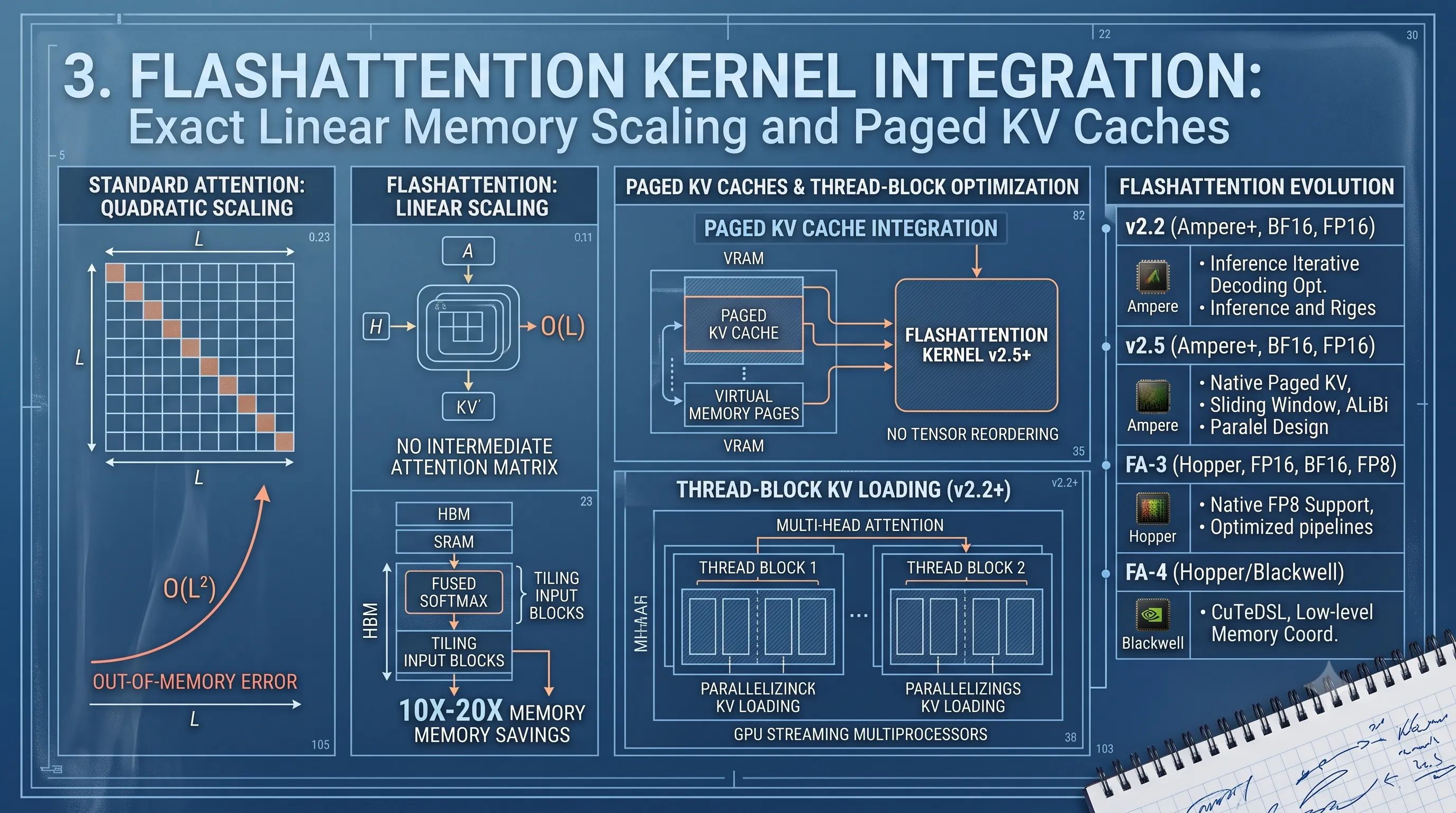
Serving large 30B parameter architectures across long contexts up to 128k on a constrained 16GB GPU memory budget requires eliminating intermediate attention matrix materialization.Standard multi-head attention calculates full attention matrices that scale quadratically with sequence length, causing out-of-memory errors during long-sequence inference.
FlashAttention resolves this fundamental bottleneck by implementing exact attention with linear memory complexity relative to sequence length, maintaining full mathematical precision without approximations.
Linear Memory Complexity and Thread-Block KV Loading Optimization
The exact attention algorithm introduced by Tri Dao, Daniel Y. Fu, Stefano Ermon, Atri Rudra, and Christopher Ré restructures how GPU high-bandwidth memory (HBM) and static random-access memory (SRAM) interact during attention computation.By fusing softmax reduction and tiling input blocks, the kernel bypasses the need to write intermediate attention maps back to global VRAM.
This mathematical formulation yields 10X memory savings at sequence length 2K and 20X memory savings at sequence length 4K compared to standard quadratic attention memory overhead.
The Dao-AILab/flash-attention implementation (spanning 25.1k stars and 3.1k forks) includes specialized features for positional and contextual variations, providing full support for sliding window attention and ALiBi mechanisms.
For autoregressive generation workloads, FlashAttention version 2.2 introduces dedicated optimizations for inference iterative decoding.
During the single-token decoding phase, memory bandwidth saturation often limits throughput.
Version 2.2 optimizes this stage by splitting KV cache loading across thread blocks, parallelizing cache retrieval and maximizing compute utilization across streaming multiprocessors.
Achieving full BF16 and advanced feature execution requires specific GPU architectures such as Ampere, Ada, or Hopper.
FlashAttention Evolution: From Paged KV Cache to FA-3 and FA-4 CuTeDSL
As serving frameworks shifted toward non-contiguous memory management to reduce fragmentation during variable-length serving, kernel integration evolved accordingly.FlashAttention version 2.5 introduced native support for paged KV caches, enabling memory allocators to point the kernel directly to non-contiguous virtual memory pages without requiring expensive tensor reordering.
Subsequent generations further exploit modern hardware pipelines and instruction sets to maintain linear scaling across deeper contexts.
| Release / Version | Supported Architectures & Data Formats | Core Architectural Capabilities |
|---|---|---|
| FlashAttention v2.2 | Ampere, Ada, Hopper (BF16, FP16) | Inference iterative decoding optimization via KV cache loading split across thread blocks. |
| FlashAttention v2.5 | Ampere, Ada, Hopper (BF16, FP16) | Native paged KV cache integration; sliding window attention and ALiBi support. |
| FlashAttention-3 (Beta) | Hopper GPUs (FP16, BF16, FP8) | Optimized hardware utilization with native FP8, BF16, and FP16 execution pipelines. |
| FlashAttention-4 | Hopper and Blackwell GPUs | Kernel architecture written in CuTeDSL for low-level memory and compute coordination. |
FlashAttention-4 advances kernel design by utilizing CuTeDSL, optimizing memory layouts and tensor operations specifically for Hopper and Blackwell GPU architectures.
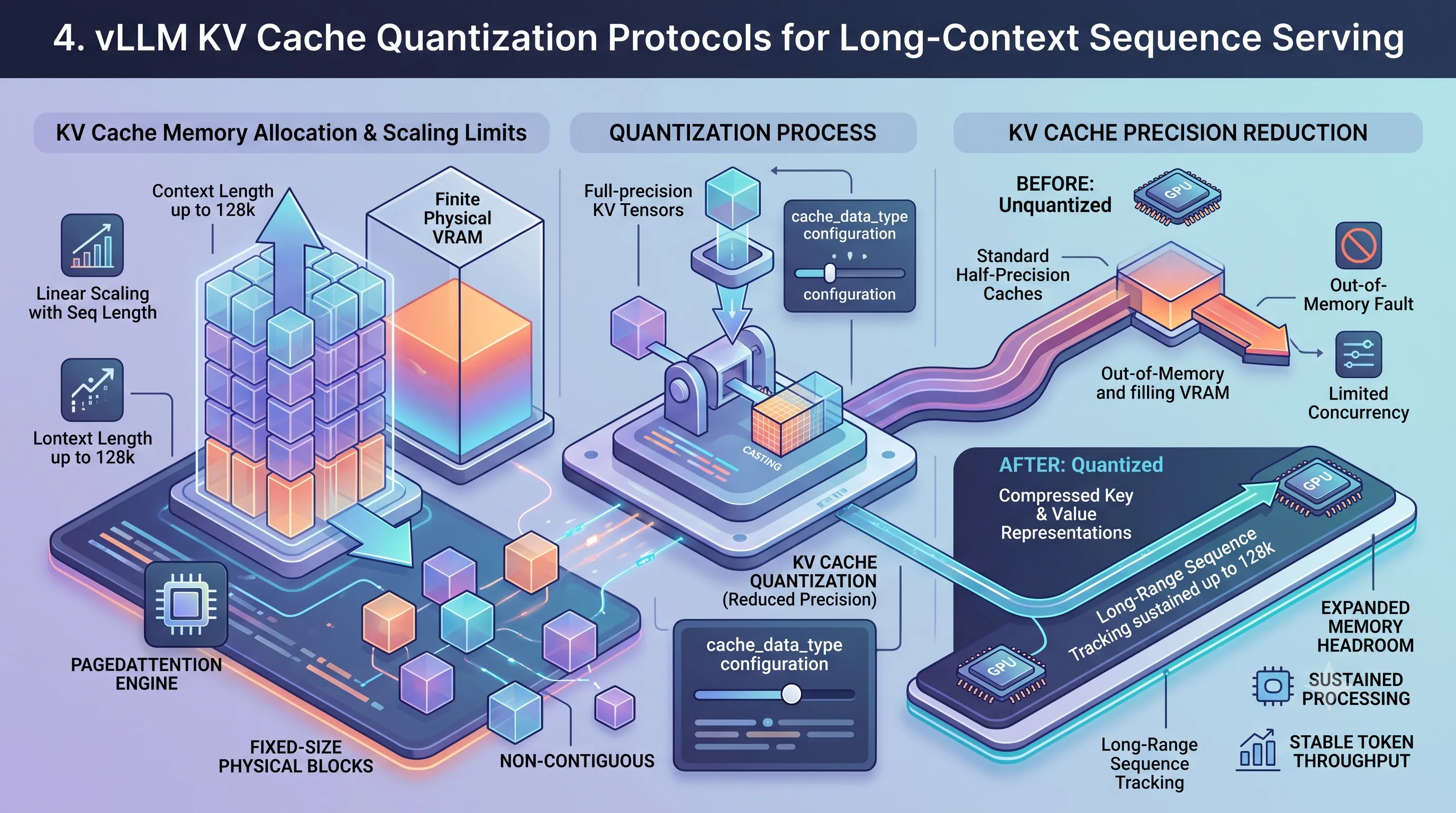
4. vLLM KV Cache Quantization Protocols for Long-Context Sequence Serving
Serving extensive context lengths such as 128k sequences on memory-constrained accelerators requires strict management of dynamic Key-Value allocations.In vLLM, memory management shifts away from monolithic contiguous buffers toward page-based chunking mechanisms.
When weights and context compete for finite physical VRAM, key-value memory quantization becomes essential to retain long-range sequence tracking without triggering out-of-memory faults.
KV Cache Memory Allocation and Scaling Limits at 128k Context
The PagedAttention engine in vLLM divides the dynamic Key-Value cache into fixed-size physical blocks across available GPU memory.As the active sequence expands toward 128k tokens, the total volume of generated keys and values scales linearly with sequence length, batch count, layer depth, and attention head dimensions.
In long-sequence scenarios, unquantized cache allocations rapidly outgrow the footprint of the underlying model weights.
Without precision reduction, standard half-precision caches exhaust available allocation spaces, limiting concurrency and leading to preemptive request eviction.
Configuring precise memory fraction thresholds ensures that the runtime reserves adequate space for transient activations during generation while maximizing the page pool dedicated to extended sequence contexts.
Precision Reduction Strategies and Quantized KV Cache Configuration
To alleviate memory pressure during deep-context inference, vLLM supports reduced-precision KV cache formats directly within its execution kernels.Lowering cache precision compresses the stored key and value representations before writing them to PagedAttention blocks, significantly decreasing the per-token byte requirement.
This precision reduction is managed via the runtime cache data type configuration parameter, allowing the engine to cast Key and Value tensors into quantized data formats during attention block creation.
By scaling the cache footprint down through quantized storage formats, the memory headroom available for long-context windows expands, sustaining sequence processing up to 128k tokens under strict physical memory constraints.
The reduced memory bandwidth overhead during cache retrieval also stabilizes token throughput across prolonged autoregressive generation passes.
5. llama.cpp Dynamic KV Cache Compression and Sub-Bit TurboQuant Management
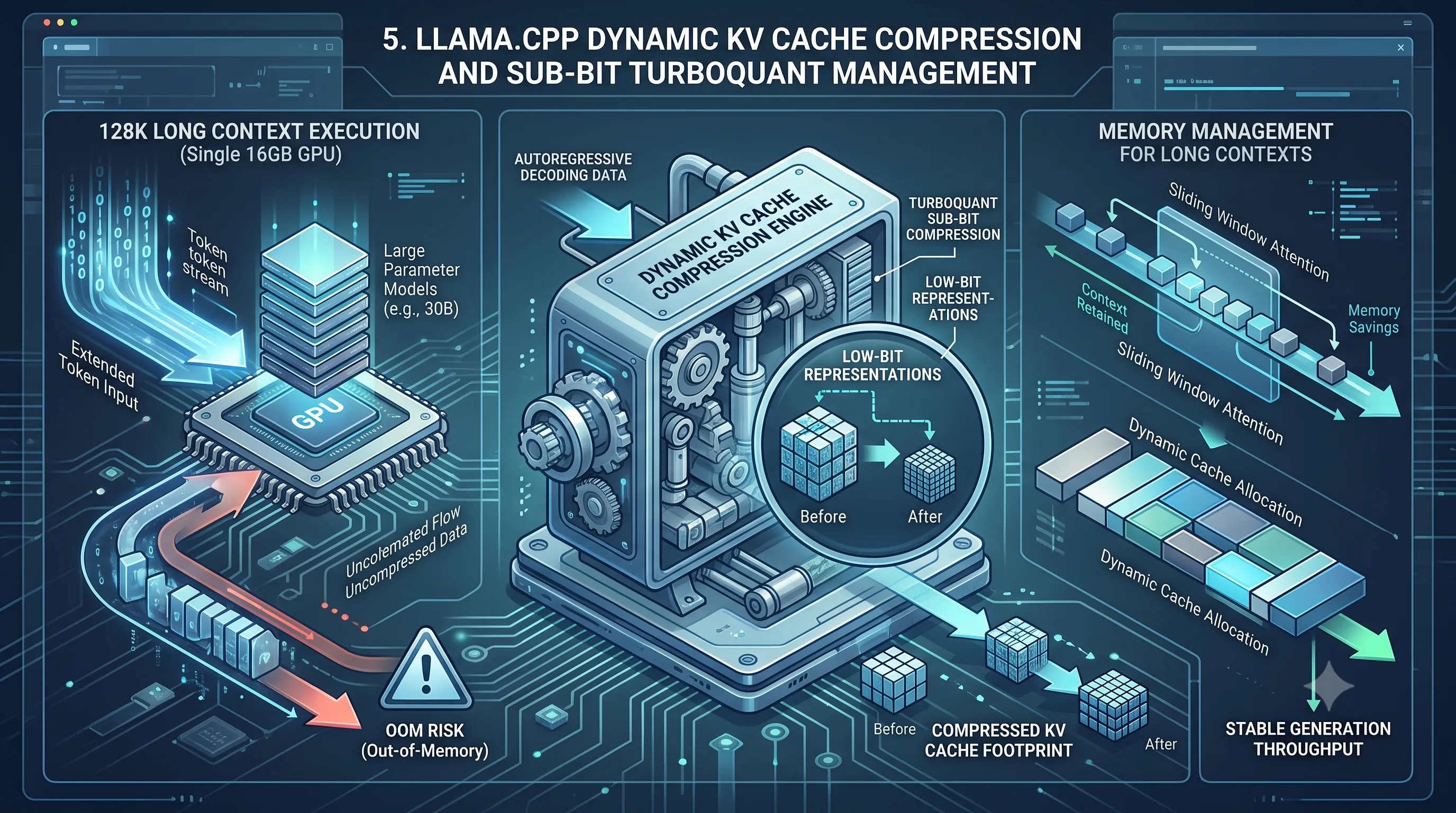
Serving large 30B models across extended 128k context windows on a single 16GB GPU requires efficient memory management during inference.Runtime KV cache compression in llama.cpp provides the necessary memory reductions to prevent GPU memory exhaustion while maintaining generation throughput.
Autoregressive Decoding Memory Overhead and OOM Prevention
During autoregressive decoding, llama.cpp stores past token computation results inside the KV cache to avoid redundant calculations across successive generation steps.However, extremely long context sequences can rapidly lead to out-of-memory (OOM) errors on consumer GPUs if the KV cache is left uncompressed.
Managing this memory footprint is essential when hosting large parameter models on constrained hardware, making dynamic cache allocation and compression critical for long-context execution.
TurboQuant Sub-Bit Compression and Sliding Window Context Management
To mitigate context memory pressure, llama.cpp integrates runtime KV cache compression algorithms such as TurboQuant for sub-bit and low-bit KV representations.In addition to sub-bit representations, the runtime handles long-context sequences across sliding window attention and hybrid architectures.
Although runtime quantization introduces minor processing overhead during decoding, it successfully compresses the memory footprint to prevent out-of-memory failures during deep context evaluation.
6. Engineering Trade-offs and Engine Selection: vLLM vs. llama.cpp on 16GB VRAM
Serving a 30B model with a 128k context window on a single 16GB GPU requires careful evaluation of serving paradigms against strict hardware constraints.The architectural trade-offs between execution engines define how compute capacity and memory allocation are balanced under extreme resource pressure.
Continuous Batching vs. Low-Complexity Single-Stream Execution
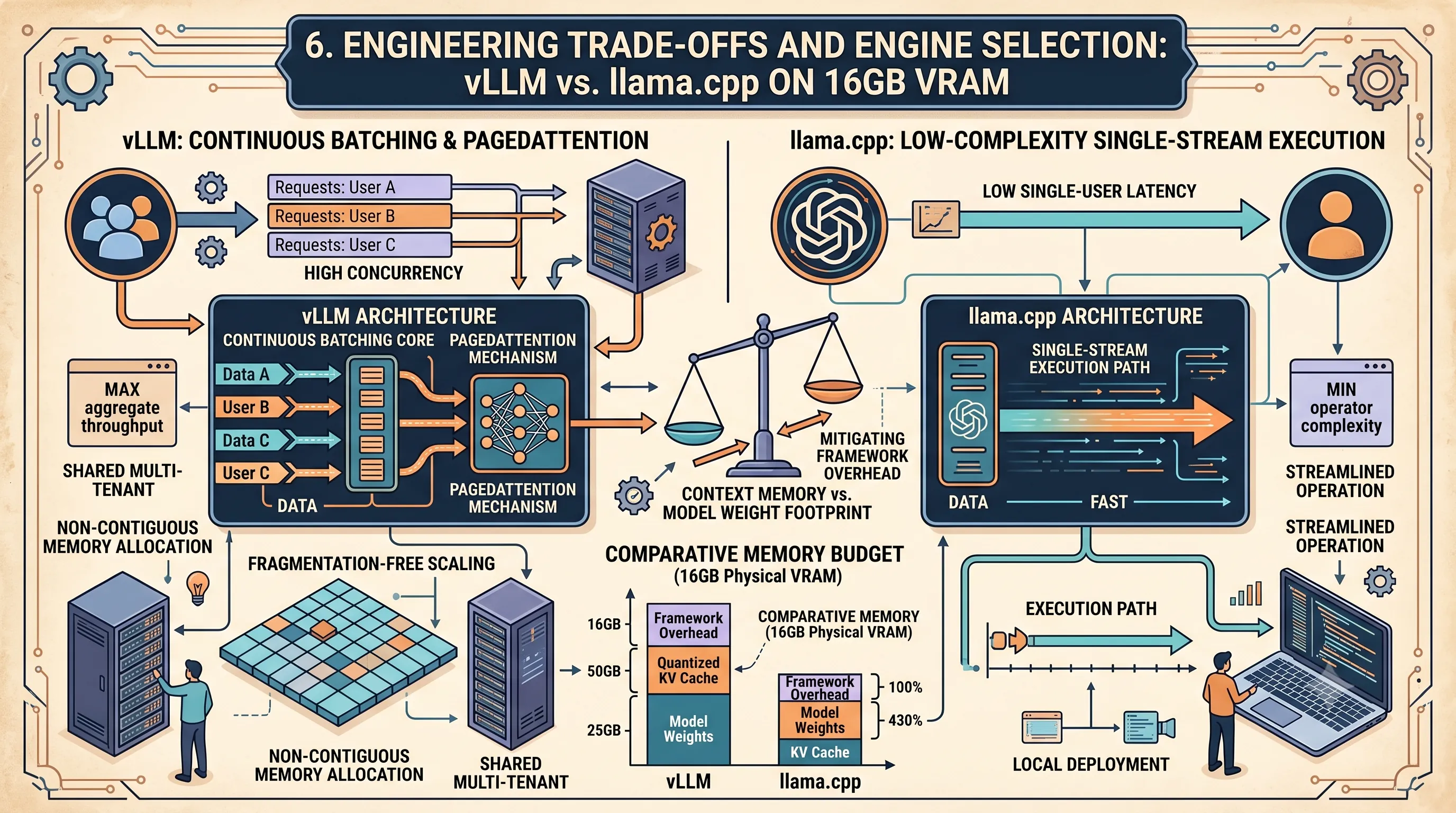
Engine selection is primarily governed by the target concurrency model and serving objectives.vLLM utilizes continuous batching to maximize GPU compute utilization, making it suited for multi-user serving environments that demand high aggregate throughput.
To manage non-contiguous memory allocations during extended sequences, vLLM incorporates PagedAttention, which eliminates memory fragmentation issues when scaling to long context windows.
In contrast, llama.cpp focuses on low operational complexity and delivers lower single-user latency for local deployment.
While vLLM optimizes shared multi-tenant throughput, llama.cpp provides a streamlined execution path for single-stream workloads.
Context Memory vs. Model Weight Footprint: Mitigating Framework Overhead
Scaling sequence lengths to 128k introduces significant memory dynamics that alter standard VRAM budgeting.Long context memory overhead grows directly with sequence length and can exceed the memory footprint of the model weights if the KV cache remains unquantized.
Furthermore, runtime framework overhead and scaffolding reduce the effective VRAM available for allocating the KV cache within the strict 16GB physical limit.
Balancing framework overhead against dynamic context demands is critical to preventing out-of-memory states during long-context inference.
Related Posts


Generative AI may have assisted with research or drafting for this article. Topic selection, fact-checking, final wording, and publication remain the responsibility of DragonStone74. AI use disclosure