
Google Open-Sources TPU Sync to Slash KV Cache Transfer Latency
🚀 Key Takeaways
- Unified Memory Architecture: TPU Sync binds accelerator High Bandwidth Memory, pinned host DRAM, and data center fabrics into a single continuous memory hierarchy.
- Zero-Copy Physical Tiling: Retains native TPU tensor layouts across memory tiers and wire protocols, feeding Matrix Multiply Units directly without host CPU translation.
- Drastic Transfer Latency Reduction: High-bandwidth direct memory streaming slashes key-value migration delays by more than 90%, dramatically shortening time-to-first-token.
- Disaggregated Prefill and Decode: Decouples computational prefill from token generation by streaming multi-turn contexts asynchronously over network links without stalling active decode steps.
- Resilient Host DRAM Persistence: Leverages POSIX shared memory to retain terabytes of cached attention contexts through process crashes, worker upgrades, and container restarts.
- Accelerated RL Weight Synchronization: Employs low-level streaming primitives and automated resharding to synchronize active weights between distributed trainers and inference rollout engines.
- Turnkey Ecosystem Support: Plugs directly into modern serving runtimes including vLLM and SGLang alongside cluster-wide prefix routing across modern TPU generations.
As modern frontier models expand their context windows across multi-turn agentic workflows, distributed inference architectures face a critical bottleneck: memory capacity and inter-host data migration. While the computational throughput of tensor accelerators has surged, on-chip High Bandwidth Memory remains a scarce resource. Serving massive mixture-of-experts architectures frequently forces clusters into redundant prefill calculations whenever cached context blocks exceed localized accelerator memory boundaries.
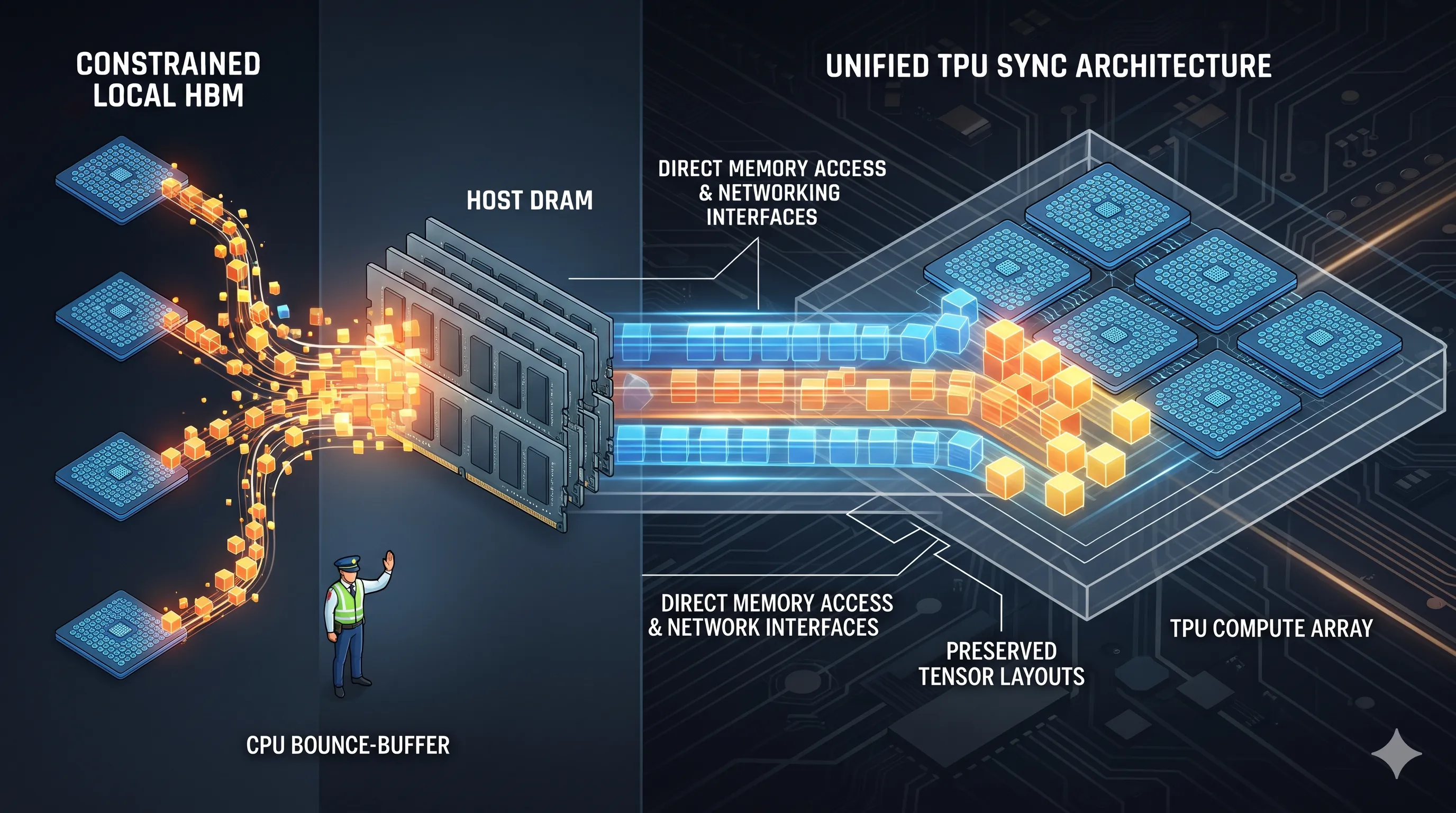
TPU Sync fundamentally changes this paradigm by turning host-level system resources into an active, low-latency tier of accelerator memory. By orchestrating direct memory access engines and networking interfaces into an integrated pipeline, the open-source C++ framework allows TPU clusters to stream attention states and model weights without CPU bounce-buffer overhead or costly tensor layout conversions.
This breakthrough enables production teams to execute efficient disaggregated prefill-decode architectures and maintain robust prefix-cache hit rates under heavy real-time concurrency. For machine learning engineers operating large-scale reasoning and reinforcement learning systems, TPU Sync provides the missing architectural link between raw matrix compute and fluid data mobility.
1. Architectural Design and the Unified TPU Memory Hierarchy
To understand how TPU Sync improves KV cache and weight transfer on TPUs, it is essential to examine its low-level structural blueprint.TPU Sync is an open-source native C++ library licensed under Apache 2.0 that fundamentally restructures how accelerator memory interacts with system and network resources.
Rather than treating accelerator memory as an isolated silo, TPU Sync integrates three core components: a Global KV store responsible for prompt prefix hash mapping, a TPU Sync controller for transfer orchestration, and a local KV cache manager dedicated to buffer tracking.
This design replaces earlier distribution artifacts, as legacy TPU Raiden package names such as tpu-raiden-jax and tpu-raiden-torch have been retired and are no longer controlled on PyPI.
Co-Designing HBM, Host DRAM, and Multi-Host DCN Tiers
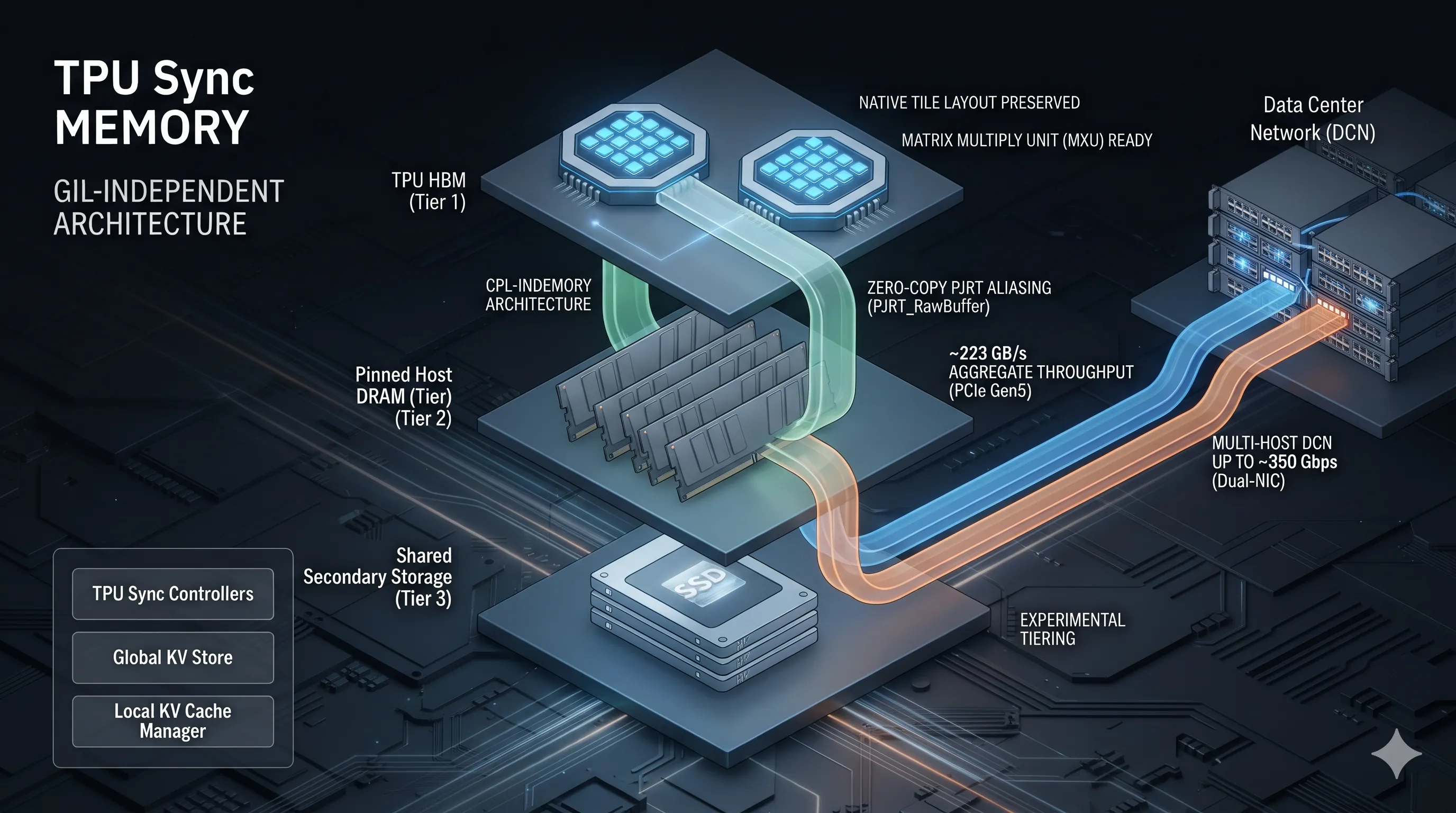
The core strength of TPU Sync lies in co-designing TPU HBM (Tier 1), pinned host DRAM (Tier 2), shared secondary storage (Tier 3), and multi-host data center networks (DCN) into a unified memory hierarchy.Standard serving systems typically force tensors through intermediate CPU staging buffers, triggering costly layout transformations when moving data between host memory and TPU chips.
TPU Sync eliminates these bottlenecks by strictly preserving the native TPU physical tile layout across HBM, host DRAM, secondary storage, and network transport wires.
Because the physical tile layout remains intact throughout every transfer stage, data ingested into HBM is immediately available for Matrix Multiply Unit (MXU) execution without layout conversion or CPU bounce buffers.
To maintain non-blocking execution across this multi-tier fabric, TPU Sync deploys a GIL-independent architecture.
Memory routines, data movement pipelines, and transfer requests are dispatched directly onto native C++ background thread pools, completely bypassing Python runtime locks.
Zero-Copy PJRT Aliasing and Out-of-Graph Execution
Conventional TPU workflows enforce data synchronization through the XLA (Accelerated Linear Algebra) compilation graph, which routinely stalls compute tasks and incurs compilation overhead during dynamic tensor slicing.TPU Sync bypasses the XLA compilation graph entirely to orchestrate memory transfers and execute tile-aware strided resharding without triggering runtime XLA compilation.
This out-of-graph mechanism relies on zero-copy PJRT buffer aliasing using PJRT_RawBuffer abstractions.
By manipulating device pointers at the driver interface without acquiring or holding framework usage locks, TPU Sync runs bidirectional memory transfers concurrently with active compute kernels.
Tensors move directly into accelerator memory while the MXU processes previous inference tokens simultaneously, maintaining uninterrupted execution streams.
PCIe Gen5 Bandwidth Saturation on Ironwood Hardware
The native pipeline achieves near-theoretical physical limits when transferring data across bus interfaces and network interconnects on Google Ironwood (TPU v7x) hardware.On Ironwood hosts, TPU Sync aggregates up to 223 GB/s device-to-host (D2H) and host-to-device (H2D) throughput against a physical 256 GB/s PCIe Gen5 hardware ceiling.
Under production workloads containing variable KV cache blocks, hardware DMA reaches approximately ~200 GB/s bidirectional PCIe bandwidth.
For inter-chassis distribution, TPU Sync streams across the data center network at up to ~192 Gbps on a single 200 Gbps network interface card (NIC).
When utilizing dual 200 Gbps NIC architectures, NUMA-aware multi-NIC striping scales DCN throughput to ~350 Gbps, ensuring cluster-wide cache transfers keep pace with accelerator requirements.
| Hardware Interface / Metric | Theoretical Physical Ceiling | TPU Sync Achieved Performance | Architectural Mechanism |
|---|---|---|---|
| Ironwood Host PCIe Gen5 (D2H / H2D) | 256 GB/s | Up to 223 GB/s aggregate throughput | Native C++ out-of-graph DMA transfer orchestration |
| Bidirectional PCIe DMA (Production KV Cache) | 256 GB/s | Approximately ~200 GB/s | Zero-copy PJRT buffer aliasing (PJRT_RawBuffer) |
| Single-NIC Data Center Network (DCN) | 200 Gbps | Up to ~192 Gbps | Native tile layout preserved directly across wire |
| Dual-NIC Data Center Network (DCN) | 400 Gbps | ~350 Gbps | NUMA-aware multi-NIC striping via native C++ threads |
2. Empirical Inference Benchmarks and Latency Reductions
Understanding how TPU Sync improves KV cache and weight transfer on TPUs requires evaluating empirical inference benchmarks where memory interconnects and transfer mechanisms are pushed under heavy load.By moving data efficiently through host pinned DRAM rather than stalling execution pipelines, TPU Sync directly eliminates bottlenecks associated with large language model serving.
TTFT and KV Transfer Latency Reductions Across Large Models
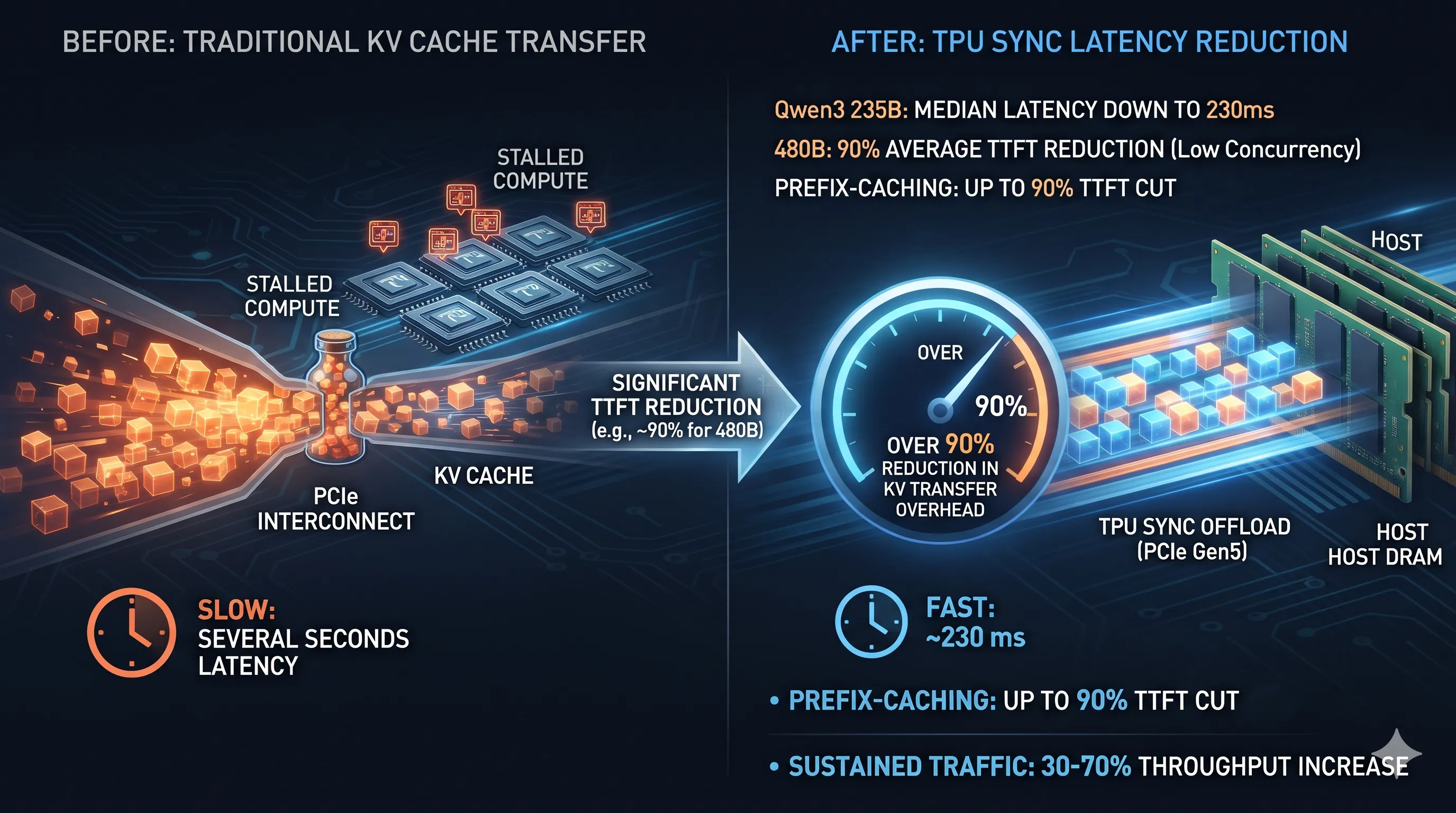
Evaluating raw latency metrics demonstrates significant performance enhancements across dense and mixture-of-experts model scales.For Qwen3 235B, the median KV transfer latency dropped from several seconds down to about 230 ms, marking an overall reduction in KV transfer overhead of over 90%.
Under low-concurrency serving conditions, this transfer efficiency yielded an average Time to First Token (TTFT) reduction of 60% for Qwen3 235B.
The impact expands further on larger parameter profiles: 480B architectures demonstrated an average TTFT reduction of 90% under low-concurrency traffic.
Reflecting on these latency gains, industry practitioner Anand Butani noted: "TPU sync cutting kv transfer latency 90% matters more to me than the chip names, long-context serving mostly dies on moving cache between nodes."
| Model Architecture / Workload | Context / Concurrency State | Evaluated Metric | Observed Benchmark Impact |
|---|---|---|---|
| Qwen3 235B | Standard Evaluation | Median KV Transfer Latency | Reduced from several seconds to ~230 ms (>90% overhead cut) |
| Qwen3 235B | Low Concurrency | Time to First Token (TTFT) | 60% average reduction |
| 480B Architectures | Low Concurrency | Time to First Token (TTFT) | 90% average reduction |
| Qwen3 235B | Sustained Traffic Spikes | Token Output Throughput | 30% to 70% average increase |
| Prefix-Caching Workloads | 64K Context Length | Time to First Token (TTFT) | Up to 90% average reduction |
| Prefix-Caching Workloads | Prefix-Cached Evaluation | Token Output Throughput | Over 50% increase |
| Prefix-Caching Workloads | Prefix-Cached Evaluation | P99 Inter-Token Latency (ITL) | 30% reduction |
High-Concurrency Throughput and 64K-Context Prefix Caching
Serving long-sequence requests under real-world multi-user demand introduces extreme memory pressure on accelerator memory pools.TPU Sync expands effective KV cache capacity beyond on-chip HBM limits by offloading cache structures into host pinned DRAM.
During sustained traffic spikes, this architectural behavior allowed token output throughput for 235B models to increase by an average of 30% to 70%.
On 64K-context prefix-caching workloads, TPU Sync directly bypasses heavy compute prefill stages for repeated instruction blocks and multi-turn dialogues, resulting in an average TTFT reduction of up to 90%.
In these prefix-caching scenarios, overall token throughput increased by over 50%, while tail latency stabilized with a 30% reduction in P99 inter-token latency (ITL).
This mechanism sustains high cache-hit rates across thousands of concurrent sessions for shared system prompts and multi-turn agent contexts.
Analyzing the hardware trade-offs between sheer bandwidth and actual memory footprint, community commentator @lgoodbookd stated: "8i Max doubles HBM bandwidth to ~17.2TB/s, yet one 64K session on a 235B MoE still eats ~12.6GB of KV cache. That's why open-sourcing TPU Sync (host-DRAM KV tiering, ~223GB/s per v7x host) may matter as much as the new package. Bandwidth helps; capacity is still the wall."
However, real-world performance, cache hit rates, and latency reductions vary based on hardware setup, network bandwidth, and workload traffic patterns.
Benchmark Parameters on TPU v7x Topologies
The empirical metrics were recorded during internal benchmark testing conducted in July 2026.The test environment utilized TPU v7x accelerators configured in a 2x2x1 topology.
Interconnect hardware featured PCIe Gen5 x16 per chip, supplying host-DRAM KV tiering rates of approximately 223GB/s per v7x host.
The serving and execution software framework executed tpu-inference v0.24.0, built on JAX 0.10.2 and libtpu 0.0.42.1.
3. Pipelined Prefill/Decode Disaggregation and Multi-Tier Caching
Serving large language models efficiently requires separating compute-heavy prompt processing from memory-bound generation, a paradigm supported directly by TPU Sync's transport mechanisms.In the broader context of how TPU Sync improves KV cache and weight transfer on TPUs, this section analyzes the mechanics of pipelined prefill/decode disaggregation and multi-tier memory offloading.
The Three-Step D2H, H2H, and H2D Disaggregated Pipeline
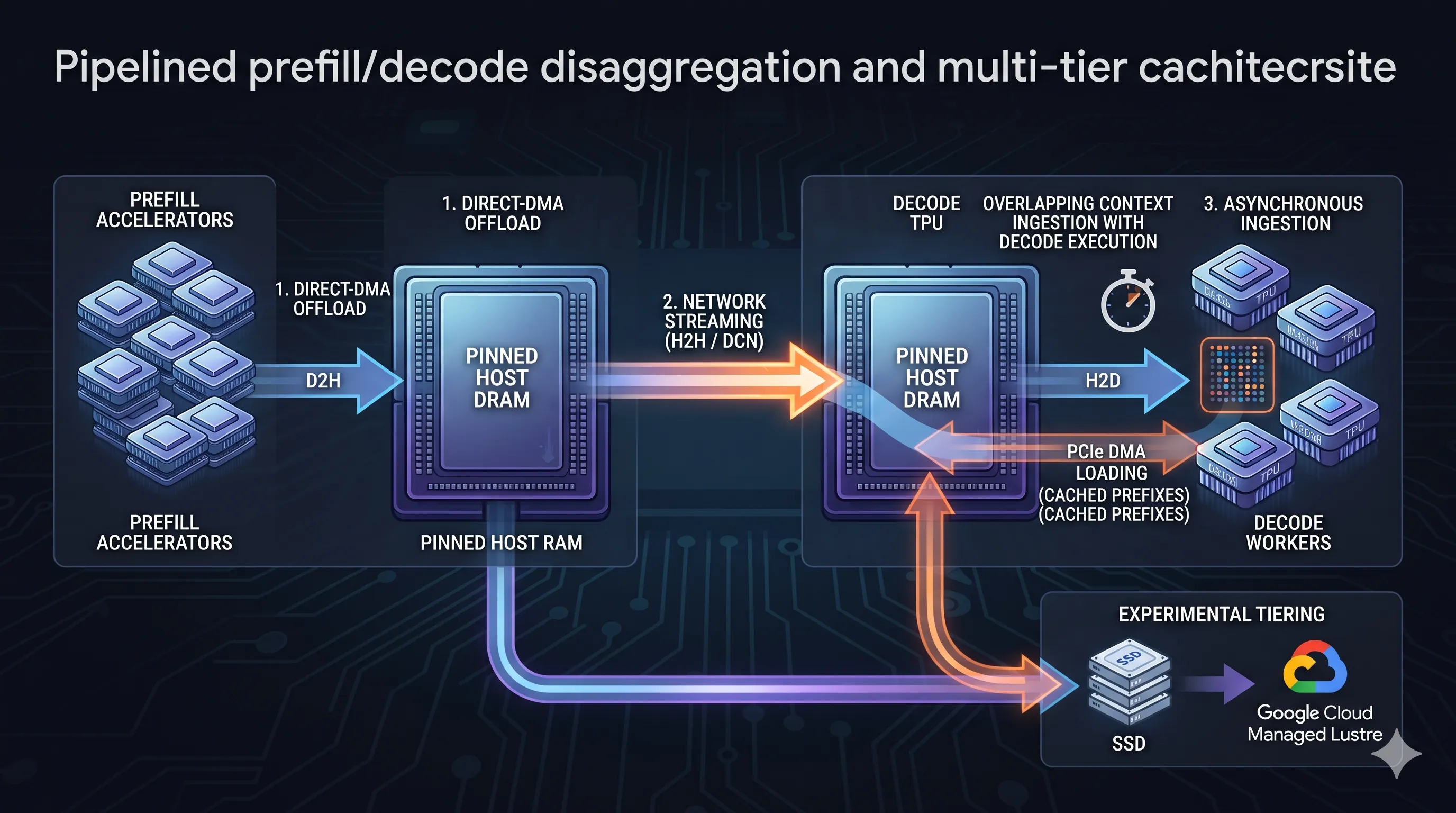
TPU Sync executes a dedicated three-step prefill/decode pipeline to move KV cache data between dedicated prefill accelerators and decode workers.First, the prefill TPU node performs Direct-DMA offloading of generated KV activations to pinned host RAM (D2H).
Second, the data is transferred via host-to-host streaming across the data center network (H2H / DCN).
Third, the target decode node performs overlapped asynchronous ingestion from host memory directly into decode TPU High Bandwidth Memory (H2D).
| Pipeline Stage | Data Path | Operational Role |
|---|---|---|
| 1. Direct-DMA Offload | Device-to-Host (D2H) | Direct-DMA offloading of KV cache blocks to pinned host RAM. |
| 2. Network Streaming | Host-to-Host (H2H) | Streaming KV data across the Data Center Network (DCN). |
| 3. Asynchronous Ingestion | Host-to-Device (H2D) | Overlapped ingestion into decode TPU High Bandwidth Memory (HBM). |
Overlapping Context Ingestion with Decode Execution
To hide the latency of moving large contexts across system boundaries, TPU Sync overlaps incoming H2D context ingestion with ongoing token decode execution.This concurrency minimizes time to first token (TTFT) by preventing decode engines from idling while waiting for upstream context transfers to complete.
In addition, the pipeline overlaps PCIe DMA loading of subsequent cached prefixes from host DRAM with active request compute.
By interleaving prefix memory retrieval with ongoing matrix operations, TPU Sync shields serving performance from host-device bandwidth limits.
Tiering Beyond Host DRAM to Secondary Storage
When handling massive context windows or deep prefix trees, KV blocks can exceed available host DRAM capacity.TPU Sync provides experimental secondary storage tiering to local SSDs or Google Cloud Managed Lustre for KV blocks that outgrow host memory.
However, storage tiering beyond host DRAM is currently experimental, requiring careful validation when architecting long-context caching layers.
4. Process Resilience and Fast Recovery via POSIX Shared Memory
In high-throughput TPU serving environments, optimizing KV cache and weight transfer relies not only on fast interconnect bandwidth, but also on eliminating redundant data transfers between host memory and TPU devices.TPU Sync directly addresses this by integrating OS-level resilience into the offloading pipeline, allowing host staging memory to persist across process failures.
Preserving Host DRAM Buffers Across Container Restarts
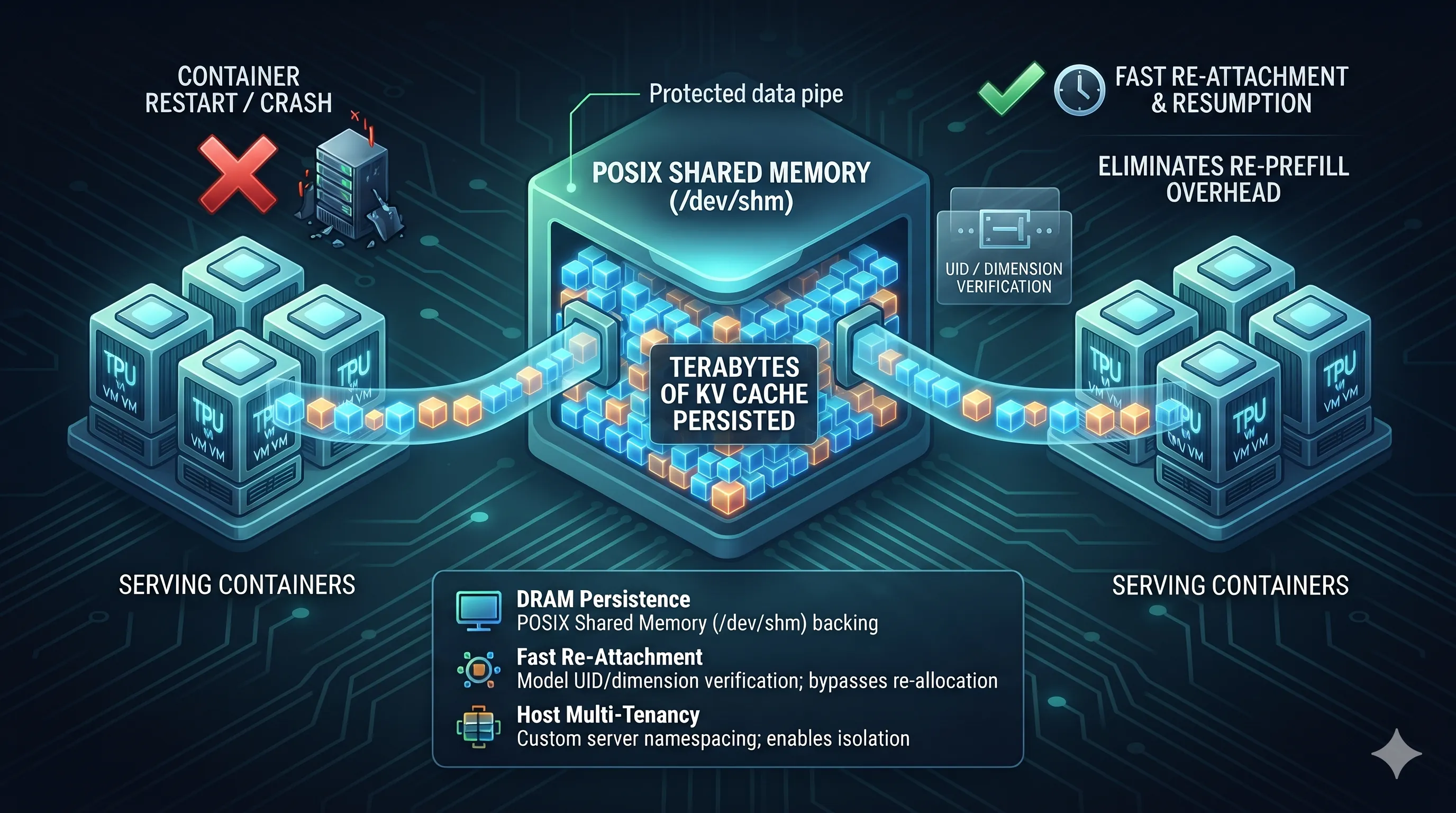
TPU Sync supports backing host memory staging buffers and least-recently-used (LRU) metadata using OS-level POSIX Shared Memory located in /dev/shm.Standard serving architectures allocate staging memory inside the ephemeral address space of a single serving process or container, causing complete cache eviction whenever the process terminates.
By decoupling buffer allocation from process lifecycles and anchoring it in /dev/shm, TPU Sync preserves terabytes of offloaded KV cache in physical host DRAM through container restarts, unexpected application crashes, or live serving binary updates.
Retaining host DRAM buffers across failures prevents cold-start re-prefill computation overhead following process restarts, ensuring that active client contexts remain intact in the offload tier instead of forcing the TPU cluster to re-compute identical tokens from scratch.
UID and Dimension Verification During DMA Re-Registration
Re-attaching to existing shared memory blocks introduces the risk of structural misalignment or stale model configurations.To ensure data integrity, TPU Sync automatically verifies the model UID and dimensions upon restart before re-attaching to preserved memory segments.
Once structural compatibility is confirmed, the system re-registers the existing physical pages directly with the TPU DMA engine without triggering memory re-allocation.
Bypassing memory re-allocation allows the TPU DMA transfer pipeline to resume immediately, establishing low-latency KV cache swapping back into high-bandwidth memory without initialization delays.
Multi-Server Isolation and Lifecycle Management in /dev/shm
To support dense hosting configurations, TPU Sync provides multi-server isolation on a single TPU VM via custom server namespacing.Distinct namespaces segregate shared memory endpoints in /dev/shm, allowing separate model instances or serving tasks to maintain independent staging buffers on the same physical host without memory collisions.
Because POSIX shared memory segments survive process crashes by design, physical host DRAM pages remain allocated in the operating system even after the host container or binary exits.
Consequently, complete cluster cleanups require manual unlinking of namespaced shared memory objects to release physical host DRAM back to the OS kernel.
| Component / Feature | Implementation Mechanism | System Impact |
|---|---|---|
| DRAM Persistence | POSIX Shared Memory (/dev/shm) backing | Preserves terabytes of KV cache through container restarts, crashes, and binary updates; eliminates re-prefill overhead. |
| Fast Re-Attachment | Model UID and dimension verification | Re-registers memory pages directly with the TPU DMA engine without re-allocation. |
| Host Multi-Tenancy | Custom server namespacing | Enables multi-server isolation on a single TPU VM. |
| Lifecycle Management | Manual memory unlinking | Requires explicit unlinking to free physical host DRAM pages during full cluster cleanups. |
5. High-Throughput Weight Synchronization for Distributed Reinforcement Learning
In reinforcement learning (RL) workflows, efficient weight transfer is just as critical as low-latency key-value (KV) cache mobility.TPU Sync addresses this operational bottleneck by extending its optimized transfer primitives beyond KV caches to handle high-frequency model parameter updates between decoupled compute pools.
Streaming Trainer Updates Directly to Rollout Samplers
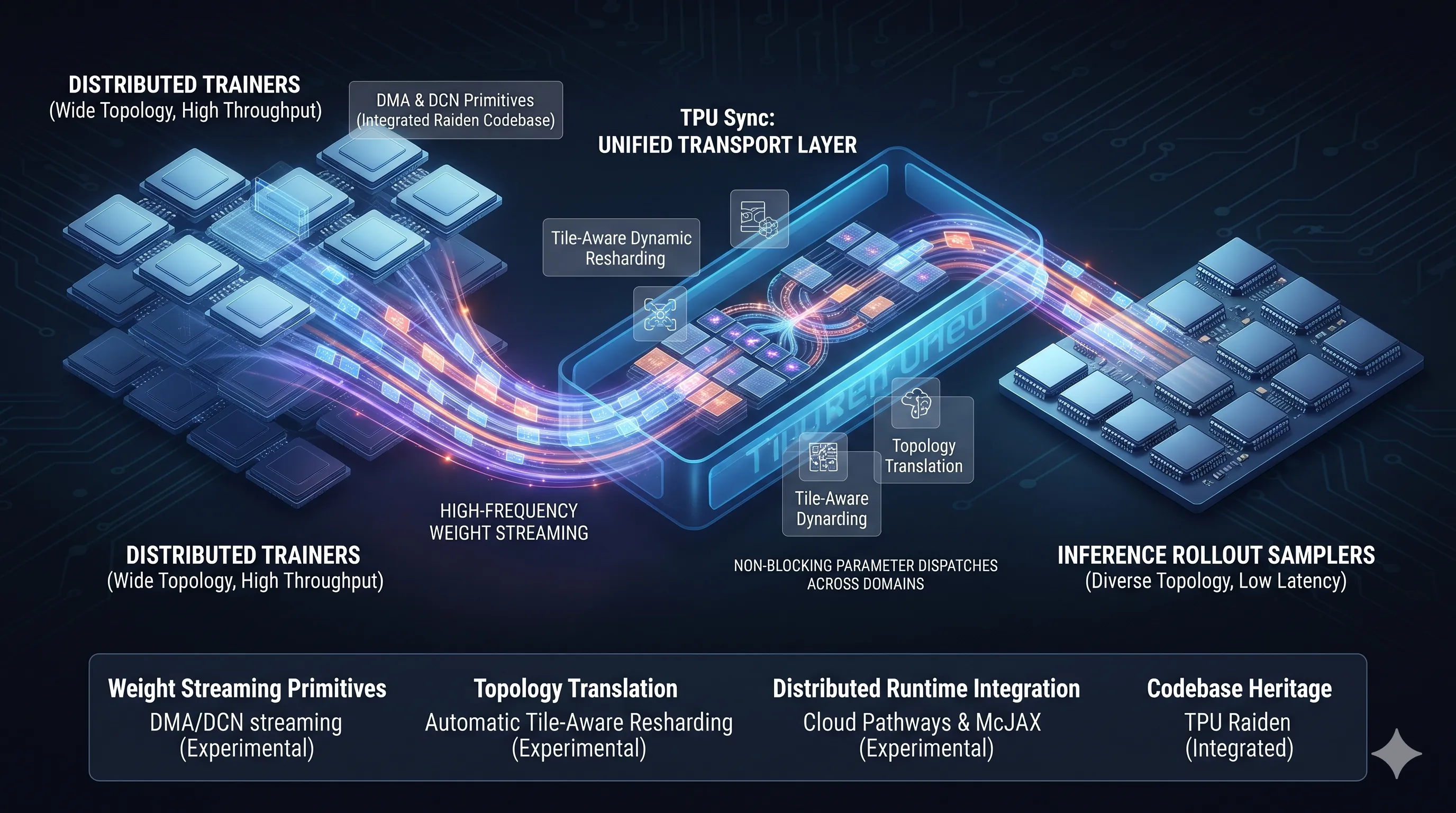
In distributed reinforcement learning architectures, continuous updates from learner clusters must reach inference rollout samplers without stalling parallel generation.TPU Sync exposes low-level direct memory access (DMA) and Data Center Network (DCN) primitives designed to stream updated model weights directly from training nodes to inference rollout samplers.
To build these low-latency communication paths, TPU Sync absorbs the codebase and synchronization techniques previously developed under the TPU Raiden project.
By consolidating the TPU Raiden synchronization mechanics directly into its unified transport layer, TPU Sync removes the overhead of orchestrating out-of-band weight checkpoints.
Engineers should note that while these direct streaming mechanisms are operational, the RL weight synchronization module remains experimental.
Tile-Aware Dynamic Resharding Across Topologies
Distributed reinforcement learning systems rarely use identical hardware configurations or partition strategies for both training and inference.Training nodes typically run wide tensor, pipeline, or data parallel layouts optimized for throughput, whereas rollout samplers often run independent replicas or distinct partition schemes tuned for generation latency.
TPU Sync resolves this structural mismatch by performing automatic tile-aware weight resharding between differing trainer and sampler parallelism topologies.
As weights stream across the DCN, TPU Sync translates and routes weight tensors according to the target hardware tiles without requiring intermediate host-memory reassembly or manual tensor slicing.
Integration with Cloud Pathways and Multi-Controller JAX
Scaling reinforcement learning pipelines requires native synchronization hooks inside modern orchestrators and distributed runtimes.TPU Sync integrates directly with distributed RL runtimes, including Cloud Pathways and multi-controller JAX (McJAX).
This integration allows McJAX and Cloud Pathways environments to trigger non-blocking parameter dispatches across distinct controller domains.
| Feature / Component | Architectural Mechanism | Deployment Status |
|---|---|---|
| Weight Streaming Primitives | Exposes low-level DMA and DCN primitives to stream parameter updates from training nodes to inference samplers. | Experimental |
| Topology Translation | Performs automatic tile-aware weight resharding between differing trainer and sampler parallelism layouts. | Experimental |
| Distributed Runtime Integration | Integrates with Cloud Pathways and multi-controller JAX (McJAX) execution environments. | Experimental |
| Codebase Heritage | Absorbs the codebase and synchronization techniques previously developed under the TPU Raiden project. | Integrated |
6. Ecosystem Framework Integrations and Hardware Target Topologies
Connecting directly to the core mission of accelerating KV cache and weight transfer on Tensor Processing Units, TPU Sync functions as the underlying transport and layout-aware transfer layer within open-source inference stacks.Rather than operating as an isolated point-to-point utility, its primitives are embedded directly into distributed model-serving frameworks and cluster orchestrators, standardizing how TPU memory communicates across disaggregated nodes.
Integrating with vLLM, SGLang, and GKE llm-d Orchestration
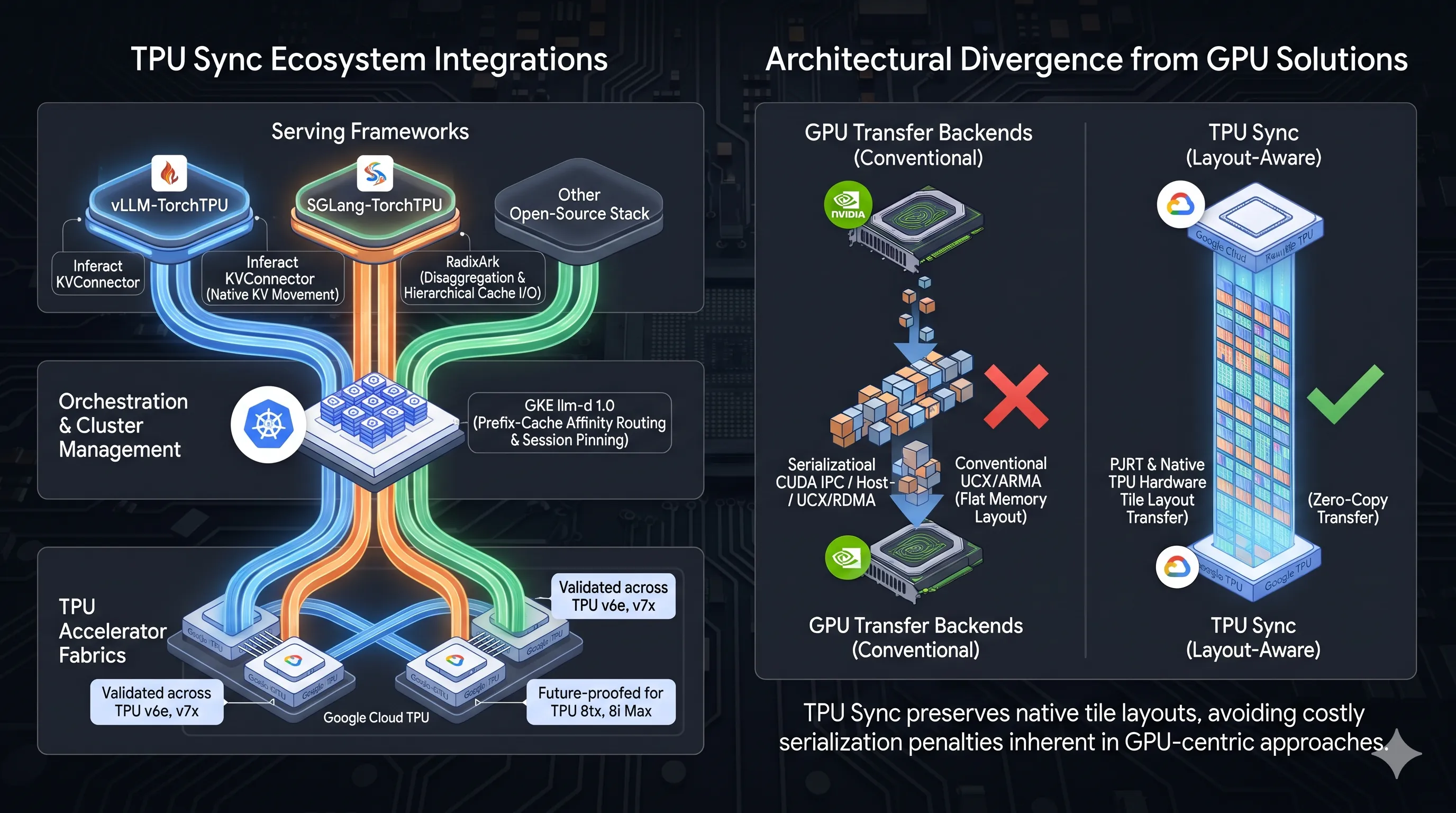
To deliver high-throughput inference across distributed TPU pods, TPU Sync integrates directly with leading serving engines and cluster schedulers.Within the vLLM-TorchTPU ecosystem, TPU Sync was co-engineered with Inferact to serve as the native KVConnector implementation.
This integration allows vLLM workers running on TPUs to offload and fetch KV cache blocks across network boundaries without passing intermediate buffers through host memory bottlenecks.
For SGLang-TorchTPU, TPU Sync integrates with RadixArk, functioning as both the disaggregation backend and the hierarchical cache I/O layer.
Through RadixArk, SGLang disaggregates prefill and decode instances while TPU Sync manages the physical transfer of token states across TPU ranks.
At the cluster management tier, TPU Sync pairs directly with llm-d 1.0 deployed on Google Kubernetes Engine (GKE).
This combination enables global prefix-cache-affinity routing, directing incoming requests to workers that already host matching attention states, while maintaining per-rank decode session pinning across serving pods.
The operational efficacy of these ecosystem integrations has been evaluated and adopted by enterprise industry organizations, including Meta and Wayfair, for production-scale distributed serving.
| Framework / Orchestrator | Integration Component | Operational Role in TPU Sync Architecture |
|---|---|---|
| vLLM-TorchTPU | Inferact KVConnector | Native connector implementation for KV cache movement across TPU inference nodes. |
| SGLang-TorchTPU | RadixArk | Disaggregation backend and hierarchical cache I/O layer for split prefill-decode topologies. |
| Google Kubernetes Engine (GKE) | llm-d 1.0 | Global prefix-cache-affinity request routing and per-rank decode session pinning. |
Hardware Validation Across TPU Generations
TPU Sync is designed around hardware-level topology constraints, mapping communication graphs directly onto physical accelerator fabrics.The implementation is validated on Google Cloud TPU v6e and TPU v7x hardware generations, establishing production performance for high-density inference and disaggregated workloads.
Looking forward, TPU Sync is targeted at supporting new systems, specifically TPU 8tx and TPU 8i Max platforms.
By aligning memory transfers to generation-specific inter-chip interconnects, the library ensures that generational scaling across TPU revisions does not require rewriting upstream serving framework logic.
Architectural Divergence from GPU Transfer Backends
In contemporary inference architectures, distributed KV transfer is handled by GPU-centric frameworks and protocols such as NVIDIA Dynamo/NIXL, LMCache, Mooncake, and native vLLM prefill connectors.While TPU Sync shares the high-level objective of disaggregating prefill and decode phases, its internal architecture diverges fundamentally from these GPU solutions.
GPU transfer libraries predominantly rely on CUDA IPC, standard host-pinned memory engines, or specialized UCX/RDMA paths designed around flat GPU memory layouts.
In contrast, TPU Sync remains intrinsically coupled to PJRT (Platform-neutral Runtime) and hardware-native TPU hardware tile layouts.
Because TPU high-bandwidth memory (HBM) stores multi-dimensional matrix buffers across structured sublane and tile dimensions, conventional linear byte-copy approaches incur severe serialization and repacking overheads.
TPU Sync avoids this translation penalty by directly driving the PJRT runtime interfaces and scheduling tiled data transfers natively, preserving memory layouts across interconnect boundaries.
7. Build Configuration, ABI Compatibility, and Installation Toolchains
To understand how TPU Sync improves KV cache and weight transfer on TPUs, engineers must first account for the strict low-level compilation and runtime requirements governing its native communication primitives.Because high-speed distributed weight streaming and KV cache synchronization rely on native C++ extensions operating close to hardware runtimes, alignment across host toolchains, Python runtimes, and framework ABIs is mandatory.
Toolchain Requirements and PyTorch ABI Constraints
Deploying TPU Sync requires precise synchronization of build tools and runtime interpreters.Compiling the underlying C++ extension binaries demands Bazel version 8.6.0 within a strictly maintained Python 3.12 environment.
Framework bindings, particularly for PyTorch, impose strict binary constraints that dictate local dependency resolution.
Specifically, PyTorch ABI compatibility explicitly pins torch==2.11.0+cpu.
Furthermore, the PyTorch wheel remains strictly ABI-locked to torch and torch_tpu builds that are not hosted on public PyPI indexes.
Beyond basic package pins, linking PyTorch C++ extensions requires binary-level patching to prevent conflicting runtime hooks.
The PyTorch C++ build process requires patchelf to inject an explicit
NEEDED dynamic entry for libpywrap_torch_tpu_common.so.Without this modification via patchelf, the runtime encounters fatal XLA duplicate allocator registration crashes during initialization.
Engineering teams should also note that the PyTorch wheel release process is not yet gated on end-to-end performance tests.
| Component / Dependency | Pinned Version / Specification | Toolchain Role and Constraints |
|---|---|---|
| Bazel | 8.6.0 | Required build orchestrator for compiling C++ extension binaries. |
| Python | 3.12 | Designated host environment runtime for compilation and runtime bindings. |
| JAX Target | 0.11.2 | Default build target version defined in the workspace toolchain. |
| PyTorch ABI Target | torch==2.11.0+cpu | Strictly locked target build; requires patchelf modification for libpywrap_torch_tpu_common.so. |
Compiling C++ Extensions via Bazel and Custom JAX Flags
Compiling TPU Sync extensions directly from source requires explicit control over framework headers.By default, the compilation environment defaults to building against JAX version 0.11.2.
Maintaining an exact header match is critical, as mismatching compiled jaxlib headers with the runtime jaxlib causes in-process silent memory corruption or delayed crashes during tensor transfers.
To facilitate non-default target builds, the repository provides a build.sh script that supports the RAIDEN_JAX_VERSION environment variable.
Setting this environment variable enables compilation against supported target versions enumerated in third_party/jax/versions.bzl.
Because the underlying TPU Sync APIs are actively evolving, maintainers advise pinning deployments to the explicit commit identified in lkg.version (last known good) rather than tracking the main branch directly.
Installing Development Builds and Staging Workspace Directories
For workloads relying on pre-built artifacts, packages are distributed via PyPI under designated package names.Only development nightly builds are published on PyPI prior to the first stable release.
These pre-built development wheels are distributed as tpu-sync-jax and tpu-sync-torch.
The JAX wheel is self-contained and automatically pulls pinned jax, jaxlib, and libtpu dependencies upon installation.
To install the pre-built development wheels from PyPI for JAX and PyTorch bindings, pass the pre-release flag directly to the pip installer:
pip install --pre tpu-sync-jax
pip install --pre tpu-sync-torchWhen building extensions directly on remote TPUVMs, default partition configurations can become a severe bottleneck.
Bazel places intermediate build trees in the system temporary directory, which frequently exhausts the root filesystem.
To avoid exhausting disk space in /tmp during remote Bazel builds on TPUVMs, redirect the build root before invoking compilation:
export BAZEL_OUTPUT_BASE=$YOUR_TMP_DIR_WITH_ENOUGH_SPACE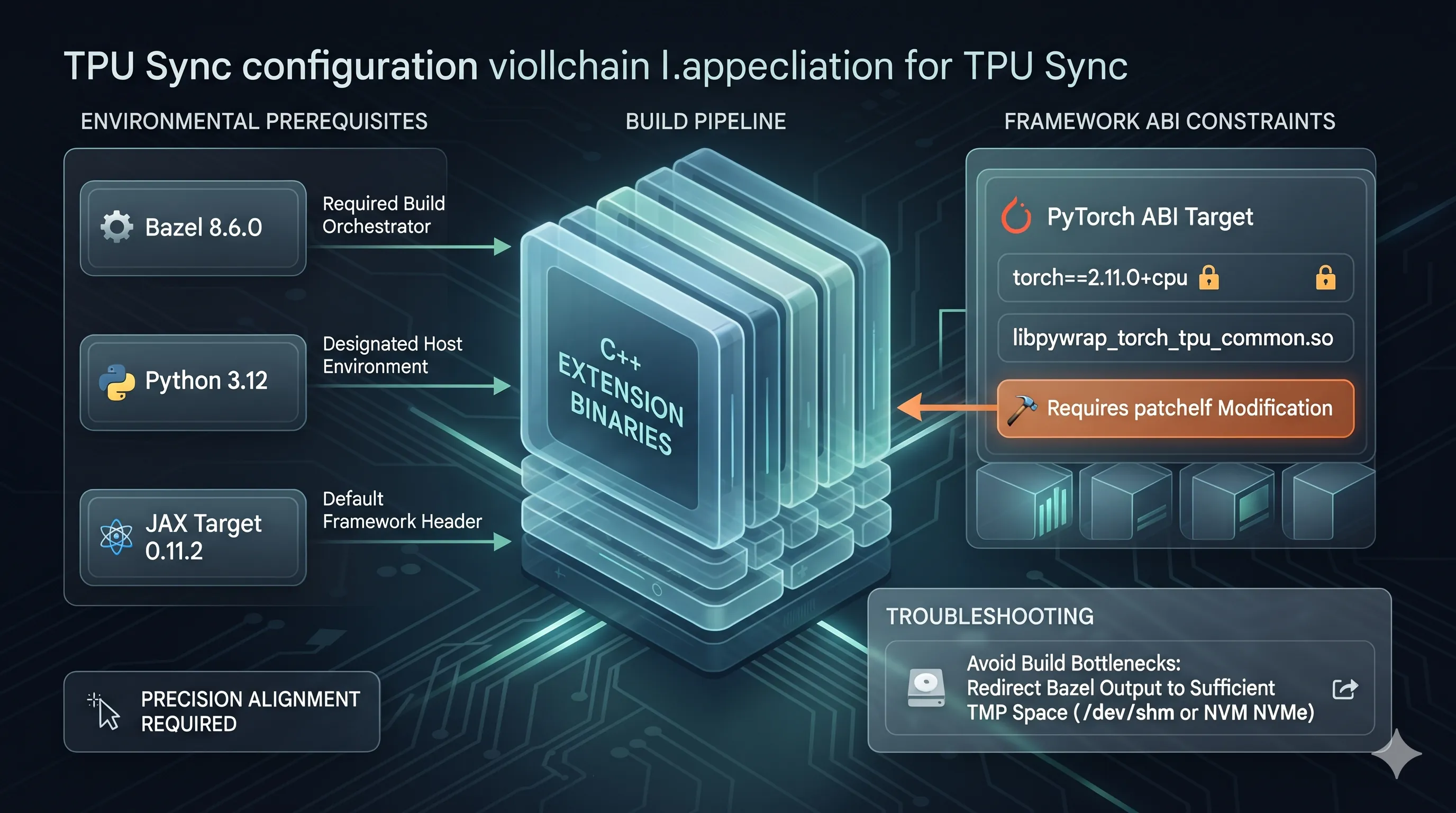
Related Posts

Generative AI may have assisted with research or drafting for this article. Topic selection, fact-checking, final wording, and publication remain the responsibility of DragonStone74. AI use disclosure