
LongCat-2.5 Unveiled: Meituan Open-Sources 1.6T-Parameter MoE Model
🚀 Key Takeaways
- Sparse Trillion-Parameter Scale: LongCat-2.5 employs a Mixture-of-Experts (MoE) backbone totaling 1.6 trillion parameters while dynamically routing only 48 billion parameters per token across a 1-million-token context window.
- Unified Multimodal Processing: Visual inputs—including full-resolution screenshots, charts, and video streams—are converted directly into discrete tokens within a shared semantic space rather than pre-compressed into generic thumbnails.
- Agent-Centric Reinforcement Learning: Training incorporates real-world software pull requests, strict multi-turn execution penalties, and multi-teacher distillation to eliminate repetitive reasoning loops during long-horizon workflows.
- Major Benchmark Advancements: The model delivers generational performance jumps over LongCat-2.0 across multi-step terminal challenges, automated browsing, and comprehensive repository-level code maintenance benchmarks.
- Optimized INT4 Inference: Tailored W4A4 quantization, learnable transformations, and custom grouped GEMM kernels allow efficient deployment and higher throughput across enterprise accelerator clusters.
- Permissive Open-Source Licensing: Released under the MIT license with complete weights and an OpenAI-compatible API endpoint, the model directly supports leading agent harnesses and IDE extensions.
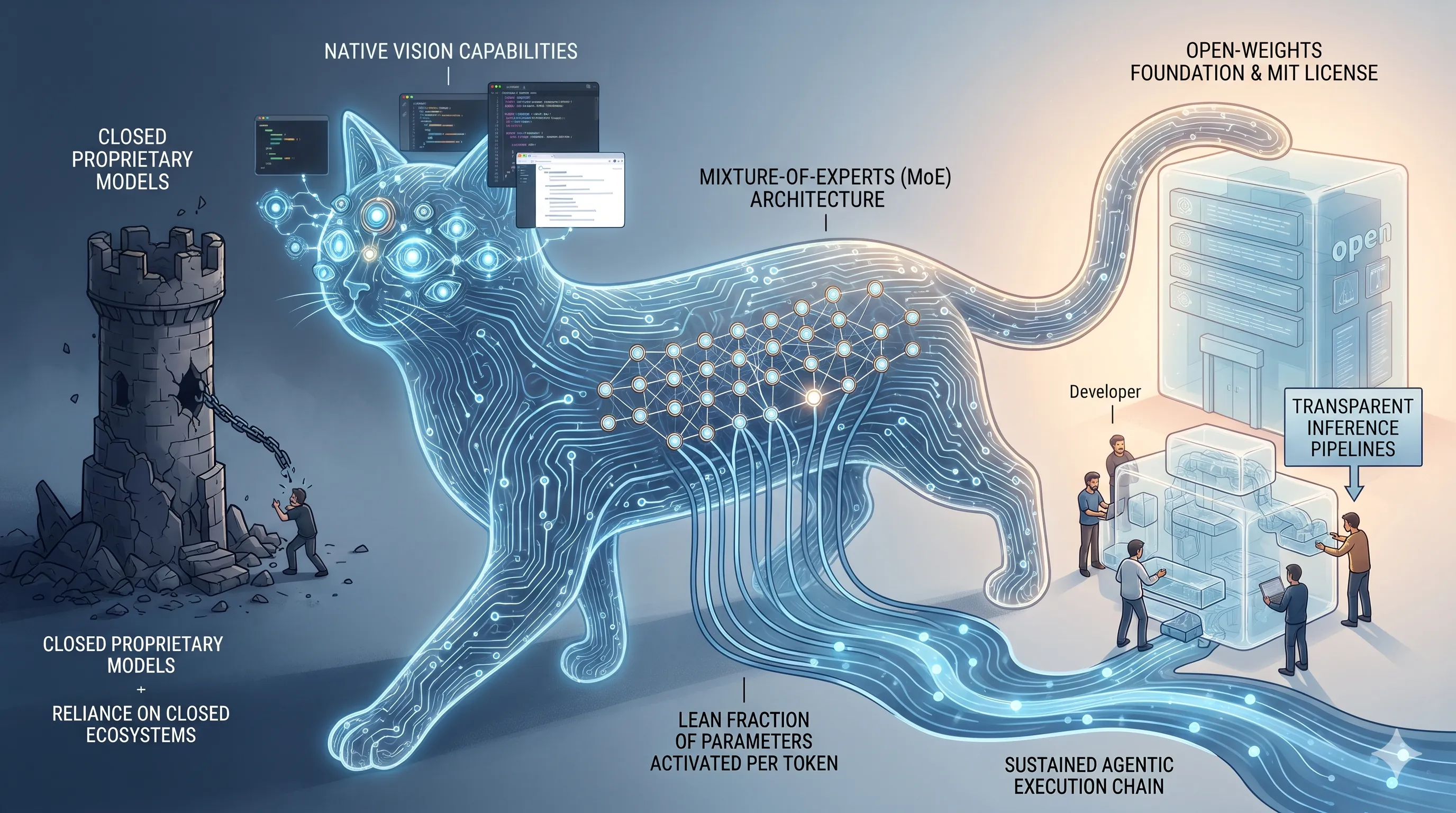
The frontier of autonomous software engineering and multi-step tool use has long been dominated by tightly controlled proprietary models, leaving developers reliant on closed ecosystems for complex problem-solving. Meituan’s release of LongCat-2.5 under an unrestricted MIT license shifts that balance, delivering an open-weights foundation capable of sustaining coherent reasoning over million-token contexts and intricate execution chains.
At the core of this release is a massive Mixture-of-Experts architecture engineered specifically for sustained agentic tasks. By activating only a lean fraction of its total parameter capacity per token, LongCat-2.5 pairs extensive parametric knowledge with practical computational throughput. Combined with native vision capabilities that preserve pixel-level fidelity across documents, interfaces, and video, the model directly tackles visual verification and terminal interaction hurdles that frequently derail automated workflows.
With enterprise engineering teams increasingly focused on local reproducibility, customizable agent harnesses, and transparent inference pipelines, LongCat-2.5 establishes a new benchmark for open-source foundation systems designed to operate across long horizons without supervision.
1.6-Trillion Parameter MoE Architecture and Sparse Routing Mechanics
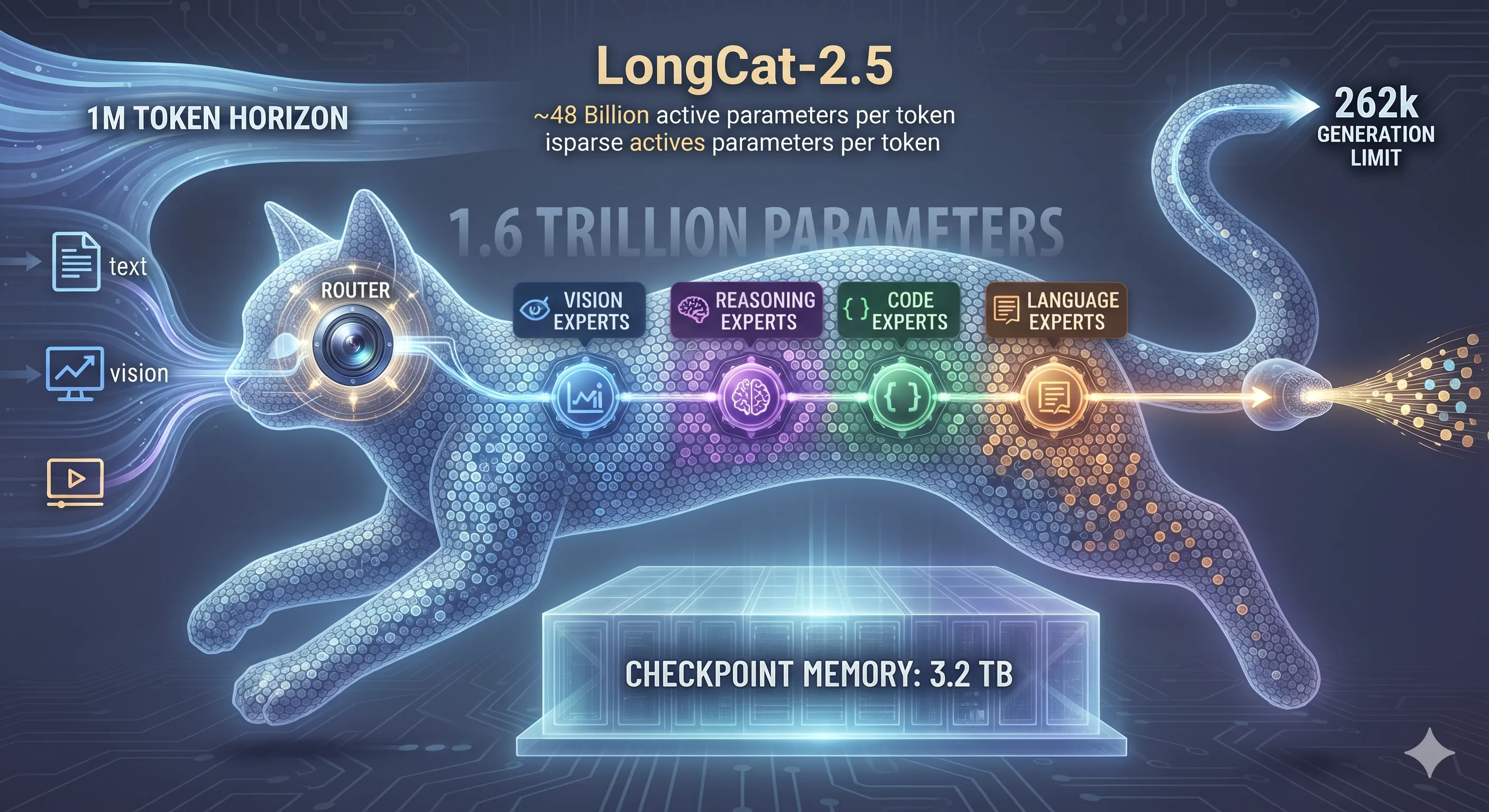
Understanding the foundational scale and routing mechanics of LongCat-2.5 provides the core technical context for how the model executes long-horizon agentic tasks.As the architectural successor to the text-only LongCat-2.0 released in June 2026, LongCat-2.5 transitions the lineage into a native multimodal Mixture-of-Experts (MoE) design constructed specifically for prolonged reasoning and execution horizons.
Sparse Expert Routing: 48B Active Parameters Out of 1.6T Total
The architecture of LongCat-2.5 operates at an aggregate scale of 1.6 trillion parameters, while its Hugging Face repository metadata reflects a 1.8T figure.Rather than engaging the full computational graph for every forward pass, the model utilizes a sparse routing mechanism designed to route each token through a dedicated subset of its experts.
According to Meituan's model card, approximately 48 billion parameters are activated per token out of the 1.6 trillion total.
This sparse activation profile enables LongCat-2.5 to scale parameter capacity to support native multimodal capabilities while keeping per-token compute aligned with the demands of long-horizon tasks.
Context Horizon: 1M Window and 262K Generation Limits
Sustaining agentic continuity over extensive tasks requires both large ingestion capacity and high-volume output generation.LongCat-2.5 supports a total context window of 1,048,576 tokens, covering combined input and output capacity across its 1M token horizon.
According to the model's parameters page, the architecture can scale up to a maximum output length of 262,144 tokens in a single run.
This pairing of a 1,048,576-token context window with a 262,144-token generation limit ensures that long-horizon tasks proceed without prematurely truncating complex intermediate outputs or dense context chains.
Serving Infrastructure: Checkpoint Footprint and Full-Memory Requirements
While sparse routing dynamically isolates active weights to roughly 48 billion parameters per token during computation, deploying LongCat-2.5 introduces significant infrastructure constraints.Serving the model requires making the entire 1.6T parameter checkpoint available in memory simultaneously, as any expert across the cluster may be queried on a per-token basis.
Under a hypothetical uniform 16-bit representation at 2 bytes per parameter, storing the checkpoint weights alone necessitates approximately 3.2 TB of dedicated memory.
Operating LongCat-2.5 at scale therefore demands infrastructure capable of hosting the complete 1.6T parameter space to facilitate real-time sparse expert routing.
| Specification Metric | LongCat-2.5 Architectural Detail |
|---|---|
| Total Parameter Scale | 1.6 trillion parameters (Hugging Face repository metadata lists 1.8T) |
| Active Parameters Per Token | Approximately 48 billion parameters |
| Architecture Modality | Native multimodal Mixture-of-Experts (MoE) |
| Context Window Length | 1,048,576 tokens (1M combined input and output) |
| Maximum Output Capacity | Up to 262,144 tokens |
| Checkpoint Memory Footprint | Roughly 3.2 TB (at uniform 16-bit representation / 2 bytes per parameter) |
| Predecessor Model | LongCat-2.0 (Text-only architecture, released in June 2026) |
| Serving Memory Constraint | Requires the entire 1.6T parameter checkpoint resident in memory |
2. Native Multimodal Vision Integration and High-Resolution Tokenization
To sustain effective reasoning across long-horizon workflows, LongCat-2.5 connects its Mixture-of-Experts (MoE) backbone directly to rich visual context, ensuring that multi-step tasks involving visual artifacts maintain semantic fidelity.Native-Resolution Visual Ingestion Without Thumbnail Squashing
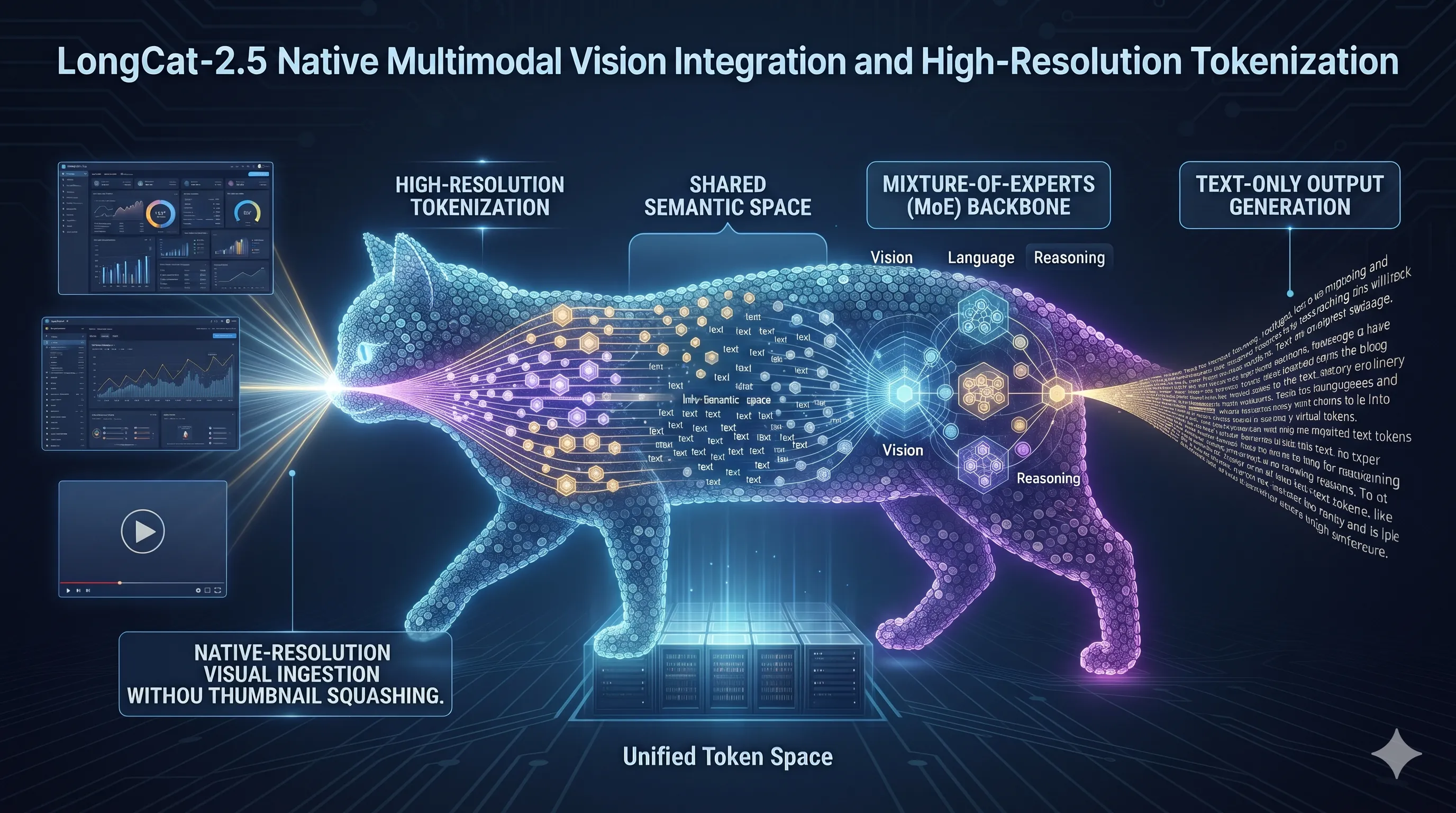
LongCat-2.5 handles visual inputs by converting native-resolution visual features directly into discrete tokens.These tokens are projected and processed alongside text tokens within a single, shared semantic space.
Standard vision-language models often downscale incoming visual assets into uniform low-resolution thumbnails, discarding granular information.
In contrast, LongCat-2.5 avoids squashing images into thumbnails by dynamically assigning more tokens to high-resolution screenshots.
This dynamic token allocation ensures that fine-grained structural data across complex screenshots, charts, images, and videos remains fully legible during long-horizon task execution.
Image and Video Ingestion Constraints and URL Routing Boundaries
The model establishes defined volumetric boundaries for multimodal ingestion to manage token allocation efficiently.Requests accommodate up to 50 images, with each image capped at a file size limit of 10 MB.
For temporal visual data, the architecture accepts up to 10 videos per request, enforcing an upper ceiling of 100 MB per file and a maximum duration of under one hour.
Input routing differs between asset classes: images can either be embedded directly in requests or supplied via URL.
Conversely, the documented video interface accepts inputs exclusively via URL, presenting operational constraints for workflows reliant on internal or local screen recordings.
| Media Type | Maximum Count per Request | Individual File Size Limit | Duration Limit | Ingestion Method |
|---|---|---|---|---|
| Images (including screenshots and charts) | Up to 50 images | 10 MB | N/A | Directly embedded or supplied via URL |
| Videos | Up to 10 videos | 100 MB | Under 1 hour | Exclusively via URL |
Unified Token Space with Text-Only Output Generation
While LongCat-2.5 expands token processing to handle dense native-resolution visual representations, its generation pipeline is asymmetric.The model processes screenshots, charts, standalone images, and video feeds in the unified token space, but it strictly produces text-only output.
LongCat-2.5 does not synthesize, reconstruct, or output images or video.
By restricting its generative head purely to text, the architecture dedicates its parameter routing entirely to multi-step textual analysis and decision-making over the ingested visual evidence.
3. Long-Horizon Reinforcement Learning and Multi-Teacher Knowledge Transfer
To sustain autonomous problem-solving within the LongCat-2.5 MoE architecture for long-horizon tasks, the model pairs architectural scale with specialized post-training and inference runtimes.Rather than relying solely on static supervision, the training pipeline bridges extended agentic execution, structured distillation, and compute-efficient decoding.
Agentic RL on Filtered GitHub PRs and Anti-Looping Penalties
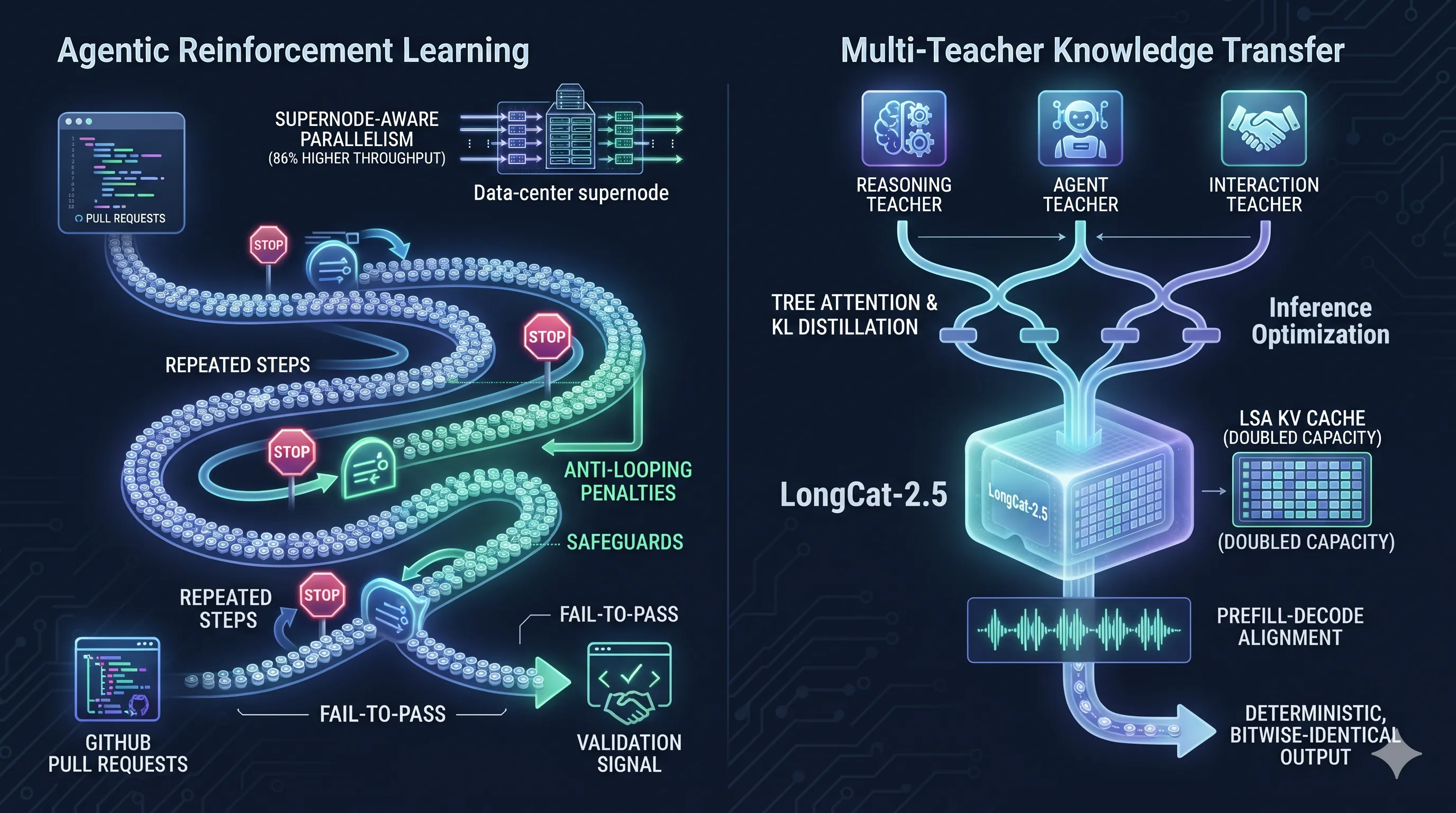
Long-horizon agentic reinforcement learning in LongCat-2.5 directly targets real-world software engineering scenarios.The training data combines complex development workflows extracted from filtered GitHub pull requests, using rigorous fail-to-pass tests as unambiguous validation signals.
When orchestrating multi-turn trajectories across long time horizons, autonomous agents often succumb to degenerative execution loops.
To counteract this degradation, the reinforcement learning formulation explicitly incorporates penalties for repeated reasoning steps as well as cyclic, repeated tool calls during rollout execution.
Furthermore, RL training integrates dedicated safeguards engineered specifically to mitigate reward hacking behaviors during environment exploration.
At the infrastructure layer, scaling long-sequence supervised fine-tuning (SFT) tasks benefits from supernode-aware parallelism, which achieves 86% higher per-device throughput compared to the standard Distributed Data Parallel (DDP) baseline.
Multi-Teacher KL Distillation via Tree Attention
To compress domain competencies across distinct modalities of reasoning without catastrophic forgetting, LongCat-2.5 utilizes multi-teacher learning.The model is guided through full-vocabulary Kullback-Leibler (KL) distillation overseen by specialized teacher networks.
This setup deploys dedicated agent teachers, reasoning teachers, and interaction teachers simultaneously.
Knowledge transfer among these heterogeneous teacher networks is orchestrated via Tree Attention, allowing structured probability mass distillation over complex, branching solution paths.
Deterministic Prefill-Decode Bitwise Alignment and LSA KV Optimization
A critical issue in sustained inference and reinforcement rollouts is divergence between prefill and decoding phases.LongCat-2.5 resolves this numerical inconsistency through aligned training and inference logic, ensuring bitwise-identical token log probabilities across prefill and decoding stages.
To overcome memory bottlenecks during long-horizon context retention, LongCat Sparse Attention (LSA) is integrated alongside targeted KV cache optimization.
This memory architecture nearly doubles decode KV capacity without incurring penalties on time per output token (TPOT).
| Optimization Dimension | Applied Mechanism | Operational Impact |
|---|---|---|
| SFT Infrastructure | Supernode-aware parallelism | Achieves 86% higher per-device throughput than DDP baseline in long-sequence SFT tasks. |
| Agentic Reinforcement Learning | Filtered GitHub PRs, fail-to-pass tests, anti-looping penalties, and rollout safeguards | Eliminates repeated reasoning steps and tool calls while mitigating reward hacking. |
| Knowledge Transfer | Full-vocabulary KL distillation and Tree Attention | Distills guidance across specialized agent, reasoning, and interaction teachers. |
| Inference Precision & Memory | Aligned prefill-decode logic and LongCat Sparse Attention (LSA) | Yields bitwise-identical token log probabilities and nearly doubles decode KV capacity without increasing TPOT. |
4. Empirical Verification: Agentic Task Execution and Codebase Problem-Solving
To substantiate how LongCat-2.5 uses MoE architecture for long-horizon tasks, empirical evaluations across multi-step autonomous software engineering benchmarks provide critical quantitative validation.The architectural shift toward specialized expert routing directly impacts the model's sustained reasoning capacity over extended agentic loops, demonstrating substantial improvements over its predecessor, LongCat-2.0.
Terminal and Codebase Problem-Solving on Terminal Bench and DeepSWE
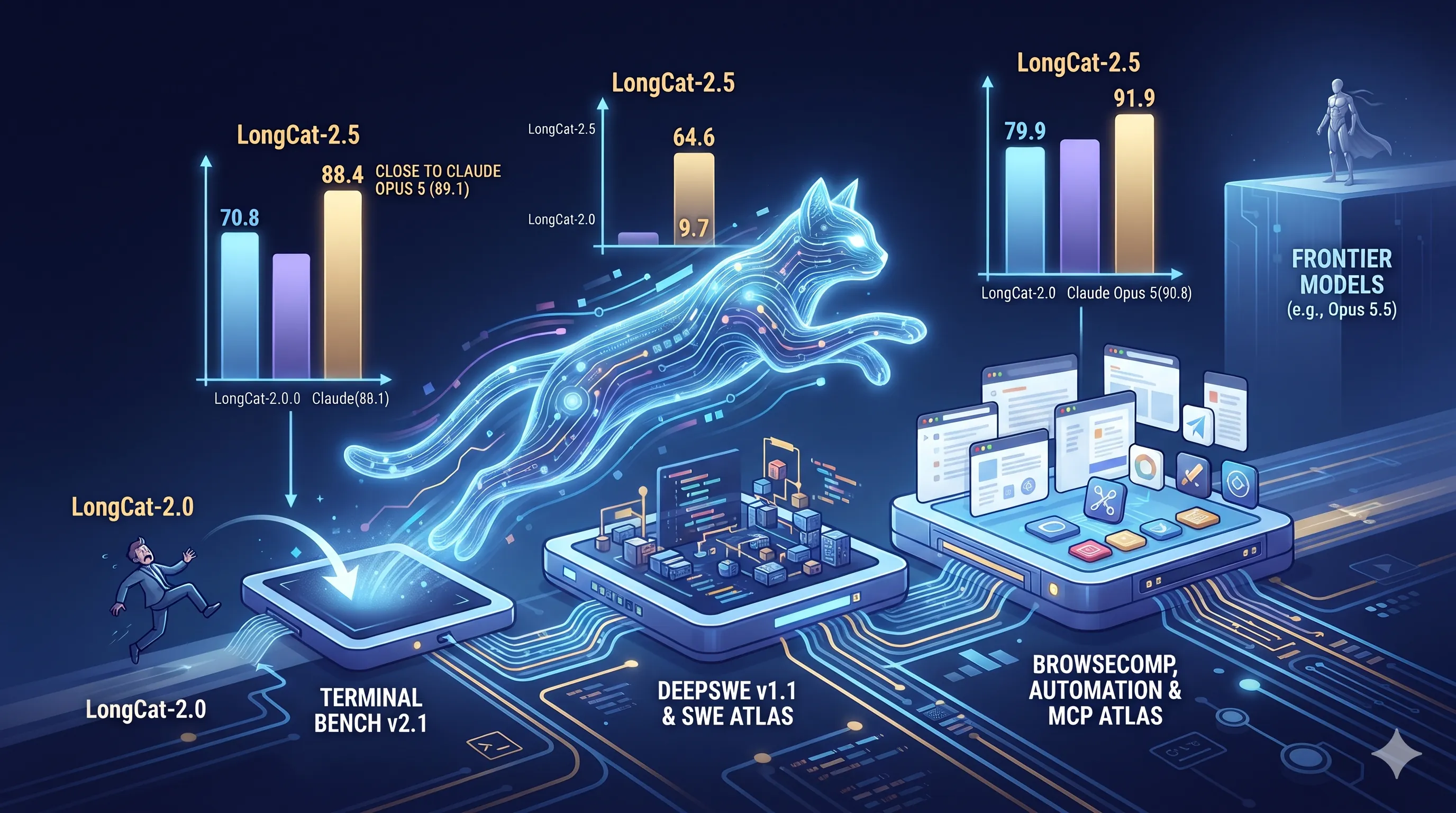
The execution of complex commands in persistent developer environments represents a core stress test for agentic models.On Terminal Bench v2.1, LongCat-2.5 achieves an evaluation score of 88.4, representing a marked leap over the 70.8 scored by LongCat-2.0 and closing in tightly on Claude Opus 5, which registered 89.1.
When subjected to the more grueling multi-turn challenges of Terminal Bench v4.0, LongCat-2.5 secures a score of 38.5.
While trailing Claude Opus 5 (53.9), this marks a profound architectural progression compared to LongCat-2.0, which collapsed to a score of 3.0 on the same evaluation suite.
This multi-step problem-solving capacity extends into real-world software issue resolution and codebase navigation.
On DeepSWE v1.1, LongCat-2.5 records a score of 64.6, dramatically surpassing LongCat-2.0's 9.7.
This puts LongCat-2.5 within striking distance of Claude Opus 5 (68.8), though it remains behind DeepSeek-V4.1-Flash at 74.2.
In codebase question-answering on SWE Atlas, LongCat-2.5 scores 58.3 compared to 33.1 for LongCat 2.0.
Additionally, full-repository generation tasks measured via NL2Repo show LongCat-2.5 reaching 60.5 against 40.9 for LongCat-2.0 and 75.3 for Claude Opus 5.
In specialized spatial and procedural modeling on 3DCodeBench, LongCat-2.5 achieves 55.4, edging out Claude Opus 5 (54.3), DeepSeek-V4.1-Flash (53.3), and GPT-5.6 Sol (52.3).
Autonomous Tool Use Across BrowseComp, AutomationBench, and MCP Atlas
Agentic workflows require fluid coordination across web environments, programmatic tool calls, and external protocol interfaces.On BrowseComp, which evaluates complex autonomous web browsing, LongCat-2.5 registers a score of 91.9, surpassing its predecessor LongCat-2.0 (79.9) and outperforming Claude Opus 5 (90.8) in Meituan's published test runs.
A similar trend emerges on AutomationBench, where LongCat-2.5 posts 51.8, outperforming Claude Opus 5 (50.3) and substantially elevating execution fidelity over LongCat-2.0 (15.8).
Standardized tool and context orchestration assessed via MCP Atlas further reinforces this trajectory.
LongCat-2.5 posts an 83.1 on MCP Atlas, representing an improvement over LongCat-2.0's 61.8, while sitting slightly below Claude Opus 5's mark of 85.8.
On multi-modal web automation under Vision2Web, LongCat-2.5 delivers 78.6, outperforming GPT-5.6 Sol (73.5) while closely tracking DeepSeek-V4.1-Flash (79.2) and Claude Opus 5 (80.2).
| Benchmark Suite | LongCat-2.5 | LongCat-2.0 | Claude Opus 5 | DeepSeek-V4.1-Flash | GPT-5.6 Sol |
|---|---|---|---|---|---|
| Terminal Bench v2.1 | 88.4 | 70.8 | 89.1 | — | — |
| Terminal Bench v4.0 | 38.5 | 3.0 | 53.9 | — | — |
| DeepSWE v1.1 | 64.6 | 9.7 | 68.8 | 74.2 | — |
| SWE Atlas | 58.3 | 33.1 | — | — | — |
| BrowseComp | 91.9 | 79.9 | 90.8 | — | — |
| AutomationBench | 51.8 | 15.8 | 50.3 | — | — |
| MCP Atlas | 83.1 | 61.8 | 85.8 | — | — |
| NL2Repo | 60.5 | 40.9 | 75.3 | — | — |
| 3DCodeBench | 55.4 | — | 54.3 | 53.3 | 52.3 |
| Vision2Web | 78.6 | — | 80.2 | 79.2 | 73.5 |
Evaluation Protocols and Frontier Baseline Comparison Nuances
Standardized configurations ensure consistent agentic execution throughout these evaluations.All benchmark runs for LongCat-2.5 are conducted with thinking mode enabled, set to a sampling temperature of 1.0 and a top_p of 0.95 unless noted otherwise.
These inference parameters provide the model with the necessary search latitude during extended multi-step reasoning cycles.
Contextualizing these results requires examining the baselines selected in Meituan's published test runs.
While LongCat-2.5 outperforms Claude Opus 5 on tasks like BrowseComp and AutomationBench, Meituan's comparison tables relied on earlier proprietary reference models rather than current frontier baselines.
Consequently, when faced with direct successor proprietary models such as GPT-6.1 Sol and Claude Opus 5.5 on Terminal Bench v4.0, LongCat-2.5 trails behind their elevated operational marks.
Nonetheless, the empirical jumps across software engineering, terminal execution, and browser interaction establish LongCat-2.5 as a substantial open advancement over LongCat-2.0 for persistent, long-horizon workflows.
5. Low-Bit Quantization and High-Throughput Inference Engineering
Sustaining real-time execution across the massive parameter scale of LongCat-2.5 during long-horizon tasks requires purpose-built inference engineering and low-bit numerical compression.To eliminate the computational and memory bandwidth bottlenecks inherent to sparse Mixture-of-Experts (MoE) routing, the architecture integrates hardware-aligned quantization and runtime optimizations tailored for domestic AI accelerators and NPUs.
W4A4 FlatQuant Architecture and INT4 Communication Reuse
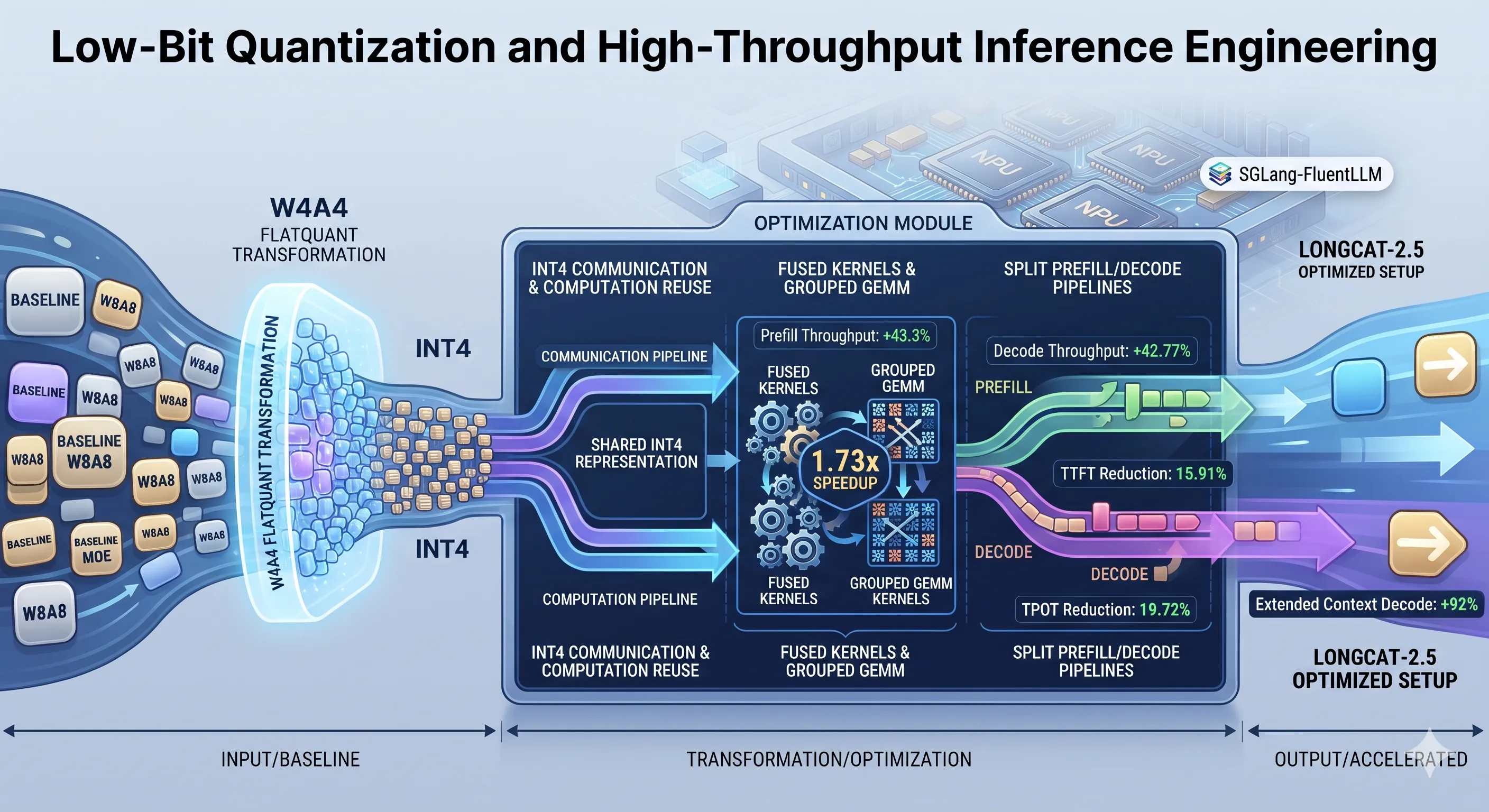
LongCat-2.5 applies W4A4 quantization to expert weights and activations to enable native INT4 computation on domestic AI accelerators.To address the steep accuracy degradation typically associated with aggressive low-bit integer compression, the system utilizes FlatQuant-style learnable transformations that preserve benchmark performance close to unquantized weights.
Inter-node communication overhead frequently constrains distributed MoE serving due to repeated hidden-state dispatches.
LongCat-2.5 mitigates this by implementing a shared expert-input transformation, which enables INT4 representations to be reused across both communication and computation pipelines before token dispatch occurs.
Fused Kernels, Grouped GEMM, and Split Prefill/Decode Pipelines
Hardware execution efficiency is optimized through dedicated fused kernels that combine transformation, scaling, quantization, and packing into streamlined operations.The serving runtime isolates disparate execution profiles by utilizing split prefill/decode pipelines, tailoring hardware scheduling to the contrasting needs of initial context processing and autoregressive token generation.
To address sparse matrix calculations across distributed experts, specialized grouped GEMM kernels achieve an average 1.73x speedup over standard W8A8 execution, reducing compute underutilization during token routing.
Throughput Latency Benchmarks and NPU Integration via SGLang-FluentLLM
Online stress tests confirm significant throughput and latency benefits when deploying LongCat-2.5 under low-bit configurations compared to standard precision baselines.Serving pipelines on domestic NPU platforms are officially supported through SGLang-FluentLLM integration.
However, validating visual and tool-use performance requires matching deployment setups when adapting the model to non-tested accelerator fleets.
| Evaluation Metric / Pipeline Component | Baseline Configuration | LongCat-2.5 Optimized Setup | Observed Benchmark Gain |
|---|---|---|---|
| Prefill Serving Throughput | W8A8 MoE Baseline | W4A4 MoE (Online Stress Test) | 43.3% higher prefill throughput |
| Decode Serving Throughput | W8A8 MoE Baseline | W4A4 MoE (Online Stress Test) | 42.77% higher decode throughput |
| Time to First Token (TTFT) | W8A8 Baseline | W4A4 MoE Pipeline | 15.91% latency reduction |
| Time Per Output Token (TPOT) | W8A8 Baseline | W4A4 MoE Pipeline | 19.72% latency reduction |
| Expert GEMM Execution Speed | W8A8 Matrix Kernels | Grouped GEMM Kernels | 1.73x average speedup |
| Extended Context Decode Throughput | W8A8KV16 Baseline | W4A4KV8 Quantization | 92% higher decode throughput |
6. Open-Weights Governance, Deployment Ecosystems, and API Cost Structure
While LongCat-2.5 uses an MoE architecture for long-horizon tasks, its real-world implementation depends on software integration flexibility, open licensing governance, and operational compute economics.Deploying mixture-of-experts models across extended horizons requires sustained context ingestion, making commercial accessibility and ecosystem support critical for production viability.
Permissive MIT Open-Weights Release and Coding Harness Integration
Meituan structured the public rollout of LongCat-2.5 across a phased timeline in late 2026.The initial preview opened on September 25, 2026, followed by the release of a technical blog on November 1, 2026.
The hosted API reached general availability on November 2, 2026, culminating in the publication of the model weights on Hugging Face on November 9 under the permissive MIT License.
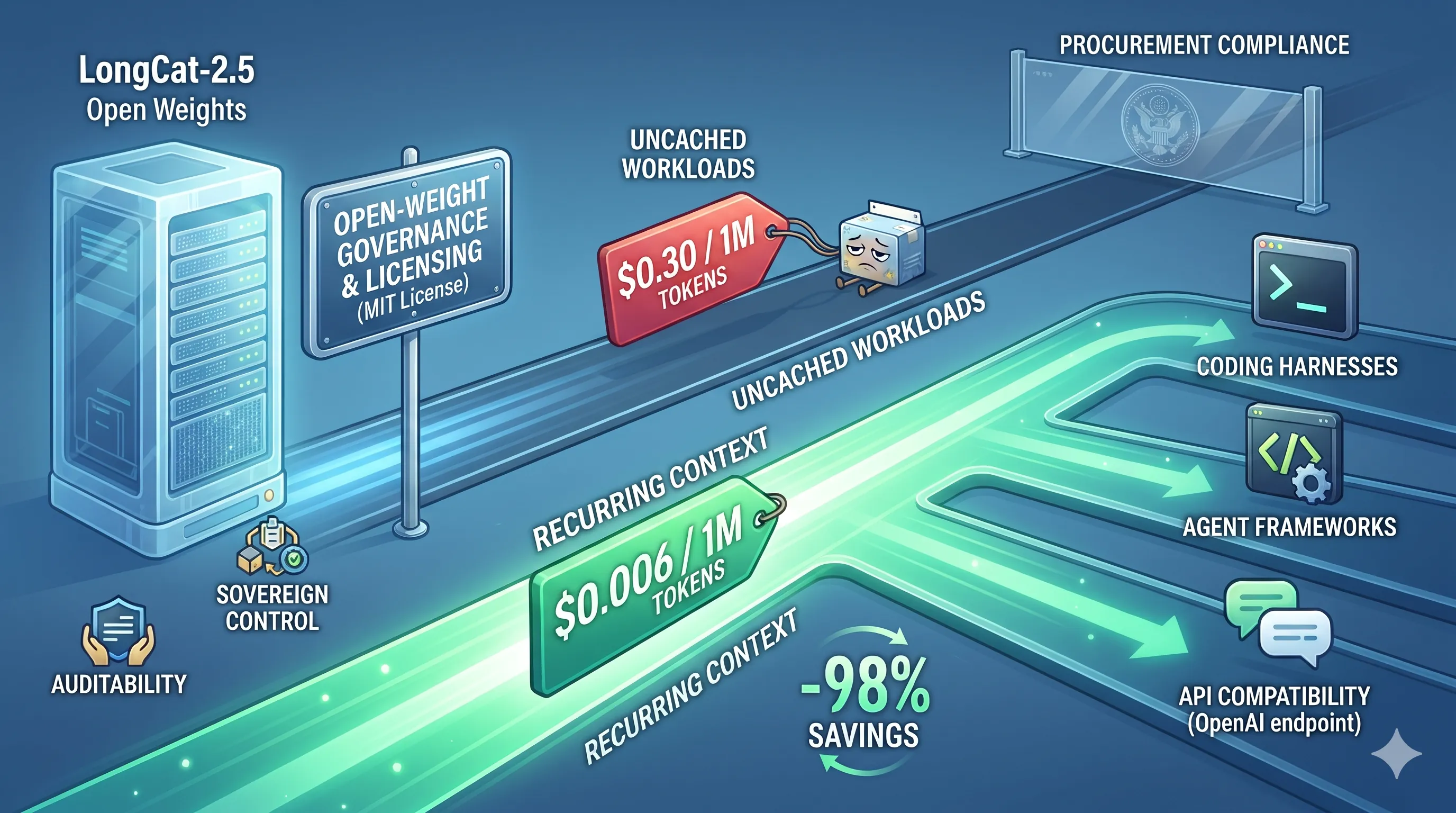
This MIT licensing framework removes commercial restrictions, allowing organizations to inspect, self-host, and modify the weights locally.
To facilitate immediate developer adoption, the hosted service provides native compatibility with the OpenAI Responses format endpoint (
/openai/v1/responses).This drop-in API compatibility allows direct integration into modern autonomous coding harnesses and agent frameworks, including Claude Code, Codex, Cline, Kilo Code, and Hermes Agent.
API Economic Model: 98% Prompt Caching Savings and Workload Costs
Running long-horizon agent workflows requires repeated exchanges of massive contextual prompts, making API economics a decisive factor in deployment.Meituan introduced a tiered commercial pricing model featuring aggressive prompt caching incentives.
Standard uncached input tokens are billed at $0.30 per million tokens (CNY ¥2), while output generation is priced at $1.20 per million tokens (CNY ¥8).
For recurring context, cached input tokens are priced at $0.006 per million tokens (CNY ¥0.04), which constitutes an effective 98% reduction as cached input costs just 2% of the standard uncached input rate.
Under this commercial schedule, a representative workload consisting of 200,000 uncached input tokens and 100,000 output tokens costs $0.18 under Meituan's API.
However, enterprise architecture teams should note that these hosted API rates are currently designated as limited-time promotional pricing.
| API Tier / Workload Component | USD Rate (per 1M Tokens) | CNY Rate (per 1M Tokens) | Pricing Mechanics and Context |
|---|---|---|---|
| Uncached Input Tokens | $0.30 | ¥2.00 | Standard rate for initial prompt ingestion. |
| Cached Input Tokens | $0.006 | ¥0.04 | Costs 2% of the standard rate (98% prompt caching savings). |
| Generated Output Tokens | $1.20 | ¥8.00 | Standard completion pricing across workloads. |
| Sample Workload Cost (200k Input / 100k Output) | $0.18 | — | Calculated benchmark on Meituan API using uncached inputs. |
Enterprise Procurement Considerations and Compliance Landscape
Despite technical viability and cost advantages, institutional adoption requires strict adherence to corporate compliance and vendor risk frameworks.Ongoing U.S. federal scrutiny on Chinese AI models presents potential enterprise procurement compliance hurdles for international organizations.
However, reporting from VentureBeat confirmed that no publicly disclosed U.S. federal procurement or use restriction specifically named Meituan or LongCat-2.5 as of Nov. 9.
Enterprises evaluating the model must therefore balance external procurement scrutiny against the auditability and sovereign control offered by its permissive MIT open-weights release.
Related Posts
MiniMax M3 Unleashed: Open-Weight AI Model with 1M Context, Multimodal, Coding, and Autonomous AI AgentsMiniMax has released M3 , an open-weight AI model integrating a 1-million-token context, native...
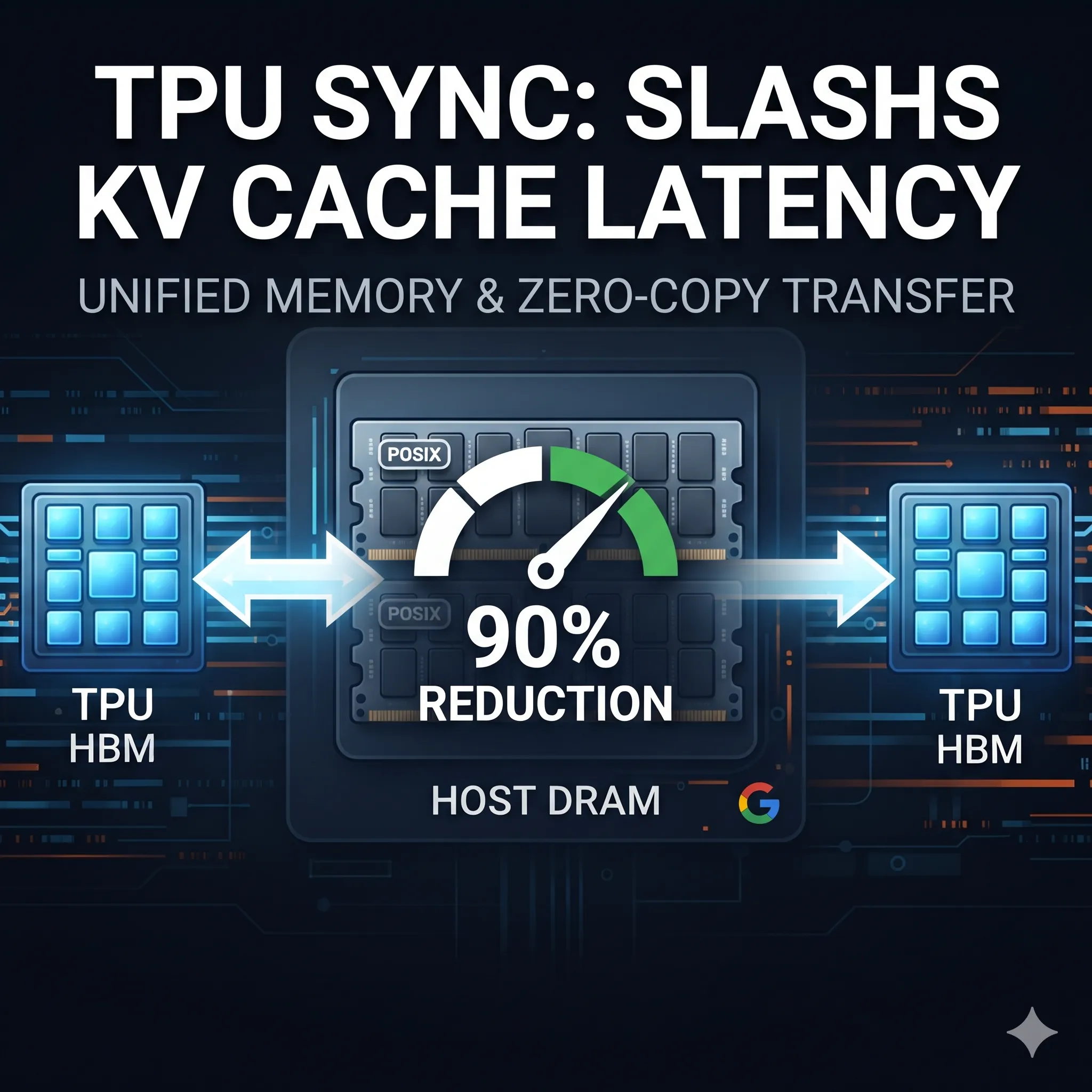
Google Open-Sources TPU Sync to Slash KV Cache Transfer LatencyDiscover how Google's open-source TPU Sync slashes KV cache transfer latency by 90% and accelerates...
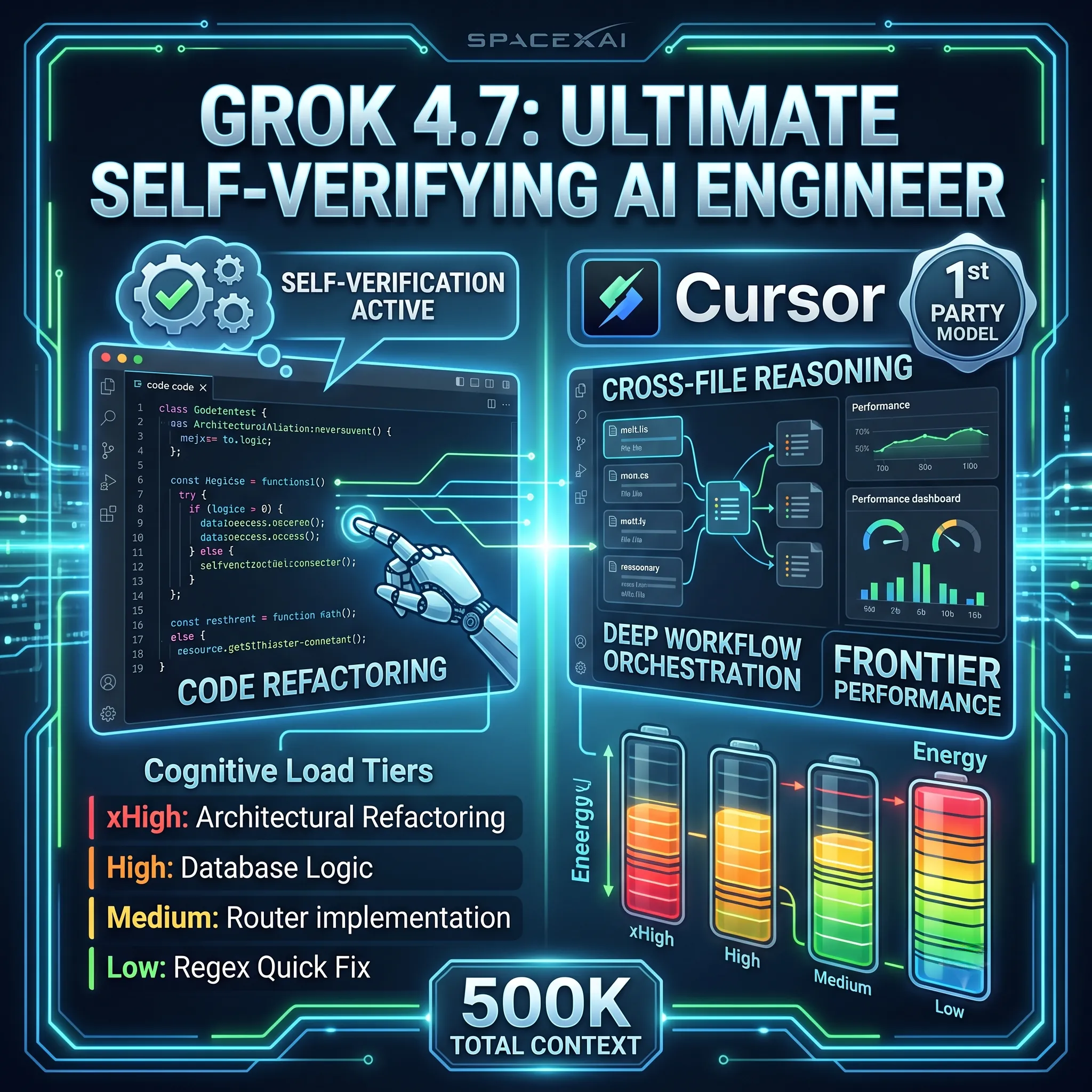
Grok 4.7 Developer Guide: Architecture, Reasoning Tiers, and Cursor IntegrationExplore the architecture of Grok 4.7, featuring real-time self-verification, configurable reasoning...
Generative AI may have assisted with research or drafting for this article. Topic selection, fact-checking, final wording, and publication remain the responsibility of DragonStone74. AI use disclosure