
Grok 4.7 Developer Guide: Architecture, Reasoning Tiers, and Cursor Integration
🚀 Key Takeaways
- Built-In Self-Verification: Grok 4.7 incorporates an internal critic during intermediate reasoning steps to catch logic errors and type mismatches before returning final code.
- Configurable Reasoning Tiers: Four distinct effort levels allow developers to dynamically scale reasoning compute from sub-second quick fixes to intensive architectural refactoring.
- Native Cursor Ecosystem Support: Fully integrated as a first-party model inside Cursor for seamless multi-file editing, cloud agents, and enterprise deployments.
- Standardized API Architecture: Compatible with OpenAI-style SDKs while maintaining Chain-of-Thought continuity across multi-turn agent sessions via encrypted reasoning payloads.
- Tiered Long-Context Pricing: Maintains economical base rates for standard tasks while introducing stepped rate thresholds for complex, high-context workloads.
- Frontier Engineering Performance: Demonstrates state-of-the-art benchmark results across software engineering evaluations, outperforming predecessors on autonomous coding tasks.
Built to handle complex, multi-file software engineering tasks, the model pairs deep reasoning capabilities with native integration across modern development tools like Cursor. By allowing engineers to modulate reasoning effort depending on task complexity, teams can effectively balance real-time responsiveness with rigorous computational verification for mission-critical modules.
Unlocking the full potential of Grok 4.7 requires understanding its reasoning controls, environment configuration, and pricing dynamics. This guide explores the internal mechanics of its self-correcting engine and outlines practical setup patterns to optimize your development pipeline in Cursor and through the API.
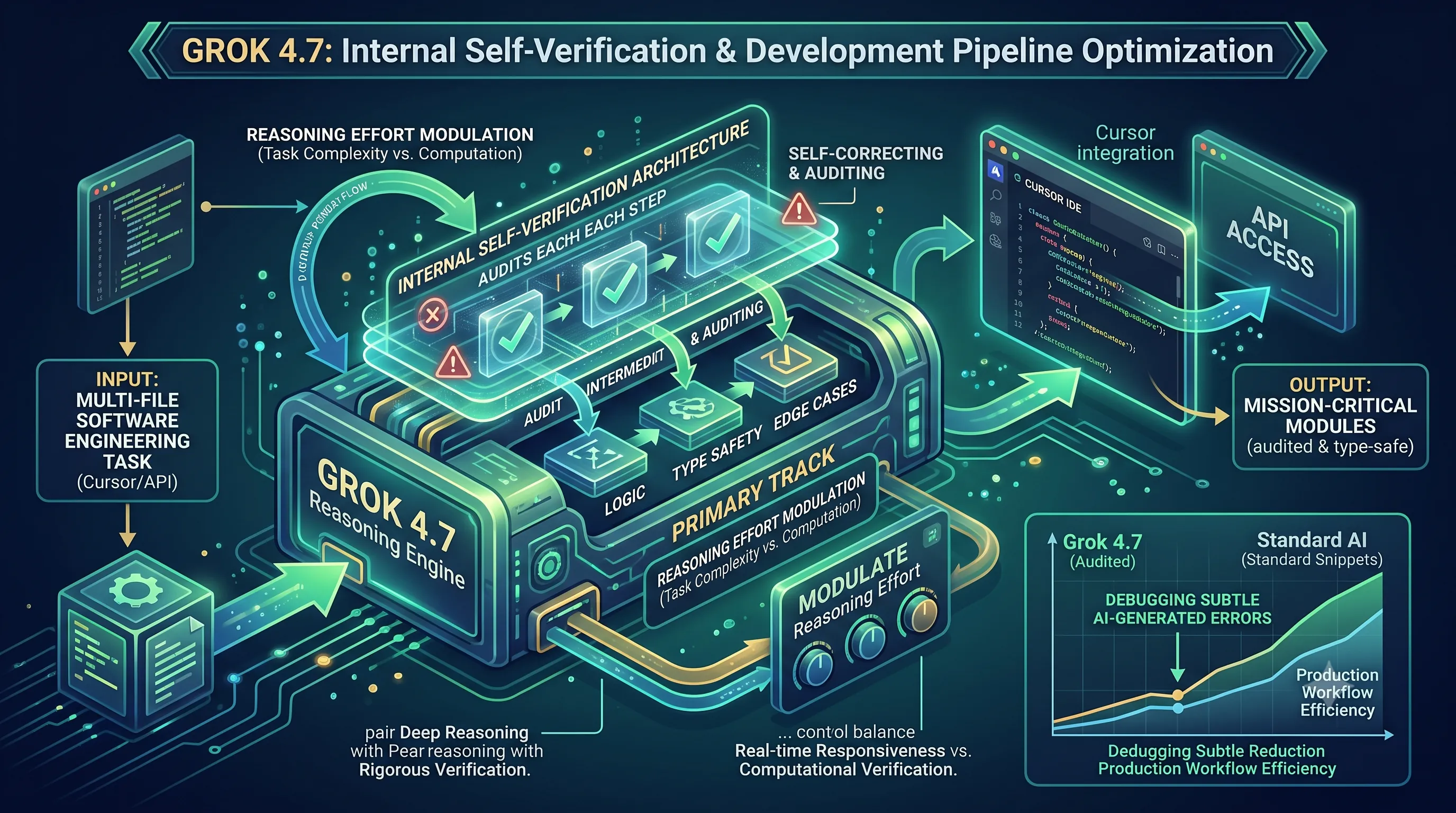
1. Internal Critic Architecture and the Mechanics of Real-Time Self-Verification
Understanding the architectural foundation of Grok 4.7 is essential for mastering self-verifying development workflows in Cursor.
Unlike conventional models that generate code sequentially without runtime evaluation, Grok 4.7 integrates real-time self-verification mechanisms directly into its generation loop.
Intermediate Step Validation via Reinforcement Learning and the Internal Critic
Grok 4.7 was built jointly with SpaceXAI as a first-party model in Cursor, featuring a larger base model architecture optimized for complex multi-hour tasks.
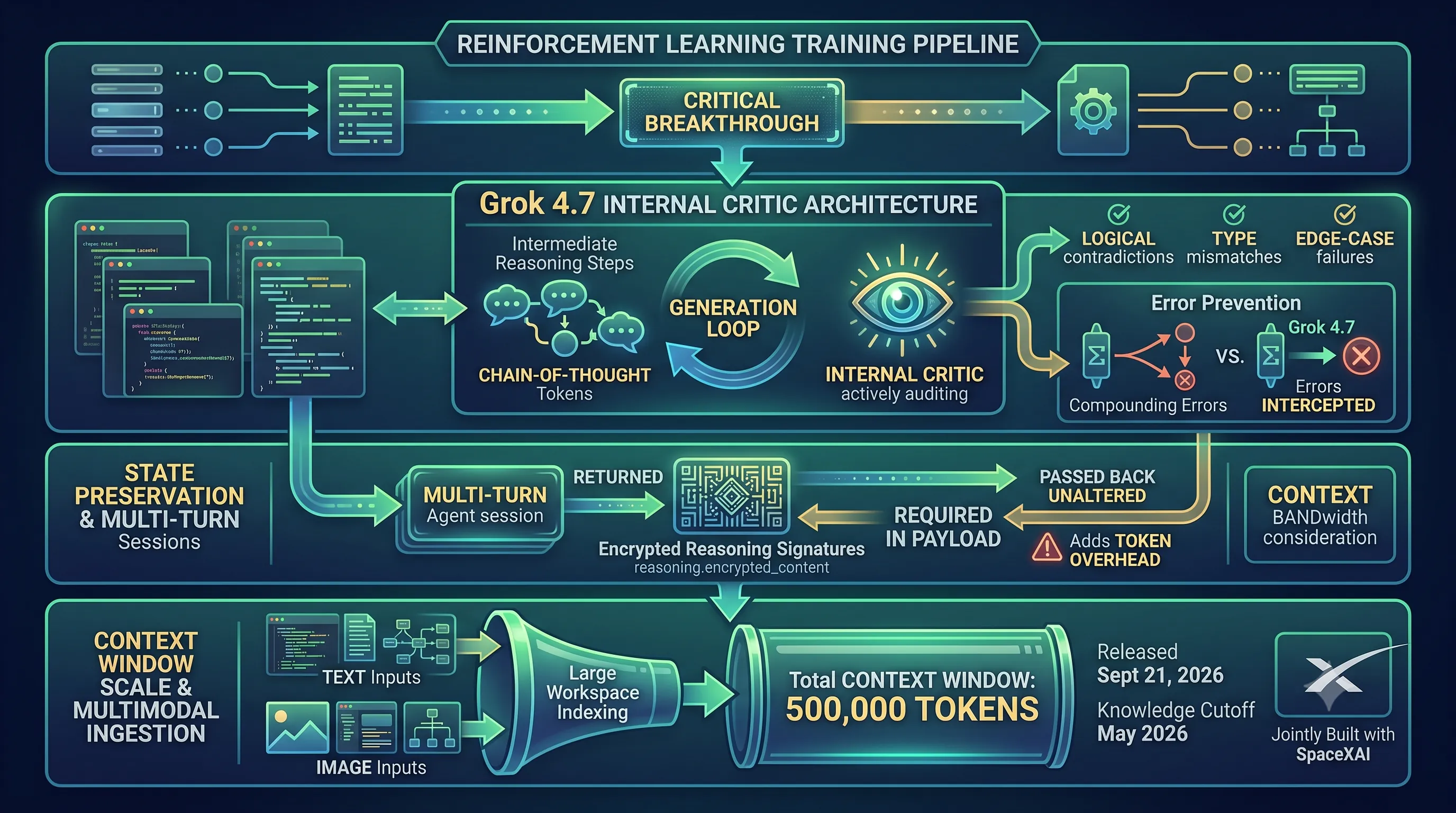
The core breakthrough of this architecture lies in its reinforcement learning training pipeline.
During reinforcement learning, Grok 4.7 activates an Internal Critic at intermediate reasoning steps rather than evaluating code solely at the final output stage.
This Internal Critic constantly audits the intermediate Chain-of-Thought tokens to intercept logical contradictions, type mismatches, and edge-case failures before final code emission occurs.
By verifying intermediate hypotheses prior to synthesizing syntax, the model prevents compounding errors throughout extended programming sessions.
Encrypted Chain-of-Thought Signatures and Multi-Turn State Retention
To preserve proprietary reasoning strategies while enabling continuous execution across multi-turn agent sessions, Grok 4.7 employs encrypted reasoning signatures.
API responses return these signatures through the reasoning.encrypted_content payload field.
This mechanism protects the internal Chain-of-Thought while maintaining multi-turn context continuity across long-running development loops.
However, downstream implementations must account for token overhead considerations.
Multi-turn agents must pass back encrypted reasoning items unaltered in conversation history, which directly adds tokens to subsequent API calls and consumes context bandwidth.
Context Window Scale and Multimodal Ingestion Capabilities
Grok 4.7 was officially released on September 21, 2026, equipped with a knowledge cutoff of May 2026.
To facilitate deep workspace indexing and extended reasoning, the model supports a 500,000-token total context window.
Furthermore, Grok 4.7 accepts both text and image inputs and generates text responses, enabling developers to feed visual UI layouts, architectural diagrams, and large codebases directly into the context window.
| Architectural Parameter | Specification / Implementation Detail |
|---|---|
| Release Date | September 21, 2026 |
| Knowledge Cutoff | May 2026 |
| Total Context Window | 500,000 tokens |
| Input Modalities | Text and Image |
| Output Modality | Text |
| Development Partnership | Built jointly with SpaceXAI as a first-party model in Cursor |
| State Preservation Signature | reasoning.encrypted_content (required in multi-turn payloads) |
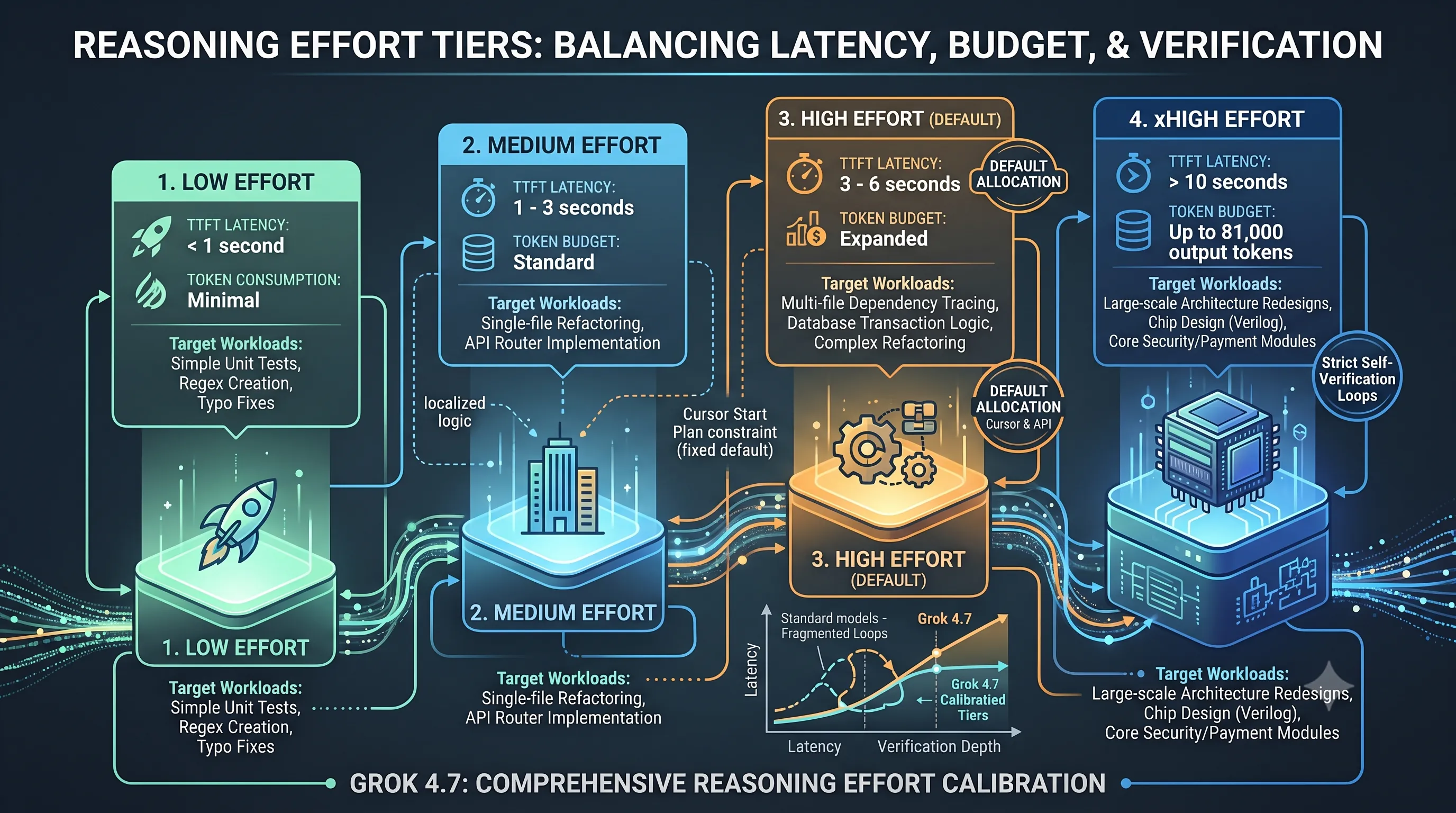
2. Reasoning Effort Tiers: Calibrating Latency, Token Budget, and Verification Depth
Grok 4.7 introduces a granular computational allocation system that directly powers its self-verification engine within development environments like Cursor.By structuring cognitive load into distinct reasoning tiers, the model balances time-to-first-token (TTFT) latency against output token budgets to match specific engineering tasks.
Four-Tier Reasoning Effort Profiles and TTFT Benchmarks
Grok 4.7 supports four reasoning effort tiers: low, medium, high, and xhigh.Each tier dictates the depth of the model's internal verification loops, resulting in distinct response latency profiles and token ceilings.
At the lowest tier, low effort yields a TTFT latency of under 1 second, operating with minimal token consumption for immediate feedback.
Stepping up to medium effort introduces moderate verification passes, bringing TTFT latency to a window between 1 and 3 seconds.
The high effort tier operates with a TTFT latency ranging between 3 and 6 seconds, providing thorough multi-step validation.
At the upper boundary, xhigh effort requires a TTFT latency exceeding 10 seconds and can consume up to 81,000 output tokens per task to execute exhaustive self-checking routines.
| Reasoning Effort Tier | TTFT Latency Range | Token Budget / Consumption | Target Engineering Workloads |
|---|---|---|---|
| Low | < 1 second | Minimal token consumption | Simple unit tests, regex creation, typo fixes |
| Medium | 1 – 3 seconds | Standard token budget | Single-file refactoring, API router implementation |
| High (Default) | 3 – 6 seconds | Expanded token budget | Multi-file dependency tracing, database transaction logic, complex refactoring |
| xHigh | > 10 seconds | Up to 81,000 output tokens | Large-scale architecture redesigns, chip design (Verilog), core security/payment modules |
Workload Routing: From Unit Tests to xHigh Hardware and Architecture Redesigns
Calibrating reasoning effort ensures that compute is allocated effectively across distinct software and hardware engineering domains.Low effort is optimized for lightweight developer interactions where rapid generation is essential, targeting simple unit tests, regex creation, and typo fixes with minimal token consumption.
Medium effort expands reasoning capacity to handle localized logic, specifically targeting single-file refactoring and standard API router implementation.
When dealing with cross-module state and system persistence, high effort balances multi-file dependency tracing, database transaction logic, and complex architectural refactoring.
For mission-critical engineering, xhigh effort runs strict self-verification loops designed for large-scale architecture redesigns, chip design in Verilog, and the implementation of core security and payment modules where logical errors cannot be tolerated.
Cursor Start Plan Constraints and Default High-Effort Allocation
The official default reasoning effort for both Cursor and the direct API integration is high.This baseline ensures that standard queries benefit from multi-file tracing and deep validation logic out of the box.
However, environment tiering impacts available controls.
On Cursor Start plans, the reasoning effort is pinned to a fixed default of medium effort.
Users on the Cursor Start plan cannot alter the effort level or enable Fast mode, restricting dynamic tier calibration to higher plan tiers and custom API implementations.
3. Cursor IDE Configuration: Multi-File Orchestration and Cost Optimization
Connecting Grok 4.7 to your development workflow requires establishing the proper configuration across Cursor environments to maximize cross-file reasoning while maintaining strict cost controls.Optimal Settings Configuration for Multi-File Composer Mode
Grok 4.7 is accessible across the Cursor Desktop app, Web and cloud agents, CLI, SDK, Automations, and the iOS app.When executing complex software modifications, multi-file composer mode directly leverages Grok 4.7 cross-file dependency analysis to ensure structural consistency across interconnected modules.
Throughout these operations, Cursor Composer remains active alongside Grok 4.7 for everyday coding speed and lower cost.
To establish an optimal Cursor settings configuration for Grok 4.7 multi-file development and cost control, apply the following configuration to your
settings.json file:{
"cursor.model": "grok-4.7",
"cursor.modelEffort": "high",
"cursor.composerMode": "multi-file",
"cursor.enableFastMode": false
}Enterprise Endpoint Accessibility via the Cursor Vendor Catalog
Network security policies frequently restrict developer access to external third-party endpoints.Grok 4.7 is served under the Cursor vendor catalog, allowing enterprise teams that block third-party xAI endpoints to access it securely.
Because the model routes through Cursor's integrated catalog, organizations can deploy Grok 4.7 capabilities across the Desktop app, CLI, SDK, cloud agents, Automations, and mobile interfaces without requiring custom external firewall exemptions.
Cost Discipline: Disabling Fast Mode Surcharges
Fast mode on Cursor runs inference at 2x the standard token rate.When managing large codebases that generate heavy context windows, disabling Fast mode is recommended for strict cost optimization.
By turning off Fast mode via
"cursor.enableFastMode": false, developers eliminate the 2x pricing surcharge while continuing to leverage Grok 4.7 for multi-file orchestration and standard Cursor Composer for lightweight, high-speed tasks.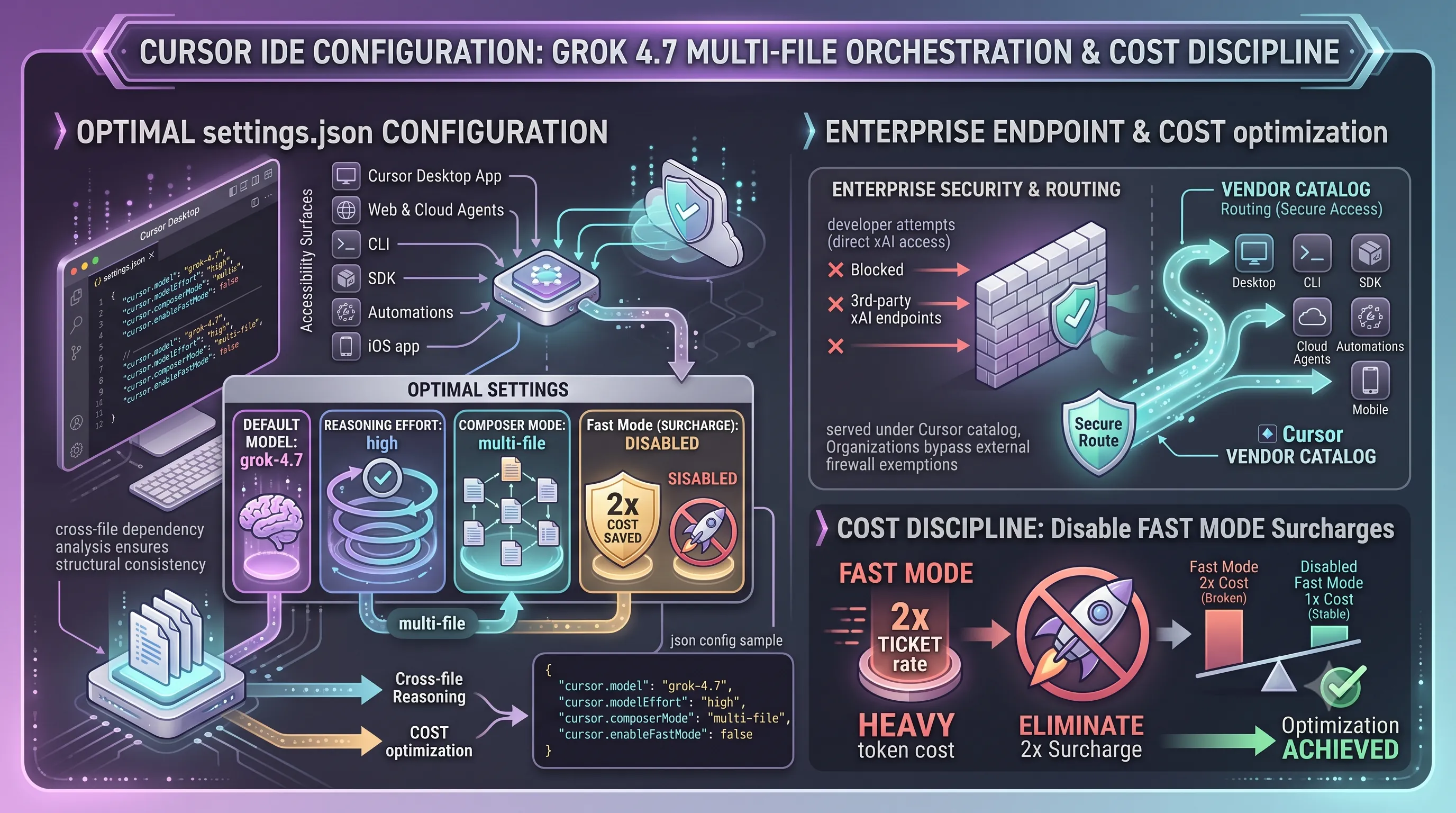
4. Programmatic Integration: Implementing Grok 4.7 via the xAI Python SDK and API
To integrate Grok 4.7 directly into automated engineering workflows, developers can leverage existing client libraries without introducing custom transport abstractions.This programmatic approach enables engineering teams to operationalize Grok 4.7's self-verification and automated code patch generation across deployment pipelines.
OpenAI SDK Compatibility and Reasoning Parameter Injection
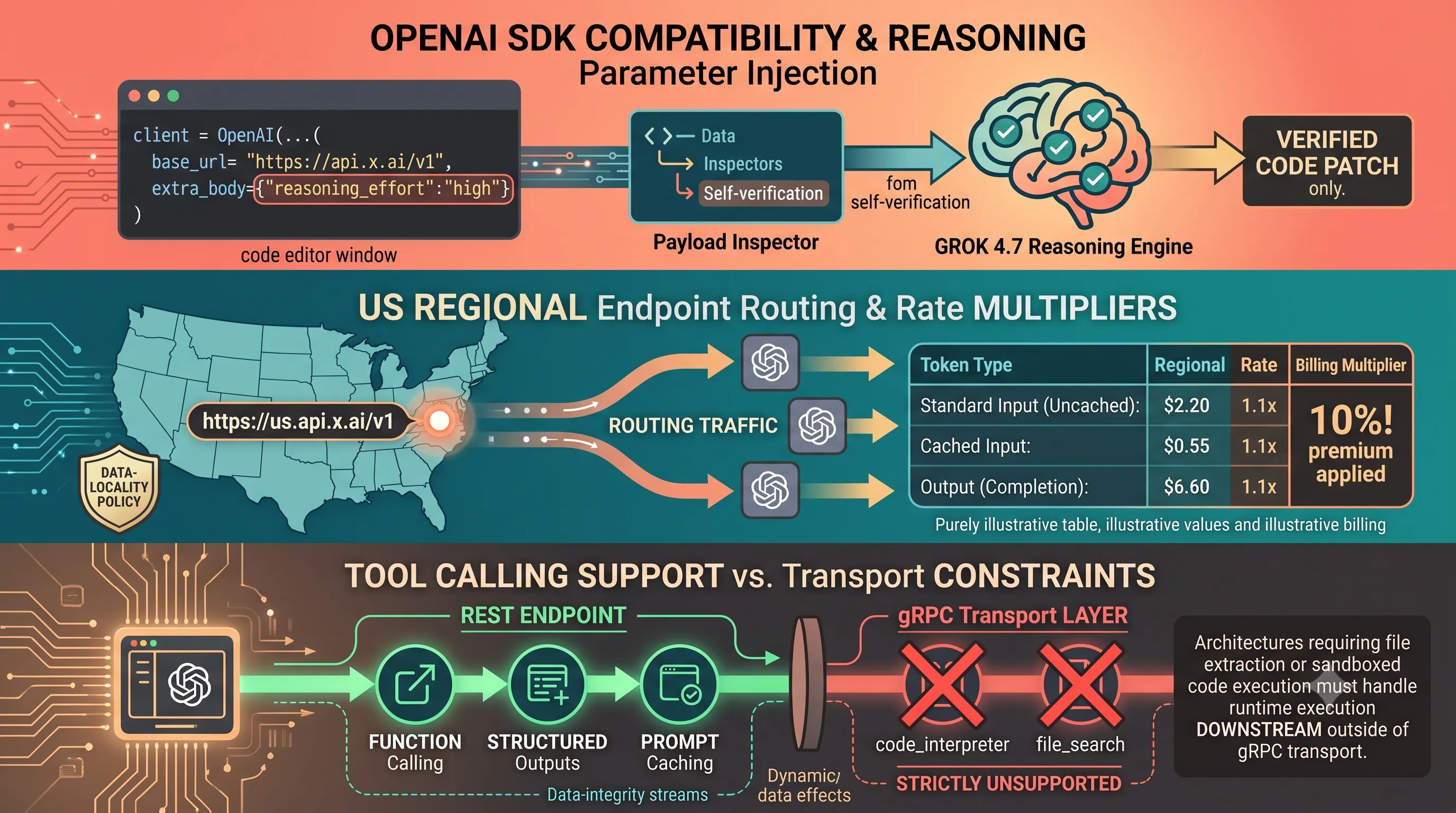
The xAI API provides drop-in compatibility with the standard OpenAI Python SDK by routing requests to https://api.x.ai/v1.Controlling the deep-thinking mechanism requires passing an explicit reasoning budget through custom request payloads.
Developers configure reasoning depth by injecting the extra_body={"reasoning_effort": "high"} parameter during chat completion instantiation.
Calling Grok 4.7 via the OpenAI-compatible Python SDK with an explicit reasoning effort parameter ensures the model triggers self-verification loops for complex logic.
import os
from openai import OpenAI

client = OpenAI(
    api_key=os.environ.get("XAI_API_KEY"),
    base_url="https://api.x.ai/v1"
)

response = client.chat.completions.create(
    model="grok-4.7",
    messages=[
        {"role": "system", "content": "You are a principal engineer focusing on zero-defect code patches."},
        {"role": "user", "content": "Analyze this concurrency bottleneck and output the fixed patch only."}
    ],
    extra_body={"reasoning_effort": "high"}
)

print(response.choices[0].message.content)US Regional Endpoint Routing and Rate Adjustments
For workloads governed by specific data-locality policies, xAI provides a dedicated US regional endpoint located at https://us.api.x.ai/v1.Routing traffic through the US regional endpoint applies a 10% premium, represented as a 1.1x rate multiplier over baseline global token rates.
For workloads processing under 200k prompt tokens, the regional pricing structure scales predictably across prompt ingestion, cached context retrieval, and completion output.
| Token Processing Type | Regional Rate (per 1M Tokens, <200k Prompt Tokens) | Billing Multiplier |
|---|---|---|
| Standard Input (Uncached) | $2.20 | 1.1x (10% premium applied) |
| Cached Input | $0.55 | 1.1x (10% premium applied) |
| Output (Completion) | $6.60 | 1.1x (10% premium applied) |
Tool Calling Support and gRPC Transport Limitations
Grok 4.7 natively supports enterprise orchestration features including function calling, structured outputs, and prompt caching via REST endpoints.These capabilities allow pipelines to enforce strict output schemas and reuse large context blocks cost-effectively.
However, specific transport constraints apply when integrating via lower-level protocols.
The code_interpreter and file_search tools remain strictly unsupported when utilizing the gRPC API interface within the Python xAI SDK.
Architectures requiring file extraction or sandboxed code execution must handle runtime execution downstream outside of the gRPC transport layer.
5. Pricing Dynamics and Long-Context Surcharge Thresholds
Operating Grok 4.7 as an autonomous coding agent with iterative self-verification—whether integrated into developer workflows or managed via IDE environments like Cursor—requires an exact understanding of its API token economics.Because multi-turn reasoning loops, codebase indexing, and self-checking mechanisms continually inject context back into the prompt window, API consumption costs are directly shaped by context length boundaries and caching efficiency.
Standard vs. Long-Context Billing and the 200k Token Cliff
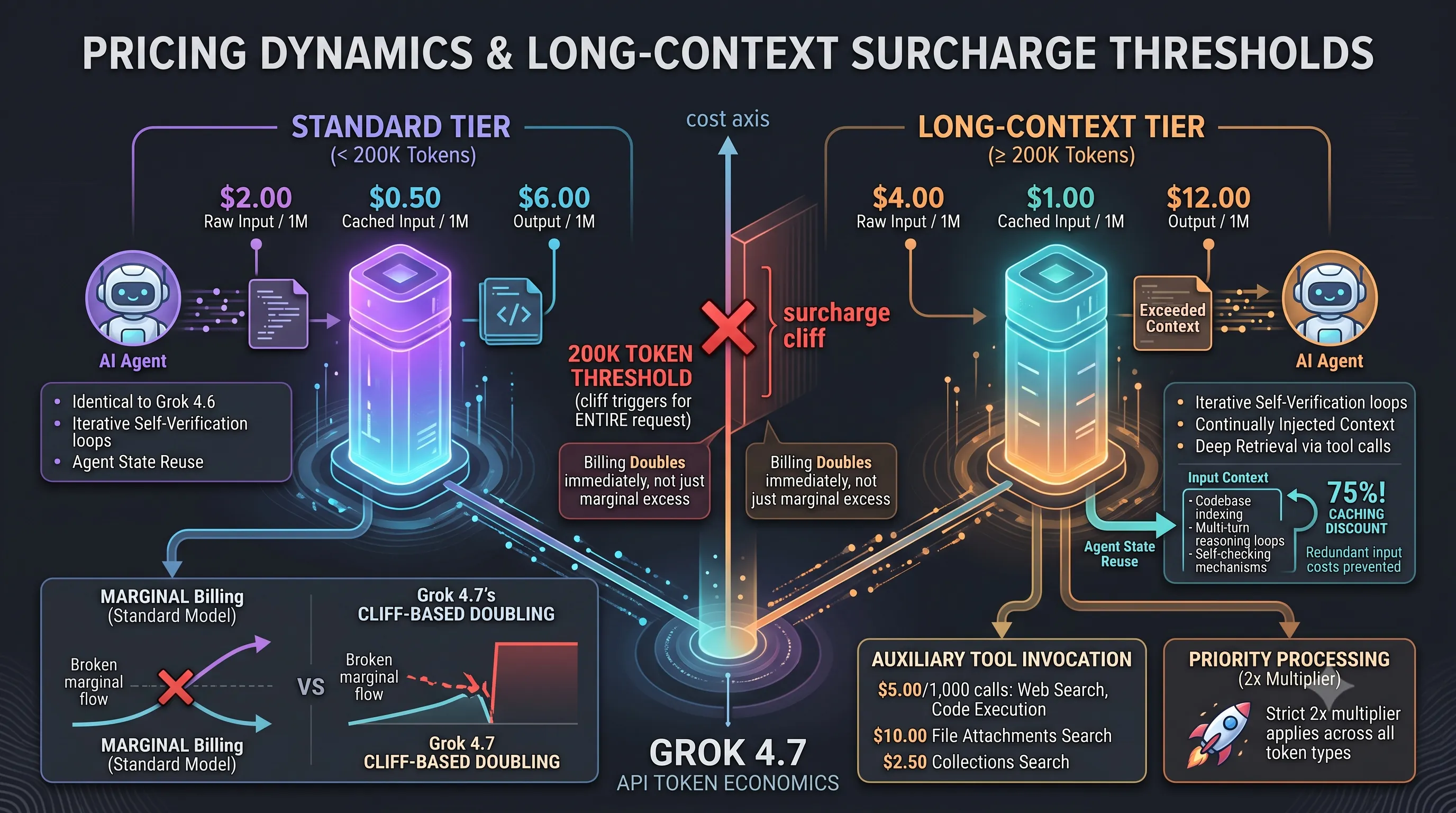
Grok 4.7 maintains a dual-tier token pricing structure where per-token rates are identical to Grok 4.6.For standard requests where prompt length remains under 200k tokens, the base pricing is structured at $2.00 per 1M input tokens, $0.50 per 1M cached input tokens, and $6.00 per 1M output tokens.
However, reaching or exceeding the 200k prompt token threshold triggers a strict long-context pricing cliff.
Once a prompt hits 200k tokens, the billing doubles to $4.00 per 1M input tokens, $1.00 per 1M cached input tokens, and $12.00 per 1M output tokens.
Crucially, this surcharge is not billed on a marginal basis.
Crossing the 200k prompt token threshold by even a small amount doubles the cost for the entire request, rather than applying only to the excess tokens beyond the 200k mark.
In addition, Grok 4.7 currently does not receive a Batch API discount, meaning batch workloads cannot offset long-context overhead through volume-based pricing reductions.
Prompt Caching Economics and Agent State Reuse
To mitigate context expansion during extended multi-turn sessions, Grok 4.7 provides prompt caching.Cached input delivers a direct 75% discount off standard input rates, reducing input costs from $2.00 to $0.50 per 1M tokens under standard context, and from $4.00 to $1.00 per 1M tokens in long-context mode.
Utilizing prompt caching keys helps prevent redundant input costs in long multi-turn agent sessions.
In workflows where an agent repeatedly analyzes static files, system instructions, and historical conversation state to verify code correctness, cached tokens allow developers to maintain deep context windows without paying full raw input ingestion fees on every sequential turn.
Specialized Tool Call Pricing and Priority Tier Multipliers
Beyond raw token generation, tool execution and latency management carry distinct pricing tiers.Enabling the Priority Processing tier applies a strict 2x rate multiplier across all token types, including base input, cached input, and output tokens.
Auxiliary tool invocations are billed on a per-call basis independent of token counts.
Web Search and Code Execution tools are billed at $5.00 per 1,000 calls.
Deep retrieval tools follow differentiated rates: File Attachments Search costs $10.00 per 1,000 calls, whereas Collections Search costs $2.50 per 1,000 calls.
| Billing Dimension / Tool | Standard Tier (< 200k Tokens) | Long-Context Tier (≥ 200k Tokens) | Priority Processing (2x Multiplier) |
|---|---|---|---|
| Raw Input Tokens | $2.00 / 1M tokens | $4.00 / 1M tokens | 2x base token rate ($4.00 or $8.00 / 1M) |
| Cached Input Tokens (75% Off) | $0.50 / 1M tokens | $1.00 / 1M tokens | 2x cached rate ($1.00 or $2.00 / 1M) |
| Output Tokens | $6.00 / 1M tokens | $12.00 / 1M tokens | 2x output rate ($12.00 or $24.00 / 1M) |
| Web Search Invocation | $5.00 / 1,000 calls | ||
| Code Execution Invocation | $5.00 / 1,000 calls | ||
| File Attachments Search | $10.00 / 1,000 calls | ||
| Collections Search | $2.50 / 1,000 calls | ||
6. Autonomous Task Efficiency and Frontier Cost-Performance Metrics
Assessing the viability of Grok 4.7's self-verification capabilities within environments like Cursor requires examining verified benchmark results and unit economics across long-horizon software engineering tasks.Rigorous empirical evaluations illustrate how Grok 4.7 filters incorrect logic paths autonomously while maintaining competitive execution costs against frontier models.
Autonomous Task Verification: DeepSWE, CursorBench, and EEBench Results
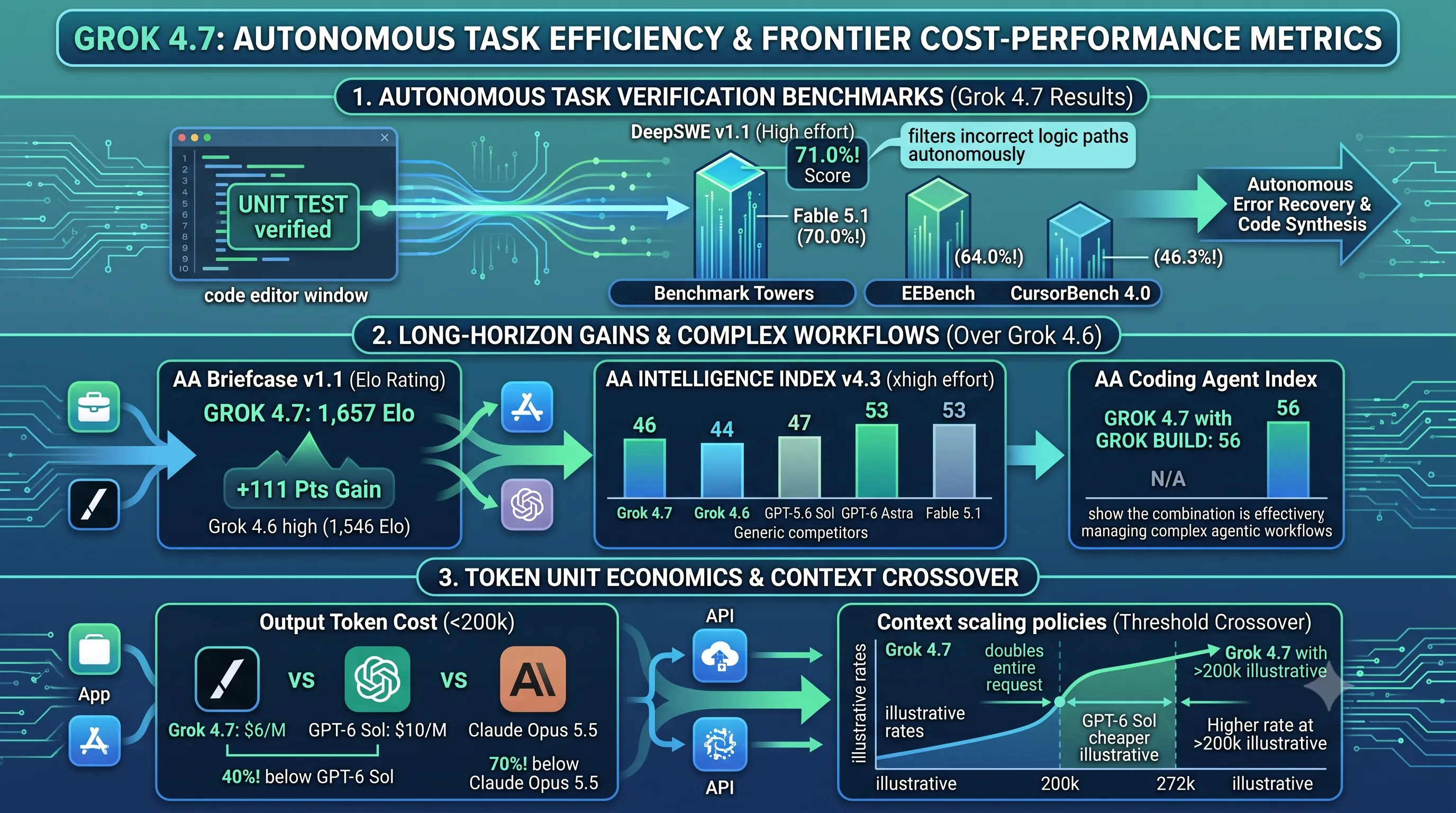
On standalone engineering evaluations that test autonomous error recovery and code synthesis, Grok 4.7 records competitive accuracy across standardized testbeds.When evaluated on CursorBench 4.0, Grok 4.7 achieved a benchmark score of 46.3%, validating its interactive coding and contextual edit accuracy inside editor environments.
In full-repository software engineering benchmarks, Grok 4.7 evaluated at high effort reached 71.0% on DeepSWE v1.1, outperforming Fable 5.1, which achieved 70.0%.
Furthermore, Grok 4.7 secured a score of 64.0% on EEBench, reflecting its robust verification capabilities across demanding technical problem sets.
Complex Long-Horizon Gains over Grok 4.6 on AA Briefcase and Coding Index
Grok 4.7 demonstrates significant performance gains on long-horizon engineering benchmarks and multi-step autonomous workflows over its predecessor, Grok 4.6.On the AA Briefcase v1.1 evaluation, Grok 4.7 registered an Elo rating of 1,657 Elo, representing a net gain of 111 points over Grok 4.6 high.
On the Artificial Analysis Intelligence Index v4.3, Grok 4.7 operating at xhigh effort scored 46, surpassing the score of 44 logged by Grok 4.6, while positioning close to GPT-5.6 Sol at 47 and trailing GPT-6 Astra and Claude Fable 5.1, which both scored 53.
When paired with Grok Build, Grok 4.7 achieved a score of 56 on the Artificial Analysis Coding Agent Index, confirming its effectiveness in managing complex, multi-step agentic workflows.
Frontier Token Unit Economics and the 200k-272k Prompt Cost Crossover
Evaluating the economic efficiency of autonomous coding agents involves analyzing token pricing structures alongside benchmark performance.At standard rates for contexts below 200k tokens, Grok 4.7 output tokens cost $6 per million tokens ($6/M).
This baseline makes Grok 4.7 output tokens 40% less expensive than GPT-6 Sol at $10/M and 70% less expensive than Claude Opus 5.5 at $20/M.
However, context scaling policies introduce a specific cost crossover dynamic.
Between 200k and 272k prompt tokens, GPT-6 Sol is cheaper than Grok 4.7 because Grok 4.7 applies long-context pricing rates earlier at the 200k token threshold.
| Benchmark / Metric | Grok 4.7 | Frontier Comparison Baseline | Key Differential / Configuration |
|---|---|---|---|
| CursorBench 4.0 | 46.3% | N/A | Evaluates in-editor interactive coding accuracy |
| DeepSWE v1.1 | 71.0% | 70.0% (Fable 5.1) | High effort configuration |
| EEBench | 64.0% | N/A | Evaluates autonomous engineering capability |
| AA Briefcase v1.1 | 1,657 Elo | 1,546 Elo (Grok 4.6 high) | +111 Elo gain over Grok 4.6 high |
| AA Intelligence Index v4.3 | 46 | 44 (Grok 4.6) / 47 (GPT-5.6 Sol) / 53 (GPT-6 Astra / Fable 5.1) | xhigh effort configuration |
| AA Coding Agent Index | 56 | N/A | Paired with Grok Build |
| Output Token Cost (<200k) | $6/M | $10/M (GPT-6 Sol) / $20/M (Claude Opus 5.5) | 40% below GPT-6 Sol; 70% below Claude Opus 5.5 |
| Context Threshold Crossover | Higher rate at >200k | Cheaper between 200k and 272k (GPT-6 Sol) | Grok 4.7 applies long-context pricing starting at 200k tokens |
Related Posts
Generative AI may have assisted with research or drafting for this article. Topic selection, fact-checking, final wording, and publication remain the responsibility of DragonStone74. AI use disclosure