
Inside Cult.fit: How OpenAI Codex Powers Citizen Development
🚀 Key Takeaways
- SDLC Standardization: Cult.fit unified its software engineering lifecycle around OpenAI Codex, dismantling an uncoordinated sprawl of isolated coding tools.
- Citizen Development Across Operations: Non-engineering teams in marketing, customer support, and field operations now translate natural language instructions into functional scripts and internal tools.
- Structured Engineering Guardrails: User-generated automations operate safely through sandboxed execution environments, standardized template libraries, and mandatory peer code review gates.
- SaaS Tooling Consolidation: Rapid in-house software development powered by Codex has enabled the company to build proprietary internal apps and phase out costly commercial SaaS subscriptions.
- Enterprise Operational Leverage: The initiative unlocks faster data transformations and custom ticket workflows to support Cult.fit's expansive hybrid fitness operations nationwide.
As hybrid consumer fitness platforms scale across physical centers and digital platforms, back-office backlogs frequently throttle operational agility.
When frontline teams in customer support, marketing, and logistics must wait weeks for developer bandwidth to build routine data pipelines or diagnostic dashboards, organizational momentum slows.
To resolve this perennial bottleneck, Cult.fit has transformed its engineering lifecycle by standardizing operations on OpenAI Codex.
Rather than treating AI code generation merely as an autocomplete tool for senior developers, the company has established an enterprise-wide citizen development model that empowers non-technical personnel to build reliable, functional software directly from natural language workflows.
Supported by sandboxed testing environments, reusable templates, and strict engineering review checkpoints, this strategy allows Cult.fit to retire redundant commercial SaaS tools in favor of tailored internal software.
The rollout delivers a pragmatic framework for high-growth enterprises aiming to convert artificial intelligence into immediate, measurable operational muscle.
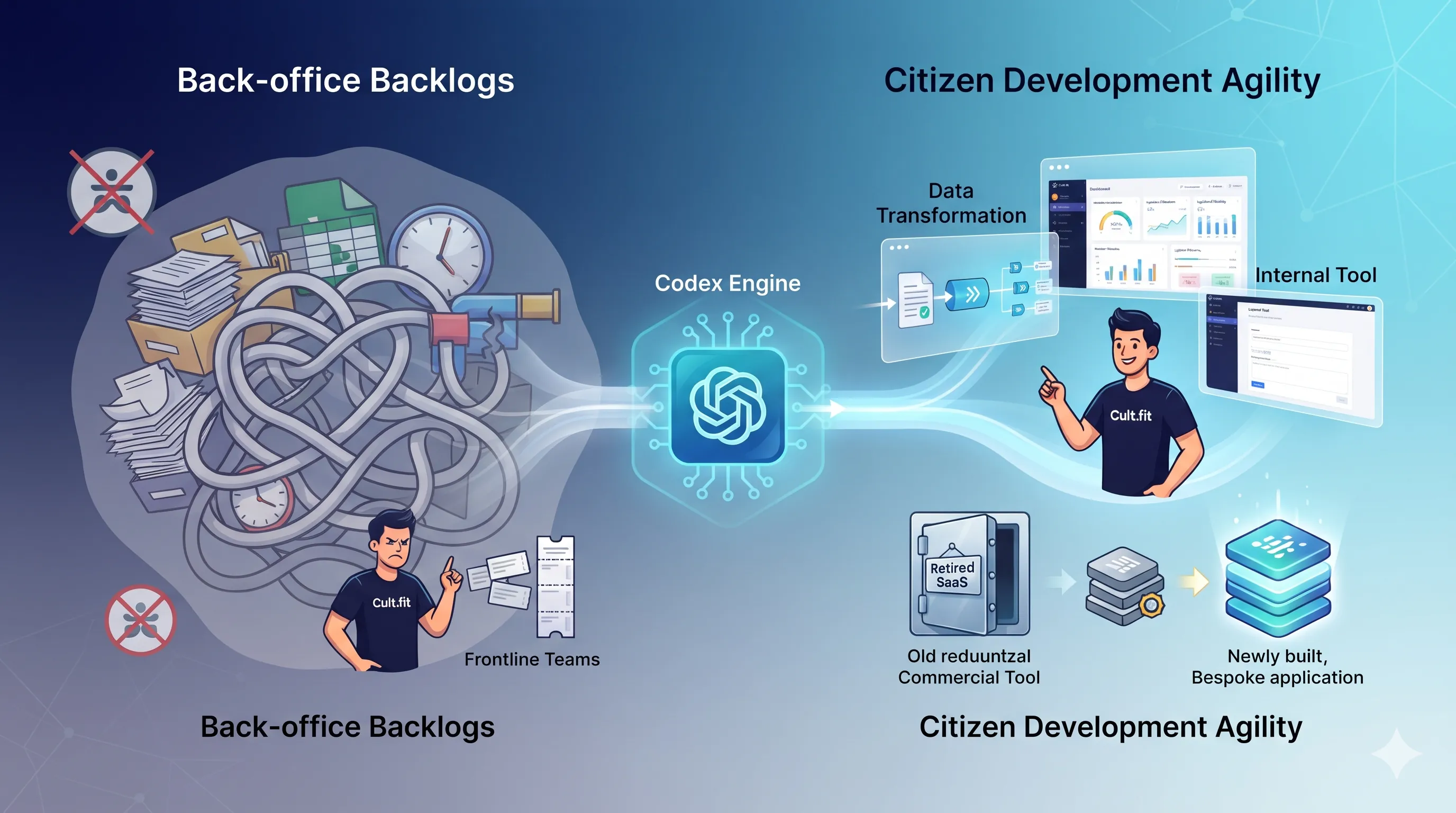
1. Enabling Cross-Functional Citizen Development Across Operations, Marketing, and Support
Cult.fit builds operational muscle with Codex by transitioning technical execution capabilities directly to frontline teams.Officially released on November 5, 2026, this implementation allows non-engineering personnel across the company's network to bypass traditional software engineering bottlenecks.
Operating over 200 physical fitness centers requires continuous coordination across physical facilities, localized supply chains, and customer interactions.
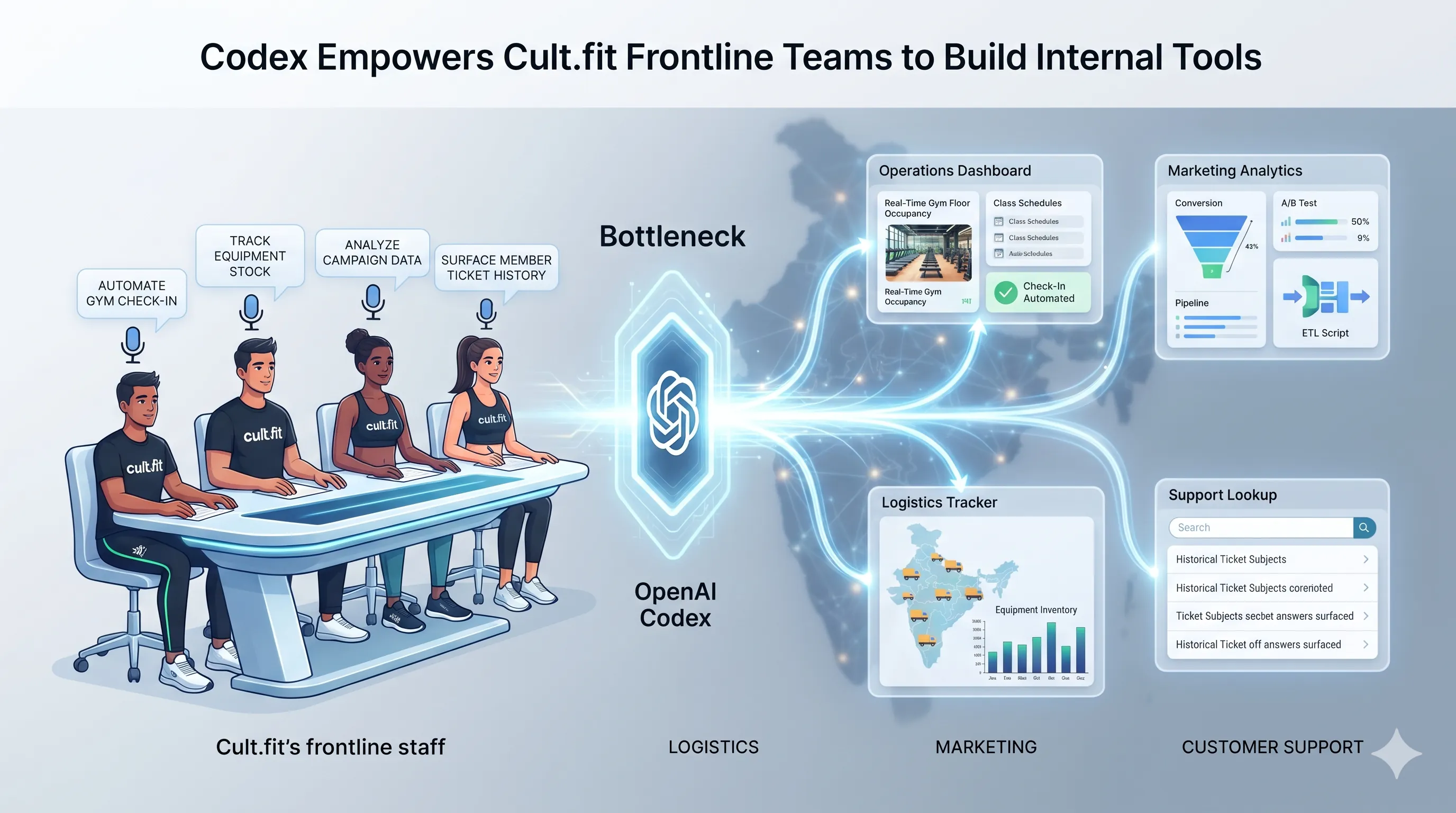
To meet these operational demands, non-engineering teams now leverage natural language instructions with Codex to build custom scripts, dashboards, and operational tools tailored to real-time gym management.
Operational Workflows and Real-Time Logistics Dashboards
Within the day-to-day management of Cult.fit's fitness centers, operations teams write natural language descriptions of their specific operational workflows to automatically generate Python or JavaScript execution code.This automated script generation eliminates manual script requests and converts descriptive administrative steps directly into executable routines.
Simultaneously, logistics staff utilize Codex to construct real-time tracking dashboards dedicated to equipment distribution across the company's 200+ physical fitness centers.
Managing physical gym equipment across an expansive facility footprint demands high visibility, and logistics teams are able to stand up custom tracking interfaces without waiting on dedicated software sprint cycles.
This implementation represents a decisive shift toward citizen development within an operations-heavy consumer health-tech business model.
However, adopting citizen development introduces structural compromises, as the organization intentionally trades some degree of code quality consistency in exchange for development speed and closer alignment with direct business context.
| Functional Team | Natural Language Codex Input | Generated Tool / Asset | Operational Purpose |
|---|---|---|---|
| Operations | Natural language descriptions of recurring workflows | Python and JavaScript execution code | Direct automation of administrative gym center workflows |
| Logistics | Tracking and distribution interface prompts | Real-time tracking dashboards | Monitoring physical equipment distribution across 200+ gym locations |
| Marketing | Data transformation logic and analytics requirements | Custom ETL scripts | Processing campaign analytics and accelerating A/B test analysis |
| Customer Support & Success | Knowledge retrieval and historical search specifications | Internal lookup tools | Surfacing solutions from documentation and past tickets without backlog wait times |
Support Knowledge Surfacing and Marketing ETL Pipelines
The expansion of citizen development extends into Cult.fit's customer retention and acquisition arms.Customer success and support teams use Codex to build internal lookup tools that instantly surface answers from historical documentation and past customer tickets.
By assembling these retrieval interfaces themselves, support staff resolve specific operational inquiries without waiting in central engineering or product backlogs.
In parallel, marketing staff generate data transformation ETL scripts using Codex to process campaign analytics and accelerate A/B test analysis.
These marketing pipelines allow non-technical analysts to restructure campaign performance datasets into actionable formats on demand.
According to the OpenAI case study reported via Emergent, Cult.fit did not disclose specific productivity metrics or cost savings associated with the deployment.
The measurable impact remains characterized by the functional independence granted to operations, support, and marketing units across the organization's physical and digital touchpoints.
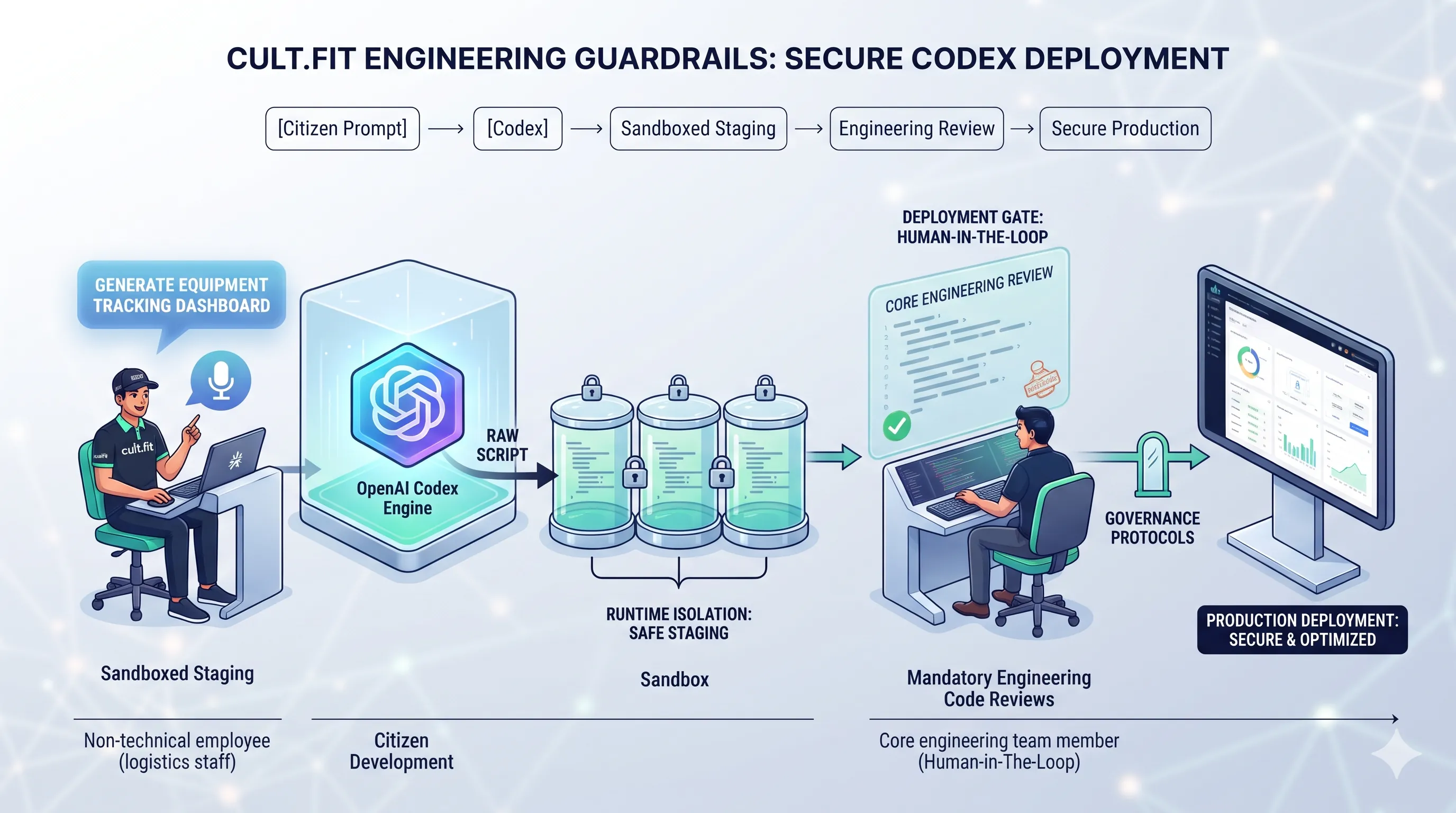
2. Engineering Guardrails: Sandboxes, Review Gates, and Governance Protocols
Connecting directly to how Cult.fit builds operational muscle with Codex, technical safeguards ensure that non-developer automation does not compromise core infrastructure.Empowering business teams to synthesize automation requires balancing democratization with strict operational stability.
Cult.fit established robust technical protocols and governance mechanisms to validate, refine, and deploy citizen-developed scripts without risking system reliability.
Sandboxed Staging and Mandatory Engineering Code Reviews
To safeguard operational integrity, generated scripts are never executed directly within production environments.Cult.fit mandates that all generated scripts run in isolated sandboxed testing environments prior to any production deployment.
These sandboxes isolate runtime dependencies and query execution, allowing operations personnel to test logic and catch unexpected edge cases safely.
Furthermore, automated execution alone does not clear a workflow for operational release.
Cult.fit institutes mandatory code review gates conducted directly by core engineering teams before any production rollout.
Engineers evaluate the generated code for syntax efficiency, system safety, and architectural alignment.
This human-in-the-loop review ensures that non-technical team output adheres strictly to enterprise development standards.
Standardized Prompt Optimization and Reusable Template Libraries
Scaling internal tooling safely also depends on standardizing how staff interact with Codex models.Cult.fit established a centralized template library targeting recurring operational workflows.
This library provides vetted patterns for database queries, API integrations, and automated report generation.
By standardizing common tasks into validated templates, the organization reduces code variance and minimizes synthesis errors.
To complement these structural assets, Cult.fit conducts dedicated natural language prompt optimization workshops for non-technical staff.
These workshops instruct operational team members on framing precise prompts, improving generation accuracy, and reducing iterations needed to produce functional scripts.
| Governance Layer | Technical Implementation and Guardrail Detail |
|---|---|
| Runtime Isolation | Generated scripts run in sandboxed testing environments before production deployment. |
| Deployment Gate | Mandatory code review gates by engineering teams before production rollout. |
| Pattern Standardization | Establishment of a template library for common operational tasks including database queries, API integrations, and report generation. |
| Skill Enablement | Conducting natural language prompt optimization workshops for non-technical staff. |
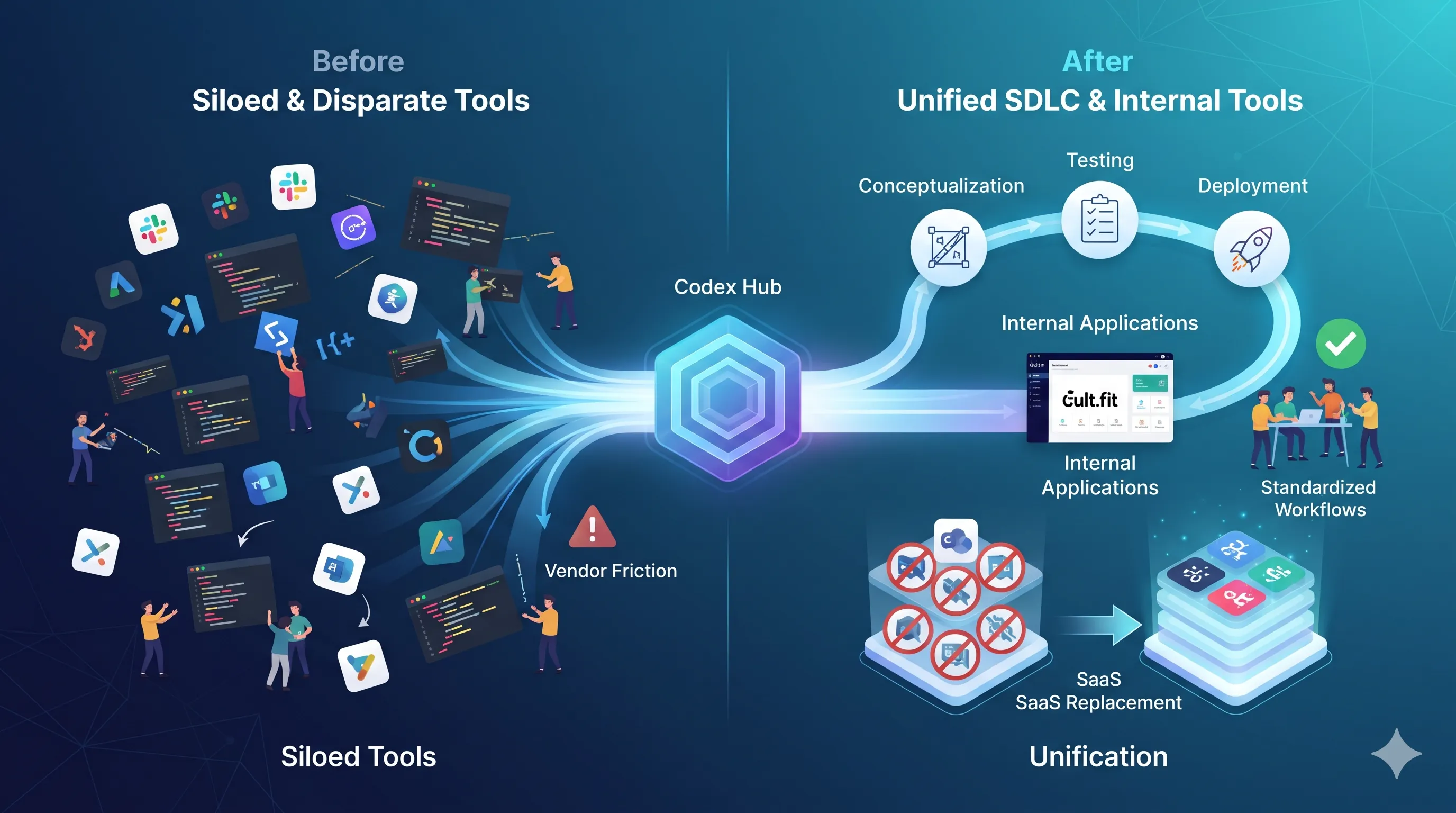
3. SDLC Standardization, Engineering Unification, and SaaS Displacement
Cult.fit builds operational muscle with Codex by first establishing structural discipline at the engineering core, transforming how software is conceptualized, tested, and shipped.By consolidating its foundational developer workflows around a centralized AI platform, the organization transformed technical velocity into broader enterprise capabilities.
Consolidating Coding Agents into a Unified Foundation
Prior to engineering consolidation, Cult.fit faced an internal sprawl of disparate coding assistants and fragmented agents deployed across distinct engineering groups.This proliferation of mismatched tools created operational friction, siloed practices, and inconsistent technical standards across teams.
CTO Santhosh Kumar noted that standardizing on Codex allowed Cult.fit to unify its software development lifecycle around a single platform.
By anchoring the engineering environment to Codex, the organization established a shared foundation across its entire codebase.
This unified baseline governs repository structures, agent instructions, skills, testing protocols, code reviews, and continuous feedback loops.
Standardizing these core mechanisms enabled engineering teams to share conventions, establish uniform quality controls, and systematically reuse capabilities across squads.
Cult.fit perfected these shared conventions within the technical organization first, validating testing protocols and agent guidelines before rolling the platform out to non-engineering functions.
Internal Application Development to Replace Commercial SaaS
Unifying the software development lifecycle around Codex directly empowered Cult.fit to accelerate internal product delivery.With engineering capabilities and agent-driven workflows standardized across repositories, developer teams gained the speed required to engineer bespoke solutions in-house.
This elevated development velocity allowed Cult.fit to build custom internal applications and systematically displace third-party SaaS subscriptions.
Replacing external commercial software with tailor-made internal tools reduced recurring vendor dependencies while tightly aligning enterprise software to Cult.fit's specific operational needs.
4. Codex CLI Technical Architecture, Terminal Deployment, and Setup Commands
Engineering teams building operational muscle with Codex at Cult.fit rely directly on terminal-native automation, where the technical deployment architecture and agent configuration dictate day-to-day execution efficiency.Terminal Distribution, Licensing, and Authentication Options
Codex CLI is an OpenAI coding agent designed to run locally in the terminal.The tool is licensed under the Apache-2.0 License, providing transparent access to its client architecture.
For installation across workstations and servers, Codex CLI is distributed as standalone binaries sourced from either releases.openai.com or GitHub Releases.
Authentication provides multiple pathways depending on organizational access requirements.
The CLI supports direct authentication through ChatGPT accounts across Plus, Pro, Business, Edu, and Enterprise tiers.
Alternatively, teams can authenticate using an API key.
However, using an API key with Codex CLI requires additional manual setup compared to standard ChatGPT account sign-in.
| Specification Category | Technical Architecture Details |
|---|---|
| Agent Execution | Runs locally in the terminal |
| License | Apache-2.0 License |
| Distribution Channels | Standalone binaries from releases.openai.com or GitHub Releases |
| Direct Account Auth | ChatGPT accounts (Plus, Pro, Business, Edu, Enterprise) |
| Manual Auth Option | API key (requires additional manual setup) |
Environment Configuration and Interactive CLI Execution
To force the Codex installer to download assets from GitHub Releases instead of the default releases.openai.com domain, configure the dedicated environment variable prior to installation.CODEX_INSTALLER_USE_RELEASES_OPENAI_COM=falseOnce the binary is installed, launching the interactive environment requires executing the core CLI binary command.
codex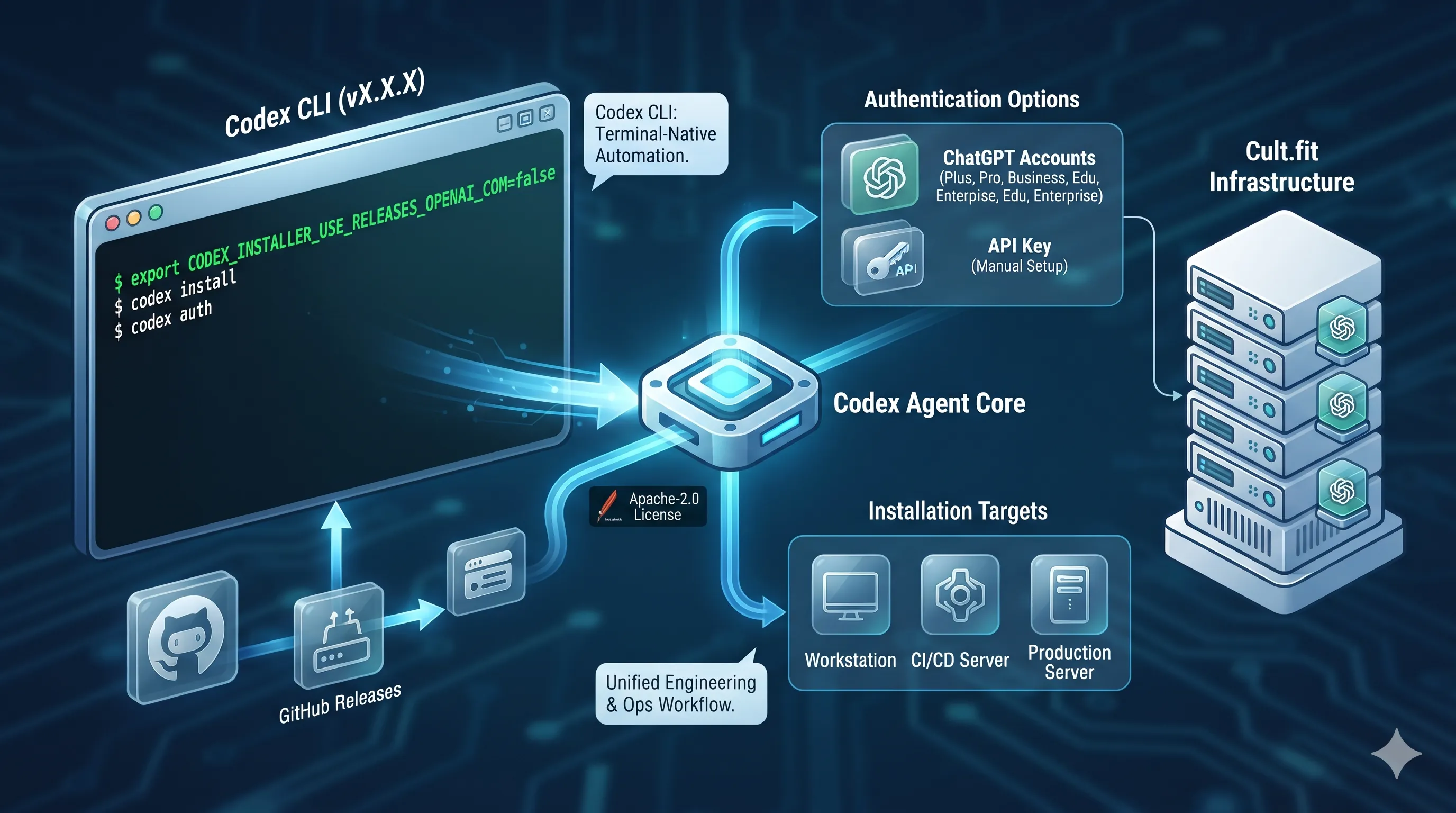
5. Corporate Scale, Financial Performance, and Strategic Board Governance Ahead of IPO
As Cult.fit builds operational muscle with Codex and modern engineering practices, the company's enterprise scale and financial architecture reflect a parallel maturation.The technological optimization underpinning its platforms directly supports the physical and digital footprint managed by parent company Curefit Healthcare since its founding in 2016.
Translating operational efficiency into measurable fiscal sustainability has become critical as the organization aligns its corporate infrastructure for public market scrutiny.
Hybrid Fitness Model and FY25 Financial Turnaround
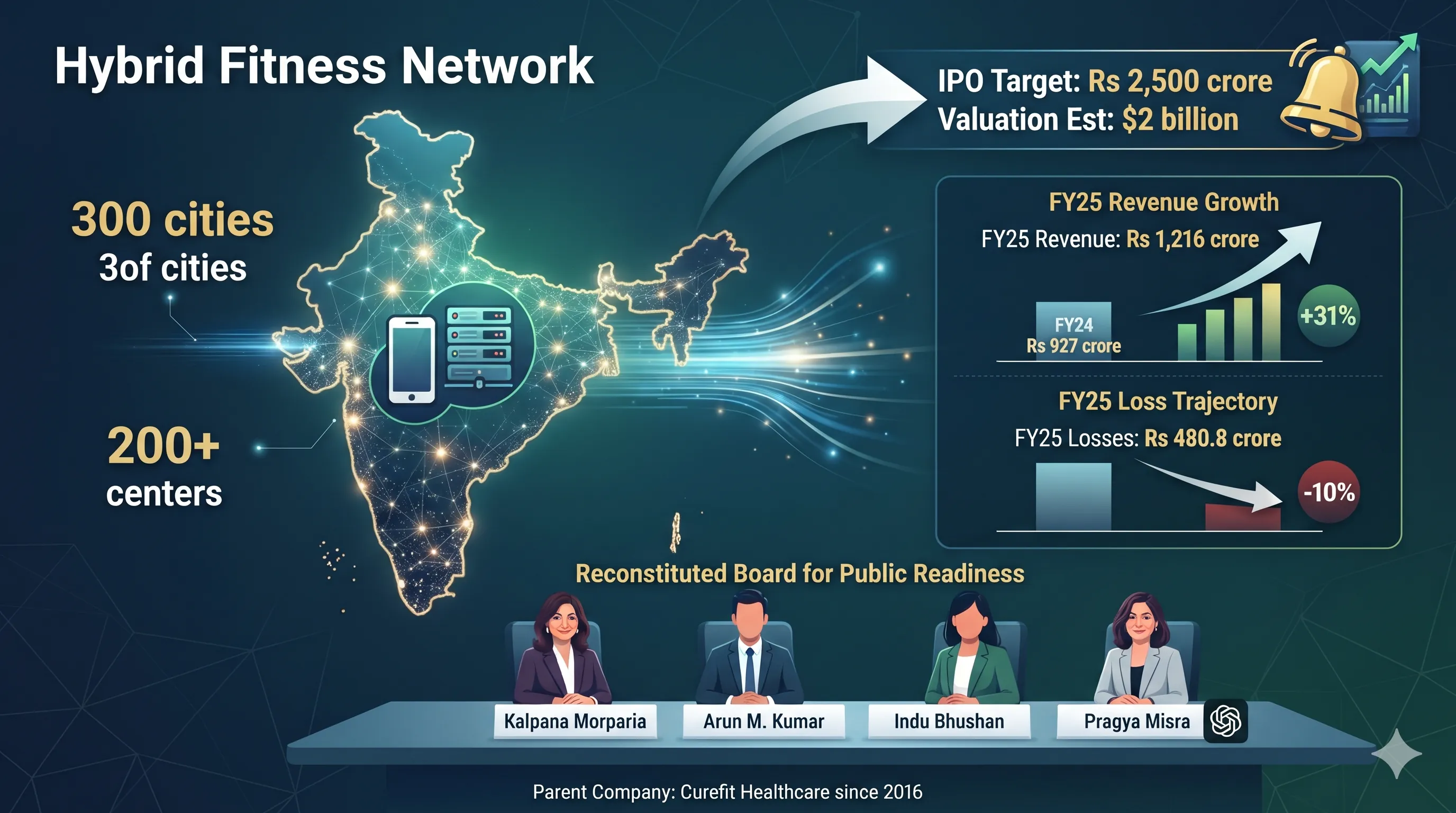
Cult.fit operates a hybrid fitness model that pairs interactive digital services alongside physical centers and unified Cultpass subscriptions.This network allows members to navigate across workout formats while granting the enterprise operational density across 300 cities in India.
The financial dividends of this unified operational model surfaced distinctly in the fiscal year ended March 2025.
Operating revenue for FY25 rose 31% YoY to Rs 1,216 crore, climbing from Rs 927 crore recorded in FY24.
Simultaneously, disciplined operational management enabled Cult.fit to narrow its losses by 10% to Rs 480.8 crore for the fiscal year ended March 2025.
| Financial & Operational Benchmark | Performance Detail |
|---|---|
| FY25 Operating Revenue | Rs 1,216 crore |
| FY24 Operating Revenue | Rs 927 crore |
| Year-over-Year Revenue Growth | 31% increase |
| FY25 Losses | Rs 480.8 crore |
| Loss Trajectory | Narrowed by 10% YoY |
| Geographic Center Reach | Physical fitness centers across 300 cities in India |
IPO Capitalization Targets and Strategic Board Appointments
Cult.fit's balance sheet has been fortified through extensive institutional backing.The company received Rs 440 crore ($47 million) in funding from Temasek, bringing total funding raised across its lifetime to exceed $720 million.
These capital injections anchor the firm's planned initial public offering, where Cult.fit is targeting a Rs 2,500 crore (nearly $300 million) IPO at an estimated $2 billion valuation.
To govern this transition and ensure rigorous public-readiness oversight, Cult.fit strengthened its corporate leadership through strategic board expansion.
The company appointed four independent directors to its board: Kalpana Morparia, Arun M. Kumar, Indu Bhushan, and Pragya Misra.
Notably, independent director Pragya Misra brings specialized global tech governance expertise, serving as Head of Strategy & Global Affairs for India at OpenAI.
This reconstituted board combines extensive financial governance, public policy leadership, and modern technological strategy to steer Cult.fit through its capitalization roadmap.
References
Related Posts
Anthropic September 2026 Threat Report: Multi-Agent Offensive AI OperationsAnalysis of the Anthropic September 2026 report on how threat actors use multi-agent AI swarms to...
Inside Topcoat: The New Full-Stack Rust Web Framework Without WASMDiscover Topcoat, a new full-stack Rust web framework by Tokio creators that brings server-rendered...
How Pyrefly Speeds Up Python Type Checking With RustDiscover how Google and Meta use Pyrefly, a high-performance Rust-powered Python type checker, to...
Generative AI may have assisted with research or drafting for this article. Topic selection, fact-checking, final wording, and publication remain the responsibility of DragonStone74. AI use disclosure