
Inside Topcoat: The New Full-Stack Rust Web Framework Without WASM
🚀 Key Takeaways
- Server-first architecture: Topcoat generates HTML directly on the server through async Rust functions, bypassing WebAssembly bundles in favor of a lean, checked-in browser runtime.
- Tokio ecosystem pedigree: Spearheaded by Tokio creator Carl Lerche and Julien Scholz, the project provides a cohesive full-stack web framework geared toward database-driven applications.
- Hybrid client reactivity: The engine renders type-checked Rust expressions on the server and cross-compiles them into minimal JavaScript, pairing local event handling with server-rendered dynamic shards.
- Node-free asset workflows: Out-of-the-box support for module-based routing, native Tailwind CSS processing, and content-hashed asset bundling eliminates external JavaScript toolchains.
- Early-stage evolutionary design: While offering an alternative to WASM-centric frameworks like Leptos and Dioxus, Topcoat remains in active 0.x development with specific syntactic boundaries and ongoing coherence refinements.
For years, full-stack Rust development has oscillated between two distinct philosophies: low-level asynchronous HTTP engines like Axum and client-heavy WebAssembly environments like Leptos or Dioxus. While WASM-driven single-page applications unlock rich client-side interactivity, they frequently impose noticeable binary payloads, hydration overhead, and fragmented build pipelines.
Topcoat reframes this dynamic by bringing modern server-driven HTML streaming and seamless hypermedia patterns directly into the Tokio ecosystem.
Instead of transmitting compiled binary artifacts to client browsers, the framework renders pages natively on the server alongside direct database access, shipping minimal JavaScript to manage local state transitions and live partial updates.
This transition mirrors the developer experience popularized by Phoenix LiveView and modern hypermedia architectures, yet anchors it in Rust's strict type safety and high-concurrency runtime.
As web engineering increasingly favors operational simplicity and instant time-to-interactive metrics, Topcoat marks a significant milestone in establishing Rust as an accessible, productive choice for standard server-rendered business software.
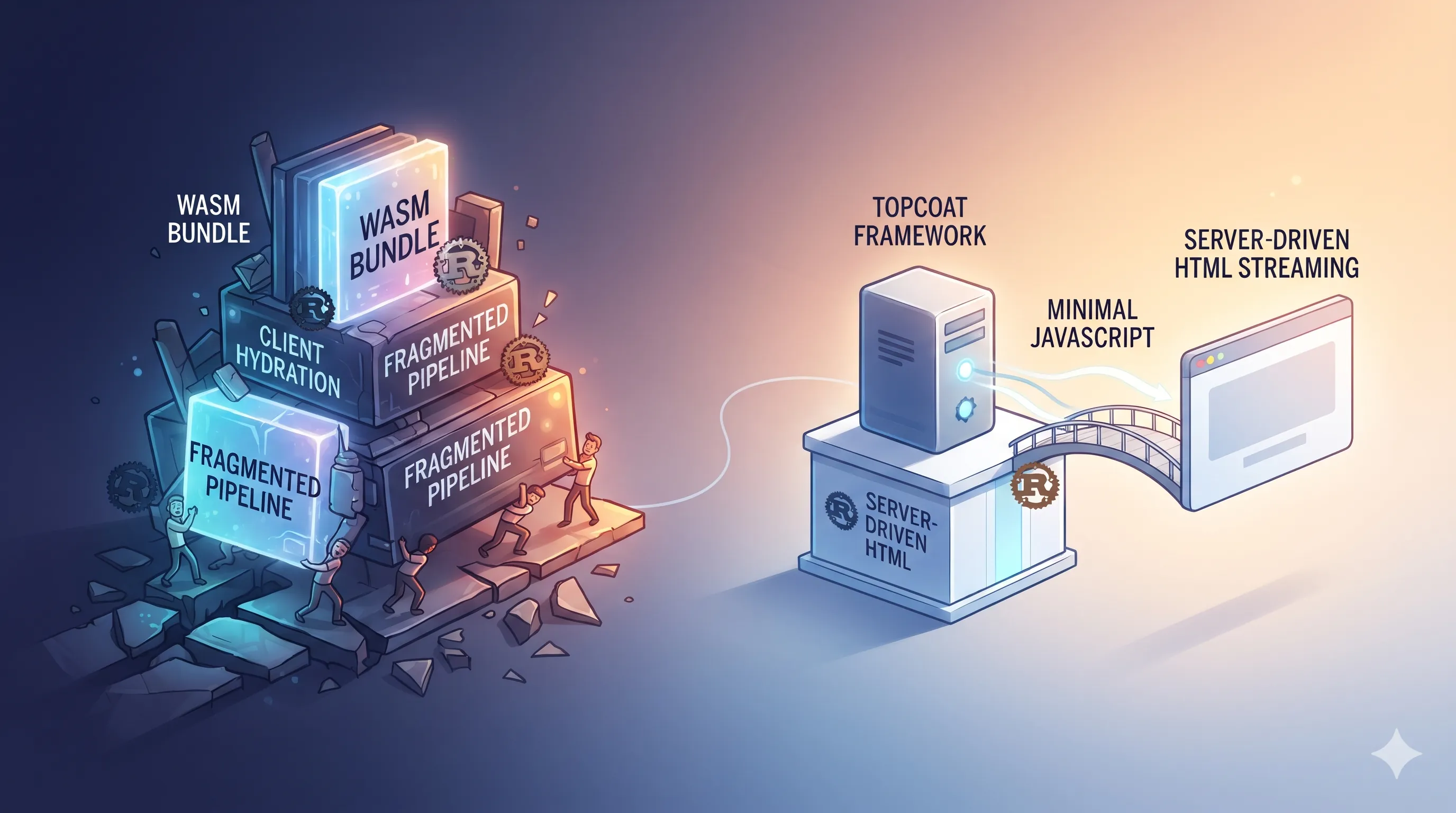
1. Server-Rendered Architecture: How Topcoat Re-evaluates Full-Stack Rust Without WebAssembly
This section examines how Topcoat brings server-rendered capabilities to Rust by replacing complex client-side execution models with a streamlined, server-centric architecture.Rather than relying on compilation pipelines that target the browser via WebAssembly, Topcoat operates as a modular, batteries-included full-stack web framework designed around direct server rendering.
Lightweight Runtime and Direct Database Access
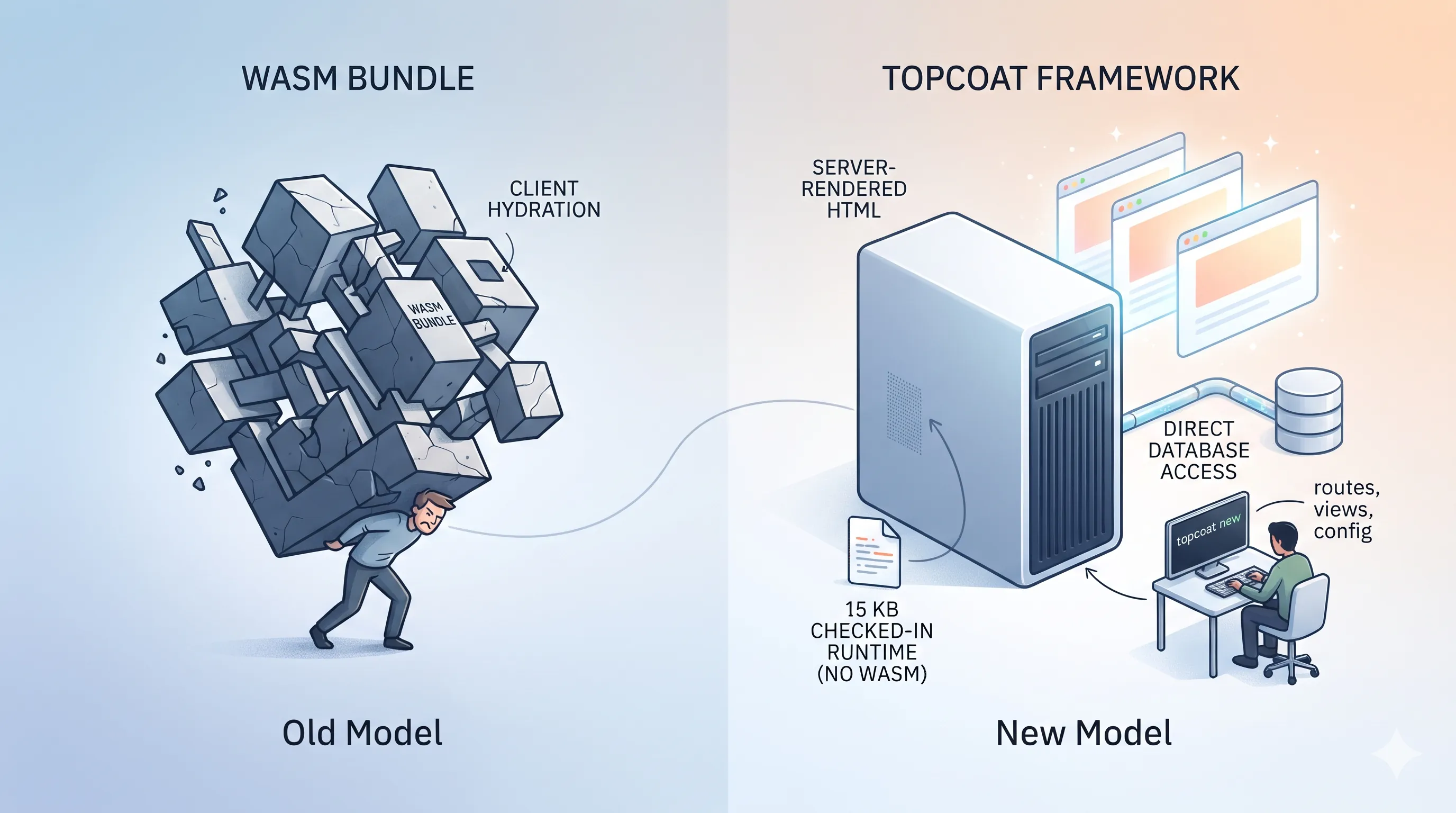
Topcoat fundamentally alters the full-stack Rust development workflow by rendering all page markup on the server via asynchronous Rust functions.Because these rendering functions execute entirely on the server, they can query databases directly without requiring intermediate REST endpoints or GraphQL translation layers.
This architectural choice eliminates the need for a WebAssembly bundle or a separate client-side build step to achieve baseline interactivity.
Instead of sending heavy binary payloads to the client, Topcoat ships with a checked-in browser runtime script that measures approximately 15 KB gzipped (specifically 15,160 bytes) in v0.10.0.
From an infrastructure and toolchain perspective, adopting the framework requires modern language features, demanding a minimum Rust version of v1.98 as of Topcoat v0.10.0.
| Specification Metric | Value / Detail |
|---|---|
| Core Architecture Model | Server-rendered HTML via async Rust functions with direct database queries |
| Client Footprint | ~15 KB gzipped (15,160 bytes) checked-in browser runtime (no WASM bundle) |
| Compiler Prerequisite | Minimum Rust version v1.98 (as of Topcoat v0.10.0) |
| Licensing & Ecosystem | MIT License under the tokio-rs ecosystem |
| Repository Traction | 6.4k stars, 227 forks, 33 issues, and 22 pull requests |
Tokio Ecosystem Governance and Project Scope
Topcoat is developed under the tokio-rs ecosystem and published under the permissive MIT license.The project is led by Tokio creator Carl Lerche alongside Julien Scholz, anchoring the initiative within Rust's premier asynchronous networking community.
Topcoat's public GitHub repository opened alongside a v0.9 release and an accompanying blog series.
Developer engagement in the repository reflects steady community inspection, recording 6.4k stars, 227 forks, 33 issues, and 22 pull requests.
Despite this growing visibility, the project's leadership maintains clear boundaries regarding Topcoat's scope and design targets.
Tokio creator Carl Lerche stated Topcoat is designed for "run-of-the-mill, browser-based, database-driven applications" rather than Figma-scale applications.
Engineering teams evaluating the framework must balance its operational ergonomics against early-stage trade-offs: Topcoat remains experimental and in early 0.x releases with no long-term stability guarantees.
Scaffolding Applications with the Topcoat CLI
To begin development, developers must scaffold a new Topcoat application using the framework's native command-line interface.topcoat newBy executing this scaffolding step, developers instantiate the initial project structure, dependencies, and configuration required to render async server components without manual boilerplate setup.
2. Client Reactivity and Shards: Dynamic State Management and WebSocket Streaming
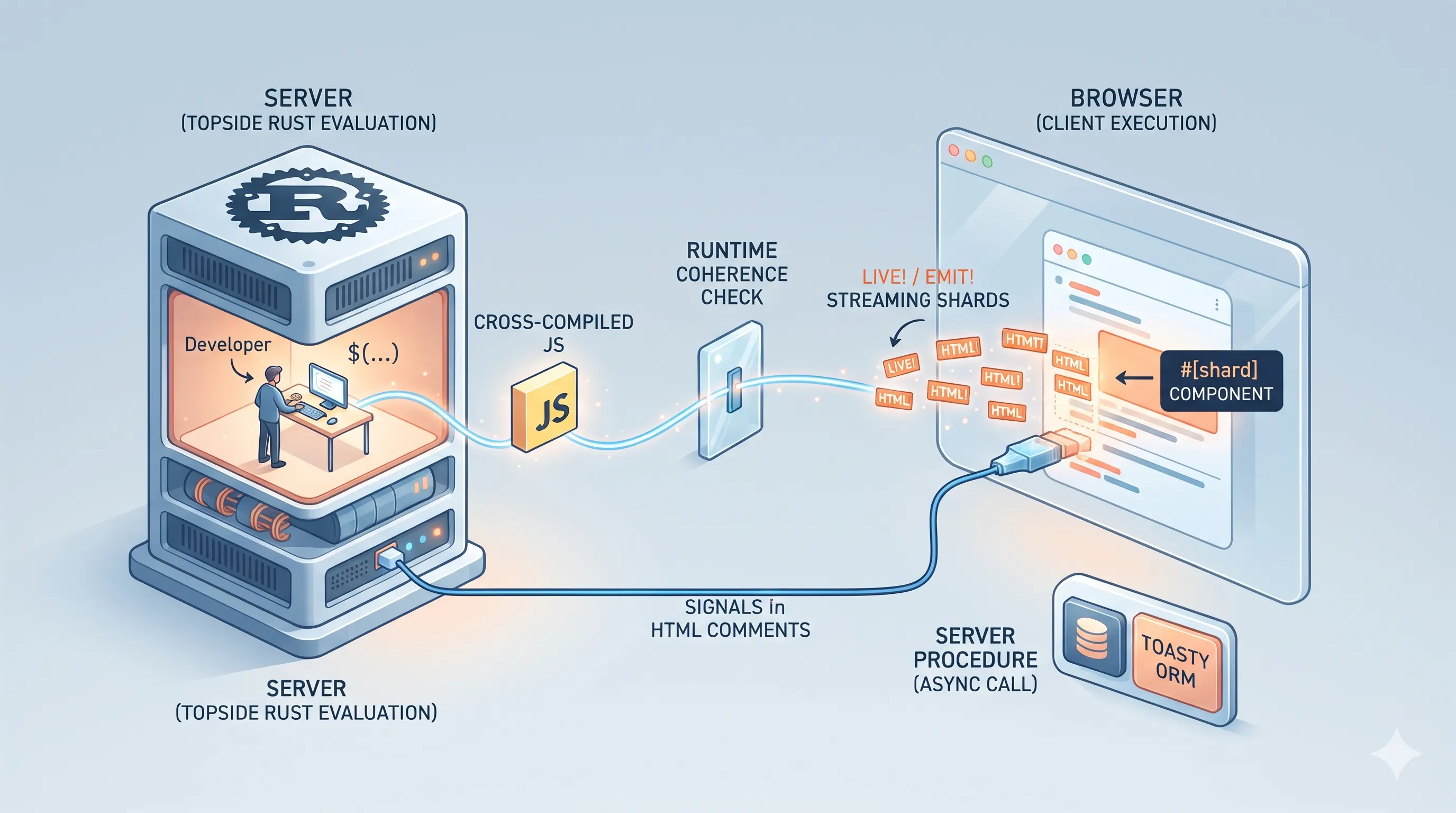
As Topcoat brings server-rendered capabilities to Rust, bridging server architecture with browser interactivity requires a specialized execution model.This section examines Topcoat's hybrid approach to client-side reactivity, isolated component patching, and real-time streaming, showing how Rust code bridges the gap between server evaluation and browser execution.
Cross-Compiled Rust Expressions and Signal Hydration
Topcoat approaches browser interactivity by running type-checked Rust logic across both server and client environments.At the core of this system are $(...) expressions, which contain type-checked Rust code evaluated on the server during the initial render and cross-compiled to JavaScript for client-side execution.
This dual-stage evaluation eliminates the need to maintain parallel implementations in separate programming languages for rendering and dynamic browser updates.
State management on the client relies on signals that track dynamic values.
Topcoat serializes these signals directly into the markup, embedding them initially into HTML comments during the server render phase.
When the document reaches the browser, the client runtime reads the values stored within these HTML comments to hydrate the dynamic state without executing complete page hydration passes.
To manipulate markup and capture user inputs, the template system introduces specialized attributes:
Topcoat features :bind attributes for server-rendered dynamic attributes, keeping DOM properties synchronized with state values.
For browser-local execution, templates use @event handlers, allowing local interactions to trigger state modifications directly in the client.
| Primitive / Mechanism | Execution Location | Functional Role |
|---|---|---|
| $(...) Expressions | Server and Client | Contains type-checked Rust code evaluated on the server for initial render and cross-compiled to JavaScript for browser execution. |
| Signals in HTML Comments | Client (hydrated from Server) | Manages client-side state initialized through values embedded directly into HTML comments. |
| :bind Attributes | Server and DOM | Manages server-rendered dynamic attributes within templates. |
| @event Handlers | Client Browser | Captures user interactions for browser-local execution. |
| #[shard] Components | Server | Re-renders on the server upon argument changes and patches replacement HTML directly into the page. |
| Server Procedures | Server (invoked from Client) | Async server functions that can be invoked and awaited directly from browser code. |
| live! and emit! Primitives | Server over WebSocket | Streams HTML updates over persistent WebSocket connections to client targets. |
Targeted DOM Patching with Server-Side Shards
Rather than forcing full-page reloads or relying on large client-side bundles to update views, Topcoat introduces #[shard] components.A #[shard] component executes re-renders on the server whenever its arguments change.
Upon re-rendering, the server produces a targeted fragment and patches replacement HTML directly into the page DOM, isolating updates to the exact component boundary.
When client operations require server execution beyond rendering, Topcoat supports server procedures.
These server procedures are implemented as async server functions that can be invoked and awaited directly from browser code.
This mechanism allows client logic to communicate asynchronously with server routines through direct function call semantics, receiving server responses without manually writing custom endpoint handlers.
Real-Time WebSocket Streaming with live! and emit!
For state changes that push beyond request-response cycles, Topcoat incorporates live! and emit! primitives.These primitives stream real-time HTML updates across persistent WebSocket connections directly into the active document.
Through this streaming pipeline, server workflows emit updated markup fragments as state progresses, feeding continuous UI transitions without client polling.
To govern resource utilization and concurrency over these duplex channels, Topcoat establishes operational limits.
The framework supports up to 64 concurrent runs per WebSocket connection as a default limit.
This constraint prevents unbounded parallel execution loops across individual socket channels while supporting multiple concurrent operations per client session.
Syntax Vocabulary and Security Guard Constraints
The dual-runtime design of Topcoat introduces concrete boundaries regarding language features and endpoint security.Because the reactive layer translates Rust expressions into JavaScript, client-side Rust-to-JavaScript translation covers a restricted syntax and type vocabulary.
Developers cannot compile arbitrary Rust language constructs or complex standard library structures to the browser runtime.
To verify that code translates and behaves consistently despite these constraints, Topcoat relies on a coherence test suite that tracks execution outcomes across native Rust and V8 engines.
Architectural boundaries also affect request authentication and authorization.
Page and layout guards do not execute automatically on direct shard POST requests.
Because shard invocations bypass the outer page and layout guard pipeline, applications must enforce authorization checks directly within the shard implementation itself.
3. Full-Stack Developer Experience: Macros, Routing, Asset Bundling, and Localized Tooling
To understand how Topcoat brings server-rendered capabilities to Rust, developers must examine the ergonomic developer experience that eliminates traditional full-stack friction.By consolidating templating, file-system-driven routing, compilation-free styling, and data handling into a unified Rust-native workflow, Topcoat removes external runtime dependencies while preserving idiomatic Rust patterns.
Integrated view! Templating and Module-Based Routing
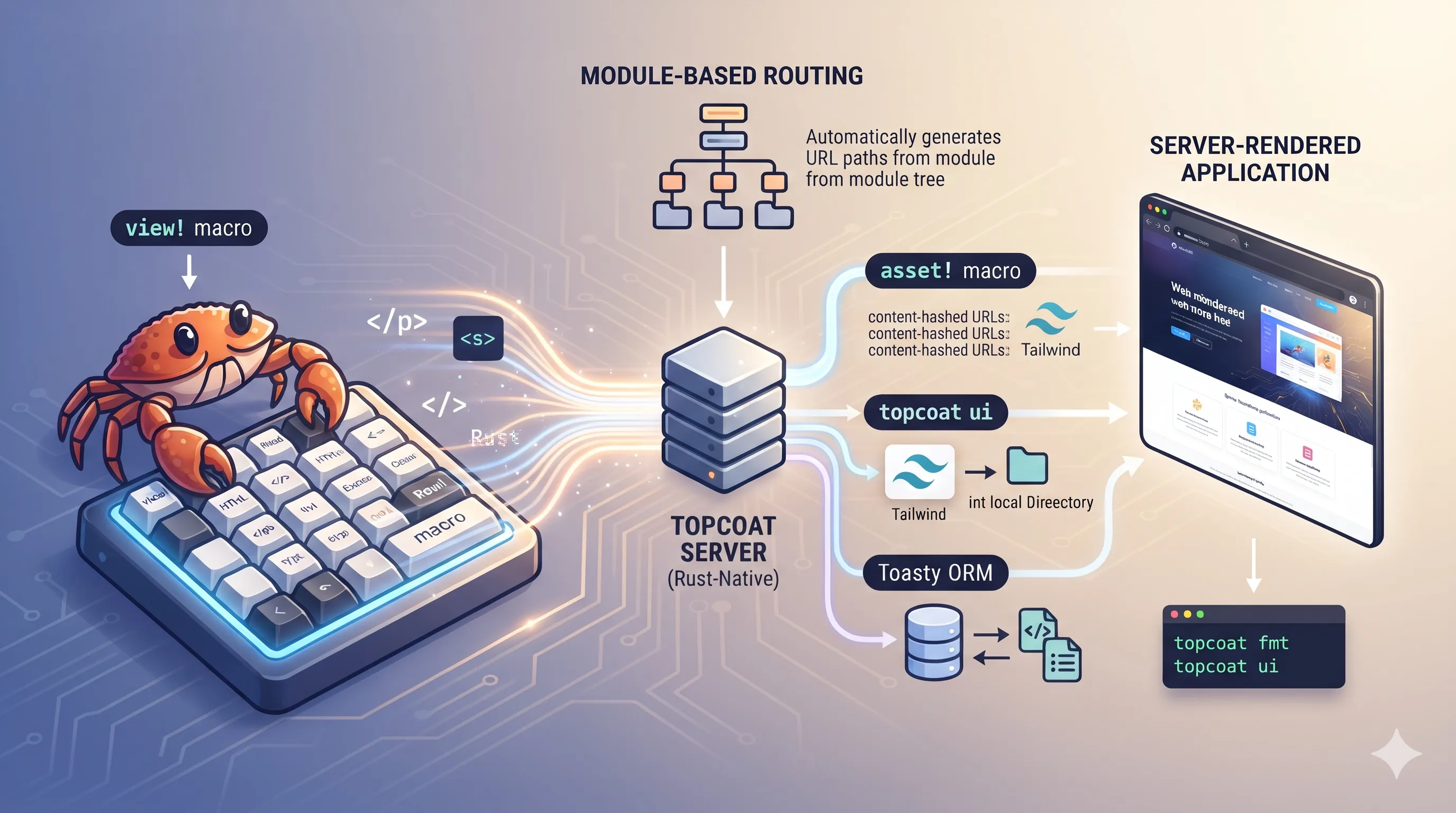
Server-side rendering in Topcoat centers around the view! macro, which allows developers to blend standard HTML syntax directly with native Rust control flow expressions.This integration removes the boundary between view logic and application state, allowing loops, conditional statements, and pattern matches to drive HTML rendering with compile-time type safety.
Navigational routing is structured without external configuration files or routing registries.
Topcoat includes module-based routing to infer application URL routes directly from the Rust module tree without requiring a dedicated build step.
Because standard code formatters often struggle to process embedded markup within macro invocations, Topcoat introduces dedicated tooling to maintain syntax consistency.
When developers need to format macro bodies such as view! throughout a project codebase, they execute the formatting CLI command:
topcoat fmtZero-Node Asset Pipelines and Component Vendoring
Front-end asset management in server-rendered applications frequently introduces bloated external toolchains.Topcoat solves this by bundling a native asset pipeline that utilizes the asset! macro to generate automatic content-hashed URLs and caching optimization.
Static assets referenced via this macro receive immutable cache headers and deterministic digest hashing directly at compile time.
Style management is decoupled from third-party JavaScript environments.
Topcoat integrates Tailwind CSS out of the box without requiring a Node.js runtime, compiling utility classes natively alongside the Rust application.
To facilitate front-end component composition, the framework distributes Topcoat UI as editable Tailwind components vendored directly into project source trees, modeled after the distribution model of shadcn/ui.
When teams need to vendor premade components into the local project directory for custom styling and behavior, they invoke the UI initialization command:
topcoat uiAsync Database Integration with Toasty and Request Context
State management and persistent data flows in Topcoat are architected around asynchronous Rust primitives.Topcoat pairs directly with Toasty, an async ORM designed for database queries and schema migrations within the same workspace.
However, teams should account for framework boundaries during setup: the database handle and models must be manually managed and passed through application context rather than relying on automatic ambient injection.
Request lifecycles are governed by request context (Cx) passing, which provides structured access to incoming metadata.
Topcoat features request-level memoization via the #[memoize] attribute, cookie management, and bring-your-own-storage sessions to preserve user state efficiently across stateless server requests.
For auxiliary application services, Topcoat offers built-in mail construction and dispatch via SMTP, file, or in-memory transports, complemented by Fluent localization to handle multi-language template rendering.
| Developer Tooling Domain | Integrated Feature Mechanism | Operational Benefit |
|---|---|---|
| Templating | view! macro and topcoat fmt | Blends standard HTML with Rust control flow while maintaining consistent macro formatting. |
| Routing Architecture | Module-based routing | Infers application URL routes directly from the Rust module tree with no dedicated build step. |
| Asset Management | asset! macro and Node-free Tailwind CSS | Delivers automatic content hashing, optimized caching, and modern styling without a Node.js runtime. |
| UI Distribution | topcoat ui (shadcn/ui model) | Vendors editable Tailwind components directly into the local repository for full source ownership. |
| Data Persistence | Toasty ORM integration | Executes async queries and database schema migrations within the same unified workspace. |
| Request Lifecycle | Request context (Cx) and #[memoize] | Provides request-level memoization, cookie handling, and bring-your-own-storage sessions. |
| Messaging & I18n | SMTP, file, in-memory mailers, and Fluent | Supports multi-transport mail dispatch and localization directly within the server runtime. |
4. Architectural Positioning: Topcoat vs. Leptos, Dioxus, Loco.rs, and Phoenix LiveView
Understanding Topcoat's arrival directly informs how it brings server-rendered capabilities to Rust, redefining where application state and rendering execution reside.By moving away from client-side runtime overhead while expanding beyond raw routing primitives, the framework establishes a distinct architectural niche among Rust and web application frameworks.
WASM SPA Frameworks vs. Server-Driven DOM Hydration
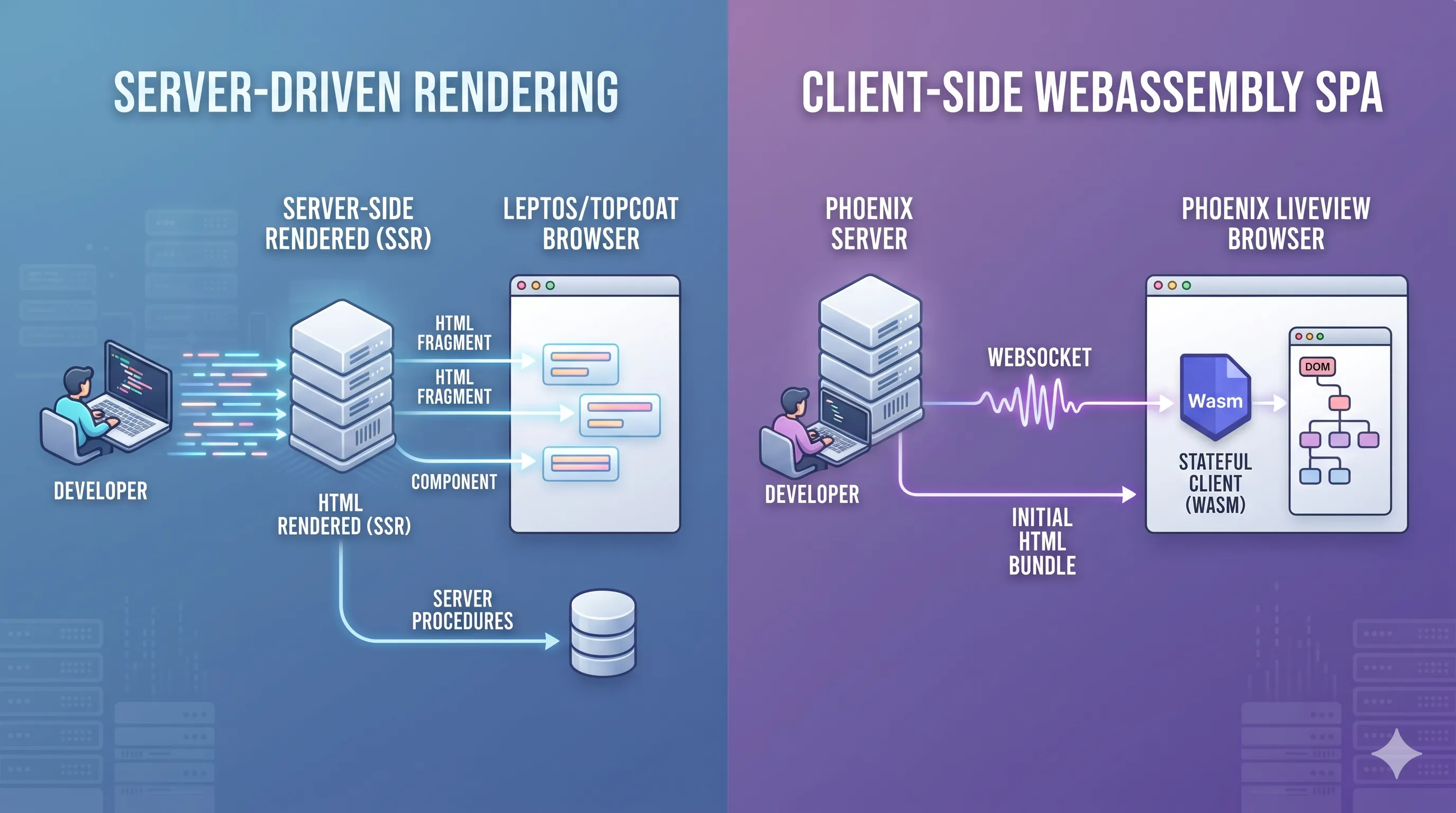
Topcoat directly contrasts with established Rust web frameworks such as Leptos and Dioxus, which primarily compile Rust to WebAssembly and transmit client WASM bundles to the browser.Leptos and Dioxus remain more mature production choices for development teams seeking cross-platform targets or established web patterns with rich client-side runtimes.
Rather than aligning with client-heavy single-page application (SPA) ecosystems like React or SolidJS, Topcoat draws architectural comparisons to Phoenix LiveView, HTMX, Alpine.js, and Datastar.
This server-driven approach focuses on streaming dynamic updates from the backend, keeping execution logic on the server while eliminating the need to ship heavy compiled WASM assets to end users.
Comparison with Full-Stack Rust Frameworks
Topcoat competes conceptually with full-stack frameworks such as Loco.rs and Cot in offering Rails- and Django-inspired full-stack workflows in Rust.Within this category, Loco v1.2 provides server-rendered Tera template support alongside database integrations to streamline backend-driven application construction.
Despite these shared full-stack ambitions, ecosystem observers note that Topcoat currently lacks built-in administrative dashboards and integrated authentication compared to the batteries-included baselines seen in Django or Cot.
| Framework / Ecosystem | Rendering and Delivery Architecture | Architectural Inspiration and Paradigm | Notable Characteristics and Limitations |
|---|---|---|---|
| Topcoat | Server-rendered application delivery skipping client WASM binaries | Phoenix LiveView, HTMX, Alpine.js, Datastar, Rails, and Django | Lacks built-in administrative dashboards and integrated authentication compared to Django or Cot |
| Leptos / Dioxus | Client WebAssembly compilation and browser-transmitted WASM bundles | Client-side single-page applications (SPA) | More mature production choices for teams seeking cross-platform workflows or established web patterns |
| Loco.rs (v1.2) / Cot | Server-rendered HTML via Tera template support and database integrations | Rails- and Django-inspired full-stack frameworks | Cot and Django provide built-in administration and authentication features currently absent in Topcoat |
| Phoenix LiveView / HTMX / Alpine.js / Datastar | Server-driven hypermedia and dynamic client DOM updates | Server-driven reactive interfaces without client-heavy SPA runtimes | Direct architectural inspirations for Topcoat rather than React or SolidJS patterns |
Complementing Axum in the Tokio Application Stack
Topcoat complements Axum rather than directly replacing it within the wider Tokio ecosystem.Axum remains Tokio's lower-level HTTP API router, specialized in handling fine-grained transport control, endpoint definitions, and core request pipeline routing.
Topcoat serves as a higher-level, batteries-included application framework designed to operate alongside these foundations.
By supplying full-stack conventions on top of lower-level primitives, Topcoat addresses application assembly needs while allowing Axum to focus on underlying HTTP networking duties.
5. Edge Cases, Compiler Mismatches, and the Topcoat Development Roadmap
As Topcoat brings server-rendered capabilities to Rust, translating server-side semantics into client-side execution introduces subtle compiler boundary edge cases.Bridging native Rust evaluation and browser environments without standard WebAssembly layers requires precise parity, making it critical to examine the boundaries where native semantics diverge from client runtimes.
Coherence Testing and Rust-to-V8 Evaluation Quirks
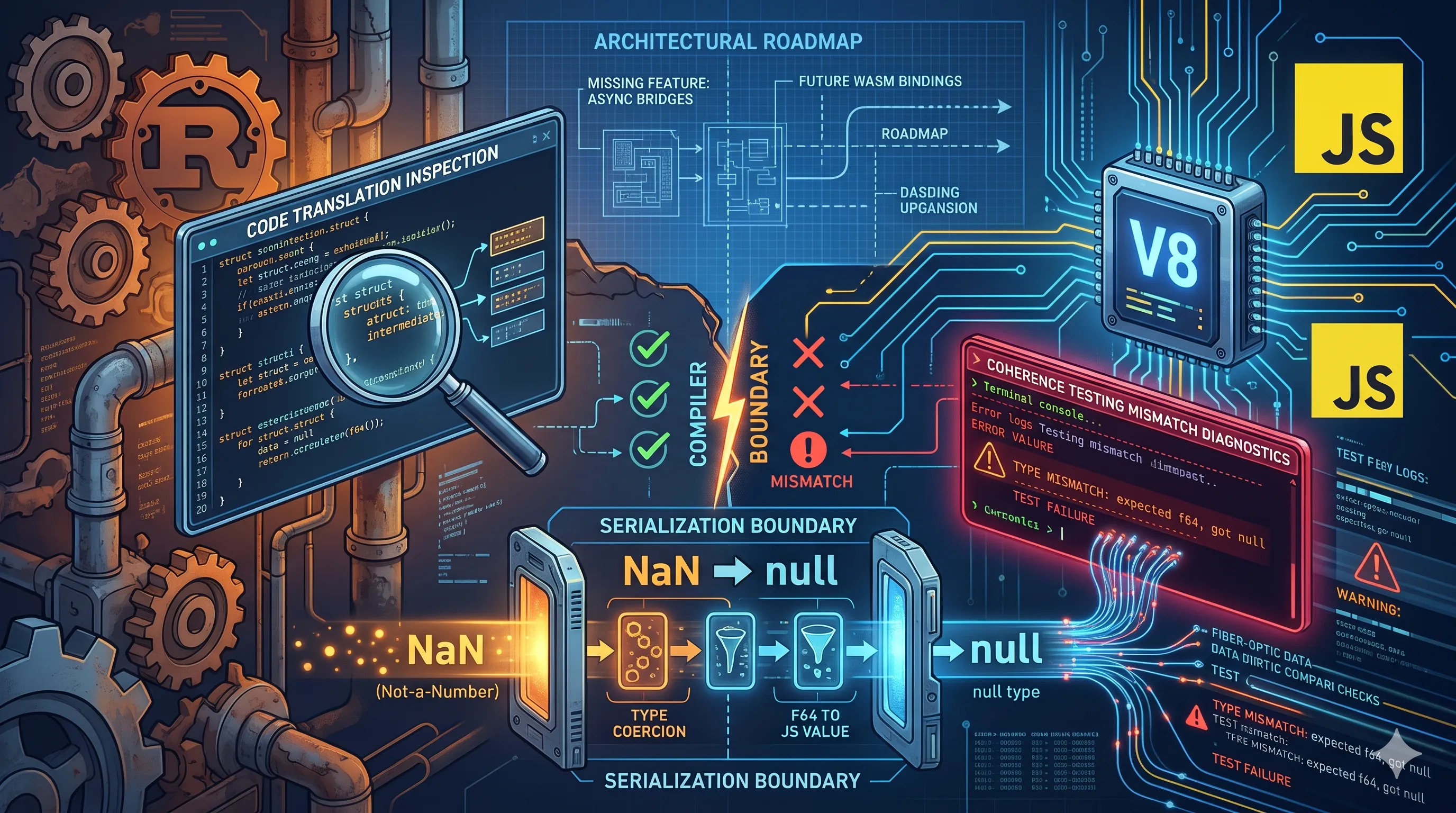
Executing Rust logic in server environments while compiling interactive subsets for client-side JavaScript runtimes introduces distinct behavioral variations.The Topcoat v0.10.0 coherence test suite records 6 known behavioral mismatches between Rust and V8 evaluation.
These discrepancies emerge directly from underlying engine assumptions, where native compiled machine code diverges from the semantics enforced by V8 during dynamic interpretation.
The coherence test suite continuously validates these parity borders to pinpoint operations that compile cleanly on the server but behave differently once executed inside browser engines.
Control Flow Pitfalls in Event Handlers
Control flow constructs within client-side interactions present severe translation challenges for the compiler.Early return statements inside
if conditions within event handlers exit only generated inner arrow functions in JavaScript, allowing trailing code to execute.Because the compiler translates handler branches into isolated lexical scopes, a Rust
return intended to abort an entire event pipeline instead terminates only the immediate anonymous function wrapper.Furthermore, loop and branch interactions produce critical parsing errors in the browser.
Using
break or continue statements inside runtime if conditions generates invalid JavaScript syntax rejected by the browser.While Rust permits early loop termination or iteration jumps across nested blocks, emitting these keywords directly into conditional JavaScript blocks without proper enclosing loop constructs violates ECMAScript grammar, triggering runtime script failures.
Type Serialization Boundaries and the raw! Escape Hatch
Type marshaling across server-to-client boundaries introduces specific data loss edge cases, particularly regarding floating-point numbers.Nonfinite floating-point values like
NaN serialize across boundaries as null and hydrate as unit types, converting to empty strings upon browser updates.Because standard JSON lacks representation for nonfinite IEEE-754 numbers, the transmission pipeline coerces
NaN to null.Upon reaching client-side hydration, Topcoat maps this null state to a unit type, which subsequently wipes active DOM values into empty strings during reactive reconciliation.
| Boundary Issue | Rust Source Context | JavaScript / Browser Manifestation | Runtime Consequence |
|---|---|---|---|
| Handler Early Return | return within conditional if branch |
Exits only generated inner arrow function | Trailing handler logic continues execution |
| Conditional Loop Controls | break or continue inside if block |
Emits control keywords outside JavaScript loops | Invalid JavaScript syntax rejected by browser |
| Nonfinite Float Serialization | Float values evaluating to NaN |
Serializes as null and hydrates as unit |
Converts values to empty strings during updates |
Topcoat offers a
raw! macro escape hatch to embed explicit JavaScript when expressions exceed the supported compiler vocabulary.By leveraging
raw!, developers can write hand-tuned client code directly for complex behaviors that the automated compiler cannot yet represent cleanly.Current Roadmap Gaps and Future Infrastructure
While Topcoat delivers reactive server-rendered capabilities, several full-stack infrastructure primitives remain unaddressed in the current ecosystem.Topcoat lacks built-in background jobs, static exports, OpenAPI endpoints, and native auth flows in current releases.
Application developers requiring asynchronous queuing, static site generation, contract-first API definitions, or out-of-the-box credential management must assemble these capabilities using external libraries.
Ongoing architectural planning and feature development to address these missing primitives are actively tracked under GitHub issue 104.
Related Posts
Inside the AWS Local Cloud Emulator Powered by Smithy and AI AgentsDiscover how AWS uses Smithy API models and autonomous AI agents to power a local emulator...
Inside libghostty-vt 1.0: Modern C ABI Design and Low-Level ToolsExplore modern low-level systems programming advancements, featuring libghostty-vt 1.0, static...

Inside Cult.fit: How OpenAI Codex Powers Citizen DevelopmentDiscover how Cult.fit standardized its software lifecycle on OpenAI Codex, empowering non-technical...
Generative AI may have assisted with research or drafting for this article. Topic selection, fact-checking, final wording, and publication remain the responsibility of DragonStone74. AI use disclosure