
Inside the AWS Local Cloud Emulator Powered by Smithy and AI Agents
🚀 Key Takeaways
- Automated Schema Alignment: Service endpoints are generated directly from official Smithy API models, guaranteeing structural interface parity with AWS SDKs across hundreds of cloud services.
- Autonomous Agent Development: Fleets of autonomous AI agents engineer and maintain the codebase through continuous loops that synthesize tests, detect semantic drift, and implement code fixes.
- Dual Execution Workflows: Teams can run the emulator as a local HTTP daemon via standard endpoint overrides or compile it directly into test binaries for isolated in-process evaluation.
- Transparent Fidelity Scorecards: Granular regression suites benchmark local responses against live AWS endpoints, giving teams quantified visibility into control-plane and data-plane behavioral parity.
- Cost-Free Local Boundaries: The emulator operates with ephemeral in-memory state and zero infrastructure fees, focusing strictly on functional API verification rather than IAM policy enforcement or load testing.
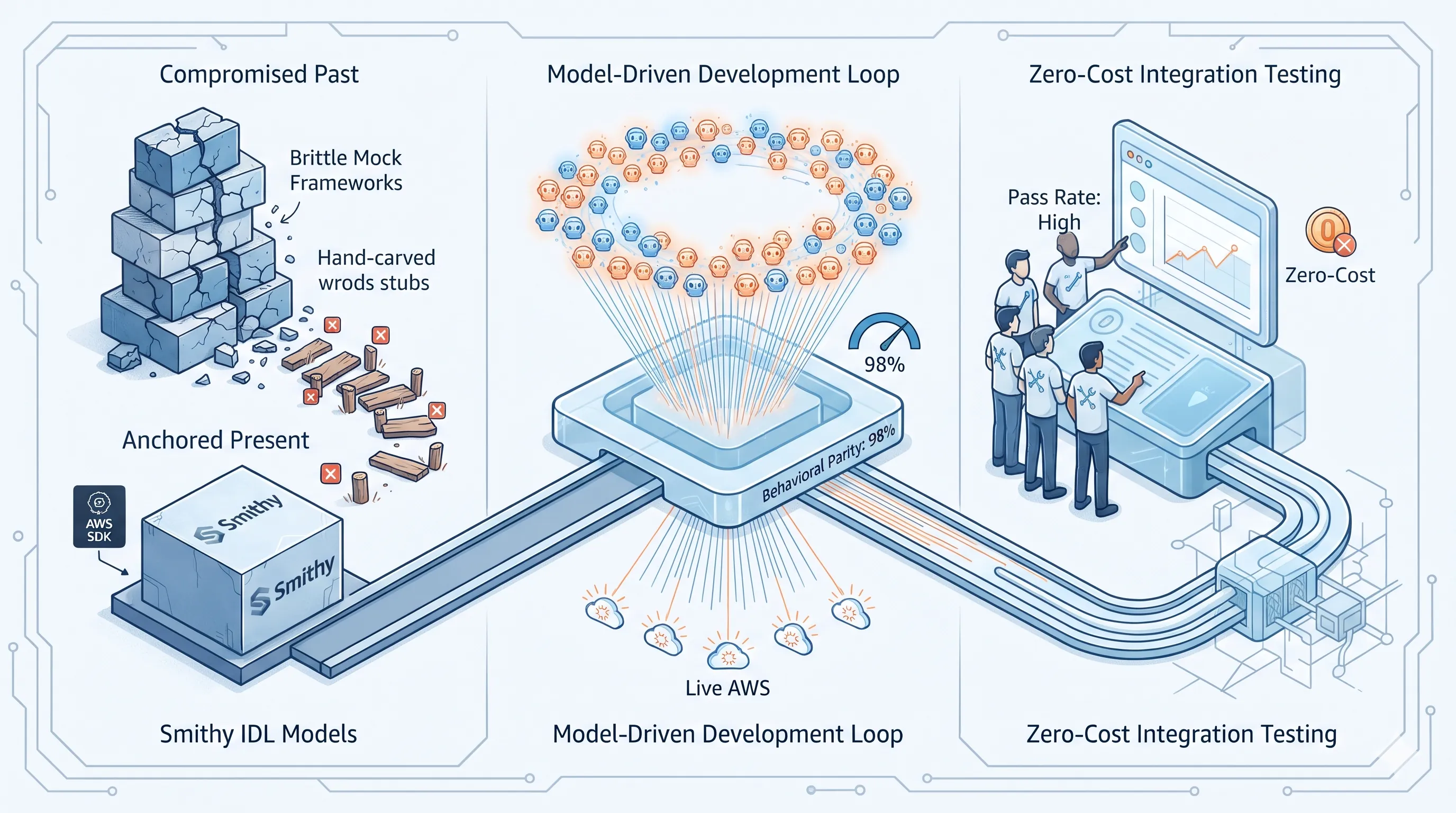
Local cloud development has long been compromised by brittle mock frameworks and hand-crafted stubs that quietly diverge from production behavior. By anchoring its architecture directly to the public Smithy Interface Definition Language models powering official AWS SDKs, the AWS Emulator introduces an automated approach to local cloud fidelity.
Rather than relying on manual feature re-implementation, this model-driven platform operates alongside an autonomous AI agent development system. Thousands of specialized agents continuously execute fidelity test suites against live AWS endpoints, surfacing behavioral edge cases and refining code implementations to mirror live cloud semantics.
For engineers navigating complex cloud architectures, this provides predictable, zero-cost integration testing with measurable behavioral guarantees. Exploring how Smithy schemas and autonomous verification power the emulator highlights a major evolution in how local cloud tooling is constructed, verified, and integrated into modern engineering pipelines.
1. Smithy-Driven Architecture: Compiling Hundreds of AWS Interfaces into Rust Crates
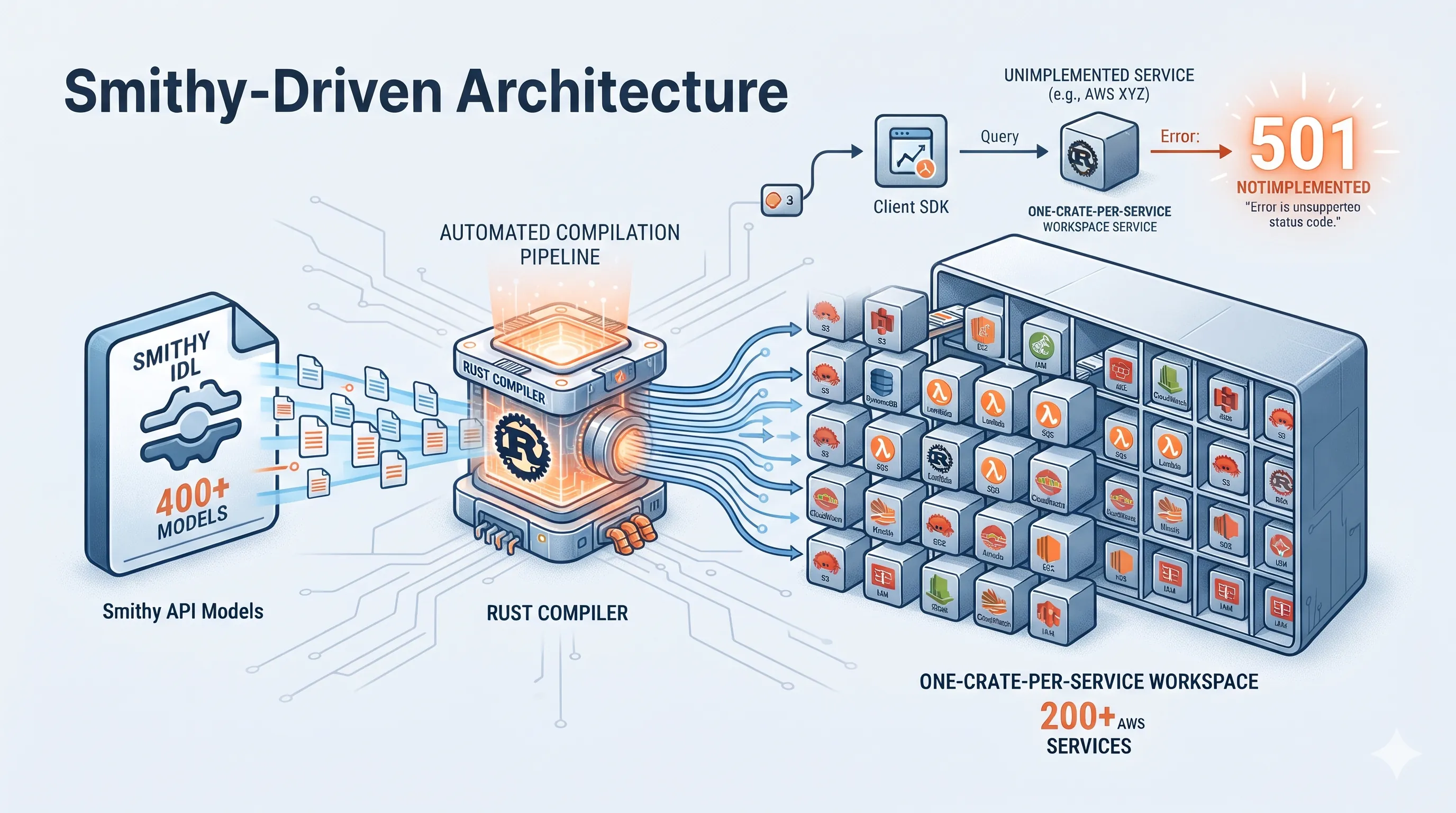
The foundation of how the AWS Emulator accurately mimics cloud environments for testing lies in its automated, model-driven compilation pipeline.By anchoring local testing infrastructure directly to official service definitions, the emulator mirrors cloud behaviors without requiring hand-coded interface bindings for every target endpoint.
From IDL Definitions to One-Crate-per-Service Workspace
The AWS Emulator is constructed entirely in Rust, organizing its broad emulation surface through a modular workspace design.Within this Rust workspace structure, the build architecture allocates one dedicated crate per emulated AWS service.
This modular division allows the system to scale across more than 200 AWS services while maintaining clean compilation boundaries.
The entire interface catalog is generated from more than 400 Smithy API models published by AWS for its official SDKs.
As attributed by Swaminathan Sivasubramanian, grounding the emulator's generation in these 400-plus public Smithy models ensures that the local test framework reflects the exact public API interfaces distributed to developers worldwide.
| Architectural Component | Specification & Implementation Detail |
|---|---|
| Language & Workspace Pattern | Constructed in Rust using a workspace structure that allocates one crate per emulated AWS service. |
| Upstream Model Base | Generated from more than 400 public Smithy API models released by AWS for its official SDKs. |
| Emulated Surface Area | Emulates public API interfaces spanning more than 200 distinct AWS services. |
| Interface Derivation | Generates service endpoints directly from public Smithy Interface Definition Language models to maintain schema alignment. |
| Unsupported Route Handling | Returns HTTP status code 501 with the error code NotImplemented. |
Schema Alignment and NotImplemented Error Handling
Generating service endpoints directly from public Smithy Interface Definition Language (IDL) models guarantees strict schema alignment across requests and responses.Because the generated Rust crates adhere directly to the Smithy IDL specifications, input parsing, serialization rules, and endpoint paths stay synchronized with official cloud contracts.
When client SDKs invoke operations that have not yet had custom mock logic implemented within the service crate, the runtime maintains protocol fidelity rather than failing unexpectedly.
In these instances, the emulator returns HTTP status code 501 with the explicit error code NotImplemented.
This uniform fallback behavior allows test runners to distinguish missing local handlers from malformed requests or schema mismatches.
2. The Autonomous AI Agent Development Loop: Model-Based Testing and Automated Fixes
The operationalization of API models into a functioning local environment relies on an autonomous software engineering loop, directly connecting Smithy-modeled specifications to production-grade parity without manual intervention.The codebase of the AWS Emulator is 100% written by autonomous AI agents, using thousands of agents that write tests, identify defects, and implement fixes without human review.
Three-Division Agent Architecture on Amazon Bedrock AgentCore
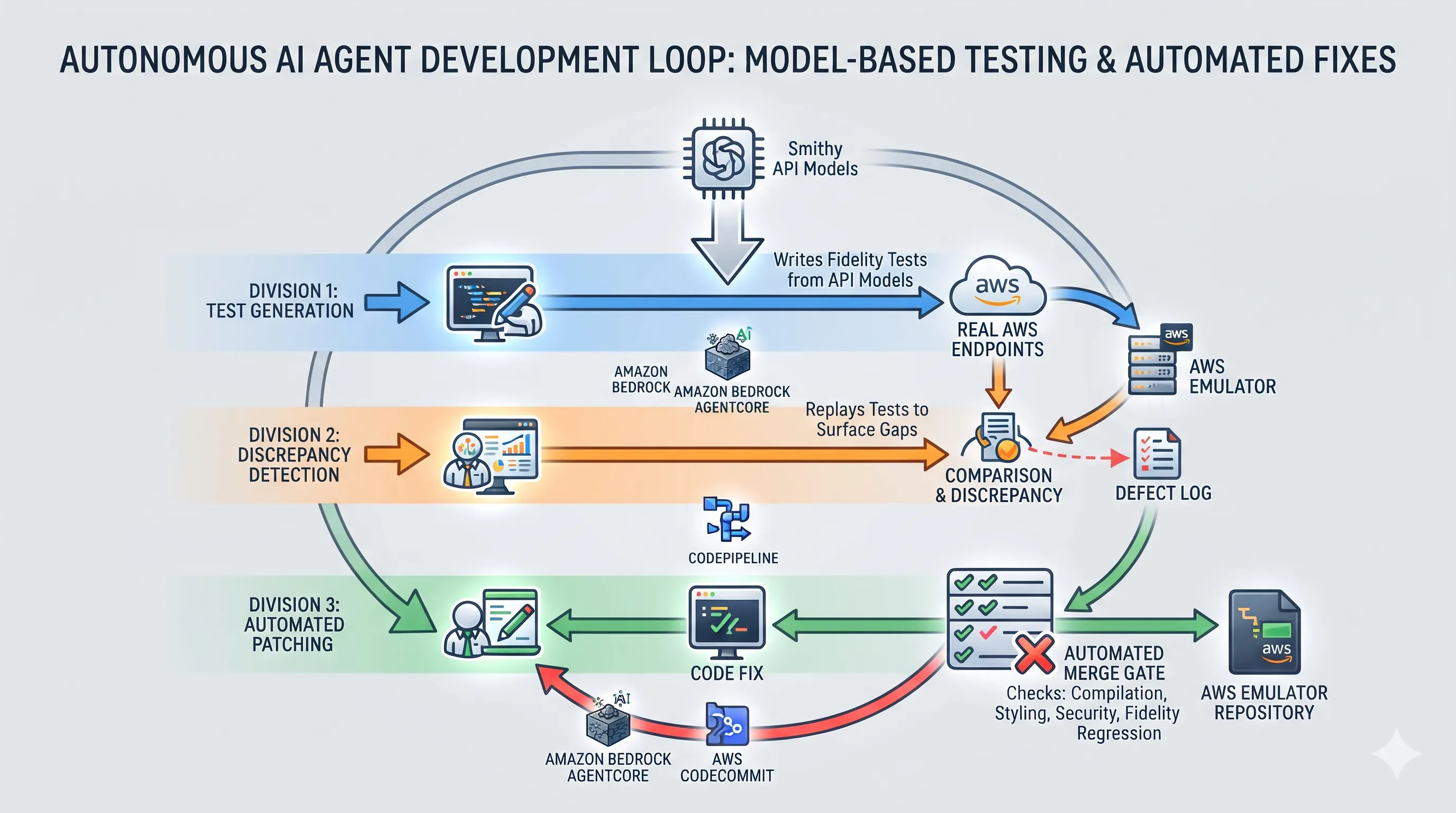
Matthew Goldberg, Senior Principal Engineer at AWS, detailed the three-team agent architecture executing against real AWS endpoints to establish behavioral parity.The autonomous agent infrastructure operates directly on Amazon Bedrock AgentCore Runtime Instances, AWS CodePipeline, and AWS CodeCommit.
Work is systematically partitioned across three specialized agent divisions that iterate against live cloud behaviors and public API models.
| Agent Division | Primary Responsibility | Execution Target |
|---|---|---|
| Division 1: Test Generation | Writes fidelity tests derived from public API models | Real AWS endpoints |
| Division 2: Discrepancy Detection | Replays tests to identify and report behavioral discrepancies | AWS Emulator vs. live cloud baseline |
| Division 3: Automated Patching | Writes code fixes to resolve reported behavioral defects | AWS Emulator repository |
The second division replays these test suites against the local emulator to surface discrepancies between the baseline and the emulated environment.
Once defects are logged, the third division writes code fixes directly to the codebase to reconcile the behavioral gaps.
Continuous Merge Gates and Discrepancy Reconciliation
Because development proceeds entirely without human review, code changes must clear strict programmatic hurdles prior to integration.The pipeline employs an automated merge gate requiring all commits to pass compilation, coding standards, security scans, and fidelity regression checks.
When the patch generation agents propose updates via AWS CodeCommit and AWS CodePipeline, the merge gates validate that the implementation strictly mirrors live service behavior.
If any compilation error, styling deviation, security scan violation, or fidelity regression occurs, the pull request is rejected and redirected into the agent loop for automated remediation.
3. Measuring Behavioral Fidelity: Scorecards, Pass Rates, and Implementation Gaps
While Smithy API models supply the formal schemas and contract boundaries for the AWS Emulator, evaluating actual emulation accuracy requires strict behavior matching against live AWS environments.A test achieves a passing status only when the emulator reproduces the identical behavior of the real cloud service, including matching HTTP status codes, producing exact error responses, and executing identical operational side effects.
To track this alignment, behavioral testing is evaluated across discrete service layers and operational planes.
Control-Plane Versus Data-Plane Fidelity Benchmarks
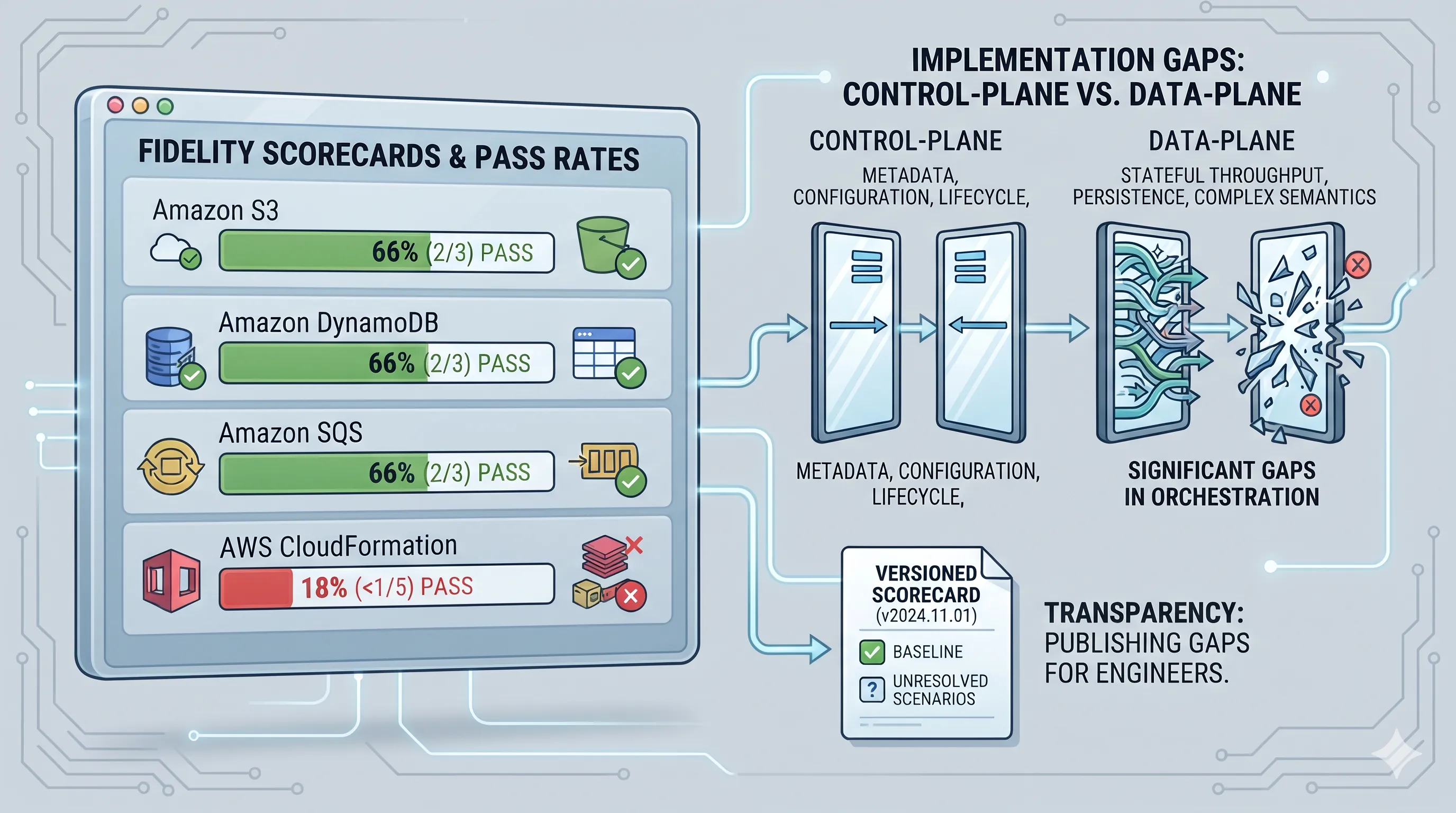
Fidelity aligns closest on control-plane APIs compared to data-plane operations.Because control-plane endpoints primarily manage metadata, resource configurations, and lifecycle events, they map more directly to Smithy definitions and schema validations.
In contrast, data-plane operations involve stateful throughput, complex persistence mechanics, and nuanced stream or query semantics that present higher implementation hurdles.
As identified by developer Josh Builds, published fidelity tests show distinct tiers of service maturity across the platform.
| Target Service | Reported Test Pass Rate | Observed Fidelity Behavior |
|---|---|---|
| Amazon S3 | Approximately 2 in 3 tests | Consistent behavior across baseline object and bucket handling, with remaining gaps in deep operational side effects. |
| Amazon DynamoDB | Approximately 2 in 3 tests | Solid control-plane and standard query matching, though specific data-plane side effects and exact error envelopes may diverge. |
| Amazon SQS | Approximately 2 in 3 tests | High parity on message queue configuration and standard messaging, with edge-case behaviors remaining unpassed. |
| AWS CloudFormation | Fewer than 1 in 5 tests | Significant implementation gaps across complex resource orchestration and dependency resolution flows. |
IaC Emulation Discrepancies and Versioned Scorecards
The gap in behavioral fidelity introduces distinct friction when testing deployment workflows.Support for Infrastructure as Code (IaC) tooling—including CloudFormation, Terraform, and the AWS CDK—varies significantly across services due to the emulator's uneven pass rates.
Because CloudFormation passes fewer than 1 in 5 published fidelity tests, automated stacks that rely heavily on native engine provisioning frequently encounter unhandled edge cases or unsupported resource transitions.
To maintain transparency regarding these limitations, AWS distributes versioned fidelity test suites and per-service scorecards alongside each emulator release.
These evaluation test suites deliberately include scenarios that the current emulator release does not yet pass.
By publishing test runs that incorporate unresolved scenarios, the versioned scorecards provide engineers with an exact accounting of verified versus unimplemented service behaviors before integrating CDK or Terraform pipelines into local test environments.
4. Execution Workflows: Server Mode, Embedded Rust Binaries, and Setup Prerequisites
Operationalizing Smithy API models for local testing requires flexible runtime topologies that fit both developer workstations and automated integration pipelines.The AWS Emulator exposes the generated Smithy contract validation logic through two distinct operational architectures: an out-of-process server daemon and an embedded in-process testing harness.
Connecting these operational modes to existing tooling enables developers and automated coding agents to validate AWS workflows locally without touching live cloud infrastructure.
Server Mode Versus Embedded In-Process Rust Testing
Server mode operates as an independent local service that processes requests from any AWS software development kit (SDK) or client utility.When started in server mode, the emulator serves local HTTPS traffic on default address 127.0.0.1:9297 using a self-signed certificate.
This architecture allows standard AWS CLI and AWS SDK clients to target the local endpoint via standard environment variables such as AWS_ENDPOINT_URL without altering existing application code.
Because communication occurs over HTTP/HTTPS, multiple independent applications and terminal sessions can communicate concurrently with the same running emulator instance.
Embedded mode, in contrast, eliminates the network daemon overhead for native Rust test suites.
In this topology, developers compile the emulator directly into Rust test binaries, running an isolated in-process instance per test and binding directly to the SDK client.
This provides total state isolation between concurrent test executions while verifying model compliance directly within memory.
System Requirements, Platform Packages, and Telemetry Controls
Setting up the AWS Emulator requires specific tooling, dependencies, and environment considerations across target platforms.Workflows executed by coding agents using the aws-emulator skill require AWS CLI version 2.35.0 or later to ensure endpoint redirection operates reliably.
For engineers compiling the emulator from source, local storage requirements are substantial: building the project requires at least 100 GB of free disk space allocated to the target directory.
Platform distribution formats vary significantly depending on the operating system.
Prebuilt binaries are supplied for Linux as RPM and Debian packages supporting both x86_64 and aarch64 architectures.
However, AWS does not distribute prebuilt container images for macOS and Windows, requiring local builds from a provided Dockerfile on those platforms.
Furthermore, the project repository maintains an issue-only contribution model; it does not accept external pull requests, redirecting all external community bug reports and requests to GitHub Issues.
| Platform / Target OS | Supported Architecture | Distribution and Installation Mechanism |
|---|---|---|
| Linux | x86_64, aarch64 | Prebuilt RPM and Debian packages |
| macOS | Host dependent | Local builds required from provided Dockerfile (no prebuilt containers) |
| Windows | Host dependent | Local builds required from provided Dockerfile (no prebuilt containers) |
Operators can explicitly disable telemetry collection via CLI flags, environment variables, configuration files, or embedded APIs.
To disable usage telemetry when starting the emulator from the command line, provide the dedicated flag during invocation:
aws-emulator --telemetry offTo disable telemetry across all emulator invocations in a shell session without specifying command-line flags repeatedly, set the environment configuration variable:
export EMULATOR_TELEMETRY=off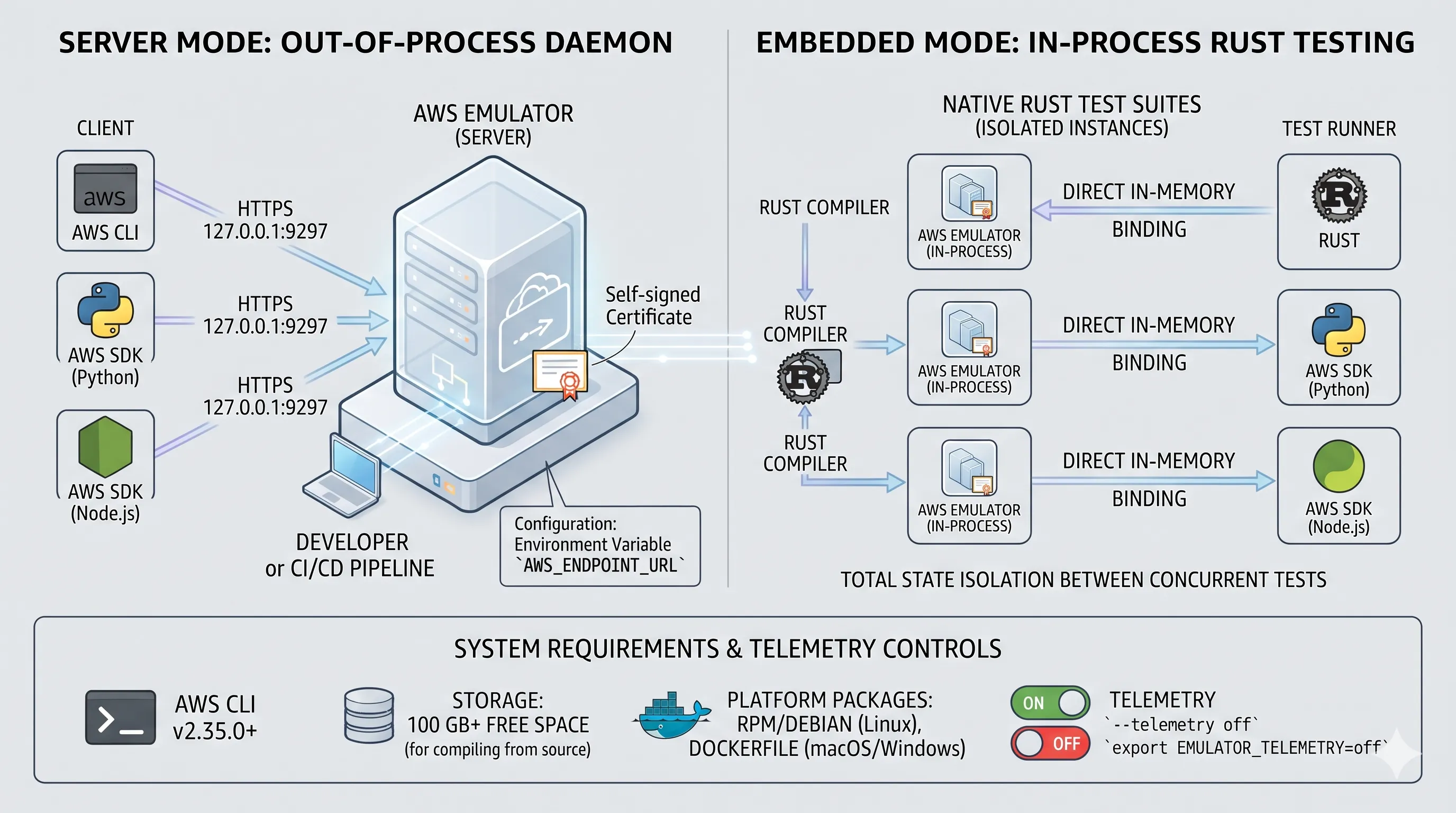
5. Operational Scope: Non-Goals, Policy Omissions, and Ephemeral Boundaries
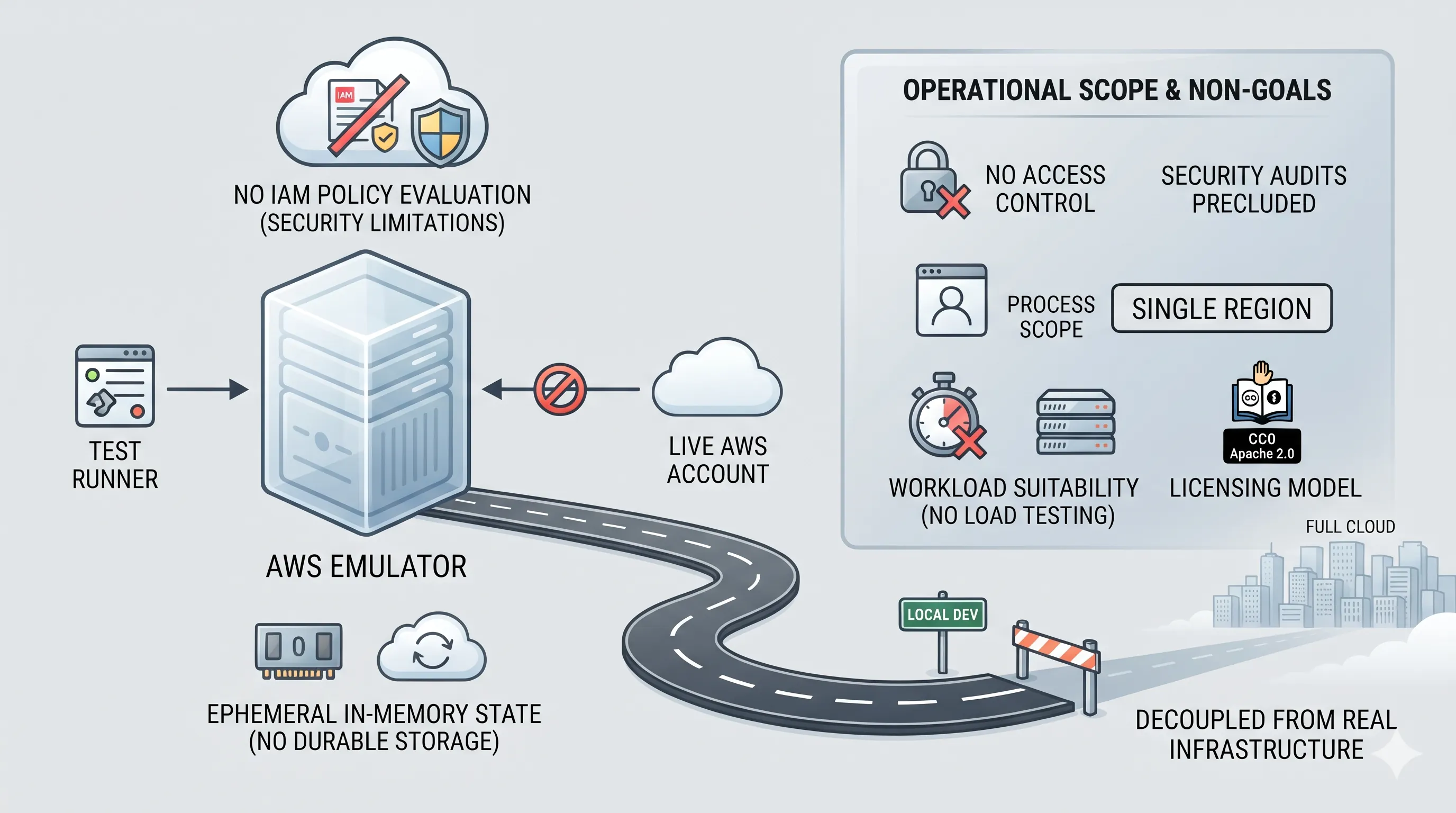
Connecting directly to the broader exploration of how the AWS Emulator uses Smithy API models for testing, establishing operational boundaries is essential for understanding where model-driven emulation stops and full cloud validation begins.While Smithy interface contracts govern the structure, types, and protocol serialization of mock endpoints, the emulator is deliberately designed with architectural non-goals that keep it lightweight, decoupled from real infrastructure, and friction-free for local development.
The core source code is published under the CC0 1.0 Universal public domain dedication, while third-party code packaged in the vendor/ directory is licensed under Apache 2.0.
Because the tool executes entirely in local environments, it incurs zero AWS service fees and operates without requiring an AWS account or active cloud credentials.
| Dimension | Operational Specification | Boundary Status and Architectural Impact |
|---|---|---|
| Licensing Model | CC0 1.0 Universal public domain dedication (with vendor/ code under Apache 2.0) | Unencumbered open-source distribution without proprietary runtime overhead. |
| Cloud Cost and Account Requirement | Zero AWS service fees; no AWS account required | Enables isolated, credential-free execution in offline local workflows and test runners. |
| Access Control Evaluation | No evaluation of IAM or resource-based policies | Precludes use for security, credential, or permission validation. |
| Process Scope | Constrained to a single shared AWS account and Region per process | Does not simulate multi-region routing or multi-tenant account boundaries. |
| State Management | Ephemeral in-memory lifecycle | All simulated state disappears completely when the emulator process terminates. |
| Workload Suitability | Not engineered or validated for load testing or extended runtimes | Targeted strictly at functional correctness rather than sustained operational traffic. |
Security Limitations: Absent IAM and Access Policy Enforcement
A core architectural omission in the emulator is the deliberate absence of an authorization and identity evaluation layer.The emulator does not evaluate IAM policies, role trust policies, or resource-based policies attached to simulated entities.
Consequently, every API request received by the Smithy-modeled dispatch layer is treated as authorized, regardless of the calling identity or simulated permissions.
This explicit design decision completely precludes the emulator's use for security audits, least-privilege validation, or policy configuration testing.
Teams verifying permission boundaries, service control policies (SCPs), or fine-grained resource policies must rely on cloud-hosted environments rather than this local emulator.
Additionally, the runtime is strictly constrained to a single shared AWS account and Region per running process, preventing the validation of cross-account access rules or cross-region event topologies within a single instance.
Ephemeral In-Memory State and Concurrency Limits
The persistence model of the AWS Emulator is strictly transient and scoped to the active execution lifetime.The system relies on in-memory state that disappears as soon as the emulator process terminates.
Because no state is written to persistent disks or durable databases, test fixtures, database records, and mock infrastructure constructs are erased between restarts.
This makes the emulator optimal for idempotent, deterministic unit and component integration tests, but incapable of serving scenarios requiring state survival across lifecycle boundaries.
Furthermore, the emulator is not engineered or validated for load testing or extended, long-running operational workloads.
Related Posts
Inside Topcoat: The New Full-Stack Rust Web Framework Without WASMDiscover Topcoat, a new full-stack Rust web framework by Tokio creators that brings server-rendered...
How Pyrefly Speeds Up Python Type Checking With RustDiscover how Google and Meta use Pyrefly, a high-performance Rust-powered Python type checker, to...
OpenAI's GPT-5.5 & Frontier Models Now Native on AWS Bedrock: Transform Enterprise AI, Coding & Autonomous AgentsAWS customers can now directly access and deploy OpenAI's cutting-edge models , including the...
Generative AI may have assisted with research or drafting for this article. Topic selection, fact-checking, final wording, and publication remain the responsibility of DragonStone74. AI use disclosure