
How Pyrefly Speeds Up Python Type Checking With Rust
🚀 Key Takeaways
- Unprecedented Execution Speed: Engineered in Rust, Pyrefly processes code at massive throughput and enables sub-second incremental rechecks that eliminate developer turnaround bottlenecks.
- Enterprise Monorepo Adoption: Tech leaders including Google and Meta have transitioned mission-critical systems to Pyrefly, replacing legacy checkers to dramatically streamline developer edit-and-test loops.
- Strict Typing Conformance: Pyrefly combines near-complete alignment with official Python typing standards, sound union validation, and Rust-style diagnostic messages pinpointing exact root causes.
- Intelligent Framework Integration: Native support for tools like Pydantic, Django, and PyTorch—alongside automated migration utilities—ensures rapid onboarding without disrupting existing configurations.
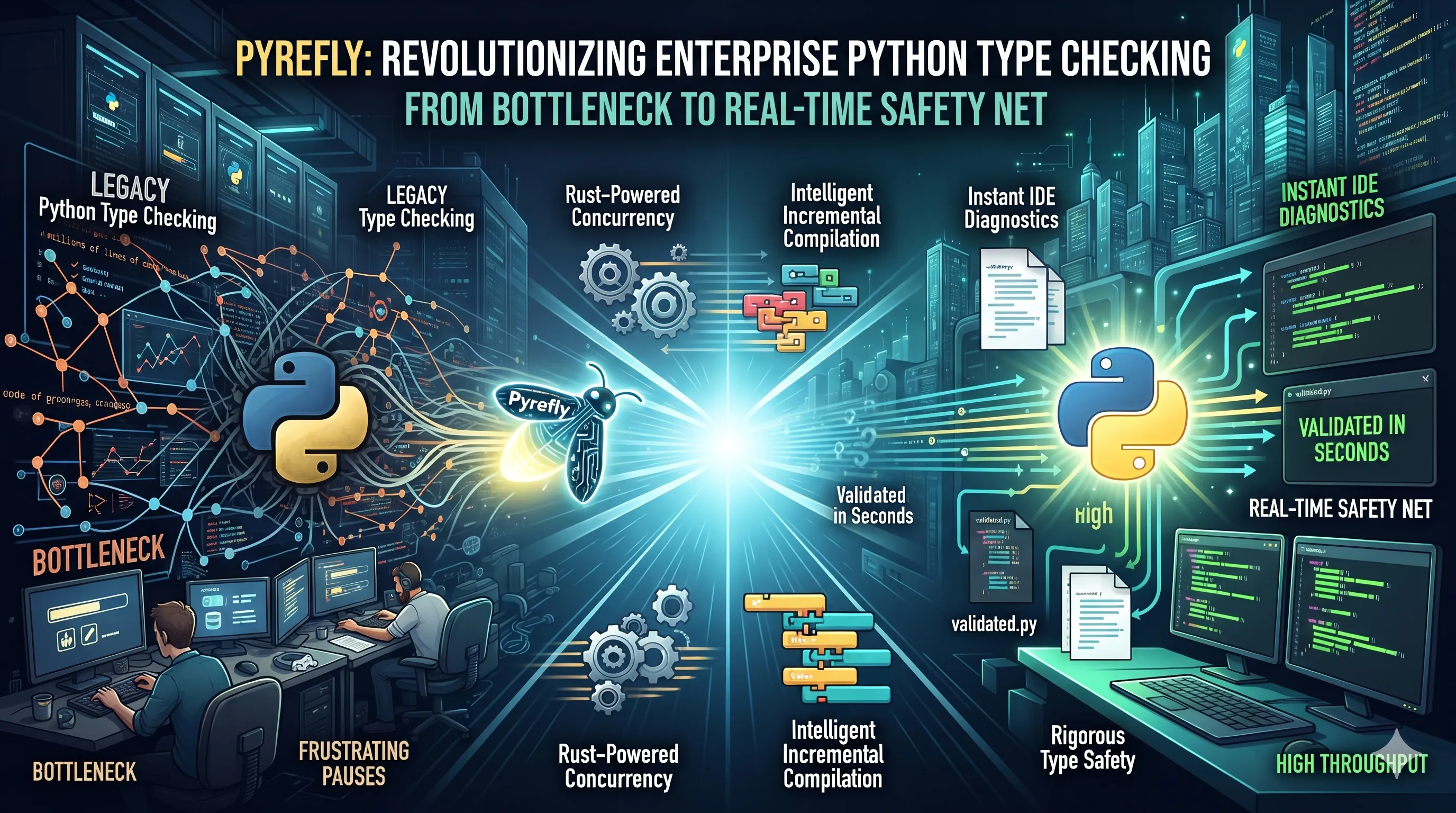
As enterprise Python systems expand to tens of millions of lines, static type verification has frequently degraded into one of the slowest stages of software delivery.
Developers have historically grappled with brittle bytecode analyzers and sluggish checkers that strain under sprawling dependency graphs, turning routine file saves into frustrating pauses.
Pyrefly represents a structural shift in Python tooling, combining Rust-powered concurrency with an intelligent incremental compilation model.
By delivering instantaneous IDE diagnostics alongside the throughput required to validate monolithic codebases in seconds, it transforms static analysis from a continuous build bottleneck into an agile, real-time safety net.
Beyond raw velocity, Pyrefly raises the standard for type safety through rigorous adherence to modern typing specifications, intuitive compiler errors, and deep awareness of ubiquitous libraries.
Understanding Pyrefly's architectural strengths demonstrates why industry giants are standardizing on next-generation type checking to accelerate their engineering velocity.
1. Replacing Pytype at Google: Monorepo Scale and Rebuild Latency Reduction
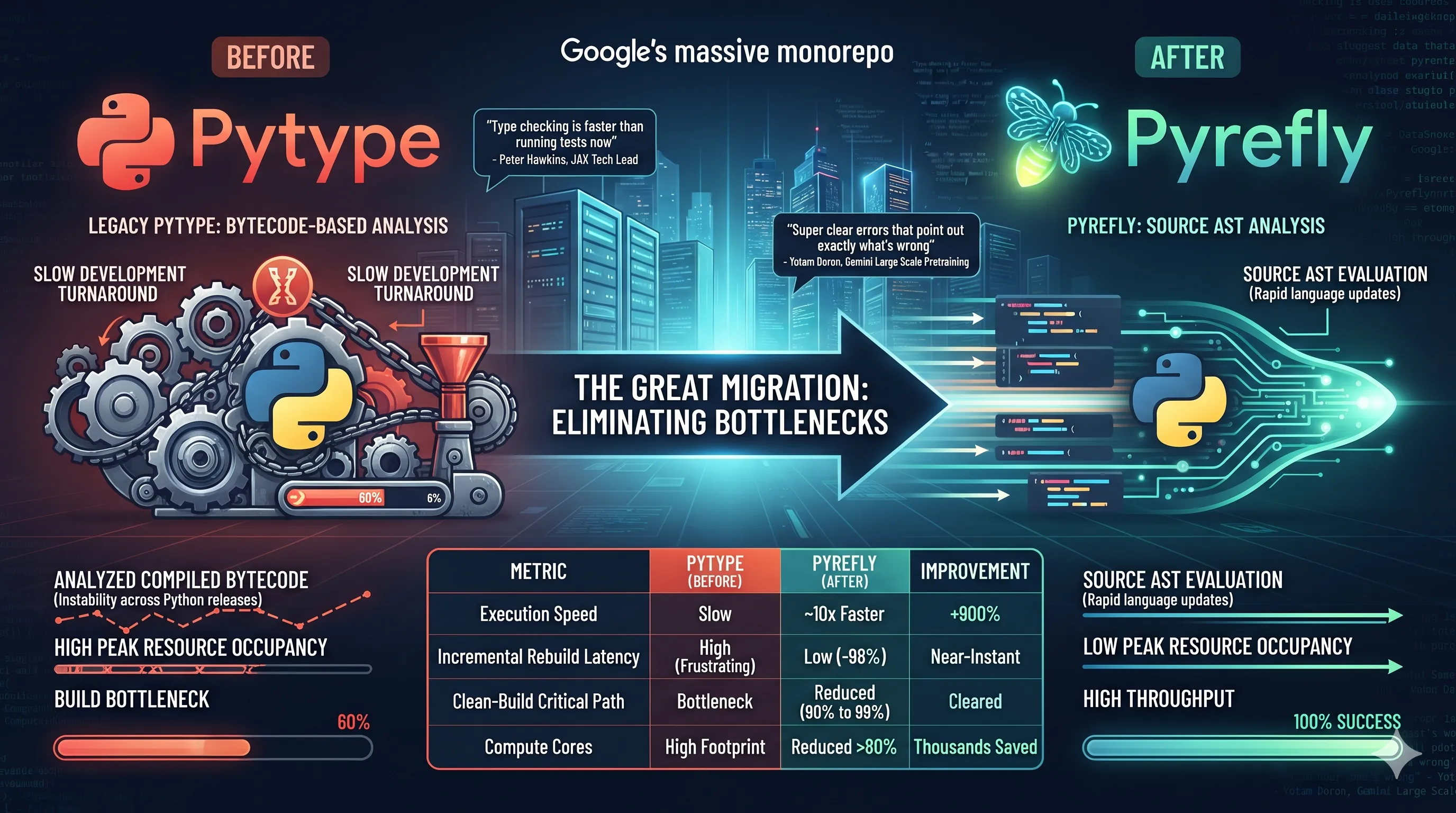
Understanding how Pyrefly improves Python type checking requires examining its performance in massive enterprise codebases.Google demonstrated this impact by replacing Pytype with Pyrefly across its internal monorepo, which houses hundreds of thousands of Python files.
Bytecode Limitations and the Migration Away from Pytype
Pytype was internally developed starting in 2012 and established Python 3.12 as its final supported version.A core limitation of Pytype stemmed from its underlying architecture: it analyzed compiled bytecode rather than source ASTs.
This reliance on bytecode created an ongoing maintenance burden due to bytecode instability across Python releases.
As the language evolved, Pytype struggled to maintain pace with modern typing PEPs and deliver fast development turnarounds.
Transitioning to Pyrefly eliminated these architectural constraints, replacing bytecode analysis with direct source evaluation to support rapid language updates.
| Metric / Architectural Dimension | Pytype | Pyrefly |
|---|---|---|
| Analysis Representation | Analyzed compiled bytecode (faced bytecode instability across releases) | Source AST analysis |
| Execution Speed | Baseline performance | Approximately 10 times faster in internal Google benchmarks |
| Incremental Rebuild Latency | Slow development turnaround | Reduced latency by up to 98% in edit-and-rebuild workflows |
| Clean-Build Critical Path | Represented a long-standing build bottleneck | Reduced type-checking share of critical paths by 90% to 99% |
| Compute Resource Occupancy | High peak resource footprint | Reduced peak compute occupancy by >80%, saving thousands of machine cores daily |
| Lifecycle Status | Developed since 2012; Python 3.12 established as final supported version | Active type checker across Google's monorepo |
Quantifying Compute and Build Path Reductions Across Google's Monorepo
Internal Google benchmarks showed that Pyrefly runs approximately 10 times faster than Pytype.In day-to-day developer edit-and-rebuild workflows, Pyrefly reduced incremental rebuild latency by up to 98%.
The adoption of Pyrefly also eliminated long-standing bottlenecks along Google build critical paths, reducing the type-checking share of clean-build critical paths by 90% to 99%.
Beyond individual developer speed, the migration yielded infrastructure efficiency improvements.
Pyrefly reduced Google peak compute occupancy for Python type checking by more than 80%, saving thousands of machine cores daily across the monorepo.
Production Validation from JAX and Gemini Engineering Teams
Engineers deploying critical systems across Google have documented substantial workflow improvements following the Pyrefly migration.Peter Hawkins, JAX Tech Lead, underscored the impact on execution speed: "I haven't waited for a Pytype action to complete since our project switched [to Pyrefly].
It is doubly awesome for agentic coding.
Type checking is faster than running the tests now."
Diagnostics and error clarity have shown equal utility in large-scale machine learning workflows.
Yotam Doron of Gemini Large Scale Pretraining stated: "I really like that Pyrefly gives super clear errors that point out exactly what's wrong."
Tom Ward of GDM Science reinforced these findings: "Pyrefly keeps our experimental iterations fast and catches subtle bugs early with clear, actionable errors."
2. Rust-Powered Architecture: Achieving Multi-Threaded Throughput and Sub-10ms IDE Latency
Understanding how Pyrefly improves Python type checking requires an examination of its foundational engine, which replaces legacy single-threaded type analysis with high-throughput native execution.Rust Core and Parallel Lazy Evaluation Engine
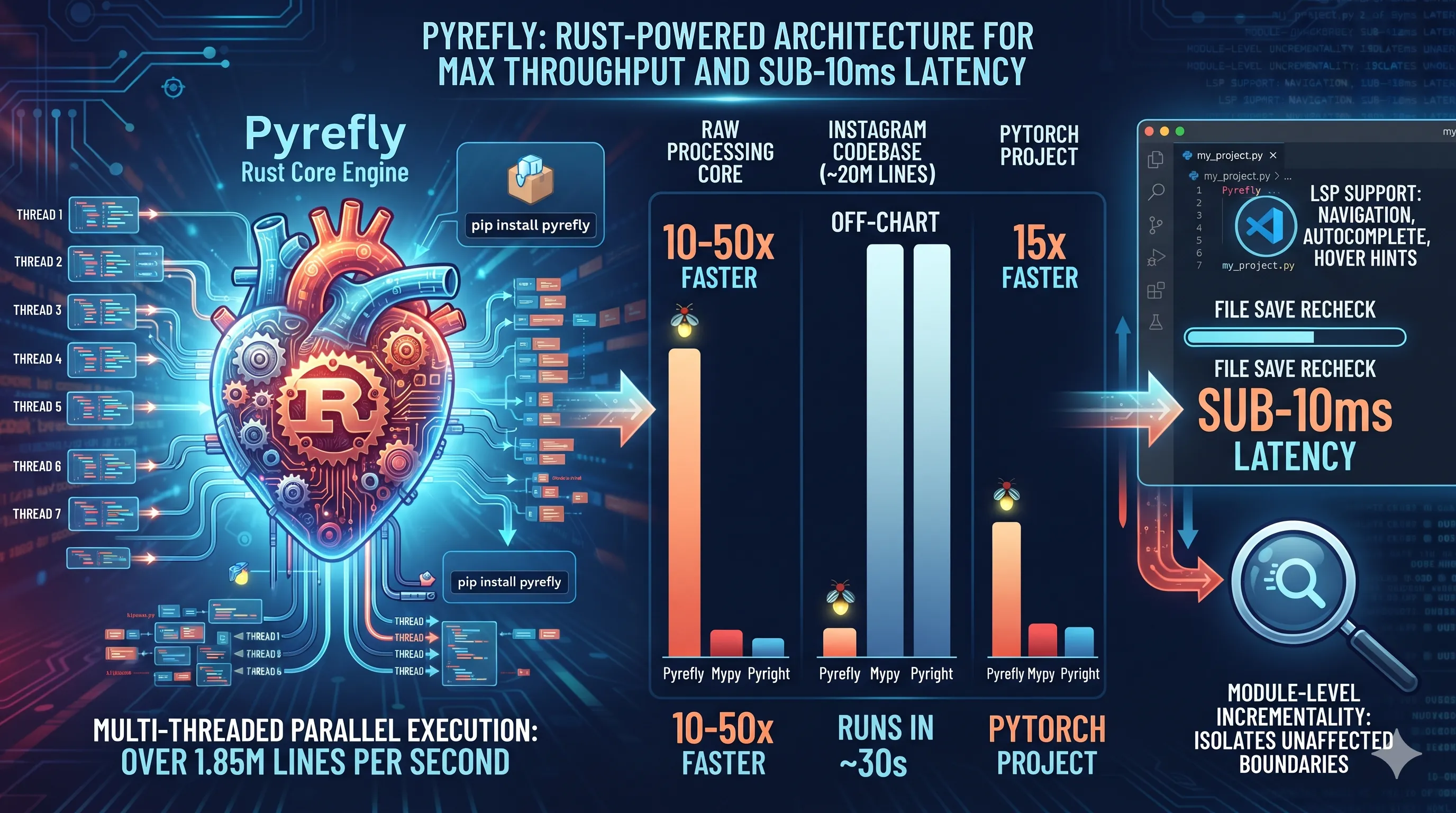
Pyrefly is implemented in Rust to maximize execution efficiency.By moving away from Python-interpreted checking runtimes, the core engine processes over 1.85 million lines of code per second.
To sustain this throughput across complex architectures, Pyrefly employs a custom incremental computation model and multi-threaded parallel checking across available cores.
The engine utilizes lazy evaluation to scale across large dependency graphs, ensuring that type rules and symbol tables are evaluated only when directly demanded by downstream type queries.
To install the Pyrefly command-line tool via pip, run the following command:
pip install pyreflyModule-Level Incrementality and Language Server Protocol Performance
Interactive editor workflows rely on immediate feedback loops rather than batch recompilations.Pyrefly features module-level incrementality that only rechecks modules affected by source changes.
Because the computation graph isolates unaffected boundaries, rechecks in IDE environments typically complete in under 10 milliseconds after saving a file.
Beyond pure diagnostic reporting, Pyrefly includes full Language Server Protocol (LSP) support for editor navigation, autocomplete, hover hints, and semantic highlighting.
Developers obtain immediate semantic inspections without locking editor threads or pausing background checks.
Large-Scale Verification Benchmarks: Instagram and PyTorch
The real-world advantage of this architecture is evident when comparing runtimes against traditional industry tools.Pyrefly runs 10 to 50 times faster than mypy and pyright on large codebases.
For instance, Meta runs Pyrefly on Instagram's codebase of approximately 20 million lines in roughly 30 seconds.
Similarly, Pyrefly type checks projects like PyTorch 15 times faster than Mypy and Pyright.
| Target / Environment | Scale or Benchmark Scope | Observed Pyrefly Performance | Comparison vs. Mypy and Pyright |
|---|---|---|---|
| Raw Processing Core | Multi-threaded execution across available cores | Over 1.85 million lines of code per second | 10 to 50 times faster on large codebases |
| Instagram Codebase | Approximately 20 million lines | Roughly 30 seconds | 10 to 50 times faster on large codebases |
| PyTorch Project | Full project type verification | High-speed parallel type check | 15 times faster than Mypy and Pyright |
| IDE / LSP Session | File save recheck | Under 10 milliseconds | Sub-10ms response with full LSP support |
3. Typing Specification Conformance and Rust-Style Sound Diagnostics
Pyrefly improves Python type checking by moving away from legacy heuristic evaluation and anchoring its engine directly to modern typing specification conformance and rigorous sound analysis.Conformance Dashboard Metrics and Specification Alignment
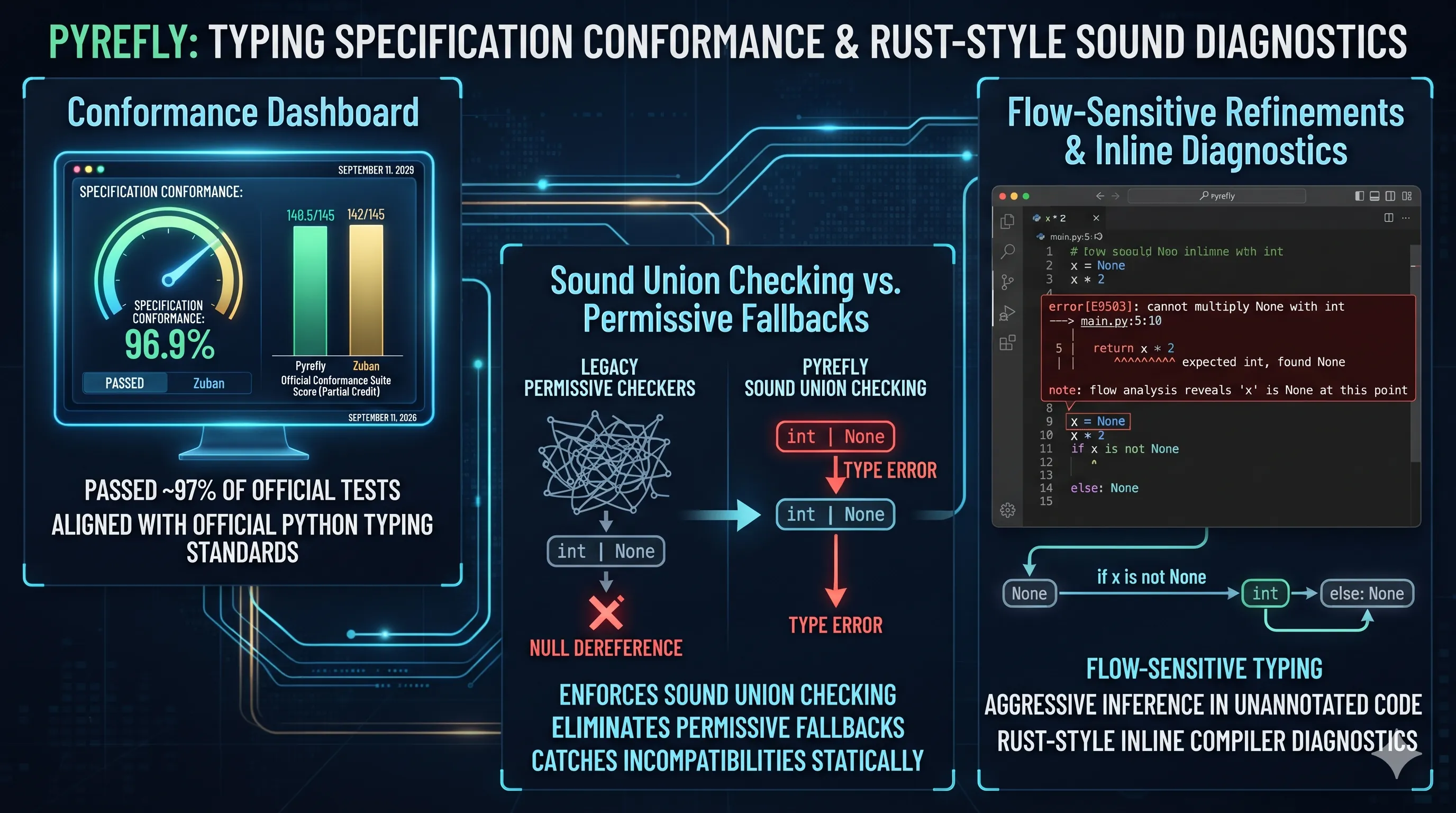
Pyrefly achieves broad compliance with standard typing behaviors, passing approximately 97% of tests in the official typing specification conformance test suite.On September 11, 2026, Pyrefly recorded a score of 140.5 out of 145 (96.9%) when evaluated with partial credit on the official typing conformance dashboard.
Despite this high level of specification adherence, Pyrefly scored behind Zuban on the partial-credit conformance metric on the official dashboard.
| Evaluation Metric | Specification Score / Benchmark Result | Comparative Standing |
|---|---|---|
| Official Conformance Suite Pass Rate | Approximately 97% | Aligned with official Python typing standards |
| Conformance Dashboard Score (September 11, 2026) | 140.5 out of 145 (96.9% with partial credit) | Scored behind Zuban on the partial-credit metric |
Sound Union Checking vs. Permissive Type Fallbacks
A central architectural advancement in how Pyrefly improves type checking is its implementation of sound union checking.Pyrefly enforces sound union checking in analytical contexts where older tools like Pytype were historically permissive.
Under this sound model, Pyrefly flags errors when passing a union type like
int | None or int | str to a function expecting a concrete type like int.By eliminating permissive fallbacks, the type checker catches potential null dereferences and type incompatibilities statically before execution.
Flow-Sensitive Refinements and Inline Compiler Diagnostics
To complement its union verification, Pyrefly provides flow-sensitive typing that refines types following conditional guards and assertions.Pyrefly also infers types aggressively in unannotated code, detecting bugs like
None * 2 without requiring explicit type annotations from the developer.When an error is detected, Pyrefly generates Rust-style compiler diagnostics with inline code annotations pointing directly to root causes.
These inline diagnostic messages illuminate the exact control-flow locations and refinement boundaries where assumptions fail, streamlining debugging across complex codebases.
4. Framework Integrations, Automated Migration, and CI Adoption Tooling
Understanding how Pyrefly improves Python type checking requires looking beyond raw checking algorithms to its real-world operational integration.A type checker must cleanly understand modern web and scientific frameworks, minimize friction during adoption, and fit directly into enterprise continuous integration pipelines.
First-Class Support for Pydantic, Django, and Tensor Shapes
Pyrefly provides built-in framework awareness out of the box for Pydantic models, Django reverse relationships, and SQLAlchemy update statements.This native understanding allows developers to avoid complex third-party plugins when verifying dynamic model fields and query operations.
For scientific computing and machine learning workflows, Pyrefly supports PyTorch module attributes as well as experimental tensor shape types via
Int[N] and Tensor[[B, S]] annotations.Teams adopting these deep-learning typing features should note that tensor-shape checking for PyTorch remains an experimental feature.
Automated Configuration Migration and Type Inference Commands
Transitioning a legacy codebase to Pyrefly is structured to avoid manual conversion overhead.To auto-migrate configuration from existing type checkers and bootstrap annotations, developers execute the initialization and inference workflow:
pyrefly init
pyrefly inferpyrefly init automatically converts existing mypy or pyright configuration settings into the Pyrefly configuration format.Following configuration migration, the
pyrefly infer command statically generates and inserts type annotations and required imports directly into source files.When type violations cannot be immediately addressed during migrations, Pyrefly supports targeted inline diagnostic suppressions using
# type: ignore[pyrefly:<code>] to pinpoint exact error codes without muting other typing issues.Configuration Presets, Release Cadence, and CI Quality Gates
Pyrefly structures rule governance through six standardized configuration presets designed to match a project's maturity level.| Configuration Preset | Rule Enforcement Scope |
|---|---|
| off | Disables type checking rules entirely. |
| basic | Provides minimal baseline checking rules for loose environments. |
| legacy | Configured to accommodate unannotated or older codebases undergoing migration. |
| default | Standard rule preset balancing strict safety with general productivity. |
| strict | Enforces aggressive typing requirements across all project source code. |
| all | Enables every available typing diagnostic and rule check. |
Pyrefly operates on a monthly minor release cadence (
1.x.0) with intermediate patch versions as needed.Engineers should note that Pyrefly does not follow strict semantic versioning, as minor versions can introduce new type check errors into existing codebases.
To maintain reliable pipelines despite new diagnostics, Pyrefly includes dedicated adoption tooling such as coverage reports, coverage threshold CI gates, and baseline snapshot files to catch regressions without failing builds on existing debt.
For seamless build system integration, Pyrefly exports diagnostics to JUnit XML format via the
--output-format junit-xml flag for native test reporting across CI systems.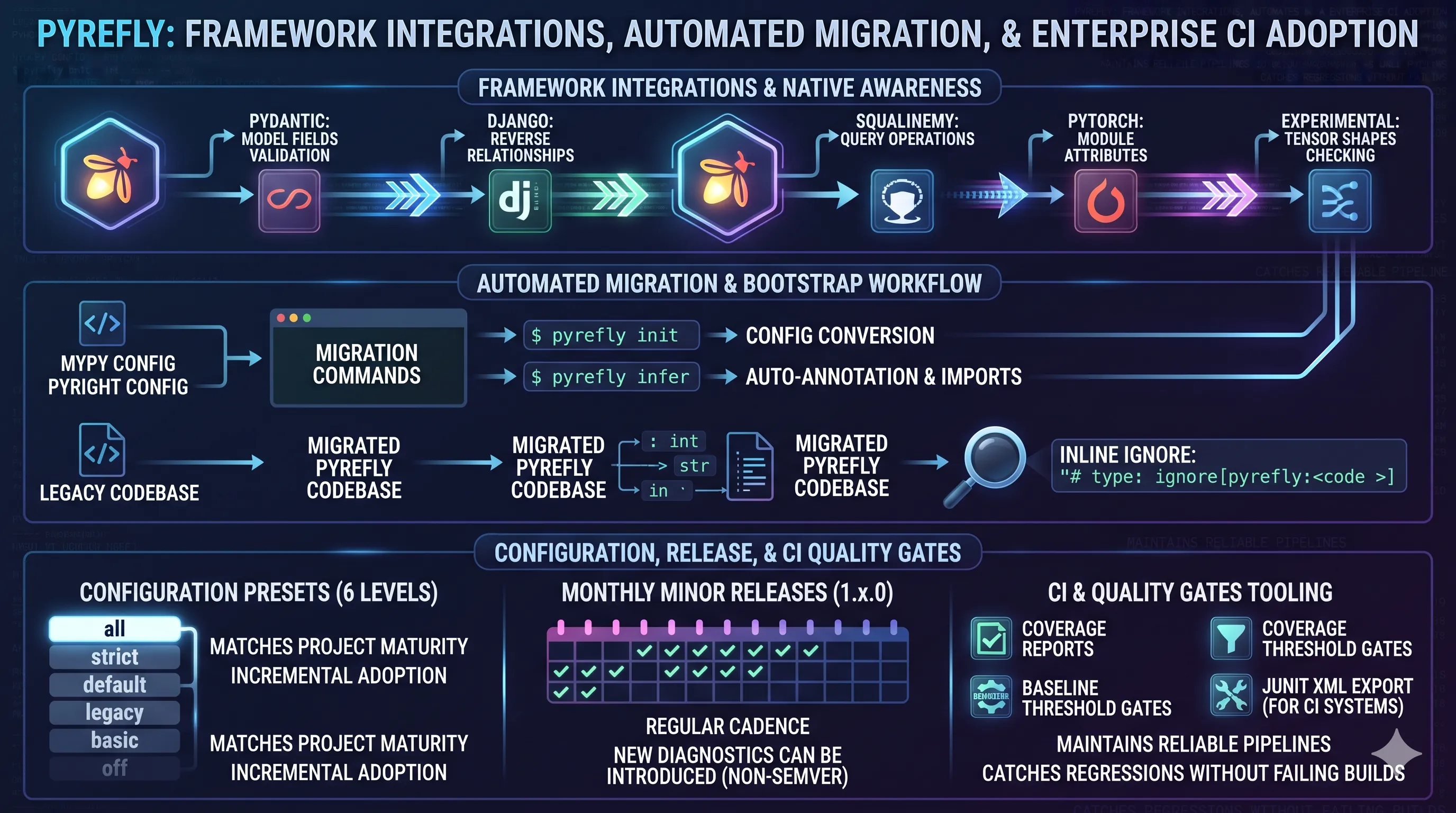
Related Posts


Generative AI may have assisted with research or drafting for this article. Topic selection, fact-checking, final wording, and publication remain the responsibility of DragonStone74. AI use disclosure