
Google Pixel Tag Brings UWB Tracking and Find Hub to Android
🚀 Key Takeaways
- Official Google Tracking Hardware: The Pixel Tag brings native first-party item tracking to Android with single-unit and value four-pack options.
- Sturdy Oblong Design: Built from durable stainless steel and polycarbonate, featuring an integrated 80-decibel speaker for audible alerts.
- Year-Long Battery Life: Operates for over twelve months on a standard user-replaceable CR2032 coin-cell battery.
- Precision Distance Finding: Combines Ultra-Wideband (UWB) and Bluetooth 6.0 Channel Sounding for direct, meter-accurate visual guidance.
- Global Find Hub Network: Taps into a crowdsourced network of over one billion Android devices alongside reverse phone-ringing capabilities.
- Dedicated Partner Accessories: Google teamed up with Bellroy to offer custom protective cases and keychains tailored to the tag's unique profile.
Android users have spent years waiting for a dedicated first-party tracker capable of matching the seamless ecosystem convenience seen elsewhere in the tech landscape. With the official rollout of the Pixel Tag, Google has answered that demand by delivering a purpose-built hardware beacon engineered specifically to keep tabs on everyday essentials.
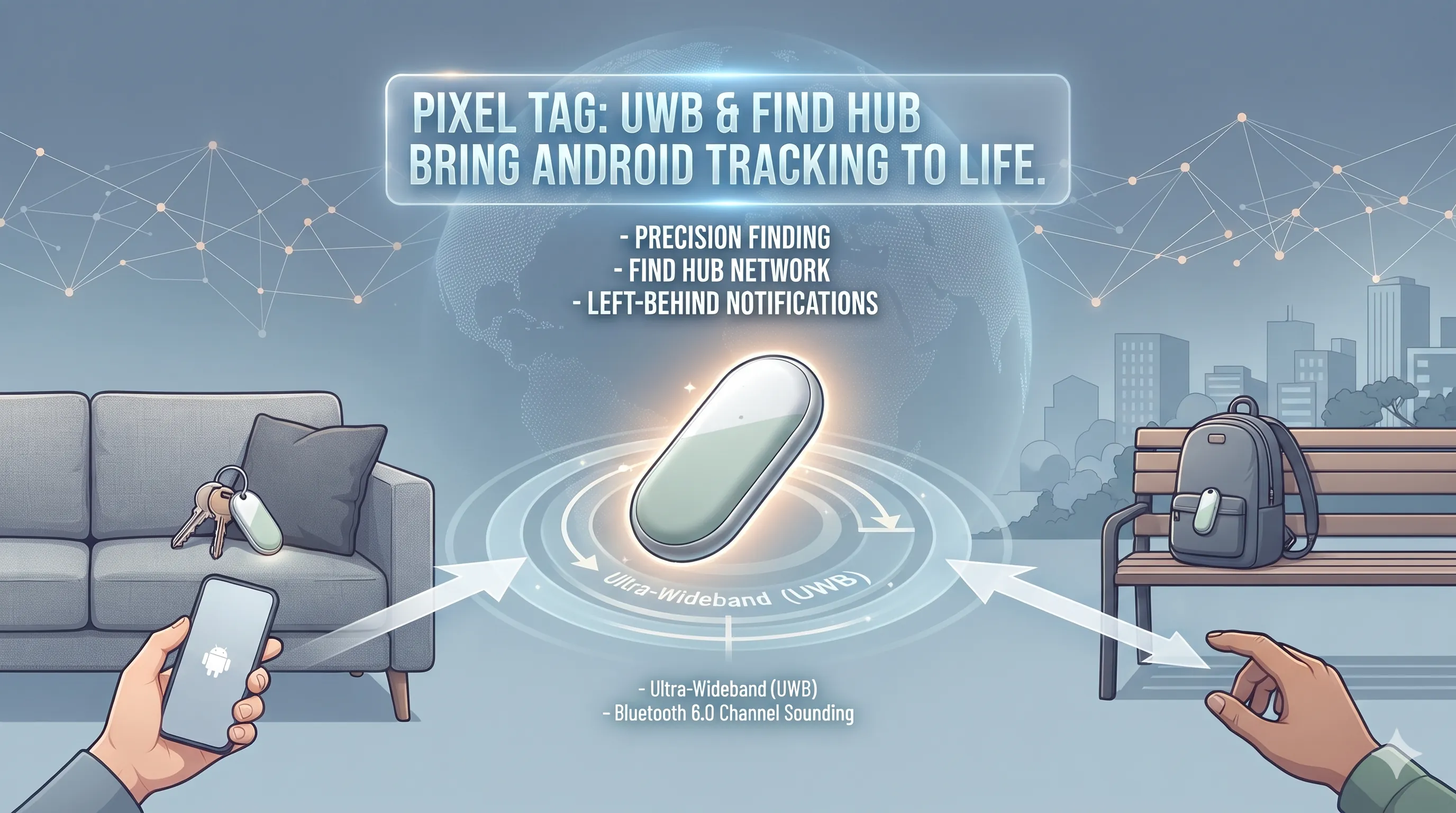
Rather than relying merely on standard Bluetooth proximity, the new tracker embraces modern spatial technologies like Ultra-Wideband (UWB) and Bluetooth 6.0 Channel Sounding to guide users directly to their misplaced belongings with remarkable accuracy. Connected natively to the decentralized Find Hub network spanning over a billion active devices worldwide, it provides reliable location reporting whether an item slips between couch cushions or disappears across town.
From two-way ringer triggers to proactive left-behind notifications, the arrival of the Pixel Tag marks a major upgrade in how Android owners safeguard their keys, backpacks, and luggage without third-party compromises.
1. Pixel Tag Pricing, Retail Launch, and Market Availability
Equipping personal belongings with item trackers directly connects to the broader ecosystem where the Pixel Tag works with Android devices for tracking across everyday routines.Understanding the hardware investment and retail logistics establishes how accessible this tracking solution is for consumers deploying tags across multiple personal items.
Individual Units and Four-Pack Value
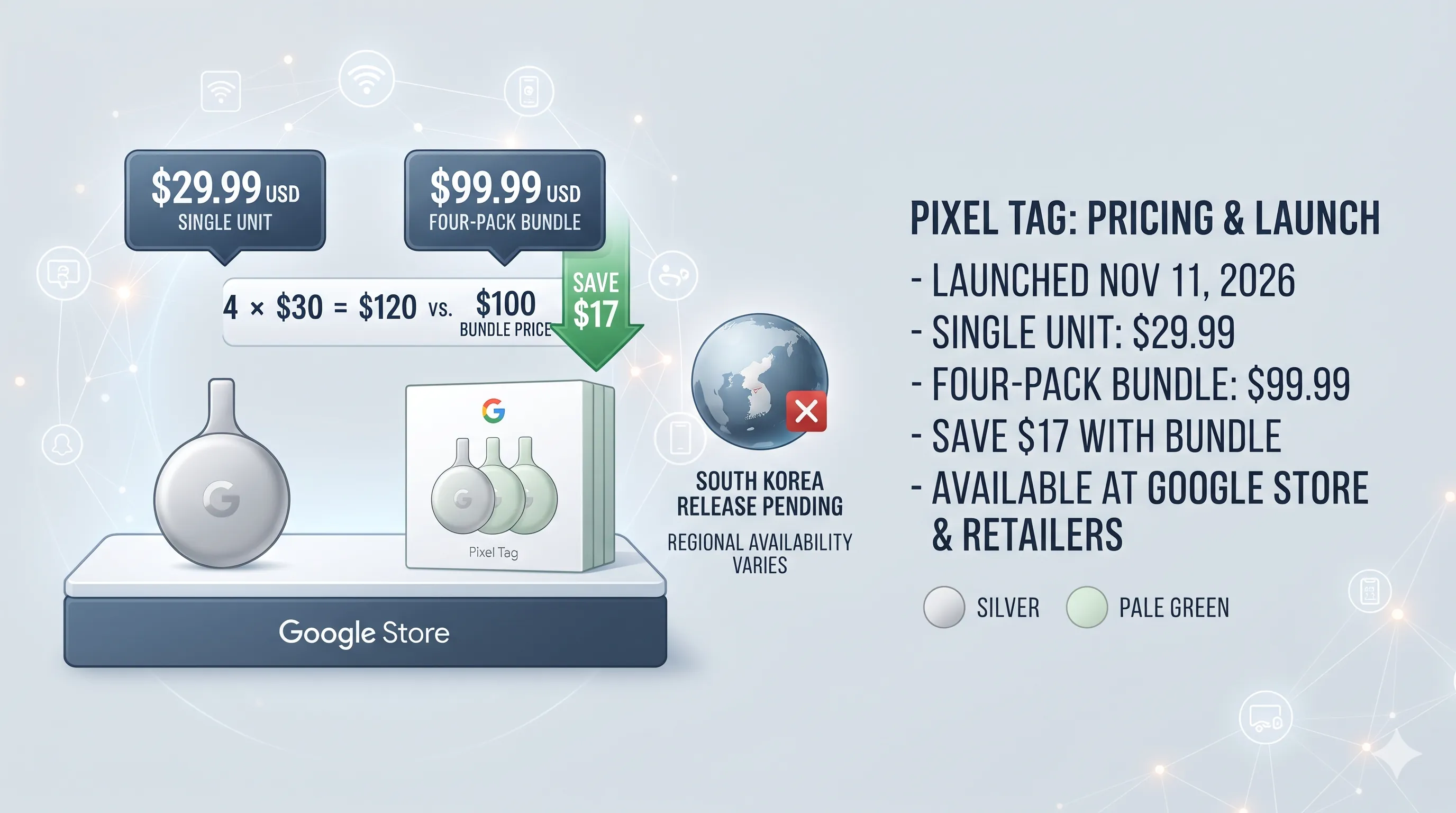
Following its initial announcement in August 2026, Google officially launched the Pixel Tag at retail on November 11, 2026.For single-item tracking, the Pixel Tag costs $29.99 per individual unit, which is also referenced across retail contexts at $29 or $30.
Consumers intending to outfit multiple essentials simultaneously can purchase a multi-pack bundle designed for broader deployment.
A four-pack of Pixel Tags costs $99.99, alternatively cited as $99 or $100 in retail listings.
Choosing the multi-pack structure delivers direct cost efficiency, as the four-pack saves $17 compared to buying four individual tags separately.
Reporting on the pricing and arrival, Andrew Liszewski reported: "The Pixel Tag launches today for $30 each or discounted to $100 for a four-pack."
| Package Option | Retail Price | Effective Unit Cost | Bundle Savings |
|---|---|---|---|
| Single Unit | $29.99 (referenced as $29 or $30) | $29.99 | N/A |
| Four-Pack | $99.99 (referenced as $99 or $100) | ~$25.00 | Saves $17 compared to four single units |
Retail Channels and Regional Availability
Consumers looking to pair accessories with their Android hardware can acquire the tracker through primary distribution points.The hardware is sold directly via the Google Store as well as through authorized retailers.
To complement different aesthetic preferences and item pairings, the Pixel Tag is available in two color finishes: silver and pale green.
While the hardware rollout is established in major launch regions, international access faces specific regional timelines.
The South Korea release date remains unconfirmed as of the initial launch announcements, leaving availability in that market pending further distribution updates.
2. Compact Hardware Architecture, Materials, and Physical Form Factor
The physical engineering of the device provides the foundational baseline for how the Pixel Tag works with Android devices for tracking items in daily transit.To seamlessly maintain proximity and asset monitoring within the Android ecosystem, the tag relies on a compact footprint engineered for effortless concealment inside pockets, bags, and luggage.
Chassis Dimensions and AirTag Size Comparison
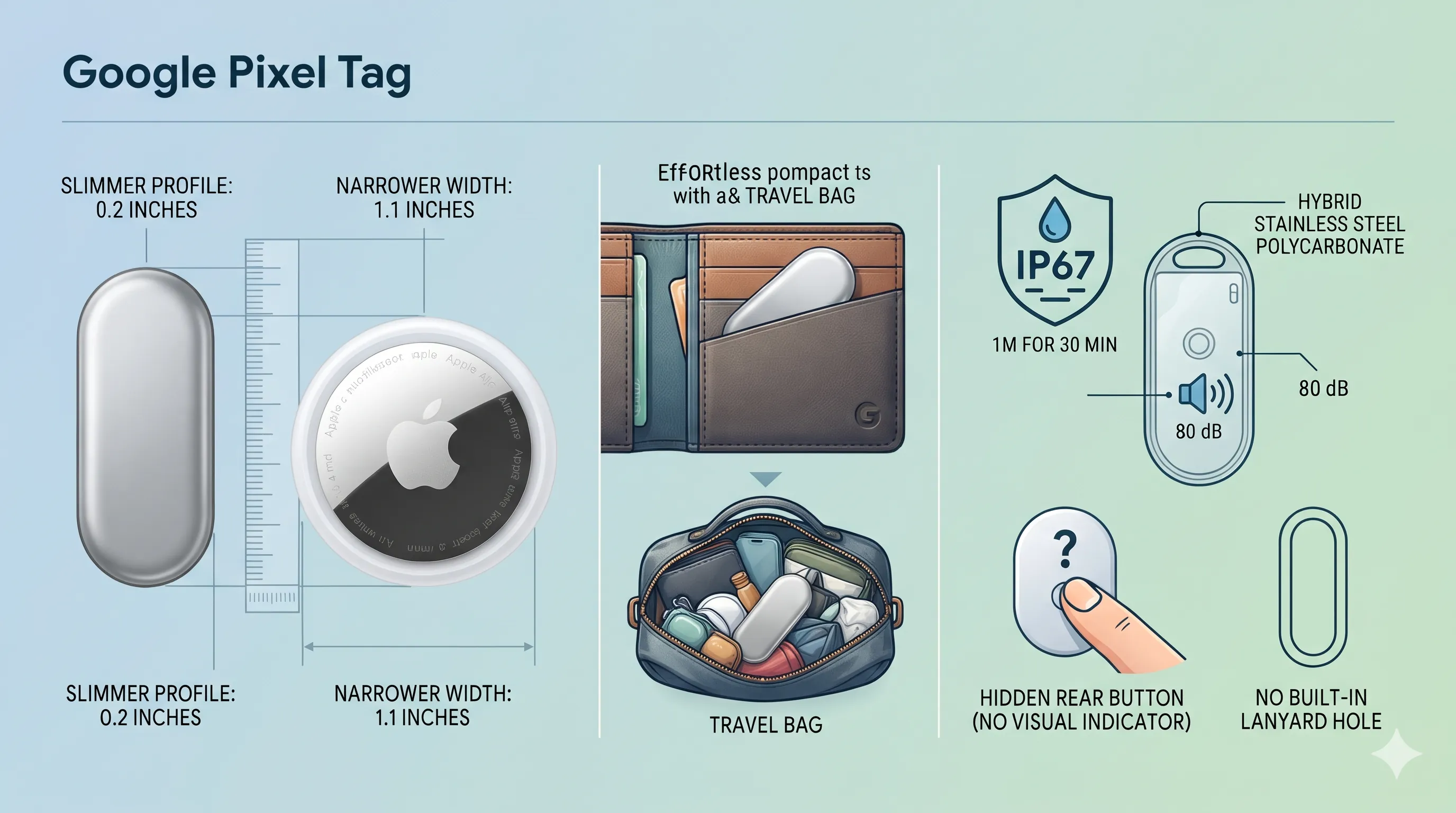
Google departs from circular tracking puck designs by utilizing an elongated oval and oblong form factor.With the battery included, the Pixel Tag weighs 0.4 ounces (11.8 grams).
Its chassis measures 1.1 inches (28 mm) in width, 1.8 inches (46.1 mm) in height, and 0.2 inches (5.4 mm) in thickness or depth.
When evaluated against the standard market benchmark, the Apple AirTag (which features a 1.26-inch width and a 0.31-inch depth), the Pixel Tag is noticeably narrower and thinner.
This slimmer depth profile allows the device to slide into narrow compartments with minimal protrusion.
| Hardware Specification | Google Pixel Tag | Apple AirTag Benchmark |
|---|---|---|
| Form Factor | Elongated oval / oblong | Circular disc |
| Width | 1.1 inches (28 mm) | 1.26 inches |
| Depth / Thickness | 0.2 inches (5.4 mm) | 0.31 inches |
| Height | 1.8 inches (46.1 mm) | Not specified in source data |
| Total Weight (with battery) | 0.4 ounces (11.8 grams) | Not specified in source data |
| Ingress Protection Rating | IP67 (up to 1 meter for 30 minutes) | Not specified in source data |
Durability, IP67 Rating, and Onboard Speaker
The Pixel Tag chassis is crafted from a hybrid assembly of stainless steel and polycarbonate, specifically selected to resist structural flexing and cracking under mechanical pressure.Environmental protection is certified with an official IP67 rating, ensuring total dust ingress resistance and water protection capable of withstanding liquid submersion up to a depth of 1 meter for up to 30 minutes.
For auditory location tracking, the enclosure integrates an internal speaker capable of emitting alerts reaching up to 80 decibels across three selectable volume levels.
Physical device interaction is managed through a rear button positioned beneath the battery cover.
Despite these hardware features, the physical architecture presents specific trade-offs.
The casing contains no visual indication or icon marking the exact location of the physical button on the exterior surface, making tactile actuation difficult without prior familiarity.
Additionally, the enclosure lacks a built-in lanyard or keychain hole, requiring users to purchase external accessory cases to mechanically tether the tracker to keys and everyday carry items.
3. Power System and User-Replaceable CR2032 Battery Mechanism
Reliable power delivery is essential to how the Pixel Tag works with Android devices for tracking keys, luggage, and personal belongings continuously.A connected tracker must remain powered for long periods without frequent maintenance so that registered Android devices can locate misplaced items at any moment.
CR2032 Lifespan and Twist-to-Open Compartment
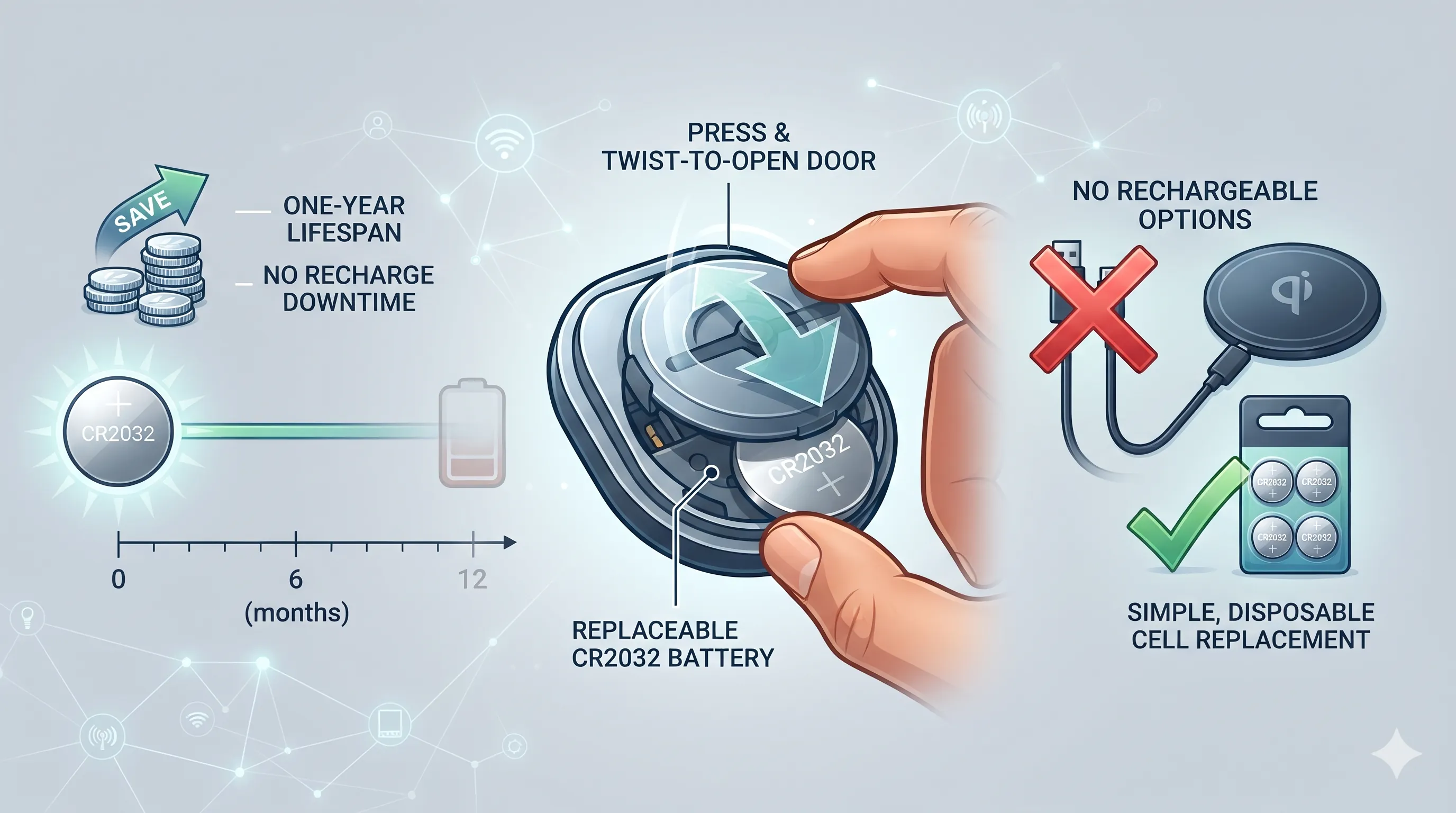
The tracker is powered by a single replaceable CR2032 coin cell lithium battery.Engineered for continuous background operation, the battery life lasts over one year of typical everyday usage before requiring attention.
For initial activation, the unit includes a pull-tab out of the box to initiate initial pairing directly with an Android device upon unboxing.
When the cell eventually runs out of energy, accessing the internal chamber requires a secure physical maneuver.
The device features a user-replaceable battery door that opens by pressing down and twisting counterclockwise, safeguarding the enclosure against accidental openings while allowing manual replacement.
Disposable Cells vs. Rechargeable Power Trade-Offs
Hardware design decisions around tracker power involve specific operational considerations.The Pixel Tag uses a disposable coin-cell battery instead of rechargeable USB-C or Qi wireless charging mechanisms.
Opting for a CR2032 cell avoids taking the unit out of service for regular recharge cycles via cables or wireless pads.
Conversely, the lack of integrated USB-C or Qi wireless charging options means owners must acquire and dispose of replacement coin-cell batteries whenever the year-long operational lifespan finishes.
4. Precision Finding Wireless Stack: UWB, Bluetooth 6.0 Channel Sounding, and NFC
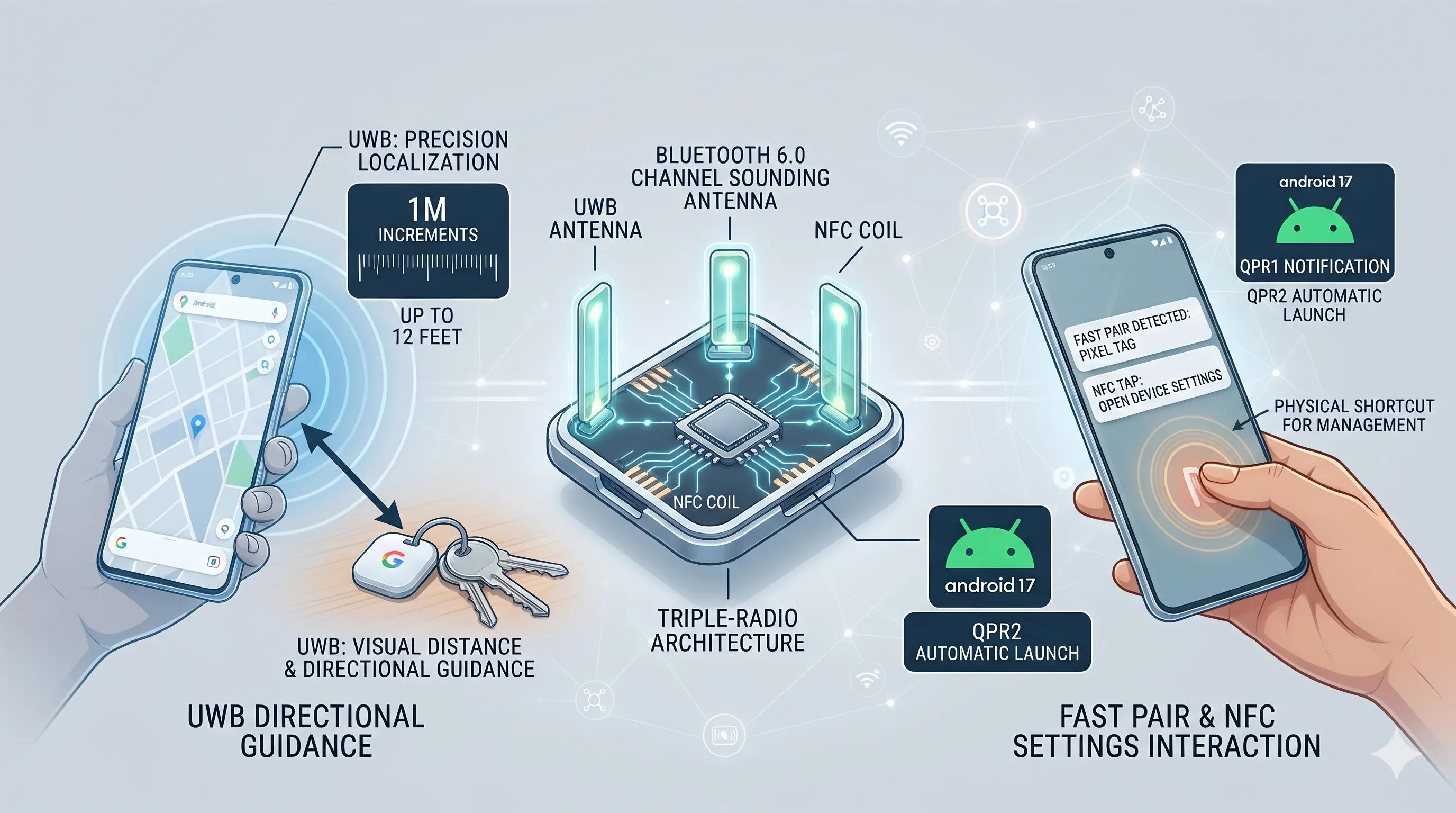
The core foundation ensuring that the Pixel Tag works with Android devices for tracking is its integrated triple-radio wireless architecture.By combining Ultra-Wideband (UWB), Bluetooth 6.0 Channel Sounding, and Near Field Communication (NFC), the tracker establishes distinct operational layers ranging from swift initial pairing to close-range precision localization.
UWB Directional Guidance vs. Bluetooth 6.0 Channel Sounding
The Pixel Tag is equipped with an Ultra-Wideband (UWB) radio engineered to deliver visual distance and directional guidance directly to compatible Android handsets.When tracking an item, the system's directional precision finding cues work up to around 10 to 12 feet before diminishing.
Within this operational threshold, precision tracking resolves distance down to 1-meter increments, guiding the user toward the exact physical coordinates of the tag.
Complementing the UWB radio, the tracker is equipped with Bluetooth 6.0 Channel Sounding for distance measurement.
However, a distinct technical boundary exists between these two radios.
Bluetooth Channel Sounding is restricted to distance estimation without directional pointing.
Consequently, while Bluetooth 6.0 measures how far away the tracker rests, directional cues rely strictly on the UWB radio.
To access full precision finding functions, users require specific phone hardware equipped with both UWB and Bluetooth 6.0.
| Wireless Technology | Primary Function | Capabilities and Limitations |
|---|---|---|
| Ultra-Wideband (UWB) | Visual distance and directional guidance | Resolves distance down to 1-meter increments; directional cues operate up to around 10 to 12 feet before diminishing; requires specific phone hardware with UWB. |
| Bluetooth 6.0 Channel Sounding | Distance measurement | Restricted to distance estimation without directional pointing; requires specific phone hardware with Bluetooth 6.0. |
| Near Field Communication (NFC) | Direct device settings access and interaction | Triggers direct configuration via physical tap; behavior varies between Android 17 QPR1 (notification) and Android 17 QPR2 (automatic launch). |
Fast Pair Setup and NFC Settings Interaction
The onboarding experience is streamlined through Google Fast Pair, allowing the tracker to pair rapidly with Android handsets upon detection.In addition to proximity pairing, the device is equipped with Near Field Communication (NFC) functionality.
The NFC area taps directly to the phone to open device settings, offering a physical shortcut for tag management.
The operational flow of this tap interaction depends on the operating system version installed on the handset.
On devices running Android 17 QPR1, tapping the NFC area opens device settings via a notification prompt.
On devices updated to Android 17 QPR2, the NFC tap bypasses the prompt and opens device settings automatically.
5. Find Hub Network Integration, Ecosystem Controls, and Security Features
Understanding how the Pixel Tag works with Android devices for tracking requires examining the Find Hub network architecture and the platform-level features that link hardware accessories to the broader Android environment.By anchoring hardware directly to Google's centralized tracking ecosystem, the Pixel Tag transitions standalone asset tracking into an integrated, cross-device utility.
Crowdsourced Network Tracking and Reverse Phone Paging
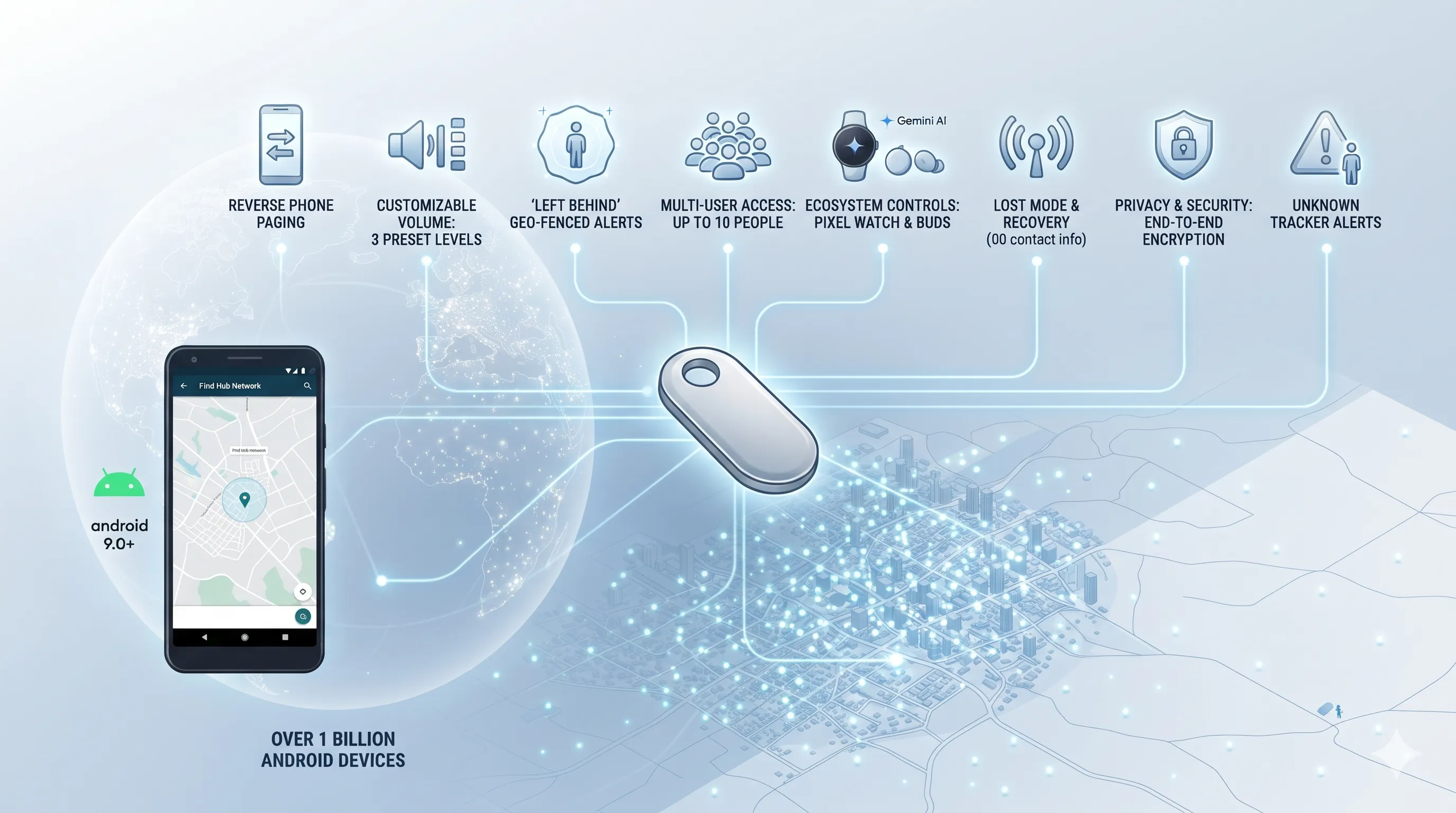
The operational foundation of the Pixel Tag relies on broad system compatibility, functioning with smartphones operating Android 9.0 or newer.For long-distance tracking, the device locates lost items by tapping into Google's crowdsourced network comprising over 1 billion Android devices globally.
Despite this massive footprint, users must account for real-world environmental constraints, as the Find Hub crowdsourced tracking network has historically faced inconsistent performance outside densely populated areas.
Furthermore, while basic tracking remains accessible, the Bluetooth 6.0 requirement for advanced Channel Sounding limits high-precision directional features on older and budget handsets.
For day-to-day proximity tracking, the Pixel Tag incorporates direct two-way paging mechanisms.
Users can trigger reverse phone finding directly from the tracker: double-clicking the tag's rear button rings the connected phone even when the handset is set to silent mode.
Once the phone is retrieved, single-clicking the tag's button silences the phone ringer immediately.
Audible feedback on the tracker itself is customizable, as Find Hub volume can be adjusted between 3 preset loudness levels.
To prevent accidental separation, the system provides proactive 'Left Behind' alerts that notify users if they walk away from tagged valuables, while offering customizable exclusion zones for trusted locations such as home or office addresses.
Cross-Device Pixel Ecosystem and Privacy Protections
Ecosystem interoperability extends device control beyond smartphones to wearable and audio endpoints.Cross-device support allows users to check tag status and ring items via the Pixel Watch using an app or web browser, or issue hands-free voice commands through Pixel Buds using Gemini.
Collaborative tracking is built into the management interface, enabling Pixel Tag location data to be shared with up to 10 people simultaneously within Find Hub.
When an asset is misplaced beyond immediate physical reach, activating Lost Mode allows owners to broadcast their contact email, phone number, and a custom message to anyone who discovers the accessory.
The platform automatically marks the item as found as soon as the tag returns within range of the owner's devices.
To address personal safety and data security, crowdsourced location reporting across the Find Hub network is protected by end-to-end encryption.
Unwanted surveillance is mitigated through integrated unknown tracker alerts, which notify users if an unidentified tag travels along with them.
Reviewing the real-world convergence of these features, Ben Schoon evaluated: "Pixel Tag is the device that finally brings it all together, and it’s brilliant so far."
| Feature / Specification | Technical Parameter and Capability | Operational Role in Tracking |
|---|---|---|
| Platform Compatibility | Android 9.0 or newer | Ensures baseline network compatibility and tracking functionality across modern and legacy Android handsets. |
| Crowdsourced Reach | Over 1 billion Android devices globally | Enables long-distance location reporting, though subject to inconsistent performance outside densely populated regions. |
| Precision Hardware Prerequisite | Bluetooth 6.0 (Channel Sounding) | Enables advanced precision capabilities; limits advanced precision features on older and budget devices lacking the spec. |
| Hardware Controls | Rear physical button | Double-click rings phone (bypassing silent mode); single-click silences the ringer once the handset is located. |
| Audible Alert Output | 3 preset loudness levels | Permits volume adjustment within the Find Hub application to suit different acoustic environments. |
| Separation Warnings | 'Left Behind' geofenced alerts | Pushes proactive separation notices; supports custom exclusion zones for home or office addresses. |
| Multi-User Access | Up to 10 people simultaneously | Enables coordinated tracking and shared location visibility among group members in Find Hub. |
| Wearable and Voice Controls | Pixel Watch and Pixel Buds via Gemini | Allows locating, checking, and ringing tags directly from smartwatches (app/browser) or through audio voice commands. |
| Recovery Protocol | Lost Mode | Broadcasts contact phone, email, and a custom message; automatically marks item as found when back in range. |
| Privacy and Anti-Stalking | End-to-end encryption & unknown tracker alerts | Protects crowdsourced data transmission and alerts individuals if an unidentified tag is detected traveling with them. |
6. Official Made for Google Accessories and Mounting Compatibility
As the Pixel Tag works with Android devices for tracking personal items, attaching the device securely to keys, luggage, and everyday gear depends on dedicated mounting hardware.Rather than producing its own first-party cases, Google partners with the "Made for Google" partner brand Bellroy to supply the official mounting lineup, with all official cases distributed directly through the official Google Store.
Bellroy Lite Case Duo and Leather Case Options
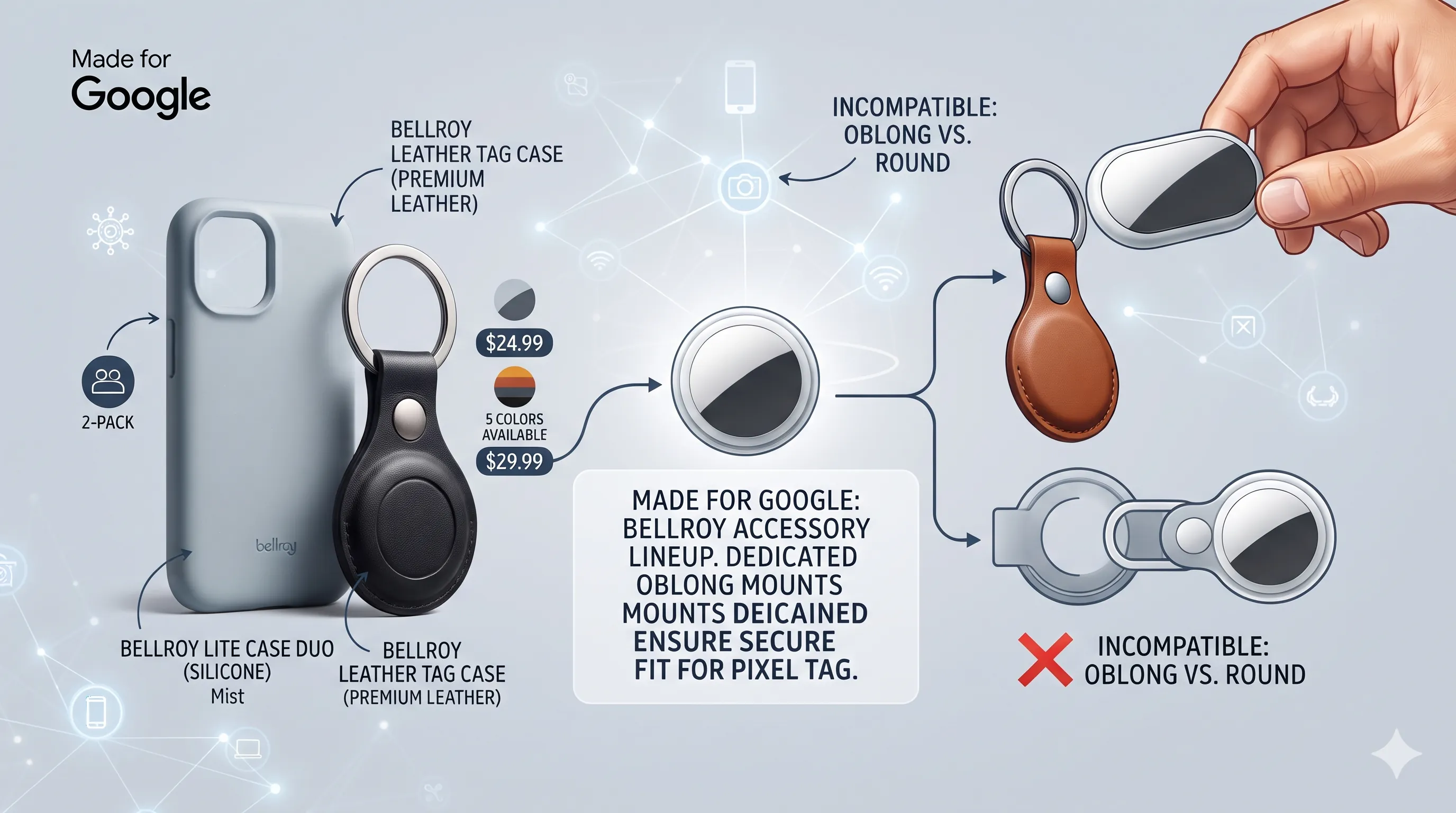
The official accessory lineup offers two distinct material choices designed specifically for securing the tracker.For active and casual use, Google offers the silicone Bellroy Lite Case Duo, which costs $24.99 for a 2-pack.
The Bellroy Lite Case Duo is offered in Mist and Shadow colors, and each unit features a built-in corner loop paired with a color-matching cord for looping onto lanyards, key rings, and bag straps.
For users seeking a more premium finish, the Bellroy Leather Tag Case costs $29.99 each.
The leather option provides tailored protection and is offered in five distinct colorways: Artichoke, Azalea, Black, Pewter, and Red Ochre.
| Accessory Model | Material | Price | Available Colors | Included Features |
|---|---|---|---|---|
| Bellroy Lite Case Duo | Silicone | $24.99 (2-pack) | Mist, Shadow | Corner loop and color-matching cord |
| Bellroy Leather Tag Case | Leather | $29.99 each | Artichoke, Azalea, Black, Pewter, Red Ochre | Single-unit protective leather enclosure |
Form Factor Incompatibility with Round AirTag Holders
A critical hardware factor for users adopting the tracker is physical chassis geometry.The Pixel Tag oblong shape prevents compatibility with existing round AirTag mounting accessories.
Because circular sleeves, clips, and keychains designed for round alternatives cannot physically house the elongated body, users integrating the tracker into the Android tracking ecosystem must rely on purpose-built oblong accessories.
Related Posts

How Pyrefly Speeds Up Python Type Checking With RustDiscover how Google and Meta use Pyrefly, a high-performance Rust-powered Python type checker, to...
Google Expands Gemini Flash: 3.6, 3.5 Lite & Cyber Boost AI Agent Speed & EfficiencyGoogle expanded its Gemini Flash series on July 21, 2026 , introducing Gemini 3.6 Flash , 3.5...

Google DiffusionGemma Unveiled: Open-Source LLM Achieves 4x Faster Text Generation via Novel Diffusion & MoE Architecture for Real-Time AIGoogle has released DiffusionGemma , an experimental open-source LLM introducing a novel text...
Generative AI may have assisted with research or drafting for this article. Topic selection, fact-checking, final wording, and publication remain the responsibility of DragonStone74. AI use disclosure