
Google and Meta Open-Source TorchTPU as Native PyTorch TPU Backend
🚀 Key Takeaways
- First-Class Hardware Support: TorchTPU establishes native Google TPU execution within standard PyTorch, elevating TPUs alongside CPUs and GPUs.
- Deprecation of PyTorch/XLA: The legacy lazy-tensor bridge is formally superseded by TorchTPU and is scheduled for repository archival on November 15, 2026.
- Flexible Execution Engine: The backend integrates via PyTorch's extension dispatcher, supporting Strict Eager, DeferAndFuse, and TorchDynamo graph compilation.
- Massive Cluster Scalability: Validated across TPU v5 through v7 (Ironwood), maintaining high hardware utilization and near-linear scaling up to 8,192 chips.
- Unified Inference Stack: Native production serving integrations are immediately available across vLLM, SGLang, llm-d, and Hugging Face Transformers.
- End-to-End Training & Alignment: TorchTitan and VeRL provide validated distributed pre-training and reinforcement learning workflows on TPU clusters.
- Agent-Assisted Tooling: An integrated TPU agent suite automates developer onboarding, diagnostics, and kernel performance optimization in modern coding harnesses.
For years, training and deploying state-of-the-art deep learning architectures on alternative accelerator silicon required navigating brittle lazy-tensor abstractions and complex hardware-specific workarounds. The joint release of TorchTPU by Google and Meta marks a watershed moment in machine learning infrastructure, transforming Google Cloud TPUs into native execution targets within standard PyTorch codebases.
By wiring directly into PyTorch's low-level dispatcher, the backend bypasses proprietary wrappers and removes runtime dependencies on external frameworks. At a time when frontier foundation models demand unprecedented compute budgets and multi-thousand-chip clusters, this architectural convergence provides engineers with authentic hardware diversity and seamless portability between silicon vendors.
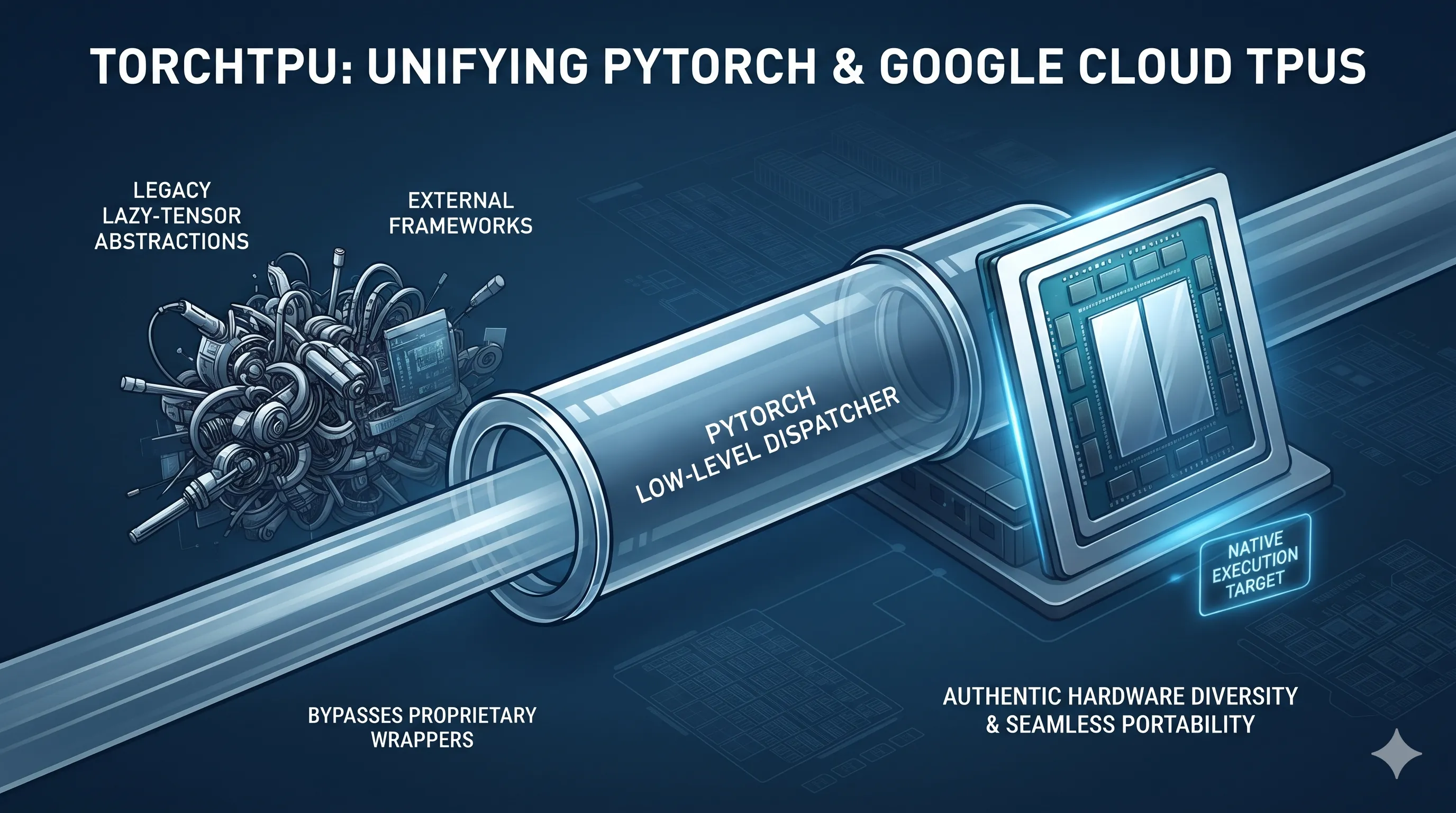
1. TorchTPU Open-Source Launch: Unifying PyTorch and Google Cloud TPUs
This foundational release directly underpins how TorchTPU enables native PyTorch execution on TPUs by establishing Google Cloud TPUs alongside CPUs and GPUs as first-class, standard execution targets.Joint Architecture by Google and Meta
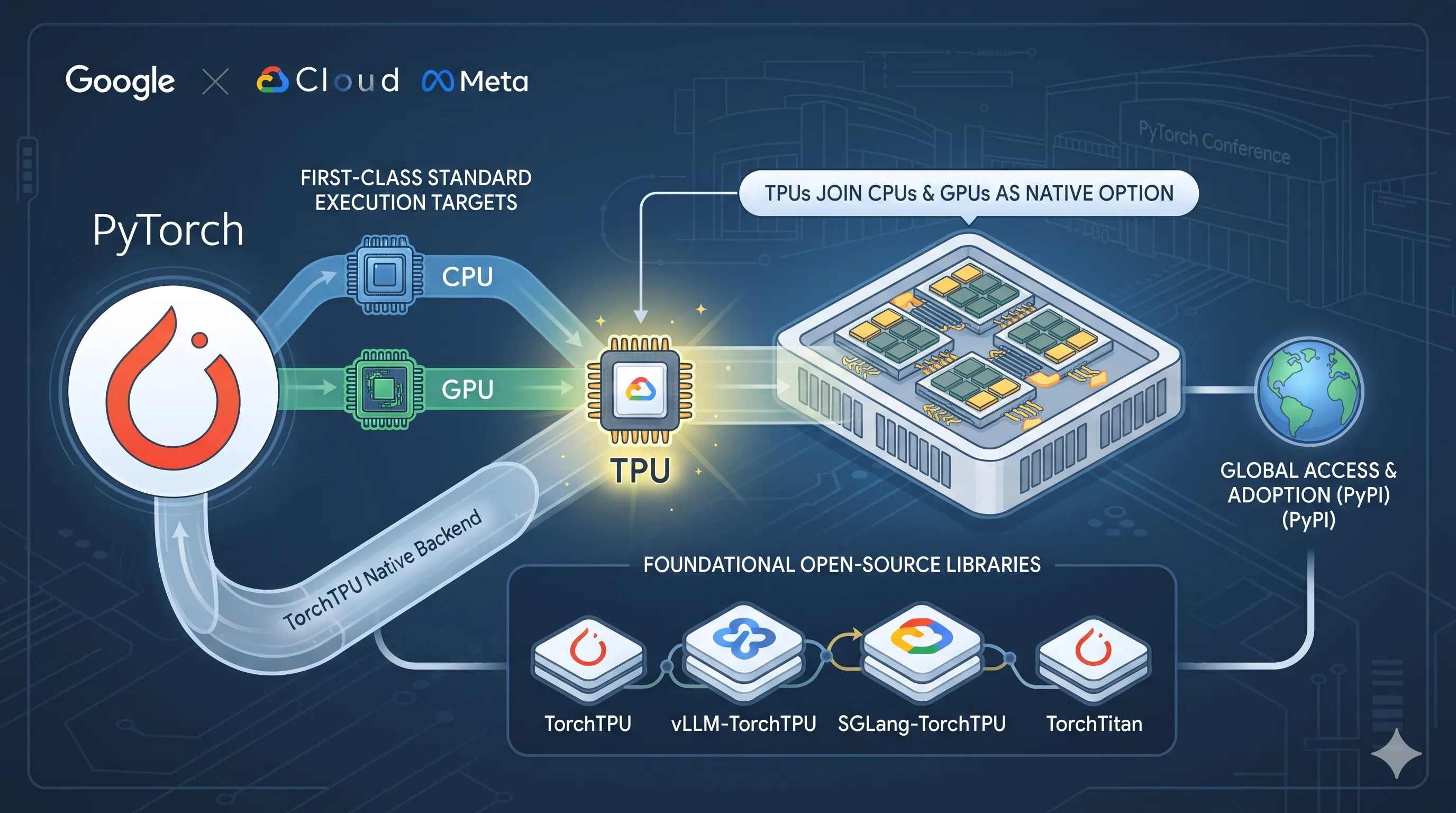
TorchTPU is an open-source, native PyTorch backend for Google TPUs co-developed through an engineering partnership between Google Cloud and the PyTorch team at Meta.The collaboration was established to eliminate legacy abstraction layers and allow TPUs to join GPUs and CPUs as fully native PyTorch execution targets.
Reflecting on this architectural convergence, Google Cloud and Bill Jia stated: "With TorchTPU, TPUs join GPUs and CPUs as a native option for PyTorch."
The initiative was officially open-sourced on October 20, 2026, on stage at the PyTorch Conference North America in San Jose.
Highlighting the collaborative ecosystem delivery, Zongwei Zhou of Meta stated: "All of this is open source and available today and it is just a beginning."
The core public codebase is hosted within the google-pytorch GitHub organization.
Developer documentation, operational guidelines, and integration runbooks are published at torchtpu.readthedocs.io.
Foundational Repositories and Release Specifications
The collaborative launch made four foundational repositories publicly available under the Apache 2.0 license: TorchTPU, vLLM-TorchTPU, SGLang-TorchTPU, and TorchTitan.To facilitate direct developer adoption, the distribution was accompanied by the release of the torch-tpu 0.2.0 package on PyPI on October 19, 2026.
The packaged build offers verified binary support for Python 3.11 and later, specifically providing pre-compiled wheels for CPython 3.11 through 3.14 on Linux x86-64 architectures.
| Repository / Component | License | Hosting Organization / Distribution Channel | Release Metadata & Compatibility |
|---|---|---|---|
| TorchTPU | Apache 2.0 | google-pytorch GitHub / PyPI (package: torch-tpu 0.2.0) | Native PyTorch TPU backend; released October 19–20, 2026; Linux x86-64 wheels for CPython 3.11 through 3.14 |
| vLLM-TorchTPU | Apache 2.0 | google-pytorch GitHub | Foundational repository open-sourced October 20, 2026 at PyTorch Conference North America |
| SGLang-TorchTPU | Apache 2.0 | google-pytorch GitHub | Foundational repository open-sourced October 20, 2026 at PyTorch Conference North America |
| TorchTitan | Apache 2.0 | google-pytorch GitHub | Foundational repository open-sourced October 20, 2026 at PyTorch Conference North America |
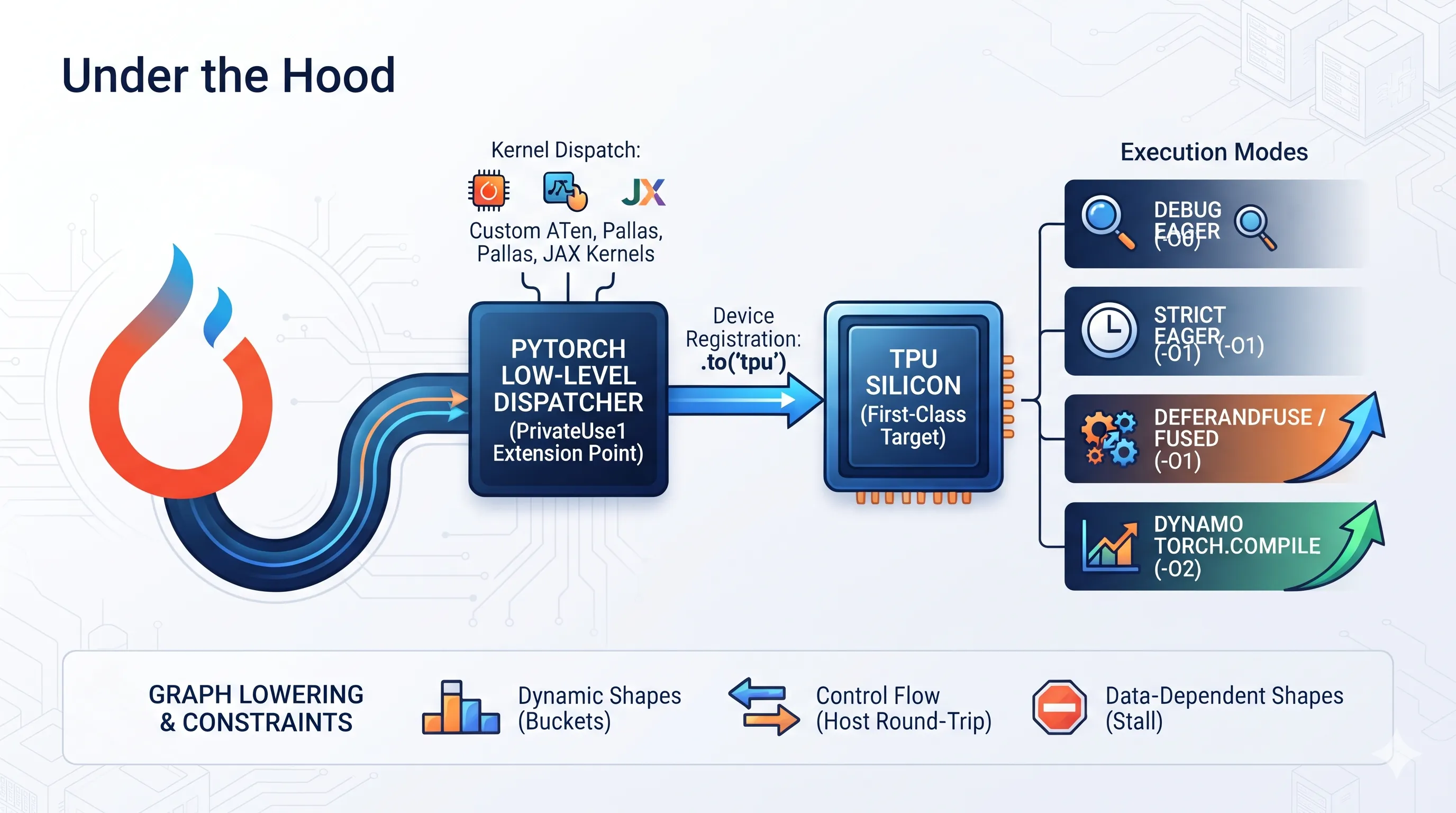
2. Under the Hood: PrivateUse1 Registration, Execution Modes, and Kernel Dispatch
The central breakthrough that allows TorchTPU to enable native PyTorch execution on TPUs is its architectural integration with PyTorch's native C++ core.Rather than introducing external wrappers, foreign abstraction layers, or non-standard model subclasses, TorchTPU operates directly through official PyTorch dispatch mechanisms to treat TPU silicon as a first-class hardware target.
PrivateUse1 Dispatcher and Seamless Device Registration
TorchTPU interfaces with PyTorch by plugging directly into the low-level dispatcher via the PrivateUse1 extension point.Under this registration pattern, TorchTPU eliminates the friction of custom device subclasses or fragmented runtime APIs.
Through autoloading, the runtime replaces PyTorch's generic PrivateUse1 backend string and exposes the device as 'tpu'.
At the kernel level, the dispatch architecture routes operations to custom ATen kernels alongside specialized kernels written in Pallas and JAX.
This low-level dispatch layer natively accommodates distributed training, offering immediate support for Distributed Data Parallel, SimpleFSDP, and DTensor out of the box.
To transition an existing workload to this native stack, developers simply change the standard hardware target.
To port existing model code from CUDA to TPU execution without refactoring model definitions, developers alter the device target string:
model.to("tpu")Execution Modes: From Strict Eager to TORCH_TPU_DEFER_AND_FUSE
To balance immediate debugging with runtime efficiency, TorchTPU provides three eager execution modes alongside a graph-compilation pipeline, all backed by a shared compilation cache.Developers can toggle between Debug, Strict, and DeferAndFuse (also referred to as Fused) eager execution modes.
Under the default Strict eager execution, operations compile just-in-time at -O1 optimization and populate the cache.
For workloads held back by eager overhead, setting the TORCH_TPU_DEFER_AND_FUSE environment variable enables the DeferAndFuse mode, which aggregates operations to claim up to a 50% to 100+% speedup over default Strict Eager.
When maximum throughput is required, torch.compile captures FX graphs via Torch Dynamo and lowers them through XLA and StableHLO at an aggressive -O2 compilation level.
| Execution Mode / Target | Optimization Level | Compilation and Lowering Path | Performance Characteristics |
|---|---|---|---|
| Debug Eager | Unoptimized | Direct dispatch via PrivateUse1 without fusion | Immediate error isolation and step-by-step kernel trace inspection. |
| Strict Eager | -O1 | Per-operation compilation cached in shared compilation cache | Standard out-of-the-box execution baseline. |
| DeferAndFuse / Fused | -O1 (Deferred) | Deferred execution queue fusing adjacent kernel launches | Delivers up to a 50% to 100+% speedup over default Strict Eager. |
| Dynamo torch.compile | -O2 | Torch Dynamo FX graph capture lowered to XLA and StableHLO | Full graph-level optimization and advanced scheduling. |
Graph Lowering, Dynamic Shapes, and Device Bottlenecks
When running under torch.compile, Torch Dynamo captures intermediate representations as FX graphs, subsequently lowering them through XLA and StableHLO at -O2 to generate optimized TPU executables.However, accommodating varying input dimensions introduces distinct constraints.
TorchTPU handles variable dimensions via bounded-dynamic executables, compiling specific size buckets aligned strictly to multiples of 128.
The runtime defaults to one bucket and allows at most eight buckets per trace.
These bounded-dynamic executables do not support dynamic=True and are not saved to the AOTAutograd cache, forcing them to recompile whenever a new process starts.
Architectural limitations also surface when control flow depends directly on tensor values.
Data-dependent Python branches, such as evaluating if my_tensor.all(), force an immediate data copy from the TPU back to the host CPU.
This host-device round trip drains the execution queue and breaks execution graphs in compiled or fused modes.
Similarly, operations that produce data-dependent output shapes, including torch.masked_select and torch.nonzero, cause the TPU execution pipeline to stall entirely.
In distributed settings, Skinny Collectives can incur a 30-40% performance penalty because XLA lacks compute and communication overlap for these narrow communication profiles.
Finally, at the operating system level, TPU hardware allocation remains strictly exclusive, supporting only one user-space process at a time per device.
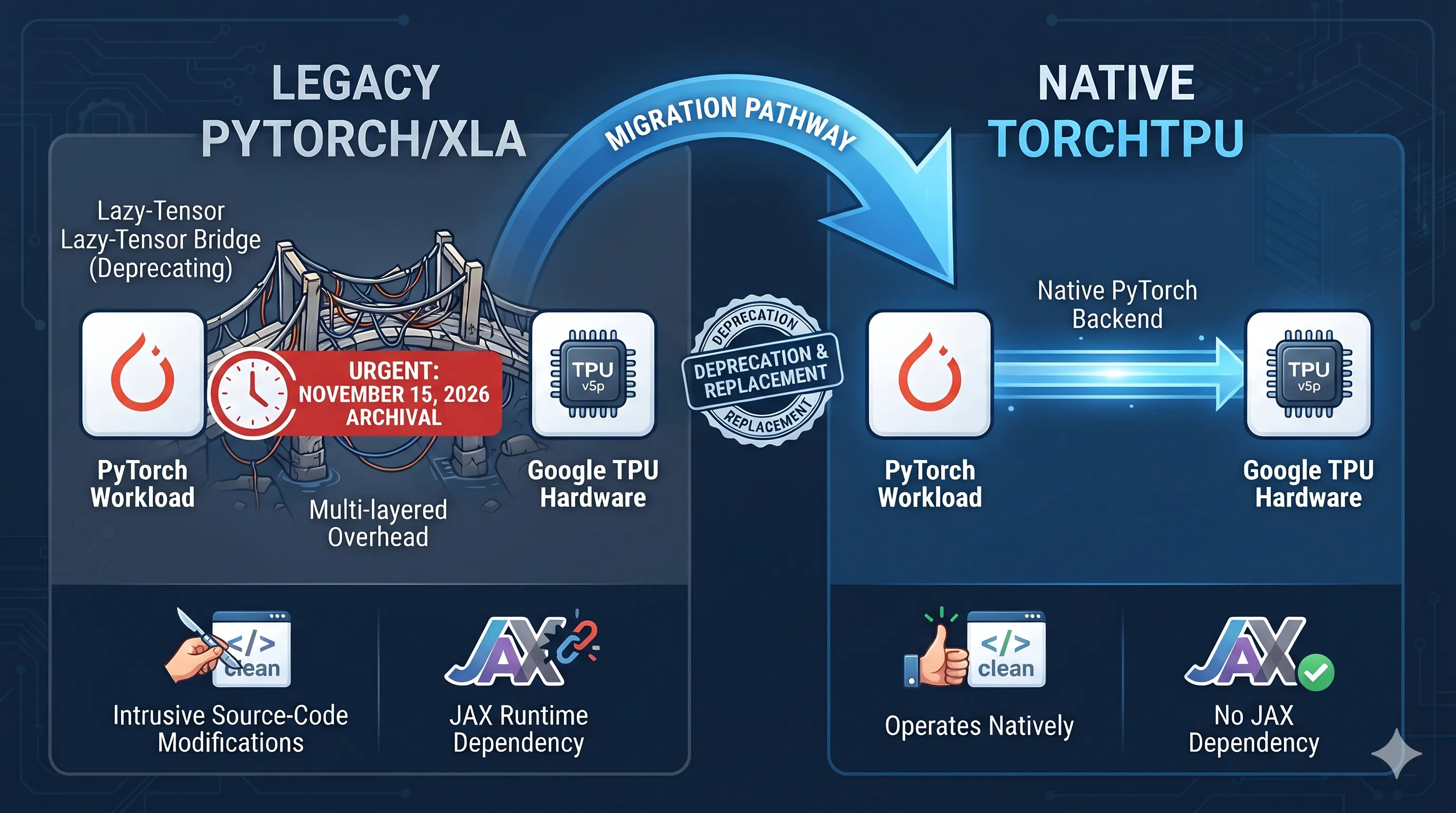
3. Retiring PyTorch/XLA: Structural Modernization and Migration Timelines
To understand how TorchTPU enables native PyTorch execution on TPUs, it is essential to examine the retirement of the software stack it supersedes.The launch of TorchTPU marks a fundamental architectural departure from the legacy translation mechanisms that previously mediated between PyTorch workloads and Google TPU hardware.
The End of the Lazy-Tensor Bridge: November 15, 2026 Archival
PyTorch/XLA was originally introduced as a lazy-tensor bridge in 2020 to bring PyTorch models onto TPU infrastructure.That bridging architecture has now reached the end of its lifecycle.
As the official documentation clarifies, the TorchTPU FAQ states: "PyTorch/XLA is deprecated and replaced by TorchTPU, which is now public."
TorchTPU fully deprecates and replaces PyTorch/XLA, moving TPU acceleration into a first-class, native PyTorch runtime environment.
The transition window for engineering teams is remarkably compressed.
The PyTorch/XLA repository is officially scheduled to be archived on November 15, 2026.
After November 15, 2026, the PyTorch/XLA repository becomes read-only, with no new issues or PRs accepted.
Consequently, teams currently using
torch_xla face an urgent operational deadline, leaving them under four weeks from the announcement to migrate to native TorchTPU before archival takes effect.Architectural Shift: Decoupling from JAX Runtime Dependencies
The structural upgrade from PyTorch/XLA to TorchTPU resolves critical operational overhead and pipeline complexity.Historically, PyTorch/XLA required intrusive source-code modifications and leaned on JAX runtime components and proprietary APIs to manage hardware execution.
TorchTPU eliminates this multi-layered overhead entirely.
Specifically, TorchTPU operates as a native PyTorch backend with no JAX runtime dependency, while not replacing JAX itself.
By operating directly as an engine within the native framework, TorchTPU removes the requirement for intrusive source-code modifications across user repositories.
| Architectural Attribute | Legacy PyTorch/XLA | Native TorchTPU |
|---|---|---|
| Core Architecture | Lazy-tensor bridge introduced in 2020 | Native PyTorch backend directly targeting TPUs |
| Runtime Dependencies | Leaned on JAX runtime components and proprietary APIs | No JAX runtime dependency (does not replace JAX itself) |
| Integration Impact | Required intrusive source-code modifications | Operates natively without intrusive source-code changes |
| Repository & Support Status | Scheduled to be archived on November 15, 2026 (becomes read-only with no new issues or PRs; teams have under four weeks to migrate) | Publicly released; fully deprecates and replaces PyTorch/XLA |
4. Silicon Validation: Hardware Compatibility and Multi-Pod Scaling Benchmarks
The core promise of TorchTPU—enabling native PyTorch execution on TPUs—hinges directly on physical silicon compatibility and multi-pod workload execution.
Validating this integration requires verifying that native PyTorch operations execute with predictable numerical accuracy and hardware utilization across generations of tensor hardware.
Hardware Validation: TPU v5e Through Ironwood v7x
Hardware validation for TorchTPU covers four primary accelerator tiers: TPU v5e, TPU v5p, TPU v6e, and TPU v7 / v7x (codename Ironwood).
These hardware generations form the validated matrix for native PyTorch model runs and distributed topologies.
TPU v8i and TPU v8t remain on the near-term roadmap and are not yet supported by the runtime.
Operating modern clusters under this validation matrix introduces operational changes: recent TPU hardware generations require Google Kubernetes Engine (GKE) for orchestration rather than standalone virtual machine instances.
Distributed Scaling Metrics and MFU Realization
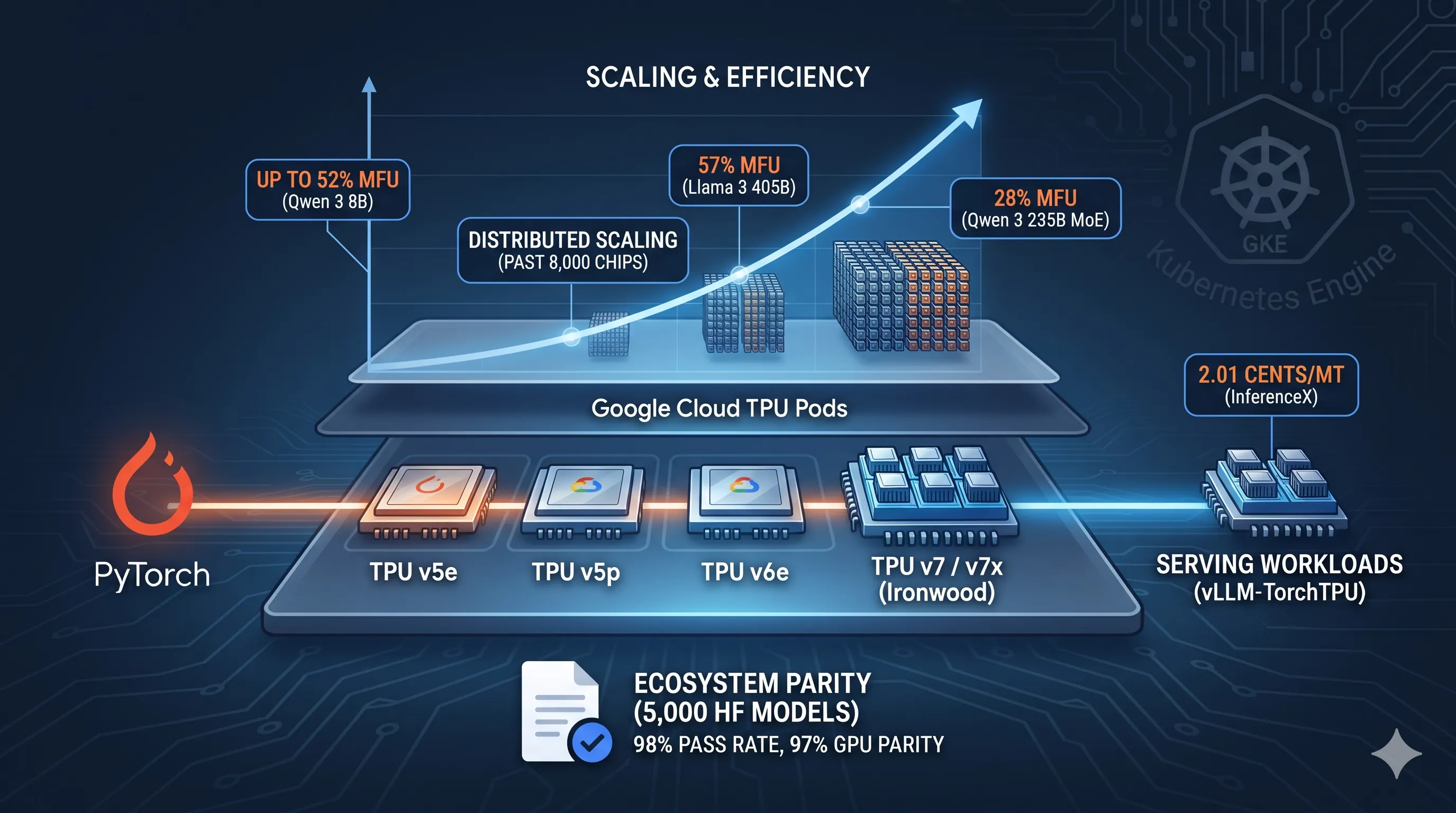
Scaling TorchTPU beyond single-board systems has demonstrated near-linear distributed scaling past 8,000 TPU chips, maintaining constant per-chip throughput across expanded multi-pod topologies.
On dense architectures, Qwen 3 8B achieved up to 52% Model Flops Utilization (MFU) with near-linear scaling up to 8,192 Ironwood TPUs.
Scaling large-parameter dense workloads such as Llama 3 405B showed 57% MFU across allocations spanning 128 to 1,024 Ironwood chips.
Mixture-of-experts (MoE) workloads were validated using Qwen 3 235B, which achieved 28% MFU across 8,192 TPU v7x chips.
For serving workloads, the SemiAnalysis InferenceX benchmark reported that TPU v7 running vLLM-TorchTPU reached an operational cost of 2.01 cents per million tokens.
| Hardware Generation | Tested Architecture / Workload | Cluster Scale | Reported Performance / Efficiency Metric |
|---|---|---|---|
| TPU v7 / v7x (Ironwood) | Qwen 3 8B (Dense) | Up to 8,192 chips | Up to 52% MFU (near-linear scaling) |
| TPU v7x (Ironwood) | Qwen 3 235B (MoE) | 8,192 chips | 28% MFU |
| TPU v7 / v7x (Ironwood) | Llama 3 405B (Dense) | 128 to 1,024 chips | 57% MFU |
| TPU v7 | vLLM-TorchTPU (InferenceX) | Serving Pod Configuration | 2.01 cents per million tokens |
| TPU v5e, v5p, v6e, v7 / v7x | 5,000 Hugging Face Models | Multi-Generation Test Suite | 98% Tier-1 pass rate; 97% GPU parity |
Ecosystem Parity and Vendor Benchmark Caveats
Ecosystem-wide validation across 5,000 Hugging Face models demonstrated broad coverage, recording a 98% Tier-1 no-crash pass rate alongside 97% numerical parity with GPUs.
Despite these high compatibility metrics, operational production results carry necessary constraints.
All reported MFU figures and massive cluster scaling results represent vendor-reported benchmarks executed under optimized configurations without independent third-party verification.
Deploying arbitrary native PyTorch code directly via a simple device target change does not immediately guarantee peak TPU utilization.
Hardware utilization bottlenecks persist because standard model tensor shapes, operator selections, and sharding strategies across the broader PyTorch ecosystem remain heavily skewed toward GPU execution models rather than TPU execution matrices.
5. Serving Stack Integrations: Native Backends in vLLM, SGLang, and Hugging Face
The transition of TorchTPU to enable native PyTorch execution on TPUs extends directly into production inference environments, eliminating translation layers across modern serving stacks.
By embedding native TorchTPU runtimes into production engines, model serving shifts from experimental deployment to high-efficiency enterprise orchestration.
vLLM and SGLang Native TorchTPU Backends
High-throughput serving engines have integrated TorchTPU to deliver zero-overhead inference execution.
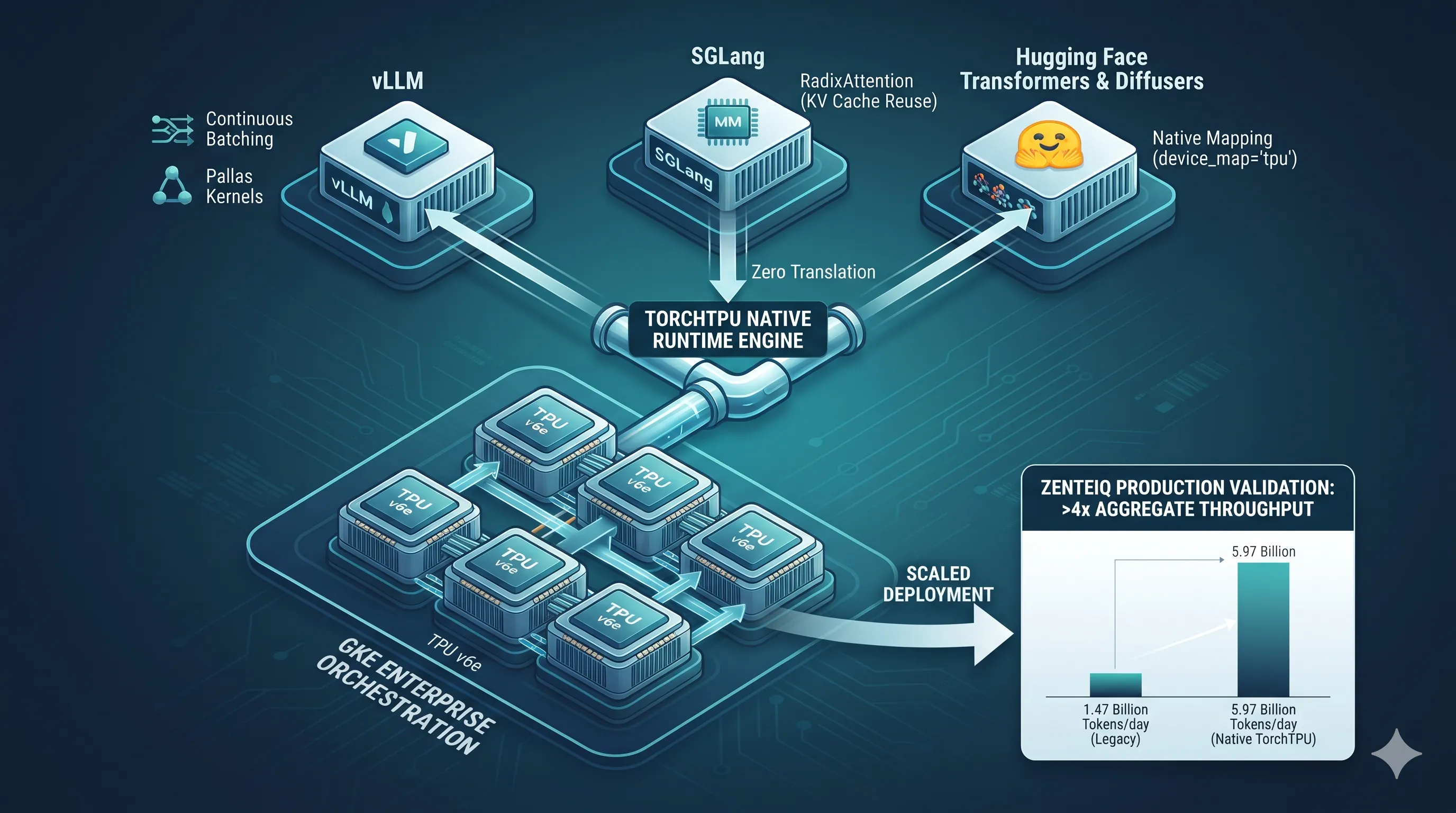
The native PyTorch backend for vLLM was developed in partnership with Inferact, introducing low-level acceleration through Pallas kernels.
This integration delivers native support for continuous batching, advanced quantization, and multi-chip parallelism directly on TPU infrastructure without routing through legacy compilation wrappers.
Simon Mo of Inferact stated: "Developers can immediately run production workloads on TPUs with the high throughput, low latency, and memory efficiency they expect from our stack."
In parallel, the SGLang native PyTorch backend was engineered alongside RadixArk to optimize memory reuse and stateful decoding.
The integration brings native execution of RadixAttention to TorchTPU, facilitating high-speed key-value (KV) cache reuse across requests, paired with integrated HiCache I/O backends for efficient context retention.
Distributed Serving at Scale with llm-d on GKE
Enterprise multi-node orchestration expands through llm-d 1.0, released as a CNCF Sandbox project in partnership with Red Hat, IBM, over 500 contributors, and 25 organizations.
Running on Google Kubernetes Engine (GKE), llm-d 1.0 provides distributed capabilities including prefix-cache-aware routing, prefill/decode disaggregation, and comprehensive multi-tenant flow control.
Production validation shows significant efficiency gains when combining llm-d with TorchTPU.
Enterprise adopter Zenteiq reported over 4x aggregate inference throughput using llm-d on GKE.
Driven by disaggregated execution and cache routing, Zenteiq scaled daily token capacity from 1.47 billion to 5.97 billion tokens per 1,000 TPU v6e accelerators.
| Serving Engine / Project | Key Partners & Governance | Core Architectural Features & Optimizations | Production Throughput & Scale Metrics |
|---|---|---|---|
| vLLM | Inferact | Native PyTorch backend on TorchTPU, Pallas kernels, continuous batching, quantization, multi-chip parallelism | High throughput, low latency, and memory efficiency in production workloads |
| SGLang | RadixArk | Native PyTorch backend on TorchTPU, RadixAttention for KV cache reuse, HiCache I/O backends | Optimized memory reuse and accelerated stateful inference |
| llm-d 1.0 | Red Hat, IBM, CNCF Sandbox (500+ contributors, 25 orgs) | Prefix-cache-aware routing, prefill/decode disaggregation, multi-tenant flow control on GKE | Over 4x aggregate throughput; 1.47B to 5.97B tokens/day per 1,000 TPU v6e at Zenteiq |
Hugging Face Transformers and Diffusers Native Mapping
Seamless development workflows are anchored by native support across Hugging Face libraries on TorchTPU.
Hugging Face Transformers v5 provides out-of-the-box hardware targeting validated by automated nightly CI/CD testing on TPU hardware.
Jeff Boudier of Hugging Face stated: "Hardware diversity is essential to making open-source AI accessible to everyone."
To deploy Hugging Face Transformer models directly onto TPU accelerators in Transformers v5, developers invoke the native hardware target during model initialization:
device_map="tpu"This parameter specifies the TPU hardware mapping parameter when loading Hugging Face models, directing the runtime to bind tensors directly to TPU memory without manual device staging.
Beyond language modeling, the Diffusers library runs natively on TorchTPU.
It provides first-class support for standard PyTorch workflows, including uncompiled eager mode, optimization via torch.compile, and distributed tensor parallelism across accelerator clusters.
6. Distributed Training, Reinforcement Learning, and Edge Deployment
TorchTPU enables native PyTorch execution on TPUs, bridging high-performance distributed scaling, reinforcement learning, and edge runtime export directly into the upstream PyTorch framework.By eliminating custom hardware divergence, this integration allows standard distributed libraries and execution runtimes to target Google TPUs natively.
TorchTitan and Distributed Training Recipes
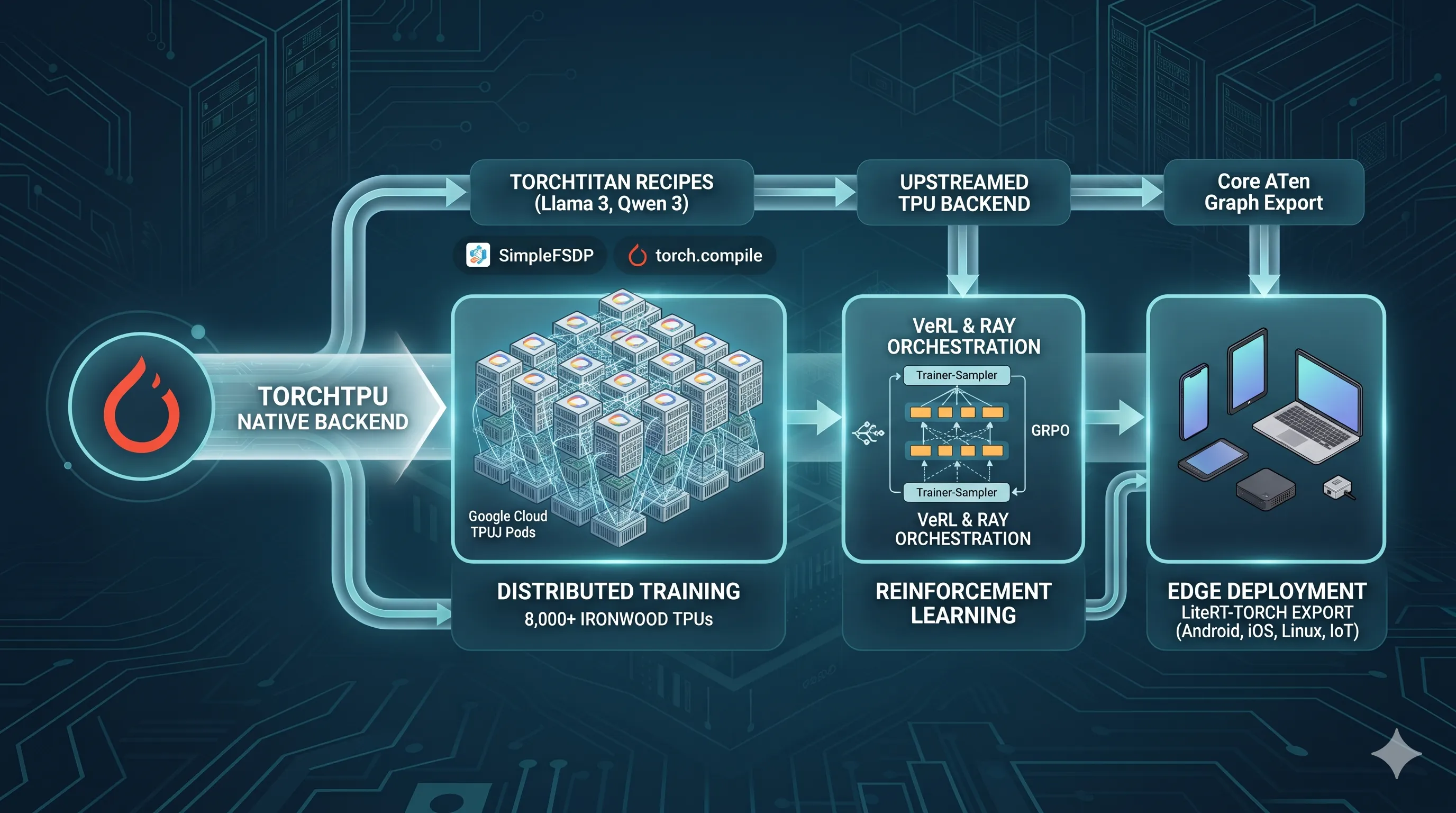
TorchTitan provides a reference implementation featuring production-grade integration with TorchTPU via SimpleFSDP, torch.compile, and Pallas kernels.Large-scale pre-training and fine-tuning workflows are validated across massive multi-accelerator configurations, extending to clusters of up to 8,000/8,192 Ironwood TPUs.
Supported production model recipes within TorchTitan include Llama 3 (70B and 405B variants), Qwen 3 (8B, 32B, and 235B parameters), MuseGlimmer 30B, and FLUX.1 12B.
Underscoring the necessity of native PyTorch support across diversified infrastructure, Jana van Greunen of Meta stated: "At Meta, advancing the frontier of AI requires immense compute scale and deep hardware diversity. We cannot be constrained by a single hardware architecture."
| Framework / Component | Supported Models / Recipes | Parallelism Models & Architecture | Deployment & Hardware Targets |
|---|---|---|---|
| TorchTitan | Llama 3 (70B, 405B), Qwen 3 (8B, 32B, 235B), MuseGlimmer 30B, FLUX.1 12B | SimpleFSDP, torch.compile, Pallas kernels | Up to 8,000/8,192 Ironwood TPUs |
| VeRL | Reinforcement Learning workflows | Disaggregated trainer-sampler architecture, GRPO | Upstreamed TPU backend |
| Ray | Unified end-to-end AI pipelines | Distributed orchestration (data processing, training, RL, serving) | Heterogeneous compute across CPUs, GPUs, and TPUs |
| LiteRT-Torch | PyTorch Core ATen models | Graph export via torch.export() | Cross-platform edge (Android, iOS, macOS, Windows, Linux, IoT) |
Reinforcement Learning with VeRL and Ray Orchestration
Reinforcement learning pipelines benefit directly from the unification of PyTorch execution across accelerator architectures.VeRL received an upstreamed TPU backend equipped with an end-to-end reference recipe for Group Relative Policy Optimization (GRPO).
This implementation leverages a disaggregated trainer-sampler architecture to optimize resource utilization across training and sampling phases.
To manage distributed execution across varied compute fleets, Ray adds native TorchTPU support to orchestrate data processing, training, RL, and serving across CPUs, GPUs, and TPUs in a unified workflow.
Highlighting the structural impact on AI infrastructure, Edward Oakes of Anyscale noted: "TorchTPU embeds Google TPUs directly in that industry-standard stack."
Edge Export via LiteRT-Torch and Ecosystem Maturity Limits
Downstream deployment extends beyond datacenter clusters into client and edge platforms.LiteRT (formerly TensorFlow Lite) joined the PyTorch ecosystem via LiteRT-Torch, enabling PyTorch model export using Core ATen and torch.export().
To convert PyTorch models for cross-platform edge deployment via LiteRT-Torch, developers execute the core export interface:
litert-torch.convert()Despite these multi-platform capabilities, specific ecosystem maturity constraints remain present in the current release.
FSDPv2 remains experimental with low performance on TorchTPU.
Additionally, SymInts support is currently experimental within the runtime stack.
7. Automated Onboarding and Diagnostics: The TPU Agent Suite
TorchTPU enables native PyTorch execution on TPUs, shifting how machine learning teams compile, trace, and execute workloads on Google infrastructure.To accelerate the configuration and troubleshooting of this runtime, Google launched a developer tooling preview of the TPU Agent Suite on GitHub, providing an automated layer of skills and subagents designed specifically for AI-assisted software harnesses.
Router Architecture and Specialist Subagents
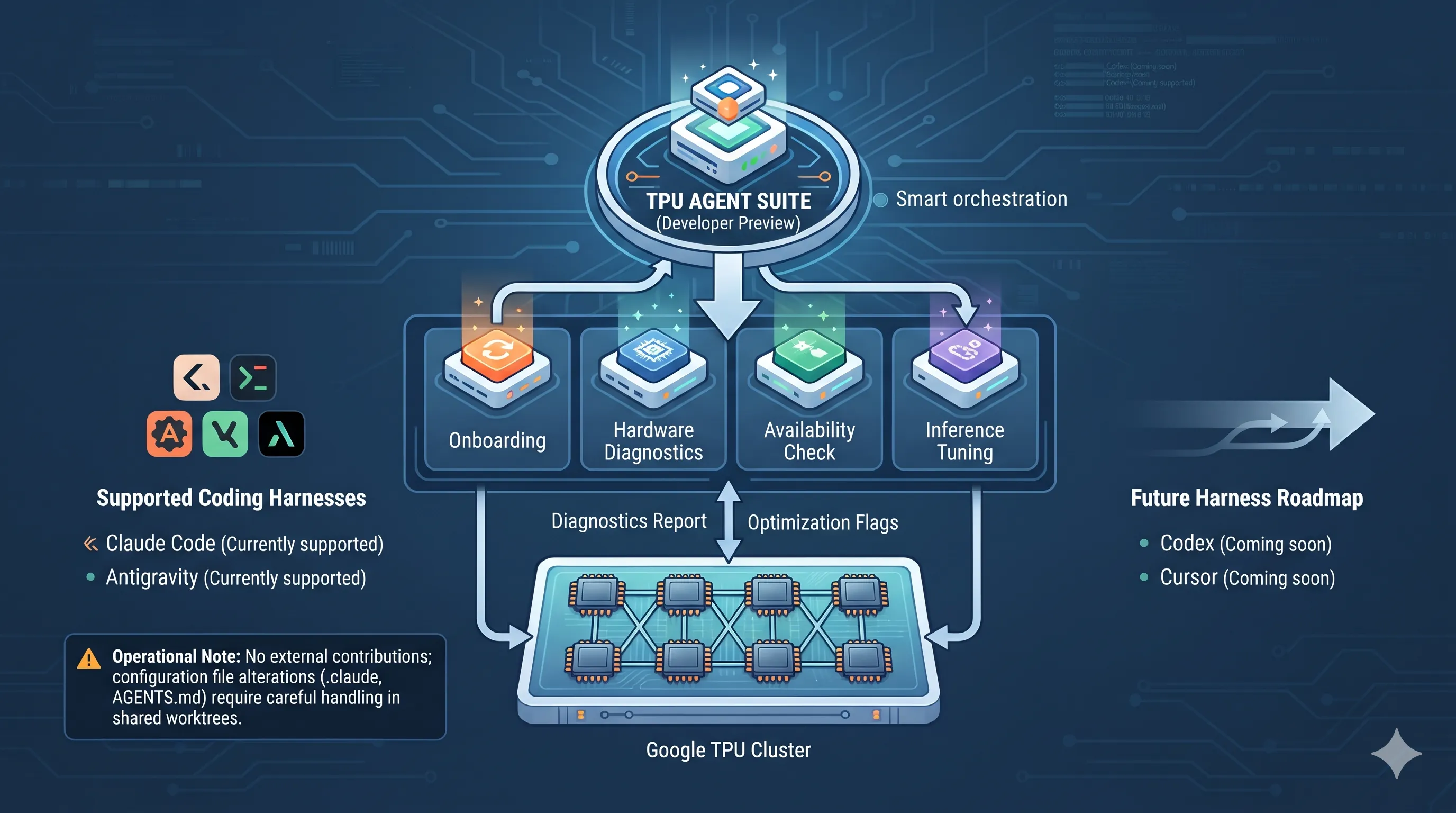
The TPU Agent Suite operates as a modular package containing structured skills and subagents built to interface directly with modern development environments.At the center of the architecture is the primary tpu-agent skill, which serves as a central orchestrator and request router.
Instead of handling disparate infrastructure commands through a single prompt flow, the tpu-agent router inspects user tasks and delegates operations to targeted specialist subagents.
These specialized subagents handle distinct lifecycle operations across four designated areas: environment onboarding, hardware diagnostics, hardware availability checks, and inference performance tuning.
The onboarding subagent automates environment preparation and dependency verification needed to run PyTorch natively on accelerator hardware.
Dedicated hardware check and diagnostic subagents inspect underlying TPU chips, validating communication topologies and cluster readiness prior to job submission.
The inference performance tuning subagent evaluates model execution paths, identifying throughput constraints and runtime flags to assist engineers in maximizing TPU utilization.
Supported Harnesses, Worktree Caveats, and Roadmaps
Adoption of the TPU Agent Suite depends on integration with automated coding assistants and interactive CLI interfaces.The preview release currently supports two development environments: Claude Code and Antigravity.
Google has scheduled support for additional platforms, explicitly listing integrations for Codex and Cursor harnesses as coming soon.
| Coding Harness | Support Status |
|---|---|
| Claude Code | Currently supported |
| Antigravity | Currently supported |
| Codex | Coming soon |
| Cursor | Coming soon |
The TPU Agent Suite repository does not accept external contributions for now, keeping code management restricted to internal teams during the initial rollout.
Furthermore, running a project-scope installation introduces configuration file alterations that require careful handling.
The setup process automatically writes updates to agent configuration files, specifically modifying .claude or AGENTS.md.
Engineering teams using fresh Git worktrees or ephemeral branches must exercise caution, as automated edits to these tracking files can cause branch drift or inadvertent configuration churn across shared repositories.
Related Posts
Generative AI may have assisted with research or drafting for this article. Topic selection, fact-checking, final wording, and publication remain the responsibility of DragonStone74. AI use disclosure