
Digit 360 Tactile Sensor, Isaac Sim, ROS 2, and Sparsh Pipeline Integration Guide
🚀 Key Takeaways
- Omnidirectional Tactile Embodiment: Digit 360 delivers hemispherical optical touch sensing with wide-angle optics and on-device processing to capture multi-directional contact dynamics.
- High-Fidelity Isaac Sim Integration: Sectorized and convex URDF collision meshes enable seamless digital twin modeling and synthetic tactile data generation within NVIDIA Isaac Sim.
- Low-Latency ROS 2 Telemetry: Native ROS 2 nodes package raw optical tactile streams into standard message topics for downstream robot manipulation policies.
- Generalizable Touch Representations: The Sparsh foundation framework leverages self-supervised vision-based learning to extract invariant tactile embeddings across diverse elastomeric sensors.
- Lightweight Downstream Decoders: Frozen Sparsh encoders power real-time decoders for contact localization, shear slip tracking, and multi-finger object pose estimation.
- Sim-to-Real Contact Adaptation: Multisensory tactile pipelines bridge the simulation-to-reality gap, providing resilient feedback for precision insertion and in-hand reorientation.
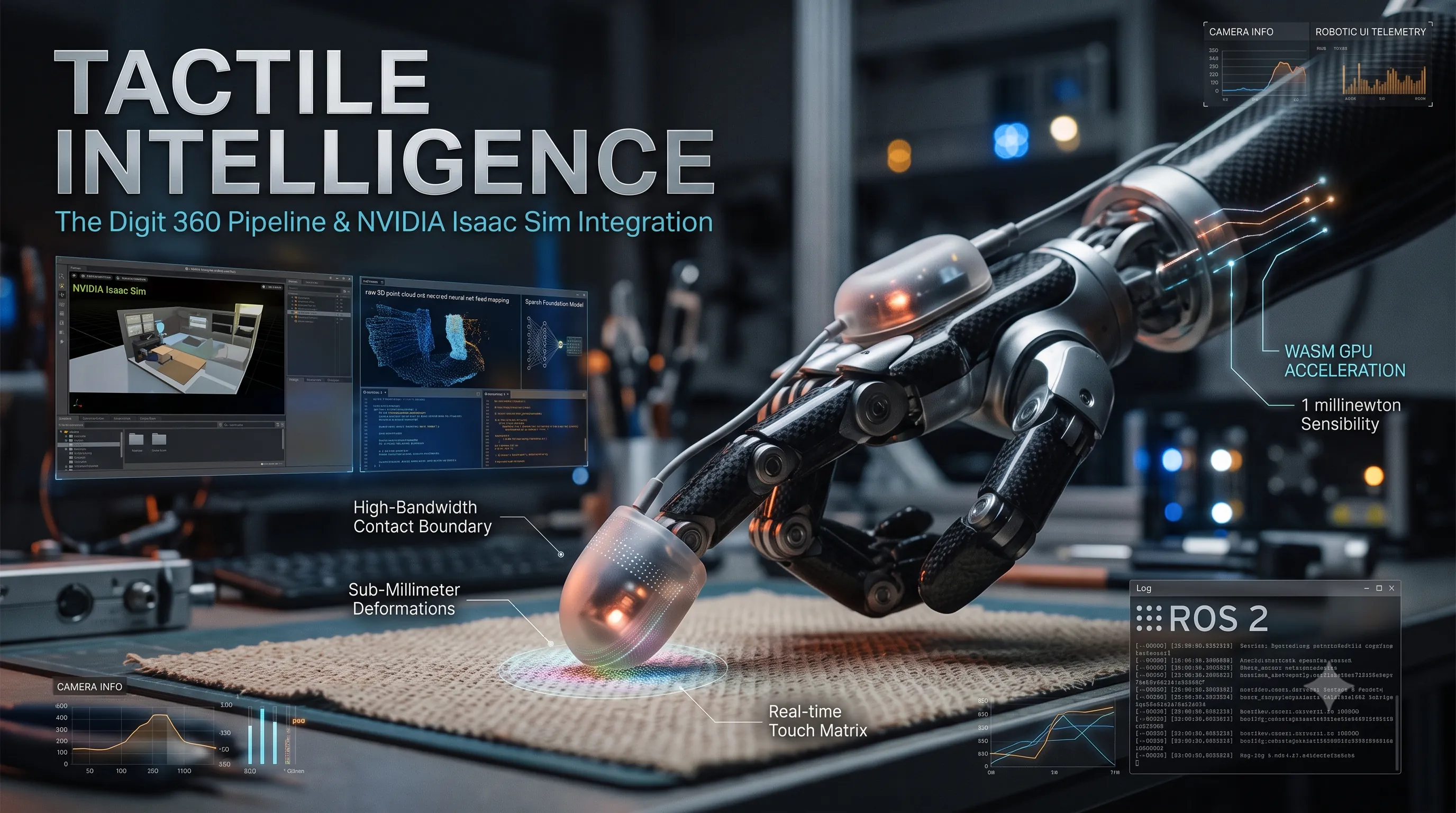
Dexterous robotic manipulation has historically faced an information bottleneck at the contact boundary. While camera-based vision systems excel at global scene comprehension, they inevitably struggle with occlusions, microscopic slip, and sub-millimeter compliance during physical contact. Optical tactile sensing addresses this gap by converting elastomeric skin deformations into rich visual signals, transforming artificial fingertips into dense sensory surfaces capable of dynamic touch perception.
Bridging high-bandwidth contact data with real-time robot controllers requires a unified pipeline connecting simulation, robotics middleware, and foundation models. Integrating the Digit 360 sensor with NVIDIA Isaac Sim and ROS 2 creates a robust digital-to-physical workflow, allowing developers to generate synthetic tactile interactions in simulation and stream live contact matrices to physical manipulators with minimal transport latency.
By combining this hardware and simulation ecosystem with Meta’s self-supervised Sparsh framework, engineers can bypass manual tactile calibration in favor of generalized, task-agnostic touch representations. This guide explores the complete implementation pipeline, from URDF import in Isaac Sim to ROS 2 node streaming and real-time Sparsh force decoding for precision robotic tasks.
1. Digit 360 Hardware Architecture and Omnidirectional Tactile Sensing
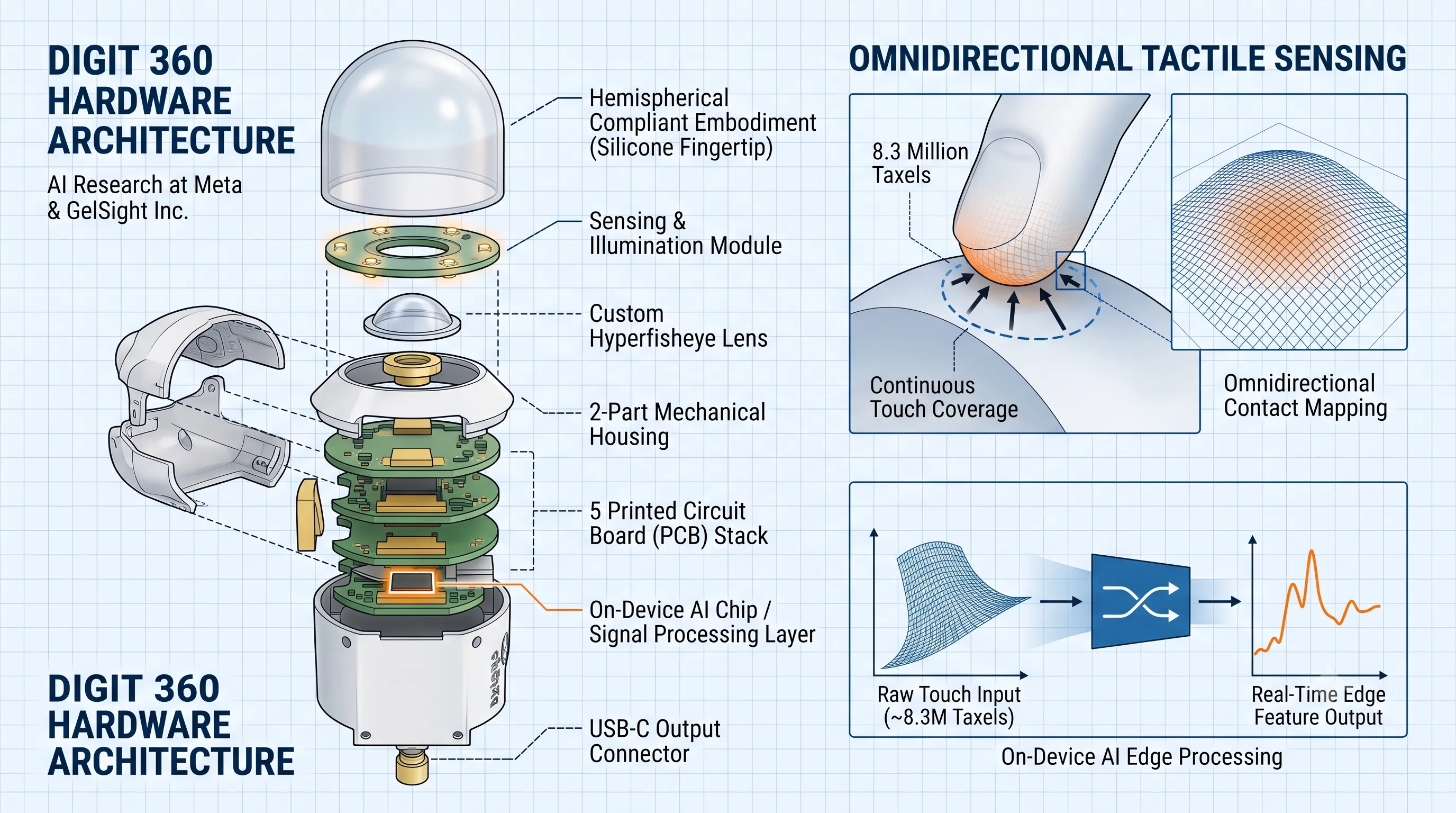
In any modern tactile pipeline—such as those connecting sensory feeds to ROS2, Isaac Sim environments, and Sparsh models—physical fidelity at the contact interface dictates the quality of downstream perception.The Digit 360 tactile sensor establishes this physical interface through an advanced embodiment engineered by AI Research at Meta in partnership with GelSight Inc.
8.3 Million Taxel Hemispherical Embodiment and Optical Stack
The Digit 360 is engineered as a hemispherical compliant embodiment designed specifically as an artificial fingertip.Unlike traditional flat tactile sensors that constrain contact mechanics to planar surfaces, this hemispherical profile allows continuous interaction across curved and variable contact angles.
Central to this high-density surface transduction is an optical assembly featuring a custom hyperfisheye lens.
This hyperfisheye optics system projects the entire deformation of the compliant hemispherical surface onto internal sensing arrays, delivering high-resolution sensors with approximately 8.3 million taxels.
To package this dense optical and sensing capability into an artificial fingertip form factor, the hardware utilizes a robust 2-part mechanical housing.
Inside this compact enclosure, system electronics and sensor routing are integrated via a 5 printed circuit board (PCB) stack.
| Specification Category | Digit 360 Hardware Attribute |
|---|---|
| Development Partners | AI Research at Meta in partnership with GelSight Inc. |
| Form Factor | Hemispherical compliant embodiment designed as an artificial fingertip |
| Tactile Resolution | Approximately 8.3 million taxels across high-resolution sensors |
| Optical Assembly | Custom hyperfisheye lens |
| Mechanical Construction | 2-part mechanical housing |
| Electronic Architecture | 5 printed circuit board (PCB) stack |
| Signal Processing | On-device artificial intelligence for real-time edge processing |
On-Device AI Processing and Multi-Modal Omnidirectional Capture
Handling the massive stream of sensory data produced by millions of sensing points requires specialized edge architecture.The Digit 360 integrates on-device artificial intelligence directly within its physical stack to process tactile signals in real time.
This internal processing layer enables the sensor to interpret deformation and contact dynamics without introducing severe computational bottlenecks into the host robot controller.
Furthermore, the physical construction captures omnidirectional multi-modal tactile signals across its hemispherical interaction field.
By capturing rich, omnidirectional tactile modalities directly at the contact point, the sensor supplies the foundational tactile representations required for modern robotic pipelines.
2. NVIDIA Isaac Sim Modeling and Synthetic Asset Pipeline for Digit 360
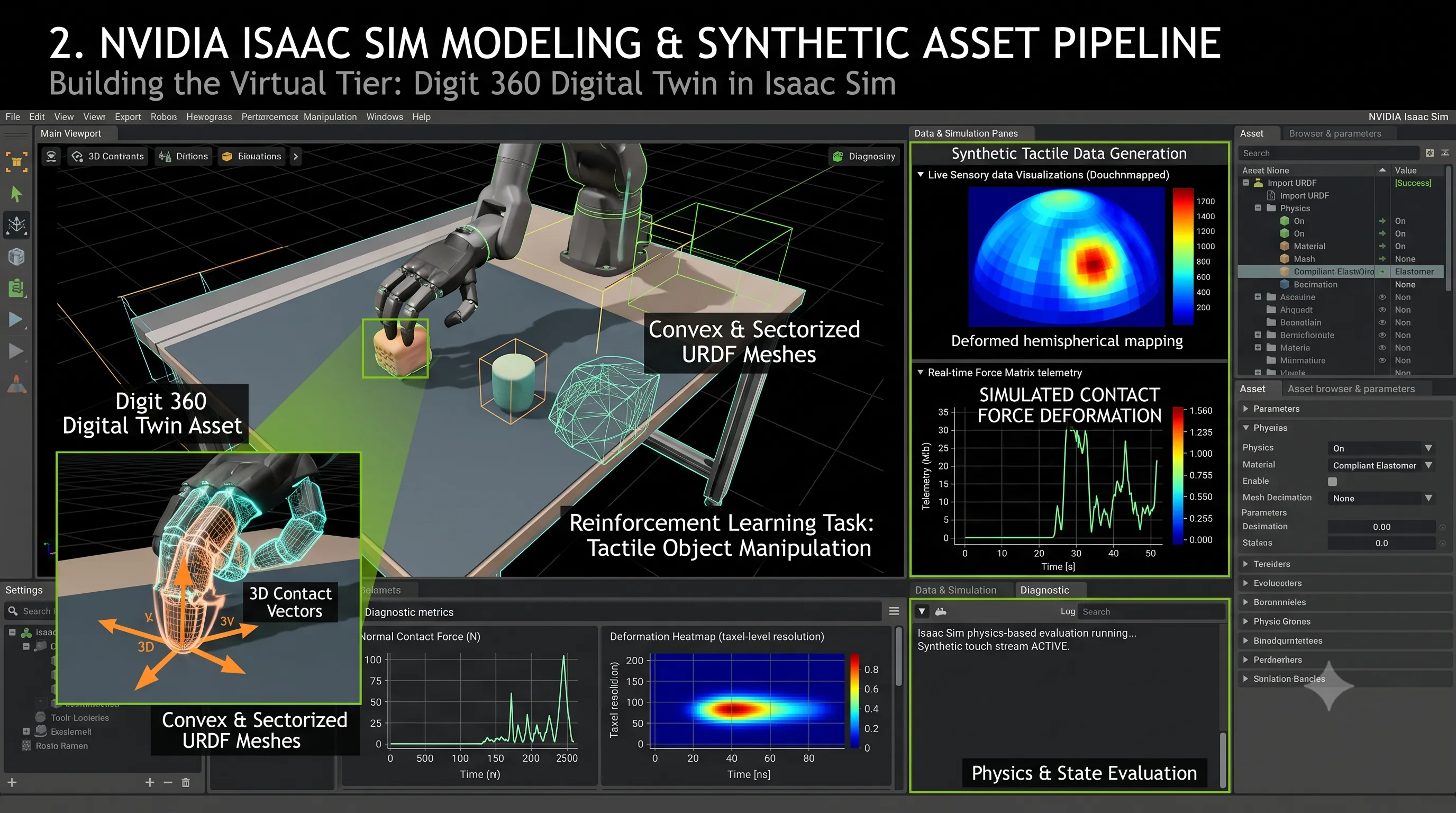
In the context of the broader tactile pipeline connecting ROS 2 and NVIDIA Isaac Sim with the Digit 360 sensor and Sparsh tactile representations, constructing an accurate simulation model serves as the foundational virtual tier.Physics-based robotic manipulation requires high-fidelity spatial representation that can interact seamlessly with dynamic simulation environments.
Sectorized and Convex URDF Meshes for Reinforcement Learning
To support robust contact physics in virtual training stages, the Digit 360 pipeline provides sectorized and convex meshes formatted in URDF specifically prepared for reinforcement learning environments.Both convex and sectorized meshes can be directly imported into Isaac Sim without requiring manual mesh decimation or format conversions.
By offering both convex representations for collision approximations and sectorized structures for multi-region spatial decomposition, the pipeline equips reinforcement learning setups to simulate fine tactile interactions efficiently.
Digital Twin Tactile Sensor Asset Evaluation in Isaac Sim
Once imported into the simulation workspace, Isaac Sim supports digital twin tactile sensor asset evaluation alongside synthetic tactile data generation.This infrastructure allows engineers to inspect and validate the physical behavior and surface interaction properties of digital twin tactile sensor assets under various simulated force distributions.
Furthermore, synthetic tactile data generation within Isaac Sim enables scalable production of contact profiles, bridging virtual contact modeling directly with downstream processing pipelines.
3. Digit 360 ROS 2 Node Interfacing and Real-Time Tactile Streaming
Connecting tactile hardware and simulation into the broader robotic tactile pipeline—anchored around the main architecture of "Robotic Tactile Sensing Integrated with ROS 2 and Isaac Sim: A Practical Pipeline for Digit 360 and Sparsh Models"—requires reliable node-level communication.
The Digit 360 platform provides the foundational data plumbing needed to expose sensor modalities directly to robotic compute stacks.
Native ROS 2 Publisher Nodes and Python Programming Interface
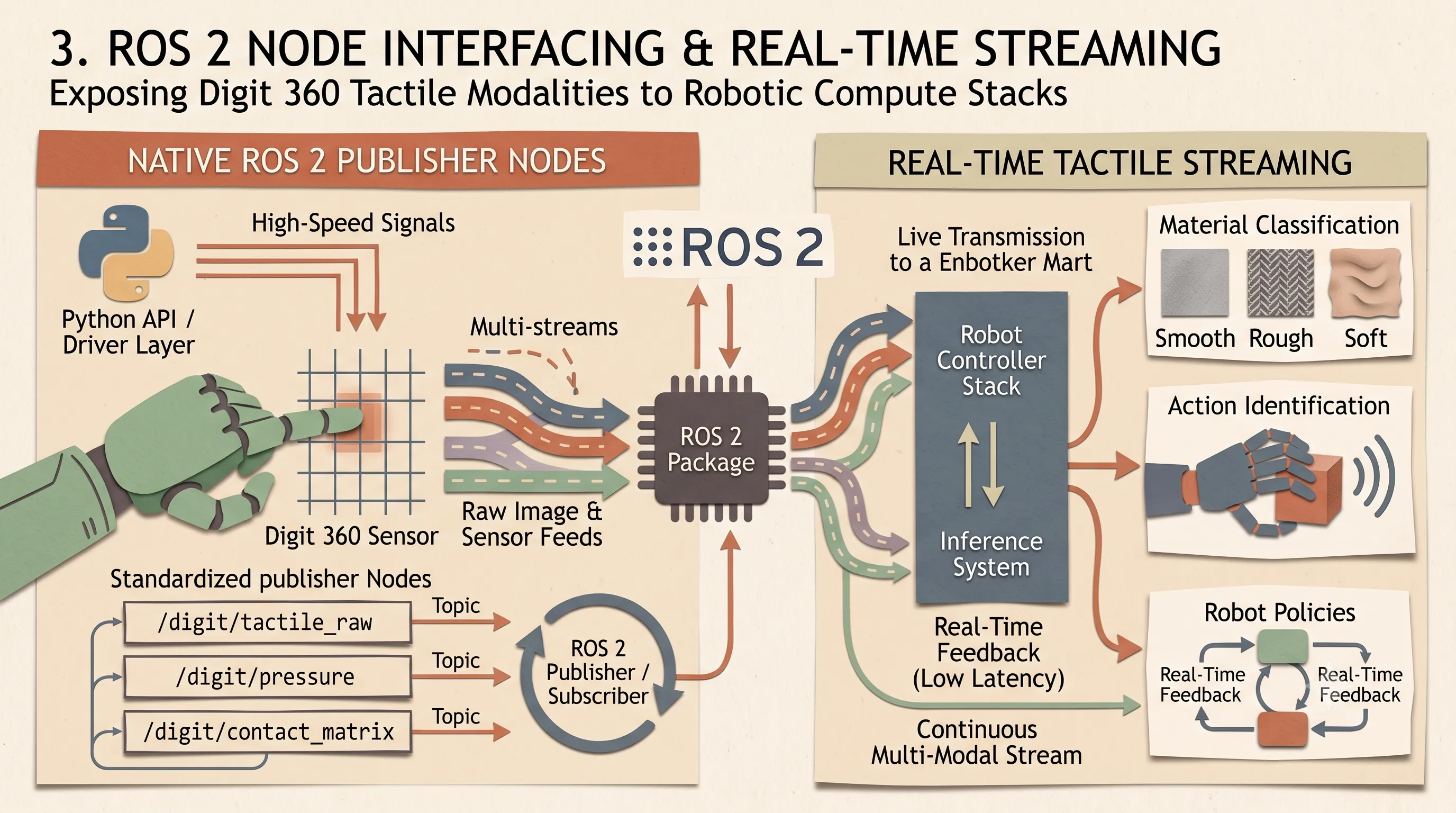
Direct interaction with the Digit 360 sensor begins at the API layer, which provides a Python interface designed for direct programmatic access to all Digit 360 output modalities.Developers can inspect and ingest tactile raw streams programmatically without requiring heavy middleware wrappers when developing custom scripts.
To integrate these capabilities into standardized robotic computation graphs, the ecosystem includes a native ROS 2 package.
This package encapsulates the underlying driver logic and publishes the sensor's output modalities as standard ROS 2 topics.
By deploying the native ROS 2 node, robotic systems running ROS 2 can seamlessly subscribe to live tactile signals across local or distributed networks.
Tactile Data Streaming for Robot Policies and Material Classification
Once exposed as ROS 2 topics, the architecture supports streaming and formatting real-time tactile data streams tailored specifically for downstream robot control policies.This real-time tactile streaming ensures feedback loops within motor control networks can ingest physical contact signals at the low latencies required for dynamic manipulation.
Beyond direct control loops, the pipeline supports multimodal classification workflows.
These classification pipelines process touch interactions to perform material identification and action identification directly from the streaming tactile modalities.
This integration establishes the real-time link between raw tactile acquisition and downstream policy inference models.
4. Sparsh Self-Supervised Vision-Tactile Representation Framework
Within the end-to-end tactile processing pipeline bridging simulation and physical deployment—anchored by the "Robotic Tactile Sensing Integrated with ROS 2 and Isaac Sim: A Practical Pipeline for Digit 360 and Sparsh Models" workflow—the Sparsh framework functions as the foundational vision-tactile representation backbone.
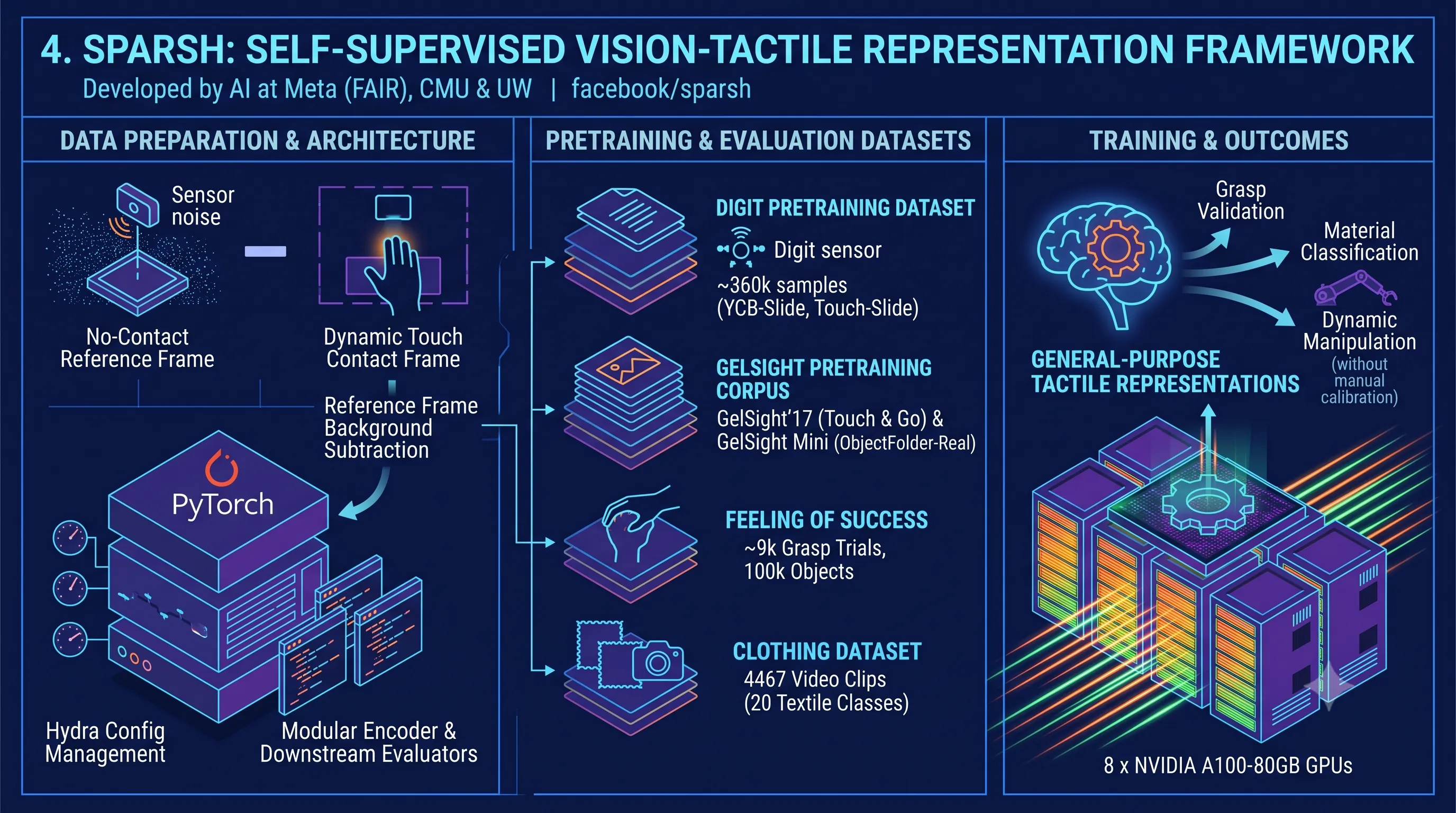
Developed by AI at Meta (FAIR), the Robotics Institute at CMU, and the University of Washington, Sparsh provides general-purpose visual-tactile representations directly applicable to sensory feature streams.
Pretrained model weights for the architecture are distributed via Hugging Face under the repository path facebook/sparsh.
PyTorch and Hydra Architecture with Reference Frame Background Subtraction
The framework relies on a native PyTorch implementation providing self-supervised touch representations tailored specifically for vision-based tactile sensors.To orchestrate modular workflows, Sparsh uses Hydra for experiment configuration management across varied encoders and downstream evaluation tasks.
Tactile camera feeds inherently register optical variations, baseline sensor curvature, and internal illumination artifacts under static rest conditions.
To isolate actual physical surface deformation, the architecture requires background subtraction using dedicated no-contact reference frames stored directly in a bgs directory.
By standardizing input normalization against these unperturbed reference captures, PyTorch-based encoders maintain focus on contact-induced geometric shifts during dynamic interactions.
Pretraining Datasets and 8 A100 GPU Computational Configuration
Sparsh derives its representation capabilities from extensive multi-sensor pretraining corpuses.The primary DIGIT pretraining dataset contains approximately 360k tactile image samples aggregated from the YCB-Slide and Touch-Slide datasets.
Complementing DIGIT sensor observations, the pretraining datasets incorporate GelSight'17 (Touch and Go) and GelSight Mini (ObjectFolder-Real) to support diverse elastomeric membrane geometries.
Downstream and evaluation pipelines incorporate additional task-specific corpuses, including the Feeling of Success dataset, which comprises approximately 9k grasp trials over 100k objects.
Furthermore, fine-grained material recognition utilizes the Clothing dataset, containing 4467 short video clips structured across 20 textile classes.
To process these vision-tactile inputs, model training experiments were conducted using a high-throughput cluster configuration of 8 A100-80GB GPUs.
| Dataset / Infrastructure Component | Sensor / System Modality | Dataset Scale / Hardware Specifications |
|---|---|---|
| DIGIT Pretraining Dataset | DIGIT (YCB-Slide, Touch-Slide) | Approximately 360k tactile image samples |
| GelSight Pretraining Corpuses | GelSight'17 (Touch and Go), GelSight Mini (ObjectFolder-Real) | Integrated multi-sensor vision-tactile representations |
| Feeling of Success Dataset | Vision-based touch manipulation | Approximately 9k grasp trials over 100k objects |
| Clothing Dataset | Tactile surface video sequences | 4467 short video clips across 20 textile classes |
| Model Training Hardware | Compute Infrastructure | 8 A100-80GB GPUs |
5. Sparsh Downstream Decoders, Force Field Evaluation, and Sensor Interfacing
Within the broader architecture of the pipeline connecting tactile models to simulation and robotic control frameworks, downstream decoders and low-level device interfacing serve as the bridge translating high-dimensional tactile representations into physical metrics.This section anchors directly to the pipeline by examining how frozen encoder representations map to physical force fields, multi-finger SE(3) pose estimations, and Linux-level device identification.
Frozen Encoder Protocol and ATI nano17 Ground Truth Alignment
The evaluation framework follows a frozen evaluation protocol where the Sparsh encoder weights remain frozen while training lightweight task decoders.To establish reliable physical force ground truth, normal and shear forces are recorded using an ATI nano17 force/torque sensor.
Contact experiments employ 3 probe shapes—hemisphere, sharp, and flat—each sliding 2mm on sensor elastomers to collect calibrated normal and shear force labels.
The lightweight decoders trained on these representations drive a real-time live force field demo that visualizes normal contact localization along with shear force vectors, isolating translational shear and torsional slip.
| Evaluation Aspect | Configuration / Tooling | Operational Specification |
|---|---|---|
| Encoder Protocol | Sparsh Foundation Model | Weights remain frozen; lightweight downstream decoders trained for specific tasks |
| Ground Truth Reference | ATI nano17 sensor | Direct measurement and recording of normal and shear force/torque labels |
| Contact Probes | Hemisphere, sharp, flat geometries | Sliding trajectory of 2mm across elastomer surfaces to generate force profiles |
| Force Field Output | Live visualization decoder | Real-time visualization of normal contact localization, translational shear, and torsional slip |
Multi-Finger Pose Tracking and Linux UVC Sensor Verification
Beyond single-point contact force evaluation, tactile representations support multi-finger pose estimation.The system evaluates multi-finger pose estimation using DIGIT sensors mounted on 3 robot fingertips: index, middle, and ring.
Physical hardware units for these DIGIT sensors are identified by serial numbers following the format DXXXXX.
Trajectory recording utilizes 2 objects—a Pringles can and a YCB sugar box—integrated with tag tracking to record SE(3) pose perturbation trajectories during manipulation tasks.
Connecting optical tactile hardware to the computing host requires identifying the relevant system device nodes.
GelSight Mini hardware interfaces with Linux systems as a standard UVC webcam device.
To check the allocated Linux video device node when connecting a webcam-recognized tactile sensor like GelSight Mini, the standard device directory listing command is executed:
ls -l /dev/video*/dev to identify the device index corresponding to the connected sensor.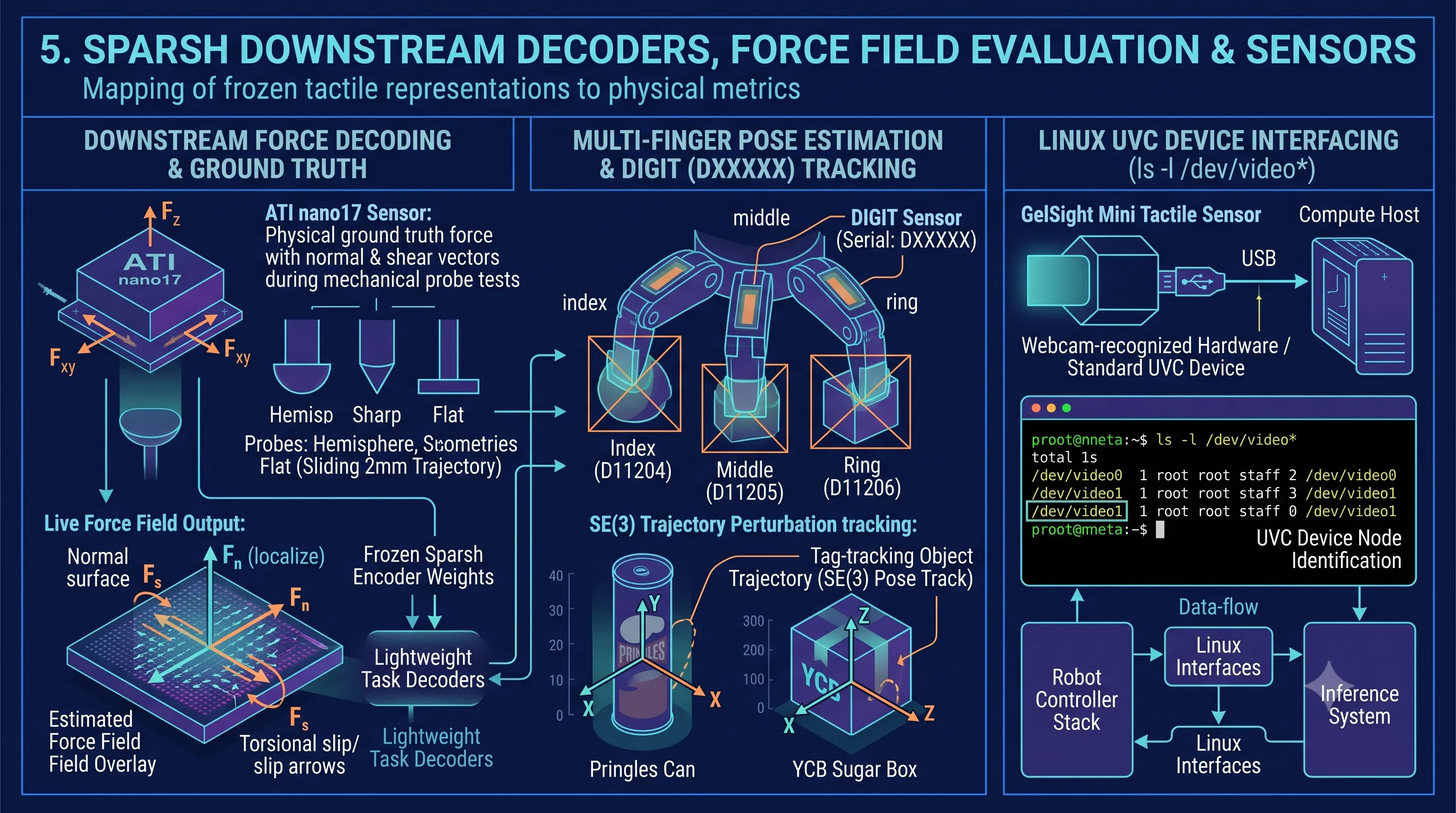
6. Multisensory Touch Fusion and Sparsh-X Sim-to-Real Adaptation
Bridging the tactile perception pipeline established across ROS2, Isaac Sim, and Digit 360 requires closing the physical domain discrepancy through Sparsh-X.While visual and optical tactile sensors record high-resolution deformation patterns, robotic execution hinges on continuous physical interactions that standard optical signals cannot completely resolve alone.
Complementary Multimodal Tactile Dynamics Across Spatial-Temporal Scales
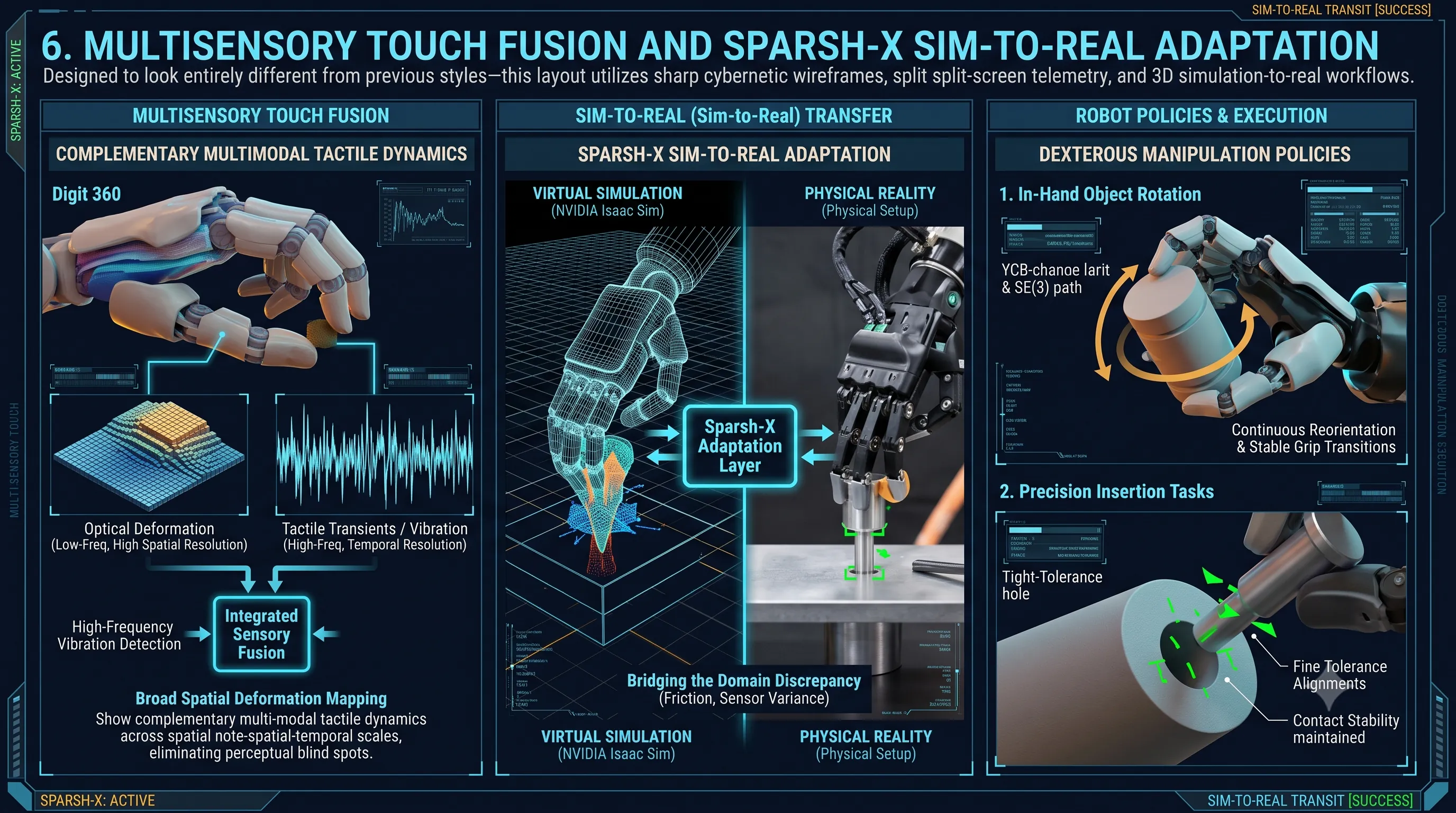
Tactile sensing mechanisms must capture complementary contact dynamics across differing spatial and temporal resolutions beyond optical imaging alone.Optical tactile frames provide detailed structural footprints at discrete visual capture intervals, yet fine transient shifts during physical contact demand sensory signals acting across distinct temporal frequencies.
Integrating multimodal tactile dynamics ensures that high-frequency contact events and broad spatial deformations are represented simultaneously.
This complementary fusion mitigates the perceptual blind spots inherent to purely vision-based tactile representations, feeding richer representations into downstream models.
Sim-to-Real Transfer for In-Hand Rotation and Precision Insertion Policies
The Sparsh-X framework enables a sim-to-real tactile adaptation pipeline that adapts simulation-trained manipulation policies to physical robotic platforms.Policies trained inside simulation environments frequently encounter domain shifts when deployed onto physical robot setups due to complex frictional properties and sensor variances.
Sparsh-X bridges this simulation-to-reality divide by conditioning tactile representations for robust policy adaptation across target hardware.
This adaptation pipeline significantly improves policy robustness and performance for precision dexterous manipulation tasks, including insertion and in-hand object rotation.
Physical robotic platforms leverage these adapted policies to maintain stable grip transitions during continuous reorientation while executing tight-tolerance insertions without losing contact stability.
Related Posts

Generative AI may have assisted with research or drafting for this article. Topic selection, fact-checking, final wording, and publication remain the responsibility of DragonStone74. AI use disclosure