
Inside libghostty-vt 1.0: Modern C ABI Design and Low-Level Tools
🚀 Key Takeaways
- C ABI Modernization: Production-grade foundations like libghostty-vt demonstrate that strict, opaque C ABI designs can eliminate brittle C++ standard library dependencies while delivering portable performance across diverse platforms.
- Static Binary Recompilation: Automated translation toolchains that convert legacy machine instructions directly into readable, portable C enable complex native binaries to execute seamlessly inside modern web runtimes and non-native environments.
- Low-Level Architectural Virtualization: Upstream kernel breakthroughs, such as per-process page size emulation and lightweight hypervisor isolation, dismantle hardware constraints by allowing 4 KiB workloads to coexist smoothly on 16 KiB architectures.
- Accessible Bare-Metal Toolchains: Modern compilation workflows targeting UEFI firmware facilitate direct hardware interaction and self-contained execution without the overhead or complexity of a full operating system kernel.
- Ergonomic Systems Languages: Emerging platforms and frameworks—including Zig, asynchronous embedded Rust, and Mojo—unify ergonomic developer ergonomics with fine-grained register, memory, and accelerator control.
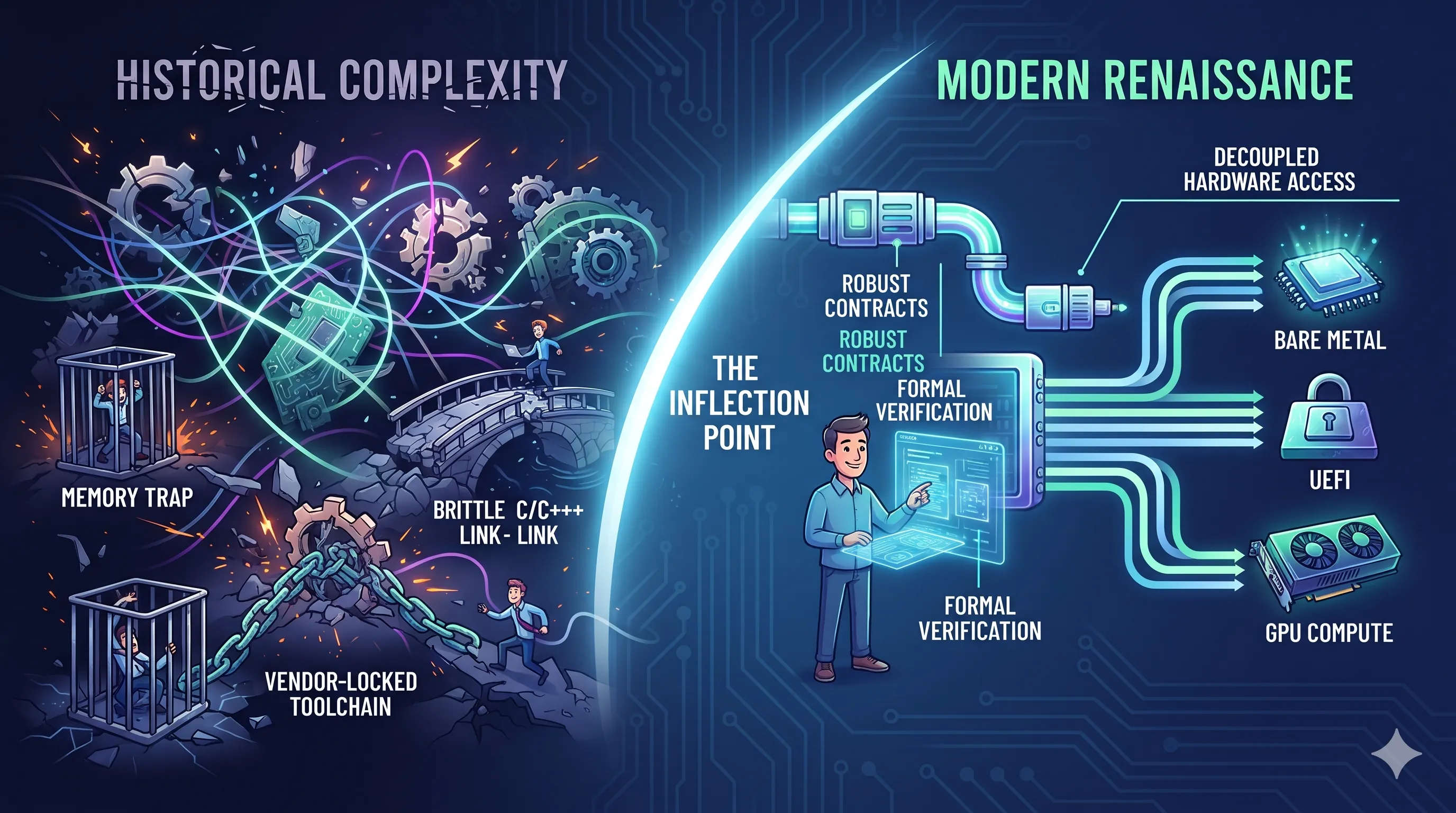
Low-level systems programming historically forced developers to choose between raw execution efficiency and grueling operational complexity. Building deterministically for bare metal, kernel subsystems, or platform firmware required navigating vendor-locked toolchains, brittle C/C++ linking behaviors, and perilous memory management traps. Today, an inflection point is reshaping systems engineering: disciplined ABI paradigms, automated decompilation and translation pipelines, and modern hardware-native languages are systematically lowering the entry barrier.
As software stacks push closer to the underlying silicon, modern tooling is decoupling hardware access from monolithic operating systems. Developers now run production-grade emulation engines across millions of developer seats with zero standard library bloat, dynamically recompile native titles into portable browser-compatible source code, and deploy asynchronous runtimes directly to microcontrollers. This transformation replaces manual, bug-prone plumbing with robust contracts, formal verification, and automated build pipelines.
Whether your work involves bridging hardware page-size mismatches, orchestrating bare-metal binaries via UEFI firmware, or directing graphics compute units without heavy proprietary frameworks, low-level programming is entering a renaissance. Modern tools provide unprecedented transparency and safety, making high-performance systems engineering more approachable, portable, and reliable than ever before.
1. Architectural Stability in Modern Systems C: Inside libghostty-vt 1.0
The evolution of low-level systems programming relies heavily on libraries that minimize integration friction while maximizing execution predictability.As part of the broader technological movement where new tools and libraries enable easier low-level programming, the release of libghostty-vt 1.0 establishes a notable milestone for systems developers.
Extracted directly from the Ghostty core, libghostty-vt 1.0 delivers a portable, high-performance C terminal emulation library designed to serve as an enduring foundation across bare-metal environments, modern operating systems, and embedded runtimes alike.
Opaque Handle Architecture and Dependency-Free C Design
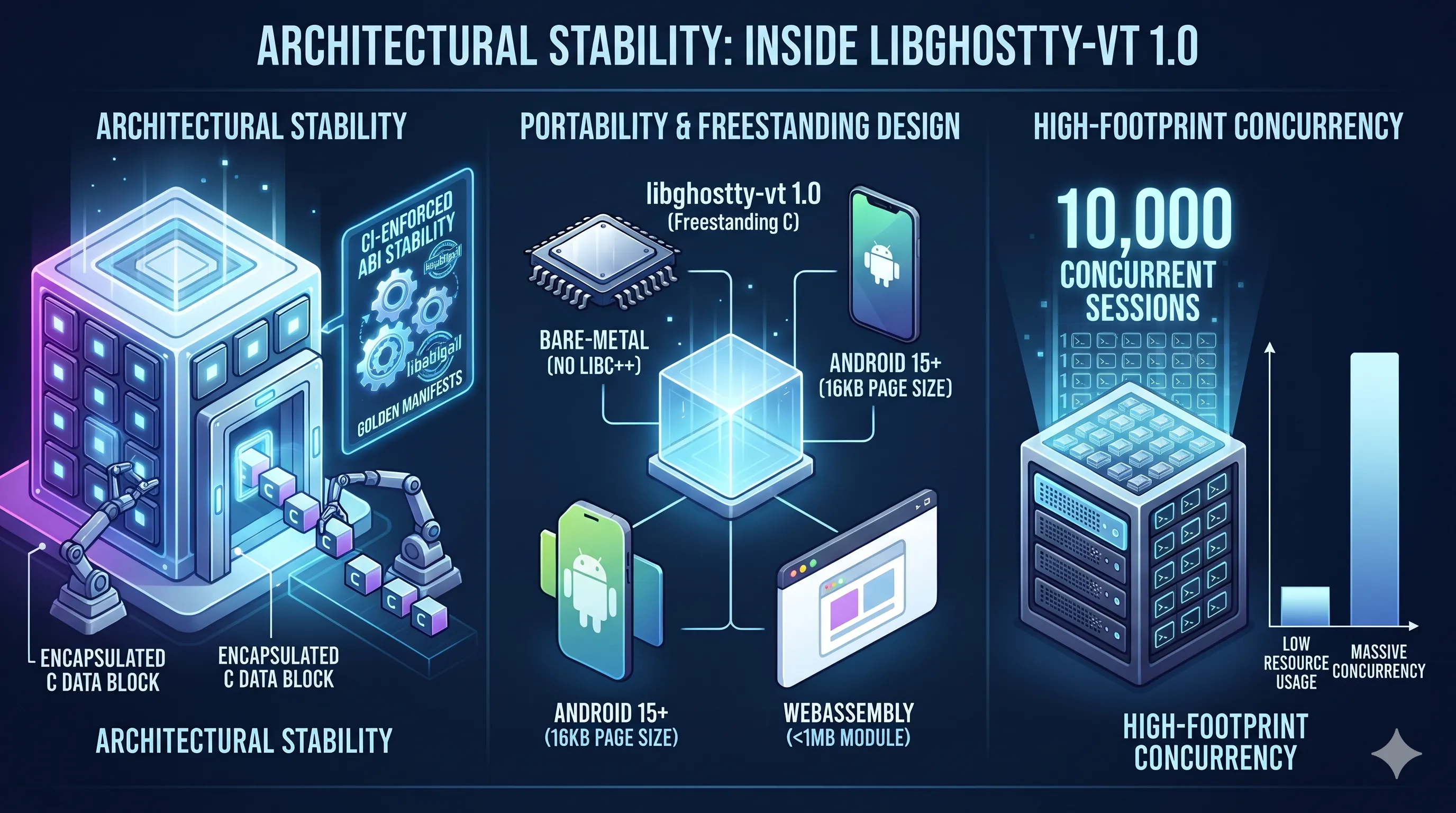
Central to the architectural philosophy of libghostty-vt 1.0 is the preservation of strict encapsulation and zero-overhead interop.The library employs an opaque handle architecture, ensuring that all internal data access passes strictly through enum-keyed getters and setters.
This decoupling prevents consumer code from depending on internal memory layouts, insulating applications from underlying data structure mutations across versions.
When client code linked against older headers attempts to access functionality that is unavailable or deprecated, the library returns explicit GHOSTTY_UNSUPPORTED status codes rather than generating memory violations or triggering undefined behavior.
To facilitate broad systems adoption, libghostty-vt 1.0 eliminates external runtime entanglements.
The library operates with zero C++ standard library dependencies by compiling underlying utility libraries—specifically simdutf and Google Highway—entirely without libc++.
This enables the codebase to achieve fully freestanding operation for bare-metal targets whenever SIMD acceleration is disabled.
Distributed under the MIT license alongside explicit machine-readable dependency manifests, the library streamlines compliance and provenance tracking for enterprise toolchains.
However, developer workflows must account for runtime constraints: the default runtime build requires libc due to default malloc allocator bindings and active SIMD vector requirements.
CI-Enforced ABI Stability and Low-Footprint Concurrency Benchmarks
Maintaining binary compatibility across heterogeneous platforms requires rigorous continuous verification.Emphasizing this engineering discipline, Mitchell Hashimoto stated that ABI stability is the hallmark of a high-quality and enduring C library.
To enforce this standard deterministically, libghostty-vt 1.0 utilizes libabigail in Linux continuous integration pipelines, while validating golden manifests across macOS and WebAssembly builds.
Any uncommitted or unintentional shift in symbol export, calling convention, or ABI surface breaks CI validation before merges occur.
This stability underpins massive deployment scales, including a reach of over 12.5 million active users achieved through deep integration within the JetBrains IDE terminal subsystem.
Despite this production footprint, the library dramatically reduces the complexity of writing native tools, enabling a complete, fully functional terminal emulator implementation in approximately 1,500 lines of C.
Concurrency profiles further highlight its minimal resource overhead: the engine successfully ran 10,000 active shell sessions concurrently on a constrained server provisioned with just 4 cores and 8 GB of RAM.
In browser and sandboxed runtimes, the smallest compiled WebAssembly module builds to under 1 megabyte.
Furthermore, the library incorporates native support for 16 KB page sizes, satisfying the mandatory architectural specifications of Android 15 and higher.
| Architectural Dimension | Technical Specification & Benchmark | Operational Scope & Environment |
|---|---|---|
| Application Footprint | Full terminal emulator implemented in ~1,500 lines of C | Native C systems development |
| Session Concurrency | 10,000 concurrent active shell sessions | Benchmarked on a 4-core, 8 GB RAM server |
| WebAssembly Footprint | Binary module builds to under 1 MB | WebAssembly browser and sandboxed runtimes |
| Memory Architecture | 16 KB memory page size support | Targeted for Android 15 and higher |
| ABI Verification | libabigail checks and golden manifests | Linux CI (libabigail), macOS & WebAssembly (golden manifests) |
| Runtime Dependencies | Zero libc++ dependencies; freestanding when SIMD is disabled | Bare-metal capable (default build requires libc for malloc/SIMD) |
| Production Deployment | Over 12.5 million active users | JetBrains IDE integrated terminal ecosystem |
2. From x86 Machine Code to WebAssembly: Static Binary Recompilation in Action
Modern low-level programming tooling has expanded beyond standard compiler toolchains to encompass automated translation pipelines that ingest legacy binaries and output modern, portable code.Static binary recompilation represents a pivotal breakthrough in this ecosystem, lowering the barrier to preserving, analyzing, and deploying complex legacy software across contemporary environments.
Translating x86 Instructions to Portable C for Browser Runtimes
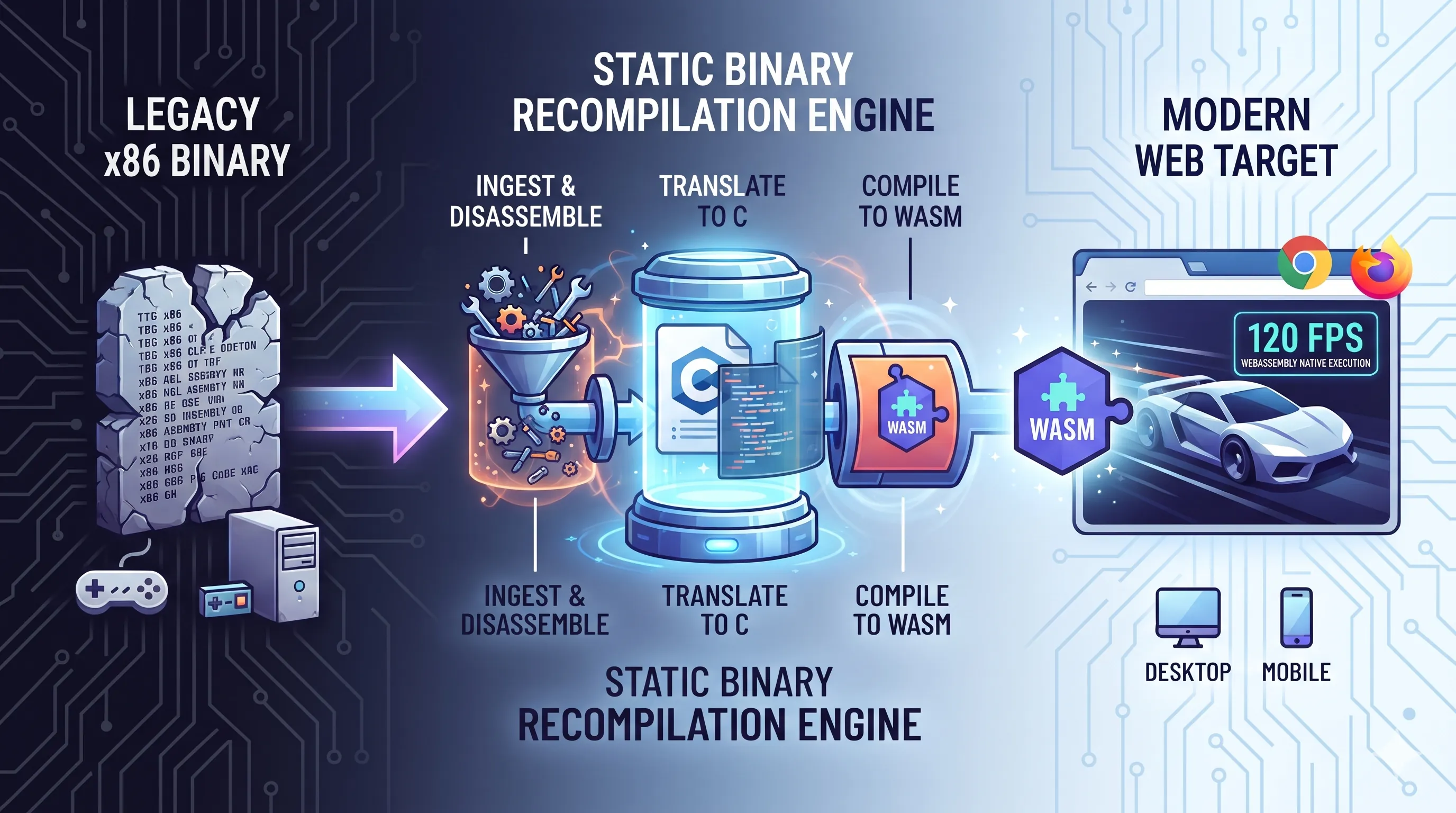
Static binary recompilation operates by disassembling and translating original x86 machine instructions directly into portable C sources.By parsing machine instructions ahead of runtime, this methodology eliminates the emulation layers and interpretation overhead historically needed to execute legacy software.
These recompiled C sources are then compiled directly into web targets to run natively in Chrome and Firefox browsers.
The browser implementation is forked from the NFSU2Recomp MIT-licensed codebase dated 16 October 2026.
Through this pipeline, the recompiled codebase executes efficiently within sandboxed web engines, delivering up to 120 frames per second in browser environments.
Lineage and Runtime Enhancements Across Controller and Display Layers
The architecture behind this browser deployment is built on the static recompilation lineage of prior milestone projects, specifically N64: Recompiled and XenonRecomp.These tools pioneered techniques for lifting console-specific instruction sets and low-level subsystem interfaces into structured, cross-platform source representations.
Beyond basic instruction conversion, the modern translation runtime re-engineers peripheral and platform interfaces to function across modern platforms.
The runtime implements native controller, steering wheel, touch control, and cloud save mappings to bridge desktop and mobile browser form factors.
This work represents a community fan implementation operating without Electronic Arts endorsement or affiliation.
By transforming compiled x86 binaries into maintainable C code that targets web platforms, static recompilation demonstrates how emerging toolchains simplify low-level architecture translation for decentralized software preservation.
3. Kernel-Level Virtualization and Page Size Translation in Asahi Linux
Modern engineering efforts targeting complex silicon architectures illustrate how new tools and low-level kernel libraries simplify systems programming.Bridging the divide between non-standard platform architectures and general-purpose Linux distributions requires specialized virtualization harnesses and direct register manipulation tools.
In the context of the Linux 7.3 release upstreaming cycle, the Asahi Linux project has developed specialized kernel mechanisms that streamline execution paths, driver interfaces, and cross-layer debugging.
Per-Process Page Size (P3S) Virtualization and Translation Control Registers
Handling architecture-level memory constraints often introduces severe performance trade-offs for legacy binaries and games designed around specific memory page granularities.To bypass these friction points without incurring the full weight of virtualized machine environments, developers implemented Per-Process Page Size (P3S).
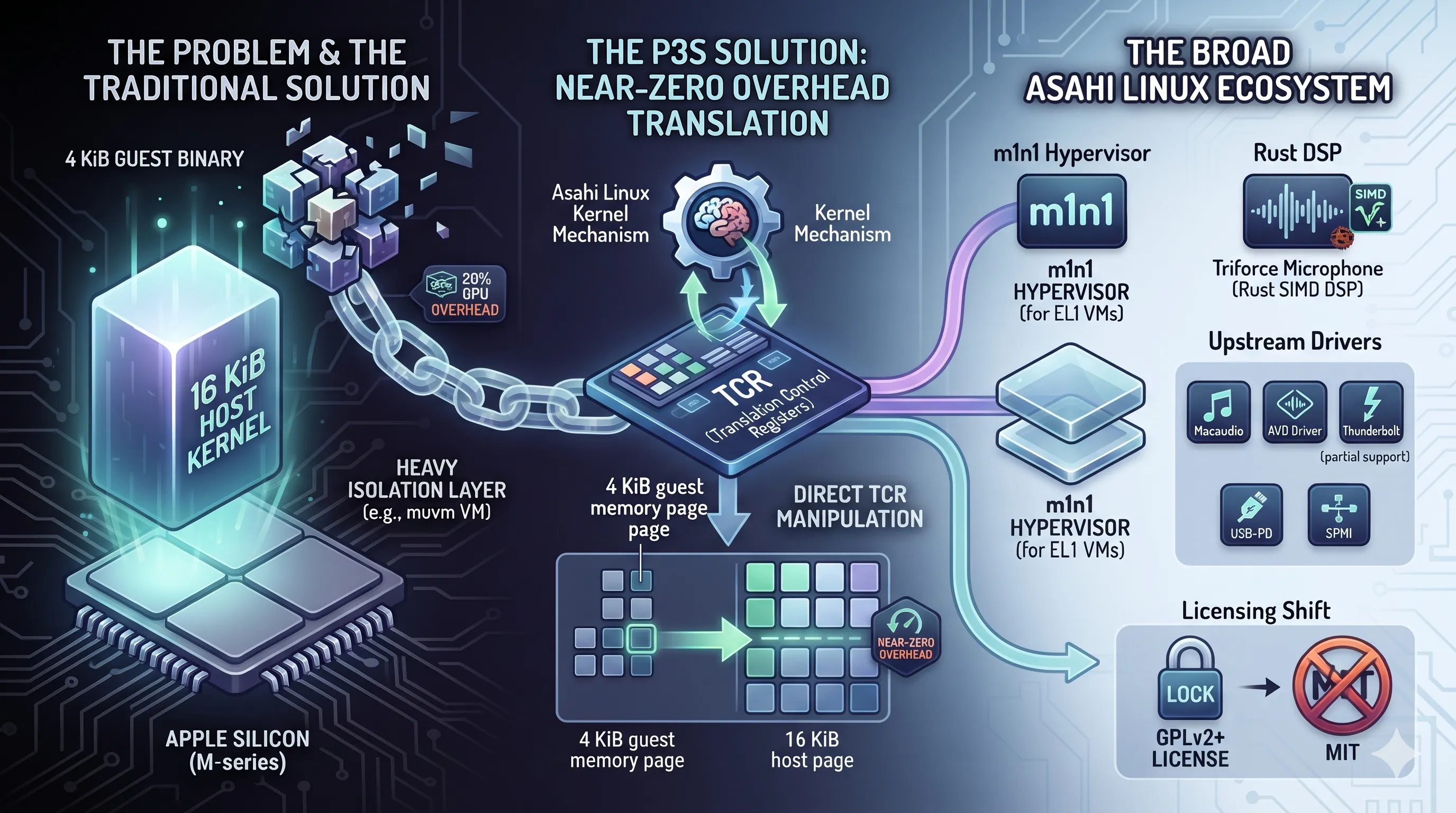
P3S directly manipulates Translation Control Registers (TCR) to execute 4 KiB memory pages seamlessly on top of 16 KiB host kernels.
This low-level register translation layer achieves near-zero overhead during active execution.
The architectural efficiency of P3S stands in sharp contrast to heavier isolation layers.
For instance, the alternative muvm VM environment imposed approximately 20% GPU workload performance degradation under comparable workloads.
Despite its runtime efficiency, the current implementation of the P3S patchset retains specific limitations.
The patchset remains hard-coded for 16 KiB host and 4 KiB guest processes, requiring a binary shim to orchestrate execution boundaries.
| Kernel Subsystem / Tool | Code Footprint (Lines of Code) | Primary Subsystem Scope | Performance and Virtualization Trade-Offs |
|---|---|---|---|
| Per-Process Page Size (P3S) | N/A (Kernel patchset & binary shim) | Memory Management / TCR Manipulation | Near-zero overhead; hard-coded for 16 KiB host and 4 KiB guest processes; requires binary shim. |
| muvm Virtual Machine | N/A (User-space / VM wrapper) | Hypervisor Guest Environment | Imposed approximately 20% GPU workload performance degradation. |
| Macaudio Subsystem | Roughly 3,100 lines | ALSA drivers and Devicetree | Upstream-first native audio architecture integration. |
| AVD Driver Submission | Approximately 13,000 lines | AVD driver and Devicetree | Comprehensive driver enablement upstreamed for Linux 7.3. |
Hypervisor Isolation, Rust SIMD DSP, and Upstream Hardware Enablement
Hardware reverse engineering and isolated execution require flexible hypervisor environments capable of emulating complex proprietary firmware topologies.Under the m1n1 hypervisor environment, developers run 3 virtual machines in EL1 to reverse engineer macOS Exclaves.
m1n1 directly virtualizes the Secure Kernel and SPTM Exclaves by utilizing Tightbeam IPC isolation.
Beyond isolation frameworks, modern systems languages and vectorization libraries are accelerating platform digital signal processing (DSP).
The project's Triforce microphone beamformer is written in Rust and accelerated using explicit SIMD implementations for arm64 and amd64 instruction sets.
These low-level software components feed directly into hardware support submitted during the Linux 7.3 release upstreaming cycle.
The submitted upstream patchsets carry substantial footprints across multiple submodules.
The Macaudio patchset spans roughly 3,100 lines across ALSA drivers and Devicetree configurations.
Concurrently, the AVD driver and Devicetree submission comprises approximately 13,000 lines of code.
Hardware enablement targets an upstream-first approach across TI USB-PD, SPMI, and custom Apple Thunderbolt controllers.
However, the current Thunderbolt implementation lacks PCIe and DisplayPort tunneling support.
To safeguard these engineering contributions, downstream repositories underwent a licensing shift from MIT to GPLv2+.
This governance update counters unauthorized code lifting, with the Asahi Linux project team stating that permissively licensed projects were being targeted by bad faith actors and AI data scrapers.
4. Direct Bare-Metal PC Development Through UEFI Firmware Toolchains
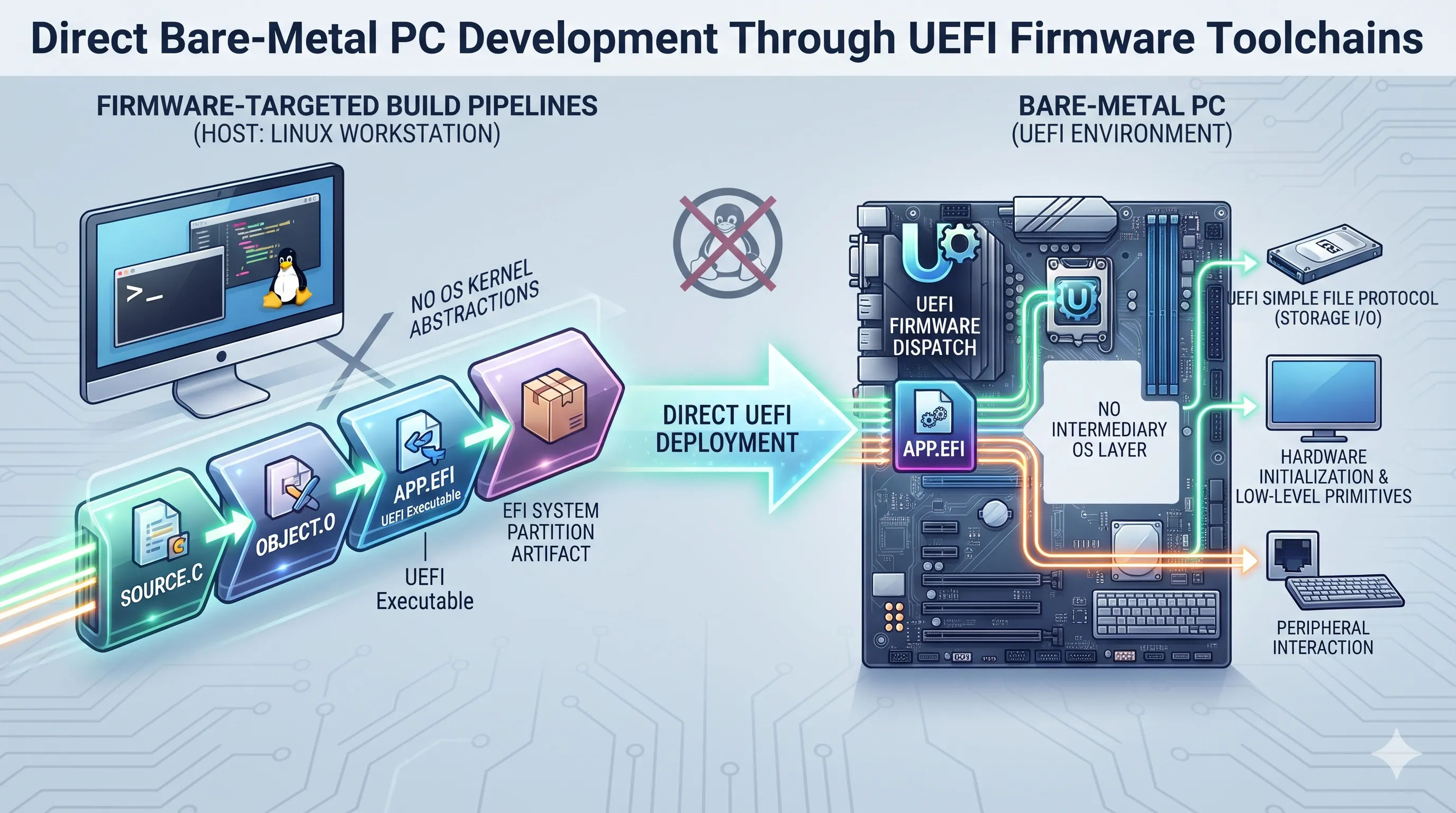
Modern engineering approaches to low-level system design increasingly bypass traditional operating system architectures, reflecting the broader evolution where modern toolchains and specialized libraries streamline direct hardware interaction.By utilizing Linux workstations to compile and link targets specifically for x86 UEFI environments, developers can create self-contained applications that run immediately on bare-metal PC hardware without depending on standard OS kernels.
Constructing Firmware-Targeted Build Pipelines for the EFI System Partition
Building software for direct x86 firmware execution demands a dedicated compilation and linking pipeline configured to output artifacts compatible with the EFI system partition.Instead of producing conventional ELF binaries meant for runtime environments managed by Linux, the toolchain establishes a workflow designed to position the resulting executable straight into the firmware's boot hierarchy.
Managing this setup requires a strict understanding of linear dependencies across each phase of firmware linking and bootable image creation.
Every stage—from object generation to the final packaging of the bootable media image—relies sequentially on the preceding step, ensuring the firmware loader can validate and initialize the binary payload upon platform start.
Bypassing Kernel Abstractions via the UEFI Simple File Protocol
Once the bare-metal executable is dispatched by the UEFI environment, the application communicates directly with platform peripherals without an intermediary OS layer.Storage I/O is achieved through the native UEFI Simple File Protocol, which grants direct hardware storage access straight from the firmware interface.
This protocol allows low-level routines to traverse file systems and interact with underlying non-volatile media without loading drivers from a conventional kernel.
By eliminating the overhead and abstraction layers of full operating systems, development workflows remain tightly bounded to essential hardware initialization and low-level storage primitives.
5. Next-Generation Systems Languages: Redefining Embedded Control and GPU Computing
To realize the overarching shift toward making low-level programming easier and more accessible, modern infrastructure requires alternatives to legacy toolchains that maintain performance while eliminating historical friction points.Traditional low-level C remains prone to memory safety vulnerabilities, forcing developers to balance severe security risks against manual execution control.
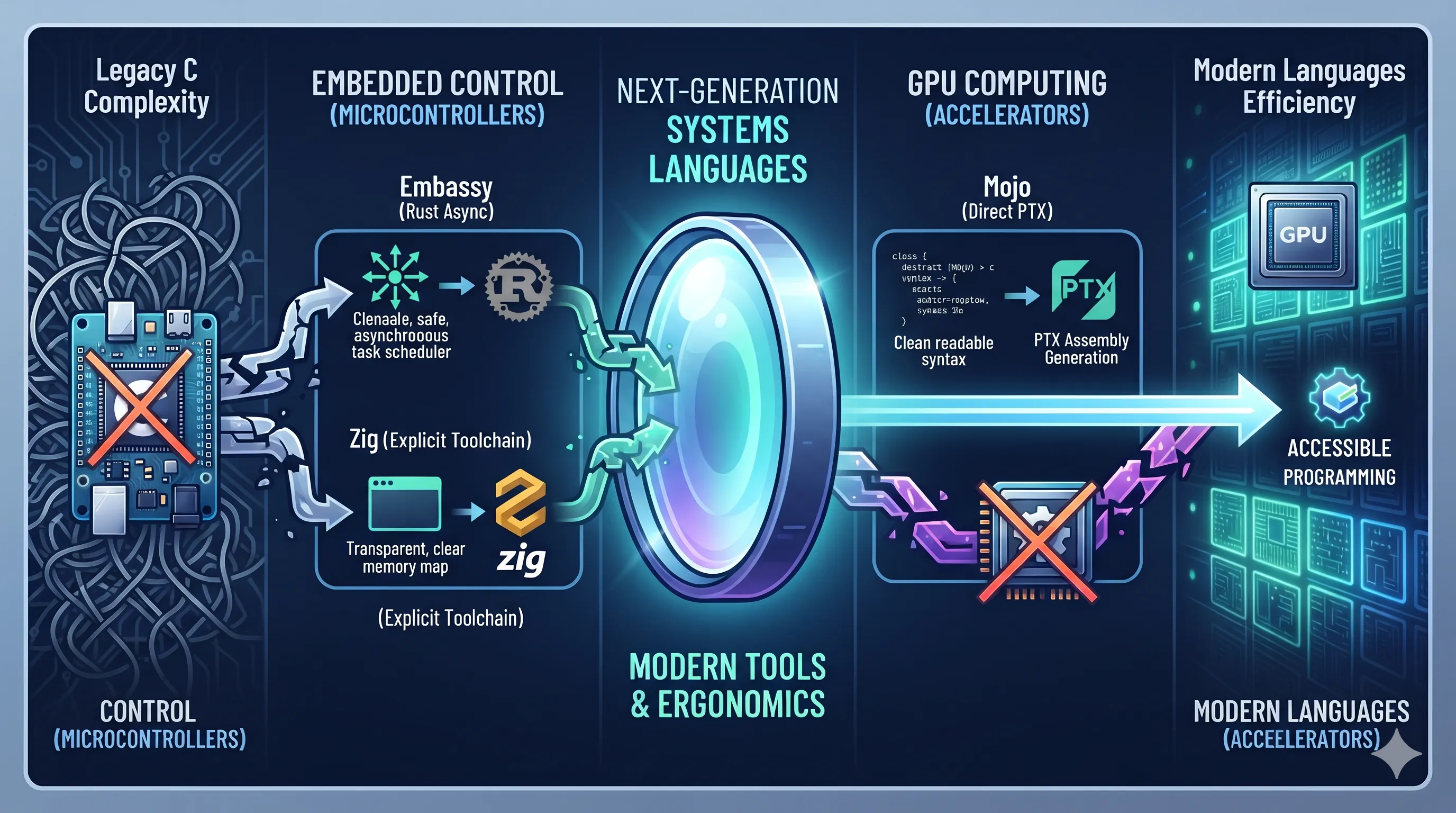
In response, new systems languages and frameworks are redefining microcontroller programming and accelerator workflows by pairing granular resource visibility with modern language ergonomics.
Asynchronous Microcontroller Runtimes and Explicit Toolchains with Rust and Zig
Embedded systems development has long been constrained by the trade-offs between borrow-checker strictness and explicit manual memory management models.To simplify embedded application development without compromising safety, the Embassy framework leverages Rust asynchronous facilities to build safe, deterministic embedded applications.
By relying on modern language-level concurrency, Embassy enables deterministic task scheduling without exposing microcontrollers to standard memory corruption patterns.
Conversely, where absolute transparency over memory structures is favored over compile-time lifetime mechanics, Zig provides modern systems programming with explicit memory management and integrated toolchain support.
Zig eliminates hidden control flow and implicit memory allocations while offering an integrated toolchain that directly streamlines the cross-compilation process for resource-constrained targets.
Mojo and Direct PTX Generation for Low-Level GPU Programming
Hardware accelerator programming presents comparable historical barriers, frequently locking engineers into complex, vendor-locked toolchains.The Mojo systems language directly addresses this by combining readable syntax with direct low-level GPU abstractions and PTX assembly generation without CUDA dependencies.
By generating PTX assembly directly, Mojo strips away intermediate framework overhead and complex dependency stacks, granting programmers direct machine-level access while retaining a familiar syntax.
These emerging paradigms collectively eliminate traditional low-level C vulnerability patterns and runtime overhead, driving forward modern tools that simplify deep systems programming across microcontrollers and GPUs alike.
Related Posts
Inside Topcoat: The New Full-Stack Rust Web Framework Without WASMDiscover Topcoat, a new full-stack Rust web framework by Tokio creators that brings server-rendered...
How Nemotron 3.5 Parse Accelerates Vision-Language Document ExtractionDiscover how NVIDIA's Nemotron 3.5 Parse boosts inference speed and document extraction efficiency...
Microsoft Ignite 2026: Copilot Work OS and Agent 365 GovernanceDiscover how Microsoft Ignite 2026 redefines enterprise AI with Copilot as the Work OS, centralized...
Generative AI may have assisted with research or drafting for this article. Topic selection, fact-checking, final wording, and publication remain the responsibility of DragonStone74. AI use disclosure