
Why Anthropic Replaced Git with Scion for AI-Driven Development
🚀 Key Takeaways
- Autonomous AI agent swarms overwhelmed traditional Git, pushing decentralized, offline-first version control architectures past their practical throughput limits.
- Scion adopts an asymmetric client-server model, discarding local client independence to manage changesets, merges, and historical metadata centrally in the cloud.
- Multi-tier immutable caching accelerates developer feedback loops, eliminating redundant packfile negotiations and dramatically reducing continuous integration overhead.
- Engineering workflows transitioned from manual code review to intent governance, relying on semantic policy gates, automated conflict resolution, and post-merge verification.
- Bespoke source control systems remain specialized solutions, offering general engineering teams valuable architectural lessons in sparse workflows and concurrency controls rather than direct replacement software.
The rapid emergence of autonomous coding swarms has fundamentally inverted the core constraints of software development.
For modern artificial intelligence research organizations, the primary operational bottleneck is no longer the human speed of authoring software, but rather the capacity of foundational developer infrastructure—such as version control, build environments, and automated continuous integration pipelines—to ingest continuous machine-generated changes.
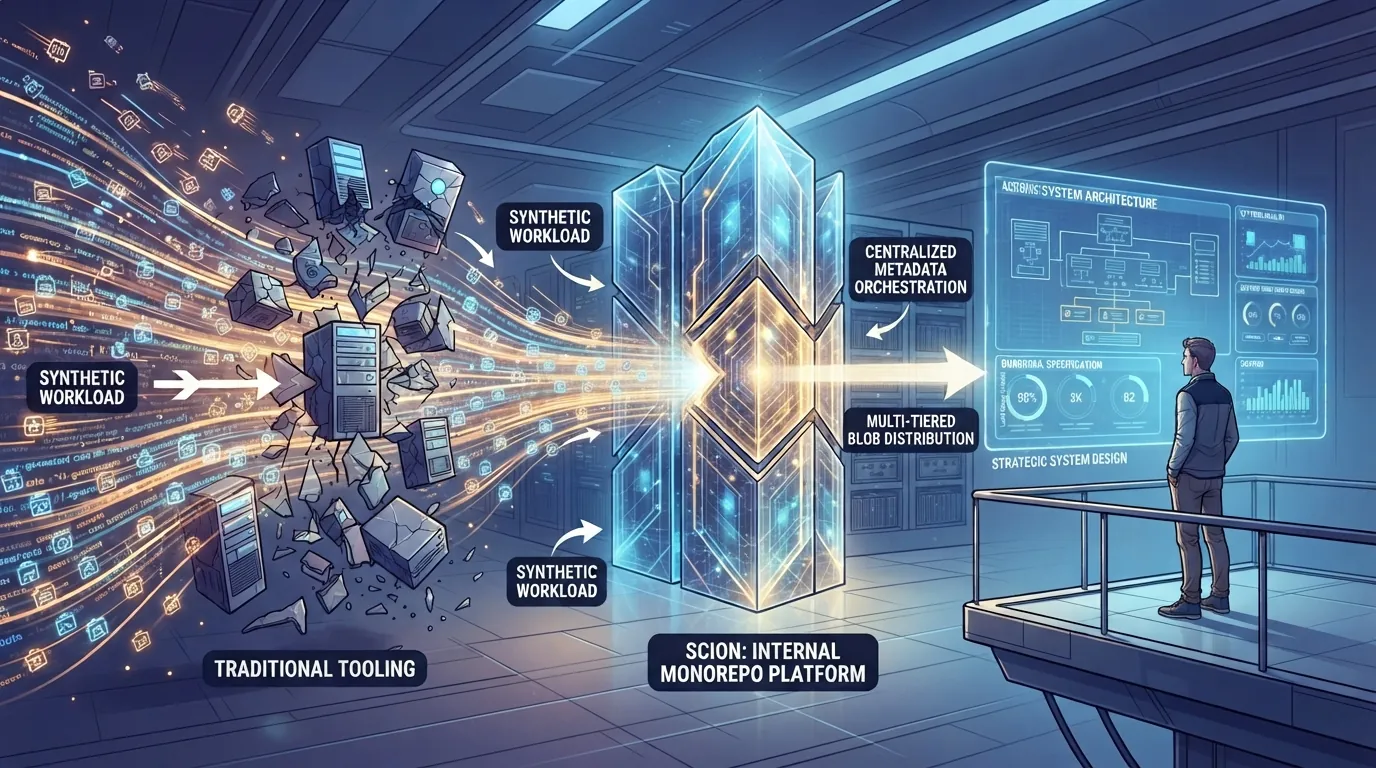
To confront the structural collapse of traditional decentralized tooling under synthetic workloads, Anthropic engineered Scion, an internal monorepo platform tailored specifically for automated agents.
By replacing offline-first assumptions with centralized metadata orchestration and multi-tiered blob distribution, Scion illustrates how enterprise code hosting must adapt when autonomous models become the primary commit authors across large engineering repositories.
This architectural pivot marks a broader evolution in the day-to-day discipline of software engineering.
As automated pipelines assume the burden of routine implementations and concurrent branch reconciliations, human practitioners are transitioning from granular, line-by-line diff inspections toward high-level architectural oversight, guardrail specification, and strategic system design.
1. The Breaking Point of Git: Handling Autonomous AI Agent Velocity at Monorepo Scale
To evaluate the true impact of Scion on developer workflows in AI companies, engineering teams must first trace the structural failure boundary where traditional version control collapsed.The emergence of Scion was precipitated by an unprecedented operational crisis: Git's foundational, decentralized architecture proved fundamentally incompatible with the extreme throughput demands generated by continuous, autonomous AI agents.
Git Decentralization vs. Continuous Agent Merge Velocity
Git was conceived around an offline-first, decentralized model where every contributor maintains a full peer clone capable of executing local diff, blame, and checkout operations independently.While this paradigm supported human engineering teams for two decades, it collapsed when autonomous AI agents replaced humans as the primary contributors to the codebase.
As Anthropic stated: 'At Anthropic, coding is no longer the bottleneck to building systems or doing research. The bottleneck, now, is all of the developer infrastructure built for human scale: source control, builds, and CI.'
The transition from human to machine contributors triggered an exponential velocity curve in Anthropic's monorepo.
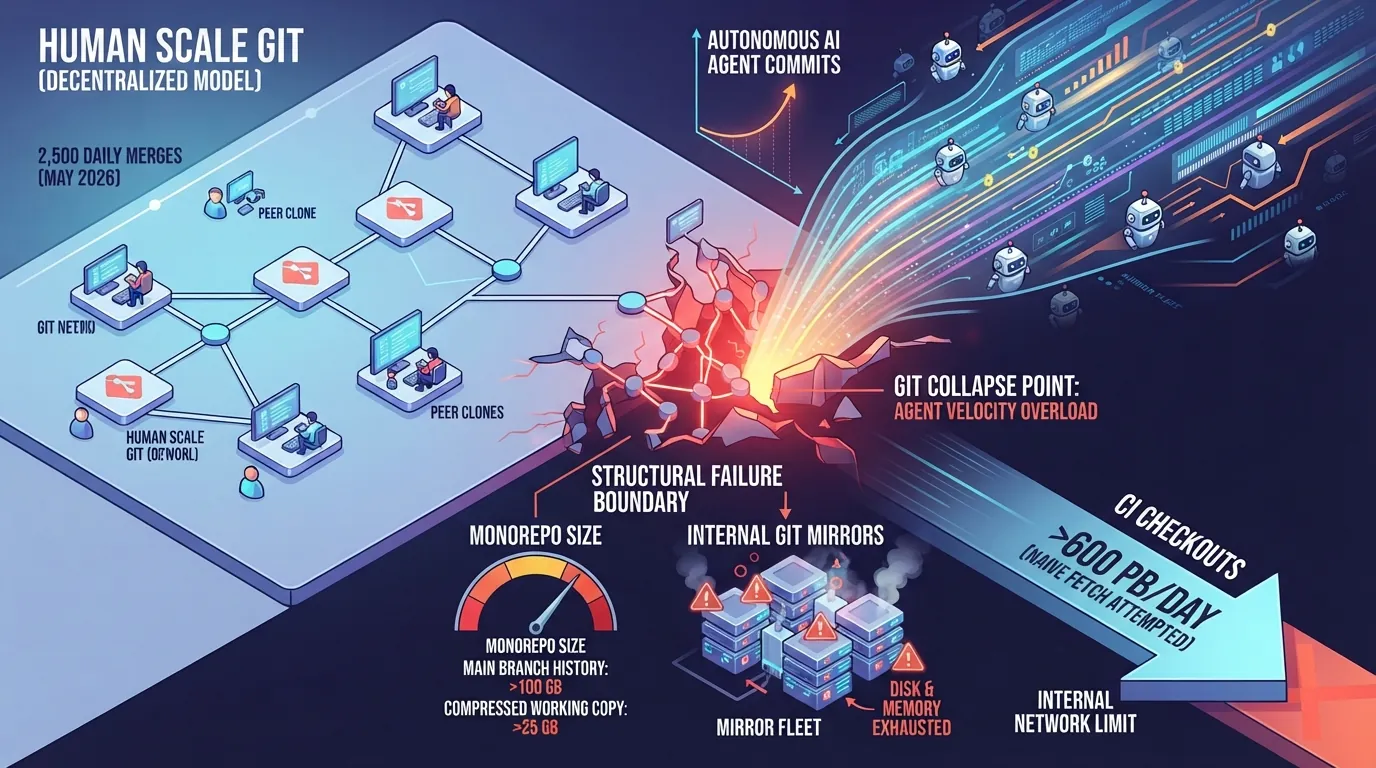
Daily merged code changes grew from approximately 2,500 in May 2026 to over 30,000 in September 2026.
This activity peaked at 30,401 daily merged changes on September 9, 2026, sustaining an average merge velocity of roughly one change every 2.9 to 3 seconds.
At this cadence, the monorepo expanded beyond standard operational thresholds.
The main branch history of Anthropic's monorepo exceeded nearly 100 GB, while a single compressed working copy exceeded 25 GB.
Compounding the sheer volume of commits, continuous integration (CI) systems performed approximately 25 million checkouts daily to validate and land rapid agent changes.
Had the infrastructure attempted to service these checkouts by fetching full repositories naively, it would have generated over 600 PB of Git network traffic per day, overwhelming the company's internal network and storage tiers.
Degradation of Seed Snapshots, Partial Clones, and Internal Mirrors
Anthropic initially mitigated Git bottlenecks using standard optimizations: shallow clones, sparse checkouts, promisor remotes, repository seeds in blob storage, and internal mirrors.However, as autonomous agent merge velocity accelerated, these standard workarounds progressively degraded.
Pre-baked repository seed snapshots stored in object storage drifted further from the main branch tip between refreshes, meaning agents spent increasing amounts of time catching up on missed deltas.
To bypass storing full histories locally, sparse checkouts and promisor remotes were deployed to fetch files dynamically on demand.
Under agent workloads, dynamic partial-clone fetches via fetch-pack became slow because missing objects arrived one by one, adding network round-trip overhead to every step.
Furthermore, routine blame and diff operations on partial clones degraded because historical commit objects were missing locally, forcing blocking remote round-trips.
To distribute the load of 25 million daily CI checkouts, Anthropic operated several hundred internal Git mirrors at peak scale.
Yet, these internal Git mirrors strained disk and memory capacity once repository scale outgrew physical machine limits, proving that horizontal replication of full Git instances could no longer absorb the pace of AI agent development.
| System Dimension / Mechanism | Git Scale Limits & Traffic Volumes | Operational Failure Mode Under Agent Velocity |
|---|---|---|
| Daily Merge Velocity | Scaled from ~2,500 daily merges (May 2026) to >30,000 (September 2026), peaking at 30,401 merges (one change every 2.9 to 3 seconds). | Continuous branch-tip movement rendered repository seed snapshots rapidly stale between periodic refreshes. |
| Monorepo Size | Main branch history exceeded nearly 100 GB; compressed working copy exceeded 25 GB. | Physical machine disk and memory limits were exhausted across the infrastructure. |
| CI Checkouts & Network Load | Approximately 25 million checkouts daily; naive full fetches threatened >600 PB of daily Git network traffic. | Central servers and network pipes faced saturation, necessitating complex caching layers that ultimately deteriorated. |
| Partial Clones & Promisor Remotes | Dynamic on-demand object retrieval via fetch-pack with sparse checkouts. | High latency as missing objects arrived one by one; blame and diff degraded due to missing local historical commit objects. |
| Mirroring Infrastructure | Fleet of several hundred internal Git mirrors deployed at peak scale. | Mirrors strained disk and memory capacity as repository dimensions outgrew the physical boundaries of host machines. |
2. Inside Scion's Architecture: Client-Server Asymmetry and Coordination-Free Changesets
Understanding the direct impact of Scion on developer workflows in AI companies requires examining its fundamental departure from Git's distributed model.Modern AI engineering environments are dominated by continuous integration jobs and automated coding agents that operate at high concurrency.
To serve these workloads, Scion discards Git's peer-to-peer legacy and operates entirely on the premise that clients—both automated agents and CI jobs—are permanently online.
Log-Structured Changesets and Spanner-Backed Reference Isolation
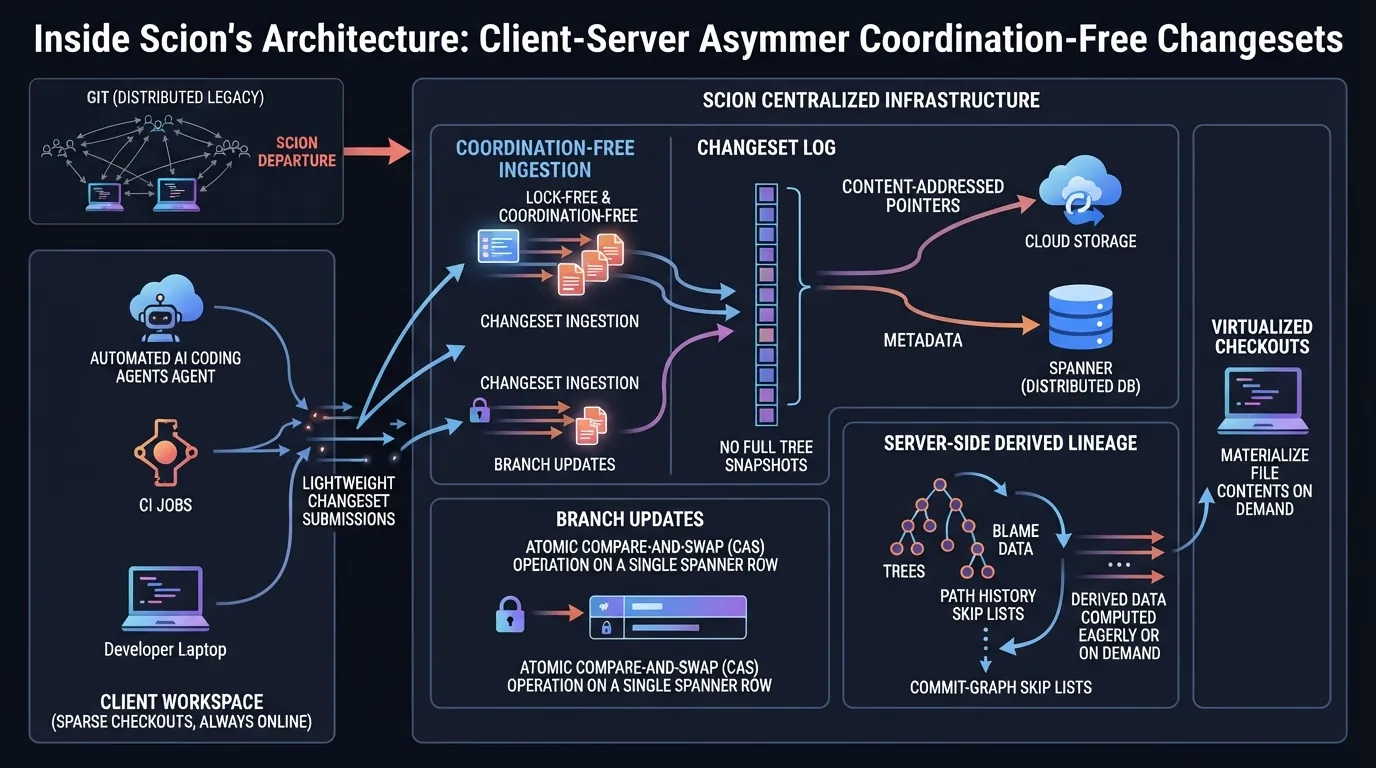
Scion enforces a radical client-server asymmetry by moving commits, merges, rebases, history, and blame queries entirely to the server side.Rather than requiring clients to compute merge graphs or generate repository snapshots locally, the client merely submits modifications to the centralized infrastructure.
The foundational unit of work in Scion is a changeset recorded in an append-only write-ahead log.
Unlike traditional systems that assemble complete snapshot trees, a Scion changeset records only the files changed relative to its first parent.
These changesets use content-addressed pointers that point directly to compressed blobs hosted in cloud storage, while corresponding metadata is persisted in Spanner.
A Scion changeset does not store a full tree pointer snapshot.
| Architectural Dimension | Scion Implementation Detail |
|---|---|
| Work Unit and Storage | Changeset recorded in a write-ahead log; content-addressed pointers to compressed blobs in cloud storage with metadata in Spanner; no full tree pointer snapshots. |
| Ingestion Mechanics | Coordination-free and lock-free ingestion without packfiles; accepting changesets is completely separated from advancing branch pointers. |
| Branch Updates | Isolated to a compare-and-swap (CAS) operation on a single Spanner row; reference creation outside main and release branches is actively discouraged. |
| Client Workspace | Sparse and virtualized checkouts that materialize file contents on disk on demand; requires permanent online connectivity. |
| Lineage and Derivations | Server-side recursive derived data computed eagerly or on demand for trees, blame, path history, and commit-graph skip lists. |
In Scion, accepting incoming changesets is architecturally separated from moving reference pointers.
Because changesets do not require synchronous packfile generation or immediate global locking, ingestion remains completely lock-free.
When a reference pointer does need to advance, updating branch references is isolated to a compare-and-swap (CAS) operation on a single Spanner row.
To maintain high throughput and avoid reference explosion under heavy automation, reference creation is actively discouraged outside main and release branches.
Virtualized Checkouts and Server-Side Derived Tree Lineage
To construct repository state without full tree snapshots in the log, Scion treats tree structures as recursive derived data.The server platform computes directory trees, blame data, path history, and commit-graph skip lists server-side, evaluating them either eagerly or on demand.
This lineage architecture builds upon foundational prior art, as Anthropic credited Meta's Sapling and Mononoke—specifically the Bonsai data model—alongside Google's Piper as foundational prior art for Scion's design.
On the client side, developer and agent environments bypass the overhead of downloading entire monorepo trees.
Clients utilize sparse and virtualized checkouts that materialize file contents on disk strictly on demand.
This approach minimizes network transfer and local disk pressure during automated CI runs and rapid agent executions.
However, these capabilities come with intentional architectural trade-offs.
Scion intentionally sacrifices client offline independence in exchange for a drastically reduced local storage footprint.
Because core operations and workspace projections rely on continuous access to Spanner and cloud storage blobs, the system requires continuous server availability to function.
3. Multi-Tier Object Fetching: Reclaiming Compute Cycles and Eliminating Git Overhead
In AI organizations where thousands of ephemeral pipelines and automated agents continuously pull, test, and branch repositories, source control infrastructure directly determines the velocity of developer workflows.Scion addresses the scaling limitations of standard distributed version control systems by decoupling object fetching from monolithic Git protocols, replacing legacy packfile transfers with an integrated, multi-tier object cache designed specifically to eliminate transport bottlenecks and compute overhead.
Hierarchical Caching: scion-daemon, scion-cache, and Authoritative Servers
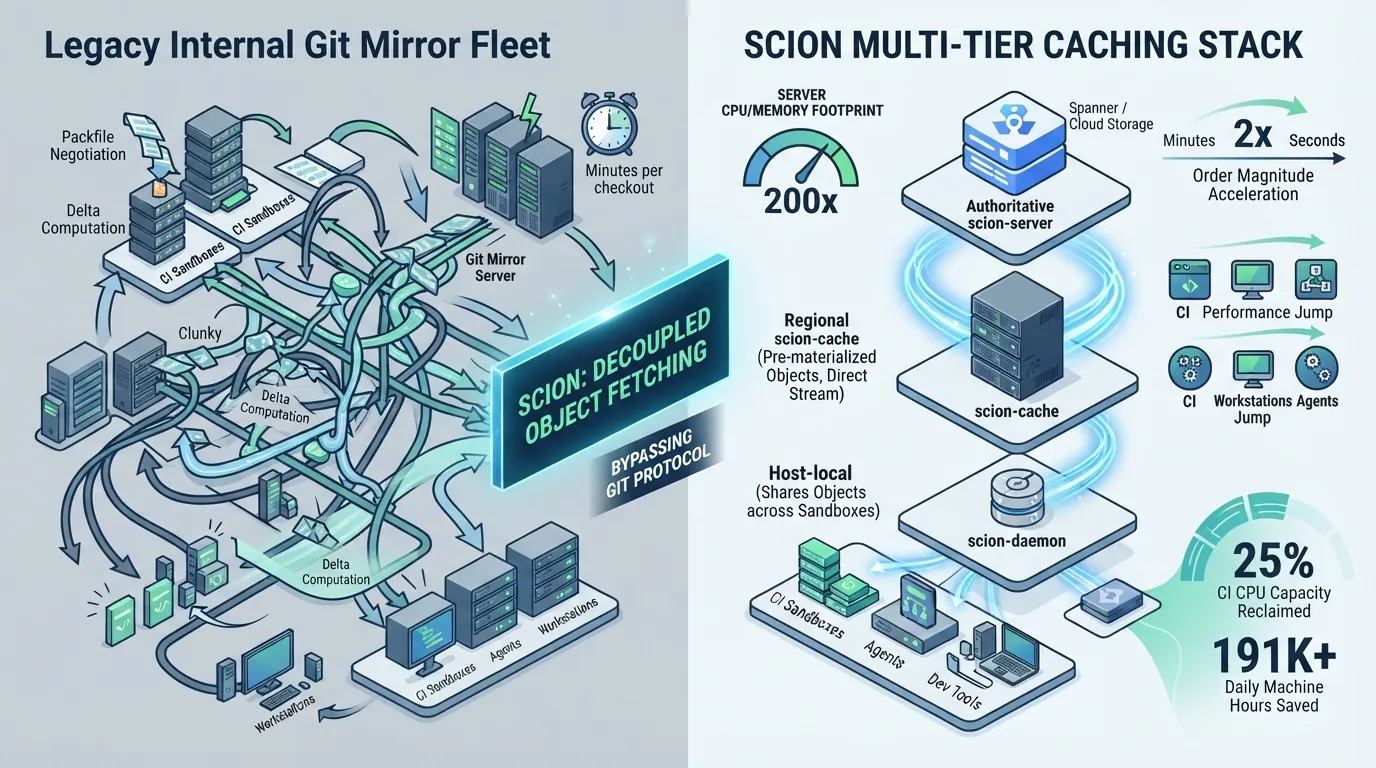
Traditional version control workflows rely heavily on Git packfile have/want negotiation protocols, forcing mirrors and clients to compute delta compression on the fly during synchronization.The Scion architecture completely bypasses this expensive negotiation.
Instead, the scn client traverses directory structures recursively from a root tree, identifying and querying only missing immutable trees and blobs directly from the local node.
At the foundation of this hierarchical retrieval model sits the scion-daemon, an optimized node-local service running on each host machine.
Rather than allowing competing CI sandboxes, agent environments, and local tools to initiate duplicate network requests, scion-daemon caches objects locally and shares them across all jobs and sandboxes on the host.
When a host-level cache miss occurs, scion-daemon communicates upward to regional in-memory cache servers known as scion-cache.
These regional servers store pre-materialized objects and stream data directly across the network in daemon disk format without performing delta compression, eliminating on-the-fly packing costs entirely.
If an object is not present in memory at the regional layer, the regional cache servers query the authoritative scion-server tier.
Authoritative scion-server instances manage durable state and resolve requests backed by Spanner and cloud storage backends.
To maintain structural resilience under heavy enterprise traffic, all tiers—including scion-daemon, scion-cache, and scion-server—expose identical RPC interfaces.
Each node strictly enforces tier hierarchy when escalating misses, preventing cascading stampedes from overwhelming upstream storage layers.
Through this strict isolation, Scion maintains cache hit rates above 99% across each caching tier.
Quantifying Infrastructure Gains: Checkouts, Worktrees, and Host Footprints
The transition to immutable tree traversal and hierarchical caching delivers measurable efficiency across both centralized clusters and local developer environments.By eliminating dynamic packfile generation and delta computation, the caching system reduced the server CPU and memory footprint by 200x compared to Anthropic's previous Git mirror fleet.
Because fetches stream pre-formatted blobs with sub-second latency, CI and research checkouts accelerated by two orders of magnitude, dropping from minutes to seconds.
This acceleration relieves sustained compute pressure across large-scale compute clusters.
By reducing checkout latency by an average of 27.5 seconds across 25 million daily checkouts, Scion reclaimed roughly 191,000 to 195,000 machine hours daily.
As a direct result of shortening fetch lifecycles and shedding synchronization bottlenecks, CI pipelines achieved an overall 25% CPU capacity win.
Local workstations and agent execution sandboxes experienced corresponding performance jumps.
Status commands running on developer workstations accelerated by a factor of 207x, removing interface lag during active development.
Simultaneously, the generation of fresh agent worktrees sped up by a factor of 84x, allowing autonomous agents to instantiate clean workspaces and evaluate code modifications almost instantaneously.
Industry observers including InfoQ and Matthews Wong note that the reported 200x efficiency improvement was measured directly against Anthropic's internal mirror architecture rather than standard Git benchmarks.
Furthermore, these performance metrics reflect Anthropic's specialized internal workload and have not been independently verified in external production environments.
| Architecture Dimension | Legacy Internal Git Mirror Fleet | Scion Multi-Tier Caching Stack |
|---|---|---|
| Object Resolution Protocol | Packfile have/want negotiation with delta compression | Recursive traversal of missing immutable trees and blobs from root tree |
| Host Object Sharing | Redundant fetches per isolated job or sandbox | Node-local scion-daemon sharing cached objects across all local sandboxes |
| Regional Cache Streaming | Dynamic on-the-fly packing and compression | Direct data streaming in daemon disk format via scion-cache without delta compression |
| Storage Backend Architecture | Distributed Git mirror disk pools | Authoritative scion-server backed by Spanner and cloud storage |
| Cache Hit Performance | Variable depending on mirror sync and pack status | Above 99% hit rate maintained across each individual tier |
| Server CPU & Memory Footprint | Baseline mirror cluster resource consumption | 200x reduction in server CPU and memory footprint |
| Checkout Latency | Minutes per checkout | Seconds per checkout (two orders of magnitude acceleration; 27.5 seconds saved per checkout) |
| CI Infrastructure Efficiency | Baseline compute allocation consumed by fetch overhead | 25% overall CI CPU capacity reclaimed; ~191,000 to 195,000 daily machine hours saved |
| Workstation Status Queries | Baseline Git status latency | 207x faster execution |
| Fresh Agent Worktree Creation | Baseline worktree checkout duration | 84x faster instantiation |
4. Evolving Engineering Workflows: Post-Merge Validation, Automated Conflict Repair, and AI Reviewers
Understanding the impact of Scion on developer workflows in AI companies requires examining how day-to-day code collaboration, merging, and review mechanisms fundamentally shifted away from traditional Git conventions.A core team of 7 engineers built Scion, Antique, and surrounding tools, successfully completing the monorepo migration within 5 months.
Between January and September 2026, the scm and antique codebases recorded 12,257 changes, reflecting an extraordinarily high velocity achieved by pairing a compact engineering team with automated toolchains.
| System / Workflow Component | Operational Transformation | Recorded Metric or Benchmark |
|---|---|---|
| Core Tooling Development & Migration | Built Scion, Antique, and surrounding infrastructure to replace legacy monorepo workflows. | 7 engineers completed the full migration in 5 months; 12,257 code changes recorded between January and September 2026. |
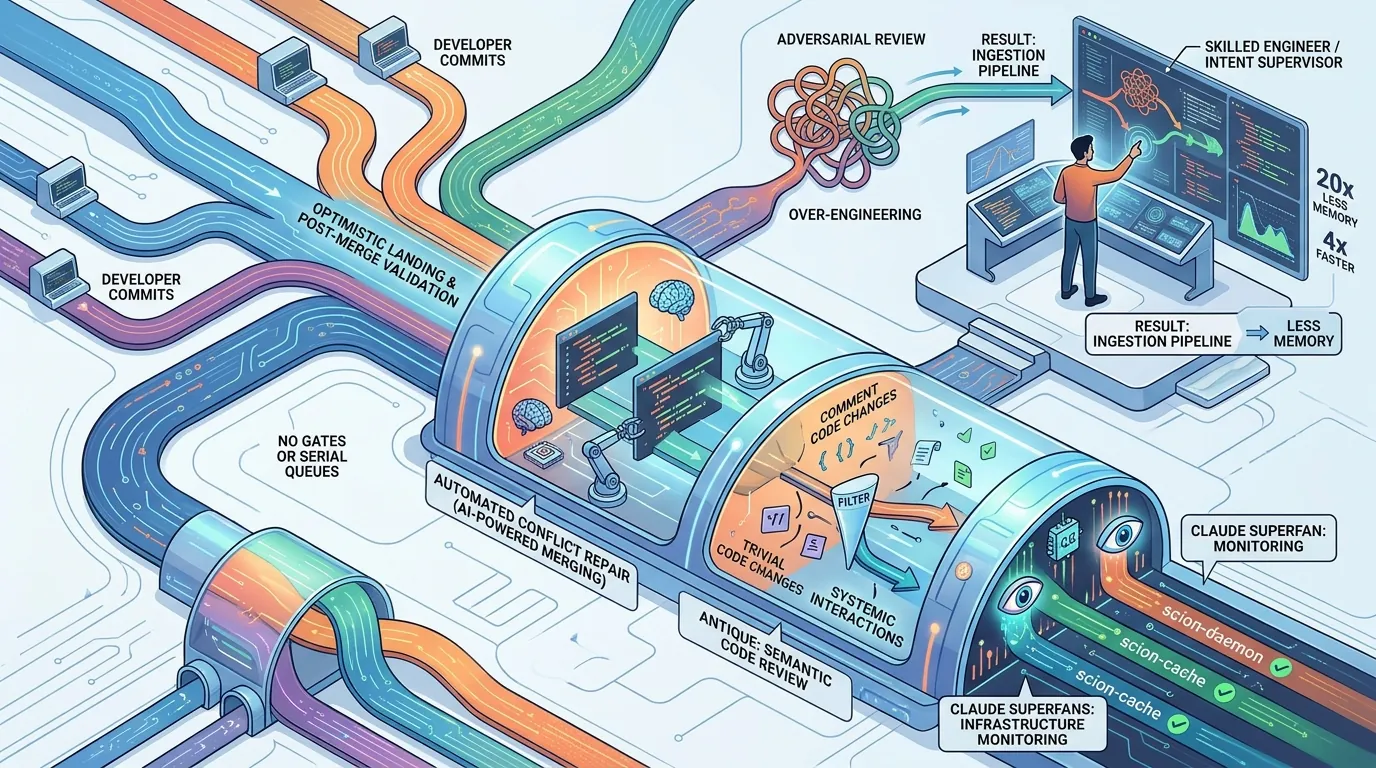
| Merge Queue Architecture | Abandoned globally locked merge queues in favor of optimistic landing, post-merge validation, and AI conflict resolution. | Autonomous models resolve concurrent branch collisions rapidly post-landing. |
| Ingestion Pipeline | Rewritten using an internal snapshot of Claude Mythos Preview to optimize resource consumption and ingestion speed. | Executes 4x faster while consuming 20x less memory. |
| Subsystem Telemetry | Deployed automated Claude monitoring instances ("superfans") over internal logs. | Continuous real-time inspection dedicated to scion-daemon and scion-cache. |
Transitioning from Serial Merge Queues to Post-Merge Autonomous Repair
Traditional monorepo scalability typically breaks down around centralized merge queues, where long lines of commits block one another during serial continuous integration checks.Anthropic abandoned traditional globally locked merge queues entirely, moving developer branches into an optimistic paradigm governed by post-merge and pre-deploy automated validation.
Instead of forcing developers to wait for exhaustive serial gatekeeping before landing changes, commits are integrated directly, shifting testing and verification downstream prior to production deployment.
When concurrent commits produce collisions, autonomous models are used to repair concurrent merge conflicts rapidly after landing, eliminating the manual rebasing cycles that traditionally stall developer velocity.
Antique and Semantic Code Review: Engineers as Intent Supervisors
Alongside Scion, Anthropic deployed a dedicated code review tool named Antique that enforces semantic approval rules.Antique differentiates between substantive operational alterations and non-functional updates, allowing human reviewers to bypass trivial changes like comments.
Because syntactic minutiae and superficial edits are handled through semantic rules, engineers transitioned from line-by-line manual code inspection to validating overall intent and setting architectural boundaries.
This evolution reframes the human developer not as an error checker for formatting or minor diffs, but as an architectural supervisor evaluating systemic interactions and high-level correctness.
Claude Superfans and Countering Adversarial Review Over-Engineering
Engineering workflows under Scion also extended autonomous oversight into long-term infrastructure health.Automated Claude monitoring instances called 'superfans' continuously inspect telemetry and logs for specific subsystems like scion-daemon and scion-cache.
These dedicated instances identify anomalous runtime patterns across the source control fabric without requiring constant manual log auditing from on-call staff.
However, relying on continuous automated intelligence introduced specific failure modes that required strict human guidance.
Engineers frequently had to intervene and tell Claude 'no' to prevent over-engineering resulting from adversarial AI reviews and invalid patterns like linear commit log scans.
Reflecting on this operational friction, Anthropic stated: 'Anthropic also makes extensive use of adversarial review, and, while this is incredibly effective in many ways, it can also be myopic, so skilled engineers needed to steer Claude away from over-engineering parts of the system.'
When properly steered, modern models delivered massive infrastructure optimizations; using an internal snapshot of Claude Mythos Preview, Anthropic rewrote its ingestion pipeline to use 20x less memory and execute 4x faster.
5. Strategic Takeaways for AI Engineering Teams: When to Re-Architect Beyond Git
The core discussion surrounding the impact of Scion on developer workflows in AI companies centers on how organizations manage scale when synthetic contributors begin outstripping human engineering throughput.
While Scion demonstrates how source control can be re-architected around high-frequency autonomous agents, understanding its strategic implications requires assessing whether such radical paradigm shifts are viable or necessary outside hyperscale environments.
The Pragmatic Reality: Why Scion Is Not a Drop-In Git Replacement
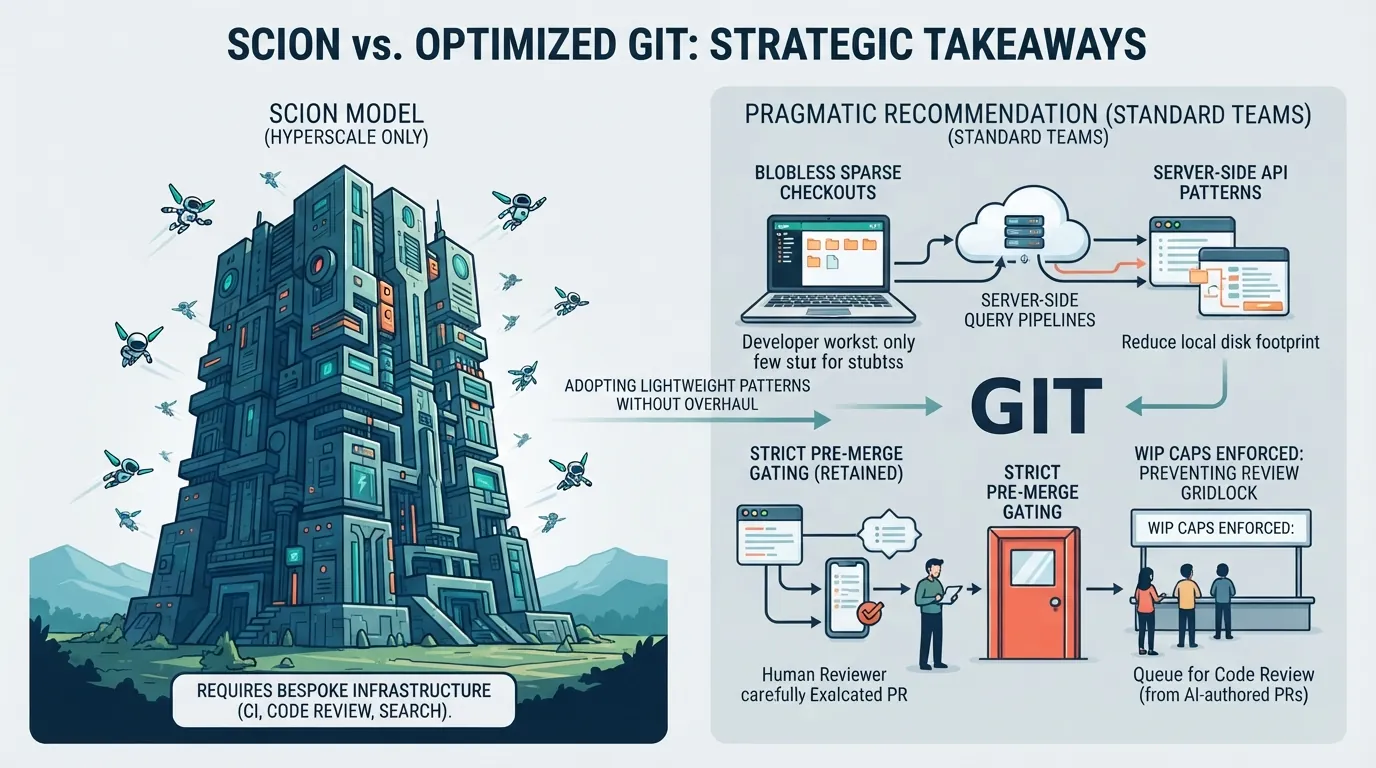
Anthropic has explicitly clarified that Scion is not a general-purpose, downloadable Git replacement designed for standard software organizations.
Attempting to adopt Scion externally is impractical for conventional development teams because the engine does not operate in isolation.
Full adoption requires replacing standard code review tools, search engines, and continuous integration (CI) infrastructure with deeply integrated, bespoke systems.
Consequently, Scion's extreme architectural approach is only cost-effective for organizations operating at immense operational scales.
Specifically, this model suits environments supporting tens of thousands of engineers or prolific swarms of autonomous agents backed by massive internal compute budgets.
For teams without these specific scaling pressures or capital allocations, constructing and maintaining custom VCS tooling yields diminishing returns compared to optimizing established source control systems.
| Architectural Dimension | Anthropic Scion Model | Pragmatic Recommendation for External Teams |
|---|---|---|
| Infrastructure Scope | Requires bespoke, tightly coupled replacements for CI, code review, and search infrastructure. | Retain established Git platforms while layering modern server-side API patterns. |
| Repository Ingestion | Bypasses local full-tree clones via server-native virtualization and custom query pipelines. | Adopt blobless sparse checkouts on existing Git platforms to minimize local disk footprint. |
| Validation & CI Strategy | Bypasses blocking pre-merge gates in favor of continuous post-merge testing and remediation. | Maintain pre-merge gating unless robust automated post-merge repair pipelines exist. |
| Reviewer Load Management | Accommodates prolific autonomous agent generation via custom, non-blocking ingestion lanes. | Establish work-in-progress (WIP) caps to stop unreviewed AI changes from swamping humans. |
Adopting Server-Side Patterns, WIP Caps, and Safe Pre-Merge Hygiene
Rather than undertaking an infrastructural overhaul, Anthropic recommends that external engineering teams adopt server-side API patterns and blobless sparse checkouts directly on existing Git platforms.
Blobless sparse checkouts eliminate the drag of downloading massive commit histories and unneeded subdirectories, allowing engineering teams to retain Git compatibility while significantly reducing workspace bloat.
Pairing these selective checkouts with server-side query and manipulation APIs allows organizations to emulate the lightweight footprint of Scion without breaking ecosystem tooling.
At the same time, engineering leadership must exercise caution regarding testing paradigms.
Abandoning pre-merge test gating is outright dangerous for teams that lack comprehensive automated post-merge testing and automated repair pipelines.
Because standard organizations rarely maintain automated remediation bots capable of continuously diagnosing and repairing mainline trunk breakages, retaining strict pre-merge gating remains essential to preserving production stability.
Furthermore, workflow analysis frameworks recommend establishing strict work-in-progress (WIP) caps to prevent unreviewed AI changes from overwhelming human reviewers.
When autonomous agents generate PRs faster than team members can validate them, review queues experience gridlock, leading to reviewer fatigue and undetected regressions.
Enforcing hard limits on concurrent AI-authored PRs ensures that synthetic velocity matches human review capacity.
The Future of Open Source Version Control Under AI Swarms
Rather than encouraging industry-wide fragmentation into proprietary source control forks, Anthropic advocates that the broader Git, GitHub, GitLab, and open-source communities evolve standard protocols.
The primary objective is modernizing these widespread tools to support first-class server-side RPCs and better composed partial checkouts.
By standardizing remote procedure interfaces and fine-grained, on-demand file hydration within standard version control ecosystems, development teams can support autonomous agent workflows without abandoning the global open-source software supply chain.
Related Posts


Generative AI may have assisted with research or drafting for this article. Topic selection, fact-checking, final wording, and publication remain the responsibility of DragonStone74. AI use disclosure