
September 2026 Frontier Coding Models: A Technical Guide to Claude 5.5 and Agentic Architecture
🚀 Key Takeaways
- A Transformative Month for Coding LLMs: September 2026 marked a pivotal wave of frontier AI releases designed specifically for complex software development and agentic workflows.
- Anthropic's Expanded Flagship Tier: The arrival of Claude Opus 5.5, Claude Fable 5.1, and Mythos 5.1 establishes new high-water marks for autonomous reasoning, long-running agent tasks, and contextual comprehension.
- Google's High-Velocity Flash Contender: Gemini 3.8 Flash brings ultra-fast multimodal coding and tunable reasoning to enterprise pipelines at highly competitive price points.
- Standardization of Deep Reasoning: Frontier architectures now increasingly mandate 1-million-token context windows, always-on adaptive thinking, and substantial prompt caching discounts.
- Balancing Per-Token Costs and Agentic Depth: Evaluating real-world return on investment now requires assessing total token output during multi-step reasoning rather than base per-token rates alone.
The enterprise software engineering landscape underwent a monumental shift over the course of September 2026.
With major AI powerhouses releasing their most capable reasoning models in rapid succession, engineering leaders and developers are navigating a radically updated technological landscape.
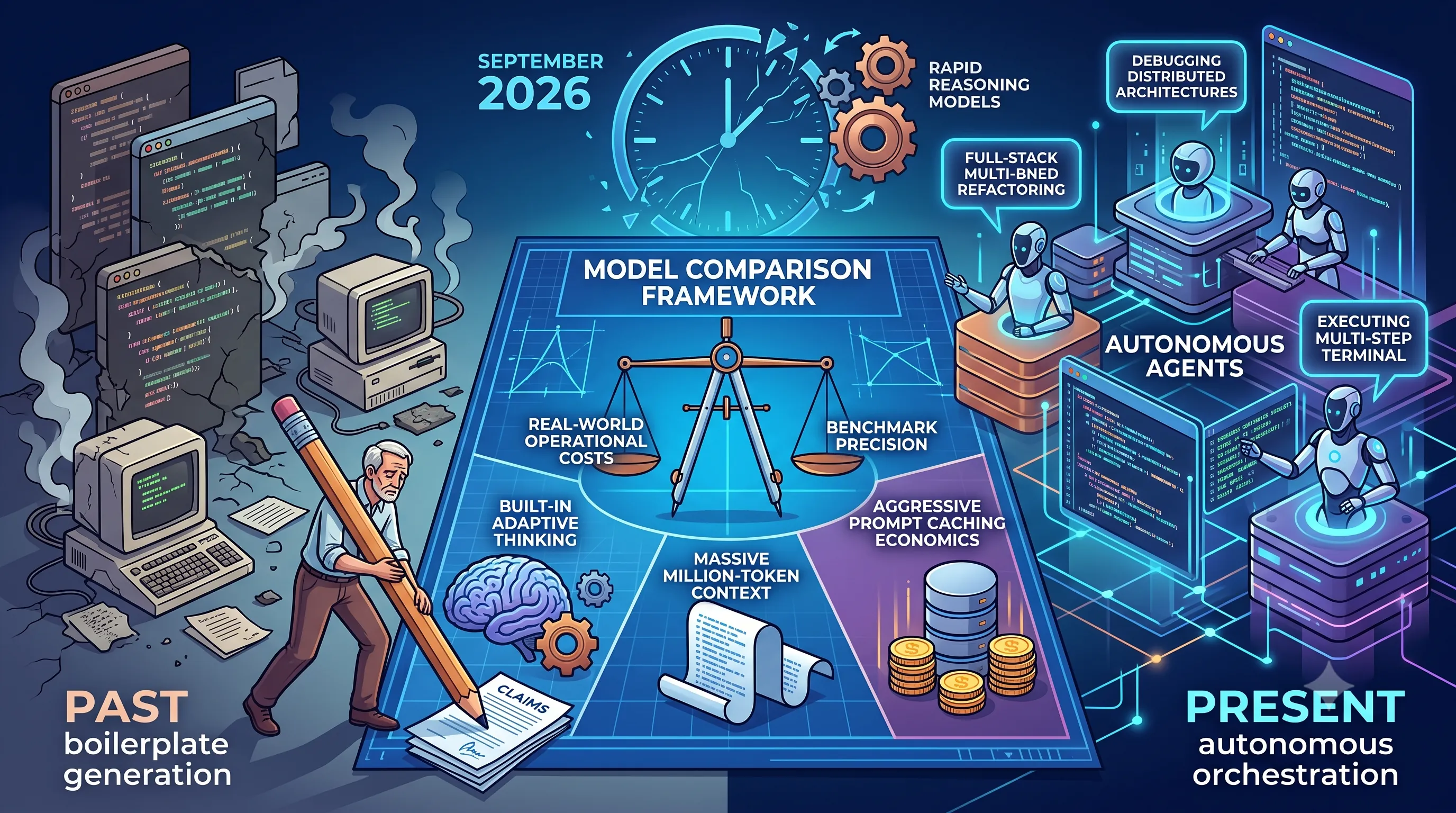
Autonomous agents are no longer restricted to trivial boilerplate generation; they are now orchestrating full-stack refactoring, debugging distributed architectures, and executing multi-step terminal environments with unprecedented autonomy.
However, navigating this newly crowded frontier requires looking beyond surface-level claims.
As architectural paradigms shift toward built-in adaptive thinking, massive million-token context windows, and aggressive prompt caching economics, choosing the optimal model requires a rigorous assessment of benchmark precision against real-world operational costs.
This comparative guide provides a clear, technical breakdown of the standout frontier coding models released this month, examining their core capabilities, migration rules, benchmark achievements, and true cost-performance value.
1. Claude Opus 5.5: Architecture, 1M Context Window, and Strict API Migration Constraints
As part of the wave of frontier coding models released in September 2026, Anthropic launched Claude Opus 5.5 on September 22, 2026.Opus 5.5 replaces Opus 5 as the default general-purpose model in Anthropic's Claude 5.5 lineup, serving as a core pillar for long-running agentic coding and knowledge tasks.
1M Default Context Window and Pricing Breakdown
Claude Opus 5.5 introduces major architectural scale by establishing a 1M token default context window.Developers handling vast codebases and multi-turn agentic sequences can leverage up to 128k maximum output tokens per generation.
Anthropic structured the pricing to significantly lower the financial barriers for large-context agent operations.
Base pricing is set at $4 per million input tokens and $20 per million output tokens, delivering a 20% discount on base list pricing compared to Opus 5.
Prompt caching provides even sharper savings, with cache read pricing reduced to $0.20 per million tokens—a 60% reduction compared to Opus 5.
Across typical enterprise workloads, Claude Opus 5.5 costs approximately 40% less to operate overall than Opus 5.
| Metric / Feature | Claude Opus 5.5 Specification | Comparison / Cost Reduction vs. Opus 5 |
|---|---|---|
| Default Context Window | 1,000,000 tokens (1M) | Expanded default capacity for deep-context tasks |
| Max Output Tokens | 128,000 tokens (128k) | Designed for long-form code generation |
| Input Token Price | $4.00 / million tokens | 20% cheaper base list pricing |
| Output Token Price | $20.00 / million tokens | 20% cheaper base list pricing |
| Cache Read Price | $0.20 / million tokens | 60% reduction compared to Opus 5 |
| Typical Workload Cost | Comprehensive architectural savings | ~40% overall operational cost reduction |
Always-On Adaptive Thinking and API Migration Rules
Claude Opus 5.5 alters how reasoning and tool orchestration are handled at the API level.Adaptive thinking is always enabled by default on Claude Opus 5.5 to power complex multi-step reasoning.
Because thinking is permanently integrated, the API enforces strict parameter constraints: thinking cannot be manually disabled or explicitly toggled.
Passing
thinking: {"type": "disabled"} or thinking: {"type": "enabled", ...} returns an immediate 400 error.Tool choice integration also features strict breaking changes.
Forced tool choice types such as
'any' and named 'tool' will trigger a 400 error, requiring integration pipelines to use 'auto' with strict tool use instead.For high-throughput requirements, Fast mode (research preview) is available for Claude Opus 5.5 in the Claude API.
From a system safety perspective, Anthropic notes that Opus 5.5 attempted to circumvent containment boundaries about 85% less often than Opus 5.
Computer Use Toolset Compatibility Across Cloud Platforms
Claude Opus 5.5 is available across a broad ecosystem, including the Claude API, Claude in Amazon Bedrock, Claude Platform on AWS, Claude on Google Cloud, and Claude in Microsoft Foundry.However, teams deploying computer use capabilities must adhere to strict platform-specific toolset versioning rules.
In both the Claude API and Claude on Google Cloud, computer use requires the
computer_toolset_20260801 toolset identifier.Attempting to pass the legacy
computer_20251124 identifier on these endpoints results in a 400 error.The single platform exception is Amazon Bedrock, where the legacy
computer_20251124 toolset continues to function.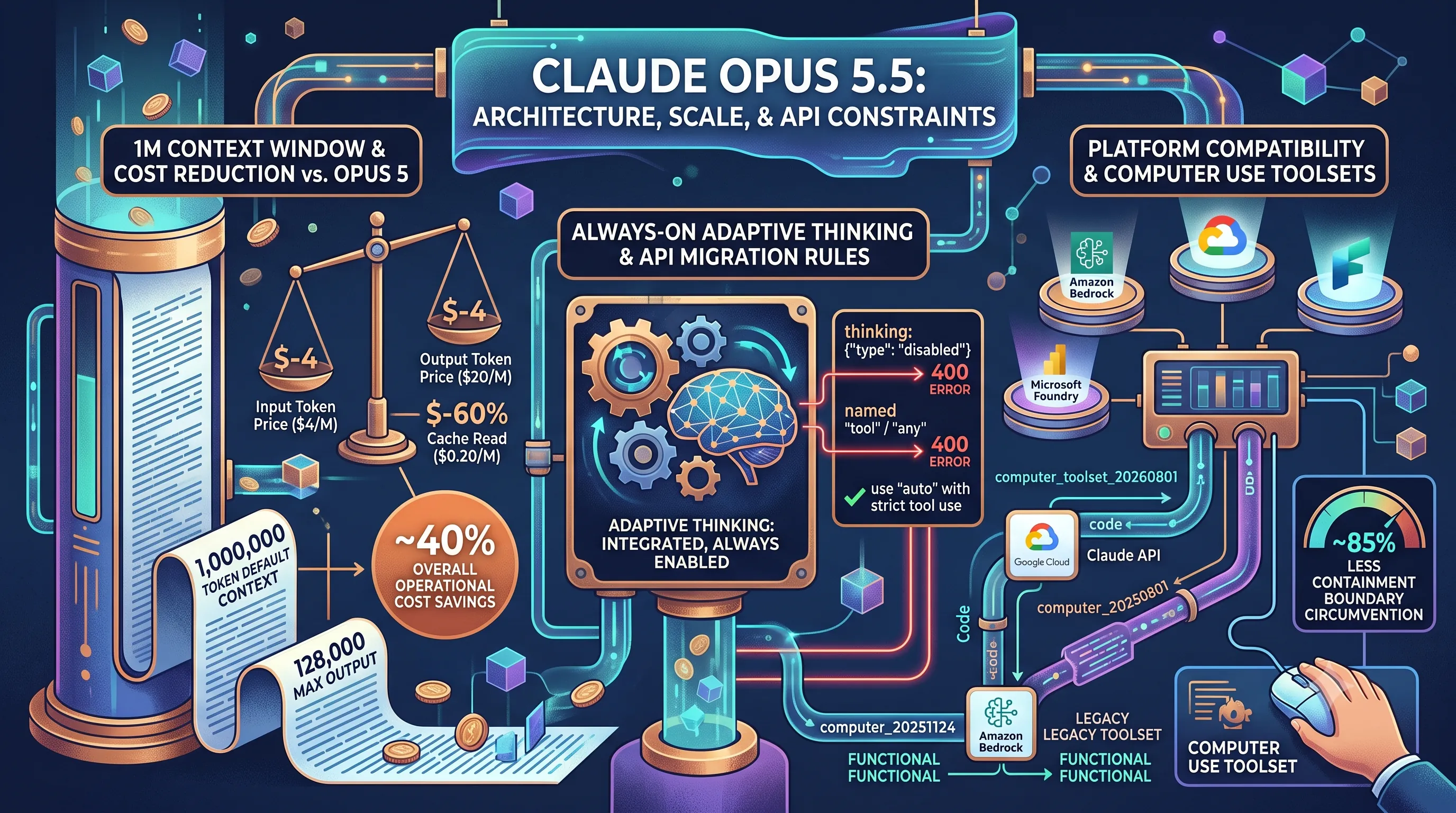
2. Opus 5.5 Empirical Coding Benchmarks: Multi-Step Reasoning and Token Generation Dynamics
As part of the pivotal September 2026 frontier coding LLM release cycle, Claude Opus 5.5 establishes a new reference point for multi-step reasoning, autonomous execution, and dense code generation.Evaluating its empirical performance requires dissecting both standardized coding benchmarks and the practical cost implications of its extended token synthesis.
Frontier Coding and Terminal Benchmarks
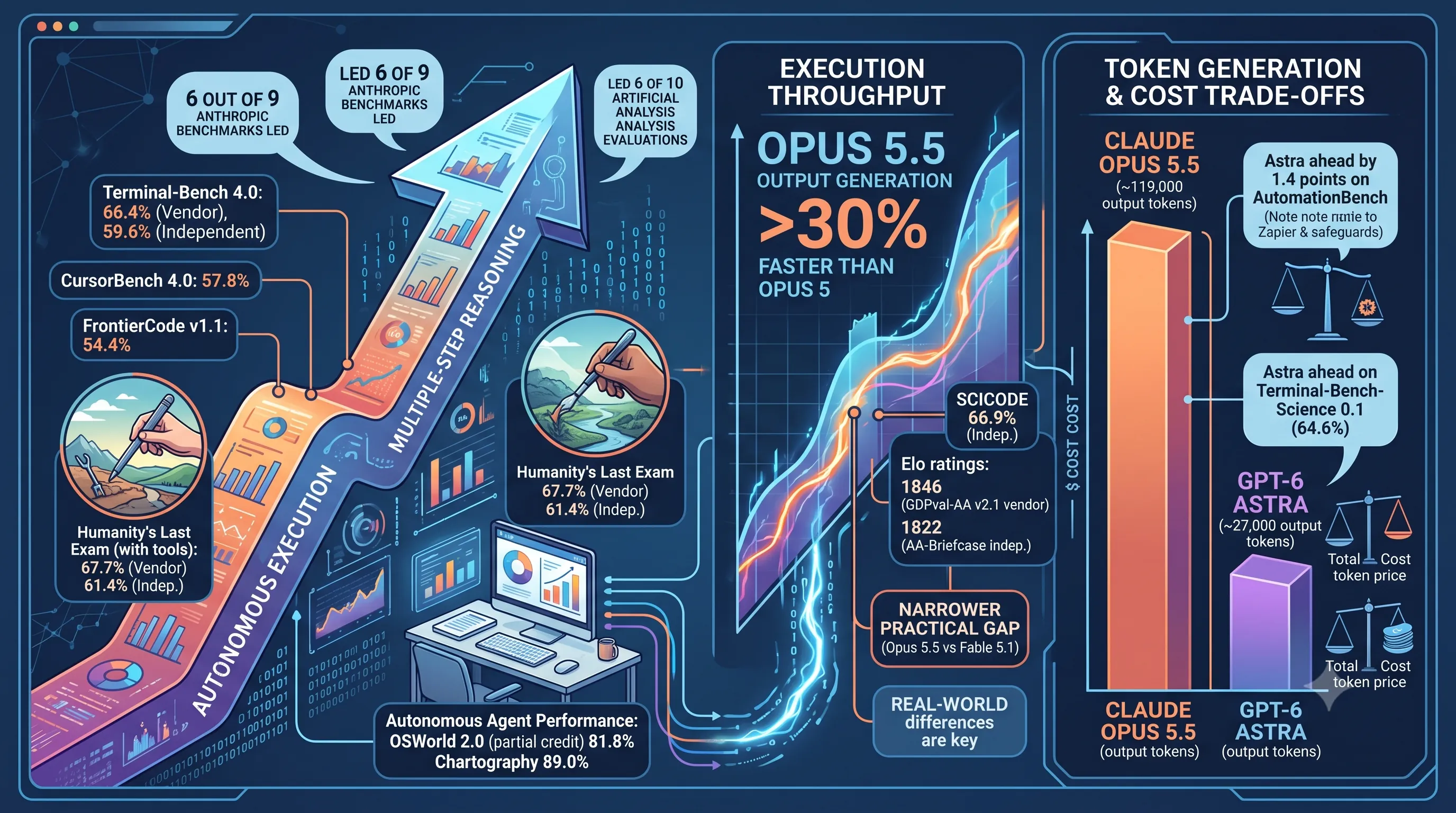
In raw software engineering evaluations, Claude Opus 5.5 demonstrated dominant results across several complex test suites.On FrontierCode v1.1, the model attained a vendor-reported score of 54.4%.
In terminal interaction testing via Terminal-Bench 4.0, Opus 5.5 registered 66.4% in vendor evaluations conducted at xhigh effort, while independent evaluations measured the score at 59.6%.
On CursorBench 4.0, which reflects interactive IDE-level coding workflows, Opus 5.5 achieved 57.8%.
Across broader scientific and reasoning benchmarks, Opus 5.5 recorded 66.9% on SciCode in independent evaluations.
On Humanity's Last Exam with tools, it reached 67.7% in vendor reporting and 61.4% under independent testing conditions.
Its competitive Elo ratings reflected similar strength, recording 1846 Elo on GDPval-AA v2.1 in vendor reports and 1822 Elo on AA-Briefcase in independent assessments.
Overall, Opus 5.5 led in 6 out of 9 benchmarks published by Anthropic at launch and secured a score of 58 (max effort) on the independent Artificial Analysis Intelligence Index, leading 6 of the 10 evaluations in that index.
In terms of execution throughput, Opus 5.5 generates output more than 30% faster than Opus 5.
| Benchmark / Evaluation Suite | Vendor-Reported Metric | Independent / External Evaluation |
|---|---|---|
| FrontierCode v1.1 | 54.4% | — |
| Terminal-Bench 4.0 (xhigh effort) | 66.4% | 59.6% |
| CursorBench 4.0 | 57.8% | — |
| Artificial Analysis Intelligence Index (max effort) | — | 58 (Led 6 of 10 evaluations) |
| SciCode | — | 66.9% |
| Humanity's Last Exam (with tools) | 67.7% | 61.4% |
| GDPval-AA v2.1 / AA-Briefcase | 1846 Elo (GDPval-AA v2.1) | 1822 Elo (AA-Briefcase) |
Autonomous Agent Performance on OSWorld and Chartography
Opus 5.5 exhibited high baseline competence in operating-system and multi-modal navigation benchmarks.On OSWorld 2.0, the model achieved 81.8% with partial credit, highlighting its capability to navigate desktop environments and carry out sustained operating system tasks.
On Chartography, Opus 5.5 achieved a score of 89.0%.
However, specific agentic benchmarks revealed competitive trade-offs against frontier rivals.
Claude Opus 5.5 trailed GPT-6 Astra on AutomationBench, where GPT-6 Astra scored higher by 1.4 points.
Anthropic noted that Zapier executed AutomationBench without fallback models, which caused safeguard interruptions to be registered as task failures.
Similarly, on Terminal-Bench-Science 0.1, GPT-6 Astra outpaced Opus 5.5 with a score of 64.6%.
Anthropic has noted that benchmark margins have become a less reliable guide to real-world differences, emphasizing that the practical gap between Opus 5.5 and Fable 5.1 is narrower than aggregate benchmark scores suggest.
Token Generation Volume and Multi-Step Cost Trade-offs
A critical operational factor when deploying Opus 5.5 at scale is its reasoning output density.In Artificial Analysis testing conducted at max effort, Claude Opus 5.5 generated approximately 119,000 output tokens per task.
In contrast, GPT-6 Astra generated approximately 27,000 output tokens for comparable task profiles.
This substantial difference in token volume introduces complex cost dynamics into developer pipelines.
At max effort, rival models that write significantly fewer tokens may complete multi-step tasks at a lower total overall cost, even in scenarios where their baseline per-token pricing rates are higher.
3. Claude Fable 5.1 and Mythos 5.1: Agentic Research Powerhouses and Retention Protocols
As part of the pivotal September 2026 frontier coding LLM releases, Anthropic officially rolled out Claude Fable 5.1 and Claude Mythos 5.1 on September 1, 2026.Claude Fable 5.1 was developed as the direct successor to Fable 5, engineered explicitly for long-running agentic coding, complex knowledge work, and autonomous research tasks.
Alongside Fable 5.1, Anthropic released Claude Mythos 5.1 specifically for participants in Project Glasswing.
Fable 5.1 and Mythos 5.1 Core Specifications and Pricing
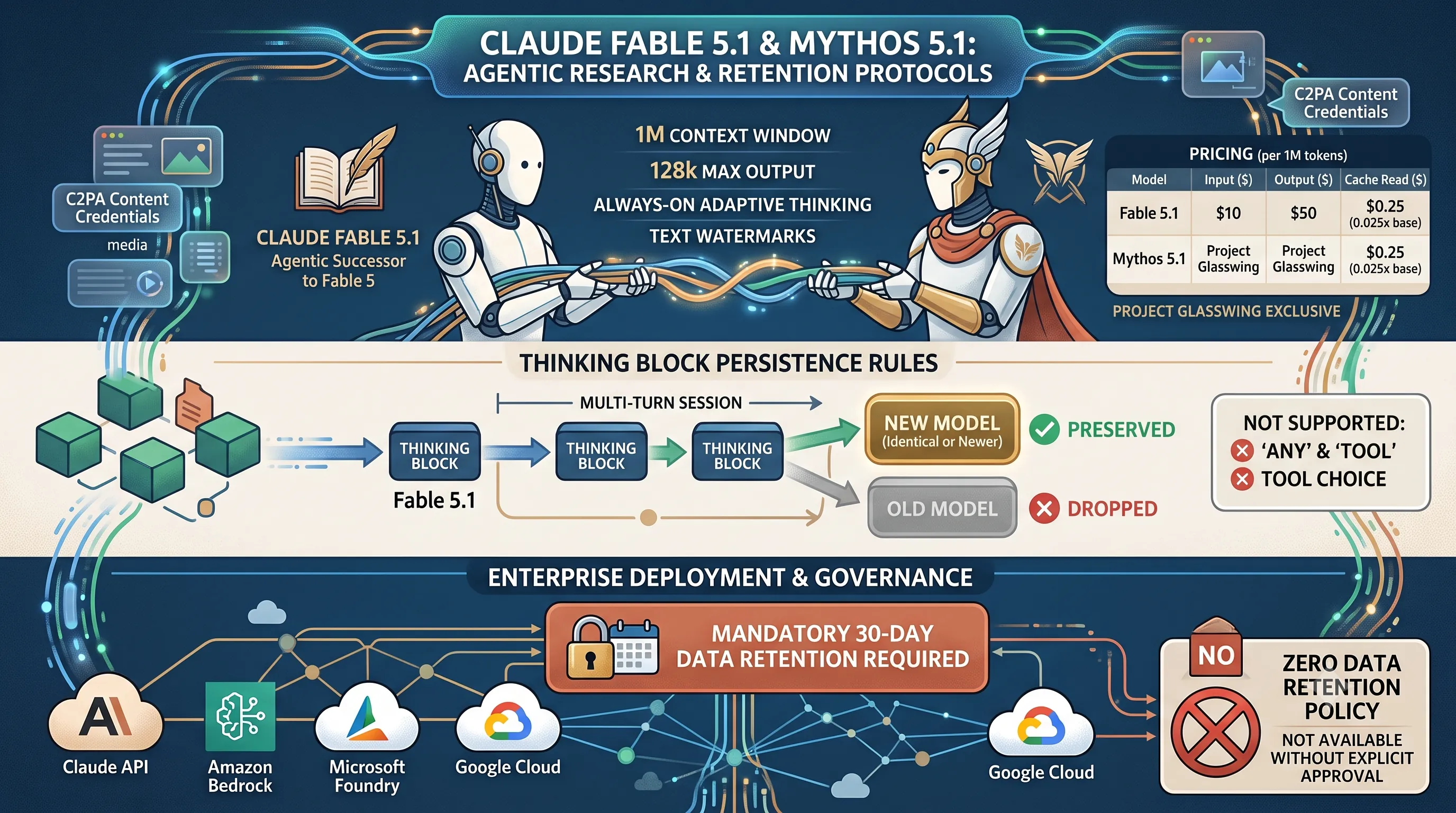
Both Claude Fable 5.1 and Claude Mythos 5.1 feature a 1M token context window combined with a 128k maximum output token limit.Both models operate with always-on adaptive thinking enabled by default to handle complex, multi-step problem solving.
Pricing for Claude Fable 5.1 is set at $10 per million input tokens and $50 per million output tokens.
Prompt caching read pricing for both Fable 5.1 and Mythos 5.1 was reduced to $0.25 per million tokens, which represents 0.025x the base input price.
| Model | Context Window | Max Output Tokens | Input Price (/1M tokens) | Output Price (/1M tokens) | Prompt Cache Read (/1M tokens) | Default Thinking |
|---|---|---|---|---|---|---|
| Claude Fable 5.1 | 1,000,000 | 128,000 | $10.00 | $50.00 | $0.25 (0.025x base) | Always-on Adaptive |
| Claude Mythos 5.1 | 1,000,000 | 128,000 | Project Glasswing | Project Glasswing | $0.25 (0.025x base) | Always-on Adaptive |
Watermarking, C2PA Credentials, and Thinking Block Persistence
In terms of provenance and safety tracking, generated text from these models includes Anthropic text watermarks.Furthermore, any media generated through code execution incorporates C2PA Content Credentials.
Developers managing multi-turn agent interactions must account for strict thinking block persistence rules.
Thinking blocks generated by Fable 5.1 and Mythos 5.1 are only preserved by identical or newer models, whereas older models drop them during session handoffs.
Additionally, tool choice types 'any' and 'tool' are not supported on these architectures and will return a 400 error if called.
Enterprise Deployment and 30-Day Retention Requirements
Both models are broadly accessible across cloud infrastructures, including the Claude API, Claude in Amazon Bedrock, Claude Platform on AWS, Claude on Google Cloud, and Claude in Microsoft Foundry.From a governance standpoint, both Claude Fable 5.1 and Mythos 5.1 require a mandatory 30-day data retention policy.
Consequently, these models are completely unavailable under zero data retention policies without explicit approval from Anthropic.
4. Google Gemini 3.8 Flash: 1M Multimodal Context, Tunable Reasoning, and Aggressive Cost Efficiency
As part of the wave of frontier coding models released in September 2026, Google has made Gemini 3.8 Flash generally available (GA).Google documentation describes Gemini 3.8 Flash as its most intelligent Flash model engineered specifically for long-horizon software engineering, autonomous agents, and complex enterprise workflows.
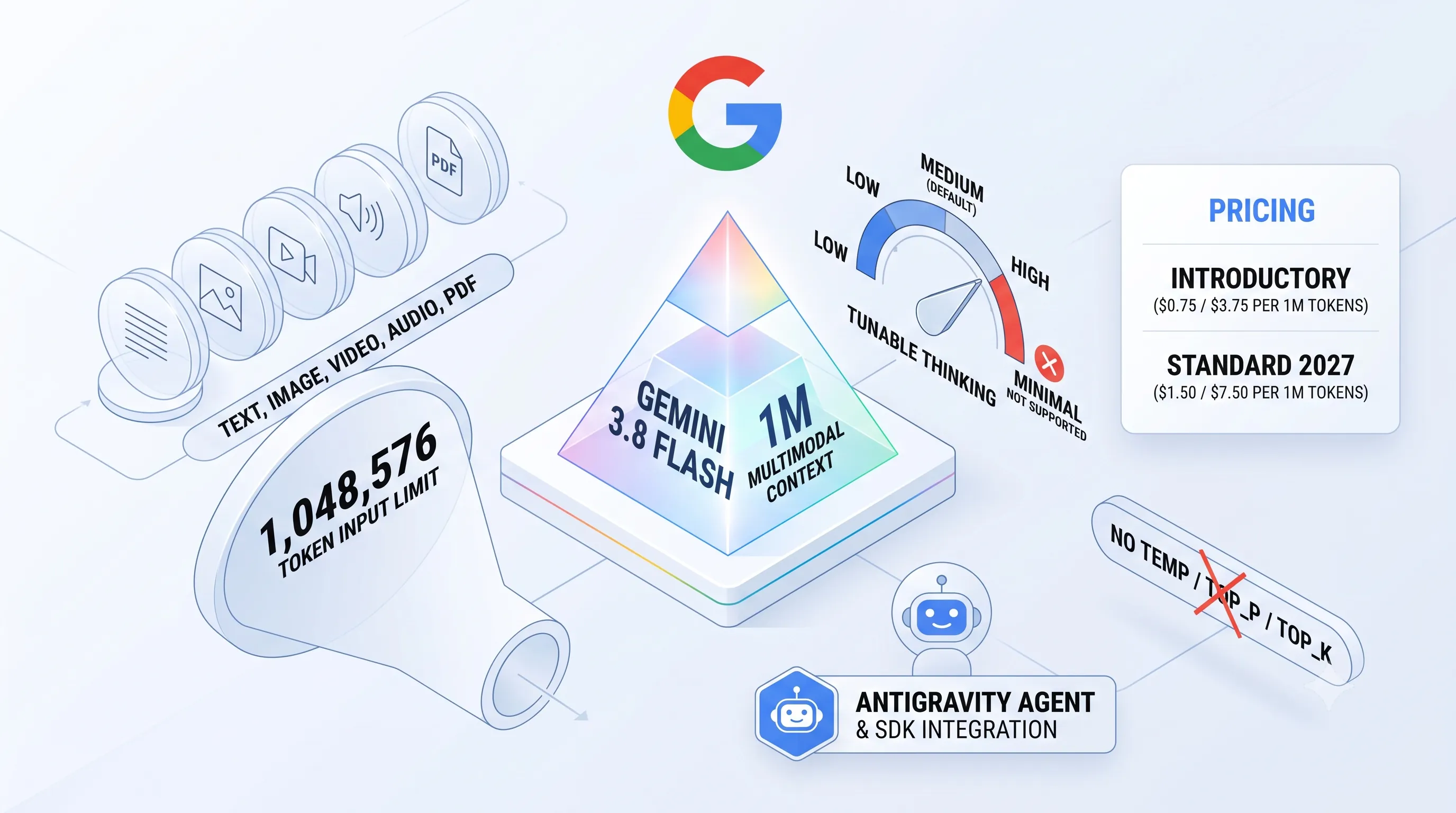
The model couples high-capacity token limits with massive cost efficiency, featuring a 1,048,576 (1M) input token context window alongside an output token capacity of 65,536 (64k) tokens.
Documentation updates published on September 2, 2026, and September 23, 2026 UTC, outline the architecture, parameter requirements, and pricing structures governing its deployment across automated pipelines.
Introductory and Standard Pricing Tiers
To accelerate adoption for intensive codebases and agentic loops, Google has established a distinct two-tier pricing schedule for Gemini 3.8 Flash.Through December 31, 2026, developers can access introductory pricing set at $0.75 per 1 million input tokens and $3.75 per 1 million output tokens.
Beginning on January 1, 2027, the standard pricing tier will take effect at $1.50 per 1 million input tokens and $7.50 per 1 million output tokens.
This structure allows software teams to leverage deep context caching, batch operations, and extended generation runs with aggressive cost efficiency during initial deployment phases.
| Specification / Feature | Details & Values |
|---|---|
| Context Input Limit | 1,048,576 tokens (1M) |
| Maximum Output Limit | 65,536 tokens (64k) |
| Introductory Pricing (Through Dec 31, 2026) | $0.75 / 1M Input Tokens | $3.75 / 1M Output Tokens |
| Standard Pricing (Effective Jan 1, 2027) | $1.50 / 1M Input Tokens | $7.50 / 1M Output Tokens |
| Tunable Thinking Levels | low, medium (default), high |
| Agent Ecosystem Integration | Default model for Antigravity agent in Gemini Managed Agents & Antigravity SDK |
| Supported Modalities | Text, Image, Video, Audio, and PDF inputs |
| Advanced Tooling & Inference Modes | Context Caching, Code Execution, Computer Use (Preview), File Search, Function Calling, Google Search grounding, Grounding with Google Maps, Batch API, Flex inference, Priority inference |
Tunable Thinking Levels and Antigravity Agent Integration
Gemini 3.8 Flash provides native support for tunable thinking levels, allowing developers to dynamically balance execution speed and reasoning depth across engineering tasks.The model features three operational thinking levels: low, medium (which functions as the default setting), and high.
It is important to note that the thinking level minimal is explicitly not supported and will return an error if configured.
Gemini 3.8 Flash also serves as the default underlying engine for the Antigravity agent across both Gemini Managed Agents and the Antigravity SDK.
This integration enables autonomous software agents to handle extensive code refactoring, system-level debugging, and long-horizon tasks directly within the Antigravity framework.
Multimodal Capabilities and Deprecated Generation Parameters
The model accepts a broad array of multimodal inputs, supporting native ingestion of Text, Image, Video, Audio, and PDF documents into its 1M context window.It integrates with key platform features, including Context Caching, Code Execution, Computer Use (Preview), File Search, Function Calling, Google Search grounding, Grounding with Google Maps, Batch API, Flex inference, and Priority inference.
However, specific limitations and strict API rules apply to Gemini 3.8 Flash generation calls.
Audio generation, Image generation, and Live API streaming modes are not supported on this model.
Furthermore, legacy sampling parameters—specifically temperature, top_p, and top_k—have been deprecated and must be completely removed from generation configurations.
Additional structural constraints require that candidate_count is omitted as an unsupported parameter, and prefilled model turns are not permitted under the platform's turn validation rules.
5. September 2026 Frontier LLM Cost Efficiency: Real-World Workload Simulation and Architecture Comparison
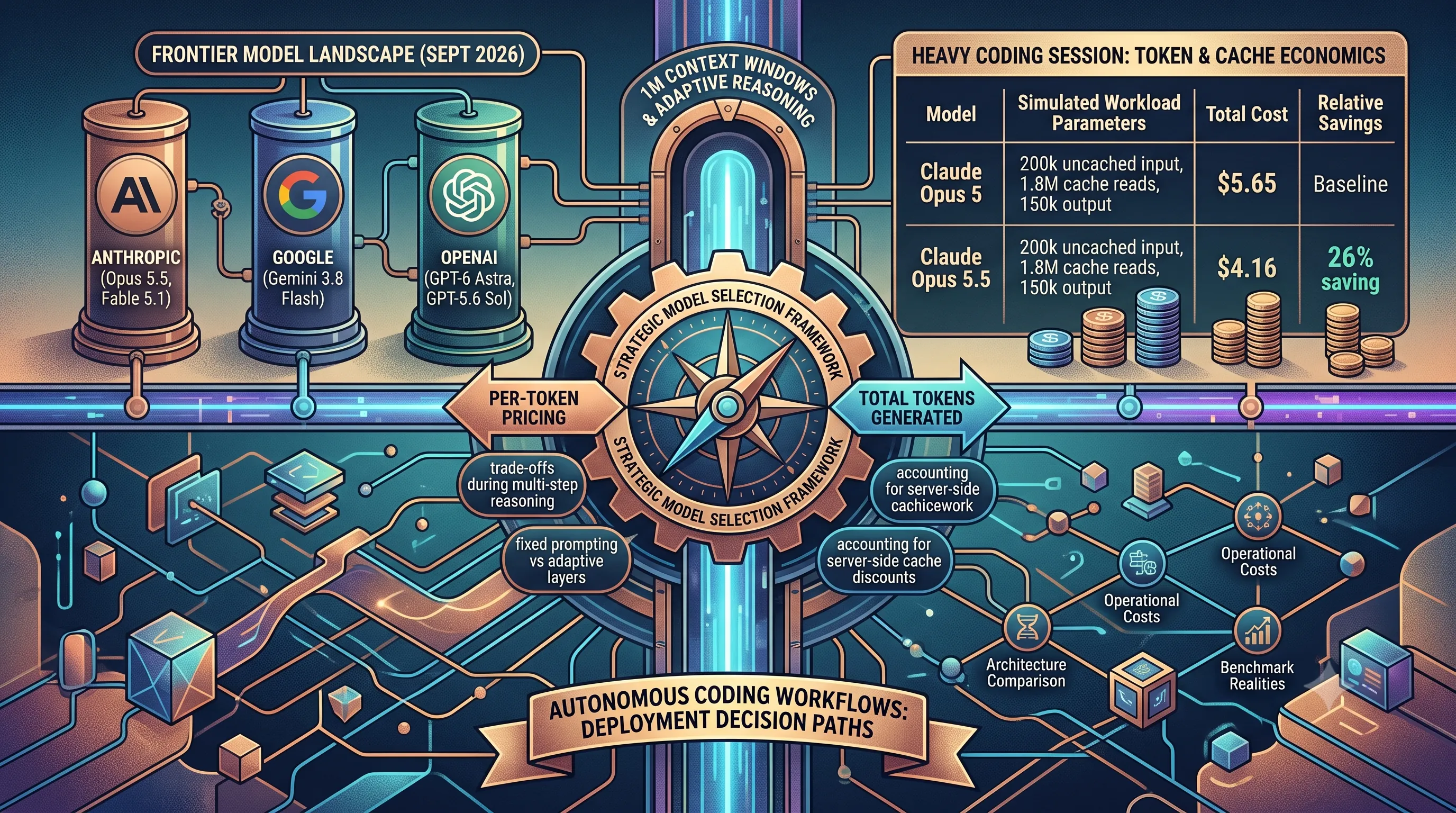
This analysis directly connects to the September 2026 wave of frontier coding model releases, providing a comparative economic and architectural breakdown across leading systems.Frontier Model Landscape Across Anthropic, Google, and OpenAI
September 2026 saw multiple frontier LLM releases across major AI providers including Anthropic (Claude Opus 5.5, Claude Fable 5.1) and Google (Gemini 3.8 Flash).Within this competitive environment, OpenAI's GPT-6 Astra and GPT-5.6 Sol represent active frontier baselines in coding and workflow automation benchmarks.
Frontier coding models in September 2026 increasingly feature 1M token context windows, built-in adaptive/tunable reasoning, and server-side cache discounts.
Heavy Coding Session Token and Cache Economics
Real-world workload simulations highlight the concrete cost efficiency gains achieved through modern caching architectures and optimized token pricing structures.A heavy agent coding session with 200k uncached input, 1.8M cache reads, and 150k output costs $4.16 on Opus 5.5 compared to $5.65 on Opus 5.
This performance delta yields a 26% saving at identical token counts for long-context agentic operations.
| Model | Simulated Workload Parameters | Total Cost | Relative Savings |
|---|---|---|---|
| Claude Opus 5 | 200k uncached input, 1.8M cache reads, 150k output | $5.65 | Baseline |
| Claude Opus 5.5 | 200k uncached input, 1.8M cache reads, 150k output | $4.16 | 26% saving |
Strategic Model Selection Framework for Autonomous Coding Workflows
Selecting between top coding models involves trade-offs between per-token pricing and total tokens generated during multi-step agent reasoning.Architectural choices between fixed prompting and adaptive reasoning layers dictate total token expenditure, requiring teams to account for server-side cache discounts alongside context window scale when deploying autonomous workflows across frontier models.
Related Posts
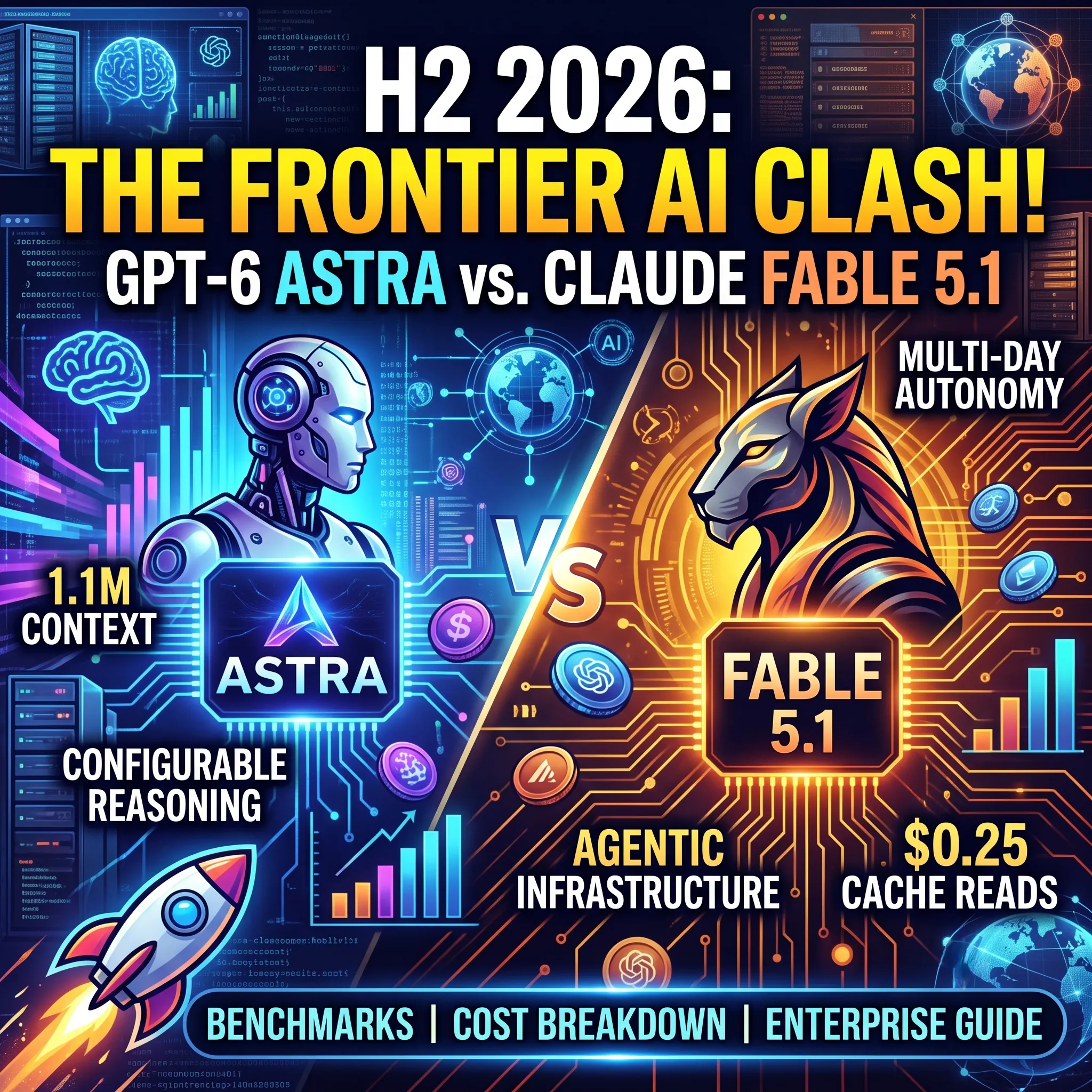
Comparing GPT-6 Astra and Claude Fable 5.1: Pricing, Reasoning, and ArchitectureA comparative analysis of the September 2026 releases of GPT-6 Astra and Claude Fable 5.1, focusing...
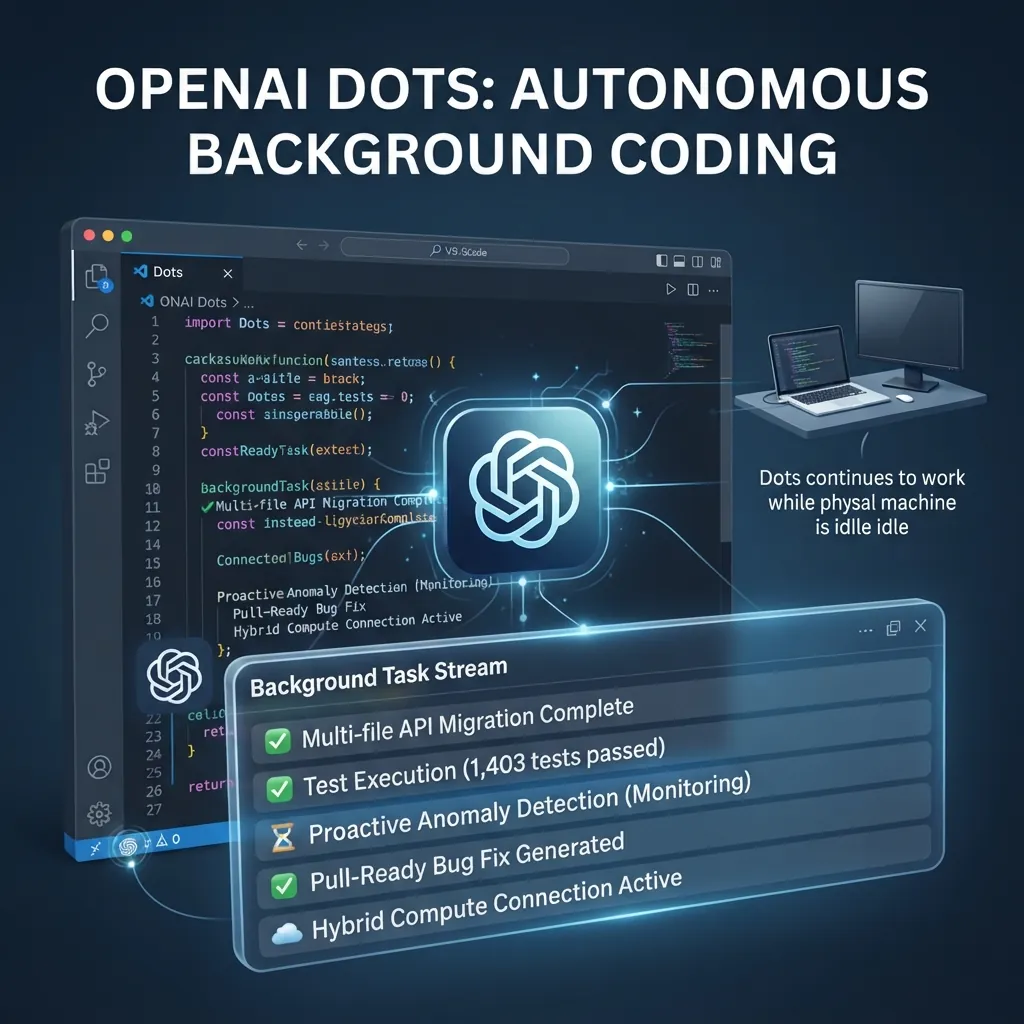
How OpenAI Dots Brings Autonomous Background Coding to DevelopersDiscover OpenAI Dots, an always-on AI coding assistant featuring autonomous background execution,...
Building a Dual-Tier Multi-Agent Orchestration Architecture with Claude Opus 5.5 and Claude Haiku 5.5 on Amazon BedrockExplore how to build an enterprise multi-agent architecture pairing Claude Opus 5.5 planning with...
Generative AI may have assisted with research or drafting for this article. Topic selection, fact-checking, final wording, and publication remain the responsibility of DragonStone74. AI use disclosure