
Building a Dual-Tier Multi-Agent Orchestration Architecture with Claude Opus 5.5 and Claude Haiku 5.5 on Amazon Bedrock
🚀 Key Takeaways
- Role-Specialized Orchestration: Claude Opus 5.5 handles high-level strategic reasoning and planning, while Claude Haiku 5.5 operates as a rapid, cost-efficient subagent execution layer.
- Scalable Worker Efficiency: Haiku 5.5 provides massive context handling and fast throughput to execute repetitive, well-defined operational tasks at scale.
- Dynamic Effort Tuning: Native model effort parameters enable teams to trade off reasoning depth against latency and cost without switching model families.
- Enterprise Cloud Readiness: Deploying the dual-agent architecture on Amazon Bedrock provides cross-region availability, granular IAM security, and automated observability.
As autonomous AI architectures evolve beyond monolithic prompts into collaborative multi-agent swarms, engineering teams face a familiar dilemma. Deploying flagship frontier models for every routine subtask quickly inflates operational budgets and slows down latency-sensitive workflows, while smaller standalone models frequently falter on complex reasoning, architectural design, and edge-case triage.
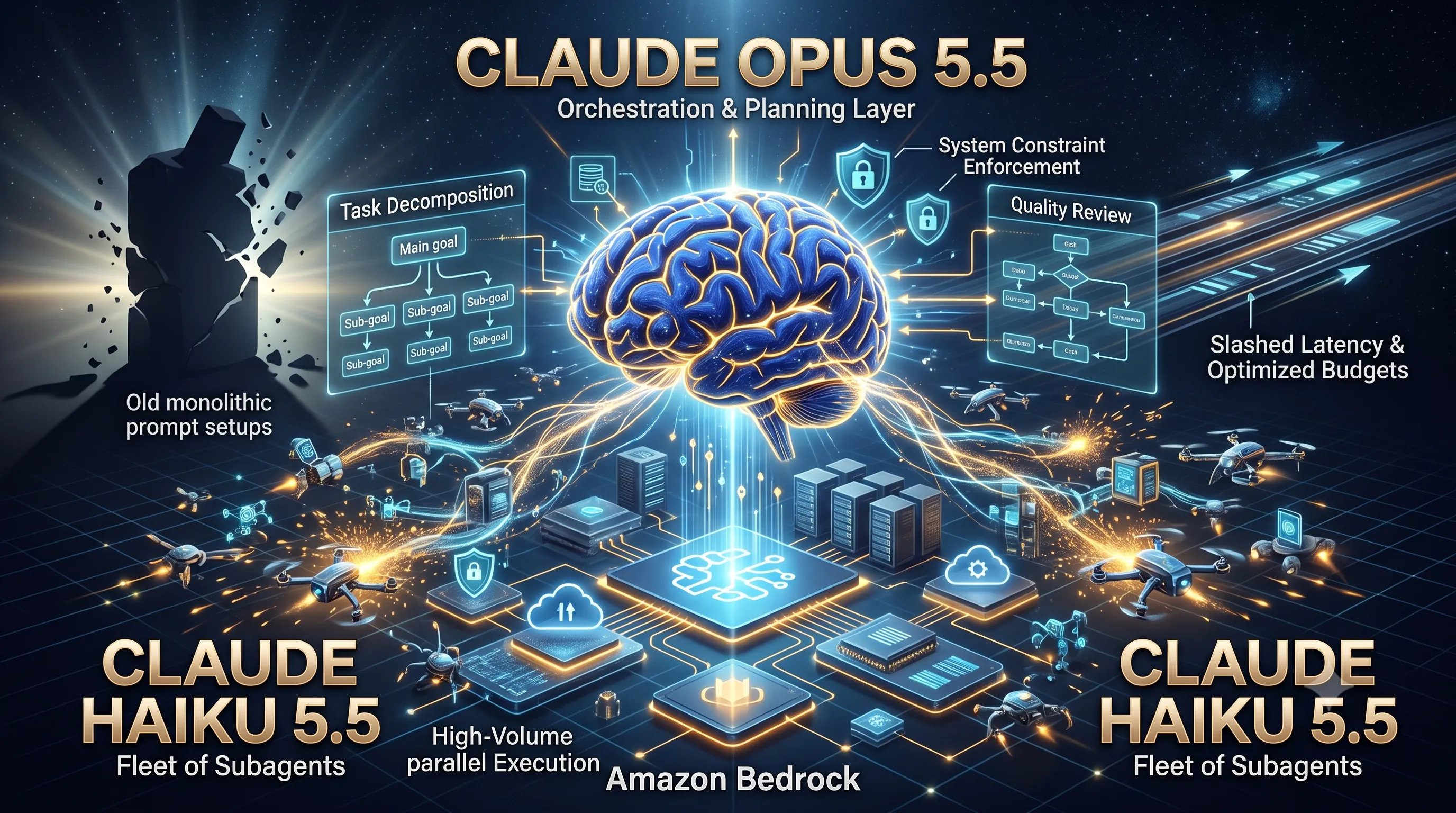
The dual-tier design pattern pairing Claude Opus 5.5 with Claude Haiku 5.5 solves this trade-off through a deliberate division of labor. By establishing Opus 5.5 as the deliberative planning layer to decompose goals, enforce system constraints, and review outputs, organizations can securely delegate high-volume execution loops to Haiku 5.5 as a fleet of responsive subagents.
This architecture demonstrates how to construct an enterprise-grade multi-agent orchestration framework on Amazon Bedrock, balancing frontier-tier intelligence with cost-effective, parallel execution across complex production environments.
1. Architectural Foundation: Claude Haiku 5.5 Specifications and Cost Efficiency
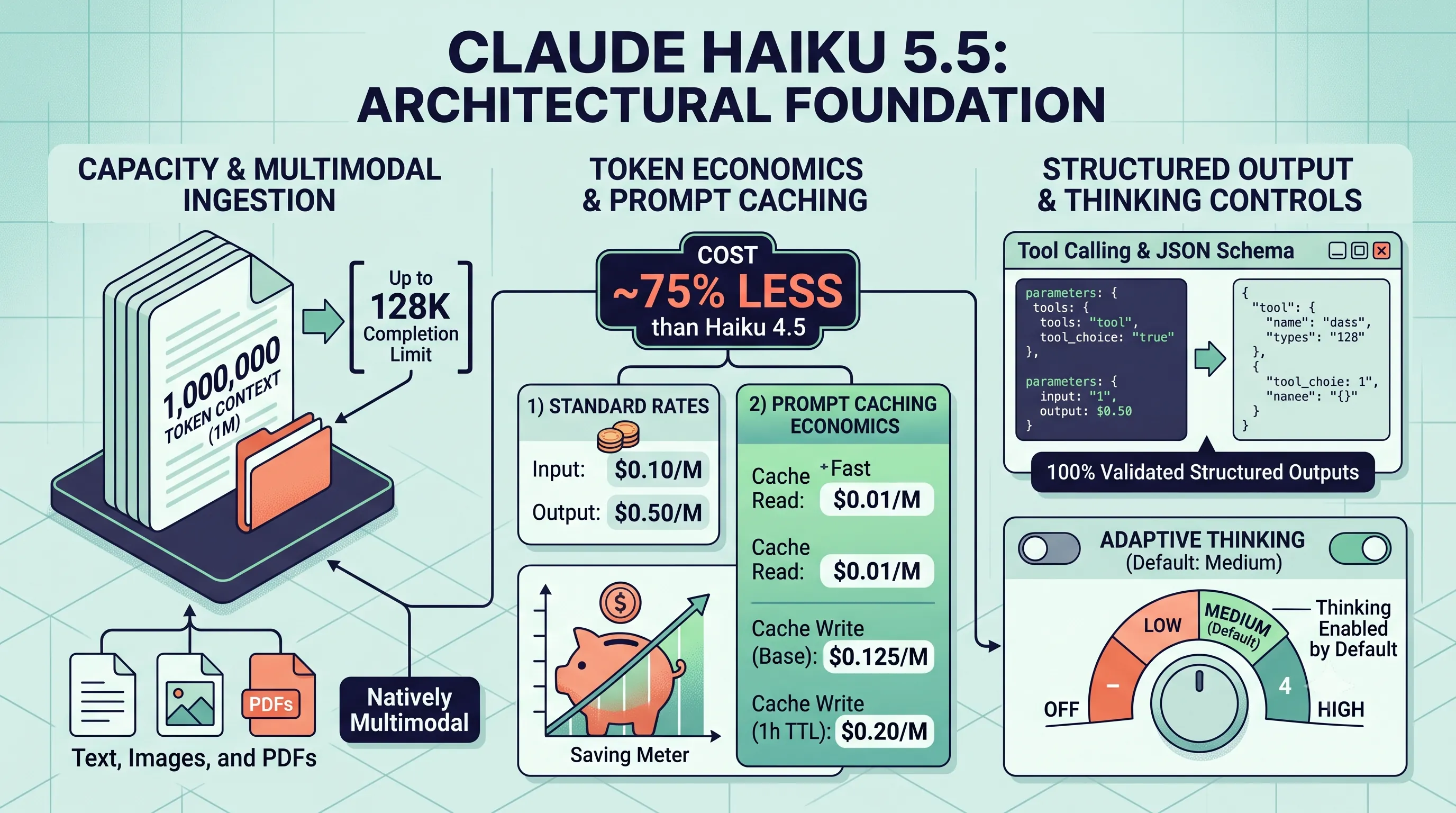
Within the multi-agent architecture outlined in "Opus Plans, Haiku Executes: Building Multi-Agent Orchestration with Claude Haiku 5.5," high-level planning demands an equally capable, rapid execution engine. Claude Haiku 5.5 serves as this foundational execution layer, translating complex plans designed by larger reasoning models into scalable task execution. Released on October 7, 2026, Claude Haiku 5.5 is positioned as Anthropic's fastest and most cost-effective model in the Claude 5.5 family. According to Anthropic, it is purpose-built for subagents and high-volume, budget-conscious workloads, delivering the critical balance between throughput and computational efficiency.1M Context Window and Massive Completion Capacity
Claude Haiku 5.5 expands operational capacity with a 1,000,000 token (1M tokens) context window.This expansive context allows subagents to ingest entire code repositories, comprehensive documentation, and broad conversational histories without aggressive summarization.
Complementing the large context window, the model supports up to 128,000 completion tokens in a single generation.
This completion volume enables worker agents to produce long-form deliverables, extensive source files, and dense serialization traces in continuous execution passes.
For multimodal workflows, Claude Haiku 5.5 accepts text, image inputs, and files such as PDFs as input, returning structured or analytical text.
Worker agents can therefore process visual diagrams, captured screenshots, and multi-page technical documents directly alongside textual inputs.
Token Pricing Structure and Prompt Caching Economics
Cost efficiency is critical when coordinating swarms of parallel subagents.Claude Haiku 5.5 costs around 75 percent less than Claude Haiku 4.5 for most tasks.
Its baseline token pricing is established at $0.10 per million input tokens ($0.10/M) and $0.50 per million output tokens ($0.50/M).
To further minimize the expense of iterative agent calls over shared instructions, the architecture integrates prompt caching tiers.
The Cache Read rate is priced at $0.01 per million tokens ($0.01/M).
Initial prompt caching incurs a Cache Write rate of $0.125 per million tokens ($0.125/M), while extended storage is supported at a Cache Write (1h) rate of $0.20 per million tokens ($0.20/M).
These prompt caching rates allow static orchestrator schemas and repeated context blocks to be reused at a fraction of standard input rates.
| Metric / Specification | Claude Haiku 5.5 Rate / Capacity | Architectural Detail |
|---|---|---|
| Context Window | 1,000,000 tokens (1M tokens) | Ingests large file sets, histories, and documentation |
| Completion Limit | Up to 128,000 tokens | Generates extensive code blocks and deep continuous outputs |
| Input Token Price | $0.10 per million tokens ($0.10/M) | Around 75% cost reduction compared to Claude Haiku 4.5 |
| Output Token Price | $0.50 per million tokens ($0.50/M) | Optimized for high-volume agent generation |
| Cache Read Price | $0.01 per million tokens ($0.01/M) | Sub-agent retrieval over shared static prompt blocks |
| Cache Write Price | $0.125 per million tokens ($0.125/M) | Base checkpointing for prompt caching |
| Cache Write (1h) Price | $0.20 per million tokens ($0.20/M) | One-hour TTL caching for persistent workflows |
Structured Output Schemas and Adaptive Thinking Controls
Deterministic coordination among multi-agent systems requires strict interface boundaries.Claude Haiku 5.5 supports tool calling via tools and tool_choice parameters.
This allows orchestrators to enforce explicit function dispatching across external systems and local sandboxes.
In addition, the model supports structured outputs via JSON schema configured directly in response_format.
By standardizing subagent outputs into validated JSON structures, the orchestrator eliminates extraction overhead and format variability between execution nodes.
Beyond structural controls, Claude Haiku 5.5 integrates adaptive thinking with adjustable effort controls.
Adaptive thinking is enabled by default to evaluate step-by-step logic prior to generation.
Developers can adjust the effort setting across low, medium, and high levels, or turn thinking off entirely for raw generation speed.
The default effort setting on Claude Haiku 5.5 is medium, providing a baseline of reasoning rigor suited for independent execution tasks.
2. Orchestrator-Subagent Pattern: Opus 5.5 Planning and Haiku 5.5 Parallel Execution
The core architectural paradigm of multi-agent orchestration pairs high-capacity planning models with rapid, specialized execution engines.In the context of multi-agent orchestration frameworks where Opus plans and Haiku executes, this section deconstructs how responsibility is partitioned between the cognitive planning tier and the distributed operational tier.
Opus 5.5 as the Cognitive and Escalation Layer
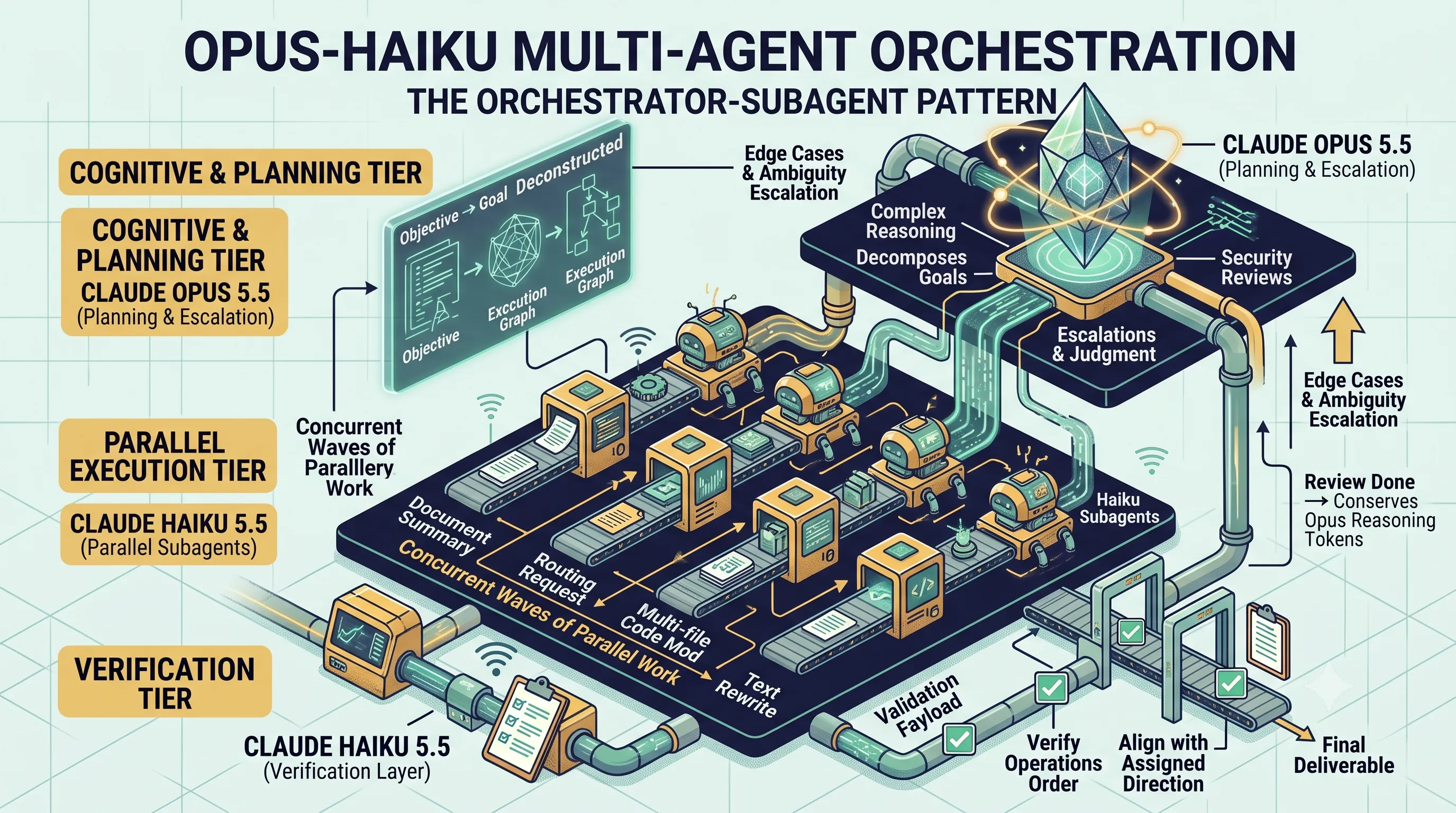
Within this orchestrator-subagent architecture, Claude Opus 5.5 acts as the central planning and judgment layer.Its primary role is to ingest overarching objectives, break down complex problems into structured execution graphs, and decide optimal implementation approaches.
Rather than expending compute on routine mechanical operations, Claude Opus 5.5 handles heavy reasoning tasks that demand profound context and analytical rigor.
These responsibilities include deep release debugging, conducting security reviews across large pull requests, and producing long, multi-faceted technical analyses.
As highlighted in the AWS Blog, Claude Opus 5.5 and Claude Haiku 5.5 function as an integrated team where Opus 5.5 formulates plans and makes high-level judgment calls while Haiku 5.5 executes well-defined tasks rapidly and at scale.
The orchestrator-subagent design explicitly delegates high-volume narrow tasks downward while escalating ambiguous edge cases and complex architectural decisions back up to Claude Opus 5.5.
Concurrent Haiku 5.5 Subagent Waves for High-Volume Tasks
Operating beneath the strategic tier, Claude Haiku 5.5 serves as the subagent execution layer designed to manage high-volume, strictly bounded operations.When a master plan is generated, multiple Claude Haiku 5.5 subagents can run concurrently in parallel waves to process independent units of work simultaneously.
The discrete tasks allocated to Claude Haiku 5.5 subagents include routing inbound requests, classifying and summarizing unstructured text, rewriting technical documentation, and making targeted code changes across multiple files.
Distributing these repetitive tasks across parallel worker waves prevents queue bottlenecks and ensures rapid task resolution without saturating the primary planner.
| Architecture Layer | Assigned Model | Primary Responsibilities | Execution Characteristics |
|---|---|---|---|
| Planning and Escalation Layer | Claude Opus 5.5 | Problem breakdown, approach decision, release debugging, security reviews of large pull requests, and long analyses | Centralized high-reasoning planner handling escalations and judgment calls |
| Subagent Execution Layer | Claude Haiku 5.5 | Routing requests, classifying, summarizing, rewriting documents, and applying multi-file code modifications | Concurrent parallel waves executing well-defined, high-volume tasks |
| Verification Subagent Layer | Claude Haiku 5.5 | Checking sequential order of operations and verifying execution direction | Inline verification pipeline preventing unneeded escalation to the orchestrator |
Verification Pipelines and Reasoning Token Conservation
Beyond direct task execution, Claude Haiku 5.5 operates as a review subagent within the pipeline to monitor execution consistency.In this role, subagents systematically verify the order of operations and confirm that intermediate outputs align with the assigned direction before work is finalized.
By deploying Claude Haiku 5.5 as an automated verification checkpoint, the system ensures that Claude Opus 5.5 conserves reasoning tokens exclusively for problems that require advanced cognitive synthesis.
This hierarchical structure concentrates valuable reasoning tokens directly in the orchestrator layer while delegating narrow validations to lightweight workers.
Consequently, total operating cost and overall latency are substantially reduced across the entire workflow while maintaining end-to-end analytical precision.
3. Dynamic Effort Calibration and Multi-Model Selection Strategies
Building an effective multi-agent architecture where Claude Opus orchestrates system planning and Claude Haiku executes downstream tasks requires precision tuning of runtime performance.Rather than treating model selection as a static binary decision, orchestrating Claude 5.5 workloads depends on dynamic effort calibration and structured model escalation paths.
Calibrating Effort Parameters: Latency vs Intelligence Trade-Offs
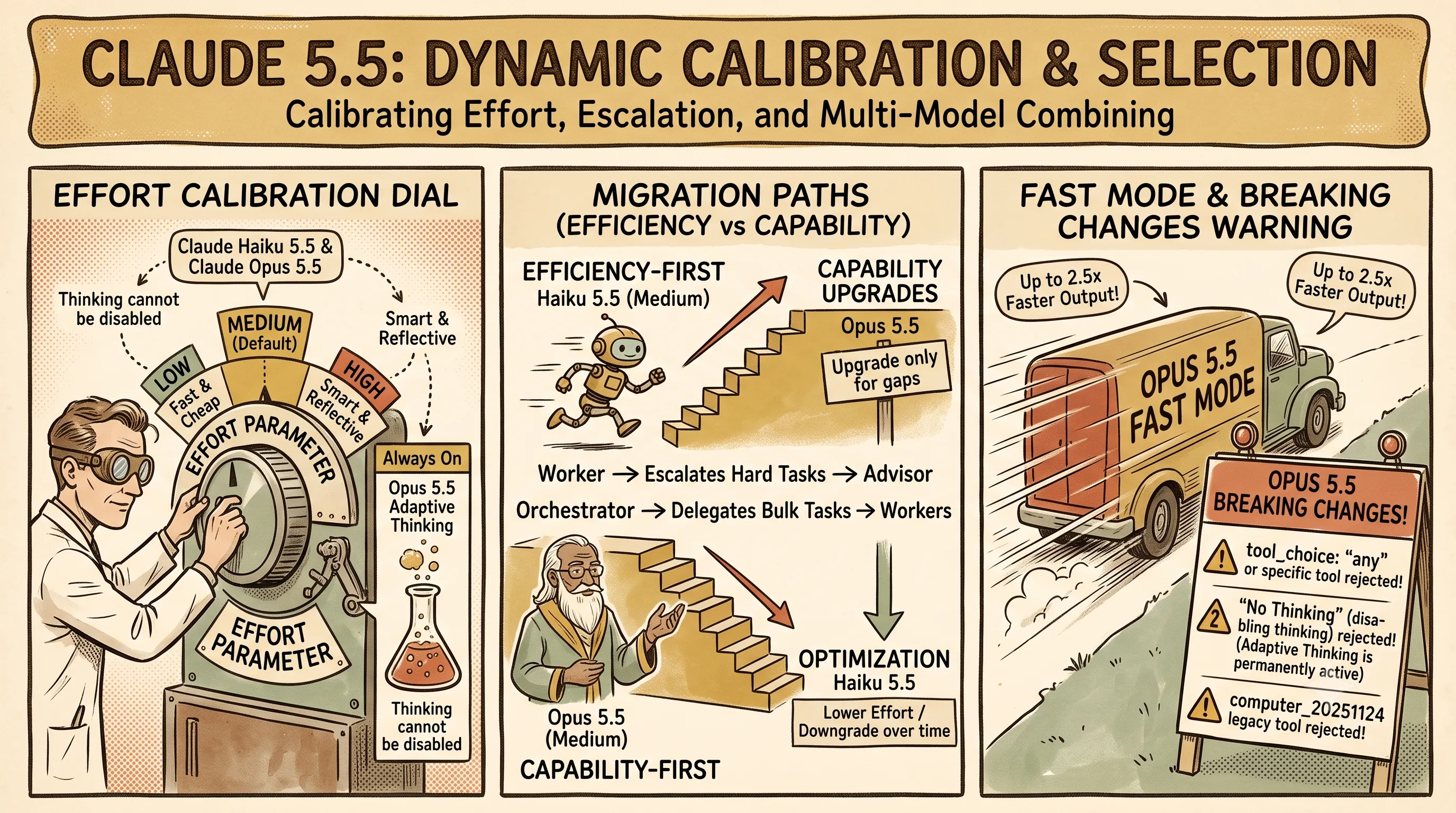
The effort parameter enables developers to systematically trade off intelligence against latency and operational cost within a single model.Anthropic documentation states that adjusting effort within a model is often a better lever than switching models entirely.
Both Claude Haiku 5.5 and Claude Opus 5.5 default to medium effort.
Modulating this setting allows an agent to balance reasoning depth with response speed depending on operational demands.
Furthermore, Claude Opus 5.5 runs with adaptive thinking always enabled, ensuring dynamic reasoning depth across complex orchestration duties.
Efficiency-First vs Capability-First Migration Patterns
System architects design multi-agent workflows around two complementary adoption frameworks: the efficiency-first paradigm and the capability-first paradigm.The efficiency-first selection approach starts with Claude Haiku 5.5 and upgrades to higher-tier models only if specific capability gaps occur during execution.
Conversely, the capability-first approach starts with Claude Opus 5.5 to ensure maximum reasoning quality, progressively lowering effort settings or downgrading tasks to Claude Haiku 5.5 over time as workflows optimize.
These pathways directly inform multi-model combining patterns, which include worker executors escalating hard edge cases to advisor models, as well as lead orchestrators delegating bulk parallel tasks to worker agents.
| Selection Paradigm | Initial Baseline Model | Optimization Path | Multi-Model Interaction Pattern |
|---|---|---|---|
| Efficiency-First | Claude Haiku 5.5 (Medium effort default) | Upgrades to higher capability only when specific capability gaps occur | Executors escalating unresolved tasks to advisors |
| Capability-First | Claude Opus 5.5 (Medium effort default) | Lowers effort within the model or downgrades tasks to Haiku as workflows optimize | Orchestrators delegating bulk execution tasks to workers |
Fast Mode Benefits and Opus 5.5 Operational Constraints
High-throughput multi-agent execution pipelines can leverage fast mode on Claude Opus, which supports up to 2.5 times faster output speed.However, orchestration systems must account for strict operational constraints and compatibility requirements introduced in Claude Opus 5.5.
Enforcing tool use with 'any' or specific tool choices introduces breaking changes on Opus 5.5.
Disabling thinking also introduces breaking changes on Opus 5.5, because adaptive thinking remains permanently active on the model.
Additionally, attempting to call legacy computer tools such as computer_20251124 introduces breaking changes on Opus 5.5, requiring orchestrators to adapt their tooling interfaces to supported configurations.
4. Enterprise Bedrock Deployment: Infrastructure Setup and Runtime Integration
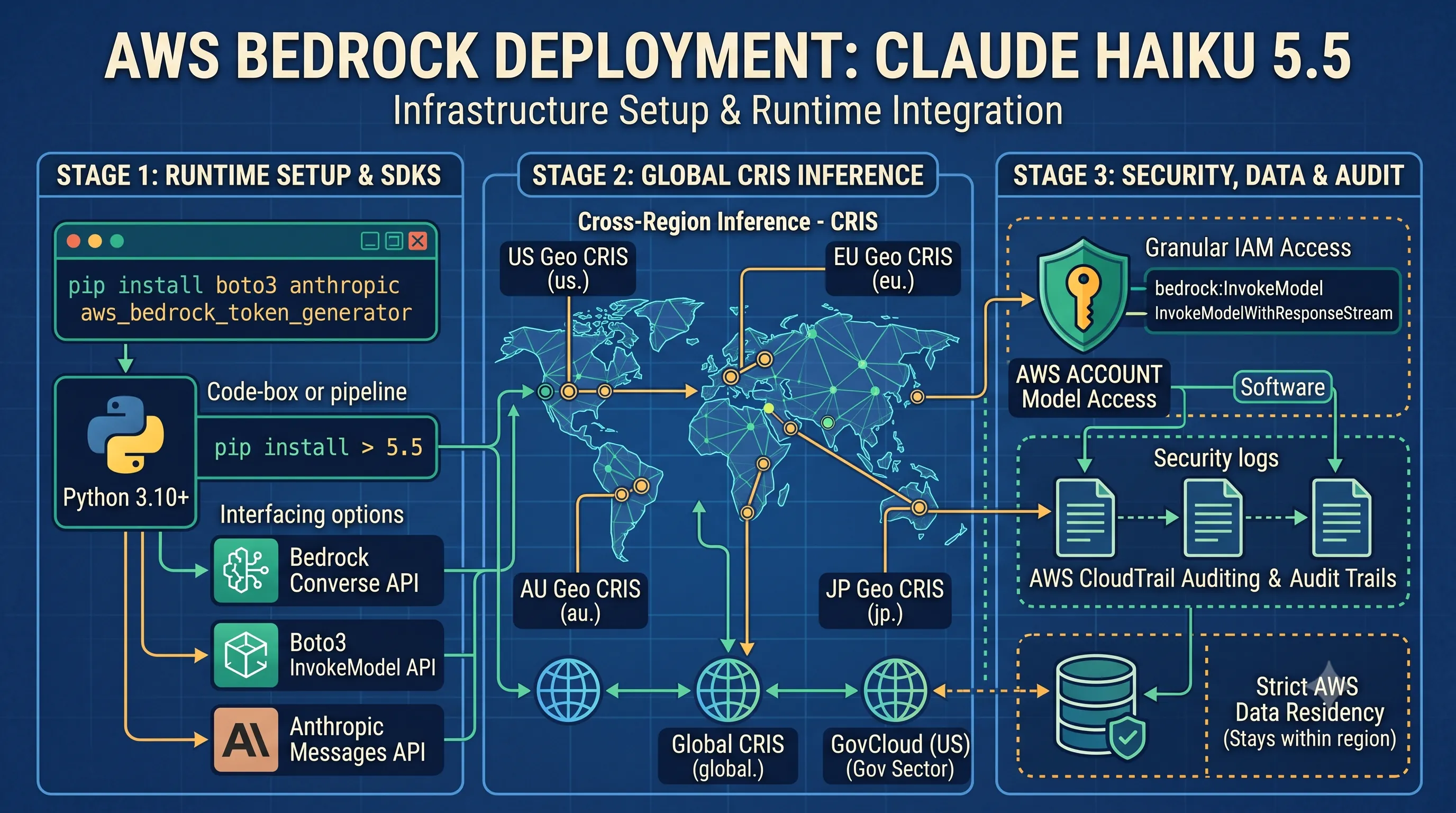
To realize a multi-agent orchestration architecture where Claude Opus handles strategic planning and Claude Haiku 5.5 executes high-throughput sub-tasks, establishing a robust runtime foundation on Amazon Bedrock is essential.This section outlines the infrastructure prerequisites, regional inference configurations, and enterprise operational governance required to deploy Claude Haiku 5.5 across production environments.
Environment Prerequisites and Library Installation
Deploying Claude Haiku 5.5 runtime environments requires Python 3.10+ as the core runtime runtime version.To execute multi-agent calls against Amazon Bedrock, developers must install the requisite Python client libraries and authentication helper utilities.
Install prerequisite Python client libraries and authentication generator for running Claude Haiku 5.5 on Amazon Bedrock:
pip install boto3
pip install anthropic
pip install aws_bedrock_token_generatorOnce installed, Claude Haiku 5.5 supports model invocation across three supported programmatic interfaces: the Amazon Bedrock Converse API, the standard Boto3 InvokeModel API, and the Anthropic Messages API accessed via the anthropic SDK.
Geographic CRIS Inference Profiles and Endpoint Configuration
Claude Haiku 5.5 is accessible across global regions utilizing Cross-Region Inference (CRIS) profiles designed to optimize throughput and availability.Workloads can route requests through localized regional profiles or dynamically balance traffic across global infrastructure.
| Inference Profile / Platform Endpoint | Prefix / Routing Scope | Deployment Context |
|---|---|---|
| US Geo CRIS | us. |
Routes inference dynamically within AWS United States regions. |
| EU Geo CRIS | eu. |
Confines routing and execution across AWS European regions. |
| AU Geo CRIS | au. |
Routes traffic across Australian AWS regional infrastructure. |
| JP Geo CRIS | jp. |
Routes inference within Japanese AWS regional infrastructure. |
| Global CRIS | global. |
Distributes requests globally across Bedrock infrastructure endpoints. |
| AWS GovCloud (US) | bedrock-runtime / bedrock-mantle |
Dedicated endpoints for regulated public sector and government workloads. |
| Claude Platform on AWS | North America availability | Managed Anthropic platform access running directly on AWS. |
bedrock-runtime and bedrock-mantle endpoints.Additionally, enterprise teams operating in North America can access the model via the Claude Platform on AWS.
IAM Access Control, Data Residency, and Telemetry Integration
Operating Claude Haiku 5.5 in enterprise multi-agent workflows requires an active AWS account configured with Amazon Bedrock model access.Security principals executing agentic tasks must be granted granular AWS Identity and Access Management (IAM) permissions, specifically requiring bedrock:InvokeModel for standard synchronous execution and bedrock:InvokeModelWithResponseStream for streaming agent responses.
Enterprise governance and compliance requirements are enforced through native AWS service integrations:
First, strict data residency is maintained within the underlying AWS Regional infrastructure during all inference and agent processing activities.
Second, security monitoring and compliance verification integrate directly with AWS CloudTrail to capture audit trails of all API transactions.
Related Posts
Generative AI may have assisted with research or drafting for this article. Topic selection, fact-checking, final wording, and publication remain the responsibility of DragonStone74. AI use disclosure