
Inside tsrs: The AI-Generated Rust Port Transforming TypeScript
🚀 Key Takeaways
- AI-Driven Systems Port: Built by directing frontier AI models with zero manual code authorship, tsrs relies entirely on TypeScript’s comprehensive test suite as its formal behavioral specification.
- Ecosystem Alignment: Incubated within the Oxc JavaScript toolchain alongside Cloudflare, VoidZero, and Owner.com, the project operates in direct alignment with the official TypeScript team rather than acting as a competing fork.
- Order-of-Magnitude Performance: Migrating to Rust’s concurrent, arena-allocated memory model unlocks dramatic throughput accelerations and slashes peak memory consumption across large enterprise codebases.
- Edge-Ready WebAssembly: Compiling directly to WASI without an embedded runtime garbage collector enables sandboxed execution across Cloudflare Workers, browser playgrounds, and agentic workflows.
- Two-Way Upstream Innovation: In achieving near-complete baseline test parity, architectural optimizations discovered during tsrs development are actively upstreamed back into the core TypeScript compiler.
Type checking has long remained one of the most stubborn computational bottlenecks across large-scale web engineering.
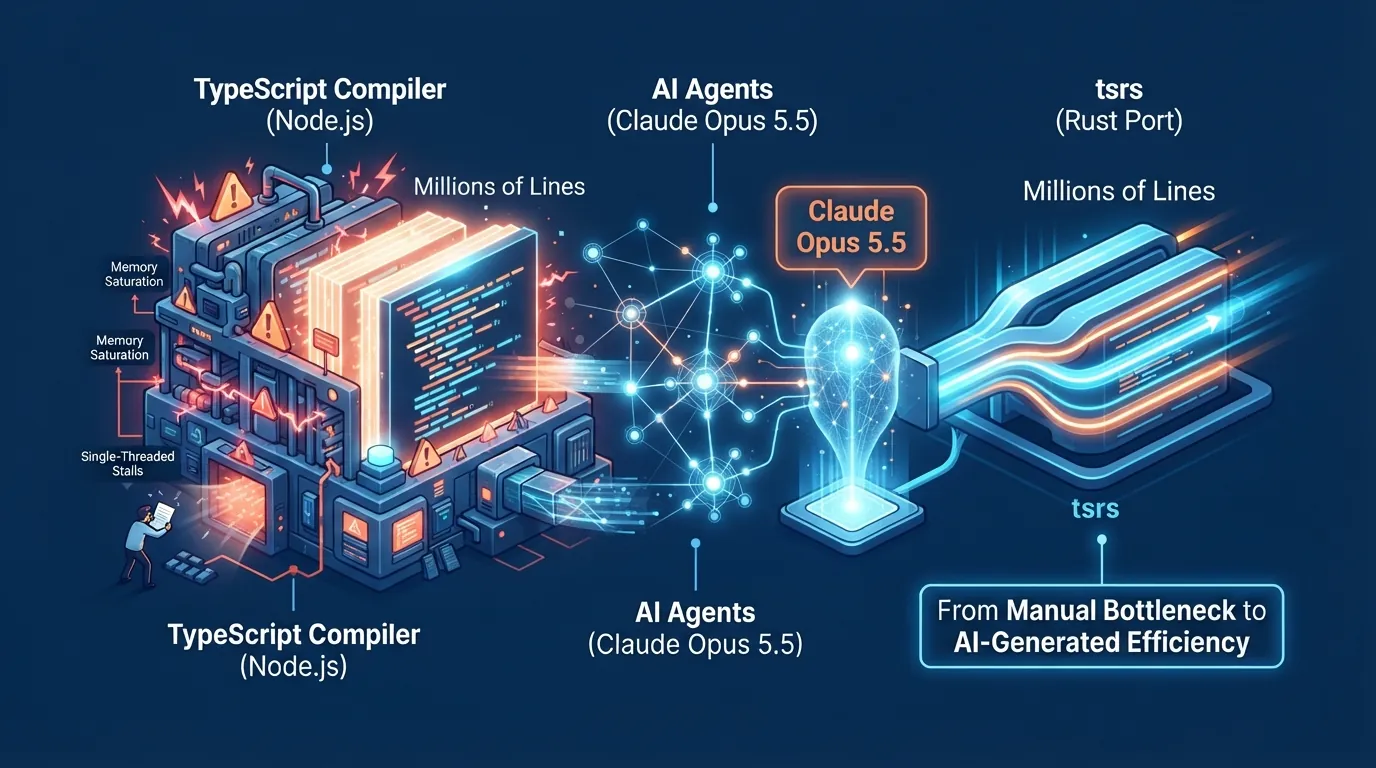
As massive codebases routinely expand into millions of lines, the traditional Node.js-based compiler architecture encounters significant hurdles with memory saturation and single-threaded execution stalls.
The arrival of tsrs, an experimental native Rust port of the TypeScript compiler incubated within the Oxc ecosystem, represents a pivotal milestone in overcoming these historical scaling barriers.
What distinguishes tsrs from conventional re-engineering initiatives is how it came to life.
Rather than dedicating years of manual engineering to rewrite intricate semantic analysis algorithms, the port was produced through AI agents led by Claude Opus 5.5.
By treating thousands of official conformance tests as an inviolable specification, this initiative demonstrates that agentic AI can faithfully translate notoriously complex language runtimes into high-performance systems software.
As development environments increasingly converge with real-time edge runtimes, WebAssembly sandboxes, and autonomous coding agents, the demand for instantaneous, low-footprint type diagnostics has never been greater.
Exploring the mechanics of tsrs reveals not only a faster tool for everyday development, but a blueprint for how AI-assisted compiler engineering is reshaping modern infrastructure.
1. AI-Directed Architecture: How Claude Opus 5.5 and Conformance Suites Built tsrs
To understand how tsrs converts TypeScript to Rust using AI, it is essential to examine the engineering workflows and architectural decisions that made an automated native port possible.Rather than relying on human engineers to manually re-implement the vast surface area of the TypeScript compiler, the project redefined native compilation through autonomous multi-agent systems and test-driven synthesis.
Agentic Porting Directed by Claude Opus 5.5 and 15,197 Conformance Cases
The foundational mechanics of tsrs diverge fundamentally from conventional software porting initiatives.Max Schwenk authored zero manual code throughout the process, stating explicitly that he wrote "zero" code while directing autonomous AI agents led by Claude Opus 5.5.
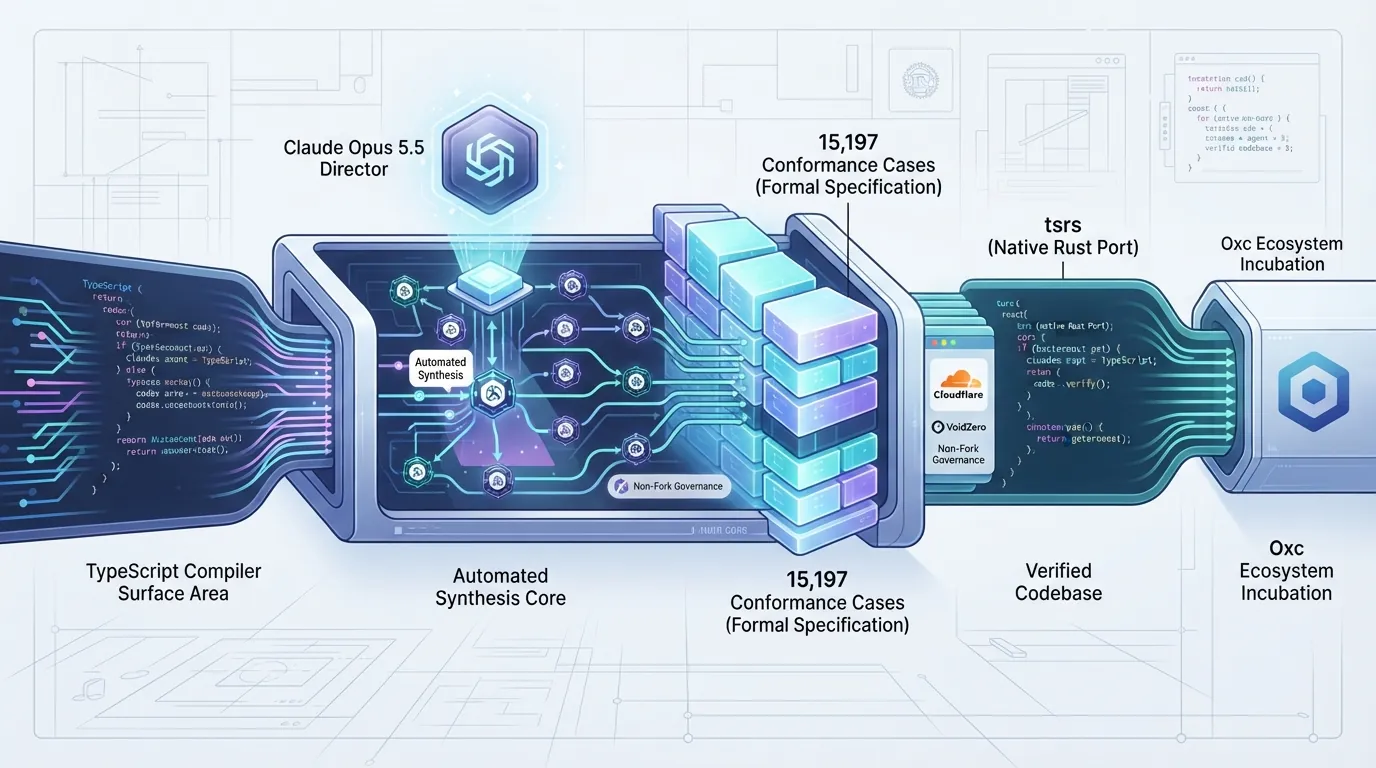
To establish rigorous ground truth without introducing synthetic or inaccurate behaviors, Max Schwenk used TypeScript's own 15,197 conformance cases as the formal specification for the port.
By deploying these 15,197 official test suites as the sole acceptance criteria, the AI agents systematically generated, verified, and tuned the Rust codebase to deliver a faithful port directly aligned with the upstream compiler.
| Project Parameter | Implementation Detail |
|---|---|
| Core AI Driver | AI agents led by Claude Opus 5.5 |
| Manual Code Written | Zero manual lines of code (directed by Max Schwenk) |
| Formal Specification | TypeScript's 15,197 official conformance test cases |
| Toolchain Ecosystem | Incubated at oxc-project/tsrs inside the Oxc JavaScript compiler toolchain |
| Open Source Licensing | Apache-2.0 license |
| Downstream Unification | Collaboration with Theo Browne to unify tsrs with tsc-rs, adding LSP and content mapper support |
Oxc Incubation, Multi-Party Collaboration, and Non-Fork Governance
The tsrs codebase is an experimental Rust port of the TypeScript compiler incubated directly inside the Oxc JavaScript compiler toolchain at oxc-project/tsrs.The initiative operates as a multi-party collaboration between Cloudflare, VoidZero, and Max Schwenk of Owner.com, working in close collaboration with the official TypeScript team.
Governance is defined by an open, non-adversarial posture toward upstream stewards, with the software distributed as open source under the Apache-2.0 license.
Cloudflare formally established its anti-fork commitment, stating: "To be clear, we are not forking TypeScript.
We believe the TypeScript team should remain in full control of the language’s design and direction."
Expanding beyond the compiler core, Cloudflare is collaborating with Theo Browne to merge tsc-rs and tsrs into a single unified package with Language Server Protocol (LSP) and content mapper support.
2. Performance Benchmarks and Memory Footprint Across Production Monoliths
Evaluating the real-world utility of automated migration tools requires looking past syntax translation into execution metrics.In the broader workflow of how tsrs converts TypeScript to Rust using AI, validating the generated Rust port against massive production codebases confirms whether machine-generated systems code actually delivers the performance benefits promised by native compilation.
By pitting the Rust-based compiler against canonical releases such as TypeScript 7.0 and TypeScript 7.1, engineering teams have captured empirical data regarding execution speed, worker scaling, and heap behavior under real production constraints.
Benchmark Results Across Monoliths and Multi-Checker Configurations
Cloudflare claimed that tsrs runs up to 8x faster at type checking than TypeScript 7.0 when configured with the same number of checker workers.To ensure experimental rigor, Cloudflare and the TypeScript team aligned configurations to ensure benchmark fairness against TypeScript default settings.
Standard benchmark charts across four public test repositories running 4 checkers demonstrated that tsrs executed 3.83x to 8.10x faster while consuming only 0.13x to 0.31x of peak memory compared to TypeScript 7.0.2.
Specific codebases underscore these operational discrepancies.
On the documentation codebase for MUI docs, tsrs completed type checking in 1.29 seconds while drawing 1.03 GiB of memory, whereas TypeScript 7.0.2 required 10.44 seconds and consumed 7.70 GiB.
The disparity became more evident when deployed across production-scale codebases.
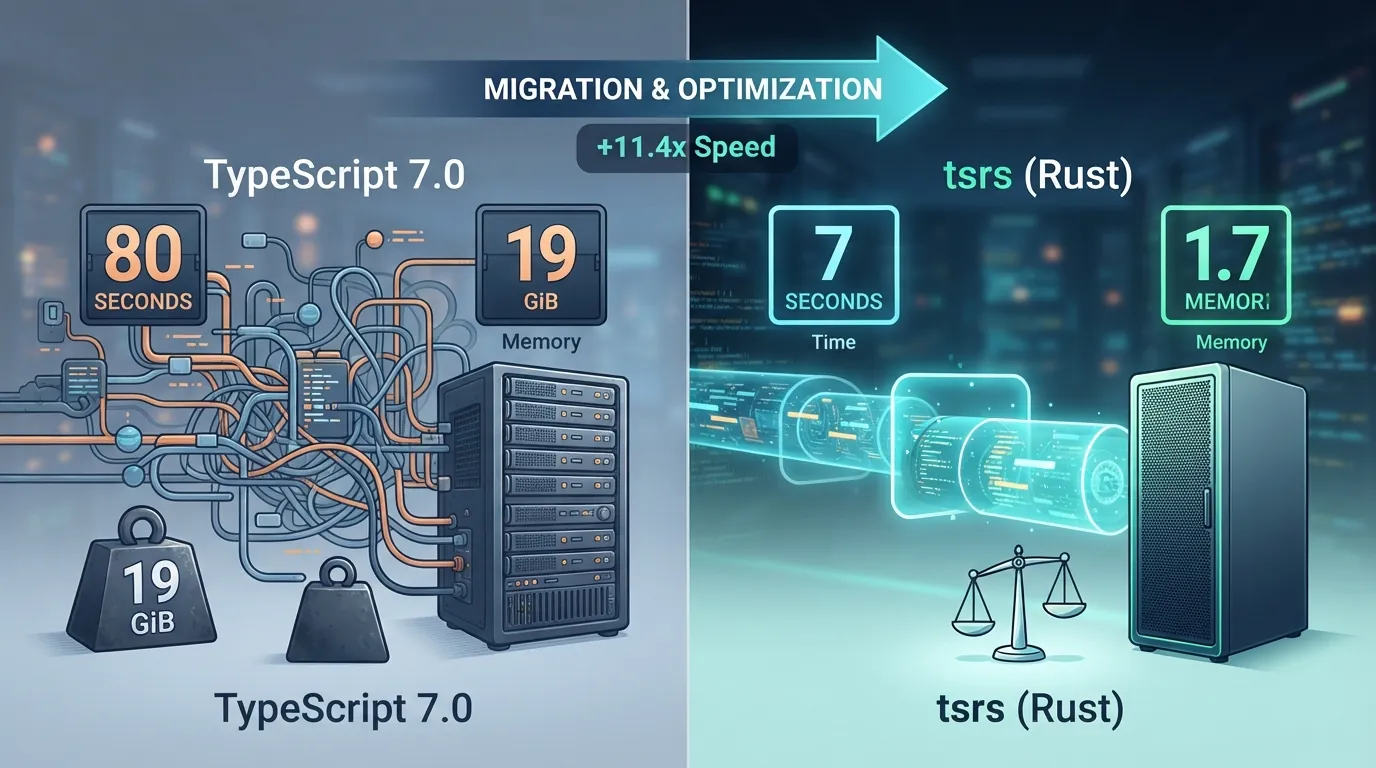
On Owner.com's 37,000-file monolith, type checking time dropped from 80 seconds and 19 GiB on TypeScript 7.0 down to 7 seconds on tsrs.
Validating these results in production contexts, Peter Steinberger posted on X: "Moved to tsrs over the weekend. Drop-in replacement. Around 5x faster for OC."
Independent developer benchmarks further corroborated these metrics, recording 5.3x faster checking alongside 72% less memory while producing byte-identical emit.
Scaling worker threads expands these throughput deltas.
Under a maximum resources benchmark provisioning 14 checkers, tsrs measured 4.51x to 8.65x faster than TypeScript 7.0.2.
However, fast mode and maximum resources configurations utilize more memory to achieve this peak execution speed.
| Benchmark Environment / Target | TypeScript Execution Time & Memory | tsrs Execution Time & Memory | Observed Speedup / Delta |
|---|---|---|---|
| MUI docs (4 Checkers vs TS 7.0.2) | 10.44 seconds / 7.70 GiB | 1.29 seconds / 1.03 GiB | ~8.09x faster / 0.13x peak memory |
| Owner.com Monolith (37,000 files vs TS 7.0) | 80 seconds / 19 GiB | 7 seconds | ~11.4x faster reduction in checking time |
| Four Public Projects Suite (4 Checkers vs TS 7.0.2) | Baseline execution and baseline heap | 3.83x to 8.10x faster | Consumes 0.13x to 0.31x of peak memory |
| Maximum Resources Configuration (14 Checkers vs TS 7.0.2) | Baseline multi-worker throughput | Peak allocation settings | 4.51x to 8.65x faster execution |
| Independent Developer Validation | Baseline checking time and memory | Byte-identical emit output | 5.3x faster / 72% less memory |
| ImportStatic Benchmark (vs TS 7.1 beta) | TypeScript 7.1 beta baseline | Native Rust execution | 2.7x speedup |
Memory Footprint Mechanics and Upstreaming Optimizations to TypeScript 7.1
Memory consumption remains a primary operational factor alongside pure wall-clock execution time.Across baseline configurations, Cloudflare claimed tsrs uses approximately 70% less memory compared to TypeScript 7.0 at the same worker count.
Much of this reduction stems from native Rust memory layouts, though architectural trade-offs have surfaced.
Some developers questioned whether the arena-based, never-freed memory model used in tsrs is sound for persistent processes.
Furthermore, the performance delta between native Rust execution and JavaScript runtimes shifted as algorithmic refinements were shared back with upstream maintainers.
Daniel Rosenwasser noted that much of the speed "does not just come down to language choice" and that optimizations from tsrs feed into TypeScript 7.1.
Optimizations uncovered during the development of tsrs were upstreamed back to Microsoft's TypeScript 7.1 codebase.
Consequently, when measuring against TypeScript 7.1 beta, ImportStatic found a 2.7x speedup rather than the 8x gain seen against TypeScript 7.0.
3. GC-Free WebAssembly: Sandboxed Toolchains for Cloudflare Workers and AI Agents
In the broader architecture of using AI to convert TypeScript codebases to Rust, the operational portability of the translation pipeline is essential.To allow the compiler to execute universally across modern infrastructure without native dependency burdens, tsrs distributes its core machinery directly to WebAssembly.
The @tsrs/wasm Architecture and wasm32-wasip1 Compilation
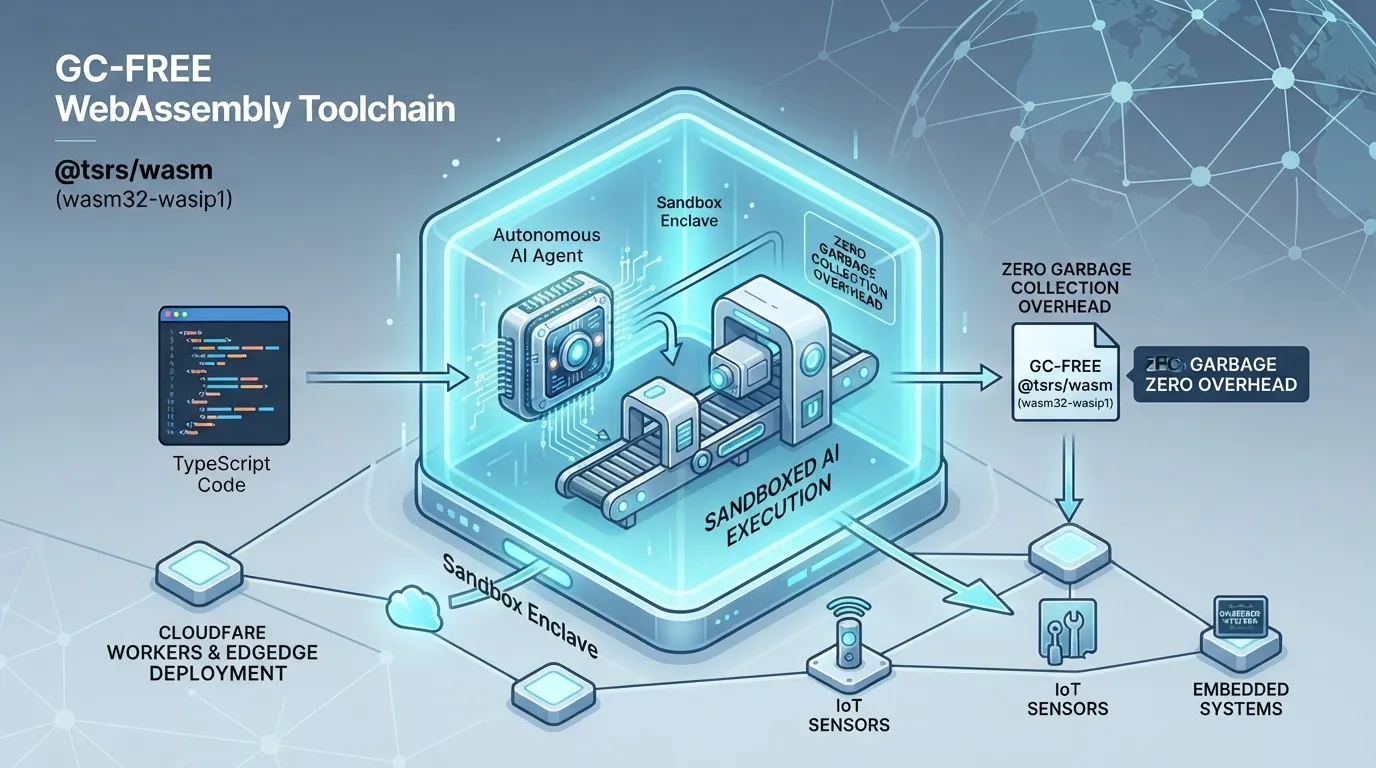
The toolchain ships the @tsrs/wasm package, which is compiled to WebAssembly targeting the wasm32-wasip1 (WASI Preview 1) specification.A significant architectural advantage of building this compiler layer in Rust lies in runtime characteristics.
Unlike Go binaries targeting WebAssembly, which embed an entire runtime and garbage collector into the resulting bundle, Rust compiles directly to WebAssembly without bundling an embedded garbage collector.
This avoids the payload inflation and unpredictable background sweeps inherent to garbage-collected binaries compiled for WebAssembly runtimes.
Eliminating GC Overhead for Edge Workers and Agentic Sandboxes
By completely eliminating garbage collection overhead, the compiled artifact achieves high memory efficiency and predictable execution across strict operating envelopes.This design enables execution within resource-constrained environments, including Cloudflare Workers, client browsers, IoT devices, and embedded systems.
Furthermore, Rust-based WebAssembly compilation enables complete development toolchains to run directly inside sandboxed environments alongside autonomous AI agents.
Autonomous AI agents driving TypeScript-to-Rust migration workflows can inspect, parse, and execute compilation steps locally inside an isolated sandbox, ensuring memory safety and isolation without host platform configuration.
4. Inside the Fast Mode Engine: Adaptive Checkers, Locality Scheduling, and Lazy Evaluation
In the end-to-end pipeline of how tsrs converts TypeScript to Rust using AI, rapid type inference and semantic validation form the foundation for accurate downstream code generation.Before synthesis models can map dynamic TypeScript semantics into strictly typed Rust constructs, the underlying static analysis engine must parse, bind, and verify the source codebase without incurring prohibitive execution overhead.
To address large-scale performance bottlenecks, version 0.20.0 of tsrs introduced an optimized execution architecture known as fast mode.
To activate this optimization preset during compilation or pipeline analysis, developers configure either the command-line interface or the execution environment.
Enabling the fast optimization preset in tsrs via CLI or environment variable ensures high-throughput type checking across multiple cores.
--fast
TSRS_FAST=1Adaptive Checker Bounding and Locality Work-Stealing Scheduling
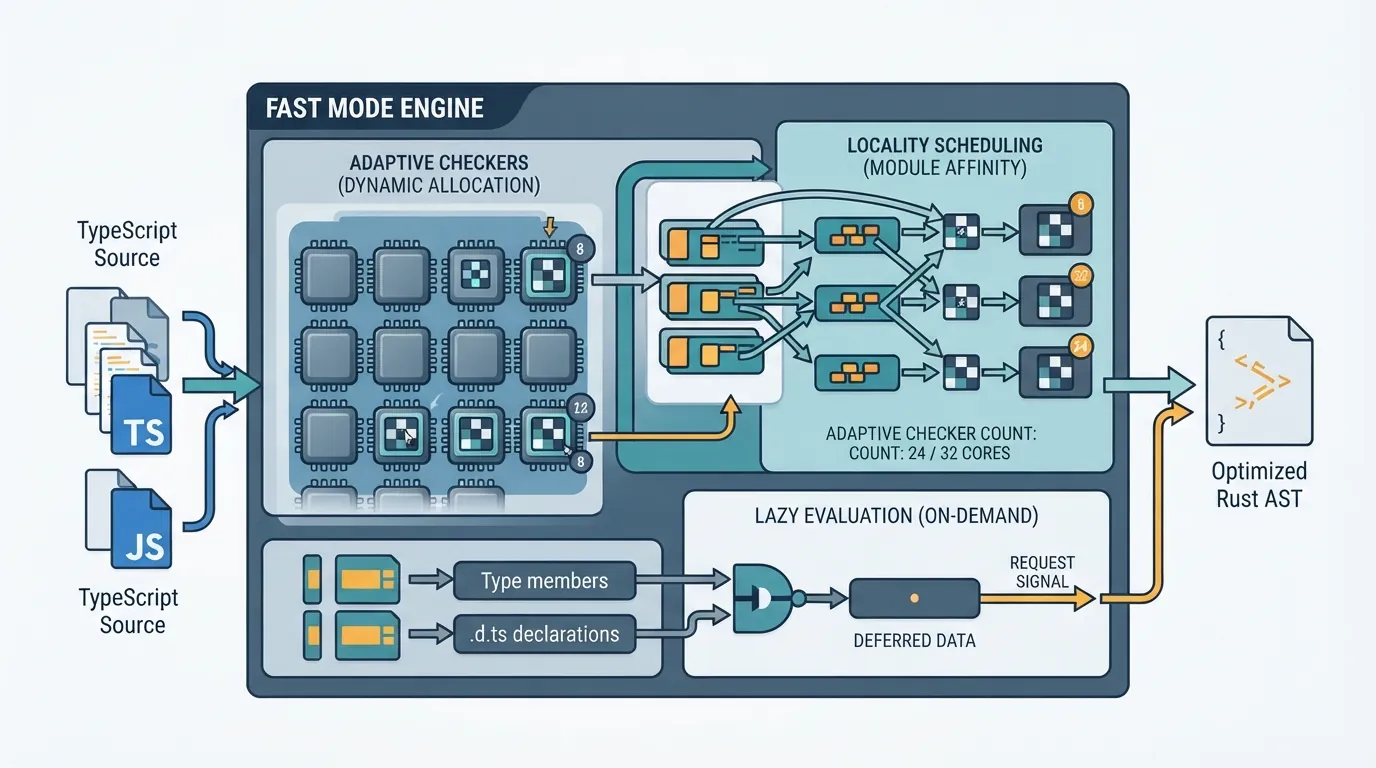
Fast mode fundamentally alters how tsrs allocates system resources across worker threads.Rather than relying on static thread pools, the engine calculates adaptive checker counts dynamically according to hardware availability.
Adaptive checker counts assign one checker per core up to 16 cores, and above 16 cores assign the greater of 16 and half the total cores rounded down.
Total checker counts are bounded between 4 and 32 before applying file-count limits.
When processing smaller codebases, small programs reduce checker counts toward 4 to maintain at least 32 checked files per checker, preventing thread management overhead from overshadowing actual validation throughput.
Work distribution is handled by a specialized locality scheduler designed to minimize cross-thread synchronization and cache misses.
Locality scheduling groups nearby files on the same checker, prioritizes heavy files, and allows idle checkers to steal unstarted work.
When massive type libraries are encountered, heavy declaration files (.d.ts) can be split and checked concurrently across multiple checkers.
To maintain efficiency on large systems, module affinity activates at 16 checkers, or at 8 checkers for codebases with at least 24,000 checked files.
| Scheduling Mechanism | Operational Rule / Metric | Constraint / Activation Threshold |
|---|---|---|
| Core Allocation (Under 16 Cores) | One checker assigned per available core | Bounded between 4 and 16 checkers |
| Core Allocation (Over 16 Cores) | Greater of 16 and half total cores rounded down | Hard upper bound of 32 checkers |
| Small Codebase File Threshold | Scales checkers downward toward 4 | Minimum ratio of 32 checked files per checker |
| Module Affinity (Standard) | Binds related modules to specific checkers | Activates when pool reaches 16 checkers |
| Module Affinity (Large Codebase) | Early activation of module grouping | Activates at 8 checkers for 24,000+ checked files |
Lazy Member Evaluation and Memory Management Trade-Offs
Alongside concurrency restructuring, fast mode employs aggressive on-demand evaluation strategies to minimize unnecessary type allocations.Fast mode incorporates lazy type members, instantiating classes, interfaces, mapped types, and tuple members strictly on demand.
Complementing member-level laziness, lazy declaration parsing defers parsing member lists in .d.ts files when skipLibCheck or noCheck is active.
These mechanisms bypass deep structural analysis for types that are declared but never referenced by downstream translation components.
Memory reclamation is similarly optimized during targeted validation passes.
Finished leaf files have syntax trees and binder data released during non-incremental, non-watch --noEmit compilation.
This aggressive deallocation lifecycle comes with specific environment requirements: leaf-file memory freeing requires Unix with compressed pointers and a checker upper bound of at most 16.
Operating under fast mode introduces clear engineering trade-offs that teams must weigh.
Fast mode changes scheduling and checker history, which can alter diagnostic order, error messages, or exit statuses in recursive or order-dependent types.
Furthermore, compilation pipelines that rely heavily on incremental state cannot freely toggle modes without a performance penalty.
Switching between default and fast modes invalidates incremental and build caches, requiring fresh type checks across the entire project.
5. Conformance Verification, Compatibility Gaps, and CI Migration Workflows
Validating semantic conformance and operational behavior is fundamental to understanding how tsrs converts TypeScript to Rust using AI, as automated code generation must preserve compiler fidelity across complex language constructs.Evaluating official test baselines, configuration compatibility, and pipeline differences reveals both the viability and the current boundaries of running tsrs as a drop-in verification engine.
Test Suite Baselines and TypeScript 7 Compatibility Status
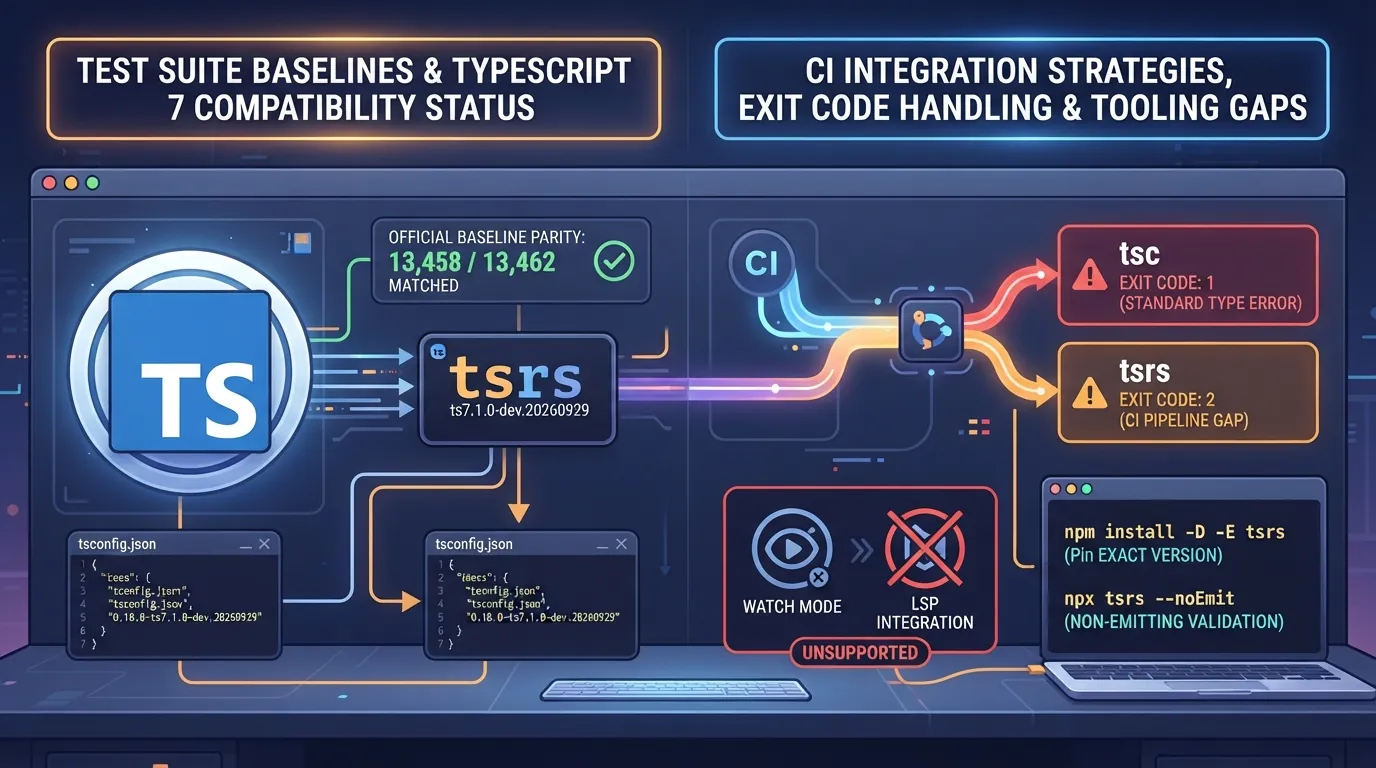
The semantic precision of tsrs has been verified against the official TypeScript compiler test harness.In official test evaluations, tsrs matched 13,458 out of 13,462 error baselines, with the remaining 4 discrepancies attributed to test-harness artifacts rather than internal type-checking flaws.
The prerelease version evaluated under these benchmarks was 0.18.0-ts7.1.0-dev.20260929.
Architecturally, tsrs targets TypeScript 7 compatibility and is designed to consume existing
tsconfig.json configuration files directly without alteration.Developers who want to inspect type checking and code emission without modifying local environments can test behavior using a browser playground.
However, subtle operational differences remain in daily usage.
Diagnostic messages emitted by tsrs may appear in a different order compared to standard tsc output due to differences in internal AST traversal and processing.
Additionally, external pull requests on the repository remain closed due to review bandwidth limitations, though the GitHub issue tracker remains open for reporting community bugs and edge cases.
CI Integration Strategies, Exit Code Handling, and Current Tooling Gaps
Introducing tsrs into existing continuous integration pipelines requires accounting for specific developer tooling gaps and exit code handling differences.To begin testing the experimental binary in an existing project without triggering unintentional dependency updates, engineering teams must pin the package version exactly.
npm install -D -E tsrspackage.json, preventing unintended prerelease upgrades during regular package manager routines.Once installed, teams can evaluate codebase compatibility by executing non-emitting verification passes side-by-side with tsc.
npx tsrs --noEmitWhen scripting CI stages, pipeline maintainers must account for process termination differences.
While canonical tsc exits with status code 1 when type errors occur, tsrs exits with status code 2 on type errors.
This exit code mismatch can disrupt existing CI automation, shell scripts, or status-monitoring hooks that explicitly listen for code 1 to identify type-checking failures.
Furthermore, initial experimental builds of tsrs do not support watch mode or Language Server Protocol (LSP) integration, restricting its current utility in interactive editor environments.
The CLI options
--init and --showConfig are also unsupported.| Feature / Metric | Canonical TypeScript (tsc) | tsrs (0.18.0-ts7.1.0-dev.20260929) |
|---|---|---|
| Official Test Baseline Parity | Baseline standard (13,462 baselines) | 13,458 of 13,462 matched (4 harness artifacts) |
| Exit Code on Type Error | Status code 1 | Status code 2 |
| Configuration File Handling | Standard tsconfig | Reuses existing tsconfig files without alteration |
| Target Version Compatibility | Standard release track | Targets TypeScript 7 compatibility |
| Watch Mode Support | Supported natively | Currently unsupported |
| LSP Integration | Supported natively (tsserver) | Missing in initial experimental releases |
| CLI Flags (--init, --showConfig) | Supported | Currently unsupported |
Related Posts

Building a Dual-Tier Multi-Agent Orchestration Architecture with Claude Opus 5.5 and Claude Haiku 5.5 on Amazon BedrockExplore how to build an enterprise multi-agent architecture pairing Claude Opus 5.5 planning with...

September 2026 Frontier Coding Models: A Technical Guide to Claude 5.5 and Agentic ArchitectureAn analysis of September 2026 AI model releases including Claude Opus 5.5 and Fable 5.1, detailing...
Inside Topcoat: The New Full-Stack Rust Web Framework Without WASMDiscover Topcoat, a new full-stack Rust web framework by Tokio creators that brings server-rendered...
Generative AI may have assisted with research or drafting for this article. Topic selection, fact-checking, final wording, and publication remain the responsibility of DragonStone74. AI use disclosure