
Inside Helsing's Clarity: The European AI Rival to Palantir Maven
🚀 Key Takeaways
- Sovereign Defense Intelligence: Helsing has unveiled Clarity, an AI-native operational software platform engineered specifically for European defense autonomy and deployed entirely on customer-owned infrastructure.
- Parallel Agentic Analysis: The platform leverages hundreds of specialized AI agents working concurrently to synthesize multi-sensor streams into an actionable operational picture within seconds.
- Enforced Human Oversight: Doctrinal verification gates require consensus across independent intelligence sources and mandate explicit human authorization before any effector engagement can proceed.
- Vendor-Agnostic Munition Pairing: Aligned with NATO and modular open architecture standards, the system interfaces with legacy military hardware to tailor targeting parameters to specific weapon systems.
- Strategic Counterweight to Foreign Systems: Clarity establishes an indigenous European software capability designed to address critical data-processing bottlenecks without relying on non-European commercial defense platforms.
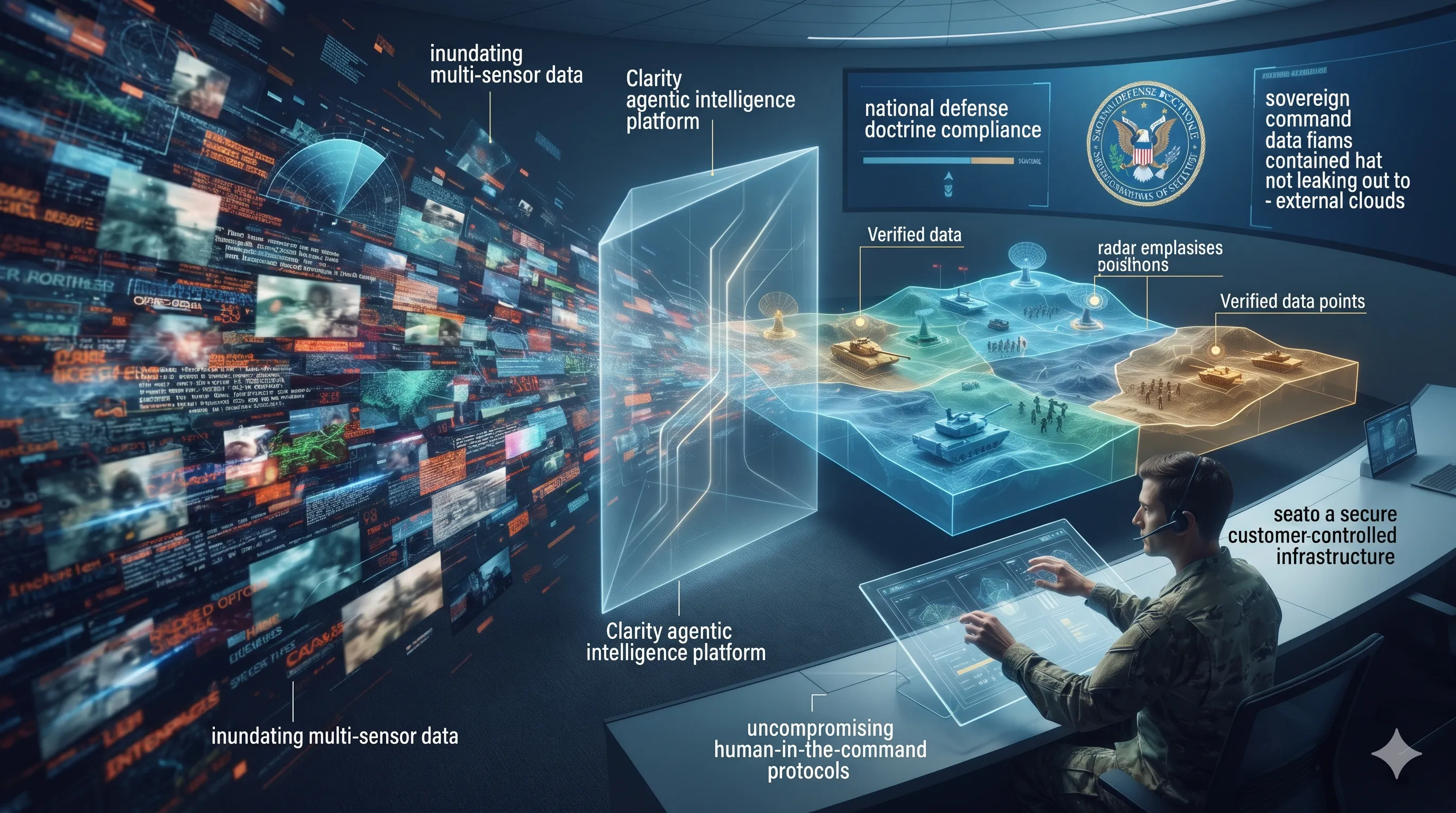
Modern battlefields generate an unprecedented volume of multi-sensor data, inundating analysts with radar tracks, electronic emissions, and visual reconnaissance feeds that outpace manual exploitation.
This data saturation has created an operational bottleneck, delaying threat identification and complicating command-and-control workflows when seconds matter most.
In response to this challenge, defense technology firm Helsing has unveiled Clarity, an agentic intelligence platform designed to autonomously parse fragmented battlefield signals into a coherent operational picture.
The debut comes amid heightened scrutiny over defense autonomy, data sovereignty, and foreign technology dependencies across allied armed forces.
While allied operations demand cutting-edge analytics, defense ministries increasingly require complete algorithmic traceability, proprietary cloud containment, and strict compliance with national defense doctrine.
Clarity directly confronts these geopolitical realities by anchoring its analytical models on customer-controlled infrastructure rather than remote third-party systems.
By coupling rapid multi-source cross-verification with uncompromising human-in-the-command protocols, the platform reflects a major shift in how military institutions approach artificial intelligence.
As international defense organizations balance accelerated modernization against doctrinal safety, customized agentic platforms like Clarity are defining the next era of sovereign command and intelligence analytics.
1. Helsing Unveils Clarity: Sovereign AI-Native Intelligence for European Defense
As modern defense ministries demand military-customized AI to enhance defense analytics, European defense technology company Helsing officially unveiled its intelligence platform, Clarity, in Berlin on November 11, 2026.The launch marks a significant inflection point in the company's trajectory since its founding in 2021.
Demonstrating rapid capital growth, Helsing raised $1.8 billion in Series E funding in July 2026, pushing the company's valuation to $18 billion.
Built specifically to provide sovereign capabilities, Clarity operates as an AI-native agentic intelligence software platform built in Europe under European control.
Resolving Multi-Sensor Operational Bottlenecks in Parallel
Clarity directly addresses the operational bottleneck of manually converting disparate multi-sensor feeds into actionable operational pictures.To bypass human processing delays across surveillance streams, the platform processes large volumes of data in parallel to detect military assets and positions in seconds.
Highlighting the underlying technical architecture, Rob Fink, Chief Technology Officer at Helsing, stated that Clarity combines multi-modal sensor understanding with strong data governance, traceability, provenance, and classified handling.
This multi-modal foundation enables defense analysts to track target information rapidly while preserving strict auditability and classified integrity.
Positioning Against Palantir Maven and Anduril Lattice
The rollout of Clarity positions Helsing as a direct European rival to established American defense software offerings, notably Palantir's Maven Smart System and Anduril's Lattice.Helsing differentiates its platform through strict adherence to sovereign hosting and infrastructure independence.
Gundbert Scherf, Co-CEO and Co-Founder of Helsing, emphasized this operational philosophy, stating that autonomous systems require connecting what is seen to what is struck, and that critical capabilities must be sovereign and built on customer infrastructure.
Despite the strategic emphasis on European operational sovereignty, German Bundeswehr adoption of Clarity has not been announced, making the platform's commercial unveiling distinct from German military procurement plans.

2. Multi-Agent System Architecture: Distributed Workflows and Dual-Source Training
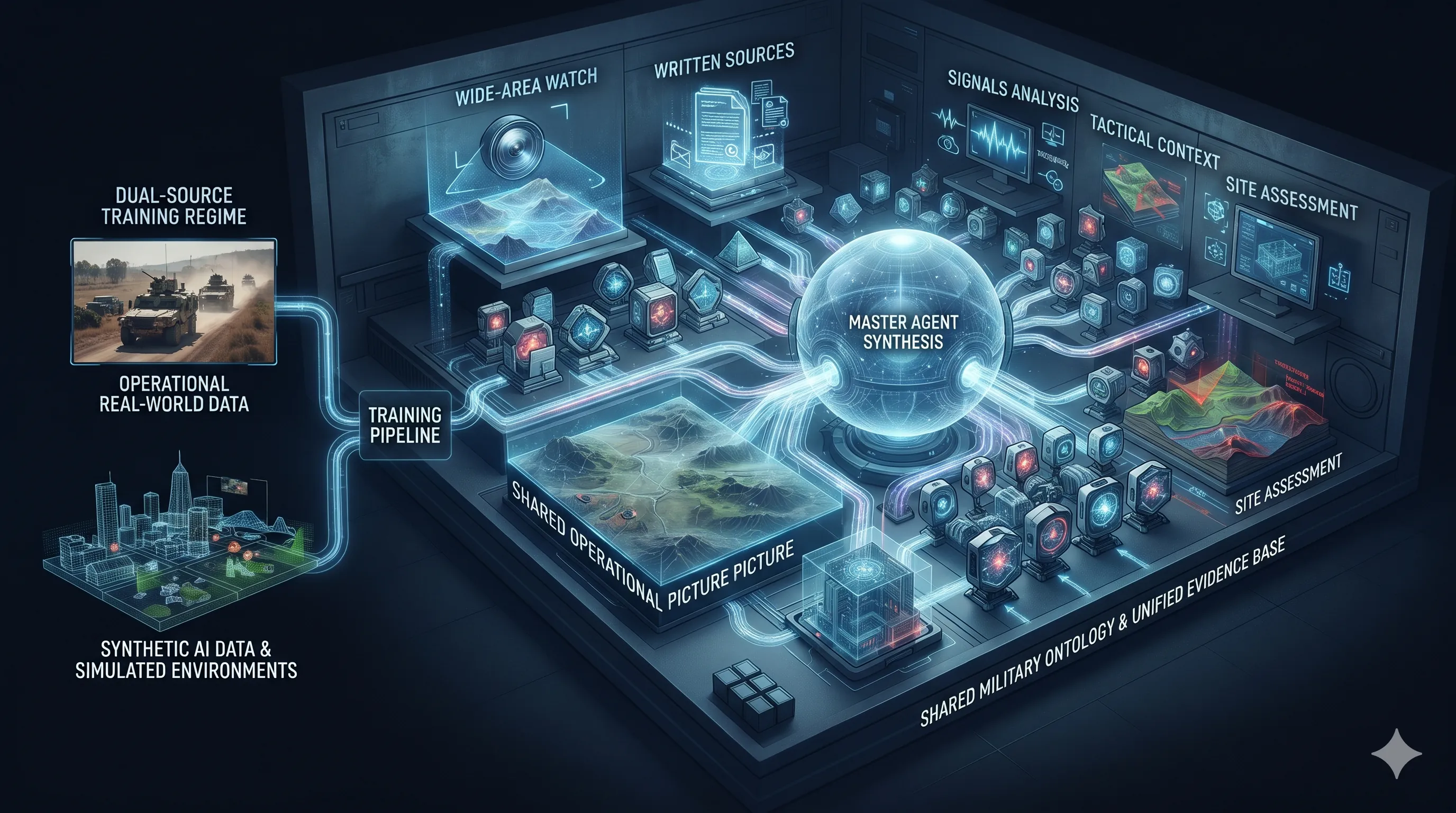
Clarity enhances defense analytics by abandoning monolithic processing in favor of a distributed multi-agent system architecture.At the foundation of this platform, hundreds of specialized AI agents run in parallel to ingest, monitor, and evaluate battlefield information simultaneously.
To maintain structural cohesion across these concurrent processes, every component within Clarity operates over a shared military ontology and unified evidence base, guaranteeing that all analytical deductions remain mutually intelligible and technically aligned.
Specialized Agent Pipelines and Master Agent Synthesis
Clarity organizes its parallel agent workforce across dedicated functional workflows designed for distinct intelligence disciplines.These dedicated workflows encompass wide-area watch, written sources, signals analysis, tactical context, and site assessment.
Operating independently within their specific functional domains, these agents continuously process incoming data streams and flag detected movements and critical changes.
Rather than leaving intelligence teams to manually deconflict isolated alerts, these independent agents feed all observations directly into a centralized master agent.
The master agent reconciles the inputs from all active pipelines, turning fragmented data into a cohesive, shared operational picture for defense decision-makers.
| Functional Workflow | Operational Focus | Integration Pathway |
|---|---|---|
| Wide-Area Watch | Continuous surveillance over extensive geographic zones | Flags detected movements and spatial changes to the master agent |
| Written Sources | Extraction and analysis of text-based intelligence and documentation | Grounds textual observations into the shared military ontology |
| Signals Analysis | Monitoring, decoding, and processing of technical signal transmissions | Supplies verified signal activity to the unified evidence base |
| Tactical Context | Evaluation of local battlefield dynamics, terrain, and operational parameters | Provides situational context to correlate fragmented event anomalies |
| Site Assessment | Detailed evaluation of specific physical locations, structures, and facilities | Feeds localized structural changes into the shared operational picture |
Synthetic Environments and Operational Data Training Regime
Building a multi-agent framework capable of high-reliability defense analytics requires a dual-source training pipeline.Clarity trains its underlying models by combining operational real-world military data with synthetic AI-generated data and simulated environments.
The integration of authentic operational military data ensures that agents adapt to real combat dynamics, sensor noise, and authentic defense variables.
Simultaneously, pairing real-world inputs with synthetic generation and simulated environments allows the system to expose its specialized agents to diverse scenarios and dense tactical variations that may be rare in peacetime operations.
This combined regime equips both domain-specific agents and the master agent with the necessary baseline models to accurately distill multi-source intelligence into an actionable operational picture.
3. Targeting Governance: Embedding Human-in-the-Command and Verification Gates
Clarity uses military-customized AI to enhance defense analytics by enforcing strict command-and-control governance rather than allowing unconstrained automation.By integrating operational boundaries directly into its core processing architecture, the platform ensures that machine intelligence remains strictly subservient to human command throughout the targeting lifecycle.
Consensus-Driven Target Nominations Across Independent Sensors
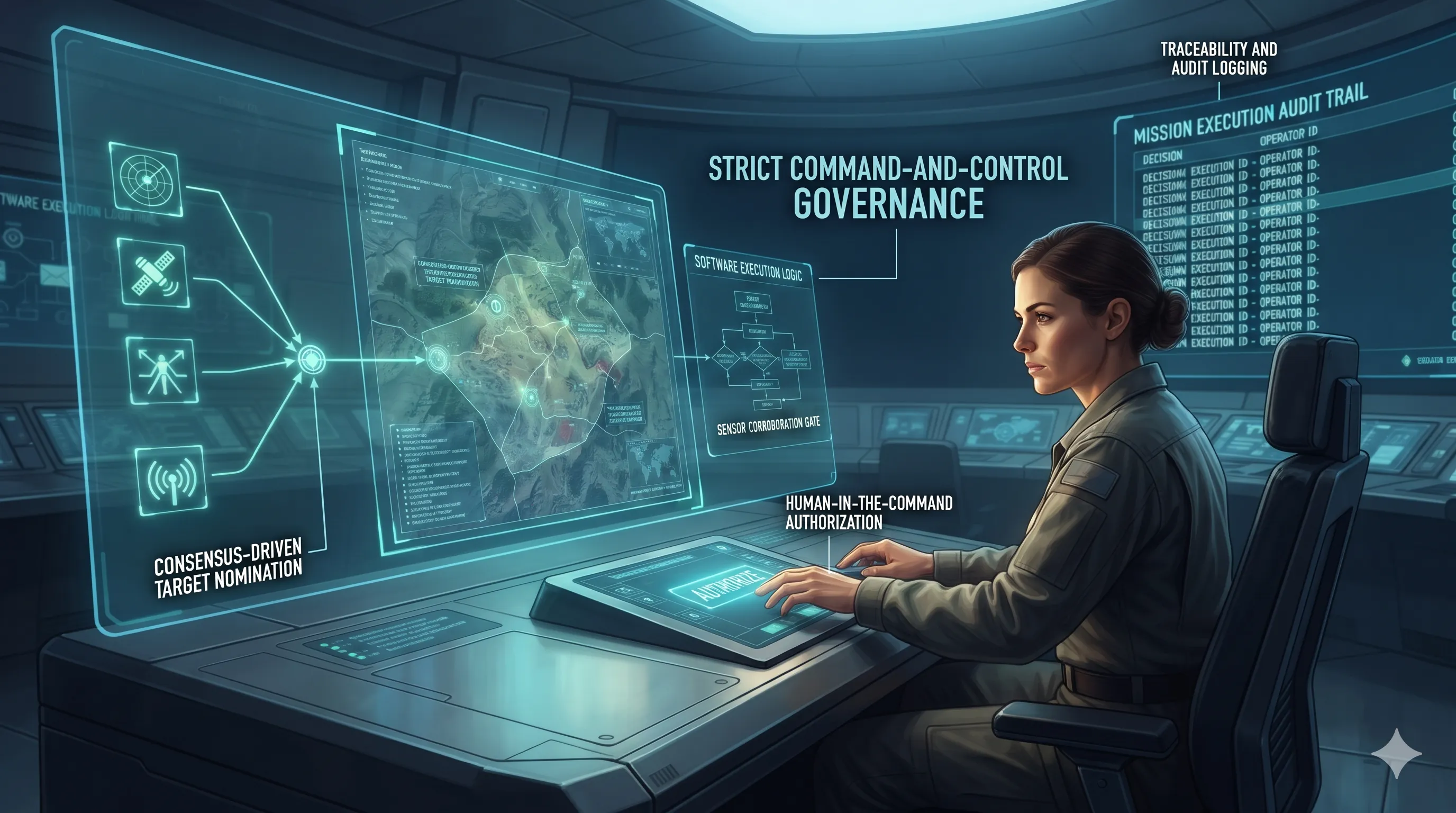
A foundational rule within Clarity’s analytical pipeline is that the system never relies on a single data source to nominate a target.To prevent sensor-specific artifacts, spoofing, or isolated intelligence errors from escalating into kinetic workflows, target nominations strictly require agreement across independent data sources.
Furthermore, these independent streams must achieve corroboration with high confidence before a nominated entity is presented for operational review.
By mandating multi-source consensus at the computational level, Clarity eliminates single-point-of-failure target generation and establishes high evidential fidelity before any human verification step takes place.
Doctrine-Encoded Verification Gates and Operator Accountability
Clarity embeds formal military targeting doctrine and mandatory verification gates directly into software execution.Rather than delegating lethal or kinetic engagement cycles to autonomous heuristics, the architecture enforces a strict human-in-the-command design.
Under this design, an authorized operator must actively review the corroborated evidence and provide explicit authorization before any hand-offs to weapons can occur.
To maintain total organizational accountability, Clarity logs and records every single targeting decision alongside the verified identity of the human operator who authorized it.
This immutably binds every engagement step to an identifiable chain of command, ensuring continuous auditability throughout mission execution.
| Targeting Governance Gate | Architectural Rule & Software Execution Logic |
|---|---|
| Sensor Corroboration Gate | Never relies on a single data source to nominate a target; requires agreement across independent data sources with high confidence prior to confirmation. |
| Doctrine Integration Gate | Directly embeds military targeting doctrine and mandatory verification gates into software execution paths. |
| Human-in-the-Command Authorization | Enforces a design where a designated operator must review the synthesized evidence and authorize hand-offs to weapons. |
| Traceability and Audit Logging | Logs and records every targeting decision directly alongside the identity of the human operator who authorized it. |
4. Effector Interoperability: MOSA Compliance and Tailored Engagement Packages
To deliver operational value within the overarching architecture of Clarity Uses Military-Customized AI to Enhance Defense Analytics, intelligence processing must directly drive operational effectors.Clarity links analytical target verification with battlefield execution by translating enriched intelligence into precise, actionable engagement packages.
Dynamic Effector Selection and Data Packaging
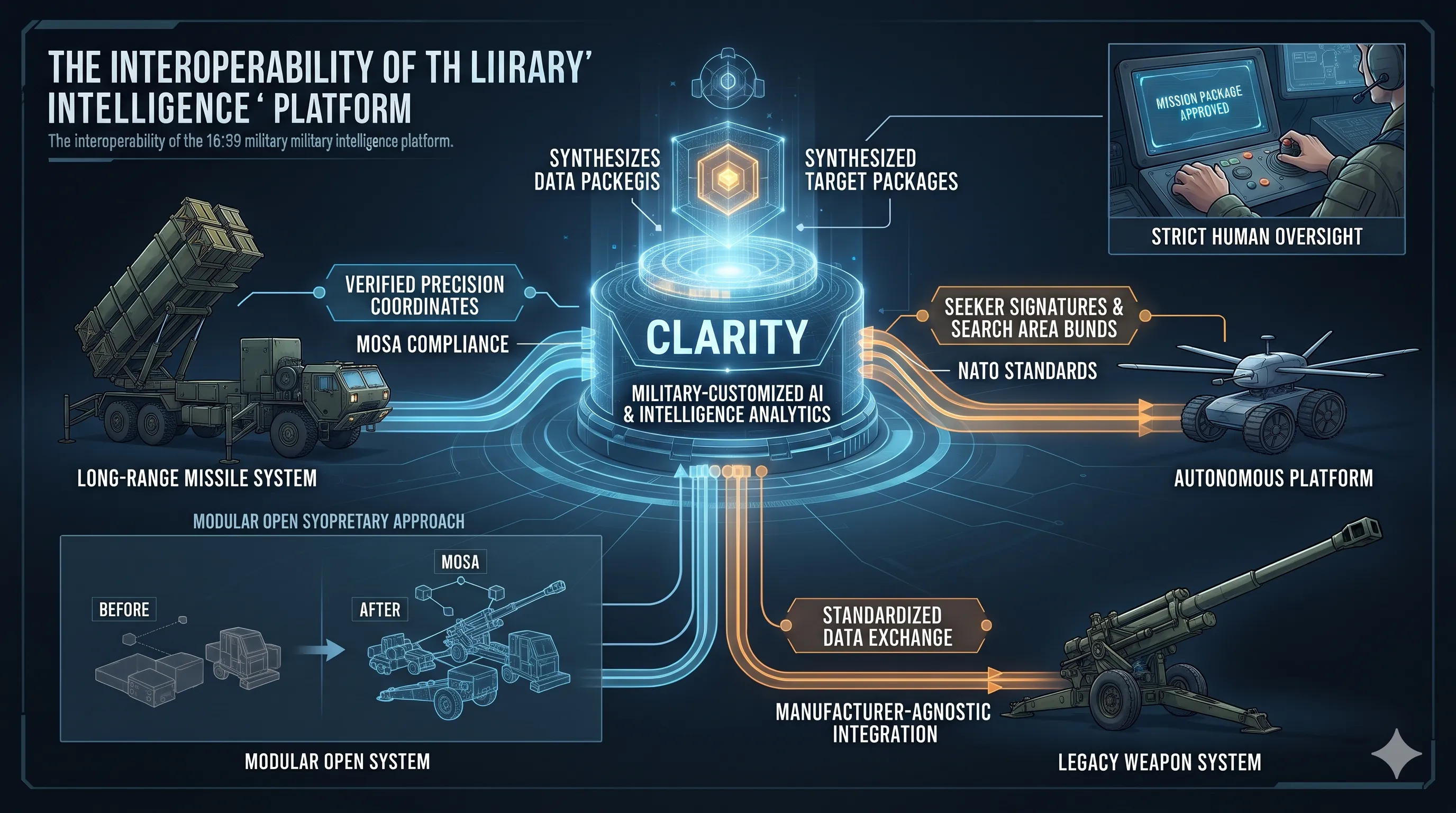
Clarity features automated weapon recommendation mechanics designed to evaluate incoming intelligence and propose the best-suited weapon effector for a designated target.Before any mission package is generated, the platform rigorously verifies data precision to ensure target parameters match mission requirements.
The entire process maintains strict human oversight, generating final engagement packages only upon explicit operator approval.
Once approved, Clarity tailors the data payload specifically to the operational profile and technical requirements of the assigned weapon type.
For long-range missile systems, the system compiles high-fidelity, verified coordinate hand-offs.
Conversely, when deploying autonomous platforms, Clarity constructs specialized data bundles containing seeker signatures and designated search areas to enable autonomous target acquisition in the field.
| Effector Category | Tailored Engagement Data Package | Interoperability and Architectural Standards |
|---|---|---|
| Long-Range Missiles | Precision target coordinates verified prior to hand-off | Modular Open Systems Approach (MOSA) principles and relevant NATO standards |
| Autonomous Platforms | Target seeker signatures and bounded search areas | Modular Open Systems Approach (MOSA) principles and relevant NATO standards |
MOSA Standards and Manufacturer-Agnostic Legacy Integration
Clarity prevents architectural lock-in by adhering strictly to Modular Open Systems Approach (MOSA) principles and relevant NATO standards.This standardization allows defense forces to link modern intelligence analytics directly with existing operational inventories.
The platform connects seamlessly to legacy military systems and weapon effectors regardless of manufacturer, bridging disparate arsenals across coalition environments.
By decoupling analytics software from proprietary hardware constraints, Clarity enables military commanders to command mixed fleets of legacy and modern effectors through standardized data exchanges.
5. Strategic Defense Autonomy: On-Premise Sovereign Infrastructure in European Defense
Clarity uses military-customized AI to enhance defense analytics by operating entirely within customer-managed secure environments, aligning technical execution with European strategic autonomy.This on-premise operational model ensures that analytical pipelines remain sovereign and structurally insulated from external control.
Customer-Owned Infrastructure vs. Foreign Cloud Dependencies
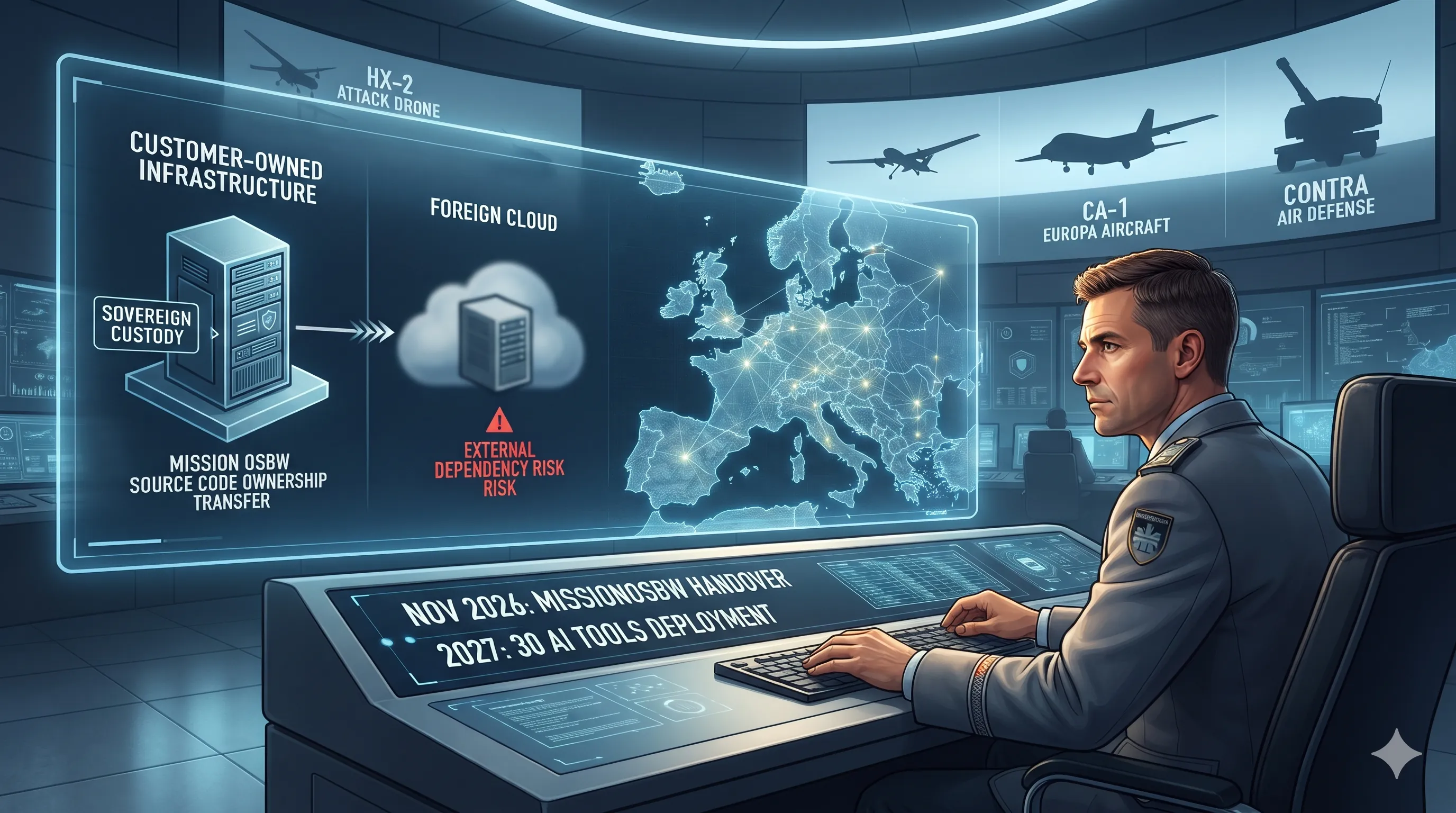
Clarity directly addresses European defense requirements to retain sovereign control over sensitive military intelligence data and algorithms.To prevent critical vulnerabilities associated with external technical ecosystems, Clarity ensures all data, models, and operations stay hosted on customer-owned infrastructure rather than foreign vendor clouds.
This customer-owned hosting framework offers an explicit technical alternative to foreign defense architectures that rely on extraterritorial cloud environments.
European resistance to non-sovereign platforms crystallized when senior German military officials previously ruled out procuring Palantir's Maven in April 2026.
By deploying AI pipelines directly into national military computing infrastructure, European defense forces prevent data extraction risks and eliminate dependence on foreign vendor platforms for mission-critical defense intelligence processing.
German Military AI Timelines and Helsing's Integrated Ecosystem
The operational shift toward sovereign defense software is guided by formalized procurement and evaluation roadmaps.The German military is evaluating 30 AI decision-support tools targeting a 2027 deployment timeline.
Demonstrating this commitment to sovereign technical custody, Helsing transferred MissionOSBw source code ownership to the German Bundeswehr on November 4, 2026.
Direct source code ownership allows armed forces to inspect, modify, and run mission software independently of third-party control.
Within this operational landscape, Clarity coexists with other Helsing hardware and software releases, including HX-2 attack drones, CA-1 Europa aircraft, and Contra air defense.
| System / Program | Classification | Sovereign Integration and Timeline Context |
|---|---|---|
| MissionOSBw | Defense Software | Source code ownership transferred to the German Bundeswehr on November 4, 2026. |
| German Military AI Evaluation | Decision-Support Pipeline | Evaluation of 30 AI decision-support tools targeting a 2027 deployment timeline. |
| HX-2 | Attack Drones | Hardware release coexisting alongside Clarity within the broader platform ecosystem. |
| CA-1 Europa | Aircraft | Aviation platform coexisting alongside Clarity within the broader platform ecosystem. |
| Contra | Air Defense | Air defense release coexisting alongside Clarity within the broader platform ecosystem. |
References
Related Posts

Inside Anthropic's Vision: How AI Will Eradicate Major Diseases in a DecadeAnthropic CEO Dario Amodei predicts AI will eradicate major diseases like cancer and Alzheimer's...

Inside China's First AI Export Controls Under Mofcom No. 48Explore China's first AI export controls under Mofcom Announcement No. 48, detailing compute...

How AI Uncovered Critical PHP Vulnerabilities and Triggered a Global CrisisDiscover how advanced AI models uncovered critical engine-level PHP vulnerabilities, sparking a...
Generative AI may have assisted with research or drafting for this article. Topic selection, fact-checking, final wording, and publication remain the responsibility of DragonStone74. AI use disclosure