
Inside China's First AI Export Controls Under Mofcom No. 48
🚀 Key Takeaways
- Landmark Regulatory Framework: China has formally established its first dedicated artificial intelligence export control mechanism under Announcement No. 48, mandating new licensing rules alongside immediate pre-export filing obligations.
- Frontier Model Ceilings: The regulatory regime introduces quantitative boundaries governing frontier training compute, parameter scale, public evaluation rankings, and foundational training data classifications.
- Orchestration and Infrastructure Oversight: Export controls encompass high-level autonomous agent frameworks, multi-agent coordination systems, and large-scale computing cluster interconnect optimization software.
- Deliberate Deployment Boundaries: Standard remote API interactions and verified public open-source weights are excluded from export licensing, whereas physical model hosting and weight migrations abroad face strict compliance checks.
- Extraterritorial Corporate Scrutiny: The mandate expands oversight across cross-border corporate restructuring, overseas entity redomiciling, and global mergers involving domestic algorithmic intellectual property.
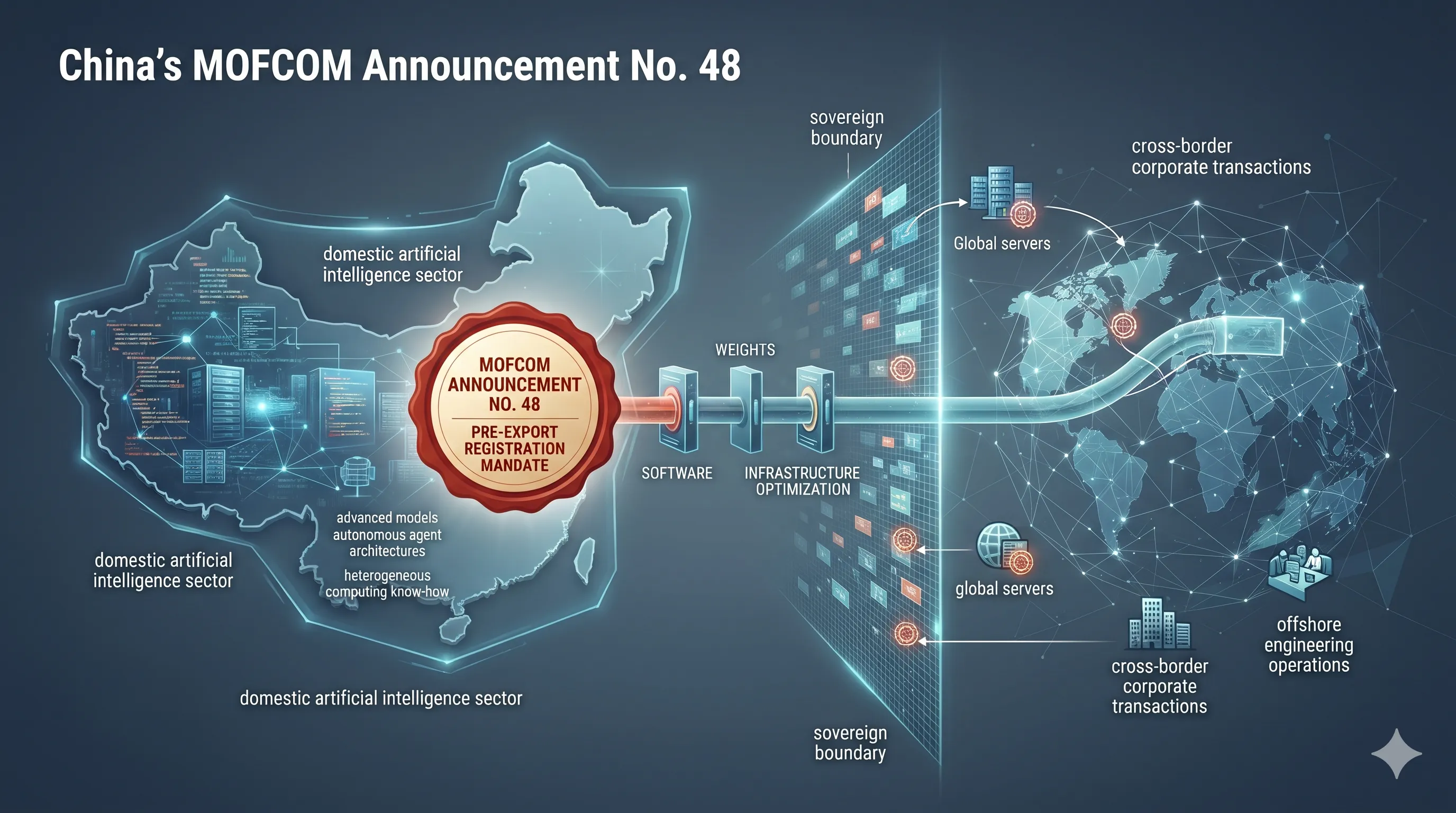
On October 16, 2026, China's Ministry of Commerce (MOFCOM) in tandem with the Ministry of Science and Technology (MOST) unveiled Announcement No. 48, marking Beijing's most decisive step yet to erect a comprehensive export control regime around its domestic artificial intelligence sector. By overhauling the Catalogue of Technologies Prohibited or Restricted from Export, regulators have explicitly designated advanced models, autonomous agent architectures, and heterogeneous computing know-how as strategic national technologies requiring robust state oversight.
The immediate rollout of an interim pre-export registration mandate introduces a new regulatory reality for Chinese frontier labs, multinational technology enterprises, and venture investors. Rather than mirroring Western controls centered primarily on silicon fabrication and advanced lithography tooling, this policy establishes a sovereign boundary at the software, weights, and infrastructure optimization layers—scrutinizing how foundational capabilities are disseminated beyond mainland borders.
As international enterprises integrate Chinese foundational models into global products, Announcement No. 48 fundamentally reshapes international technical cooperation, cross-border corporate transactions, and offshore engineering operations. Organizations operating across both Chinese and international ecosystems must now re-examine deployment topologies, internal codebase transfers, and licensing strategies to remain compliant under this evolving framework.
1. MOFCOM Announcement No. 48: The Legislative Framework and Immediate Pre-Export Registration
This section establishes the legislative baseline of China Announces First AI Export Controls via Mofcom No. 48, examining the statutory mechanics, categorical distribution, and immediate compliance obligations introduced by the regulatory action.Statutory Foundations and Catalogue Allocation
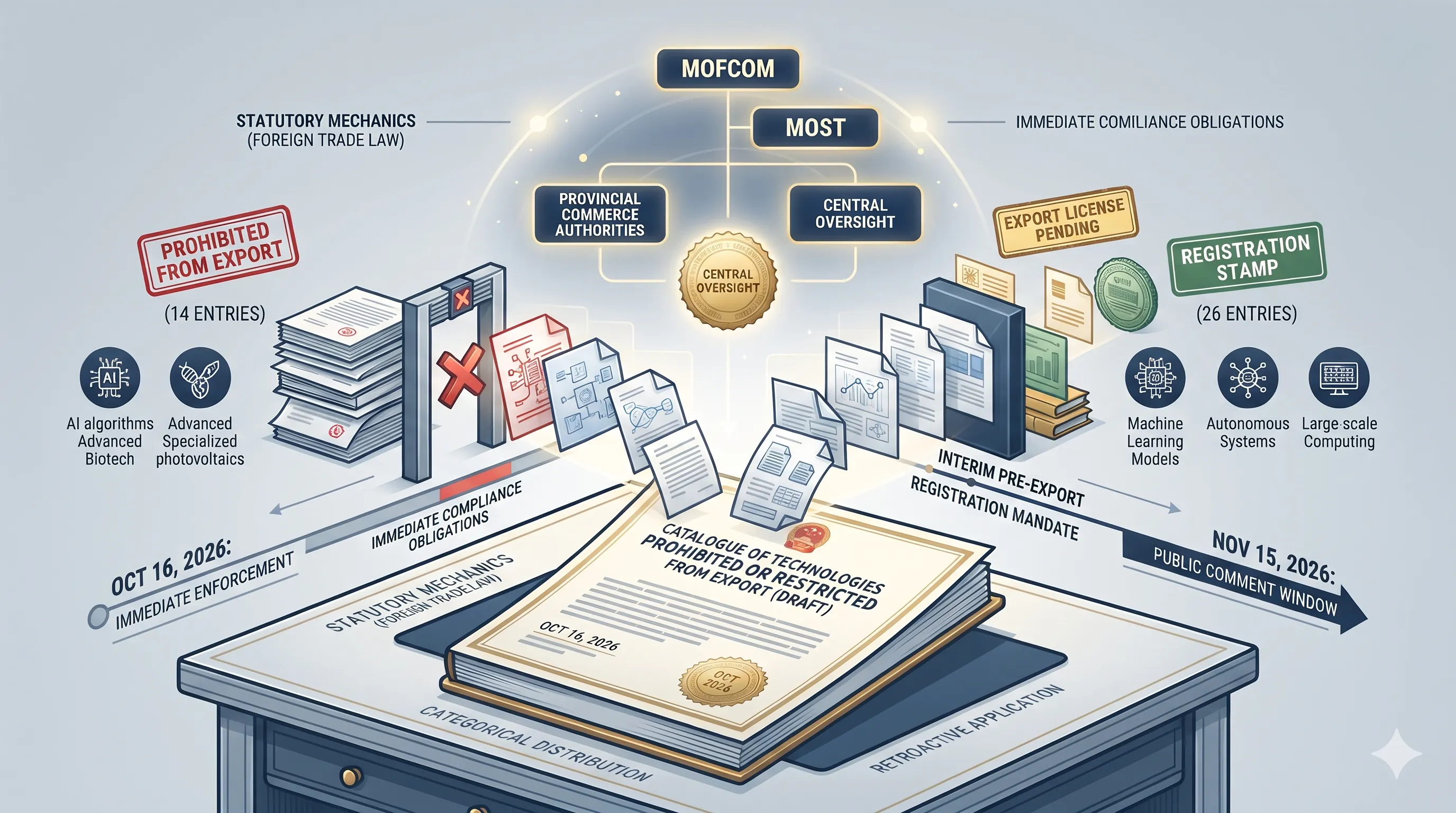
On October 16, 2026, the Ministry of Commerce (MOFCOM) alongside the Ministry of Science and Technology (MOST) jointly released Announcement No. 48 of 2026.This regulatory action proposes adding 40 technologies to the national Catalogue of Technologies Prohibited or Restricted from Export.
The statutory foundation of this initiative is anchored directly in Article 20 of the Foreign Trade Law of the People's Republic of China and is governed under the Regulations on Technology Import and Export Administration.
In framing the release, a MOFCOM spokesperson stated that the measure is routine, "does not target any specific country, region, or entity", and aims to prevent misuse while maintaining legitimate international cooperation.
The proposed expansion allocates 40 technologies across three specific sectors: 23 entries in artificial intelligence, 5 entries in biomedicine, and 12 entries in photovoltaics.
A formal public comment window on the draft catalogue opened on October 16, 2026, and runs through November 15, 2026.
Prohibited vs. Restricted Technologies Breakdown
The 40 entries set forth in Announcement No. 48 are segmented into two distinct legal classifications: 14 items categorized as prohibited from export and 26 items categorized as restricted under licensing.Technologies categorized as prohibited cannot be transferred abroad under any commercial or licensing arrangement.
Technologies classified as restricted require explicit export licenses before transfer or technical sharing can occur.
The licensing process for restricted technologies is administered primarily by provincial-level commerce authorities, though central authorities maintain the jurisdiction for potential intervention in prominent cases.
| Sector | Total Proposed Entries | Regulatory Classifications | Administrative Authority |
|---|---|---|---|
| Artificial Intelligence | 23 | Prohibited (subset of 14 total) / Restricted (subset of 26 total) | Provincial authorities (licensing) with potential central intervention |
| Photovoltaics | 12 | Prohibited (subset of 14 total) / Restricted (subset of 26 total) | Provincial authorities (licensing) with potential central intervention |
| Biomedicine | 5 | Prohibited (subset of 14 total) / Restricted (subset of 26 total) | Provincial authorities (licensing) with potential central intervention |
| Total Scope | 40 | 14 Prohibited, 26 Restricted | MOFCOM / MOST / Provincial Commerce Departments |
Immediate Enforcement and Retroactive Pre-Export Registration
While the additions to the Catalogue of Technologies Prohibited or Restricted from Export were presented as a draft subject to public review through November 15, 2026, administrative compliance took force without delay.Announcement No. 48 implemented an interim pre-export registration requirement that took effect immediately on October 16, 2026.
Significantly, the mandate applies registration requirements retroactively to ongoing technology exports that commenced prior to October 16, 2026, but remain incomplete.
Exporters engaging in outbound transfers falling under the covered categories must adhere to these interim filing obligations while operating within the overarching statutory framework of the Regulations on Technology Import and Export Administration.
2. Frontier Model Thresholds: Compute, Parameter Caps, and Dynamic Ranking Metrics
China's announcement of its inaugural AI export controls via Ministry of Commerce (Mofcom) Announcement No. 48 marks a major shift toward codifying precise technical limits on artificial intelligence systems.The framework establishes explicit quantitative metrics, structural parameters, and data classifications to determine whether frontier foundation models and their supporting software assets require export licensing or face complete transfer bans.
Compute, Parameter, and Data Classification Thresholds
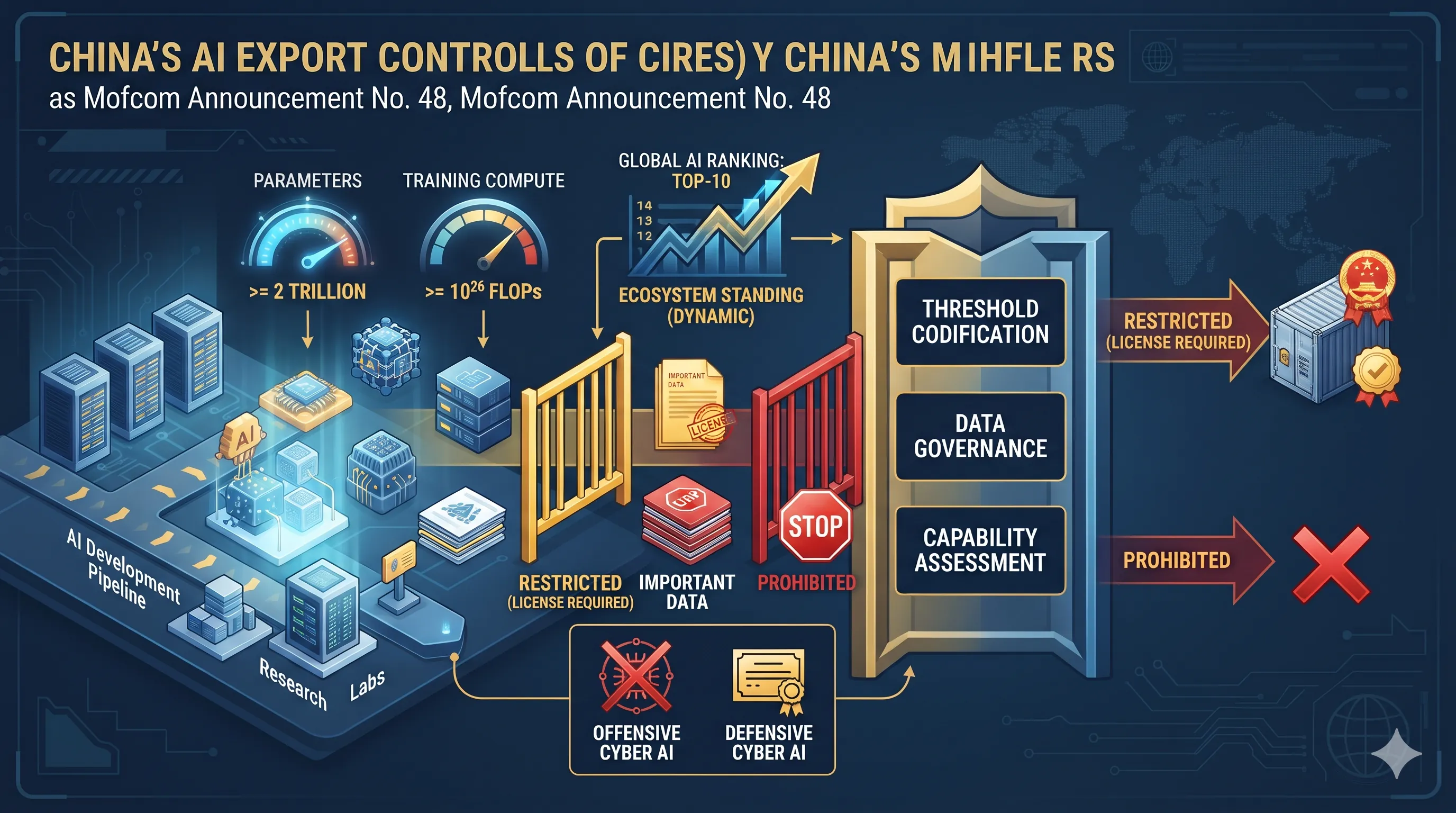
Mofcom No. 48 defines restricted frontier models by setting aggressive compute ceilings and scale thresholds.Specifically, the controls restrict frontier model weights, key checkpoints, source code, and core architecture exceeding 10^26 FLOPs of total training compute.
Alongside computation caps, the measures restrict any foundation model possessing at least 2 trillion parameters.
The scope of oversight is not confined strictly to static runtime files; it directly controls training and inference optimization know-how alongside physical weights.
The regulatory structure also anchors frontier capabilities directly to domestic data security governance.
Under guidelines linked to China's Data Security Law, models trained on "important data" are classified as restricted and require explicit administrative licensing for foreign transfer.
In contrast, models trained on "core data" are met with outright prohibitions on cross-border transmission.
Despite the stringency of the computational boundary, market analysts note that no released Chinese model currently exceeds the 10^26 FLOP threshold as of late 2026.
| Control Category | Technical Threshold / Criterion | Export Status under Mofcom No. 48 |
|---|---|---|
| Training Compute | Exceeding 10^26 FLOPs (covering weights, key checkpoints, source code, and architecture) | Restricted |
| Model Scale | Possessing at least 2 trillion parameters | Restricted |
| Data Governance: Important Data | Models trained on data categorized as "important data" under Data Security Law guidelines | Restricted (Licensing required) |
| Data Governance: Core Data | Models trained on data categorized as "core data" under Data Security Law guidelines | Prohibited |
| Ecosystem Standing | Global top-10 position on public evaluations, global call volume, or benchmark rankings at time of export | Restricted (Dynamic compliance) |
| Engineering Expertise | Proprietary training and inference optimization know-how | Controlled / Restricted |
| Offensive Cyber Capabilities | AI-driven malicious code generation and mutation technology | Prohibited |
| Defensive Cyber Security | AI-assisted vulnerability discovery and red-teaming detection tools | Restricted (Licensing required) |
The Global Top-10 Dynamic Ranking Dilemma
Beyond static FLOP and parameter counts, Mofcom No. 48 restricts models occupying a global top-10 position on public evaluations, global call volume, or benchmark rankings at the time of export.This mechanism establishes a dynamic compliance standard where a model's regulatory status may shift post-deployment based on ranking changes.
A model initially compliant for transfer might later cross into controlled territory simply by gaining traction in developer adoption or rising in public benchmark leaderboards.
This metric introduces significant compliance ambiguity for developers and deploying organizations.
The regulatory draft does not specify designated official ranking bodies for evaluating global top-10 standing.
Highlighting the resulting administrative uncertainty, analysis from ChinaTalk characterized the global leading rank criterion as "by far the most up-for-interpretation".
Without designated evaluation authorities, exporters face operational unpredictability regarding how external evaluations and third-party call volume metrics will be verified by regulators.
Cybersecurity and Offensive AI Tool Controls
Mofcom No. 48 extends its boundaries directly into specialized artificial intelligence software utilized in cybersecurity operations.The order outright prohibits the export of AI-driven malicious code generation and mutation technology.
By barring the cross-border distribution of automated payload creation tools, the policy prevents the outbound transfer of high-risk offensive cyber assets.
Simultaneously, dual-use security utilities are brought under formal regulatory scrutiny.
The measures place AI-assisted vulnerability discovery and red-teaming detection tools under restricted licensing regimes.
Developers distributing automated testing mechanisms, offensive simulation software, or discovery platforms must navigate specialized regulatory approval channels before transferring those assets abroad.
3. Expanding the Perimeter: Autonomous Agents, Supercomputing Clusters, and Advanced Chip Architectures
With the promulgation of Announcement No. 48, the Ministry of Commerce (Mofcom) establishes China's first comprehensive export control regime over artificial intelligence, deliberately expanding the regulatory perimeter far beyond raw foundation model weights.Rather than restricting only monolithic base models, Mofcom No. 48 establishes explicit technical thresholds spanning autonomous agent orchestration, large-scale cluster networking, and foundational semiconductor architectures.
Agent Orchestration Limits: Task Decomposition and Multi-Agent Scale
Mofcom No. 48 regulates intelligent agents based directly on system behavior and orchestration capacity, applying controls independently of underlying model parameter size.Under these provisions, orchestration frameworks integrating wide toolsets can trigger strict export restrictions even when operating smaller, sub-frontier base models.
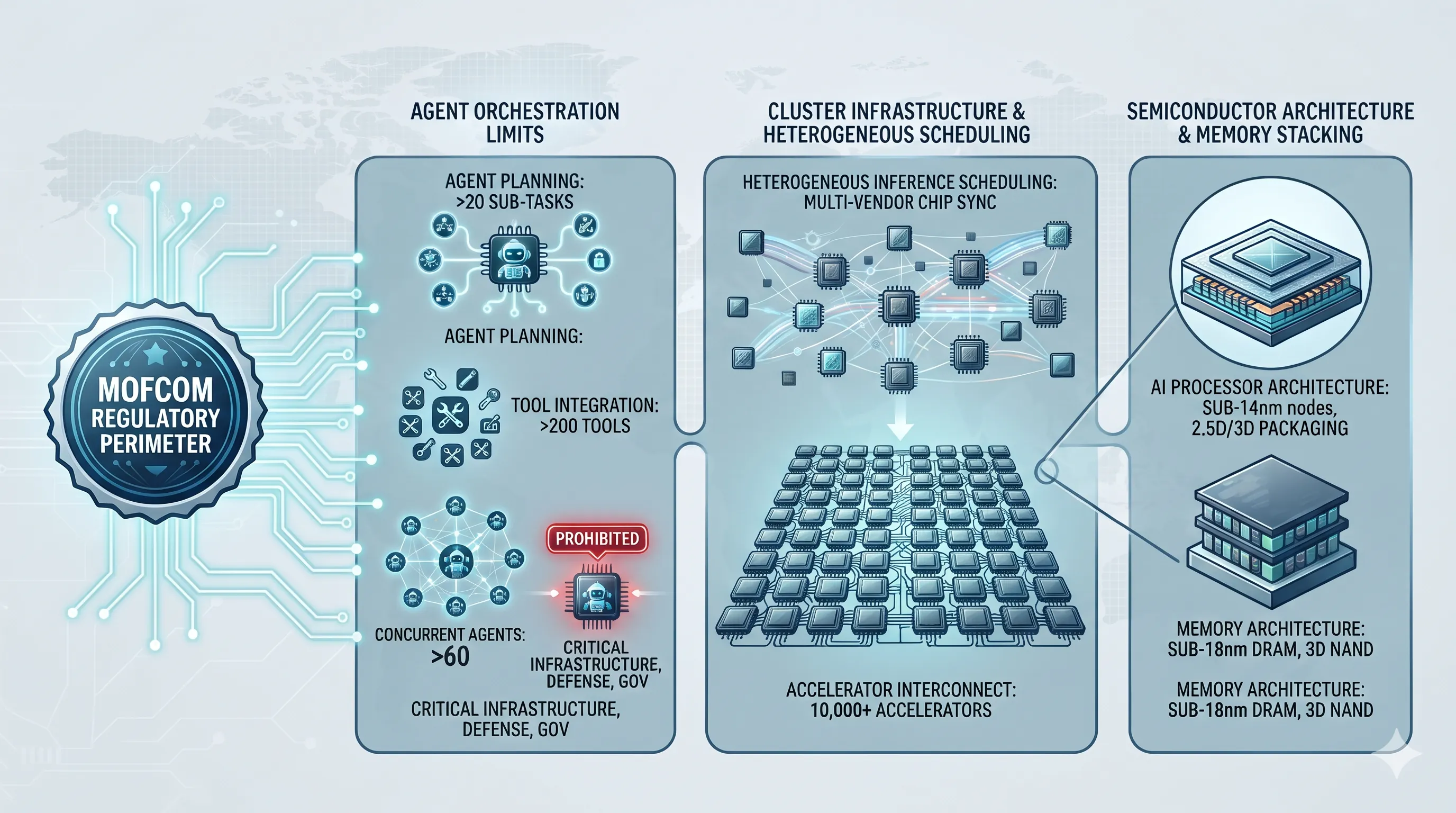
Specifically, the control list establishes agent planning restrictions when an autonomous system exhibits natural language instruction decomposition exceeding 20 sub-tasks.
The framework similarly restricts agent systems capable of integrating 200 or more external tools.
For distributed execution, regulatory cutoffs target multi-agent systems coordinating 60 or more concurrent agents.
Beyond conditional export licensing thresholds, the directive mandates an outright prohibition on high-performance agents designed for critical information infrastructure, national defense, or core government use.
Cluster Infrastructure and Heterogeneous Inference Scheduling
Beyond agent logic, Mofcom No. 48 extends into the physical and software scaffolding that sustains large-scale AI operations.The regulation restricts high-speed interconnect and fault-recovery technology developed for computing clusters containing 10,000 or more accelerators.
On the runtime layer, the regulatory perimeter encompasses both model serving harnesses and inference acceleration software as formally controlled assets.
Crucially, these provisions bring heterogeneous inference scheduling across multi-vendor chips under strict export control, targeting environments where diverse computing silicons are synchronized to drive production workloads.
Semiconductor Architecture and Memory Stacking Restrictions
At the silicon level, the export restrictions apply technical cutoffs to cutting-edge processor topologies and storage fabrics.The mandate restricts AI processor designs utilizing sub-14nm process nodes as well as advanced 2.5D/3D packaging techniques.
Complementing compute processing limits, the directive restricts advanced memory chip designs utilizing 3D NAND, sub-18nm DRAM, and multi-layer bonding or stacking architectures.
| Control Category | Technical Metric / Cutoff | Restricted Scope and Regulatory Mechanism |
|---|---|---|
| Agent Task Decomposition | Exceeding 20 sub-tasks | Natural language instruction decomposition and planning logic. |
| Agent Tool Integration | 200 or more external tools | Frameworks integrating wide toolsets, regardless of underlying model parameter size. |
| Concurrent Agent Swarms | 60 or more concurrent agents | Multi-agent orchestration and dynamic agent coordination systems. |
| Accelerator Interconnect | Clusters of 10,000 or more accelerators | High-speed interconnect and cluster fault-recovery technologies. |
| Heterogeneous Runtime Software | Multi-vendor chip scheduling | Model serving harnesses, inference acceleration software, and cross-vendor scheduling. |
| AI Processor Architecture | Sub-14nm nodes; 2.5D/3D packaging | Advanced AI chip design and sophisticated physical packaging technologies. |
| Memory Architecture | Sub-18nm DRAM; 3D NAND | Multi-layer bonding and stacking design for high-density storage silicon. |
| Sovereign Infrastructure Agents | High-performance deployment | Outright prohibition for critical information infrastructure, defense, and core government use. |
4. Deployment Boundaries: Cloud API Safe Harbors Versus Overseas Custody and Open Source
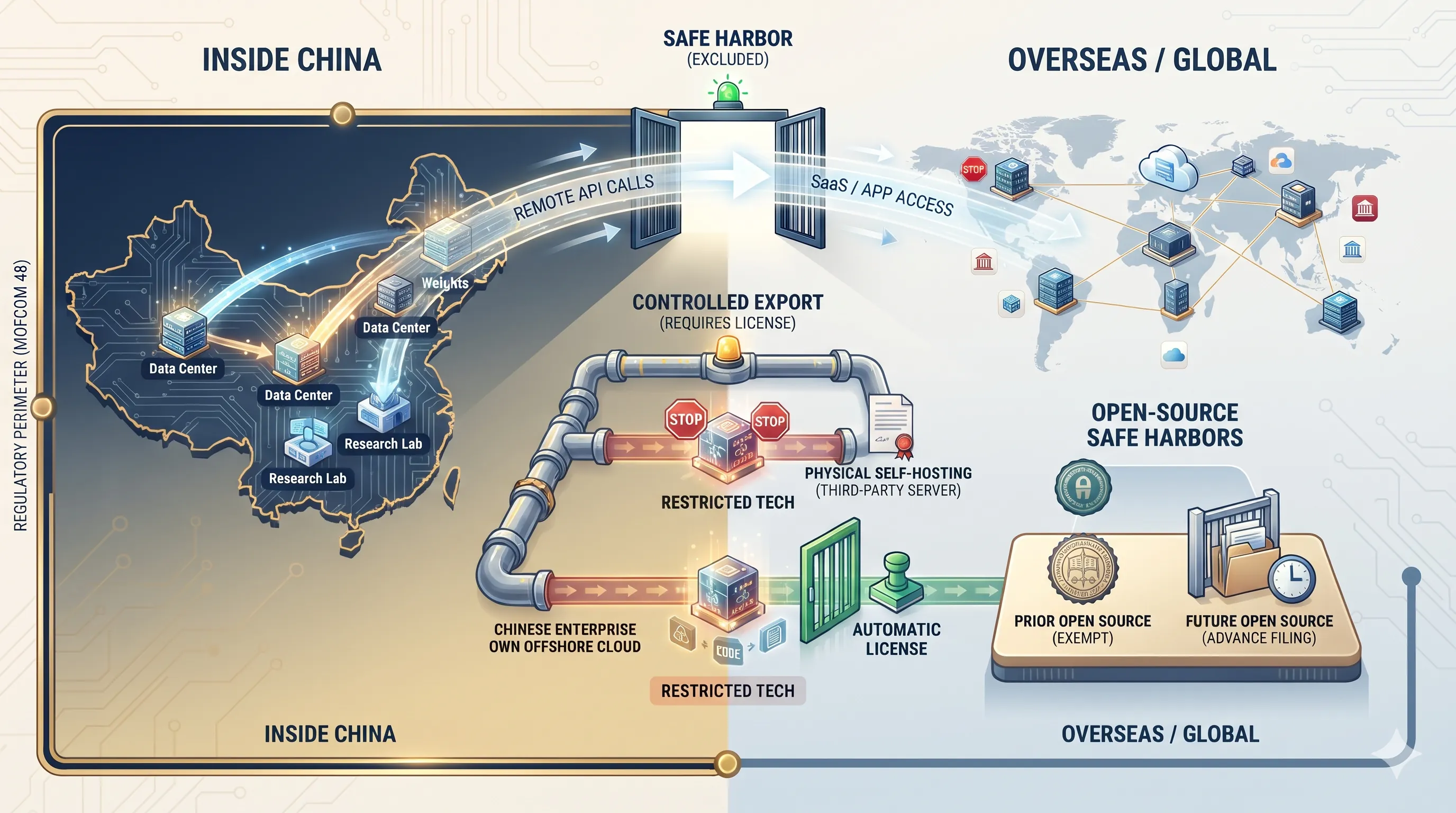
The regulatory framework introduced under Mofcom Announcement No. 48 establishes a critical jurisdictional boundary dividing intangible cloud consumption from physical technology transfers.In defining the perimeter of AI export controls, MOFCOM framed the central test as whether restricted technology moves from inside China to overseas.
This baseline standard delineates clear safe harbors for remote consumption models while imposing strict export classifications on infrastructure-level deployments and software artifacts positioned outside Chinese borders.
Cloud APIs vs. Physical Server Custody
The regulatory structure explicitly excludes remote API calls, app and web interactions, SaaS applications, and lightweight on-device deployments from export management.Because user-directed inferences and remote cloud queries do not transfer underlying architectural assets across borders, cross-border API endpoints operate outside the scope of traditional export control mechanisms.
In sharp contrast, the framework classifies physical installation or local self-hosting of restricted models on overseas servers outside China as a controlled export.
This distinction poses acute operational challenges for global organizations seeking strict physical isolation.
Specifically, enterprises self-hosting Chinese models abroad for data security boundaries face compliance risk if vendors lack export licenses.
When an international enterprise copies weights onto non-domestic hardware to comply with localized privacy mandates, the act crosses the threshold into regulated export activity.
| Deployment / Distribution Channel | Export Control Classification | Regulatory Obligation |
|---|---|---|
| Remote API Calls, SaaS, App/Web Access, Lightweight On-Device | Excluded from export management | None (operates within regulatory safe harbor) |
| Local Overseas Self-Hosting (Third-Party / Foreign Servers) | Controlled physical export | Vendor must secure a formal export license |
| Chinese Enterprise Deployments on Own Offshore Cloud | Regulated deployment within corporate perimeter | Subject to an automatic licensing mechanism |
| Prior Open-Source Releases & Academic Publications | Exempt (public domain) | None (pre-existing public domain safe harbor) |
| Future Open-Source Releases (Restricted Scale) | Controlled public release | Advance filing and automatic licensing procedure |
Offshore Infrastructure and Automatic Licensing Rules
To balance regulatory friction against the operational demands of domestic cloud providers expanding abroad, the rules institute an automatic licensing mechanism for local overseas deployments hosted directly within a Chinese enterprise's own offshore cloud infrastructure.Under this provision, domestic entities managing their own proprietary compute clusters internationally can deploy restricted models across their foreign regions without submitting individual, transaction-level license applications.
This path is strictly reserved for infrastructure maintained directly by the originating domestic organization.
Independent overseas entities and foreign third-party hosters do not benefit from this automatic channel, ensuring that unmonitored model custody remains under rigorous administrative supervision.
Open-Source Safe Harbors and Advance Filing Protocols
The announcement addresses model weights and scientific documentation by carving out a safe harbor for foundational research already accessible to the public.The regulatory framework exempts technology and weights that have already entered the public domain through prior open-source releases or academic publications.
Consequently, models, code bases, and parameter files shared openly before the control mandates retain uninterrupted accessibility.
However, outgoing releases face structured oversight going forward.
The rules subject future open-source releases of restricted-scale models to an advance filing and automatic licensing procedure.
Despite these procedural stipulations, significant ambiguities remain within the draft text.
The draft leaves the legal definition of 'open source' unspecified and does not clarify the status of restricted-use open licenses.
This absence of precision creates ongoing uncertainty for developer teams utilizing custom responsible-AI licenses or commercial-restriction clauses when attempting to navigate advance filing obligations.
5. Cross-Border Corporate Scrutiny: Registration Triggers, Offshore R&D, and M&A Precedents
MOFCOM Announcement No. 48 substantially expands China's regulatory perimeter beyond conventional merchandise trade by targeting cross-border corporate reorganizations, offshore licensing arrangements, and collaborative development structures.This operational dimension directly bridges the broader export control framework with enterprise governance, enforcing procedural obligations whenever proprietary artificial intelligence assets cross physical or jurisdictional borders.
Four Mandatory Interim Registration Triggers
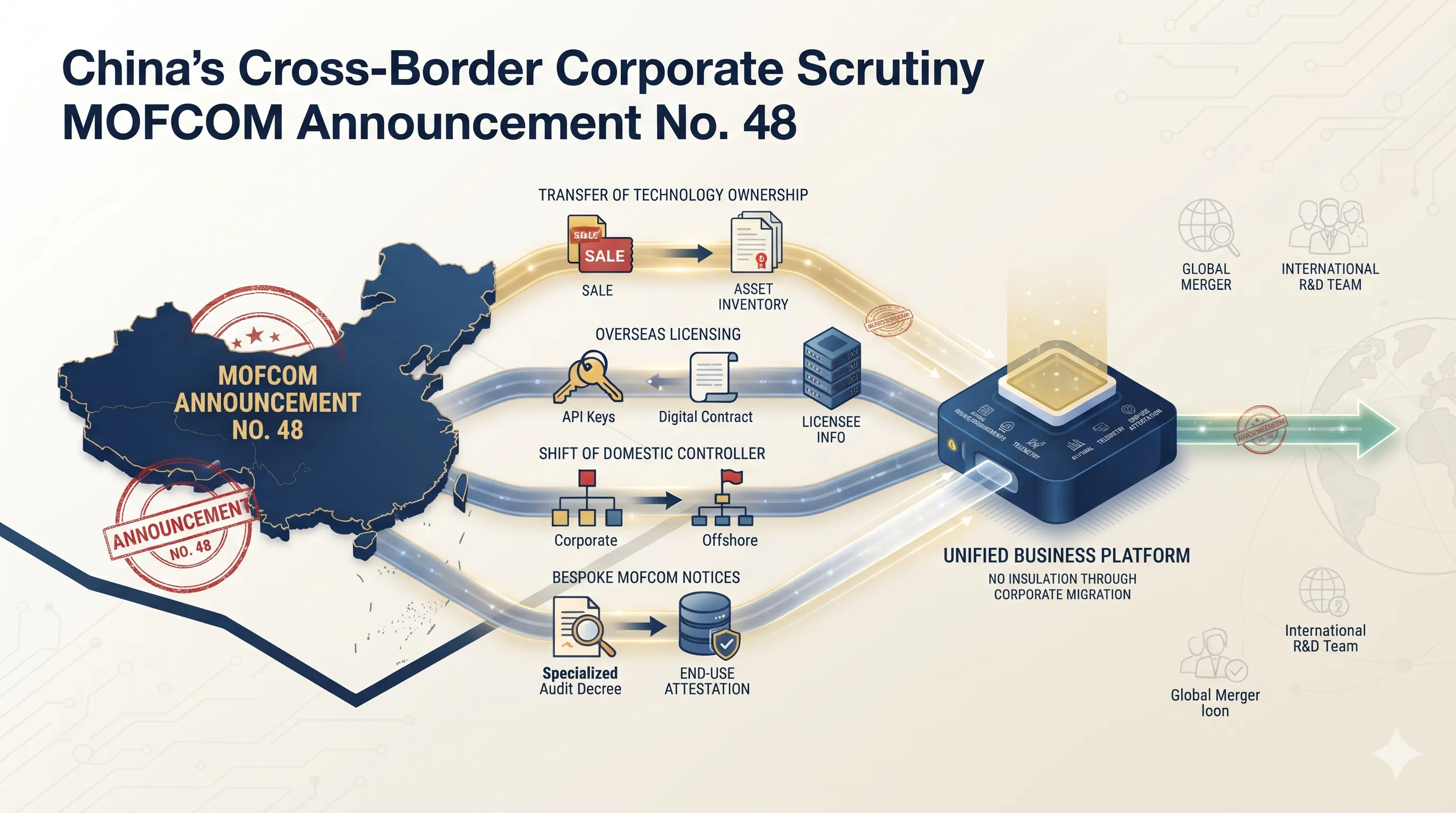
Under the compliance architecture established by MOFCOM Announcement No. 48, technology exporters are subject to strict filing requirements executed through MOFCOM's unified business platform.The regulatory regime places the affirmative legal burden directly on exporting entities to conduct self-determinations regarding whether their AI assets and cross-border operations fall within statutory thresholds.
Filings mandate the disclosure of extensive transaction telemetry, requiring companies to submit verified recipient identities, designated overseas destinations, detailed technical parameters, end-use attestations, and estimated transaction values.
Compliance scrutiny activates across four defined interim triggers governing corporate transactions and technology flows:
| Registration Trigger | Transaction Scope | Mandatory Platform Disclosures |
|---|---|---|
| Transfer of Technology Ownership Abroad | Permanent assignment, IP sale, or asset transfer of domestic AI models and algorithmic codebases to foreign entities. | Recipient identities, overseas destinations, technical parameters, end uses, estimated transaction values. |
| Overseas Licensing | Exclusive or non-exclusive outbound software licenses, API access agreements, and commercial technology authorizations. | Licensee identities, operational parameters, intended end-use scopes, contract valuations. |
| Shift of Domestic Controller to a Foreign Entity | Corporate restructuring, cross-border mergers, or shareholding reorganizations transferring domestic operational control to offshore parents. | Restructuring structure, controlling foreign entity details, asset inventories, algorithmic specifications. |
| Bespoke MOFCOM Notices | Ad hoc supervisory interventions, specialized audit decrees, or bespoke agency notices targeting specific AI asset categories. | Transaction specifics, technical parameter documentation, and supplementary end-user validations as directed. |
Intra-Group Code Sharing and Non-Contractual Transfers
The procedural reach of MOFCOM's unified business platform extends beyond formal, third-party commercial contracts into everyday multinational engineering operations.Registration forms explicitly incorporate reporting fields for non-contractual transfers, introducing critical compliance friction for enterprise architectures that rely on distributed international development teams.
Under this standard, routine technical transfers between domestic Chinese R&D units and foreign affiliates are brought under potential regulatory scrutiny.
Engineering workflows involving the continuous sharing of model checkpoints, experimental weights, and shared code repositories across borders expose companies to reporting obligations.
Because the registration documentation captures non-contractual and intra-corporate technical distributions, domestic engineering divisions face significant ambiguity regarding whether standard internal enterprise code synchronizations trigger immediate pre-transfer filing duties.
Technology exporters must therefore maintain active internal self-determination protocols over continuous integration and deployment pipelines to prevent unfiled cross-border data transfers.
The Meta-Manus Precedent and Cross-Border M&A Impact
The operational reality of China's AI export controls was formalized in the January 2026 regulatory precedent involving Meta's acquisition of Manus.In that case, MOFCOM asserted regulatory scrutiny over the transaction despite Manus maintaining corporate domicile in Singapore.
The regulatory review established the definitive precedent that redomiciling a corporate headquarters or spinning out offshore entities does not extinguish China's export jurisdiction over AI assets developed by domestic teams.
Cross-border corporate restructurings, global mergers and acquisitions, and offshore talent relocations involving China-developed AI technologies remain tethered to domestic export control mandates.
As a consequence, foreign acquirers and domestic founders can no longer insulate cross-border transactions through holding company jurisdictions or corporate migration without resolving MOFCOM compliance liabilities.
Related Posts

How Frontier AI Models Are Rewriting Theoretical PhysicsExplore how frontier AI models and autonomous agents are transforming theoretical physics,...

How Agent Harnesses Function as the Operating System for AI ModelsDiscover how agent harnesses function as the new operating system for AI models, replacing brittle...

Inside Anthropic's Vision: How AI Will Eradicate Major Diseases in a DecadeAnthropic CEO Dario Amodei predicts AI will eradicate major diseases like cancer and Alzheimer's...
Generative AI may have assisted with research or drafting for this article. Topic selection, fact-checking, final wording, and publication remain the responsibility of DragonStone74. AI use disclosure