
How AI Uncovered Critical PHP Vulnerabilities and Triggered a Global Crisis
🚀 Key Takeaways
- AI-Driven Discovery Breakthrough: Advanced reasoning models successfully identified decade-old memory-safety vulnerabilities deep within the PHP core that long eluded legacy static analysis and manual code audits.
- Critical Engine-Level Flaws: The dual vulnerabilities known as PHP2Shell involve out-of-memory handling errors and use-after-free states capable of arbitrary remote code execution before application scripts even execute.
- Accelerated Zero-Day Exploitation: Premature public leaks sparked widespread automated attack campaigns across the internet, compressing the standard coordinated disclosure window into an emergency response.
- Broad Ecosystem Exposure: As the engine powering the vast majority of web content management platforms, the flaw exposed millions of organizations and unmaintained legacy web servers worldwide.
- Upstream Runtime Patching Required: Application-level mitigations and content management updates cannot resolve engine-layer memory corruption, mandating immediate PHP runtime binaries and container rebuilds.
- Historic Global Government Response: International cyber authorities and national leadership took the extraordinary step of instructing administrators to pull unpatched web services entirely offline.
- Fragile Temporary Mitigations: Web application firewall rules and server configuration workarounds provide partial friction against common exploits, but complete remediation requires upgrading the underlying interpreter.
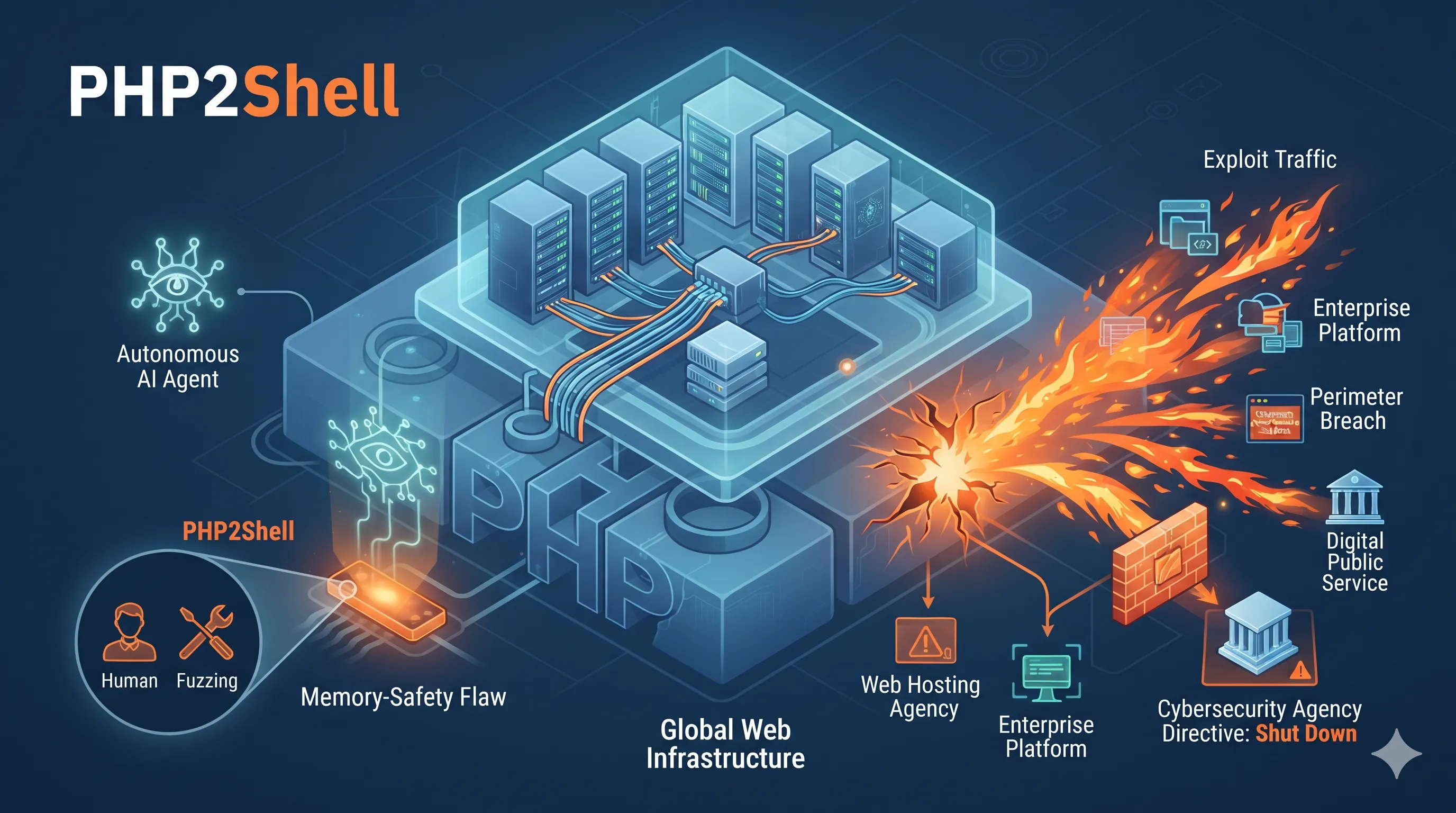
The software security landscape reached a defining inflection point when autonomous artificial intelligence models uncovered severe, long-dormant vulnerabilities buried inside the open-source PHP runtime engine. Known collectively as "PHP2Shell," these critical memory-safety flaws resided quietly within the foundational plumbing of the global web for over a decade, remaining invisible to conventional fuzzing suites and experienced human code auditors.
The discovery quickly transformed from an academic triumph into an operational crisis. Following early technical leaks, active exploit traffic escalated exponentially across the internet, compromising perimeter defenses and bypassing standard application-level controls across web hosting providers, enterprise platforms, and digital public services.
With sovereign cybersecurity agencies taking the rare step of directing organizations to shut down unpatched systems, this event underscores both the immense defensive promise and the acute dual-use volatility of AI-driven vulnerability research. As automated tools master source code comprehension, the window between silent discovery and weaponized mass exploitation has permanently contracted.
1. AI-Driven Vulnerability Discovery: The OpenAI and Wiz Research Breakthrough
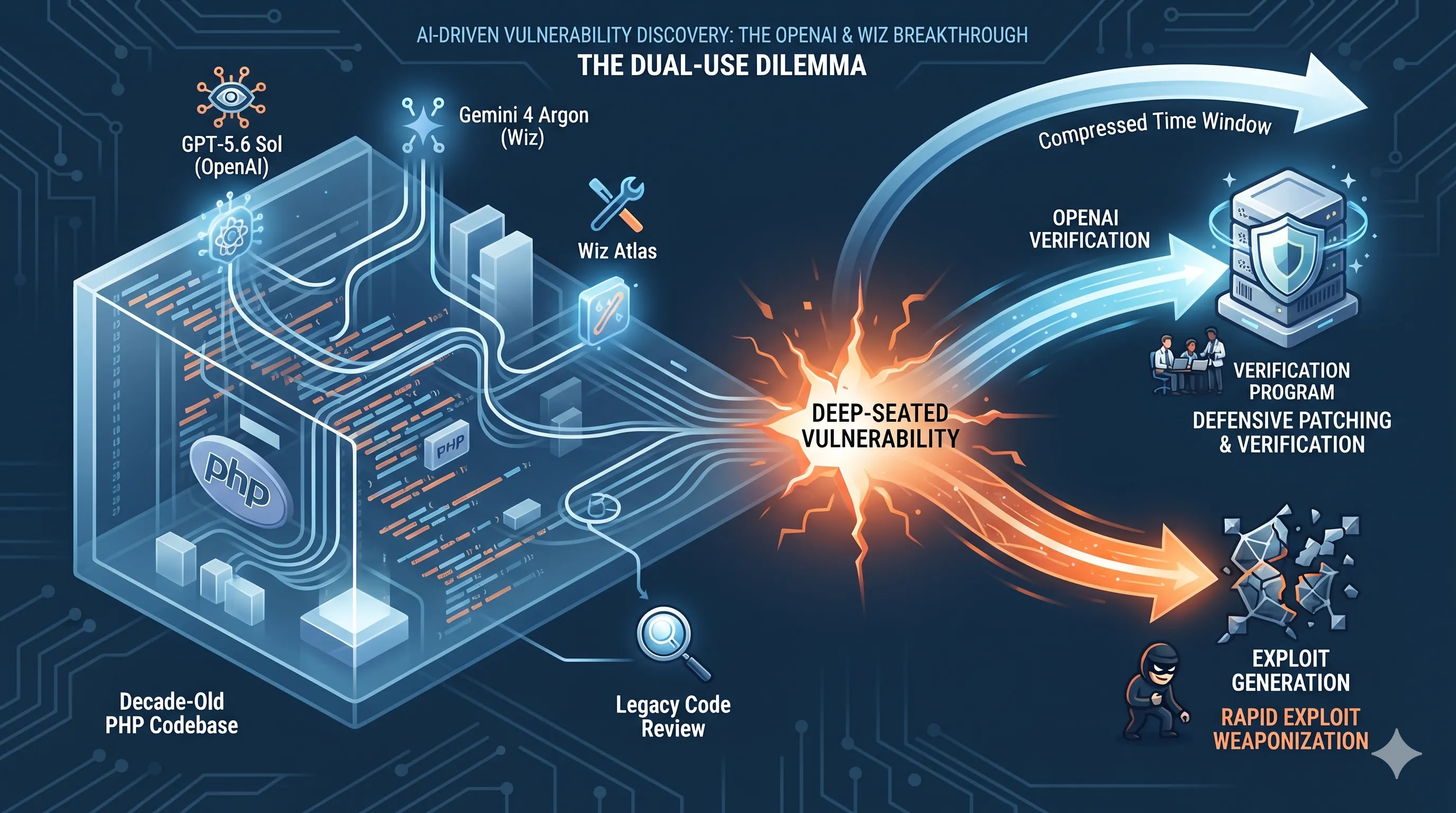
Connecting directly to the broader investigation into how AI uncovered previously unknown PHP vulnerabilities, this section examines the collaborative breakthrough between independent researchers, Wiz, and OpenAI.By deploying next-generation frontier models, researchers successfully traced deep-seated flaws that had evaded traditional code review for over ten years.
OpenAI 'Patch the Planet' Initiative and GPT-5.6 Sol Deployment
In August 2026, Ryan Austin at Calif uncovered the vulnerabilities as part of OpenAI's 'Patch the Planet' initiative.To locate the deep security flaws within the PHP source code, Austin utilized OpenAI's GPT-5.6 Sol model.
Reflecting on the magnitude of the discovery, Ryan Austin stated to the BBC that it was "the most serious vulnerability I've ever found".
OpenAI similarly underscored the gravity of the finding, describing the discovery as "one of the most impactful security issues in recent memory".
Following the identification of the vulnerabilities, OpenAI released a dedicated verification program to test if PHP platforms remain secure.
Wiz Atlas and Autonomous Source Code Auditing
Parallel research efforts by Wiz researchers identified the flaws using large language models Gemini 4 Argon and GPT-5.6 Sol alongside their autonomous tool Wiz Atlas.Wiz characterized the findings as the "most severe" vulnerabilities ever detected by AI.
Advanced AI models analyzed source code to discover deep security flaws substantially faster than human auditors or legacy systems.
Although the underlying bugs had persisted in the codebase for over a decade, AI provided the capability to identify and trace them across complex logic paths.
Highlighting this technological leap, Salil Kanhere of UNSW Sydney stated: "The underlying bugs weren't new; what changed was our ability to find them".
Without modern AI tooling, the vulnerabilities would have been extraordinarily difficult and complex for human researchers to identify manually.
| Research Entity | AI Models and Autonomous Tooling | Program / Discovery Scope |
|---|---|---|
| Ryan Austin (Calif) | OpenAI GPT-5.6 Sol | OpenAI 'Patch the Planet' initiative (August 2026) |
| Wiz Researchers | Gemini 4 Argon, GPT-5.6 Sol, Wiz Atlas | Autonomous source code auditing of decade-old codebase bugs |
| OpenAI | GPT-5.6 Sol | Deployment of a dedicated verification program for PHP platforms |
The Dual-Use Dilemma: Defensive Auditing vs. Rapid Exploitation
The discovery has brought renewed attention to the dual-use security paradigm inherent in automated code analysis.The discovered flaws highlight a dual-use risk where AI can uncover defensive flaws while enabling threat actors to rapidly generate exploits.
Because advanced AI models can trace obscure code paths far faster than legacy systems, the window between vulnerability discovery and weaponization presents acute challenges for defenders working to secure affected software.
2. Anatomy of PHP2Shell: Deep Dive into CVE-2026-109618 and CVE-2026-109619
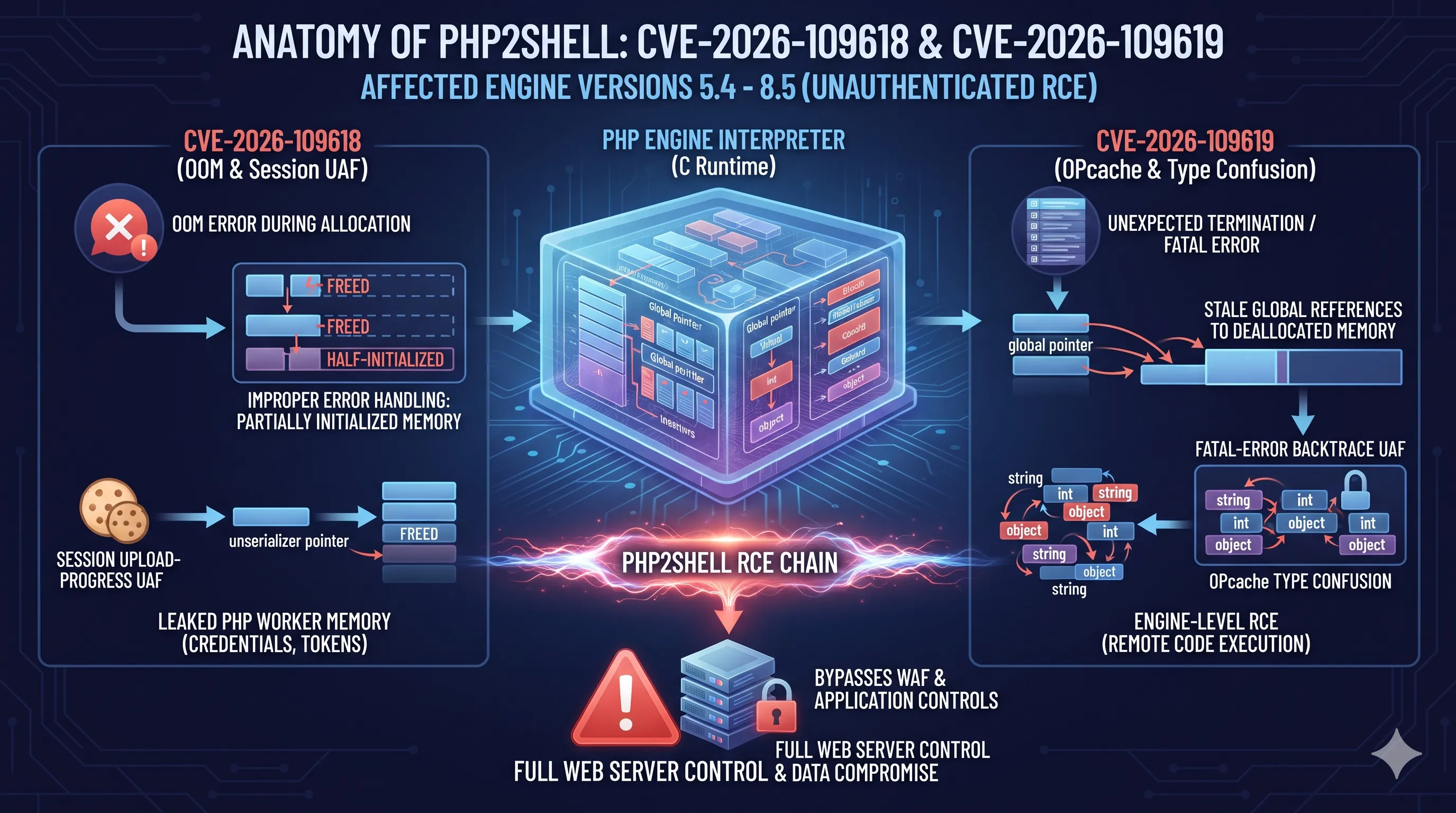
Understanding how AI uncovered previously unknown PHP vulnerabilities requires a technical examination of the underlying memory-safety flaws exposed during the process.Collectively designated as PHP2Shell, the vulnerabilities tracked under CVE-2026-109618 and CVE-2026-109619 affect PHP engine releases spanning versions 5.4 through 8.5.
These flaws reside deep within the C runtime architecture of the PHP interpreter, granting unauthenticated remote code execution (RCE) directly at the PHP engine runtime level.
CVE-2026-109618: Out-of-Memory Handling and Session UAF
The vulnerability cataloged as CVE-2026-109618 exposes critical oversights in PHP's low-level memory allocation routines.At its foundation lies an out-of-memory (OOM) error handling issue involving partially initialized request memory.
During heavy resource allocation, if the PHP engine experiences an allocation failure, error pathways fail to safely release or seal partially populated memory segments.
This failure cascades into a use-after-free (UAF) flaw inside the session upload-progress unserializer.
When the unserializer attempts to reference tracking structures for active file uploads, freed or half-initialized memory buffers are accessed instead, enabling attackers to leak PHP worker memory.
Remarkably, a core PHP developer had previously spotted the underlying OOM bug during an audit in 2024.
However, the flaw went unfixed at that time due to a lack of developer consensus and the absence of a working exploit demonstration to validate its feasibility.
CVE-2026-109619: OPcache Type Confusion and Fatal-Error Backtraces
The second critical vulnerability, CVE-2026-109619, targets execution state consistency across requests.It stems from a stale-state flaw where PHP globals retain lingering references to request memory that has already been deallocated.
This persistence creates an unstable execution context whenever the engine encounters an unexpected termination.
Specifically, a use-after-free condition is triggered when the engine attempts to generate fatal-error backtraces over memory blocks that have already been reclaimed.
When paired with an OPcache type-confusion condition, the internal bytecode caching subsystem treats stale data pointers as valid operational structures.
This corruption allows external payloads to break type boundaries within the PHP engine, achieving unauthenticated remote code execution directly at the runtime tier across versions 5.4 through 8.5.
| CVE Identifier | Affected Engine Versions | Vulnerability Mechanism | Attack Primitives and Exploitation Impact | CVSS Severity Ratings |
|---|---|---|---|---|
| CVE-2026-109618 | PHP 5.4 through 8.5 | Out-of-memory (OOM) handling failure; UAF in session upload-progress unserializer | Partially initialized request memory corruption; leaks PHP worker memory | 9.2 (PHP Developers) / 10.0 (watchTowr) |
| CVE-2026-109619 | PHP 5.4 through 8.5 | Stale-state globals retaining freed request memory; fatal-error backtrace UAF; OPcache type confusion | Type-confusion exploitation; unauthenticated engine-level remote code execution | 9.2 (PHP Developers) / 10.0 (watchTowr) |
Runtime Bypass Mechanisms and Memory Disclosure Vectors
The severity of PHP2Shell has provoked measurable debate regarding CVSS scoring metrics.PHP developers assigned both vulnerabilities a CVSS v4.0 critical rating of 9.2 out of 10.
In contrast, cybersecurity firm watchTowr assessed the CVSS severity at a maximum 10.0 score, emphasizing the absence of operational barriers to exploitation.
Because the flaws reside in the native engine interpreter rather than in userland application logic, exploitation completely bypasses application security controls.
Web application firewalls (WAFs) and defensive secure coding patterns within the web application remain blind to the attack vector, leaving securely coded web applications vulnerable.
When PHP runs via mod_php, these exploits execute arbitrary code before any target application code executes.
Even in scenarios where full code execution is restricted, the memory disclosure mechanisms remain potent.
Attackers can reliably leak sensitive credentials, authentication tokens, API keys, and session cookies originating from parallel worker requests sharing the same process space.
As cybersecurity firm Wiz noted, under correct conditions, attackers could seize full web server control and compromise data across all PHP-dependent assets.
3. The Disclosure Race: Early Leaks, Threat Telemetry, and Rapid In-the-Wild Exploits
This section directly connects to the broader investigation into How AI Uncovered Previously Unknown PHP Vulnerabilities by documenting the critical breakdown between coordinated discovery and real-world exploitation.Once automated and AI-assisted workflows surfaced long-hidden memory flaws in the PHP engine, the window between responsible disclosure and adversarial weaponization collapsed into an unprecedented operational emergency.
From Responsible Disclosure to Pre-Embargo Leaks
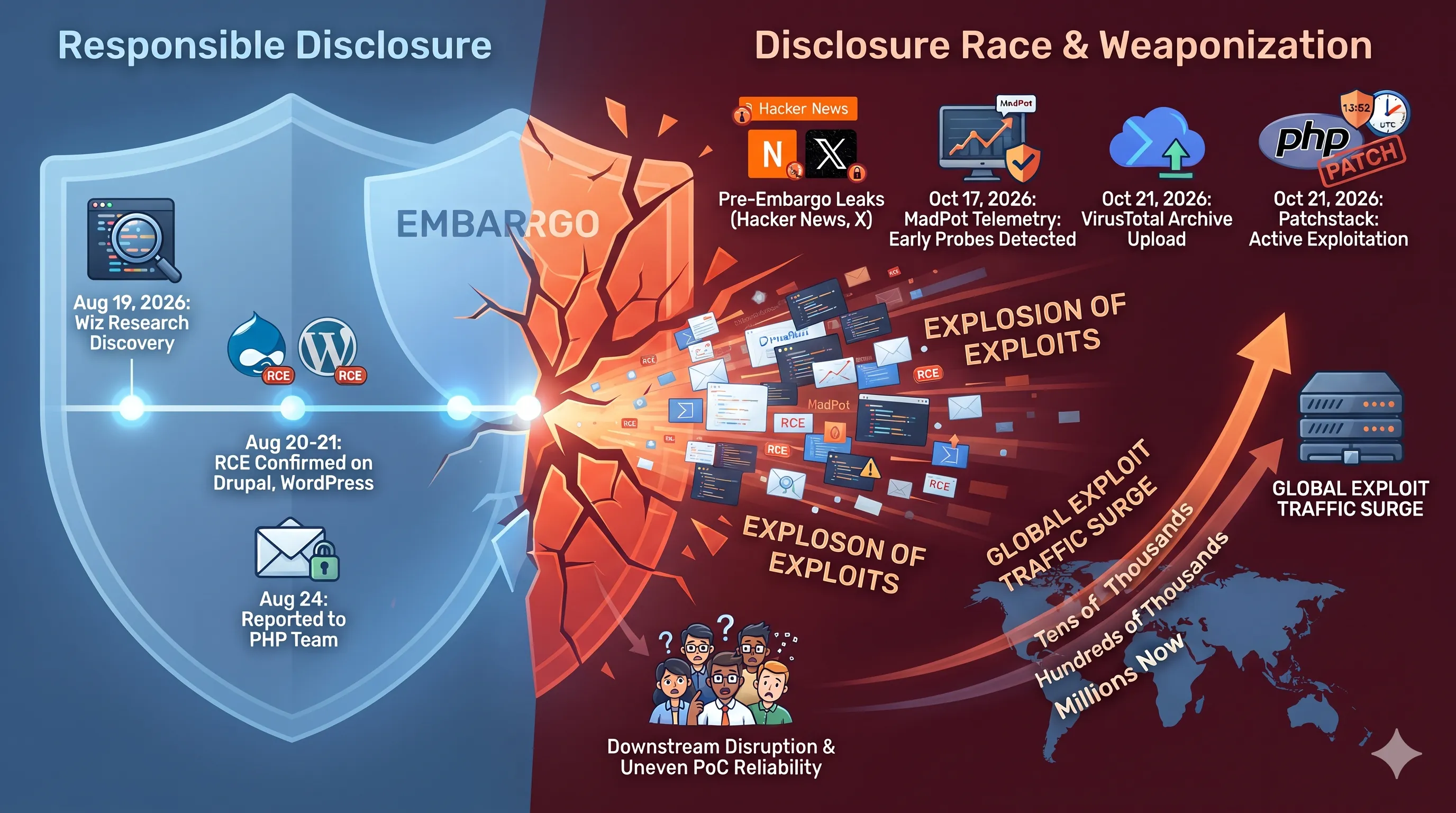
The discovery cycle began when Wiz Research discovered the first vulnerability on August 19, 2026.Validation across widespread web software followed immediately, as Wiz confirmed unauthenticated remote code execution (RCE) on Drupal on August 20, 2026, and on WordPress on August 21, 2026.
Following these findings, the vulnerabilities were privately reported to the PHP team on August 24, 2026 to establish a coordinated embargo and remediation timeline.
The planned disclosure process broke down when technical details, a proof-of-concept video, and patched binaries leaked early on Hacker News, X, and via early vendor package releases.
The breach of secrecy escalated when a leaked vulnerability archive was uploaded to VirusTotal at 02:29 UTC on October 21, 2026.
This premature disclosure forced maintainers to accelerate the release schedule before the planned embargo deadline, culminating when PHP maintainers issued the emergency security update at 13:52 UTC on October 21, 2026.
| Date / Timestamp | Entity / Platform | Event Description |
|---|---|---|
| August 19, 2026 | Wiz Research | First vulnerability discovered |
| August 20, 2026 | Wiz Research / Drupal | Unauthenticated RCE confirmed on Drupal |
| August 21, 2026 | Wiz Research / WordPress | Unauthenticated RCE confirmed on WordPress |
| August 24, 2026 | PHP Team | Vulnerabilities privately reported to PHP maintainers |
| October 17, 2026 | Amazon Threat Intelligence | Exploitation attempts detected in MadPot telemetry four days before disclosure |
| October 21, 2026 (02:29 UTC) | VirusTotal | Leaked vulnerability archive uploaded |
| October 21, 2026 (07:34 UTC) | Patchstack | Active exploitation notifications received from hosting partners |
| October 21, 2026 (13:52 UTC) | PHP Maintainers | Emergency security update officially released |
Amazon MadPot and Cloudflare Traffic Surges
Telemetry data indicates that threat actors were probing the flaw well before the coordinated fix went live.Amazon Threat Intelligence detected exploitation attempts in MadPot telemetry on October 17, 2026, four days before disclosure.
Host-level detection escalated sharply on the morning of release, with Patchstack noting active exploitation notifications from hosting partners at 07:34 UTC on October 21, 2026.
Global network edge monitoring captured the massive transition from targeted scans to widespread internet bombardment.
Cloudflare observed thousands of exploit attempts 10 hours prior to release, rising to millions following public awareness.
Illustrating the rapid surge, Matthew Prince of Cloudflare reported exploit traffic jumped to "tens of thousands in the 45 minutes post announcement, hundreds of thousands within two hours, and millions now."
Flawed Public PoCs and the Acceleration of In-the-Wild Exploitation
The unauthorized dissemination of exploit material caused significant disruption across downstream operations.Early leaks created an unpatched exposure window where public exploits circulated before official upstream patches were available.
Analyzing the rapid fallout, Costin Raiu of TLP:Black described the rapid aftermath as an AI-powered "race to exploit."
Despite the high volume of automated traffic, offensive execution was uneven.
Several public GitHub PoC scripts relied on invalidated cached-pointer theories, causing varying exploit reliability across targeted targets.
4. Global Attack Surface: Mapping Worldwide PHP Exposure Across Legacy Infrastructure
When artificial intelligence models uncovered previously unknown PHP zero-day vulnerabilities, the immediate challenge shifted from theoretical code auditing to assessing real-world exposure across the global web fabric.Because PHP powers approximately 70% of all websites globally according to Wiz data, even isolated vulnerabilities in core parsing logic propagate into structural threats across millions of organizations.
Paul Spain of Gorilla Cyber Security estimated the vulnerability could compromise "millions and millions" of web servers worldwide.
Telemetry Findings Across Veridion, Modat, and VirusTotal
Independent scans conducted across global network telemetry illustrate the vast breadth and structural obscurity of this attack surface.Corporate mapping from Veridion identified affected PHP version strings tied to 7.07 million companies, the vast majority of which represent small organizations operating with fewer than 50 employees.
Beyond those with identifiable deployments, an additional 21.9 million companies operated PHP instances without disclosing specific version strings in their HTTP response headers.
This observation aligns with a fundamental scanning limitation: version-based internet scans routinely undercount the total attack surface because approximately four in five PHP servers actively hide version headers.
Telemetry compiled by Modat registered 4,384,302 PHP services running across 1,886,612 unique hosts.
Concurrently, VirusTotal telemetry identified 5.1 million IP addresses running PHP, with only 1.1 million actively disclosing their exact release branches.
The urgency of patching mechanisms was underscored when VirusTotal identified 85,000 IP addresses already deployed on the September 24 release before patched binaries arrived to remediate the flaw.
| Telemetry Source | Mapped Host / Service Volume | Disclosed vs. Undisclosed Visibility | Key Legacy / Version Concentrations |
|---|---|---|---|
| Veridion | 7.07 million companies mapped to affected strings | 21.9 million additional companies with undisclosed version strings | Heavy concentration in organizations with fewer than 50 employees |
| Modat | 4,384,302 PHP services across 1,886,612 unique hosts | Full network service mapping across reachable endpoints | 79% running on end-of-life branches; 878,761 services on PHP 7.4 |
| VirusTotal | 5.1 million IP addresses running PHP | 1.1 million disclosing versions (approximately 4 in 5 hide headers) | 85,000 IPs on September 24 release before patched binaries arrived |
The End-of-Life Crisis: Legacy Branches in Active Production
The vulnerability surface is severely aggravated by the persistence of unsupported software branches.Modat telemetry revealed that 79% of all observed PHP services reside on end-of-life branches that no longer receive official updates.
Specifically, Modat reported PHP 7.4 alone running on 878,761 active services worldwide.
The vast majority of exposed web servers run end-of-life PHP versions that receive no automated upstream security binaries, creating an environment where discovered vulnerabilities remain unpatched indefinitely.
The exploitable environments span the web’s most ubiquitous content management systems, including WordPress, Drupal, Joomla, MediaWiki, and Magento.
Furthermore, vulnerability impacts extend across various underlying web server integration architectures and Server Application Programming Interfaces (SAPIs).
Environments executing Apache mod_php, PHP-FPM, php-cgi, FrankenPHP, and LiteSpeed are all affected by the exposure vectors.
Turnkey server installations and appliances remain equally vulnerable: PHP instances bundled into popular hosting control panels such as cPanel and Plesk, vendor appliances, and Windows tools are consistently exposed to internet-wide scanning.
Co-Hosted Attack Vectors: Open Databases and Administrative Ports
The danger of newly discovered core PHP vulnerabilities extends beyond simple web defacement or isolated code execution.Exposed PHP servers commonly co-host direct database and remote administration ports, allowing lateral network movement once initial remote code execution is achieved.
VirusTotal telemetry tracked 394,000 PHP hosts exposing SSH, 233,000 exposing MySQL, and 68,000 exposing RDP directly to the public internet.
When a perimeter web application running on an unpatched or end-of-life runtime is compromised, attackers gain immediate local network positioning alongside these unsegmented management interfaces.
The combination of widespread unpatched runtimes, missing upstream security binaries, and direct access to remote administration ports transforms AI-discovered PHP vulnerabilities into severe enterprise-level pivot vectors.

5. Patch Distribution Challenges and Managing Unsupported Legacy Versions
When automated AI auditing tools uncovered previously unknown vulnerabilities deep within the PHP core, the discovery precipitated an immediate operational crisis for infrastructure maintainers.Remediating these structural flaws cannot be handled via superficial filters or runtime configuration tweaks.
PHP maintainers stressed that "there were no complete mitigations and that updating was the only safe choice," leaving direct runtime patching as the sole path to security.
Underlining the urgency of the threat, PHP maintainers officially stated: "All PHP users are strongly encouraged to update immediately."
Yet, distributing critical runtime updates across widely fragmented production deployments poses significant logistical and architectural hurdles.
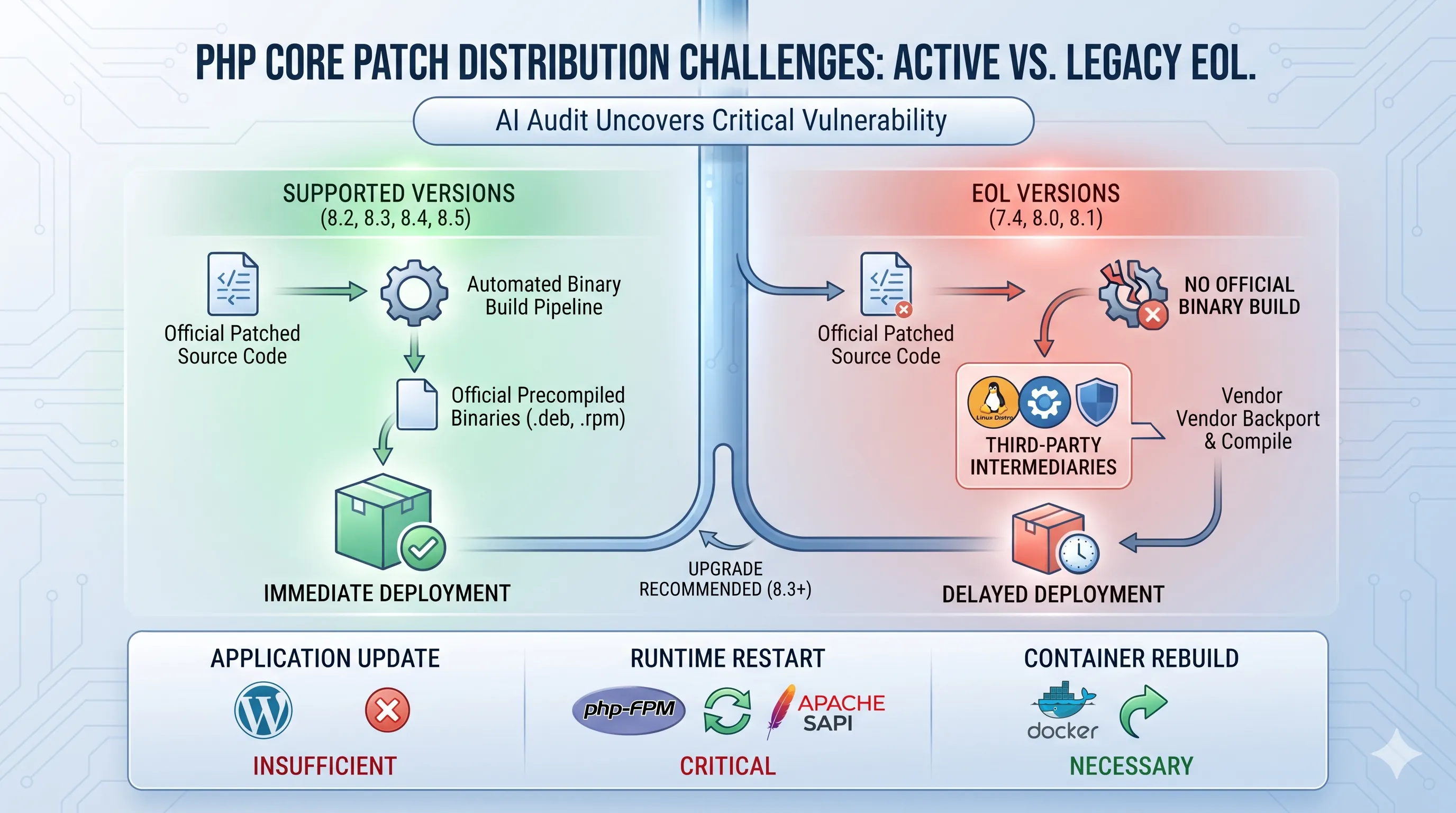
Official Binaries vs. Uncompiled Source Patches for EOL Branches
To address the core engine flaws, the PHP project published official patched versions across actively supported release streams: 8.2.35, 8.3.36, 8.4.27, and 8.5.12.However, a substantial portion of global infrastructure continues to run unsupported legacy releases.
In response, source code patches were provided for end-of-life branches 7.4, 8.0, and 8.1 without compiled binary packages.
Because no precompiled official binaries exist for legacy versions 8.1 and earlier, operators maintaining older systems cannot rely on standard upstream binary distribution channels.
Furthermore, PHP 8.2 reaches security end-of-life at the end of 2026, prompting recommendations to upgrade to 8.3 or higher to maintain long-term binary support and stability.
| Release Branch | Patched Version / Remediation Deliverable | Lifecycle Status | Binary Package Availability |
|---|---|---|---|
| PHP 8.5 | 8.5.12 | Active Support | Official precompiled binaries available |
| PHP 8.4 | 8.4.27 | Active Support | Official precompiled binaries available |
| PHP 8.3 | 8.3.36 | Active Support (Recommended upgrade target) | Official precompiled binaries available |
| PHP 8.2 | 8.2.35 | Reaches security end-of-life at the end of 2026 | Official precompiled binaries available |
| PHP 8.1 | Source code patch | End-of-Life (EOL) | No official precompiled binaries (Source-only) |
| PHP 8.0 | Source code patch | End-of-Life (EOL) | No official precompiled binaries (Source-only) |
| PHP 7.4 | Source code patch | End-of-Life (EOL) | No official precompiled binaries (Source-only) |
Container Rebuilds and SAPI Service Restart Requirements
A dangerous misconception during widespread language-level security events is that web applications can be shielded through content management updates.Application-level updates (such as updating WordPress core or plugins) do not resolve the vulnerability in the PHP engine.
Neutralizing the threat requires modifying the underlying execution environment itself.
Upgrading to designated patched versions and restarting web server services (Apache or PHP-FPM) completely resolves the root causes.
Without terminating and restarting these Server API (SAPI) daemons, active processes continue executing with vulnerable memory segments loaded.
In modern deployment architectures, runtime patching extends beyond basic package manager commands.
Containerized environments require rebuilding base images with updated PHP runtimes to deploy fixes.
If organizations merely update code repositories without rebuilding and rolling out updated container images, the underlying runtime vulnerability remains exposed.
PHP Foundation Maintenance Resources and Vendor Backporting
The massive coordination required to address engine-level flaws highlights the operational bottlenecks of open-source stewardship.The PHP Foundation operates with 13 full- and part-time staff members relying on external donations.
Given these finite internal resources, upstream maintainers cannot sustain full-scale binary build pipelines for obsolete releases alongside four active release lines.
Consequently, organizations bound to legacy environments must rely on third-party downstream intermediaries.
The absence of official compiled binaries for versions 8.1 and earlier creates a hard dependency requiring Linux distributions or LTS vendors to backport patches into their respective downstream repositories.
Until distribution packagers successfully ingest the raw source patches, adapt them to legacy codebases, and publish compiled packages, millions of servers running legacy stacks remain completely dependent on external vendor maintenance lifecycles.
6. Global Incident Response: Emergency Directives and Precautionary Outages
Connecting directly to the revelations of how artificial intelligence uncovered previously unknown PHP vulnerabilities, the emergence of the PHP2Shell threat catalyzed an immediate, coordinated operational shift across international cybersecurity agencies and enterprise infrastructure.Because the vulnerability exposed core interpreter behaviors that had escaped manual security reviews for years, the disclosure forced global administrators into severe defensive measures rather than standard rolling updates.
Government Directives: NSA, NCSC, and International Advisories
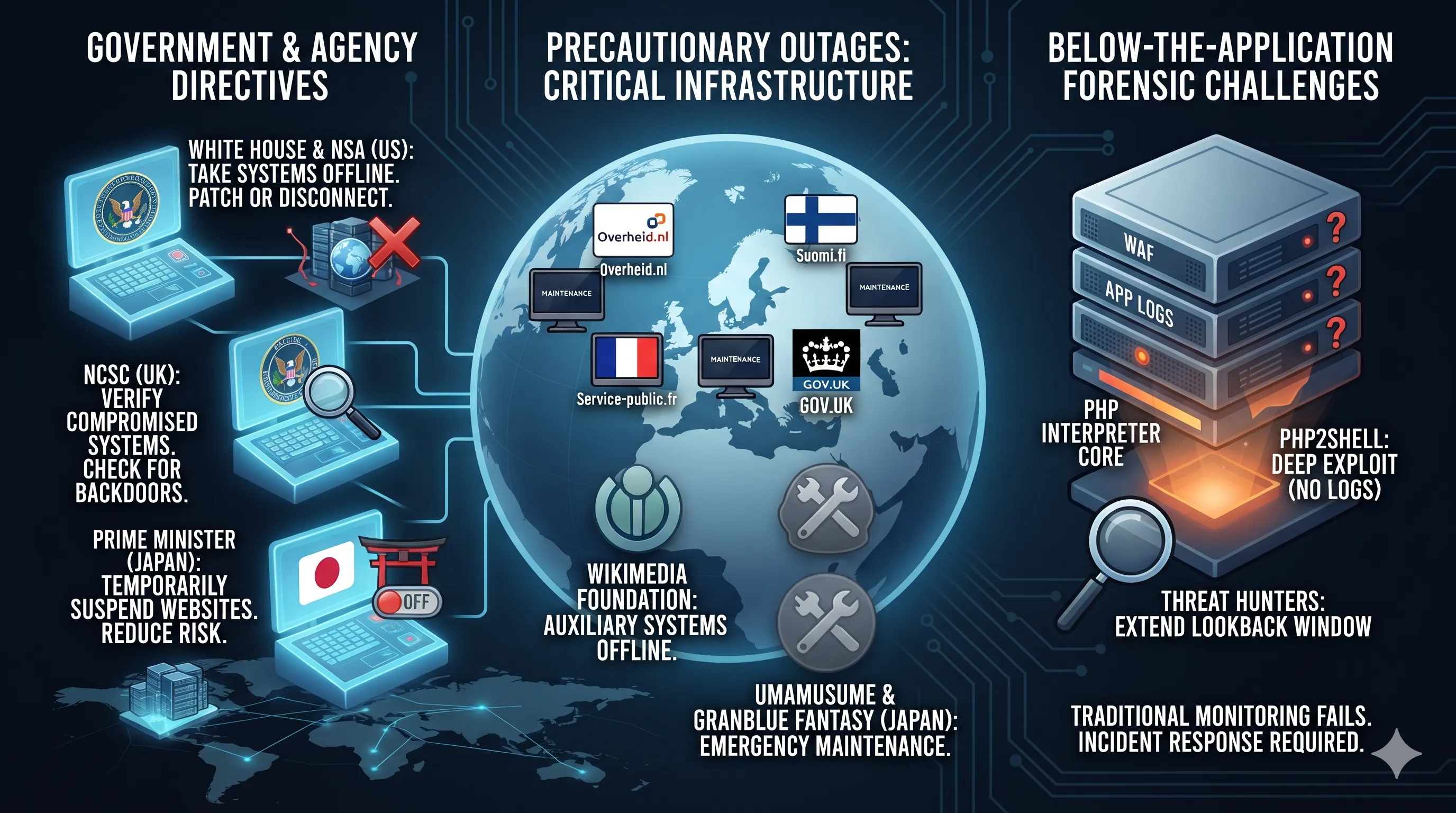
The operational fallout began at the highest levels of state intelligence and cybersecurity governance.The United States White House was alerted to the vulnerability on Friday ahead of public disclosures, setting in motion immediate multi-agency reviews.
Shortly thereafter, emergency security directives were issued across the United States, the United Kingdom, the European Union, Germany, Finland, the Netherlands, Australia, and Japan.
The regulatory instructions reflected the critical severity of the zero-day flaw.
The US National Security Agency (NSA) issued severe mitigation guidance, instructing "all organisations that use PHP to take their systems offline if they were unable to patch them immediately."
Simultaneously, the UK National Cyber Security Centre (NCSC) escalated its mandates, instructing organizations to rigorously verify systems for "backdoors installed by an attacker."
In Japan, high-level executive involvement underscored the potential disruption.
Japanese Prime Minister Sanae Takaichi posted an urgent request on X stating: "temporarily suspending websites and similar measures can be considered an effective way to reduce risk."
| Entity / Jurisdiction | Directive or Defensive Action | Stated Objective or Instruction |
|---|---|---|
| United States (NSA / White House) | Alerted White House on Friday ahead of disclosures; issued national directive | Instructed all organisations using PHP to take systems offline if unable to patch immediately |
| United Kingdom (NCSC) | Issued emergency security directive | Instructed organizations to verify compromised systems for backdoors installed by an attacker |
| Japan (Prime Minister Sanae Takaichi) | Issued public executive guidance via X | Advised that temporarily suspending websites and similar measures can be considered an effective way to reduce risk |
| European Agencies (Netherlands, Finland, France, UK) | Proactive network disconnects | Pulled official administrative portals and digital identity services offline to prevent exploitation |
Proactive Shutdowns Across European Public Portals and Wikimedia
Rather than risking live compromise while patches were compiled and vetted, critical infrastructure providers opted for immediate, precautionary downtime.Government agencies across the Netherlands, Finland, France, and the UK proactively pulled official portals and digital identity sites offline to isolate them from network exposure.
Beyond civil services, prominent non-profit and digital knowledge platforms took parallel defensive maneuvers.
The Wikimedia Foundation took auxiliary systems offline as a defensive safeguard to protect underlying infrastructure.
At the same time, commercial platforms, broad web services, and Japanese gaming infrastructure—including Umamusume and Granblue Fantasy—entered emergency maintenance periods to mitigate exposure.
Forensic Challenges of Below-the-Application Exploitation
The defensive decision to disconnect services rather than rely on telemetry monitoring stems directly from how the vulnerability functions under the surface.Exploitation attempts operate below the application layer, leaving few or no indicators in standard web application logs.
Because standard application monitoring fails to record malicious payloads traversing these interpreter paths, security teams cannot rely on traditional web application firewalls or access logs to confirm safety.
Consequently, incident response operations face steep forensic hurdles.
Threat hunters must extend lookback windows to dates preceding public disclosure to spot early intrusion attempts and verify whether backdoors were covertly planted before preventative shutdowns were enacted.
7. Temporary Workarounds, Configuration Hardening, and Forensic Diagnostics
As artificial intelligence methodologies uncover previously unknown PHP vulnerabilities, enterprise response teams face a critical operational window where unpatched attack vectors can be exploited in the wild before vendor patches are distributed and deployed.This section connects directly to mitigating the risks of these newly discovered vulnerabilities by detailing temporary configuration hardening, evaluating the defensive boundaries of Web Application Firewalls (WAFs), and providing authenticated forensic verification techniques to audit live web runtime environments.
Apache and PHP-FPM Configuration Adjustments
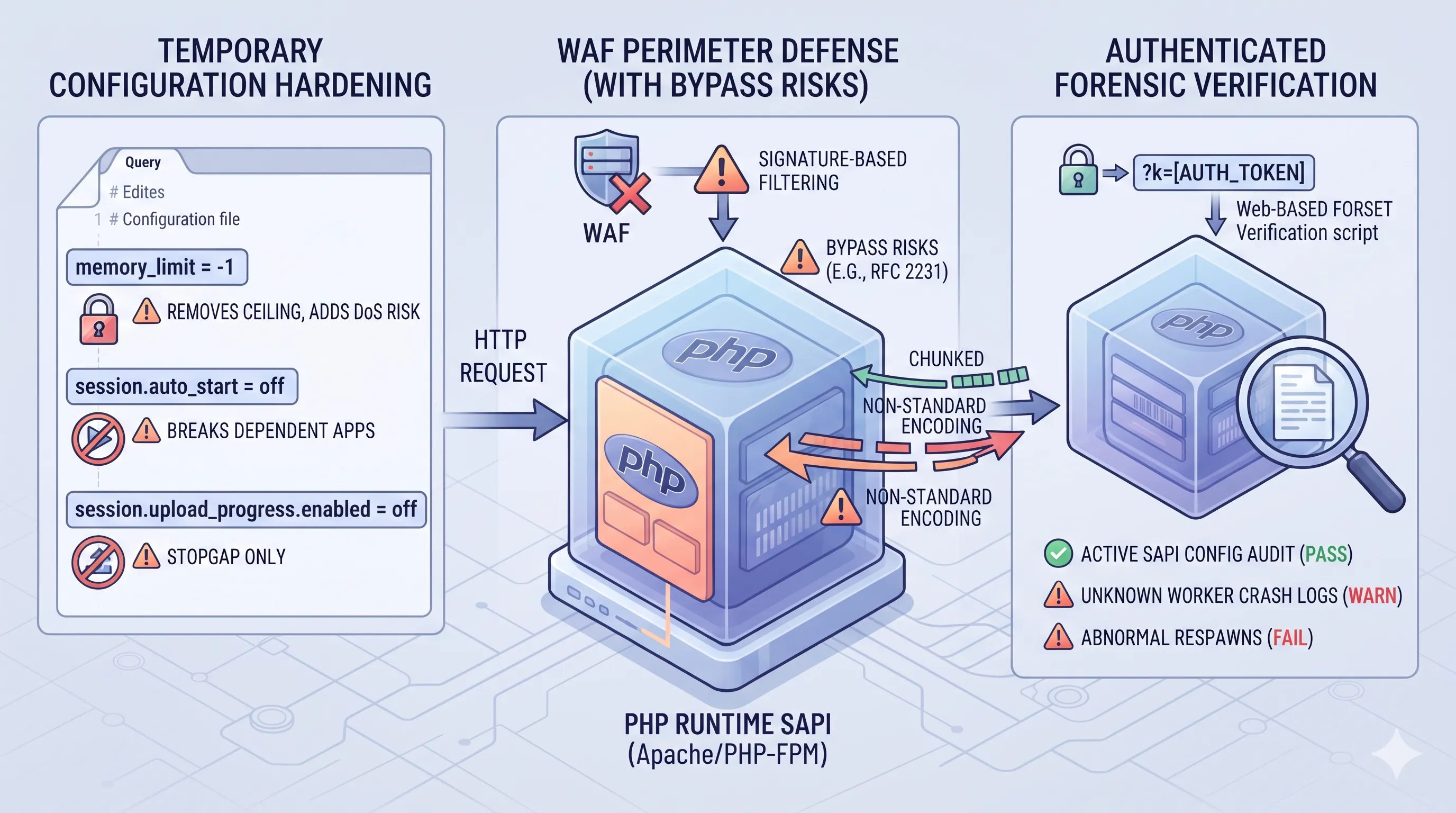
Temporary configuration adjustments disable upload progress tracking and session auto-start to eliminate unauthenticated state injection paths.To apply temporary mod_php hardening settings in Apache configuration to limit exposure when patches cannot be applied immediately, administrators can implement directives at the server or directory configuration level:
php_admin_value memory_limit -1
php_admin_flag session.auto_start offHowever, setting memory_limit to -1 removes PHP's memory ceilings, potentially creating denial-of-service risks unless constrained at the OS level.
Furthermore, disabling session.auto_start breaks applications that use $_SESSION without an explicit session_start() call.
In environments operating through modern process managers, operators must configure PHP-FPM pool parameters to restrict session upload progress and auto-start vectors directly:
php_admin_value[memory_limit] = -1
php_admin_flag[session.upload_progress.enabled] = off
php_admin_flag[session.auto_start] = offIn these environments, default PHP garbage collection cleans session files after 1440 seconds (24 minutes), meaning lingering session artifacts remain accessible during this window unless strictly managed.
Administrators must recognize that temporary mitigations fail to protect against emerging code variations and are strictly stopgaps until patching.
| Configuration Directive | Hardening Mechanism | Operational Limitation / Side Effect |
|---|---|---|
| memory_limit = -1 | Overrides PHP memory limits at the admin level to prevent out-of-memory crashes | Removes memory ceilings and introduces denial-of-service risks unless constrained at the OS level |
| session.auto_start = off | Disables automatic initiation and creation of sessions across incoming HTTP requests | Breaks applications that interact with $_SESSION without calling session_start() explicitly |
| session.upload_progress.enabled = off | Disables upload progress tracking to neutralize session upload progress attack vectors | Disables native tracking features and functions strictly as a temporary stopgap until patching |
WAF Limitations and Encoding Bypass Risks
Edge perimeter defenses often attempt to intercept exploits targeting PHP session structures before payloads reach the backend interpreter.WAF rules target multipart requests containing PHP_SESSION_UPLOAD_PROGRESS or deeply nested field names.
Relying entirely on inspection layers introduces severe operational risk because WAF detection can be bypassed using alternate character sets, large chunked payloads, or RFC 2231/5987 encodings.
Because edge filters evaluate standard serialization patterns, malicious actors leveraging non-standard encodings can deliver payloads that bypass perimeter signatures entirely.
Consequently, temporary mitigations fail to protect against emerging code variations and are strictly stopgaps until patching.
Server-Level Log Forensics and Authenticated SAPI Verification
Validating whether an environment is resilient requires deep inspection of the active Server Application Programming Interface (SAPI) rather than superficial checks.Xint security analysis emphasized that command line verification ('php -v') does not inspect web server runtime configs.
A command-line execution evaluates the CLI binary's distinct configuration, entirely bypassing the loaded pool settings and administrative flags active in Apache mod_php or PHP-FPM.
To safely invoke web-based verification script in document root without exposing diagnostics to unauthorized visitors, administrators must use an authenticated query parameter structure:
https://<your-domain>/<script-name>.php?token=When assessing potentially breached hosts, forensic investigations examine server-level error logs for crashes referencing 'in Unknown on line 0' or abnormal worker restarts.
If evidence of system compromise or unexpected worker termination is uncovered, compromised hosts require network isolation, credential replacement, and cryptographic key rotation.
Related Posts


Generative AI may have assisted with research or drafting for this article. Topic selection, fact-checking, final wording, and publication remain the responsibility of DragonStone74. AI use disclosure