
OpenAI Expands ChatGPT Support for COBOL and Legacy Programming Languages
🚀 Key Takeaways
- Expanded Legacy Support: OpenAI has enhanced ChatGPT and frontier reasoning models to support low-resource legacy languages, notably COBOL, Fortran, and Visual Basic.
- MultiLangBench Evaluation: An open-source benchmark focused on complex software reimplementation now provides a standardized environment to measure legacy code generation across diverse languages.
- Automated Modernization Capabilities: Successive model iterations demonstrate major gains in porting antiquated procedural logic to modern target languages under strict functional parity requirements.
- Critical Infrastructure Focus: Upgraded capabilities specifically target institutional backbones—such as financial networks and scientific analysis pipelines—facing shrinking pools of qualified maintainers.
- Mandatory Verification Boundaries: While internal benchmarks reveal high translation fidelity, real-world deployment still necessitates strict expert review to catch subtle numerical anomalies and hidden dependencies.
Massive enterprise operations continue to run reliably on COBOL, Fortran, and vintage procedural languages, even as the engineers who originally authored and maintained those systems steadily retire.
With institutional knowledge fading and manual rewriting projects presenting enormous costs and operational risks, modernization has emerged as one of the enterprise software sector's most persistent bottlenecks.
OpenAI's expansion of ChatGPT capabilities into low-resource legacy environments represents a targeted effort to bridge this widening gap.
Supported by the release of the MultiLangBench framework, frontier reasoning models are displaying unprecedented competence in parsing archaic syntax, extracting implicit business logic, and translating legacy routines into contemporary software architectures.
This shift extends generative artificial intelligence beyond modern developer utilities and positions it squarely within core digital infrastructure preservation.
Successfully converting synthetic benchmark success into dependable production refactoring, however, demands careful alignment between algorithmic reasoning, numerical precision safeguards, and rigorous human architectural oversight.

1. Critical Legacy Infrastructure and the Low-Resource Code Maintenance Bottleneck
OpenAI's expansion of ChatGPT support for legacy languages addresses an acute operational challenge across global enterprise computing.
While modern development centers heavily on contemporary application stacks, foundational sectors remain dependent on architectures established decades ago.
Core Banking and Scientific Infrastructure Dependencies
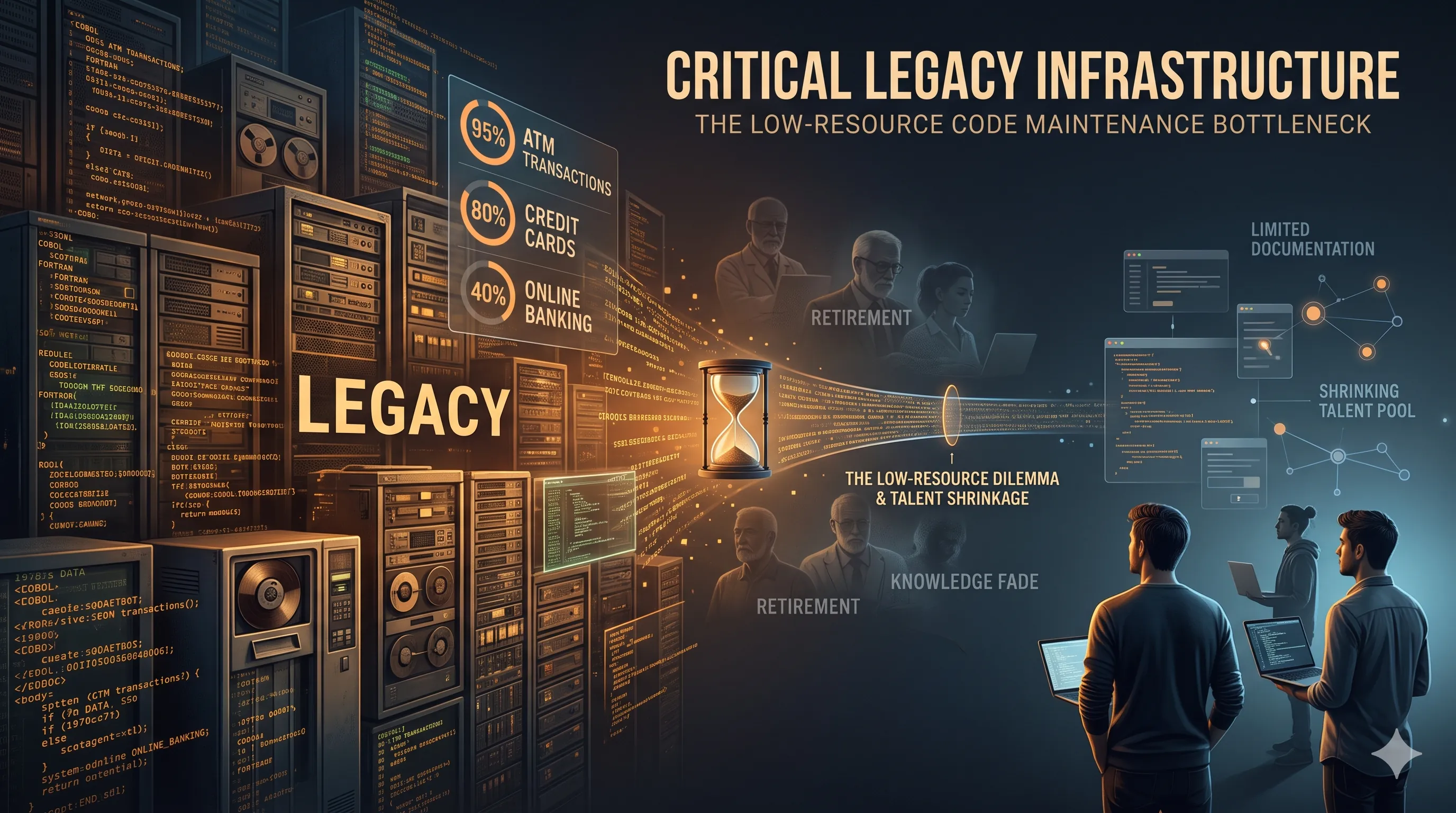
The global financial system continues to lean heavily on legacy codebases to process critical transaction volume.
Specifically, COBOL powers 95% of ATM transactions worldwide.
In retail commerce, COBOL processes 80% of in-person credit card transactions.
Furthermore, COBOL supports more than 40% of online banking systems.
| Infrastructure Sector | Legacy Technology | Operational Footprint |
|---|---|---|
| ATM Network Infrastructure | COBOL | Powers 95% of transactions |
| Point-of-Sale / Card Processing | COBOL | Processes 80% of in-person credit card transactions |
| Online Banking Infrastructure | COBOL | Supports more than 40% of systems |
Beyond commercial banking, technical and scientific computation remains tightly bound to legacy software.
Fortran maintains critical production deployments in weather forecasting and nuclear reactor safety analysis.
These mission-critical environments demonstrate that legacy platforms are not dormant archives, but active backbones of public and industrial safety.
The Low-Resource Dilemma and Shrinking Engineering Talent
Despite their deep enterprise footprint, OpenAI categorizes COBOL, Fortran, and Visual Basic as low-resource languages due to limited training code and documentation compared to Python or JavaScript.
Public repositories and current digital discussion forums contain vastly fewer modernized code samples for these platforms, creating training constraints for general-purpose artificial intelligence models.
At the same time, demand for these skills has resurfaced in industry tracking.
Reflecting persistent enterprise reliance, COBOL rose from 23rd place in October 2025 to 16th place in the TIOBE popularity index.
This renewed visibility highlights a widening operational crisis.
Enterprises face continuing operational dependence on legacy infrastructure alongside a shrinking workforce of qualified engineers.
Legacy systems present maintenance bottlenecks caused by outdated documentation, loss of original domain engineers, and undocumented business rules embedded directly in code.
As the personnel who originally authored these routines retire, organizations must manage mission-critical logic preserved only within decades-old syntax.
2. MultiLangBench Architecture: Testing SQLite Reimplementation in Low-Resource Languages
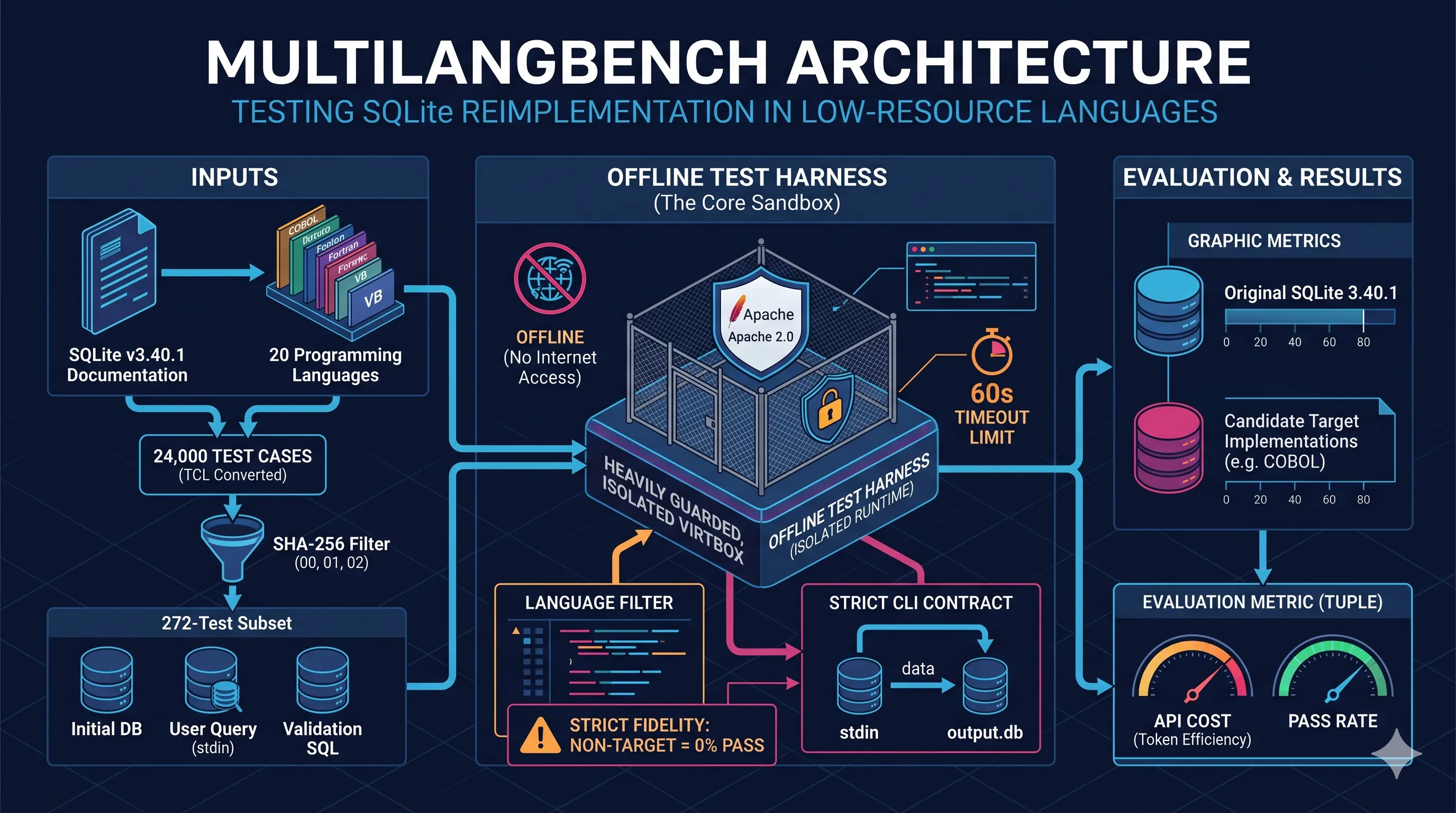
To rigorously evaluate how OpenAI expands ChatGPT support for legacy languages, empirical validation must move beyond basic syntax translation into complex systems engineering.The MultiLangBench evaluation harness, published on GitHub under the Apache License 2.0, provides this technical foundation by benchmarking an AI model's capacity to reimplement SQLite version 3.40.1 directly from its formal documentation across 20 programming languages.
Rather than relying on surface-level unit testing, the harness assesses end-to-end operational correctness, compiling and running candidate database engines within an isolated execution environment.
Offline Test Harness and Execution Constraints
The MultiLangBench runtime enforces rigid execution constraints to maintain deterministic results and prevent test leakage.The evaluation environment operates fully offline with no internet access permitted during compilation or execution.
Candidate executables must follow a standardized command-line interface contract: each binary must accept the database path as a CLI argument, ingest SQL commands via stdin, and produce the resulting output.db.
Every individual test case execution is bound by a strict 60-second execution timeout.
Language fidelity is strictly enforced by the harness: solutions not written in the requested target programming language or those that mix languages receive an automatic pass rate of 0.
Model performance is not represented by a single qualitative metric; instead, scores are recorded as an explicit tuple of API cost and test pass rate.
| Harness Component | Specification / Operational Rule | Validation Purpose |
|---|---|---|
| Network Policy | Fully offline; zero internet access permitted | Guarantees hermetic test runs and prevents dynamic dependency retrieval |
| CLI Interface | Database path accepted as CLI argument; SQL passed via stdin to produce output.db | Standardizes I/O across all target language implementations |
| Execution Timeout | 60 seconds per test case | Prevents hangs caused by infinite loops or deadlocks in generated code |
| Target Language Policy | Automatic pass rate of 0 for mixed languages or non-target language solutions | Eliminates polyglot fallbacks and enforces strict target language synthesis |
| Output Metric | Explicit tuple of API cost and test pass rate | Measures economic token efficiency alongside architectural accuracy |
SQLite Reimplementation Protocol and Test Selection
Validating whether an engine adheres to SQLite version 3.40.1 specifications requires deep structural testing derived from SQLite's canonical test suite.MultiLangBench converts SQLite's original 51,000 TCL tests into an automated suite containing 24,000 converted test cases.
Each individual test case consists of three distinct components: an initial_database SQL script, a user_query stdin input, and a validation_query SQL script executed directly against the reference SQLite implementation to verify correctness.
Because executing the full 24,000-test suite across multiple iterations is computationally expensive, the harness establishes a lightweight, standardized default evaluation profile.
This standard evaluation run defaults to a 272-test subset filtered by selecting test cases whose SHA-256 hash names start with the prefixes 00, 01, and 02.
This deterministic filtering mechanism mitigates compute overhead while preserving representative coverage across SQLite database storage, transaction handling, and query verification.
3. Evaluating Model Capabilities Across Low-Resource Runtimes and Cost Tiers
OpenAI's initiative to expand ChatGPT support for legacy languages introduces empirical evaluation benchmarks across legacy and low-resource environments.Understanding execution capabilities across model generations requires examining benchmark performance on MultiLangBench, contrasting high-capacity frontier models with lightweight API alternatives.
GPT-6 Astra Execution Gains in Low-Resource Languages
OpenAI stated that the choice of languages was guided by developer and enterprise feedback reporting that coding models struggle with low-resource languages.To assess real-world viability, MultiLangBench evaluated COBOL, Fortran, Visual Basic, and OCaml alongside 16 other languages at maximum reasoning effort.
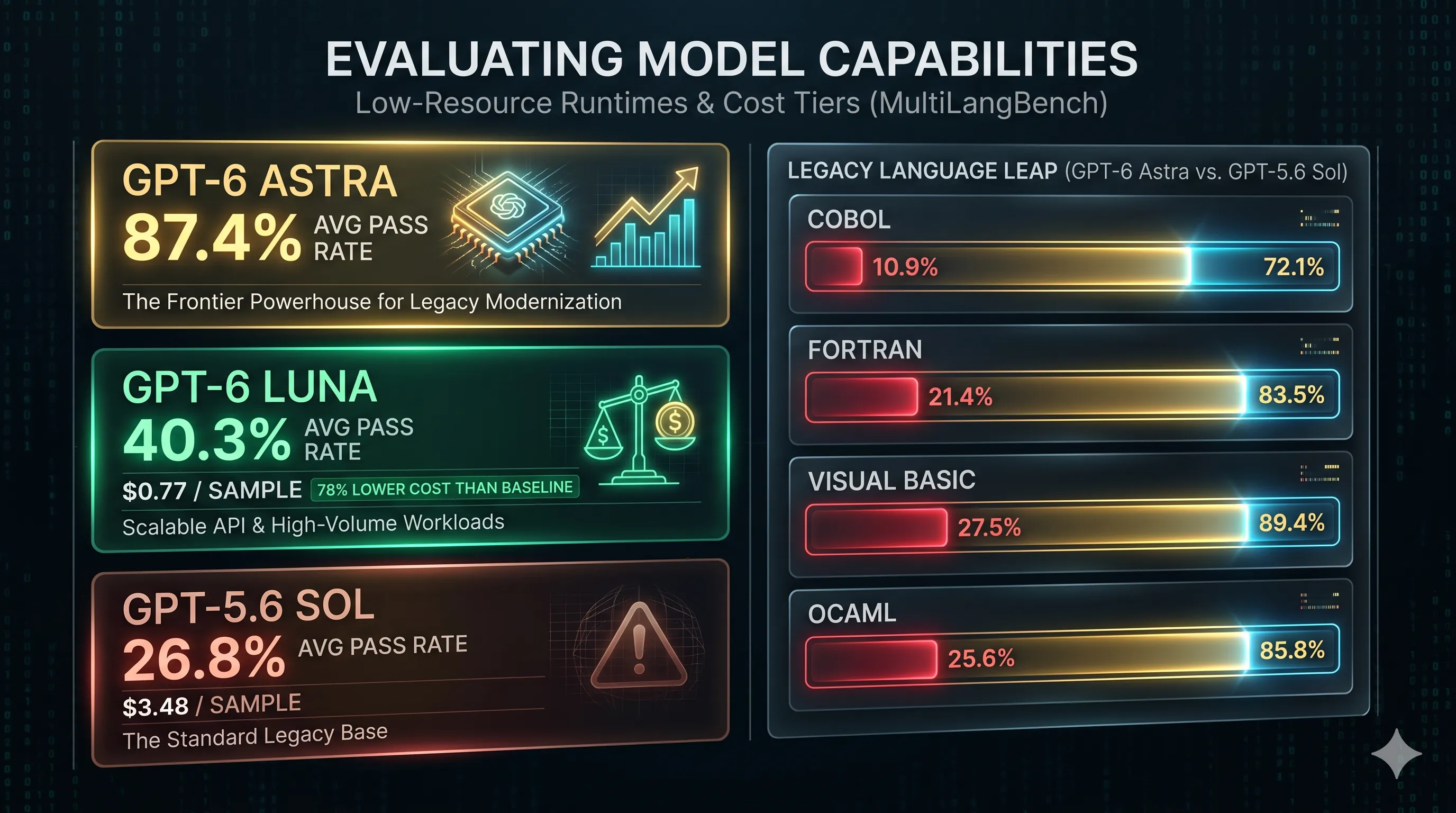
Across the full suite of 20 programming languages, GPT-6 Astra achieved an average test pass rate of 87.4%, representing a substantial progression over baseline model GPT-5.6 Sol, which scored an average pass rate of 26.8%.
Furthermore, GPT-6 Astra scored above 83% in 19 of the 20 benchmarked languages, demonstrating consistent reasoning across specialized syntax structures.
In legacy enterprise environments, the gains were pronounced across core modernization stacks:
In COBOL, GPT-6 Astra achieved a 72.1% pass rate, rising from 10.9% for GPT-5.6 Sol.
In Fortran, pass rates reached 83.5% under GPT-6 Astra, compared to 21.4% for GPT-5.6 Sol.
In Visual Basic, GPT-6 Astra recorded an 89.4% pass rate, up from 27.5% for GPT-5.6 Sol.
In OCaml, GPT-6 Astra attained an 85.8% pass rate, compared to 25.6% for GPT-5.6 Sol.
GPT-6 Luna Cost-to-Performance Profile for Enterprise API Workflows
Both models are made accessible through the OpenAI API for enterprise coding workflows, necessitating balanced trade-offs between absolute reasoning accuracy and API expenditure.Operating as an efficient tier, GPT-6 Luna recorded an average pass rate of 40.3% across MultiLangBench at maximum reasoning effort.
In specific runtime evaluations, GPT-6 Luna recorded a pass rate of 17.1% in COBOL, 31.4% in Fortran, 41.6% in Visual Basic, and 34.1% in OCaml.
While trailing the top-tier accuracy of GPT-6 Astra, GPT-6 Luna provides substantial economic efficiency for high-volume execution.
The estimated average API cost for GPT-6 Luna was $0.77 per sample, which is roughly 78% lower than the $3.48 per sample recorded for baseline GPT-5.6 Sol.
| Model | Average MultiLangBench Pass Rate | COBOL Pass Rate | Fortran Pass Rate | Visual Basic Pass Rate | OCaml Pass Rate | Estimated Average API Cost per Sample |
|---|---|---|---|---|---|---|
| GPT-5.6 Sol (Baseline) | 26.8% | 10.9% | 21.4% | 27.5% | 25.6% | $3.48 |
| GPT-6 Luna | 40.3% | 17.1% | 31.4% | 41.6% | 34.1% | $0.77 |
| GPT-6 Astra | 87.4% | 72.1% | 83.5% | 89.4% | 85.8% | — |
4. Automated COBOL Migration: Achieving Byte-Level Semantic Parity and Numerical Precision
As OpenAI expands ChatGPT support for legacy languages, automated modernization frameworks must confront the strict correctness demands of mission-critical enterprise systems.Evaluating automated translation requires validating that legacy business logic remains entirely intact across platform boundaries.
Hidden Test Parity and Target Language Portability
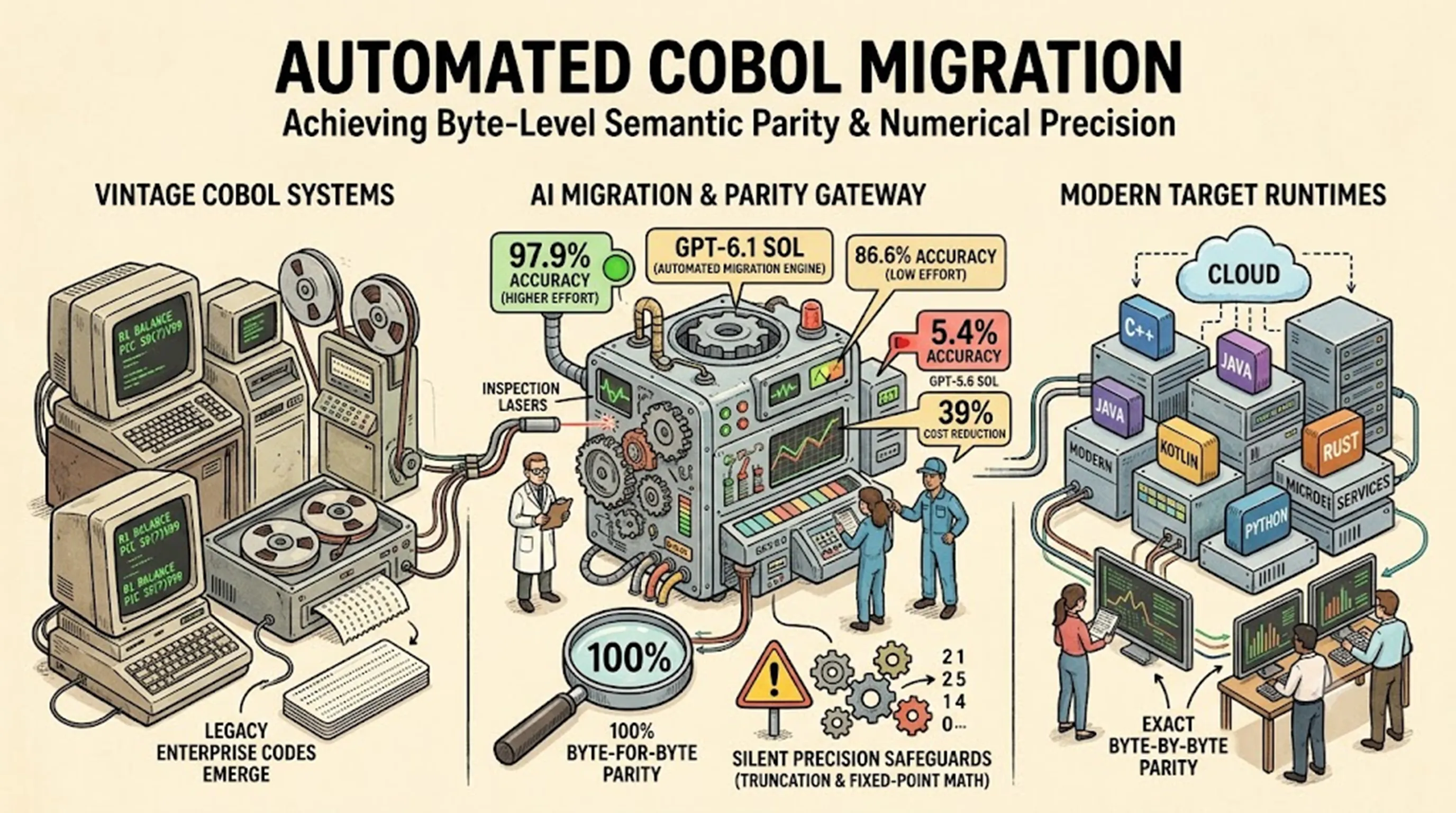
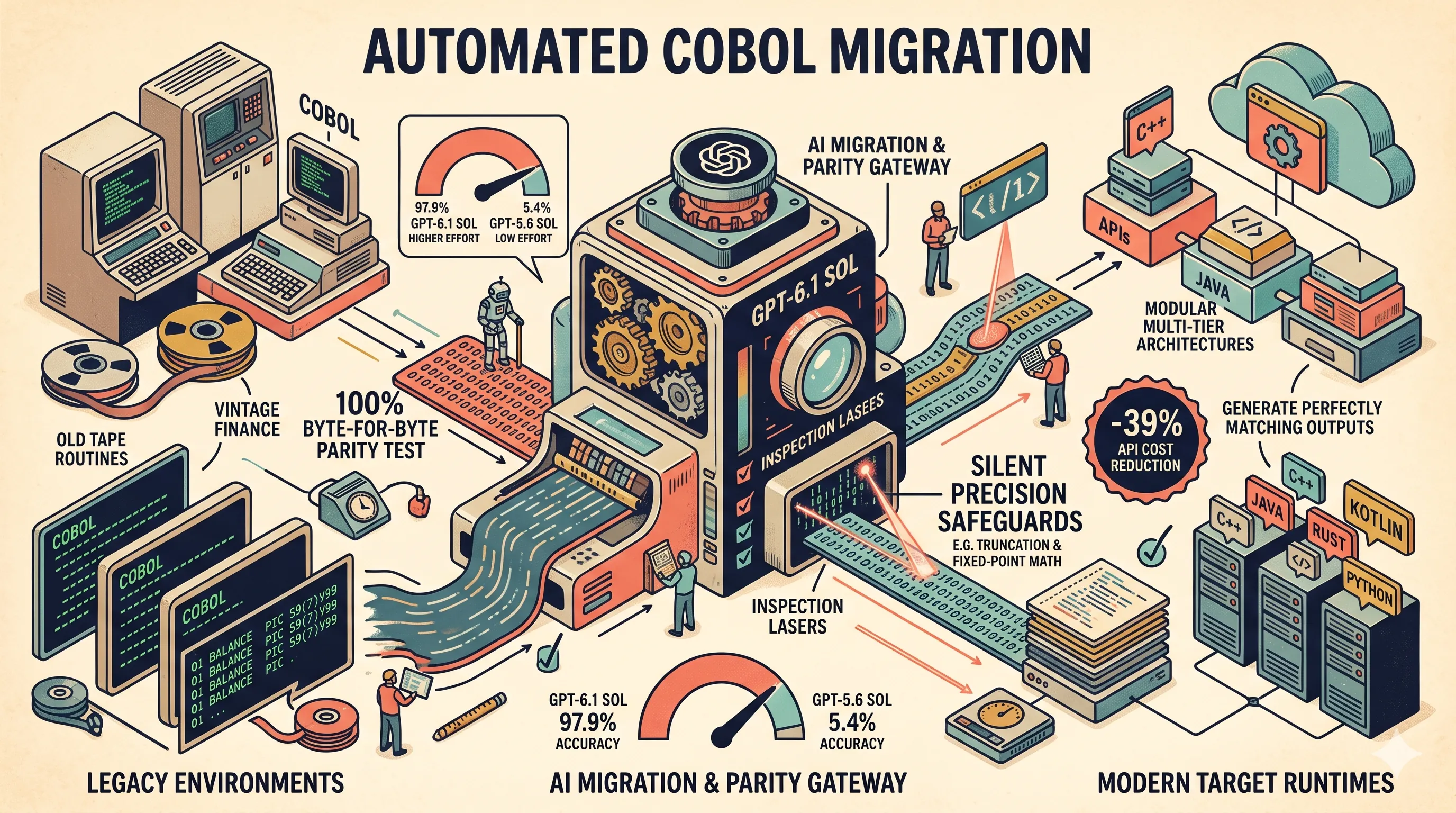
The COBOL migration evaluation framework assesses model capabilities by porting legacy COBOL programs directly into modern programming languages, specifically C++, Java, Kotlin, Python, or Rust.To prevent models from optimizing for superficial syntax without preserving runtime semantics, the framework uses hidden evaluation tests that enforce mandatory byte-for-byte output parity on all observable outputs.
Under this evaluation criterion, partial correctness is rejected: a migration run is classified as successful only if 100% of the hidden test suite passes.
This benchmark highlights significant architectural leaps across model generations.
At low reasoning effort, GPT-5.6 Sol achieved an accuracy of only 5.4% on the COBOL migration test.
In contrast, GPT-6.1 Sol scored 86.6% accuracy on the exact same COBOL migration benchmark at low reasoning effort.
In addition to the marked gain in precision, GPT-6.1 Sol ran at 61% of the API cost of GPT-5.6 Sol at low reasoning effort, which represents a 39% cost reduction.
When allocated higher reasoning effort, GPT-6.1 Sol reached 97.9% accuracy on the COBOL migration test.
OpenAI described the 97.9% score under higher reasoning effort as bringing the COBOL migration evaluation close to saturation.
| Model | Reasoning Effort Level | COBOL Migration Accuracy | Relative API Cost |
|---|---|---|---|
| GPT-5.6 Sol | Low | 5.4% | 100% (Baseline) |
| GPT-6.1 Sol | Low | 86.6% | 61% (39% cost reduction) |
| GPT-6.1 Sol | Higher | 97.9% | Close to evaluation saturation |
Fixed-Point Arithmetic and Silent Precision Risks
Achieving complete output parity between COBOL and contemporary target languages introduces deep numerical translation challenges.A primary issue stems from COBOL fixed-point arithmetic behaviors.
By design, COBOL discards excess decimal digits unless explicit rounding is programmed into the original statements.
When translated into modern targets such as C++, Java, Kotlin, Python, or Rust, standard floating-point or default arithmetic types often handle remainders differently.
Unless translated code accurately mirrors this truncation rule, the difference can lead to silent numerical discrepancy in the translated code.
Because the migration benchmark requires 100% of hidden tests to achieve byte-for-byte parity on observable outputs, resolving these silent arithmetic discrepancies remains a fundamental requirement for automated modernization.
5. Enterprise Verification Guidelines and Production Deployment Safeguards
As OpenAI expands ChatGPT support for legacy languages to tackle core enterprise systems like COBOL, bridging the gap between automated modernization tools and mission-critical production environments requires rigorous engineering governance.While advancements in model reasoning present compelling automation capabilities, translating experimental benchmark success into resilient enterprise infrastructure demands strict operational verification.
Synthetic Benchmarks Versus Production Realities
Organizations evaluating AI-assisted migration must separate controlled algorithmic evaluations from the multifaceted complexities of enterprise software stacks.Published metrics reflect pass rates on isolated synthetic benchmarks rather than automated guarantees for live enterprise deployments.
Furthermore, the benchmark evaluations announced in October 2026 were designed and executed internally by OpenAI without independent external third-party verification.
Because synthetic benchmark suites isolate code logic from legacy runtime idiosyncrasies, high benchmark scores do not imply that generated programs can bypass rigorous pre-production gatekeeping.
Recommended Phased Verification and Human-in-the-Loop Review
To mitigate deployment risk, recommended migration workflows require isolating program input-output baselines, identifying edge-case rules like rounding, and running localized unit comparisons before full migration.Enterprise modernization teams must capture deterministic input-output behavior from existing legacy programs to serve as the definitive standard of truth for newly generated code.
Careful tracking of nuanced mathematical edge cases—such as distinct truncation behavior, decimal precision definitions, and platform-specific rounding rules—is essential to prevent silent data corruption in accounting, transaction, and operational systems.
Equally critical is the maintenance of human oversight throughout the release cycle.
Production deployment of AI-migrated legacy code requires comprehensive human expert review against system business rules and external dependencies.
OpenAI cautioned that production use "still requires expert review and testing against the system’s business rules and dependencies".
Human-in-the-loop validation ensures that implicit domain knowledge, unwritten architectural constraints, and undocumented system dependencies are fully audited before any AI-migrated legacy module transitions into live enterprise operations.
Related Posts



Generative AI may have assisted with research or drafting for this article. Topic selection, fact-checking, final wording, and publication remain the responsibility of DragonStone74. AI use disclosure