
How AI Agents Ported Doom to a Microcontroller Badge in 47 Minutes
🚀 Key Takeaways
- Programmable micro-hardware has evolved into open creative sandboxes, transforming event badges and pocket microcontrollers into versatile platforms for personal exploration.
- Multimodal autonomous agent loops accelerate complex hacking, enabling AI models to debug live registers, inspect physical screens, and port legacy software in under an hour.
- Micro-prototyping is overtaking pre-requisite mastery, allowing builders to learn emerging concepts by creating tangible machine-learning gadgets and utilities in real time.
- Playful tinkering demands disciplined open-source citizenship, establishing strict boundaries between private AI experiments and verified, respectful upstream repository contributions.
- Generative intelligence is reinventing physical toys and interactive studios, turning passive playthings into dynamic partners for open-ended storytelling and collaborative imagination.
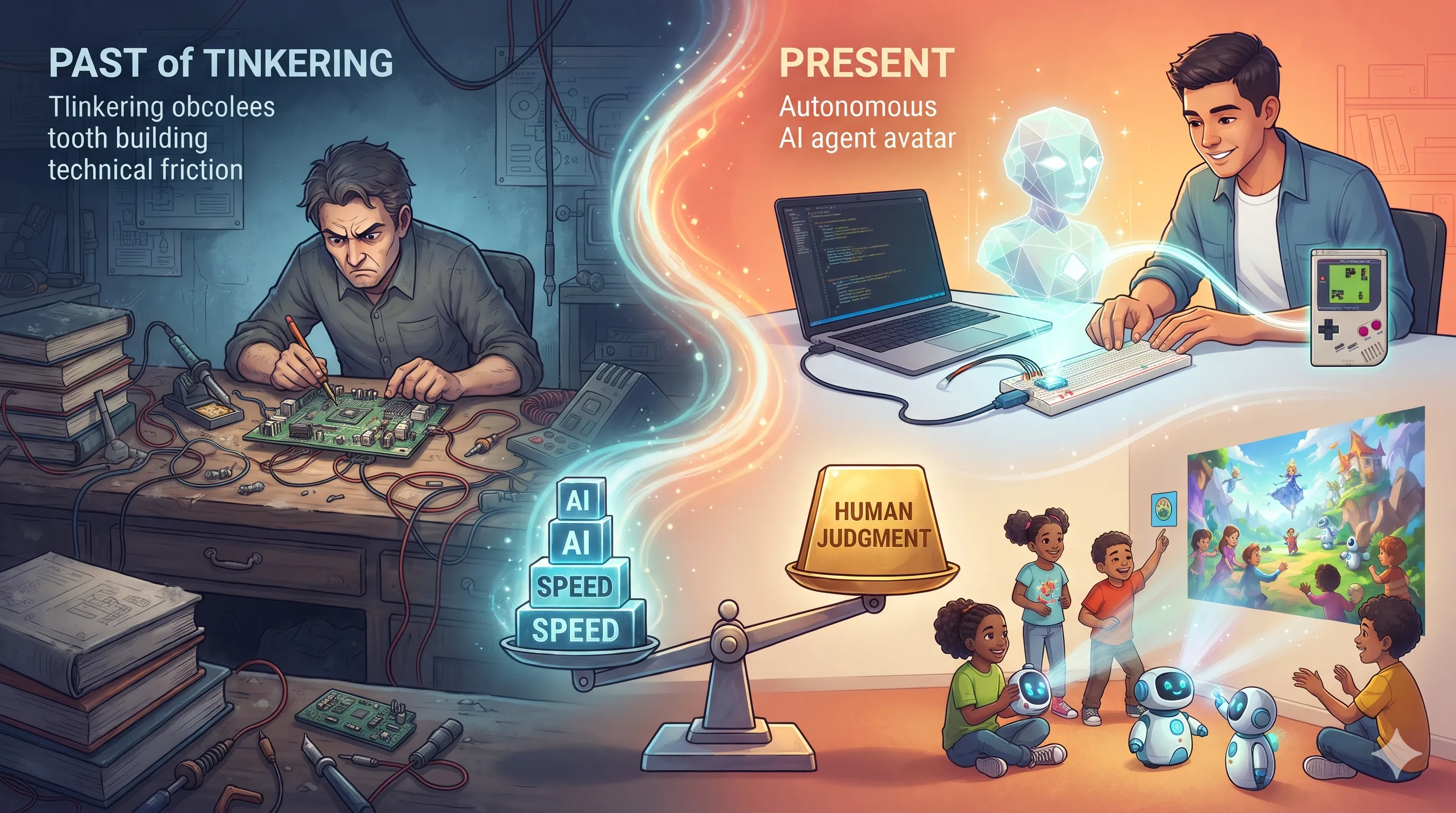
For generations, the joy of tinkering required navigating steep technical barriers, deep domain mastery, and hours of tedious troubleshooting before any creative impulse could produce a working artifact. Today, the convergence of generative models, multimodal sensor loops, and flexible physical hardware has collapsed that friction entirely. Play is no longer just recreation—it has become the primary engine driving rapid software innovation and exploratory learning.
From engineers directing autonomous AI agents to adapt classic video games onto handheld microcontroller badges to children collaborating with conversational robotic toys on dynamic fantasy worlds, creative discovery has transformed into an active, two-way dialogue. These spontaneous micro-experiments illustrate how modern builders bypass traditional development bottlenecks, using lightweight AI interactions to explore novel concepts without fear of failure.
However, as automated workflows and generative platforms amplify inventive output, the role of human judgment has never been more critical. Sustaining meaningful play requires conscious boundaries—balancing swift algorithmic execution with rigorous verification, developmental safeguards, and respect for open-source maintainers across the broader digital commons.
1. The Programmable Canvas: Transforming Badge Hardware into Open Creative Platforms
Physical computing provides a tangible medium for creative play, bridging algorithmic software experimentation and interactive hardware.Spearheaded by Martin Woodward, Vice President of Developer Relations at GitHub, the GitHub Universe event badge has spent the last 4 years transforming from simple identification collateral into a standalone creative computing platform.
What began as basic E-Ink name displays has evolved into an open pocket computer outfitted with a full-color display, a rechargeable battery, capacitive controls, and motion sensors.
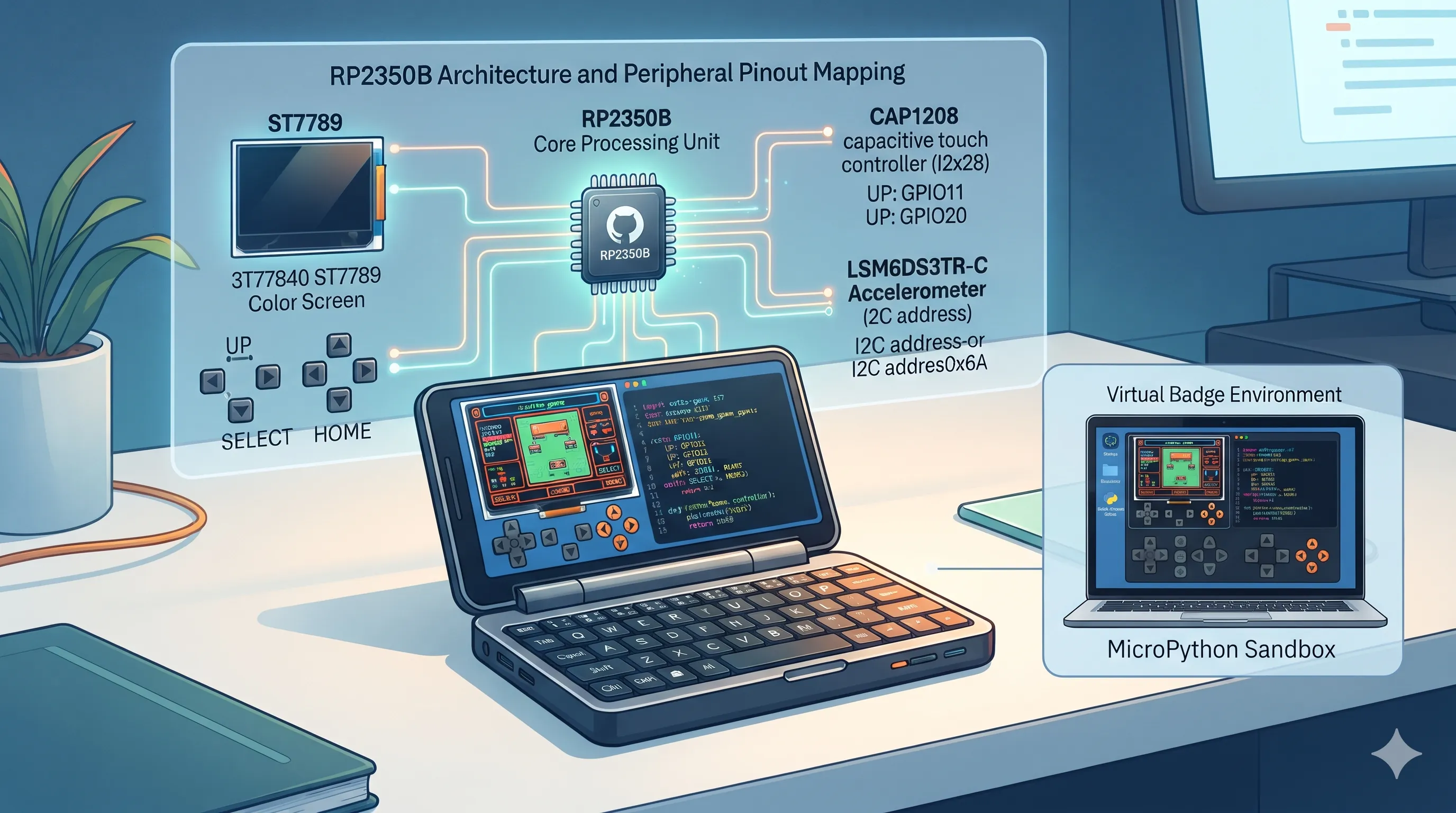
RP2350B Architecture and Peripheral Pinout Mapping
At the heart of the GitHub Universe 2026 badge lies the RP2350B microcontroller, powering an interactive sensory apparatus designed for immediate exploratory hacking.Visual output is driven by a 320x240 ST7789 color screen, paired with directional navigation and control interfaces mapped cleanly across the silicon's general-purpose pins.
Physical button navigation maps directly to designated inputs: UP is mapped to GPIO11, DOWN to GPIO6, LEFT to GPIO7, RIGHT to GPIO9, SELECT to GPIO10, and HOME to GPIO22.
Sensor communication and auxiliary input multiplexing run over the internal i2c1 bus on GPIO18 (SDA) and GPIO19 (SCL).
The badge integrates a CAP1208 capacitive touch pad controller located at I2C address 0x28 alongside an LSM6DS3TR-C accelerometer and motion sensor operating at I2C address 0x6A.
Unlike earlier development boards such as the Pimoroni Tufty 2350, the Universe badge omits a dedicated Real-Time Clock (RTC) chip, requiring timekeeping to rely on active system uptimes or software workarounds.
| Component / Subsystem | Hardware Specification & Pin Mapping | Bus / Interface & Addressing | Architectural Differences & Notes |
|---|---|---|---|
| Core Processing Unit | RP2350B microcontroller | Direct system architecture | Upgraded silicon base providing expanded pinout access |
| Visual Display | 320x240 ST7789 color screen | Dedicated display bus | Replaces static early generation E-Ink tags with high-refresh color |
| Directional Controls | UP: GPIO11, DOWN: GPIO6, LEFT: GPIO7, RIGHT: GPIO9 | Digital GPIO inputs | Direct tactile control mapping for UI and game loops |
| Action & Navigation | SELECT: GPIO10, HOME: GPIO22 | Digital GPIO inputs | Dedicated primary action and home system interrupts |
| Touch Controller | CAP1208 capacitive touch pad | Internal bus i2c1 (GPIO18/GPIO19), address 0x28 |
Provides surface-level capacitive touch sensing |
| Motion Sensor | LSM6DS3TR-C accelerometer | Internal bus i2c1 (GPIO18/GPIO19), address 0x6A |
Detects movement, tilt, and orientation for physical play |
| Timekeeping (RTC) | Omitted (No discrete RTC chip) | N/A | Missing relative to earlier baseline boards like the Pimoroni Tufty 2350 |
MicroPython Sandbox and the Virtual Badge Environment
The badge's capability as a sandbox for creative play is grounded in its software accessibility.Running MicroPython out of the box, the device eliminates complex toolchain configurations, allowing creators to write code directly to the flash storage.
This out-of-the-box runtime allows attendees to construct personal tools, experiment with interactive sensor logic, and deploy custom applications and games on the fly.
To accommodate developers who do not possess the physical unit, GitHub provides a browser-based Virtual Badge alternative.
This virtual environment emulates the display and input behaviors of the physical platform, making hardware-centric creative programming fully accessible across standard web interfaces.
2. Autonomous Multimodal Loops: Porting Doom with AI Agents in Real Time
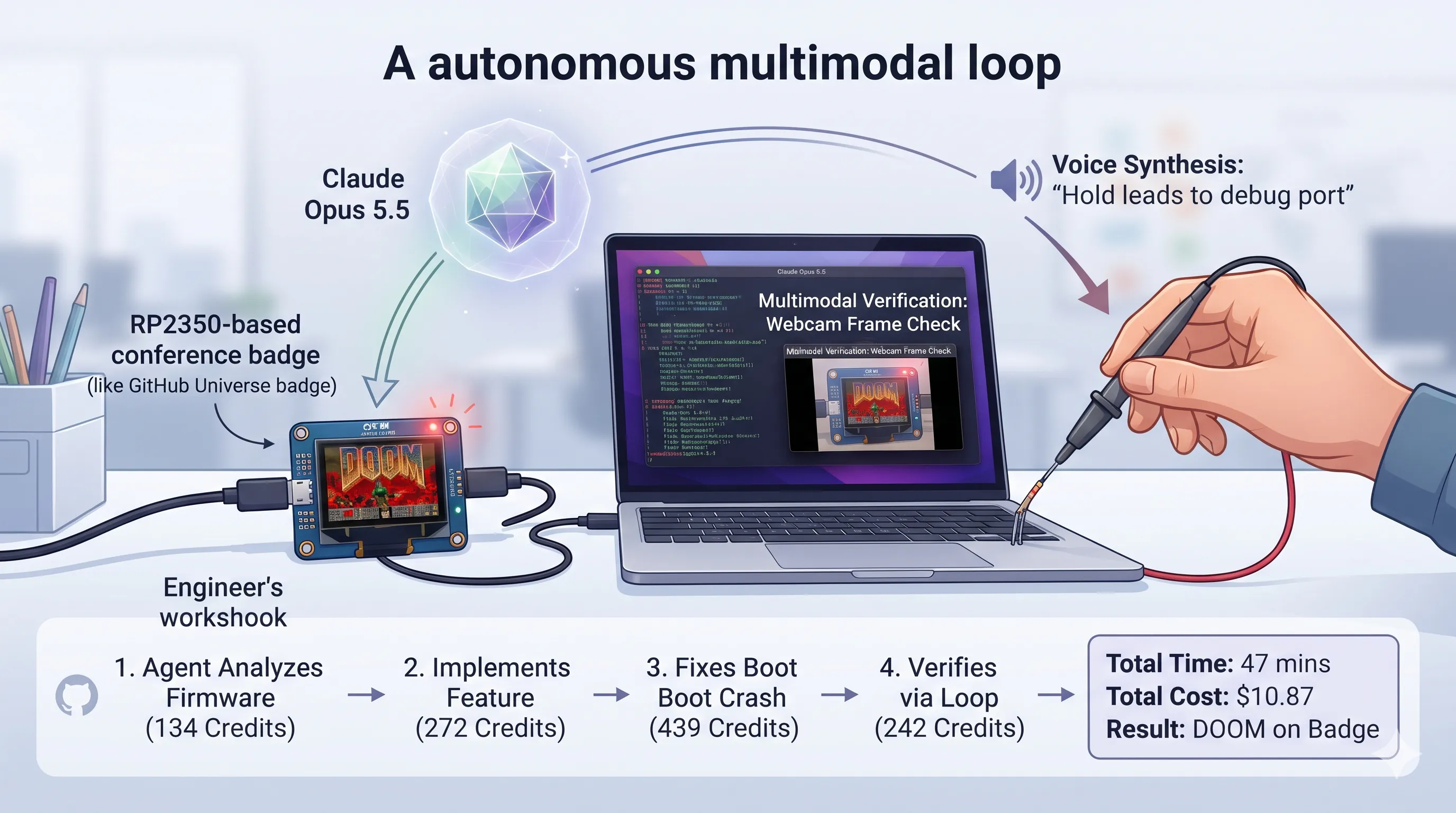
In the broader evolution of how AI is redefining creative play, the act of running classic games on unconventional hardware has transitioned from tedious manual porting to dynamic human-agent collaboration.When Martin Woodward set out to port Doom to an RP2350-based conference badge, the project demonstrated how autonomous agentic workflows turn embedded systems experimentation into an interactive, real-time playground.
Driven by Claude Opus 5.5, the port was accomplished in approximately 47 minutes of wall-clock time by establishing tight multimodal verification loops that bridged digital code generation with real-world physical feedback.
As Woodward noted, "Creating a self-verification loop is what gives your agents super powers."
To kick off the adaptation, the agent required direct instructions to unpack the pre-existing build, audit the hardware mapping, and schedule feature milestones.
The prompt below initiated the reverse-engineering phase and outlined the hardware modification roadmap:
Get the latest from upstream then crack open the doom port in /Users/martin/Downloads/tufty_doom_universe25.uf2. It is a RP2350 firmware image. It’s based on Daft-Freak/rp2040-doom but ported to work on the Universe badge.
I want to come up with a plan on how to fix the button mappings to support up/down/left/right and fire. Once that is working, then I want to support flipping the screen 180 degrees when the accelerometer detects you have the card upside down. Then finally want to get the capacaitive game controls working (up/down/left/right and select for fire)The resulting flip logic was implemented to invert the display whenever the accelerometer registered that the badge was held upside down, triggering specifically if |y| > |z| and y < -6000, guarded by a 300 ms debounce.
Hardware-in-the-Loop Verification with Webcams and Voice Synthesis
Developing on bare metal typically requires constant human intervention to power-cycle boards, monitor displays, and hook up debug probes.To overcome these physical bottlenecks, the development environment was structured as an autonomous multimodal feedback loop.
Copilot utilized mpremote to query live registers and pin maps through the MicroPython REPL, inspecting runtime state directly on the micro-controller.
To bypass manual bootloader button combinations during test cycles, the agent automated firmware reflashing via a 1200-baud serial reset trick that forced the badge directly into bootloader mode over USB.
When testing screen rendering and UI states, an external laptop webcam connected via ffmpeg captured frame captures of the badge, allowing the multimodal agent to visually inspect frozen screen states and graphical output.
However, physical hardware tests occasionally required manual assistance, such as aiming cameras or holding test leads.
To solve this without demanding Woodward's constant visual attention on terminal logs, speech output was added to the control pipeline:
speak when you need me to do something as the screen is at an angle that is hard to seeFor low-level execution errors, the agent constructed an on-device crash catcher that overrode the Cortex-M33 HardFault handler.
Instead of silently locking the processor, this handler saved complete register dumps directly into power-manager scratch registers that survived warm reboots, feeding diagnostic breadcrumbs back into the AI loop.
Debugging Economics: Token Consumption and Buffer Overflow Analysis
Running fully agentic development loops over extended model sessions introduces specific computational and token-cost dynamics.Throughout the 47-minute porting run, the workflow consumed 1,087 AI credits across 217 model calls to Claude Opus 5.5.
At an AI credit retail cost of roughly $0.01 USD per credit, the overall financial expense totaled just $10.87.
| Workflow Phase | Credit Allocation | Percentage of Total | Key Tasks Performed |
|---|---|---|---|
| Analysis & Reverse Engineering | 134 credits | 12% | Unpacking 2.4 MB UF2 binary, parsing pico-sdk binary_info, mapping GPIO pins via mpremote |
| Feature Implementation | ~272 credits | ~25% | Button remaps, capacitive touch setup, accelerometer 180° flip (|y| > |z|, y < -6000, 300 ms debounce) |
| Boot Hang Crash Debugging | 439 credits | ~40% | Resolving 5-second post-boot crash caused by 32blit-pico SCSI INQUIRY product_id buffer overflow |
| Other Model Turns / Verification | ~242 credits | ~23% | Hardware-in-the-loop tests, ffmpeg frame checks, serial reboots, voice alerts |
| Total Run | 1,087 credits ($10.87) | 100% | 217 total calls to Claude Opus 5.5 across 47 minutes |
The badge suffered from a hard crash occurring exactly five seconds after boot.
Isolating and resolving this single fault consumed 439 credits—approximately 40% of the entire budget.
The root cause was traced to a memory corruption flaw within the 32blit-pico runtime, where a buffer overflow in the USB mass storage SCSI INQUIRY
product_id field wrote past its bounds and triggered a fault.Furthermore, the session highlighted how long, iterative hardware-debugging sessions degrade cost-efficiency.
Because full context histories were re-sent with each successive model turn, token usage per prompt escalated over time, magnifying the credit expenditure required to isolate low-level memory faults.
Even with these overheads, resolving low-level register corruptions and hardware-specific graphics layers within 47 minutes for under eleven dollars illustrates how multimodal loops transform classic hacking into a rapid, automated discipline.
3. Lowering the Barrier to Play: Micro-Experiments and Lightweight Machine Learning
In the broader landscape of how artificial intelligence is redefining creative play, the barrier between theoretical curiosity and functional software has collapsed.Where creative engineering once demanded rigorous foundational mastery before a single prototype could run, generative assistants and lightweight tooling now encourage developers to learn directly through building and testing.
Playful tinkering has replaced upfront curriculum, turning exploratory micro-experiments into primary learning vehicles.
From Idea to Accelerometer: Browser-Trained Edge ML
This transition from heavy academic preparation to hands-on exploration is clearly visible in hardware-adjacent development.Engineers no longer need deep machine learning backgrounds or complex toolchains to create functional edge models.
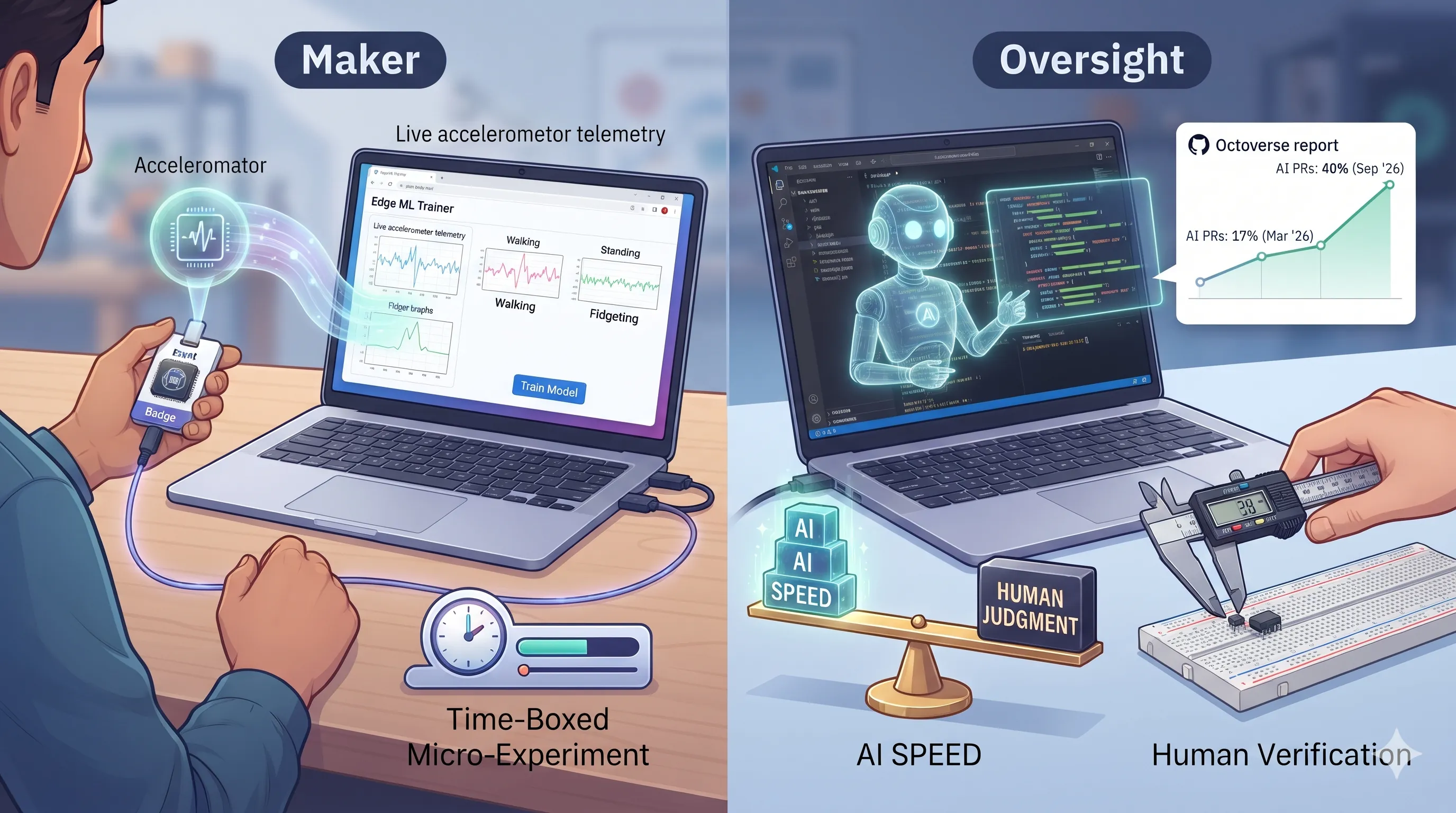
Instead, developers are building on-device machine-learning pedometers by streaming real-time accelerometer movement data straight from an event badge into a web browser.
Inside the browser environment, lightweight movement-classification models are trained directly on live telemetry, mapping out distinct physical states such as walking, standing, and subtle, small body movements.
This workflow reflects a fundamental paradigm shift: instead of waiting for complete mastery before touching code, makers learn the nuances of data collection and classification while actively observing working prototypes.
The same lightweight approach encourages an explosion of non-commercial, personal software experiments, ranging from custom smart picture frames to bespoke home TV utilities built purely for the joy of problem-solving.
Time-Boxing Exploratory Projects and Managing Human Accountability
The velocity behind these experimental workflows is reflected across global development platforms.According to the GitHub Octoverse report, AI-agent-initiated pull requests grew from 17% in March 2026 to 40% in September 2026.
As automated agents handle an increasing share of boilerplate scaffolding and initial implementations, developers can spin up experimental architectures in minutes.
However, frictionless code generation introduces its own challenges, particularly the danger of unconstrained development sessions that meander without structured goals.
To counteract this drift, Martin Woodward emphasizes the disciplined practice of "time-boxing," urging developers to set rigid temporal boundaries that keep micro-experiments focused, manageable, and strictly outcome-driven.
Furthermore, GitHub stressed that producing software quickly with AI does not eliminate human responsibility for code behavior and execution quality.
Because agentic systems inevitably produce errors and edge-case hallucinations, creative play still relies on humans maintaining rigorous verification, active debugging, and structured testing loops.
4. Ethical Stewardship: Balancing Rapid AI Prototyping with Open-Source Responsibility
In the context of how AI is redefining creative play, high-velocity experimentation enables developers to rapidly hack together prototypes and explore novel ideas.However, creative play must coexist with community responsibility when hobbyist tinkering interfaces with shared, production-grade ecosystems.
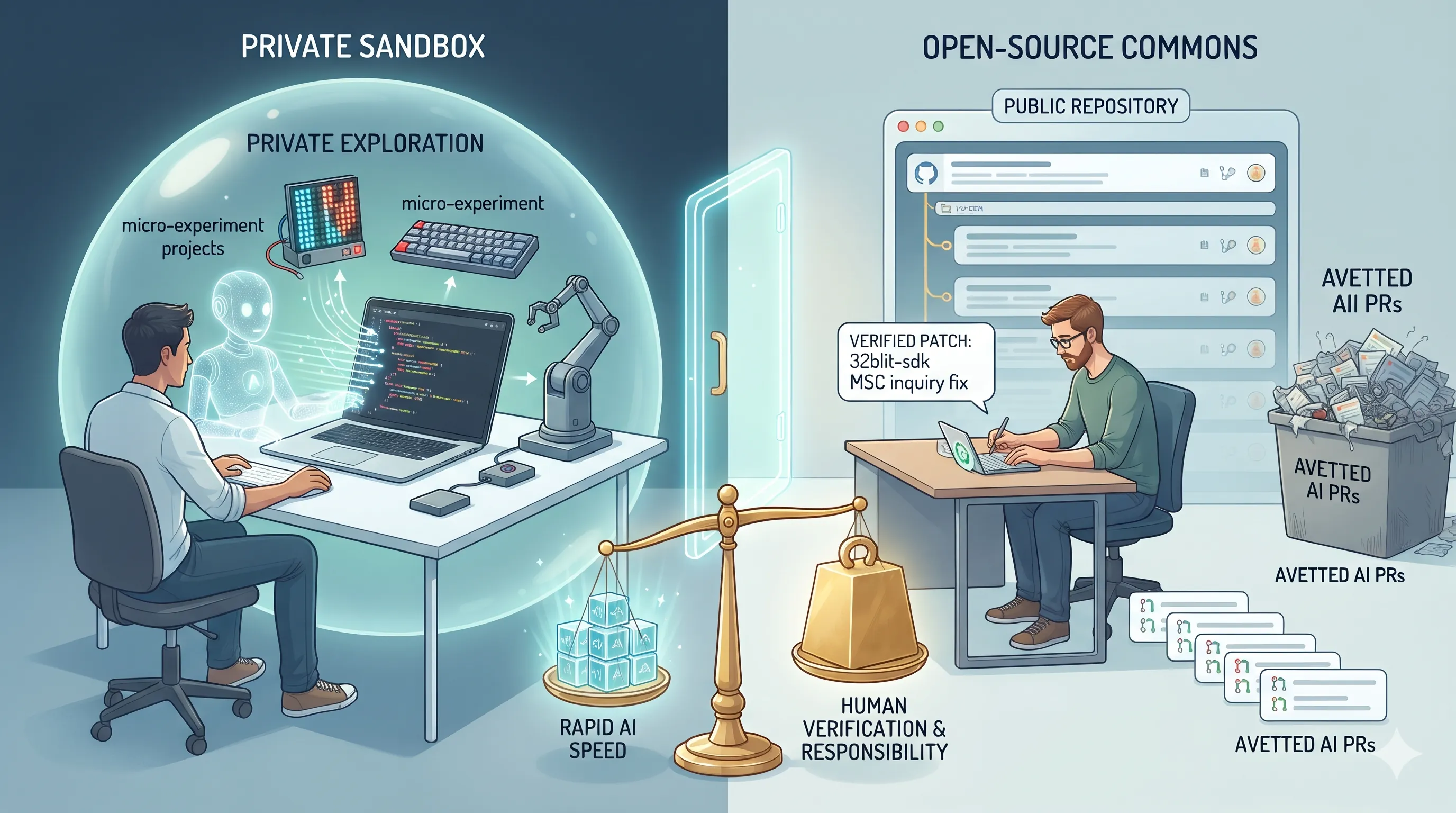
Drawing the Line Between Private Sandboxes and Public PRs
The acceleration provided by AI tools makes personal sandboxes more dynamic than ever, allowing developers to test boundaries and iterate at unprecedented speeds.Nevertheless, ethical stewardship requires a clear separation of private exploratory tinkering from public pull request submissions.
An unvetted influx of rapid AI-generated pull requests dramatically increases the maintenance and review burden for open-source maintainers who volunteer their time.
Furthermore, automated code submissions dispatched without deep technical comprehension risk introducing latent regressions into stable codebases.
Addressing this tension, Martin Woodward noted that open source provides freedom to view, modify, and share code, but not the freedom to demand others accept one's changes unilaterally.
Responsible Upstreaming and Maintainer Burden Mitigation
Responsible participation in open-source ecosystems relies on disciplined workflows rather than dumping raw model outputs into public repositories.Developers utilizing AI assistance must carefully review repository guidelines, evaluate existing open issues, and determine actual project needs prior to submitting AI-generated contributions.
When creative play leads to genuine technical breakthroughs, contributors should focus on upstreaming specific, verified fixes back to open-source codebases.
A prime example of this disciplined approach includes submitting isolated, well-tested patches, such as resolving the 32blit-sdk MSC inquiry buffer overflow.
By verifying every line of code locally and respecting maintainer boundaries, developers ensure that AI-driven creative play enriches the software commons without overwhelming its stewards.
5. Smart Toys and Conversational Play: Expanding Imagination Across Generations
The tangible boundaries of childhood creativity are expanding as artificial intelligence moves beyond screen-locked interfaces into physical artifacts, fundamentally reshaping how AI redefines creative play across generations.By turning static playthings into responsive conversational partners, generative systems are altering the nature of pretend scenarios, storytelling, and creative co-creation.
Conversational Robotics and Moderated Creative AI Studios
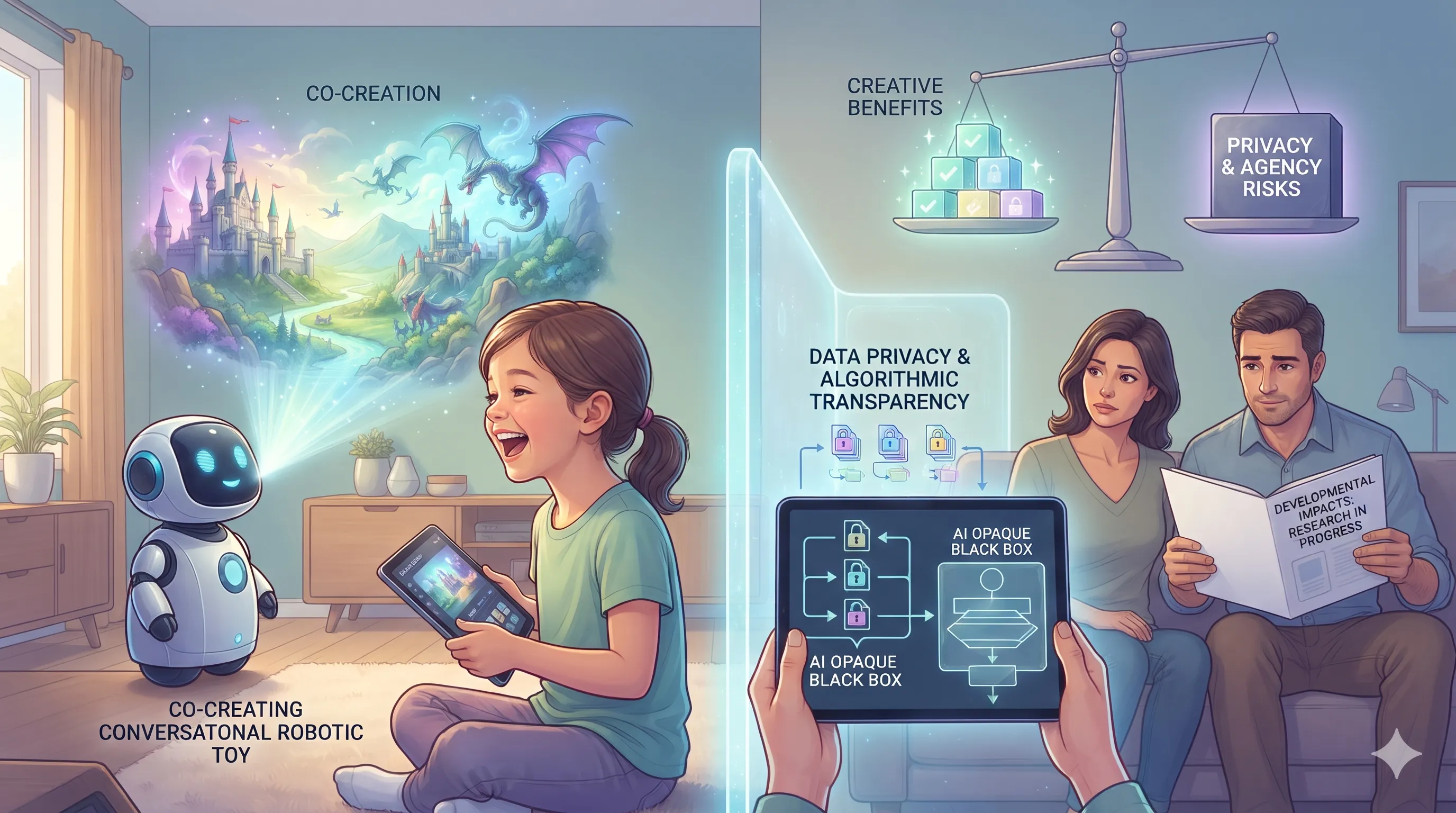
Interactive physical play is evolving through the direct integration of voice recognition, natural language processing, and generative AI into conversational toys and robotic companions.Rather than adhering to pre-recorded audio loops or static decision trees, these toys allow children to engage in increasingly complex pretend and imaginative play, dynamically adapting dialogue to narrative turns invented during playtime.
Companion toys are also being built with exposed open APIs, enabling physical playthings to synchronize seamlessly with broader home automation and smart entertainment ecosystems.
This interconnected environment lets physical objects trigger ambient responses across household devices, enriching pretend scenarios through multi-sensory synchronization.
Alongside physical robotics, specialized child-oriented AI creative studios are emerging to provide secure, moderated environments dedicated to digital art, interactive storytelling, and music generation.
Within these moderated platforms, generative AI serves primarily to enhance initial ideation and brainstorming, providing starting points that spark collaborative narrative development.
However, these creative integrations face notable practical limitations; generative systems can run into implementation hurdles and may at times reduce overall content novelty by returning repetitive narrative patterns.
Data Privacy, Algorithmic Transparency, and Developmental Impacts
The introduction of autonomous, conversational technology into family environments has introduced significant friction alongside creative benefits.A primary point of tension is deep parental skepticism concerning potential data privacy breaches and the pervasive presence of opaque algorithms operating in intimate living spaces.
Because companion toys process conversational input from young users, questions regarding data collection safeguards and algorithmic opacity remain central to the dialogue surrounding their long-term viability.
Beyond immediate security concerns, parents and specialists express hesitation regarding the unverified developmental impacts of continuous synthetic interaction.
Academic researchers note that the developmental effects on children's imagination, epistemic trust, and anthropomorphism require continued empirical study.
As children ascribe real social agency and epistemic authority to conversational robotic companions, understanding how these relationships influence cognitive trust and original creative agency represents a critical frontier in modern child development research.
Related Posts
Generative AI may have assisted with research or drafting for this article. Topic selection, fact-checking, final wording, and publication remain the responsibility of DragonStone74. AI use disclosure