
How Google Optimized Gemini for Low-Memory Android Devices
🚀 Key Takeaways
- Targeted Client Re-Architecture: Google re-engineered the Gemini client to deliver a fluid, full-featured assistant experience on memory-constrained Android (Go edition) devices.
- OS-Level Resource Efficiency: Operating models via centralized system services prevents duplicate memory footprints, protecting multitasking performance from aggressive Low Memory Killer process termination.
- Uncompromised Multimodal Utilities: Lower-memory hardware retains flagship capabilities, including spoken natural language dialog, camera-driven document translation, and on-device image synthesis.
- Frictionless Distribution Channels: Accessibility is streamlined through Google Play installations, quick-launch physical power button integration, and factory preloads with partner brands like Transsion.
Generative on-device experiences have traditionally demanded substantial RAM and high-end processing, historically relegating budget and entry-tier smartphones to rigid, bare-bones voice commands. As frontier models expanded in size and functionality, device memory bottlenecks threatened to leave millions of global mobile users behind.
Google addressed this compute divide by fundamentally overhauling how the Gemini client operates on memory-constrained hardware. Rather than compromising user utility, engineering teams re-architected client-side execution to allow lightweight Android (Go edition) smartphones to drive rich multimodal queries without triggering persistent operating system stutter.
Achieving high responsiveness within tight hardware limits relies on replacing isolated application model bloat with efficient, system-level execution frameworks. By mastering how Gemini preserves physical RAM while maintaining full interactive capabilities, mobile engineering establishes a blueprint for sustainable, inclusive on-device intelligence.
1. Re-Architecting the Gemini Client for Android Go and Low-Memory Hardware
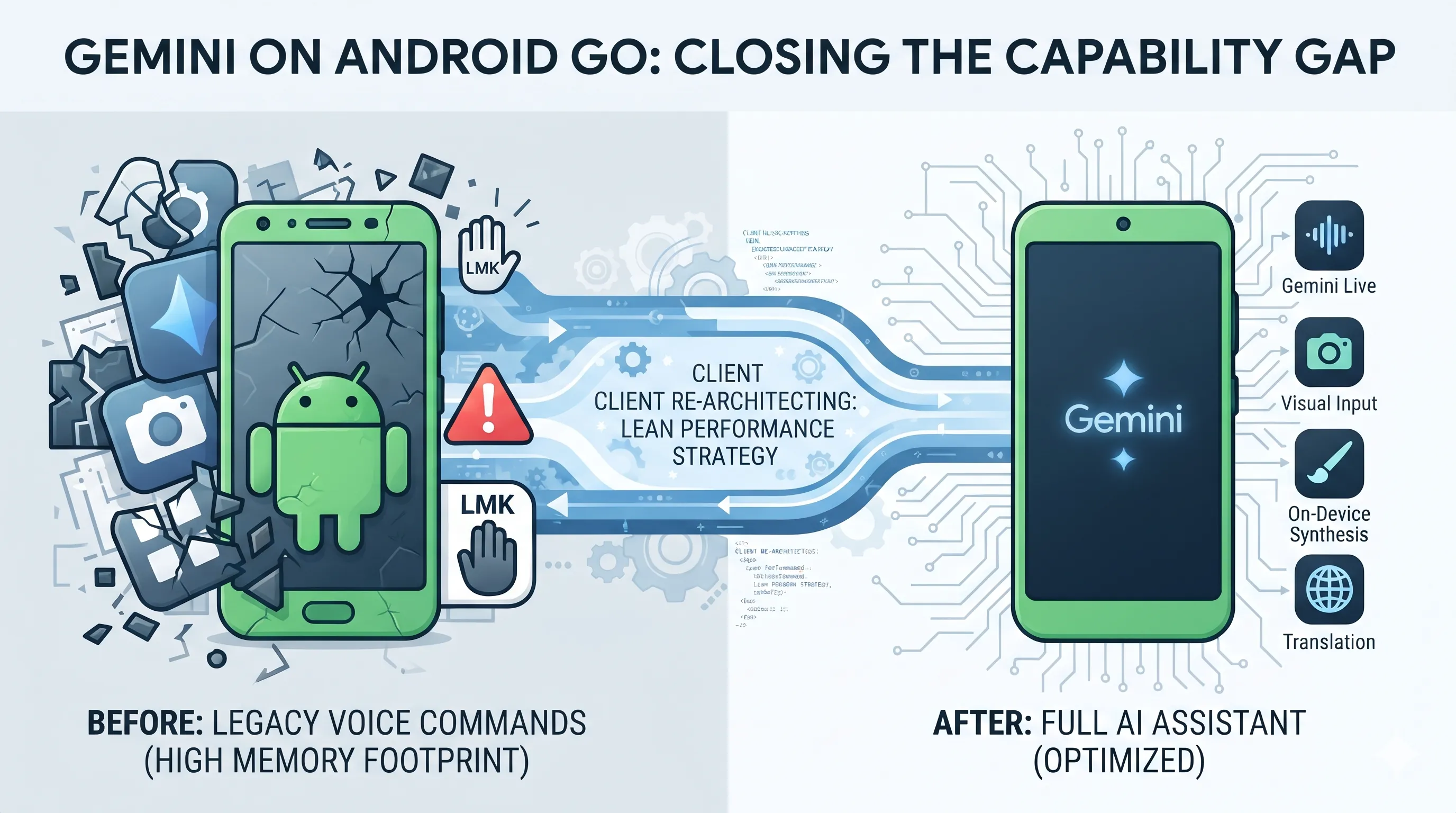
To realize the broader goal of how the Gemini app optimizes performance on lower-memory devices, Google focused on a structural redesign of its mobile client framework.Engineering a responsive AI interface for hardware with constrained memory required resolving key platform bottlenecks directly at the application layer.
Overcoming Hardware Constraints on Android Go
Operating within strict memory limits requires an intentional design strategy centered on lean client performance.Google re-architected the Gemini app so the core assistant experience runs smoothly on hardware with constrained memory.
This newly optimized application targets eligible Android (Go edition) devices, extending modern software support to entry-level hardware configurations.
Highlighting this development focus, Angus Logan, Builder, Gemini App, noted: "We re-architected the app so the core Gemini experience runs smoothly on hardware with less memory."
Through these foundational code adjustments, the client retains responsiveness and stability even under tight memory thresholds.
Upgrading from Legacy Voice Commands to Full Assistant Capabilities
Prior to this structural re-architecture, entry-tier mobile users faced strict utility boundaries.Hardware limitations previously restricted lower-memory Android devices to basic voice command functionality.
These earlier implementations lacked deep conversational flexibility and limited users to rudimentary task shortcuts.
The re-engineered Gemini client upgrades lower-memory devices from basic voice commands to the full personal AI assistant experience.
Eligible Android (Go edition) devices can now support richer interactive workflows, closing the capability gap between entry-level hardware and modern AI assistant tools.
2. Uncompromised Core Features: Spoken Interaction, Visual Analysis, and Local Generation
Optimizing the Gemini app for lower-memory devices does not necessitate stripping away key multimodal experiences.Even when operating under constrained hardware parameters, the platform maintains foundational capabilities spanning conversational voice interaction, live optical analysis, and on-device visual synthesis.
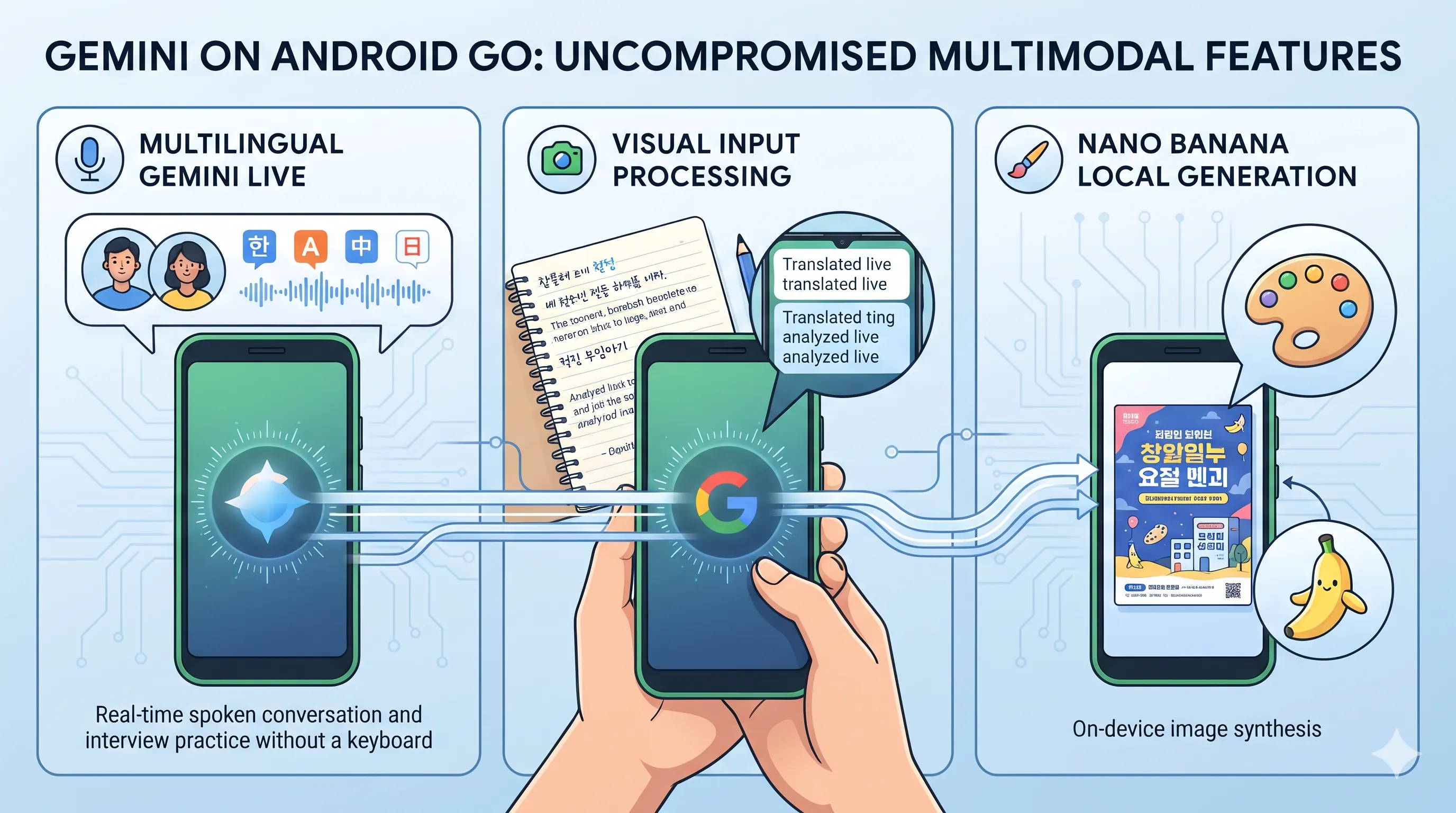
Multilingual Gemini Live Spoken Interactions
A central pillar preserved on lower-memory hardware is Gemini Live, which facilitates real-time spoken interactions across more than 45 languages.Users do not need to enter written prompts through a physical or digital keyboard.
Instead, Gemini Live supports fluid spoken conversations directly out loud, enabling natural use cases such as interactive interview practice.
By sustaining low-latency audio processing on memory-limited setups, the system ensures interactive dialogue remains intuitive and conversational regardless of local memory restrictions.
Visual Input Processing and Nano Banana Generation
Visual analysis remains fully functional on resource-constrained equipment through integrated camera inputs.Users can point their device camera directly at printed forms or handwritten notes to read, interpret, learn from, and translate documentation on the fly.
Alongside live visual input processing, generative visual synthesis is sustained through the integrated Nano Banana model.
Despite hardware memory limitations, this integrated engine directly creates custom images on demand, producing outputs such as promotional flyers and event announcements without degrading device responsiveness.
| Core Capability | Supported Input Modality | Functional Output and Use Cases |
|---|---|---|
| Gemini Live | Real-time spoken voice (no typing required) | Spoken conversational interactions across more than 45 languages; out-loud interview practice |
| Visual Input Processing | Camera feed pointed at physical materials | Learning and real-time translation of printed forms and handwritten notes |
| Nano Banana Image Generation | Image creation requests | Custom generated imagery, including event flyers and promotional flyers |
3. OEM Integration and Access Methods Across Low-Memory Ecosystems
Ensuring responsive performance on lower-memory devices requires optimized deployment paths alongside lightweight invocation methods.Delivering the Gemini app to resource-constrained environments depends on specialized software distribution channels and direct hardware integration designed to minimize system overhead.
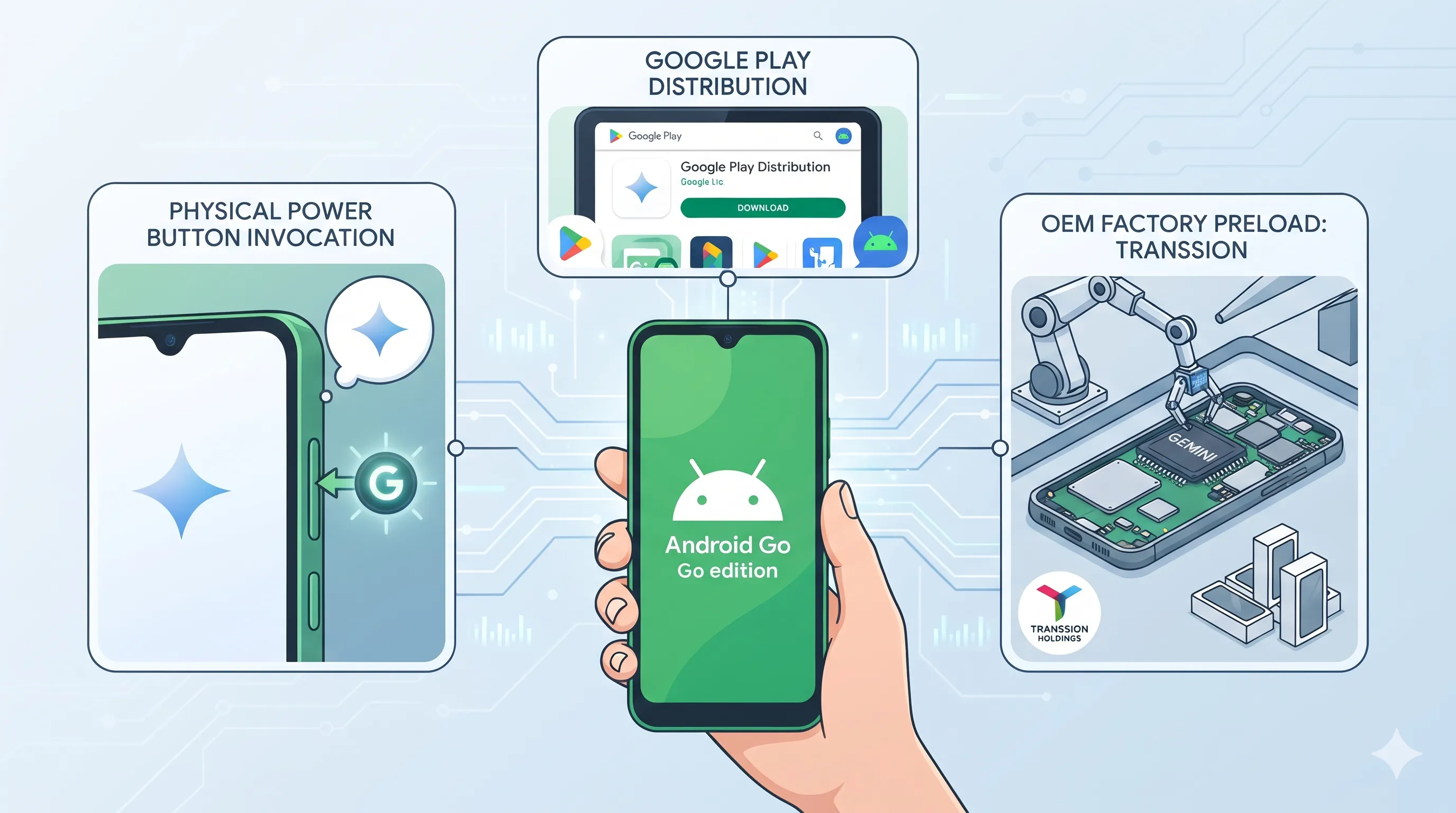
Physical Power Button Invocation and Google Play Access
On low-memory hardware, launching applications through heavy system menus or persistent background overlays can strain available system resources.To streamline interaction, users can launch the assistant by pressing and holding the physical power button on compatible phones.
This direct hardware invocation method offers an intuitive, low-latency access trigger that avoids unnecessary operational friction.
In terms of digital distribution, the Gemini app is available for download on supported hardware via Google Play.
However, device installation eligibility is not universal.
Availability is limited to eligible Android (Go edition) and supported partner models, ensuring that the software runs exclusively on device architectures tailored to handle its operational profile.
OEM Preloading Partnerships with Transsion
Native integration directly from factory configuration plays an essential role in how Gemini enters lower-memory ecosystems.The Gemini app comes preloaded on hardware releases through targeted OEM partnerships.
Within this initiative, Transsion is identified as a partner preloading Gemini on devices.
By integrating the assistant straight into the system image of supported partner releases, device manufacturers ensure the application is pre-configured and accessible without requiring supplementary setup procedures on memory-sensitive hardware.
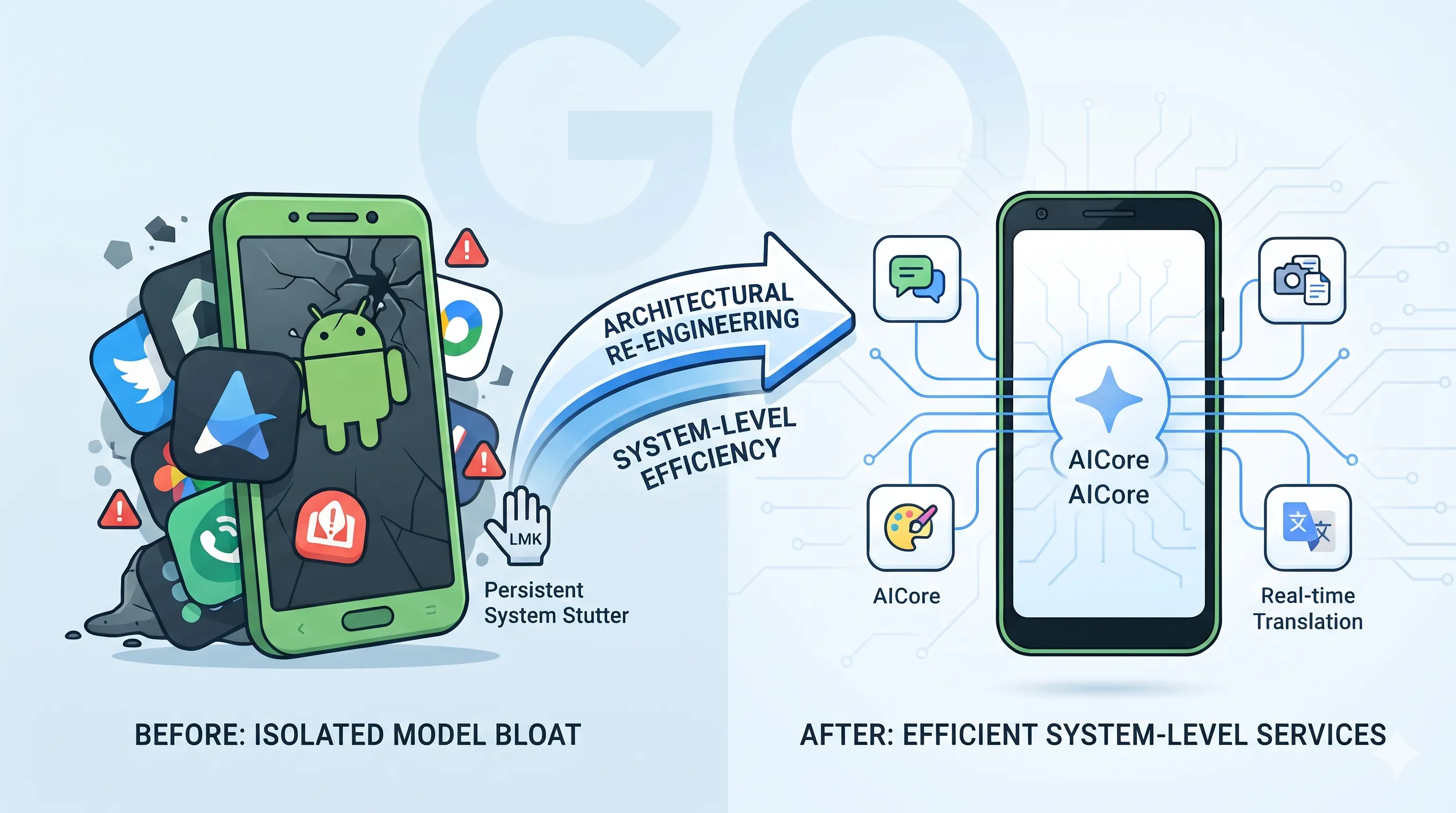
4. System-Level Architecture: AICore Service and Mitigating the Low Memory Killer
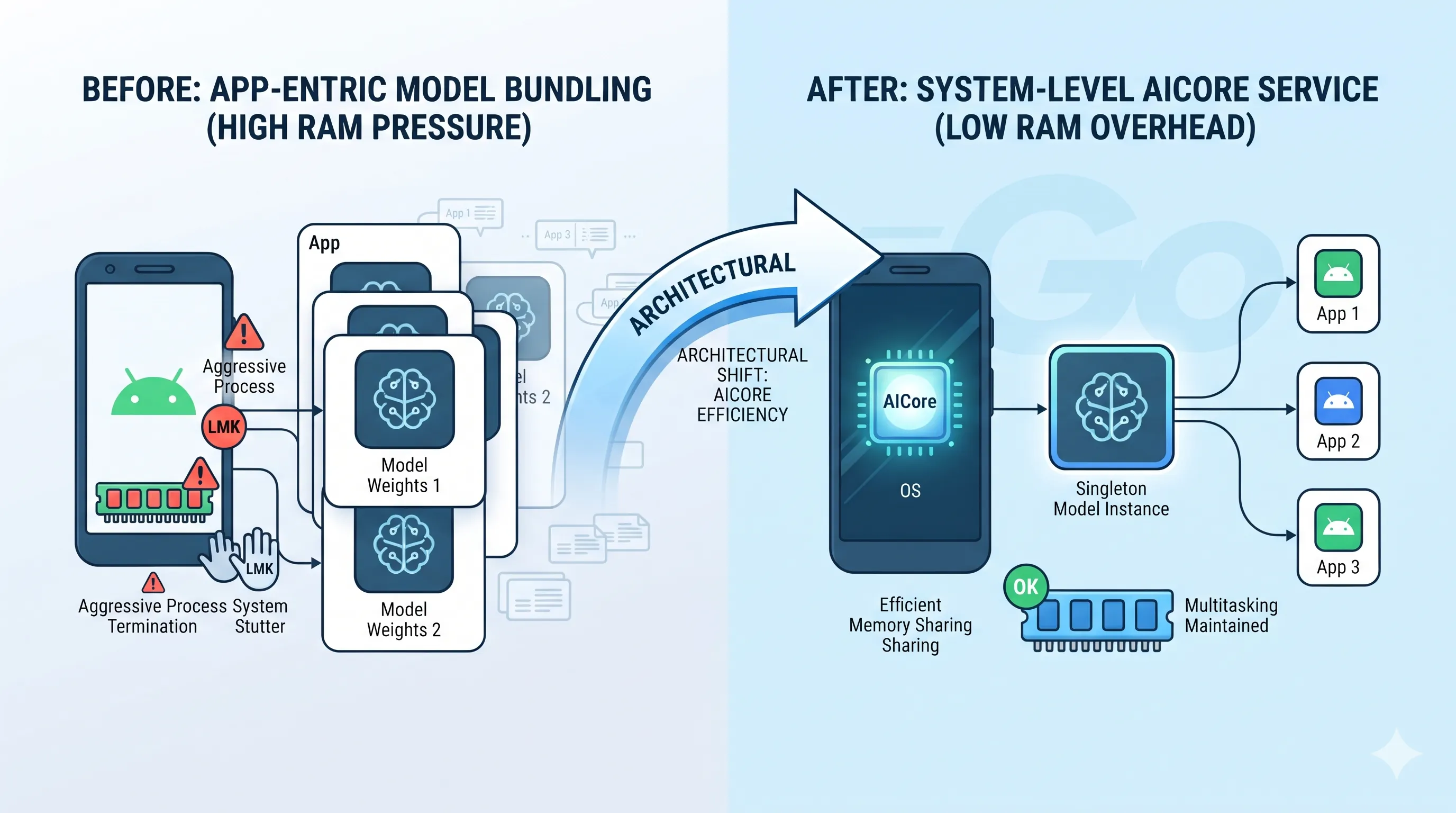
Understanding how the Gemini app optimizes performance on lower-memory devices requires examining the underlying system architecture that governs on-device intelligence.Traditional app-centric approaches bundle individual models directly inside distinct client applications, creating severe inefficiencies across entry-level hardware.
By shifting model execution from individual application packages to centralized system-level services such as AICore, mobile operating systems fundamentally reshape resource allocation.
Preventing RAM Duplication with Singleton System Services
App-centric model bundling wastes internal storage and rapidly exhausts physical memory by forcing separate software packages to store and load redundant weights.When multiple applications bundle independent copies of an on-device model, each active process occupies isolated memory blocks in hardware RAM.
System-centric AI architectures resolve this issue by managing on-device models entirely via centralized system-level services.
Under this design, services such as AICore maintain singleton model instances shared across the operating system environment.
Operating a single shared model instance prevents multiple consumer applications from duplicating memory footprints in system RAM.
By eliminating redundant runtime allocations, this unified service architecture drastically reduces memory overhead, allowing memory-constrained devices to run advanced features without duplicating footprint penalties.
Mitigating Android Low Memory Killer (LMK) Triggers
On lower-memory devices, high memory saturation and app-centric model bundling waste valuable RAM, provoking aggressive operating system process termination.When multiple applications inflate active system memory usage simultaneously, the Android Low Memory Killer (LMK) is forced to execute aggressive background sweeps.
These sweeping terminations discard background processes, disrupting the user experience and undermining seamless task switching.
Utilizing system-centric execution and singleton instances significantly curbs overall RAM pressure, effectively mitigating triggers for the Android Low Memory Killer.
Preventing aggressive LMK invocations safeguards background multitasking capabilities, ensuring that background applications remain intact while on-device AI tasks execute smoothly.
Related Posts
Google Cloud Brings OpenAI Models to Model Garden in Major Hyperscaler ShiftDiscover how Google Cloud integrates OpenAI models into Model Garden, offering unified access...
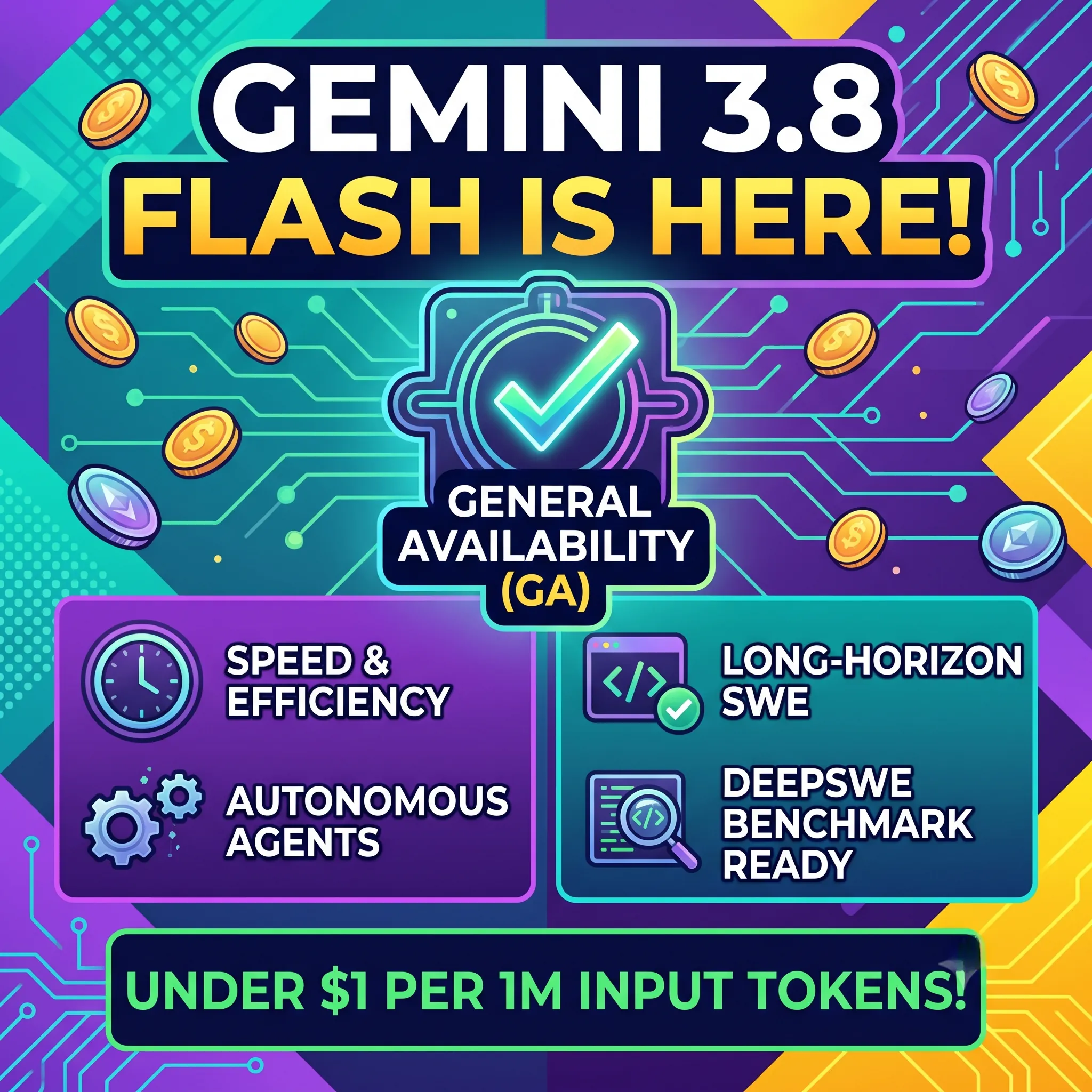
Gemini 3.8 Flash: GA Specifications, Reasoning Controls, and Cost-Efficiency AnalysisExplore the official Gemini 3.8 Flash release: covering its 1M context window, configurable...

Gemini 3.7 Flash: Google's Next-Gen AI for Developers – Unlocking Superior Coding, Multimodal Power & Cost-Effective PerformanceDiscover Google's Gemini 3.7 Flash: the latest AI model offering superior coding, multimodal input...
Generative AI may have assisted with research or drafting for this article. Topic selection, fact-checking, final wording, and publication remain the responsibility of DragonStone74. AI use disclosure