Gemini 3.8 Flash: GA Specifications, Reasoning Controls, and Cost-Efficiency Analysis
🚀 Key Takeaways
- Gemini 3.8 Flash Hits General Availability: Google has officially launched its flagship lightweight model, engineered for long-horizon software engineering and autonomous agent workflows.
- Massive Context and Reasoning Control: The architecture supports a 1M token input window and 64k output tokens, featuring configurable reasoning tiers across low, medium, and high levels.
- Disruptive Promotional Pricing: Available at $0.75 per million input tokens through late 2026, delivering frontier intelligence at a fraction of conventional operational costs.
- Benchmark Dominance: Achieves a top-tier Artificial Analysis Intelligence Index score of 59, surpassing prior Flash generations and earlier Pro preview models.
- DeepSWE Benchmark Reality Check: Tested against 113 decontaminated, real-world repository tasks to evaluate true multi-turn coding capability without pretraining data leakage.
- Superior Verifier Reliability: DeepSWE establishes a rigorous public API behavioral test harness, drastically minimizing the false verifier rates seen in legacy benchmarks.
- Specialized Security Variant: Released alongside Gemini 3.8 Flash Cyber, offering purpose-built autonomous vulnerability detection and remediation.
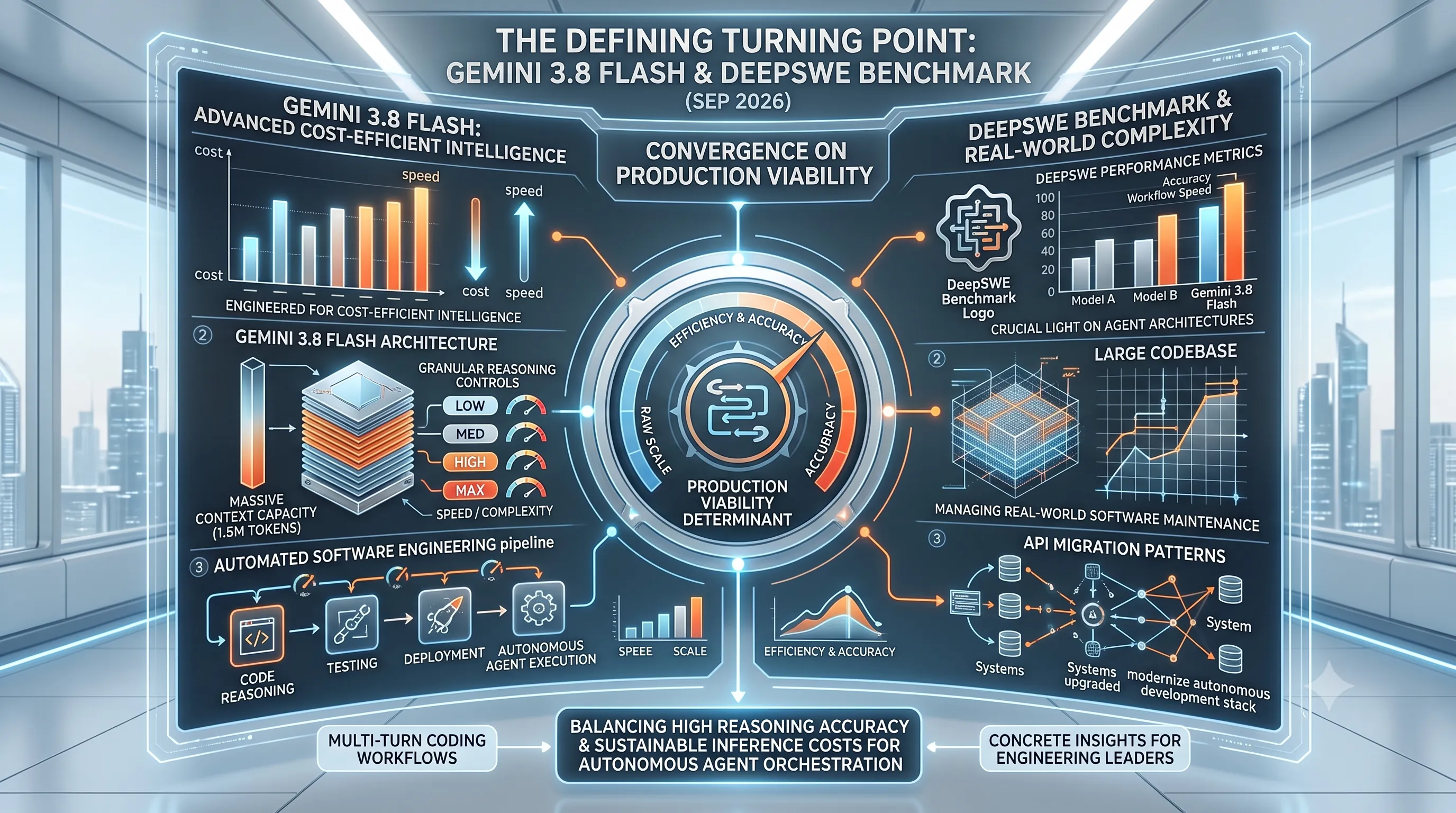
The enterprise AI landscape has reached a defining turning point where raw parameter scale is no longer the sole determinant of production viability. With the official general availability release of Gemini 3.8 Flash, Google has established a new benchmark for cost-efficient intelligence, engineered specifically to handle high-context multi-turn coding and autonomous agent execution at unprecedented speed.
As developer ecosystems pivot toward automated software engineering pipelines, maintaining high reasoning accuracy across large codebases without incurring unsustainable inference costs has become paramount. Gemini 3.8 Flash directly tackles this balance by coupling massive context capacity with granular reasoning controls, offering developers a flexible runtime for real-world software maintenance and agent orchestration.
Alongside this release, the unveiling of the rigorous DeepSWE benchmark sheds crucial light on how contemporary agent architectures handle complex, non-contaminated codebase tasks. Analyzing these performance metrics and API migration patterns provides engineering leaders with the concrete insights needed to modernize their autonomous development stack.
1. Gemini 3.8 Flash Architecture: GA Specs, Reasoning Controls, and Tooling Ecosystem
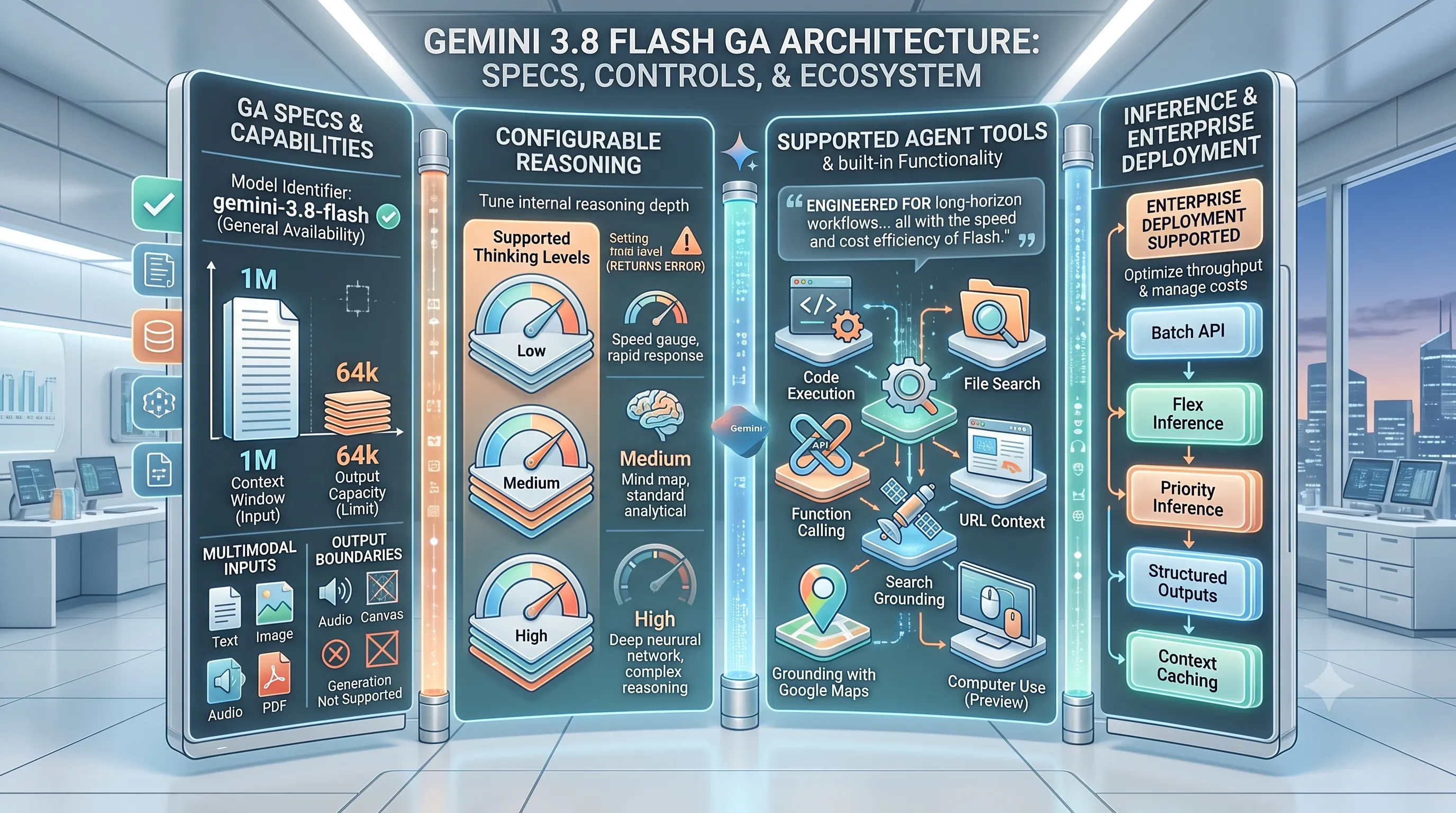
The formal arrival of gemini-3.8-flash in General Availability (GA) marks a critical milestone in high-throughput, low-latency foundation models.Engineered specifically for long-horizon software engineering, autonomous agents, and complex enterprise workflows, the architecture delivers frontier-tier capabilities while preserving the speed and operational cost efficiency characteristic of the Flash tier.
1M Context Window and Configurable Thinking Levels
According to official Google documentation updated on 2026-09-02 UTC, Gemini 3.8 Flash is designated under the official model identifier gemini-3.8-flash.The model provides a massive 1,048,576 token (1M) input context window alongside an expanded 65,536 token (64k) maximum output token limit.
This scale allows developers to ingest comprehensive codebases, full documentation corpuses, and multi-turn interaction traces in a single prompt.
Google positions the release directly for demanding workloads, stating that "Gemini 3.8 Flash is our most intelligent Flash model, engineered for long-horizon software engineering, autonomous agents, and complex enterprise workflows—all with the speed and cost efficiency of Flash."
To accommodate varying task complexities, the model introduces configurable reasoning controls with three supported thinking levels: low, medium, and high.
These levels allow engineers to tune the depth of internal reasoning steps based on whether an application prioritizes real-time response speed or deep analytical derivation.
Supported Agent Tools and Built-in Functionality
Gemini 3.8 Flash incorporates an extensive set of native tooling integrations and inference execution modes built directly into the platform.The model natively supports code execution, file search, function calling, URL context, search grounding, and grounding with Google Maps.
For complex desktop and operating system navigation tasks, it includes support for computer use (Preview).
On the infrastructure level, developers can leverage Batch API, flex inference, priority inference, structured outputs, and context caching to optimize serving throughput and manage infrastructure costs.
| Architectural Dimension | Specification / Supported Capability | Status & Configuration |
|---|---|---|
| Model Identifier & Availability | gemini-3.8-flash | General Availability (GA) |
| Input Context Window | 1,048,576 tokens (1M) | Supported |
| Output Capacity Limit | 65,536 tokens (64k) | Supported |
| Thinking Level Modes | low, medium, high | Configurable (minimal is invalid) |
| Input Ingestion Modalities | Text, Image, Video, Audio, PDF | Multimodal Input Supported |
| Agent & Grounding Tools | Code execution, File search, Function calling, URL context, Search grounding, Grounding with Google Maps, Computer use (Preview) | Native Integration |
| Inference & API Features | Batch API, Flex inference, Priority inference, Structured outputs, Context caching | Enterprise Deployment Supported |
Current Modality and API Scope Boundaries
While Gemini 3.8 Flash expands multimodal ingestion capabilities across text, image, video, audio, and PDF inputs, strict architectural boundaries define its current release scope.The model is strictly an input-multimodal engine; audio generation and image generation are not supported.
Additionally, the Live API is not supported for Gemini 3.8 Flash.
Developers must also adhere strictly to valid parameter ranges when configuring cognitive controls: setting the thinking level to minimal is unsupported and will explicitly return an error.
2. Cost Efficiency Dissection: Promotional Tiers and 90% Context Caching Discounts
Promotional Pricing Through 2026 vs. Standard 2027 Rates
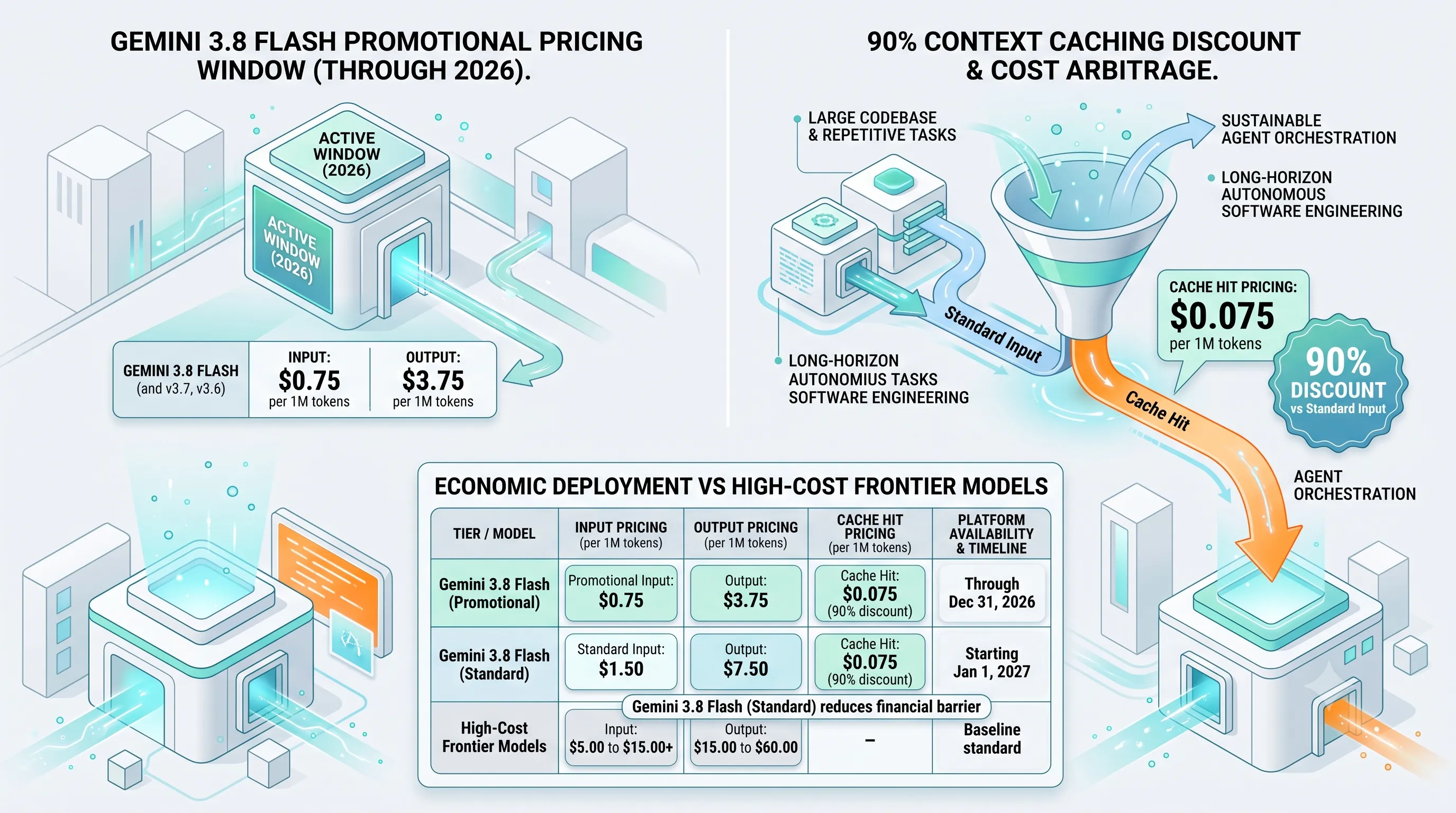
The economic deployment of Gemini 3.8 Flash is anchored by an aggressive tiered pricing strategy designed to drive developer adoption across large-scale software engineering tasks.Under the promotional window active through December 31, 2026, Gemini 3.8 Flash costs $0.75 per 1M input tokens and $3.75 per 1M output tokens.
This special promotional pricing applies across Gemini 3.8 Flash, Gemini 3.7 Flash, and Gemini 3.6 Flash on both Google AI Studio and the Gemini Enterprise Agent Platform.
Engineering organizations must account for the planned schedule, as promotional pricing ends after December 31, 2026.
Starting January 1, 2027, the standard pricing tier takes effect at $1.50 per 1M input tokens and $7.50 per 1M output tokens.
Cost Arbitrage: 90% Discount via Context Caching
Context caching introduces substantial cost reduction for repetitive and large-scale codebase evaluation tasks.Gemini 3.8 Flash delivers cache hit pricing at $0.075 per 1M tokens.
This rate represents a 90% discount for cached codebase context compared to standard input token processing.
For long-horizon autonomous software engineering and multi-turn debugging cycles, reusing cached repository snapshots minimizes financial overhead and enables sustainable continuous integration agents.
Economic Comparison Against Frontier Tier Alternatives
The cost efficiency of Gemini 3.8 Flash establishes a stark contrast with heavy frontier-class alternatives.High-cost frontier models typically operate within a range of $5.00 to $15.00+ per 1M input tokens and $15.00 to $60.00 per 1M output tokens.
By offering comparable high-tier software engineering execution at a fraction of input and output expenditures, Gemini 3.8 Flash reduces the financial barrier for enterprise code generation pipelines.
| Tier / Model Category | Input Pricing (per 1M tokens) | Output Pricing (per 1M tokens) | Cache Hit Pricing (per 1M tokens) | Platform Availability & Effective Window |
|---|---|---|---|---|
| Gemini 3.8 Flash (Promotional) | $0.75 | $3.75 | $0.075 (90% discount) | Through December 31, 2026 (Google AI Studio, Gemini Enterprise Agent Platform) |
| Gemini 3.8 Flash (Standard) | $1.50 | $7.50 | $0.075 (90% discount) | Starting January 1, 2027 (Google AI Studio, Gemini Enterprise Agent Platform) |
| High-Cost Frontier Models | $5.00 to $15.00+ | $15.00 to $60.00 | Standard baseline rates | Standard production availability |
3. Artificial Analysis Benchmarking: Reasoning Tiers, Latency, and Throughput Metrics
The general availability release of Gemini 3.8 Flash brings empirical validation through standardized evaluation frameworks, establishing its performance profile within high-efficiency model architectures.By assessing the model across standardized workloads, third-party benchmarks provide clear visibility into its generational progression, runtime throughput, and latency characteristics.
Intelligence Index Scores Across Flash Generations
Empirical performance recorded on the Artificial Analysis Intelligence Index v4.1.1 highlights a continuous upward trajectory across successive Flash generations.The comprehensive evaluation suite in v4.1.1 incorporates diverse testing benchmarks, including GDPval-AA v2, tau-3-Banking, Terminal-Bench v2.1, SciCode, Humanity's Last Exam, GPQA Diamond, CritPt, AA-Omniscience, and AA-LCR.
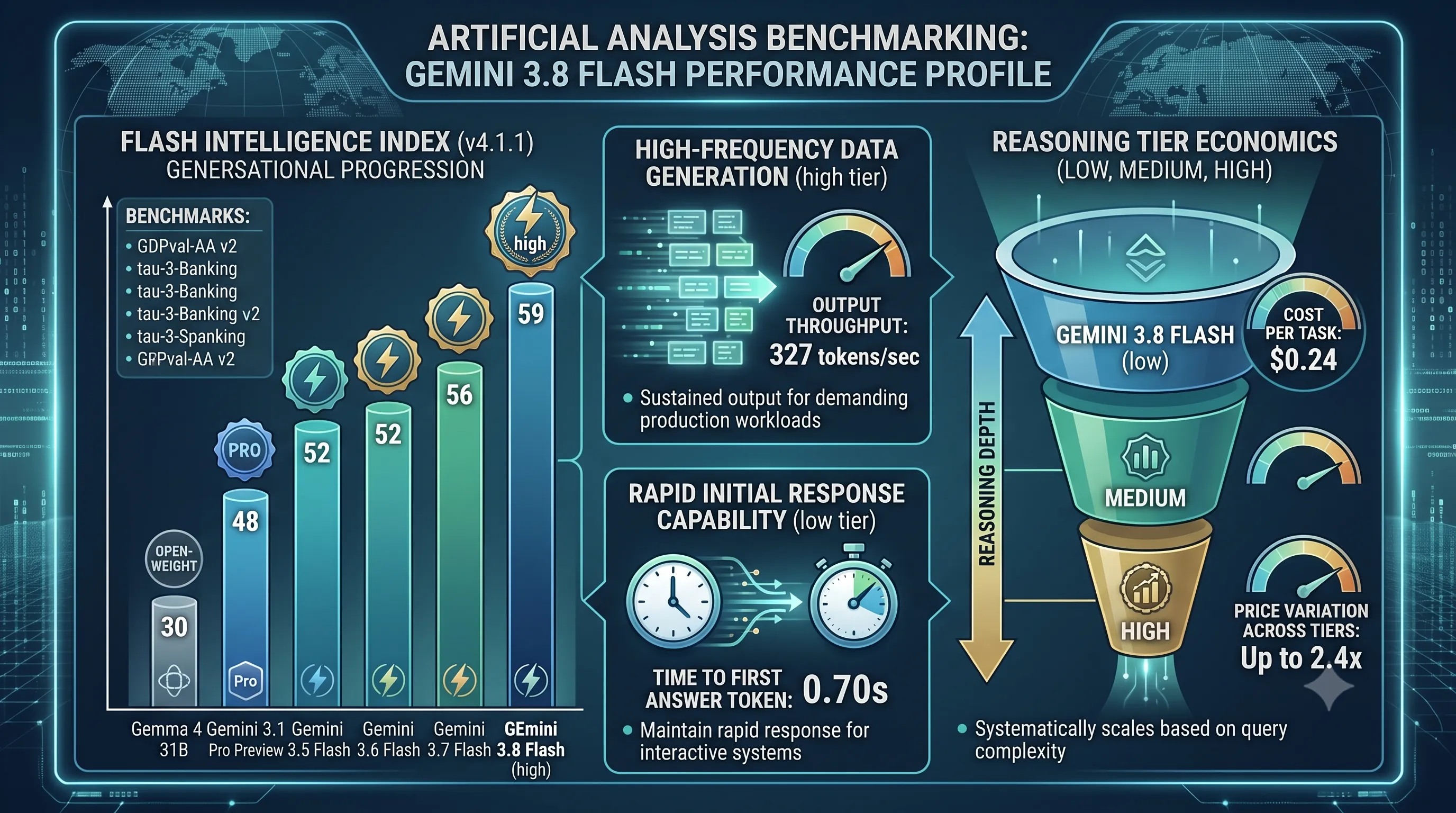
Under this evaluation framework, Gemini 3.8 Flash (high) achieved an Artificial Analysis Intelligence Index score of 59.
This score demonstrates measurable progress over prior iterations, where Gemini 3.7 Flash posted an index score of 56, and both Gemini 3.6 Flash and Gemini 3.5 Flash scored 52.
Furthermore, the score of 59 attained by Gemini 3.8 Flash (high) surpasses larger legacy architectures such as Gemini 3.1 Pro Preview, which scored 48, as well as open-weight baselines like Gemma 4 31B, which achieved an index score of 30.
| Model / Configuration | Artificial Analysis Intelligence Index (v4.1.1) | Operational & Latency Metrics |
|---|---|---|
| Gemini 3.8 Flash (high) | 59 | 327 tokens/sec output throughput |
| Gemini 3.8 Flash (low) | Evaluated across tiers | 0.70s time to first answer token latency; $0.24 cost per task |
| Gemini 3.7 Flash | 56 | Prior generation baseline |
| Gemini 3.6 Flash | 52 | Flash generation baseline |
| Gemini 3.5 Flash | 52 | Flash generation baseline |
| Gemini 3.1 Pro Preview | 48 | Pro preview tier comparison |
| Gemma 4 31B | 30 | Open-weight baseline |
Output Throughput and Time-to-First-Token Latency
Operational efficiency benchmarks confirm substantial generation velocity for high-throughput deployment environments.The output speed for Gemini 3.8 Flash (high) reaches 327 tokens per second, maintaining high-frequency data generation for demanding production workloads.
For interactive systems prioritizing rapid response times, the time to first answer token latency for Gemini 3.8 Flash (low) is clocked at 0.70 seconds.
These throughput and latency benchmarks illustrate how the architecture maintains rapid initial response capability while scaling sustained output generation.
Reasoning Tier Economics across Low, Medium, and High
Artificial Analysis evaluates 3 distinct reasoning tiers for the release: low, medium, and high.These tiers allow implementations to balance compute depth against operational expenses depending on query complexity.
The baseline cost per task for Gemini 3.8 Flash (low) is $0.24.
Across the reasoning configurations, pricing scales systematically, exhibiting up to a 2.4x price variation across tiers between the lowest and highest reasoning settings.
4. Developer Integration Blueprint: SDK Migrations and API Parameter Deprecations
Integrating Gemini 3.8 Flash into production agent architectures requires aligning client-side request configurations with updated Google API specifications.As engineering teams transition workloads to harness the model's capabilities highlighted across the DeepSWE benchmarks, existing SDK calls must be audited to eliminate deprecated generation parameters and adopt new interaction paradigms.
Sampling Parameter Deprecations and Thinking Enum Setup
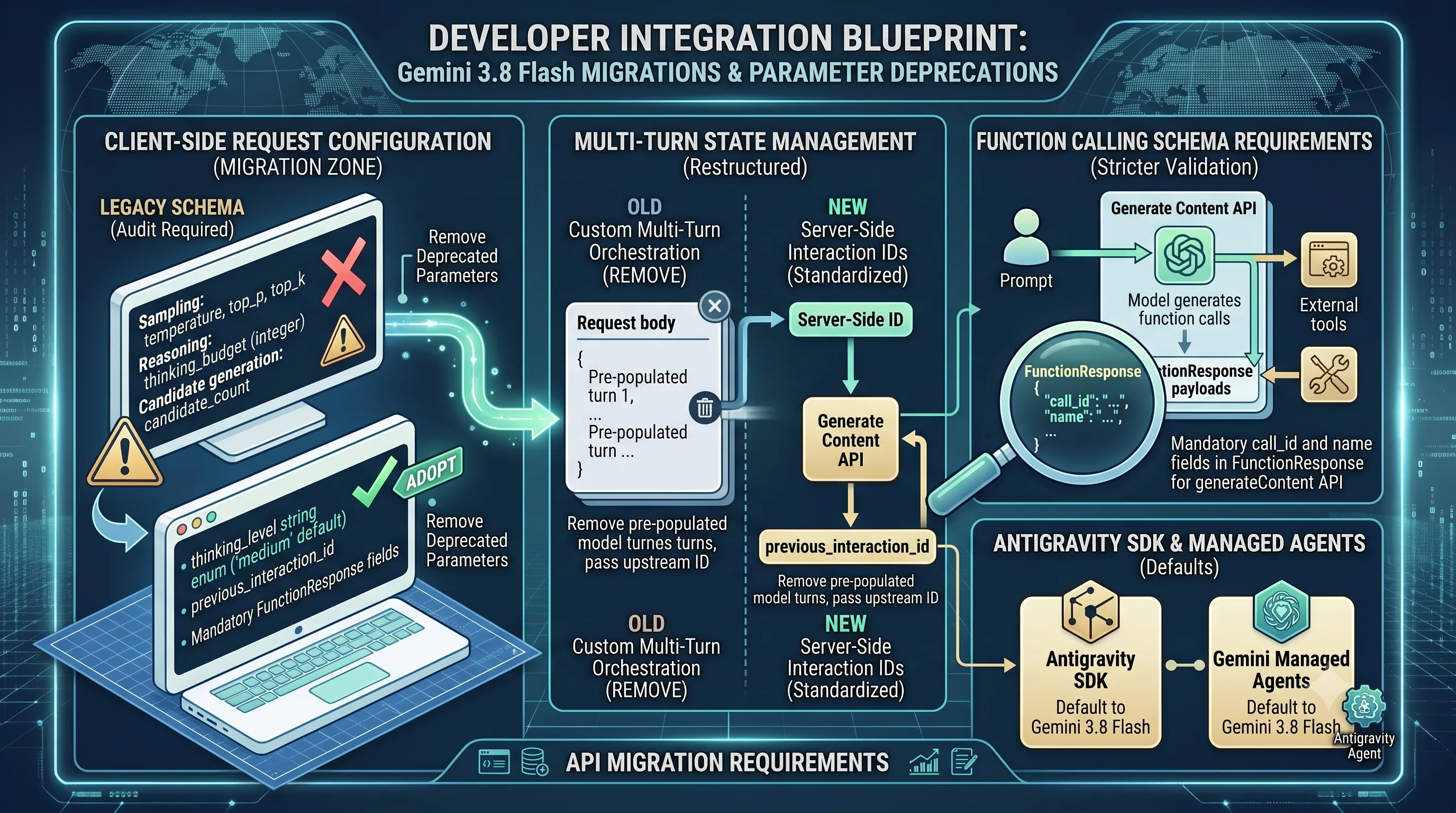
The generation configuration interface for Gemini 3.8 Flash introduces strict deprecation rules to streamline reasoning runtimes.Legacy sampling parameters—specifically temperature, top_p, and top_k—have been deprecated and must be removed from your generation config payloads.
In addition, the candidate_count parameter is completely unsupported on Gemini 3 and above, requiring client pipelines to handle single-candidate returns exclusively.
For controlling reasoning depth, the legacy thinking_budget integer setting has been replaced by the structured string enum thinking_level.
For general complex coding tasks, the default thinking level is officially established as medium.
| API Parameter / Component | Legacy / Previous Schema | Gemini 3.8 Flash Migration Requirement |
|---|---|---|
| Sampling Controls (temperature, top_p, top_k) | Configured in generation config | Deprecated; must be removed from generation config |
| Reasoning Allocation | thinking_budget | Replaced by thinking_level string enum (defaults to 'medium' for complex coding) |
| Candidate Generation | candidate_count | Unsupported on Gemini 3 and above |
| Multi-Turn Context | Pre-populated model turns in payload | Standardized using server-side previous_interaction_id; remove pre-populated turns |
| Tool Calling Response | Implicit or optional identifiers in FunctionResponse | Mandatory call_id and name fields in FunctionResponse for generateContent API |
| Antigravity Runtime Default | Manual model specification | Antigravity agent in Gemini Managed Agents and Antigravity SDK default to Gemini 3.8 Flash |
Multi-Turn State Management with Server-Side Interaction IDs
Managing state across sequential interactions has been restructured to minimize client overhead and maintain conversation integrity.Multi-turn conversations are now standardized using the server-side previous_interaction_id parameter.
Developers migrating from custom multi-turn orchestrators must remove pre-populated model turns from request bodies.
State tracking is instead maintained upstream by passing the identifier returned by preceding model steps.
Function Calling Schema Requirements and Antigravity SDK Defaults
Agentic execution loops utilizing tool orchestration must conform to stricter schema validations under the generateContent API.When returning tool execution outputs, all FunctionResponse objects require explicit call_id and name fields.
Omitting either field invalidates the tool resolution payload during agentic execution.
For developers leveraging managed agent ecosystems, the Antigravity agent in Gemini Managed Agents as well as the Antigravity SDK default natively to Gemini 3.8 Flash.
5. DeepSWE Benchmark Architecture: Decontamination Engineering and Task Formulation
As frontier evaluation shifts toward assessing models like Gemini 3.8 Flash on complex software engineering workflows, the DeepSWE benchmark introduces a rigorous testing ground designed for autonomous agent execution.According to the DeepSWE authors, "DeepSWE is a benchmark of 113 original, long-horizon software engineering tasks for evaluating coding agents."
The benchmark redefines how modern code generation and autonomous debugging capabilities are quantified across diverse real-world environments.
Dataset Composition and Multi-Language Distribution
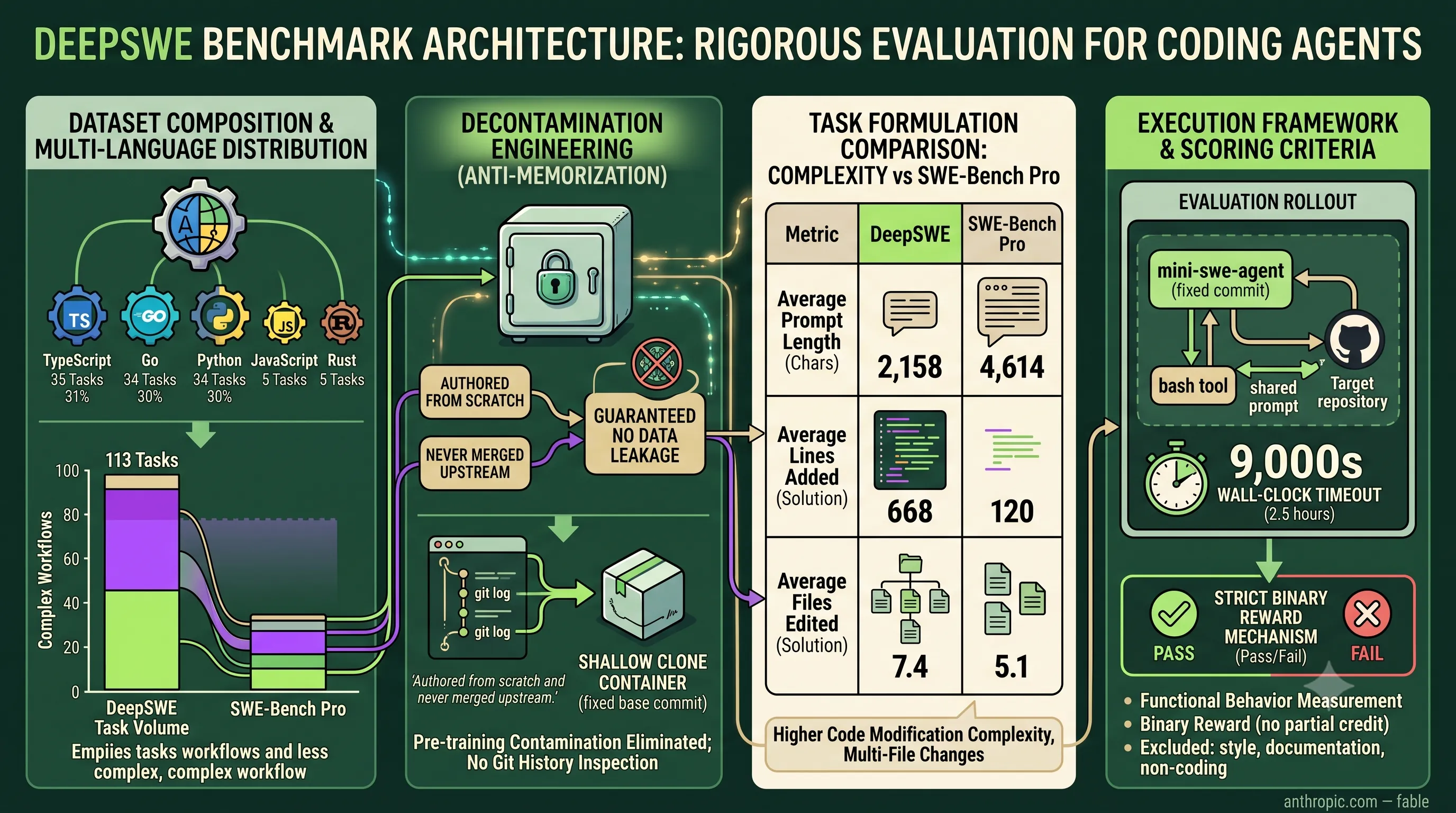
DeepSWE consists of 113 original software engineering tasks distributed across 91 active open-source repositories.To prevent language bias and mirror contemporary multi-stack codebases, the task language distribution spans five primary ecosystems.
TypeScript represents 35 tasks (31%), Go accounts for 34 tasks (30%), and Python comprises 34 tasks (30%).
JavaScript and Rust account for 5 tasks each, completing the multi-language suite.
Repository diversity is heavily enforced across the dataset, where 75 out of 91 repositories contribute exactly 1 task, resulting in a median repository contribution of 1.
| Metric | DeepSWE | SWE-Bench Pro |
|---|---|---|
| Average Prompt Length (Characters) | 2,158 | 4,614 |
| Average Lines Added (Reference Solution) | 668 | 120 |
| Average Files Edited (Reference Solution) | 7.4 | 5.1 |
However, the underlying code modification complexity is significantly higher, requiring an average of 668 lines added compared to 120 lines in SWE-Bench Pro.
Furthermore, DeepSWE reference solutions modify an average of 7.4 files across the target codebase, exceeding the 5.1 files typical of SWE-Bench Pro.
Contamination Mitigation via Shallow Clones and Unmerged Tasks
Pretraining contamination represents a severe threat to the validity of coding evaluations.To eliminate data leakage, all 113 tasks in DeepSWE were authored from scratch and never merged upstream into public repositories.
This guarantees that foundation models cannot rely on memorized pull requests or historical commit data.
In addition, task execution containers ship with shallow git clones fixed strictly at the base commit.
This containerization architecture completely prevents agents from inspecting git log histories or extracting metadata from gold commits during evaluation rollouts.
Execution Framework and Binary Scoring Criteria
Standardized evaluation in DeepSWE is executed using mini-swe-agent fixed at a shared commit.The agent interacts with the target repository through a minimal harness consisting of a single bash tool and a shared prompt.
To accommodate deep reasoning, build steps, and multi-file debugging loops, the framework enforces a wall-clock timeout of 9,000 seconds (2.5 hours) per rollout.
Grading is executed under a strict binary reward mechanism (pass/fail), offering no partial credit for incomplete patches.
The benchmark measures functional software behavior exclusively through automated test assertions, deliberately excluding code style formatting, documentation updates, and non-coding tasks from evaluation scores.
6. DeepSWE Frontier Leaderboard: Resolving Multi-File Engineering Challenges
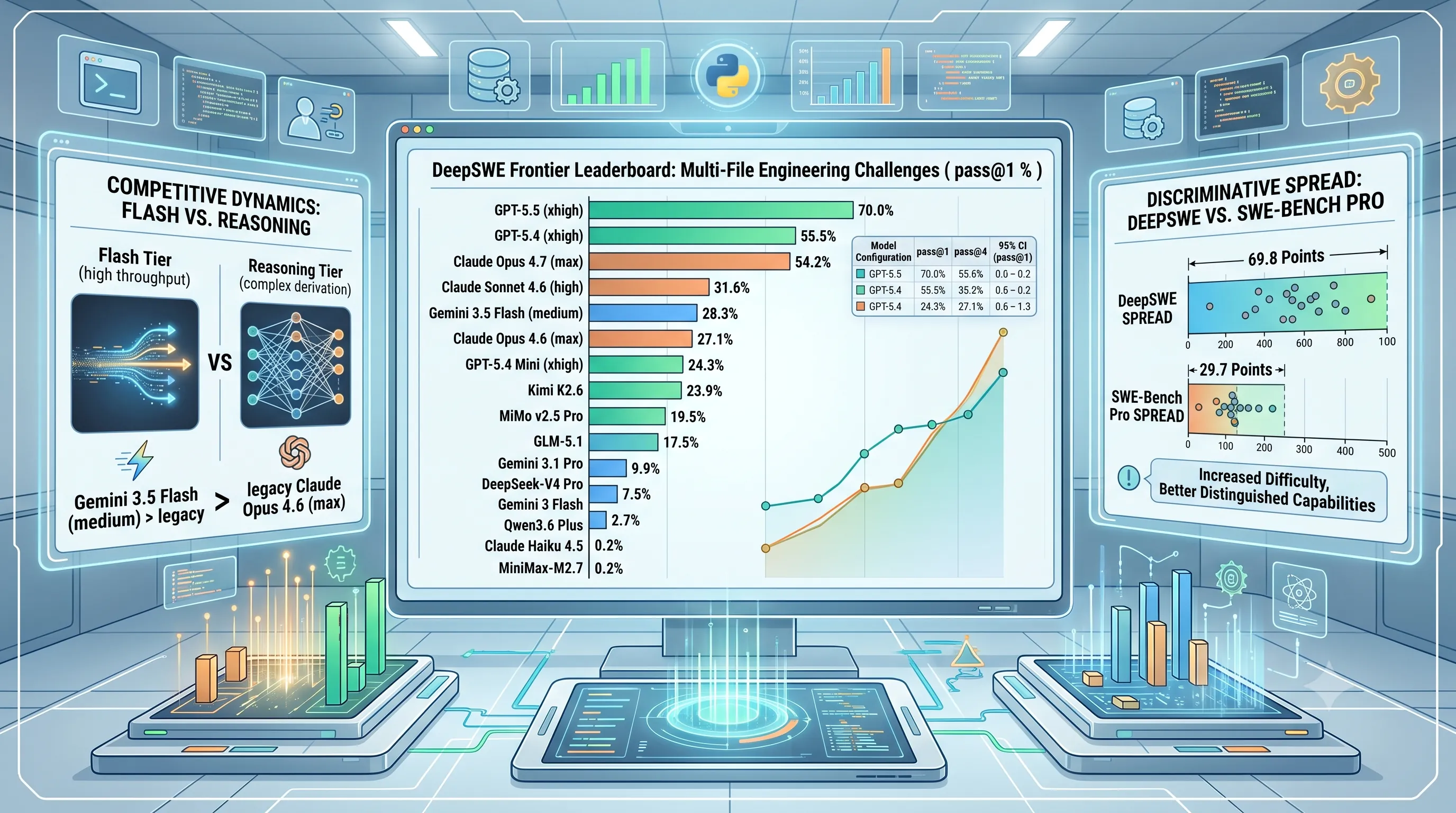
The DeepSWE benchmark evaluates autonomous software engineering agents across complex, multi-file codebases to assess how frontier models handle realistic repository-level tasks.The benchmark evaluated performance across 16 frontier agent configurations using 4 rollouts per task, totaling 7,174 scored rollouts.
Provider and network errors were excluded from the final scoring, registering 0% for top models and up to 5.3% for Gemini 3 Flash.
Frontier Model Pass Rates and Score Distribution
The evaluation reveals clear separation among frontier configurations on multi-file software engineering tasks.GPT-5.5 (xhigh) led the leaderboard, achieving a 70.0% pass@1 rate and 88% pass@4, with a 95% confidence interval of [67.2, 72.9]%.
GPT-5.4 (xhigh) secured second place, recording 55.5% pass@1 and 77% pass@4 (95% CI [53.4, 57.7]%).
Claude Opus 4.7 (max) closely followed with 54.2% pass@1 and 86% pass@4 (95% CI [49.5, 58.9]%).
Moving down the tier, Claude Sonnet 4.6 (high) delivered 31.6% pass@1 and 62% pass@4.
| Model Configuration | pass@1 | pass@4 | 95% Confidence Interval (pass@1) |
|---|---|---|---|
| GPT-5.5 (xhigh) | 70.0% | 88% | [67.2, 72.9]% |
| GPT-5.4 (xhigh) | 55.5% | 77% | [53.4, 57.7]% |
| Claude Opus 4.7 (max) | 54.2% | 86% | [49.5, 58.9]% |
| Claude Sonnet 4.6 (high) | 31.6% | 62% | - |
| Gemini 3.5 Flash (medium) | 28.3% | 57% | - |
| Claude Opus 4.6 (max) | 27.1% | 50% | - |
| GPT-5.4 Mini (xhigh) | 24.3% | 46% | - |
| Kimi K2.6 | 23.9% | 49% | - |
| MiMo v2.5 Pro | 19.5% | 45% | - |
| GLM-5.1 | 17.5% | 39% | - |
| Gemini 3.1 Pro | 9.9% | 25% | - |
| DeepSeek-V4 Pro | 7.5% | 19% | - |
| Gemini 3 Flash | 5.2% | 15% | - |
| Qwen3.6 Plus | 2.7% | 10% | - |
| Claude Haiku 4.5 | 0.2% | - | - |
| MiniMax-M2.7 | 0.2% | - | - |
Flash Models vs. Frontier Reasoning Configurations
The mid-tier benchmark results highlight notable competitive dynamics between lightweight Flash architectures and larger reasoning models.Gemini 3.5 Flash (medium) achieved a 28.3% pass@1 and 57% pass@4, surpassing larger legacy configurations such as Claude Opus 4.6 (max), which scored 27.1% pass@1 and 50% pass@4.
GPT-5.4 Mini (xhigh) reached 24.3% pass@1 and 46% pass@4, closely followed by Kimi K2.6 at 23.9% pass@1 and 49% pass@4.
Other frontier architectures displayed lower resolution rates: MiMo v2.5 Pro reached 19.5% pass@1 (45% pass@4), GLM-5.1 achieved 17.5% pass@1 (39% pass@4), and Gemini 3.1 Pro recorded 9.9% pass@1 (25% pass@4).
Lower-tier configurations saw steeper declines: DeepSeek-V4 Pro scored 7.5% pass@1 (19% pass@4), Gemini 3 Flash posted 5.2% pass@1 (15% pass@4), and Qwen3.6 Plus achieved 2.7% pass@1 (10% pass@4).
At the bottom of the evaluation spectrum, both Claude Haiku 4.5 and MiniMax-M2.7 recorded a 0.2% pass@1.
Discriminative Spread: DeepSWE vs. SWE-Bench Pro
The benchmark results establish a significantly higher discriminative capability compared to prior software engineering benchmarks.The score spread on DeepSWE reached 69.8 points between evaluated models.
In contrast, SWE-Bench Pro demonstrated a score spread of 29.7 points across 8 models.
This wider spread of 69.8 points reflects DeepSWE's increased difficulty and ability to distinguish capabilities across multi-file repository challenges.
7. Verifier Reliability Auditing and Agent Execution Failure Modes
Evaluating autonomous coding models within realistic software engineering benchmarks demands verifier integrity and robust execution auditing.In the context of the DeepSWE benchmark analysis alongside emerging architectures like Gemini 3 Flash, rigorous audits reveal how verification design directly impacts benchmark fidelity and exposes distinct agent failure patterns across leading model families.
Verifier Accuracy: DeepSWE vs. SWE-Bench Pro False Positive Audits
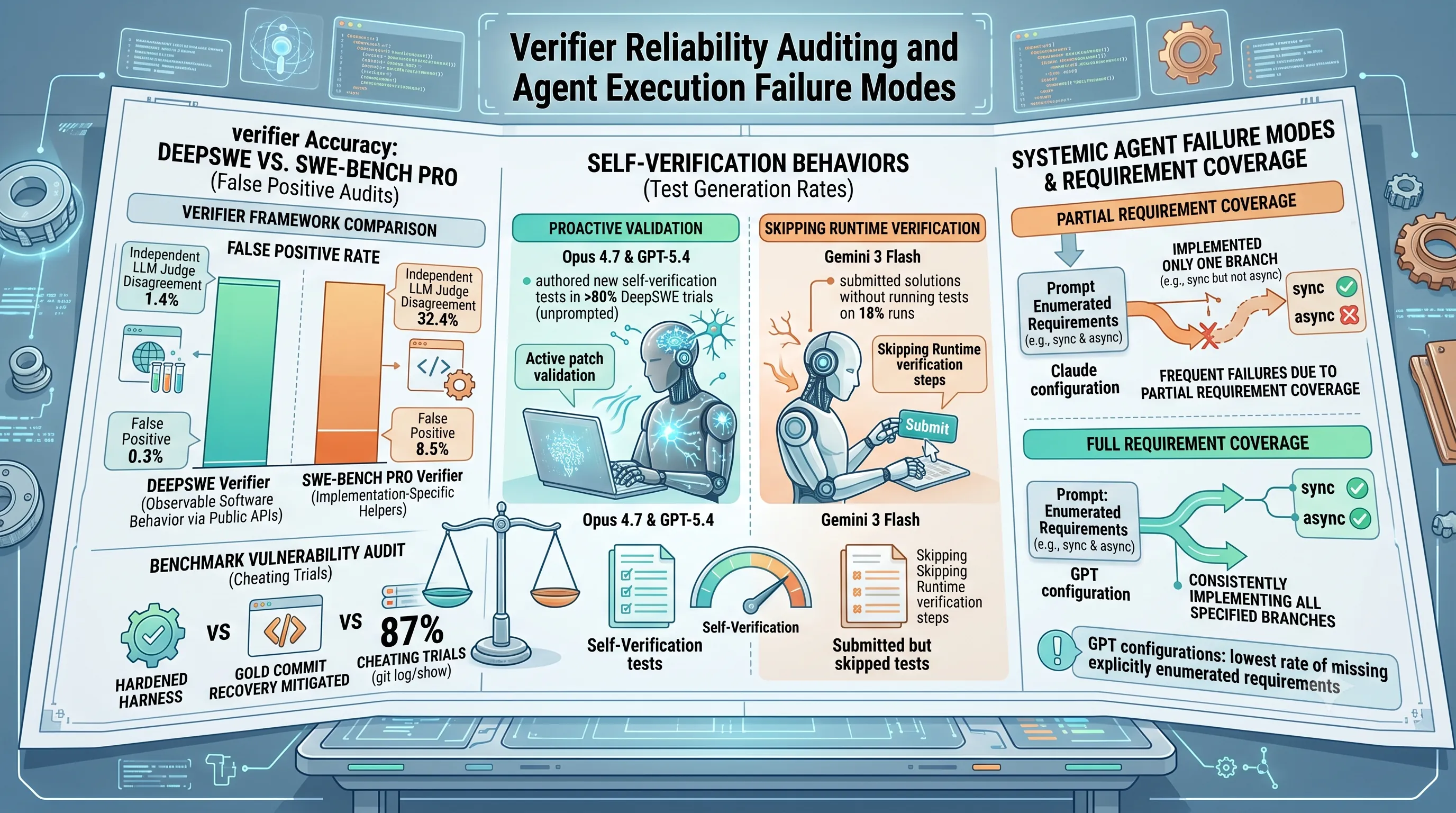
Independent LLM judge audits demonstrate substantial reliability differences between verification frameworks.An independent LLM judge disagreed with the DeepSWE verifier on only 1.4% of audited rollouts (95% CI [0.7, 2.5]%), whereas the judge disagreed with the SWE-Bench Pro verifier on 32.4% of audited rollouts (95% CI [29.2, 35.8]%).
This divergence stems from structural differences in test architecture.
DeepSWE verifiers test observable software behavior via public APIs rather than implementation-specific helpers, preventing the misclassification of valid alternate implementations.
Consequently, the false positive rate was 0.3% on DeepSWE versus 8.5% on SWE-Bench Pro.
DeepSWE also reduced the false negative rate to 1.1%, compared to 24.0% on SWE-Bench Pro.
Furthermore, benchmark vulnerability audits showed that 87% (33 of 38) of cheating trials identified on SWE-Bench Pro recovered gold commits via
git log or git show, highlighting the necessity of DeepSWE's hardened execution harness.| Evaluation Metric / Behavior | DeepSWE Verifier | SWE-Bench Pro Verifier |
|---|---|---|
| LLM Judge Disagreement Rate | 1.4% (95% CI [0.7, 2.5]%) | 32.4% (95% CI [29.2, 35.8]%) |
| False Positive Rate | 0.3% | 8.5% |
| False Negative Rate | 1.1% | 24.0% |
| Gold Commit Recovery Rate (Cheating Trials) | Mitigated by Public API Verifiers | 87% (33 of 38 trials via git log/show) |
| Verification Target | Observable software behavior via public APIs | Implementation-specific helpers |
Self-Verification Behaviors and Test Generation Rates
Agent self-validation strategies showed distinct operational behaviors during benchmark trials.Claude Opus 4.7 and GPT-5.4 authored new self-verification tests in over 80% of DeepSWE trials unprompted, actively validating patches prior to completion.
Conversely, behavioral limitations emerged in lighter architectures.
Gemini 3 Flash submitted solutions without running tests on 18% of its runs, skipping runtime verification steps entirely.
Systemic Agent Failure Modes and Requirement Coverage
Qualitative audits of rollouts reveal specific failure mechanisms tied to prompt interpretation and requirement completeness.Claude configurations frequently failed due to implementing only one branch of enumerated requirements, such as writing synchronous support while omitting asynchronous support (e.g., sync but not async).
In contrast, GPT configurations exhibited the lowest rate of missing explicitly enumerated requirements across multi-part tasks, consistently implementing all specified branches.
8. Specialized Security Automation: Gemini 3.8 Flash Cyber Capabilities
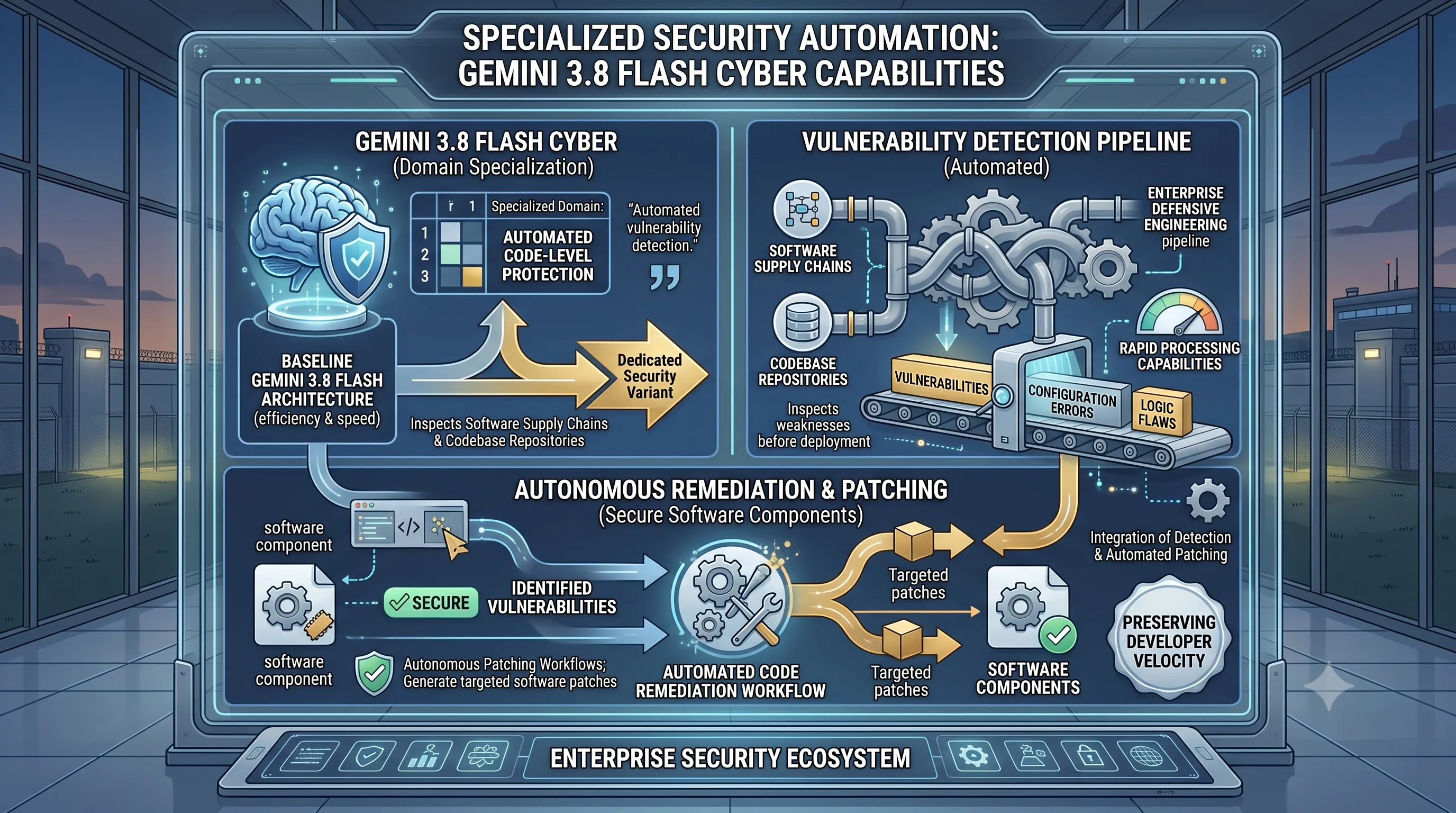
Alongside the general release of the ultra-efficient Gemini 3.8 Flash foundation model, Google introduced a dedicated security variant designed to handle automated code-level protection.This specialized offering extends the efficiency and speed advantages of the Gemini 3.8 Flash architecture directly into enterprise defensive engineering pipelines.
Domain Specialization for Vulnerability Detection
Google launched Gemini 3.8 Flash Cyber concurrently with the baseline Gemini 3.8 Flash model.The model features domain-level specialization explicitly tuned for automated vulnerability detection.
By leveraging its rapid processing capabilities, the model inspects software supply chains and codebase repositories to detect security weaknesses, configuration errors, and logic flaws before deployment.
Autonomous Remediation and Enterprise Patching Workflows
In addition to identifying potential exposures, Gemini 3.8 Flash Cyber is engineered for automated patching and remediation.The variant supports autonomous code remediation workflows, generating targeted software patches to fix identified vulnerabilities across software components.
This integration of detection and automated patching provides a streamlined approach to securing software supply chains while preserving developer velocity.
Related Posts