Gemini 3.8 Flash vs. Muse Spark 1.3: A Comparison of High-Efficiency AI Architectures
🚀 Key Takeaways
- Frontier Capability at Lower Cost: Both Google Gemini 3.8 Flash and Meta Muse Spark 1.3 deliver top-tier reasoning, long-horizon coding, and agentic performance at a fraction of traditional flagship pricing.
- Expansive Million-Token Contexts: Each model supports a 1,048,576-token context window with advanced multimodal input processing, purpose-built for enterprise codebases and multi-file analysis.
- Record-Setting Benchmark Achievements: Modern benchmark evaluations show these cost-efficient models outperforming established giants like Opus 5 and GPT-5.6 Sol across specialized software engineering and deep retrieval tasks.
- Distinct Architectural Trade-offs: Selecting between the two hinges on specific workflow requirements, balancing Gemini's Google ecosystem grounding against Muse Spark's specialized token-efficient coding harnesses and verbosity dynamics.
The enterprise AI landscape has reached an inflection point where massive parameter counts and premium pricing no longer monopolize frontier-level intelligence. The recent releases of Google Gemini 3.8 Flash and Meta Muse Spark 1.3 have redefined cost efficiency, proving that lightweight, highly optimized architectures can challenge and surpass heavy flagship models across rigorous software engineering and autonomous agent tasks.
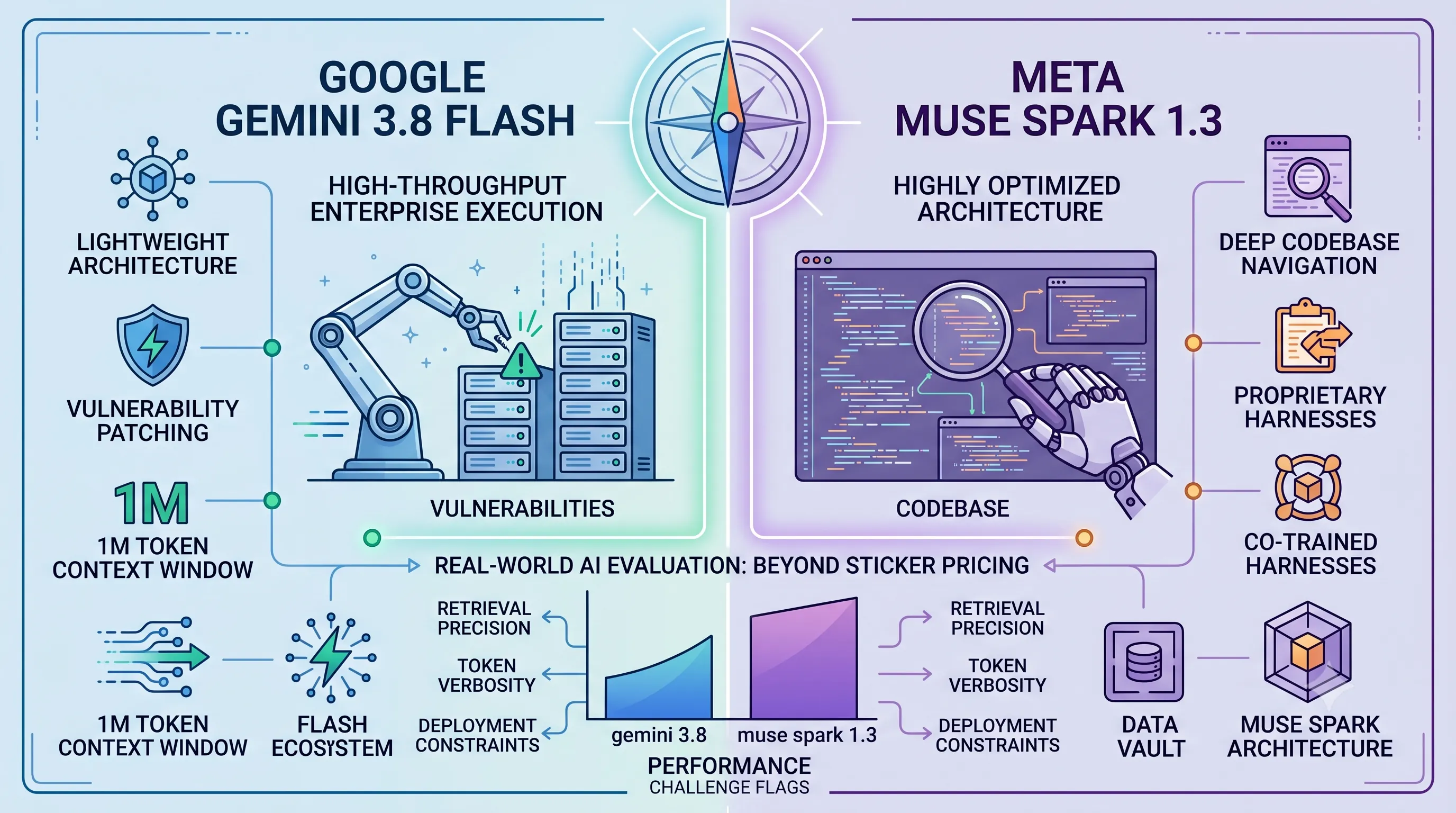
Equipped with 1M-token context windows, multimodal comprehension, and sophisticated tool-use integrations, both models target the same critical bottleneck: scaling long-running, multi-step production pipelines without incurring prohibitive token expenses. Google's Flash ecosystem focuses on high-throughput enterprise execution and vulnerability patching, while Meta's proprietary Muse Spark architecture introduces specialized co-trained harnesses for deep codebase navigation.
Navigating this new tier of high-efficiency reasoning models requires looking beyond sticker pricing to evaluate real-world retrieval precision, token verbosity, and deployment constraints. This comprehensive comparison breaks down the technical capabilities, benchmark performance, and architectural trade-offs of Gemini 3.8 Flash and Muse Spark 1.3.
1. Gemini 3.8 Flash Architecture: 1M Context Window and Long-Horizon Execution Specs
In the pursuit of outperforming massive frontier models at roughly one-tenth of the deployment cost, model architecture must deliver uncompromising capacity alongside optimized inference modes.Google's Gemini 3.8 Flash realizes this balance by combining large-scale context ingestion with specialized agentic tooling and multi-tier reasoning controls.
As documented in Google documentation, "Gemini 3.8 Flash is our most intelligent Flash model, engineered for long-horizon software engineering, autonomous agents, and complex enterprise workflows—all with the speed and cost efficiency of Flash."
Multimodal Ingestion and 1M Context Window Limits
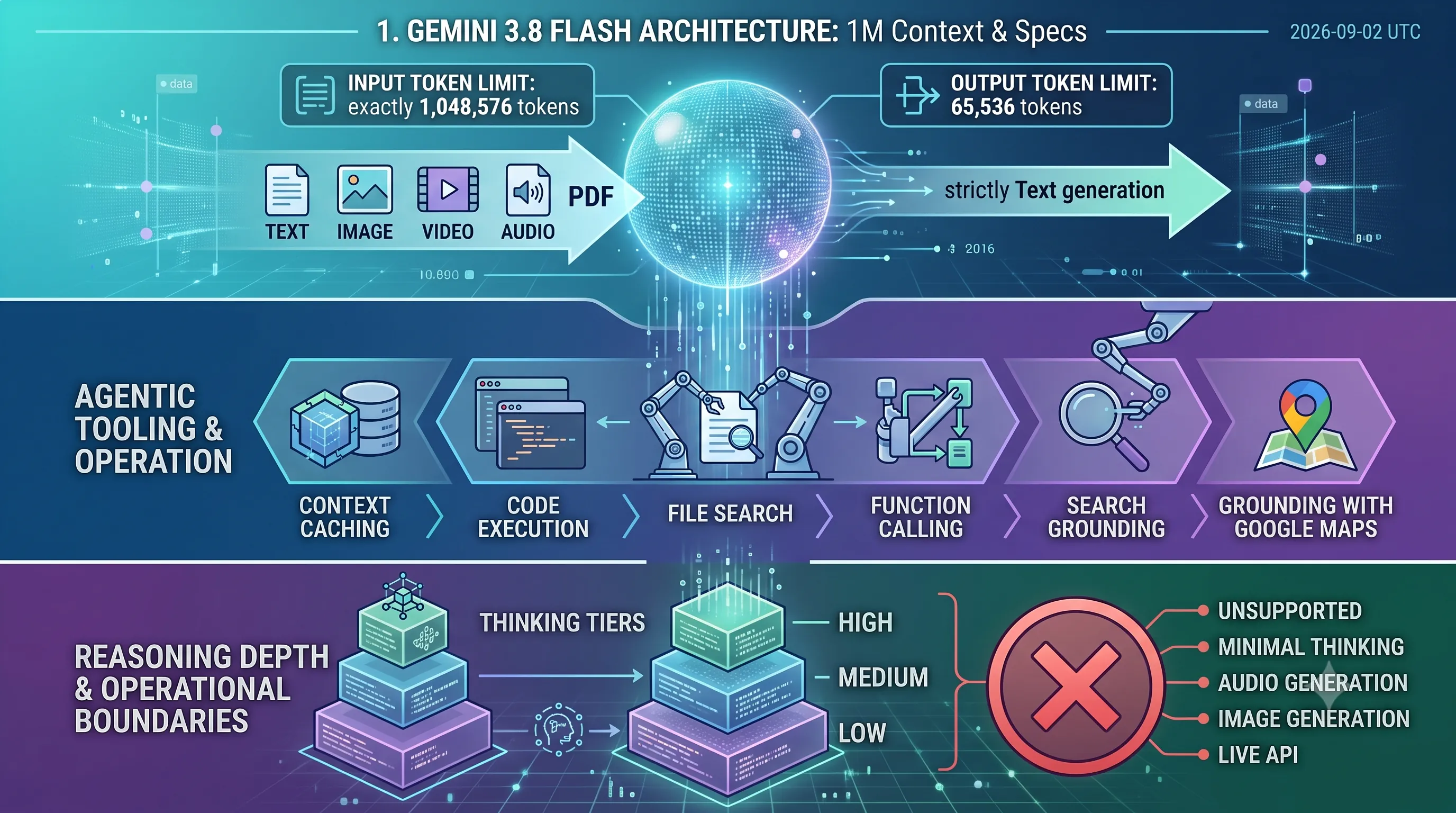
Gemini 3.8 Flash provides an extensive context architecture designed to ingest vast multi-repository codebases and deep enterprise data streams.The model features an input capacity of exactly 1,048,576 tokens and supports an output token limit of 65,536 tokens.
On the input front, the architecture natively accepts diverse modalities, including Text, Image, Video, Audio, and PDF formats.
Regardless of the rich multimodal input stream, the model's generation layer outputs strictly in Text format.
This combination enables technical teams to feed full documentation suites, architectural schematics, audio recordings, and massive source code archives into a single prompt without fragmentation.
| Specification Category | Gemini 3.8 Flash Parameter / Capability |
|---|---|
| Input Token Limit | 1,048,576 tokens |
| Output Token Limit | 65,536 tokens |
| Supported Input Modalities | Text, Image, Video, Audio, PDF |
| Output Modality | Text |
| Thinking Tiers | Low, Medium, High (Minimal unsupported) |
| Last Updated Specification Date | 2026-09-02 UTC |
Autonomous Tooling, Thinking Tiers, and Operational Boundaries
To handle complex execution loops and autonomous agent workloads, Gemini 3.8 Flash integrates a comprehensive toolset and inference routing options.The engine natively supports Context Caching, Code execution, File search, Function calling, Search grounding, and Grounding with Google Maps.
For enterprise system interactions, it includes Computer use (Preview) alongside URL context ingestion.
Developers can structure outputs systematically using Structured outputs via schema and deploy workloads via Batch API, Flex inference, and Priority inference mechanisms.
Reasoning depth is managed through explicit thinking configurations, offering low, medium, and high levels depending on the analytical complexity required.
However, architectural configurations enforce specific operational limitations.
Setting the thinking parameter to "minimal" is not supported and returns an error.
Furthermore, Gemini 3.8 Flash maintains strict functional boundaries: Audio generation is not supported, Image generation is not supported, and the Live API is not supported.
These design specifications establish a focused, high-throughput text-and-reasoning engine optimized for robust agentic pipelines and developer tasks.
2. Cost-Effective Frontier Disruption: Gemini 3.8 Flash Product Lineup and Cyber Variant
Dual Release: Gemini 3.8 Flash and Flash Cyber Architecture
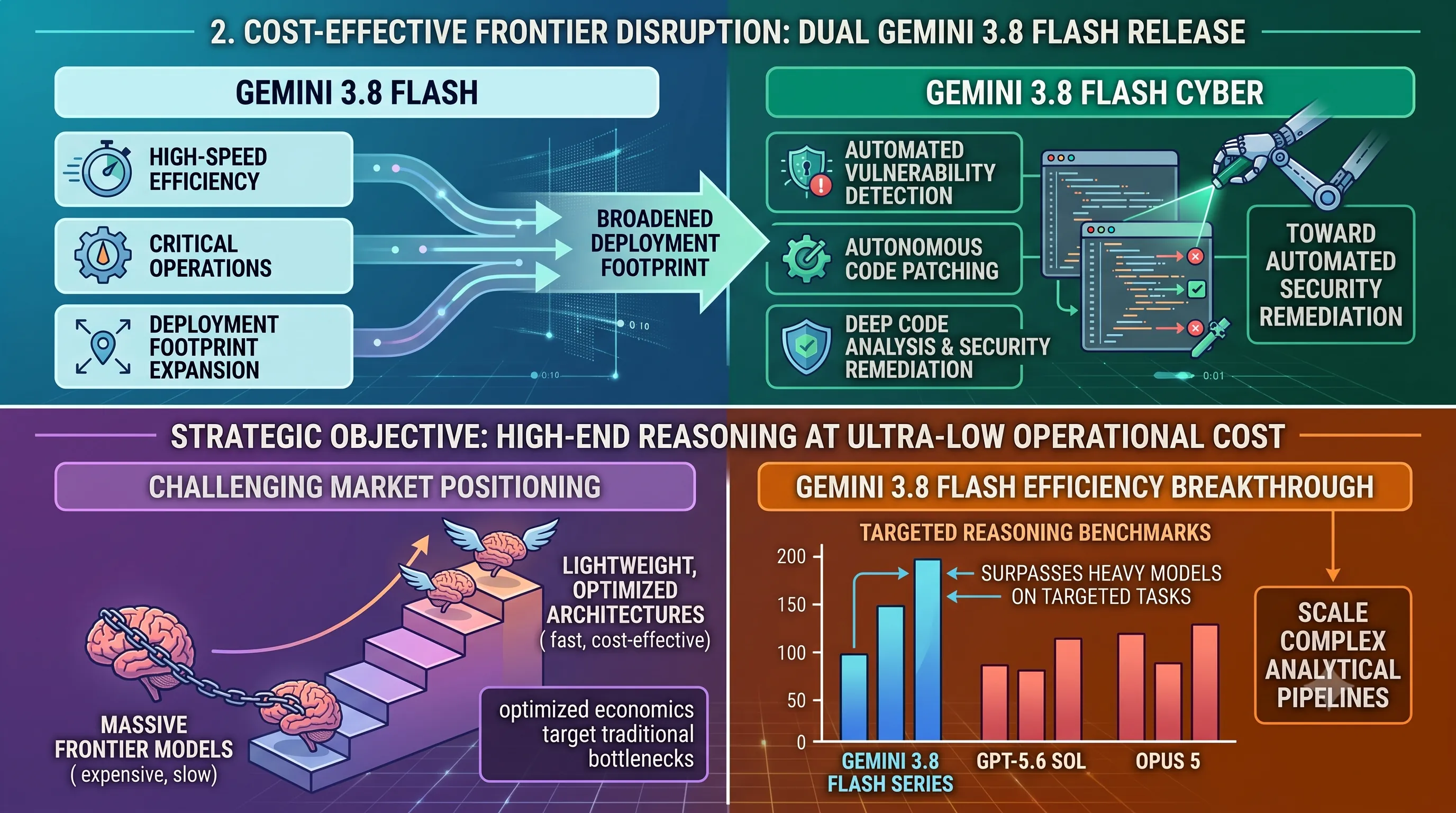
Google expanded its lightweight efficiency lineup through the simultaneous rollout of Gemini 3.8 Flash alongside a dedicated domain-specialized build, Gemini 3.8 Flash Cyber.This dual-release strategy broadens the deployment footprint of high-speed model architectures across critical technical operations.
Specifically, Gemini 3.8 Flash Cyber is engineered directly for automated vulnerability detection and autonomous code patching workflows.
By tailoring lightweight Flash architectures toward deep code analysis and security remediation, organizations can execute continuous vulnerability scans without incurring the prohibitive operational overhead typical of massive frontier models.
Targeting Flagship Reasoning Workflows at Substantially Lower Cost
The core strategic objective behind the Gemini 3.8 Flash series is delivering high-end reasoning capabilities while sustaining ultra-low operational costs.Rather than restricting advanced reasoning to slow, expensive flagship models, Google has optimized Flash-tier economics to challenge traditional market positioning.
According to coverage by the Times of India, Google claims that Gemini 3.8 Flash outperforms massive frontier models, including Opus 5 and GPT-5.6 Sol, on select industry benchmarks.
This efficiency breakthrough enables complex analytical pipelines and automated security workflows to run at scale, proving that optimized lightweight architectures can surpass heavy frontier models on targeted reasoning tasks at a fraction of the cost.
3. Meta Muse Spark 1.3 Specifications: Pricing Structure, Latency, and Reasoning Tiers
To understand how modern cost-optimized reasoning models outperform frontier architectures at a fraction of standard operational expenses, evaluating Meta's closed-weights proprietary multimodal reasoning model, Muse Spark 1.3, is essential.Released on September 2, 2026, Muse Spark 1.3 was engineered specifically for long-running agentic, multi-agent, and complex coding workflows.
The model features a massive context window of 1,048,576 tokens (1M tokens) and accepts text, image, video, and PDF inputs.
Developers can access the architecture via the Muse Code coding agent harness, the Meta Model API, and OpenRouter, utilizing native tool calling, function calling via tools/tool_choice, and structured outputs enforced through JSON schema.
Tiered Endpoint Pricing and Contributor Tokenomics
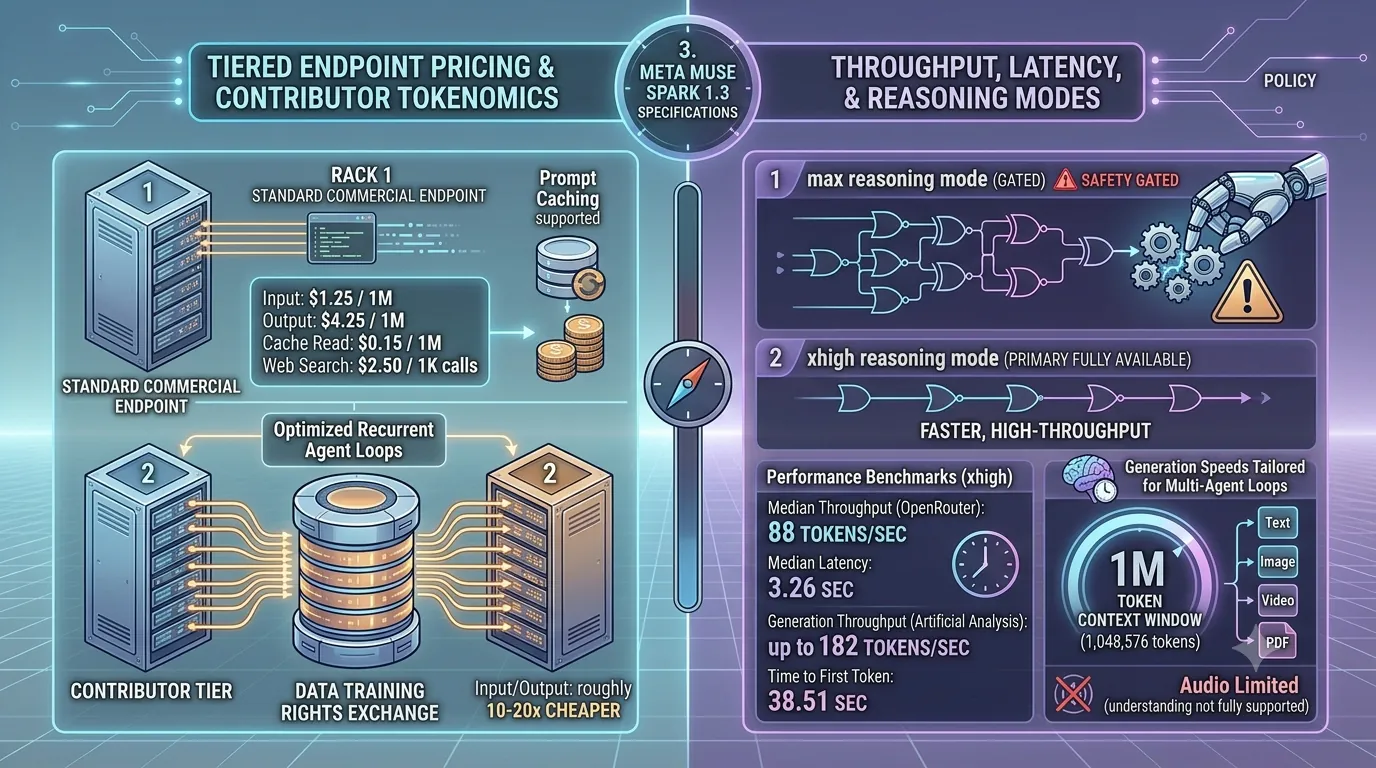
The tokenomics of Muse Spark 1.3 provide a highly aggressive cost structure designed to minimize production overhead across sustained reasoning tasks.Under standard endpoint pricing, the model is billed at $1.25 per 1M input tokens and $4.25 per 1M output tokens.
To optimize recurrent agent loops, prompt caching is supported at a Cache Read rate of $0.15 per 1M tokens.
For workflows requiring real-time grounding, integrated Web Search is priced at $2.50 per 1K calls.
In addition to standard commercial endpoints, Meta provides a Contributor endpoint tier that offers roughly 10-20x cheaper pricing in exchange for data training rights, dramatically lowering entry barriers for high-volume automated pipelines.
| Metric / Specification | Standard Commercial Endpoint | Contributor Tier / Alternative Rate |
|---|---|---|
| Input Pricing (per 1M tokens) | $1.25 | Roughly 10-20x cheaper (data training exchange) |
| Output Pricing (per 1M tokens) | $4.25 | Roughly 10-20x cheaper (data training exchange) |
| Cache Read Rate (per 1M tokens) | $0.15 | N/A |
| Web Search Execution | $2.50 per 1K calls | N/A |
| Context Window Capacity | 1,048,576 tokens (1M tokens) | 1,048,576 tokens (1M tokens) |
| Modalities Supported | Text, Image, Video, PDF (Audio limited) | Text, Image, Video, PDF (Audio limited) |
Throughput Metrics, Latency Profiles, and Reasoning Modes
Muse Spark 1.3 ships in two distinct reasoning tiers: the max mode (its top reasoning configuration) and the xhigh mode (a faster, high-throughput configuration).At initial launch, the max reasoning mode was gated behind safety testing, making the xhigh configuration the primary fully available mode across public routing platforms.
Performance benchmarks demonstrate robust generation speeds tailored for multi-agent loops.
On OpenRouter, the model records a median P50 throughput of 88 tokens per second across providers, paired with a P50 latency of 3.26 seconds.
Under dedicated benchmark testing by Artificial Analysis on the xhigh configuration, generation throughput reaches up to 182 tokens per second, alongside a time to first answer token of 38.51 seconds during deep reasoning runs.
While the model delivers robust parsing for visual and document formats, audio understanding is currently not fully supported, and response quality on audio-heavy requests may be degraded.
4. Evaluating Muse Spark 1.3: Long-Context Coding Efficiency and Agentic Trade-offs
In the broader context of deploying cost-efficient architectures to match or exceed frontier LLMs, evaluating Muse Spark 1.3 provides critical empirical data on where streamlined models excel and where operational trade-offs emerge.A detailed examination of recent benchmark data reveals how architectural tuning and harness co-training impact real-world software engineering performance and token economics.
Long-Context Retrieval and Codebase Engineering Capabilities
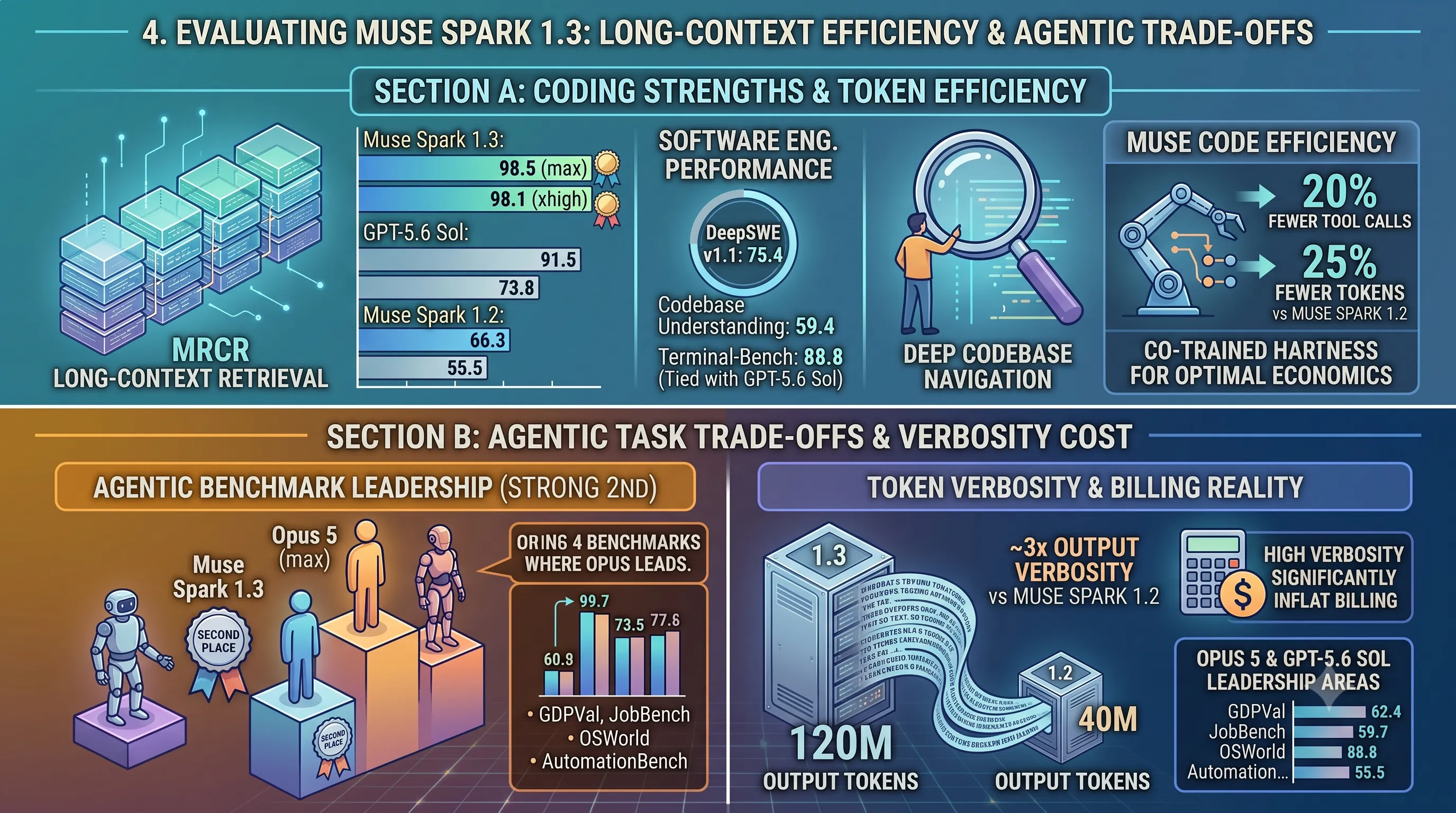
Muse Spark 1.3 established a strong presence on general reasoning leaderboards, ranking #6 out of 636 models on the Artificial Analysis Intelligence Index with an Index score of 62 on its max variant and 61 on its xhigh variant.The model demonstrates standout capabilities in long-context retrieval, achieving MRCR scores of 98.5 and 98.1.
These figures significantly outpace frontier alternatives like GPT-5.6 Sol, which scored 91.5 and 73.8, as well as the prior-generation Muse Spark 1.2, which recorded 66.3 and 55.5.
In specialized software engineering evaluations, Muse Spark 1.3 scored 75.4 on the DeepSWE v1.1 coding benchmark and 59.4 on codebase understanding.
On Terminal-Bench, the model achieved a score of 88.8, placing it in a direct tie with GPT-5.6 Sol.
To optimize developer workflows, Muse Spark 1.3 was co-trained with Meta's Muse Code harness for optimal token efficiency inside Muse Code.
According to Meta, this co-training allows the model to complete coding tasks using approximately 20% fewer tool calls and 25% fewer tokens than Muse Spark 1.2.
Furthermore, the model is explicitly trained to confirm before executing irreversible actions, ask clarifying questions, and maintain coherence across long conversation threads.
Agentic Task Strengths and Verbosity Cost Realities
Despite notable coding and retrieval metrics, multi-agent evaluation suites expose specific competitive boundaries.Opus 5 (max) leads Muse Spark 1.3 on 4 out of 6 agent benchmarks, including GDPVal, JobBench, OSWorld, and AutomationBench.
Meanwhile, GPT-5.6 Sol outperforms Muse Spark 1.3 on 2 agent benchmarks: DeepSearchQA and Agentic IF.
An analysis by eesel AI summarized this dynamic, stating: "Muse Spark 1.3 owns long context and coding... but on the agent evaluations 1.3 is a strong second, not the leader."
Additionally, transparency concerns arose regarding the launch benchmark scorecard, which compared Muse Spark 1.3 in max mode against Muse Spark 1.2 in xhigh mode rather than matching like-for-like reasoning tiers.
A crucial operational factor for engineering teams is output verbosity and its impact on infrastructure billing.
Muse Spark 1.3 emitted 120M output tokens to complete the Intelligence Index evaluation, whereas the field median stood at 72M tokens.
Community testing confirms that the model generates roughly 3x more output tokens than Muse Spark 1.2.
This high verbosity (3x token output) significantly increases actual token billing costs in production, counterbalancing its low per-token baseline pricing.
| Evaluation Domain / Metric | Muse Spark 1.3 Result | Comparative Context & Competing Models |
|---|---|---|
| Artificial Analysis Intelligence Index | Score: 62 (max) / 61 (xhigh) | Ranked #6 of 636 models evaluated |
| MRCR Long-Context Retrieval | 98.5 / 98.1 | GPT-5.6 Sol: 91.5 / 73.8 Muse Spark 1.2: 66.3 / 55.5 |
| DeepSWE v1.1 Coding Benchmark | 75.4 | Demonstrates leading performance in long-context coding tasks |
| Codebase Understanding Benchmark | 59.4 | Measures architectural and codebase comprehension |
| Terminal-Bench Execution | 88.8 | Tied with GPT-5.6 Sol (88.8) |
| Coding Harness Efficiency (Muse Code) | ~20% fewer tool calls, ~25% fewer tokens | Compared to Muse Spark 1.2 inside Meta's Muse Code harness |
| Agentic Benchmark Leadership | Strong 2nd place across suites | Opus 5 (max) leads on 4/6 (GDPVal, JobBench, OSWorld, AutomationBench) GPT-5.6 Sol leads on 2/6 (DeepSearchQA, Agentic IF) |
| Token Verbosity & Billing Impact | 120M output tokens (Index eval) | Field median: 72M tokens; ~3x output verbosity vs. Muse Spark 1.2 inflates net billing |
Related Posts