
Inside SpaceX's Starmind: How 1 Million AI Satellites Will Operate
🚀 Key Takeaways
- Historic Regulatory Milestone: The FCC has granted regulatory clearance for SpaceX to operate an orbital computing constellation carrying dedicated AI processing hardware in low Earth orbit.
- Space-Native Thermal and Power Systems: The spacecraft architecture leverages unconstrained space solar power and deployable liquid radiators to overcome the severe thermal limits of microgravity.
- Optical In-Orbit Networking: On-orbit processing pipelines bypass terrestrial bottlenecks by relaying processed compute directly through high-speed optical laser links integrated with Starlink.
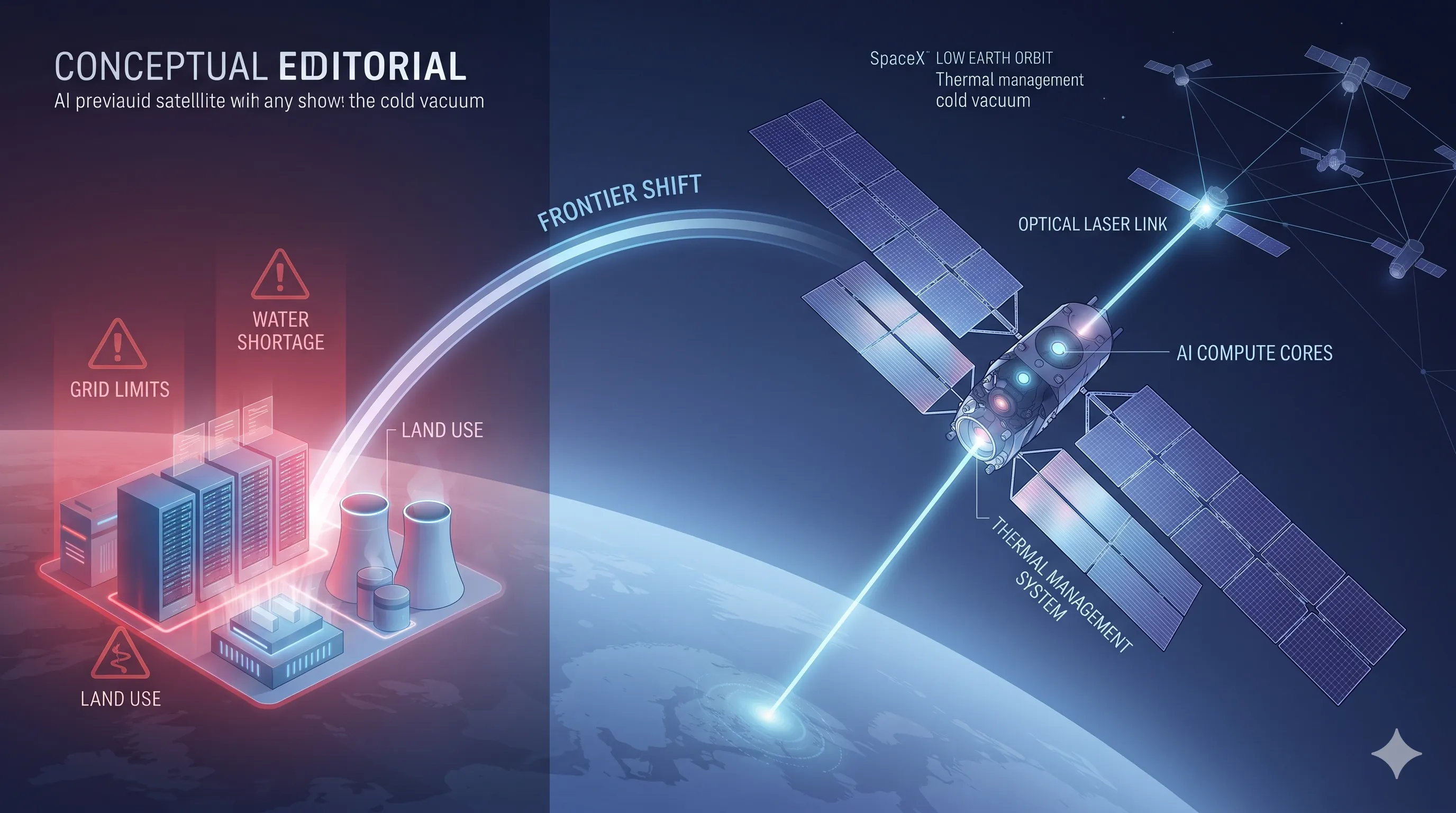
- Bypassing Terrestrial Resource Caps: Shifting intensive machine learning workloads to orbit sidesteps Earthbound bottlenecks in electrical grid capacity, real estate, and industrial water cooling.
As terrestrial artificial intelligence infrastructure runs headfirst into hard limits on local electrical grid allocations, water supplies, and physical land, the frontier of enterprise computing is moving beyond the atmosphere. The Federal Communications Commission’s regulatory approval earlier this week marks the first formal authorization for a massive, spaceborne AI compute network, positioning low Earth orbit as the next operational tier for advanced data infrastructure.
SpaceX's planned Starmind constellation represents a foundational shift in satellite design and purpose. Instead of functioning strictly as communications repeaters or remote-sensing platforms, these high-powered spacecraft are purpose-built floating server nodes engineered to harness direct solar radiation, execute intense AI inference and training workloads in orbit, and radiate excessive thermal energy directly into the cold expanse of space.
With rival aerospace and hyperscale tech alliances preparing parallel orbital initiatives, understanding the mechanics of orbital compute has become vital. From structural thermal radiators to optical inter-satellite links, examining how these data center satellites will operate reveals how humanity plans to solve the looming compute crisis off-planet.
1. FCC Regulatory Approval and the Starmind Phased Orbital Timeline
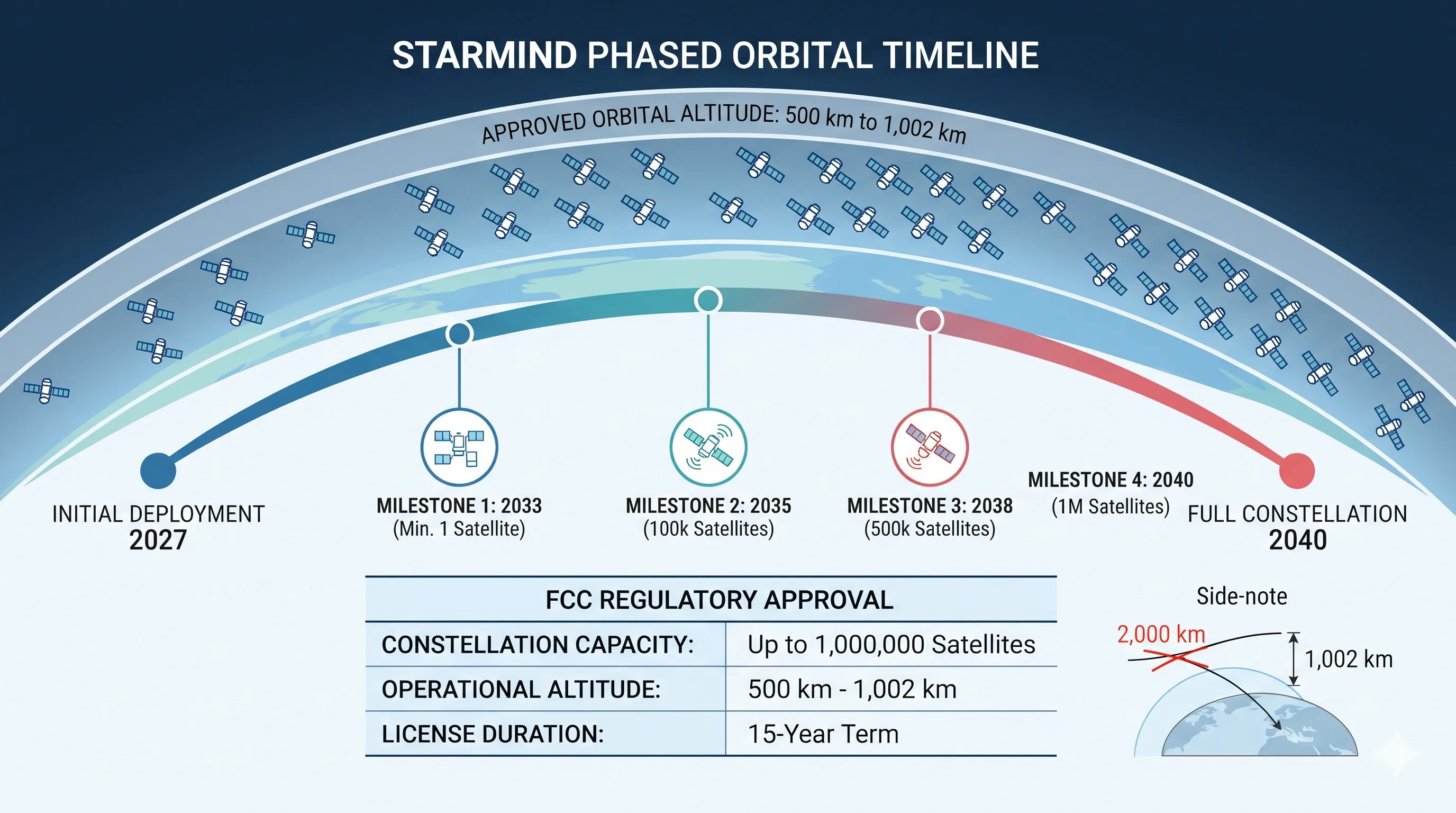
Understanding the operational architecture of SpaceX’s data center satellites requires examining the regulatory parameters that govern their presence in low Earth orbit.On November 25, 2026, the Federal Communications Commission (FCC) granted regulatory approval permitting SpaceX to deploy up to 1 million AI chip-equipped satellites, marking the first US approval granted for a full constellation of AI data center satellites.
This decision sets the legal, orbital, and temporal boundaries under which the orbital computing network—designated as Starmind—will operate above Earth.
Deployment Milestones and Altitude Envelopes
The FCC’s authorization restricts the operational domain of SpaceX’s constellation to an approved orbital altitude range between 500 and 1,002 kilometers above Earth.SpaceX's original proposal included orbital altitudes reaching 2,000 kilometers, but the commission capped the operational ceiling at 1,002 kilometers to balance spectrum use and orbital density.
SpaceX is targeting initial Starmind launches starting in 2027 to begin validating hardware in this designated altitude shell.
The regulatory order imposes a binding phased deployment schedule that spans through 2040.
SpaceX must deploy at least one authorized satellite by November 25, 2033.
Following initial deployment, the company must reach 10% constellation deployment (100,000 satellites) by November 25, 2035.
The halfway mark requires 50% deployment (500,000 satellites) by November 25, 2038, culminating in full deployment of the authorized 1 million satellite constellation by November 25, 2040.
The authorization carries a 15-year operational term, which officially begins upon the first operational certification.
| Regulatory Metric / Parameter | FCC Requirement / Threshold | Context and Operational Constraints |
|---|---|---|
| Constellation Capacity | Up to 1,000,000 satellites | First US authorization for a full constellation of AI chip-equipped satellites. |
| Operational Altitude | 500 km to 1,002 km | Restricted from SpaceX's originally proposed 2,000 km altitude ceiling. |
| Initial Launch Target | 2027 | Target date for initial Starmind orbital deployments. |
| License Duration | 15-year term | Commences upon the filing of the first operational certification. |
| Milestone 1 | November 25, 2033 | Deployment of at least one authorized operational satellite. |
| Milestone 2 (10%) | November 25, 2035 | Deployment of 100,000 operational satellites. |
| Milestone 3 (50%) | November 25, 2038 | Deployment of 500,000 operational satellites. |
| Milestone 4 (100%) | November 25, 2040 | Full deployment of all 1,000,000 authorized satellites. |
| Safety Reporting | Semi-annual (Jan 1 / Jul 1) | Mandatory reporting on conjunction events and collision maneuvers. |
Reporting Obligations and Graveyard Orbit Deferrals
To maintain compliance throughout the multi-decade buildout, the FCC imposed specific operational monitoring mandates.SpaceX must certify its first satellite's successful operation within five business days of orbital activation.
Furthermore, SpaceX must submit operational safety reports twice yearly—specifically by January 1 and July 1—covering conjunction events and all collision-related maneuvers executed by the constellation.
The authorization was granted after the FCC formally dismissed petitions to deny filed by market competitors, including Amazon.
However, the regulator did not grant blanket approval to all operational requests.
The FCC deferred SpaceX's request to dispose of satellites above 600 kilometers in graveyard orbits due to insufficient process plans.
Until comprehensive disposal mechanisms for the higher altitude tiers are reviewed and approved, deorbit and end-of-life disposal procedures above 600 kilometers remain under regulatory scrutiny.
Astronomical Concerns and Strategic Implications
The scale of the Starmind orbital data center network has prompted formal scrutiny from the scientific community.The American Astronomical Society raised concerns regarding radio interference and infrared emissions affecting observations, warning that thermal radiation from intense onboard AI compute workloads could impact deep-space instruments.
Despite these environmental and observational concerns, regulatory leadership emphasized the strategic value of space-based compute infrastructure.
Brendan Carr emphasized that computing campuses and data centers are essential to maintaining US superintelligence dominance.
Underscoring this perspective, the FCC stated that the constellation represents a turning point in US superintelligence development bringing humanity closer to a Kardashev II civilization.
2. Inside the AI1 Satellite Architecture: Solar Harvesting and Vacuum Thermal Radiators
To understand how SpaceX’s data center satellites will operate in orbit, the operational focus centers on the physical platform engineered to sustain high-density compute workloads in space.SpaceX has designated this dedicated satellite hardware platform as the AI1 architecture.
Operating beyond the protective atmosphere of Earth requires a complete redesign of conventional data center infrastructure, replacing terrestrial utility feeds and chilling infrastructure with integrated orbital solar collection and vacuum heat radiation.
AI1 Physical Dimensions and Power Harvesting
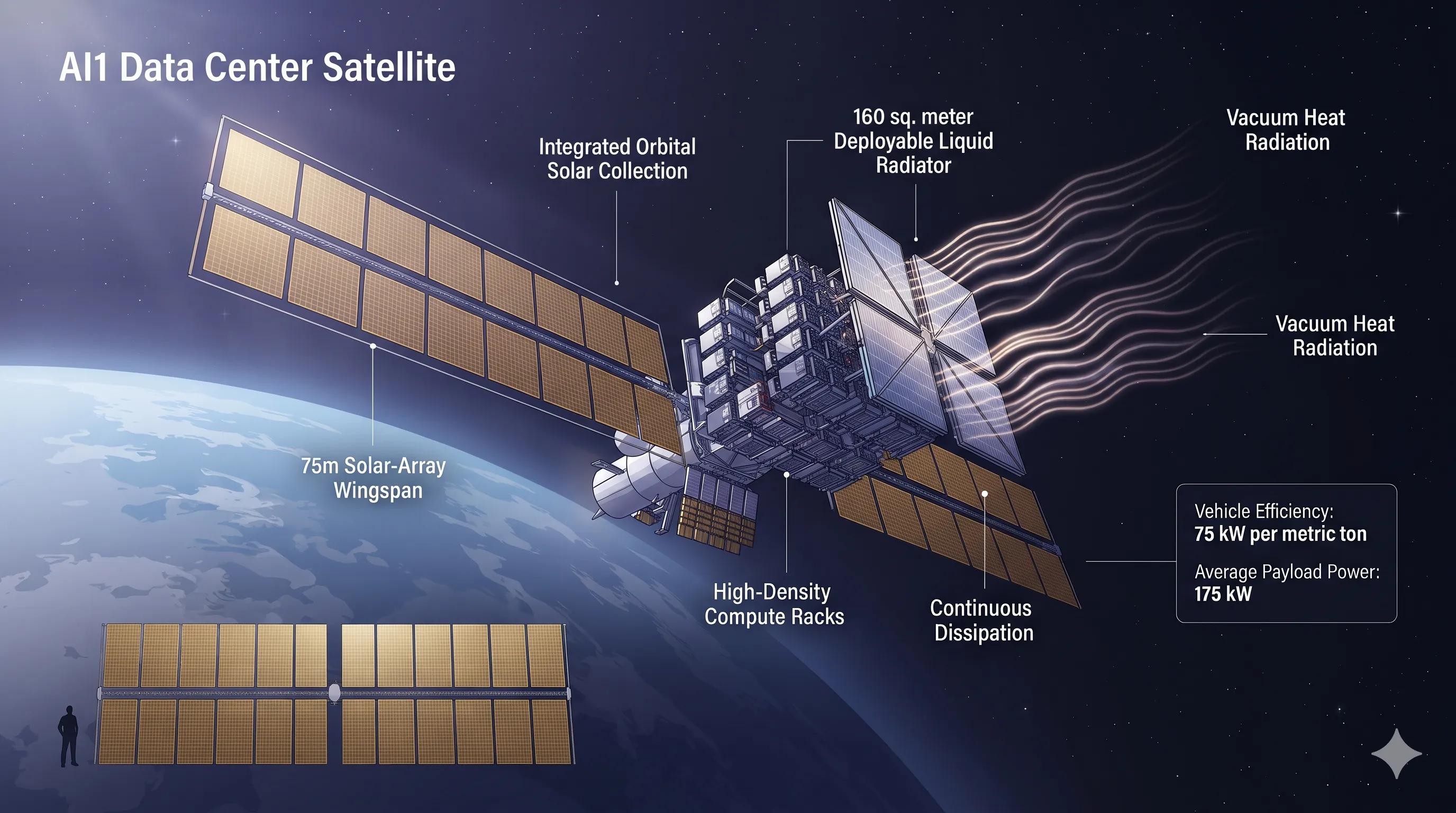
The physical scale of the AI1 spacecraft reflects the massive electrical power required by modern machine learning clusters.Once fully deployed in orbit, each AI1 satellite reaches a vertical height of approximately 30 meters.
Lateral expansion is dominated by extensive photovoltaic wings, creating an overall solar-array wingspan of approximately 75 meters.
Power generation is driven by space-based solar energy harvested directly by a 210-kilowatt solar array.
These specialized solar panels are manufactured at SpaceX's Bastrop, Texas facility.
The harvested solar power feeds the onboard compute systems, which sustain an average computing-payload power demand of 175 kilowatts.
To handle burst compute operations, the power subsystem accommodates a peak computing-payload power demand reaching up to 250 kilowatts.
Deployable Liquid Radiators and Heat Dissipation in Vacuum
Without atmospheric conduction or convection, large-scale orbital computing operations face severe physical constraints regarding heat removal.Standard terrestrial data centers rely on cooling towers, mechanical chillers, or ambient airflow to cycle heat away from processing units.
The AI1 architecture bypasses terrestrial cooling infrastructure entirely by utilizing continuous thermal dissipation into the vacuum of space.
To achieve this, the spacecraft utilizes a deployable liquid radiator providing an active thermal surface area of 160 square meters.
Closed-loop liquid cooling transports heat away from the dense processor racks directly out to the radiator panels, radiating thermal energy into the cold background of space.
Pointing to this balance between direct solar collection and radiator-based vacuum cooling, Elon Musk stated that space is the lowest-cost place to put AI and will be realized in 2 to 3 years.
Terafab Processing Hardware and Vehicle Mass Efficiency
The computational core of the AI1 satellite is designed around strict mass-to-power density ratios.SpaceX has set a target vehicle efficiency of approximately 75 kilowatts of computing capacity per metric ton of spacecraft mass.
Achieving such high efficiency requires specialized, high-density silicon tailored for orbital operations.
To support this payload demand, SpaceX plans to fabricate chips for the satellites at an upcoming Terafab facility.
Deploying custom silicon produced via the Terafab pipeline ensures that compute nodes integrate directly with the AI1 thermal loops, keeping mass overhead low while maintaining the 75 kW per metric ton structural efficiency standard.
| Hardware Specification | AI1 Architecture Metric | Operational Notes |
|---|---|---|
| Deployed Height | Approximately 30 meters | Full orbital deployed vertical structure |
| Solar-Array Wingspan | Approximately 75 meters | Extended wingspan for orbital solar capture |
| Solar Array Capacity | 210 kW | Manufactured at SpaceX Bastrop, Texas facility |
| Average Payload Power | 175 kW | Nominal operational demand for AI compute |
| Peak Payload Power | Up to 250 kW | Maximum load during burst training/inference |
| Radiator Surface Area | 160 square meters | Deployable liquid radiator for vacuum thermal radiation |
| Vehicle Efficiency Target | Approximately 75 kW per metric ton | Compute payload power per metric ton of spacecraft mass |
| Chip Fabrication Source | Terafab facility | Planned in-house fabrication for orbital silicon payloads |
3. Orbital Compute Data Flow: Inter-Satellite Laser Links and Spectrum Coordination
Understanding the operational architecture of SpaceX’s data center satellites requires examining how raw data, computational workloads, and resulting telemetry move across space and down to terrestrial infrastructure.As a fundamental component of how SpaceX’s data center satellites operate in orbit, the data transmission pathway bridges high-performance hardware with distributed network routing.
Optical Mesh Integration with Starlink Laser Crosslinks
The primary computational workflow centers on the Starmind architecture, where nodes execute heavy computing tasks locally in microgravity.Starmind processes AI workloads directly in orbit aboard satellites, eliminating the constant round-trip latency traditionally associated with moving raw datasets to ground infrastructure for processing.
Once computational tasks are completed in orbit, downlinking efficiency becomes critical.
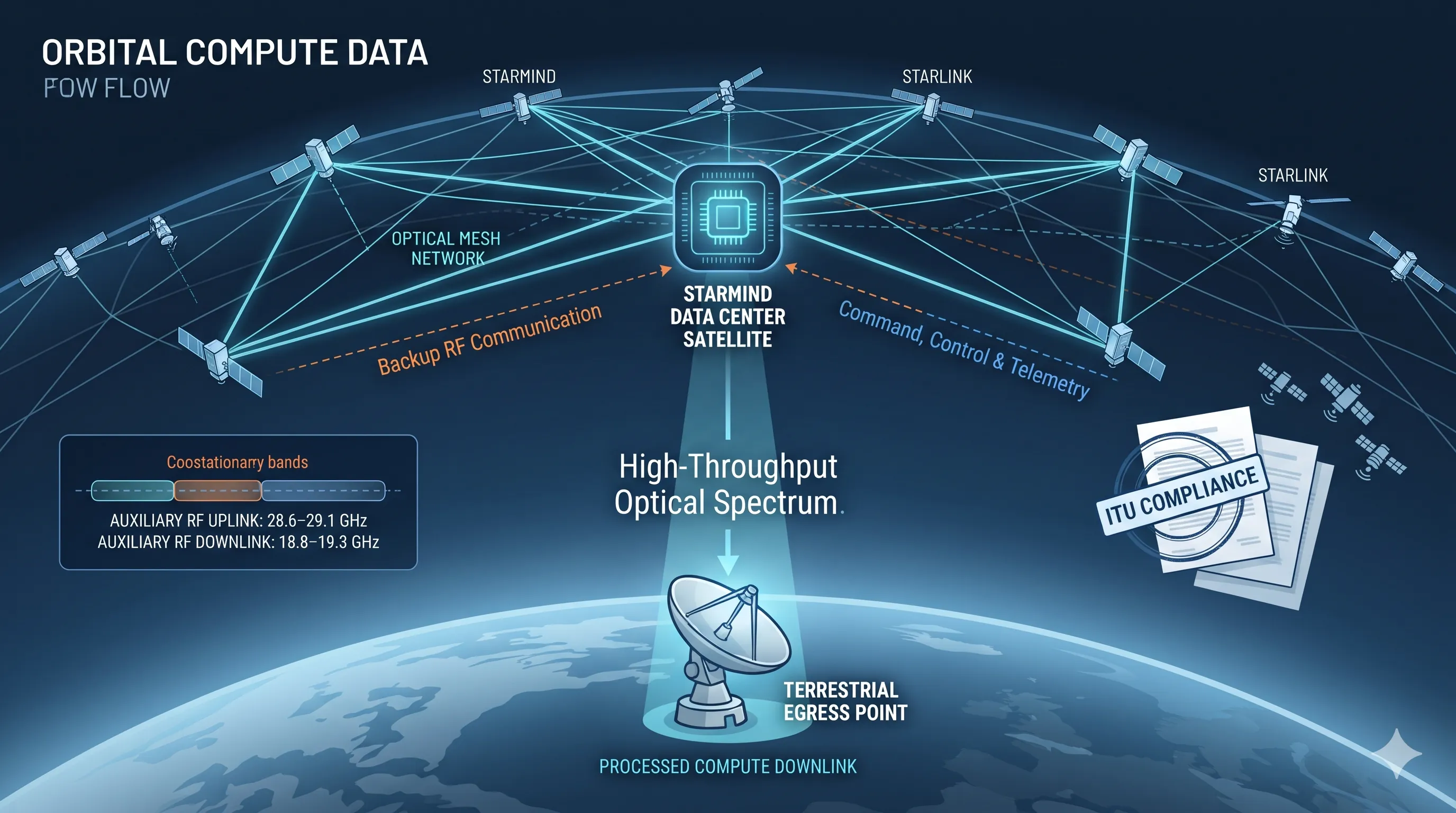
Processed computing results transmit to Earth via high-speed, high-bandwidth laser links connecting to the Starlink satellite network.
By integrating directly into this optical mesh, the compute nodes bypass conventional atmospheric optical degradation, routing processed information across inter-satellite laser crosslinks until an optimal terrestrial egress point is established.
Spectrum Management and Backup RF Downlink/Uplink Bands
While optical inter-satellite links carry high-throughput compute payloads, operational continuity demands dependable auxiliary paths.Spacecraft communications are backed by radio frequency links in authorized spectrum bands to maintain command, control, and telemetry availability under all conditions.
These auxiliary radio frequency pathways are allocated across specific spectrum ranges for bi-directional routing.
Backup RF communication links utilize the 28.6–29.1 GHz uplink band to receive incoming communications from ground terminals.
For returning data to ground assets, backup RF communication links utilize the 18.8–19.3 GHz downlink band.
| Communication Pathway | Allocated Spectrum / Medium | Primary Operational Role |
|---|---|---|
| Optical Inter-Satellite Link | High-speed, high-bandwidth optical spectrum | Transmits processed computing results to Earth via the Starlink satellite network |
| Auxiliary RF Uplink | 28.6–29.1 GHz | Backup RF communication link for uplink transmissions to the spacecraft |
| Auxiliary RF Downlink | 18.8–19.3 GHz | Backup RF communication link for downlink transmissions to Earth |
ITU Compliance and Constellation Coordination
Deploying and operating a high-density compute constellation demands strict adherence to international regulatory frameworks.The constellation must operate consistently with International Telecommunication Union (ITU) filings and coordinate with other licensed operators.
Because orbital tracks and authorized frequency allocations overlap with non-geostationary and geostationary systems, regulatory compliance is continuous rather than static.
Consequently, the system requires strict interference protection coordination with other licensed satellite constellations to prevent signal degradation across adjacent RF vectors.
Adhering to these ITU filings ensures that both high-volume compute routing and backup radio frequency telemetry coexist reliably alongside external space operations.
4. The Orbital Compute Race: Addressing Terrestrial Bottlenecks Against Industry Competitors
Understanding how SpaceX’s data center satellites will operate in orbit requires situating their architecture within a broader commercial and technological transition.While SpaceX targets orbital deployment to scale compute beyond planetary limits, they are not operating in isolation.
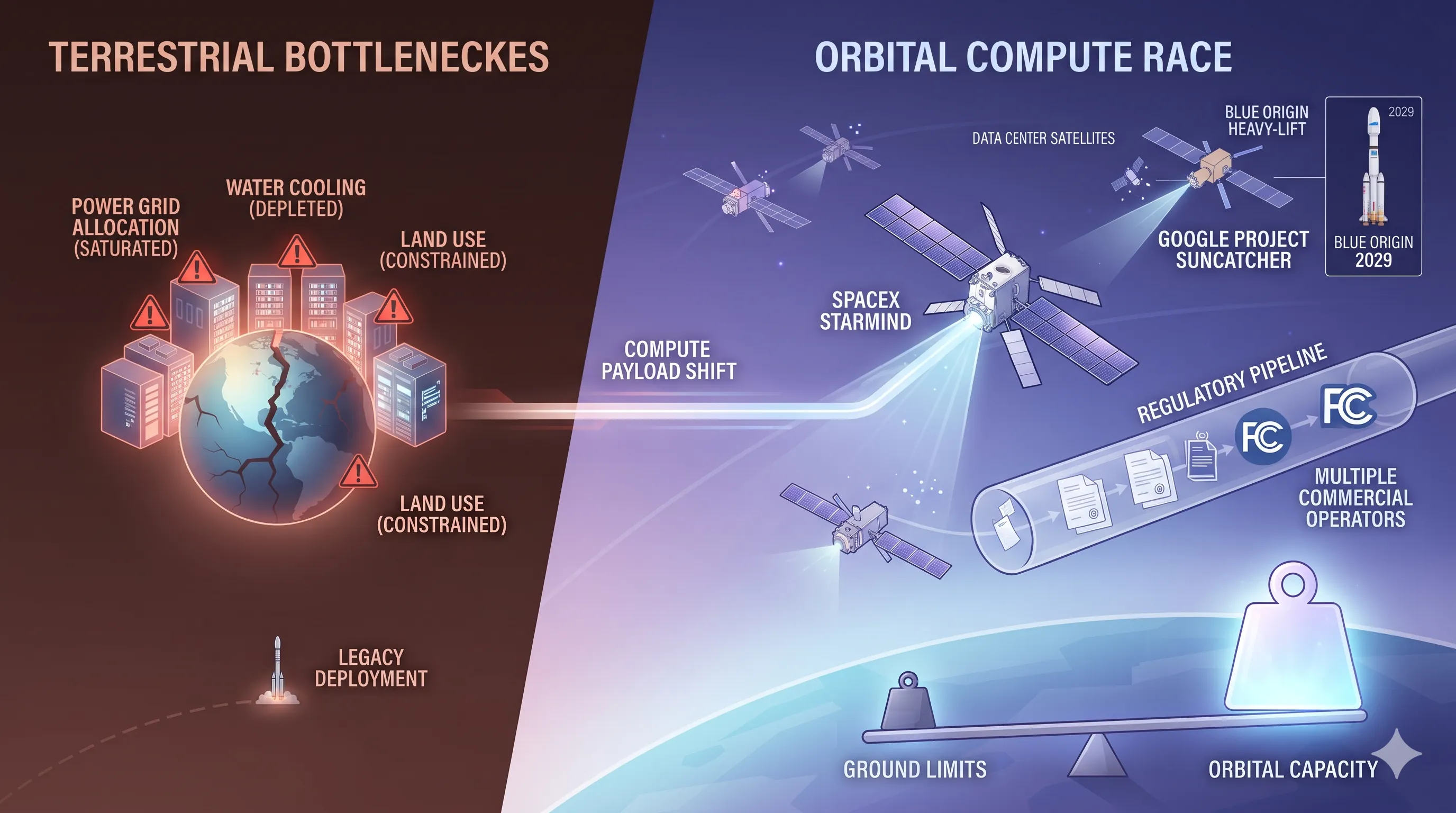
The structural challenges constraining ground facilities have triggered an industry-wide space compute race, mobilizing major hyperscalers, aerospace logistics providers, and regulatory agencies.
Terrestrial Grid and Cooling Bottlenecks Driving Space Data Centers
The acceleration toward space-based compute architectures is directly propelled by the physical limitations of Earth-bound infrastructure.Terrestrial data center expansion faces mounting terrestrial resource constraints in land, electrical grid capacity, and water consumption.
High-density AI workloads require massive power allocations that local municipal utilities and regional energy grids struggle to supply.
Simultaneously, the intense thermal dissipation demands of high-performance hardware consume vast volumes of water, creating severe environmental and operational bottlenecks.
By relocating compute payloads to orbit, operators seek an alternative operating environment free from terrestrial land-use conflicts, local cooling dependencies, and terrestrial grid capacity saturation.
Google Project Suncatcher and Blue Origin Heavy-Lift Deployments
Hyperscale competitors are actively pursuing operational hardware validation in low Earth orbit.Google deployed a Project Suncatcher AI server test satellite to evaluate orbital compute.
This experimental platform allows Google to assess the functional realities of running server hardware and processing AI workloads in the space environment.
To scale beyond initial testing, dedicated space logistics partnerships have already been established.
Blue Origin is contracted to conduct dedicated heavy-lift launches for Google's Project Suncatcher.
Under this commercial agreement, Google's Project Suncatcher dedicated heavy-lift launch by Blue Origin is scheduled for 2029.
This launch contract underscores that hyperscalers view orbital computing as a concrete multi-phase deployment roadmap rather than a purely theoretical experiment.
FCC Multi-Operator Pipeline for Space Compute Campuses
The emergence of space-based data processing has expanded beyond isolated technology demonstrations into a broader regulatory pipeline.Multiple operators have submitted orbital data center proposals that the FCC is actively reviewing under standard procedures.
The regulatory review of these commercial applications reflects the formal institutional shift toward managing constellations dedicated specifically to data center workloads rather than conventional telecommunications.
| Operator / Program | Key Partner / Agency | Operational Milestone / Role | Deployment Timeline |
|---|---|---|---|
| Google (Project Suncatcher) | Blue Origin | Deployed AI server test satellite to evaluate orbital compute | Operational test deployed; heavy-lift scheduled for 2029 |
| Blue Origin | Contracted to conduct dedicated heavy-lift launch operations | 2029 scheduled launch window | |
| Multiple Commercial Operators | Federal Communications Commission (FCC) | Submitted orbital data center proposals undergoing active review under standard procedures | Under current active review |
Related Posts



Generative AI may have assisted with research or drafting for this article. Topic selection, fact-checking, final wording, and publication remain the responsibility of DragonStone74. AI use disclosure