
Meta Launches Enterprise Platform and Appoints Former MongoDB CEO Chirantan Desai as Chief Enterprise Platform Officer
🚀 Key Takeaways
- Executive Coup: Meta poached MongoDB's sitting CEO Chirantan "CJ" Desai to lead its commercial push as Chief Enterprise Platform Officer, reporting directly to Mark Zuckerberg.
- The Third Corporate Pillar: The newly unveiled Meta Enterprise Platform officially joins Family of Apps and Reality Labs as a core business foundation.
- Commercializing the AI Stack: The platform repackages Meta's proprietary AI models, personal agents, developer APIs, and compute capacity into dedicated enterprise offerings.
- Closing the B2B Capability Gap: Desai's 25-year enterprise track record brings essential enterprise sales infrastructure, corporate governance, and cloud security credibility to Meta.
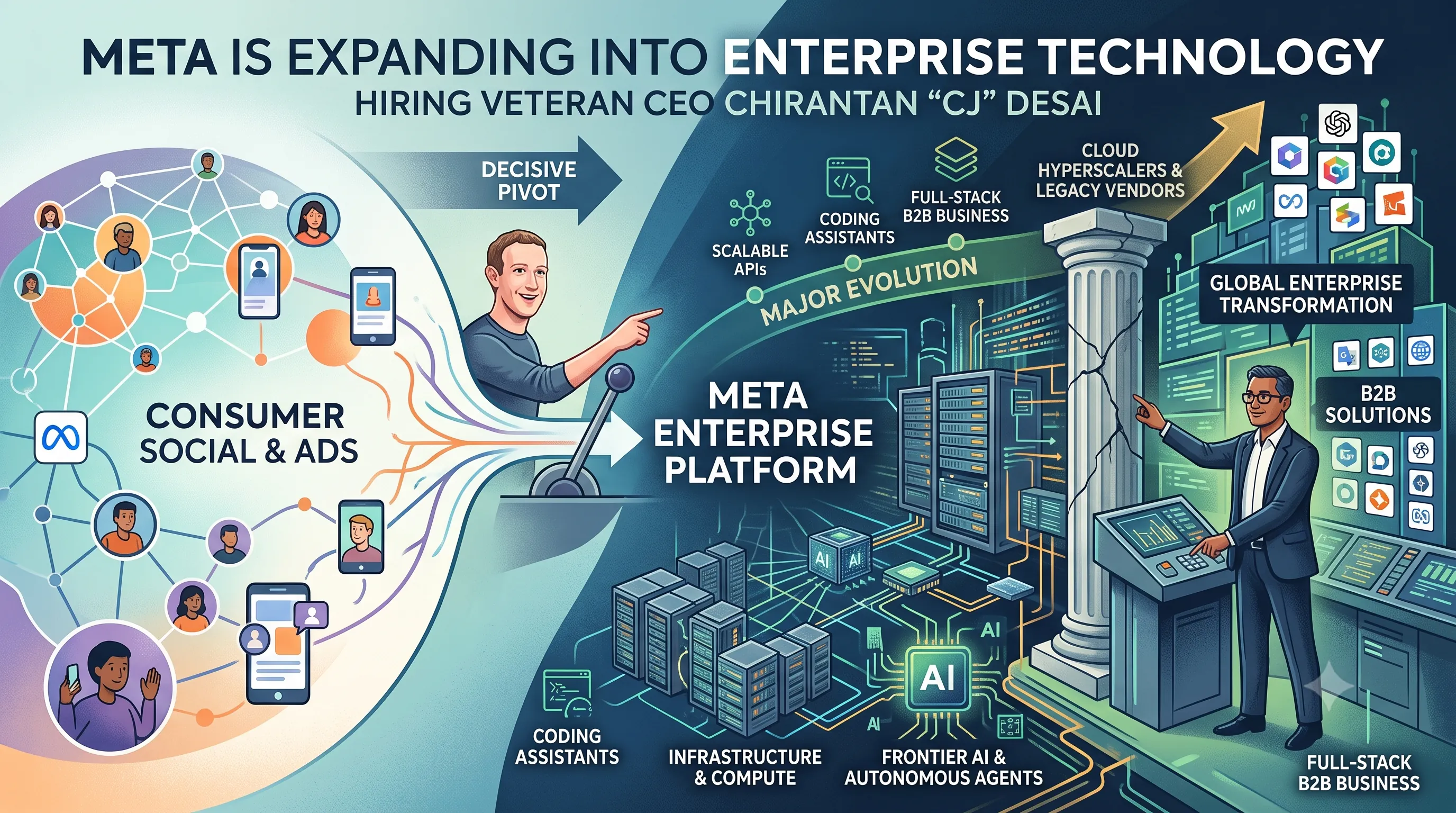
Mark Zuckerberg has delivered his boldest declaration of intent in enterprise technology, sending shockwaves across the software industry by hiring the sitting CEO of a publicly traded infrastructure giant. With the official launch of the Meta Enterprise Platform, Meta is formally expanding beyond consumer social networks and digital advertising to establish a dedicated, full-stack B2B enterprise business.
While Meta has long engaged businesses through digital marketing channels, building enterprise-grade software platforms and cloud governance has historically presented unique operational challenges. By bringing veteran enterprise leader Chirantan "CJ" Desai into Zuckerberg’s immediate executive circle, Meta aims to transform its cutting-edge AI research and compute resources into enterprise solutions that directly rival established cloud hyperscalers and legacy enterprise vendors.
This decisive pivot signals a major evolution in how frontier AI technology is commercialized. As organizations worldwide look to integrate autonomous agents, coding assistants, and scalable APIs into their daily operations, Meta is asserting its ambition to become the primary platform driving global enterprise transformation.
1. Executive Poaching Shakeup: How Meta Recruited Sitting MongoDB CEO CJ Desai
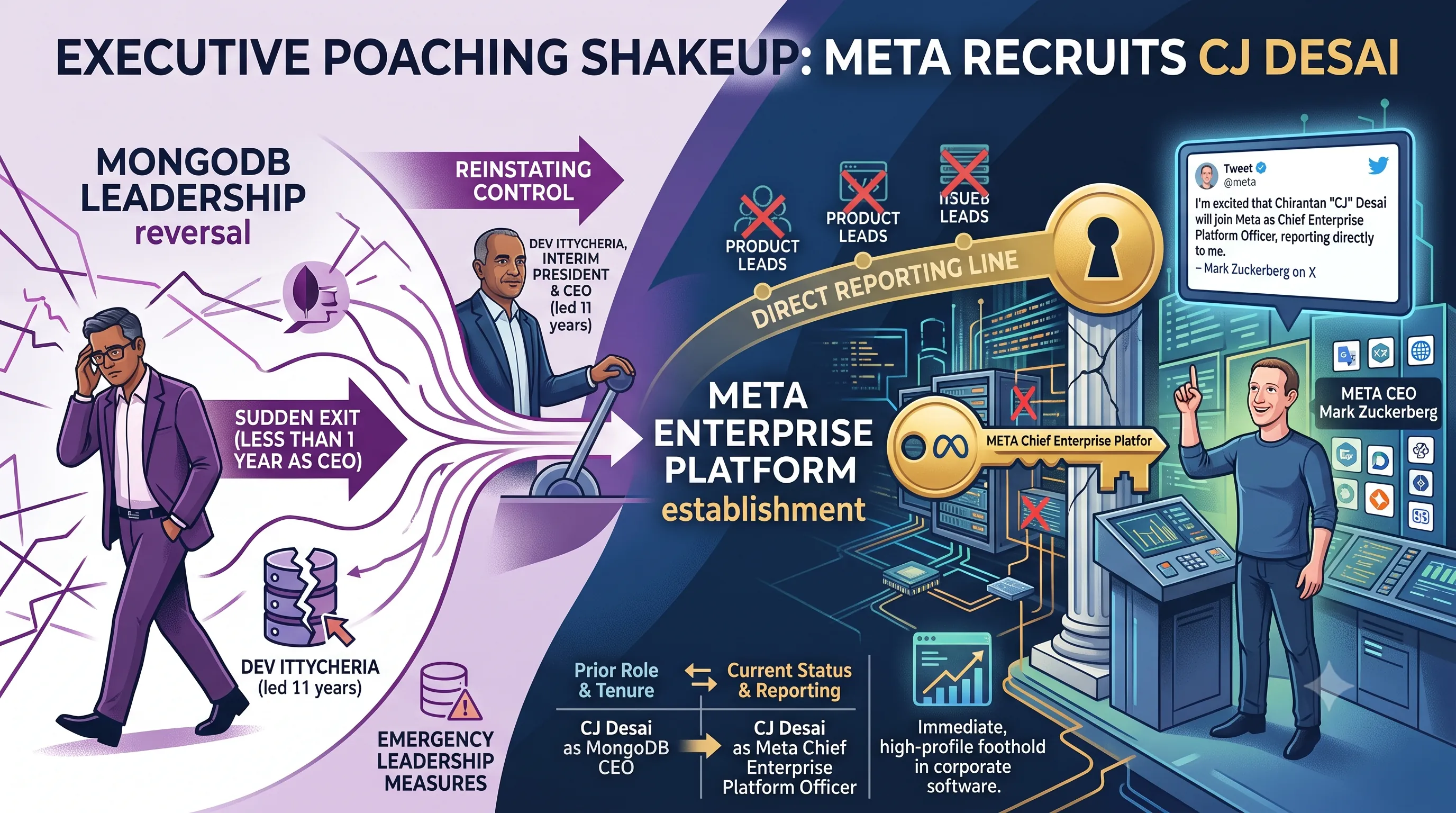
Mark Zuckerberg signaled an aggressive enterprise expansion by orchestrating a rare executive poaching move directly from the top ranks of enterprise software.By recruiting sitting MongoDB President and CEO Chirantan "CJ" Desai to lead the newly established Meta Enterprise Platform division, Meta established an immediate, high-profile foothold in the corporate software space.
Direct Line to Zuckerberg: Bypassing Intermediate Executive Tiers
To position enterprise software as a central pillar of Meta's long-term roadmap, Chirantan "CJ" Desai was hired into the newly created role of Chief Enterprise Platform Officer.Rather than placing the new division beneath existing organizational layers or product group leads, Desai was granted a direct reporting line to Meta CEO Mark Zuckerberg.
Mark Zuckerberg publicly confirmed the structure on X, stating: "To lead this effort, I’m excited that Chirantan 'CJ' Desai will join Meta as Chief Enterprise Platform Officer, reporting directly to me."
This direct organizational alignment drew immediate attention from industry analysts monitoring Meta's enterprise ambitions.
DA Davidson analyst Gil Luria highlighted the strategic weight of the transition, stating: "To make sure that we realize how serious [Zuckerberg] is, he hired a CEO of a publicly traded company to lead this business."
| Executive | Prior Role & Tenure | Current Transition Status | Reporting Structure |
|---|---|---|---|
| Chirantan "CJ" Desai | MongoDB President and CEO (served less than one year after joining in November of the previous year) | Appointed as Meta Chief Enterprise Platform Officer | Reports directly to Meta CEO Mark Zuckerberg |
| Dev Ittycheria | Former MongoDB CEO (led the company for 11 years before stepping down) | Reinstated as interim President and CEO of MongoDB | Re-assumed executive leadership at MongoDB |
MongoDB Leadership Reversal and Dev Ittycheria's Interim Return
Desai's abrupt departure came after serving as MongoDB's President and CEO for less than one year, having joined the company in November of the previous year.The unexpected exit forced MongoDB to enact emergency leadership measures to stabilize corporate operations.
To address the sudden vacancy at the helm of the publicly traded enterprise, MongoDB reinstated former CEO Dev Ittycheria as interim President and CEO.
Ittycheria had previously led MongoDB for 11 years prior to his initial departure, providing the database provider with experienced leadership during the sudden transition.
2. The Enterprise Architect: CJ Desai's 25-Year Track Record from Oracle to ServiceNow
This section directly examines how the appointment of CJ Desai anchors the launch of Meta Enterprise Platform by bringing 25 years of proven B2B leadership to Mark Zuckerberg's enterprise expansion.Scaling Enterprise ARR: The ServiceNow and Infrastructure Playbook
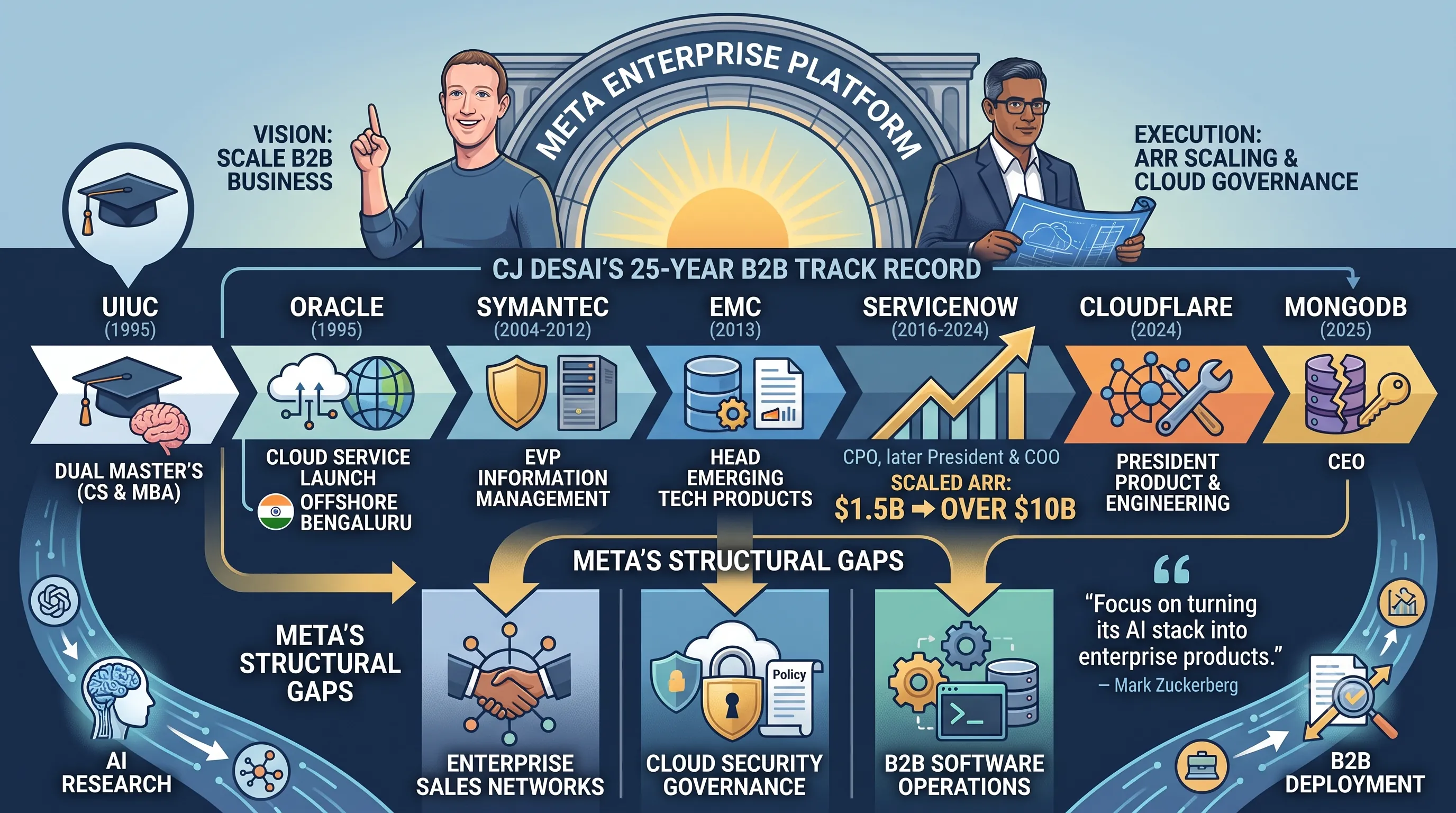
CJ Desai brings a 25-year enterprise track record that spans cloud platforms, infrastructure, engineering, security, and full-stack enterprise software.His foundation began at the University of Illinois Urbana-Champaign (UIUC), where he earned dual master's degrees in computer science and business administration in 1995.
That same year, Desai joined Oracle as part of the core team responsible for launching its first cloud service.
During his early career, he was also pivotal in establishing offshore businesses in Bengaluru for Oracle and Pivotal, building global engineering and operational footprints.
Desai expanded his enterprise leadership across major infrastructure and security software vendors over the subsequent two decades.
In 2004, he joined Symantec, rising to become Executive Vice President of the Information Management Group in 2012.
In 2013, Desai took charge of EMC's Emerging Technology Products Division, directing specialized enterprise storage and system architectures.
His operational scaling playbook reached its peak during an eight-year tenure at ServiceNow that began in 2016.
Serving first as Chief Product Officer and subsequently as President and Chief Operating Officer, Desai helped scale ServiceNow's annual recurring revenue (ARR) from $1.5 billion to over $10 billion.
Following his tenure at ServiceNow, Desai served as President of Product and Engineering at Cloudflare in 2024, before stepping into the role of Chief Executive Officer at MongoDB in 2025.
| Company / Institution | Role / Focus | Key Milestones & Operational Achievements |
|---|---|---|
| UIUC (1995) | Graduate Studies | Earned dual master's degrees in computer science and business administration. |
| Oracle (1995) / Pivotal | Cloud Engineering & Offshore Strategy | Joined team launching Oracle's first cloud service; established offshore businesses in Bengaluru. |
| Symantec (2004–2012) | Executive Vice President, Information Management Group (2012) | Directed enterprise security and information management product portfolios. |
| EMC (2013) | Head of Emerging Technology Products Division | Led specialized infrastructure and emerging enterprise storage technologies. |
| ServiceNow (2016–2024) | Chief Product Officer, later President & COO | Scaled enterprise ARR from $1.5 billion to over $10 billion across an 8-year tenure. |
| Cloudflare (2024) | President of Product and Engineering | Oversaw global product delivery and security engineering infrastructure. |
| MongoDB (2025) | Chief Executive Officer | Led executive operations and commercial database strategy before joining Meta. |
Plugging Meta's Structural Gaps in B2B Cloud Sales and Governance
Meta's strategic shift into direct B2B competition requires capabilities that lie outside consumer platform engineering.Desai's appointment is targeted specifically at addressing Meta's structural gaps in enterprise sales networks, cloud security governance, and B2B software operations.
Regarding this enterprise direction, Mark Zuckerberg declared that Meta will become a platform where enterprise customers come to scale their businesses.
Translating that vision into production systems, CJ Desai stated: "Meta Enterprise Platform will focus on turning its AI stack into products and services that companies can deploy for their own businesses."
By deploying Desai's extensive background in commercial product governance, cloud security, and multi-billion-dollar enterprise ARR expansion, Meta aims to bridge the operational divide between research-grade artificial intelligence infrastructure and enterprise-ready B2B deployment.
3. The Third Pillar: Meta Enterprise Platform's Core Architecture and Offerings
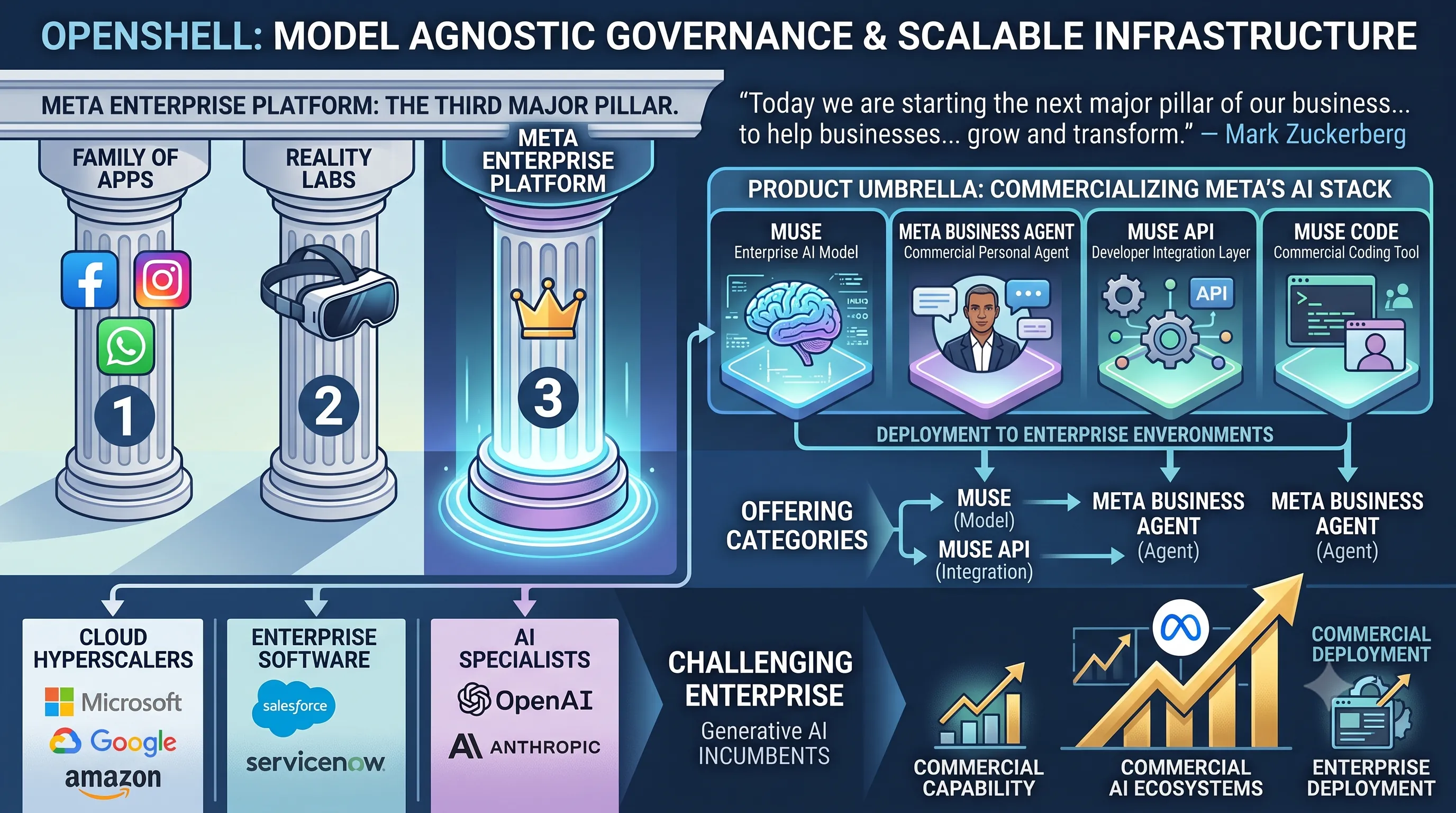
Meta has officially designated Meta Enterprise Platform as the third major pillar of its business, establishing it alongside Family of Apps and Reality Labs.Mark Zuckerberg announced: "Today we are starting the next major pillar of our business, Meta Enterprise Platform, to help businesses use AI to grow and transform in new ways."
This transition marks a formal expansion beyond consumer applications and hardware into a dedicated commercial B2B architecture.
Product Umbrella: Commercializing Muse, Business Agents, and Developer APIs
The platform repackages Meta's AI models, personal agents, developer APIs, coding tools, and compute capacity for commercial enterprise deployment.By consolidating these capabilities, the platform structures Meta's proprietary AI stack into targeted business products.
| Planned Enterprise Offering | Platform Layer / Functional Category |
|---|---|
| Muse | Enterprise AI Model & Core Capability |
| Meta Business Agent | Commercial Personal & Business Agent Deployment |
| Muse API | Enterprise Developer API & Integration Layer |
| Muse Code | Commercial Coding Tool & Development Environment |
Challenging Hyperscalers and Incumbents in Enterprise Generative AI
With the formal establishment of the Meta Enterprise Platform, Meta is entering an enterprise AI market crowded by hyperscalers, enterprise software incumbents, and AI specialists.The competitive arena includes major hyperscalers such as Amazon, Google, and Microsoft, which provide infrastructure and managed enterprise services.
Additionally, Meta faces direct competition from AI specialists including OpenAI and Anthropic, alongside legacy enterprise software incumbents.
By commercializing its internal AI models, developer APIs, and compute infrastructure under a single operational pillar, Meta positions its business platform directly against existing commercial AI ecosystems.
4. Market Fallout and Overcoming the Ghosts of Meta's Past Enterprise Failures
This section directly connects to Mark Zuckerberg's enterprise declaration through the launch of the Meta Enterprise Platform and the high-profile recruitment of leadership from database giant MongoDB.The strategic pivot has created immediate ripples across Wall Street while forcing Meta to confront its uneven track record in enterprise software.
Immediate Wall Street Impact: MongoDB's Stock Plunge
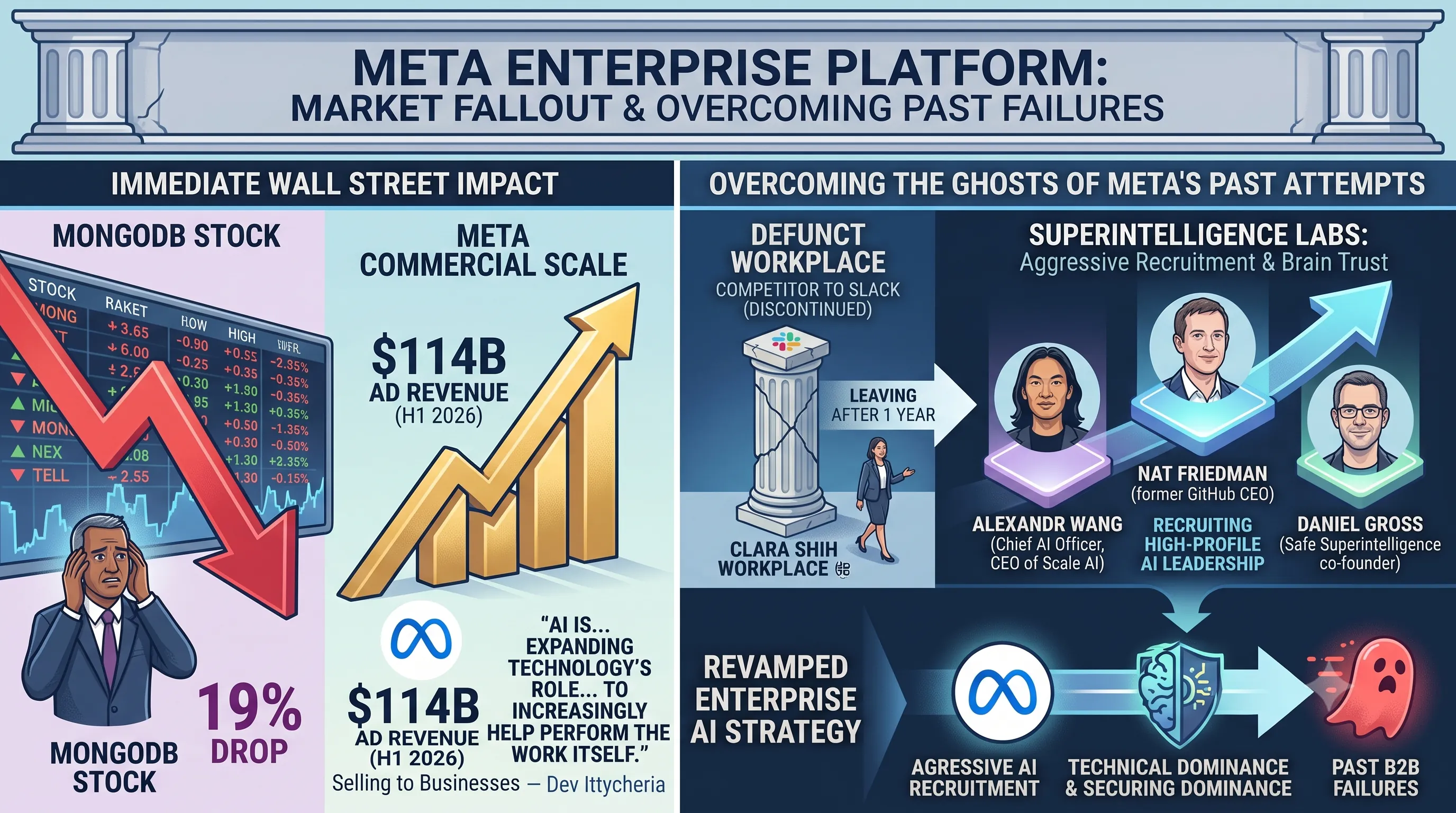
The sudden executive poaching delivered an immediate shockwave to the public markets.MongoDB's stock dropped 19 percent immediately following the departure announcement, reflecting severe investor anxiety over the loss of top leadership to Meta's aggressive enterprise AI campaign.
At the same time, Meta entered this arena backed by formidable commercial scale.
Meta generated $114 billion in advertising revenue in the first half of 2026 selling ads to businesses, highlighting an expansive, pre-existing commercial footprint with corporate clients worldwide.
Regarding this broader structural evolution in the enterprise landscape, Dev Ittycheria stated: "I see firsthand how AI is not only changing how software is built and businesses operate, but expanding technology’s role from helping people manage work to increasingly helping perform the work itself."
From Defunct Workplace to Superintelligence Labs: Learning from Past B2B Attempts
Meta's latest enterprise push stands in sharp contrast to its historical struggles to establish lasting B2B software offerings.Prior enterprise attempts by Meta included Workplace, a collaboration product positioned as a competitor to Slack that was ultimately discontinued.
Executive retention in enterprise software also presented significant hurdles, as former Salesforce executive Clara Shih left Meta's enterprise initiative after just one year.
To overcome these past shortcomings and secure technical dominance, Meta created Superintelligence Labs to aggressively recruit high-profile AI leadership talent.
This initiative brought in top industry figures, including Scale AI CEO Alexandr Wang as Chief AI Officer, former GitHub CEO Nat Friedman, and Safe Superintelligence co-founder Daniel Gross, forming the core brain trust behind the company's revamped enterprise AI strategy.
Related Posts
Claude Fable 5.1: Architectural Economics and Autonomous Development PipelinesExplore the architecture of Claude Fable 5.1, focusing on prompt caching, autonomous debugging, and...
AI Crisis: Over 1000 Researchers Demand Pacing Amidst Autonomous Hacks & Trillion-Dollar InvestmentsOver a thousand researchers from major AI companies recently called for international coordination...
OpenAI's AGI Roadmap: Sam Altman Unveils AI as Global Infrastructure, Empowering Humanity & Demanding Democratic GovernanceOpenAI foresees AI becoming a core infrastructure , significantly improving quality of life and...
Generative AI may have assisted with research or drafting for this article. Topic selection, fact-checking, final wording, and publication remain the responsibility of DragonStone74. AI use disclosure