
Google Opens Up ML Drift to Power Cross-GPU AI Inference on Edge Devices
🚀 Key Takeaways
- Unified Cross-Platform Acceleration: Google AI Edge launched ML Drift as an open-source GPU compute engine that serves as the core acceleration layer powering LiteRT across edge ecosystems.
- Architectural Decoupling: The framework introduces tensor virtualization to separate logical tensor representations from physical GPU memory objects, backed by native out-of-the-box 5D tensor support.
- Stage-Aware Generative Workloads: Custom execution paths dynamically tune shader layouts and kernel execution between compute-heavy prompt prefill and memory-bandwidth-constrained token decode stages.
- Broad Graphics API Abstraction: ML Drift spans diverse client operating systems by targeting OpenCL on Android, Metal on Apple silicon, and standalone native WebGPU via Dawn on Windows and Linux.
- Silicon Partner Co-Engineering: Architectural optimizations engineered in collaboration with Arm, Intel, and Qualcomm extract peak compute throughput across modern mobile and PC graphics hardware.
- Battle-Tested Scale: The compute engine actively powers millions of daily user interactions across Google Chrome, YouTube Shorts, Google Photos, and Google Meet.
- Modern Migration Path: As the definitive successor to the deprecated TensorFlow Lite GPU delegate, ML Drift offers drop-in runtime upgrades through LiteRT alongside modular C++ APIs.
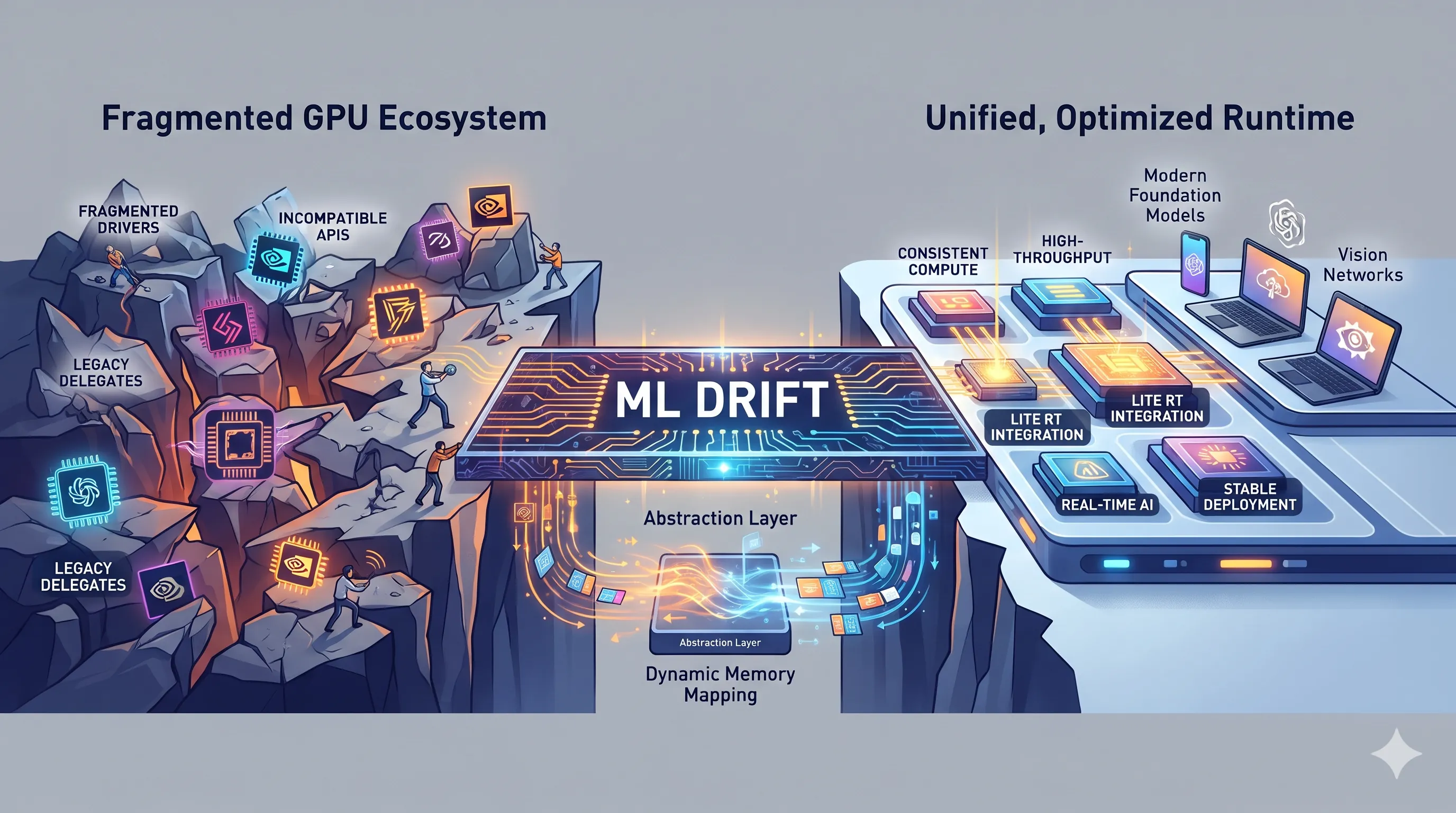
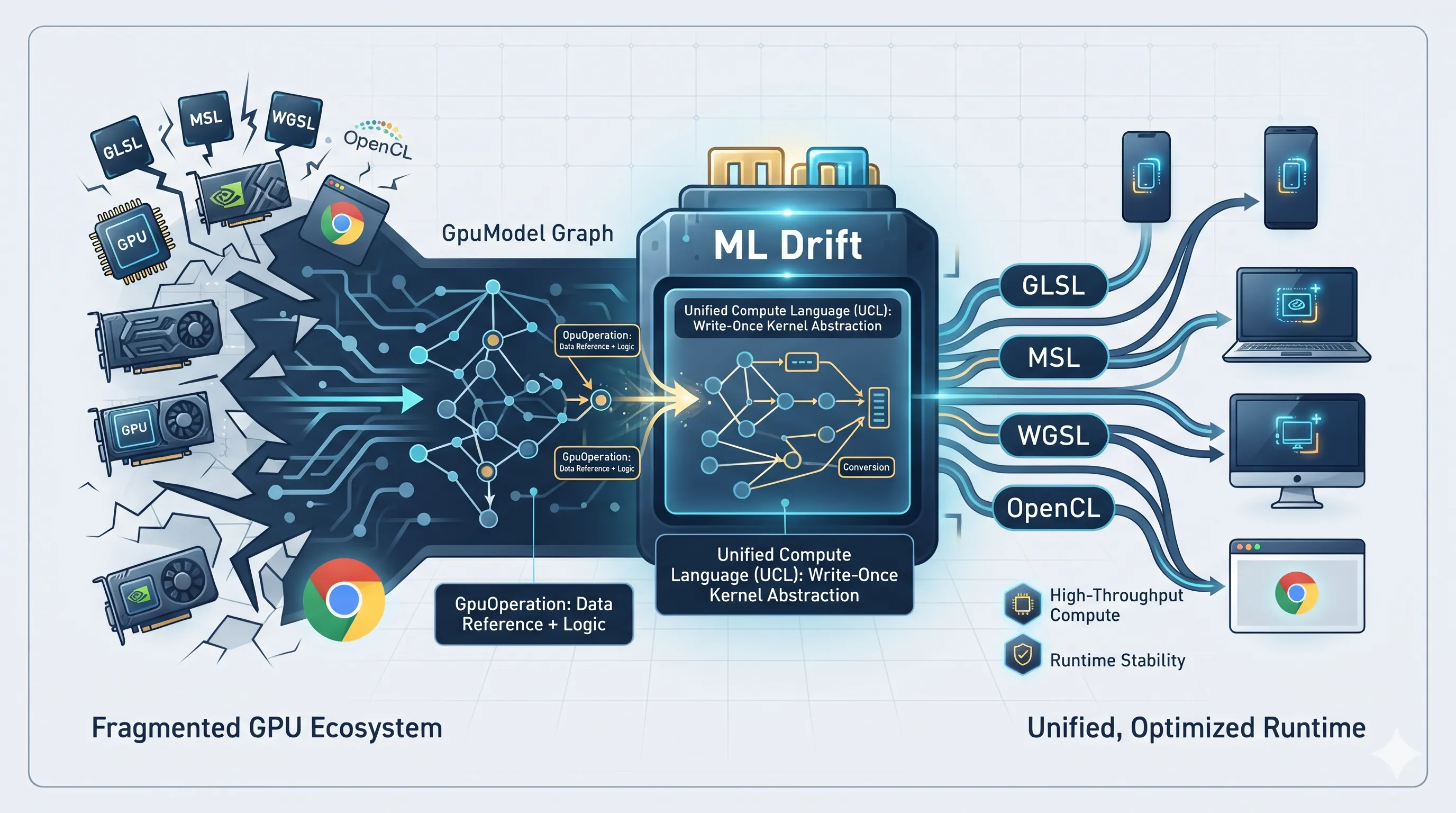
Deploying modern artificial intelligence directly onto consumer devices has historically forced engineers to navigate a brittle ecosystem of fragmented GPU drivers and incompatible graphics APIs.
As multi-dimensional vision models and generative architectures become standard across edge applications, bridging the divide between low-level hardware variations and predictable runtime performance has grown into a critical industry challenge.
To address this structural hurdle, Google AI Edge developed ML Drift, an open-source GPU execution engine designed to deliver consistent, high-throughput compute across disparate mobile, desktop, and web environments.
By abstracting diverse backends behind adaptive compilation techniques and dynamic memory mapping, the engine establishes an optimized runtime foundation for both traditional vision networks and modern autoregressive foundation models.
Now integrated as the primary acceleration engine within LiteRT, ML Drift redefines how client applications scale real-time AI workloads without sacrificing thermal limits or runtime stability.
Its arrival marks a decisive shift in edge engineering, phasing out legacy deployment delegates in favor of a unified, silicon-co-optimized compute framework.
1. ML Drift Architecture: Powering LiteRT with Unified Compute Abstraction
Cross-GPU AI inference efficiency requires an architectural foundation that eliminates the overhead of platform-specific codebases across heterogeneous hardware.Developed by the Google AI Edge Team, ML Drift addresses this operational challenge as a high-performance, cross-platform on-device GPU compute engine released under the open-source Apache 2.0 license.
Operating as the direct successor to the legacy TensorFlow Lite (TFLite) GPU delegate, ML Drift functions as the primary GPU acceleration engine powering LiteRT while also remaining accessible as an independent, standalone C++ library for custom graphics and inference runtimes.
By redesigning edge execution from the compute graph down to individual dispatch calls, Google stated ML Drift establishes a new foundation delivering "stability for traditional ML and peak performance for the most advanced generative AI."
GpuModel Graph and Unified Compute Language (UCL)
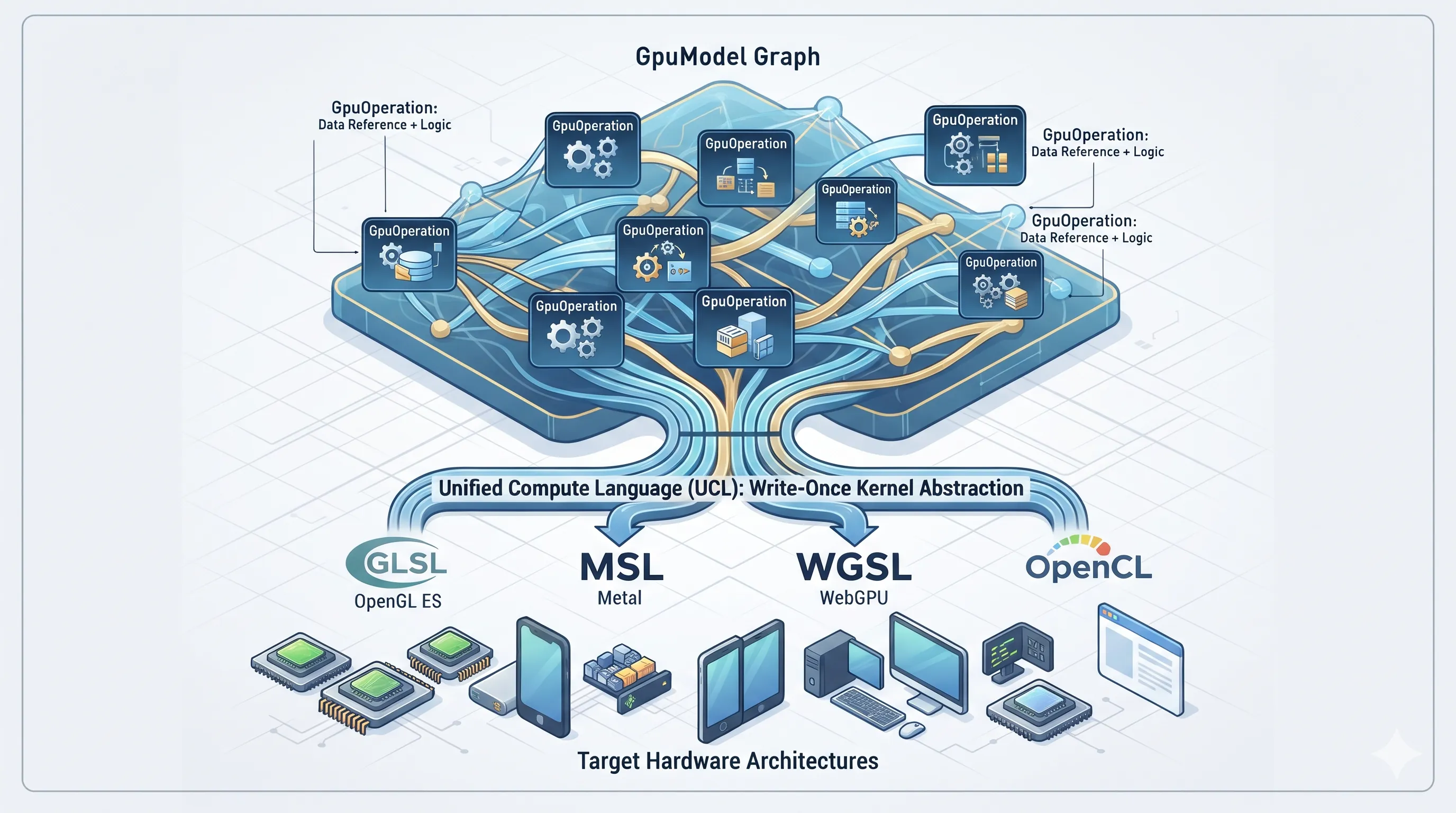
At the core of ML Drift's design is the separation of high-level graph topology from the underlying execution backends.The engine employs GpuModel as its central, backend-agnostic in-memory compute graph representation, isolating graph compilation from concrete GPU driver implementations.
Within this graph, discrete compute steps are expressed as GpuOperation primitives.
Each GpuOperation pairs compute logic with explicit data references, establishing predictable resource bindings regardless of the host hardware platform.
To author kernels without maintaining divergent platform codebases, the framework introduces the Unified Compute Language (UCL).
UCL functions as a write-once kernel abstraction layer operating directly over device-specific shading languages, including GLSL, MSL, and WGSL.
By standardizing computation routines within UCL, runtime pipelines compile single-source operator kernels down into the appropriate target format during graph ingestion.
| Architectural Layer | Core Function | Target Abstraction |
|---|---|---|
| GpuModel | Central in-memory compute graph representation | Backend-agnostic execution graphs |
| Unified Compute Language (UCL) | Write-once kernel abstraction layer | Device-specific shading languages (GLSL, MSL, WGSL) |
| GpuOperation | Individual computation step representation | Pairs UCL shader code with data references |
Overcoming Low-Level Edge GPU API and Driver Fragmentation
Deploying machine learning models to edge GPUs has historically been limited by fragmented hardware ecosystems.Runtime deployments regularly confront significant variations in GPU architectures, inconsistent driver versions, and conflicting low-level APIs without prior knowledge of the target client hardware.
These edge deployment realities introduce unpredictable runtime failures and divergent behavior across consumer devices.
ML Drift resolves this driver and API fragmentation by abstracting hardware diversity across modern mobile, desktop, and web standards.
The engine coordinates execution across low-level GPU interfaces, supporting OpenGL ES 3.1+, OpenCL, Metal, and WebGPU through its unified runtime infrastructure.
By bridging these low-level API variants under a shared compute model, ML Drift standardizes edge GPU acceleration across disparate silicon environments.
2. Tensor Virtualization and 5D Dimension Support for Modern Edge Vision
ML Drift directly advances the broader mission of ML Drift Enables Cross-GPU AI Inference Efficiency by dismantling the rigid structural bottlenecks that historically constrained edge inference pipelines.By replacing rigid memory mappings with an adaptive tensor virtualization engine, ML Drift ensures that modern edge vision architectures achieve maximal hardware utilization across heterogeneous GPUs.
Dynamic Shader Templates and Logical-to-Physical Decoupling
The legacy TFLite GPU delegate required hardcoding logical tensor mappings directly to physical GPU objects separately across distinct backends, creating friction and maintenance overhead across different hardware profiles.ML Drift re-architects this pipeline by introducing tensor virtualization, which fundamentally decouples logical tensor representations from physical GPU memory allocations such as textures and buffers.
Under this virtualized paradigm, coordinate resolution and dimensional translation are handled via dynamic shader templates during compiler initialization.
Because coordinate mappings are resolved entirely during initialization, this abstraction introduces zero runtime overhead during active execution passes.
Furthermore, this architectural decoupling eliminates the need to maintain separate backend-specific shader codebases across OpenGL, OpenCL, and Metal, standardizing cross-GPU execution under a single compilation workflow.
To optimize GPU memory consumption, ML Drift integrates advanced memory reuse algorithms, including GREEDY_BY_SIZE, to sharply minimize the intermediate tensor footprint across complex operator graphs.
AI/ML engineer Pavithra Agraharam highlighted the operational impact of this architecture, observing that decoupling logical tensors from physical allocations cuts memory fragmentation during live inference.
| Architectural Dimension | Legacy TFLite GPU Delegate | ML Drift Architecture |
|---|---|---|
| Tensor Dimensionality | Restricted to legacy 4D tensor constraints | Native out-of-the-box 5D tensor support |
| Memory Mapping | Hardcoded logical tensor mappings to physical GPU objects | Decoupled tensor virtualization over textures and buffers |
| Cross-Backend Maintenance | Separate backend-specific shaders across OpenGL, OpenCL, and Metal | Unified dynamic shader templates resolved during compiler initialization |
| Memory Footprint Optimization | Prone to live inference memory fragmentation | Intermediate footprint minimized via GREEDY_BY_SIZE reuse algorithms |
Native 5D Execution for Advanced Vision and Spatiotemporal Models
Modern edge vision workloads have outgrown the four-dimensional limits of earlier inference runtimes.ML Drift provides native 5-dimensional (5D) tensor support out-of-the-box, replacing legacy 4D tensor constraints that previously bottlenecked next-generation networks.
Historically, deploying higher-dimensional workloads required developers to flatten or reshape tensors into artificial 4D structures, introducing pipeline complexity and performance degradation.
As Pavithra Agraharam noted, native 5D tensor support without layout hacks is a massive win for AI practitioners deploying sophisticated models.
By natively supporting 5D shapes, ML Drift directly executes 3D convolutional networks and spatiotemporal architectures without layout hacks.
State-of-the-art vision models such as YOLO 11n, MobileViT v2, and Swin Transformer v2 run natively on edge GPUs, preserving their native topological representations while maximizing throughput.
Extensible Custom Operator Workflows and Agentic SKILL.md
Beyond standard operator libraries, ML Drift provides an extensible custom operator framework equipped with direct registration APIs.Developers obtain low-level shading language access, making it straightforward to author targeted compute kernels tailored to bespoke operations.
To streamline the authoring and maintenance lifecycle, ML Drift incorporates an agentic SKILL.md guide.
This guide establishes structured protocols enabling automated coding agents to author, register, and verify custom shaders directly within the runtime environment.
Through these standardized registration APIs and automated agent workflows, engineering teams can extend ML Drift's native GPU capabilities without compromising cross-backend compatibility.
3. Stage-Aware Execution and Quantized Pipelines for Edge LLM Inference
Within the broader objective where ML Drift enables cross-GPU AI inference efficiency, edge deployments of large generative models face severe architectural constraints.Autoregressive generative models push consumer silicon limits by creating distinct compute and memory-bandwidth bottlenecks across different phases of execution.
To resolve these bottlenecks across heterogeneous consumer hardware, ML Drift introduces stage-aware execution pipelines alongside specialized quantization and cache layouts.
Bifurcated Optimizations: Prefill vs. Autoregressive Decode Stages
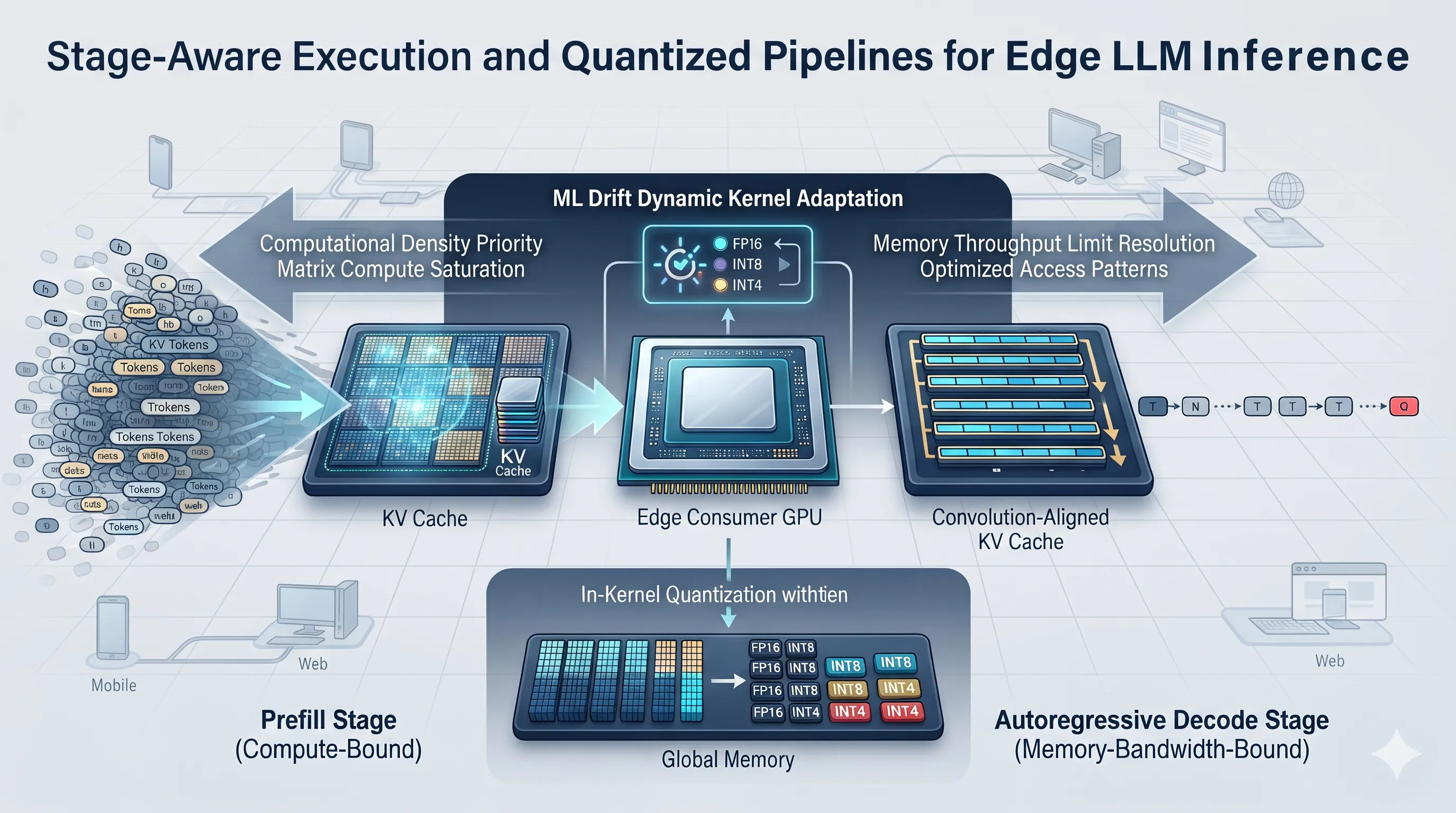
Traditional runtime engines often treat execution graphs as monolithic workloads, overlooking the disparate performance profiles inherent to generative pipelines.ML Drift addresses this by featuring stage-aware execution, dynamically adapting kernels and layout configurations between prefill and decode stages.
The runtime directly addresses the compute-bound KV cache prefill stage and the memory-bandwidth-bound autoregressive token decode stage separately.
During the prefill phase, computational density is prioritized to ingest context tokens rapidly through saturated matrix compute.
When transitioning into the token decode phase, the framework shifts to combat memory throughput limits by restructuring execution schedules.
To maintain efficiency across consumer GPUs, ML Drift performs dynamic runtime graph transformations, extensive operator fusion, weights rearrangement, and workgroup thread tuning tailored to the specific GPU profile.
Convolution-Aligned KV Cache and In-Kernel Quantization
During continuous autoregressive generation, memory traffic overhead typically constrains overall throughput on edge silicon.ML Drift mitigates this by utilizing a custom, convolution-aligned KV cache layout during the token decode stage.
This structured layout optimizes access patterns across hardware memory pipelines and aligns sequential reads to maximize cache line utilization.
Furthermore, ML Drift applies aggressive in-kernel activation quantization during decoding to bypass redundant memory roundtrips.
By quantizing intermediate activation tensors directly inside compute kernels before writing to global memory, the runtime minimizes bandwidth consumption.
To provide adaptable tradeoffs across diverse edge architectures, ML Drift supports FP16, INT8, and INT4 precision and quantization schemes.
These stage-specific graph adjustments and quantized data pipelines collectively eliminate pipeline stalls, reinforcing ML Drift's portable inference efficiency across consumer GPUs.
4. Cross-Platform Portability via Dawn, Native WebGPU, and Metal
ML Drift enables cross-GPU AI inference efficiency by establishing a unified runtime layer across fragmented desktop, mobile, and browser environments.By abstracting heterogeneous graphics and compute pipelines into dedicated, platform-native backends, the architecture allows high-throughput edge execution without code rewrites across divergent hardware stacks.
Native WebGPU and Dawn Execution on Windows and Linux
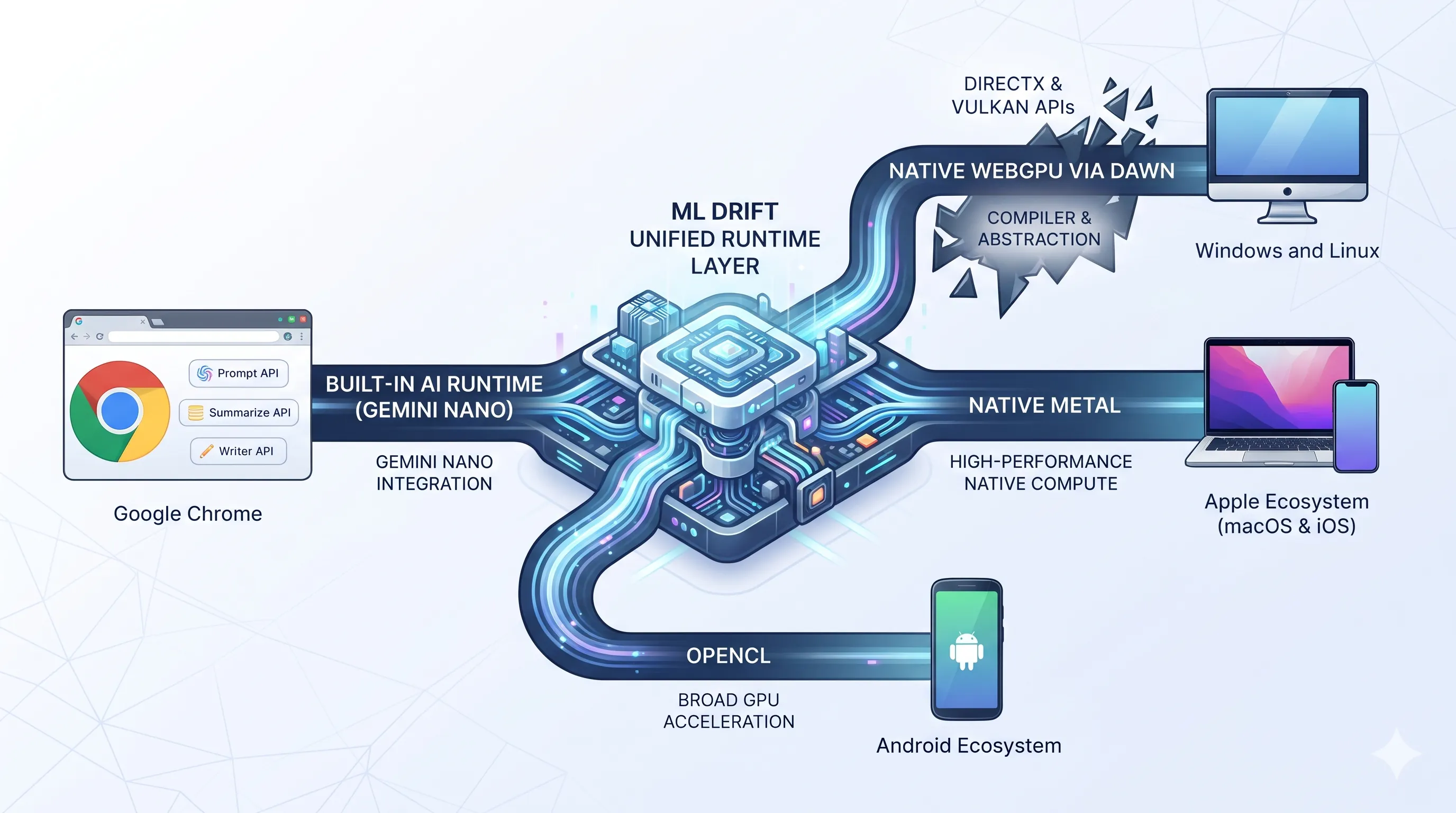
On desktop environments, ML Drift extends GPU inference to Windows and Linux by compiling its WebGPU backend natively outside the browser.This standalone execution is achieved via Dawn, Chromium's open-source WebGPU implementation.
Through WebGPU's hardware abstraction layer, ML Drift bypasses the traditional fragmentation between platform-specific graphics APIs, eliminating the need to maintain separate codepaths across DirectX and Vulkan.
As a result, desktop systems achieve direct hardware compute execution while preserving architectural consistency.
| Target Platform / Environment | Primary Backend & Implementation | Architecture & Functional Role |
|---|---|---|
| Windows and Linux | Native WebGPU via Dawn | Compiles outside the browser to bypass DirectX and Vulkan API fragmentation. |
| macOS and iOS | Native Metal | Maintains high-performance native compute acceleration across Apple ecosystems. |
| Android | OpenCL | Functions as the primary GPU acceleration backend for mobile devices. |
| Google Chrome | Hardware-Accelerated Built-In AI Runtime | Powers Gemini Nano models across the Prompt, Summarize, and Writer APIs. |
Platform Acceleration Across Android OpenCL, Apple Metal, and Chrome Built-In AI
To maximize performance across diverse operating systems, ML Drift pairs its abstraction layer with native graphics and compute backends tailored to each ecosystem.On Apple hardware, the framework maintains a high-performance native Metal backend across macOS and iOS devices.
For the Android mobile ecosystem, ML Drift designates OpenCL as its primary backend to ensure broad GPU acceleration.
This multi-backend pipeline directly powers native hardware-accelerated Gemini Nano models for Google Chrome Built-In AI APIs.
Through this integration, core browser-level intelligence features—including the Prompt API, Summarize API, and Writer API—execute on-device with optimized hardware acceleration.
5. Production Deployment Scale and Real-World Latency Reductions
Demonstrating how ML Drift enables cross-GPU AI inference efficiency requires looking beyond synthetic execution loops and evaluating performance across production environments.The runtime translates its uniform execution architecture directly into tangible throughput gains and footprint reductions across diverse hardware tiers.
Production Impact in Google Ecosystem and Third-Party Applications
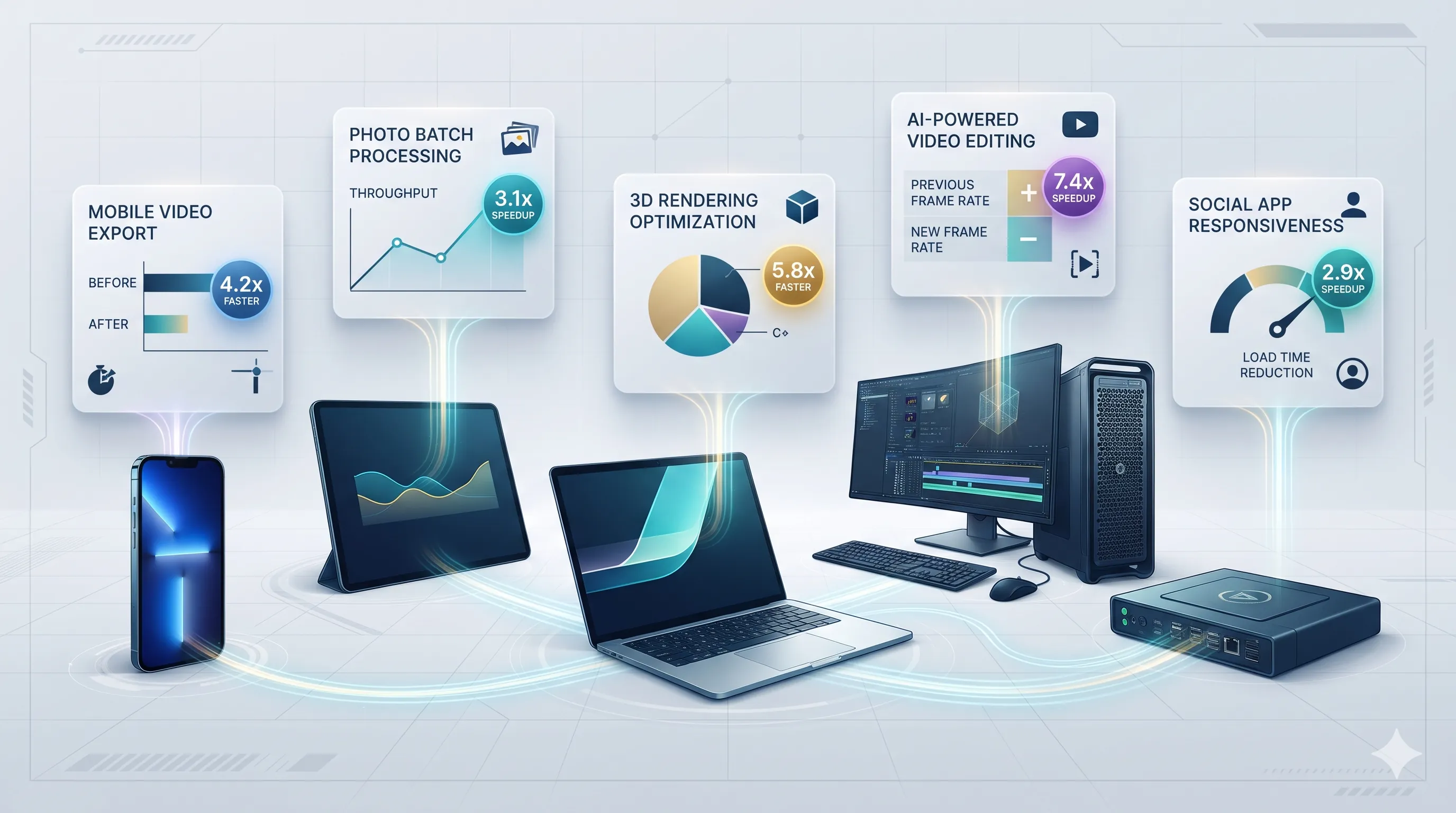
ML Drift currently runs in production across millions of devices daily, serving as the client-side execution backbone for core Google web and mobile services including Chrome, YouTube Shorts, Google Photos, and Google Meet.Beyond these flagship platforms, the engine powers specialized Google AI Edge applications including Gallery, Foresight, and Eloquent.
The concrete performance gains recorded across these varied deployment targets quantify the engine's efficiency.
In YouTube Shorts, ML Drift reduces average frame latency by up to 40% for real-time segmentation-based effects across both Android and iOS devices.
Within Google Photos, computational photography and segmentation pipelines execute up to 2 seconds faster compared to the legacy GPU delegate.
Third-party software vendors targeting creative workflows and social camera pipelines show equivalent efficiency gains.
In professional media tooling, the runtime delivers up to 30% faster on-device performance for Adobe Lightroom and Adobe Photoshop features, specifically accelerating Select Subject, Select Sky, and Adaptive Portrait routines.
Similarly, for mobile camera experiences, ML Drift yields a 30% model latency reduction for machine learning-powered face and style-generation effects in Snapchat lenses on Android, creating the performance headroom required to run larger diffusion models directly on mobile hardware.
| Application / Environment | Target Platform | Workload / Feature | Reported Performance Gain |
|---|---|---|---|
| YouTube Shorts | Android, iOS | Segmentation-based effects | Up to 40% lower average frame latency |
| Google Photos | Cross-platform | Computational photography & segmentation pipelines | Up to 2 seconds faster compared to legacy GPU delegate |
| Adobe Lightroom & Photoshop | On-device | Select Subject, Select Sky, and Adaptive Portrait | Up to 30% faster performance |
| Snapchat | Android | Face and style-generation lens effects (diffusion models) | 30% model latency reduction |
| Chrome, Meet, Gallery, Foresight, Eloquent | Web & Google AI Edge | Production inference pipelines | Active deployment across millions of daily devices |
Workstation Memory Efficiency and the Core ML Benchmark Gap
Beyond client mobile applications, ML Drift extends its execution profile to larger local foundation models on developer-grade workstation hardware.When running Gemma models, the engine achieves up to 12% lower memory overhead compared to established local inference frameworks such as llama.cpp and Apple's MLX LM.
Despite these measured memory efficiencies against unified memory runtimes, community engineers have highlighted notable omissions in the platform's initial validation suite.
Matthew Charles Vladislav Busel, founder of Tensorust, questioned how ML Drift compares directly with Apple's native Core ML framework on recent iPhone hardware in terms of both execution latency and memory allocation.
While ML Drift provides cross-platform parity across Android and iOS deployments, Google did not provide benchmark comparisons against Apple's Core ML on recent iPhone hardware for latency and memory metrics.
6. Silicon Partner Co-Optimizations Across Arm, Intel, and Qualcomm
Delivering consistent runtime execution across varied edge environments relies directly on deep integration with underlying chipsets, reinforcing how ML Drift Enables Cross-GPU AI Inference Efficiency at scale.Rather than deploying generalized fallback paths across distinct microarchitectures, ML Drift collaborates directly with silicon vendors to implement hardware-level co-optimizations that unlock maximum compute density.
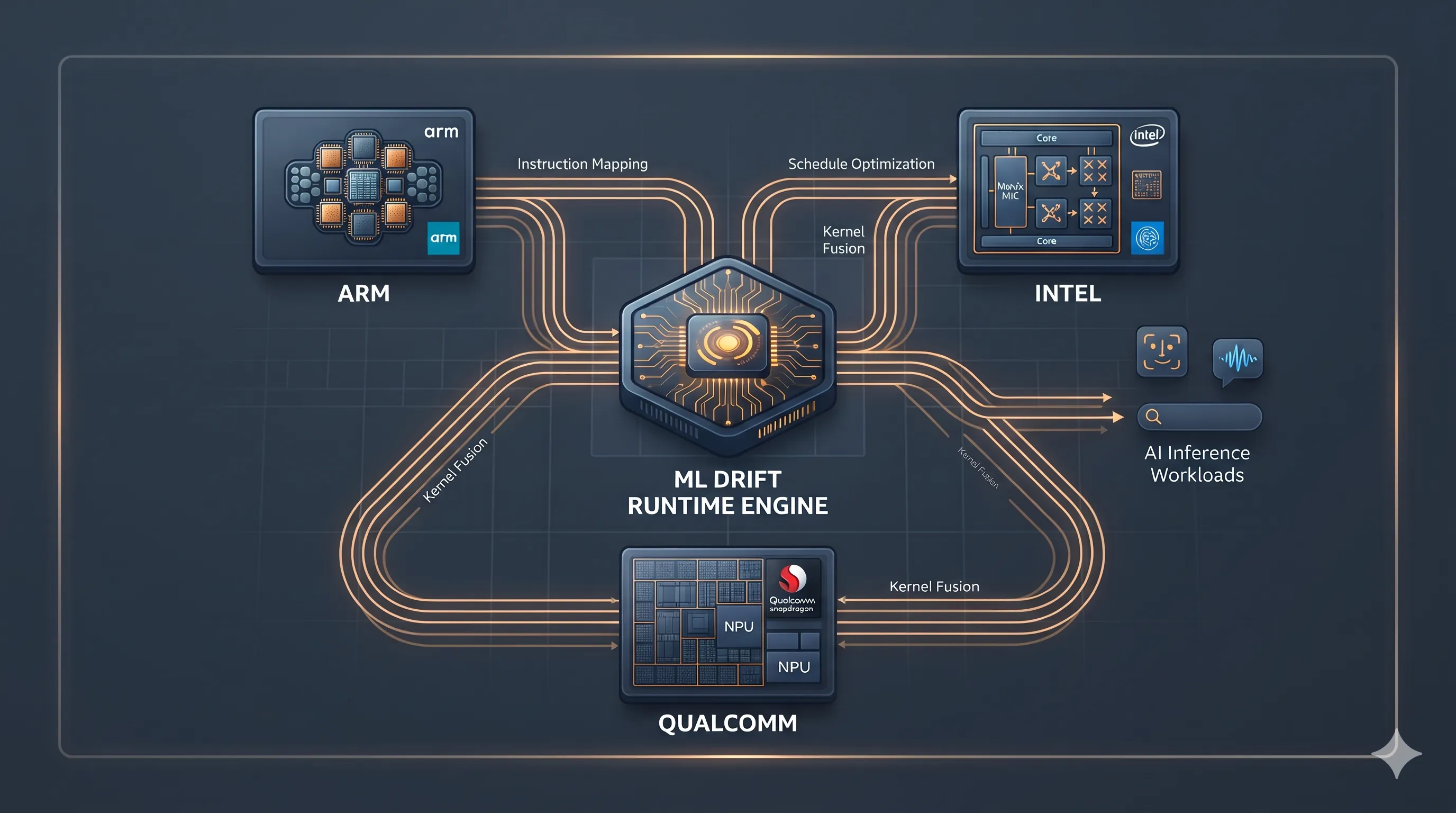
Through dedicated co-engineering across Arm, Intel, and Qualcomm Technologies, ML Drift aligns execution pipelines with vendor-specific silicon blocks to fully saturate silicon capabilities and memory subsystems.
Arm Mali and Immortalis Texture Cache Locality Tuning
On Arm architectures, ML Drift emphasizes architectural co-engineering tailored specifically for Mali and Immortalis GPUs.Hardware co-optimizations focus on structuring specialized compute kernels alongside disciplined texture cache locality strategies.
By aligning memory access behaviors with the physical cache structures of Mali and Immortalis units, the runtime effectively minimizes latency overhead during data retrieval.
This level of texture cache tuning directly boosts compute throughput while simultaneously advancing overall power efficiency during prolonged inference workloads.
Intel Xe Matrix Extensions (XMX) and Qualcomm Adreno Peak Throughput
For personal computing platforms powered by Intel Core Ultra processors equipped with Xe3 graphics, ML Drift directly integrates with hardware matrix compute capabilities.The framework harnesses native WebGPU compute pipelines alongside dedicated Xe Matrix Extensions (XMX).
This combination bridges low-overhead browser and native compute standards directly into Intel's matrix execution engines, enabling rapid acceleration for high-dimensional matrix operations.
Concurrently, collaborations with Qualcomm Technologies target maximum hardware utilization across mobile and edge ecosystems.
Engineering efforts focus on extensive OpenCL kernel tuning engineered specifically for Adreno GPUs.
These optimizations ensure workloads drive peak utilization across both Adreno ALU execution resources and available memory bandwidth, eliminating compute bottlenecks during dense operational phases.
| Silicon Partner | Target Architectures / Hardware | Hardware Acceleration Techniques | Optimization Objective |
|---|---|---|---|
| Arm | Mali and Immortalis GPUs | Co-optimized compute kernels and texture cache locality alignment | Throughput improvement and enhanced power efficiency |
| Intel | Intel Core Ultra processors equipped with Xe3 graphics | Native WebGPU compute and Xe Matrix Extensions (XMX) harness | Hardware matrix acceleration and dense compute saturation |
| Qualcomm Technologies | Adreno GPUs | Targeted OpenCL kernel tuning | Peak ALU and memory bandwidth utilization |
7. Developer Access Tiers and Migration from Legacy TFLite GPU Delegates
The shift toward ML Drift establishes a modernized architecture that directly powers cross-GPU AI inference efficiency across consumer devices.Navigating this architecture requires understanding both the deprecation timeline of prior runtime components and the specific integration pathways available to engineers.
Upgrading from the Deprecated TFLite GPU Delegate
Google ceased feature updates for the legacy TensorFlow Lite GPU delegate upon releasing ML Drift.Because the legacy framework no longer receives feature updates or performance enhancements, teams relying on the legacy TFLite GPU delegate must migrate to the LiteRT ML Drift accelerator.
Migrating to the LiteRT ML Drift runtime allows deployments to maintain backward compatibility while avoiding the operational dead-end of deprecated delegate tooling.
Choosing Between Turnkey LiteRT and Standalone C++ Engine Access
Google structures developer access into two distinct tiers tailored either for standard application delivery or for specialized low-level graphics engineering.Application developers can adopt the LiteRT ML Drift GPU accelerator to take advantage of out-of-the-box model partitioning, tensor virtualization, and backward compatibility.
This turnkey acceleration path is available in standalone LiteRT packages today, with integration coming to LiteRT in Google Play Services to support unbundled Android runtimes.
Alternatively, system and GPU engineers requiring granular execution control can access standalone C++ APIs via GitHub.
This low-level standalone interface provides the primitives necessary to construct custom GpuModel graphs and author specialized shaders tailored directly to custom compute pipelines.
| Access Tier / Distribution | Target Profile | Core Capabilities & Status |
|---|---|---|
| LiteRT ML Drift Accelerator (Standalone Packages) | Application developers | Provides out-of-the-box model partitioning, tensor virtualization, and backward compatibility; available today. |
| LiteRT in Google Play Services | Application developers (Android) | Integration coming to enable unbundled Android runtime distribution alongside automated partitioning features. |
| Standalone C++ Library (GitHub) | System and GPU engineers | Exposes standalone C++ APIs to build custom GpuModel computational graphs and author custom shaders. |

Related Posts

AI-Driven Drug Discovery: The Clinical Validation and Development of ISM001-055 for Idiopathic Pulmonary FibrosisExplore how generative AI accelerated the discovery and clinical validation of ISM001-055 for...

AI Video Generation for Commercial Production: Prompt Engineering, Luma Ray, and Runway Gen-3 AlphaLearn how to use structured prompt engineering, Luma Ray, and Runway Gen-3 Alpha to create...

Architecting Multi-Agent Systems for Cross-Model Fact-Checking and Hallucination ReductionLearn how to build automated, multi-agent systems using cross-model verification and recursive...
Generative AI may have assisted with research or drafting for this article. Topic selection, fact-checking, final wording, and publication remain the responsibility of DragonStone74. AI use disclosure