
Architecting Multi-Agent Systems for Cross-Model Fact-Checking and Hallucination Reduction
🚀 Key Takeaways
- Supervisor Orchestration: Centralized multi-agent routing isolates specialized domain tasks and optimizes context window utilization.
- Cross-Model Verification: Pitting distinct model families like Claude and GPT against each other eliminates single-model self-enhancement bias.
- Automated Self-Refinement: Recursive feedback advisors evaluate draft outputs and dynamically trigger targeted re-generation loops.
- Reasoning-First Evaluation: Enforcing structured diagnostic rationale before numeric scoring ensures transparent, deterministic fact-checking.
- Cascading Error Prevention: Multi-agent verification checkpoints intercept intermediate hallucinations before context drift corrupts downstream workflows.
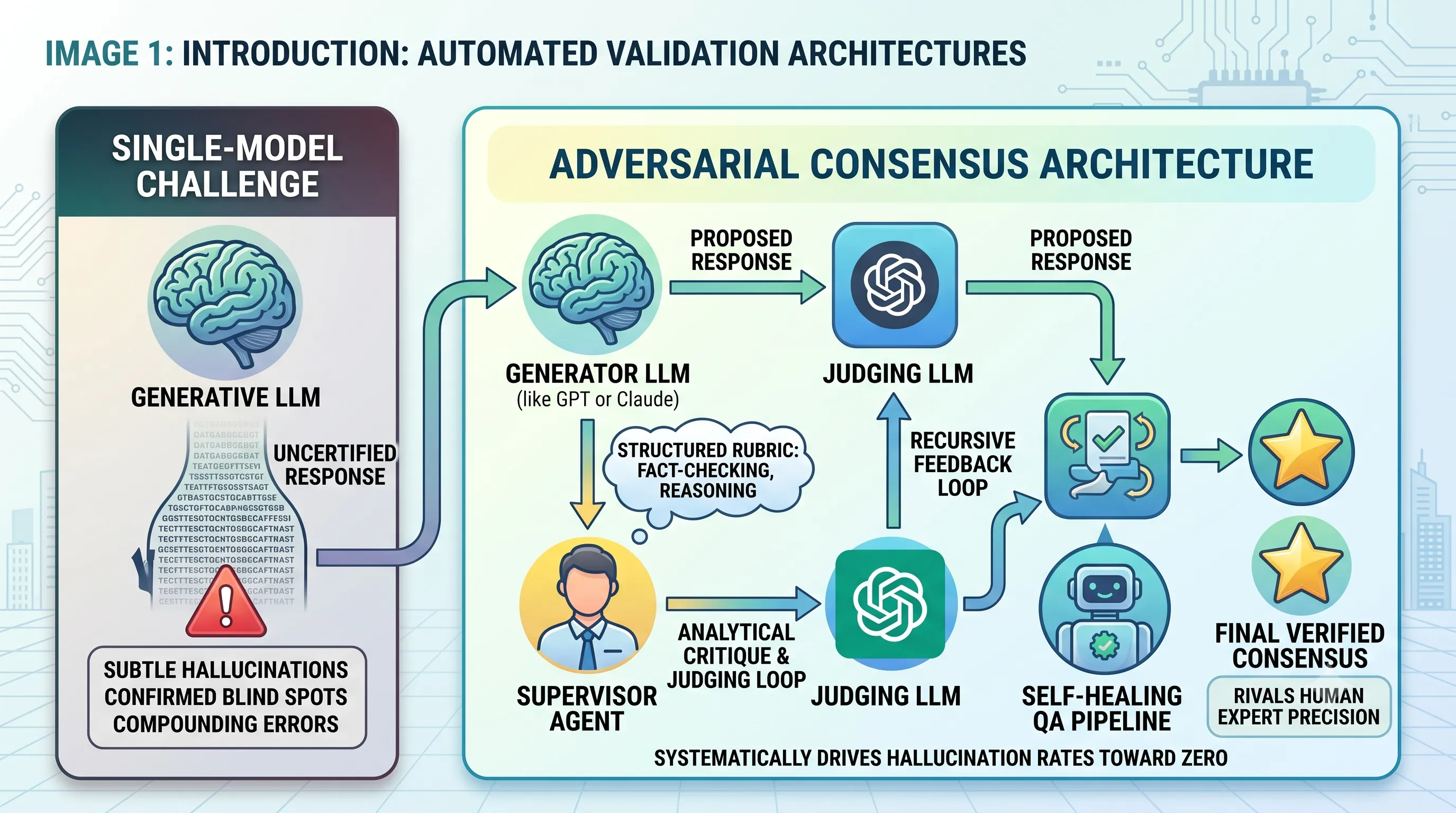
Frontier architectures like Claude and GPT exhibit fundamentally different reasoning strengths and error profiles. When these complementary model families are orchestrated in a structured adversarial setup, one model's analytical critique directly neutralizes the factual drift of another, achieving verification precision that rivals human expert consensus.
By integrating multi-agent supervisor patterns with recursive cross-model judging loops, developers can construct an automated, self-healing quality assurance pipeline. This guide explores the architectural blueprints, structured rubrics, and feedback mechanisms required to systematically drive hallucination rates toward zero.
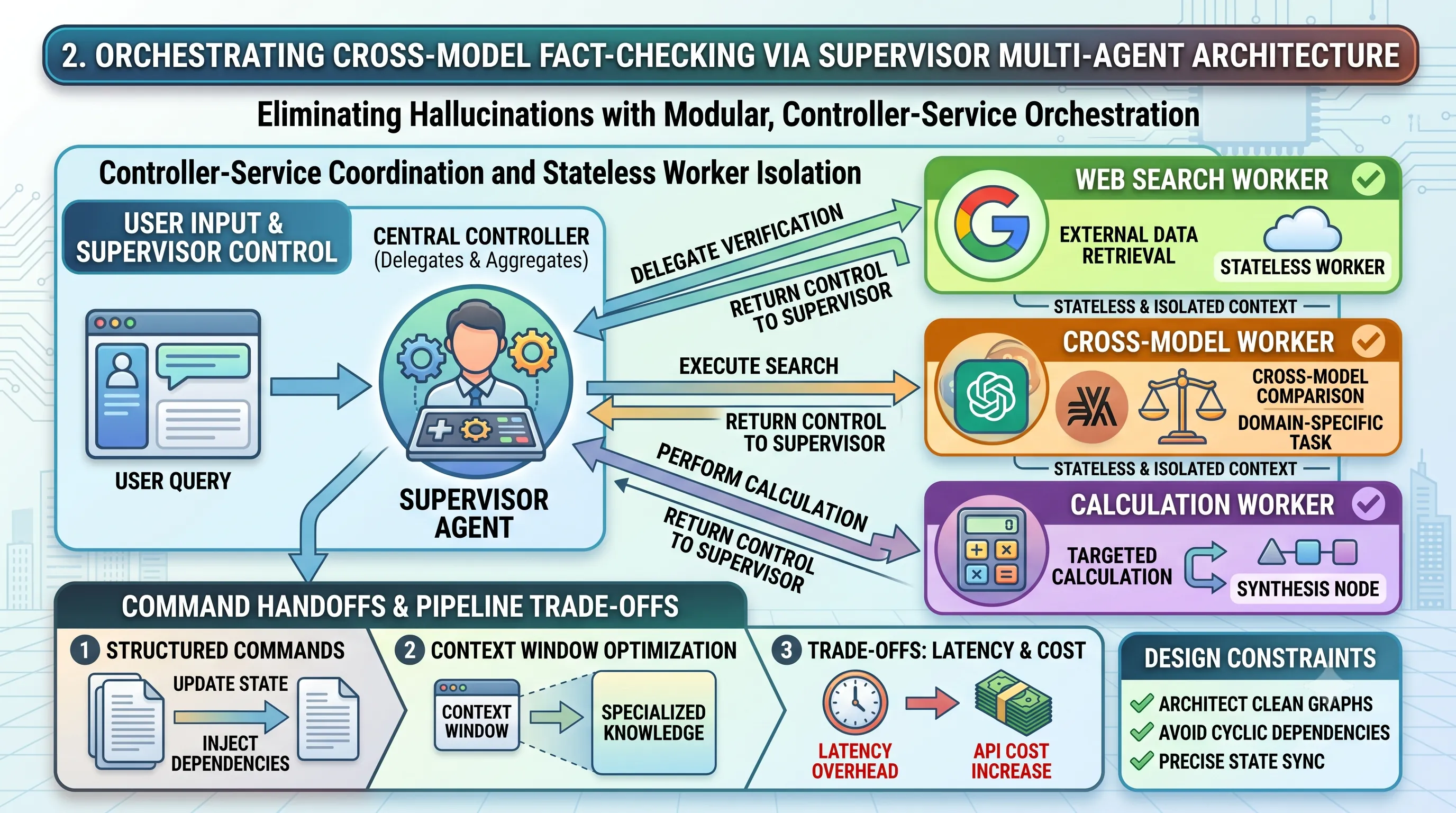
1. Orchestrating Cross-Model Fact-Checking via Supervisor Multi-Agent Architecture
Building an automated verification pipeline to eliminate hallucinations across frontier models requires a robust architectural pattern to coordinate task execution.Rather than relying on a monolithic prompt to perform fact retrieval, cross-model comparison, and synthesis simultaneously, multi-agent frameworks distribute these duties across modular nodes.
Controller-Service Coordination and Stateless Worker Isolation
The Supervisor Agent pattern operates analogously to the Controller-Service architecture found in the Spring Framework.Within this paradigm, a central supervisor acts as the primary controller that receives incoming queries, delegates verification tasks to specialized worker agents, and aggregates the resulting outputs.
Worker agents are designed to execute isolated domain-specific tasks, such as external web search retrieval or targeted calculations.
To maintain an orderly pipeline, worker agents return execution control directly back to the supervisor rather than responding independently to the end user.
Furthermore, these subagents are stateless by design.
By enforcing strict context isolation at the worker tier, the primary supervisor retains sole responsibility for maintaining conversational state throughout the fact-checking workflow.
Command Handoffs, Context Window Optimization, and Latency Trade-offs
Handoff mechanisms within the multi-agent system rely on structured command architectures to route control, update conversational state, and inject dependencies between agents.This pattern enables efficient context window management, allowing developers to inject domain-specific knowledge and specialized instructions into subagents without overloading a single model context window.
However, orchestrating multi-agent systems introduces distinct operational and structural constraints.
Managing agent dependencies requires architecting clean graphs that avoid cyclic dependencies and enforce a strict separation of responsibilities.
As fact-checking workflows grow more complex, system designers must maintain precise state synchronization across distributed agent nodes.
Additionally, routing tasks through sequential LLM invocations introduces latency overhead and increases cumulative per-request API costs.
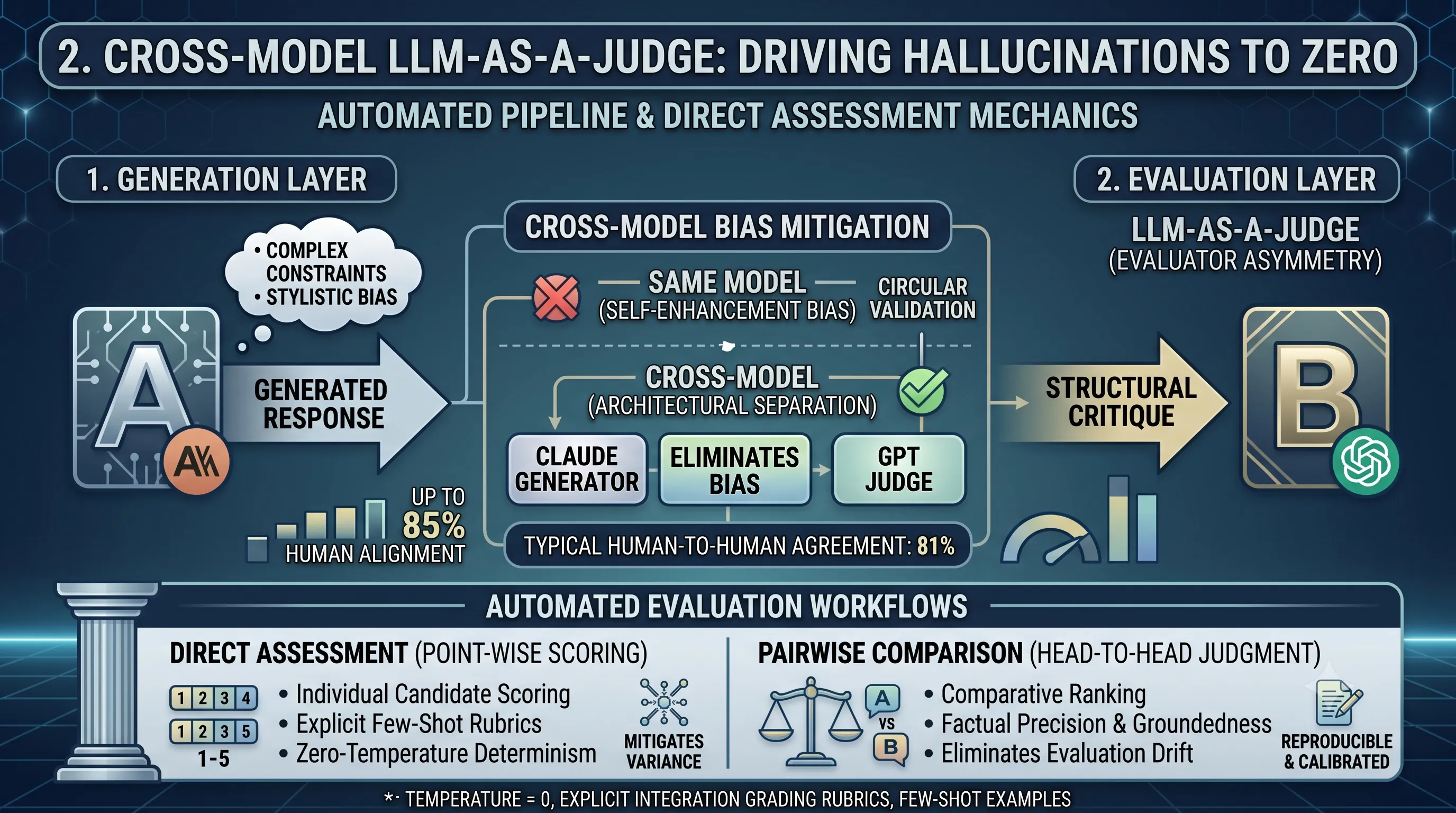
2. Cross-Model LLM-as-a-Judge Verification and Direct Assessment Mechanics
Building an automated pipeline to drive hallucination rates down toward zero requires an objective validation layer capable of auditing generated claims without inheriting the generator's internal blind spots.
Cross-model verification resolves this challenge by pitting distinct frontier model families—such as Anthropic Claude and OpenAI GPT—against one another within an automated LLM-as-a-judge architecture.
Cross-Model Bias Mitigation and Evaluator Asymmetry
Automated verification exploits a core computational principle: critiquing and detecting factual inconsistencies within generated text is structurally and computationally far easier than generating constrained original content from scratch.
When an LLM generates a response, it operates under complex generative constraints, whereas an evaluator focuses exclusively on factual extraction, consistency auditing, and rubric validation.
However, using the same model to both generate and verify content introduces severe self-enhancement bias, where a model systematically favors its own stylistic and reasoning patterns.
Cross-model verification mitigates this generation bias by enforcing architectural separation—for instance, assigning Claude as the generator while deploying a distinct GPT instance or dedicated judge model for evaluation.
As outlined in the Spring AI LLM-as-a-Judge framework and Anthropic Claude evaluation documentation, general-purpose frontier models can effectively judge text, but maintaining isolated ChatClient instances or cross-family evaluators is essential to prevent circular validation.
When properly configured, sophisticated LLM judge models achieve an alignment with human judgment of up to 85%, outperforming typical human-to-human agreement benchmarks of 81%.
Deterministic Direct Assessment and Pairwise Scoring Rubrics
Automated LLM evaluation workflows rely on two primary verification patterns: Direct Assessment and Pairwise Comparison.
Direct Assessment applies point-wise scoring to evaluate candidate outputs individually against standardized integer scales, typically ranging from 1 to 4 or 1 to 5.
In contrast, Pairwise Comparison conducts head-to-head assessments between two candidate responses to determine superior factual precision and groundedness.
To ensure strict reproducibility and eliminate variance in high-throughput validation pipelines, deterministic evaluation is enforced by setting the model temperature to 0.
This zero-temperature parameter is paired with explicit integer grading rubrics and few-shot examples embedded directly into the judge prompt, guaranteeing that scoring remains stable, auditable, and calibrated across both Claude and GPT verification runs.
| Evaluation Pattern | Scoring Scale & Configuration | Core Operational Mechanism | Bias & Alignment Attributes |
|---|---|---|---|
| Direct Assessment (Point-wise) | Integer scale (1–4 or 1–5), Temperature = 0 | Individual candidate scoring against explicit few-shot rubrics | Mitigates variance via deterministic zero-temperature settings |
| Pairwise Comparison | Head-to-head selection, Temperature = 0 | Direct comparative ranking between two candidate model outputs | Eliminates single-response evaluation drift across rival models |
| Cross-Model LLM-as-a-Judge | Separated ChatClient instances across model families | Structural critique of generated text using opposing architectures | Eliminates self-enhancement bias; reaches up to 85% human alignment (vs. 81% human-to-human) |
3. Self-Refinement Pipelines and Recursive Advisor Feedback Loops
To eliminate hallucinations in automated fact-checking pipelines, single-pass generation must be replaced with autonomous evaluation and correction mechanisms.
Spring AI introduced experimental Recursive Advisors in version 1.1.0-M4+ to enable structured self-refinement pipelines.
Recursive Feedback Interception and Dynamic Sub-Chain Generation
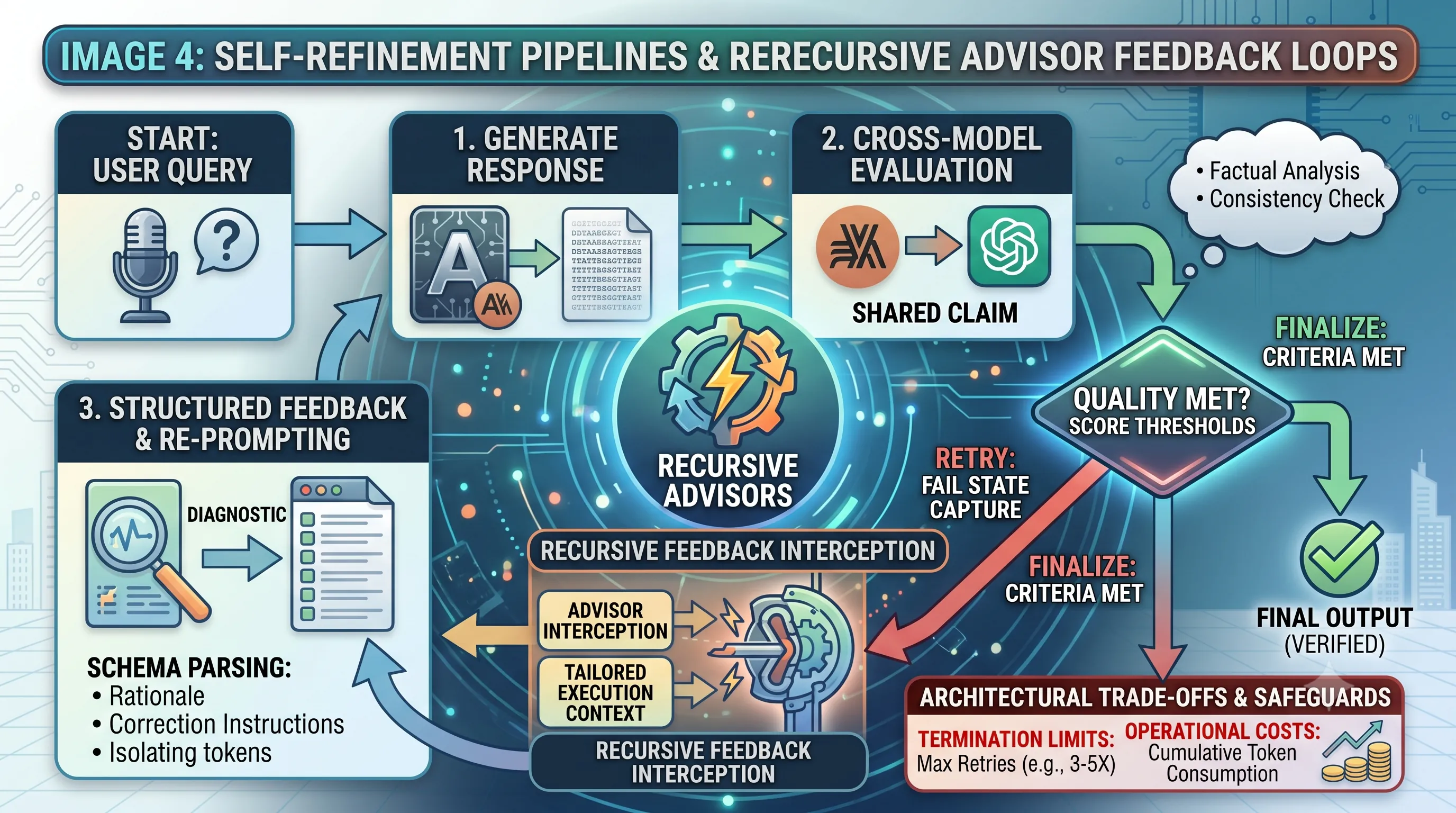
Self-refinement loops automate quality control through an iterative cycle: generate response -> evaluate quality with judge model -> retry with structured feedback if criteria are unmet -> finalize upon meeting score thresholds.
Rather than relying on static prompt chains, recursive advisors intercept AI execution chains and spawn dynamic sub-chains to re-prompt generation models with diagnostic critique.
When a cross-model evaluation detects factual inaccuracies or unverified claims, the advisor captures the failure state and generates a tailored execution context.
According to the Spring AI Documentation, this dynamic re-prompting ensures that corrective directives are fed directly back into the generation layer without requiring manual workflow orchestration.
Structured Diagnostic Parsing and Termination Limit Safeguards
The success of recursive refinement depends on the precision of the feedback delivered to the generator.
Structured output parsing converts evaluation judgments into explicit schemas containing numeric ratings, rationales, and actionable correction instructions.
By standardizing critique into an actionable schema, the retry prompt isolates hallucinated tokens and supplies deterministic guidance for factual remediation.
However, deploying recursive loops introduces critical architectural and operational trade-offs.
Recursive evaluation loops must enforce termination conditions and explicit maximum retry limits to prevent infinite loops.
Because each verification cycle executes multiple model calls, iterative judging loops increase overall token consumption and API operational costs.
Additionally, recursive evaluation advisors in Spring AI operate in non-streaming mode and require strict advisor chain ordering to ensure that verification filters execute in the correct programmatic sequence.
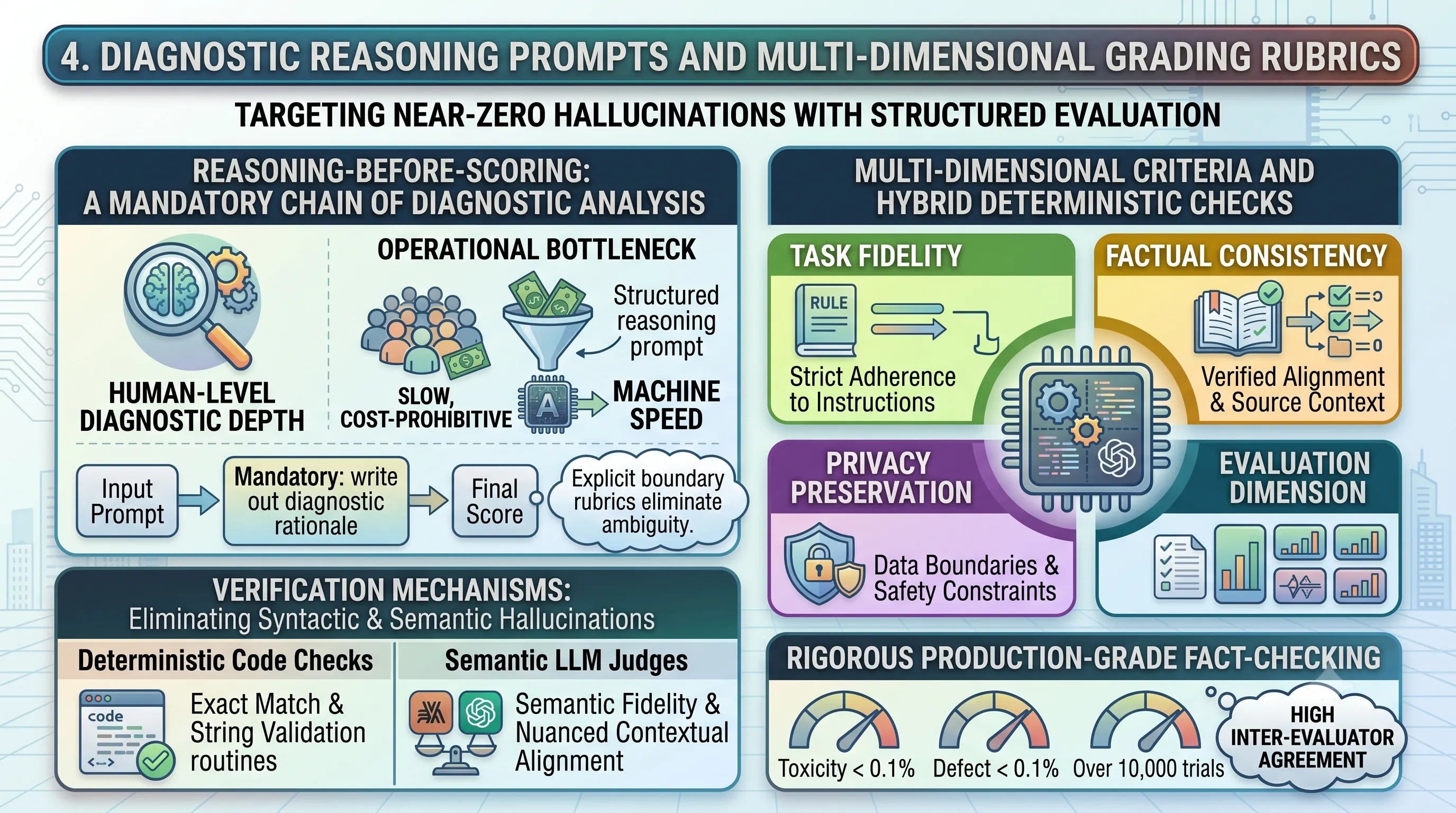
4. Diagnostic Reasoning Prompts and Multi-Dimensional Grading Rubrics
To construct an automated cross-model fact-checking pipeline that targets near-zero hallucination rates, the evaluation architecture must move beyond superficial scoring heuristics.A robust verification framework requires structured evaluation designs that systematically dissect claims through diagnostic rationale and rigorous multi-dimensional grading.
Reasoning-Before-Scoring and Explicit Boundary Rubrics
Automated evaluation systems must mandate reasoning-before-scoring ("think first") prompts where the judge model explicitly writes out its diagnostic rationale prior to emitting any final integer or categorical score.Without a mandatory chain of diagnostic analysis, judge models are prone to generating noisy or inconsistent evaluations when confronted with complex factual disputes.
According to Anthropic Prompt Engineering & Evaluation Documentation, purely qualitative criteria that lack clear, unambiguous scoring rubrics prove difficult to grade reliably at scale.
To overcome this limitation, high-signal evaluation rubrics enforce explicit boundary definitions that eliminate ambiguity across automated grading runs.
By setting strict qualitative thresholds for each score tier, the fact-checking pipeline ensures reproducibility and high inter-evaluator agreement.
While human grading provides high quality, it remains too slow and cost-prohibitive for continuous-integration testing pipelines operating under high throughput.
Structured reasoning prompts solve this operational bottleneck by extracting human-level diagnostic depth at machine speed.
Multi-Dimensional Criteria and Hybrid Deterministic Checks
Modern automated evaluation designs avoid single-metric reductionism by deploying multi-dimensional grading rubrics that analyze outputs across critical performance vectors.Rather than relying solely on semantic model judges or static validation scripts, effective pipelines deploy hybrid architectures combining deterministic code checks and semantic LLM evaluators.
| Evaluation Dimension / Method | Operational Role | Verification Mechanism |
|---|---|---|
| Deterministic Code Checks | Rule-based validation | Executes exact match and string validation routines for rigid, unambiguous criteria. |
| Semantic LLM Judges | Nuanced interpretation | Assesses high-level semantic fidelity and nuanced contextual alignment. |
| Task Fidelity | Multi-dimensional rubric | Measures strict adherence to operational instructions and structural requirements. |
| Factual Consistency & Source Utilization | Multi-dimensional rubric | Verifies factual alignment and measures source context utilization against verified reference data. |
| Privacy Preservation | Multi-dimensional rubric | Guarantees that sensitive data boundaries and safety constraints remain intact. |
Furthermore, establishing explicit quantitative benchmarks—such as maintaining toxicity or defect rates below 0.1% across 10,000 test trials—provides the statistical rigor necessary for production-grade fact-checking engines.
5. Mitigating Context Drift and Cascading Errors in Multi-Agent Pipelines
Divergent Model Error Profiles and Cross-Boundary Cascades
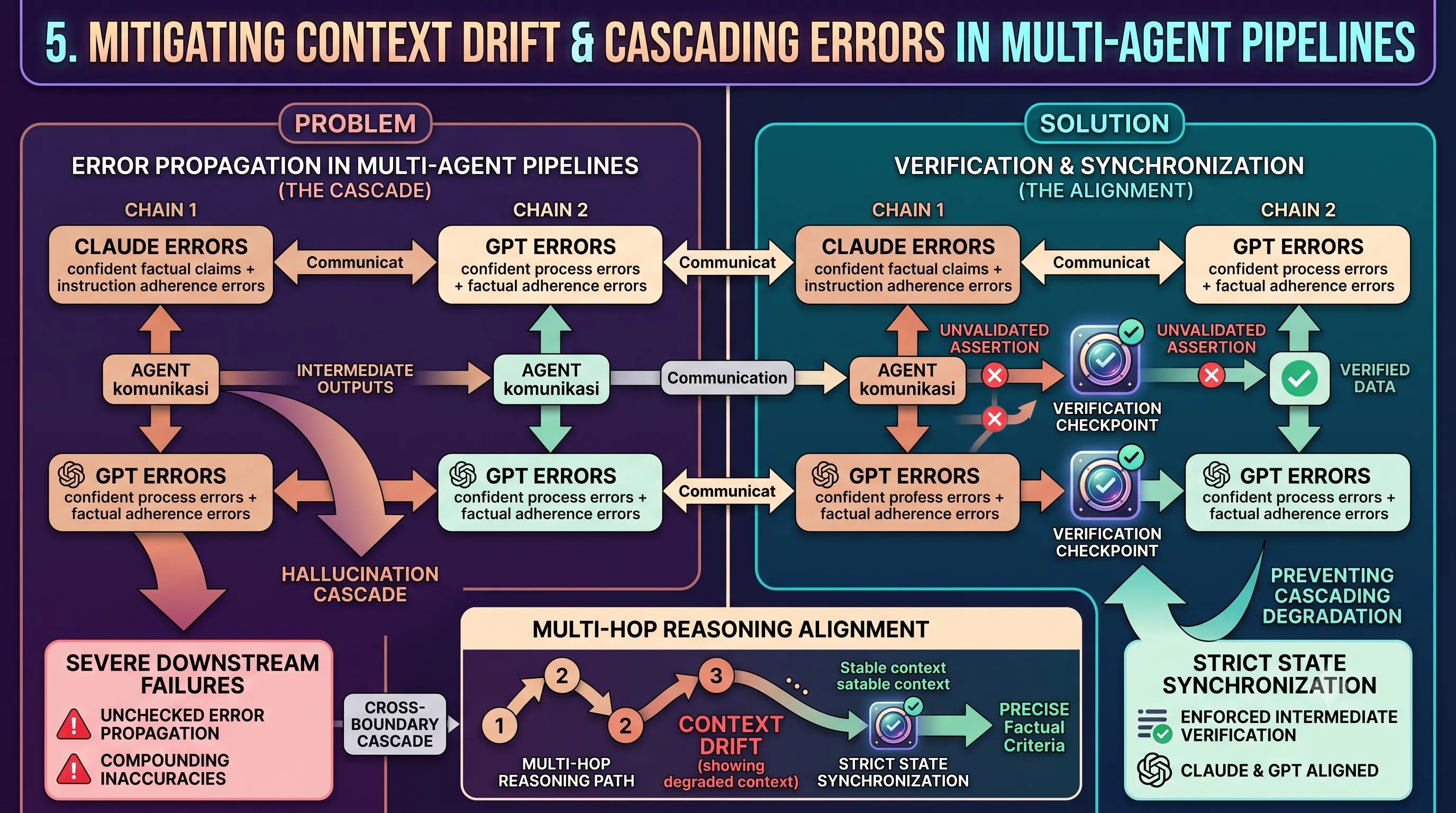
Deploying an automated fact-checking pipeline that pairs Claude and GPT requires an understanding of how distinct frontier foundation models generate errors.Claude and GPT exhibit differing hallucination profiles across confident factual claims versus process and instruction adherence errors.
When orchestrating these models in a collaborative architecture, recognizing these disparate failure modes is essential for establishing structured evaluation boundaries.
In multi-agent architectures, hallucinations can cascade across agent communication boundaries if intermediate outputs are not verified.
An unvalidated factual assertion or a misapplied procedural constraint generated by one model can be ingested as ground truth by the peer model.
This dynamic allows unchecked error propagation in multi-agent pipelines to compound initial model inaccuracies into severe downstream failures.
To build a system targeting near-zero hallucination rates, intermediate verification checkpoints must be enforced at every handoff between the collaborating models.
Preventing Context Drift Across Multi-Hop Reasoning Steps
Beyond localized factual errors at communication boundaries, complex fact-checking tasks suffer from structural degradation during extended workflows.Context drift in multi-agent workflows occurs when synchronized state between collaborating models degrades across multi-hop reasoning steps.
As intermediate reasoning paths lengthen and agents exchange iterative arguments, the core factual constraints and initial system instructions can lose fidelity.
This gradual erosion of shared context causes collaborating agents to evaluate secondary artifacts rather than the primary ground-truth inputs.
Maintaining strict state synchronization across every step of multi-hop verification prevents cascading degradation, ensuring both Claude and GPT remain aligned on precise factual criteria throughout the automated pipeline.
References
- velog.io — LangGraph-Agent-Supervisor-%EC%95%84%ED%82%A4…
- docs.langchain.com — multi-agent
- platform.claude.com — overview
- platform.claude.com — develop-tests
- docs.spring.io — llm-as-judge.html
- Hallucination Cascade: Analyzing Error Propagation in Multi-Agent LL…
- Hallucination as Context Drift: Synchronization Protocols for Multi …
Related Posts