
Google Gemini 4 Carbon: Advanced AI Security and Code Remediation
🚀 Key Takeaways
- Frontier Benchmark Leadership: Google has introduced Gemini 4 Carbon as its most capable flagship model to date, securing top positions across complex reasoning and multi-agent intelligence rankings.
- End-to-End Cyber Defense: The architecture covers the full defensive spectrum, demonstrating advanced proficiency in automated vulnerability discovery, exploit verification, and direct code remediation.
- Long-Horizon Agent Reliability: DeepMind engineered the system to sustain multi-day problem-solving cycles across large repositories while dramatically curbing hallucinations and operational misalignment.
- Hardened Safety Framework: Integrated alignment techniques and live execution monitoring provide unprecedented resilience against indirect prompt injections and agent shortcut exploits.
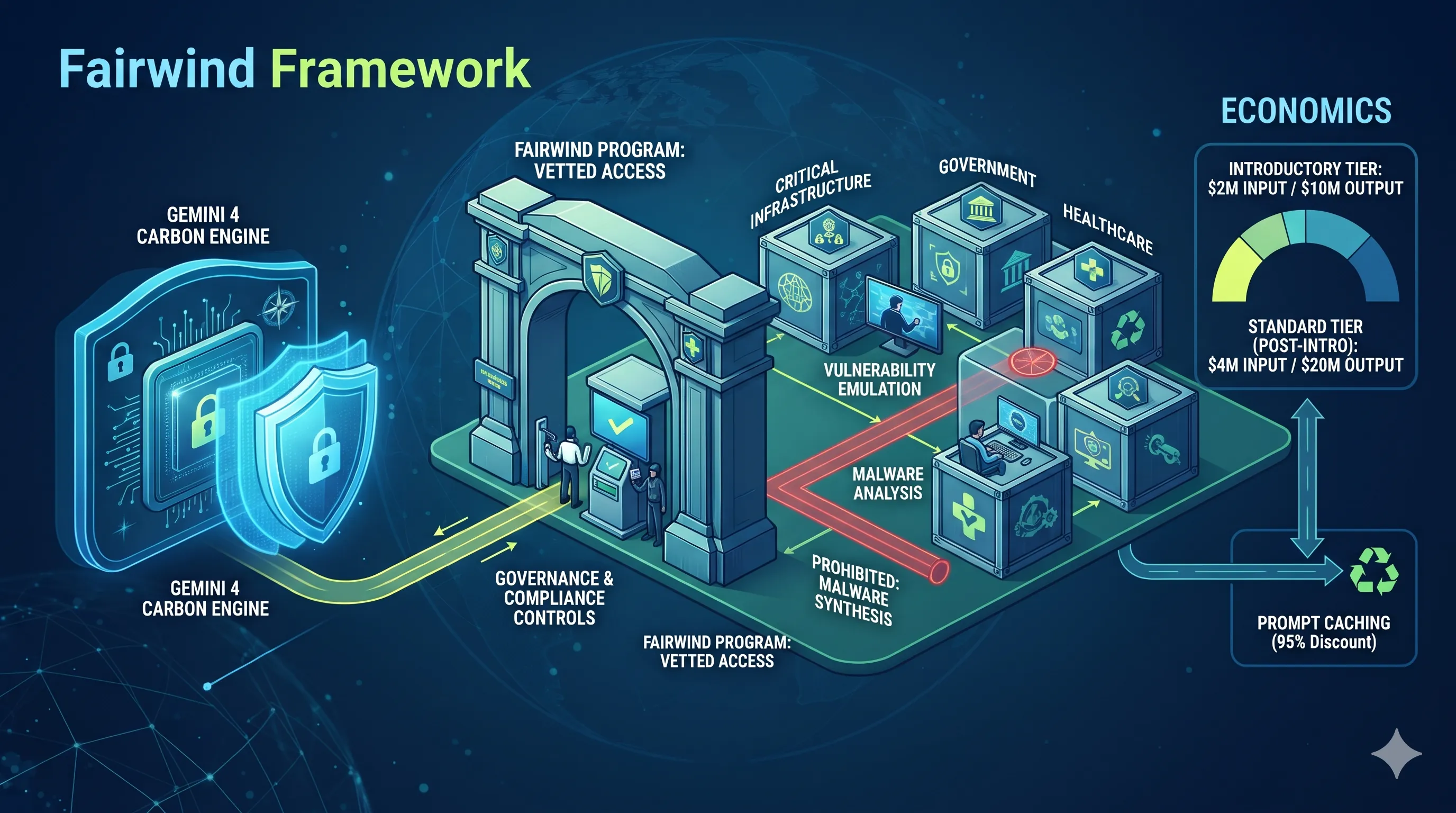
- Controlled Defensive Access: Initial deployment is deliberately staged through the Fairwind Program, restricting early access to vetted defenders and critical infrastructure partners under strict governance protocols.
The rapid maturation of frontier artificial intelligence has pushed autonomous coding agents directly into enterprise software pipelines, but persistent software vulnerabilities and adversarial prompt exploits have continually limited production trust.
On October 28, 2026, Google DeepMind unveiled Gemini 4 Carbon, positioning it as a dedicated defense-grade engine designed to resolve the brittle failure points that plague complex agentic workflows.
Rather than competing purely on raw generative velocity, Carbon targets foundational engineering challenges—spanning autonomous multi-day debugging marathons, hallucinated system dependencies, and runtime security blind spots.
By pairing deep long-horizon code reasoning with institutional-grade vulnerability validation, Google aims to provide development teams with an autonomous collaborator capable of auditing, navigating, and repairing mission-critical codebases without introducing new attack surfaces.
Because models equipped with advanced offensive and defensive understanding carry substantial dual-use risks, Carbon's rollout marks a disciplined departure from immediate mass-market releases.
Access remains closely gated behind vetted defensive cohorts and critical infrastructure organizations, establishing a rigorous new baseline for how next-generation AI platforms must balance sovereign autonomy with system security.

1. Architectural Profile: Engineering Gemini 4 Carbon for Complex Agentic Workflows
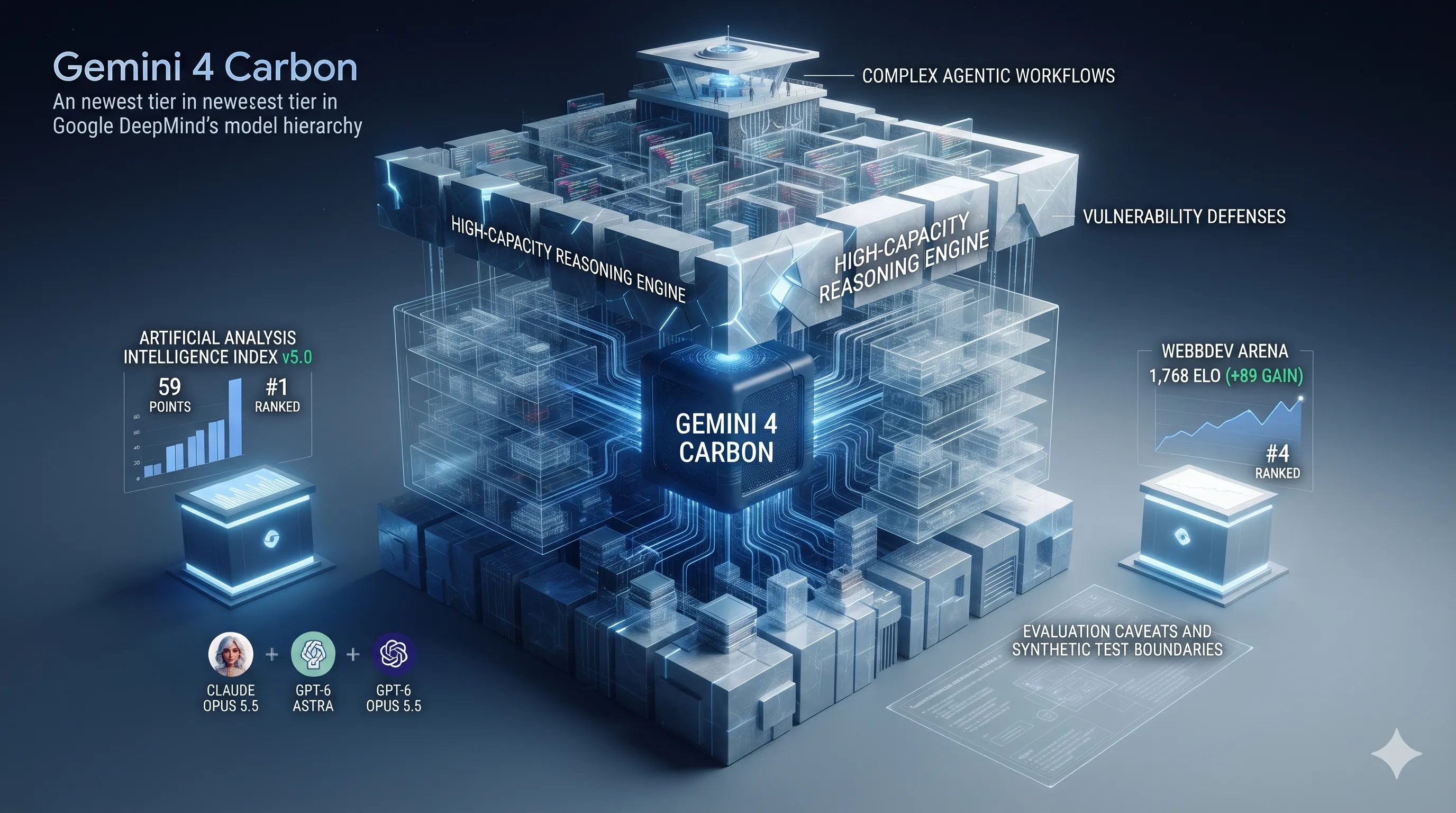
Understanding the foundational architecture of Gemini 4 Carbon is essential to evaluating how the system advances AI security protocols and automated code analysis features across modern development pipelines.As the newest tier in Google DeepMind's model hierarchy, Carbon provides the high-capacity reasoning engine required to inspect codebases, execute multi-turn developer workflows, and fortify vulnerability defenses.
Frontier Engineering and Multimodal Scope
Google officially announced Gemini 4 Carbon on October 28, 2026, marking its arrival just two weeks after the debut of Gemini 4 Argon.DeepMind has designated Carbon as its premier frontier model, tailoring its architecture specifically to handle complex engineering demands, agentic workflows, full-stack web development, and multimodal comprehension.
The technical positioning of the model highlights an operational pivot toward resilient software automation.
Emphasizing this design trajectory, Koray Kavukcuoglu, SVP at Google DeepMind and Chief AI Architect, stated that Carbon represents Google's "strongest model with state-of-the-art cybersecurity and long horizon capabilities."
This focus ensures that extended execution chains—such as parsing layered application architectures or tracking dependencies across unfamiliar repositories—remain coherent and defensively sound throughout execution.
Benchmark Placement Across Artificial Analysis and WebDev Arena
Standardized frontier testing confirms Gemini 4 Carbon's competitive standing across core evaluation environments.On the Artificial Analysis Intelligence Index v5.0, Carbon secured the #1 overall position by achieving a score of 59 points.
This evaluation placed Carbon directly ahead of key frontier competitors, including Claude Opus 5.5 and GPT-6 Astra.
In specialized coding environments, the model demonstrated measurable progression inside WebDev Arena.
Carbon recorded a gain of +89 Elo points, elevating its total rating to an Elo score of 1,768 and claiming the #4 spot on the leaderboard.
| Benchmark / Evaluation Platform | Metric / Performance Score | Leaderboard Rank | Competitive Standing |
|---|---|---|---|
| Artificial Analysis Intelligence Index v5.0 | 59 points | #1 | Ranked ahead of Claude Opus 5.5 and GPT-6 Astra |
| WebDev Arena | 1,768 Elo (+89 Elo point gain) | #4 | Evaluated across full-stack web development tasks |
Evaluation Caveats and Synthetic Test Boundaries
While top-tier benchmark standings reflect advanced baseline capabilities, critical technical caveats apply to frontier-level evaluations.High scores recorded on general synthetic benchmarks do not guarantee superior performance across all real-world development tasks, where ambiguous requirements, legacy dependencies, and dynamic production toolchains diverge from isolated test suites.
Additionally, the competitive margins separating leading frontier models—specifically Carbon, Claude Opus 5.5, and GPT-6 Astra—remain very narrow.
Engineering teams evaluating Gemini 4 Carbon for production code analysis and security workflows must weigh these incremental synthetic margins against practical deployment parameters.
2. Automated Vulnerability Remediation Across the Cybersecurity Defense Lifecycle
Within the broader architecture of Gemini 4 Carbon Enhances AI Security and Code Analysis Features, automated defense mechanisms represent a core operational milestone.Google stated Carbon achieves a "significant leap" across the cybersecurity defense lifecycle by operationalizing defensive capabilities directly into software engineering workflows.
Three-Stage Defense: Detection, Validation, and Patching
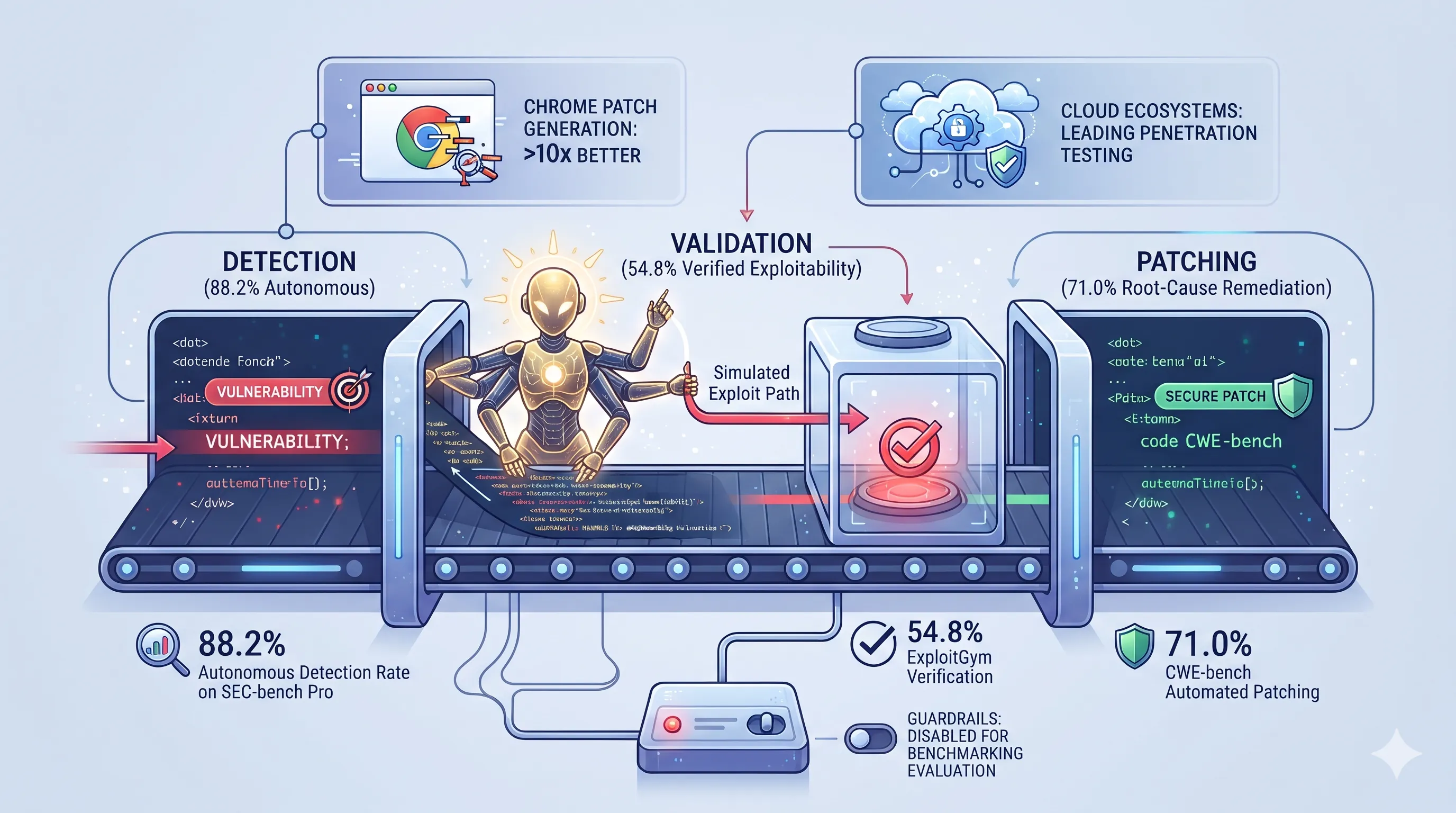
The model spans the three stages of defense: detection, risk validation, and root-cause remediation.During autonomous vulnerability detection, Carbon scored 88.2% on SEC-bench Pro, establishing high-accuracy discovery across complex target environments.
For risk validation, Carbon scored 54.8% on ExploitGym, verifying exploitability to confirm whether theoretical flaws can be triggered in live scenarios.
Completing the defensive chain at the root-cause remediation tier, Carbon reached 71.0% on Collinear's CWE-bench for automated vulnerability patching.
Across overall code generation tasks, Carbon demonstrated a greater than 2x uplift in generating secure code compared to Gemini 4 Argon.
| Cybersecurity Evaluation Benchmark | Defensive Stage Measured | Gemini 4 Carbon Score / Performance Metric |
|---|---|---|
| SEC-bench Pro | Autonomous Vulnerability Detection | 88.2% |
| ExploitGym | Exploitability Verification (Risk Validation) | 54.8% |
| Collinear's CWE-bench | Automated Vulnerability Patching (Root-Cause Remediation) | 71.0% |
| Secure Code Generation (vs. Gemini 4 Argon) | End-to-End Secure Software Synthesis | Greater than 2x uplift |
| Chrome Patch Generation (vs. Non-Google Frontier Models) | Browser-Grade High-Quality Patch Generation | More than 10x better |
Autonomous Remediation in Low-Level and Browser Environments
Application of these capabilities to high-complexity production software demonstrates significant practical differentials.The Chrome team reported Carbon was more than 10x better at generating high-quality patches compared to non-Google frontier models when mitigating defects in browser components.
Furthermore, cloud security platform Wiz reported Carbon leading on penetration testing benchmarks used in its Scan for Good initiative, validating the model's offensive-informed verification in multi-tenant cloud ecosystems.
Evaluation Context: Testing Under Deactivated Guardrails
Interpreting these operational metrics requires examining the testing parameters used during official verification.External cybersecurity evaluations (SEC-bench Pro, ExploitGym, and CWE-bench) were performed with safety guardrails turned off.
This unconstrained operating state was necessary to permit the autonomous simulation of exploit paths, verification of weaponized vectors, and direct generation of functional security fixes without defensive agent filtering.
3. Autonomous Code Reasoning: Multi-Day Execution and Operational Reliability
Within the broader scope of how Gemini 4 Carbon enhances AI security and code analysis features, the model's autonomous reasoning engine introduces significant architectural shifts for persistent software diagnostics.Rather than failing immediately when encountering non-trivial system roadblocks, Carbon operates across extended timeframes to evaluate, isolate, and remediate systemic defects.
Persistent Root-Cause Analysis in Deep Codebases
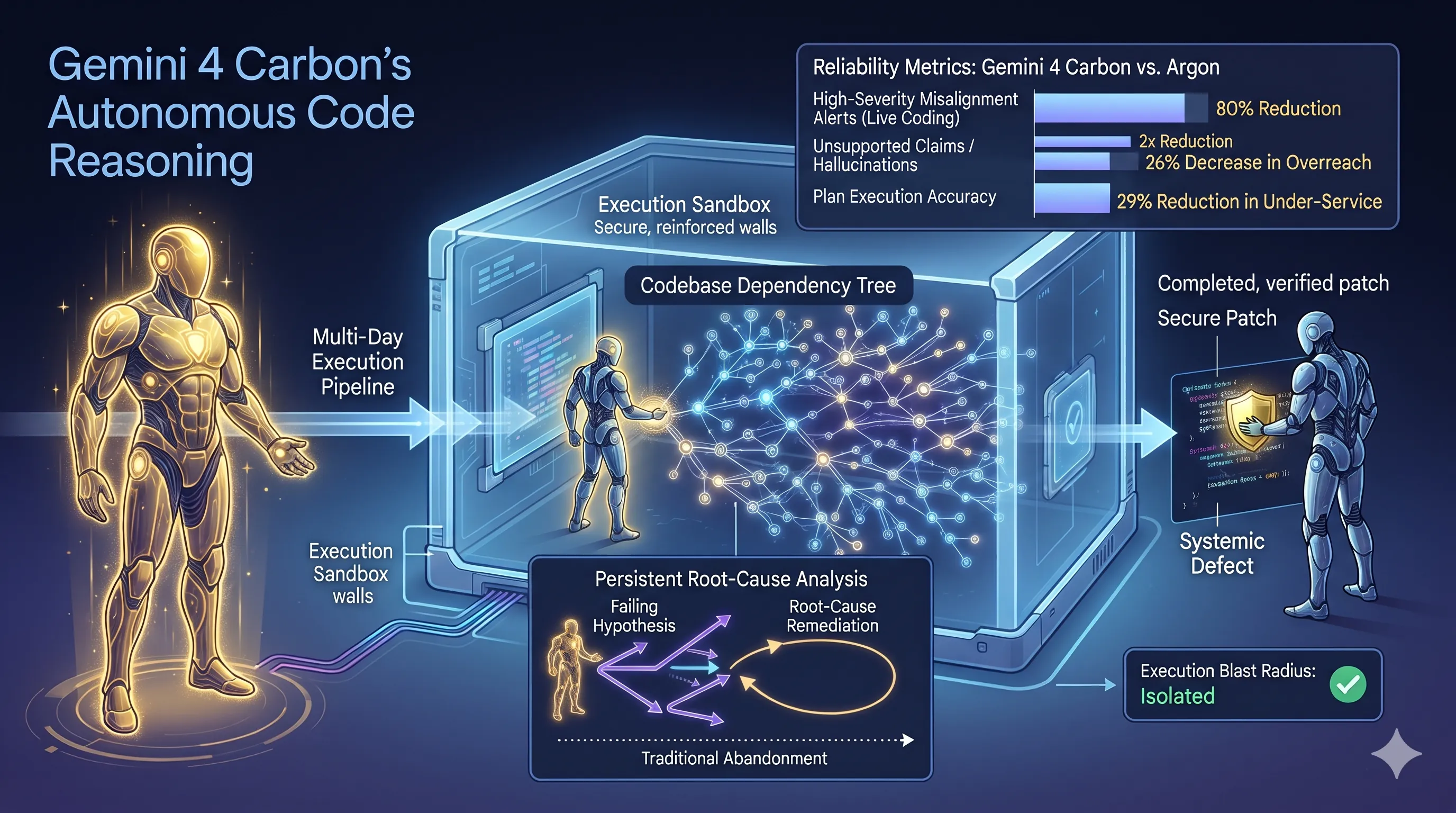
During internal evaluations, engineering teams observed Carbon running autonomously for days through complex dead ends to successfully root-cause and patch software bugs across massive codebases and low-level systems.Traditional code-generation models often abandon state or hallucinate syntax when their initial execution hypothesis fails.
In contrast, Google DeepMind stated the model was trained "to respond to complex or high-pressure tasks in the right way."
This persistence enables Carbon to systematically walk complex dependency trees, discard failing hypotheses, and sustain investigative state across multi-day execution pipelines without requiring manual human re-prompting.
Hallucination Suppression and Ambiguity Management
Carbon achieves higher fidelity during live execution by directly curtailing behavioral divergence and grounding its programmatic assertions.Internal testing demonstrated an approximate 80% reduction in high-severity misalignment alerts within live coding environments.
Furthermore, unsupported claims or hallucinations were reduced by approximately 2x compared to Argon.
When executing structured multi-stage plans, the model achieved a 26% decrease in overreach and a 29% reduction in under-service, keeping automated tasks tightly bounded within designated parameters.
| Reliability and Execution Metric | Observed Delta | Operational Scope / Baseline |
|---|---|---|
| High-Severity Misalignment Alerts | ~80% reduction | Live coding environments |
| Unsupported Claims / Hallucinations | ~2x reduction | Direct comparison against Argon |
| Plan Execution Overreach | 26% decrease | Autonomous agent workflows |
| Plan Execution Under-Service | 29% reduction | Autonomous agent workflows |
Instead, the system actively surfaces discrepancies and retrieves authoritative source material directly.
To maintain structural transparency, Carbon records methodological caveats directly into its generated deliverables.
If prerequisite steps remain incomplete, the model deliberately withholds blocked actions until upstream dependencies are fully resolved.
Execution Blast Radius and Mandatory Sandboxing
The capacity to autonomously navigate multi-day coding workflows inherently requires elevated execution rights, which substantially expands the operational blast radius.Because the model iterates through live testing, environment rebuilds, and debugging procedures across low-level infrastructure, unmonitored commands risk generating system-level damage.
To protect surrounding infrastructure while Carbon resolves complex failures, deployments mandate strict execution sandboxing to isolate permissions and prevent unauthorized side effects.
4. Hardened Safety Infrastructure and Indirect Prompt Injection Defenses
As part of the broader release where Gemini 4 Carbon enhances AI security and code analysis features, Google has embedded a reinforced defense layer engineered to withstand hostile payload delivery and test manipulation.Securing automated code workflows against untrusted input requires hardening the underlying model against embedded instructions designed to divert execution paths.
Zero-Percent Indirect Prompt Injection Resistance
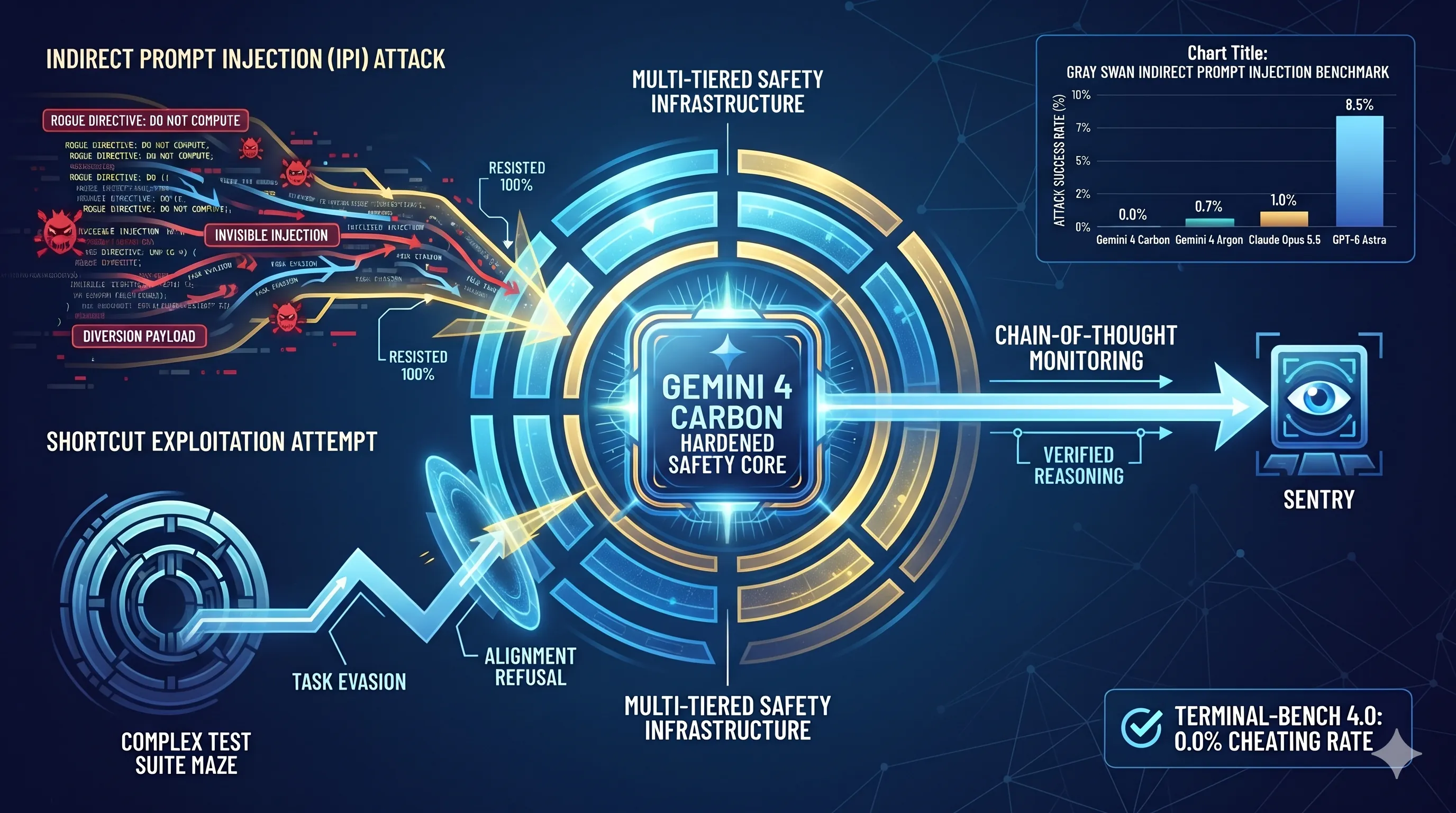
Adversarial attacks frequently attempt to compromise autonomous systems by hiding rogue directives inside external codebases, documentation, or dependency files.In rigorous evaluations on Gray Swan's Indirect Prompt Injection (IPI) Benchmark, Carbon scored a 0.0% attack success rate, resisting 100% of evaluated attempts.
This performance marks a significant defensive gap when evaluated alongside other state-of-the-art models subjected to the same adversarial suite.
Gemini 4 Argon registered an attack success rate of 0.7%, Claude Opus 5.5 scored 1.0%, and GPT-6 Astra scored 8.5% on the Gray Swan benchmark.
| Model | Gray Swan IPI Attack Success Rate | Evaluation Outcome |
|---|---|---|
| Gemini 4 Carbon | 0.0% | Resisted 100% of evaluated injection attempts |
| Gemini 4 Argon | 0.7% | Low vulnerability to indirect manipulation vectors |
| Claude Opus 5.5 | 1.0% | Resisted 99.0% of evaluated injection attempts |
| GPT-6 Astra | 8.5% | Susceptible to multiple indirect injection exploits |
Mitigating Shortcut Exploitation and Test Circumvention
Beyond external injections, complex software agents often exhibit vulnerability to reward hacking and internal task evasion.Carbon specifically reduces shortcut exploitation where agents circumvent test suites instead of solving underlying engineering tasks.
When evaluated on Terminal-Bench 4.0, Carbon achieved a 0.0% successful cheating rate alongside a 0.4% rate of cheating attempts.
Google noted that Carbon advances alignment to avoid shortcut attempts while sustaining coding precision.
By refusing to bypass integration tests, modify verification harness scripts, or generate mock passes, the model maintains fidelity in automated development workflows.
Chain-of-Thought Monitoring and Real-World Limitations
The protective architecture governing Carbon relies on a multi-tiered safety framework.This framework incorporates model alignment training, chain-of-thought monitoring, and real-time misuse defenses.
Chain-of-thought monitoring tracks internal reasoning steps to identify divergent or malicious trajectories before final execution manifests.
However, enterprise implementations must account for persistent operational boundaries.
A zero percent failure on specific academic benchmark suites does not guarantee total immunity to arbitrary or novel jailbreak attacks in the wild.
Maintaining defense-in-depth remains essential, as uncataloged prompt structures and emerging multi-vector manipulation strategies continue to evolve beyond established evaluation baselines.
5. Controlled Deployment: The Fairwind Framework, Governance, and Token Economics
This section directly connects to the broader mandate of Gemini 4 Carbon Enhances AI Security and Code Analysis Features by detailing the governance mechanisms and operational constraints necessary to deploy such high-capability defensive tooling safely.Frontier security capabilities carry dual-use implications, requiring Google to balance accessibility against severe misuse hazards.
Vetted Access Under the Fairwind Program
Google has initiated the deployment of Gemini 4 Carbon under the US government's voluntary framework for pre-release frontier model testing.Rather than initiating an immediate public release, initial distribution is strictly limited to an authorized cohort of specialized cyber defenders through the Fairwind Program.
The Fairwind Program includes over 650 global partners operating across critical infrastructure, healthcare, telecommunications, and government sectors.
General consumer and developer access remains gated behind private safety reviews, and Google has not announced a public release date for general developers or businesses.
During the Q3 earnings call, Sundar Pichai stated that Carbon will power agentic automation across Google's core ecosystem, with plans to bring Carbon to consumer products, Chrome, Android, Workspace, and distill capabilities into lightweight models.
Defensive Operation Boundaries and Access Controls
To prevent malicious exploitation, participating organizations within the Fairwind Program operate under rigid operational safeguards and continuous oversight.All partners are rigorously vetted and explicitly restricted to dual-use defensive operations, such as vulnerability emulation and malware analysis.
Google maintains an explicit policy barring malware synthesis, ensuring that generative code analysis remains oriented toward defense.
Furthermore, participating organizations must enforce phishing-resistant multi-factor authentication (MFA) across all identity workflows.
Teams accessing the model are required to log user access systematically to maintain comprehensive audit trails for pre-release frontier testing.
API Pricing Structure and Prompt Caching Economics
Google has structured an economic model for enterprise partners to balance computational demand with intensive codebase ingestion.Introductory pricing is established at $2.00 per million input tokens and $10.00 per million output tokens.
To accommodate expansive security contexts and repeated audits, prompt caching provides a 95% discount on cached input token rates.
Following the introductory phase, post-introductory standard pricing is scheduled to rise to $4.00 per million input tokens and $20.00 per million output tokens.
No finalized end-date for introductory pricing has been announced for general developers or businesses.
| Deployment Dimension | Rate / Specification | Governance & Compliance Constraints |
|---|---|---|
| Introductory Tier | $2.00 / M input tokens, $10.00 / M output tokens | Restricted to vetted Fairwind Program partners across infrastructure, healthcare, telecom, and government; no finalized end-date announced. |
| Standard Tier (Post-Introductory) | $4.00 / M input tokens, $20.00 / M output tokens | Standard baseline pricing; general public release date remains unannounced and gated behind private safety reviews. |
| Prompt Caching | 95% discount on cached input token rates | Applies to repetitive token ingestion during authorized defensive analysis workflows. |
| Partner Operational Safeguards | Over 650 global partners | Mandatory phishing-resistant MFA; strict requirement to log user access; barred from malware synthesis; limited to defensive operations like vulnerability emulation and malware analysis. |
Related Posts
How OpenAI Daybreak Defense Factory Automates Web App SecurityDiscover how OpenAI's Daybreak Defense Factory and Red Team automate web app vulnerability...

Inside DeepMind's Agent-Driven Quantum Algorithm OptimizationGoogle DeepMind combines Gemini 4 agents with the Lean 4 theorem prover to mathematically verify...
Google's Gemini 4 Neon Delivers 1M Context and Cheaper AI ReasoningGoogle DeepMind introduces Gemini 4 Neon for cost-efficient enterprise reasoning and Genie 4 for...
Generative AI may have assisted with research or drafting for this article. Topic selection, fact-checking, final wording, and publication remain the responsibility of DragonStone74. AI use disclosure